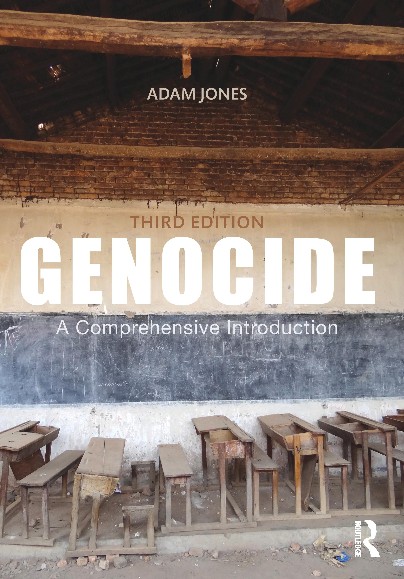
NOW AVAILABLE: Genocide: A Comprehensive Introduction, by Adam Jones (Routledge, 2006; 430 pp., US $33.95 pbk). See www.genocidetext.net. "The best introductory text available to students of genocide studies ... likely to become the gold standard by which all subsequent introductions to this enormously important subject will be measured" (Kenneth J. Campbell).
Saturday, October 14, 2006
NOW AVAILABLE: Genocide: A Comprehensive Introduction, by Adam Jones (Routledge, 2006; 430 pp., US $33.95 pbk). See www.genocidetext.net. "The best introductory text available to students of genocide studies ... likely to become the gold standard by which all subsequent introductions to this enormously important subject will be measured" (Kenneth J. Campbell).


Genocide Studies Media File
October 7-14, 2006
A compendium of news stories, features, and human rights reports pertaining to genocide and crimes against humanity. Compiled by Adam Jones. Please send links and feedback to adamj_jones@hotmail.com.
Consider inviting colleagues and friends to subscribe to Genocide_Studies and the G_S Media File. All it takes is an email to genocide_studies-subscribe@topica.com.
ARGENTINA
"Death Squad Fears Again Haunt Argentina"
By Larry Rohter
The New York Times, 8 October 2006 [Registration Required]
"A crucial witness in the trial of a notorious human rights abuser has been missing for nearly three weeks, and authorities and rights groups here say they fear he may have been abducted and killed in a new campaign to intimidate prosecutors, judges and witnesses in cases that have not yet gone to court. The disappearance of Jorge Julio López, 77, a retired construction worker and former political prisoner, has awakened a host of old fears among Argentines. Some worry that it is a signal of a return of right-wing death squads that were thought to be extinct, precisely at the moment when the leaders of those groups are belatedly being summoned to justice. 'They are sending a message, that they can still threaten, kidnap and kill,' said Nilda Eloy of the Association of Former Detainees and the Disappeared, referring to former members of the police, security and military forces that were responsible for the forced disappearance of as many as 30,000 people. 'There is a great deal of fear.' Buenos Aires, the Argentine capital, is awash in posters with Mr. López's name and image, some urging anyone with potential clues or leads to call a hot line, and others proclaiming 'We are looking for truth, justice, Julio.' The government has offered a $65,000 reward for information that can establish his whereabouts or fate, and on Friday night an estimated 100,000 people marched to the main plaza here to call for Mr. Lopez's reappearance. Mr. López vanished Sept. 18, one day before Miguel Etchecolatz, who was the police commissioner in Buenos Aires Province during the right-wing military dictatorship that ruled Argentina from 1976 to 1983, was sentenced to life in prison. ... In June 2005, though, the Supreme Court ruled both amnesty measures unconstitutional, making it possible to revisit old prosecutions and begin new ones. Mr. Etchecolatz's trial was the first to start, but more than 200 security officials of the dictatorship, including former presidents and junta members, are under investigation and could face charges. [...]"
CROATIA/NEO-NAZISM
"Nazty Croats Form Swastika"
By Mark Irwin
The Sun (UK), 10 October 2006
"Croatia could be kicked out of Euro 2008 if fans abuse England's black players tonight. Soccer chiefs fear trouble after 200 of their supporters formed a human swastika at a friendly in Italy. UEFA's William Gaillard warned: 'We won't tolerate racism. We have had many problems with this in Eastern Europe before and Croatia have been among the worst offenders. But we are determined this will not happen again and will send out a strong message to stop any incidents during the game against England. FIFA have recently introduced new rules which can, in extreme cases, lead to a team being docked points or even being excluded from the competition. Because of the problems we have encountered with Croatian teams in the past, they have been warned future sanctions will be much heavier than any which have been imposed for previous incidents.' Croatian supporters have a long history of racism. The nation's federation were fined after French players were racially abused and white supremacist banners were displayed at Euro 2004. And UEFA were fuming following the human swastika incident in Livorno, Italy, two months ago. Action group Let's Kick Racism out of football have launched a Kick It Out Week of Action in the community."
[n.b. This is the complete text of the dispatch; the article online includes an image of the Croatian fans forming a human swastika in the stands.]
IRAQ
"Iraq Casualty Figures Open Up New Battleground"
By Dan Murphy
The Christian Science Monitor, 13 October 2006
"[...] Why are the number of Iraqi deaths so difficult to pin down? The short answer is that much of the country is too dangerous for researchers or government officials to travel in search of accurate statistics. The best tally would come from counting every death certificate issued in the country in the three years before and three years since the invasion. But there is no central reporting mechanism for this in the country. So instead, the researchers, backed up by the Johns Hopkins Bloomberg School of Public Health, relied on the same polling methodology that is used to measure voter preferences or what their favorite TV shows are. 'I loved when President Bush said "their methodology has been pretty well discredited,"' says Richard Garfield, a public health professor at Columbia University who works closely with a number of the authors of the report. 'That's exactly wrong. There is no discrediting of this methodology. I don't think there's anyone who's been involved in mortality research who thinks there's a better way to do it in unsecured areas. I have never heard of any argument in this field that says there's a better way to do it.' ... The Lancet report follows a 2004 survey published in the same publication and carried out by largely the same group of researchers that found 100,000 excess deaths had resulted in Iraq since the war, which was confronted with the same criticism at the time. Dr. Burnham says that in the most recent survey, which had twice the sampling size of the original one, the numbers of deaths reported for 2004 mirrored the earlier report. ... The survey also argues that most of the violence is now Iraqi on Iraqi. It found that 31 percent of violent deaths were claimed to be caused by American forces, a smaller proportion than in the 2004 survey but still a larger absolute number, because of the overall rise in the death toll. [...]"
[n.b. Close to two hundred thousand of the Iraqi deaths were "caused by American forces" -- more than Saddam Hussein's regime killed during the genocidal Anfal Campaign of 1988.]
"Can We Call It Genocide Now?"
By Paul Craig Roberts
Counterpunch.com, 12 October 2006
"When does 'collateral damage' so dwarf combatant deaths that war becomes genocide? ... Americans are too inattentive and distracted to be aware of the grave danger that the neoconservative Bush regime presents to American liberty and to world stability. The neoconservative drive to achieve hegemony over the American people and the entire world is similar to Hitler's drive for hegemony. Hitler used racial superiority to justify Germany's right to ride roughshod over other peoples and the right of the Nazi elite to rule over the German people. Neoconservatives use 'American exceptionalism' and 'the war on terror.' There is no practical difference. Hitler cared no more about the peoples he mowed down in his drive for supremacy than the neoconservatives care about 655,000 dead Iraqis, 100,000 disabled American soldiers and 2,747 dead ones. [...]"
[n.b. The author "was Assistant Secretary of the Treasury in the Reagan administration. He was Associate Editor of the Wall Street Journal editorial page and Contributing Editor of National Review."]
"Aura of Fear and Death Stalks Iraq"
By Peter Beaumont
The Guardian, 12 October 2006
"[...] Law and order does not exist as the police themselves are involved in the killing. There are so many bodies that their disposal has become a problem of waste management. Most cities have to cope with fly-tipping of rubbish. Baghdad has to cope with the fly-tipping of corpses. In some areas of Baghdad, such as Sadr City, US soldiers welded down sewer covers to prevent bodies being dumped. But that was when the death squads cared about concealment. Today there is little time for such niceties. The bodies are dumped on rubbish heaps, in rivers, on areas of open ground. Often victims are shot on the street in front of waiting traffic, as a reminder, if anyone needed it, that the next bullet could be for them. Most victims have their hands bound, their feet tied and many show signs of torture. Two years ago, journalists were reluctant to accept that victims were tortured with drills, nails and caustic liquids. No one disputes it today. Some Sunni families have stopped going to Baghdad's morgue, which is in an area controlled by Shia militias, who are responsible for the death squads. The families of two recently murdered Sunni soldiers in a largely Shia battalion of the Iraqi army, their colonel said, were followed to the morgue and attacked. Funerals have also been targeted. Death follows death. Hospitals have been used for holding and torturing the disappeared. [...]"
[n.b. This must surely now be considered the worst campaign of mass murder underway anywhere in the world.]
"Excess Death in Iraq"
By Dahr Jamail
Truthout.org, 12 October 2006
"It is the single most important statistic regarding the illegal US invasion and occupation of Iraq. How many Iraqis have been killed? 655,000. 655,000 Iraqis killed as a result of the US invasion and occupation of Iraq. I have worked for eight months in Iraq as a journalist, witnessing the carnage on a daily basis, visiting the morgues with bodies and body parts piled into them, meeting family after family who had lost a loved one, or more ... Finally, we get an accurate figure that shows how immense the scale of the long drawn carnage really is. ... While the staggeringly high number of the dead may shock some, for others who have kept track of facts it is no great wonder that surveyors have found a steady increase in Iraqi mortality since the invasion and a steeper increase in the last year. This alarmingly reflects the worsening violence which even the US military, the news media and civilian groups have been forced to admit. Most of what we have heard reported, prior to this survey, had been deaths in Baghdad, with headlines like '50 Bodies Found in Baghdad' and 'Baghdad Morgue Reporting 100 Bodies per Day.' They are stories that have failed to take into account the rest of the country, although Baghdad is roughly 20% of the total population of Iraq. What has been happening in the rest of the country is a question that the latest survey answers: that there are approximately 500 unexpected violent deaths every single day throughout Iraq. ... For over a year now many Iraqis have been referring to what is happening in their country as genocide. With over 500 Iraqis being killed every single day as a direct result of the occupation, it is difficult to argue with them."
"'655,000 Iraqis Killed Since Invasion'"
By Sarah Boseley
The Guardian, 11 October 2006
"The death toll among Iraqis as a result of the US-led invasion has now reached an estimated 655,000, a study in the Lancet medical journal reports today. The figure for the number of deaths attributable to the conflict -- which amounts to around 2.5% of the population -- is at odds with figures cited by the US and UK governments and will cause a storm, but the Lancet says the work, from the Johns Hopkins Bloomberg School of Public Health in Baltimore, has been examined and validated by four separate independent experts who all urged publication. In October 2004, the same researchers published a study estimating that 100,000 Iraqis had died as a result of the war since the beginning of the March 2003 invasion, a figure that was hugely controversial. Their new study, they say, reaffirms the accuracy of their survey of two years ago and moves it on. 'Although such death rates might be common in times of war, the combination of a long duration and tens of millions of people affected has made this the deadliest international conflict of the 21st century and should be of grave concern to everyone,' write the authors, Gilbert Burnham and colleagues. 'At the conclusion of our 2004 study we urged that an independent body assess the excess mortality that we saw in Iraq. This has not happened. We continue to believe that an independent international body to monitor compliance with the Geneva conventions and other humanitarian standards in conflict is urgently needed. With reliable data, those voices that speak out for civilians trapped in conflict might be able to lessen the tragic human cost of future wars.' [...]"
[n.b. Six. Hundred. Thousand. Killed. As an aside, 91 percent of those killed were males, overwhelmingly between 15 and 44 years of age. Link to the full text of the Lancet study (registration required).]
"UK Minister Urged Aljazeera Bombing"
Aljazeera.net, 12 October 2006
"David Blunkett, the UK's former home secretary, has said that during the 2003 invasion of Iraq he suggested to Tony Blair that Britain's military should bomb Aljazeera's television transmitter in Baghdad. Aljazeera television said on Thursday that Blunkett's claims -- made in an interview with Britain's Channel 4 television to be aired on Monday -- support its belief that the US and Britain deliberately bombed its Baghdad offices during the war. Ahmed al-Sheikh, editor-in-chief of Aljazeera's Arabic channel, said; 'This adds to the growing number of evidences that will one day prove that the attack on Aljazeera was premeditated ... at the highest levels. Aljazeera was being targeted at the time because the people who were waging war on Iraq didn't like what it was showing. We talk about terrorism, this is pure terrorism.' Al-Sheikh also said that Aljazeera will ask for an official British statement on Blunkett's claims. 'In the past, we got in touch with the Americans and asked them to apologise or to hold an investigation. But we haven't heard anything from them. This time, we will also complain,' he said, adding that an official statement would be released later. During his interview with Channel 4, Blunkett, who is promoting a new book, said that he had told Tony Blair, the British prime minister, that Aljazeera television transmitting equipment should be targeted because it was broadcasting 'propaganda.' 'There wasn't a worry from me because I believed that this was a war and in a war you wouldn't allow the broadcast to continue taking place,' Blunkett said. 'I don't think for a minute in previous wars we'd have thought twice about ensuring that a propaganda mechanism on the soil of the country you were invading would actually continue being able to propagandise against you.' [...]"
"Woman Tells Court Saddam Forces Buried Family Alive"
By Kawther Abdul-Amir
Reuters dispatch, 9 October 2006
"Saddam Hussein's forces buried a Kurdish family alive in a mass grave during a military operation against ethnic Kurds in the 1980s, a witness told the genocide trial of the ousted Iraqi leader on Monday. The court also heard grim testimony about conditions at Nugrat Salman, a desert prison facility in southern Iraq, where food shortages and polluted water caused many Kurds who had been rounded up and sent there to fall ill and die. Two witnesses spoke about a black dog that dug up and ate the bodies of dead prisoners. A Kurdish woman, sitting to the left of the judges and speaking from behind a curtain to protect her identity, was the latest witness to give testimony about Saddam's 1988 Anfal (Spoils of War) campaign against the Kurds in northern Iraq. 'I know the fate of my family. They were buried alive,' she told the court through a translator. 'I would like to ask Saddam a question: "What was the guilt of women and children?"' The court heard that identity cards belonging to five of her sisters had been found in mass graves in Samawa in south Iraq. The woman did not say how she knew her family was buried alive but U.S.-led forensic experts have said some victims unearthed from mass graves were still alive when they were buried, despite having been shot, most of them at close range. Thousands of Kurds, including many women and children, were taken from their villages, executed and then dumped in mass graves in northern and southern Iraq, prosecutors say. Saddam's trial resumed on Monday after a two-week break. Chaos reigned at the previous session, when Saddam was repeatedly ejected from the courtroom and his lawyers walked out over the sacking of the chief judge. [...]"
"Hidden Victims of a Brutal Conflict: Iraq's Women"
By Peter Beaumont
The Observer, 8 October 2006
"Bodies of young women have appeared in its dusty lanes and avenues, places patrolled by packs of dogs where the boundaries bleed into the desert. It is a favourite place for dumping murder victims. Iraqis do not like to talk about it much, but there is an understanding of what is going on these days. If a young woman is abducted and murdered without a ransom demand, she has been kidnapped to be raped. Even those raped and released are not necessarily safe: the response of some families to finding that a woman has been raped has been to kill her. Iraq's women are living with a fear that is increasing in line with the numbers dying violently every month. They die for being a member of the wrong sect and for helping their fellow women. They die for doing jobs that the militants have decreed that they cannot do: for working in hospitals and ministries and universities. They are murdered, too, because they are the softest targets for Iraq's criminal gangs. Iraq's women live in terror of speaking their opinions; of going out to work; or defying the strict new prohibitions on dress and behaviour applied across Iraq by Islamist militants, both Sunni and Shia. They live in fear of their husbands, too, as women's rights have been undermined by the country's postwar constitution that has taken power from the family courts and given it to clerics. ... After a month-long investigation, The Observer has established that in almost every major area of human rights, women are being seriously discriminated against, in some cases seeing their conditions return to those of females in the Middle Ages. In areas such as the Shia militia stronghold of Sadr City in east Baghdad, women have been beaten for not wearing socks. Even the headscarf and juba -- the ankle-length, flared coat that buttons to the collar -- are not enough for the zealots. Some women have been threatened with death unless they wear the full abbaya, the black, all-encompassing veil. [...]"
KENYA/BRITISH COLONIALISM
"Shameful Legacy"
By Chris McGreal
The Guardian, 13 October 2006
"[...] [Espon] Makanga was just one of the estimated 150,000 Kenyans held in British prison camps for up to seven years during what was known as the Kenya Emergency, a rebellion against colonial rule in Kenya. Today, he is among a group of 10 survivors, all in their 70s and 80s, who took the first legal step in London this week towards suing the British government for what they say was officially sanctioned torture and other human rights abuses. Some of the former prisoners describe rape and sexual abuse of women; others say they survived camps where inmates were flogged, worked to death, murdered in cold blood or starved. They want compensation but also an apology for what they describe as a system of organised brutality unmatched anywhere else in the waning years of the British empire. Even in the 1950s, the camps were described as 'Kenya's gulags' and likened by officials to Nazi slave labour camps. The camps were justified, in British eyes, by the Mau Mau's butchering of 32 white settlers and African chiefs loyal to the crown early in the rebellion. The Mau Mau were dominated by the Kikuyu, the largest ethnic group in Kenya, and were largely driven by bitterness at the loss of land to the white settlers. But the struggle also divided the tribe, and the Mau Mau ultimately killed far more fellow Kikuyu than whites, with massacres such as the killing of 120 men, women and children at Lari in March 1953. In Britain the Mau Mau were portrayed as representing the re-emergence of a primitive bloodlust that the twin benefits of colonisation -- Christianity and civilisation -- were intended to eradicate. But the British soon proved they could be as brutal as their enemies. [...]"
RUSSIA
"Moscow Rally Memorializes Slain Reporter"
By Peter Finn
The Washington Post, 9 October 2006 [Registration Required]
"Hundreds of Russians attended a rally in Moscow on Sunday to commemorate Anna Politkovskaya, a veteran journalist who was fatally shot in an apparent contract killing Saturday, and the country's top law enforcement official said he was taking personal charge of the investigation because of its 'particular importance and its wide resonance within society.' 'The investigation will focus on possible links between the killing and Politkovskaya's work,' said Marina Gridneva, a spokeswoman for the prosecutor general, Yuri Chaika, who is now heading the probe into the journalist's death. The killing of Politkovskaya, a fierce critic of the Kremlin and its proxies in the conflict in Chechnya, was the second assassination of a crusading figure in Moscow in less than a month. In September, Andrei Kozlov, a Central Bank official who had led a campaign against corruption, was gunned down as he left a soccer match in the city. That case remains unsolved. The two killings challenge the notion that President Vladimir Putin has eradicated the vicious score-settling that marked Russian society in the 1990s or that his centralization of power has fostered stability. The killings also raise questions about whether it is safe for journalists, bureaucrats or opposition activists to challenge the country's vested interests, whether public or private. 'The murder is a diagnosis for this society,' Igor Yakovenko, head of the Russian Union of Journalists, said of Politkovskaya's death. 'But our society is unconscious.' [...]"
"Assassin's Bullet Kills Fiery Critic of Putin"
By Tom Parfitt
The Observer, 8 October 2006
"Anna Politkovskaya, the journalist who did most to uncover the Kremlin's dirty war in Chechnya, was shot dead close to her Moscow apartment yesterday in a killing that sent shock waves across Russia. Her body was found slumped in a lift next to a pistol and four bullets. Politkovskaya, 48, was a constant critic of the Kremlin and her murder will throw suspicion on the security services and the pro-Moscow regime in Chechnya. Former Soviet leader Mikhail Gorbachev called the killing 'a grave crime against the country, against all of us.' She was recognised around the world for her principled stand against two brutal wars prosecuted by Moscow in Chechnya that have left hundreds of thousands of people dead, injured or missing. Despite repeated threats to her life she vowed she would not be silenced: 'There are people in this country who would do anything to keep me quiet. I don't consider it anything heroic -- I'm just trying to do my job, to let people know what's happening in our country.' In an anthology 'Another Sky,' due to be published next year by English PEN, a writers' group campaigning against political oppression, Politkovskaya chillingly predicted yesterday's events: 'Some time ago Vladislav Surkov, deputy head of the presidential administration, explained that there were people who were enemies but whom you could talk sense into, and there were incorrigible enemies to whom you couldn't and who simply needed to be "cleansed" from the political arena. So they are trying to cleanse it of me and others like me.' On a visit to Chechnya she alleged that the former President of the Chechen Republic Akhmad Kadyrov vowed to assassinate her. 'The women in the crowd tried to conceal me because they were sure the Kadyrov people would shoot me on the spot if they knew I was there,' she said 'They reminded me that Kadyrov publicly vowed to murder me. He actually said during a meeting of his government that Politkovskaya was a condemned woman. I was told about it by members of the government.' [...]"
[n.b. Anna Politkovskaya, whose Chechnya reporting I sample in my forthcoming edited volume, Men of the Global South: A Reader, was an inspiration to millions in Russia and around the world. Her murder is a great blow to the cause of honest witnessing to genocide.]
"'This is Ethnic Cleansing' -- Georgia"
By Mark Franchetti
The Sunday Times, 8 October 2006
"The tiny former Soviet republic of Georgia accused Russia of ethnic cleansing yesterday after the Kremlin cut trade, transport and postal links and began to investigate children with Georgian names in Moscow schools. The clampdown came in retaliation for the arrests of four Russian officers in Georgia on spy charges. 'We are not scared. We are not panicking,' said Mikhail Saakashvili, Georgia's pro-western president, even though his country faces possible ruin as a result of Russian sanctions. Saakashvili, speaking in his Soviet-era office, said: 'It's a deliberate policy to make our lives miserable but this is not breaking us. On the contrary it's making us stronger and more independent. The Kremlin is running out of ammunition.' The already poisoned relations between the former allies seem set to deteriorate further. Moscow police ordered schools in the Russian capital to provide lists of children with Georgian surnames in what they said was an attempt to root out illegal migrants. Gela Bezhuashvili, Georgia's foreign minister, accused Moscow of xenophobia and ethnic cleansing. This week the Duma, the lower house of the Russian parliament, will consider a bill that would stop the flow of funds Georgians send home to their often impoverished families. Worse still, the Kremlin could cut off gas supplies. Last week Russia deported a planeload of 150 Georgians it accused of violating immigration laws. The deportees were rounded up in police raids, taken under armed escort to a military airport and put on a plane to Tbilisi. [...]"
RWANDA
"Rwanda Moves to Ban Death Penalty"
BBC Online, 13 October 2006
"The leaders of Rwanda's ruling party have endorsed a proposal to abolish the death penalty, which may encourage the transfer of genocide suspects in exile. The political bureau of the Rwandan Patriotic Front (RPF) backed the decision at a meeting chaired by President Paul Kagame. Many countries refuse to extradite criminal suspects to states which use torture and execution. Some 800,000 Tutsis and moderate Hutus were slaughtered in Rwanda's genocide. 'We have conducted extensive debates within the party and come to a common position that capital punishment is of no use to Rwanda,' RPF spokesman Servilien Sebasoni told AFP news agency. However, survivors of the 1994 genocide are strongly opposed to the decision. Mr. Sebasoni told reporters that a bill was currently being drafted and would be tabled very soon. The RPF controls both chambers of parliament. ... The new legislation could also encourage the transfer of war crimes suspects detained at the International Criminal Tribunal for Rwanda (ICTR), based in the Tanzanian town of Arusha, correspondents say. Most of the high-profile genocide cases have been tried by the Arusha tribunal, which since 1997 has convicted 25 ringleaders of the genocide and acquitted three people. Frustrated at its slow process, Rwanda wants suspects transferred to face trial at home. The court is due to be disbanded in 2008."
"Macy's Partners With Rwandan Widows"
Associated Press dispatch in KiplingerForecasts.com, 13 October 2006
"When Macy's decided to sell baskets made by Rwandan widows, the store was swayed in part by the prospect of contributing to a developing economy and in part by the women's tale of suffering during their country's 1994 genocide. But Macy's was clear: This may have been charitable, but it was not charity. Baskets, woven from sisal and sweet grass, are inspected to verify they meet quality requirements and then paid for in cash on the spot. Macy's imported 650 baskets last year in a successful test run, and bought 31,000 more to sell this fall in stores in New York, Atlanta and Chicago and online. ... The money a weaver receives for a typical basket is enough to feed herself for a month. That sum is on average $24, or about one-third of the retail price. Shalit estimates a weaver's income at $4 a day (it takes roughly a week to make a basket), as compared to the average income of $0.56 a day for the country. Macy's partnership with the Rwandan women grew from perhaps an even more unusual one. The women used the traditional art of basket-making to reach out across ethnic lines after the 100-day genocide, during which at least 500,000 people were killed. 'In practical terms, basket-making is an opportunity for unity, for reconciliation,' said Consolee Mukanyiligira, coordinator for the association of genocide widows, known by its French acronym, Avega. 'Nothing like sitting around doing nothing increases trauma,' said Mukanyiligira, so Avega encouraged women to weave as a way of healing. Pascasie Mukabuligo, a master weaver, saw the potential for these baskets as commercial merchandise and organized their sale at local markets. Noeleen Heyzer, director of the United Nations Development Fund for Women, then worked to establish an American market for the goods. [...]"
SERBIA/KOSOVO
"Bad News for Kosovo Raises Balkan Tension"
By Simon Tisdall
The Guardian, 13 October 2006
"Plain-speaking Martti Ahtisaari, the former Finnish president who has been widely tipped to win the Nobel peace prize today, let the Kosovo cat out of the bag this week with potentially unpredictable consequences for Balkan stability. As UN envoy charged with brokering a settlement by the end of the year between Serbia and the ethnic Albanian leadership in Pristina, Mr Ahtisaari conceded the negotiations were not going well. In fact, he went further. Agreement on Kosovo's final status was not on the cards, 'at least not in my lifetime,' he said. 'The parties remain diametrically opposed.' The breakaway province might have to wait a little longer for its long-sought independence, he said. ... some fear the Kosovo controversy may act as a lightning rod for wider discontents. This year's suspension of Serbia's EU membership talks, the perceived failure of the 2000 pro-democracy revolution, and entrenched economic problems are all fuelling an anticipated surge in support for the far right [in Serbia]. The Radical party, led by the jailed war crimes indictee Vojislav Seselj, looks likely to win most votes. Liberal and left-of-centre parties are meanwhile urging a boycott of the constitutional referendum, saying its passage will trigger renewed confrontation with the west. [...]"
"Kosovo Rises on International Agenda"
By Howard LaFranchi
The Christian Science Monitor, 11 October 2006
"With unsettling nuclear developments in North Korea, wars in Iraq and Afghanistan, and political upheaval in the Middle East, little attention is being paid to the Balkans, which might seem like a preoccupation of the post-cold-war 1990s. But Kosovo -- a Serbian province of 2 million people that spawned a NATO bombing campaign in 1999 -- is on the brink of bursting onto the world stage once again. With the United States and the European Union pressing for resolution of Kosovo's final status this year, it once looked like independence was assured. But now Serbia is finagling to put that decision off -- a move that could awaken Balkan unrest once again. After seven years of United Nations control, the majority Albanian and Muslim population is clamoring for independence. But the Serbian (and largely Christian) minority is campaigning to remain attached to Serbia. The Serbian Kosovars claim that independence would mean creation of an Islamic fundamentalist state in Europe and expose them to ethnic violence. Beyond those issues, other factors seem primed to raise Kosovo's status on the international agenda. The US would like to free up the 1,700 peacekeeping troops it still has in the province. Economic investment in a region that is an important trade and energy route is being held up by uncertainty over Kosovo's status. And while some experts warn that failure to resolve Kosovo's status could turn it into a powder keg once again, still others caution against hasty action: They say Kosovo is being closely watched by other restless regions in eastern Europe and central Asia -- including in Georgia, Azerbaijan, and Moldova -- and could be used to fire up breakaway movements. [...]"
SUDAN/DARFUR
"Tough Sanctions Urged over Darfur"
BBC Online, 12 October 2006
"A 'weak and divided' international response on sending UN peacekeepers to Darfur is playing into the hands of the Sudanese government, a report says. The International Crisis Group says diplomacy has 'failed' and targeted sanctions are now needed to prevent the humanitarian situation from worsening. It calls for economic measures to be applied to key business interests, in particular Sudan's petroleum sector. An estimated 200,000 people have been killed during three years of fighting. The ICG report says unless the world presents a unified front on the issue of Darfur, Khartoum will continue to exploit divisions, believing it can 'act with virtual impunity.' ... The report says targeted sanctions should be applied to Sudan's key business interests, in particular its petroleum sector. This should be done in combination with limited military action, including the establishment of a no-fly-zone over Darfur, as well as steps to make the International Criminal Court investigation into war crimes more effective, the report says. It argues that in past disputes -- for example over the issue of international terror suspects -- Khartoum has responded positively to economic pressure. The ICG says it is concerned that any alternative action would be 'too little too late' as the security and humanitarian situation continues to deteriorate in the region."
[n.b. Link to the full text of the report.]
"Sudan 'Kills Hundreds in Darfur'"
BBC Online, 9 October 2006
"Hundreds of Sudanese have been killed in attacks in Darfur, with the apparent knowledge and support of the government, a UN report says. The attacks took place in August but the UN previously thought that 38 people had died in the attacks on black African villages. Sudan has always denied backing the Arab militias accusing of widespread atrocities in Darfur. The government is opposed to plans to send UN peacekeepers to Darfur. Some 7,000 African Union (AU) troops have been unable to end the violence, which has led some 2m people to flee their homes since 2003. Studies estimate at least 200,000 people have died during the conflict. The UN's High Commissioner for Human Rights (OHCHR) Louise Arbour called for an investigation into the attacks in the Buram area of South Darfur and for those responsible to be prosecuted. The report says the attacks were carried out by up to 1,000 Arab militiamen wearing government-style uniforms, using machine guns mounted on vehicles. See which parts of Darfur are too dangerous for aid workers. 'As they approached houses, the attackers fired indiscriminately into civilian dwellings, shooting those inside, and systematically setting fire to houses,' it says. 'Possessions, including all livestock, were extensively looted. Civilians attempting to flee the village were caught and fired at.' [...]
"The Leopard-Skin Shoe Dictator Who Holds the Key to Darfur"
By Stephen Castle
The Independent, 8 October 2006
"He is a military hardman, an enemy of the White House and the man who holds the key to solving the humanitarian disaster in Darfur. But as visitors to his presidential residence discovered last week, Omar al-Bashir also wears leopard-skin shoes. Sudan's President is at the centre of a diplomatic stand-off over the Darfur crisis as he refuses to admit a United Nations peacekeeping force to the northern Sudanese province, where about 300,000 people have died and another 2.5 million have been driven from their homes. On Friday a letter from Sudan's government described such an idea as a 'hostile act' and a 'prelude to invasion,' prompting Washington to call for emergency consultations at the UN Security Council. Such language is hardly out of character for one of Africa's most oppressive leaders. In recent weeks he has dismissed Western peace protests as being 'organised by Zionist, Jewish organisations,' and suggested that human rights groups 'have exaggerated the crisis in Darfur to help their fundraising.' ... For Mr. Bashir the UN and the US are interchangeable. Any international military intervention would, he argues, be a prelude to Iraq-style invasion. But for all his rhetoric, he appears to yearn for international respectability. Diplomats believe his greatest fear is that he could end up in the International Criminal Court, accused of responsibility for genocide in Darfur. [...]"
"Sudan Divestment Effort Gains Momentum at State Level"
By Nora Boustany
The Washington Post, 7 October 2006 [Registration Required]
"House members are scattering to their home states this week with inconclusive results on the humanitarian crisis in the Darfur region of western Sudan, but momentum is growing at the state level for governments to divest public funds from companies, mostly foreign-based, doing business with Khartoum. In a victory for business lobbyists on Capitol Hill, lawmakers approved a Sudan sanctions bill stripped of language that would have endorsed states' rights to pass divestment laws. The National Foreign Trade Council, representing more than 300 multinational companies, had lobbied aggressively against the provision on state investments inserted by the House during its consideration of the bill last year. A divestment movement, however, appears to be gaining momentum across the country, with active campaigns on university campuses and at city and state levels. Six states have already passed divestment laws: Maine, Connecticut, Oregon, Illinois, New Jersey and California. Although state legislatures will not be in session until January, lawmakers in many states are pushing for divestment bills, according to Adam Sterling, the executive director of the Sudan Divestment Task Force, a nonprofit organization dedicated to the issue. Colorado, Indiana, Iowa, Kansas, Maryland, Massachusetts, Michigan, Nebraska, New York, North Carolina, Ohio, Oklahoma, Pennsylvania, Rhode Island, Texas, Vermont, Virginia and Washington could consider some form of legislation early next year, according to the task force's Web site, which is tracking the initiatives and keeping a list of companies that warrant scrutiny. California Gov. Arnold Schwarzenegger's much-publicized signing of his state's divestment law -- standing alongside actor-activists Don Cheadle and George Clooney -- has helped spread popular awareness on the continuing violence in Darfur and given added momentum to the divestment drive, Sterling said. [...]"
[n.b. See also Martin Plaut, "Darfur Campaign Cuts Sudan Money," BBC Online, 7 October 2006.]
TURKEY/FRANCE/ARMENIAN GENOCIDE
"Armenian Genocide Monument Destroyed in France"
Reuters dispatch, 14 October 2006
"A bronze monument near Paris commemorating the 1915 massacre of Armenians by Ottoman Turks has been destroyed just two days after France's parliament passed a bill that would make it a crime to deny the genocide. A local member of the Armenian church in Chaville, a town near Paris, said the heavy bronze sculpture was wrenched off its pedestal late Friday night or early Saturday morning. 'Police say it might have been stolen for the metal, but it seems too much of a coincidence that this should have happened just after parliament voted the Armenia bill,' said Stephane Topalian, a member of the Armenian church council. Ankara denies accusations that some 1.5 million Armenians perished in a systematic genocide during World War One, saying large numbers of both Christian Armenians and Muslim Turks died in a partisan conflict raging at that time. Turkey has protested against Thursday's lower house vote, which establishes a one year prison term and 45,000 euro ($57,000) fine for anyone denying the massacres. The bill still needs to be approved by the upper house Senate to become law."
[n.b. This is the complete text of the dispatch.]
"Pamuk Slams France on Genocide Law"
Reuters dispatch in Gulf Times, 14 October 2006
"Turkish Nobel laureate Orhan Pamuk, tried at home for commenting on the killing of Armenians by Ottoman Turks, said yesterday a French law banning the denial of the Armenian genocide went against free speech. 'Freedom of expression is a French discovery and this law is contrary to the culture of freedom of expression. We must not pass a law forbidding freedom,' Pamuk told Turkish broadcaster Kanal D in an interview from New York. Turkey's powerful speaker of parliament earlier challenged Pamuk to declare his stand on the controversial bill approved by France's lower house of parliament on Thursday, which came the day he was awarded the literary world's most coveted prize. Turkey denies that Armenians suffered genocide in Turkey during World War One, arguing that large numbers of both Muslim Turks and Christian Armenians died in a partisan conflict that accompanied the collapse of the Ottoman Empire. The French bill shocked many Turks who are sensitive about their history and reluctant to discuss it, while the Nobel committee's decision puts the centre-right government in an awkward spot as it has been a regular critic of Pamuk. Nationalist prosecutors took Pamuk to trial in January on charges he insulted Turkey's identity by telling a Swiss newspaper 1mn Armenians had died in Turkey during World War One and 30,000 Kurds had perished in recent decades. The trial, under article 301 of the penal code, was later dismissed on a technicality but not before it brought a sharp rebuke from the European Union. [...]"
"French Bill Complicates Turkey's EU Bid"
By Scott Peterson
The Christian Science Monitor, 13 October 2006
"By a wide margin, the French parliament voted Thursday to make it a criminal act to deny an Armenian genocide at the hands of Ottoman Turks, enraging Turkey and further deepening its suspicion of the European Union. Islamic Turkey -- which has sought for decades to join the EU and is now in membership negotiations -- vowed retaliation against France that could disrupt billions of dollars in trade, even as both sides explore the limits of free speech. The vote came the same day that Orhan Pamuk, the celebrated Turkish novelist, was awarded the Nobel Prize for Literature. Charges of 'denigrating Turkishness' against Mr. Pamuk -- brought after he publicly spoke of the killing of 1 million Armenians during World War I, and 30,000 Kurds -- were dropped earlier this year in a case seen as a test of Turkey's commitment to EU-driven reforms. The two events get at the heart of contradictions in modern Turkey, where democratic and West-leaning EU aspirations often clash with history. The staunchly secular state -- a full member of the NATO military alliance -- casts itself as an indispensable bridge between East and West, but has yet to be accepted as such by Europe. ... Turkish lawmakers Wednesday proposed a counter-bill that would recognize an 'Algerian genocide' carried out by colonial French forces in 1945. Turkish columnists are also raising France's considerable role in Rwanda's 1994 genocide, as they seek to even the moral playing field. [...]"
"EU Concern at French Genocide Vote"
Reuters dispatch on CNN.com, 12 October 2006
"The European Union said French parliament approval on Thursday of a bill making it a crime to deny Armenians suffered genocide by Ottoman Turks could harm efforts to end decades of dispute over the killings. Ankara said the French lower house vote was a severe blow to French-Turkish ties and its Economics Minister Ali Babacan, the man leading EU entry talks with Brussels, said he could not rule out consequences for French firms. A European Commission spokeswoman noted the bill still needed upper house approval and said EU Enlargement Commissioner Olli Rehn had repeatedly warned in recent days it would damage efforts in Turkey and Armenia to resolve the dispute. 'Should this law enter into force ... it would prohibit dialogue which is necessary for reconciliation on the issue,' spokeswoman Krisztina Nagy told a regular news conference. Asked whether the bill could add a stumbling block to difficult accession talks with Ankara opened just over a year ago, she noted recognition of the 1915 killings as a genocide was not a precondition for accession. 'It is not up to law to write history. Historians need to have debate,' she said. In Ankara, the Turkish Foreign Ministry said in a statement that French-Turkish relations had been dealt a severe blow by 'irresponsible false claims of French politicians who do not see the political consequences of their actions.' The ministry did not say whether Turkey would take any retaliatory measures against France but Babacan, in Brussels for the latest round of accession talks, said he could not exclude an impact for French business in Turkey. [...]"
"French in Armenia 'Genocide' Row"
BBC Online, 12 October 2006
"The French parliament has adopted a bill making it a crime to deny that Armenians suffered 'genocide' at the hands of the Turks, infuriating Turkey. The bill, which provides for a year in jail and a heavy fine, still needs approval from the Senate and president. Turkey called the decision a 'serious blow' to relations with France. It has already threatened economic sanctions. Armenia says Ottoman Turks killed 1.5 million people systematically in 1915 -- a claim strongly denied by Turkey. Turkey has been warning France for weeks not to pass the bill. 'Turkish-French relations, which have been meticulously developed over the centuries, took a severe blow today through the irresponsible initiatives of some short-sighted French politicians, based on unfounded allegations,' the Turkish foreign ministry said. The vote, in the lower house of the French parliament on Thursday morning, was sponsored by the opposition Socialist party. The ruling Union for a Popular Movement (UMP) did not back the law, but gave its deputies a free vote. It passed by 106 votes to 19. [...]"
UGANDA
"Uganda Rebels Threaten Tenuous Peace"
By Francis Kwera
Reuters dispatch in The Mail & Guardian (South Africa), 9 October 2006
"Uganda's Lord's Resistance Army (LRA) rebels reiterated a threat on Monday to keep fighting one of Africa's longest insurgencies unless international arrest warrants for their top commanders are scrapped. The government and rebels signed a long-awaited truce in August, supposed to give both sides breathing space while peace talks aimed at ending their 20-year rebellion continued in the south Sudanese capital Juba. But LRA leader Joseph Kony and deputy Vincent Otti have refused to leave their jungle hideouts on the Sudan/Democratic Republic of Congo border to talk directly, fearing arrests over war-crimes indictments against them by the Hague-based International Criminal Court. 'They should not expect us to sign an agreement and later cage our leaders in The Hague. Our leaders are not fools,' LRA spokesperson Godfrey Ayoo told journalists in Juba. The charges against five top LRA commanders are seen as a test case for the fledgling human rights court, but many Ugandans see it as an obstacle to a long-awaited peace deal. 'As long as the ICC indictments still stand, no single soldier is going to come out of the bush. This is the position we have taken and it will not change,' Ayoo said. Despite a ceasefire, tempers have frayed between the LRA and the Ugandan army in the past two weeks. [...]"
UNITED STATES/ISRAEL LOBBY
"US Free Speech Row Grows as Author Says Jewish Complaints Stopped Launch Party"
By Ed Pilkington
The Guardian, 11 October 2006
"The British-based author and former publisher Carmen Callil has become embroiled in a growing dispute over the limits of freedom of speech in America after a party celebrating her new book on Vichy France was cancelled because of the opinion she expresses about the modern state of Israel. A party in honour of Bad Faith, Callil's account of Louis Darquier, the Vichy official who arranged the deportation of thousands of Jews, was to have taken place at the French embassy in New York last night but was cancelled after the embassy became aware of a paragraph in the postscript of the book. In the postscript Callil says she grew anxious while researching the 'helpless terror of the Jews of France' to see 'what the Jews of Israel were passing on to the Palestinian people. Like the rest of humanity, the Jews of Israel "forget" the Palestinians. Everyone forgets.' The embassy said the passage had been brought to its attention after a guest declined the invitation because of it. A spokesman denied allegations from Callil, reported by Reuters, that 'fundamentalist Jews' had complained and had the party shut down. The row over Callil's book is the latest element in a dispute about restrictions on freedom of speech in the US in relation to comments on Israel. A British-born academic based at New York University has had two speaking engagements called off after criticism of his views. Tony Judt, an American Jew who was brought up in Britain, was due to speak on the subject of the influence of the pro-Israeli lobby on US foreign policy and at a separate location under the title War and Genocide in European Memory Today. The first lecture was cancelled by the Polish consulate in New York, which owned the venue, while Mr. Judt pulled out of the second after he was asked by the organisers to refrain from direct references to Israel. In both cases pro-Israeli organisations and individuals had raised objections to Mr. Judt's views on Israel. [...]"
[n.b. Disturbing examples here of how bullying tactics by the Israel lobby have led to a climate of intimidation, censorship, and self-censorship.]
ISSUE: GLOBAL DEVELOPMENT
"Comment: A Truly Inspiring Choice for Nobel Peace Prize"
By Gabriel Rozenberg
The Times, 13 October 2006
"[...] To award a Peace Prize for an anti-poverty inititative [the Grameen Bank] is striking enough, but that is only half the story. In rich Western capitals like London there is today a thriving 'international development community': well-meaning, thoughtful people in charities, pressure groups and Whitehall who came together last year at Live 8 and led to the world's wealthiest nations doubling their aid budgets. But probe beneath the surface and you will find confusion. The charities praise aid in public; yet they quietly admit that simply handing over cash to often-corrupt governments has frequently failed miserably. They call for good governance, the latest buzzword, but any attempt to cut off cash to bad governments ties them in moral knots. ... The Grameen Bank presents a totally different approach. It was not dreamt up by a faraway Western aid agency. It is tried and tested; it is a business solution which comes from the grassroots. Grameen shows us the poor and the destitute not as pitiable charity cases condemned to their lot, but as thwarted entrepreneurs who just lack the means to improve their families' lives. It is a profoundly optimistic view of human nature. With this inspired choice the Nobel Committee has lit a path that could lead to the eradication of poverty in our time."
ISSUE: GLOBAL HEALTH
"For the Sick, No Place to Turn"
By Kim Murphy
The Los Angeles Times, 9 October 2006 [Registration Required]
"[...] Russia's steep population decline in the 15 years since the collapse of the Soviet Union has many causes, but the end of the Soviet healthcare system and the debut of free-market medicine have added to the slide. In the new Russia, millions are born sick. Many succumb to poisons in the air and water around them, or are slowly killed by alcohol, cigarettes or stress. Most are too poor to buy back their health. The overwhelmed healthcare system can't help much. Although medical care still is nominally free, in practice all but the most basic services are available only to those able to pay hefty fees. Bribes, the cost of superior treatment even in the Soviet era, are a feature of nearly every successful medical transaction. They can ensure that a patient will be admitted to a decent hospital and increase the chances that a doctor will be diligent. For the well-off -- mostly foreigners and those who struck it rich in Russia's transition from communism -- there are gleaming 'European medical centers' with modern equipment and foreign-trained physicians who charge $100 a visit. Everyone else is relegated to foul-smelling infirmaries with stained sheets, no food and a dearth of equipment as basic as a functioning X-ray machine. The doctors work for as little as $140 a month. The Scientific Center of Children's Health, a branch of the Russian Academy of Medical Sciences, estimates that 45% of Russian children are born with 'health deviations,' including problems of the central nervous system, faulty hearts, malformed urinary tracts and low birth weight. ... Russian President Vladimir V. Putin has responded to the problem, pushing healthcare to the top of the nation's priorities. This year, his government is spending $24.6 billion to more than quadruple some doctors' salaries, build hospitals, buy ambulances and equipment, pay for more surgeries, vaccinations and AIDS treatment, and subsidize medicines for children and pregnant women. [...]"
"A Simple Solution"
By Andrea Gerlin
Time.com, 8 October 2006
"[...] 'To save the life of a person with diarrhea is probably the cheapest health intervention you can think of,' says David Sack, an American doctor who is the ICDDR's executive director. Cheap; but nothing like as commonly available as it should be. Oral rehydration has saved the lives of more than 40 million children since it was first put to the test during a cholera outbreak among refugees on India's border with Bangladesh in 1971. But decades later, it remains grossly underused. The result, according to the World Health Organization (WHO): 3 million people a year still die from diarrheal complications, including 1.9 million children under 5, or 17% of the estimated 11 million deaths in that age group. These deaths are largely preventable and unnecessary. 'We have the tools to really reduce deaths,' says Olivier Fontaine, a diarrheal disease expert at the WHO in Geneva, Switzerland. 'The cost of this intervention is minimal. Yet we can't get it to every child that needs it.' Why not? Because crowded cities and remote areas of poor countries often don't have adequate health facilities nearby; because many parents of young children never learn how to make oral rehydration solution at home; because sachets of the powdered mix require packaging, storage and distribution to those who need them; because oral rehydration does not initially reduce a child's stool output, leading some parents to conclude that it doesn't work, and give up. Because -- perhaps above all -- our sense of global health priorities is uncomfortably skewed. While diarrhea is a major killer in developing countries, in the rich world it is usually no more than an irritant. So developed nations channel health-care funds into areas perceived as presenting greater risks. Antiviral drugs are purchased and vaccines are ordered to guard against the potential threat from avian influenza instead of getting packages of rehydration solution costing just 6¢ a liter to those at risk of dying from diarrhea elsewhere. But far more children die from diarrhea every day than have ever died from avian flu. [...]"
ISSUE: VIOLENCE AGAINST CHILDREN
"Study Reveals Global Child Abuse"
BBC Online, 12 October 2006
"A shocking picture of physical, sexual and psychological violence being perpetrated against children on a daily basis has been revealed in a UN report. The first UN study of global violence against children says such abuse is often socially approved or even legal. It concludes that violence against under-18s occurs in every country, every society and every social group. The UN has called on states to outlaw violence against children and to ensure their rights are protected. The study, which was requested by UN Secretary General Kofi Annan, is the result of four years of research. ... The report, the first of its kind, charts various kinds of violence, from prostitution to school bullying, taking place in different stages and spheres of children's lives -- at home, in the community and in institutions. It estimates that some 150 million girls, 14% of the planet's child population, are sexually abused each year, as well as seven percent of boys, or 73 million children. Such violence can leave serious long-term psychological scars which result in increased risky sexual behaviour, substance abuse and violence towards others in adulthood. The study suggests that between 80-93% of children suffer physical punishment in their homes, although many of them do not speak of it due to stigma, shame and a lack of faith in legal systems. The home can also be a dangerous place for some of the estimated 82 million girls who marry before the age of 18 and can face violence from their partners. ... Gender also shapes the likelihood of experiencing different types of violence. A study of 21 mainly developed countries, for example, found that up to 36% of women and 29% of men reported being sexually victimised during childhood. But boys, especially in the 15-17 age group, are up to four times more likely to be murdered than girls of the same age. [...]"
[n.b. Link to the complete text of the report.]
ISSUE: VIOLENCE AGAINST WOMEN
"Gunning Down Women"
By Jackson Katz
Counterpunch.com, 11 October 2006
"In the many hours devoted to analyzing the recent school shootings, once again we see that as a society we seem constitutionally unable, or unwilling, to acknowledge a simple but disturbing fact: these shootings are an extreme manifestation of one of contemporary American society's biggest problems -- the ongoing crisis of men's violence against women. ... Incredibly, few if any prominent voices in the broadcast or print media have called the incidents what they are: hate crimes perpetrated by angry white men against defenseless young girls, who -- whatever the twisted motives of the shooters -- were targeted for sexual assault and murder precisely because they are girls. What is it going to take for our society to deal honestly with the extent and depth of this problem? How many more young girls have to die before decision-makers in media and other influential institutions stop averting their eyes from the lethal mix of deep misogyny and violent masculinity at work here? In response to the recent spate of shootings, the White House announced plans to bring together experts in education and law enforcement. The goal was to discuss 'the nature of the problem' and federal action that can assist communities with violence prevention. This approach is misdirected. Instead of convening a group of experts on 'school safety,' the president should catalyze a long-overdue national conversation about sexism, masculinity, and men's violence against women. [...]"
"Violence Against World's Women 'Pervasive': UN Report"
Agence France-Presse dispatch on Truthout.org, 11 October 2006
"Violence against women is 'severe and pervasive' worldwide with one in three women subjected to intimate partner abuse during her lifetime, according to a UN report. 'There is compelling evidence that violence against women is severe and pervasive throughout the world,' said UN chief Kofi Annan's report, titled 'Ending Violence Against Women: from Words to Action.' The study cited surveys on violence against women conducted in at least 71 countries showing 'a significant proportion of women suffer physical, sexual or psychological violence ... On average, at least one in three women is subjected to intimate partner violence in the course of her lifetime.' A World Health Organization study in 11 countries found that the percentage of women subjected to sexual violence by an intimate partner ranged between six percent in Japan and Serbia and Montenegro, and 59 percent in Ethiopia. Murders of women often involve sexual violence, with between 40 and 70 percent of female murder victims killed by husbands or boyfriends in Australia, Canada, Israel, South Africa and the United States, Annan's report said. It noted that more than 130 million girls are victims of female genital mutilation, a practice most prevalent in Africa and some Middle Eastern countries but also found in immigrant communities in Europe, North America and Australia. Female infanticide, prenatal sex selection and systematic neglect of girls were said to be widespread in South Asia, Southeast Asia, North Africa and the Middle East. The study also highlighted the fact that women experience sexual harassment throughout their lives, with between 40 and 50 percent of women in the European Union reporting some form of sexual harassment. [...]"
[n.b. The full text of the report can be downloaded from this page.]
ISSUE: THE "WAR ON TERROR"
"America's Nuremberg Laws"
By Ted Rall
CommonDreams.org, 12 October 2006
"[...] Under the terrifying terms of the radical new Military Commissions Act, Bush can declare anyone -- including you -- an 'unlawful enemy combatant,' a term that doesn't exist in U.S. or international law. All he has to do is sign a piece of paper claiming that you 'purposefully and materially supported hostilities against the United States.' The law's language is brilliantly vague, allowing the president to imprison -- for the rest of his or her life -- anyone, including a U.S. citizen, from someone who makes a contribution to a group he disapproves of to a journalist who criticizes the government. Although Bush and his top officials ordered and endorsed torture, the courts had found that it was illegal under U.S. law and treaty obligations. Now torture is, for the first time, legal. ... How did we get here? Good Germans -- and many of them were decent, moral people -- asked themselves the same thing. The answer is incrementalism, the tendency of radical change to manifest itself in bits and pieces. People who should have known better -- journalists, Democrats, and Republicans who are more loyal to their country than their party -- allowed Bush and his neofascist gangsters to hijack our republic and its values. They weren't as bad as Bush. They just couldn't see the big picture. Just as no single rollback led marked the transition from the Weimar Republic to the Third Reich, no event is individually responsible for America's shocking five-year transformation from beacon of freedom to autocratic torture state. It wasn't just letting Bush get away with his 2000 coup d'état. It wasn't just us standing by as he deliberately allowed his family friend Osama bin Laden to escape, or as he invaded Afghanistan, or as he built the concentration camps at Guantánamo and elsewhere, or even Iraq. It was all of those things collectively. The Military Commissions Act signals that our traditional system of beliefs and government has irrevocably devolved into moral bankruptcy. Memo to Senator McCain: You don't negotiate with terrorists, and you don't compromise with torturers. [...]"
"The Myth of the Ticking Time Bomb"
By Alfred W. McCoy
The Progressive, October 2006
"[...] As we slide down the slippery slope to torture in general, we should also realize that there is a chasm at the bottom called extrajudicial execution. With the agency's multinational gulag full of dozens, even hundreds, of detainees of dwindling utility, CIA agents, active and retired, have been vocal in their complaints about the costs and inconvenience of limitless, even lifetime, incarceration for these tortured terrorists. The ideal solution to this conundrum from an agency perspective is pump and dump, as in Vietnam -- pump the terrorists for information, and then dump the bodies. After all, the systematic French torture of thousands from the Casbah of Algiers in 1957 also entailed more than 3,000 'summary executions' as 'an inseparable part' of this campaign, largely, as one French general put it, to ensure that 'the machine of justice' not be 'clogged with cases.' For similar reasons, the CIA's Phoenix program produced, by the agency's own count, over 20,000 extrajudicial killings. ... The use of torture to stop ticking bombs leads ultimately to a cruel choice -- either legalize this brutality, à la Dershowitz and Bush, or accept that the logical corollary to state-sanctioned torture is state-sponsored murder, à la Vietnam."
[n.b. This is a vital article, the depth and detail of which can only be hinted at in this brief excerpt.]
Consider inviting colleagues and friends to subscribe to Genocide_Studies and the G_S Media File. All it takes is an email to genocide_studies-subscribe@topica.com.
ARGENTINA
"Death Squad Fears Again Haunt Argentina"
By Larry Rohter
The New York Times, 8 October 2006 [Registration Required]
"A crucial witness in the trial of a notorious human rights abuser has been missing for nearly three weeks, and authorities and rights groups here say they fear he may have been abducted and killed in a new campaign to intimidate prosecutors, judges and witnesses in cases that have not yet gone to court. The disappearance of Jorge Julio López, 77, a retired construction worker and former political prisoner, has awakened a host of old fears among Argentines. Some worry that it is a signal of a return of right-wing death squads that were thought to be extinct, precisely at the moment when the leaders of those groups are belatedly being summoned to justice. 'They are sending a message, that they can still threaten, kidnap and kill,' said Nilda Eloy of the Association of Former Detainees and the Disappeared, referring to former members of the police, security and military forces that were responsible for the forced disappearance of as many as 30,000 people. 'There is a great deal of fear.' Buenos Aires, the Argentine capital, is awash in posters with Mr. López's name and image, some urging anyone with potential clues or leads to call a hot line, and others proclaiming 'We are looking for truth, justice, Julio.' The government has offered a $65,000 reward for information that can establish his whereabouts or fate, and on Friday night an estimated 100,000 people marched to the main plaza here to call for Mr. Lopez's reappearance. Mr. López vanished Sept. 18, one day before Miguel Etchecolatz, who was the police commissioner in Buenos Aires Province during the right-wing military dictatorship that ruled Argentina from 1976 to 1983, was sentenced to life in prison. ... In June 2005, though, the Supreme Court ruled both amnesty measures unconstitutional, making it possible to revisit old prosecutions and begin new ones. Mr. Etchecolatz's trial was the first to start, but more than 200 security officials of the dictatorship, including former presidents and junta members, are under investigation and could face charges. [...]"
CROATIA/NEO-NAZISM
"Nazty Croats Form Swastika"
By Mark Irwin
The Sun (UK), 10 October 2006
"Croatia could be kicked out of Euro 2008 if fans abuse England's black players tonight. Soccer chiefs fear trouble after 200 of their supporters formed a human swastika at a friendly in Italy. UEFA's William Gaillard warned: 'We won't tolerate racism. We have had many problems with this in Eastern Europe before and Croatia have been among the worst offenders. But we are determined this will not happen again and will send out a strong message to stop any incidents during the game against England. FIFA have recently introduced new rules which can, in extreme cases, lead to a team being docked points or even being excluded from the competition. Because of the problems we have encountered with Croatian teams in the past, they have been warned future sanctions will be much heavier than any which have been imposed for previous incidents.' Croatian supporters have a long history of racism. The nation's federation were fined after French players were racially abused and white supremacist banners were displayed at Euro 2004. And UEFA were fuming following the human swastika incident in Livorno, Italy, two months ago. Action group Let's Kick Racism out of football have launched a Kick It Out Week of Action in the community."
[n.b. This is the complete text of the dispatch; the article online includes an image of the Croatian fans forming a human swastika in the stands.]
IRAQ
"Iraq Casualty Figures Open Up New Battleground"
By Dan Murphy
The Christian Science Monitor, 13 October 2006
"[...] Why are the number of Iraqi deaths so difficult to pin down? The short answer is that much of the country is too dangerous for researchers or government officials to travel in search of accurate statistics. The best tally would come from counting every death certificate issued in the country in the three years before and three years since the invasion. But there is no central reporting mechanism for this in the country. So instead, the researchers, backed up by the Johns Hopkins Bloomberg School of Public Health, relied on the same polling methodology that is used to measure voter preferences or what their favorite TV shows are. 'I loved when President Bush said "their methodology has been pretty well discredited,"' says Richard Garfield, a public health professor at Columbia University who works closely with a number of the authors of the report. 'That's exactly wrong. There is no discrediting of this methodology. I don't think there's anyone who's been involved in mortality research who thinks there's a better way to do it in unsecured areas. I have never heard of any argument in this field that says there's a better way to do it.' ... The Lancet report follows a 2004 survey published in the same publication and carried out by largely the same group of researchers that found 100,000 excess deaths had resulted in Iraq since the war, which was confronted with the same criticism at the time. Dr. Burnham says that in the most recent survey, which had twice the sampling size of the original one, the numbers of deaths reported for 2004 mirrored the earlier report. ... The survey also argues that most of the violence is now Iraqi on Iraqi. It found that 31 percent of violent deaths were claimed to be caused by American forces, a smaller proportion than in the 2004 survey but still a larger absolute number, because of the overall rise in the death toll. [...]"
[n.b. Close to two hundred thousand of the Iraqi deaths were "caused by American forces" -- more than Saddam Hussein's regime killed during the genocidal Anfal Campaign of 1988.]
"Can We Call It Genocide Now?"
By Paul Craig Roberts
Counterpunch.com, 12 October 2006
"When does 'collateral damage' so dwarf combatant deaths that war becomes genocide? ... Americans are too inattentive and distracted to be aware of the grave danger that the neoconservative Bush regime presents to American liberty and to world stability. The neoconservative drive to achieve hegemony over the American people and the entire world is similar to Hitler's drive for hegemony. Hitler used racial superiority to justify Germany's right to ride roughshod over other peoples and the right of the Nazi elite to rule over the German people. Neoconservatives use 'American exceptionalism' and 'the war on terror.' There is no practical difference. Hitler cared no more about the peoples he mowed down in his drive for supremacy than the neoconservatives care about 655,000 dead Iraqis, 100,000 disabled American soldiers and 2,747 dead ones. [...]"
[n.b. The author "was Assistant Secretary of the Treasury in the Reagan administration. He was Associate Editor of the Wall Street Journal editorial page and Contributing Editor of National Review."]
"Aura of Fear and Death Stalks Iraq"
By Peter Beaumont
The Guardian, 12 October 2006
"[...] Law and order does not exist as the police themselves are involved in the killing. There are so many bodies that their disposal has become a problem of waste management. Most cities have to cope with fly-tipping of rubbish. Baghdad has to cope with the fly-tipping of corpses. In some areas of Baghdad, such as Sadr City, US soldiers welded down sewer covers to prevent bodies being dumped. But that was when the death squads cared about concealment. Today there is little time for such niceties. The bodies are dumped on rubbish heaps, in rivers, on areas of open ground. Often victims are shot on the street in front of waiting traffic, as a reminder, if anyone needed it, that the next bullet could be for them. Most victims have their hands bound, their feet tied and many show signs of torture. Two years ago, journalists were reluctant to accept that victims were tortured with drills, nails and caustic liquids. No one disputes it today. Some Sunni families have stopped going to Baghdad's morgue, which is in an area controlled by Shia militias, who are responsible for the death squads. The families of two recently murdered Sunni soldiers in a largely Shia battalion of the Iraqi army, their colonel said, were followed to the morgue and attacked. Funerals have also been targeted. Death follows death. Hospitals have been used for holding and torturing the disappeared. [...]"
[n.b. This must surely now be considered the worst campaign of mass murder underway anywhere in the world.]
"Excess Death in Iraq"
By Dahr Jamail
Truthout.org, 12 October 2006
"It is the single most important statistic regarding the illegal US invasion and occupation of Iraq. How many Iraqis have been killed? 655,000. 655,000 Iraqis killed as a result of the US invasion and occupation of Iraq. I have worked for eight months in Iraq as a journalist, witnessing the carnage on a daily basis, visiting the morgues with bodies and body parts piled into them, meeting family after family who had lost a loved one, or more ... Finally, we get an accurate figure that shows how immense the scale of the long drawn carnage really is. ... While the staggeringly high number of the dead may shock some, for others who have kept track of facts it is no great wonder that surveyors have found a steady increase in Iraqi mortality since the invasion and a steeper increase in the last year. This alarmingly reflects the worsening violence which even the US military, the news media and civilian groups have been forced to admit. Most of what we have heard reported, prior to this survey, had been deaths in Baghdad, with headlines like '50 Bodies Found in Baghdad' and 'Baghdad Morgue Reporting 100 Bodies per Day.' They are stories that have failed to take into account the rest of the country, although Baghdad is roughly 20% of the total population of Iraq. What has been happening in the rest of the country is a question that the latest survey answers: that there are approximately 500 unexpected violent deaths every single day throughout Iraq. ... For over a year now many Iraqis have been referring to what is happening in their country as genocide. With over 500 Iraqis being killed every single day as a direct result of the occupation, it is difficult to argue with them."
"'655,000 Iraqis Killed Since Invasion'"
By Sarah Boseley
The Guardian, 11 October 2006
"The death toll among Iraqis as a result of the US-led invasion has now reached an estimated 655,000, a study in the Lancet medical journal reports today. The figure for the number of deaths attributable to the conflict -- which amounts to around 2.5% of the population -- is at odds with figures cited by the US and UK governments and will cause a storm, but the Lancet says the work, from the Johns Hopkins Bloomberg School of Public Health in Baltimore, has been examined and validated by four separate independent experts who all urged publication. In October 2004, the same researchers published a study estimating that 100,000 Iraqis had died as a result of the war since the beginning of the March 2003 invasion, a figure that was hugely controversial. Their new study, they say, reaffirms the accuracy of their survey of two years ago and moves it on. 'Although such death rates might be common in times of war, the combination of a long duration and tens of millions of people affected has made this the deadliest international conflict of the 21st century and should be of grave concern to everyone,' write the authors, Gilbert Burnham and colleagues. 'At the conclusion of our 2004 study we urged that an independent body assess the excess mortality that we saw in Iraq. This has not happened. We continue to believe that an independent international body to monitor compliance with the Geneva conventions and other humanitarian standards in conflict is urgently needed. With reliable data, those voices that speak out for civilians trapped in conflict might be able to lessen the tragic human cost of future wars.' [...]"
[n.b. Six. Hundred. Thousand. Killed. As an aside, 91 percent of those killed were males, overwhelmingly between 15 and 44 years of age. Link to the full text of the Lancet study (registration required).]
"UK Minister Urged Aljazeera Bombing"
Aljazeera.net, 12 October 2006
"David Blunkett, the UK's former home secretary, has said that during the 2003 invasion of Iraq he suggested to Tony Blair that Britain's military should bomb Aljazeera's television transmitter in Baghdad. Aljazeera television said on Thursday that Blunkett's claims -- made in an interview with Britain's Channel 4 television to be aired on Monday -- support its belief that the US and Britain deliberately bombed its Baghdad offices during the war. Ahmed al-Sheikh, editor-in-chief of Aljazeera's Arabic channel, said; 'This adds to the growing number of evidences that will one day prove that the attack on Aljazeera was premeditated ... at the highest levels. Aljazeera was being targeted at the time because the people who were waging war on Iraq didn't like what it was showing. We talk about terrorism, this is pure terrorism.' Al-Sheikh also said that Aljazeera will ask for an official British statement on Blunkett's claims. 'In the past, we got in touch with the Americans and asked them to apologise or to hold an investigation. But we haven't heard anything from them. This time, we will also complain,' he said, adding that an official statement would be released later. During his interview with Channel 4, Blunkett, who is promoting a new book, said that he had told Tony Blair, the British prime minister, that Aljazeera television transmitting equipment should be targeted because it was broadcasting 'propaganda.' 'There wasn't a worry from me because I believed that this was a war and in a war you wouldn't allow the broadcast to continue taking place,' Blunkett said. 'I don't think for a minute in previous wars we'd have thought twice about ensuring that a propaganda mechanism on the soil of the country you were invading would actually continue being able to propagandise against you.' [...]"
"Woman Tells Court Saddam Forces Buried Family Alive"
By Kawther Abdul-Amir
Reuters dispatch, 9 October 2006
"Saddam Hussein's forces buried a Kurdish family alive in a mass grave during a military operation against ethnic Kurds in the 1980s, a witness told the genocide trial of the ousted Iraqi leader on Monday. The court also heard grim testimony about conditions at Nugrat Salman, a desert prison facility in southern Iraq, where food shortages and polluted water caused many Kurds who had been rounded up and sent there to fall ill and die. Two witnesses spoke about a black dog that dug up and ate the bodies of dead prisoners. A Kurdish woman, sitting to the left of the judges and speaking from behind a curtain to protect her identity, was the latest witness to give testimony about Saddam's 1988 Anfal (Spoils of War) campaign against the Kurds in northern Iraq. 'I know the fate of my family. They were buried alive,' she told the court through a translator. 'I would like to ask Saddam a question: "What was the guilt of women and children?"' The court heard that identity cards belonging to five of her sisters had been found in mass graves in Samawa in south Iraq. The woman did not say how she knew her family was buried alive but U.S.-led forensic experts have said some victims unearthed from mass graves were still alive when they were buried, despite having been shot, most of them at close range. Thousands of Kurds, including many women and children, were taken from their villages, executed and then dumped in mass graves in northern and southern Iraq, prosecutors say. Saddam's trial resumed on Monday after a two-week break. Chaos reigned at the previous session, when Saddam was repeatedly ejected from the courtroom and his lawyers walked out over the sacking of the chief judge. [...]"
"Hidden Victims of a Brutal Conflict: Iraq's Women"
By Peter Beaumont
The Observer, 8 October 2006
"Bodies of young women have appeared in its dusty lanes and avenues, places patrolled by packs of dogs where the boundaries bleed into the desert. It is a favourite place for dumping murder victims. Iraqis do not like to talk about it much, but there is an understanding of what is going on these days. If a young woman is abducted and murdered without a ransom demand, she has been kidnapped to be raped. Even those raped and released are not necessarily safe: the response of some families to finding that a woman has been raped has been to kill her. Iraq's women are living with a fear that is increasing in line with the numbers dying violently every month. They die for being a member of the wrong sect and for helping their fellow women. They die for doing jobs that the militants have decreed that they cannot do: for working in hospitals and ministries and universities. They are murdered, too, because they are the softest targets for Iraq's criminal gangs. Iraq's women live in terror of speaking their opinions; of going out to work; or defying the strict new prohibitions on dress and behaviour applied across Iraq by Islamist militants, both Sunni and Shia. They live in fear of their husbands, too, as women's rights have been undermined by the country's postwar constitution that has taken power from the family courts and given it to clerics. ... After a month-long investigation, The Observer has established that in almost every major area of human rights, women are being seriously discriminated against, in some cases seeing their conditions return to those of females in the Middle Ages. In areas such as the Shia militia stronghold of Sadr City in east Baghdad, women have been beaten for not wearing socks. Even the headscarf and juba -- the ankle-length, flared coat that buttons to the collar -- are not enough for the zealots. Some women have been threatened with death unless they wear the full abbaya, the black, all-encompassing veil. [...]"
KENYA/BRITISH COLONIALISM
"Shameful Legacy"
By Chris McGreal
The Guardian, 13 October 2006
"[...] [Espon] Makanga was just one of the estimated 150,000 Kenyans held in British prison camps for up to seven years during what was known as the Kenya Emergency, a rebellion against colonial rule in Kenya. Today, he is among a group of 10 survivors, all in their 70s and 80s, who took the first legal step in London this week towards suing the British government for what they say was officially sanctioned torture and other human rights abuses. Some of the former prisoners describe rape and sexual abuse of women; others say they survived camps where inmates were flogged, worked to death, murdered in cold blood or starved. They want compensation but also an apology for what they describe as a system of organised brutality unmatched anywhere else in the waning years of the British empire. Even in the 1950s, the camps were described as 'Kenya's gulags' and likened by officials to Nazi slave labour camps. The camps were justified, in British eyes, by the Mau Mau's butchering of 32 white settlers and African chiefs loyal to the crown early in the rebellion. The Mau Mau were dominated by the Kikuyu, the largest ethnic group in Kenya, and were largely driven by bitterness at the loss of land to the white settlers. But the struggle also divided the tribe, and the Mau Mau ultimately killed far more fellow Kikuyu than whites, with massacres such as the killing of 120 men, women and children at Lari in March 1953. In Britain the Mau Mau were portrayed as representing the re-emergence of a primitive bloodlust that the twin benefits of colonisation -- Christianity and civilisation -- were intended to eradicate. But the British soon proved they could be as brutal as their enemies. [...]"
RUSSIA
"Moscow Rally Memorializes Slain Reporter"
By Peter Finn
The Washington Post, 9 October 2006 [Registration Required]
"Hundreds of Russians attended a rally in Moscow on Sunday to commemorate Anna Politkovskaya, a veteran journalist who was fatally shot in an apparent contract killing Saturday, and the country's top law enforcement official said he was taking personal charge of the investigation because of its 'particular importance and its wide resonance within society.' 'The investigation will focus on possible links between the killing and Politkovskaya's work,' said Marina Gridneva, a spokeswoman for the prosecutor general, Yuri Chaika, who is now heading the probe into the journalist's death. The killing of Politkovskaya, a fierce critic of the Kremlin and its proxies in the conflict in Chechnya, was the second assassination of a crusading figure in Moscow in less than a month. In September, Andrei Kozlov, a Central Bank official who had led a campaign against corruption, was gunned down as he left a soccer match in the city. That case remains unsolved. The two killings challenge the notion that President Vladimir Putin has eradicated the vicious score-settling that marked Russian society in the 1990s or that his centralization of power has fostered stability. The killings also raise questions about whether it is safe for journalists, bureaucrats or opposition activists to challenge the country's vested interests, whether public or private. 'The murder is a diagnosis for this society,' Igor Yakovenko, head of the Russian Union of Journalists, said of Politkovskaya's death. 'But our society is unconscious.' [...]"
"Assassin's Bullet Kills Fiery Critic of Putin"
By Tom Parfitt
The Observer, 8 October 2006
"Anna Politkovskaya, the journalist who did most to uncover the Kremlin's dirty war in Chechnya, was shot dead close to her Moscow apartment yesterday in a killing that sent shock waves across Russia. Her body was found slumped in a lift next to a pistol and four bullets. Politkovskaya, 48, was a constant critic of the Kremlin and her murder will throw suspicion on the security services and the pro-Moscow regime in Chechnya. Former Soviet leader Mikhail Gorbachev called the killing 'a grave crime against the country, against all of us.' She was recognised around the world for her principled stand against two brutal wars prosecuted by Moscow in Chechnya that have left hundreds of thousands of people dead, injured or missing. Despite repeated threats to her life she vowed she would not be silenced: 'There are people in this country who would do anything to keep me quiet. I don't consider it anything heroic -- I'm just trying to do my job, to let people know what's happening in our country.' In an anthology 'Another Sky,' due to be published next year by English PEN, a writers' group campaigning against political oppression, Politkovskaya chillingly predicted yesterday's events: 'Some time ago Vladislav Surkov, deputy head of the presidential administration, explained that there were people who were enemies but whom you could talk sense into, and there were incorrigible enemies to whom you couldn't and who simply needed to be "cleansed" from the political arena. So they are trying to cleanse it of me and others like me.' On a visit to Chechnya she alleged that the former President of the Chechen Republic Akhmad Kadyrov vowed to assassinate her. 'The women in the crowd tried to conceal me because they were sure the Kadyrov people would shoot me on the spot if they knew I was there,' she said 'They reminded me that Kadyrov publicly vowed to murder me. He actually said during a meeting of his government that Politkovskaya was a condemned woman. I was told about it by members of the government.' [...]"
[n.b. Anna Politkovskaya, whose Chechnya reporting I sample in my forthcoming edited volume, Men of the Global South: A Reader, was an inspiration to millions in Russia and around the world. Her murder is a great blow to the cause of honest witnessing to genocide.]
"'This is Ethnic Cleansing' -- Georgia"
By Mark Franchetti
The Sunday Times, 8 October 2006
"The tiny former Soviet republic of Georgia accused Russia of ethnic cleansing yesterday after the Kremlin cut trade, transport and postal links and began to investigate children with Georgian names in Moscow schools. The clampdown came in retaliation for the arrests of four Russian officers in Georgia on spy charges. 'We are not scared. We are not panicking,' said Mikhail Saakashvili, Georgia's pro-western president, even though his country faces possible ruin as a result of Russian sanctions. Saakashvili, speaking in his Soviet-era office, said: 'It's a deliberate policy to make our lives miserable but this is not breaking us. On the contrary it's making us stronger and more independent. The Kremlin is running out of ammunition.' The already poisoned relations between the former allies seem set to deteriorate further. Moscow police ordered schools in the Russian capital to provide lists of children with Georgian surnames in what they said was an attempt to root out illegal migrants. Gela Bezhuashvili, Georgia's foreign minister, accused Moscow of xenophobia and ethnic cleansing. This week the Duma, the lower house of the Russian parliament, will consider a bill that would stop the flow of funds Georgians send home to their often impoverished families. Worse still, the Kremlin could cut off gas supplies. Last week Russia deported a planeload of 150 Georgians it accused of violating immigration laws. The deportees were rounded up in police raids, taken under armed escort to a military airport and put on a plane to Tbilisi. [...]"
RWANDA
"Rwanda Moves to Ban Death Penalty"
BBC Online, 13 October 2006
"The leaders of Rwanda's ruling party have endorsed a proposal to abolish the death penalty, which may encourage the transfer of genocide suspects in exile. The political bureau of the Rwandan Patriotic Front (RPF) backed the decision at a meeting chaired by President Paul Kagame. Many countries refuse to extradite criminal suspects to states which use torture and execution. Some 800,000 Tutsis and moderate Hutus were slaughtered in Rwanda's genocide. 'We have conducted extensive debates within the party and come to a common position that capital punishment is of no use to Rwanda,' RPF spokesman Servilien Sebasoni told AFP news agency. However, survivors of the 1994 genocide are strongly opposed to the decision. Mr. Sebasoni told reporters that a bill was currently being drafted and would be tabled very soon. The RPF controls both chambers of parliament. ... The new legislation could also encourage the transfer of war crimes suspects detained at the International Criminal Tribunal for Rwanda (ICTR), based in the Tanzanian town of Arusha, correspondents say. Most of the high-profile genocide cases have been tried by the Arusha tribunal, which since 1997 has convicted 25 ringleaders of the genocide and acquitted three people. Frustrated at its slow process, Rwanda wants suspects transferred to face trial at home. The court is due to be disbanded in 2008."
"Macy's Partners With Rwandan Widows"
Associated Press dispatch in KiplingerForecasts.com, 13 October 2006
"When Macy's decided to sell baskets made by Rwandan widows, the store was swayed in part by the prospect of contributing to a developing economy and in part by the women's tale of suffering during their country's 1994 genocide. But Macy's was clear: This may have been charitable, but it was not charity. Baskets, woven from sisal and sweet grass, are inspected to verify they meet quality requirements and then paid for in cash on the spot. Macy's imported 650 baskets last year in a successful test run, and bought 31,000 more to sell this fall in stores in New York, Atlanta and Chicago and online. ... The money a weaver receives for a typical basket is enough to feed herself for a month. That sum is on average $24, or about one-third of the retail price. Shalit estimates a weaver's income at $4 a day (it takes roughly a week to make a basket), as compared to the average income of $0.56 a day for the country. Macy's partnership with the Rwandan women grew from perhaps an even more unusual one. The women used the traditional art of basket-making to reach out across ethnic lines after the 100-day genocide, during which at least 500,000 people were killed. 'In practical terms, basket-making is an opportunity for unity, for reconciliation,' said Consolee Mukanyiligira, coordinator for the association of genocide widows, known by its French acronym, Avega. 'Nothing like sitting around doing nothing increases trauma,' said Mukanyiligira, so Avega encouraged women to weave as a way of healing. Pascasie Mukabuligo, a master weaver, saw the potential for these baskets as commercial merchandise and organized their sale at local markets. Noeleen Heyzer, director of the United Nations Development Fund for Women, then worked to establish an American market for the goods. [...]"
SERBIA/KOSOVO
"Bad News for Kosovo Raises Balkan Tension"
By Simon Tisdall
The Guardian, 13 October 2006
"Plain-speaking Martti Ahtisaari, the former Finnish president who has been widely tipped to win the Nobel peace prize today, let the Kosovo cat out of the bag this week with potentially unpredictable consequences for Balkan stability. As UN envoy charged with brokering a settlement by the end of the year between Serbia and the ethnic Albanian leadership in Pristina, Mr Ahtisaari conceded the negotiations were not going well. In fact, he went further. Agreement on Kosovo's final status was not on the cards, 'at least not in my lifetime,' he said. 'The parties remain diametrically opposed.' The breakaway province might have to wait a little longer for its long-sought independence, he said. ... some fear the Kosovo controversy may act as a lightning rod for wider discontents. This year's suspension of Serbia's EU membership talks, the perceived failure of the 2000 pro-democracy revolution, and entrenched economic problems are all fuelling an anticipated surge in support for the far right [in Serbia]. The Radical party, led by the jailed war crimes indictee Vojislav Seselj, looks likely to win most votes. Liberal and left-of-centre parties are meanwhile urging a boycott of the constitutional referendum, saying its passage will trigger renewed confrontation with the west. [...]"
"Kosovo Rises on International Agenda"
By Howard LaFranchi
The Christian Science Monitor, 11 October 2006
"With unsettling nuclear developments in North Korea, wars in Iraq and Afghanistan, and political upheaval in the Middle East, little attention is being paid to the Balkans, which might seem like a preoccupation of the post-cold-war 1990s. But Kosovo -- a Serbian province of 2 million people that spawned a NATO bombing campaign in 1999 -- is on the brink of bursting onto the world stage once again. With the United States and the European Union pressing for resolution of Kosovo's final status this year, it once looked like independence was assured. But now Serbia is finagling to put that decision off -- a move that could awaken Balkan unrest once again. After seven years of United Nations control, the majority Albanian and Muslim population is clamoring for independence. But the Serbian (and largely Christian) minority is campaigning to remain attached to Serbia. The Serbian Kosovars claim that independence would mean creation of an Islamic fundamentalist state in Europe and expose them to ethnic violence. Beyond those issues, other factors seem primed to raise Kosovo's status on the international agenda. The US would like to free up the 1,700 peacekeeping troops it still has in the province. Economic investment in a region that is an important trade and energy route is being held up by uncertainty over Kosovo's status. And while some experts warn that failure to resolve Kosovo's status could turn it into a powder keg once again, still others caution against hasty action: They say Kosovo is being closely watched by other restless regions in eastern Europe and central Asia -- including in Georgia, Azerbaijan, and Moldova -- and could be used to fire up breakaway movements. [...]"
SUDAN/DARFUR
"Tough Sanctions Urged over Darfur"
BBC Online, 12 October 2006
"A 'weak and divided' international response on sending UN peacekeepers to Darfur is playing into the hands of the Sudanese government, a report says. The International Crisis Group says diplomacy has 'failed' and targeted sanctions are now needed to prevent the humanitarian situation from worsening. It calls for economic measures to be applied to key business interests, in particular Sudan's petroleum sector. An estimated 200,000 people have been killed during three years of fighting. The ICG report says unless the world presents a unified front on the issue of Darfur, Khartoum will continue to exploit divisions, believing it can 'act with virtual impunity.' ... The report says targeted sanctions should be applied to Sudan's key business interests, in particular its petroleum sector. This should be done in combination with limited military action, including the establishment of a no-fly-zone over Darfur, as well as steps to make the International Criminal Court investigation into war crimes more effective, the report says. It argues that in past disputes -- for example over the issue of international terror suspects -- Khartoum has responded positively to economic pressure. The ICG says it is concerned that any alternative action would be 'too little too late' as the security and humanitarian situation continues to deteriorate in the region."
[n.b. Link to the full text of the report.]
"Sudan 'Kills Hundreds in Darfur'"
BBC Online, 9 October 2006
"Hundreds of Sudanese have been killed in attacks in Darfur, with the apparent knowledge and support of the government, a UN report says. The attacks took place in August but the UN previously thought that 38 people had died in the attacks on black African villages. Sudan has always denied backing the Arab militias accusing of widespread atrocities in Darfur. The government is opposed to plans to send UN peacekeepers to Darfur. Some 7,000 African Union (AU) troops have been unable to end the violence, which has led some 2m people to flee their homes since 2003. Studies estimate at least 200,000 people have died during the conflict. The UN's High Commissioner for Human Rights (OHCHR) Louise Arbour called for an investigation into the attacks in the Buram area of South Darfur and for those responsible to be prosecuted. The report says the attacks were carried out by up to 1,000 Arab militiamen wearing government-style uniforms, using machine guns mounted on vehicles. See which parts of Darfur are too dangerous for aid workers. 'As they approached houses, the attackers fired indiscriminately into civilian dwellings, shooting those inside, and systematically setting fire to houses,' it says. 'Possessions, including all livestock, were extensively looted. Civilians attempting to flee the village were caught and fired at.' [...]
"The Leopard-Skin Shoe Dictator Who Holds the Key to Darfur"
By Stephen Castle
The Independent, 8 October 2006
"He is a military hardman, an enemy of the White House and the man who holds the key to solving the humanitarian disaster in Darfur. But as visitors to his presidential residence discovered last week, Omar al-Bashir also wears leopard-skin shoes. Sudan's President is at the centre of a diplomatic stand-off over the Darfur crisis as he refuses to admit a United Nations peacekeeping force to the northern Sudanese province, where about 300,000 people have died and another 2.5 million have been driven from their homes. On Friday a letter from Sudan's government described such an idea as a 'hostile act' and a 'prelude to invasion,' prompting Washington to call for emergency consultations at the UN Security Council. Such language is hardly out of character for one of Africa's most oppressive leaders. In recent weeks he has dismissed Western peace protests as being 'organised by Zionist, Jewish organisations,' and suggested that human rights groups 'have exaggerated the crisis in Darfur to help their fundraising.' ... For Mr. Bashir the UN and the US are interchangeable. Any international military intervention would, he argues, be a prelude to Iraq-style invasion. But for all his rhetoric, he appears to yearn for international respectability. Diplomats believe his greatest fear is that he could end up in the International Criminal Court, accused of responsibility for genocide in Darfur. [...]"
"Sudan Divestment Effort Gains Momentum at State Level"
By Nora Boustany
The Washington Post, 7 October 2006 [Registration Required]
"House members are scattering to their home states this week with inconclusive results on the humanitarian crisis in the Darfur region of western Sudan, but momentum is growing at the state level for governments to divest public funds from companies, mostly foreign-based, doing business with Khartoum. In a victory for business lobbyists on Capitol Hill, lawmakers approved a Sudan sanctions bill stripped of language that would have endorsed states' rights to pass divestment laws. The National Foreign Trade Council, representing more than 300 multinational companies, had lobbied aggressively against the provision on state investments inserted by the House during its consideration of the bill last year. A divestment movement, however, appears to be gaining momentum across the country, with active campaigns on university campuses and at city and state levels. Six states have already passed divestment laws: Maine, Connecticut, Oregon, Illinois, New Jersey and California. Although state legislatures will not be in session until January, lawmakers in many states are pushing for divestment bills, according to Adam Sterling, the executive director of the Sudan Divestment Task Force, a nonprofit organization dedicated to the issue. Colorado, Indiana, Iowa, Kansas, Maryland, Massachusetts, Michigan, Nebraska, New York, North Carolina, Ohio, Oklahoma, Pennsylvania, Rhode Island, Texas, Vermont, Virginia and Washington could consider some form of legislation early next year, according to the task force's Web site, which is tracking the initiatives and keeping a list of companies that warrant scrutiny. California Gov. Arnold Schwarzenegger's much-publicized signing of his state's divestment law -- standing alongside actor-activists Don Cheadle and George Clooney -- has helped spread popular awareness on the continuing violence in Darfur and given added momentum to the divestment drive, Sterling said. [...]"
[n.b. See also Martin Plaut, "Darfur Campaign Cuts Sudan Money," BBC Online, 7 October 2006.]
TURKEY/FRANCE/ARMENIAN GENOCIDE
"Armenian Genocide Monument Destroyed in France"
Reuters dispatch, 14 October 2006
"A bronze monument near Paris commemorating the 1915 massacre of Armenians by Ottoman Turks has been destroyed just two days after France's parliament passed a bill that would make it a crime to deny the genocide. A local member of the Armenian church in Chaville, a town near Paris, said the heavy bronze sculpture was wrenched off its pedestal late Friday night or early Saturday morning. 'Police say it might have been stolen for the metal, but it seems too much of a coincidence that this should have happened just after parliament voted the Armenia bill,' said Stephane Topalian, a member of the Armenian church council. Ankara denies accusations that some 1.5 million Armenians perished in a systematic genocide during World War One, saying large numbers of both Christian Armenians and Muslim Turks died in a partisan conflict raging at that time. Turkey has protested against Thursday's lower house vote, which establishes a one year prison term and 45,000 euro ($57,000) fine for anyone denying the massacres. The bill still needs to be approved by the upper house Senate to become law."
[n.b. This is the complete text of the dispatch.]
"Pamuk Slams France on Genocide Law"
Reuters dispatch in Gulf Times, 14 October 2006
"Turkish Nobel laureate Orhan Pamuk, tried at home for commenting on the killing of Armenians by Ottoman Turks, said yesterday a French law banning the denial of the Armenian genocide went against free speech. 'Freedom of expression is a French discovery and this law is contrary to the culture of freedom of expression. We must not pass a law forbidding freedom,' Pamuk told Turkish broadcaster Kanal D in an interview from New York. Turkey's powerful speaker of parliament earlier challenged Pamuk to declare his stand on the controversial bill approved by France's lower house of parliament on Thursday, which came the day he was awarded the literary world's most coveted prize. Turkey denies that Armenians suffered genocide in Turkey during World War One, arguing that large numbers of both Muslim Turks and Christian Armenians died in a partisan conflict that accompanied the collapse of the Ottoman Empire. The French bill shocked many Turks who are sensitive about their history and reluctant to discuss it, while the Nobel committee's decision puts the centre-right government in an awkward spot as it has been a regular critic of Pamuk. Nationalist prosecutors took Pamuk to trial in January on charges he insulted Turkey's identity by telling a Swiss newspaper 1mn Armenians had died in Turkey during World War One and 30,000 Kurds had perished in recent decades. The trial, under article 301 of the penal code, was later dismissed on a technicality but not before it brought a sharp rebuke from the European Union. [...]"
"French Bill Complicates Turkey's EU Bid"
By Scott Peterson
The Christian Science Monitor, 13 October 2006
"By a wide margin, the French parliament voted Thursday to make it a criminal act to deny an Armenian genocide at the hands of Ottoman Turks, enraging Turkey and further deepening its suspicion of the European Union. Islamic Turkey -- which has sought for decades to join the EU and is now in membership negotiations -- vowed retaliation against France that could disrupt billions of dollars in trade, even as both sides explore the limits of free speech. The vote came the same day that Orhan Pamuk, the celebrated Turkish novelist, was awarded the Nobel Prize for Literature. Charges of 'denigrating Turkishness' against Mr. Pamuk -- brought after he publicly spoke of the killing of 1 million Armenians during World War I, and 30,000 Kurds -- were dropped earlier this year in a case seen as a test of Turkey's commitment to EU-driven reforms. The two events get at the heart of contradictions in modern Turkey, where democratic and West-leaning EU aspirations often clash with history. The staunchly secular state -- a full member of the NATO military alliance -- casts itself as an indispensable bridge between East and West, but has yet to be accepted as such by Europe. ... Turkish lawmakers Wednesday proposed a counter-bill that would recognize an 'Algerian genocide' carried out by colonial French forces in 1945. Turkish columnists are also raising France's considerable role in Rwanda's 1994 genocide, as they seek to even the moral playing field. [...]"
"EU Concern at French Genocide Vote"
Reuters dispatch on CNN.com, 12 October 2006
"The European Union said French parliament approval on Thursday of a bill making it a crime to deny Armenians suffered genocide by Ottoman Turks could harm efforts to end decades of dispute over the killings. Ankara said the French lower house vote was a severe blow to French-Turkish ties and its Economics Minister Ali Babacan, the man leading EU entry talks with Brussels, said he could not rule out consequences for French firms. A European Commission spokeswoman noted the bill still needed upper house approval and said EU Enlargement Commissioner Olli Rehn had repeatedly warned in recent days it would damage efforts in Turkey and Armenia to resolve the dispute. 'Should this law enter into force ... it would prohibit dialogue which is necessary for reconciliation on the issue,' spokeswoman Krisztina Nagy told a regular news conference. Asked whether the bill could add a stumbling block to difficult accession talks with Ankara opened just over a year ago, she noted recognition of the 1915 killings as a genocide was not a precondition for accession. 'It is not up to law to write history. Historians need to have debate,' she said. In Ankara, the Turkish Foreign Ministry said in a statement that French-Turkish relations had been dealt a severe blow by 'irresponsible false claims of French politicians who do not see the political consequences of their actions.' The ministry did not say whether Turkey would take any retaliatory measures against France but Babacan, in Brussels for the latest round of accession talks, said he could not exclude an impact for French business in Turkey. [...]"
"French in Armenia 'Genocide' Row"
BBC Online, 12 October 2006
"The French parliament has adopted a bill making it a crime to deny that Armenians suffered 'genocide' at the hands of the Turks, infuriating Turkey. The bill, which provides for a year in jail and a heavy fine, still needs approval from the Senate and president. Turkey called the decision a 'serious blow' to relations with France. It has already threatened economic sanctions. Armenia says Ottoman Turks killed 1.5 million people systematically in 1915 -- a claim strongly denied by Turkey. Turkey has been warning France for weeks not to pass the bill. 'Turkish-French relations, which have been meticulously developed over the centuries, took a severe blow today through the irresponsible initiatives of some short-sighted French politicians, based on unfounded allegations,' the Turkish foreign ministry said. The vote, in the lower house of the French parliament on Thursday morning, was sponsored by the opposition Socialist party. The ruling Union for a Popular Movement (UMP) did not back the law, but gave its deputies a free vote. It passed by 106 votes to 19. [...]"
UGANDA
"Uganda Rebels Threaten Tenuous Peace"
By Francis Kwera
Reuters dispatch in The Mail & Guardian (South Africa), 9 October 2006
"Uganda's Lord's Resistance Army (LRA) rebels reiterated a threat on Monday to keep fighting one of Africa's longest insurgencies unless international arrest warrants for their top commanders are scrapped. The government and rebels signed a long-awaited truce in August, supposed to give both sides breathing space while peace talks aimed at ending their 20-year rebellion continued in the south Sudanese capital Juba. But LRA leader Joseph Kony and deputy Vincent Otti have refused to leave their jungle hideouts on the Sudan/Democratic Republic of Congo border to talk directly, fearing arrests over war-crimes indictments against them by the Hague-based International Criminal Court. 'They should not expect us to sign an agreement and later cage our leaders in The Hague. Our leaders are not fools,' LRA spokesperson Godfrey Ayoo told journalists in Juba. The charges against five top LRA commanders are seen as a test case for the fledgling human rights court, but many Ugandans see it as an obstacle to a long-awaited peace deal. 'As long as the ICC indictments still stand, no single soldier is going to come out of the bush. This is the position we have taken and it will not change,' Ayoo said. Despite a ceasefire, tempers have frayed between the LRA and the Ugandan army in the past two weeks. [...]"
UNITED STATES/ISRAEL LOBBY
"US Free Speech Row Grows as Author Says Jewish Complaints Stopped Launch Party"
By Ed Pilkington
The Guardian, 11 October 2006
"The British-based author and former publisher Carmen Callil has become embroiled in a growing dispute over the limits of freedom of speech in America after a party celebrating her new book on Vichy France was cancelled because of the opinion she expresses about the modern state of Israel. A party in honour of Bad Faith, Callil's account of Louis Darquier, the Vichy official who arranged the deportation of thousands of Jews, was to have taken place at the French embassy in New York last night but was cancelled after the embassy became aware of a paragraph in the postscript of the book. In the postscript Callil says she grew anxious while researching the 'helpless terror of the Jews of France' to see 'what the Jews of Israel were passing on to the Palestinian people. Like the rest of humanity, the Jews of Israel "forget" the Palestinians. Everyone forgets.' The embassy said the passage had been brought to its attention after a guest declined the invitation because of it. A spokesman denied allegations from Callil, reported by Reuters, that 'fundamentalist Jews' had complained and had the party shut down. The row over Callil's book is the latest element in a dispute about restrictions on freedom of speech in the US in relation to comments on Israel. A British-born academic based at New York University has had two speaking engagements called off after criticism of his views. Tony Judt, an American Jew who was brought up in Britain, was due to speak on the subject of the influence of the pro-Israeli lobby on US foreign policy and at a separate location under the title War and Genocide in European Memory Today. The first lecture was cancelled by the Polish consulate in New York, which owned the venue, while Mr. Judt pulled out of the second after he was asked by the organisers to refrain from direct references to Israel. In both cases pro-Israeli organisations and individuals had raised objections to Mr. Judt's views on Israel. [...]"
[n.b. Disturbing examples here of how bullying tactics by the Israel lobby have led to a climate of intimidation, censorship, and self-censorship.]
ISSUE: GLOBAL DEVELOPMENT
"Comment: A Truly Inspiring Choice for Nobel Peace Prize"
By Gabriel Rozenberg
The Times, 13 October 2006
"[...] To award a Peace Prize for an anti-poverty inititative [the Grameen Bank] is striking enough, but that is only half the story. In rich Western capitals like London there is today a thriving 'international development community': well-meaning, thoughtful people in charities, pressure groups and Whitehall who came together last year at Live 8 and led to the world's wealthiest nations doubling their aid budgets. But probe beneath the surface and you will find confusion. The charities praise aid in public; yet they quietly admit that simply handing over cash to often-corrupt governments has frequently failed miserably. They call for good governance, the latest buzzword, but any attempt to cut off cash to bad governments ties them in moral knots. ... The Grameen Bank presents a totally different approach. It was not dreamt up by a faraway Western aid agency. It is tried and tested; it is a business solution which comes from the grassroots. Grameen shows us the poor and the destitute not as pitiable charity cases condemned to their lot, but as thwarted entrepreneurs who just lack the means to improve their families' lives. It is a profoundly optimistic view of human nature. With this inspired choice the Nobel Committee has lit a path that could lead to the eradication of poverty in our time."
ISSUE: GLOBAL HEALTH
"For the Sick, No Place to Turn"
By Kim Murphy
The Los Angeles Times, 9 October 2006 [Registration Required]
"[...] Russia's steep population decline in the 15 years since the collapse of the Soviet Union has many causes, but the end of the Soviet healthcare system and the debut of free-market medicine have added to the slide. In the new Russia, millions are born sick. Many succumb to poisons in the air and water around them, or are slowly killed by alcohol, cigarettes or stress. Most are too poor to buy back their health. The overwhelmed healthcare system can't help much. Although medical care still is nominally free, in practice all but the most basic services are available only to those able to pay hefty fees. Bribes, the cost of superior treatment even in the Soviet era, are a feature of nearly every successful medical transaction. They can ensure that a patient will be admitted to a decent hospital and increase the chances that a doctor will be diligent. For the well-off -- mostly foreigners and those who struck it rich in Russia's transition from communism -- there are gleaming 'European medical centers' with modern equipment and foreign-trained physicians who charge $100 a visit. Everyone else is relegated to foul-smelling infirmaries with stained sheets, no food and a dearth of equipment as basic as a functioning X-ray machine. The doctors work for as little as $140 a month. The Scientific Center of Children's Health, a branch of the Russian Academy of Medical Sciences, estimates that 45% of Russian children are born with 'health deviations,' including problems of the central nervous system, faulty hearts, malformed urinary tracts and low birth weight. ... Russian President Vladimir V. Putin has responded to the problem, pushing healthcare to the top of the nation's priorities. This year, his government is spending $24.6 billion to more than quadruple some doctors' salaries, build hospitals, buy ambulances and equipment, pay for more surgeries, vaccinations and AIDS treatment, and subsidize medicines for children and pregnant women. [...]"
"A Simple Solution"
By Andrea Gerlin
Time.com, 8 October 2006
"[...] 'To save the life of a person with diarrhea is probably the cheapest health intervention you can think of,' says David Sack, an American doctor who is the ICDDR's executive director. Cheap; but nothing like as commonly available as it should be. Oral rehydration has saved the lives of more than 40 million children since it was first put to the test during a cholera outbreak among refugees on India's border with Bangladesh in 1971. But decades later, it remains grossly underused. The result, according to the World Health Organization (WHO): 3 million people a year still die from diarrheal complications, including 1.9 million children under 5, or 17% of the estimated 11 million deaths in that age group. These deaths are largely preventable and unnecessary. 'We have the tools to really reduce deaths,' says Olivier Fontaine, a diarrheal disease expert at the WHO in Geneva, Switzerland. 'The cost of this intervention is minimal. Yet we can't get it to every child that needs it.' Why not? Because crowded cities and remote areas of poor countries often don't have adequate health facilities nearby; because many parents of young children never learn how to make oral rehydration solution at home; because sachets of the powdered mix require packaging, storage and distribution to those who need them; because oral rehydration does not initially reduce a child's stool output, leading some parents to conclude that it doesn't work, and give up. Because -- perhaps above all -- our sense of global health priorities is uncomfortably skewed. While diarrhea is a major killer in developing countries, in the rich world it is usually no more than an irritant. So developed nations channel health-care funds into areas perceived as presenting greater risks. Antiviral drugs are purchased and vaccines are ordered to guard against the potential threat from avian influenza instead of getting packages of rehydration solution costing just 6¢ a liter to those at risk of dying from diarrhea elsewhere. But far more children die from diarrhea every day than have ever died from avian flu. [...]"
ISSUE: VIOLENCE AGAINST CHILDREN
"Study Reveals Global Child Abuse"
BBC Online, 12 October 2006
"A shocking picture of physical, sexual and psychological violence being perpetrated against children on a daily basis has been revealed in a UN report. The first UN study of global violence against children says such abuse is often socially approved or even legal. It concludes that violence against under-18s occurs in every country, every society and every social group. The UN has called on states to outlaw violence against children and to ensure their rights are protected. The study, which was requested by UN Secretary General Kofi Annan, is the result of four years of research. ... The report, the first of its kind, charts various kinds of violence, from prostitution to school bullying, taking place in different stages and spheres of children's lives -- at home, in the community and in institutions. It estimates that some 150 million girls, 14% of the planet's child population, are sexually abused each year, as well as seven percent of boys, or 73 million children. Such violence can leave serious long-term psychological scars which result in increased risky sexual behaviour, substance abuse and violence towards others in adulthood. The study suggests that between 80-93% of children suffer physical punishment in their homes, although many of them do not speak of it due to stigma, shame and a lack of faith in legal systems. The home can also be a dangerous place for some of the estimated 82 million girls who marry before the age of 18 and can face violence from their partners. ... Gender also shapes the likelihood of experiencing different types of violence. A study of 21 mainly developed countries, for example, found that up to 36% of women and 29% of men reported being sexually victimised during childhood. But boys, especially in the 15-17 age group, are up to four times more likely to be murdered than girls of the same age. [...]"
[n.b. Link to the complete text of the report.]
ISSUE: VIOLENCE AGAINST WOMEN
"Gunning Down Women"
By Jackson Katz
Counterpunch.com, 11 October 2006
"In the many hours devoted to analyzing the recent school shootings, once again we see that as a society we seem constitutionally unable, or unwilling, to acknowledge a simple but disturbing fact: these shootings are an extreme manifestation of one of contemporary American society's biggest problems -- the ongoing crisis of men's violence against women. ... Incredibly, few if any prominent voices in the broadcast or print media have called the incidents what they are: hate crimes perpetrated by angry white men against defenseless young girls, who -- whatever the twisted motives of the shooters -- were targeted for sexual assault and murder precisely because they are girls. What is it going to take for our society to deal honestly with the extent and depth of this problem? How many more young girls have to die before decision-makers in media and other influential institutions stop averting their eyes from the lethal mix of deep misogyny and violent masculinity at work here? In response to the recent spate of shootings, the White House announced plans to bring together experts in education and law enforcement. The goal was to discuss 'the nature of the problem' and federal action that can assist communities with violence prevention. This approach is misdirected. Instead of convening a group of experts on 'school safety,' the president should catalyze a long-overdue national conversation about sexism, masculinity, and men's violence against women. [...]"
"Violence Against World's Women 'Pervasive': UN Report"
Agence France-Presse dispatch on Truthout.org, 11 October 2006
"Violence against women is 'severe and pervasive' worldwide with one in three women subjected to intimate partner abuse during her lifetime, according to a UN report. 'There is compelling evidence that violence against women is severe and pervasive throughout the world,' said UN chief Kofi Annan's report, titled 'Ending Violence Against Women: from Words to Action.' The study cited surveys on violence against women conducted in at least 71 countries showing 'a significant proportion of women suffer physical, sexual or psychological violence ... On average, at least one in three women is subjected to intimate partner violence in the course of her lifetime.' A World Health Organization study in 11 countries found that the percentage of women subjected to sexual violence by an intimate partner ranged between six percent in Japan and Serbia and Montenegro, and 59 percent in Ethiopia. Murders of women often involve sexual violence, with between 40 and 70 percent of female murder victims killed by husbands or boyfriends in Australia, Canada, Israel, South Africa and the United States, Annan's report said. It noted that more than 130 million girls are victims of female genital mutilation, a practice most prevalent in Africa and some Middle Eastern countries but also found in immigrant communities in Europe, North America and Australia. Female infanticide, prenatal sex selection and systematic neglect of girls were said to be widespread in South Asia, Southeast Asia, North Africa and the Middle East. The study also highlighted the fact that women experience sexual harassment throughout their lives, with between 40 and 50 percent of women in the European Union reporting some form of sexual harassment. [...]"
[n.b. The full text of the report can be downloaded from this page.]
ISSUE: THE "WAR ON TERROR"
"America's Nuremberg Laws"
By Ted Rall
CommonDreams.org, 12 October 2006
"[...] Under the terrifying terms of the radical new Military Commissions Act, Bush can declare anyone -- including you -- an 'unlawful enemy combatant,' a term that doesn't exist in U.S. or international law. All he has to do is sign a piece of paper claiming that you 'purposefully and materially supported hostilities against the United States.' The law's language is brilliantly vague, allowing the president to imprison -- for the rest of his or her life -- anyone, including a U.S. citizen, from someone who makes a contribution to a group he disapproves of to a journalist who criticizes the government. Although Bush and his top officials ordered and endorsed torture, the courts had found that it was illegal under U.S. law and treaty obligations. Now torture is, for the first time, legal. ... How did we get here? Good Germans -- and many of them were decent, moral people -- asked themselves the same thing. The answer is incrementalism, the tendency of radical change to manifest itself in bits and pieces. People who should have known better -- journalists, Democrats, and Republicans who are more loyal to their country than their party -- allowed Bush and his neofascist gangsters to hijack our republic and its values. They weren't as bad as Bush. They just couldn't see the big picture. Just as no single rollback led marked the transition from the Weimar Republic to the Third Reich, no event is individually responsible for America's shocking five-year transformation from beacon of freedom to autocratic torture state. It wasn't just letting Bush get away with his 2000 coup d'état. It wasn't just us standing by as he deliberately allowed his family friend Osama bin Laden to escape, or as he invaded Afghanistan, or as he built the concentration camps at Guantánamo and elsewhere, or even Iraq. It was all of those things collectively. The Military Commissions Act signals that our traditional system of beliefs and government has irrevocably devolved into moral bankruptcy. Memo to Senator McCain: You don't negotiate with terrorists, and you don't compromise with torturers. [...]"
"The Myth of the Ticking Time Bomb"
By Alfred W. McCoy
The Progressive, October 2006
"[...] As we slide down the slippery slope to torture in general, we should also realize that there is a chasm at the bottom called extrajudicial execution. With the agency's multinational gulag full of dozens, even hundreds, of detainees of dwindling utility, CIA agents, active and retired, have been vocal in their complaints about the costs and inconvenience of limitless, even lifetime, incarceration for these tortured terrorists. The ideal solution to this conundrum from an agency perspective is pump and dump, as in Vietnam -- pump the terrorists for information, and then dump the bodies. After all, the systematic French torture of thousands from the Casbah of Algiers in 1957 also entailed more than 3,000 'summary executions' as 'an inseparable part' of this campaign, largely, as one French general put it, to ensure that 'the machine of justice' not be 'clogged with cases.' For similar reasons, the CIA's Phoenix program produced, by the agency's own count, over 20,000 extrajudicial killings. ... The use of torture to stop ticking bombs leads ultimately to a cruel choice -- either legalize this brutality, à la Dershowitz and Bush, or accept that the logical corollary to state-sanctioned torture is state-sponsored murder, à la Vietnam."
[n.b. This is a vital article, the depth and detail of which can only be hinted at in this brief excerpt.]
Friday, October 06, 2006
NOW AVAILABLE: Genocide: A Comprehensive Introduction, by Adam Jones (Routledge, 2006; 430 pp., US $33.95 pbk). See www.genocidetext.net. "The best introductory text available to students of genocide studies ... likely to become the gold standard by which all subsequent introductions to this enormously important subject will be measured" (Kenneth J. Campbell).
Genocide Studies Media File
September 29 - October 6, 2006
A compendium of news stories, features, and human rights reports pertaining to genocide and crimes against humanity. Compiled by Adam Jones. Please send links and feedback to adamj_jones@hotmail.com.
Consider inviting colleagues and friends to subscribe to Genocide_Studies and the G_S Media File. All it takes is an email to genocide_studies-subscribe@topica.com.
ARGENTINA
"Argentines Rally in Support of Dictator"
Associated Press dispatch in The Daily Comet, 6 October 2006
"Some 5,000 right-wing demonstrators rallied in the capital, showing support for the former military dictatorship that waged a brutal campaign against suspected leftists. The protesters gathered at a plaza in downtown Buenos Aires, chanting slogans and saying that the bloody tactics used by the dictatorship were justified in the fight against subversive groups. 'No soldier will ask for forgiveness,' said Ana Lucioni, a member of the Commission to Honor the Victims of Subversion, one of the groups that organized the rally. Official estimates blame the 1976-83 military regime for the disappearance of some 13,000 suspected leftists, though human rights groups put the figure at about 30,000. Carrying signs with slogans such as 'Victims of terrorism are never remembered,' the protesters criticized leftist President Nestor Kirchner's efforts to bring those responsible for human rights abuses to trial. Under Kirchner, a number of dictatorship-era human rights trials have been reopened that could send military officials -- most of them retired -- to prison. Leftist organizations staged a counterprotest two blocks away to demand 'trial and punishment for genocide.' Police kept the two groups apart. [...]"
BOSNIA AND HERZEGOVINA
"Early Results of Bosnia Vote Reinforce Ethnic Split"
By Nicholas Wood
The New York Times, 3 October 2006
"Bosnia's ethnic divisions seem most likely to become even more firmly entrenched, as partial results of national elections on Monday showed two parties with diametrically opposing views in the lead. The results could delay a move by the international authorities to end their oversight of the country. Parties led by Haris Silajdzic, top, and Milorad Dodik were expected to dominate the Bosnian government after elections. After a campaign dominated by nationalist grandstanding, parties led by Haris Silajdzic, the Bosnian Muslim who was prime minister during the war fought from 1992 to 1995, and Milorad Dodik, the most prominent Bosnian Serb politician, were expected to dominate the country's main institutions. Complete results in the voting for the country's complex governing system were not expected until the end of the week. During the election campaign, both men were criticized for increasing ethnic tensions as they outlined conflicting views of Bosnia's future. Each man advocates a tough version of the policies generally supported by his ethnic group. Bosnian Muslims, the country's largest group, with some support from their Roman Catholic Croat allies, seek a more unified country. They want to carry out political and economic changes that will enable Bosnia to join the European Union. But many Serbs still want the half of the country that they dominate to become independent. [...]"
EAST TIMOR
"East Timor Shock as New UN Chief Changes His Mind"
By Lindsay Murdoch
The Sydney Morning Herald, 29 September 2006
"The man appointed by the United Nations Secretary-General, Kofi Annan, to head a new mission in East Timor has decided not to take the job, in a setback for plans to help the country recover from months of violence. Antonio Mascarenhas Monteiro, a former president of Cape Verde, who originally accepted the job earlier this month, has changed his mind, which will leave the UN mission in East Timor leaderless for weeks as international police and troops struggle to curb gang violence in the capital, Dili. The mission is also under pressure to move quickly to help organise national elections scheduled for April. The mission approved by the UN Security Council in August has been without a leader since it formally assumed responsibilities in East Timor almost a month ago. Japan's Sukehiro Hasegawa, who had led the former UN mission since 2004, has already left the country. The new mission will consist of 1600 international police, including 130 Australians, and about 500 UN civilian personnel. Hundreds of Australian troops will also remain in the country. Mr. Monteiro told the UN this week that he decided not to take the job because of opposition to his appointment in Dili. [...]"
GERMANY/NAZISM
"Germans Uncover 'Nazi Mass Grave'"
BBC Online, 5 October 2006
"Skeletons of 22 children and 29 adults have been found in a suspected Nazi-era mass grave excavated in Germany. The remains were exhumed from the cemetery of a Catholic church in the village of Menden-Barge. Officials said the dead may have been victims of Adolf Hitler's 'euthanasia' programme, under which many disabled people were murdered. Hitler's Nazi regime killed more than six million Jews and other minorities across Europe during World War II. 'We assume that these were victims of the Nazi regime,' state prosecutor Ulrich Maass said. Mr. Maass said authorities would search for evidence about the suspected killings and witnesses to any atrocities. At least one witness, a former church assistant, said he saw corpses brought to the grave by horse-drawn cart. But he admitted that it could be difficult to find enough strong evidence to bring charges against any individual, 61 years after the end of the war. Poisons often used to kill victims would be hard to detect after so many years. The prosecutor said a culture of secrecy surrounded the grave until recent years. The cemetery is near the site of a hospital once run by Hitler's personal doctor Karl Brandt, who headed the 'euthanasia' programme, called Action T4. Victims were killed by lethal injection or by carbon monoxide fumes piped into sheds from car exhausts."
[n.b. This is the complete text of the dispatch.]
"Third Reich Epic Sparks Bidding War"
By Jason Burke
The Guardian, 1 October 2006
"[...] Les Bienveillantes (The Furies) has stayed at the top of the French bestseller list since its publication a month ago. With 100,000 copies sold, it is listed for major literary prizes and French critics have lauded the book in terms unheard for many years. 'A stunning saga in the tradition of the great Russians,' said Le Monde, comparing Littell, an American educated in France, to Tolstoy. Marc Fumaroli, of the French Academy, called it 'an enormous saucepan thumped down on the table of a literary public dying of hunger.' For Le Point magazine, it is 'enormous, black, incandescent, the sort of book we thought was now impossible.' Les Bienveillantes is the fictional memoirs of Dr. Maximilien Aue, a Waffen-SS officer, and readers are plunged into a labyrinth of Nazi bureaucracy and mass murder. It took its author four months to write after four years of research. [Jonathan] Littell, son of US spy thriller writer Robert Littell, is a former aid worker who attributes his fascination with 'the banality of evil' to meeting genocidal killers in the Balkans and seeing mass graves in Chechnya and Africa. Gallimard, the book's Paris publishers, attribute the success of Les Bienveillantes to the sheer quality of the work, but others are less flattering. 'There are two types of literary success in France, the authentic and the manufactured,' said one reporter at a literary magazine, who did not wish to be named. 'The success of this book is artificial. It is dependent on the whole publishing machine, with critics, journalists, editors and eventually the public building up a "buzz" that is not deserved.' [...]"
"Anti-Neo Nazi Shirt Seller Fined"
Reuters dispatch on CNN.com, 30 September 2006
"A German judge on Friday fined the seller of a range of anti-neo Nazi t-shirts and badges because the products bear the infamous swastika symbol -- with a large red line through it. The logo -- a red circle with a line across it superimposed on the Nazi emblem -- is a popular image among left-wing activists and anti-neo Nazi campaigners in Germany and can be purchased on lapel-pins and items of clothing. However, Wolfgang Kuellmer, a Stuttgart judge, ruled on Friday that its increasing popularity risked making the Nazi hooked cross acceptable again in Germany, over 60 years after it was outlawed following Hitler's defeat. 'In particular this mass market business risked undermining its taboo status,' Kuellmer said. Under German law, performing a Hitler salute, wearing Nazi uniform or displaying the swastika can carry a penalty of a fine or up to three years in prison. The 32-year-old distributor, who ran a mail order service and Web site, was fined 3,600 euros. The judge ordered the seizure of 16,500 pieces of merchandise, two palettes of brochures and around 8,400 publicity flyers bearing the logo. Green party member of parliament, Claudia Roth, herself once investigated by the Stuttgart authorities for wearing an anti-Nazi lapel pin, said the ruling was unjustified. 'This ruling is scandalous,' she said. 'It is a form of autism which completely ignores the real problems of right wing extremism, anti-Semitism and racism in this country.' [...]"
GUATEMALA
"Guatemala Ex-Dictator May Face Genocide Charges"
Reuters dispatch on Yahoo! News, 6 October 2006
"Former Guatemalan dictator Efrain Rios Montt may face genocide charges related to widespread massacres of Maya Indians at the height of one of Latin America's bloodiest civil wars in the early 1980s. Guatemalan prosecutors are reviewing evidence dating to the 1960-1996 civil war to determine whether human rights activists have a case against the 80-year-old retired general, public prosecutor Nancy Lorena Paiz said on Friday. Two prominent human rights groups have spent five years scouring war-ravaged hamlets and villages for evidence, which includes first-hand accounts of massacres by survivors of the conflict in which an estimated 200,000 people died. If public prosecutors deem the evidence sufficient, a Guatemalan judge will decide whether Rios Montt, who ran for president in 2003 two decades after his 1982-83 coup-led rule, can stand trial. Rios Montt, the second of three anti-communist rulers between the early 1970s and early 1980s, declared an all-out war on leftist guerrillas fighting his U.S.-backed government in Guatemala's predominantly Mayan highlands and jungles. His brief rule was characterized by army and paramilitary massacres of entire villages thought to sympathize with rebels and is considered by human rights groups to be the bloodiest period of the war, which U.N.-brokered peace accords ended. All previous efforts to prosecute Rios Montt have failed. Earlier this year a Spanish high court judge visited Guatemala to gather genocide evidence against him but he returned empty-handed and his later calls from Spain for Rios Montt's arrest have not been heeded."
[n.b. Oh, this is one bastard I would dearly love to see in the dock. This is the complete text of the dispatch.]
IRAQ
"Iraqi Journalists Add Laws to List of Dangers"
By Paul von Zielbauer
The New York Times (on Truthout.org), 29 September 2006
"Ahmed al-Karbouli, a reporter for Baghdadiya TV in the violent city of Ramadi, did his best to ignore the death threats, right up until six armed men drilled him with bullets after midday prayers. He was the fourth journalist killed in Iraq in September alone, out of a total of more than 130 since the 2003 invasion, the vast majority of them Iraqis. But these days, men with guns are not Iraqi reporters' only threat. Men with gavels are, too. Under a broad new set of laws criminalizing speech that ridicules the government or its officials, some resurrected verbatim from Saddam Hussein's penal code, roughly a dozen Iraqi journalists have been charged with offending public officials in the past year. Currently, three journalists for a small newspaper in southeastern Iraq are being tried here for articles last year that accused a provincial governor, local judges and police officials of corruption. The journalists were accused of violating Paragraph 226 of the penal code, which makes anyone who 'publicly insults' the government or public officials subject to up to seven years in prison. ... In addition to coping with government pressures, dozens of Iraqi journalists have been kidnapped by criminal gangs or detained by the American military, on suspicion that they are helping Sunni insurgents or Shiite militias. One, Bilal Hussein, who photographed insurgents in Anbar Province for The Associated Press, has been in American custody without charges since April. And all Iraqi journalists have to live with the fear of death, which often dictates extreme security measures. Abdel Karim Hamadie, the news manager for Al Iraqiya Television, said he sometimes went months without leaving the station's compound. [...]"
ISRAEL/LEBANON
"Israeli Bomblets Plague Lebanon"
By Michael Slackman
The New York Times, 6 October 2006 [Registration Required]
"Since the war between Israel and Hezbollah ended in August, nearly three people have been wounded or killed each day by cluster bombs Israel dropped in the waning days of the war, and officials now say it will take more than a year to clear the region of them. United Nations officials estimate that southern Lebanon is littered with one million unexploded bomblets, far outnumbering the 650,000 people living in the region. They are stuck in the branches of olive trees and the broad leaves of banana trees. They are on rooftops, mixed in with rubble and littered across fields, farms, driveways, roads and outside schools. As of Sept. 28, officials here said cluster bombs had severely wounded 109 people -- and killed 18 others. ... Cluster bombs are legal if aimed at military targets and are very effective, military experts say. Nonetheless, Israel has been heavily criticized by United Nations officials, Amnesty International and Human Rights Watch for using cluster bombs, because they are difficult to focus exclusively on military targets. Israel was also criticized because it fired most of its cluster bombs in the last days of the war, when the United Nations Security Council was negotiating a resolution to end the conflict. ... In Lebanon there are two explanations of why Israel unleashed cluster bombs at the end of the war: to inflict as much damage as possible on Hezbollah before withdrawing, or to litter the south with unexploded cluster bombs as a strategy to keep people from returning right away. ... Repeated efforts to get Israeli officials to explain the rationale behind the use of the bombs have proved fruitless, with spokesmen referring all queries to short official statements arguing that everything done conformed with international law. [...]"
"UN: Israel Used Precision Bomb to Hit UN Officers"
Reuters dispatch on Yahoo! News, 29 September 2006
"Israel used a precision-guided bomb to launch a direct hit on four U.N. peacekeepers killed in southern Lebanon last July, the
United Nations said on Friday of its probe into the incident. But a report by a special U.N.-appointed board of inquiry could not affix blame because Israel did not allow the access to operational or tactical level commanders involved in the July 25 disaster at Khiam. Four military observers died, officers from Austria, Canada, China and Finland. Therefore, the board was 'unable to determine why the attacks on the U.N. position were not halted, despite repeated demarches (communications) to the Israeli authorities from U.N. personnel, both in the field and in U.N. headquarters,' Secretary-General Kofi Annan said in a statement. Annan said the U.N. bunker at Khiam 'was struck by a 500-kilogram precision-guided aerial bomb.' Despite not drawing any conclusions, a senior U.N. official briefing reporters on condition of anonymity, said precision-guided munitions were 'precision-guided and meant to hit the targets they hit, which was the United Nations.' ... U.N. officials agreed Hizbollah guerrillas were at a base in the area as well as in a nearby prison. But they said there was no activity from the militia on July 25 and the U.N. bunker was clearly marked. Jane Holl Lute, a deputy head of U.N. peacekeeping operations, told the U.N. Security Council on July 26 there were 21 strikes within 300 metres (yards) of the observer post during the six hours before it was completely destroyed. Twelve of the 21 struck within 100 metres, including four that scored direct hits, Holl Lute said. While there was speculation Israel may have been targeting Hizbollah positions near the Khiam post, Holl Lute said there was no Hizbollah firing coming from near the outpost. An Irish army officer in south Lebanon warned Israeli forces six times that its strikes threatened the lives of the four observers, Ireland's Foreign Ministry said."
[n.b. One wonders whether the "senior U.N. official briefing reporters on condition of anonymity," and stating that "precision-guided [bombs are] meant to hit the targets they hit, which was the United Nations," was in fact Kofi Annan himself.]
ISRAEL/PALESTINE
"The Siege Of Gaza Goes On"
By John Dugard
The Independent (on CounterCurrents.org), 5 October 2006
"[...] Israel's war in Gaza has disappeared from the radar of international concern. Yet it is as important as the conflict in Lebanon. It highlights the intractability of the Israeli-Palestinian conflict, and reveals, yet again, the brutality of Israel's occupation. Israel's attack on Gaza has taken several forms. On the military front, it has made repeated incursions in which both militants and civilians have been killed. Targeted assassinations have continued, accompanied by 'collateral damage' -- the name Israel gives to the indiscriminate killing of civilians who happen to be in the proximity. The Israeli Air Force has bombed all six transformers of the only domestic power plant in Gaza. Since then, the power supply has been substantially reduced. Generators are used to operate X-ray departments and operating theatres. Perishable food cannot be preserved. Poverty in Gaza stands at 75 per cent. Food prices have inflated and sugar, dairy products and milk are low as commercial supplies from Israel are limited. Fish is no longer available as a result of Israel's sea blockade. Gaza's border crossings, for persons to Egypt, and for goods to Israel, have been mostly closed since 25 June. This has brought to a virtual end the export of produce; and drastically limited the import of foodstuffs and other goods. ... In short, the people of Gaza have been subjected to collective punishment in clear violation of article 33 of the Fourth Geneva Convention. [...]"
[n.b. The author "is special rapporteur to the Human Rights Council on the situation of human rights in occupied Palestinian territory."]
KENYA/GREAT BRITAIN
"Mau Mau Veterans to Sue Britain over 'Torture'"
By Rob Crilly
The Times, 6 October 2006
"The Norfolk Hotel has stood for a century as a symbol of Britain's colonial rule in Kenya. It is the sort of place where descendants of white settlers take gin and tonics on the veranda, away from the hurly burly of the Nairobi streets. So it was fitting that Jane Muthoni Mara, a 66-year-old veteran of the Mau Mau Uprising, made the journey to the Norfolk for the first time yesterday to begin a compensation claim against the British Government for the torture she says she suffered during the 1950s. Hers is one of 11 test cases that will be brought in a £1 million claim. If successful, it could open the floodgates for hundreds more. Kenya's Human Rights Commission believes that about 90,000 Kenyans were executed, tortured or maimed during the struggle against British colonial rule. Yesterday, as the 11 were revealed for the first time, Mrs. Mara told her story. ... The case is the latest to be brought by Martyn Day, a British human rights lawyer. He said that he had evidence that Whitehall supported a deliberate attempt to use brutal measures to put down the uprising. ... The claim will be lodged with the British Government next week. If it refuses to settle, the papers will be passed to the High Court. However, the claim faces considerable legal challenges. It is half a century since many of the alleged crimes were committed, and a spokeswoman for the British High Commission in Nairobi said that all claims of government responsibility were passed to the Kenyan Government at independence."
NAMIBIAN GENOCIDE
"Namibia: Genocide Claims Get Huge Support in Parly"
By Kuvee Kangueehi
New Era (Windhoek) (on AllAfrica.com), 5 October 2006
"The motion in the National Assembly on the Ovaherero Genocide yesterday gained momentum as three opposition parties threw their weight behind it. The motion was introduced by Nudo President and Ovaherero Paramount Chief, Kuaima Riruako, last month. The presidents of the DTA of Namibia, Congress of Democrats (CoD) and United Democratic Front (UDF) all called for Parliament to support the motion and demand reparations. DTA President Katuutire Kaura, who was the first to take the floor on the motion yesterday, said he was no stranger to the topic (genocide) and showed a picture where he and Riruako were delivering a petition to the German Embassy during the visit to Namibia of former Chancellor Helmut Kohl. Kaura said the fact that he was from the DTA and Riruako from Nudo was immaterial. He said the local German population becomes very sensitive when the issue is touched on and feel that the Ovahereros are talking about them. Kaura thus called on local Germans to drop the attitude of guilt by association and help the Ovahereros in sensitizing the German Government on the issue. 'If the German Government is assisting German schools in this country, why can't it assist the schools in Namibia where victims of the infamous destruction order are being trained?' Kaura further noted that the genocide issue is not owned by anyone in particular but today is owned by all of the descendants of the genocide as well as other Namibians. The parliamentarian claimed that the 'chickens have come home to roost and the motion is at the right place in the Namibian Parliament.' [...]"
SERBIA/KOSOVO
"Serbia Asserts Its Sovereignty over Kosovo in Legislation"
By Nicholas Wood
The New York Times, 2 October 2006 [Registration Required]
"As the United Nations Security Council looks increasingly likely to grant independence to Kosovo, Serbia's government has adopted a new Constitution that asserts what it considers is its irrefutable right to the province. The Serbian Parliament voted overwhelmingly on Saturday to pass the Constitution, which includes a provision that defines Kosovo -- currently administered by the United Nations -- as an 'integral part' of Serbia. Kosovo's fate is the subject of United Nations-led negotiations between the Serbian government and ethnic Albanians in the province. The ethnic Albanians want independence, while the Serbian government and the province's small Serbian community demand that Kosovo remain part of Serbia. Few Western diplomats say the groups will be able to reach agreement, leaving the decision to the United Nations Security Council, which is expected to grant Kosovo its independence, possibly by the end of the year. The countries leading the United Nations effort to broker an agreement -- a group that includes the United States and Russia -- have been trying to get commitments from Kosovo's ethnic Albanians that they would not discriminate against or harm the Serbian minority. The countries hoped that would help Serbia accept Kosovo's independence. But Western diplomats say Serbia has been intransigent about the possible breakup, and the passage of the Constitution is yet another indication that the country will not accept Kosovo's independence easily. [...]"
SUDAN/DARFUR
"Darfur: Rwanda Next Time?"
By Aaron Tesfaye
Pambazuka News (on ZMag.org), 6 October 2006
"[...] The Darfur insurrection, crisis, and genocide are grim reminders of the after-effects of colonialism and hastily cobbled, post-colonial states in Africa that cannot deliver political and economic goods to their people. In this kind of struggle between the modern African state and its plural societies over the command of power and resources, Darfur is not alone. In the east in 2005, centered in Port Sudan, capital of the Red Sea State, the Beja Congress recently went on strike, demanding more power and wealth sharing. In the south, while the Machako Agreement between the state and the Sudan People's Liberation Army (SPLA) seems to be holding -- with the South having significant autonomy -- for all practical purposes the peace is tenuous, dependent partially on the politics of the region, especially of Ethiopia, Eritrea, and Uganda. As for Darfur, as the historian R.S. O'Fahay has noted, 'I believe Darfur's future lies with the Sudan -- I prefer with rather than in -- but it has to be with Sudan that is ruled very differently than the present Sudan.' How differently Sudan is ruled and how to constitutionally engineer and above all implement a new arrangement, including wealth sharing, that will augur peace and development is a challenge to all Sudanese and their friends in Africa and the world. Such a challenge begins with the acceptance of UN peacekeeping forces that will put a stop to the slaughter of the innocents."
[n.b. A good introductory overview, I think.]
"Sudan Gives UN 'Hostile Act' Warning"
By Evelyn Leopold
Reuters dispatch in The Mail & Guardian (South Africa), 5 October 2006
"The United States on Thursday called emergency UN Security Council consultations after Sudan warned nations considering troops for Darfur that their action was a 'prelude to an invasion.' The letter from Sudan's mission to the UN was sent to dozens of states who attended a meeting on September 25 on potential troop contributions to a future UN force in Darfur, if the Khartoum government agrees, which it has not. 'Any volunteering to provide peacekeeping troops to Darfur will be considered as a hostile act, a prelude to an invasion of a member country of the UN,' the letter said. The meeting, diplomats said, would discuss how to respond to the Sudan letter. The letter said that Sudan 'fully supports' augmenting an African Union force now in Darfur but said again that Khartoum rejected a UN-run operation. The UN peacekeeping department organised a meeting to discuss troops for any future force in Darfur so the world body could move into Darfur as soon as Sudan agreed. Norway offered 250 logistics experts and together with Sweden, a battalion of engineers while Tanzania, Nigeria and Bangladesh pledged infantry soldiers. But the force, approved by the UN Security Council, is still on paper only, with its goal of 22 500 soldiers and police. Sudan's President, Omar Hassan Bashir, has refused to allow the UN to take over the AU operation. [...]"
"Sudan Murdering Its Citizens, Kristof Says"
By Ben Fornell
The Daily Iowan, 5 October 2006
"The government of Sudan is sponsoring the wholesale murder of its citizens in Darfur, and those who have never forgotten are in short supply. So said Nicholas Kristof, a two-time Pulitzer Prize winner and columnist for the New York Times. He spoke to a nearly full auditorium in Macbride Hall on Wednesday about the terrorist teams and gang rapists called the Janjaweed, who are trying to eliminate the African farming tribes of rural Sudan. 'The best way to honor the victims of past genocide isn't to build memorials or offer classes on genocide,' Kristof said. 'But to look at what's going on in the world today, and that's why Darfur is so important.' He described an oasis in the desert of Darfur he visited on his first reporting trip to the country, where refugees from villages all over Sudan had gathered. As Kristof made his way through the crowd, he came to a pair of brothers, one who had been shot in the foot and had carried the other for 49 days to the oasis, moving only at night to avoid being killed by the Janjaweed. The next woman Kristof encountered had watched as her mother was shot by the Sudanese guerillas and then thrown into the village water supply to poison it. The woman was then gang raped, and her brother was executed in front of her. [...]"
"Renewed Fighting Forces 10,000 Darfuris to Flee"
Reuters dispatch in The Mail & Guardian (South Africa), 4 October 2006
"Fresh inter-rebel fighting has forced 10,000 Darfuris to seek refuge near a camp of African Union forces monitoring a widely ignored truce in Sudan's west, sources said on Wednesday. United Nations spokesperson Radhia Achouri said only two aid agencies were working in the Muhajiriya area and they were unable to cope with the strain of the new arrivals fleeing fighting in nearby Gereida in south Darfur. 'The humanitarian situation [is] alarming and requires immediate attention,' said one AU source who declined to be named. The source added pockets of rebel Sudan Liberation Army (SLA) soldiers were patrolling the town. Achouri said it was not clear which rebel groups were involved in the fighting. The towns of Muhajiriya and Gereida are controlled by the Minni Arcua Minnawi SLA faction, the only one of three negotiating rebel factions to sign a May peace deal with the government. ... The AU source added that in Gereida, at least two women were raped in recent days. The women were from the non-Arab Massaleit tribe. On Wednesday the Sudanese Organisation Against Torture reported one of Darfur's most volatile camps, Kalma Camp in South Darfur, was attacked by armed militia and two men from the non-Arab Fur tribe were killed and another injured. [...]"
"International Action"
By George Packer
The New Yorker, 2 October 2006
"[...] International intervention as a means of stopping mass slaughter has never had many supporters, other than an idealistic minority in the West and the desperate people in need of rescue. But in Kosovo and in East Timor in the late nineteen-nineties it had its moment. The results were decidedly mixed, but the worst was prevented or stopped. Intervention required an unlikely combination of propitious circumstances on the ground, political will in world capitals, and a kind of moral legitimacy that was able to override the self-serving objections of ethnically or economically interested parties. In Darfur, the circumstances are confused and complex, with the rebel groups turning on one another and much of the violence indistinguishable from banditry. After three years, Darfur is starting to look less like Rwanda and more like Congo, and no intervention will end the fighting by force. But there are steps that Washington could take to prevent Khartoum from allowing a new slaughter, of the two million civilians clustered in relief camps; for example, targeting the assets of Sudanese leaders, whose lifeblood, as John Prendergast, of the International Crisis Group, points out, flows from shell companies and fraudulent charities set up to siphon off the country's new oil wealth. It would require not only political will but diplomatic finesse for the U.S. to harness Europe, pressure China, and empower Africa to isolate Khartoum and undermine its support in the Arab world. The lack of such will is normal in a great power confronted with the suffering of people in faraway, unimportant regions; it is a recurring theme in twentieth-century American history. The collapse of moral legitimacy is more recent."
"Student Activists Rise Again -- This Time for Darfur"
By Matthew Clark
The Christian Science Monitor, 4 October 2006
"[...] The Darfur crisis has caught on with American activists in a way not seen since the anti-apartheid movement of the 1980s and early '90s. And the big surprise is: They're achieving results. In the past month alone: • The US appointed a special envoy to Darfur, bowing to pressure after an international day of protests -- including a rally of some 30,000 in New York's Central Park. • California passed legislation to stop investing in companies supporting the Sudan regime -- the fifth state to do so. More than two dozen colleges and universities are also in the process of divesting. 'The grass-roots people have really kept the issue alive and forced the hand of the governments,' says Alex de Waal, a fellow of the Global Equity Initiative at Harvard University, who has been advising the African Union on Darfur. He says the UN Security Council's decision in March 2005 to refer Darfur war crimes cases to the International Criminal Court and the US move two years ago to label the conflict 'genocide' would not have happened without advocates' pressure. That pressure is building. Yesterday, student musicians from Berklee School of Music in Boston released a CD dedicated to the women of Darfur. Proceeds will benefit aid programs there run by Mercy Corps, an international humanitarian group. Last week, a coalition of Cincinnati-area religious, civic, and student groups held 'Five Days for Darfur,' a series of awareness-raising events. [...]"
"Hopes for Darfur Rest on African Force"
By Stephen Castlein
The Independent, 2 October 2006
"A beefed-up African peacekeeping force has emerged as the best hope of averting humanitarian catastrophe in Darfur after the Sudanese President defiantly brushed aside pressure to admit UN troops. In almost two hours of talks, Omar al-Bashir, the President of Sudan, told the European Commission president, Jose Manuel Barroso, that he feared his country would suffer the same fate as Iraq if UN soldiers were to intervene. Diplomats are now concentrating on proposals to strengthen a 7,000-strong African Union (AU) force already in Darfur. They believe Mr Bashir might allow the addition of some UN components providing there is no American involvement and that control remains in African hands. The search for a solution was given added urgency by warnings from the World Food Programme (WFP) that 155,000 people have not received food for four months because of an increase in violence. ... On the ground the AU force lacks equipment and has proved difficult to co-ordinate. Most soldiers do not speak Arabic and have struggled to engage with refugees in camps dotted around main settlements. Officers complain of having strict rules of engagement and say their mission was poorly prepared. [...]"
"EU Chief Tries a Gentler Approach to Get the UN into Darfur"
By Jonathan Steele
The Guardian, 2 October 2006
"The president of the European commission, José Manuel Barroso, told Sudan this weekend that Darfur needed a 'stronger and more effective' international presence but stopped short of insisting that only UN troops could prevent a further collapse of security. On the first visit by a major aid donor to Khartoum since Sudan's president, Omar al-Bashir, warned the UN security council last month that the country would not accept UN troops, Mr Barroso's tone was markedly more conciliatory than that of Washington or London. His public remarks made no mention of the contentious UN resolution 1706, which called on Sudan to accept UN troops. Although Mr Barroso insisted he was not 'mediating' between Sudan and the US, he repeatedly pointed out that Sudan had refused to agree to UN troops and that 'we need a political settlement.' George Bush has suggested that UN troops might invade Sudan if Mr Bashir goes on refusing to give them a green light. Tony Blair has offered a package of debt relief and a reduction of sanctions if Sudan accepts, but a tightening of the screw if Mr Bashir still says no. Mr Barroso's line was similar to that of the UN deputy secretary-general, Mark Malloch Brown, who said last week: 'The megaphone diplomacy coming out of Washington and London, "you damn well are going to let the UN deploy and if you don't, beware the consequences" isn't plausible. Tony Blair and George Bush need to get beyond this posturing and grandstanding.' [...]
"It Was Meant to Bring Peace. Instead, British-brokered Deal Has Rekindled War"
By Jonathan Steele
The Guardian, 30 September 2006
"[...] The main problem is that only one of the three opposition groups -- Minnawi's -- signed the deal, which was supposed to lead to the disarmament of the Janjaweed militia and the rebels and give Darfur a greater share of Sudan's surging oil wealth. Aid agency observers here say the united front of Fur and Zaghawa, which had fought the government for three years, was already splitting before the Darfur peace agreement was signed. Tribal clashes erupted as groups sought to increase their areas of control, though the clashes after the deal were worse. With bitter humour, the settlement of 20,000 people north of El Fasher is called As Salaam (Peace). Though the shelters are rudimentary, aid agencies worked fast to dig latrines and wells, and provide food and medical services. The attacks on the ground are now being matched by a furious struggle for hearts and minds in Darfur's dozens of camps for displaced people. Those in favour of the peace deal and those against are trying to control opinion by any means. ... These new fissures on the rebel side plus the split over whether to sign the peace deal have added new complexity to Darfur. The old template of an Arab versus African conflict that prompted thousands of people in the west to denounce genocide and ethnic cleansing now looks even less accurate. [...]"
"UN 'Must Drop' Darfur Peace Force"
BBC Online, 29 September 2006
"Top UN officials say the world body must abandon efforts to pressure Sudan to accept UN peacekeepers in Darfur. UN Sudan envoy Jan Pronk says the existing African Union force should instead be strengthened. Sudan has always argued that the AU should remain in charge of peacekeeping in Darfur, rather than the UN. ... The UN Security Council has approved sending a larger, better equipped UN peacekeeping force to protect civilians and guarantee the security of aid workers. But this was dependent on Sudan's approval, and Khartoum rejected the resolution. ... Mr. Pronk has meanwhile told the Associated Press news agency he does not expect Khartoum to accept UN peacekeepers any time soon. 'The international community should instead push for the African Union's mission to be prolonged and reinforced,' Mr. Pronk is quoted as saying. He said the AU force's mandate should be extended indefinitely to ensure relief continued to reach Darfur's refugees. Mr. Pronk is quoted as saying he was certain Khartoum would allow the AU force to stay on in Darfur. World leaders, he said, must guarantee more funds for the AU so it can carry out necessary peacekeeping work. 'Otherwise, we're shooting ourselves in the foot each time,' he said. 'Our first priority must be to help the people of Darfur.' [...]"
"The Book Was Closed Too Soon on Peace in Dafur"
By Alex de Waal
The Guardian, 29 September 2006
"There is still a chance to protect Darfur's civilians from a further round of violence, hunger and displacement, but only if government and rebels resume peace negotiations. This means stepping back from rhetorical confrontation and empty threats of military action. Sudan's President Omar al-Bashir knows that US and British saber-rattling is moralistic hyperventilation, and he has called their bluff. Finding a solution hinges on a sober assessment of what is practical, not on making Darfur a guinea pig for 'the duty to protect' or a test case for a new global moral consciousness. ... The knock-down argument against humanitarian invasion is that it won't work. The idea of foreign troops fighting their way into Darfur and disarming the Janjaweed militia by force is sheer fantasy. Practicality dictates that a peacekeeping force in Darfur cannot enforce its will on any resisting armed groups without entering into a protracted and unwinnable counter-insurgency in which casualties are inevitable. The only way peacekeeping works is with consent: the agreement of the Sudan government and the support of the majority of the Darfurian populace, including the leaders of the multitudinous armed groups in the region. Without this, UN troops will not only fail but will make the plight of Darfurians even worse. Over the past two decades we have learned enough about both peacekeeping and ending African civil wars to know that there is a workable alternative to philanthropic imperialism. They're called peace talks. [...]"
[n.b. "Alex de Waal is the author, with Julie Flint, of Darfur: A Short History of a Long War; he was an adviser to the African Union mediation for the conflict in Darfur."]
THAILAND
"In Thailand, a New Model for Militants?"
By John M. Glionna
The Los Angeles Times, 1 October 2006 [Registration Required]
"[...] Since 2004, militants in Thailand's predominantly Muslim south have waged a bloody separatist insurgency against the cultural elite of this largely Buddhist nation, targeting teachers, monks, community leaders and government officials. So far, 1,700 people have been killed, yet the campaign of almost-daily bombings, arson attacks, kidnappings and assassinations has gone largely unnoticed in a Western world fixated on higher-profile Islamic terrorism campaigns in Iraq and elsewhere. 'The violence in southern Thailand is quite significant compared to many other world conflicts today,' said Panitan Wattanayagorn, a political scientist at Chulalongkorn University in Bangkok. 'The U.S. lost 3,000 soldiers in three years in Iraq. This death toll is not far behind.' International terrorism experts are keeping a close eye on southern Thailand's guerrilla war, believing that the attacks could become a blueprint for small insurgencies in the post9/11 world. The strategy of incessant low-level attacks against civilians could be imitated by other regional militants, they say. Experts also fear that the insurgents could soon be joined by international terrorists slipping across Thailand's porous borders, bringing money, expertise and manpower. 'It's important that this regional war not escalate,' said John Brandon, director of the Asia Foundation's international relations program. 'The world cannot afford this war to become ripe for outside terror influences to take advantage of it.' A recent State Department report concluded that there was no evidence of any connection between the militants and global terrorist groups such as Al Qaeda or Jemaah Islamiah, based in Southeast Asia. 'There is concern, however, that these groups may attempt to capitalize on an increasingly violent situation for their own purposes,' the report stated. [...]"
ISSUE: COLONIALISM AND GENOCIDE
"Justice for A Genocide, in Book Form"
By John Dolan
AlterNet.org, 30 September 2006
"One of the great mysteries of the 20th century was the way Britain got away with pillaging nearly every country on the planet without suffering any retribution. I've spent a long, bitter time brooding over this experimental proof that there's no such thing as karma. Among the reasons I've found for this failure to prosecute are the reluctance of the raped to report their sufferings, the stupidity and credulity of American scholars vis-a-vis their Oxbridge colleagues, and the charmed life that seems to reward those individuals and nations lucky enough to lack any vestige of conscience. But there are simpler reasons, bravely revealed in Caroline Elkins's account of the slaughter of some 300,000 ethnic Kikuyu of Kenya, the torture of hundreds of thousands more, and the internment of the entire Kikuyu population, in mid-20th-century Kenya. As Elkins reveals [in Imperial Reckoning: The Untold Story of Britain's Gulag in Kenya (Henry Holt and Co, 2006)], the Brits simply destroyed every record of the massacres they could find, and -- unlike the French, Germans or other conscience-harried colonials -- kept the settlers' oath of Omerta, never revealing what they did to the 'Kukes' to anyone except other vets whose anecdotes were as bloody and full of blame as theirs. The difference between the British Empire and other fascist empires is not that these guys were nicer. Nobody who reads this book could continue to believe that, if they were fool enough to believe it beforehand. The difference is that the Brits were good at it, and had no conscience to trouble them. Thanks to that careful incineration of records and highly adaptive national sociopathic disorder, '... there would be no soul-searching or public accounting [in Britain] for the crimes perpetrated against the hundreds of thousands of men and women in Kenya.' [...]"
ISSUE: ENVIRONMENT
"The Century of Drought"
By Michael McCarthy
The Independent, 4 October 2006
"Drought threatening the lives of millions will spread across half the land surface of the Earth in the coming century because of global warming, according to new predictions from Britain's leading climate scientists. Extreme drought, in which agriculture is in effect impossible, will affect about a third of the planet, according to the study from the Met Office's Hadley Centre for Climate Prediction and Research. It is one of the most dire forecasts so far of the potential effects of rising temperatures around the world -- yet it may be an underestimation, the scientists involved said yesterday. The findings, released at the Climate Clinic at the Conservative Party conference in Bournemouth, drew astonished and dismayed reactions from aid agencies and development specialists, who fear that the poor of developing countries will be worst hit. 'This is genuinely terrifying,' said Andrew Pendleton of Christian Aid. 'It is a death sentence for many millions of people. It will mean migration off the land at levels we have not seen before, and at levels poor countries cannot cope with.' One of Britain's leading experts on the effects of climate change on the developing countries, Andrew Simms from the New Economics Foundation, said: 'There's almost no aspect of life in the developing countries that these predictions don't undermine -- the ability to grow food, the ability to have a safe sanitation system, the availability of water. For hundreds of millions of people for whom getting through the day is already a struggle, this is going to push them over the precipice.' [...]"
"Global Sludge Ends in Tragedy for Ivory Coast"
By Lydia Polgreen and Marlise Simons
The New York Times, 2 October 2006 [Registration Required]
"[...] How that slick, a highly toxic cocktail of petrochemical waste and caustic soda, ended up in Mr. Oudrawogol's backyard in a suburb north of Abidjan is a dark tale of globalization. It came from a Greek-owned tanker flying a Panamanian flag and leased by the London branch of a Swiss trading corporation whose fiscal headquarters are in the Netherlands. Safe disposal in Europe would have cost about $300,000, or even twice that, counting the cost of delays. But because of decisions and actions made not only here but also in Europe, it was dumped on the doorstep of some of the world's poorest people. So far eight people have died, dozens have been hospitalized and 85,000 have sought medical attention, paralyzing the fragile health care system in a country divided and impoverished by civil war, and the crisis has forced a government shakeup. 'In 30 years of doing this kind of work I have never seen anything like this,' said Jean-Loup Quéru, an engineer with a French cleanup company brought in by the Ivorian government to remove the waste. 'This kind of industrial waste, dumped in this urban setting, in the middle of the city, never.' ... Greenpeace has filed criminal complaints in Amsterdam against Trafigura, Amsterdam Port Services and the Dutch environmental authorities. The Dutch government said it could not comment while criminal investigations were under way. There are no fewer than five investigations going on in Ivory Coast. [...]"
ISSUE: GENOCIDE ON FILM
"Hot Docs: The Anatomy of Evil"
The West Australian, 3 October 2006
"What makes an ordinary person commit mass murder during war? And after the genocide, how does he return to everyday life with hundreds of killings on his conscience? These questions are asked in a confronting new documentary, The Anatomy Of Evil, which premieres in Hot Docs on SBS Television tonight at 10.00pm. The fifth feature-length documentary from acclaimed Danish director Ove Nyholm, The Anatomy of Evil probes the thinking and the emotions played out during war. Nyholm, who specialises in films with scientific or political content, researched human evil and sought answers about the motivation behind mass slaughter committed during two conflicts, World War II and the 1990s Balkans War. Speaking anonymously to Nyholm, some of the world's bloodiest executioners talk candidly and without remorse about their deeds: a member of Serbia's special police tells how they opened fire on a house full of people. 'Afterwards we got drunk, and that was that.' A Serbian paramilitary says he would go crazy if he tried to recall every murder. A German former teacher explains how, as a commander with the so-called Einsatz Groups, he executed people most efficiently: women were forced to hold their children against their chest so two people could be killed with a single bullet. Members of the four Einsatz Groups were dispatched to penetrate the Eastern Front and 'cleanse' the area. They killed more than two million Jews, Gypsies and communists over two years. His justification for the killing: orders are orders. [...]"
ISSUE: GENOCIDE TRIBUNALS
"UN Prosecutor: Key War Crime Suspects Could Evade Justice"
Associated Press dispatch on Nasdaq.com, 6 October 2006
"The chief prosecutor of the Yugoslav war crimes tribunal warned on Friday that the key suspects in Balkan war atrocities could escape justice if the international community does not continue to support her court. The U.N. tribunal is being pressured by the U.N. Security Council to wrap up all trials by 2008 and finish work on appeals two years later, but with six major suspects -- including wartime Bosnian Serb leader Radovan Karadzic and military chief Gen. Ratko Mladic -- still on the run, it seems certain some trials will last beyond those dates if they start at all. Speaking at a meeting of international war crimes prosecutors in The Hague, Carla Del Ponte said a plan is urgently needed to ensure that trials can continue. More than two dozen people are on trial at the tribunal in cases expected to last months, if not years. She said political pressure to wrap up proceedings is likely to make way for financial pressure next year. The U.N. funds the court and can cut back its multimillion dollar budget, possibly instead urging member states to make voluntary contributions outside the U.N. budget to keep the court running. 'The completion strategy was never intended to foster impunity for those accused of genocide and other most serious crimes,' she said. 'If we do not devise today substantial measures for the task of the ICTY to be completed, this is exactly what will happen,' she added. 'I trust the international community cannot tolerate such a blatant breach of its principles and commitments. The victims of the Balkan wars do not deserve to be betrayed once more.' [...]"
ISSUE: TORTURE/THE "WAR ON TERROR"
"Only Way to the Truth -- Torture Hastert"
By Tom D'Antoni
The Huffington Post, 4 October 2006
"Is there anything worse, in the minds of most Americans than being a sexual predator to underage kids? Why it's right up there with rape and murder. Finding out who in Congress knew about [ex-Congressman Mark] Foley, when did they know it, and why didn't they do anything about it is as important to the nation as finding out who was behind 9/11. Are our children worth less? There's only one way to get this information. Send Foley, Hastert, Boehner, and the rest of them to Guantanamo and torture the information out of them. I mean, that's this administration's policy, isn't it? Why restrict it to Muslims? Why not just expand it to all involved in anti-social activities, especially one as serious as this. That we'd have to build a double-wide waterboard for Hastert is beside the point. Habeas Corpus? Pfaff! If President Bush can waive it for Muslims, he can waive it for those who prey on our children, right? It's the policy of the administration that Bush has the power to choose whom to torture. It's only logical thing to do, and the only way to get the truth out of these Republican Congressional leaders. Living by the sword makes for tough payback."
[n.b. This is the complete text of the dispatch.]
"Canadian Police Official Apologizes for Mistakes"
By Doug Struck
The Washington Post, 29 September 2006 [Registration Required]
"Canada's top Mountie apologized Thursday for the 'terrible injustices' done to a Canadian Muslim spirited to Syria and tortured for 10 months on false suspicions of terrorist ties. Critics of the government demanded that the prime minister offer his own apology. Giuliano Zaccardelli, commissioner of the Royal Canadian Mounted Police, directed his remarks to Maher Arar, 36, who four years ago was detained at a New York airport and delivered to a Syrian prison by U.S. agents. Those agents were working on false information given to them by Canada. 'Mr. Arar, I wish to take this opportunity to express publicly to you and to your wife and to your children how truly sorry I am' for RCMP actions that led to 'the terrible injustices that you experienced and the pain that you and your family endured,' Zaccardelli said, testifying before a parliamentary committee. The remarks on the Arar case were Zaccardelli's first since a judicial inquiry on the controversy was released Sept. 18. The inquiry found that RCMP agents had given exaggerated and often flat-out false reports to U.S. intelligence agents, suggesting that Arar had terrorist connections and was the subject of a terrorist investigation. In fact, the exhaustive inquiry found, he was an innocent computer programmer. The United States sent Arar to Syria as part of its 'extraordinary rendition' program, in which terrorist suspects are secretly dispatched to other countries, some of which are known to torture prisoners and practice brutal interrogation methods. U.S. officials have not acknowledged Arar's innocence or any wrongdoing on their part. Political critics excoriated Canadian Prime Minister Stephen Harper on Thursday for balking at extending the same apology made by the RCMP commissioner. The House of Commons unanimously voted last week that 'apologies should be presented' to Arar. But Harper's government has said any such formal expression from the government must be part of a negotiated settlement to compensate the father of two children, ages 9 and 4. [...]"
[n.b. That is a meaningful apology from Mr. Zaccardelli. Now where is Mr. Harper?]
"Rushing Off a Cliff"
The New York Times (Editorial) (on Truthout.org), 28 September 2006
"Here's what happens when this irresponsible Congress railroads a profoundly important bill to serve the mindless politics of a midterm election: The Bush administration uses Republicans' fear of losing their majority to push through ghastly ideas about antiterrorism that will make American troops less safe and do lasting damage to our 217-year-old nation of laws -- while actually doing nothing to protect the nation from terrorists. Democrats betray their principles to avoid last-minute attack ads. Our democracy is the big loser. ... Last week, the White House and three Republican senators announced a terrible deal on this legislation that gave Mr. Bush most of what he wanted, including a blanket waiver for crimes Americans may have committed in the service of his antiterrorism policies. Then Vice President Dick Cheney and his willing lawmakers rewrote the rest of the measure so that it would give Mr. Bush the power to jail pretty much anyone he wants for as long as he wants without charging them, to unilaterally reinterpret the Geneva Conventions, to authorize what normal people consider torture, and to deny justice to hundreds of men captured in error. ... They'll know that in 2006, Congress passed a tyrannical law that will be ranked with the low points in American democracy, our generation's version of the Alien and Sedition Acts."
[n.b. "A tyrannical law that will be ranked with the low points in American democracy" -- that just about covers it.]
"This Is What Waterboarding Looks Like"
By David Corn
DavidCorn.com, 28 September 2006
"[...] In an email to me, Blank explained the significance of the photos. He wrote: 'The crux of the issue before Congress can be boiled down to a simple question: Is waterboarding torture? Anybody who considers this practice to be "torture lite" or merely a "tough technique" might want to take a trip to Phnom Penh. The Khymer Rouge were adept at torture, and there was nothing "lite" about their methods. Incidentally, the waterboard in these photo wasn't merely one among many torture devices highlighted at the prison museum. It was one of only two devices singled out for highlighting (the other was another form of water-torture -- a tank that could be filled with water or other liquids; I have photos of that too.) There was an outdoor device as well, one the Khymer Rouge didn't have to construct: chin-up bars. (The prison where the museum is located had been a school before the Khymer Rouge took over). These bars were used for "stress positions" -- another practice employed under current US guidelines. At the Khymer Rouge prison, there is a tank of water next to the bars. It was used to revive prisoners for more torture when they passed out after being placed in stress positions. The similarity between practices used by the Khymer Rouge [sic] and those currently being debated by Congress isn't a coincidence. [...]"
"Molly Ivins: Habeas Corpus, R.I.P. (1215 - 2006)"
By Molly Ivins
Truthdig.com, 27 September 2006
"[...] The bill simply removes a suspect's right to challenge his detention in court. This is a rule of law that goes back to the Magna Carta in 1215. That pretty much leaves the barn door open. As Vladimir Bukovsky, the Soviet dissident, wrote, an intelligence service free to torture soon 'degenerates into a playground for sadists.' But not unbridled sadism -- you will be relieved that the compromise took out the words permitting interrogation involving 'severe pain' and substituted 'serious pain,' which is defined as 'bodily injury that involves extreme physical pain.' In July 2003, George Bush said in a speech: 'The United States is committed to worldwide elimination of torture, and we are leading this fight by example. Freedom from torture is an inalienable human right. Yet torture continues to be practiced around the world by rogue regimes, whose cruel methods match their determination to crush the human spirit.' Fellow citizens, this bill throws out legal and moral restraints as the president deems it necessary -- these are fundamental principles of basic decency, as well as law. I'd like those supporting this evil bill to spare me one affliction: Do not, please, pretend to be shocked by the consequences of this legislation. And do not pretend to be shocked when the world begins comparing us to the Nazis."
NOW AVAILABLE: Genocide: A Comprehensive Introduction, by Adam Jones (Routledge, 2006; 430 pp., US $33.95 pbk). See www.genocidetext.net. "The best introductory text available to students of genocide studies ... likely to become the gold standard by which all subsequent introductions to this enormously important subject will be measured" (Kenneth J. Campbell).
Consider inviting colleagues and friends to subscribe to Genocide_Studies and the G_S Media File. All it takes is an email to genocide_studies-subscribe@topica.com.
ARGENTINA
"Argentines Rally in Support of Dictator"
Associated Press dispatch in The Daily Comet, 6 October 2006
"Some 5,000 right-wing demonstrators rallied in the capital, showing support for the former military dictatorship that waged a brutal campaign against suspected leftists. The protesters gathered at a plaza in downtown Buenos Aires, chanting slogans and saying that the bloody tactics used by the dictatorship were justified in the fight against subversive groups. 'No soldier will ask for forgiveness,' said Ana Lucioni, a member of the Commission to Honor the Victims of Subversion, one of the groups that organized the rally. Official estimates blame the 1976-83 military regime for the disappearance of some 13,000 suspected leftists, though human rights groups put the figure at about 30,000. Carrying signs with slogans such as 'Victims of terrorism are never remembered,' the protesters criticized leftist President Nestor Kirchner's efforts to bring those responsible for human rights abuses to trial. Under Kirchner, a number of dictatorship-era human rights trials have been reopened that could send military officials -- most of them retired -- to prison. Leftist organizations staged a counterprotest two blocks away to demand 'trial and punishment for genocide.' Police kept the two groups apart. [...]"
BOSNIA AND HERZEGOVINA
"Early Results of Bosnia Vote Reinforce Ethnic Split"
By Nicholas Wood
The New York Times, 3 October 2006
"Bosnia's ethnic divisions seem most likely to become even more firmly entrenched, as partial results of national elections on Monday showed two parties with diametrically opposing views in the lead. The results could delay a move by the international authorities to end their oversight of the country. Parties led by Haris Silajdzic, top, and Milorad Dodik were expected to dominate the Bosnian government after elections. After a campaign dominated by nationalist grandstanding, parties led by Haris Silajdzic, the Bosnian Muslim who was prime minister during the war fought from 1992 to 1995, and Milorad Dodik, the most prominent Bosnian Serb politician, were expected to dominate the country's main institutions. Complete results in the voting for the country's complex governing system were not expected until the end of the week. During the election campaign, both men were criticized for increasing ethnic tensions as they outlined conflicting views of Bosnia's future. Each man advocates a tough version of the policies generally supported by his ethnic group. Bosnian Muslims, the country's largest group, with some support from their Roman Catholic Croat allies, seek a more unified country. They want to carry out political and economic changes that will enable Bosnia to join the European Union. But many Serbs still want the half of the country that they dominate to become independent. [...]"
EAST TIMOR
"East Timor Shock as New UN Chief Changes His Mind"
By Lindsay Murdoch
The Sydney Morning Herald, 29 September 2006
"The man appointed by the United Nations Secretary-General, Kofi Annan, to head a new mission in East Timor has decided not to take the job, in a setback for plans to help the country recover from months of violence. Antonio Mascarenhas Monteiro, a former president of Cape Verde, who originally accepted the job earlier this month, has changed his mind, which will leave the UN mission in East Timor leaderless for weeks as international police and troops struggle to curb gang violence in the capital, Dili. The mission is also under pressure to move quickly to help organise national elections scheduled for April. The mission approved by the UN Security Council in August has been without a leader since it formally assumed responsibilities in East Timor almost a month ago. Japan's Sukehiro Hasegawa, who had led the former UN mission since 2004, has already left the country. The new mission will consist of 1600 international police, including 130 Australians, and about 500 UN civilian personnel. Hundreds of Australian troops will also remain in the country. Mr. Monteiro told the UN this week that he decided not to take the job because of opposition to his appointment in Dili. [...]"
GERMANY/NAZISM
"Germans Uncover 'Nazi Mass Grave'"
BBC Online, 5 October 2006
"Skeletons of 22 children and 29 adults have been found in a suspected Nazi-era mass grave excavated in Germany. The remains were exhumed from the cemetery of a Catholic church in the village of Menden-Barge. Officials said the dead may have been victims of Adolf Hitler's 'euthanasia' programme, under which many disabled people were murdered. Hitler's Nazi regime killed more than six million Jews and other minorities across Europe during World War II. 'We assume that these were victims of the Nazi regime,' state prosecutor Ulrich Maass said. Mr. Maass said authorities would search for evidence about the suspected killings and witnesses to any atrocities. At least one witness, a former church assistant, said he saw corpses brought to the grave by horse-drawn cart. But he admitted that it could be difficult to find enough strong evidence to bring charges against any individual, 61 years after the end of the war. Poisons often used to kill victims would be hard to detect after so many years. The prosecutor said a culture of secrecy surrounded the grave until recent years. The cemetery is near the site of a hospital once run by Hitler's personal doctor Karl Brandt, who headed the 'euthanasia' programme, called Action T4. Victims were killed by lethal injection or by carbon monoxide fumes piped into sheds from car exhausts."
[n.b. This is the complete text of the dispatch.]
"Third Reich Epic Sparks Bidding War"
By Jason Burke
The Guardian, 1 October 2006
"[...] Les Bienveillantes (The Furies) has stayed at the top of the French bestseller list since its publication a month ago. With 100,000 copies sold, it is listed for major literary prizes and French critics have lauded the book in terms unheard for many years. 'A stunning saga in the tradition of the great Russians,' said Le Monde, comparing Littell, an American educated in France, to Tolstoy. Marc Fumaroli, of the French Academy, called it 'an enormous saucepan thumped down on the table of a literary public dying of hunger.' For Le Point magazine, it is 'enormous, black, incandescent, the sort of book we thought was now impossible.' Les Bienveillantes is the fictional memoirs of Dr. Maximilien Aue, a Waffen-SS officer, and readers are plunged into a labyrinth of Nazi bureaucracy and mass murder. It took its author four months to write after four years of research. [Jonathan] Littell, son of US spy thriller writer Robert Littell, is a former aid worker who attributes his fascination with 'the banality of evil' to meeting genocidal killers in the Balkans and seeing mass graves in Chechnya and Africa. Gallimard, the book's Paris publishers, attribute the success of Les Bienveillantes to the sheer quality of the work, but others are less flattering. 'There are two types of literary success in France, the authentic and the manufactured,' said one reporter at a literary magazine, who did not wish to be named. 'The success of this book is artificial. It is dependent on the whole publishing machine, with critics, journalists, editors and eventually the public building up a "buzz" that is not deserved.' [...]"
"Anti-Neo Nazi Shirt Seller Fined"
Reuters dispatch on CNN.com, 30 September 2006
"A German judge on Friday fined the seller of a range of anti-neo Nazi t-shirts and badges because the products bear the infamous swastika symbol -- with a large red line through it. The logo -- a red circle with a line across it superimposed on the Nazi emblem -- is a popular image among left-wing activists and anti-neo Nazi campaigners in Germany and can be purchased on lapel-pins and items of clothing. However, Wolfgang Kuellmer, a Stuttgart judge, ruled on Friday that its increasing popularity risked making the Nazi hooked cross acceptable again in Germany, over 60 years after it was outlawed following Hitler's defeat. 'In particular this mass market business risked undermining its taboo status,' Kuellmer said. Under German law, performing a Hitler salute, wearing Nazi uniform or displaying the swastika can carry a penalty of a fine or up to three years in prison. The 32-year-old distributor, who ran a mail order service and Web site, was fined 3,600 euros. The judge ordered the seizure of 16,500 pieces of merchandise, two palettes of brochures and around 8,400 publicity flyers bearing the logo. Green party member of parliament, Claudia Roth, herself once investigated by the Stuttgart authorities for wearing an anti-Nazi lapel pin, said the ruling was unjustified. 'This ruling is scandalous,' she said. 'It is a form of autism which completely ignores the real problems of right wing extremism, anti-Semitism and racism in this country.' [...]"
GUATEMALA
"Guatemala Ex-Dictator May Face Genocide Charges"
Reuters dispatch on Yahoo! News, 6 October 2006
"Former Guatemalan dictator Efrain Rios Montt may face genocide charges related to widespread massacres of Maya Indians at the height of one of Latin America's bloodiest civil wars in the early 1980s. Guatemalan prosecutors are reviewing evidence dating to the 1960-1996 civil war to determine whether human rights activists have a case against the 80-year-old retired general, public prosecutor Nancy Lorena Paiz said on Friday. Two prominent human rights groups have spent five years scouring war-ravaged hamlets and villages for evidence, which includes first-hand accounts of massacres by survivors of the conflict in which an estimated 200,000 people died. If public prosecutors deem the evidence sufficient, a Guatemalan judge will decide whether Rios Montt, who ran for president in 2003 two decades after his 1982-83 coup-led rule, can stand trial. Rios Montt, the second of three anti-communist rulers between the early 1970s and early 1980s, declared an all-out war on leftist guerrillas fighting his U.S.-backed government in Guatemala's predominantly Mayan highlands and jungles. His brief rule was characterized by army and paramilitary massacres of entire villages thought to sympathize with rebels and is considered by human rights groups to be the bloodiest period of the war, which U.N.-brokered peace accords ended. All previous efforts to prosecute Rios Montt have failed. Earlier this year a Spanish high court judge visited Guatemala to gather genocide evidence against him but he returned empty-handed and his later calls from Spain for Rios Montt's arrest have not been heeded."
[n.b. Oh, this is one bastard I would dearly love to see in the dock. This is the complete text of the dispatch.]
IRAQ
"Iraqi Journalists Add Laws to List of Dangers"
By Paul von Zielbauer
The New York Times (on Truthout.org), 29 September 2006
"Ahmed al-Karbouli, a reporter for Baghdadiya TV in the violent city of Ramadi, did his best to ignore the death threats, right up until six armed men drilled him with bullets after midday prayers. He was the fourth journalist killed in Iraq in September alone, out of a total of more than 130 since the 2003 invasion, the vast majority of them Iraqis. But these days, men with guns are not Iraqi reporters' only threat. Men with gavels are, too. Under a broad new set of laws criminalizing speech that ridicules the government or its officials, some resurrected verbatim from Saddam Hussein's penal code, roughly a dozen Iraqi journalists have been charged with offending public officials in the past year. Currently, three journalists for a small newspaper in southeastern Iraq are being tried here for articles last year that accused a provincial governor, local judges and police officials of corruption. The journalists were accused of violating Paragraph 226 of the penal code, which makes anyone who 'publicly insults' the government or public officials subject to up to seven years in prison. ... In addition to coping with government pressures, dozens of Iraqi journalists have been kidnapped by criminal gangs or detained by the American military, on suspicion that they are helping Sunni insurgents or Shiite militias. One, Bilal Hussein, who photographed insurgents in Anbar Province for The Associated Press, has been in American custody without charges since April. And all Iraqi journalists have to live with the fear of death, which often dictates extreme security measures. Abdel Karim Hamadie, the news manager for Al Iraqiya Television, said he sometimes went months without leaving the station's compound. [...]"
ISRAEL/LEBANON
"Israeli Bomblets Plague Lebanon"
By Michael Slackman
The New York Times, 6 October 2006 [Registration Required]
"Since the war between Israel and Hezbollah ended in August, nearly three people have been wounded or killed each day by cluster bombs Israel dropped in the waning days of the war, and officials now say it will take more than a year to clear the region of them. United Nations officials estimate that southern Lebanon is littered with one million unexploded bomblets, far outnumbering the 650,000 people living in the region. They are stuck in the branches of olive trees and the broad leaves of banana trees. They are on rooftops, mixed in with rubble and littered across fields, farms, driveways, roads and outside schools. As of Sept. 28, officials here said cluster bombs had severely wounded 109 people -- and killed 18 others. ... Cluster bombs are legal if aimed at military targets and are very effective, military experts say. Nonetheless, Israel has been heavily criticized by United Nations officials, Amnesty International and Human Rights Watch for using cluster bombs, because they are difficult to focus exclusively on military targets. Israel was also criticized because it fired most of its cluster bombs in the last days of the war, when the United Nations Security Council was negotiating a resolution to end the conflict. ... In Lebanon there are two explanations of why Israel unleashed cluster bombs at the end of the war: to inflict as much damage as possible on Hezbollah before withdrawing, or to litter the south with unexploded cluster bombs as a strategy to keep people from returning right away. ... Repeated efforts to get Israeli officials to explain the rationale behind the use of the bombs have proved fruitless, with spokesmen referring all queries to short official statements arguing that everything done conformed with international law. [...]"
"UN: Israel Used Precision Bomb to Hit UN Officers"
Reuters dispatch on Yahoo! News, 29 September 2006
"Israel used a precision-guided bomb to launch a direct hit on four U.N. peacekeepers killed in southern Lebanon last July, the
United Nations said on Friday of its probe into the incident. But a report by a special U.N.-appointed board of inquiry could not affix blame because Israel did not allow the access to operational or tactical level commanders involved in the July 25 disaster at Khiam. Four military observers died, officers from Austria, Canada, China and Finland. Therefore, the board was 'unable to determine why the attacks on the U.N. position were not halted, despite repeated demarches (communications) to the Israeli authorities from U.N. personnel, both in the field and in U.N. headquarters,' Secretary-General Kofi Annan said in a statement. Annan said the U.N. bunker at Khiam 'was struck by a 500-kilogram precision-guided aerial bomb.' Despite not drawing any conclusions, a senior U.N. official briefing reporters on condition of anonymity, said precision-guided munitions were 'precision-guided and meant to hit the targets they hit, which was the United Nations.' ... U.N. officials agreed Hizbollah guerrillas were at a base in the area as well as in a nearby prison. But they said there was no activity from the militia on July 25 and the U.N. bunker was clearly marked. Jane Holl Lute, a deputy head of U.N. peacekeeping operations, told the U.N. Security Council on July 26 there were 21 strikes within 300 metres (yards) of the observer post during the six hours before it was completely destroyed. Twelve of the 21 struck within 100 metres, including four that scored direct hits, Holl Lute said. While there was speculation Israel may have been targeting Hizbollah positions near the Khiam post, Holl Lute said there was no Hizbollah firing coming from near the outpost. An Irish army officer in south Lebanon warned Israeli forces six times that its strikes threatened the lives of the four observers, Ireland's Foreign Ministry said."
[n.b. One wonders whether the "senior U.N. official briefing reporters on condition of anonymity," and stating that "precision-guided [bombs are] meant to hit the targets they hit, which was the United Nations," was in fact Kofi Annan himself.]
ISRAEL/PALESTINE
"The Siege Of Gaza Goes On"
By John Dugard
The Independent (on CounterCurrents.org), 5 October 2006
"[...] Israel's war in Gaza has disappeared from the radar of international concern. Yet it is as important as the conflict in Lebanon. It highlights the intractability of the Israeli-Palestinian conflict, and reveals, yet again, the brutality of Israel's occupation. Israel's attack on Gaza has taken several forms. On the military front, it has made repeated incursions in which both militants and civilians have been killed. Targeted assassinations have continued, accompanied by 'collateral damage' -- the name Israel gives to the indiscriminate killing of civilians who happen to be in the proximity. The Israeli Air Force has bombed all six transformers of the only domestic power plant in Gaza. Since then, the power supply has been substantially reduced. Generators are used to operate X-ray departments and operating theatres. Perishable food cannot be preserved. Poverty in Gaza stands at 75 per cent. Food prices have inflated and sugar, dairy products and milk are low as commercial supplies from Israel are limited. Fish is no longer available as a result of Israel's sea blockade. Gaza's border crossings, for persons to Egypt, and for goods to Israel, have been mostly closed since 25 June. This has brought to a virtual end the export of produce; and drastically limited the import of foodstuffs and other goods. ... In short, the people of Gaza have been subjected to collective punishment in clear violation of article 33 of the Fourth Geneva Convention. [...]"
[n.b. The author "is special rapporteur to the Human Rights Council on the situation of human rights in occupied Palestinian territory."]
KENYA/GREAT BRITAIN
"Mau Mau Veterans to Sue Britain over 'Torture'"
By Rob Crilly
The Times, 6 October 2006
"The Norfolk Hotel has stood for a century as a symbol of Britain's colonial rule in Kenya. It is the sort of place where descendants of white settlers take gin and tonics on the veranda, away from the hurly burly of the Nairobi streets. So it was fitting that Jane Muthoni Mara, a 66-year-old veteran of the Mau Mau Uprising, made the journey to the Norfolk for the first time yesterday to begin a compensation claim against the British Government for the torture she says she suffered during the 1950s. Hers is one of 11 test cases that will be brought in a £1 million claim. If successful, it could open the floodgates for hundreds more. Kenya's Human Rights Commission believes that about 90,000 Kenyans were executed, tortured or maimed during the struggle against British colonial rule. Yesterday, as the 11 were revealed for the first time, Mrs. Mara told her story. ... The case is the latest to be brought by Martyn Day, a British human rights lawyer. He said that he had evidence that Whitehall supported a deliberate attempt to use brutal measures to put down the uprising. ... The claim will be lodged with the British Government next week. If it refuses to settle, the papers will be passed to the High Court. However, the claim faces considerable legal challenges. It is half a century since many of the alleged crimes were committed, and a spokeswoman for the British High Commission in Nairobi said that all claims of government responsibility were passed to the Kenyan Government at independence."
NAMIBIAN GENOCIDE
"Namibia: Genocide Claims Get Huge Support in Parly"
By Kuvee Kangueehi
New Era (Windhoek) (on AllAfrica.com), 5 October 2006
"The motion in the National Assembly on the Ovaherero Genocide yesterday gained momentum as three opposition parties threw their weight behind it. The motion was introduced by Nudo President and Ovaherero Paramount Chief, Kuaima Riruako, last month. The presidents of the DTA of Namibia, Congress of Democrats (CoD) and United Democratic Front (UDF) all called for Parliament to support the motion and demand reparations. DTA President Katuutire Kaura, who was the first to take the floor on the motion yesterday, said he was no stranger to the topic (genocide) and showed a picture where he and Riruako were delivering a petition to the German Embassy during the visit to Namibia of former Chancellor Helmut Kohl. Kaura said the fact that he was from the DTA and Riruako from Nudo was immaterial. He said the local German population becomes very sensitive when the issue is touched on and feel that the Ovahereros are talking about them. Kaura thus called on local Germans to drop the attitude of guilt by association and help the Ovahereros in sensitizing the German Government on the issue. 'If the German Government is assisting German schools in this country, why can't it assist the schools in Namibia where victims of the infamous destruction order are being trained?' Kaura further noted that the genocide issue is not owned by anyone in particular but today is owned by all of the descendants of the genocide as well as other Namibians. The parliamentarian claimed that the 'chickens have come home to roost and the motion is at the right place in the Namibian Parliament.' [...]"
SERBIA/KOSOVO
"Serbia Asserts Its Sovereignty over Kosovo in Legislation"
By Nicholas Wood
The New York Times, 2 October 2006 [Registration Required]
"As the United Nations Security Council looks increasingly likely to grant independence to Kosovo, Serbia's government has adopted a new Constitution that asserts what it considers is its irrefutable right to the province. The Serbian Parliament voted overwhelmingly on Saturday to pass the Constitution, which includes a provision that defines Kosovo -- currently administered by the United Nations -- as an 'integral part' of Serbia. Kosovo's fate is the subject of United Nations-led negotiations between the Serbian government and ethnic Albanians in the province. The ethnic Albanians want independence, while the Serbian government and the province's small Serbian community demand that Kosovo remain part of Serbia. Few Western diplomats say the groups will be able to reach agreement, leaving the decision to the United Nations Security Council, which is expected to grant Kosovo its independence, possibly by the end of the year. The countries leading the United Nations effort to broker an agreement -- a group that includes the United States and Russia -- have been trying to get commitments from Kosovo's ethnic Albanians that they would not discriminate against or harm the Serbian minority. The countries hoped that would help Serbia accept Kosovo's independence. But Western diplomats say Serbia has been intransigent about the possible breakup, and the passage of the Constitution is yet another indication that the country will not accept Kosovo's independence easily. [...]"
SUDAN/DARFUR
"Darfur: Rwanda Next Time?"
By Aaron Tesfaye
Pambazuka News (on ZMag.org), 6 October 2006
"[...] The Darfur insurrection, crisis, and genocide are grim reminders of the after-effects of colonialism and hastily cobbled, post-colonial states in Africa that cannot deliver political and economic goods to their people. In this kind of struggle between the modern African state and its plural societies over the command of power and resources, Darfur is not alone. In the east in 2005, centered in Port Sudan, capital of the Red Sea State, the Beja Congress recently went on strike, demanding more power and wealth sharing. In the south, while the Machako Agreement between the state and the Sudan People's Liberation Army (SPLA) seems to be holding -- with the South having significant autonomy -- for all practical purposes the peace is tenuous, dependent partially on the politics of the region, especially of Ethiopia, Eritrea, and Uganda. As for Darfur, as the historian R.S. O'Fahay has noted, 'I believe Darfur's future lies with the Sudan -- I prefer with rather than in -- but it has to be with Sudan that is ruled very differently than the present Sudan.' How differently Sudan is ruled and how to constitutionally engineer and above all implement a new arrangement, including wealth sharing, that will augur peace and development is a challenge to all Sudanese and their friends in Africa and the world. Such a challenge begins with the acceptance of UN peacekeeping forces that will put a stop to the slaughter of the innocents."
[n.b. A good introductory overview, I think.]
"Sudan Gives UN 'Hostile Act' Warning"
By Evelyn Leopold
Reuters dispatch in The Mail & Guardian (South Africa), 5 October 2006
"The United States on Thursday called emergency UN Security Council consultations after Sudan warned nations considering troops for Darfur that their action was a 'prelude to an invasion.' The letter from Sudan's mission to the UN was sent to dozens of states who attended a meeting on September 25 on potential troop contributions to a future UN force in Darfur, if the Khartoum government agrees, which it has not. 'Any volunteering to provide peacekeeping troops to Darfur will be considered as a hostile act, a prelude to an invasion of a member country of the UN,' the letter said. The meeting, diplomats said, would discuss how to respond to the Sudan letter. The letter said that Sudan 'fully supports' augmenting an African Union force now in Darfur but said again that Khartoum rejected a UN-run operation. The UN peacekeeping department organised a meeting to discuss troops for any future force in Darfur so the world body could move into Darfur as soon as Sudan agreed. Norway offered 250 logistics experts and together with Sweden, a battalion of engineers while Tanzania, Nigeria and Bangladesh pledged infantry soldiers. But the force, approved by the UN Security Council, is still on paper only, with its goal of 22 500 soldiers and police. Sudan's President, Omar Hassan Bashir, has refused to allow the UN to take over the AU operation. [...]"
"Sudan Murdering Its Citizens, Kristof Says"
By Ben Fornell
The Daily Iowan, 5 October 2006
"The government of Sudan is sponsoring the wholesale murder of its citizens in Darfur, and those who have never forgotten are in short supply. So said Nicholas Kristof, a two-time Pulitzer Prize winner and columnist for the New York Times. He spoke to a nearly full auditorium in Macbride Hall on Wednesday about the terrorist teams and gang rapists called the Janjaweed, who are trying to eliminate the African farming tribes of rural Sudan. 'The best way to honor the victims of past genocide isn't to build memorials or offer classes on genocide,' Kristof said. 'But to look at what's going on in the world today, and that's why Darfur is so important.' He described an oasis in the desert of Darfur he visited on his first reporting trip to the country, where refugees from villages all over Sudan had gathered. As Kristof made his way through the crowd, he came to a pair of brothers, one who had been shot in the foot and had carried the other for 49 days to the oasis, moving only at night to avoid being killed by the Janjaweed. The next woman Kristof encountered had watched as her mother was shot by the Sudanese guerillas and then thrown into the village water supply to poison it. The woman was then gang raped, and her brother was executed in front of her. [...]"
"Renewed Fighting Forces 10,000 Darfuris to Flee"
Reuters dispatch in The Mail & Guardian (South Africa), 4 October 2006
"Fresh inter-rebel fighting has forced 10,000 Darfuris to seek refuge near a camp of African Union forces monitoring a widely ignored truce in Sudan's west, sources said on Wednesday. United Nations spokesperson Radhia Achouri said only two aid agencies were working in the Muhajiriya area and they were unable to cope with the strain of the new arrivals fleeing fighting in nearby Gereida in south Darfur. 'The humanitarian situation [is] alarming and requires immediate attention,' said one AU source who declined to be named. The source added pockets of rebel Sudan Liberation Army (SLA) soldiers were patrolling the town. Achouri said it was not clear which rebel groups were involved in the fighting. The towns of Muhajiriya and Gereida are controlled by the Minni Arcua Minnawi SLA faction, the only one of three negotiating rebel factions to sign a May peace deal with the government. ... The AU source added that in Gereida, at least two women were raped in recent days. The women were from the non-Arab Massaleit tribe. On Wednesday the Sudanese Organisation Against Torture reported one of Darfur's most volatile camps, Kalma Camp in South Darfur, was attacked by armed militia and two men from the non-Arab Fur tribe were killed and another injured. [...]"
"International Action"
By George Packer
The New Yorker, 2 October 2006
"[...] International intervention as a means of stopping mass slaughter has never had many supporters, other than an idealistic minority in the West and the desperate people in need of rescue. But in Kosovo and in East Timor in the late nineteen-nineties it had its moment. The results were decidedly mixed, but the worst was prevented or stopped. Intervention required an unlikely combination of propitious circumstances on the ground, political will in world capitals, and a kind of moral legitimacy that was able to override the self-serving objections of ethnically or economically interested parties. In Darfur, the circumstances are confused and complex, with the rebel groups turning on one another and much of the violence indistinguishable from banditry. After three years, Darfur is starting to look less like Rwanda and more like Congo, and no intervention will end the fighting by force. But there are steps that Washington could take to prevent Khartoum from allowing a new slaughter, of the two million civilians clustered in relief camps; for example, targeting the assets of Sudanese leaders, whose lifeblood, as John Prendergast, of the International Crisis Group, points out, flows from shell companies and fraudulent charities set up to siphon off the country's new oil wealth. It would require not only political will but diplomatic finesse for the U.S. to harness Europe, pressure China, and empower Africa to isolate Khartoum and undermine its support in the Arab world. The lack of such will is normal in a great power confronted with the suffering of people in faraway, unimportant regions; it is a recurring theme in twentieth-century American history. The collapse of moral legitimacy is more recent."
"Student Activists Rise Again -- This Time for Darfur"
By Matthew Clark
The Christian Science Monitor, 4 October 2006
"[...] The Darfur crisis has caught on with American activists in a way not seen since the anti-apartheid movement of the 1980s and early '90s. And the big surprise is: They're achieving results. In the past month alone: • The US appointed a special envoy to Darfur, bowing to pressure after an international day of protests -- including a rally of some 30,000 in New York's Central Park. • California passed legislation to stop investing in companies supporting the Sudan regime -- the fifth state to do so. More than two dozen colleges and universities are also in the process of divesting. 'The grass-roots people have really kept the issue alive and forced the hand of the governments,' says Alex de Waal, a fellow of the Global Equity Initiative at Harvard University, who has been advising the African Union on Darfur. He says the UN Security Council's decision in March 2005 to refer Darfur war crimes cases to the International Criminal Court and the US move two years ago to label the conflict 'genocide' would not have happened without advocates' pressure. That pressure is building. Yesterday, student musicians from Berklee School of Music in Boston released a CD dedicated to the women of Darfur. Proceeds will benefit aid programs there run by Mercy Corps, an international humanitarian group. Last week, a coalition of Cincinnati-area religious, civic, and student groups held 'Five Days for Darfur,' a series of awareness-raising events. [...]"
"Hopes for Darfur Rest on African Force"
By Stephen Castlein
The Independent, 2 October 2006
"A beefed-up African peacekeeping force has emerged as the best hope of averting humanitarian catastrophe in Darfur after the Sudanese President defiantly brushed aside pressure to admit UN troops. In almost two hours of talks, Omar al-Bashir, the President of Sudan, told the European Commission president, Jose Manuel Barroso, that he feared his country would suffer the same fate as Iraq if UN soldiers were to intervene. Diplomats are now concentrating on proposals to strengthen a 7,000-strong African Union (AU) force already in Darfur. They believe Mr Bashir might allow the addition of some UN components providing there is no American involvement and that control remains in African hands. The search for a solution was given added urgency by warnings from the World Food Programme (WFP) that 155,000 people have not received food for four months because of an increase in violence. ... On the ground the AU force lacks equipment and has proved difficult to co-ordinate. Most soldiers do not speak Arabic and have struggled to engage with refugees in camps dotted around main settlements. Officers complain of having strict rules of engagement and say their mission was poorly prepared. [...]"
"EU Chief Tries a Gentler Approach to Get the UN into Darfur"
By Jonathan Steele
The Guardian, 2 October 2006
"The president of the European commission, José Manuel Barroso, told Sudan this weekend that Darfur needed a 'stronger and more effective' international presence but stopped short of insisting that only UN troops could prevent a further collapse of security. On the first visit by a major aid donor to Khartoum since Sudan's president, Omar al-Bashir, warned the UN security council last month that the country would not accept UN troops, Mr Barroso's tone was markedly more conciliatory than that of Washington or London. His public remarks made no mention of the contentious UN resolution 1706, which called on Sudan to accept UN troops. Although Mr Barroso insisted he was not 'mediating' between Sudan and the US, he repeatedly pointed out that Sudan had refused to agree to UN troops and that 'we need a political settlement.' George Bush has suggested that UN troops might invade Sudan if Mr Bashir goes on refusing to give them a green light. Tony Blair has offered a package of debt relief and a reduction of sanctions if Sudan accepts, but a tightening of the screw if Mr Bashir still says no. Mr Barroso's line was similar to that of the UN deputy secretary-general, Mark Malloch Brown, who said last week: 'The megaphone diplomacy coming out of Washington and London, "you damn well are going to let the UN deploy and if you don't, beware the consequences" isn't plausible. Tony Blair and George Bush need to get beyond this posturing and grandstanding.' [...]
"It Was Meant to Bring Peace. Instead, British-brokered Deal Has Rekindled War"
By Jonathan Steele
The Guardian, 30 September 2006
"[...] The main problem is that only one of the three opposition groups -- Minnawi's -- signed the deal, which was supposed to lead to the disarmament of the Janjaweed militia and the rebels and give Darfur a greater share of Sudan's surging oil wealth. Aid agency observers here say the united front of Fur and Zaghawa, which had fought the government for three years, was already splitting before the Darfur peace agreement was signed. Tribal clashes erupted as groups sought to increase their areas of control, though the clashes after the deal were worse. With bitter humour, the settlement of 20,000 people north of El Fasher is called As Salaam (Peace). Though the shelters are rudimentary, aid agencies worked fast to dig latrines and wells, and provide food and medical services. The attacks on the ground are now being matched by a furious struggle for hearts and minds in Darfur's dozens of camps for displaced people. Those in favour of the peace deal and those against are trying to control opinion by any means. ... These new fissures on the rebel side plus the split over whether to sign the peace deal have added new complexity to Darfur. The old template of an Arab versus African conflict that prompted thousands of people in the west to denounce genocide and ethnic cleansing now looks even less accurate. [...]"
"UN 'Must Drop' Darfur Peace Force"
BBC Online, 29 September 2006
"Top UN officials say the world body must abandon efforts to pressure Sudan to accept UN peacekeepers in Darfur. UN Sudan envoy Jan Pronk says the existing African Union force should instead be strengthened. Sudan has always argued that the AU should remain in charge of peacekeeping in Darfur, rather than the UN. ... The UN Security Council has approved sending a larger, better equipped UN peacekeeping force to protect civilians and guarantee the security of aid workers. But this was dependent on Sudan's approval, and Khartoum rejected the resolution. ... Mr. Pronk has meanwhile told the Associated Press news agency he does not expect Khartoum to accept UN peacekeepers any time soon. 'The international community should instead push for the African Union's mission to be prolonged and reinforced,' Mr. Pronk is quoted as saying. He said the AU force's mandate should be extended indefinitely to ensure relief continued to reach Darfur's refugees. Mr. Pronk is quoted as saying he was certain Khartoum would allow the AU force to stay on in Darfur. World leaders, he said, must guarantee more funds for the AU so it can carry out necessary peacekeeping work. 'Otherwise, we're shooting ourselves in the foot each time,' he said. 'Our first priority must be to help the people of Darfur.' [...]"
"The Book Was Closed Too Soon on Peace in Dafur"
By Alex de Waal
The Guardian, 29 September 2006
"There is still a chance to protect Darfur's civilians from a further round of violence, hunger and displacement, but only if government and rebels resume peace negotiations. This means stepping back from rhetorical confrontation and empty threats of military action. Sudan's President Omar al-Bashir knows that US and British saber-rattling is moralistic hyperventilation, and he has called their bluff. Finding a solution hinges on a sober assessment of what is practical, not on making Darfur a guinea pig for 'the duty to protect' or a test case for a new global moral consciousness. ... The knock-down argument against humanitarian invasion is that it won't work. The idea of foreign troops fighting their way into Darfur and disarming the Janjaweed militia by force is sheer fantasy. Practicality dictates that a peacekeeping force in Darfur cannot enforce its will on any resisting armed groups without entering into a protracted and unwinnable counter-insurgency in which casualties are inevitable. The only way peacekeeping works is with consent: the agreement of the Sudan government and the support of the majority of the Darfurian populace, including the leaders of the multitudinous armed groups in the region. Without this, UN troops will not only fail but will make the plight of Darfurians even worse. Over the past two decades we have learned enough about both peacekeeping and ending African civil wars to know that there is a workable alternative to philanthropic imperialism. They're called peace talks. [...]"
[n.b. "Alex de Waal is the author, with Julie Flint, of Darfur: A Short History of a Long War; he was an adviser to the African Union mediation for the conflict in Darfur."]
THAILAND
"In Thailand, a New Model for Militants?"
By John M. Glionna
The Los Angeles Times, 1 October 2006 [Registration Required]
"[...] Since 2004, militants in Thailand's predominantly Muslim south have waged a bloody separatist insurgency against the cultural elite of this largely Buddhist nation, targeting teachers, monks, community leaders and government officials. So far, 1,700 people have been killed, yet the campaign of almost-daily bombings, arson attacks, kidnappings and assassinations has gone largely unnoticed in a Western world fixated on higher-profile Islamic terrorism campaigns in Iraq and elsewhere. 'The violence in southern Thailand is quite significant compared to many other world conflicts today,' said Panitan Wattanayagorn, a political scientist at Chulalongkorn University in Bangkok. 'The U.S. lost 3,000 soldiers in three years in Iraq. This death toll is not far behind.' International terrorism experts are keeping a close eye on southern Thailand's guerrilla war, believing that the attacks could become a blueprint for small insurgencies in the post9/11 world. The strategy of incessant low-level attacks against civilians could be imitated by other regional militants, they say. Experts also fear that the insurgents could soon be joined by international terrorists slipping across Thailand's porous borders, bringing money, expertise and manpower. 'It's important that this regional war not escalate,' said John Brandon, director of the Asia Foundation's international relations program. 'The world cannot afford this war to become ripe for outside terror influences to take advantage of it.' A recent State Department report concluded that there was no evidence of any connection between the militants and global terrorist groups such as Al Qaeda or Jemaah Islamiah, based in Southeast Asia. 'There is concern, however, that these groups may attempt to capitalize on an increasingly violent situation for their own purposes,' the report stated. [...]"
ISSUE: COLONIALISM AND GENOCIDE
"Justice for A Genocide, in Book Form"
By John Dolan
AlterNet.org, 30 September 2006
"One of the great mysteries of the 20th century was the way Britain got away with pillaging nearly every country on the planet without suffering any retribution. I've spent a long, bitter time brooding over this experimental proof that there's no such thing as karma. Among the reasons I've found for this failure to prosecute are the reluctance of the raped to report their sufferings, the stupidity and credulity of American scholars vis-a-vis their Oxbridge colleagues, and the charmed life that seems to reward those individuals and nations lucky enough to lack any vestige of conscience. But there are simpler reasons, bravely revealed in Caroline Elkins's account of the slaughter of some 300,000 ethnic Kikuyu of Kenya, the torture of hundreds of thousands more, and the internment of the entire Kikuyu population, in mid-20th-century Kenya. As Elkins reveals [in Imperial Reckoning: The Untold Story of Britain's Gulag in Kenya (Henry Holt and Co, 2006)], the Brits simply destroyed every record of the massacres they could find, and -- unlike the French, Germans or other conscience-harried colonials -- kept the settlers' oath of Omerta, never revealing what they did to the 'Kukes' to anyone except other vets whose anecdotes were as bloody and full of blame as theirs. The difference between the British Empire and other fascist empires is not that these guys were nicer. Nobody who reads this book could continue to believe that, if they were fool enough to believe it beforehand. The difference is that the Brits were good at it, and had no conscience to trouble them. Thanks to that careful incineration of records and highly adaptive national sociopathic disorder, '... there would be no soul-searching or public accounting [in Britain] for the crimes perpetrated against the hundreds of thousands of men and women in Kenya.' [...]"
ISSUE: ENVIRONMENT
"The Century of Drought"
By Michael McCarthy
The Independent, 4 October 2006
"Drought threatening the lives of millions will spread across half the land surface of the Earth in the coming century because of global warming, according to new predictions from Britain's leading climate scientists. Extreme drought, in which agriculture is in effect impossible, will affect about a third of the planet, according to the study from the Met Office's Hadley Centre for Climate Prediction and Research. It is one of the most dire forecasts so far of the potential effects of rising temperatures around the world -- yet it may be an underestimation, the scientists involved said yesterday. The findings, released at the Climate Clinic at the Conservative Party conference in Bournemouth, drew astonished and dismayed reactions from aid agencies and development specialists, who fear that the poor of developing countries will be worst hit. 'This is genuinely terrifying,' said Andrew Pendleton of Christian Aid. 'It is a death sentence for many millions of people. It will mean migration off the land at levels we have not seen before, and at levels poor countries cannot cope with.' One of Britain's leading experts on the effects of climate change on the developing countries, Andrew Simms from the New Economics Foundation, said: 'There's almost no aspect of life in the developing countries that these predictions don't undermine -- the ability to grow food, the ability to have a safe sanitation system, the availability of water. For hundreds of millions of people for whom getting through the day is already a struggle, this is going to push them over the precipice.' [...]"
"Global Sludge Ends in Tragedy for Ivory Coast"
By Lydia Polgreen and Marlise Simons
The New York Times, 2 October 2006 [Registration Required]
"[...] How that slick, a highly toxic cocktail of petrochemical waste and caustic soda, ended up in Mr. Oudrawogol's backyard in a suburb north of Abidjan is a dark tale of globalization. It came from a Greek-owned tanker flying a Panamanian flag and leased by the London branch of a Swiss trading corporation whose fiscal headquarters are in the Netherlands. Safe disposal in Europe would have cost about $300,000, or even twice that, counting the cost of delays. But because of decisions and actions made not only here but also in Europe, it was dumped on the doorstep of some of the world's poorest people. So far eight people have died, dozens have been hospitalized and 85,000 have sought medical attention, paralyzing the fragile health care system in a country divided and impoverished by civil war, and the crisis has forced a government shakeup. 'In 30 years of doing this kind of work I have never seen anything like this,' said Jean-Loup Quéru, an engineer with a French cleanup company brought in by the Ivorian government to remove the waste. 'This kind of industrial waste, dumped in this urban setting, in the middle of the city, never.' ... Greenpeace has filed criminal complaints in Amsterdam against Trafigura, Amsterdam Port Services and the Dutch environmental authorities. The Dutch government said it could not comment while criminal investigations were under way. There are no fewer than five investigations going on in Ivory Coast. [...]"
ISSUE: GENOCIDE ON FILM
"Hot Docs: The Anatomy of Evil"
The West Australian, 3 October 2006
"What makes an ordinary person commit mass murder during war? And after the genocide, how does he return to everyday life with hundreds of killings on his conscience? These questions are asked in a confronting new documentary, The Anatomy Of Evil, which premieres in Hot Docs on SBS Television tonight at 10.00pm. The fifth feature-length documentary from acclaimed Danish director Ove Nyholm, The Anatomy of Evil probes the thinking and the emotions played out during war. Nyholm, who specialises in films with scientific or political content, researched human evil and sought answers about the motivation behind mass slaughter committed during two conflicts, World War II and the 1990s Balkans War. Speaking anonymously to Nyholm, some of the world's bloodiest executioners talk candidly and without remorse about their deeds: a member of Serbia's special police tells how they opened fire on a house full of people. 'Afterwards we got drunk, and that was that.' A Serbian paramilitary says he would go crazy if he tried to recall every murder. A German former teacher explains how, as a commander with the so-called Einsatz Groups, he executed people most efficiently: women were forced to hold their children against their chest so two people could be killed with a single bullet. Members of the four Einsatz Groups were dispatched to penetrate the Eastern Front and 'cleanse' the area. They killed more than two million Jews, Gypsies and communists over two years. His justification for the killing: orders are orders. [...]"
ISSUE: GENOCIDE TRIBUNALS
"UN Prosecutor: Key War Crime Suspects Could Evade Justice"
Associated Press dispatch on Nasdaq.com, 6 October 2006
"The chief prosecutor of the Yugoslav war crimes tribunal warned on Friday that the key suspects in Balkan war atrocities could escape justice if the international community does not continue to support her court. The U.N. tribunal is being pressured by the U.N. Security Council to wrap up all trials by 2008 and finish work on appeals two years later, but with six major suspects -- including wartime Bosnian Serb leader Radovan Karadzic and military chief Gen. Ratko Mladic -- still on the run, it seems certain some trials will last beyond those dates if they start at all. Speaking at a meeting of international war crimes prosecutors in The Hague, Carla Del Ponte said a plan is urgently needed to ensure that trials can continue. More than two dozen people are on trial at the tribunal in cases expected to last months, if not years. She said political pressure to wrap up proceedings is likely to make way for financial pressure next year. The U.N. funds the court and can cut back its multimillion dollar budget, possibly instead urging member states to make voluntary contributions outside the U.N. budget to keep the court running. 'The completion strategy was never intended to foster impunity for those accused of genocide and other most serious crimes,' she said. 'If we do not devise today substantial measures for the task of the ICTY to be completed, this is exactly what will happen,' she added. 'I trust the international community cannot tolerate such a blatant breach of its principles and commitments. The victims of the Balkan wars do not deserve to be betrayed once more.' [...]"
ISSUE: TORTURE/THE "WAR ON TERROR"
"Only Way to the Truth -- Torture Hastert"
By Tom D'Antoni
The Huffington Post, 4 October 2006
"Is there anything worse, in the minds of most Americans than being a sexual predator to underage kids? Why it's right up there with rape and murder. Finding out who in Congress knew about [ex-Congressman Mark] Foley, when did they know it, and why didn't they do anything about it is as important to the nation as finding out who was behind 9/11. Are our children worth less? There's only one way to get this information. Send Foley, Hastert, Boehner, and the rest of them to Guantanamo and torture the information out of them. I mean, that's this administration's policy, isn't it? Why restrict it to Muslims? Why not just expand it to all involved in anti-social activities, especially one as serious as this. That we'd have to build a double-wide waterboard for Hastert is beside the point. Habeas Corpus? Pfaff! If President Bush can waive it for Muslims, he can waive it for those who prey on our children, right? It's the policy of the administration that Bush has the power to choose whom to torture. It's only logical thing to do, and the only way to get the truth out of these Republican Congressional leaders. Living by the sword makes for tough payback."
[n.b. This is the complete text of the dispatch.]
"Canadian Police Official Apologizes for Mistakes"
By Doug Struck
The Washington Post, 29 September 2006 [Registration Required]
"Canada's top Mountie apologized Thursday for the 'terrible injustices' done to a Canadian Muslim spirited to Syria and tortured for 10 months on false suspicions of terrorist ties. Critics of the government demanded that the prime minister offer his own apology. Giuliano Zaccardelli, commissioner of the Royal Canadian Mounted Police, directed his remarks to Maher Arar, 36, who four years ago was detained at a New York airport and delivered to a Syrian prison by U.S. agents. Those agents were working on false information given to them by Canada. 'Mr. Arar, I wish to take this opportunity to express publicly to you and to your wife and to your children how truly sorry I am' for RCMP actions that led to 'the terrible injustices that you experienced and the pain that you and your family endured,' Zaccardelli said, testifying before a parliamentary committee. The remarks on the Arar case were Zaccardelli's first since a judicial inquiry on the controversy was released Sept. 18. The inquiry found that RCMP agents had given exaggerated and often flat-out false reports to U.S. intelligence agents, suggesting that Arar had terrorist connections and was the subject of a terrorist investigation. In fact, the exhaustive inquiry found, he was an innocent computer programmer. The United States sent Arar to Syria as part of its 'extraordinary rendition' program, in which terrorist suspects are secretly dispatched to other countries, some of which are known to torture prisoners and practice brutal interrogation methods. U.S. officials have not acknowledged Arar's innocence or any wrongdoing on their part. Political critics excoriated Canadian Prime Minister Stephen Harper on Thursday for balking at extending the same apology made by the RCMP commissioner. The House of Commons unanimously voted last week that 'apologies should be presented' to Arar. But Harper's government has said any such formal expression from the government must be part of a negotiated settlement to compensate the father of two children, ages 9 and 4. [...]"
[n.b. That is a meaningful apology from Mr. Zaccardelli. Now where is Mr. Harper?]
"Rushing Off a Cliff"
The New York Times (Editorial) (on Truthout.org), 28 September 2006
"Here's what happens when this irresponsible Congress railroads a profoundly important bill to serve the mindless politics of a midterm election: The Bush administration uses Republicans' fear of losing their majority to push through ghastly ideas about antiterrorism that will make American troops less safe and do lasting damage to our 217-year-old nation of laws -- while actually doing nothing to protect the nation from terrorists. Democrats betray their principles to avoid last-minute attack ads. Our democracy is the big loser. ... Last week, the White House and three Republican senators announced a terrible deal on this legislation that gave Mr. Bush most of what he wanted, including a blanket waiver for crimes Americans may have committed in the service of his antiterrorism policies. Then Vice President Dick Cheney and his willing lawmakers rewrote the rest of the measure so that it would give Mr. Bush the power to jail pretty much anyone he wants for as long as he wants without charging them, to unilaterally reinterpret the Geneva Conventions, to authorize what normal people consider torture, and to deny justice to hundreds of men captured in error. ... They'll know that in 2006, Congress passed a tyrannical law that will be ranked with the low points in American democracy, our generation's version of the Alien and Sedition Acts."
[n.b. "A tyrannical law that will be ranked with the low points in American democracy" -- that just about covers it.]
"This Is What Waterboarding Looks Like"
By David Corn
DavidCorn.com, 28 September 2006
"[...] In an email to me, Blank explained the significance of the photos. He wrote: 'The crux of the issue before Congress can be boiled down to a simple question: Is waterboarding torture? Anybody who considers this practice to be "torture lite" or merely a "tough technique" might want to take a trip to Phnom Penh. The Khymer Rouge were adept at torture, and there was nothing "lite" about their methods. Incidentally, the waterboard in these photo wasn't merely one among many torture devices highlighted at the prison museum. It was one of only two devices singled out for highlighting (the other was another form of water-torture -- a tank that could be filled with water or other liquids; I have photos of that too.) There was an outdoor device as well, one the Khymer Rouge didn't have to construct: chin-up bars. (The prison where the museum is located had been a school before the Khymer Rouge took over). These bars were used for "stress positions" -- another practice employed under current US guidelines. At the Khymer Rouge prison, there is a tank of water next to the bars. It was used to revive prisoners for more torture when they passed out after being placed in stress positions. The similarity between practices used by the Khymer Rouge [sic] and those currently being debated by Congress isn't a coincidence. [...]"
"Molly Ivins: Habeas Corpus, R.I.P. (1215 - 2006)"
By Molly Ivins
Truthdig.com, 27 September 2006
"[...] The bill simply removes a suspect's right to challenge his detention in court. This is a rule of law that goes back to the Magna Carta in 1215. That pretty much leaves the barn door open. As Vladimir Bukovsky, the Soviet dissident, wrote, an intelligence service free to torture soon 'degenerates into a playground for sadists.' But not unbridled sadism -- you will be relieved that the compromise took out the words permitting interrogation involving 'severe pain' and substituted 'serious pain,' which is defined as 'bodily injury that involves extreme physical pain.' In July 2003, George Bush said in a speech: 'The United States is committed to worldwide elimination of torture, and we are leading this fight by example. Freedom from torture is an inalienable human right. Yet torture continues to be practiced around the world by rogue regimes, whose cruel methods match their determination to crush the human spirit.' Fellow citizens, this bill throws out legal and moral restraints as the president deems it necessary -- these are fundamental principles of basic decency, as well as law. I'd like those supporting this evil bill to spare me one affliction: Do not, please, pretend to be shocked by the consequences of this legislation. And do not pretend to be shocked when the world begins comparing us to the Nazis."
NOW AVAILABLE: Genocide: A Comprehensive Introduction, by Adam Jones (Routledge, 2006; 430 pp., US $33.95 pbk). See www.genocidetext.net. "The best introductory text available to students of genocide studies ... likely to become the gold standard by which all subsequent introductions to this enormously important subject will be measured" (Kenneth J. Campbell).
Subscribe to:
Posts (Atom)


 Posts
Posts