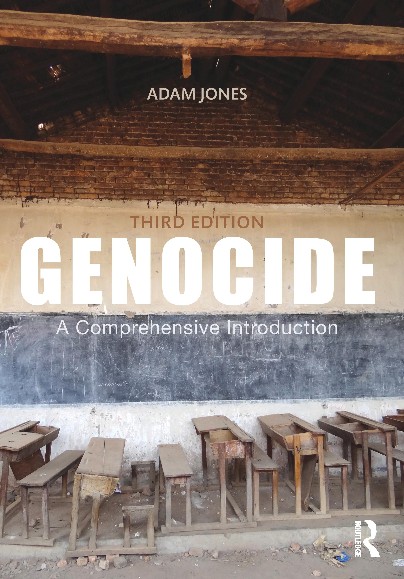
NOW AVAILABLE: Genocide: A Comprehensive Introduction, by Adam Jones (Routledge, 2006; 430 pp., US $33.95 pbk). See www.genocidetext.net. "The best introductory text available to students of genocide studies ... likely to become the gold standard by which all subsequent introductions to this enormously important subject will be measured" (Kenneth J. Campbell).
Wednesday, November 08, 2006
NOW AVAILABLE: Genocide: A Comprehensive Introduction, by Adam Jones (Routledge, 2006; 430 pp., US $33.95 pbk). See www.genocidetext.net. "The best introductory text available to students of genocide studies ... likely to become the gold standard by which all subsequent introductions to this enormously important subject will be measured" (Kenneth J. Campbell).


Genocide Studies Media File
November 1-8, 2006
A compendium of news stories, features, and human rights reports pertaining to genocide and crimes against humanity. Compiled by Adam Jones. Please send links and feedback to adamj_jones@hotmail.com.
Consider inviting colleagues and friends to subscribe to Genocide_Studies and the G_S Media File. All it takes is an email to genocide_studies-subscribe@topica.com.
ARGENTINA
"'Dirty War' Victim Again Missing"
By Patrick J. McDonnell
The Los Angeles Times, 6 November 2006 [Registration Required]
"Jorge Julio Lopez has become known as the man who was disappeared twice. The first time was in 1976, during the dark days of Argentina's military dictatorship, when he was a labor activist. Lopez survived the beatings, humiliations and electric shock, and was released after three years, apparently judged not a threat. He went on with his life, reared two children and seldom spoke about the ordeal. Lopez vanished for the second time in September, after he gave crucial testimony in a case that helped seal the conviction of his chief torturer, a former police commander with a sadistic streak. The 78-year-old retired construction worker was last seen on a street near his home in La Plata, a city southeast of Buenos Aires, on Sept. 18. The following day, a three-judge panel sentenced the former police official to life in prison, branding the abuses in the country's 'dirty war' against dissenters a genocide, the first such official finding here. This time, Lopez's fate remains a mystery. As the first desaparecido since democracy returned to Argentina almost a quarter of a century ago, Lopez is the focus of a massive manhunt. His case has become a national cause celebre and sinister whodunit, while posing a direct challenge to a government that has aggressively tracked down the now-graying abusers from the dark days of the junta. In a nation where memory remains a battlefield and conspiracy theories flourish, many suspect the worst: that operatives loyal to the disgraced generals grabbed Lopez in retaliation for his damaging testimony, and as a warning to others inclined to come forward in other long-delayed trials. [...]"
ARMENIAN GENOCIDE
"Dead Reckoning: The Armenian Genocide and the Politics of Silence"
By Elizabeth Kolbert
The New Yorker, 6 November 2006
"[...] Turkey has long sought to join the European Union, and, while a history of genocide is clearly no barrier to membership, denying it may be; several European governments have indicated that they will oppose the country's bid unless it acknowledges the crimes committed against the Armenians. Are the Turks really willing to risk their country's economic future merely in order to hide -- or pretend to hide -- an ugly fact about its origins? To believe this seems to require a view of Turkish ethnic pride that gets dangerously close to a national stereotype. In fact, many Turkish nationalists oppose E.U. membership; from their perspective, denying the Armenian genocide serves an eminently practical political purpose. That being said, [Taner] Akcam clearly has a point, and one that Americans, in particular, ought to be able to appreciate. Before the arrival of the first Europeans, there were, it is estimated, at least forty million indigenous people living in the Americas; by 1650, fewer than ten million were left. The decline was the result of casual cruelty on the one hand -- diseases unwittingly spread -- and systematic slaughter on the other. Every November, when American schoolchildren are taught about Thanksgiving, they are insistently told the story of how the Pilgrims, in their gratitude, entertained the kindly Wampanoag. We now know that the comity of that original Thanksgiving was entirely atypical, and that, by 1621, the Wampanoag were already a dying nation. While it was cowardly of Congress to pull H.R. 596, passing it would, in its own way, also have been problematic. We may side with the Armenians, but, historically speaking, we probably have more in common with the Turks."
[n.b. This long feature article is built around a review of Taner Akcam's new book, "A Shameful Act: The Armenian Genocide and the Question of Turkish Responsibility."]
"Mass Burial of Possible Armenian Genocide Victims Discovered in Turkey"
PanArmenian.net, 4 November 2006
"Turkish Gendarmerie has instructed local villagers of a southeastern region to keep silence about a mass grave, discovered on October 17, that might contain remains of Armenian Genocide victims. According to a Kurdish newspaper published in Turkish Ulkede Ozgur Gundem, villagers from Xirabebaba (Kuru) were digging a grave for one of their relatives when they came across to a cave full of skulls and bones of reportedly 40 people. The Xirabebaba residents assumed they had uncovered a mass grave of 300 Armenian villagers massacred during the Genocide of 1915. They informed Akarsu Gendarmerie headquarters, the
local military unit, about the discovered remains. Turkish army officers, according to the Kurdish newspaper, instructed the villagers to block the cave entrance and make no mention of the remains buried in it. The officers said an investigation would take place. The newspaper reported on the developments and the Turkish military's attempt to hide the news. Journalists, who had arrived to obtain more information, were denied access to the cave. As the mass burial made news, local Gendarmerie made another visit to the villagers. The latter were pressed to report the name of the person who leaked the mass burial discovery to the press. The villagers were warned not to show anyone directions to the cave. The victims of the mass grave, according to Sodertorn University History Professor David Gaunt, are most likely the 150 Armenian and 120 Assyrian males from the nearby town of Dara (now Oguz) killed on June 14, 1915, reports Asbarez."
[n.b. Forwarded by email (thanks to Thea Halo) -- no link supplied. This is the complete text of the dispatch.]
ETHIOPIA/ERITREA
"Annan Warns of Another War between Ethiopia and Eritrea"
By Xan Rice
The Guardian, 31 October 2006
"The UN secretary-general, Kofi Annan, has warned that the war between Ethiopia and Eritrea, which claimed 70,000 lives between 1998 and 2000, could soon reignite unless the two countries are persuaded to talk. Describing the impasse as a 'classic example of the tragedy' of Africa, Mr. Annan said the UN had been unable to persuade the neighbours to cooperate and called for more world attention on the region. Tensions in the Horn of Africa have risen sharply in recent weeks with accusations that Eritrea has sent troops into the border buffer zone, and the two countries have taken active positions on opposite sides in a looming conflict in Somalia. 'We need to handle it [the situation] very carefully before it leads to another explosion,' Mr. Annan said in a speech at Georgetown University in the US last night. The war originally erupted over a border dispute. After signing a ceasefire in 2000, both countries agreed to abide by the decision of an independent panel on the location of their mutual border. Thousands of UN troops were sent to patrol the frontier until demarcation occurred. But Ethiopia's prime minister, Meles Zenawi, has refused to accept the panel's decision. The president of Eritrea, Isaias Afewerki, who assisted Mr Meles in toppling the Marxist dictator Mengistu Haile Mariam, maintains there is no ground for negotiation. He has accused the international community, and the US in particular, of siding with Ethiopia. [...]"
FRANCE/RWANDAN GENOCIDE
"France to Declassify Rwanda Files"
BBC Online, 2 November 2006
"France says it will release classified documents on the Rwandan genocide, after claims that French troops were complicit in the 1994 massacre. Some 105 documents will be given to a magistrate investigating the claims by four genocide survivors. Defence Minister Michele Alliot-Marie took the decision on the recommendation of France's defence secrets commission. The plaintiffs accuse soldiers of rape, murder and complicity 'in genocide and/or crimes against humanity.' The Rwandan Tutsis, aged between 25 and 39, have brought their case against the French military in the French courts. During the genocide some 800,000 Tutsis and moderate Hutus were killed by Hutu extremists. French troops were sent to Rwanda as part of a United Nations force. Rwanda has repeatedly accused Paris of complicity in the genocide. France has denied any role. The four survivors say French troops committed crimes themselves, and also let Hutu killers enter refugee camps under their protection. An inquiry began last month in Rwanda into alleged French complicity in training and arming the Hutu extremists. After hearing testimony from witnesses, the Rwandan panel will rule on whether to file a suit at the International Court of Justice."
[n.b. This is the complete text of the dispatch.]
GUATEMALA
"Suspects in Guatemalan Genocide Arrested"
OneWorld.net, 7 November 2006
"In an unprecedented move, Guatemalan authorities arrested earlier today at least two of the eight named defendants in the Guatemalan Genocide Case that is pending before the Spanish National Court (SNC). Guatemalan Judge Morelia Rios, President of Criminal Sentencing Court No. 5, courageously authorized the arrests in response to the international arrest warrants issued earlier this year by Spanish judge Santiago Pedraz. Attorneys with the San Francisco-based Center for Justice & Accountability (CJA) represent victims of the Guatemalan genocide and applaud the arrests. Former Ministry of Defense Ángel Aníbal Guevara Rodriguez and former Director of the National Police Colonel German Chupina Barahona were taken into police custody earlier today. Also, police have secured the area around the home of former president General Oscar Humberto Mejias Victores, but he appears to be on the run. They each will face extradition to Spain. Judge Rios has authorized the arrests of the other individuals named in the Spanish arrest orders with the exception of former dictator Efraín Rios Montt. CJA International Attorney Almudena Bernabeu explains, 'We are extremely encouraged by the news of these historical arrests made today in Guatemala. These men have blood on their hands from the tens of thousands who died in the Guatemalan genocide of the 1980s. We hope that Rios Montt will also be brought into custody as soon as possible and we are inquiring as to why his arrest has not yet been ordered.' The other defendants named on the arrest warrants are former President Romeo Lucas Garcia, former Minister of Interior Donaldo Álvarez Ruiz, former Police Commander Pedro Garcia Arredondo, and former Chief of the Armed Forces General Staff Benedicto Lucas Garcia. [...]"
[n.b. This is potentially massive news.]
IRAN/JEWISH HOLOCAUST
"More Anger as Holocaust Cartoon Winners Unveiled"
Reuters dispatch in The Sydney Morning Herald, 3 November 2006
"A Moroccan has won first prize in Iran's International Holocaust Cartoons Contest, which sparked widespread condemnation when it was announced last February. Iran's best-selling newspaper, Hamshahri, launched a competition to find the best cartoon about the Holocaust, in which 6 million Jews were killed by the Nazis. The contest was a retaliation for last year's publication of caricatures of the prophet Muhammad in Danish and other European newspapers that angered Muslims worldwide. Presenting a prize to a representative of the Moroccan cartoonist, Abdellah Derkaoui, the Culture and Islamic Guidance Minister, Mohammad Hossein Saffar-Harandi, praised Iran's President, Mahmoud Ahmadinejad, who has described the Holocaust as a myth. Derkaoui's cartoon shows a crane with a Star of David sign, putting up blocks to make a wall separating the Muslim shrine, the Dome of the Rock, from Jerusalem. The wall has a gate, shown in the distance, that looks like one at the Auschwitz concentration camp in Poland, where Jews were incarcerated and killed. 'The taboo is broken,' the minister said. 'People should not think that by questioning the Holocaust they are committing a crime.' The cartoonist won $US12,000 ($15,500). Masoud Shojai-Tabatabai, head of the Cartoon House, which helped organise the exhibition of entries, said the Government was not financing the prizes but did not say who was. [...]"
IRAQ
"Saddam Back in Court to Face Genocide Claims"
Associated Press dispatch in The Guardian, 7 November 2006
"Saddam Hussein today returned to court for the first time since he was sentenced to hang for crimes against humanity. The deposed dictator, sentenced two days ago, was appearing at a hearing of another trial, in which he faces charges of genocide. Wearing a black suit and white shirt, he made his way quietly to his seat among the other six defendants, showing none of the bravado of two days ago, when he shouted: 'Long live the people and death to their enemies.' All are charged in connection with the Operation Anfal crackdown against Iraqi Kurds in the late 80s. More than 180,000 people are said to have died in the operation. The chief judge convened the session and called the first witness, Qahar Khalil Mohammed. On Sunday, another five-judge panel convicted Saddam over the deaths of nearly 150 Shia Muslims following a 1982 assassination attempt against him in the town of Dujail. Along with two others, he was sentenced to death by hanging. Four co-defendants received lesser sentences, and one was acquitted. The Dujail case is subject to appeal, and the Anfal trial will continue while the appeal is under way. [...]"
"This Was a Guilty Verdict on America As Well"
By Robert Fisk
The Independent, 6 November 2006
"So America's one-time ally has been sentenced to death for war crimes he committed when he was Washington's best friend in the Arab world. America knew all about his atrocities and even supplied the gas -- along with the British, of course -- yet there we were yesterday declaring it to be, in the White House's words, another 'great day for Iraq.' ... Now we are to give the Iraqi people bread and circuses, the final hanging of Saddam, twisting, twisting slowly in the wind. We have won. We have inflicted justice upon the man whose country we invaded and eviscerated and caused to break apart. No, there is no sympathy for this man. 'President Saddam Hussein has no fear of being executed,' Bouchra Khalil, a Lebanese lawyer on his team, said in Beirut a few days ago. 'He will not come out of prison to count his days and years in exile in Qatar or any other place. He will come out of prison to go to the presidency or to his grave.' It looks like the grave. Keitel went there. Ceausescu went there. Milosevic escaped sentence. The odd thing is that Iraq is now swamped with mass murderers, guilty of rape and massacre and throat-slitting and torture in the years since our 'liberation' of Iraq. Many of them work for the Iraqi government we are currently supporting, democratically elected, of course. And these war criminals, in some cases, are paid by us, through the ministries we set up under this democratic government. And they will not be tried. Or hanged. That is the extent of our cynicism. And our shame. Have ever justice and hypocrisy been so obscenely joined?"
NAZISM
"Victims of Hitler's Plan for a Master Race"
By Jess Smee
The Guardian, 6 November 2006
"Blond hair, blue eyes: the Third Reich's sinister plan to boost the 'master race' has left behind an emotionally charged legacy that lingers to this day. The Lebensborn Kinder -- a long hushed-up aspect of Nazi history -- were born in special maternity homes, places where mostly unmarried women and the wives of SS men gave birth to children with 'good Aryan' blood. Now in their 60s, a group of these children met this weekend in the eastern German town of Wernigerode, telling their stories in the hope of quelling the taboos and flamboyant myths about the murky Nazi institutions. ... For decades after the second world war a climate of shame suppressed discussion of the social impact of the Third Reich. That meant that many Lebensborn children only recently discovered their roots -- especially those who grew up in the former communist east. Among those, some were astounded to read about their background in their Stasi secret service files, which were made public after the reunification of Germany in 1990. The children represented a traumatic chapter in 20th century history and were often shunned by society. Kikki Skjermo, a lively woman who travelled here from Norway, described being stigmatised as a 'Nazi child' during her childhood in a Norwegian children's home. When she later found her own mother she also met a wall of coldness. 'She only touched me once, gently on the nose. I can remember that day so clearly,' Kikki said. The weekend meeting of the group called Lebensspuren (traces of life), is full of similarly painful stories. Since its creation four years ago, its members swap stories about tracing relatives and dealing with rejection and lies. There is the odd happy tale of reunited families, but for many it has been a battle against taboos and misinformation. [...]"
SERBIA/KOSOVO
"Kosovo May Soon Be Free of Serbia, But Not of Supervision"
By Nicholas Wood
The New York Times, 2 November 2006 [Registration Required]
"In the next few months, Kosovo is likely to win independence from Serbia, concluding a titanic struggle by the United Nations and Western governments to close a chapter that began with ethnic warfare there. The U.N. mission in Pristina is to be replaced by a European one. But it is unlikely to be the conclusion Western governments hoped for, after investing seven years supervising the province at an estimated cost of $1.3 billion a year. It is increasingly evident that the international authorities will need to retain far greater responsibility in Kosovo than they wanted to. The Kosovo Albanians, the province’s majority population, who demand independence, and the government of Serbia have failed to reach an agreement in nine months of negotiations. The Serbs have refused to recognize government institutions dominated by the Albanians in what has been a territory dear to Serbian religious and cultural heritage. The negotiations are dragging on, raising the likelihood that a solution will be imposed, ending a process that began 15 years ago with the breakup of Yugoslavia, which led to wars in Croatia, Bosnia and finally Kosovo. [...]"
SUDAN/DARFUR
"In a Calm Corner of Darfur, Villagers Rebuild Ties"
By Jeffrey Gettleman
The New York Times, 8 November 2006 [Registration Required]
"[...] Much of Darfur, a vast swath of territory in western Sudan, is still a battlefield, with vicious fighting between the Sudanese government and rebel forces, and masses of people fleeing their villages each day. But there are other parts, lesser known, where people are heading the other way, going home. It is a journey that is also difficult, with homecomings that may prove to be short-lived. ... A vast majority of those who are returning are farmers, the primary victims of the bloodshed in Darfur. In this part of the world, lifestyle and ethnicity are closely connected, with most farmers belonging to non-Arab tribes, while most nomads consider themselves full-blooded Arabs. The conflict has pitted these two groups against each other, though it wasn't always like that. Not so long ago, in the village of Wastani, near Artala, nomadic women and women from farms would meet in the fields halfway between their homes and share little glasses of tea. The nomads, who herded camels and cows, would bring meat, and the farmers would bring grain, and they would trade with one another in a fragile tapestry of interdependence between two peoples surviving off the same slice of dry, unforgiving land. ... But then war came. Nomadic gunmen on horses -- some of whom the farmers recognized, some they did not -- raided Wastani in 2003, burning huts and shooting people in the chest. It was a nightmare that recurred countless times across Darfur, an area the size of France. But now, for the first time since then, Wastani’s farmers are moving back, and the nomads are trying to make amends. [...]"
"Controls Tighten on Media and Aid Workers in Darfur"
By Opheera McDoom
Reuters dispatch, 8 November 2006
"Sudan has tightened restrictions on aid workers and journalists travelling to Darfur, and analysts say the aim is to conceal renewed hostilities between rebels and the army. Journalists have been detained, aid workers obstructed and rules changed weekly for foreigners in the strifetorn region. A British Sunday Times reporter this week was detained on arrival at the main airport, initially on the grounds she was wearing a cap belonging to a different news organisation. Then her passport was seized over alleged irregularities. She is just one example. 'Definitely there's been a massive crackdown in the last few months,' said Leslie Lefkow of Human Rights Watch. 'It's the same old pattern of the government in trying to restrict the flow of information. They've managed to conduct a massive media campaign that is subverting the reality of what's happening in Darfur.' She said the two main targets were journalists and non-governmental organisations (NGOs). Darfur has the world's largest aid operation, with 14,000 aid workers supplying humanitarian help to miserable camps in the region. The stakes are high. An estimated 200,000 people have been killed and 2.5 million displaced in fighting since mostly non-Arab rebels took up arms in Darfur in 2003. [...]"
"Darfur 'Genocide Crosses to Chad'"
BBC Online, 7 November 2006
"Chad's government has accused Sudan of 'exporting the genocide' in Darfur across the border. It says there have been 'numerous victims' of recent clashes between Arabs and non-Arab groups just across the border from Darfur. Earlier, a minister said that more than 100 people had been killed in separate clashes in south-eastern Chad. Eastern Chad and Darfur have a similar ethnic make-up and the two governments have swapped charges of backing rebels. Chad's government called for UN peacekeepers to be deployed along the border area. 'There is a genocide overflowing from Sudan's region of Darfur,' it said about the clashes in the Dar Sila area. Earlier, National Administration Minister Ahmat Mahamat Bachir said several villages had been burned in last week's violence in Salamat. He said Arabs had organised attacks on local Kibet villages but that the situation was now under control. There has been an ongoing dispute between the Arab and the Kibet communities over land issues and water resources. [...]"
"Darfur Militias 'Kill Children'"
BBC Online, 3 November 2006
"Militias backing Sudan's government have killed at least 63 people in attacks in Darfur in the past week, African peacekeepers say. At least 27 of the victims are thought to be children under the age of 12. The attacks were on camps for the displaced in the rebel stronghold of Jebel Moon, in West Darfur. The government says it is disarming the Janjaweed militia but a BBC correspondent in Sudan says all the evidence points to the exact opposite. United Nations Secretary-General Kofi Annan has urged the Sudanese government to restrain the militias following the attacks. Militia wearing government uniforms, on camels and horseback, swept into eight villages and camps in Jebel Moon on 29 October. The African Union (AU) investigation team has just returned from the area to make its report. The area is a stronghold of the National Redemption Front (NRF) alliance, one of the Darfur rebel group which refused to sign up to a peace deal in May. [...]"
ISSUE: CLUSTER BOMBS
"UN Calls for Cluster Bomb Freeze"
By Richard Beeston
The Times, 8 November 2006
"The United Nations called yesterday for an immediate worldwide freeze on cluster bombs, adding its weight to a growing campaign to ban the munitions blamed for the death and injury of scores of civilians during this summer’s war in Lebanon. Jan Egeland, the UN's head of humanitarian affairs, said that the moratorium should be imposed until the use of the weapons could be curbed under international treaty. 'As long as there is no effective ban, these weapons will continue to affect civilians disproportionately, maiming and killing women, children and other vulnerable groups.' Cluster bombs consist of one large shell containing dozens of bomblets that can be dropped over an area the size of a football pitch. The bomblets often fail to explode on impact and detonate later, usually harming civilians -- especially children who mistake the tiny, brightly coloured canisters for toys. The dangers of the bombs were highlighted this summer when Israel dropped an estimated one million on southern Lebanon, killing 20 people and leaving unexploded bombs scattered across villages and agricultural land. On Monday the International Committee of the Red Cross called for countries to stop using the bombs and to begin destroying stockpiles. It wants their use restricted under the Convention on Certain Conventional Weapons, which is under review this week in Geneva. The move was resisted yesterday by the US, Britain, Russia and other countries that continue to keep cluster munitions in their armouries. [...]"
ISSUE: GENOCIDE DENIAL
"Holocaust Questioner Goes on Trial in France"
Associated Press dispatch in The Star-Ledger, 8 November 2006
"A French far-right leader and member of the European Parliament went on trial yesterday over remarks in which he questioned the existence of Nazi gas chambers. Bruno Gollnisch, the No. 2 in France's National Front party, is accused of 'disputing a crime against humanity' in the trial in Lyon in southeast France. A verdict is expected today. He faces up to one year in prison if convicted. The trial had been postponed three times over the past year over procedural issues. Gollnisch also is the subject of a lawsuit filed by the anti-racism group MRAP. At an October 2004 news conference, Gollnisch questioned whether the Nazis used gas chambers in the Holocaust and suggested that the number of Jews killed during World War II might have been exaggerated. Gollnisch's comments sparked uproar among Jewish and anti-racism groups, and he was suspended by Jean Moulin University in Lyon, where he taught law and Japanese, for five years over the remarks. The European Union assembly stripped Gollnisch of his legislative immunity from prosecution. Gollnisch has said he is a victim of a 'witch hunt' in the case."
[n.b. This is the complete text of the dispatch.]
"The Folly of Jailing Genocide Deniers"
By Garin K. Hovannisian
The Christian Science Monitor, 6 November 2006
"[...] Hilda Tchoboian, president of the European Armenian Federation, welcomed this 'historic step,' noting that 'the hydra of denial is a tumor on freedom of expression,' which proved that you can mix metaphors and talk nonsense in the span of five nouns. Genocide denial might be a tumor on truth, memory, or even human dignity, but it's not even a pimple on the freedom of expression. It's an exercise -- however false or disgusting -- of that freedom, which Ms. Tchoboian wants to ration. A government that has the power to punish lies also has the power to punish truth (consider Turkey's law that punishes those who denigrate 'Turkishness') and, really, to punish anything it pleases. This was the terrible lesson of the 20th century, fleshed out in millions upon millions of carcasses across Joseph Stalin's gulags, Adolf Hitler's concentration camps, Pol Pot's killing fields, and Mao Zedong's torture chambers. Indeed, this was the lesson of the Armenian genocide, which was perpetrated by a regime that tried to build one people, one religion, and -- most important -- one idea, 'Ottomanization,' on the rubble of human rights. That lesson, sadly, is lost on some French parliamentarians and the Armenian diaspora, whose notion of politics ends where the genocide begins. [...]"
ISSUE: GENOCIDE PREVENTION
"UN Reforms Peacekeeping and Genocide Prevention Guidelines"
By Andre de Nesnera
Voice of America, 6 November 2006
"[...] Experts say U.N. members also agreed on an important principle: to intervene in cases of genocide or ethnic cleansing. That principle is known as the responsibility to protect. And Nancy Soderberg, former alternate U.S. representative to the United Nations (1997-2001) says that is a revolutionary idea. 'The U.N. is founded on the basis of sovereignty, meaning that each country is responsible for its own affairs, and no country has a right to intervene in the internal affairs of another member. And that's enshrined in the [U.N.] charter, and it is very much how the U.N. drives. After the debacle of Bosnia, and, particularly, the genocide in Rwanda, the secretary-general said, "we need to think again about what responsibility the international community has when things like this happen." And, he pulled together the brightest minds in the world, and they came up with this new theory, which is the "responsibility to protect" -- which says, when a state is either unwilling or unable to protect its population, the issue of sovereignty yields to the responsibility of the international community to protect them,' she said. Analysts say, while the doctrine of the responsibility to protect has been accepted by the United Nations, the key issue is how do you implement it? Michael Doyle was an adviser to outgoing U.N. Secretary-General Kofi Annan. He said, 'So, at the level of principle or doctrine, this is a good step forward. At the level of practice, the jury is still out.' [...]"
ISSUE: GLOBAL HEALTH
"The Genocide Election"
By Dr. Peter Rost
Counterpunch.org, 6 November 2006
"[...] According to the International Herald Tribune, the White House is pushing bilateral and regional trade agreements in which poor countries are forced to enact 'superpatents' that prolong U.S. drug makers' monopolies and limit the circumstances under which the patents can be broken. Pedro Chequer, the head of Brazil's national AIDS program has said: 'If you prevent countries from using generic drugs, you are creating a concrete obstacle to providing access to drugs. You are promoting genocide, because you're killing people.' The trade deals are often negotiated in secret and attract little notice. But they have already been signed with poor countries overwhelmed by AIDS, among them six in Central America. And negotiations have started with several nations that also are overwhelmed by the AIDS virus, from Thailand to five southern African countries, including South Africa and Botswana. When a life-saving industry cheats, people die. When the White House participates in these dirty deals, the result may be genocide."
ISSUE: NUCLEARISM
"Armagideon Time: Bush's Nuclear Folly and the National Security Lie"
By Chris Floyd
Truthout.org, 7 November 2006
"Last Friday, just hours after the New York Times revealed that the Bush administration had posted advanced plans for building nuclear weapons on a public web site for months, six Arab nations formally announced they were launching nuclear programs of their own. The potential for disaster posed by this development is almost immeasurable: everything from Chernobyl-style accidents to the theft or transfer of nuclear material to terrorists to the near-certainty of new atomic arsenals appearing in the powder-keg of the Middle East. The announcement also signals the final and utter failure of the Bush administration's demented 'non-proliferation' strategy, which has been centered around a relentless, deliberate drive to gut existing nuclear arms treaties in order to free the United States to enhance its own arsenal. This open denigration of legal strictures on the development of the most dangerous technology on earth has been accompanied by a cynical inconsistency. Bush has heaped monetary and military rewards on India and Pakistan for their illegally developed nuclear arsenals, while threatening war on Iran for what has so far been a peaceful nuclear power program carried out in accordance with international treaties -- and doing nothing at all to head off North Korea's now apparently successful bid for atomic weapon capability. It is a record of astonishing recklessness and incompetence, one that has plunged the world into a new abyss of instability, insecurity and the ever-increasing likelihood of mass death and horror on an unfathomable scale. And the criminal negligence of Bush and his Congressional rubberstamps in dumping plans from Iraq's almost-complete, pre-1991 nuclear weapons program on the Internet -- solely for partisan political advantage -- has exacerbated these dangers by several magnitudes. [...]"
"Depleted Uranium Risk 'Ignored'"
BBC Online, 1 November 2006
"UK and US forces have continued to use depleted uranium weapons despite warnings they pose a cancer risk, a BBC investigation has found. Scientists have pointed to health statistics in Iraq, where the weapons were used in the 1991 and 2003 wars. A report by the World Health Organisation (WHO) in 2001 said they posed only a small contamination risk. But a senior UN scientist said research showing how depleted uranium could cause cancer was withheld. ... Depleted uranium is extremely dense and hard, and is used for armour-piercing bullets or shells. Fears over health implications led to a study by the WHO in 2001. ... Dr. Mike Repacholi, who oversaw work on the report, told Angus Stickler of BBC Radio Four's Today programme that depleted uranium was 'basically safe.' 'You would have to ingest a huge amount of depleted uranium dust to cause any adverse health effect,' he said. But Dr. Keith Baverstock, who worked on the project, said research conducted by the US Department of Defense suggested otherwise. He described a process known as genotoxicity, which begins when depleted uranium dust is inhaled. 'The particles that dissolve pose a risk -- part radioactive -- and part from the chemical toxicity in the lung,' he said. Later, he said, the material enters the body and the blood stream, potentially affecting bone marrow, the lymphatic system and the kidneys. The research was not included in the WHO report, and Dr. Baverstock believes it was blocked. ... Other senior scientists have pointed to worrying health statistics in Iraq, which show a rise in cancer and birth defects. Prof. Randy Parrish of the Isotope Geosciences Laboratory in the UK said environmental and health assessments were needed in Iraq to establish the facts. [...]"
ISSUE: VIOLENCE AGAINST GAYS
"Hatred (of Gays) Unites Jerusalem's Feuding Faiths"
By Tim McGirk
Time.com, 3 November 2006
"In a Holy City fissured by faith, finding a consensus on anything among Jewish, Christian and Muslim clerics is a near-miraculous occurrence. Yet Jerusalem's rabbis, priests and imams have united, however briefly, to stop the city's Gay Pride parade. For some of their followers, the issue is worth spilling blood over: An unknown extremist Jewish group pasted up signs announcing a $500 'reward' for every gay man or woman killed during the parade, which is scheduled for Nov. 10. Several ultra-orthodox rabbis have vowed to mobilize more than 100,000 protesters to shut down Jerusalem on the day of the parade, and police warn that some groups plan to pelt the marchers with apples jagged with razor blades. Meanwhile, in a rare display of solidarity with Jewish extremists, an influential Islamic cleric is urging Muslims to stage a simultaneous protest inside the old walled city to draw away Israeli police who would otherwise be shielding the gay parade from harm. 'Not only should these homosexuals be banned from holding their parade,' says one Muslim cleric, Sheikh Ibrahim Hassan, who preaches at a mosque near Damascus Gate, 'but they should be punished and sent to an isolated place.' Hatred, it seems, can be a bridge to inter-faith harmony. Gay pride marches have, in fact, been held in Jerusalem for the past five years, prompting only grumbling among the city's conservatives. Then, last year, an ultra-Orthodox youth waded into the crowd of revelers and slashed three people with a knife. The furor over the parade reveals a long-standing contradiction inside an Israeli culture where secular values compete with fiercely defended religious traditions. [...]"
ISSUE: VIOLENCE AGAINST WOMEN
"Women's Lives 'No Better' in New Afghanistan"
By Justin Huggler
The Independent, 1 November 2006
"The lives of Afghanistan's women have changed little five years after the fall of the Taliban, according to a new report by a UK-based women's rights group. Womankind Worldwide found violence against women is still endemic -- and the number of women setting fire to themselves because they cannot bear their lives is rising dramatically. The iconic images of women throwing off their burqas after the overthrow of the Taliban in 2001 were always a fiction. Except among a small elite in Kabul, the overwhelming majority of women in Afghanistan are still forced to cover their entire bodies and faces. The report's researchers found that very little has changed. Between 60 and 80 per cent of all marriages in Afghanistan are forced. As many as 57 per cent of girls are married off below the age of 16, some as young as six. Because of the custom of paying a bride price, marriage is essentially a financial transaction, and girls a commodity. The custom of baad, when girls and women are exchanged to settle debts and disputes, is still widely practised. The women are not treated as proper wives, but in effect are slave workers for their husbands. Honour killing is also still widespread. Women are killed for dishonouring their families through 'crimes' such as even being seen associating with a man. A family member kills the woman. Even women who have been raped cannot report the crime because they risk being prosecuted for having sex outside marriage. The Taliban were vilified for denying girls education, but even now only 19 per cent of Afghan schools are for girls and only 5 per cent of girls of secondary school age are enrolled. And the West cannot blame the Taliban, as many of the abuses take place in the north and west, where the Taliban are not active. In the north-east, where the Taliban never had control, a woman dies every 20 minutes in childbirth."
[n.b. This is the complete text of the dispatch.]
ISSUE: WAR CRIMES/CRIMINAL TRIBUNALS
"War Criminals, Beware"
By Jeremy Brecher
Znet.org, 5 November 2006
"On November 14 a group of lawyers and other experts will come before the German federal prosecutor and ask him to open a criminal investigation targeting Donald Rumsfeld, Alberto Gonzales and other key Bush Administration figures for war crimes. The recent passage of the Military Commissions Act provides a central argument for the legal action, under the doctrine of universal jurisdiction: It demonstrates the intent of the Bush Administration to immunize itself legally from prosecution in the United States, even for the most serious crimes. ... The new complaint will be based on the failure of US authorities to investigate and prosecute high-level officials. The case will draw on a powerful new argument. The Military Commissions Act of 2006, which the President promoted and recently signed into law, provides retroactive immunity for civilians who violated the War Crimes Act, including officials of the Bush Administration. Such an attempt to provide immunity for their crimes, it will be argued, is in itself evidence of an effort to block prosecution of those crimes. Indeed, according to Scott Horton, chair of the International Law Committee of the New York City Bar Association, when Yugoslavia sought to immunize senior government officials, the United States declared the act itself to be evidence of such a conspiracy. The new case will introduce other important elements as well. Lawyers who served as advocates, architects and enablers of prisoner abuse policies, like Alberto Gonzales and John Yoo, will be added as defendants. Abuse in Guantánamo will be added to that in Abu Ghraib. The complaint will present new evidence showing responsibility for torture and prisoner abuse at the highest levels of the chain of command. [...]"
Consider inviting colleagues and friends to subscribe to Genocide_Studies and the G_S Media File. All it takes is an email to genocide_studies-subscribe@topica.com.
ARGENTINA
"'Dirty War' Victim Again Missing"
By Patrick J. McDonnell
The Los Angeles Times, 6 November 2006 [Registration Required]
"Jorge Julio Lopez has become known as the man who was disappeared twice. The first time was in 1976, during the dark days of Argentina's military dictatorship, when he was a labor activist. Lopez survived the beatings, humiliations and electric shock, and was released after three years, apparently judged not a threat. He went on with his life, reared two children and seldom spoke about the ordeal. Lopez vanished for the second time in September, after he gave crucial testimony in a case that helped seal the conviction of his chief torturer, a former police commander with a sadistic streak. The 78-year-old retired construction worker was last seen on a street near his home in La Plata, a city southeast of Buenos Aires, on Sept. 18. The following day, a three-judge panel sentenced the former police official to life in prison, branding the abuses in the country's 'dirty war' against dissenters a genocide, the first such official finding here. This time, Lopez's fate remains a mystery. As the first desaparecido since democracy returned to Argentina almost a quarter of a century ago, Lopez is the focus of a massive manhunt. His case has become a national cause celebre and sinister whodunit, while posing a direct challenge to a government that has aggressively tracked down the now-graying abusers from the dark days of the junta. In a nation where memory remains a battlefield and conspiracy theories flourish, many suspect the worst: that operatives loyal to the disgraced generals grabbed Lopez in retaliation for his damaging testimony, and as a warning to others inclined to come forward in other long-delayed trials. [...]"
ARMENIAN GENOCIDE
"Dead Reckoning: The Armenian Genocide and the Politics of Silence"
By Elizabeth Kolbert
The New Yorker, 6 November 2006
"[...] Turkey has long sought to join the European Union, and, while a history of genocide is clearly no barrier to membership, denying it may be; several European governments have indicated that they will oppose the country's bid unless it acknowledges the crimes committed against the Armenians. Are the Turks really willing to risk their country's economic future merely in order to hide -- or pretend to hide -- an ugly fact about its origins? To believe this seems to require a view of Turkish ethnic pride that gets dangerously close to a national stereotype. In fact, many Turkish nationalists oppose E.U. membership; from their perspective, denying the Armenian genocide serves an eminently practical political purpose. That being said, [Taner] Akcam clearly has a point, and one that Americans, in particular, ought to be able to appreciate. Before the arrival of the first Europeans, there were, it is estimated, at least forty million indigenous people living in the Americas; by 1650, fewer than ten million were left. The decline was the result of casual cruelty on the one hand -- diseases unwittingly spread -- and systematic slaughter on the other. Every November, when American schoolchildren are taught about Thanksgiving, they are insistently told the story of how the Pilgrims, in their gratitude, entertained the kindly Wampanoag. We now know that the comity of that original Thanksgiving was entirely atypical, and that, by 1621, the Wampanoag were already a dying nation. While it was cowardly of Congress to pull H.R. 596, passing it would, in its own way, also have been problematic. We may side with the Armenians, but, historically speaking, we probably have more in common with the Turks."
[n.b. This long feature article is built around a review of Taner Akcam's new book, "A Shameful Act: The Armenian Genocide and the Question of Turkish Responsibility."]
"Mass Burial of Possible Armenian Genocide Victims Discovered in Turkey"
PanArmenian.net, 4 November 2006
"Turkish Gendarmerie has instructed local villagers of a southeastern region to keep silence about a mass grave, discovered on October 17, that might contain remains of Armenian Genocide victims. According to a Kurdish newspaper published in Turkish Ulkede Ozgur Gundem, villagers from Xirabebaba (Kuru) were digging a grave for one of their relatives when they came across to a cave full of skulls and bones of reportedly 40 people. The Xirabebaba residents assumed they had uncovered a mass grave of 300 Armenian villagers massacred during the Genocide of 1915. They informed Akarsu Gendarmerie headquarters, the
local military unit, about the discovered remains. Turkish army officers, according to the Kurdish newspaper, instructed the villagers to block the cave entrance and make no mention of the remains buried in it. The officers said an investigation would take place. The newspaper reported on the developments and the Turkish military's attempt to hide the news. Journalists, who had arrived to obtain more information, were denied access to the cave. As the mass burial made news, local Gendarmerie made another visit to the villagers. The latter were pressed to report the name of the person who leaked the mass burial discovery to the press. The villagers were warned not to show anyone directions to the cave. The victims of the mass grave, according to Sodertorn University History Professor David Gaunt, are most likely the 150 Armenian and 120 Assyrian males from the nearby town of Dara (now Oguz) killed on June 14, 1915, reports Asbarez."
[n.b. Forwarded by email (thanks to Thea Halo) -- no link supplied. This is the complete text of the dispatch.]
ETHIOPIA/ERITREA
"Annan Warns of Another War between Ethiopia and Eritrea"
By Xan Rice
The Guardian, 31 October 2006
"The UN secretary-general, Kofi Annan, has warned that the war between Ethiopia and Eritrea, which claimed 70,000 lives between 1998 and 2000, could soon reignite unless the two countries are persuaded to talk. Describing the impasse as a 'classic example of the tragedy' of Africa, Mr. Annan said the UN had been unable to persuade the neighbours to cooperate and called for more world attention on the region. Tensions in the Horn of Africa have risen sharply in recent weeks with accusations that Eritrea has sent troops into the border buffer zone, and the two countries have taken active positions on opposite sides in a looming conflict in Somalia. 'We need to handle it [the situation] very carefully before it leads to another explosion,' Mr. Annan said in a speech at Georgetown University in the US last night. The war originally erupted over a border dispute. After signing a ceasefire in 2000, both countries agreed to abide by the decision of an independent panel on the location of their mutual border. Thousands of UN troops were sent to patrol the frontier until demarcation occurred. But Ethiopia's prime minister, Meles Zenawi, has refused to accept the panel's decision. The president of Eritrea, Isaias Afewerki, who assisted Mr Meles in toppling the Marxist dictator Mengistu Haile Mariam, maintains there is no ground for negotiation. He has accused the international community, and the US in particular, of siding with Ethiopia. [...]"
FRANCE/RWANDAN GENOCIDE
"France to Declassify Rwanda Files"
BBC Online, 2 November 2006
"France says it will release classified documents on the Rwandan genocide, after claims that French troops were complicit in the 1994 massacre. Some 105 documents will be given to a magistrate investigating the claims by four genocide survivors. Defence Minister Michele Alliot-Marie took the decision on the recommendation of France's defence secrets commission. The plaintiffs accuse soldiers of rape, murder and complicity 'in genocide and/or crimes against humanity.' The Rwandan Tutsis, aged between 25 and 39, have brought their case against the French military in the French courts. During the genocide some 800,000 Tutsis and moderate Hutus were killed by Hutu extremists. French troops were sent to Rwanda as part of a United Nations force. Rwanda has repeatedly accused Paris of complicity in the genocide. France has denied any role. The four survivors say French troops committed crimes themselves, and also let Hutu killers enter refugee camps under their protection. An inquiry began last month in Rwanda into alleged French complicity in training and arming the Hutu extremists. After hearing testimony from witnesses, the Rwandan panel will rule on whether to file a suit at the International Court of Justice."
[n.b. This is the complete text of the dispatch.]
GUATEMALA
"Suspects in Guatemalan Genocide Arrested"
OneWorld.net, 7 November 2006
"In an unprecedented move, Guatemalan authorities arrested earlier today at least two of the eight named defendants in the Guatemalan Genocide Case that is pending before the Spanish National Court (SNC). Guatemalan Judge Morelia Rios, President of Criminal Sentencing Court No. 5, courageously authorized the arrests in response to the international arrest warrants issued earlier this year by Spanish judge Santiago Pedraz. Attorneys with the San Francisco-based Center for Justice & Accountability (CJA) represent victims of the Guatemalan genocide and applaud the arrests. Former Ministry of Defense Ángel Aníbal Guevara Rodriguez and former Director of the National Police Colonel German Chupina Barahona were taken into police custody earlier today. Also, police have secured the area around the home of former president General Oscar Humberto Mejias Victores, but he appears to be on the run. They each will face extradition to Spain. Judge Rios has authorized the arrests of the other individuals named in the Spanish arrest orders with the exception of former dictator Efraín Rios Montt. CJA International Attorney Almudena Bernabeu explains, 'We are extremely encouraged by the news of these historical arrests made today in Guatemala. These men have blood on their hands from the tens of thousands who died in the Guatemalan genocide of the 1980s. We hope that Rios Montt will also be brought into custody as soon as possible and we are inquiring as to why his arrest has not yet been ordered.' The other defendants named on the arrest warrants are former President Romeo Lucas Garcia, former Minister of Interior Donaldo Álvarez Ruiz, former Police Commander Pedro Garcia Arredondo, and former Chief of the Armed Forces General Staff Benedicto Lucas Garcia. [...]"
[n.b. This is potentially massive news.]
IRAN/JEWISH HOLOCAUST
"More Anger as Holocaust Cartoon Winners Unveiled"
Reuters dispatch in The Sydney Morning Herald, 3 November 2006
"A Moroccan has won first prize in Iran's International Holocaust Cartoons Contest, which sparked widespread condemnation when it was announced last February. Iran's best-selling newspaper, Hamshahri, launched a competition to find the best cartoon about the Holocaust, in which 6 million Jews were killed by the Nazis. The contest was a retaliation for last year's publication of caricatures of the prophet Muhammad in Danish and other European newspapers that angered Muslims worldwide. Presenting a prize to a representative of the Moroccan cartoonist, Abdellah Derkaoui, the Culture and Islamic Guidance Minister, Mohammad Hossein Saffar-Harandi, praised Iran's President, Mahmoud Ahmadinejad, who has described the Holocaust as a myth. Derkaoui's cartoon shows a crane with a Star of David sign, putting up blocks to make a wall separating the Muslim shrine, the Dome of the Rock, from Jerusalem. The wall has a gate, shown in the distance, that looks like one at the Auschwitz concentration camp in Poland, where Jews were incarcerated and killed. 'The taboo is broken,' the minister said. 'People should not think that by questioning the Holocaust they are committing a crime.' The cartoonist won $US12,000 ($15,500). Masoud Shojai-Tabatabai, head of the Cartoon House, which helped organise the exhibition of entries, said the Government was not financing the prizes but did not say who was. [...]"
IRAQ
"Saddam Back in Court to Face Genocide Claims"
Associated Press dispatch in The Guardian, 7 November 2006
"Saddam Hussein today returned to court for the first time since he was sentenced to hang for crimes against humanity. The deposed dictator, sentenced two days ago, was appearing at a hearing of another trial, in which he faces charges of genocide. Wearing a black suit and white shirt, he made his way quietly to his seat among the other six defendants, showing none of the bravado of two days ago, when he shouted: 'Long live the people and death to their enemies.' All are charged in connection with the Operation Anfal crackdown against Iraqi Kurds in the late 80s. More than 180,000 people are said to have died in the operation. The chief judge convened the session and called the first witness, Qahar Khalil Mohammed. On Sunday, another five-judge panel convicted Saddam over the deaths of nearly 150 Shia Muslims following a 1982 assassination attempt against him in the town of Dujail. Along with two others, he was sentenced to death by hanging. Four co-defendants received lesser sentences, and one was acquitted. The Dujail case is subject to appeal, and the Anfal trial will continue while the appeal is under way. [...]"
"This Was a Guilty Verdict on America As Well"
By Robert Fisk
The Independent, 6 November 2006
"So America's one-time ally has been sentenced to death for war crimes he committed when he was Washington's best friend in the Arab world. America knew all about his atrocities and even supplied the gas -- along with the British, of course -- yet there we were yesterday declaring it to be, in the White House's words, another 'great day for Iraq.' ... Now we are to give the Iraqi people bread and circuses, the final hanging of Saddam, twisting, twisting slowly in the wind. We have won. We have inflicted justice upon the man whose country we invaded and eviscerated and caused to break apart. No, there is no sympathy for this man. 'President Saddam Hussein has no fear of being executed,' Bouchra Khalil, a Lebanese lawyer on his team, said in Beirut a few days ago. 'He will not come out of prison to count his days and years in exile in Qatar or any other place. He will come out of prison to go to the presidency or to his grave.' It looks like the grave. Keitel went there. Ceausescu went there. Milosevic escaped sentence. The odd thing is that Iraq is now swamped with mass murderers, guilty of rape and massacre and throat-slitting and torture in the years since our 'liberation' of Iraq. Many of them work for the Iraqi government we are currently supporting, democratically elected, of course. And these war criminals, in some cases, are paid by us, through the ministries we set up under this democratic government. And they will not be tried. Or hanged. That is the extent of our cynicism. And our shame. Have ever justice and hypocrisy been so obscenely joined?"
NAZISM
"Victims of Hitler's Plan for a Master Race"
By Jess Smee
The Guardian, 6 November 2006
"Blond hair, blue eyes: the Third Reich's sinister plan to boost the 'master race' has left behind an emotionally charged legacy that lingers to this day. The Lebensborn Kinder -- a long hushed-up aspect of Nazi history -- were born in special maternity homes, places where mostly unmarried women and the wives of SS men gave birth to children with 'good Aryan' blood. Now in their 60s, a group of these children met this weekend in the eastern German town of Wernigerode, telling their stories in the hope of quelling the taboos and flamboyant myths about the murky Nazi institutions. ... For decades after the second world war a climate of shame suppressed discussion of the social impact of the Third Reich. That meant that many Lebensborn children only recently discovered their roots -- especially those who grew up in the former communist east. Among those, some were astounded to read about their background in their Stasi secret service files, which were made public after the reunification of Germany in 1990. The children represented a traumatic chapter in 20th century history and were often shunned by society. Kikki Skjermo, a lively woman who travelled here from Norway, described being stigmatised as a 'Nazi child' during her childhood in a Norwegian children's home. When she later found her own mother she also met a wall of coldness. 'She only touched me once, gently on the nose. I can remember that day so clearly,' Kikki said. The weekend meeting of the group called Lebensspuren (traces of life), is full of similarly painful stories. Since its creation four years ago, its members swap stories about tracing relatives and dealing with rejection and lies. There is the odd happy tale of reunited families, but for many it has been a battle against taboos and misinformation. [...]"
SERBIA/KOSOVO
"Kosovo May Soon Be Free of Serbia, But Not of Supervision"
By Nicholas Wood
The New York Times, 2 November 2006 [Registration Required]
"In the next few months, Kosovo is likely to win independence from Serbia, concluding a titanic struggle by the United Nations and Western governments to close a chapter that began with ethnic warfare there. The U.N. mission in Pristina is to be replaced by a European one. But it is unlikely to be the conclusion Western governments hoped for, after investing seven years supervising the province at an estimated cost of $1.3 billion a year. It is increasingly evident that the international authorities will need to retain far greater responsibility in Kosovo than they wanted to. The Kosovo Albanians, the province’s majority population, who demand independence, and the government of Serbia have failed to reach an agreement in nine months of negotiations. The Serbs have refused to recognize government institutions dominated by the Albanians in what has been a territory dear to Serbian religious and cultural heritage. The negotiations are dragging on, raising the likelihood that a solution will be imposed, ending a process that began 15 years ago with the breakup of Yugoslavia, which led to wars in Croatia, Bosnia and finally Kosovo. [...]"
SUDAN/DARFUR
"In a Calm Corner of Darfur, Villagers Rebuild Ties"
By Jeffrey Gettleman
The New York Times, 8 November 2006 [Registration Required]
"[...] Much of Darfur, a vast swath of territory in western Sudan, is still a battlefield, with vicious fighting between the Sudanese government and rebel forces, and masses of people fleeing their villages each day. But there are other parts, lesser known, where people are heading the other way, going home. It is a journey that is also difficult, with homecomings that may prove to be short-lived. ... A vast majority of those who are returning are farmers, the primary victims of the bloodshed in Darfur. In this part of the world, lifestyle and ethnicity are closely connected, with most farmers belonging to non-Arab tribes, while most nomads consider themselves full-blooded Arabs. The conflict has pitted these two groups against each other, though it wasn't always like that. Not so long ago, in the village of Wastani, near Artala, nomadic women and women from farms would meet in the fields halfway between their homes and share little glasses of tea. The nomads, who herded camels and cows, would bring meat, and the farmers would bring grain, and they would trade with one another in a fragile tapestry of interdependence between two peoples surviving off the same slice of dry, unforgiving land. ... But then war came. Nomadic gunmen on horses -- some of whom the farmers recognized, some they did not -- raided Wastani in 2003, burning huts and shooting people in the chest. It was a nightmare that recurred countless times across Darfur, an area the size of France. But now, for the first time since then, Wastani’s farmers are moving back, and the nomads are trying to make amends. [...]"
"Controls Tighten on Media and Aid Workers in Darfur"
By Opheera McDoom
Reuters dispatch, 8 November 2006
"Sudan has tightened restrictions on aid workers and journalists travelling to Darfur, and analysts say the aim is to conceal renewed hostilities between rebels and the army. Journalists have been detained, aid workers obstructed and rules changed weekly for foreigners in the strifetorn region. A British Sunday Times reporter this week was detained on arrival at the main airport, initially on the grounds she was wearing a cap belonging to a different news organisation. Then her passport was seized over alleged irregularities. She is just one example. 'Definitely there's been a massive crackdown in the last few months,' said Leslie Lefkow of Human Rights Watch. 'It's the same old pattern of the government in trying to restrict the flow of information. They've managed to conduct a massive media campaign that is subverting the reality of what's happening in Darfur.' She said the two main targets were journalists and non-governmental organisations (NGOs). Darfur has the world's largest aid operation, with 14,000 aid workers supplying humanitarian help to miserable camps in the region. The stakes are high. An estimated 200,000 people have been killed and 2.5 million displaced in fighting since mostly non-Arab rebels took up arms in Darfur in 2003. [...]"
"Darfur 'Genocide Crosses to Chad'"
BBC Online, 7 November 2006
"Chad's government has accused Sudan of 'exporting the genocide' in Darfur across the border. It says there have been 'numerous victims' of recent clashes between Arabs and non-Arab groups just across the border from Darfur. Earlier, a minister said that more than 100 people had been killed in separate clashes in south-eastern Chad. Eastern Chad and Darfur have a similar ethnic make-up and the two governments have swapped charges of backing rebels. Chad's government called for UN peacekeepers to be deployed along the border area. 'There is a genocide overflowing from Sudan's region of Darfur,' it said about the clashes in the Dar Sila area. Earlier, National Administration Minister Ahmat Mahamat Bachir said several villages had been burned in last week's violence in Salamat. He said Arabs had organised attacks on local Kibet villages but that the situation was now under control. There has been an ongoing dispute between the Arab and the Kibet communities over land issues and water resources. [...]"
"Darfur Militias 'Kill Children'"
BBC Online, 3 November 2006
"Militias backing Sudan's government have killed at least 63 people in attacks in Darfur in the past week, African peacekeepers say. At least 27 of the victims are thought to be children under the age of 12. The attacks were on camps for the displaced in the rebel stronghold of Jebel Moon, in West Darfur. The government says it is disarming the Janjaweed militia but a BBC correspondent in Sudan says all the evidence points to the exact opposite. United Nations Secretary-General Kofi Annan has urged the Sudanese government to restrain the militias following the attacks. Militia wearing government uniforms, on camels and horseback, swept into eight villages and camps in Jebel Moon on 29 October. The African Union (AU) investigation team has just returned from the area to make its report. The area is a stronghold of the National Redemption Front (NRF) alliance, one of the Darfur rebel group which refused to sign up to a peace deal in May. [...]"
ISSUE: CLUSTER BOMBS
"UN Calls for Cluster Bomb Freeze"
By Richard Beeston
The Times, 8 November 2006
"The United Nations called yesterday for an immediate worldwide freeze on cluster bombs, adding its weight to a growing campaign to ban the munitions blamed for the death and injury of scores of civilians during this summer’s war in Lebanon. Jan Egeland, the UN's head of humanitarian affairs, said that the moratorium should be imposed until the use of the weapons could be curbed under international treaty. 'As long as there is no effective ban, these weapons will continue to affect civilians disproportionately, maiming and killing women, children and other vulnerable groups.' Cluster bombs consist of one large shell containing dozens of bomblets that can be dropped over an area the size of a football pitch. The bomblets often fail to explode on impact and detonate later, usually harming civilians -- especially children who mistake the tiny, brightly coloured canisters for toys. The dangers of the bombs were highlighted this summer when Israel dropped an estimated one million on southern Lebanon, killing 20 people and leaving unexploded bombs scattered across villages and agricultural land. On Monday the International Committee of the Red Cross called for countries to stop using the bombs and to begin destroying stockpiles. It wants their use restricted under the Convention on Certain Conventional Weapons, which is under review this week in Geneva. The move was resisted yesterday by the US, Britain, Russia and other countries that continue to keep cluster munitions in their armouries. [...]"
ISSUE: GENOCIDE DENIAL
"Holocaust Questioner Goes on Trial in France"
Associated Press dispatch in The Star-Ledger, 8 November 2006
"A French far-right leader and member of the European Parliament went on trial yesterday over remarks in which he questioned the existence of Nazi gas chambers. Bruno Gollnisch, the No. 2 in France's National Front party, is accused of 'disputing a crime against humanity' in the trial in Lyon in southeast France. A verdict is expected today. He faces up to one year in prison if convicted. The trial had been postponed three times over the past year over procedural issues. Gollnisch also is the subject of a lawsuit filed by the anti-racism group MRAP. At an October 2004 news conference, Gollnisch questioned whether the Nazis used gas chambers in the Holocaust and suggested that the number of Jews killed during World War II might have been exaggerated. Gollnisch's comments sparked uproar among Jewish and anti-racism groups, and he was suspended by Jean Moulin University in Lyon, where he taught law and Japanese, for five years over the remarks. The European Union assembly stripped Gollnisch of his legislative immunity from prosecution. Gollnisch has said he is a victim of a 'witch hunt' in the case."
[n.b. This is the complete text of the dispatch.]
"The Folly of Jailing Genocide Deniers"
By Garin K. Hovannisian
The Christian Science Monitor, 6 November 2006
"[...] Hilda Tchoboian, president of the European Armenian Federation, welcomed this 'historic step,' noting that 'the hydra of denial is a tumor on freedom of expression,' which proved that you can mix metaphors and talk nonsense in the span of five nouns. Genocide denial might be a tumor on truth, memory, or even human dignity, but it's not even a pimple on the freedom of expression. It's an exercise -- however false or disgusting -- of that freedom, which Ms. Tchoboian wants to ration. A government that has the power to punish lies also has the power to punish truth (consider Turkey's law that punishes those who denigrate 'Turkishness') and, really, to punish anything it pleases. This was the terrible lesson of the 20th century, fleshed out in millions upon millions of carcasses across Joseph Stalin's gulags, Adolf Hitler's concentration camps, Pol Pot's killing fields, and Mao Zedong's torture chambers. Indeed, this was the lesson of the Armenian genocide, which was perpetrated by a regime that tried to build one people, one religion, and -- most important -- one idea, 'Ottomanization,' on the rubble of human rights. That lesson, sadly, is lost on some French parliamentarians and the Armenian diaspora, whose notion of politics ends where the genocide begins. [...]"
ISSUE: GENOCIDE PREVENTION
"UN Reforms Peacekeeping and Genocide Prevention Guidelines"
By Andre de Nesnera
Voice of America, 6 November 2006
"[...] Experts say U.N. members also agreed on an important principle: to intervene in cases of genocide or ethnic cleansing. That principle is known as the responsibility to protect. And Nancy Soderberg, former alternate U.S. representative to the United Nations (1997-2001) says that is a revolutionary idea. 'The U.N. is founded on the basis of sovereignty, meaning that each country is responsible for its own affairs, and no country has a right to intervene in the internal affairs of another member. And that's enshrined in the [U.N.] charter, and it is very much how the U.N. drives. After the debacle of Bosnia, and, particularly, the genocide in Rwanda, the secretary-general said, "we need to think again about what responsibility the international community has when things like this happen." And, he pulled together the brightest minds in the world, and they came up with this new theory, which is the "responsibility to protect" -- which says, when a state is either unwilling or unable to protect its population, the issue of sovereignty yields to the responsibility of the international community to protect them,' she said. Analysts say, while the doctrine of the responsibility to protect has been accepted by the United Nations, the key issue is how do you implement it? Michael Doyle was an adviser to outgoing U.N. Secretary-General Kofi Annan. He said, 'So, at the level of principle or doctrine, this is a good step forward. At the level of practice, the jury is still out.' [...]"
ISSUE: GLOBAL HEALTH
"The Genocide Election"
By Dr. Peter Rost
Counterpunch.org, 6 November 2006
"[...] According to the International Herald Tribune, the White House is pushing bilateral and regional trade agreements in which poor countries are forced to enact 'superpatents' that prolong U.S. drug makers' monopolies and limit the circumstances under which the patents can be broken. Pedro Chequer, the head of Brazil's national AIDS program has said: 'If you prevent countries from using generic drugs, you are creating a concrete obstacle to providing access to drugs. You are promoting genocide, because you're killing people.' The trade deals are often negotiated in secret and attract little notice. But they have already been signed with poor countries overwhelmed by AIDS, among them six in Central America. And negotiations have started with several nations that also are overwhelmed by the AIDS virus, from Thailand to five southern African countries, including South Africa and Botswana. When a life-saving industry cheats, people die. When the White House participates in these dirty deals, the result may be genocide."
ISSUE: NUCLEARISM
"Armagideon Time: Bush's Nuclear Folly and the National Security Lie"
By Chris Floyd
Truthout.org, 7 November 2006
"Last Friday, just hours after the New York Times revealed that the Bush administration had posted advanced plans for building nuclear weapons on a public web site for months, six Arab nations formally announced they were launching nuclear programs of their own. The potential for disaster posed by this development is almost immeasurable: everything from Chernobyl-style accidents to the theft or transfer of nuclear material to terrorists to the near-certainty of new atomic arsenals appearing in the powder-keg of the Middle East. The announcement also signals the final and utter failure of the Bush administration's demented 'non-proliferation' strategy, which has been centered around a relentless, deliberate drive to gut existing nuclear arms treaties in order to free the United States to enhance its own arsenal. This open denigration of legal strictures on the development of the most dangerous technology on earth has been accompanied by a cynical inconsistency. Bush has heaped monetary and military rewards on India and Pakistan for their illegally developed nuclear arsenals, while threatening war on Iran for what has so far been a peaceful nuclear power program carried out in accordance with international treaties -- and doing nothing at all to head off North Korea's now apparently successful bid for atomic weapon capability. It is a record of astonishing recklessness and incompetence, one that has plunged the world into a new abyss of instability, insecurity and the ever-increasing likelihood of mass death and horror on an unfathomable scale. And the criminal negligence of Bush and his Congressional rubberstamps in dumping plans from Iraq's almost-complete, pre-1991 nuclear weapons program on the Internet -- solely for partisan political advantage -- has exacerbated these dangers by several magnitudes. [...]"
"Depleted Uranium Risk 'Ignored'"
BBC Online, 1 November 2006
"UK and US forces have continued to use depleted uranium weapons despite warnings they pose a cancer risk, a BBC investigation has found. Scientists have pointed to health statistics in Iraq, where the weapons were used in the 1991 and 2003 wars. A report by the World Health Organisation (WHO) in 2001 said they posed only a small contamination risk. But a senior UN scientist said research showing how depleted uranium could cause cancer was withheld. ... Depleted uranium is extremely dense and hard, and is used for armour-piercing bullets or shells. Fears over health implications led to a study by the WHO in 2001. ... Dr. Mike Repacholi, who oversaw work on the report, told Angus Stickler of BBC Radio Four's Today programme that depleted uranium was 'basically safe.' 'You would have to ingest a huge amount of depleted uranium dust to cause any adverse health effect,' he said. But Dr. Keith Baverstock, who worked on the project, said research conducted by the US Department of Defense suggested otherwise. He described a process known as genotoxicity, which begins when depleted uranium dust is inhaled. 'The particles that dissolve pose a risk -- part radioactive -- and part from the chemical toxicity in the lung,' he said. Later, he said, the material enters the body and the blood stream, potentially affecting bone marrow, the lymphatic system and the kidneys. The research was not included in the WHO report, and Dr. Baverstock believes it was blocked. ... Other senior scientists have pointed to worrying health statistics in Iraq, which show a rise in cancer and birth defects. Prof. Randy Parrish of the Isotope Geosciences Laboratory in the UK said environmental and health assessments were needed in Iraq to establish the facts. [...]"
ISSUE: VIOLENCE AGAINST GAYS
"Hatred (of Gays) Unites Jerusalem's Feuding Faiths"
By Tim McGirk
Time.com, 3 November 2006
"In a Holy City fissured by faith, finding a consensus on anything among Jewish, Christian and Muslim clerics is a near-miraculous occurrence. Yet Jerusalem's rabbis, priests and imams have united, however briefly, to stop the city's Gay Pride parade. For some of their followers, the issue is worth spilling blood over: An unknown extremist Jewish group pasted up signs announcing a $500 'reward' for every gay man or woman killed during the parade, which is scheduled for Nov. 10. Several ultra-orthodox rabbis have vowed to mobilize more than 100,000 protesters to shut down Jerusalem on the day of the parade, and police warn that some groups plan to pelt the marchers with apples jagged with razor blades. Meanwhile, in a rare display of solidarity with Jewish extremists, an influential Islamic cleric is urging Muslims to stage a simultaneous protest inside the old walled city to draw away Israeli police who would otherwise be shielding the gay parade from harm. 'Not only should these homosexuals be banned from holding their parade,' says one Muslim cleric, Sheikh Ibrahim Hassan, who preaches at a mosque near Damascus Gate, 'but they should be punished and sent to an isolated place.' Hatred, it seems, can be a bridge to inter-faith harmony. Gay pride marches have, in fact, been held in Jerusalem for the past five years, prompting only grumbling among the city's conservatives. Then, last year, an ultra-Orthodox youth waded into the crowd of revelers and slashed three people with a knife. The furor over the parade reveals a long-standing contradiction inside an Israeli culture where secular values compete with fiercely defended religious traditions. [...]"
ISSUE: VIOLENCE AGAINST WOMEN
"Women's Lives 'No Better' in New Afghanistan"
By Justin Huggler
The Independent, 1 November 2006
"The lives of Afghanistan's women have changed little five years after the fall of the Taliban, according to a new report by a UK-based women's rights group. Womankind Worldwide found violence against women is still endemic -- and the number of women setting fire to themselves because they cannot bear their lives is rising dramatically. The iconic images of women throwing off their burqas after the overthrow of the Taliban in 2001 were always a fiction. Except among a small elite in Kabul, the overwhelming majority of women in Afghanistan are still forced to cover their entire bodies and faces. The report's researchers found that very little has changed. Between 60 and 80 per cent of all marriages in Afghanistan are forced. As many as 57 per cent of girls are married off below the age of 16, some as young as six. Because of the custom of paying a bride price, marriage is essentially a financial transaction, and girls a commodity. The custom of baad, when girls and women are exchanged to settle debts and disputes, is still widely practised. The women are not treated as proper wives, but in effect are slave workers for their husbands. Honour killing is also still widespread. Women are killed for dishonouring their families through 'crimes' such as even being seen associating with a man. A family member kills the woman. Even women who have been raped cannot report the crime because they risk being prosecuted for having sex outside marriage. The Taliban were vilified for denying girls education, but even now only 19 per cent of Afghan schools are for girls and only 5 per cent of girls of secondary school age are enrolled. And the West cannot blame the Taliban, as many of the abuses take place in the north and west, where the Taliban are not active. In the north-east, where the Taliban never had control, a woman dies every 20 minutes in childbirth."
[n.b. This is the complete text of the dispatch.]
ISSUE: WAR CRIMES/CRIMINAL TRIBUNALS
"War Criminals, Beware"
By Jeremy Brecher
Znet.org, 5 November 2006
"On November 14 a group of lawyers and other experts will come before the German federal prosecutor and ask him to open a criminal investigation targeting Donald Rumsfeld, Alberto Gonzales and other key Bush Administration figures for war crimes. The recent passage of the Military Commissions Act provides a central argument for the legal action, under the doctrine of universal jurisdiction: It demonstrates the intent of the Bush Administration to immunize itself legally from prosecution in the United States, even for the most serious crimes. ... The new complaint will be based on the failure of US authorities to investigate and prosecute high-level officials. The case will draw on a powerful new argument. The Military Commissions Act of 2006, which the President promoted and recently signed into law, provides retroactive immunity for civilians who violated the War Crimes Act, including officials of the Bush Administration. Such an attempt to provide immunity for their crimes, it will be argued, is in itself evidence of an effort to block prosecution of those crimes. Indeed, according to Scott Horton, chair of the International Law Committee of the New York City Bar Association, when Yugoslavia sought to immunize senior government officials, the United States declared the act itself to be evidence of such a conspiracy. The new case will introduce other important elements as well. Lawyers who served as advocates, architects and enablers of prisoner abuse policies, like Alberto Gonzales and John Yoo, will be added as defendants. Abuse in Guantánamo will be added to that in Abu Ghraib. The complaint will present new evidence showing responsibility for torture and prisoner abuse at the highest levels of the chain of command. [...]"
Tuesday, October 31, 2006
NOW AVAILABLE: Genocide: A Comprehensive Introduction, by Adam Jones (Routledge, 2006; 430 pp., US $33.95 pbk). See www.genocidetext.net. "The best introductory text available to students of genocide studies ... likely to become the gold standard by which all subsequent introductions to this enormously important subject will be measured" (Kenneth J. Campbell).
Genocide Studies Media File
October 23-31, 2006
A compendium of news stories, features, and human rights reports pertaining to genocide and crimes against humanity. Compiled by Adam Jones. Please send links and feedback to adamj_jones@hotmail.com.
Consider inviting colleagues and friends to subscribe to Genocide_Studies and the G_S Media File. All it takes is an email to genocide_studies-subscribe@topica.com.
ARGENTINA/IRAN
"Iranian Ex-Leader Sought in Argentina"
By Oscar Serrat
Associated Press dispatch in The Washington Post, 26 October 2006 [Registration Required]
"Argentine prosecutors asked a federal judge on Wednesday to order the arrest of former Iranian president Ali Akbar Hashemi Rafsanjani and seven other people in the 1994 suicide bombing of a Jewish community center here that killed 85 people. The decision to attack the center 'was undertaken in 1993 by the highest authorities of the then-government of Iran,' prosecutor Alberto Nisman said at a news conference. He said the actual attack was entrusted to the Lebanon-based group Hezbollah. The detonation of an explosives-laden vehicle near the Jewish center in Buenos Aires was among the worst terrorist attacks ever on Argentine soil. In addition to killing 85 people, the attack injured more than 200. Iran's government has vehemently denied any involvement in the bombing, following repeated accusations by Jewish community leaders and others here. Iranian authorities in Buenos Aires declined to comment. Prosecutors urged the judge to seek international and national arrest orders for Rafsanjani, who was Iran's president from 1989 to 1997. They also asked the judge to detain former intelligence chief Ali Fallahijan and former foreign minister Ali Akbar Velayati. In addition, they urged the arrest of two former commanders of Iran's Revolutionary Guards, two former Iranian diplomats and a former Hezbollah security chief for external affairs. Nisman and fellow prosecutor Marcelo Martínez Burgos said they suspected that Hezbollah undertook activities outside Lebanon only 'under orders directly emanating from the regime in Tehran.' [...]"
BOSNIA AND HERZEGOVINA
"This Film Is Pure Fiction, But the Chase Is All Too Real"
By Nicholas Wood
The New York Times, 25 October 2006 [Registration required]
"In all the time that Radovan Karadzic has been on the run, numerous tales about his whereabouts have emerged. After being indicted by United Nations prosecutors as a war crimes suspect 11 years ago, Mr. Karadzic, the former leader of Bosnia's Serbs, has supposedly been sighted disguised as a monk, spotted in a police car escaping from pursuing soldiers and even slipping into Sarajevo, Bosnia's capital, to sip coffee under the noses of international officials responsible for his arrest. Now a film starring Richard Gere as a journalist and partly shot in this city aims to tell a small chapter in one of those tales. 'Spring Break in Bosnia' is a black comedy loosely based on an actual attempt by a group of journalists to track down Mr. Karadzic. The filmmakers say they hope the movie, due out next year, will shame the international community into making his arrest a higher priority, so that he will finally go on trial at the International Criminal Tribunal for the Former Yugoslavia in The Hague on charges of genocide and crimes against humanity. Some 100,000 people, a majority of them Bosnian Muslims, are estimated to have died in the war, which lasted from 1992 to 1995. Many people in Bosnia have mixed feelings about Hollywood tackling such a fraught issue. Mr. Karadzic is the figure most reviled by Muslims and Croats, who are a majority of the population, yet many Serbs laud their former leader as a hero. [...]"
CHILE
"Pinochet Faces Charges over Secret-Prison Abuses"
Associated Press dispatch in The Los Angeles Times, 28 October 2006 [Registration Required]
"Gen. Augusto Pinochet was indicted Friday in connection with abuses at one of his regime's secret prisons, where President Michelle Bachelet and her mother were once held and mistreated, a lawyer said. Judge Alejandro Solis said he would make an announcement Monday on the indictment connected to abuses at Villa Grimaldi. Local media said the 90-year-old former strongman would face charges in one homicide, 36 kidnappings and 23 cases of torture at the prison used by his secret police in the first five years of his 1973-90 dictatorship. The reports said the indictment included an order for Pinochet to remain under house arrest at his suburban Santiago mansion. Solis, who questioned Pinochet earlier this month, has said Pinochet's health, including his mental condition, will not prevent him from standing trial, and that 'he is lucid enough to understand the consequences of what he says.' During the questioning, Solis said, Pinochet said he did not remember and was not responsible for the actions of his security forces at the prison, where according to official reports 4,500 people were held and tortured and more than 200 disappeared. Previous attempts to try Pinochet have failed after the courts dropped the charges on health grounds. He has been diagnosed with mild dementia resulting from several strokes. He also suffers from diabetes and arthritis and needs a pacemaker."
[n.b. This is the complete text of the dispatch.]
CHINA/TIBET
"China Takes Heat after Tragic Flight of Tibetan Teenager"
By Daniel Pepper
The Christian Science Monitor, 25 October 2006
"[...] Kelsang Namtso had become a Buddhist nun just last year, at the tender age of 16. Her friend, Dolma Palkyi, 16, wanted to go to India, and meet the Dalai Lama, the exiled spiritual leader of Tibetan Buddhism, before taking her vows. ... The girls' journey began with a two-day truck ride west from the Tibetan capital city of Lhasa. They joined a group of 73 others, led by two smugglers, making the mountain crossing. For the next two weeks, the group walked mostly at night and slept during the day, at times braving high winds and deep snow. ... The group was walking single file and had just reached the 18,753-foot Nangpa La Pass when they heard the distinct 'zing' of bullets passing on either side. 'They were shooting all around,' says Tenzin Wangmo, one of three nuns walking directly behind Kelsang. They never saw the Chinese policemen. 'When the shooting was going on I just prayed to His Holiness the Dali Lama to kindly save us,' she recounted softly. When a bullet hit young Kelsang, she collapsed into the snow, crying that she had been hit and asked for help. But the nuns themselves were weak with cold, fatigue, and hunger. ... About half the group was captured by Chinese police. The Chinese Foreign Ministry announced the death of a second victim, a 23-year-old male, days later in a hospital, stating he died from 'oxygen shortage.' China's official news agency, Xinhua, reported on Oct. 12 that Chinese police opened fire in self-defense after the Tibetans attacked them. Human rights groups say the Tibetans were unarmed, and that the male victim died from gunshot wounds. [...]"
CONGO
"Congo Votes in Peaceful Poll But Many Fear War after Result"
By Chris McGreal
The Guardian, 30 October 2006
"Millions of people in the Democratic Republic of Congo voted yesterday in the first free presidential elections since independence in 1960, and in the hope of ending a decade of invasion and civil war thought to have killed 4 million people. The ballot was orderly with a steady stream of enthusiastic voters and few irregularities reported. But there is a widespread anxiety that the promise of the election bringing peace, and even laying the foundation for a new prosperity across central Africa, could be lost in conflict over the election result. ... Officials with the UN peacekeeping force in Congo, the largest in the world at 17,600 troops, say they want to see the results released as soon as possible to head off destabilising speculation, particularly in the capital, Kinshasa, where about 30 people were killed in three days of fighting after the first round. The EU has sent 1,400 troops to Kinshasa for the vote with a second force on standby in neighbouring Gabon. The election has divided the country along regional lines. Mr Kabila has strong support in the east, where the war has been fought, because he is seen as having calmed the conflict through a 2002 peace agreement that brought Mr Bemba into the government. Mr Bemba is widely regarded in the east as a warlord with a lot of blood on his hands. [...]"
CROATIA/UNITED KINGDOM
"Croatian Fights Extradition After Arrest on War Crimes Warrant"
By Audrey Gillan
The Guardian, 24 October 2006
"He was convicted of war crimes in his native Croatia and sentenced to 20 years in his absence. But it was an arrest for shoplifting that brought Milan Spanovic to the attention of the British authorities. Yesterday, the 44-year-old, who lives in Carshalton, south London, was fighting extradition to the country that convicted him of being part of a Serbian paramilitary unit which burned, looted and terrorised two villages. He is believed to be the first Balkan war criminal found in Britain. The existence of an international arrest warrant might have remained unnoticed had Sutton police not entered Mr Spanovic's details on their computer. The man accused of stealing from shops had been found guilty of 'war crimes against the civilian population.' In August 1991 about 40 members of a Serb gang crashed into the villages of Maja and Svracica and 'committed acts of violence and theft.' Papers laid before Westminster magistrates court yesterday seeking Mr Spanovic's extradition claim that he was part of the gang and that they opened fire on unarmed villagers. [...]"
FRANCE
"Violence in France's Suburban Projects Gets Organized"
Associated Press dispatch in The Globe and Mail, 22 October 2006
"On a routine call, three unwitting police officers fell into a trap. A car darted out to block their path, and dozens of hooded youths surged out of the darkness to attack them with stones, bats and tear gas before fleeing. One officer was hospitalized, and no arrests made. The recent ambush was emblematic of what some officers say has become a near-perpetual and increasingly violent conflict between police and gangs in tough, largely immigrant French neighbourhoods that were the scene of a three-week paroxysm of rioting last year. One small police union claims officers are facing a 'permanent intifada.' Police injuries have risen in the year since the wave of violence. More broadly, worsening violence in France testifies to Europe's growing struggle to integrate its ethnic minorities. Some mainstream European politicians -- adopting positions previously confined largely to far-right fringes -- are suggesting that the minorities themselves are not doing enough to adapt to European mores. ... Some youth gangs no longer seem content to throw stones or torch cars and instead appear determined to hurt police officers -- or worse. 'First, it was a rock here or there. Then it was rocks by the dozen. Now, they're leading operations of an almost military sort to trap us,' said Loic Lecouplier, a police union official in the Seine-Saint-Denis region north of Paris. 'These are acts of war.' National police reported 2,458 cases of violence against officers in the first six months of the year, on pace to top the 4,246 cases recorded for all of 2005 and the 3,842 in 2004. Firefighters and rescue workers have also been targeted -- and some now receive police escorts in such areas. [...]"
HUNGARY
"Hungary Remembers 1956 Uprising"
BBC Online, 22 October 2006
"Hungary has begun ceremonies to commemorate the 50th anniversary of the uprising against Soviet rule. President Laszlo Solyom spoke at a ceremony on Sunday, calling for national unity in a country that has seen bitter recent political divisions. On Monday, events will include the unveiling of a huge monument in Budapest's Heroes Square to those who died in the events of 1956. Soviet troops put down the uprising in 12 days amid bloody fighting. ... The uprising started in Budapest on 23 October 1956, with a crowd of 23,000, the reading of a pro-democracy manifesto and the singing of banned national songs. By evening, there were 200,000 people in the centre of Budapest. The Soviet response was swift. Air and artillery assaults on Hungarian cities preceded an armoured invasion by 17 tank and infantry divisions. Imre Nagy, the reforming Prime Minister, made a final impassioned plea to the outside world by radio. He and hundreds of others were arrested and executed, among thousands of Hungarians who died. [...]"
IRAQ
"Operation Enduring Chaos: The Retreat of the Coalition & Rise of the Militias"
By Kim Sengupta
The Independent, 30 October 2006
"[...] Ironically, the death squads are the result of US policy. At the beginning of last year, with no end to the Sunni insurgency in sight, the Pentagon was reported to have decided to train Shia and Kurdish fighters to carry out 'irregular missions.' The policy, exposed in the US media, was called the 'Salvador Option' after the American-backed counter-insurgency in Latin America more than 20 years ago, which led to 70,000 deaths and countless instances of human rights abuse. Some of the most persistent allegations of abuse have been made against the Wolf Brigade, many of whom were formerly in Saddam's Baathist forces. Their main US adviser until April last year was James Steele, who, in his own biography, states that he commanded the US military group in El Salvador during the height of the guerrilla war and was involved in counter-insurgency training. The complaints against Iraqi special forces continue. [...]"
[n.b. For more on the "Salvador option" in Iraq -- that is, the death-squad and mass-murder option -- see Christopher Dickey, "Death-Squad Democracy," MSNBC.com, 11 January 2005; and Max Fuller, "For Iraq, 'The Salvador Option' Becomes Reality," GlobalResearch.ca, 2 June 2005.]
"Iraqis Better Off under Saddam, Says Former Weapons Inspector"
CBC News, 25 October 2006
"The war in Iraq is a 'pure failure' that has left Iraqis in a worse state than when they lived under Saddam Hussein, former United Nations chief weapons inspector Hans Blix said in comments published Wednesday. 'Iraq is a pure failure,' Blix was quoted as saying in the Danish newspaper Politiken. 'If the Americans pull out, there is a risk that they will leave a country in civil war. At the same time it doesn't seem that the United States can help to stabilize the situation by staying there.' Blix, in comments that were seen as unusually critical for the diplomat, said the U.S. is facing a situation where neither staying to fight nor pulling its troops out of Iraq are good decisions. Blix said Iraq would have been better off if the war had not happened. 'Saddam would still have been sitting in office. OK, that is negative and it would not have been joyful for the Iraqi people. But what we have gotten is undoubtedly worse,' he was quoted as saying. [...]"
"UK Scientists Attack Lancet Study over Death Toll"
By Sarah Boseley
The Guardian, 24 October 2006
"A study which found that more than 650,000 Iraqi people have died since the US-led invasion was attacked yesterday by scientists in the UK, who claimed that the households interviewed tended to be located in violence-hit streets. Sean Gourley and Professor Neil Johnson of the physics department at Oxford University and Professor Michael Spagat of the economics department of Royal Holloway, University of London, claimed the methodology of the study was fundamentally flawed by what they term 'main street bias.' But the lead author of the study, which was published by the Lancet medical journal, said their criticism was 'a misconception.' Gilbert Burnham of the Johns Hopkins school of public health in Baltimore, said the methodology had not been published in full by the Lancet and that streets away from obvious conflict had been chosen. Prof Spagat and colleagues levelled their criticism in email exchanges with Prof Burnham and colleagues which were mediated by Science magazine. They claimed the sampling methods used 'will result in an over-estimation of the death toll in Iraq.' ... But Prof Burnham said the researchers penetrated much further into residential areas than was clear from the Lancet paper. The notion 'that we avoided back alleys was totally untrue.' He added that 28% of households were in rural areas -- which matches the population spread. Others had suggested that it was impossible for 40 households to be surveyed in one day -- but in fact the researchers were split into two teams and conducted 20 household interviews each, he said. 'Our point is that it is a big number, we set out to prove that we had the power to say the mortality rate has more than doubled.'"
"Hunting Gays In Iraq: How the Death Squads Work"
by Doug Ireland
ZNet.org, 23 October 2006
"'Every gay and lesbian here lives in fear, just pure fear, of being beaten or killed,' says Ahmad, a 34-year-old gay man, via telephone from his home in Baghdad. 'Homosexuality is seen here as imported from the West and as the work of the devil.' Ahmad is masculine and 'straight-acting,' he says. 'I can go out without being harassed or followed.' But that's not the case for his more effeminate gay friends. 'They just cannot go outside, period,' he says. 'If they did, they would be killed.' To help them survive, Ahmad has been bringing food and other necessities to their homes. 'The situation for us gay people here is beyond bad and dangerous,' he says. Life for gay and lesbian citizens in war-torn Iraq has become grave and is getting worse every day. While President Bush hails a new, 'democratic' society, thousands of civilians are dying in a low-level civil war -- and gays are being targeted just for being gay. The Badr Corps -- the military arm of the Supreme Council for the Islamic Revolution in Iraq (SCIRI for short), the country's most powerful Shiite political group -- has launched a campaign of 'sexual cleansing,' marshaling death squads to exterminate homosexuality. When Iraq's chief Shiite cleric, the Grand Ayatollah Ali al-Sistani, removed a fatwa calling for death to gay men from his Web site earlier this year -- it wasn't removed for lesbians -- some observers thought the antigay reign of terror might end. But the fatwa still remains in effect; indeed, persecution of gay Iraqis has only escalated. [...]"
[n.b. This is the first I have read on this subject, and it is a detailed and sickening article.]
ISRAEL
"Israel's Minister of Strategic Threats"
By Jonathan Cook
Counterpunch.org, 25 October 2006
"The furore that briefly flared this week at the decision of Israel's Prime Minister, Ehud Olmert, to invite Avigdor Lieberman and his Yisrael Beiteinu party into the government coalition is revealing, but not in quite the way many observers assume. Lieberman, a Russian immigrant, is every bit the populist and racist politician he is portrayed as being. Like many of his fellow politicians, he harbours a strong desire to see the Palestinians of the occupied territories expelled, ideally to neighbouring Arab states or Europe. Lieberman, however, is more outspoken than most in publicly advocating for this position. Where he is seen as overstepping the mark is in arguing that the state should strip up to a quarter of a million Palestinians living inside Israel of their citizenship and seal them and their homes into the Palestinian ghettoes being created inside the West Bank (presumably in preparation for the moment when they will all be expelled to Jordan). He believes any remaining Arab citizens should be required to sign a loyalty oath to Israel as a 'Jewish and democratic state' -- loyalty to a democratic state alone will not suffice. Any who refuse will be physically expelled from Israel. And, as a coup de grace, he has recently demanded the execution for treason of any Arab parliamentarian who talks to the Palestinian leadership in the occupied territories or commemorates Nakba Day, which marks the expulsion and permanent dispossession of the Palestinian people in 1948. That would include every elected representative of Israel's Arab population. ... In the newly established post of Minister for Strategic Threats, Lieberman -- the avowed Arab hater -- will shape Israel's response to Iran, leading the chorus threats being made by Israel that the country is only a hair's breadth from dropping bombs, possibly nuclear warheads, on Tehran. After that, he will presumably help the government decide what other 'strategic threats' it faces. [...]"
"Israel Admits Phosphorous Bombs Used in Lebanon"
By Helen McCormack
The Independent, 23 October 2006
"The Israeli government has admitted for the first time that it used controversial phosphorous bombs during its 34-day war campaign in Lebanon. Cabinet Minister Jacob Edery confirmed that the army had used the bombs to attack 'military targets' during its war with Hizbollah in July and August. Previously, Israel had said the bombs had only been used to mark out targets. During the conflict, doctors in Lebanon reported treating civilians who appeared to have been hit by the shells, which leave their victims with severe chemical wounds that can be fatal. The reports led the Lebanese President, Emile Lahoud, to accuse Israel of breaching the Geneva Convention, which bans the use of white phosphorous both as an incendiary weapon against civilians and in air attacks against military forces in civilian areas. Yesterday, reports in the Israeli daily newspaper Haaretz revealed that Mr Edery confirmed to parliament last week that it had used the bombs during its operations this summer. ... The admission of the use of the bomb comes as a 12-year-old boy was killed in Lebanon after ordnance from a cluster bomb exploded in his village in Halta, in southern Lebanon. ... His death brings the total number of recorded victims of cluster bomb explosions in Lebanon since the conflict began to 21, with another 100 injured, according to the United Nations. [...]"
JEWISH HOLOCAUST
"Swiss Minister Wants to Legalise Genocide Deniers"
By Oliver Bradley
European Jewish Press, 23 October 2006
"Switzerland's justice minister has called on the Swiss government to reverse a law which makes historical revisionism illegal. Minister Christoph Blocher is on a campaign to change the law, according to the Neue Zuercher Zeitung (NZZ) newspaper -- even if it will impinge upon the sensitivities of minority groups, including the country's Jewish communities. Blocher claims that freedom of expression is more important than protecting the sensibilities of minority groups, NZZ wrote. Blocher just returned from a trip to Turkey where a public discussion of the Armenian genocide is de facto punishable by a court of law. Upon his return home, Blocher said that he believes that Swiss laws needs to be a beacon for other nations. As far as the minister is concerned, a ban on free speech in Turkey has made an effective public discussion of the Armenian genocide and Kurdish issues there impossible. In effect, he claims that widening the possibilities for freedom of speech in Switzerland might entice other countries to do the same. [...]"
"Coveting the Holocaust"
By Chris Hedges
Truthdig.com, 23 October 2006
"I sent my New York University journalism students out to write stories based on any one of the themes in the Ten Commandments. A woman of Armenian descent came back with an article about how Armenians she had interviewed were covetous of the Jewish Holocaust. ... She was not writing about the Holocaust itself -- no one covets the suffering of another -- but how it has become a potent political and ideological weapon in the hands of the Israeli government and many in the American Jewish community. While Armenians are still fighting to have the genocide of some 1.5 million Armenians by the Ottoman Turks accepted as historical fact, many Jews have found in the Nazi Holocaust a useful instrument to deflect criticism of Israel and the dubious actions of the pro-Israeli lobby as well as many Jewish groups in the United States. Norman Finkelstein, who for his writings has been virtually blacklisted, noted in 'The Holocaust Industry' that the Jewish Holocaust has allowed Israel to cast itself and 'the most successful ethnic group in the United States' as eternal victims. Finkelstein, the son of Jewish survivors of the Nazi Holocaust, goes on to argue that this status has enabled Israel, which has 'a horrendous human rights record,' to play the victim as it oppresses Palestinians or destroys Lebanon. This victim status has permitted U.S. Jewish organizations (the American Jewish Committee, the American Jewish Congress and others) to get their hands on billions of dollars in reparations, much of which never finds its way to the dwindling number of Holocaust survivors. Finkelstein's mother, who was in the Warsaw ghetto, received $3,500, while the World Jewish Congress walked away with roughly $7 billion in compensation moneys. [...]"
[n.b. The author is "the former Middle East bureau chief for The New York Times and author of the bestseller 'War Is a Force That Gives Us Meaning.'"]
LIBERIA/INTERNATIONAL TRIBUNALS
"Mercy vs. Justice as Liberia Heals Itself"
By Abraham McLaughlin
The Christian Science Monitor, 26 October 2006
"On a remote, palm-lined beach along West Africa's coast, inside a breeze-filled bungalow, an earnest cabal of nine men and women is plotting to overthrow the old order in their war-weary homeland. With laptops blazing, and a bed sheet strung up for viewing PowerPoint presentations, they debate such issues as how to help victims of war testify in public -- and whether to subpoena warlords-turned-members of parliament. Meet the members of Liberia's new Truth and Reconciliation Commission (TRC). Theirs is the latest of the 30-plus truth commissions held around the world since 1974, including South Africa's, which famously charted a healing path for its postapartheid nation. The group includes a bishop who unconditionally forgave the men who killed his father, a former journalist who gave up the good life in America to help her homeland, and a young, untested chairman who'll be the ultimate arbiter as the TRC tackles a looming dilemma: Should wrongdoers -- in this case warlords and fighters who carried out horrific wartime atrocities -- be punished or forgiven or something in between? In short, what's the best path to healing: justice or mercy? In a fragile nation emerging from 14 years of civil war, the TRC members know that too much rough-edged 'justice' risks igniting backlashes and fresh violence. Yet too much well-meaning "mercy" may leave grievances unaddressed, setting the stage for future conflict. Clearly, much is at stake, not least because Liberia is so connected with its war-prone West African neighborhood. Another Liberian war could reignite regional instability. Nor are there obvious institutions -- besides the TRC -- to help build a durable peace. As Priscilla Hayner of the New-York-based International Center for Transitional Justice says of the TRC: 'This is sort of it.' [...]"
"Ex-Liberian President Tries to Block Testimony"
Associated Press dispatch on CNN.com, 23 October 2006
"Lawyers for ex-president Charles Taylor have petitioned Liberia's Supreme Court to prohibit the nation's truth commission from hearing testimony or evidence regarding the ex-rebel leader's alleged crimes, officials said Monday. Taylor is awaiting trial at The Hague, Netherlands, on war crimes charges. The truth commission, modeled after a similar body in South Africa, is investigating crimes and gross human rights abuses committed in Liberia over the last quarter century. The commission will make recommendations to the government on who should be granted reparations, receive amnesty or face prosecution. The lawyers' petition called on the court to issue a writ of prohibition against any evidence or testimony produced before the Truth and Reconciliation Commission on the grounds that Taylor was not present to defend himself. They also argue it could affect the outcome of the Hague trial. Truth commission officials said they had not received any official communication from the court on the matter and therefore would not comment. Taylor's name was mentioned before the commission October 15 when a former combatant, 28-year-old Mohammed Sheriff, alleged Taylor ordered him and a group of former Taylor fighters to carry out a series of killings. The lawyers' petition asks 'that all such evidences be declared nonexistent and expunged and obstructed from the records. These kinds of lies and publications certainly do have legal capacities to effect the petitioner's ongoing trial in The Hague,' the petition said. [...]"
MEXICO
"Federal Judge Frees Former Mexican President"
Associated Press dispatch on Fox21.com, 31 October 2006
"A lawyer for former Mexican President Luis Echeverria says genocide charges were dropped against his client when a judge ruled that the statute of limitations had expired. Attorney Juan Velazquez says the federal judge has overturned a house arrest order on the genocide charges, which stem from a 1968 student massacre. Echeverria was interior secretary when it took place. He went on to serve as president from 1970-1976. The decision is the latest blow to prosecutors' attempts to bring charges against Echeverria for his actions during Mexico's so-called Dirty War, a violent crackdown on leftist dissidents in the 1960s and 1970s. Prosecutors can still appeal the decision."
[n.b. This is the complete text of the dispatch.]
NAMIBIA
"Herero Genocide Motion Adopted"
By Brigitte Weidlich
The Namibian (on AllAfrica.com), 27 October 2006
"The National Assembly yesterday adopted without any objections a motion dealing with the genocide inflicted by German colonial rule on Namibians a century ago. The motion called for the issue to be debated and for dialogue with Germany on reparations. Herero Paramount Chief Kuaima Riruako tabled the motion a month ago and 13 MPs, mainly from the opposition parties, contributed to the debate. In his short reply, Riruako thanked the House for debating the motion in a mature manner. 'The debate highlighted that what happened to our people during 1904 and 1908 as a result of General Lothar von Trotha's extermination order was a brutal act of genocide sanctioned by the German government of the day and that our people are entitled to demand the payment of reparations from the German government,' Riruako said. It further emerged during the debate over the past four weeks that the Namibian Government should be an interested party in any discussion between its nationals and Germany on the issue of reparations, while a dialogue should be held between both governments and representatives of those Namibian communities who were affected by the genocide, Riruako added. '(We should) try and resolve this matter amicably and thereby strengthen and solidify the existing excellent relations between the two countries,' the Herero Chief emphasised. Adopting the motion was the absolute minimum that could be done as a legislative body 'to honour the memory of our ancestors who laid the foundation for the war of liberation that led to our Independence on March 21 1990,' Riruako concluded."
[n.b. This is the complete text of the dispatch.]
NORTH KOREA
"N. Korea Criticized for Abuse of Citizens"
By Edward Harris
Associated Press dispatch in The Columbus Dispatch, 30 October 2006
"A Nobel prize-winning Holocaust survivor, an anti-Soviet dissident and a former European leader called yesterday for U.N. Security Council action on North Korea over its 'egregious' human rights record. Elie Wiesel, who survived a Nazi death camp and later won a Nobel Peace Prize, commissioned a 123-page report detailing North Korean atrocities with dissident playwright-turned-Czech President Vaclav Havel and a former prime minister of Norway, Kjell Magne Bondevik. In the report, the three said the dispute over the country's nuclear program should not eclipse deadly political repression there. Instead, the report said, the council should open another path to influence North Korea by taking on leader Kim Jong Il's regime over its treatment of the country's 23 million people. ... The report argues that Security Council action is warranted under a resolution unanimously approved in April by the 15-nation council that endorsed a 2005 agreement aimed at preventing tragedies like the 1994 Rwanda genocide. North Korea's actions toward its people -- such as food policies that helped fuel a late-1990s famine that killed as many as 1 million -- present a nontraditional threat to international peace, which the report argues is covered by the recent resolution. The report urged the Security Council to adopt a nonpunitive resolution that would demand unhindered access to North Korea by humanitarian workers, the release of all political prisoners and the admission of U.N. human-rights investigators. [...]"
RUSSIA/NORTH OSSETIA
"North Ossetian MPs Pass Statement on 'Genocide'"
Civil George (Tbilisi), 29 October 2006
"Lawmakers in Russia's North Ossetian Republic passed a statement on October 28 calling on the Russian State Duma, the lower house of Parliament, to condemn the crackdown by 'Georgian national-extremist forces' on South Ossetians in 1920 as a genocide of the Ossetian people, Regnum and Kavkazky Uzel news agencies reported. 'The scale and systematic nature of repressions against the Ossetian people in Georgia give reason to conclude that this repression was genocide,' the North Ossetian Parliament's statement reads. Russian President Vladimir Putin has noted several times in recent statements that the authorities in breakaway South Ossetia are accusing Georgians of 'ethnic cleansings.' Currently, there few discussions in Georgia about Ossetian-related developments in 1918-20. Some historians in Georgia say that the then newly-established Georgian Republic had to send troops to Tskhinvali, Java and the villages located in the vicinity of Roki Pass to crack down on rebels that were inspired by Russian Bolsheviks, who in turn were seeking to take over Georgia."
[n.b. this is the complete text of the dispatch.]
RWANDA
"Rwanda Begins Probe into Alleged French Genocide Role"
Reuters dispatch on CNN.com, 24 October 2006
"A Rwandan government-appointed commission launched a probe on Tuesday into allegations French troops supported soldiers behind Rwanda's 1994 genocide and helped facilitate mass murder. ... Kigali says France backed the government of Rwanda's former President Juvenal Habyarimana, providing military training for government forces, despite knowing that some within the leadership were planning to use the troops to commit genocide. France, which sent in soldiers under an operation authorized by the United Nations, has always denied any involvement in the killings. Officials said a seven-man commission, appointed by the government in April, will hear testimony from 20 witnesses over the next week. The testimony could be used as evidence in any legal action taken by Kigali against France. 'We will summon people like former militiamen who were trained and commanded by the French to kill as well as female survivors who accuse some French soldiers of rape,' Jean Paul Kimonyo a member of the commission told Reuters. 'We are also going to invite foreign witnesses including French nationals to testify before the commission.' A French parliamentary commission in 1998 cleared France of responsibility for the genocide but said 'strategic errors' had been made. 'The French sent troops, weapons, trained killers and manned roadblocks to facilitate murderers in achieving their mission of exterminating Tutsis,' Jacques Bihozagara, a former Rwandan ambassador to France, told the commission. [...]"
"Why Jeannette Employs Her Family's Killers"
By Abraham McLaughlin
The Christian Science Monitor, 24 October 2006
"A tall, slender Tutsi woman named Jeannette Nyirabaganwa has at least 100 perfectly good reasons never to speak to Anastaz Turimubakunzi again. That's how many of Jeannette's relatives, including her husband, parents, and baby, were killed during the 1994 genocide that raced through her hometown here in Africa's midsection. Anastaz is a confessed killer who, Jeannette says, helped murder her husband. Yet Jeannette does, in fact, speak to Anastaz regularly. She even pays him - along with other Hutus who killed her relatives -- to work on her coffee farm. Increasingly, their uneasy partnership is paying off: The beans they grow and pick together are being sold, along with those of many other Rwandan coffee farmers, to Starbucks and other high-end US coffee purveyors, creating growing prosperity for her, him, and others. Jeannette's explanation of how she can stand to work alongside such men is utterly pragmatic: After genocide laid waste to Rwanda, she says, 'The only solution was to go together with my countrymen' -- even the killers. 'There was no alternative.' This is a tale of Rwandan-style reconciliation. It may seem almost incomprehensible to outsiders, yet in some cases it works here. It's driven largely by economics: Coffee is Rwanda's biggest export. To get the beans grown, harvested, and processed, both killers and victims from the genocide are striking an uneasy peace born of economic codependence. 'They need each other to make that container of coffee,' says Timothy Schilling, a coffee consultant, referring to steel shipping containers that are packed with beans and shipped overseas. [...]"
[n.b. An important and moving story by one of the Monitor's best journalists.]
SERBIA/KOSOVO
"Serbs Claim Kosovo after Struggle in Referendum"
By David Charter
The Times, 30 October 2006
"Voters in Serbia backed a new constitution reinforcing sovereignty over Kosovo last night before a UN assessment of the province's suitability for independence. The referendum on the country's new constitution only narrowly reached the 50 per cent threshold for success after desperate last-minute television appeals by Vojislav Kostunica, the Prime Minister, who gave warning of 'unforeseeable consequences' if it failed. ... While the document will put the state of Serbia on a legal basis after the independence of Montenegro, its claim that Kosovo is 'integral' to the country is widely seen as a provocative act when some form of independence is likely to be proposed by the UN soon. ... While Kosovo lies within Serbia's southern borders, it has been under UN control since Nato's armed intervention to stop ethnic cleansing of the province in 1999 and is widely understood to be heading for some kind of independence. Mr. Kostunica had hoped for a resounding demonstration of traditional Serb patriotism before the long-awaited verdict on the status of Kosovo by Martii Ahtisaari, the UN Special Envoy. But the struggle to secure a 'yes' vote after a month-long campaign led by the Government and the Serbian Christian Orthodox Church suggested widespread antipathy towards the political establishment in Belgrade. The vote took place amid rising international tensions over Kosovo, with fears that Russia could veto independence moves at the UN because of concerns over a precedent for Chechnya. Similarly, China might feel that independence would set a precedent for relinquishing its claim to Taiwan or Tibet. [...]"
SOUTH AFRICA
"Govt's HIV Policy 'Is Genocide'"
By Zinkie Sithole
News24.com (South Africa), 30 October 2006
"British billionaire Richard Branson has helped build a R44m health centre for villagers in Mpumalanga because the government's own intervention programmes are 'useless.' The outspoken head of Virgin told Lilliesdale villagers at the opening of the clinic near Bushbuckridge at the weekend that the government's delay in addressing HIV/Aids was unnecessarily killing tens of thousands of people and was equivalent to genocide. 'This government is not doing enough ... the little that they are doing could be seen as genocide,' he said. '(The government) is killing thousands of its own people.' The government's lack of interest in saving people with Aids was demonstrated, he said, in the way that the national health department declined an offer by one of his friends to buy antiretrovirals worth $100m (almost R1bn) for the country. [...]"
SUDAN/DARFUR
"Sudan Would Allow Doubling of Darfur Force"
The Guardian, 25 October 2006
"Sudan is willing to accept a large increase in the number of foreign peacekeepers in Darfur with a stronger mandate to protect civilians, as long as they remain under African Union control, President Omar al-Bashir has told the Guardian. The force could have logistical help from European and Arab countries, he added, warning that any UN attempt to impose foreign troops could lead to 'such troops becoming a target of attacks and part of the conflict, not the solution.' Sudan has come under intense international pressure in recent weeks over the three-year conflict in its western region after the security council passed a resolution calling for 20,000 UN troops to replace the African Union's 7,000-strong force. Senior US and British envoys travelled to the capital, Khartoum, last week to urge the ruling coalition government to let the peacekeepers in. The Arab League's secretary-general has also discussed new options with the government. In his first interview since the diplomatic missions, Mr al-Bashir refused to give ground. Denying reports that the Arab League had suggested he accept troops from Arab or Muslim countries outside Africa, he insisted any non-African help for the AU be confined to equipment and logistics. [...]"
"No Justice for Darfur Rape Victims"
By Stephanie Nieuwoudt
Institute for War and Peace Reporting, 25 October 2006
"[...] Fiona Laird, a midwife posted until recently at southern Darfur's Kalma camp with the aid agency Médecins Sans Frontiéres, MSF, spoke in a BBC radio interview about the horrific rape cases she had seen on a daily basis. The worst case was that of a nine-year-old girl who had left the refugee encampment to gather grass for thatch and as fuel. A smiling man approached her and asked her to help him. She agreed, but as they moved further from the camp she told him her mother had told her not to wander so far. Turning ugly, the man gagged her and tied her on top of the bundles of grass before raping her repeatedly. On release, she staggered back to the camp where Laird treated her for bleeding so severe that the child was unable to walk for many days afterwards. In new reports to the United Nations Security Council, UN Secretary-General Kofi Annan and six separate UN agencies have condemned what they describe as a 'massive upsurge in rape in Darfur.' The reports come as the Nairobi-based African Women's Development and Communications Network, FEMNET, has urged the International Criminal Court, ICC, in The Hague to bring alleged rapists in Darfur to trial. 'The ICC offers an alternative avenue for justice -- other than that provided by Sudan -- for the women and girls who comprise almost ninety per cent of the victims in the Darfur conflict,' said FEMNET communications officer Christine Butegwa. The UN reports say that attacks on women and girls occur both inside and outside the refugee camps, with many different groups participating in the crimes. Warring parties seek retribution against their opponents by inflicting humiliating punishment on civilians in complete disregard of obligations under international law. [...]"
"Grim New Turn Likely to Harden Darfur Conflict"
By Lydia Polgreen
The New York Times, 23 October 2006 [Registration Required]
"Haroun Abdullah Kabir stepped from one bloodied corpse to another on the parched, rocky battlefield. He searched the soldiers' decomposing faces for an aquiline nose, fair complexion or fine, straight hair: telltale Arab features. Instead Mr. Kabir, a field commander of the Darfur rebels fighting the Arab-dominated Sudanese government, found among the Sudanese soldiers his men had felled only the dark-skinned faces of southern Sudanese and Darfurians. He looked away in disgust. 'You see, they send black men to kill black men,' he said. 'We are waiting for them to send Arabs for a real fight.' This is the new battlefield in Darfur, a blood-soaked land in which at least 200,000 people have died since early 2003, many of hunger and disease, as a result of a campaign of violence the Bush administration and others have called genocide. For the first time in more than two years, rebels fighting the government for more autonomy are making brazen, direct and successful attacks on soldiers, and are declaring that all previous cease-fires are no longer in effect. The latest peace agreement, signed in May and heavily backed by the United States but approved by only one rebel faction and the Sudanese government, is in disarray. The government vows to crush the rebellion, and as its military struggles to fend of attacks, it will likely turn again to Arab militias called janjaweed to wage its counterinsurgency campaign, analysts say. [...]"
"Sudan Expels UN Official for Blog Revealing Darfur Military Defeats"
By Jonathan Steele
The Guardian, 23 October 2006
"Sudan is to expel the UN's top official in the country after he reported two military defeats for the government and other embarrassing details in the largely invisible war in the western region of Darfur. Journalists and aid workers have minimal access to the conflict zone to check claims and counter claims by government and rebel commanders as well as displaced villagers, but Jan Pronk used his authority as Kofi Annan's special representative to make sensitive statements on his weblog. This month he reported heavy government casualties, the sacking of several generals and the mobilising of Arab militias to make up for a fall in army morale after frightened troops mutinied. His remarks were quickly denounced by the Sudanese army which described Mr Pronk as a security threat and the foreign ministry has told him to leave the country by midday Wednesday. ... The highly unusual expulsion of a UN official is likely to sour relations between Khartoum and the UN, which were already tense because of Sudan's refusal to accept a security council resolution calling for 20,000 troops to move into Darfur to protect civilians. Ironically, Mr Pronk had made it clear he personally agreed with Sudan's position that African Union troops could do the job just as well, provided they had proper funds and equipment. He was also a critic of the Bush administration for its confrontational line towards Khartoum. [...]"
ISSUE: NUCLEARISM
"The Way the World Ends"
By Helen Caldicott
The Ottawa Citizen (on CommonDreams.org), 21 October 2006
"[...] While lateral proliferation is indeed an incredibly serious problem as ever-more countries prepare to enter the portals of the nuclear club, one consistent outstanding nuclear threat that continues to endanger most planetary species is ignored by the international community. In fact, the real 'rogue' nations that continue to hold the world at nuclear ransom are Russia and the United States. Contrary to popular belief, the threat of a massive nuclear attack -- whether by accident, human fallibility or malfeasance -- has increased. Of the 30,000 nuclear weapons in the world today, the United States and Russia possess 96 per cent of them. Of these, Russia aims most of its 8,200 strategic nuclear warheads at U.S. and Canadian targets, while the U.S. aims most of its 7,000 offensive strategic hydrogen bombs on Russian missile silos and command centres. ... Most towns and cities with populations over 50,000 on the North American continent are targeted with at least one hydrogen bomb. Only 1,000 bombs exploding on 100 cities could induce nuclear winter and the end of most life on earth. There are fewer than 300 major cities in the Northern hemisphere. Such is the redundancy of nuclear weapons. A U.S. Foreign Military Studies Office report of January 2002, 'Prototypes for Targeting America, a Soviet Military Assessment,' states that New York City, for example, is the single most important target in the Atlantic region after major military installations. A U.S. Congressional Office of Technology Assessment report, commissioned in the 1980s but still relevant, estimated that Soviet nuclear war plans had two one-megaton bombs aimed at each of three airports that serve New York, one aimed at each of the major bridges, two at Wall Street and two at each of four oil refineries. The major rail centres and power stations were also targeted, along with the port facilities. The Federal Emergency Management Agency estimates that New York City would be obliterated by nuclear blasts and the resulting firestorms and fallout. [...]"
ISSUE: THE "WAR ON TERROR"
"The Horrors of 'Extraordinary Rendition'"
By Maher Arar
Foreign Policy in Focus (on CommonDreams.org), 27 October 2006
"[...] After 12 hours of detention, unlawful detention in Jordan I was eventually driven to Syria. And I just didn't want to believe that I was going to Syria. I always was hoping that someone, a miracle would happen -- the Canadian government would intervene. A miracle would happen that would take me back to my country Canada. I arrived in Syria that same day, at the end of the day and I was able to confirm that I was in fact in Syria after my blindfold was removed and I was able to see the pictures of the Syrian President. My feeling then is I just wanted to kill myself because I knew what was coming. I knew that the Americans, the American government send me there to be tortured. Sometime later the interrogators came in. They started asking questions, routine questions at the beginning, but whenever I hesitated to answer their questions or whenever they thought I was lying one of them would threaten me with a chair, a metallic chair with no seats in it, only the frames. And back then I did not understand or I did not know how they would torture people with it. I later learned that from other prison inmates. But the message was clear: if you don't speak quickly enough we will torture you. That day, the interrogation lasted about four hours. There was no physical beating; there was only verbal threats. Around midnight, they took me to the basement. In the basement, the guard opened a door for me, a metallic door. I could not believe my eyes. I looked at him and I said, what is that? He didn't answer. He just said to me: Enter. [...]"
"Cheney Endorses Simulated Drowning"
By Mark Tran
The Guardian, 27 October 2006
"The use of a form of torture known as waterboarding to gain information is a 'no-brainer,' the US vice-president, Dick Cheney, told a radio interviewer, it was reported today. Mr. Cheney implied that the technique -- a form of simulated drowning -- was used on the alleged September 11 mastermind, Khalid Sheikh Mohammed, who is being held at Guantánamo Bay. In an interview with Scott Hennen, a conservative radio show host in Fargo, North Dakota, on Tuesday, Mr Cheney agreed with the assertion that 'a dunk in water' could yield valuable intelligence from terror suspects. 'Would you agree a dunk in water is a no-brainer if it can save lives?' Mr. Hennen asked. 'Well, it's a no-brainer for me,' Mr. Cheney replied. 'But for a while there, I was criticised as being the vice president for torture. We don't torture. That's not what we're involved in.' In some versions of waterboarding, prisoners are strapped to a board and their faces covered with cloth or cellophane while water is poured over their mouths to stimulate drowning. In others, they are forced head first into water. Mr. Cheney's comments set him at odds with the Military Commissions Act, which bars, under all circumstances, treatment of prisoners that inflicts serious physical or mental pain or suffering. [...]"
"The End of Habeas Corpus and the Belligerent Despot-in-Chief"
By Ralph Nader
Counterpunch.org, 23 October 2006
"[...] If you want more evidence of how obsessively-compulsed George W. Bush is about his wars, their fabrications, budgets and cover-ups, consider his cue card statement on the legislation at the White House signing ceremony. 'It is a rare occasion when a president can sign a bill he knows will save American lives,' he declared. Hello! He has rejected all kinds of occasions to save American lives here at home. He has refused to do anything about the widespread and preventable mayhem known as medical and hospital malpractice, while fanatically pushing for restrictions on the right of such victims or their next of kin to have their full day in court. At least 80,000 Americans die from malpractice just in hospitals every year, according to the Harvard School of Public Health. The same Presidential pen could have saved thousands of more lives and prevented many more injuries were it to alight on safety legislation and larger budgets for reducing job-related sickness and trauma (58,000 lost lives a year) and air pollution (65,000 lives a year) -- to name a few categories of preventable violence. But he signaled from the onset of his Presidency that such bills would be opposed from the getgo. And once again remember his incompetence in letting U.S. soldiers -- hundreds of them die in Iraq from the lack of adequate body armor. At the signing event, Mr. Bush called the legislation 'a way to deliver justice to the terrorists we have captured.' To him all captured subjects are ipso facto convicted terrorists. It is not as if his record gives any credence to such fantasies. But he persists in his deception none the less. Out of nearly 700 prisoners in Guantánamo Bay, he has charged only ten after over four years of detention. Ten! Why? Mostly, as military, civilian lawyers and other monitors have said, because the vast majority of these abused or beaten prisoners were innocent from the day of their apprehension -- victims of bounty hunters in Afghanistan and surroundings. [...]"
Consider inviting colleagues and friends to subscribe to Genocide_Studies and the G_S Media File. All it takes is an email to genocide_studies-subscribe@topica.com.
ARGENTINA/IRAN
"Iranian Ex-Leader Sought in Argentina"
By Oscar Serrat
Associated Press dispatch in The Washington Post, 26 October 2006 [Registration Required]
"Argentine prosecutors asked a federal judge on Wednesday to order the arrest of former Iranian president Ali Akbar Hashemi Rafsanjani and seven other people in the 1994 suicide bombing of a Jewish community center here that killed 85 people. The decision to attack the center 'was undertaken in 1993 by the highest authorities of the then-government of Iran,' prosecutor Alberto Nisman said at a news conference. He said the actual attack was entrusted to the Lebanon-based group Hezbollah. The detonation of an explosives-laden vehicle near the Jewish center in Buenos Aires was among the worst terrorist attacks ever on Argentine soil. In addition to killing 85 people, the attack injured more than 200. Iran's government has vehemently denied any involvement in the bombing, following repeated accusations by Jewish community leaders and others here. Iranian authorities in Buenos Aires declined to comment. Prosecutors urged the judge to seek international and national arrest orders for Rafsanjani, who was Iran's president from 1989 to 1997. They also asked the judge to detain former intelligence chief Ali Fallahijan and former foreign minister Ali Akbar Velayati. In addition, they urged the arrest of two former commanders of Iran's Revolutionary Guards, two former Iranian diplomats and a former Hezbollah security chief for external affairs. Nisman and fellow prosecutor Marcelo Martínez Burgos said they suspected that Hezbollah undertook activities outside Lebanon only 'under orders directly emanating from the regime in Tehran.' [...]"
BOSNIA AND HERZEGOVINA
"This Film Is Pure Fiction, But the Chase Is All Too Real"
By Nicholas Wood
The New York Times, 25 October 2006 [Registration required]
"In all the time that Radovan Karadzic has been on the run, numerous tales about his whereabouts have emerged. After being indicted by United Nations prosecutors as a war crimes suspect 11 years ago, Mr. Karadzic, the former leader of Bosnia's Serbs, has supposedly been sighted disguised as a monk, spotted in a police car escaping from pursuing soldiers and even slipping into Sarajevo, Bosnia's capital, to sip coffee under the noses of international officials responsible for his arrest. Now a film starring Richard Gere as a journalist and partly shot in this city aims to tell a small chapter in one of those tales. 'Spring Break in Bosnia' is a black comedy loosely based on an actual attempt by a group of journalists to track down Mr. Karadzic. The filmmakers say they hope the movie, due out next year, will shame the international community into making his arrest a higher priority, so that he will finally go on trial at the International Criminal Tribunal for the Former Yugoslavia in The Hague on charges of genocide and crimes against humanity. Some 100,000 people, a majority of them Bosnian Muslims, are estimated to have died in the war, which lasted from 1992 to 1995. Many people in Bosnia have mixed feelings about Hollywood tackling such a fraught issue. Mr. Karadzic is the figure most reviled by Muslims and Croats, who are a majority of the population, yet many Serbs laud their former leader as a hero. [...]"
CHILE
"Pinochet Faces Charges over Secret-Prison Abuses"
Associated Press dispatch in The Los Angeles Times, 28 October 2006 [Registration Required]
"Gen. Augusto Pinochet was indicted Friday in connection with abuses at one of his regime's secret prisons, where President Michelle Bachelet and her mother were once held and mistreated, a lawyer said. Judge Alejandro Solis said he would make an announcement Monday on the indictment connected to abuses at Villa Grimaldi. Local media said the 90-year-old former strongman would face charges in one homicide, 36 kidnappings and 23 cases of torture at the prison used by his secret police in the first five years of his 1973-90 dictatorship. The reports said the indictment included an order for Pinochet to remain under house arrest at his suburban Santiago mansion. Solis, who questioned Pinochet earlier this month, has said Pinochet's health, including his mental condition, will not prevent him from standing trial, and that 'he is lucid enough to understand the consequences of what he says.' During the questioning, Solis said, Pinochet said he did not remember and was not responsible for the actions of his security forces at the prison, where according to official reports 4,500 people were held and tortured and more than 200 disappeared. Previous attempts to try Pinochet have failed after the courts dropped the charges on health grounds. He has been diagnosed with mild dementia resulting from several strokes. He also suffers from diabetes and arthritis and needs a pacemaker."
[n.b. This is the complete text of the dispatch.]
CHINA/TIBET
"China Takes Heat after Tragic Flight of Tibetan Teenager"
By Daniel Pepper
The Christian Science Monitor, 25 October 2006
"[...] Kelsang Namtso had become a Buddhist nun just last year, at the tender age of 16. Her friend, Dolma Palkyi, 16, wanted to go to India, and meet the Dalai Lama, the exiled spiritual leader of Tibetan Buddhism, before taking her vows. ... The girls' journey began with a two-day truck ride west from the Tibetan capital city of Lhasa. They joined a group of 73 others, led by two smugglers, making the mountain crossing. For the next two weeks, the group walked mostly at night and slept during the day, at times braving high winds and deep snow. ... The group was walking single file and had just reached the 18,753-foot Nangpa La Pass when they heard the distinct 'zing' of bullets passing on either side. 'They were shooting all around,' says Tenzin Wangmo, one of three nuns walking directly behind Kelsang. They never saw the Chinese policemen. 'When the shooting was going on I just prayed to His Holiness the Dali Lama to kindly save us,' she recounted softly. When a bullet hit young Kelsang, she collapsed into the snow, crying that she had been hit and asked for help. But the nuns themselves were weak with cold, fatigue, and hunger. ... About half the group was captured by Chinese police. The Chinese Foreign Ministry announced the death of a second victim, a 23-year-old male, days later in a hospital, stating he died from 'oxygen shortage.' China's official news agency, Xinhua, reported on Oct. 12 that Chinese police opened fire in self-defense after the Tibetans attacked them. Human rights groups say the Tibetans were unarmed, and that the male victim died from gunshot wounds. [...]"
CONGO
"Congo Votes in Peaceful Poll But Many Fear War after Result"
By Chris McGreal
The Guardian, 30 October 2006
"Millions of people in the Democratic Republic of Congo voted yesterday in the first free presidential elections since independence in 1960, and in the hope of ending a decade of invasion and civil war thought to have killed 4 million people. The ballot was orderly with a steady stream of enthusiastic voters and few irregularities reported. But there is a widespread anxiety that the promise of the election bringing peace, and even laying the foundation for a new prosperity across central Africa, could be lost in conflict over the election result. ... Officials with the UN peacekeeping force in Congo, the largest in the world at 17,600 troops, say they want to see the results released as soon as possible to head off destabilising speculation, particularly in the capital, Kinshasa, where about 30 people were killed in three days of fighting after the first round. The EU has sent 1,400 troops to Kinshasa for the vote with a second force on standby in neighbouring Gabon. The election has divided the country along regional lines. Mr Kabila has strong support in the east, where the war has been fought, because he is seen as having calmed the conflict through a 2002 peace agreement that brought Mr Bemba into the government. Mr Bemba is widely regarded in the east as a warlord with a lot of blood on his hands. [...]"
CROATIA/UNITED KINGDOM
"Croatian Fights Extradition After Arrest on War Crimes Warrant"
By Audrey Gillan
The Guardian, 24 October 2006
"He was convicted of war crimes in his native Croatia and sentenced to 20 years in his absence. But it was an arrest for shoplifting that brought Milan Spanovic to the attention of the British authorities. Yesterday, the 44-year-old, who lives in Carshalton, south London, was fighting extradition to the country that convicted him of being part of a Serbian paramilitary unit which burned, looted and terrorised two villages. He is believed to be the first Balkan war criminal found in Britain. The existence of an international arrest warrant might have remained unnoticed had Sutton police not entered Mr Spanovic's details on their computer. The man accused of stealing from shops had been found guilty of 'war crimes against the civilian population.' In August 1991 about 40 members of a Serb gang crashed into the villages of Maja and Svracica and 'committed acts of violence and theft.' Papers laid before Westminster magistrates court yesterday seeking Mr Spanovic's extradition claim that he was part of the gang and that they opened fire on unarmed villagers. [...]"
FRANCE
"Violence in France's Suburban Projects Gets Organized"
Associated Press dispatch in The Globe and Mail, 22 October 2006
"On a routine call, three unwitting police officers fell into a trap. A car darted out to block their path, and dozens of hooded youths surged out of the darkness to attack them with stones, bats and tear gas before fleeing. One officer was hospitalized, and no arrests made. The recent ambush was emblematic of what some officers say has become a near-perpetual and increasingly violent conflict between police and gangs in tough, largely immigrant French neighbourhoods that were the scene of a three-week paroxysm of rioting last year. One small police union claims officers are facing a 'permanent intifada.' Police injuries have risen in the year since the wave of violence. More broadly, worsening violence in France testifies to Europe's growing struggle to integrate its ethnic minorities. Some mainstream European politicians -- adopting positions previously confined largely to far-right fringes -- are suggesting that the minorities themselves are not doing enough to adapt to European mores. ... Some youth gangs no longer seem content to throw stones or torch cars and instead appear determined to hurt police officers -- or worse. 'First, it was a rock here or there. Then it was rocks by the dozen. Now, they're leading operations of an almost military sort to trap us,' said Loic Lecouplier, a police union official in the Seine-Saint-Denis region north of Paris. 'These are acts of war.' National police reported 2,458 cases of violence against officers in the first six months of the year, on pace to top the 4,246 cases recorded for all of 2005 and the 3,842 in 2004. Firefighters and rescue workers have also been targeted -- and some now receive police escorts in such areas. [...]"
HUNGARY
"Hungary Remembers 1956 Uprising"
BBC Online, 22 October 2006
"Hungary has begun ceremonies to commemorate the 50th anniversary of the uprising against Soviet rule. President Laszlo Solyom spoke at a ceremony on Sunday, calling for national unity in a country that has seen bitter recent political divisions. On Monday, events will include the unveiling of a huge monument in Budapest's Heroes Square to those who died in the events of 1956. Soviet troops put down the uprising in 12 days amid bloody fighting. ... The uprising started in Budapest on 23 October 1956, with a crowd of 23,000, the reading of a pro-democracy manifesto and the singing of banned national songs. By evening, there were 200,000 people in the centre of Budapest. The Soviet response was swift. Air and artillery assaults on Hungarian cities preceded an armoured invasion by 17 tank and infantry divisions. Imre Nagy, the reforming Prime Minister, made a final impassioned plea to the outside world by radio. He and hundreds of others were arrested and executed, among thousands of Hungarians who died. [...]"
IRAQ
"Operation Enduring Chaos: The Retreat of the Coalition & Rise of the Militias"
By Kim Sengupta
The Independent, 30 October 2006
"[...] Ironically, the death squads are the result of US policy. At the beginning of last year, with no end to the Sunni insurgency in sight, the Pentagon was reported to have decided to train Shia and Kurdish fighters to carry out 'irregular missions.' The policy, exposed in the US media, was called the 'Salvador Option' after the American-backed counter-insurgency in Latin America more than 20 years ago, which led to 70,000 deaths and countless instances of human rights abuse. Some of the most persistent allegations of abuse have been made against the Wolf Brigade, many of whom were formerly in Saddam's Baathist forces. Their main US adviser until April last year was James Steele, who, in his own biography, states that he commanded the US military group in El Salvador during the height of the guerrilla war and was involved in counter-insurgency training. The complaints against Iraqi special forces continue. [...]"
[n.b. For more on the "Salvador option" in Iraq -- that is, the death-squad and mass-murder option -- see Christopher Dickey, "Death-Squad Democracy," MSNBC.com, 11 January 2005; and Max Fuller, "For Iraq, 'The Salvador Option' Becomes Reality," GlobalResearch.ca, 2 June 2005.]
"Iraqis Better Off under Saddam, Says Former Weapons Inspector"
CBC News, 25 October 2006
"The war in Iraq is a 'pure failure' that has left Iraqis in a worse state than when they lived under Saddam Hussein, former United Nations chief weapons inspector Hans Blix said in comments published Wednesday. 'Iraq is a pure failure,' Blix was quoted as saying in the Danish newspaper Politiken. 'If the Americans pull out, there is a risk that they will leave a country in civil war. At the same time it doesn't seem that the United States can help to stabilize the situation by staying there.' Blix, in comments that were seen as unusually critical for the diplomat, said the U.S. is facing a situation where neither staying to fight nor pulling its troops out of Iraq are good decisions. Blix said Iraq would have been better off if the war had not happened. 'Saddam would still have been sitting in office. OK, that is negative and it would not have been joyful for the Iraqi people. But what we have gotten is undoubtedly worse,' he was quoted as saying. [...]"
"UK Scientists Attack Lancet Study over Death Toll"
By Sarah Boseley
The Guardian, 24 October 2006
"A study which found that more than 650,000 Iraqi people have died since the US-led invasion was attacked yesterday by scientists in the UK, who claimed that the households interviewed tended to be located in violence-hit streets. Sean Gourley and Professor Neil Johnson of the physics department at Oxford University and Professor Michael Spagat of the economics department of Royal Holloway, University of London, claimed the methodology of the study was fundamentally flawed by what they term 'main street bias.' But the lead author of the study, which was published by the Lancet medical journal, said their criticism was 'a misconception.' Gilbert Burnham of the Johns Hopkins school of public health in Baltimore, said the methodology had not been published in full by the Lancet and that streets away from obvious conflict had been chosen. Prof Spagat and colleagues levelled their criticism in email exchanges with Prof Burnham and colleagues which were mediated by Science magazine. They claimed the sampling methods used 'will result in an over-estimation of the death toll in Iraq.' ... But Prof Burnham said the researchers penetrated much further into residential areas than was clear from the Lancet paper. The notion 'that we avoided back alleys was totally untrue.' He added that 28% of households were in rural areas -- which matches the population spread. Others had suggested that it was impossible for 40 households to be surveyed in one day -- but in fact the researchers were split into two teams and conducted 20 household interviews each, he said. 'Our point is that it is a big number, we set out to prove that we had the power to say the mortality rate has more than doubled.'"
"Hunting Gays In Iraq: How the Death Squads Work"
by Doug Ireland
ZNet.org, 23 October 2006
"'Every gay and lesbian here lives in fear, just pure fear, of being beaten or killed,' says Ahmad, a 34-year-old gay man, via telephone from his home in Baghdad. 'Homosexuality is seen here as imported from the West and as the work of the devil.' Ahmad is masculine and 'straight-acting,' he says. 'I can go out without being harassed or followed.' But that's not the case for his more effeminate gay friends. 'They just cannot go outside, period,' he says. 'If they did, they would be killed.' To help them survive, Ahmad has been bringing food and other necessities to their homes. 'The situation for us gay people here is beyond bad and dangerous,' he says. Life for gay and lesbian citizens in war-torn Iraq has become grave and is getting worse every day. While President Bush hails a new, 'democratic' society, thousands of civilians are dying in a low-level civil war -- and gays are being targeted just for being gay. The Badr Corps -- the military arm of the Supreme Council for the Islamic Revolution in Iraq (SCIRI for short), the country's most powerful Shiite political group -- has launched a campaign of 'sexual cleansing,' marshaling death squads to exterminate homosexuality. When Iraq's chief Shiite cleric, the Grand Ayatollah Ali al-Sistani, removed a fatwa calling for death to gay men from his Web site earlier this year -- it wasn't removed for lesbians -- some observers thought the antigay reign of terror might end. But the fatwa still remains in effect; indeed, persecution of gay Iraqis has only escalated. [...]"
[n.b. This is the first I have read on this subject, and it is a detailed and sickening article.]
ISRAEL
"Israel's Minister of Strategic Threats"
By Jonathan Cook
Counterpunch.org, 25 October 2006
"The furore that briefly flared this week at the decision of Israel's Prime Minister, Ehud Olmert, to invite Avigdor Lieberman and his Yisrael Beiteinu party into the government coalition is revealing, but not in quite the way many observers assume. Lieberman, a Russian immigrant, is every bit the populist and racist politician he is portrayed as being. Like many of his fellow politicians, he harbours a strong desire to see the Palestinians of the occupied territories expelled, ideally to neighbouring Arab states or Europe. Lieberman, however, is more outspoken than most in publicly advocating for this position. Where he is seen as overstepping the mark is in arguing that the state should strip up to a quarter of a million Palestinians living inside Israel of their citizenship and seal them and their homes into the Palestinian ghettoes being created inside the West Bank (presumably in preparation for the moment when they will all be expelled to Jordan). He believes any remaining Arab citizens should be required to sign a loyalty oath to Israel as a 'Jewish and democratic state' -- loyalty to a democratic state alone will not suffice. Any who refuse will be physically expelled from Israel. And, as a coup de grace, he has recently demanded the execution for treason of any Arab parliamentarian who talks to the Palestinian leadership in the occupied territories or commemorates Nakba Day, which marks the expulsion and permanent dispossession of the Palestinian people in 1948. That would include every elected representative of Israel's Arab population. ... In the newly established post of Minister for Strategic Threats, Lieberman -- the avowed Arab hater -- will shape Israel's response to Iran, leading the chorus threats being made by Israel that the country is only a hair's breadth from dropping bombs, possibly nuclear warheads, on Tehran. After that, he will presumably help the government decide what other 'strategic threats' it faces. [...]"
"Israel Admits Phosphorous Bombs Used in Lebanon"
By Helen McCormack
The Independent, 23 October 2006
"The Israeli government has admitted for the first time that it used controversial phosphorous bombs during its 34-day war campaign in Lebanon. Cabinet Minister Jacob Edery confirmed that the army had used the bombs to attack 'military targets' during its war with Hizbollah in July and August. Previously, Israel had said the bombs had only been used to mark out targets. During the conflict, doctors in Lebanon reported treating civilians who appeared to have been hit by the shells, which leave their victims with severe chemical wounds that can be fatal. The reports led the Lebanese President, Emile Lahoud, to accuse Israel of breaching the Geneva Convention, which bans the use of white phosphorous both as an incendiary weapon against civilians and in air attacks against military forces in civilian areas. Yesterday, reports in the Israeli daily newspaper Haaretz revealed that Mr Edery confirmed to parliament last week that it had used the bombs during its operations this summer. ... The admission of the use of the bomb comes as a 12-year-old boy was killed in Lebanon after ordnance from a cluster bomb exploded in his village in Halta, in southern Lebanon. ... His death brings the total number of recorded victims of cluster bomb explosions in Lebanon since the conflict began to 21, with another 100 injured, according to the United Nations. [...]"
JEWISH HOLOCAUST
"Swiss Minister Wants to Legalise Genocide Deniers"
By Oliver Bradley
European Jewish Press, 23 October 2006
"Switzerland's justice minister has called on the Swiss government to reverse a law which makes historical revisionism illegal. Minister Christoph Blocher is on a campaign to change the law, according to the Neue Zuercher Zeitung (NZZ) newspaper -- even if it will impinge upon the sensitivities of minority groups, including the country's Jewish communities. Blocher claims that freedom of expression is more important than protecting the sensibilities of minority groups, NZZ wrote. Blocher just returned from a trip to Turkey where a public discussion of the Armenian genocide is de facto punishable by a court of law. Upon his return home, Blocher said that he believes that Swiss laws needs to be a beacon for other nations. As far as the minister is concerned, a ban on free speech in Turkey has made an effective public discussion of the Armenian genocide and Kurdish issues there impossible. In effect, he claims that widening the possibilities for freedom of speech in Switzerland might entice other countries to do the same. [...]"
"Coveting the Holocaust"
By Chris Hedges
Truthdig.com, 23 October 2006
"I sent my New York University journalism students out to write stories based on any one of the themes in the Ten Commandments. A woman of Armenian descent came back with an article about how Armenians she had interviewed were covetous of the Jewish Holocaust. ... She was not writing about the Holocaust itself -- no one covets the suffering of another -- but how it has become a potent political and ideological weapon in the hands of the Israeli government and many in the American Jewish community. While Armenians are still fighting to have the genocide of some 1.5 million Armenians by the Ottoman Turks accepted as historical fact, many Jews have found in the Nazi Holocaust a useful instrument to deflect criticism of Israel and the dubious actions of the pro-Israeli lobby as well as many Jewish groups in the United States. Norman Finkelstein, who for his writings has been virtually blacklisted, noted in 'The Holocaust Industry' that the Jewish Holocaust has allowed Israel to cast itself and 'the most successful ethnic group in the United States' as eternal victims. Finkelstein, the son of Jewish survivors of the Nazi Holocaust, goes on to argue that this status has enabled Israel, which has 'a horrendous human rights record,' to play the victim as it oppresses Palestinians or destroys Lebanon. This victim status has permitted U.S. Jewish organizations (the American Jewish Committee, the American Jewish Congress and others) to get their hands on billions of dollars in reparations, much of which never finds its way to the dwindling number of Holocaust survivors. Finkelstein's mother, who was in the Warsaw ghetto, received $3,500, while the World Jewish Congress walked away with roughly $7 billion in compensation moneys. [...]"
[n.b. The author is "the former Middle East bureau chief for The New York Times and author of the bestseller 'War Is a Force That Gives Us Meaning.'"]
LIBERIA/INTERNATIONAL TRIBUNALS
"Mercy vs. Justice as Liberia Heals Itself"
By Abraham McLaughlin
The Christian Science Monitor, 26 October 2006
"On a remote, palm-lined beach along West Africa's coast, inside a breeze-filled bungalow, an earnest cabal of nine men and women is plotting to overthrow the old order in their war-weary homeland. With laptops blazing, and a bed sheet strung up for viewing PowerPoint presentations, they debate such issues as how to help victims of war testify in public -- and whether to subpoena warlords-turned-members of parliament. Meet the members of Liberia's new Truth and Reconciliation Commission (TRC). Theirs is the latest of the 30-plus truth commissions held around the world since 1974, including South Africa's, which famously charted a healing path for its postapartheid nation. The group includes a bishop who unconditionally forgave the men who killed his father, a former journalist who gave up the good life in America to help her homeland, and a young, untested chairman who'll be the ultimate arbiter as the TRC tackles a looming dilemma: Should wrongdoers -- in this case warlords and fighters who carried out horrific wartime atrocities -- be punished or forgiven or something in between? In short, what's the best path to healing: justice or mercy? In a fragile nation emerging from 14 years of civil war, the TRC members know that too much rough-edged 'justice' risks igniting backlashes and fresh violence. Yet too much well-meaning "mercy" may leave grievances unaddressed, setting the stage for future conflict. Clearly, much is at stake, not least because Liberia is so connected with its war-prone West African neighborhood. Another Liberian war could reignite regional instability. Nor are there obvious institutions -- besides the TRC -- to help build a durable peace. As Priscilla Hayner of the New-York-based International Center for Transitional Justice says of the TRC: 'This is sort of it.' [...]"
"Ex-Liberian President Tries to Block Testimony"
Associated Press dispatch on CNN.com, 23 October 2006
"Lawyers for ex-president Charles Taylor have petitioned Liberia's Supreme Court to prohibit the nation's truth commission from hearing testimony or evidence regarding the ex-rebel leader's alleged crimes, officials said Monday. Taylor is awaiting trial at The Hague, Netherlands, on war crimes charges. The truth commission, modeled after a similar body in South Africa, is investigating crimes and gross human rights abuses committed in Liberia over the last quarter century. The commission will make recommendations to the government on who should be granted reparations, receive amnesty or face prosecution. The lawyers' petition called on the court to issue a writ of prohibition against any evidence or testimony produced before the Truth and Reconciliation Commission on the grounds that Taylor was not present to defend himself. They also argue it could affect the outcome of the Hague trial. Truth commission officials said they had not received any official communication from the court on the matter and therefore would not comment. Taylor's name was mentioned before the commission October 15 when a former combatant, 28-year-old Mohammed Sheriff, alleged Taylor ordered him and a group of former Taylor fighters to carry out a series of killings. The lawyers' petition asks 'that all such evidences be declared nonexistent and expunged and obstructed from the records. These kinds of lies and publications certainly do have legal capacities to effect the petitioner's ongoing trial in The Hague,' the petition said. [...]"
MEXICO
"Federal Judge Frees Former Mexican President"
Associated Press dispatch on Fox21.com, 31 October 2006
"A lawyer for former Mexican President Luis Echeverria says genocide charges were dropped against his client when a judge ruled that the statute of limitations had expired. Attorney Juan Velazquez says the federal judge has overturned a house arrest order on the genocide charges, which stem from a 1968 student massacre. Echeverria was interior secretary when it took place. He went on to serve as president from 1970-1976. The decision is the latest blow to prosecutors' attempts to bring charges against Echeverria for his actions during Mexico's so-called Dirty War, a violent crackdown on leftist dissidents in the 1960s and 1970s. Prosecutors can still appeal the decision."
[n.b. This is the complete text of the dispatch.]
NAMIBIA
"Herero Genocide Motion Adopted"
By Brigitte Weidlich
The Namibian (on AllAfrica.com), 27 October 2006
"The National Assembly yesterday adopted without any objections a motion dealing with the genocide inflicted by German colonial rule on Namibians a century ago. The motion called for the issue to be debated and for dialogue with Germany on reparations. Herero Paramount Chief Kuaima Riruako tabled the motion a month ago and 13 MPs, mainly from the opposition parties, contributed to the debate. In his short reply, Riruako thanked the House for debating the motion in a mature manner. 'The debate highlighted that what happened to our people during 1904 and 1908 as a result of General Lothar von Trotha's extermination order was a brutal act of genocide sanctioned by the German government of the day and that our people are entitled to demand the payment of reparations from the German government,' Riruako said. It further emerged during the debate over the past four weeks that the Namibian Government should be an interested party in any discussion between its nationals and Germany on the issue of reparations, while a dialogue should be held between both governments and representatives of those Namibian communities who were affected by the genocide, Riruako added. '(We should) try and resolve this matter amicably and thereby strengthen and solidify the existing excellent relations between the two countries,' the Herero Chief emphasised. Adopting the motion was the absolute minimum that could be done as a legislative body 'to honour the memory of our ancestors who laid the foundation for the war of liberation that led to our Independence on March 21 1990,' Riruako concluded."
[n.b. This is the complete text of the dispatch.]
NORTH KOREA
"N. Korea Criticized for Abuse of Citizens"
By Edward Harris
Associated Press dispatch in The Columbus Dispatch, 30 October 2006
"A Nobel prize-winning Holocaust survivor, an anti-Soviet dissident and a former European leader called yesterday for U.N. Security Council action on North Korea over its 'egregious' human rights record. Elie Wiesel, who survived a Nazi death camp and later won a Nobel Peace Prize, commissioned a 123-page report detailing North Korean atrocities with dissident playwright-turned-Czech President Vaclav Havel and a former prime minister of Norway, Kjell Magne Bondevik. In the report, the three said the dispute over the country's nuclear program should not eclipse deadly political repression there. Instead, the report said, the council should open another path to influence North Korea by taking on leader Kim Jong Il's regime over its treatment of the country's 23 million people. ... The report argues that Security Council action is warranted under a resolution unanimously approved in April by the 15-nation council that endorsed a 2005 agreement aimed at preventing tragedies like the 1994 Rwanda genocide. North Korea's actions toward its people -- such as food policies that helped fuel a late-1990s famine that killed as many as 1 million -- present a nontraditional threat to international peace, which the report argues is covered by the recent resolution. The report urged the Security Council to adopt a nonpunitive resolution that would demand unhindered access to North Korea by humanitarian workers, the release of all political prisoners and the admission of U.N. human-rights investigators. [...]"
RUSSIA/NORTH OSSETIA
"North Ossetian MPs Pass Statement on 'Genocide'"
Civil George (Tbilisi), 29 October 2006
"Lawmakers in Russia's North Ossetian Republic passed a statement on October 28 calling on the Russian State Duma, the lower house of Parliament, to condemn the crackdown by 'Georgian national-extremist forces' on South Ossetians in 1920 as a genocide of the Ossetian people, Regnum and Kavkazky Uzel news agencies reported. 'The scale and systematic nature of repressions against the Ossetian people in Georgia give reason to conclude that this repression was genocide,' the North Ossetian Parliament's statement reads. Russian President Vladimir Putin has noted several times in recent statements that the authorities in breakaway South Ossetia are accusing Georgians of 'ethnic cleansings.' Currently, there few discussions in Georgia about Ossetian-related developments in 1918-20. Some historians in Georgia say that the then newly-established Georgian Republic had to send troops to Tskhinvali, Java and the villages located in the vicinity of Roki Pass to crack down on rebels that were inspired by Russian Bolsheviks, who in turn were seeking to take over Georgia."
[n.b. this is the complete text of the dispatch.]
RWANDA
"Rwanda Begins Probe into Alleged French Genocide Role"
Reuters dispatch on CNN.com, 24 October 2006
"A Rwandan government-appointed commission launched a probe on Tuesday into allegations French troops supported soldiers behind Rwanda's 1994 genocide and helped facilitate mass murder. ... Kigali says France backed the government of Rwanda's former President Juvenal Habyarimana, providing military training for government forces, despite knowing that some within the leadership were planning to use the troops to commit genocide. France, which sent in soldiers under an operation authorized by the United Nations, has always denied any involvement in the killings. Officials said a seven-man commission, appointed by the government in April, will hear testimony from 20 witnesses over the next week. The testimony could be used as evidence in any legal action taken by Kigali against France. 'We will summon people like former militiamen who were trained and commanded by the French to kill as well as female survivors who accuse some French soldiers of rape,' Jean Paul Kimonyo a member of the commission told Reuters. 'We are also going to invite foreign witnesses including French nationals to testify before the commission.' A French parliamentary commission in 1998 cleared France of responsibility for the genocide but said 'strategic errors' had been made. 'The French sent troops, weapons, trained killers and manned roadblocks to facilitate murderers in achieving their mission of exterminating Tutsis,' Jacques Bihozagara, a former Rwandan ambassador to France, told the commission. [...]"
"Why Jeannette Employs Her Family's Killers"
By Abraham McLaughlin
The Christian Science Monitor, 24 October 2006
"A tall, slender Tutsi woman named Jeannette Nyirabaganwa has at least 100 perfectly good reasons never to speak to Anastaz Turimubakunzi again. That's how many of Jeannette's relatives, including her husband, parents, and baby, were killed during the 1994 genocide that raced through her hometown here in Africa's midsection. Anastaz is a confessed killer who, Jeannette says, helped murder her husband. Yet Jeannette does, in fact, speak to Anastaz regularly. She even pays him - along with other Hutus who killed her relatives -- to work on her coffee farm. Increasingly, their uneasy partnership is paying off: The beans they grow and pick together are being sold, along with those of many other Rwandan coffee farmers, to Starbucks and other high-end US coffee purveyors, creating growing prosperity for her, him, and others. Jeannette's explanation of how she can stand to work alongside such men is utterly pragmatic: After genocide laid waste to Rwanda, she says, 'The only solution was to go together with my countrymen' -- even the killers. 'There was no alternative.' This is a tale of Rwandan-style reconciliation. It may seem almost incomprehensible to outsiders, yet in some cases it works here. It's driven largely by economics: Coffee is Rwanda's biggest export. To get the beans grown, harvested, and processed, both killers and victims from the genocide are striking an uneasy peace born of economic codependence. 'They need each other to make that container of coffee,' says Timothy Schilling, a coffee consultant, referring to steel shipping containers that are packed with beans and shipped overseas. [...]"
[n.b. An important and moving story by one of the Monitor's best journalists.]
SERBIA/KOSOVO
"Serbs Claim Kosovo after Struggle in Referendum"
By David Charter
The Times, 30 October 2006
"Voters in Serbia backed a new constitution reinforcing sovereignty over Kosovo last night before a UN assessment of the province's suitability for independence. The referendum on the country's new constitution only narrowly reached the 50 per cent threshold for success after desperate last-minute television appeals by Vojislav Kostunica, the Prime Minister, who gave warning of 'unforeseeable consequences' if it failed. ... While the document will put the state of Serbia on a legal basis after the independence of Montenegro, its claim that Kosovo is 'integral' to the country is widely seen as a provocative act when some form of independence is likely to be proposed by the UN soon. ... While Kosovo lies within Serbia's southern borders, it has been under UN control since Nato's armed intervention to stop ethnic cleansing of the province in 1999 and is widely understood to be heading for some kind of independence. Mr. Kostunica had hoped for a resounding demonstration of traditional Serb patriotism before the long-awaited verdict on the status of Kosovo by Martii Ahtisaari, the UN Special Envoy. But the struggle to secure a 'yes' vote after a month-long campaign led by the Government and the Serbian Christian Orthodox Church suggested widespread antipathy towards the political establishment in Belgrade. The vote took place amid rising international tensions over Kosovo, with fears that Russia could veto independence moves at the UN because of concerns over a precedent for Chechnya. Similarly, China might feel that independence would set a precedent for relinquishing its claim to Taiwan or Tibet. [...]"
SOUTH AFRICA
"Govt's HIV Policy 'Is Genocide'"
By Zinkie Sithole
News24.com (South Africa), 30 October 2006
"British billionaire Richard Branson has helped build a R44m health centre for villagers in Mpumalanga because the government's own intervention programmes are 'useless.' The outspoken head of Virgin told Lilliesdale villagers at the opening of the clinic near Bushbuckridge at the weekend that the government's delay in addressing HIV/Aids was unnecessarily killing tens of thousands of people and was equivalent to genocide. 'This government is not doing enough ... the little that they are doing could be seen as genocide,' he said. '(The government) is killing thousands of its own people.' The government's lack of interest in saving people with Aids was demonstrated, he said, in the way that the national health department declined an offer by one of his friends to buy antiretrovirals worth $100m (almost R1bn) for the country. [...]"
SUDAN/DARFUR
"Sudan Would Allow Doubling of Darfur Force"
The Guardian, 25 October 2006
"Sudan is willing to accept a large increase in the number of foreign peacekeepers in Darfur with a stronger mandate to protect civilians, as long as they remain under African Union control, President Omar al-Bashir has told the Guardian. The force could have logistical help from European and Arab countries, he added, warning that any UN attempt to impose foreign troops could lead to 'such troops becoming a target of attacks and part of the conflict, not the solution.' Sudan has come under intense international pressure in recent weeks over the three-year conflict in its western region after the security council passed a resolution calling for 20,000 UN troops to replace the African Union's 7,000-strong force. Senior US and British envoys travelled to the capital, Khartoum, last week to urge the ruling coalition government to let the peacekeepers in. The Arab League's secretary-general has also discussed new options with the government. In his first interview since the diplomatic missions, Mr al-Bashir refused to give ground. Denying reports that the Arab League had suggested he accept troops from Arab or Muslim countries outside Africa, he insisted any non-African help for the AU be confined to equipment and logistics. [...]"
"No Justice for Darfur Rape Victims"
By Stephanie Nieuwoudt
Institute for War and Peace Reporting, 25 October 2006
"[...] Fiona Laird, a midwife posted until recently at southern Darfur's Kalma camp with the aid agency Médecins Sans Frontiéres, MSF, spoke in a BBC radio interview about the horrific rape cases she had seen on a daily basis. The worst case was that of a nine-year-old girl who had left the refugee encampment to gather grass for thatch and as fuel. A smiling man approached her and asked her to help him. She agreed, but as they moved further from the camp she told him her mother had told her not to wander so far. Turning ugly, the man gagged her and tied her on top of the bundles of grass before raping her repeatedly. On release, she staggered back to the camp where Laird treated her for bleeding so severe that the child was unable to walk for many days afterwards. In new reports to the United Nations Security Council, UN Secretary-General Kofi Annan and six separate UN agencies have condemned what they describe as a 'massive upsurge in rape in Darfur.' The reports come as the Nairobi-based African Women's Development and Communications Network, FEMNET, has urged the International Criminal Court, ICC, in The Hague to bring alleged rapists in Darfur to trial. 'The ICC offers an alternative avenue for justice -- other than that provided by Sudan -- for the women and girls who comprise almost ninety per cent of the victims in the Darfur conflict,' said FEMNET communications officer Christine Butegwa. The UN reports say that attacks on women and girls occur both inside and outside the refugee camps, with many different groups participating in the crimes. Warring parties seek retribution against their opponents by inflicting humiliating punishment on civilians in complete disregard of obligations under international law. [...]"
"Grim New Turn Likely to Harden Darfur Conflict"
By Lydia Polgreen
The New York Times, 23 October 2006 [Registration Required]
"Haroun Abdullah Kabir stepped from one bloodied corpse to another on the parched, rocky battlefield. He searched the soldiers' decomposing faces for an aquiline nose, fair complexion or fine, straight hair: telltale Arab features. Instead Mr. Kabir, a field commander of the Darfur rebels fighting the Arab-dominated Sudanese government, found among the Sudanese soldiers his men had felled only the dark-skinned faces of southern Sudanese and Darfurians. He looked away in disgust. 'You see, they send black men to kill black men,' he said. 'We are waiting for them to send Arabs for a real fight.' This is the new battlefield in Darfur, a blood-soaked land in which at least 200,000 people have died since early 2003, many of hunger and disease, as a result of a campaign of violence the Bush administration and others have called genocide. For the first time in more than two years, rebels fighting the government for more autonomy are making brazen, direct and successful attacks on soldiers, and are declaring that all previous cease-fires are no longer in effect. The latest peace agreement, signed in May and heavily backed by the United States but approved by only one rebel faction and the Sudanese government, is in disarray. The government vows to crush the rebellion, and as its military struggles to fend of attacks, it will likely turn again to Arab militias called janjaweed to wage its counterinsurgency campaign, analysts say. [...]"
"Sudan Expels UN Official for Blog Revealing Darfur Military Defeats"
By Jonathan Steele
The Guardian, 23 October 2006
"Sudan is to expel the UN's top official in the country after he reported two military defeats for the government and other embarrassing details in the largely invisible war in the western region of Darfur. Journalists and aid workers have minimal access to the conflict zone to check claims and counter claims by government and rebel commanders as well as displaced villagers, but Jan Pronk used his authority as Kofi Annan's special representative to make sensitive statements on his weblog. This month he reported heavy government casualties, the sacking of several generals and the mobilising of Arab militias to make up for a fall in army morale after frightened troops mutinied. His remarks were quickly denounced by the Sudanese army which described Mr Pronk as a security threat and the foreign ministry has told him to leave the country by midday Wednesday. ... The highly unusual expulsion of a UN official is likely to sour relations between Khartoum and the UN, which were already tense because of Sudan's refusal to accept a security council resolution calling for 20,000 troops to move into Darfur to protect civilians. Ironically, Mr Pronk had made it clear he personally agreed with Sudan's position that African Union troops could do the job just as well, provided they had proper funds and equipment. He was also a critic of the Bush administration for its confrontational line towards Khartoum. [...]"
ISSUE: NUCLEARISM
"The Way the World Ends"
By Helen Caldicott
The Ottawa Citizen (on CommonDreams.org), 21 October 2006
"[...] While lateral proliferation is indeed an incredibly serious problem as ever-more countries prepare to enter the portals of the nuclear club, one consistent outstanding nuclear threat that continues to endanger most planetary species is ignored by the international community. In fact, the real 'rogue' nations that continue to hold the world at nuclear ransom are Russia and the United States. Contrary to popular belief, the threat of a massive nuclear attack -- whether by accident, human fallibility or malfeasance -- has increased. Of the 30,000 nuclear weapons in the world today, the United States and Russia possess 96 per cent of them. Of these, Russia aims most of its 8,200 strategic nuclear warheads at U.S. and Canadian targets, while the U.S. aims most of its 7,000 offensive strategic hydrogen bombs on Russian missile silos and command centres. ... Most towns and cities with populations over 50,000 on the North American continent are targeted with at least one hydrogen bomb. Only 1,000 bombs exploding on 100 cities could induce nuclear winter and the end of most life on earth. There are fewer than 300 major cities in the Northern hemisphere. Such is the redundancy of nuclear weapons. A U.S. Foreign Military Studies Office report of January 2002, 'Prototypes for Targeting America, a Soviet Military Assessment,' states that New York City, for example, is the single most important target in the Atlantic region after major military installations. A U.S. Congressional Office of Technology Assessment report, commissioned in the 1980s but still relevant, estimated that Soviet nuclear war plans had two one-megaton bombs aimed at each of three airports that serve New York, one aimed at each of the major bridges, two at Wall Street and two at each of four oil refineries. The major rail centres and power stations were also targeted, along with the port facilities. The Federal Emergency Management Agency estimates that New York City would be obliterated by nuclear blasts and the resulting firestorms and fallout. [...]"
ISSUE: THE "WAR ON TERROR"
"The Horrors of 'Extraordinary Rendition'"
By Maher Arar
Foreign Policy in Focus (on CommonDreams.org), 27 October 2006
"[...] After 12 hours of detention, unlawful detention in Jordan I was eventually driven to Syria. And I just didn't want to believe that I was going to Syria. I always was hoping that someone, a miracle would happen -- the Canadian government would intervene. A miracle would happen that would take me back to my country Canada. I arrived in Syria that same day, at the end of the day and I was able to confirm that I was in fact in Syria after my blindfold was removed and I was able to see the pictures of the Syrian President. My feeling then is I just wanted to kill myself because I knew what was coming. I knew that the Americans, the American government send me there to be tortured. Sometime later the interrogators came in. They started asking questions, routine questions at the beginning, but whenever I hesitated to answer their questions or whenever they thought I was lying one of them would threaten me with a chair, a metallic chair with no seats in it, only the frames. And back then I did not understand or I did not know how they would torture people with it. I later learned that from other prison inmates. But the message was clear: if you don't speak quickly enough we will torture you. That day, the interrogation lasted about four hours. There was no physical beating; there was only verbal threats. Around midnight, they took me to the basement. In the basement, the guard opened a door for me, a metallic door. I could not believe my eyes. I looked at him and I said, what is that? He didn't answer. He just said to me: Enter. [...]"
"Cheney Endorses Simulated Drowning"
By Mark Tran
The Guardian, 27 October 2006
"The use of a form of torture known as waterboarding to gain information is a 'no-brainer,' the US vice-president, Dick Cheney, told a radio interviewer, it was reported today. Mr. Cheney implied that the technique -- a form of simulated drowning -- was used on the alleged September 11 mastermind, Khalid Sheikh Mohammed, who is being held at Guantánamo Bay. In an interview with Scott Hennen, a conservative radio show host in Fargo, North Dakota, on Tuesday, Mr Cheney agreed with the assertion that 'a dunk in water' could yield valuable intelligence from terror suspects. 'Would you agree a dunk in water is a no-brainer if it can save lives?' Mr. Hennen asked. 'Well, it's a no-brainer for me,' Mr. Cheney replied. 'But for a while there, I was criticised as being the vice president for torture. We don't torture. That's not what we're involved in.' In some versions of waterboarding, prisoners are strapped to a board and their faces covered with cloth or cellophane while water is poured over their mouths to stimulate drowning. In others, they are forced head first into water. Mr. Cheney's comments set him at odds with the Military Commissions Act, which bars, under all circumstances, treatment of prisoners that inflicts serious physical or mental pain or suffering. [...]"
"The End of Habeas Corpus and the Belligerent Despot-in-Chief"
By Ralph Nader
Counterpunch.org, 23 October 2006
"[...] If you want more evidence of how obsessively-compulsed George W. Bush is about his wars, their fabrications, budgets and cover-ups, consider his cue card statement on the legislation at the White House signing ceremony. 'It is a rare occasion when a president can sign a bill he knows will save American lives,' he declared. Hello! He has rejected all kinds of occasions to save American lives here at home. He has refused to do anything about the widespread and preventable mayhem known as medical and hospital malpractice, while fanatically pushing for restrictions on the right of such victims or their next of kin to have their full day in court. At least 80,000 Americans die from malpractice just in hospitals every year, according to the Harvard School of Public Health. The same Presidential pen could have saved thousands of more lives and prevented many more injuries were it to alight on safety legislation and larger budgets for reducing job-related sickness and trauma (58,000 lost lives a year) and air pollution (65,000 lives a year) -- to name a few categories of preventable violence. But he signaled from the onset of his Presidency that such bills would be opposed from the getgo. And once again remember his incompetence in letting U.S. soldiers -- hundreds of them die in Iraq from the lack of adequate body armor. At the signing event, Mr. Bush called the legislation 'a way to deliver justice to the terrorists we have captured.' To him all captured subjects are ipso facto convicted terrorists. It is not as if his record gives any credence to such fantasies. But he persists in his deception none the less. Out of nearly 700 prisoners in Guantánamo Bay, he has charged only ten after over four years of detention. Ten! Why? Mostly, as military, civilian lawyers and other monitors have said, because the vast majority of these abused or beaten prisoners were innocent from the day of their apprehension -- victims of bounty hunters in Afghanistan and surroundings. [...]"
Subscribe to:
Posts (Atom)

 Posts
Posts