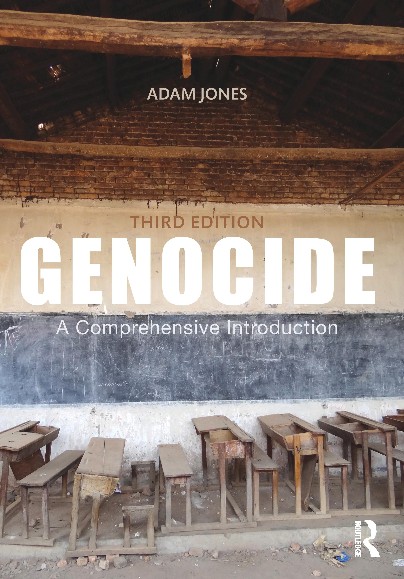
NOW AVAILABLE: Genocide: A Comprehensive Introduction, by Adam Jones (Routledge, 2006; 430 pp., US $33.95 pbk). See www.genocidetext.net. "The best introductory text available to students of genocide studies ... likely to become the gold standard by which all subsequent introductions to this enormously important subject will be measured" (Kenneth J. Campbell).
Thursday, January 11, 2007
NOW AVAILABLE: Genocide: A Comprehensive Introduction, by Adam Jones (Routledge, 2006; 430 pp., US $33.95 pbk). See www.genocidetext.net. "The best introductory text available to students of genocide studies ... likely to become the gold standard by which all subsequent introductions to this enormously important subject will be measured" (Kenneth J. Campbell).


Genocide Studies Media File
January 4-11, 2007
A compendium of news stories, features, and human rights reports pertaining to genocide and crimes against humanity. Compiled by Adam Jones. Please send links and feedback to adamj_jones@hotmail.com.
Consider inviting colleagues and friends to subscribe to Genocide_Studies and the G_S Media File. All it takes is an email to genocide_studies-subscribe@topica.com.
ARMENIAN GENOCIDE
"Headbangers Against Genocide"
By John Feffer
Foreign Policy in Focus, 4 January 2007
"[...] Serj Tankian is the lead singer of System of a Down, a popular rock group on the cusp of heavy metal. SOAD, as its fans like to call it, is part of a new generation of politically engaged rock groups. Like Rage Against the Machine or Green Day, SOAD produces some rousing antiwar songs (like 'BYOB' with its chorus of 'Why don't presidents fight the war? Why do they always send the poor?'). But the group also has a very specific political goal: to educate the world about the Armenian genocide. A new documentary, Screamers, tells the story of the 1915 genocide through the words, music, and activism of the four Armenian-American members of System of a Down. The film comes at a particularly important time. Despite repeated public avowals of 'never again' by many government leaders -- after Bosnia, after Rwanda -- genocide is again in the headlines because of Darfur. And Turkey continues to evade responsibility for the Armenian genocide even as it attempts to join the European Union and cement its alliances with the United States. Screamers, as genocide expert Samantha Powers explains in the film, are people who react viscerally to the horror of atrocity and won't stop screaming until something is done about it. The raw energy of System of a Down clearly resonates with its audience. But will such musical activism make waves outside the concert halls as well? [...]"
[n.b. Thanks to Ben Kiernan for supplying this link. System of a Down rocks!]
CONGO/FRANCE
"France to Probe Congo 'Massacre'"
BBC Online, 10 January 2007
"France's highest appeals court has ordered that an investigation be reopened into disappearances in the Republic of Congo in 1999. In 2002 a lower court threw out the case, brought against two Congolese officials with homes in France. About 350 refugees from conflict in Congo had fled to the neighbouring Democratic Republic of Congo when they disappeared returning to Brazzaville. Authorities in the Republic of Congo deny they were massacred. Rights groups and relatives of the missing say they were arrested, tortured and then executed upon their return to Congo on suspicion of backing an anti-government militia. The country's then chief of police, Jean-Francois Ndengue, was investigated but never charged while an international arrest warrant was issued for Gen Norbert Dabira. The two had homes in Meaux, east of Paris. This circumstance allowed French authorities to launch a case following legal action by relatives of some of those who disappeared. [...]"
EAST TIMOR/UNITED STATES
"East Timor a Dark Stain on Ford's Legacy"
By Hamish McDonald
The Sydney Morning Herald, 6 January 2007
"Speak nothing ill of the dead and all that, but the passing of the former United States president Gerald Ford invites mention of one big black spot in his record. None of the Washington eulogies or the mainstream media obituaries, about the decent everyman accidentally made president after the forced exits of Richard Nixon and Spiro Agnew, make note of it. This was the go-ahead Ford gave Indonesia's President Soeharto for his invasion of East Timor in 1975. Ford was first informed in July 1975 by the then secretary of state, Henry Kissinger, that with the Portuguese seeking to dump their colonies as quickly as possible, Soeharto planned to take East Timor, by force if necessary. Soeharto strongly hinted at this on a Washington visit later that month, and met no objections. In August, a coup instigated by Jakarta's Special Operations group started a civil war between rival Timorese parties, with the Portuguese stepping aside. Having just 'lost' Cambodia and South Vietnam to communist forces, Kissinger made it clear the US was not interested in upsetting the anti-communist Soeharto over Timor, especially as its socialist Fretilin party was emerging on top. His envoy in Jakarta, David Newsom, told Australia's Richard Woolcott that if Indonesia invaded, it should do so 'effectively, quickly, and not use our equipment.' [...]"
ETHIOPIA
"Ethiopian Dictator Sentenced to Life for Genocide"
Associated Press dispatch in USA Today, 11 January 2007
"Former Ethiopian dictator Mengistu Haile Mariam was sentenced to life imprisonment Thursday, ending a 12-year trial for genocide and other crimes committed during his iron-fisted rule. He was tried in absentia. Mengistu is unlikely to ever spend a day behind bars. He now lives comfortably in exile in Zimbabwe, which says it won't deport him as long as he refrains from political activity. Eleven of the former ruler's top officials were also sentenced to life while 47 other aides received sentences ranging up to 25 years, said lead judge Medhin Kiros. Relatives of victims of Mengistu's rule immediately criticized the verdict. 'This is a victory for Mengistu,' said Mulugeta Aserate, a cousin of Emperor Haile Selassie, who was ousted in a coup by Mengistu in 1994. 'These people should have been sentenced to death for mass murder of Ethiopian citizens.' Kiros told the packed courtroom he wanted the death penalty because of the nature of the crimes, but the two other judges wanted a lesser sentence. Chief prosecutor Yosef Kiros said immediately after sentencing that they may appeal because they want Mengistu to face the death penalty. The officials on trial showed no emotion as the sentences were read out."
[n.b. This is the complete text of the dispatch.]
FRANCE/RWANDAN GENOCIDE
"France's Shame?"
By Chris McGreal
The Guardian, 11 January 2007
"[...] When the genocide started, Paris made no secret of where its loyalties lay. The French military flew in ammunition for government forces and, in the following weeks, a stream of Hutu officials travelled to Paris, including Jean-Bosco Barayagwiza, who was later convicted of genocide by the international tribunal, for meetings with President François Mitterrand and the French prime minister. Even as the mass graves filled across Rwanda, Paris engineered the delivery of millions of dollars' worth of weapons to the Hutu regime from Egypt and South Africa. Africa has traditionally been considered such a special case in Paris that France's policy is run out of the presidency. At the time, the 'Africa cell' was headed by Mitterrand's son, Jean-Christophe, a close friend of the Habyarimanas. He later said that there could not have been a genocide because 'Africans are not that organised.' France's president did not deny what had happened, but took a view no less racist: 'In such countries, genocide is not too important.' Gérard Prunier, a French historian who advised the French government during the later stages of its intervention in Rwanda, has characterised Paris's view of its former African colonies not as foreign countries but as 'part of the family.' Paris's African 'back yard,' he wrote in a history of the Rwandan genocide -- in which he made clear his disaffection with French support for the Hutu regime -- 'remains its back yard because all the chicks cackle in French. There is a high degree of symbiosis between French and Francophone African political elites. It is a mixture of many things: old memories, shared material interests, delusions of grandeur, gossip, sexual peccadilloes.' [...]"
"Rwanda Leader's Widow Denied Asylum in France"
Agence France-Presse dispatch (on TocquevilleConnection.com), 10 January 2007
"The widow of Rwanda's former president Juvenal Habyarimana, whose murder sparked the 1994 genocide, has been denied asylum by France on the grounds she may have played a role in the killing spree, a judicial source said Wednesday. Agathe Habyarimana's July 2004 request for asylum was turned down on January 4 by France's refugee office OFPRA, which said in its ruling that she may have taken part 'as a[n] instigator or accomplice' in the 'crime of genocide.' Habyarimana, who has lived in France since she was evacuated by French troops after the genocide, will have a chance to appeal the decision before a refugees' commission on January 25. One of her lawyers, Philippe Meilhac, denounced the decision as baseless, pointing out that no action has been taken against her by the International Criminal Tribunal for Rwanda (ICTR) trying the perpetrators of the genocide. Habyarimana is a civil plaintiff in a French investigation into the downing of the plane carrying her husband, a Hutu, on April 6, 1994, which touched off the massacre of close to 800,000 people, mainly minority Tutsis. Rwanda broke diplomatic relations with France last month after the judge in charge of the case called for President Paul Kagame, a Tutsi, to face trial over Habyarimana's death. Kagame has always denied any involvement."
[n.b. This is the complete text of the dispatch.]
GERMANY/JEWISH HOLOCAUST
"Trial and Terror"
By J. Hoberman
The Village Voice, 9 January 2007
"After 20 months and 300 witnesses, 'the horrific has become almost routine.' So the narrator notes late in Verdict on Auschwitz, a 1993 German documentary on the mid-'60s trial of 22 SS men, just now getting an American release. If anything, the story of the Auschwitz genocide factory is today even more familiar—which makes the defamiliarizing 'German' quality of this three-hour doc all the more necessary. Directed by Rolf Bickel and Dietrich Wagner, Verdict on Auschwitz is less epic in its aspirations than Claude Lanzmann's monumental Shoah and less critical in its approach than The Specialist, in which Eyal Sivan revisited the Eichmann trial as theater. The model is Alain Resnais's Night and Fog; Verdict on Auschwitz similarly juxtaposes archival footage and postwar material (both 1963 and 1993) to produce shocking eruptions of past atrocities in the context of an orderly everyday Europe. [...]"
INDIA
"Fear and Anger in Assam's Village of Dead"
By Subir Bhaumik
BBC Online, 9 January 2007
"The dance of death around this town in the northern Indian state of Assam seems to have abated at least for the moment. But the panic amongst the Hindi-speaking settlers here is all-pervading, despite huge deployment of troops and policemen. 'I don't know why they are killing us. We are poor labourers, we cause no harm to the local Assamese. We only come here to make a living to stay alive,' says Shiv Kumar, who comes from Chhapra district in the impoverished northern state of Bihar. Kumar has worked in a brick factory in the village of Tingri near here for the last 12 years. 'I lost my brother in front of my eyes. His body was riddled with bullets on Friday night,' says Shiv Kumar. 'We will all die here, the police can't protect us,' adds Kumar's neighbour Prem Nath. Nath's brother died on Friday, too, when more than 10 suspected members of the United Liberation Front of Assam (Ulfa), clad in olive green fatigues, stormed into the labourer's colony at Tingri and opened fire with assault rifles. They killed five men. [...]"
"Migrant Workers Massacred in India"
Associated Press dispatch in The Star (Toronto), 6 January 2007
"Suspected separatist rebels fatally shot 42 migrant workers and wounded 19 others in at least 10 separate attacks launched late Friday and early Saturday in India's remote northeast, officials said. The attacks targeted poor, Hindi-speaking migrants mostly from the nearby state of Bihar and were likely carried out by United Liberation Front of Asom rebels, R.N. Mathur, Assam's police chief, told The Associated Press. Most people in the state speak Assamese. Migrant workers are frequently attacked by Assam separatists in an effort to draw the federal government's attention to their claims for autonomy. But this was the worst spate of violence in the region in recent years. The most lethal attack was Saturday's pre-dawn shooting of 13 workers while they slept in the remote town of Sadiya in Assam, 600 kilometres east of the state capital Gauhati, local administrative officer Absar Hazarika said. On Friday, 29 people were fatally shot in several incidents in the tea-growing districts of Tinsukia and Dibrugarh, 500 to 600 kilometres east of Gauhati, Mathur said. Details on individual attacks were not immediately available. ULFA has not claimed responsibility for the attacks and rebel officials don't usually comment on such incidents. [...]"
[n.b. Though it has been all but invisible in the coverage of this event, the latest Assam massacre seems a classic gendercidal attack, targeting Hindi-speaking "daily wage earners and petty traders," according to one Indian police official -- i.e., overwhelmingly poor males, as in the last spate of such attacks in 2000.]
"Monsanto, Cereal Killer GM and Agrarian Suicides in India"
By Alejandro Nadal
ZNet, 6 January 2007
"[...] The Indian Ministry of Agriculture admits to the following figures: there were 100,000 suicides by farmers between 1993 and 2003. And between 2003 and October 2006, there have been some 16,000 suicides by farmers each year. In total, between 1993 and 2006, there were around 150,000 suicide by farmers, 30 a day for 13 years! The Maharashtra government itself accepts the figure of 1,920 farmers’ suicides in Vidarbha between January 2001 and August 2006. Farmers’ organisations of the district state that there were 782 suicides by agricultural producers. Data for the past three months indicate that on average there was a suicide every eight hours. What conditions give rise to a suicide rate of about 30 farmers a day? It is said that the reason for this is indebtedness, but the ultimate reason is the imposition of a completely unsuitable agricultural technology, as much from the economic as from the environmental viewpoint. Anil Shinde had decided to plant Bt cotton, a transgenic variety produced by Monsanto that supposedly reduces the need for insecticides and increases the return for the grower. Shinde is not an exception. Hundreds of farmers who had planted transgenic cotton in the states of Maharashtra, Andhra Pradesh and Karnataka have sought suicide as way out of a desperate situation that worsens year after year. [...]"
IRAQ
"Court Hears Tape of Saddam Plotting to Gas the Kurds"
By Kim Sengupta
The Independent, 9 January 2007
"The voice of Saddam Hussein was heard in a Baghdad court yesterday discussing the gassing of Kurds with his cousin 'Chemical Ali' Hassan al-Majid. With the chair of the hanged former Iraqi president empty in the dock, the prosecution played a tape in which Saddam allegedly discusses using chemical weapons on Kurds. 'I will strike them with chemical weapons and kill them all,' a voice said to be Mr. Majid is heard saying. 'Who is going to say anything? The international community? A curse on the international community!' Another voice, said to be Saddam's, says, 'Yes, it's effective, especially on those who don't wear a mask immediately, as we understand.' A third voice, from the back, asks: 'Sir, does it exterminate thousands?' 'Saddam' responds: 'Yes, it exterminates thousands and forces them not to eat or drink and they will have to evacuate their homes without taking anything with them.' Yesterday's proceedings began with the judge officially dismissing all charges against the dead president, including genocide, in relation to the Anfal campaign against the Kurds in which more than 100,000 people were killed. [...]"
"Grim Images of Massacre Found on US Laptops"
By Josh White
The Sydney Morning Herald, 8 January 2007
"United States investigators have tracked down dozens of gruesome photographs taken by marines of 24 Iraqi civilians massacred in Haditha. The images, found on laptop computers and digital media drives, provide evidence of a series of shootings beside a taxi and inside three homes that military criminal investigators have alleged were murders. The images have provided the Naval Criminal Investigative Service with powerful and visceral evidence of what happened in Haditha on November 19, 2005. Many photographs were on laptop computers that had been shipped back to the US, and deleted images were also recovered from a Sony PlayStation Portable memory drive, investigative documents showed. Marines were found to have downloaded the images from each other's devices, traded them and loaded them onto personal websites. One marine told investigators he saw some photographs set to music on another marine's computer. Some were emailed from Iraq to a civilian in the US. [...]"
"Shiite Happens"
By Charles Krauthammer
National Review Online, 5 January 2007
"[...] True, Saddam's hanging was just and, in principle, nonsectarian. But the next hanging might not be. Breaking precedent completely undermines the death penalty provision, opening the way to future revenge and otherwise lawless hangings. Moreover, Maliki's rush to execute short-circuited the judicial process that was at the time considering Saddam's crimes against the Kurds. He was hanged for the killing of 148 men and boys in the Shiite village of Dujail. This was a perfectly good starting point -- a specific incident as a prelude to an inquiry into the larger canvas of his crimes. The trial for his genocidal campaign against the Kurds was just beginning. That larger canvas will never be painted. The starting point became the endpoint. The only charge for which Saddam was executed was that 1982 killing of Shiites -- interestingly, his response to a failed assassination attempt by Maliki's own Dawa Party. Maliki ultimately got his revenge, completing Dawa's mission a quarter-century later. However, Saddam will now never be tried for the Kurdish genocide, the decimation of the Marsh Arabs, the multiple war crimes and all the rest. Finally, there was the motley crew -- handpicked by the government -- that constituted the hanging party. They turned what was an act of national justice into a scene of sectarian vengeance. The world has now seen the smuggled video of the shouting and taunting that turned Saddam into the most dignified figure in the room -- another remarkable achievement in burnishing the image of the most evil man of his time. [...]"
ISRAEL/PALESTINE
"Israeli Documentary Captures Citizen Reconciliation -- and Encourages More"
By Ilene R. Prusher
The Christian Science Monitor, 10 January 2007
"With Kassam rockets falling more often than rain, this is a town where it would be easy to give up hope. But four young women -- an Israeli-Canadian, a Palestinian, a Jewish-American, and a Brazilian -- want to present a different picture. The result is 'Encounter Point,' a new documentary being shown in theaters around Israel and the US. It's set to be aired across the Arab world on Al Arabiyah satellite TV. For viewers here or anywhere else in the region or world affected by the Israeli-Palestinian conflict, the film is a chance to hear those on both sides not just talking, but listening. 'Encounter Point' is indeed a movie with a mission of fostering dialogue, in large part by discovering that many Arabs and Jews who have lost immediate family members are already engaged in the conversation, despite what seems like a rising tide of hostility. The film profiles real yet extraordinary Israelis and Palestinians, some who meet regularly as part of the Bereaved Families Forum or with other groups that promote reconciliation. These meetings show that at the heart of the war zone, people are going to great lengths to meet one another -- and to convince their countrymen to give peace another chance. 'We are hoping that "Encounter Point" can be the beginning of some constructive communitywide dialogue,' says producer Nahanni Rous, a Jewish-American woman who grew up in New Hampshire, spent several years in Israel, and now lives in Washington. [...]"
PERU
"Ruling on Shining Path Rebels Angers Peru"
Reuters dispatch in The New York Times, 10 January 2007 [Registration Required]
"A ruling by an international human rights court telling Peru’s government to honor 41 leftist rebels killed in a 1992 prison raid has provoked public indignation, and the government is considering withdrawing from the court. The ruling has reopened scars of a rebellion that raged from 1980 to 1998. Javier Velásquez, leader of the governing APRA party in Congress, said after meeting with President Alan García on Monday that the authorities were mulling Peru’s withdrawal from the Inter-American Court of Human Rights, which issued the ruling. The court serves to uphold and promote human rights in the Americas under the 1969 American Convention on Human Rights. The court demanded in December that the government apologize for the bloody 1992 raid on the Miguel Castro prison, pay compensation to the families of 41 rebels from the Maoist Shining Path group killed there and put their names on a monument to thousands of victims of hostilities in Peru. The verdict set off a wave of anger in Peru over what many see as honoring terrorists and killers."
[n.b. This is the complete text of the dispatch.]
"Terror, Bribery and Intrigue: The Bloody Past Fuelling Lima's Literary Renaissance"
By Rory Carroll
The Guardian, 5 January 2007
"It was a cruel, bloody and terrifying era. Rebels slaughtered villagers in the mountains and hung dogs from power lines, their carcasses daubed with Maoist slogans. The state responded with a Machiavellian mix of assassination, bribery and intrigue which brought down the rebel leader but also triggered the fall of the president. Some call that period in Peru's history a successful counter-insurgency. Others call it a cautionary tale about the cost to democracy of fighting terrorism. Others simply call it a nightmare. Whatever you call it, however, there is no denying one thing: it is a great story. Now, more than a decade after the waning of the Shining Path rebellion, the conflict's legacy is fuelling a literary renaissance. Peruvian writers are blazing a trail through Spanish and English language publishing with books exploring a saga as fascinating as it is painful. In the past year two of the three top literary prizes in Spanish have been won by novelists from the capital, Lima. Alonso Cueto won the Herralde award for The Blue Hour, about a lawyer who discovers that his naval officer father tortured prisoners. Santiago Roncagliolo received the Alfaguara prize for Red April, which follows a prosecutor's attempt to unravel a murder in Ayacucho, a pre-Inca citadel which became a cradle of the Shining Path in the 1970s. Daniel Alarcón, who was born in Lima but grew up in the US and writes in English, was shortlisted for the 2006 PEN/Hemingway award for his short story collection, War by Candlelight. [...]"
RWANDA
"Genocide Trial for Rwanda Prefect"
By Robert Walker
BBC Online, 7 January 2007
"The trial of a former Rwandan official accused of being a main perpetrator of the genocide is due to begin at the UN war crimes tribunal in Tanzania. Colonel Tharcisse Renzaho, former prefect of the Rwandan capital, Kigali, faces charges of genocide and complicity in genocide. Some 800,000 people, most of them Tutsis, were killed by Hutu extremists during the massacres in 1994. Col. Renzaho, who was arrested in DR Congo in 2002, has denied the charges. During the genocide in Rwanda, Col Renzaho was in control of the capital's police force and local officials. But rather than using this authority to stop the killings, it is alleged that he incited Hutus to kill members of the Tutsi minority. The prosecution says Col Renzaho used state radio to instruct the police and army, as well as civilians, to man roadblocks so they could identify and intercept Tutsis. It is alleged he told local officials that anyone with a Tutsi wife should also be deemed Inyenzi -- a cockroach -- the term used by Hutu extremists to describe Tutsis. Col. Renzaho faces life imprisonment if convicted. [...]"
SOMALIA
"Ethiopia's Invasion of Somalia Has U.S. Fingerprints"
By Amina Mire
The Progressive, 4 January 2007
"For the average American, the current Ethiopian invasion of Somalia is just another military operation taking place in a distant land in the war against Islamic terror. For Somalis, this invasion is nothing short of a humiliating catastrophe. ... The reason the Islamists rose to power in the Somali capital of Mogadishu in the first place was because the CIA covertly financed Somali warlords, channeling hundreds of thousands of dollars over the past year to them, according to news reports. Many Somalis, who are not religious, saw their own safety and security improved under the rule of the Islamists. They were willing to give them sufficient time to clean the streets of guns and violence. After restoring law and order on the streets, the Islamists could have chosen to modernize, albeit slowly, some of their interpretations and the applications of Islamic Shariah law, which are already part of the Somali cultural value system. A large number of Somalis living overseas were willing to return to Somalia and rebuild the country once peace and security were ensured. But now, we are back to the old, ugly days where teenage boys toting AK-47s in the back of pickup trucks terrorize the local population. ... The Somali population is armed to the teeth, humiliated and angry. It will vent its anger not only against the occupying forces but also against those who brought the occupying forces into the country -- the United States. Unless quickly defused, the situation in Somalia could turn into a killing field. After more than a decade of civil war and amid a subcontinent torn by genocide in Rwanda and Sudan, the future of Somalia again looks grim -- thanks, in part, to U.S. policy."
SOUTH AFRICA/ICC
"Genocide Charge Laid against TAC Head"
By Murray Williams and Jillian Green
Cape Argus (on iol.co.za), 11 January 2007
"A charge of genocide has been laid against Treatment Action Campaign head Zackie Achmat at the International Criminal Court in The Hague, Netherlands, for promoting the provision and use of antiretroviral drugs to treat HIV. This is the latest attack in the long-running battle between the TAC and its arch-rivals who vehemently oppose the use of ARVs. The TAC has been at the forefront of the battle to get the government to provide the drugs to HIV-positive people. A 59-page criminal complaint has been laid against Achmat by Cape Town advocate Anthony Brink of the Treatment Information Group (TIG). Brink admits that he gets funding from a foundation set up by controversial Aids treatment figure Dr Matthias Rath. In documents, he calls on the court to charge and find Achmat 'guilty of genocide -- the most serious crimes of concern to the international community as a whole.' He alleges that Achmat has played a 'direct criminal role in the deaths of thousands of South Africans from poisoning from so-called antiretroviral drugs.' He said on Thursday morning from his home in Tamboerskloof: 'Recent research data cited in the complaint (submitted at The Hague) demonstrates (ARVs) are killing thousands of people in South Africa -- mostly black and mostly poor. TAC leader Zackie Achmat correctly claims personal responsibility for getting these drugs into the public health system, and, accordingly, is personally criminally culpable for the deadly consequences.' Brink has asked the court to impose the harshest sentence on him -- 'permanent confinement in a small white steel and concrete cage, bright fluorescent light on all the time to keep an eye on him.' A TAC spokesperson described the complaint as 'the rantings and ravings of a madman' and said it 'does not deserve comment.' According to the latest available statistics, an estimated 5,5 million people are HIV-positive in South Africa. At least 500 000 of them need to be on ARV treatment."
[n.b. Provided for curiosity more than anything else; it is hard to disagree with the evaluation of the TAC spokesman that this is madness.]
SUDAN/DARFUR
"Africa's Inferno"
By Brian Brivati
New Statesman, 15 January 2007
"[...] It is clear what needs to be done to bring peace to Darfur. But will it happen? A humanitarian disaster is unfolding before our eyes and cannot be prevented. A hybrid force may gradually be deployed over the next eight or nine months, by which time many thousands will have died and the government and rebels alike will have become radicalised by each other's actions. The fighting will continue to spill into neighbouring states. The civil war in Sudan between north and south may start again. But the long-term consequences of Darfur will go far beyond these terrible possibilities. They will be profound for the system of international relations in the post-Iraq-war world and they will seriously challenge European ideas of the universalism of human rights. This universalism holds that there are some things that all human beings should enjoy and some things no human being should endure. Western imperialism can be blamed for many things, but there is no imperialist explanation for why African, Asian and Arab states do not act over Darfur. They face no logistical obstacle to establishing a no-fly zone. The problem is one of will, not agency or capability. What ought to unite us against genocide is that, in the end, there is no conceivable geopolitical gain to be had from working with genocidal regimes. The path they have embarked upon has no strategic dimension and it will, in time, self-destruct. These are allies you do not wish to have, neighbours you cannot trust, crimes you cannot live with."
"Sudanese President Says U.N. Forces Are Not Needed in Darfur"
Associated Press dispatch in USA Today, 10 January 2007
"Sudanese President Omar al-Bashir rejected Wednesday the deployment of U.N. troops in Darfur, saying they were not required and that African Union troops could maintain order in the war-wracked region of western Sudan. His comment contradicted statements by Sudanese officials, who said last month the government would accept a limited number of U.N. forces, as well those of AU officials who had proposed that the world body take over peacekeeping in Darfur. 'Our experience with U.N. operations in the world is not encouraging,' al-Bashir told an Associated Press reporter Wednesday at his residence. 'There are sufficient forces in the Sudan from African countries to maintain order, and they can provide order,' al-Bashir said. Meanwhile, the U.N. mission in Sudan said Wednesday that over 20 people were killed and 14 wounded during tribal fighting in North Darfur. The U.N. said the clashes occurred between the Mima and Zaghawa tribes on Monday and Tuesday, less than 100 miles from El Fasher as Richardson was visiting the North Darfur capital. The U.N. statement did not say why the fighting occurred. [...]"
"Sudan Orders Air Strikes on Darfur Before Arrival of UN Peacekeepers"
By Jonathan Erasmus
The Daily Telegraph, 8 January 2007
"The Sudanese government has unleashed a fresh aerial bombing campaign in Darfur in an attempt to inflict as much damage as possible on rebel forces before United Nations troops arrive in the region. Under the Darfur Peace Agreement, Sudan agreed not to continue aerial attacks over the region. But rebels claim villages have been bombed. Antonov bombers and helicopter gunships are reported to have attacked villages and fired on civilians in open defiance of UN efforts to bring an end to the fighting. The attacks are in breach of UN Security Council resolution 1591, passed in March 2005, forbidding 'offensive military flights in and over the Darfur region.' The new surge of attacks is targeting rebel strongholds throughout Darfur, where militias have secured key territories. The African Union force commander, Major Gen Luke Aprezi, confirmed the attacks and said they followed talks with rebel groups in which he agreed a ceasefire commitment that he now fears may no longer hold. In October, The Sunday Telegraph witnessed Sudanese soldiers loading bombs on to Antonov aircraft at El Fasher air base in North Darfur before a number of villages were attacked. Last week, new arrivals at the Otash camp in the South Darfur capital, Nyala, said they were forced to flee their villages when government helicopter gunships opened fire on them. 'Out of nowhere, helicopters were over the village firing at us,' said Asir Ibrahim, who fled his home near the southern town of Buram. 'I called my wife and children from my home and we starting running. Some people were hit, but it was such mayhem I don't know what happened to many of them. I don't know whether they fled or were killed.' [...]"
"The Black Holocaust"
By Nat Hentoff
The Village Voice, 7 January 2007
"[...] In the last days before he left office on December 24, Kofi Annan, still painfully cognizant of his complicity in the Rwanda genocide, was pressing the National Islamic Front government in Khartoum to fulfill its agreement to this most recent U.N. resolution to save untold thousands of black Muslim lives in Darfur and the refugee camps. But he was honest enough to say, the day before he left, that he takes 'nothing for granted,' in view of his experiences with General al-Bashir. The doomsday prospect of another monstrous shell game by al-Bashir was laid out last month by Eric Reeves, the single most continuously authoritative analyst of Khartoum's crimes against its own people. A professor at Smith College in Massachusetts, Reeves has for years devoted most of his life to alerting the world to this black holocaust. As prospects seemed to brighten for a change in al-Bashir's cold, cold heart, Reeves set the scene on his website, sudanreeves.org: 'The U.S. attempts to bluff Khartoum's genocidaires with "Plan B"; Kofi Annan seeks to burnish his legacy ... the European Union and Canada offer nothing but more bluster; the Arab League continues its mendacious ways; the African Union is a shambles ... Full-scale humanitarian collapse in Darfur looms ever closer even as the violence that will occasion the collapse relentlessly increases. Hundreds of humanitarian workers have been evacuated in recent weeks from North Darfur and eastern Chad. ... This is the ghastly, inescapable syllogism of genocidal destruction in Darfur.' [...]"
"Renewed Push for Peace in Darfur"
By Evelyn Leopold
Reuters dispatch in The Main & Guardian (South Africa), 6 January 2007
"The United Nations and the African Union announced on Friday a new push for peace talks in Sudan's Darfur region to get splinter rebel groups and the government to stop fighting each other. The Khartoum government and one rebel group signed a peace agreement last April. But since then violence has escalated, Sudan has sent troops into Darfur, where at least 200 000 people have died in three years, and UN efforts for a robust peacekeeping force have been stalled by Khartoum. Jan Eliasson, a former Swedish foreign minister, UN official and the current special envoy for Darfur, told reporters the object was to reduce the level of violence through the political process. But Eliasson said his job was not to negotiate a peacekeeping force, which would be done by other UN officials. Elliasson left on Friday for meetings at the AU headquarters in Addis Ababa in Ethiopia, after which he will go to Khartoum and then Darfur before returning to Addis Ababa for an AU summit, the UN said. He and Salim Ahmed Salim, the AU's Darfur envoy, conferred with new UN Secretary General Ban Ki-moon of South Korea, who will also go to the AU summit. Sudan has more or less agreed to a 'hybrid' AU-UN force in Darfur, but has rejected the 20,000 peacekeepers and police the Security Council wanted to send to support the 7,000 under-equipped AU troops now in Darfur. An AU-UN team is to work out the numbers. [...]"
ZIMBABWE
"Zimbabwe, The Land of Dying Children"
By R.W. Johnson
The Sunday Times, 7 January 2007
"Suffer the little children is a phrase never far from your mind in today’s Zimbabwe. The horde of painfully thin street children milling around you at traffic lights is almost the least of it: in a population now down to 11m or less there are an estimated 1.3m orphans. Go to one of the overflowing cemeteries in Bulawayo or Beit Bridge and you are struck by the long lines of tiny graves for babies and toddlers. A game ranger friend tells me that hyena attacks on humans, previously unheard of, have become increasingly common. 'So many babies, not all of them dead, are being dumped in the bush that hyenas have developed a taste for human flesh,' he explains. Under the weight of the general economic meltdown -- the economy has shrunk by 40% since 2000 and is still contracting — the health system has collapsed and a populace now weakened by five consecutive years of near-starvation dies of things which would never have been fatal before. A staggering 42,000 women died in childbirth last year, for example, compared with fewer than 1,000 a decade ago. A vast human cull is under way in Zimbabwe and the great majority of deaths are a direct result of deliberate government policies. Ignored by the United Nations, it is a genocide perhaps 10 times greater than Darfur’s and more than twice as large as Rwanda's. Genocide is not a word one should use hastily but the situation is exactly as described in the UN Convention on Genocide, which defines it as 'deliberately inflicting on the group conditions of life calculated to bring about its physical destruction in whole or in part.' ... After Rwanda, the UN vowed 'never again' but [Zimbabwean President Robert] Mugabe -- and, to a considerable extent, [South African President Thabo] Mbeki -- have already been responsible for far more deaths than Rwanda suffered and the number is fast heading into realms previously explored only by Stalin, Mao and Adolf Eichmann. [...]"
ISSUE: THE ENVIRONMENT
"Pollution Crisis Forces Iran to Clean Up Air"
By Robert Tait
The Sydney Morning Herald, 11 January 2007
"Officials in Iran have warned that the notoriously polluted air of its capital could cause a catastrophe, after figures showed 120 people a day had died from toxic fumes. The potential effects have been compared to those of a large earthquake, with 3600 people reported to have died from pollution-related illnesses in four weeks during October and November. The figures were released by officials heading a government program to cut pollution in Tehran, home to 12 million people. The statistics add to last year's 9900 reported deaths from the effects of nitrous oxide and dust particles. Environmentalists say the poisonous cocktail is compounded by 2 million tonnes of carbon monoxide and 180,000 tonnes of hydrocarbons pumped out annually. From tomorrow, city authorities will offer free air filters and services to the owners of Paykans, the Iranian-built cars that are blamed for many of the environmental problems. About 1000 old buses will be withdrawn and gas-fuelled buses and taxis will be introduced. The head of Tehran city council's clean air office, Mohammed Hadi Haidarzadeh, said life in the city amounted to 'mass suicide.' 'The danger posed by Tehran's air pollution crisis is no less than an earthquake, with the difference that the destructive effects of an earthquake are instantaneous, whereas air pollution kills innocent people gradually,' he said. [...]"
[n.b. With respect to Mr. Haidarzadeh, earthquakes are natural phenomena, and choking pollution a man-made one; which suggests that a better analogy than "mass suicide" would be "mass killing."]
ISSUE: INTERNATIONAL PEACEKEEPING
"Sudan to Probe Allegations of UN Sex Abuse"
Reuters dispatch in The Mail & Guardian (South Africa), 4 January 2007
"Sudan on Thursday described the alleged sexual abuse of children by United Nations peacekeepers in south Sudan as 'outrageous' and said it would launch its own investigation into the affair. The UN said on Wednesday it was investigating 13 cases of serious misconduct, including sexual abuse and exploitation in south Sudan. Britain's Daily Telegraph newspaper said on Wednesday that UN peacekeepers and civilian staff were raping and abusing children as young as 12 in southern Sudan. The paper said it had interviewed 20 young victims in the south Sudan capital, Juba. 'We are very concerned. It is outrageous,' foreign ministry spokesperson Ali al-Sadig told Reuters. 'If anyone has committed such crimes they should face the full weight of the law,' he added. He said the Khartoum government would launch an investigation into the matter. Any UN personnel found guilty of such crimes would be dealt with by the UN and not under Sudanese law. More than 11,000 UN police and troops are in Sudan to monitor a north-south peace deal, which will mark its second anniversary next week. [...]"
[n.b. See also "U.N. Probes over 300 for Alleged Sexual Abuse," Associated Press dispatch on MSNBC.com, 6 January 2007, http://www.msnbc.msn.com/id/16495713/.]
Consider inviting colleagues and friends to subscribe to Genocide_Studies and the G_S Media File. All it takes is an email to genocide_studies-subscribe@topica.com.
ARMENIAN GENOCIDE
"Headbangers Against Genocide"
By John Feffer
Foreign Policy in Focus, 4 January 2007
"[...] Serj Tankian is the lead singer of System of a Down, a popular rock group on the cusp of heavy metal. SOAD, as its fans like to call it, is part of a new generation of politically engaged rock groups. Like Rage Against the Machine or Green Day, SOAD produces some rousing antiwar songs (like 'BYOB' with its chorus of 'Why don't presidents fight the war? Why do they always send the poor?'). But the group also has a very specific political goal: to educate the world about the Armenian genocide. A new documentary, Screamers, tells the story of the 1915 genocide through the words, music, and activism of the four Armenian-American members of System of a Down. The film comes at a particularly important time. Despite repeated public avowals of 'never again' by many government leaders -- after Bosnia, after Rwanda -- genocide is again in the headlines because of Darfur. And Turkey continues to evade responsibility for the Armenian genocide even as it attempts to join the European Union and cement its alliances with the United States. Screamers, as genocide expert Samantha Powers explains in the film, are people who react viscerally to the horror of atrocity and won't stop screaming until something is done about it. The raw energy of System of a Down clearly resonates with its audience. But will such musical activism make waves outside the concert halls as well? [...]"
[n.b. Thanks to Ben Kiernan for supplying this link. System of a Down rocks!]
CONGO/FRANCE
"France to Probe Congo 'Massacre'"
BBC Online, 10 January 2007
"France's highest appeals court has ordered that an investigation be reopened into disappearances in the Republic of Congo in 1999. In 2002 a lower court threw out the case, brought against two Congolese officials with homes in France. About 350 refugees from conflict in Congo had fled to the neighbouring Democratic Republic of Congo when they disappeared returning to Brazzaville. Authorities in the Republic of Congo deny they were massacred. Rights groups and relatives of the missing say they were arrested, tortured and then executed upon their return to Congo on suspicion of backing an anti-government militia. The country's then chief of police, Jean-Francois Ndengue, was investigated but never charged while an international arrest warrant was issued for Gen Norbert Dabira. The two had homes in Meaux, east of Paris. This circumstance allowed French authorities to launch a case following legal action by relatives of some of those who disappeared. [...]"
EAST TIMOR/UNITED STATES
"East Timor a Dark Stain on Ford's Legacy"
By Hamish McDonald
The Sydney Morning Herald, 6 January 2007
"Speak nothing ill of the dead and all that, but the passing of the former United States president Gerald Ford invites mention of one big black spot in his record. None of the Washington eulogies or the mainstream media obituaries, about the decent everyman accidentally made president after the forced exits of Richard Nixon and Spiro Agnew, make note of it. This was the go-ahead Ford gave Indonesia's President Soeharto for his invasion of East Timor in 1975. Ford was first informed in July 1975 by the then secretary of state, Henry Kissinger, that with the Portuguese seeking to dump their colonies as quickly as possible, Soeharto planned to take East Timor, by force if necessary. Soeharto strongly hinted at this on a Washington visit later that month, and met no objections. In August, a coup instigated by Jakarta's Special Operations group started a civil war between rival Timorese parties, with the Portuguese stepping aside. Having just 'lost' Cambodia and South Vietnam to communist forces, Kissinger made it clear the US was not interested in upsetting the anti-communist Soeharto over Timor, especially as its socialist Fretilin party was emerging on top. His envoy in Jakarta, David Newsom, told Australia's Richard Woolcott that if Indonesia invaded, it should do so 'effectively, quickly, and not use our equipment.' [...]"
ETHIOPIA
"Ethiopian Dictator Sentenced to Life for Genocide"
Associated Press dispatch in USA Today, 11 January 2007
"Former Ethiopian dictator Mengistu Haile Mariam was sentenced to life imprisonment Thursday, ending a 12-year trial for genocide and other crimes committed during his iron-fisted rule. He was tried in absentia. Mengistu is unlikely to ever spend a day behind bars. He now lives comfortably in exile in Zimbabwe, which says it won't deport him as long as he refrains from political activity. Eleven of the former ruler's top officials were also sentenced to life while 47 other aides received sentences ranging up to 25 years, said lead judge Medhin Kiros. Relatives of victims of Mengistu's rule immediately criticized the verdict. 'This is a victory for Mengistu,' said Mulugeta Aserate, a cousin of Emperor Haile Selassie, who was ousted in a coup by Mengistu in 1994. 'These people should have been sentenced to death for mass murder of Ethiopian citizens.' Kiros told the packed courtroom he wanted the death penalty because of the nature of the crimes, but the two other judges wanted a lesser sentence. Chief prosecutor Yosef Kiros said immediately after sentencing that they may appeal because they want Mengistu to face the death penalty. The officials on trial showed no emotion as the sentences were read out."
[n.b. This is the complete text of the dispatch.]
FRANCE/RWANDAN GENOCIDE
"France's Shame?"
By Chris McGreal
The Guardian, 11 January 2007
"[...] When the genocide started, Paris made no secret of where its loyalties lay. The French military flew in ammunition for government forces and, in the following weeks, a stream of Hutu officials travelled to Paris, including Jean-Bosco Barayagwiza, who was later convicted of genocide by the international tribunal, for meetings with President François Mitterrand and the French prime minister. Even as the mass graves filled across Rwanda, Paris engineered the delivery of millions of dollars' worth of weapons to the Hutu regime from Egypt and South Africa. Africa has traditionally been considered such a special case in Paris that France's policy is run out of the presidency. At the time, the 'Africa cell' was headed by Mitterrand's son, Jean-Christophe, a close friend of the Habyarimanas. He later said that there could not have been a genocide because 'Africans are not that organised.' France's president did not deny what had happened, but took a view no less racist: 'In such countries, genocide is not too important.' Gérard Prunier, a French historian who advised the French government during the later stages of its intervention in Rwanda, has characterised Paris's view of its former African colonies not as foreign countries but as 'part of the family.' Paris's African 'back yard,' he wrote in a history of the Rwandan genocide -- in which he made clear his disaffection with French support for the Hutu regime -- 'remains its back yard because all the chicks cackle in French. There is a high degree of symbiosis between French and Francophone African political elites. It is a mixture of many things: old memories, shared material interests, delusions of grandeur, gossip, sexual peccadilloes.' [...]"
"Rwanda Leader's Widow Denied Asylum in France"
Agence France-Presse dispatch (on TocquevilleConnection.com), 10 January 2007
"The widow of Rwanda's former president Juvenal Habyarimana, whose murder sparked the 1994 genocide, has been denied asylum by France on the grounds she may have played a role in the killing spree, a judicial source said Wednesday. Agathe Habyarimana's July 2004 request for asylum was turned down on January 4 by France's refugee office OFPRA, which said in its ruling that she may have taken part 'as a[n] instigator or accomplice' in the 'crime of genocide.' Habyarimana, who has lived in France since she was evacuated by French troops after the genocide, will have a chance to appeal the decision before a refugees' commission on January 25. One of her lawyers, Philippe Meilhac, denounced the decision as baseless, pointing out that no action has been taken against her by the International Criminal Tribunal for Rwanda (ICTR) trying the perpetrators of the genocide. Habyarimana is a civil plaintiff in a French investigation into the downing of the plane carrying her husband, a Hutu, on April 6, 1994, which touched off the massacre of close to 800,000 people, mainly minority Tutsis. Rwanda broke diplomatic relations with France last month after the judge in charge of the case called for President Paul Kagame, a Tutsi, to face trial over Habyarimana's death. Kagame has always denied any involvement."
[n.b. This is the complete text of the dispatch.]
GERMANY/JEWISH HOLOCAUST
"Trial and Terror"
By J. Hoberman
The Village Voice, 9 January 2007
"After 20 months and 300 witnesses, 'the horrific has become almost routine.' So the narrator notes late in Verdict on Auschwitz, a 1993 German documentary on the mid-'60s trial of 22 SS men, just now getting an American release. If anything, the story of the Auschwitz genocide factory is today even more familiar—which makes the defamiliarizing 'German' quality of this three-hour doc all the more necessary. Directed by Rolf Bickel and Dietrich Wagner, Verdict on Auschwitz is less epic in its aspirations than Claude Lanzmann's monumental Shoah and less critical in its approach than The Specialist, in which Eyal Sivan revisited the Eichmann trial as theater. The model is Alain Resnais's Night and Fog; Verdict on Auschwitz similarly juxtaposes archival footage and postwar material (both 1963 and 1993) to produce shocking eruptions of past atrocities in the context of an orderly everyday Europe. [...]"
INDIA
"Fear and Anger in Assam's Village of Dead"
By Subir Bhaumik
BBC Online, 9 January 2007
"The dance of death around this town in the northern Indian state of Assam seems to have abated at least for the moment. But the panic amongst the Hindi-speaking settlers here is all-pervading, despite huge deployment of troops and policemen. 'I don't know why they are killing us. We are poor labourers, we cause no harm to the local Assamese. We only come here to make a living to stay alive,' says Shiv Kumar, who comes from Chhapra district in the impoverished northern state of Bihar. Kumar has worked in a brick factory in the village of Tingri near here for the last 12 years. 'I lost my brother in front of my eyes. His body was riddled with bullets on Friday night,' says Shiv Kumar. 'We will all die here, the police can't protect us,' adds Kumar's neighbour Prem Nath. Nath's brother died on Friday, too, when more than 10 suspected members of the United Liberation Front of Assam (Ulfa), clad in olive green fatigues, stormed into the labourer's colony at Tingri and opened fire with assault rifles. They killed five men. [...]"
"Migrant Workers Massacred in India"
Associated Press dispatch in The Star (Toronto), 6 January 2007
"Suspected separatist rebels fatally shot 42 migrant workers and wounded 19 others in at least 10 separate attacks launched late Friday and early Saturday in India's remote northeast, officials said. The attacks targeted poor, Hindi-speaking migrants mostly from the nearby state of Bihar and were likely carried out by United Liberation Front of Asom rebels, R.N. Mathur, Assam's police chief, told The Associated Press. Most people in the state speak Assamese. Migrant workers are frequently attacked by Assam separatists in an effort to draw the federal government's attention to their claims for autonomy. But this was the worst spate of violence in the region in recent years. The most lethal attack was Saturday's pre-dawn shooting of 13 workers while they slept in the remote town of Sadiya in Assam, 600 kilometres east of the state capital Gauhati, local administrative officer Absar Hazarika said. On Friday, 29 people were fatally shot in several incidents in the tea-growing districts of Tinsukia and Dibrugarh, 500 to 600 kilometres east of Gauhati, Mathur said. Details on individual attacks were not immediately available. ULFA has not claimed responsibility for the attacks and rebel officials don't usually comment on such incidents. [...]"
[n.b. Though it has been all but invisible in the coverage of this event, the latest Assam massacre seems a classic gendercidal attack, targeting Hindi-speaking "daily wage earners and petty traders," according to one Indian police official -- i.e., overwhelmingly poor males, as in the last spate of such attacks in 2000.]
"Monsanto, Cereal Killer GM and Agrarian Suicides in India"
By Alejandro Nadal
ZNet, 6 January 2007
"[...] The Indian Ministry of Agriculture admits to the following figures: there were 100,000 suicides by farmers between 1993 and 2003. And between 2003 and October 2006, there have been some 16,000 suicides by farmers each year. In total, between 1993 and 2006, there were around 150,000 suicide by farmers, 30 a day for 13 years! The Maharashtra government itself accepts the figure of 1,920 farmers’ suicides in Vidarbha between January 2001 and August 2006. Farmers’ organisations of the district state that there were 782 suicides by agricultural producers. Data for the past three months indicate that on average there was a suicide every eight hours. What conditions give rise to a suicide rate of about 30 farmers a day? It is said that the reason for this is indebtedness, but the ultimate reason is the imposition of a completely unsuitable agricultural technology, as much from the economic as from the environmental viewpoint. Anil Shinde had decided to plant Bt cotton, a transgenic variety produced by Monsanto that supposedly reduces the need for insecticides and increases the return for the grower. Shinde is not an exception. Hundreds of farmers who had planted transgenic cotton in the states of Maharashtra, Andhra Pradesh and Karnataka have sought suicide as way out of a desperate situation that worsens year after year. [...]"
IRAQ
"Court Hears Tape of Saddam Plotting to Gas the Kurds"
By Kim Sengupta
The Independent, 9 January 2007
"The voice of Saddam Hussein was heard in a Baghdad court yesterday discussing the gassing of Kurds with his cousin 'Chemical Ali' Hassan al-Majid. With the chair of the hanged former Iraqi president empty in the dock, the prosecution played a tape in which Saddam allegedly discusses using chemical weapons on Kurds. 'I will strike them with chemical weapons and kill them all,' a voice said to be Mr. Majid is heard saying. 'Who is going to say anything? The international community? A curse on the international community!' Another voice, said to be Saddam's, says, 'Yes, it's effective, especially on those who don't wear a mask immediately, as we understand.' A third voice, from the back, asks: 'Sir, does it exterminate thousands?' 'Saddam' responds: 'Yes, it exterminates thousands and forces them not to eat or drink and they will have to evacuate their homes without taking anything with them.' Yesterday's proceedings began with the judge officially dismissing all charges against the dead president, including genocide, in relation to the Anfal campaign against the Kurds in which more than 100,000 people were killed. [...]"
"Grim Images of Massacre Found on US Laptops"
By Josh White
The Sydney Morning Herald, 8 January 2007
"United States investigators have tracked down dozens of gruesome photographs taken by marines of 24 Iraqi civilians massacred in Haditha. The images, found on laptop computers and digital media drives, provide evidence of a series of shootings beside a taxi and inside three homes that military criminal investigators have alleged were murders. The images have provided the Naval Criminal Investigative Service with powerful and visceral evidence of what happened in Haditha on November 19, 2005. Many photographs were on laptop computers that had been shipped back to the US, and deleted images were also recovered from a Sony PlayStation Portable memory drive, investigative documents showed. Marines were found to have downloaded the images from each other's devices, traded them and loaded them onto personal websites. One marine told investigators he saw some photographs set to music on another marine's computer. Some were emailed from Iraq to a civilian in the US. [...]"
"Shiite Happens"
By Charles Krauthammer
National Review Online, 5 January 2007
"[...] True, Saddam's hanging was just and, in principle, nonsectarian. But the next hanging might not be. Breaking precedent completely undermines the death penalty provision, opening the way to future revenge and otherwise lawless hangings. Moreover, Maliki's rush to execute short-circuited the judicial process that was at the time considering Saddam's crimes against the Kurds. He was hanged for the killing of 148 men and boys in the Shiite village of Dujail. This was a perfectly good starting point -- a specific incident as a prelude to an inquiry into the larger canvas of his crimes. The trial for his genocidal campaign against the Kurds was just beginning. That larger canvas will never be painted. The starting point became the endpoint. The only charge for which Saddam was executed was that 1982 killing of Shiites -- interestingly, his response to a failed assassination attempt by Maliki's own Dawa Party. Maliki ultimately got his revenge, completing Dawa's mission a quarter-century later. However, Saddam will now never be tried for the Kurdish genocide, the decimation of the Marsh Arabs, the multiple war crimes and all the rest. Finally, there was the motley crew -- handpicked by the government -- that constituted the hanging party. They turned what was an act of national justice into a scene of sectarian vengeance. The world has now seen the smuggled video of the shouting and taunting that turned Saddam into the most dignified figure in the room -- another remarkable achievement in burnishing the image of the most evil man of his time. [...]"
ISRAEL/PALESTINE
"Israeli Documentary Captures Citizen Reconciliation -- and Encourages More"
By Ilene R. Prusher
The Christian Science Monitor, 10 January 2007
"With Kassam rockets falling more often than rain, this is a town where it would be easy to give up hope. But four young women -- an Israeli-Canadian, a Palestinian, a Jewish-American, and a Brazilian -- want to present a different picture. The result is 'Encounter Point,' a new documentary being shown in theaters around Israel and the US. It's set to be aired across the Arab world on Al Arabiyah satellite TV. For viewers here or anywhere else in the region or world affected by the Israeli-Palestinian conflict, the film is a chance to hear those on both sides not just talking, but listening. 'Encounter Point' is indeed a movie with a mission of fostering dialogue, in large part by discovering that many Arabs and Jews who have lost immediate family members are already engaged in the conversation, despite what seems like a rising tide of hostility. The film profiles real yet extraordinary Israelis and Palestinians, some who meet regularly as part of the Bereaved Families Forum or with other groups that promote reconciliation. These meetings show that at the heart of the war zone, people are going to great lengths to meet one another -- and to convince their countrymen to give peace another chance. 'We are hoping that "Encounter Point" can be the beginning of some constructive communitywide dialogue,' says producer Nahanni Rous, a Jewish-American woman who grew up in New Hampshire, spent several years in Israel, and now lives in Washington. [...]"
PERU
"Ruling on Shining Path Rebels Angers Peru"
Reuters dispatch in The New York Times, 10 January 2007 [Registration Required]
"A ruling by an international human rights court telling Peru’s government to honor 41 leftist rebels killed in a 1992 prison raid has provoked public indignation, and the government is considering withdrawing from the court. The ruling has reopened scars of a rebellion that raged from 1980 to 1998. Javier Velásquez, leader of the governing APRA party in Congress, said after meeting with President Alan García on Monday that the authorities were mulling Peru’s withdrawal from the Inter-American Court of Human Rights, which issued the ruling. The court serves to uphold and promote human rights in the Americas under the 1969 American Convention on Human Rights. The court demanded in December that the government apologize for the bloody 1992 raid on the Miguel Castro prison, pay compensation to the families of 41 rebels from the Maoist Shining Path group killed there and put their names on a monument to thousands of victims of hostilities in Peru. The verdict set off a wave of anger in Peru over what many see as honoring terrorists and killers."
[n.b. This is the complete text of the dispatch.]
"Terror, Bribery and Intrigue: The Bloody Past Fuelling Lima's Literary Renaissance"
By Rory Carroll
The Guardian, 5 January 2007
"It was a cruel, bloody and terrifying era. Rebels slaughtered villagers in the mountains and hung dogs from power lines, their carcasses daubed with Maoist slogans. The state responded with a Machiavellian mix of assassination, bribery and intrigue which brought down the rebel leader but also triggered the fall of the president. Some call that period in Peru's history a successful counter-insurgency. Others call it a cautionary tale about the cost to democracy of fighting terrorism. Others simply call it a nightmare. Whatever you call it, however, there is no denying one thing: it is a great story. Now, more than a decade after the waning of the Shining Path rebellion, the conflict's legacy is fuelling a literary renaissance. Peruvian writers are blazing a trail through Spanish and English language publishing with books exploring a saga as fascinating as it is painful. In the past year two of the three top literary prizes in Spanish have been won by novelists from the capital, Lima. Alonso Cueto won the Herralde award for The Blue Hour, about a lawyer who discovers that his naval officer father tortured prisoners. Santiago Roncagliolo received the Alfaguara prize for Red April, which follows a prosecutor's attempt to unravel a murder in Ayacucho, a pre-Inca citadel which became a cradle of the Shining Path in the 1970s. Daniel Alarcón, who was born in Lima but grew up in the US and writes in English, was shortlisted for the 2006 PEN/Hemingway award for his short story collection, War by Candlelight. [...]"
RWANDA
"Genocide Trial for Rwanda Prefect"
By Robert Walker
BBC Online, 7 January 2007
"The trial of a former Rwandan official accused of being a main perpetrator of the genocide is due to begin at the UN war crimes tribunal in Tanzania. Colonel Tharcisse Renzaho, former prefect of the Rwandan capital, Kigali, faces charges of genocide and complicity in genocide. Some 800,000 people, most of them Tutsis, were killed by Hutu extremists during the massacres in 1994. Col. Renzaho, who was arrested in DR Congo in 2002, has denied the charges. During the genocide in Rwanda, Col Renzaho was in control of the capital's police force and local officials. But rather than using this authority to stop the killings, it is alleged that he incited Hutus to kill members of the Tutsi minority. The prosecution says Col Renzaho used state radio to instruct the police and army, as well as civilians, to man roadblocks so they could identify and intercept Tutsis. It is alleged he told local officials that anyone with a Tutsi wife should also be deemed Inyenzi -- a cockroach -- the term used by Hutu extremists to describe Tutsis. Col. Renzaho faces life imprisonment if convicted. [...]"
SOMALIA
"Ethiopia's Invasion of Somalia Has U.S. Fingerprints"
By Amina Mire
The Progressive, 4 January 2007
"For the average American, the current Ethiopian invasion of Somalia is just another military operation taking place in a distant land in the war against Islamic terror. For Somalis, this invasion is nothing short of a humiliating catastrophe. ... The reason the Islamists rose to power in the Somali capital of Mogadishu in the first place was because the CIA covertly financed Somali warlords, channeling hundreds of thousands of dollars over the past year to them, according to news reports. Many Somalis, who are not religious, saw their own safety and security improved under the rule of the Islamists. They were willing to give them sufficient time to clean the streets of guns and violence. After restoring law and order on the streets, the Islamists could have chosen to modernize, albeit slowly, some of their interpretations and the applications of Islamic Shariah law, which are already part of the Somali cultural value system. A large number of Somalis living overseas were willing to return to Somalia and rebuild the country once peace and security were ensured. But now, we are back to the old, ugly days where teenage boys toting AK-47s in the back of pickup trucks terrorize the local population. ... The Somali population is armed to the teeth, humiliated and angry. It will vent its anger not only against the occupying forces but also against those who brought the occupying forces into the country -- the United States. Unless quickly defused, the situation in Somalia could turn into a killing field. After more than a decade of civil war and amid a subcontinent torn by genocide in Rwanda and Sudan, the future of Somalia again looks grim -- thanks, in part, to U.S. policy."
SOUTH AFRICA/ICC
"Genocide Charge Laid against TAC Head"
By Murray Williams and Jillian Green
Cape Argus (on iol.co.za), 11 January 2007
"A charge of genocide has been laid against Treatment Action Campaign head Zackie Achmat at the International Criminal Court in The Hague, Netherlands, for promoting the provision and use of antiretroviral drugs to treat HIV. This is the latest attack in the long-running battle between the TAC and its arch-rivals who vehemently oppose the use of ARVs. The TAC has been at the forefront of the battle to get the government to provide the drugs to HIV-positive people. A 59-page criminal complaint has been laid against Achmat by Cape Town advocate Anthony Brink of the Treatment Information Group (TIG). Brink admits that he gets funding from a foundation set up by controversial Aids treatment figure Dr Matthias Rath. In documents, he calls on the court to charge and find Achmat 'guilty of genocide -- the most serious crimes of concern to the international community as a whole.' He alleges that Achmat has played a 'direct criminal role in the deaths of thousands of South Africans from poisoning from so-called antiretroviral drugs.' He said on Thursday morning from his home in Tamboerskloof: 'Recent research data cited in the complaint (submitted at The Hague) demonstrates (ARVs) are killing thousands of people in South Africa -- mostly black and mostly poor. TAC leader Zackie Achmat correctly claims personal responsibility for getting these drugs into the public health system, and, accordingly, is personally criminally culpable for the deadly consequences.' Brink has asked the court to impose the harshest sentence on him -- 'permanent confinement in a small white steel and concrete cage, bright fluorescent light on all the time to keep an eye on him.' A TAC spokesperson described the complaint as 'the rantings and ravings of a madman' and said it 'does not deserve comment.' According to the latest available statistics, an estimated 5,5 million people are HIV-positive in South Africa. At least 500 000 of them need to be on ARV treatment."
[n.b. Provided for curiosity more than anything else; it is hard to disagree with the evaluation of the TAC spokesman that this is madness.]
SUDAN/DARFUR
"Africa's Inferno"
By Brian Brivati
New Statesman, 15 January 2007
"[...] It is clear what needs to be done to bring peace to Darfur. But will it happen? A humanitarian disaster is unfolding before our eyes and cannot be prevented. A hybrid force may gradually be deployed over the next eight or nine months, by which time many thousands will have died and the government and rebels alike will have become radicalised by each other's actions. The fighting will continue to spill into neighbouring states. The civil war in Sudan between north and south may start again. But the long-term consequences of Darfur will go far beyond these terrible possibilities. They will be profound for the system of international relations in the post-Iraq-war world and they will seriously challenge European ideas of the universalism of human rights. This universalism holds that there are some things that all human beings should enjoy and some things no human being should endure. Western imperialism can be blamed for many things, but there is no imperialist explanation for why African, Asian and Arab states do not act over Darfur. They face no logistical obstacle to establishing a no-fly zone. The problem is one of will, not agency or capability. What ought to unite us against genocide is that, in the end, there is no conceivable geopolitical gain to be had from working with genocidal regimes. The path they have embarked upon has no strategic dimension and it will, in time, self-destruct. These are allies you do not wish to have, neighbours you cannot trust, crimes you cannot live with."
"Sudanese President Says U.N. Forces Are Not Needed in Darfur"
Associated Press dispatch in USA Today, 10 January 2007
"Sudanese President Omar al-Bashir rejected Wednesday the deployment of U.N. troops in Darfur, saying they were not required and that African Union troops could maintain order in the war-wracked region of western Sudan. His comment contradicted statements by Sudanese officials, who said last month the government would accept a limited number of U.N. forces, as well those of AU officials who had proposed that the world body take over peacekeeping in Darfur. 'Our experience with U.N. operations in the world is not encouraging,' al-Bashir told an Associated Press reporter Wednesday at his residence. 'There are sufficient forces in the Sudan from African countries to maintain order, and they can provide order,' al-Bashir said. Meanwhile, the U.N. mission in Sudan said Wednesday that over 20 people were killed and 14 wounded during tribal fighting in North Darfur. The U.N. said the clashes occurred between the Mima and Zaghawa tribes on Monday and Tuesday, less than 100 miles from El Fasher as Richardson was visiting the North Darfur capital. The U.N. statement did not say why the fighting occurred. [...]"
"Sudan Orders Air Strikes on Darfur Before Arrival of UN Peacekeepers"
By Jonathan Erasmus
The Daily Telegraph, 8 January 2007
"The Sudanese government has unleashed a fresh aerial bombing campaign in Darfur in an attempt to inflict as much damage as possible on rebel forces before United Nations troops arrive in the region. Under the Darfur Peace Agreement, Sudan agreed not to continue aerial attacks over the region. But rebels claim villages have been bombed. Antonov bombers and helicopter gunships are reported to have attacked villages and fired on civilians in open defiance of UN efforts to bring an end to the fighting. The attacks are in breach of UN Security Council resolution 1591, passed in March 2005, forbidding 'offensive military flights in and over the Darfur region.' The new surge of attacks is targeting rebel strongholds throughout Darfur, where militias have secured key territories. The African Union force commander, Major Gen Luke Aprezi, confirmed the attacks and said they followed talks with rebel groups in which he agreed a ceasefire commitment that he now fears may no longer hold. In October, The Sunday Telegraph witnessed Sudanese soldiers loading bombs on to Antonov aircraft at El Fasher air base in North Darfur before a number of villages were attacked. Last week, new arrivals at the Otash camp in the South Darfur capital, Nyala, said they were forced to flee their villages when government helicopter gunships opened fire on them. 'Out of nowhere, helicopters were over the village firing at us,' said Asir Ibrahim, who fled his home near the southern town of Buram. 'I called my wife and children from my home and we starting running. Some people were hit, but it was such mayhem I don't know what happened to many of them. I don't know whether they fled or were killed.' [...]"
"The Black Holocaust"
By Nat Hentoff
The Village Voice, 7 January 2007
"[...] In the last days before he left office on December 24, Kofi Annan, still painfully cognizant of his complicity in the Rwanda genocide, was pressing the National Islamic Front government in Khartoum to fulfill its agreement to this most recent U.N. resolution to save untold thousands of black Muslim lives in Darfur and the refugee camps. But he was honest enough to say, the day before he left, that he takes 'nothing for granted,' in view of his experiences with General al-Bashir. The doomsday prospect of another monstrous shell game by al-Bashir was laid out last month by Eric Reeves, the single most continuously authoritative analyst of Khartoum's crimes against its own people. A professor at Smith College in Massachusetts, Reeves has for years devoted most of his life to alerting the world to this black holocaust. As prospects seemed to brighten for a change in al-Bashir's cold, cold heart, Reeves set the scene on his website, sudanreeves.org: 'The U.S. attempts to bluff Khartoum's genocidaires with "Plan B"; Kofi Annan seeks to burnish his legacy ... the European Union and Canada offer nothing but more bluster; the Arab League continues its mendacious ways; the African Union is a shambles ... Full-scale humanitarian collapse in Darfur looms ever closer even as the violence that will occasion the collapse relentlessly increases. Hundreds of humanitarian workers have been evacuated in recent weeks from North Darfur and eastern Chad. ... This is the ghastly, inescapable syllogism of genocidal destruction in Darfur.' [...]"
"Renewed Push for Peace in Darfur"
By Evelyn Leopold
Reuters dispatch in The Main & Guardian (South Africa), 6 January 2007
"The United Nations and the African Union announced on Friday a new push for peace talks in Sudan's Darfur region to get splinter rebel groups and the government to stop fighting each other. The Khartoum government and one rebel group signed a peace agreement last April. But since then violence has escalated, Sudan has sent troops into Darfur, where at least 200 000 people have died in three years, and UN efforts for a robust peacekeeping force have been stalled by Khartoum. Jan Eliasson, a former Swedish foreign minister, UN official and the current special envoy for Darfur, told reporters the object was to reduce the level of violence through the political process. But Eliasson said his job was not to negotiate a peacekeeping force, which would be done by other UN officials. Elliasson left on Friday for meetings at the AU headquarters in Addis Ababa in Ethiopia, after which he will go to Khartoum and then Darfur before returning to Addis Ababa for an AU summit, the UN said. He and Salim Ahmed Salim, the AU's Darfur envoy, conferred with new UN Secretary General Ban Ki-moon of South Korea, who will also go to the AU summit. Sudan has more or less agreed to a 'hybrid' AU-UN force in Darfur, but has rejected the 20,000 peacekeepers and police the Security Council wanted to send to support the 7,000 under-equipped AU troops now in Darfur. An AU-UN team is to work out the numbers. [...]"
ZIMBABWE
"Zimbabwe, The Land of Dying Children"
By R.W. Johnson
The Sunday Times, 7 January 2007
"Suffer the little children is a phrase never far from your mind in today’s Zimbabwe. The horde of painfully thin street children milling around you at traffic lights is almost the least of it: in a population now down to 11m or less there are an estimated 1.3m orphans. Go to one of the overflowing cemeteries in Bulawayo or Beit Bridge and you are struck by the long lines of tiny graves for babies and toddlers. A game ranger friend tells me that hyena attacks on humans, previously unheard of, have become increasingly common. 'So many babies, not all of them dead, are being dumped in the bush that hyenas have developed a taste for human flesh,' he explains. Under the weight of the general economic meltdown -- the economy has shrunk by 40% since 2000 and is still contracting — the health system has collapsed and a populace now weakened by five consecutive years of near-starvation dies of things which would never have been fatal before. A staggering 42,000 women died in childbirth last year, for example, compared with fewer than 1,000 a decade ago. A vast human cull is under way in Zimbabwe and the great majority of deaths are a direct result of deliberate government policies. Ignored by the United Nations, it is a genocide perhaps 10 times greater than Darfur’s and more than twice as large as Rwanda's. Genocide is not a word one should use hastily but the situation is exactly as described in the UN Convention on Genocide, which defines it as 'deliberately inflicting on the group conditions of life calculated to bring about its physical destruction in whole or in part.' ... After Rwanda, the UN vowed 'never again' but [Zimbabwean President Robert] Mugabe -- and, to a considerable extent, [South African President Thabo] Mbeki -- have already been responsible for far more deaths than Rwanda suffered and the number is fast heading into realms previously explored only by Stalin, Mao and Adolf Eichmann. [...]"
ISSUE: THE ENVIRONMENT
"Pollution Crisis Forces Iran to Clean Up Air"
By Robert Tait
The Sydney Morning Herald, 11 January 2007
"Officials in Iran have warned that the notoriously polluted air of its capital could cause a catastrophe, after figures showed 120 people a day had died from toxic fumes. The potential effects have been compared to those of a large earthquake, with 3600 people reported to have died from pollution-related illnesses in four weeks during October and November. The figures were released by officials heading a government program to cut pollution in Tehran, home to 12 million people. The statistics add to last year's 9900 reported deaths from the effects of nitrous oxide and dust particles. Environmentalists say the poisonous cocktail is compounded by 2 million tonnes of carbon monoxide and 180,000 tonnes of hydrocarbons pumped out annually. From tomorrow, city authorities will offer free air filters and services to the owners of Paykans, the Iranian-built cars that are blamed for many of the environmental problems. About 1000 old buses will be withdrawn and gas-fuelled buses and taxis will be introduced. The head of Tehran city council's clean air office, Mohammed Hadi Haidarzadeh, said life in the city amounted to 'mass suicide.' 'The danger posed by Tehran's air pollution crisis is no less than an earthquake, with the difference that the destructive effects of an earthquake are instantaneous, whereas air pollution kills innocent people gradually,' he said. [...]"
[n.b. With respect to Mr. Haidarzadeh, earthquakes are natural phenomena, and choking pollution a man-made one; which suggests that a better analogy than "mass suicide" would be "mass killing."]
ISSUE: INTERNATIONAL PEACEKEEPING
"Sudan to Probe Allegations of UN Sex Abuse"
Reuters dispatch in The Mail & Guardian (South Africa), 4 January 2007
"Sudan on Thursday described the alleged sexual abuse of children by United Nations peacekeepers in south Sudan as 'outrageous' and said it would launch its own investigation into the affair. The UN said on Wednesday it was investigating 13 cases of serious misconduct, including sexual abuse and exploitation in south Sudan. Britain's Daily Telegraph newspaper said on Wednesday that UN peacekeepers and civilian staff were raping and abusing children as young as 12 in southern Sudan. The paper said it had interviewed 20 young victims in the south Sudan capital, Juba. 'We are very concerned. It is outrageous,' foreign ministry spokesperson Ali al-Sadig told Reuters. 'If anyone has committed such crimes they should face the full weight of the law,' he added. He said the Khartoum government would launch an investigation into the matter. Any UN personnel found guilty of such crimes would be dealt with by the UN and not under Sudanese law. More than 11,000 UN police and troops are in Sudan to monitor a north-south peace deal, which will mark its second anniversary next week. [...]"
[n.b. See also "U.N. Probes over 300 for Alleged Sexual Abuse," Associated Press dispatch on MSNBC.com, 6 January 2007, http://www.msnbc.msn.com/id/16495713/.]
Tuesday, December 05, 2006
NOW AVAILABLE: Genocide: A Comprehensive Introduction, by Adam Jones (Routledge, 2006; 430 pp., US $33.95 pbk). See www.genocidetext.net. "The best introductory text available to students of genocide studies ... likely to become the gold standard by which all subsequent introductions to this enormously important subject will be measured" (Kenneth J. Campbell).
Genocide Studies Media File
November 25-December 5, 2006
A compendium of news stories, features, and human rights reports pertaining to genocide and crimes against humanity. Compiled by Adam Jones. Please send links and feedback to adamj_jones@hotmail.com.
Consider inviting colleagues and friends to subscribe to Genocide_Studies and the G_S Media File. All it takes is an email to genocide_studies-subscribe@topica.com.
NOTE: This will be the last Media File until the second week of January, as I will be travelling in Cuba and Mexico, with irregular access to the 'Net. See you in 2007!
ARMENIAN GENOCIDE
"Armenia Genocide in Brave Detail"
By Carlin Romano
(Review of Taner Akcam, "A Shameful Act")
Philadelphia Inquirer, 3 December 2006
"[...] Some fine earlier books in English have delivered the grim tale. But no scholar has mined and synthesized the Ottoman Empire's internal documents and memoirs with Akcam's assiduous skill. Like Raul Hilberg's The Destruction of the European Jews, A Shameful Act is destined to become a touchstone for other studies. Akcam, 56, a Turkish sociologist and historian, obtained political asylum in Germany after receiving a 10-year prison sentence at home for working on a student journal. He now teaches at the University of Minnesota. Hardly anti-Turkish, he dedicates his book to Haji Halil, a righteous Turk who, at the risk of being hanged, protected eight members of an Armenian family in his home during the genocide. As you might expect from an author of such courage, Akcam pulls no punches. Ottoman Turkish leaders 'did deliberately attempt to destroy the Armenian population.' Turkey continues to deny the genocide because many of the leaders involved in it 'later became central figures in the Turkish government' and 'admitted openly that the republic could only have been established by eliminating the Armenians and removing their demand for self-determination in Anatolia.' The most striking achievement of A Shameful Act is its depth of detail. Akcam documents every twist of the story -- from the political and racist origins of Turkish nationalism to the insistence of Muslims that they had to rule over inferior 'infidel' Christians -- with multiple sources and shocking quotations. [...]"
"Refusal to Acknowledge Armenian Genocide"
By Matthew McAllester
Newsday.com, 29 November 2006
"[...] For the Turkish state, and many Turks, to admit their forebears committed genocide is something they will not even consider, and it makes many Turks extremely angry even to suggest the genocide happened. Authors and journalists, including Nobel Prize winning novelist Orhan Pamuk, have been prosecuted for suggesting it took place. But for the 65,000 ethnic Armenians -- mostly Orthodox Christians -- who live in this country of 70 million Muslims, to speak publicly of genocide would not be just brave, but potentially suicidal. ... The Turkish government's position on the events of 1915 is that the people who died in the region at the time died as a result of inter-ethnic fighting, disease and hardships caused by war. More than 20 countries have officially recognized the genocide, as have a majority of the 50 states in the United States, including New York. It is long-standing State Department policy not to refer to the events of 1915 as genocide; many critics of this policy see it as a politically expedient way of avoiding alienating a crucial American ally. Most Western historians agree the genocide happened. Last year, the International Association of Genocide Scholars wrote to Turkey's prime minister, Recep Tayyip Erdogan, about it, concluding: 'We believe that it is clearly in the interest of the Turkish people and their future as a proud and equal participant in international, democratic discourse to acknowledge the responsibility of a previous government for the genocide of the Armenian people, just as the German government and people have done in the case of the Holocaust.' Such an acknowledgement will not come easily or quickly -- if at all. [...]"
"'Screamers' and Genocide: A Talk With Serj Tankian From System of a Down"
By R.J. Eskow
HuffingtonPost.com, 29 November 2006
"'Screamers,' a documentary by Carla Garapedian, just won the Audience Award at the AFI Film Festival. It uses archival footage, interviews, and live music to deflect on the Armenian genocide, its aftermath, and the effect that later denials of the atrocity had on history. 'Screamers' examines efforts to have the Armenian genocide internationally recognized, and ties it to other genocides, past and present -- particularly Darfur. It's a powerful document, both politically and artistically. The film centers around the highly popular Armenian-American rock band System of a Down and its lead singer, Serj Tankian, as they tour Europe and discuss the issues of Armenia, genocide, and human rights. Last week I spoke with Serj about the film and his own political work. Serj cofounded Axis of Justice with Rage Against the Machine/Audioslave guitarist Tom Morello, to mobilize musicians and music fans around progressive issues. [...]"
[n.b. System of a Down rocks! For more on the "Screamers" movie, link here.]
"Ghosts of Massacred Armenians Could Haunt Turkey's Chances To Join European Union"
By Sherwood Ross
ZMag.org, 28 November 2006
"Turkey's bid to join the European Union could suffer by its refusal to admit the genocide of its Armenian Christian population nearly a century ago. When European Union leaders meet in Brussels Dec. 14-15, the debate to admit Turkey likely will hinge on, among other issues, its failure to open its ports and airports to Cyprus, which opposes all talk of membership. The Netherlands, Germany, Austria and France are cool to admitting Turkey and are backing Cyprus. Lingering in the background, though, will be the ghosts of the Armenian genocide, a crime Turkey has denied at every turn and is still 'investigating' to this day. ... As author Elizabeth Kolbert put it in the November 6th The New Yorker, 'For the Turks to acknowledge the genocide would thus mean admitting that their country was founded by war criminals and that its existence depended on their crimes. Turkey has long sought to join the European Union, and, while a history of genocide is clearly no barrier to membership, denying it may be; several European governments have indicated that they will oppose the country's bid unless it acknowledges the crimes committed against the Armenians.' ... As there are few nations that have not dabbled in a bit of genocide, one wonders why Turkey persists in its denials? After all, genocide is hardly a bar to UN admission or getting a loan from the World Bank. Turkey has every right to membership in the same sordid club as Spain, Great Britain, Belgium, Russia, Germany, Italy, Japan, France, China, and America. Why must it be so sensitive? Let them confess and sit down with the other members to enjoy a good cup of strong coffee. They'll be made to feel right at home, as long as they don't mention Tibet, Iraq, Cambodia, the Congo, Chechnya, Timor, Darfur, Rwanda ad nauseum [sic]. After all, there are ghosts everywhere. [...]"
COLOMBIA
"Colombian Establishment Rocked by Death Squad Scandal"
By Sibylla Brodzinsky
The Guardian, 29 November 2006
"Colombia's political establishment is being shaken to its core by almost daily revelations of how allies of President Alvaro Uribe apparently worked hand-in-hand with feared rightwing militias who used terror for more than a decade to impose their will on the population. The country's supreme court this week ordered six high profile, pro-Uribe politicians -- including the foreign minister's brother -- to submit to questioning about their alleged links with the paramilitary groups, which are blamed for the massacre, murder and torture of thousands of Colombians. Two senators, an acting representative and a former congresswoman from the northern province of Sucre have already been arrested on similar charges, and a former governor is at large. Senator Alvaro García, the lynchpin of Sucre politics, even faces murder charges for allegedly planning the 2000 massacre of 14 people in a small village and for ordering the murder of an election official. The expanding investigation will have unpredictable repercussions for the political and economic elite according to political analyst Vicente Torrijos with Bogotá's Rosario University. He predicts a 'domino effect' through Colombia's political establishment as politicians try to 'save themselves by implicating others.' ... As the political crisis snowballs it is also closing in on the country's top leadership. 'No one knows how high this goes,' said Adam Isacson, who monitors Colombia for the Washington-based think-tank Centre for International Policy. [...]"
HAITI/INTERNATIONAL PEACEKEEPING
"BBC Uncovers Fresh UN Child Abuse Claims"
By Mike Williams
BBC Online, 30 November 2006
"[...] There are about 9000 peacekeepers in the UN mission to Haiti, most of them soldiers who come from 19 different nations. Most of them have come to help. They work hard in dangerous conditions to bring security and aid to the desperate people. But there are some peacekeepers who are willing to use their advantages to exploit some of the most vulnerable people in this troubled society. I spoke to a 14-year-old girl who told of the peacekeeper who offered her jelly, sweets and a few dollars for sex with her and her friend -- a child of just 11 years. Half of the population of Haiti struggle to survive on just a dollar a day and the streets are filled with people selling whatever they can to raise a little cash. At nighttime, those who have nothing to sell, sell themselves. Among the UN soldiers and civilians, they can find willing buyers. One UN official told me that a great many of the girls who work the streets are children and, in the dark streets of the capital Port-au-Prince, we watched UN officials picking up young prostitutes and driving off with them. Sarah Martin, of Refugees International, has studied the problem in UN missions across the world. 'To pray upon the very populations that you are sent to protect is one of the worst forms of violation and betrayal that there is,' she says. Sarah (not her real name) is a fragile looking girl of 16. She says that two years ago, she was raped by a Brazilian soldier serving with the UN mission there. She stared at the ground while we talked and, almost in a whisper, she explained what happened: 'He held me down by the arms and held both my wrists, twisting them back and we struggled together. And then he raped me.' ... The family have been seeking justice from the United Nations but officials at MINUSTAH say that justice was done. Three internal inquiries found there was insufficient evidence against the man and he was sent back to his unit in Brazil. [...]"
INTERNATIONAL CRIMINAL TRIBUNALS
"Chetnik Leader's War Crimes Trial Begins in The Hague"
By Adam LeBor
The Times, 27 November 2006
"He once boasted on television that his fighters would gouge out Croatian eyeballs with rusty shoehorns, but Vojislav Seselj, one of Serbia's most notorious paramilitary leaders, finally faces justice when his trial begins today at the UN war crimes tribunal in The Hague. Mr. Seselj, 52, is accused of war crimes and crimes against humanity against non-Serbs during the Croatian and Bosnian wars of 1991-95. His Chetnik militia, named after the royalist Serbian guerrillas in the Second World War, was notorious for brutality, giving no quarter to civilians. Many in it were criminals released from prison by Slobodan Milosevic, the Serbian President, and were often drunk on the battlefield. Mr. Seselj's men have laid down their arms but their ideology lives on in his extreme-nationalist Serbian Radical Party, which holds 82 seats in the 250-seat Serbian parliament and is polling some 30 per cent support with elections due in January. Anton Nikiforov, spokesman for the prosecution at the International Criminal Tribunal for the Former Yugoslavia (ICTY), said: 'This is one of the most significant trials from the prosecution's perspective. It deals with an important leader of a Serbian political party, who is known for his extremist views. Seselj led a paramilitary unit which committed crimes in both Bosnia and Croatia.' ... The trial could reveal important details about the role of the Milosevic regime and the Serbian state in the bloody ethnic cleansing in Croatia and Bosnia. Mr. Seselj told the author Tim Judah: 'Milosevic organised everything. We gathered the volunteers and he gave us a special barracks, Bubanj Potok, all our uniforms, arms, military technology and buses. His key people were the commanders. Nothing could happen on the Serbian side without Milosevic's orders or knowledge.' [...]"
IRAQ
"Iraq Violence 'Much Worse' Than Civil War, Says Annan"
By Devika Bhat
The Times, 4 December 2006
"The current situation in Iraq has become 'much worse' than civil war, with life for ordinary Iraqis worse than under the dictatorship of Saddam Hussein, Kofi Annan has said. In a damning assessment of present circumstances, the outgoing UN Secretary General said he had no doubt about the gravity of Iraq's position, 'given the level of the violence, the level of killing and the way the forces are ranged against each other.' 'A few years ago, when we had the strife in Lebanon and other places, we called that a civil war. This is much worse,' he told the BBC. ... Asked in the BBC interview about claims that the country's citizens had been better off under the regime of the ousted dictator, Mr. Annan said he understood the analogy. 'If I was an average Iraqi, I would make the same comparison,' he said. 'They had a dictator who was brutal but they had their streets: they could go out, their kids could go to school and come back without a mother or father worrying "Am I going to see my child again?" And the Iraqi government has not been able to bring the violence under control. A society needs minimum security and a secure environment for it to get on. Without security, not much can be done.' [...]"
"Death Squads Roam Baghdad's Hospitals"
By Hala Jaber
The Sunday Times, 3 December 2006
"[...] A growing number of doctors, patients and government officials ... are suggesting that Baghdad's hospitals -- supposed havens from the fighting -- are being drawn towards the frontline in the spreading sectarian conflict. There is said to be mounting evidence that Shi'ite death squads are being encouraged to roam hospitals in search of fresh Sunni victims, allegedly at the behest of officials in the Shi'ite-dominated health ministry. During the summer Jawad first became worried by the mysterious deaths of several patients who had been transferred from American field hospitals. As others went missing, often in strange circumstances, he learnt that the Mahdi Army of the radical Shi'ite cleric Moqtada al-Sadr had infiltrated the Medical City's porters and cleaners. 'I'm an Iraqi doctor, working in one of the biggest hospitals in Iraq and I want you to read this carefully because the suffering and the lives of many poor people have become the cheapest things that you can buy in my country,' Jawad's e-mail began. The patients who were disappearing and dying were often civilians injured by crossfire in shoot-outs, he noted. [...]"
"Graphic Evidence at Saddam Trial"
BBC Online, 30 November 2006
"The court trying Saddam Hussein has heard graphic accounts of how hundreds of Kurdish women and children were killed and buried in mass graves. US forensics expert Michael Trimble said three graves containing corpses of victims killed in the so-called Anfal campaign in 1988 had been uncovered. Mr. Trimble said the victims had been killed in a 'highly organised programme of execution.' Saddam Hussein was sentenced to death earlier this month after another trial. The former Iraqi leader and his six co-defendants have pleaded innocent to charges of war crimes and crimes against humanity in connection with the Anfal campaign in which at least 100,000 people were killed. Saddam Hussein and his cousin, Ali Hassan al-Majid, also face charges of genocide. Mr. Trimble, who heads the Mass Graves Investigation Team, said of the 301 bodies found, 183 belonged to children. He said 90% of the children were under 13 years old 'The captives were often bound and blindfolded. The captives were led into the grave and then executed with pistols or automatic assault rifle fire. The graves were then covered by those directing the execution.' [...]"
"Is Iraq Headed for Genocide?"
By Massimo Calabresi
Time.com, 29 November 2006
"President George W. Bush has continued to reject assertions that Iraq is in the midst of a civil war. But in the wake of his meeting with Iraqi Prime Minister Nouri al-Maliki in Amman, Jordan, to discuss the country's continuing sectarian violence, some human rights experts are worrying about a different, worse fate for Iraq: genocide. Juan Mendez, Kofi Annan's special advisor on the prevention of genocide, told TIME that the targeting of minorities based solely on religion in Iraq, the extent of the violence there, the lack of central control, and the fact that Iraq has already experienced genocide, 'constitute warning signs that we take very seriously.' He stressed that those warning signs can be present in conflicts and never rise to the level of genocide, but that his office is watching the situation closely. ... Gregory Stanton, a professor of human rights at Virginia's University of Mary Washington, sees in Iraq the same troubling signs of preparation and execution of genocidal aims that he saw in the 1990s in Rwanda when he worked at the State Department. Sunni and Shiite militias are 'trying to polarize the country, they're systematically trying to assassinate moderates, and they're trying to divide the population into homogenous religious sectors,' Stanton says. All of those undertakings, he says, are 'characteristics of genocide,' and his organization, Genocide Watch, is preparing to declare the country in a 'genocide emergency.' Though the term conjures up thoughts of enormous numbers of civilian dead, the quantity of victims is not the warning sign experts look for when considering the danger of genocide. Samantha Power, a professor at Harvard University's John F. Kennedy School of Government, says with Shi'ite and Sunni sub-groups already identifying and killing victims solely on the basis of their religious identity, 'genocidal intent' is already present in Iraq. 'When you drive up to a checkpoint and you're stopped and somebody pulls out your ID and determines whether you're a Sunni or a Shiite and takes you away and kills you because of that, there is a genocidal mentality afoot.' The question, Power says, is how broadly that mentality will spread. [...]"
"Slaughter in Iraq Soon Seems to Be Part of Normal Life"
By Patrick Cockburn
Counterpunch.org, 28 November 2006
"Iraq is rending itself apart. The signs of collapse are everywhere. In Baghdad, the police often pick up more than 100 tortured and mutilated bodies in a single day. Government ministries make war on each other. A new and ominous stage in the disintegration of the Iraqi state came earlier this month when police commandos from the Shia-controlled Interior Ministry kidnapped 150 people from the Sunni-run Higher Education Ministry in the heart of Baghdad. Iraq may be getting close to what Americans call 'the Saigon moment,' the time when it becomes evident to all that the government is expiring. 'They say that the killings and kidnappings are being carried out by men in police uniforms and with police vehicles,' the Iraqi Foreign Minister Hoshyar Zebari said to me with a despairing laugh this summer. 'But everybody in Baghdad knows that the killers and kidnappers are real policemen.' It is getting worse. The Iraqi army and police are not loyal to the state. If the US army decides to confront the Shia militias it could well find Shia military units from the Iraqi army cutting the main American supply route between Kuwait and Baghdad. One convoy was recently stopped at a supposedly fake police checkpoint near the Kuwait border and four American security men and an Austrian taken away. The US and British position in Iraq is far more of a house built on sand than is realised in Washington or London, despite the disasters of the past three-and-a-half years. George Bush and Tony Blair show a unique inability to learn from their mistakes, largely because they do not want to admit having committed any errors in the first place. Civil war is raging across central Iraq, home to a third of the country's 27 million people. As Shia and Sunni flee each other's neighbourhoods, Iraq is turning into a country of refugees. [...]"
[n.b. Though inevitably controversial in its basic thesis, this is a serious article, well worth reading and packed with on-the-ground observations.]
ISRAEL/LEBANON
"Offering Video, Israel Answers Critics on War"
By Greg Myre
The New York Times, 5 December 2006 [Registration Required]
"Israel's military, which has been accused of abuses in its war against Hezbollah this summer, has declassified photographs, video images and prisoner interrogations to buttress its accusation that Hezbollah systematically fired from civilian neighborhoods in southern Lebanon and took cover in those areas to shield itself from attack. Lebanon and international human rights groups have accused Israel of war crimes in the 34 days of fighting in July and August, saying that Israel fired into populated areas and that civilians accounted for a vast majority of the more than 1,000 Lebanese killed. Israel says that it tried to avoid civilians, but that Hezbollah fired from civilian areas, itself a war crime, which made those areas legitimate targets. In a new report, an Israeli research group says Hezbollah stored weapons in mosques, battled Israelis from inside empty schools, flew white flags while transporting missiles and launched rockets near United Nations monitoring posts. The detailed report on the war was produced by the Intelligence and Terrorism Information Center at the Center for Special Studies, a private research group headed by Reuven Erlich, a retired colonel in military intelligence, who worked closely with the Israeli military. An advance copy was given to The New York Times by the American Jewish Congress, which has itself fought against the use of 'human shields,' provided consultation and translated the study. In Lebanon, a Hezbollah official denied the study's allegations, saying its military units were based outside towns and villages and had come into populated areas only when circumstances required it. ... Israel's critics charge that its military either singled out civilians or was reckless in its pursuit of Hezbollah. The new report is an attempt to rebut such criticism. [...]"
"Israel Should Compensate Damage in Lebanon -- U.N. Team"
By Stephanie Nebehay
Reuters dispatch on Yahoo! News India, 1 December 2006
"A United Nations human rights inquiry said on Friday that Israel should be made to pay compensation for damage caused by its month-long war in Lebanon, especially losses incurred by civilians. It suggested setting up an international compensation programme similar to the one which has paid out billions of dollars to cover losses due to Iraq's 1990-91 invasion and occupation of Kuwait. But the three-member commission of inquiry -- which also rejected Israeli and U.S. charges that its recent report accusing Israel of 'flagrant violations' in the war was one-sided -- left any decision to the U.N. Human Rights Council. 'It should consider creation of a commission competent to examine individual claims for reparations and compensation ...,' commission member Joao Clemente Baena Soares told a briefing. The inquiry team was expanding on its Nov. 21 report which said Israel was guilty of 'excessive, indiscriminate and disproportionate use of force' in the July/August war, which it said caused 1,191 deaths in Lebanon and damaged 30,000 homes. Israel invaded southern Lebanon after Hezbollah captured two Israeli soldiers in a cross-border raid on July 12. The report said Israel had also suffered serious casualties from Hezbollah attacks, including 43 civilians killed and 6,000 homes damaged. Commission member Stelios Perrakis said Lebanon's fishing and farm industries had been damaged by Israeli attacks, and oil spills from refineries had reached Cyprus, Turkey and Greece. The inquiry had established that Israel bore international responsibility for the violations and damage, he said. 'If the Council, the international community, wishes to set up a mechanism, I remind you that the Security Council established a commission on Iraqi reparations for Kuwait. Why not also a commission for Lebanon?,' Perrakis told reporters. [...]"
ISRAEL/PALESTINE
"Carter: Israeli 'Domination' over Palestinians is 'Atrocious'"
By Ron Brynaert
RawStory.com, 27 November 2006
"Former Democratic President Jimmy Carter called Israeli 'domination' over Palestinians 'atrocious' during an interview Monday on ABC's Good Morning America, RAW STORY has learned. ... Carter said that there was 'no doubt now that a minority of Israelis are perpetuating apartheid on the people in Palestine, the Palestinian people.' Many Democrats are uncomfortable with Carter's use of the term 'apartheid' to describe Israeli policies. Even Congressman John Conyers, the incoming House Judiciary Committee chairman known for his more liberal ideology, has criticized the term's usage. ... 'Conyers stated recently that the use of the term "apartheid" in the book's title "does not serve the cause of peace, and the use of it against the Jewish people in particular, who have been victims of the worst kind of discrimination, discrimination resulting in death, is offensive and wrong,"' wrote Michael F. Brown for The Nation. However, Brown, a fellow at the Palestine Center, noted that 'Nobel Peace Prize recipient Bishop Desmond Tutu has made the same connection as Carter.' 'I've been very deeply distressed in my visit to the Holy Land; it reminded me so much of what happened to us black people in South Africa,' Tutu wrote over four years ago. On Good Morning America, Carter called Israel's occupation the 'prime cause' of continuing violence in the Middle East. 'And contrary to the United Nations resolutions, contrary to the official policy of the United States government, contrary to the Quartet so-called road map, all of those things -- and contrary to the majority of Israeli people's opinion -- this occupation and confiscation and colonization of land in the West Bank is the prime cause of a continuation of violence in the Middle East,' said Carter. 'And what is being done to the Palestinians under Israeli domination is really atrocious,' Carter continued. 'It's a terrible affliction on these people.' In his book, Carter argues that 'peace will come to Israel and the Middle East only when the Israeli government is willing to comply with international law, with the Roadmap for Peace, with official American policy, with the wishes of a majority of its own citizens and honor its own previous commitments by accepting its legal borders.' [...]"
[n.b. Would that this sort of language were coming from a sitting US president, with power over the pursestrings of aid to Israel, instead of from a former one. But kudos to Carter anyway, for telling it like it is. Michael Brown's article for The Nation, referenced here, is also excellent.]
"Genocide or Erasure of Palestinians: Does It Matter What You Call It?"
By Kathleen and Bill Christison
Counterpunch.org, 27 November 2006
"During an appearance in late October on Ireland's Pat Kenny radio show, a popular national program broadcast daily on Ireland's RTE Radio, we were asked as the opening question if Israel could be compared to Nazi Germany. Not across the board, we said, but there are certainly some aspects of Israel's policy toward the Palestinians that bear a clear resemblance to the Nazis' oppression. ... In retrospect, we regret not having used even stronger language. Having at that point just completed our fifth trip to Palestine since early 2003, we should have had the courage and the insight to call what we have observed Israel doing to the Palestinians by its rightful name: genocide. We have long played with words about this, labeling Israel's policy 'ethnocide,' meaning the attempt to destroy the Palestinians as a people with a specific ethnic identity. Others who dance around the subject use terms like 'politicide' or, a new invention, 'sociocide,' but neither of these terms implies the large-scale destruction of people and identity that is truly the Israeli objective. 'Genocide' -- defined by the UN Convention as the intention 'to destroy, in whole or in part, a national, ethnical, racial, or religious group' -- most aptly describes Israel's efforts, akin to the Nazis', to erase an entire people. ... You can argue over terminology, but the truth is evident everywhere on the ground where Israel has extended its writ: Palestinians are unworthy, inferior to Jews, and in the name of the Jewish people, Israel has given itself the right to erase the Palestinian presence in Palestine -- in other words, to commit genocide by destroying 'in whole or in part, a national, ethnical, racial, or religious group.' [...]"
MEXICO
"Mexican Court Orders Ex-President Tried in '68 Student Massacre"
By James C. McKinley Jr.
The New York Times, 30 November 2006 [Registration Required]
"An appeals court on Wednesday cleared the way for the arrest and trial of former President Luis Echeverría on genocide charges in connection with the massacre of student protesters in 1968. The court reversed earlier rulings that the statute of limitations had long since run out, saying it had two days to go. The ruling is the final twist in a long battle by the administration of President Vicente Fox to charge and try Mr. Echeverría, who is 84 and in poor health, for his role in the deaths and disappearances of hundreds of students, leftist dissidents and guerrillas in the late 1960s and early 1970s, a period known in Mexico as 'the dirty war.' ... Mr. Echeverría was the interior minister in October 1968 when dozens of student protesters were killed by the military at a pro-democracy rally in the Tlaletlolco housing development. Then he served as president from 1970 through 1976, at the height of Mexico's crackdown on leftists, in which more than 500 dissidents disappeared. ... From the start, Ignacio Carrillo Prieto, the special prosecutor appointed to look into the dirty war, has pursued genocide charges under Mexican law in an effort to hold military and government officials responsible for the student massacre in 1968 and another in 1971. Some critics have said that to try to apply the genocide law to students as a group is a far-fetched legal approach that is bound to fail. That criticism seemed to have been borne out last year when a lower court judge threw out the genocide charges against Mr. Echeverría, ruling that Mexico's 30-year statute of limitations for mass murder had run out and that students could not be defined as a unified group under the genocide law. Now, three appeals later, a tribunal has said the statute of limitations does not end until Friday, giving Mr. Carrillo Prieto's office a last chance to put Mr. Echeverría on trial. ... Most earlier lower court rulings concluded that the statute of limitations on the genocide charge had run out, since Mr. Echeverría stepped down as interior minister in November 1969. But prosecutors argued that he enjoyed immunity from prosecution until he left the presidency on Dec. 1, 1976 -- exactly three decades ago on Friday -- and so the legal clock should not have started until then. [...]"
RWANDA
"Doubts over French Genocide Claim"
BBC Online, 4 December 2006
"A witness says his testimony was distorted by a French inquiry which accused Rwandan President Paul Kagame of killing his predecessor. Former Rwandan soldier Emmanuel Ruzigana denies admitting to being part of a group that assassinated the president, reports a French newspaper. Earlier, Mr. Kagame accused France of 'bullying' his country after a judge issued arrest warrants for his aides. Rwanda has cut off diplomatic relations with France over the accusations. The 1994 shooting down of the plane carrying former President Juvenal Habyarimana sparked the genocide, in which some 800,000 ethnic Tutsis and Hutu moderates were massacred. According to French investigating judge Jean-Louis Bruguiere, Mr. Ruzigana testified that he was a member of a secret group known as the 'Commando Network' which was involved in the plot allegedly hatched by President Kagame to shoot down the plane. But the French newspaper now says it has seen a letter written by Mr Ruzigana to the judge, after he had given his evidence, which says he knew nothing about the 'Commando Network.' The newspaper quotes French legal sources as suggesting that Mr. Ruzigana had received 'threats' to withdraw his testimony. [...]"
"Spate of Killings Obstructs Rwanda's Quest for Justice"
By Karen McVeigh
The Observer, 3 December 2006
"It began with the offer of bribes. But Jan Mukabulele continued to do what she believed was her duty: give evidence against those she had seen armed with knives, machetes and clubs killing innocent people during Rwanda's genocide. Her defiance brought a savage beating to underline the threat that she would be killed if she did not keep silent. If she had any doubts that the threats were serious, they disappeared a few weeks ago. The night after she testified in a local court, she awoke to find her house engulfed in flames. ... She is not alone. Almost 13 years after the slaughter that left up to a million people dead, violence is again bubbling beneath the surface in Rwanda as it attempts to bring to justice those who were involved in genocide. Figures compiled by aid agencies reveal that in the past month alone, there have been four reprisal killings of witnesses like Mukabulele. Last week a local court, or gacaca, judge in Rwamagana was hacked to death on her way to work, her body dumped near her home. Her eyes had been gouged out. Two weeks ago, in Ngoma, Martin Havugivaremye was ambushed by his killers, who hacked him to death with machetes. He called out for help, but no one in his village came to his rescue as he was hated for giving the names of killers to the gacaca. He had reported intimidation in the days leading up to his murder. Since July there have been at least 16 killings and 24 attempted killings of witnesses. [...]"
"Rwanda: Church Role in Genocide Under Scrutiny"
By Stephanie Nieuwoudt
Institute for War and Peace Reporting, 1 December 2006
"More than 50 churches in Rwanda have been turned into museums, but instead of viewing artefacts celebrating life, visitors come here to stare at bones. They are the remains of human beings killed during the 1994 genocide in this beautiful country of endless green hills. There are the bones of adults and, heartbreakingly, also of babies and toddlers who were hacked to death. Visitors come not to see how life was lived but to remember how people were killed. These bone museums are a silent indictment against many clergymen who were involved in the genocide, in which some 800,000 ethnic Tutsis and moderate Hutus were put to death in just one hundred days -- a faster killing rate than that achieved by the Nazis in Germany. Some of the clergy who have been accused of aiding the killers have been indicted by the Tanzania-based International Criminal Tribunal for Rwanda, ICTR, some by the traditional village courts called 'gacaca,' and others in national courts in Belgium. Gacaca is an age-old Rwandan system of justice conducted by communities in open-air assemblies, and more recently they have been employed to speed up the process of bringing to justice those responsible for the genocide. The word translates loosely as 'justice in the grass.' The latest conviction of a person in religious orders involved a Catholic nun, Sister Theopister Mukakibibi, who was sentenced to 30 years in prison by a gacaca court on November 10. Mukakibibi was accused of denying food, medication and care to patients at the University Central Hospital in the Butare district of southern Rwanda, and also of driving Tutsi patients out of the hospital in the knowledge that the killers were waiting. She denied all charges and told a reporter of The New Times, a Rwandan newspaper, that her conscience did not condemn her. 'So there is no need to seek forgiveness,' she said. [...]"
"Rwandan Genocide Survivor Recalls Horror"
CBS 60 Minutes (on CBSNews.com), 30 November 2006
"The genocide in Rwanda 12 years ago was the most efficient ever carried out. As correspondent Bob Simon reports, 800,000 people were slaughtered in 100 days. That's a better rate than the Nazis ever achieved and it practically wiped out Rwanda's minority tribe. Those who managed to survive the mass murder did so with a combination of courage, cunning, and dumb luck. One incredible and inspiring survivor's tale has come to light only recently. It took Immaculee Ilibagiza, a college-educated young woman from a remote village, many years before she could confront the horrors she lived through. She is speaking out now, she says, to prevent further atrocities, not only in Rwanda, but in Darfur and other places where massacres loom on the horizon. In Rwanda, a green and hilly and tranquil looking land, Immaculee saw something in the distance 12 years ago and realized life would never be the same. I remember looking up to the hill across the river. And I saw somebody actually with a machete cutting somebody. And we were all like, "Wow! Something's happening here. They're going to kill us,"' she remembers. 'A person like when they're cutting, cutting. And somebody was screaming.' People were screaming all over the country. The genocide had begun. It was extremely low tech -- no gas chambers here -- just machetes, spears and knives, wielded by Hutus, the majority tribe as they tried to wipe out the minority Tutsis. There were no organized roundups as there had been in Nazi Germany; Tutsis were slaughtered in their tracks, wherever they were found. The killing fields were everywhere. And when it was over, three out of every four Tutsis in Rwanda had been killed. [...]"
[n.b. This was a powerful report on 60 Minutes, although Bob Simon was wrong to state that the genocide was accomplished by "just machetes, spears and knives" -- guns, grenades, and mortars were also highly significant. And it is a bit odd to see the rate of killing in Rwanda described as "better" than that of Nazi Germany's against the Jews.]
"Rwandans Unite in Anger at France"
By Arthur Asiimwe
Reuters dispatch in The Mail & Guardian (South Africa), 28 November 2006
"Protesting at what they insist is France's role in their nation's genocide, Rwandans from all walks of life have united in fury at calls last week by a French judge for their President Paul Kagame to be arrested. Thousands of demonstrators have taken to the streets in anger at the allegation Kagame and nine of his aides were behind the downing of a plane carrying his predecessor in 1994 -- the event that unleashed the slaughter of about 800,000 people. 'It is actually proving to be a uniting factor for Rwanda,' Emmanuel Kamasa, a lecturer at the School of Finance and Banking in the capital, Kigali, told Reuters. 'Look at the people protesting: it is a combination of both Hutus and Tutsis, and not just the genocide survivors.' Many Rwandans say the West turned a blind eye to the killings, which targeted minority ethnic Tutsis and politically moderate Hutus. And worse -- Rwanda has accused France of training soldiers it knew were plotting to commit massacres. France has denied any wrongdoing. After French anti-terrorism Judge Jean-Louis Bruguiere called for Kagame to stand trial, Kigali severed diplomatic ties with Paris, closed a French school and entertainment centre and stopped FM broadcasts by Radio France International. 'It is not a secret that had the French not been here, a genocide probably would not have occurred,' said Antoinette Murerwa, a half-Hutu survivor whose Tutsi mother was killed. 'Now how does the world just keep silent as the French try to destroy again what we have built?' she asked, demonstrating near the French embassy and waving a placard: 'We are tired of bullies. France keep off the affairs of Rwanda.' [...]"
"Rwanda Breaks Ties with France"
By Gabriel Gabiro
Sapa-AFP dispatch in The Mail & Guardian (South Africa), 25 November 2006
"Rwanda on Friday severed all ties with France as a row over a French judge's implication of the Rwandan president and top aides in the assassination of the country's former leader boiled over. In an emergency meeting just hours after Kigali announced the recall of its ambassador to Paris, President Paul Kagame's Cabinet ordered the closure of the French embassy and the expulsion of its envoy in Kigali. 'The Cabinet has requested the French ambassador to leave the country within 24 hours,' Foreign Minister Charles Murigande said. 'We are also asking for the closure of all French institutions in the country, including the French embassy and the French Cultural Centre.' Information Minister Laurent Nkusi said the order affects all French state institutions, including the French international school in Kigali, the Ecole Internationale Francaise Saint-Exupéry, which was given 72 hours to close. 'We have decided to close all contact with France at this point,' he said. The decision was confirmed in Paris by the French Foreign Ministry, which had expressed hope earlier that Kigali's recall of its envoy to France did not mean 'dialogue' between the two countries had been cut. ... The move caps months of rising tension between the once-close allies over alleged French complicity in Rwanda's 1994 genocide and charges by France's top anti-terrorism judge that Kagame was behind the incident that touched it off. But Nkusi said the Cabinet had considered what he said was a long history of French animosity toward Rwanda, as well as the allegations made by French Judge Jean-Louis Bruguiere, when it made the decision to break off relations. [...]"
SERBIA
"Serbia Prosecutor Probes Mass Grave"
Associated Press dispatch on Boston.com, 4 December 2006
"Serbia's war crimes prosecutor said Monday his office is investigating a mass grave containing up to 750 bodies as part of an inquiry into killings of civilians in eastern Bosnia at the start of the 1992-95 war. Vladimir Vukcevic did not reveal details or the location of the mass grave, but said it was connected to the investigation against a group of Serb paramilitaries accused of executing hundreds of Muslim civilians near the town of Zvornik, on the boundary between Bosnia and Serbia. Vukcevic's office has charged seven people over the Zvornik killings, but has said that the investigation is ongoing and that more people could be put on trial. The killings are considered to be among the most brutal of the Bosnian war. According to the indictment against the Serb paramilitaries, the Muslim civilians were rounded up and executed in an 'extremely brutal way,' and their bodies were later dumped in mass graves in the area. Vukcevic said the mass grave discovered during the investigation contained between 670 and 750 bodies. He said the only larger mass grave was the one containing the remains of the Srebrenica victims -- about 8,000 Muslims killed by the Bosnian Serb troops after they overran the town in July 1995. Serbia backed the Bosnian Serb troops during the war, and sent volunteers to fight there, who were often considered the most brutal in the conflict. Prosecution of Serb paramilitaries and other war crimes suspects became possible here after the ouster in 2000 of the former nationalist leader, Slobodan Milosevic, by a pro-Western coalition. [...]"
"Serbs March in Support of Seselj"
BBC Online, 2 December 2006
"Thousands of people have marched in the Serbian capital, Belgrade, in support of nationalist leader Vojislav Seselj, currently on trial in The Hague. His trial for war crimes during the break-up of Yugoslavia has been suspended since Friday because of his poor health due to a hunger strike. Mr. Seselj, 52, has been on hunger strike since 10 November. He is accused of plotting the ethnic cleansing of former Yugoslavia in the 1990s wars. He denies any wrongdoing. Thousands of supporters of Mr Seselj gathered near the United States embassy in Belgrade, waving Serbian flags. Speakers condemned The Hague tribunal and the role of the United States. Supporters of Mr Seselj's Radical Party say the tribunal is biased against Serbia and takes its orders from the US. His strong brand of Serbian nationalism still has appeal among many Serbs, says the BBC's correspondent in Belgrade, Nick Hawton. 'The Serbian Radicals' leader is not fighting in The Hague just for his rights,' said Radical Party secretary Aleksander Vucic. 'He's not fighting just for his life. But he's fighting for all of us who are gathered here. Vojislav Seselj is fighting for Serbia!' Mr. Seselj went on hunger strike three weeks ago criticising The Hague for not permitting him to conduct his defence the way he wanted. He boycotted the start of war crimes trial on Monday and lost the right to conduct his own defence. [...]"
SLOVENIA/PERSECUTION OF ROMA
"Violence and Persecution Follow Europe's Downtrodden Minority across the Continent"
By Ian Traynor
The Guardian, 28 November 2006
"[...] If the expulsion of the Strojans, living in Ambrus for decades and owners of the place they were living in for 12 years, was a trauma for the family, it was also an increasingly routine example of the epidemic of forced evictions of Roma settlements across the European Union, particularly in central and eastern Europe where the Roma are concentrated. Last week in the Czech town of Vsetin police descended on a crumbling block of flats, put more than 100 Roma on lorries and dumped them in Portacabins up to 50 miles away. The mayor, Jiri Cunek, then sent in the bulldozers. 'Cleaning an ulcer,' he announced to local applause. Last month in the eastern Romanian town of Tulcea, police evicted 110 Roma from where they had lived for seven years, their previous accommodation having burned down. The European Roma Rights Centre in Budapest, Hungary, says the forced evictions are not restricted to eastern Europe. It is also dealing with incidents in Britain, France, Spain and Italy. The scandal in Ambrus occurred not in the poorest parts of Europe where such persecution is more common, but in Slovenia, the wealthiest, westernmost, and most successful of the eight new central European members. In January, Slovenia will adopt the euro. 'The case of the Strojans in Slovenia is part of a pan-European pattern at the moment,' said Claude Cahn, the centre's programmes director. 'It's really a crisis this year. This raw destruction of neighbourhoods is quite new.' [...]"
"In Slovenia, Villagers Block Gypsies' Return to Their Homes"
By Nicholas Wood
The New York Times, 27 November 2006 [Registration Required]
"A group of Gypsies who had been forced to flee their homes in central Slovenia a month ago by local villagers tried to return late Saturday afternoon but were forced to turn back. The group, an extended family of 31 people, tried to return to Ambrus, a village 30 miles southeast of Ljubljana, after four weeks in a refugee center. But about 1,000 villagers and other residents of the area assembled, blocked roads leading to the village and then battled riot police officers. Officials then persuaded the family, the Strojans, to turn back. The standoff prolonged a crisis that has dominated politics here for a month and has prompted criticism of Slovenia from the Council of Europe, the Continent's human rights monitor, and from independent rights groups. Despite assertions by the Council of Europe and Slovenia's human rights ombudsman that the family is entitled to return to their homes, the government has been unwilling to force the issue. The family, who are Slovene citizens, agreed to leave Ambrus on Oct. 28, after a mob surrounded their homes. Local residents had demanded their removal after a fight between a man from Ambrus and a Slovene who was living with the Strojans, after which the villager fell unconscious. He remains in a coma, and the man with whom he fought is in detention. The government said it was justified in moving the family to the refugee center, saying that it had acted to protect the Strojans. But human rights groups contend that ministers sanctioned the mob's ouster of members of a minority group from their homes. The government had promised to resettle the group, but a plan to move them to a suburb of Ljubljana, the capital, foundered when residents there protested. [...]"
SRI LANKA
"Sri Lanka: The Failure of the Peace Process"
International Crisis Group press release, 28 November 2006
"Although resumed fighting has led to frustration, Sri Lanka needs international engagement more than ever, focusing first on immediate humanitarian concerns and halting serious human rights abuses, but including a longer-term effort to renew a peace process. 'Sri Lanka: The Failure of the Peace Process,' Crisis Group's first report on Sri Lanka, describes the conflict's background, its successive stages and the state of play, identifying major problems that have plagued the peace process. It will be followed by a series of more specifically focused reports, containing policy recommendations. The initial peace deal was rushed through, with the government keen to concentrate on rebuilding the economy,' says David Lewis, Crisis Group's Regional Deputy Director. 'Although it stopped full-scale military clashes, and probably saved thousands of lives, significant problems in the design of the process ultimately contributed to the failure to reach a political settlement.' The ceasefire agreed in 2002 by the government and the rebel Liberation Tigers of Tamil Eelam (LTTE) has collapsed. Since January, more than 2,500 have been killed in the fighting, many of them civilians. The LTTE has resumed suicide bombing and continues to recruit child soldiers and kill political opponents. Its failure to commit to democratic values and human rights undermines the peace process. The government's response has focused on military action, not a political solution, and has resulted in the killing of many civilians. Security forces have been accused of serious human rights abuses. An all-party conference designed to produce a consensus around a political settlement has yet to make proposals. The fighting has resulted in a very serious humanitarian situation in the north east. At least 200,000 people have fled their homes during the year. Many areas are cut off from regular supplies of food and medicine. [...]"
[Press release received by email. Link to the complete text of the report in PDF format.]
SUDAN/DARFUR
"Darfur's Violence Spreads across Borders"
By Michelle Faul
Sapa-AP dispatch in The Mail & Guardian (South Africa), 2 December 2006
"The chief's story is dark and familiar. Attackers on horseback shattering his dawn ritual of tea brewing -- shouting racial venom, killing men, raping women. The survivors fleeing to a makeshift camp, sheltering from the desert sun under lengths of cloth strung from thorn trees. Chief Umar Kabayi is not one of Darfur's tens of thousands of victims. He and his fellow villagers are Chadian, and theirs is a story of western Sudan's violence and passionate hatreds spreading across borders. 'This is an old, old story,' Kabayi said. 'We've had disputes going back 30 years, but the chiefs would settle them. We've always lived side by side, we share the same market.' Modern politics and weapons, though, have transformed age-old disputes over land and water in this bleak corner of Africa into something potentially explosive. Conflict is spreading south as surely as the march of the Sahara and is becoming increasingly violent. Chad is being buffeted by violence on multiple fronts. The government is trying to quash rebels bent on toppling President Idriss Deby. Ethnic Arab Chadians are fighting ethnic African Chadians like Kabayi, mirroring the clashes in Darfur. Sudan's Arab Janjaweed militias have been chasing refugees from Darfur pouring into Chad -- and there are reports they have attacking ethnic African Chadians as well. There are 218,000 refugees from Sudan's Darfur region, which neighbours eastern Chad, and about 90 000 internally displaced Chadians in camps close to the border. Jan Egeland, head of the United Nations Office for Coordination of Humanitarian Affairs, summed up the complexities: 'Fighters attack Chad from Darfur. Others attack Darfur and Sudan from Chad. And they all seek refuge in the Central African Republic. It's a really dangerous regional crisis.' [...]"
"U.N. Official Calls Violence in Darfur 'Horrific'"
By Nora Boustany
The Washington Post, 30 November 2006 [Registration Required]
"Atrocities in the Darfur region of Sudan are occurring daily at a 'horrific' level, the top U.N. human rights official said yesterday, adding that countries in the region were 'in denial' about the situation. The U.N. high commissioner for human rights, Louise Arbour, told a U.N. Human Rights Council meeting in Geneva that the Sudanese government and an allied militia called the Janjaweed were 'responsible for the most serious violations of international human rights and humanitarian law.' 'The atrocities must stop,' she said. Arbour's rebuke came a day after the 47-member Human Rights Council rejected a resolution from European countries and Canada calling on Sudan to prosecute those responsible for the violence. The council instead adopted a resolution urging all parties involved in the conflict to 'put an immediate end to the ongoing violations' with a special focus on 'vulnerable groups.' The conflict began in early 2003 when rebels rose up against the government, which responded by arming and supporting the Janjaweed, human rights groups say. As many as 450,000 people have died from disease and violence, and 2.5 million have been displaced. In a separate briefing, the U.N. undersecretary for humanitarian affairs, Jan Egeland, said it was 'very strange' that the council 'was quiet on Darfur for such a long time.' 'They obviously do not meet the raped women and the abused civilians. They do not see the true picture,' Egeland said. Meanwhile, the U.N. humanitarian coordinator in Sudan, Manuel Aranda da Silva, said in Khartoum, the Sudanese capital, that the forced departure of a Norwegian relief organization from Darfur this month had left 300,000 people without support. [...]"
"Sudan Puts Nail in Coffin of Joint UN Force in Darfur"
By Opheera McDoom
Reuters dispatch in The Mail & Guardian (South Africa), 28 November 2006
"Sudanese President Omar Hassan al-Bashir has put a nail in the coffin of a proposed United Nations role in the peace mission in Darfur, possibly sending UN planners back to the drawing board. At a news conference on Monday evening, Bashir repeated his hard-line position in opposition to a joint UN-African Union peacekeeping force to deploy in the troubled region of western Sudan. UN Secretary General Kofi Annan said in Addis Ababa, Ethiopia, two weeks ago that Sudan had agreed to a joint UN-AU force. White House National Security Adviser Stephen Hadley said on Monday that an agreement on the joint force was being worked out. But Bashir told the news conference: 'Any talk that we accepted joint forces is a lie.' He reiterated his rejection of a UN Security Council resolution authorising about 22 500 UN troops and police to take over from the ill-equipped AU force that has failed to stem the violence in Darfur. 'It is clear that any forces coming to Sudan under resolution 1706 are colonising forces,' he said. Bashir challenged any group to show proof of the numbers killed in Darfur. Experts and top UN officials estimate about 200 000 have been killed in three-and-a-half years of conflict. 'Counting all those killed in battles between the armed forces, the rebels and the tribes, the number does not reach 9,000,' he said. In September he said the number killed was 10,000. [...]"
"World Court Official Reports Evidence on Darfur Criminals"
By Nora Boustany
The Washington Post, 25 November 2006 [Registration Required]
"The International Criminal Court has found sufficient evidence to identify the perpetrators of some of the worst atrocities in Sudan's Darfur region, and the probe offers 'reasonable grounds to believe' that crimes against humanity were committed, chief prosecutor Luis Moreno-Ocampo told the annual meeting of the court's member states in The Hague. 'We selected incidents during the period in which the gravest crimes occurred,' he said Thursday in a report on his activities over the past year. 'Based on the evidence collected, we identified those most responsible for the crimes.' Moreno-Ocampo did not name the targets of the investigation, which he said is nearly complete. In a telephone interview before he addressed representatives of the 103 nations that have ratified the 1998 agreement creating the court, he said the atrocities included 'rape, torture, willful murder, sexual and inhuman violent acts, extra-judicial killings and the forcible transfer and persecution of civilians.' Moreno-Ocampo's investigators have collected thousands of documents and conducted 70 visits in 17 countries, including Sudan, since June 2005. His teams have interviewed judges, prosecutors and Sudanese investigators, as well as a top Sudanese military official and a senior political official. Sudanese officials shared the outcome of a government inquiry, and the Sudanese army provided its analysis of what had happened, he said. [...]"
UKRAINIAN FAMINE
"Legacy of Famine Divides Ukraine"
By Helen Fawkes
BBC Online, 24 November 2006
"[...] The famine had a devastating impact on villages across Ukraine. It is thought that around a quarter of the population was wiped out. At the KGB archive in Kiev, recently released files are piled up on an old-fashioned desk. These are said to demonstrate how the famine was artificially engineered. One document is an order from Moscow to shoot people who steal food. It is signed by Stalin in red ink. Now Ukraine's president wants what happened to be recognised as an act of genocide. Russia admits this was an awful tragedy but is angry at claims that it was an attempt to destroy the Ukrainian nation. It says that other parts of the former USSR were affected. This issue has also divided Ukraine's parliament. Last week MPs refused to vote on a law proposed by the president. He wanted parliament to declare that the famine was an act of genocide. The ruling coalition which includes the Communist Party is pro-Russian. It is led by the president's rival, Prime Minister Viktor Yanukovych -- the man who was defeated by mass protests in the 2004 'Orange Revolution.' 'This is like dancing on the graves of the dead. Before it's been proved this was an act of genocide, the Orange authorities are doing their best to persuade everyone that it was," says Sergei Gmyrya, a historian for the Communist party. 'I am furious that this is being used by the politicians in their games,' he says. For Ukraine's pro-Western President Viktor Yushchenko this is personal. 'In my family we remember my grandfather Ivan, a strong and hard-working man who died. In my local village alone 600 people died,' he says. 'It is important to realise that politics were behind the genocide. It's terrifying to know that the only aim of that experiment was to exterminate Ukrainian people.' [...]"
UNITED STATES
"The N-Word"
By Diane McWhorter
Slate.com, 28 November 2006
"[...] The taboo [against comparing US government policies to those of the Nazis] is itself a precept of the propaganda state. Usually its enforcers profess a politically correct motive: the exceptionalism of genocidal Jewish victimhood. Thus, poor Sen. Richard Durbin, the Democrat from Illinois, found himself apologizing to the Anti-Defamation League after Republicans jumped all over him for invoking Nazi Germany to describe the conditions at Guantanamo. And so by allowing the issue to be defined by the unique suffering of the Jews, we ignore the Holocaust's more universal hallmark: the banal ordinariness of the citizens who perpetrated it. The relevance of Third Reich Germany to today's America is not that Bush equals Hitler or that the United States government is a death machine. It's that it provides a rather spectacular example of the insidious process by which decent people come to regard the unthinkable as not only thinkable but doable, justifiable. Of the way freethinkers and speakers become compliant and self-censoring. Of the mechanism by which moral or humanistic categories are converted into bureaucratic ones. And finally, of the willingness with which we hand control over to the state and convince ourselves that we are the masters of our destiny. ... The most literal shock of recognition [for me] was the repulsively callous arrogance of the term 'shock and awe.' (The Iraqi people were supposed to pause and be impressed by our bombs before being incinerated/liberated by them?) Airstrikes as propaganda had been the invention of the German Luftwaffe, whose signature work, the terror-bombing Blitz of England, did not awe the British people into submission, either. Then there were subtler reverberations. When Bush's brain trust pushed through its executive-enhancing stratagems, I happened to be reading about brilliant German legal theoretician Carl Schmitt, who codified Hitler's führerprincip into law. ... When the administration established a class of nonpersons known as the 'unlawful enemy combatant,' I flashed on how the Nazis legalized their treatment of the Jews simply by rendering them stateless. [...]"
VATICAN/JEWISH HOLOCAUST
"Israeli Researcher Turns Up Internal Criticism of Vatican Policy during Holocaust"
By Matti Friedman
Associated Press dispatch in the Independent Record (Helena, Mont.), 4 December 2006
"An Israeli scholar has discovered evidence that a Vatican emissary and future Pope tried to challenge the Catholic Church's perceived indifference to the Nazi mass murder of Europe's Jews during World War II. Searching the little-known papers of an Israeli emissary who worked to save Jews during the war, Dina Porat, a professor of Jewish history from Tel Aviv University, found evidence that that Giuseppe Roncalli -- who later became Pope John XXIII -- criticized the policies of Pope Pius XII, lobbied to save Jews and passed on information about the death camps at Auschwitz months earlier than the Vatican acknowledged receiving it. Pius XII, who was Pope during the war, has come under criticism for decades for his silence and that of his church in the face of the Holocaust, when six million Jews were killed by the Nazis in an official effort to wipe out the Jews of Europe. Porat, a prominent Holocaust scholar, researched the diaries and correspondences of Haim Barlas, an emissary dispatched by the Jewish Agency in the 1940s to save Jews in Europe. His papers are held in a private archive in Israel, the owners of which have refused to be publicly identified but who granted access to Porat. she said. Barlas's papers have significant historical value, Porat said, but have been unknown so far because the documents are not in an official archive and are mostly in Hebrew. [...]"
ISSUE: ATLANTIC SLAVERY
"Blair 'Regret' over Slavery Not Enough, Say Campaigners"
By Greg Hurst
The Times, 27 November 2006
"Tony Blair has issued a statement of regret at Britain's role in the slave trade today, expressing deep sorrow for a 'profoundly shameful' episode in history. But, campaigners said his statement does not go far enough and have called for a full disclosure of facts and compensation for the families of African people who were sold for slavery. Mr. Blair's comments stop short of a formal apology but are intended to end a long controversy among some black activists before the 200th anniversary next year of Britain's ban on slave trading. Writing in New Nation, a black community newspaper that has pressed for several years for an apology for slavery, Mr Blair will emphasise that his view is a personal one, although similar remarks will be made in a written statement to Parliament. He will say: 'It is hard to believe that what would now be a crime against humanity was legal at the time. Personally I believe the bicentenary offers us a chance not just to say how profoundly shameful the slave trade was, how we condemn its existence utterly and praise those who fought for its abolition, but also to express our deep sorrow that it ever happened, that it ever could have happened and to rejoice at the different and better times we live in today.' Speaking on the BBC's Today programme Esther Stanford of the campaign group Rendezvous of Victory said: 'This statement does not go far enough. To repair the harm we are talking about educational reparations, financial reparations, family and cultural reparations. If we don't deal with this now it's tantamount to saying that you can commit crimes against humanity.' [...]"
ISSUE: THE "WAR ON TERROR"
"Boeing: Accused of Running Torture Travel Agency"
By Rick Anderson
The Seattle Weekly (on Truthout.org), 2 December 2006
"A British author and an ex-prisoner's attorney say that records uncovered by Spanish investigators show Boeing has a direct role in 'extreme renditions' -- planning and organizing the flights through a unit of its Seattle commercial airplane division. Since 2003, human-rights investigators and news media reports have described a Boeing Business Jet as one of the most-dreaded planes in the Central Intelligence Agency's clandestine air force. The modified 737 -- a model rolled out in Renton in 2001 -- was built for executive fun and comfort. But it is alleged to be the flagship of the CIA's 'extreme rendition' squadron, ferrying suspected terrorists to secret agency prisons or countries where the U.S. is said to outsource torture. The use of this jet, with a 6,000-mile flying range and plush customized cabin, has until now been Boeing's only connection to the prison airlifts. But a British author and an ex-prisoner's attorney say that records uncovered by Spanish investigators show Boeing has a more direct role -- planning and organizing the flights through a unit of its Seattle commercial airplane division. Boeing won't confirm or deny the claim. But the Spanish documents, and an investigation by Amnesty International and the Council of Europe, indicate Boeing was making arrangements for as many as 1,000 rendition flights through 14 countries by four CIA planes, including that notorious Boeing Business Jet. 'Travel agent for the CIA seems the right words,' Stephen Grey says of Boeing's role. ... According to Grey and others, a wholly owned Boeing subsidiary called Jeppesen Inc. cleared the airways and runways for the CIA, providing landing and navigation assistance, scheduling flight crews, and booking hotels for them. Jeppesen is a unit of Boeing's Seattle-based Commercial Aviation Division. The cargo of prisoners includes many who say they were tortured and others who claim to have been mistakenly abducted and abused. [...]"
"Law Lord Attacks 'Totalitarian' Bush Regime"
By Joshua Rozenberg
The Telegraph (UK), 30 November 2006
"A former law lord last night accused the Government of prosecuting a 'lawless and outrageous' war in Iraq and condemned the Bush administration for behaving like a 'totalitarian police state.' Calling for troops to be pulled out of Iraq, Lord Steyn, in a lecture to the Bar Council's law reform committee, said it was 'a black day for the rule of law' when Lord Goldsmith, the Attorney General, advised Tony Blair in 2003 that an invasion would be lawful. Lord Steyn, 74, said last night that Mr. Blair was an 'ever compliant ally' of the Bush administration, a view he has aired several times in the past. 'Our prime minister backed the Bush administration in regard to its so-called war on terrorism, however lawless and outrageous the means adopted,' he said. The war 'was an invasion by the US and Britain, without Security Council approval, of a sovereign country in a region of high social, religious and political tensions. It always was a reckless adventure against which the Foreign Office warned.'"
[n.b. This is the complete text of the dispatch.]
"Europeans Aided CIA Kidnaps, Report Finds"
By Brian Knowlton and Richard Schmitt
The Sydney Morning Herald, 30 November 2006
"A report by the European Parliament has bluntly rejected assertions by several European countries that they were unaware of a CIA program to secretly abduct, transport and imprison terrorism suspects. Many governments had co-operated passively or actively with the CIA, said Giovanni Claudio Fava, who led a special inquiry: 'They knew.' The report, issued in Brussels on Tuesday, said 11 European countries including Britain, Italy and Germany had known of the agency's activities. The United States President, George Bush, confirmed on September 6 that the CIA had been operating a secret detention program, and said 14 prisoners held abroad were being sent to the US jail at Guantanamo Bay, Cuba. Mr. Fava's draft report said that at least 1245 CIA-operated flights flew through Europe's air space or stopped at its airports, and listed Poland as among the countries least co-operative with its inquiry. Zbigniew Gniatkowski, a spokesman for the Polish mission to the European Union, said on Tuesday that Poland stood by its previous denials of involvement. [...]"
Consider inviting colleagues and friends to subscribe to Genocide_Studies and the G_S Media File. All it takes is an email to genocide_studies-subscribe@topica.com.
NOTE: This will be the last Media File until the second week of January, as I will be travelling in Cuba and Mexico, with irregular access to the 'Net. See you in 2007!
ARMENIAN GENOCIDE
"Armenia Genocide in Brave Detail"
By Carlin Romano
(Review of Taner Akcam, "A Shameful Act")
Philadelphia Inquirer, 3 December 2006
"[...] Some fine earlier books in English have delivered the grim tale. But no scholar has mined and synthesized the Ottoman Empire's internal documents and memoirs with Akcam's assiduous skill. Like Raul Hilberg's The Destruction of the European Jews, A Shameful Act is destined to become a touchstone for other studies. Akcam, 56, a Turkish sociologist and historian, obtained political asylum in Germany after receiving a 10-year prison sentence at home for working on a student journal. He now teaches at the University of Minnesota. Hardly anti-Turkish, he dedicates his book to Haji Halil, a righteous Turk who, at the risk of being hanged, protected eight members of an Armenian family in his home during the genocide. As you might expect from an author of such courage, Akcam pulls no punches. Ottoman Turkish leaders 'did deliberately attempt to destroy the Armenian population.' Turkey continues to deny the genocide because many of the leaders involved in it 'later became central figures in the Turkish government' and 'admitted openly that the republic could only have been established by eliminating the Armenians and removing their demand for self-determination in Anatolia.' The most striking achievement of A Shameful Act is its depth of detail. Akcam documents every twist of the story -- from the political and racist origins of Turkish nationalism to the insistence of Muslims that they had to rule over inferior 'infidel' Christians -- with multiple sources and shocking quotations. [...]"
"Refusal to Acknowledge Armenian Genocide"
By Matthew McAllester
Newsday.com, 29 November 2006
"[...] For the Turkish state, and many Turks, to admit their forebears committed genocide is something they will not even consider, and it makes many Turks extremely angry even to suggest the genocide happened. Authors and journalists, including Nobel Prize winning novelist Orhan Pamuk, have been prosecuted for suggesting it took place. But for the 65,000 ethnic Armenians -- mostly Orthodox Christians -- who live in this country of 70 million Muslims, to speak publicly of genocide would not be just brave, but potentially suicidal. ... The Turkish government's position on the events of 1915 is that the people who died in the region at the time died as a result of inter-ethnic fighting, disease and hardships caused by war. More than 20 countries have officially recognized the genocide, as have a majority of the 50 states in the United States, including New York. It is long-standing State Department policy not to refer to the events of 1915 as genocide; many critics of this policy see it as a politically expedient way of avoiding alienating a crucial American ally. Most Western historians agree the genocide happened. Last year, the International Association of Genocide Scholars wrote to Turkey's prime minister, Recep Tayyip Erdogan, about it, concluding: 'We believe that it is clearly in the interest of the Turkish people and their future as a proud and equal participant in international, democratic discourse to acknowledge the responsibility of a previous government for the genocide of the Armenian people, just as the German government and people have done in the case of the Holocaust.' Such an acknowledgement will not come easily or quickly -- if at all. [...]"
"'Screamers' and Genocide: A Talk With Serj Tankian From System of a Down"
By R.J. Eskow
HuffingtonPost.com, 29 November 2006
"'Screamers,' a documentary by Carla Garapedian, just won the Audience Award at the AFI Film Festival. It uses archival footage, interviews, and live music to deflect on the Armenian genocide, its aftermath, and the effect that later denials of the atrocity had on history. 'Screamers' examines efforts to have the Armenian genocide internationally recognized, and ties it to other genocides, past and present -- particularly Darfur. It's a powerful document, both politically and artistically. The film centers around the highly popular Armenian-American rock band System of a Down and its lead singer, Serj Tankian, as they tour Europe and discuss the issues of Armenia, genocide, and human rights. Last week I spoke with Serj about the film and his own political work. Serj cofounded Axis of Justice with Rage Against the Machine/Audioslave guitarist Tom Morello, to mobilize musicians and music fans around progressive issues. [...]"
[n.b. System of a Down rocks! For more on the "Screamers" movie, link here.]
"Ghosts of Massacred Armenians Could Haunt Turkey's Chances To Join European Union"
By Sherwood Ross
ZMag.org, 28 November 2006
"Turkey's bid to join the European Union could suffer by its refusal to admit the genocide of its Armenian Christian population nearly a century ago. When European Union leaders meet in Brussels Dec. 14-15, the debate to admit Turkey likely will hinge on, among other issues, its failure to open its ports and airports to Cyprus, which opposes all talk of membership. The Netherlands, Germany, Austria and France are cool to admitting Turkey and are backing Cyprus. Lingering in the background, though, will be the ghosts of the Armenian genocide, a crime Turkey has denied at every turn and is still 'investigating' to this day. ... As author Elizabeth Kolbert put it in the November 6th The New Yorker, 'For the Turks to acknowledge the genocide would thus mean admitting that their country was founded by war criminals and that its existence depended on their crimes. Turkey has long sought to join the European Union, and, while a history of genocide is clearly no barrier to membership, denying it may be; several European governments have indicated that they will oppose the country's bid unless it acknowledges the crimes committed against the Armenians.' ... As there are few nations that have not dabbled in a bit of genocide, one wonders why Turkey persists in its denials? After all, genocide is hardly a bar to UN admission or getting a loan from the World Bank. Turkey has every right to membership in the same sordid club as Spain, Great Britain, Belgium, Russia, Germany, Italy, Japan, France, China, and America. Why must it be so sensitive? Let them confess and sit down with the other members to enjoy a good cup of strong coffee. They'll be made to feel right at home, as long as they don't mention Tibet, Iraq, Cambodia, the Congo, Chechnya, Timor, Darfur, Rwanda ad nauseum [sic]. After all, there are ghosts everywhere. [...]"
COLOMBIA
"Colombian Establishment Rocked by Death Squad Scandal"
By Sibylla Brodzinsky
The Guardian, 29 November 2006
"Colombia's political establishment is being shaken to its core by almost daily revelations of how allies of President Alvaro Uribe apparently worked hand-in-hand with feared rightwing militias who used terror for more than a decade to impose their will on the population. The country's supreme court this week ordered six high profile, pro-Uribe politicians -- including the foreign minister's brother -- to submit to questioning about their alleged links with the paramilitary groups, which are blamed for the massacre, murder and torture of thousands of Colombians. Two senators, an acting representative and a former congresswoman from the northern province of Sucre have already been arrested on similar charges, and a former governor is at large. Senator Alvaro García, the lynchpin of Sucre politics, even faces murder charges for allegedly planning the 2000 massacre of 14 people in a small village and for ordering the murder of an election official. The expanding investigation will have unpredictable repercussions for the political and economic elite according to political analyst Vicente Torrijos with Bogotá's Rosario University. He predicts a 'domino effect' through Colombia's political establishment as politicians try to 'save themselves by implicating others.' ... As the political crisis snowballs it is also closing in on the country's top leadership. 'No one knows how high this goes,' said Adam Isacson, who monitors Colombia for the Washington-based think-tank Centre for International Policy. [...]"
HAITI/INTERNATIONAL PEACEKEEPING
"BBC Uncovers Fresh UN Child Abuse Claims"
By Mike Williams
BBC Online, 30 November 2006
"[...] There are about 9000 peacekeepers in the UN mission to Haiti, most of them soldiers who come from 19 different nations. Most of them have come to help. They work hard in dangerous conditions to bring security and aid to the desperate people. But there are some peacekeepers who are willing to use their advantages to exploit some of the most vulnerable people in this troubled society. I spoke to a 14-year-old girl who told of the peacekeeper who offered her jelly, sweets and a few dollars for sex with her and her friend -- a child of just 11 years. Half of the population of Haiti struggle to survive on just a dollar a day and the streets are filled with people selling whatever they can to raise a little cash. At nighttime, those who have nothing to sell, sell themselves. Among the UN soldiers and civilians, they can find willing buyers. One UN official told me that a great many of the girls who work the streets are children and, in the dark streets of the capital Port-au-Prince, we watched UN officials picking up young prostitutes and driving off with them. Sarah Martin, of Refugees International, has studied the problem in UN missions across the world. 'To pray upon the very populations that you are sent to protect is one of the worst forms of violation and betrayal that there is,' she says. Sarah (not her real name) is a fragile looking girl of 16. She says that two years ago, she was raped by a Brazilian soldier serving with the UN mission there. She stared at the ground while we talked and, almost in a whisper, she explained what happened: 'He held me down by the arms and held both my wrists, twisting them back and we struggled together. And then he raped me.' ... The family have been seeking justice from the United Nations but officials at MINUSTAH say that justice was done. Three internal inquiries found there was insufficient evidence against the man and he was sent back to his unit in Brazil. [...]"
INTERNATIONAL CRIMINAL TRIBUNALS
"Chetnik Leader's War Crimes Trial Begins in The Hague"
By Adam LeBor
The Times, 27 November 2006
"He once boasted on television that his fighters would gouge out Croatian eyeballs with rusty shoehorns, but Vojislav Seselj, one of Serbia's most notorious paramilitary leaders, finally faces justice when his trial begins today at the UN war crimes tribunal in The Hague. Mr. Seselj, 52, is accused of war crimes and crimes against humanity against non-Serbs during the Croatian and Bosnian wars of 1991-95. His Chetnik militia, named after the royalist Serbian guerrillas in the Second World War, was notorious for brutality, giving no quarter to civilians. Many in it were criminals released from prison by Slobodan Milosevic, the Serbian President, and were often drunk on the battlefield. Mr. Seselj's men have laid down their arms but their ideology lives on in his extreme-nationalist Serbian Radical Party, which holds 82 seats in the 250-seat Serbian parliament and is polling some 30 per cent support with elections due in January. Anton Nikiforov, spokesman for the prosecution at the International Criminal Tribunal for the Former Yugoslavia (ICTY), said: 'This is one of the most significant trials from the prosecution's perspective. It deals with an important leader of a Serbian political party, who is known for his extremist views. Seselj led a paramilitary unit which committed crimes in both Bosnia and Croatia.' ... The trial could reveal important details about the role of the Milosevic regime and the Serbian state in the bloody ethnic cleansing in Croatia and Bosnia. Mr. Seselj told the author Tim Judah: 'Milosevic organised everything. We gathered the volunteers and he gave us a special barracks, Bubanj Potok, all our uniforms, arms, military technology and buses. His key people were the commanders. Nothing could happen on the Serbian side without Milosevic's orders or knowledge.' [...]"
IRAQ
"Iraq Violence 'Much Worse' Than Civil War, Says Annan"
By Devika Bhat
The Times, 4 December 2006
"The current situation in Iraq has become 'much worse' than civil war, with life for ordinary Iraqis worse than under the dictatorship of Saddam Hussein, Kofi Annan has said. In a damning assessment of present circumstances, the outgoing UN Secretary General said he had no doubt about the gravity of Iraq's position, 'given the level of the violence, the level of killing and the way the forces are ranged against each other.' 'A few years ago, when we had the strife in Lebanon and other places, we called that a civil war. This is much worse,' he told the BBC. ... Asked in the BBC interview about claims that the country's citizens had been better off under the regime of the ousted dictator, Mr. Annan said he understood the analogy. 'If I was an average Iraqi, I would make the same comparison,' he said. 'They had a dictator who was brutal but they had their streets: they could go out, their kids could go to school and come back without a mother or father worrying "Am I going to see my child again?" And the Iraqi government has not been able to bring the violence under control. A society needs minimum security and a secure environment for it to get on. Without security, not much can be done.' [...]"
"Death Squads Roam Baghdad's Hospitals"
By Hala Jaber
The Sunday Times, 3 December 2006
"[...] A growing number of doctors, patients and government officials ... are suggesting that Baghdad's hospitals -- supposed havens from the fighting -- are being drawn towards the frontline in the spreading sectarian conflict. There is said to be mounting evidence that Shi'ite death squads are being encouraged to roam hospitals in search of fresh Sunni victims, allegedly at the behest of officials in the Shi'ite-dominated health ministry. During the summer Jawad first became worried by the mysterious deaths of several patients who had been transferred from American field hospitals. As others went missing, often in strange circumstances, he learnt that the Mahdi Army of the radical Shi'ite cleric Moqtada al-Sadr had infiltrated the Medical City's porters and cleaners. 'I'm an Iraqi doctor, working in one of the biggest hospitals in Iraq and I want you to read this carefully because the suffering and the lives of many poor people have become the cheapest things that you can buy in my country,' Jawad's e-mail began. The patients who were disappearing and dying were often civilians injured by crossfire in shoot-outs, he noted. [...]"
"Graphic Evidence at Saddam Trial"
BBC Online, 30 November 2006
"The court trying Saddam Hussein has heard graphic accounts of how hundreds of Kurdish women and children were killed and buried in mass graves. US forensics expert Michael Trimble said three graves containing corpses of victims killed in the so-called Anfal campaign in 1988 had been uncovered. Mr. Trimble said the victims had been killed in a 'highly organised programme of execution.' Saddam Hussein was sentenced to death earlier this month after another trial. The former Iraqi leader and his six co-defendants have pleaded innocent to charges of war crimes and crimes against humanity in connection with the Anfal campaign in which at least 100,000 people were killed. Saddam Hussein and his cousin, Ali Hassan al-Majid, also face charges of genocide. Mr. Trimble, who heads the Mass Graves Investigation Team, said of the 301 bodies found, 183 belonged to children. He said 90% of the children were under 13 years old 'The captives were often bound and blindfolded. The captives were led into the grave and then executed with pistols or automatic assault rifle fire. The graves were then covered by those directing the execution.' [...]"
"Is Iraq Headed for Genocide?"
By Massimo Calabresi
Time.com, 29 November 2006
"President George W. Bush has continued to reject assertions that Iraq is in the midst of a civil war. But in the wake of his meeting with Iraqi Prime Minister Nouri al-Maliki in Amman, Jordan, to discuss the country's continuing sectarian violence, some human rights experts are worrying about a different, worse fate for Iraq: genocide. Juan Mendez, Kofi Annan's special advisor on the prevention of genocide, told TIME that the targeting of minorities based solely on religion in Iraq, the extent of the violence there, the lack of central control, and the fact that Iraq has already experienced genocide, 'constitute warning signs that we take very seriously.' He stressed that those warning signs can be present in conflicts and never rise to the level of genocide, but that his office is watching the situation closely. ... Gregory Stanton, a professor of human rights at Virginia's University of Mary Washington, sees in Iraq the same troubling signs of preparation and execution of genocidal aims that he saw in the 1990s in Rwanda when he worked at the State Department. Sunni and Shiite militias are 'trying to polarize the country, they're systematically trying to assassinate moderates, and they're trying to divide the population into homogenous religious sectors,' Stanton says. All of those undertakings, he says, are 'characteristics of genocide,' and his organization, Genocide Watch, is preparing to declare the country in a 'genocide emergency.' Though the term conjures up thoughts of enormous numbers of civilian dead, the quantity of victims is not the warning sign experts look for when considering the danger of genocide. Samantha Power, a professor at Harvard University's John F. Kennedy School of Government, says with Shi'ite and Sunni sub-groups already identifying and killing victims solely on the basis of their religious identity, 'genocidal intent' is already present in Iraq. 'When you drive up to a checkpoint and you're stopped and somebody pulls out your ID and determines whether you're a Sunni or a Shiite and takes you away and kills you because of that, there is a genocidal mentality afoot.' The question, Power says, is how broadly that mentality will spread. [...]"
"Slaughter in Iraq Soon Seems to Be Part of Normal Life"
By Patrick Cockburn
Counterpunch.org, 28 November 2006
"Iraq is rending itself apart. The signs of collapse are everywhere. In Baghdad, the police often pick up more than 100 tortured and mutilated bodies in a single day. Government ministries make war on each other. A new and ominous stage in the disintegration of the Iraqi state came earlier this month when police commandos from the Shia-controlled Interior Ministry kidnapped 150 people from the Sunni-run Higher Education Ministry in the heart of Baghdad. Iraq may be getting close to what Americans call 'the Saigon moment,' the time when it becomes evident to all that the government is expiring. 'They say that the killings and kidnappings are being carried out by men in police uniforms and with police vehicles,' the Iraqi Foreign Minister Hoshyar Zebari said to me with a despairing laugh this summer. 'But everybody in Baghdad knows that the killers and kidnappers are real policemen.' It is getting worse. The Iraqi army and police are not loyal to the state. If the US army decides to confront the Shia militias it could well find Shia military units from the Iraqi army cutting the main American supply route between Kuwait and Baghdad. One convoy was recently stopped at a supposedly fake police checkpoint near the Kuwait border and four American security men and an Austrian taken away. The US and British position in Iraq is far more of a house built on sand than is realised in Washington or London, despite the disasters of the past three-and-a-half years. George Bush and Tony Blair show a unique inability to learn from their mistakes, largely because they do not want to admit having committed any errors in the first place. Civil war is raging across central Iraq, home to a third of the country's 27 million people. As Shia and Sunni flee each other's neighbourhoods, Iraq is turning into a country of refugees. [...]"
[n.b. Though inevitably controversial in its basic thesis, this is a serious article, well worth reading and packed with on-the-ground observations.]
ISRAEL/LEBANON
"Offering Video, Israel Answers Critics on War"
By Greg Myre
The New York Times, 5 December 2006 [Registration Required]
"Israel's military, which has been accused of abuses in its war against Hezbollah this summer, has declassified photographs, video images and prisoner interrogations to buttress its accusation that Hezbollah systematically fired from civilian neighborhoods in southern Lebanon and took cover in those areas to shield itself from attack. Lebanon and international human rights groups have accused Israel of war crimes in the 34 days of fighting in July and August, saying that Israel fired into populated areas and that civilians accounted for a vast majority of the more than 1,000 Lebanese killed. Israel says that it tried to avoid civilians, but that Hezbollah fired from civilian areas, itself a war crime, which made those areas legitimate targets. In a new report, an Israeli research group says Hezbollah stored weapons in mosques, battled Israelis from inside empty schools, flew white flags while transporting missiles and launched rockets near United Nations monitoring posts. The detailed report on the war was produced by the Intelligence and Terrorism Information Center at the Center for Special Studies, a private research group headed by Reuven Erlich, a retired colonel in military intelligence, who worked closely with the Israeli military. An advance copy was given to The New York Times by the American Jewish Congress, which has itself fought against the use of 'human shields,' provided consultation and translated the study. In Lebanon, a Hezbollah official denied the study's allegations, saying its military units were based outside towns and villages and had come into populated areas only when circumstances required it. ... Israel's critics charge that its military either singled out civilians or was reckless in its pursuit of Hezbollah. The new report is an attempt to rebut such criticism. [...]"
"Israel Should Compensate Damage in Lebanon -- U.N. Team"
By Stephanie Nebehay
Reuters dispatch on Yahoo! News India, 1 December 2006
"A United Nations human rights inquiry said on Friday that Israel should be made to pay compensation for damage caused by its month-long war in Lebanon, especially losses incurred by civilians. It suggested setting up an international compensation programme similar to the one which has paid out billions of dollars to cover losses due to Iraq's 1990-91 invasion and occupation of Kuwait. But the three-member commission of inquiry -- which also rejected Israeli and U.S. charges that its recent report accusing Israel of 'flagrant violations' in the war was one-sided -- left any decision to the U.N. Human Rights Council. 'It should consider creation of a commission competent to examine individual claims for reparations and compensation ...,' commission member Joao Clemente Baena Soares told a briefing. The inquiry team was expanding on its Nov. 21 report which said Israel was guilty of 'excessive, indiscriminate and disproportionate use of force' in the July/August war, which it said caused 1,191 deaths in Lebanon and damaged 30,000 homes. Israel invaded southern Lebanon after Hezbollah captured two Israeli soldiers in a cross-border raid on July 12. The report said Israel had also suffered serious casualties from Hezbollah attacks, including 43 civilians killed and 6,000 homes damaged. Commission member Stelios Perrakis said Lebanon's fishing and farm industries had been damaged by Israeli attacks, and oil spills from refineries had reached Cyprus, Turkey and Greece. The inquiry had established that Israel bore international responsibility for the violations and damage, he said. 'If the Council, the international community, wishes to set up a mechanism, I remind you that the Security Council established a commission on Iraqi reparations for Kuwait. Why not also a commission for Lebanon?,' Perrakis told reporters. [...]"
ISRAEL/PALESTINE
"Carter: Israeli 'Domination' over Palestinians is 'Atrocious'"
By Ron Brynaert
RawStory.com, 27 November 2006
"Former Democratic President Jimmy Carter called Israeli 'domination' over Palestinians 'atrocious' during an interview Monday on ABC's Good Morning America, RAW STORY has learned. ... Carter said that there was 'no doubt now that a minority of Israelis are perpetuating apartheid on the people in Palestine, the Palestinian people.' Many Democrats are uncomfortable with Carter's use of the term 'apartheid' to describe Israeli policies. Even Congressman John Conyers, the incoming House Judiciary Committee chairman known for his more liberal ideology, has criticized the term's usage. ... 'Conyers stated recently that the use of the term "apartheid" in the book's title "does not serve the cause of peace, and the use of it against the Jewish people in particular, who have been victims of the worst kind of discrimination, discrimination resulting in death, is offensive and wrong,"' wrote Michael F. Brown for The Nation. However, Brown, a fellow at the Palestine Center, noted that 'Nobel Peace Prize recipient Bishop Desmond Tutu has made the same connection as Carter.' 'I've been very deeply distressed in my visit to the Holy Land; it reminded me so much of what happened to us black people in South Africa,' Tutu wrote over four years ago. On Good Morning America, Carter called Israel's occupation the 'prime cause' of continuing violence in the Middle East. 'And contrary to the United Nations resolutions, contrary to the official policy of the United States government, contrary to the Quartet so-called road map, all of those things -- and contrary to the majority of Israeli people's opinion -- this occupation and confiscation and colonization of land in the West Bank is the prime cause of a continuation of violence in the Middle East,' said Carter. 'And what is being done to the Palestinians under Israeli domination is really atrocious,' Carter continued. 'It's a terrible affliction on these people.' In his book, Carter argues that 'peace will come to Israel and the Middle East only when the Israeli government is willing to comply with international law, with the Roadmap for Peace, with official American policy, with the wishes of a majority of its own citizens and honor its own previous commitments by accepting its legal borders.' [...]"
[n.b. Would that this sort of language were coming from a sitting US president, with power over the pursestrings of aid to Israel, instead of from a former one. But kudos to Carter anyway, for telling it like it is. Michael Brown's article for The Nation, referenced here, is also excellent.]
"Genocide or Erasure of Palestinians: Does It Matter What You Call It?"
By Kathleen and Bill Christison
Counterpunch.org, 27 November 2006
"During an appearance in late October on Ireland's Pat Kenny radio show, a popular national program broadcast daily on Ireland's RTE Radio, we were asked as the opening question if Israel could be compared to Nazi Germany. Not across the board, we said, but there are certainly some aspects of Israel's policy toward the Palestinians that bear a clear resemblance to the Nazis' oppression. ... In retrospect, we regret not having used even stronger language. Having at that point just completed our fifth trip to Palestine since early 2003, we should have had the courage and the insight to call what we have observed Israel doing to the Palestinians by its rightful name: genocide. We have long played with words about this, labeling Israel's policy 'ethnocide,' meaning the attempt to destroy the Palestinians as a people with a specific ethnic identity. Others who dance around the subject use terms like 'politicide' or, a new invention, 'sociocide,' but neither of these terms implies the large-scale destruction of people and identity that is truly the Israeli objective. 'Genocide' -- defined by the UN Convention as the intention 'to destroy, in whole or in part, a national, ethnical, racial, or religious group' -- most aptly describes Israel's efforts, akin to the Nazis', to erase an entire people. ... You can argue over terminology, but the truth is evident everywhere on the ground where Israel has extended its writ: Palestinians are unworthy, inferior to Jews, and in the name of the Jewish people, Israel has given itself the right to erase the Palestinian presence in Palestine -- in other words, to commit genocide by destroying 'in whole or in part, a national, ethnical, racial, or religious group.' [...]"
MEXICO
"Mexican Court Orders Ex-President Tried in '68 Student Massacre"
By James C. McKinley Jr.
The New York Times, 30 November 2006 [Registration Required]
"An appeals court on Wednesday cleared the way for the arrest and trial of former President Luis Echeverría on genocide charges in connection with the massacre of student protesters in 1968. The court reversed earlier rulings that the statute of limitations had long since run out, saying it had two days to go. The ruling is the final twist in a long battle by the administration of President Vicente Fox to charge and try Mr. Echeverría, who is 84 and in poor health, for his role in the deaths and disappearances of hundreds of students, leftist dissidents and guerrillas in the late 1960s and early 1970s, a period known in Mexico as 'the dirty war.' ... Mr. Echeverría was the interior minister in October 1968 when dozens of student protesters were killed by the military at a pro-democracy rally in the Tlaletlolco housing development. Then he served as president from 1970 through 1976, at the height of Mexico's crackdown on leftists, in which more than 500 dissidents disappeared. ... From the start, Ignacio Carrillo Prieto, the special prosecutor appointed to look into the dirty war, has pursued genocide charges under Mexican law in an effort to hold military and government officials responsible for the student massacre in 1968 and another in 1971. Some critics have said that to try to apply the genocide law to students as a group is a far-fetched legal approach that is bound to fail. That criticism seemed to have been borne out last year when a lower court judge threw out the genocide charges against Mr. Echeverría, ruling that Mexico's 30-year statute of limitations for mass murder had run out and that students could not be defined as a unified group under the genocide law. Now, three appeals later, a tribunal has said the statute of limitations does not end until Friday, giving Mr. Carrillo Prieto's office a last chance to put Mr. Echeverría on trial. ... Most earlier lower court rulings concluded that the statute of limitations on the genocide charge had run out, since Mr. Echeverría stepped down as interior minister in November 1969. But prosecutors argued that he enjoyed immunity from prosecution until he left the presidency on Dec. 1, 1976 -- exactly three decades ago on Friday -- and so the legal clock should not have started until then. [...]"
RWANDA
"Doubts over French Genocide Claim"
BBC Online, 4 December 2006
"A witness says his testimony was distorted by a French inquiry which accused Rwandan President Paul Kagame of killing his predecessor. Former Rwandan soldier Emmanuel Ruzigana denies admitting to being part of a group that assassinated the president, reports a French newspaper. Earlier, Mr. Kagame accused France of 'bullying' his country after a judge issued arrest warrants for his aides. Rwanda has cut off diplomatic relations with France over the accusations. The 1994 shooting down of the plane carrying former President Juvenal Habyarimana sparked the genocide, in which some 800,000 ethnic Tutsis and Hutu moderates were massacred. According to French investigating judge Jean-Louis Bruguiere, Mr. Ruzigana testified that he was a member of a secret group known as the 'Commando Network' which was involved in the plot allegedly hatched by President Kagame to shoot down the plane. But the French newspaper now says it has seen a letter written by Mr Ruzigana to the judge, after he had given his evidence, which says he knew nothing about the 'Commando Network.' The newspaper quotes French legal sources as suggesting that Mr. Ruzigana had received 'threats' to withdraw his testimony. [...]"
"Spate of Killings Obstructs Rwanda's Quest for Justice"
By Karen McVeigh
The Observer, 3 December 2006
"It began with the offer of bribes. But Jan Mukabulele continued to do what she believed was her duty: give evidence against those she had seen armed with knives, machetes and clubs killing innocent people during Rwanda's genocide. Her defiance brought a savage beating to underline the threat that she would be killed if she did not keep silent. If she had any doubts that the threats were serious, they disappeared a few weeks ago. The night after she testified in a local court, she awoke to find her house engulfed in flames. ... She is not alone. Almost 13 years after the slaughter that left up to a million people dead, violence is again bubbling beneath the surface in Rwanda as it attempts to bring to justice those who were involved in genocide. Figures compiled by aid agencies reveal that in the past month alone, there have been four reprisal killings of witnesses like Mukabulele. Last week a local court, or gacaca, judge in Rwamagana was hacked to death on her way to work, her body dumped near her home. Her eyes had been gouged out. Two weeks ago, in Ngoma, Martin Havugivaremye was ambushed by his killers, who hacked him to death with machetes. He called out for help, but no one in his village came to his rescue as he was hated for giving the names of killers to the gacaca. He had reported intimidation in the days leading up to his murder. Since July there have been at least 16 killings and 24 attempted killings of witnesses. [...]"
"Rwanda: Church Role in Genocide Under Scrutiny"
By Stephanie Nieuwoudt
Institute for War and Peace Reporting, 1 December 2006
"More than 50 churches in Rwanda have been turned into museums, but instead of viewing artefacts celebrating life, visitors come here to stare at bones. They are the remains of human beings killed during the 1994 genocide in this beautiful country of endless green hills. There are the bones of adults and, heartbreakingly, also of babies and toddlers who were hacked to death. Visitors come not to see how life was lived but to remember how people were killed. These bone museums are a silent indictment against many clergymen who were involved in the genocide, in which some 800,000 ethnic Tutsis and moderate Hutus were put to death in just one hundred days -- a faster killing rate than that achieved by the Nazis in Germany. Some of the clergy who have been accused of aiding the killers have been indicted by the Tanzania-based International Criminal Tribunal for Rwanda, ICTR, some by the traditional village courts called 'gacaca,' and others in national courts in Belgium. Gacaca is an age-old Rwandan system of justice conducted by communities in open-air assemblies, and more recently they have been employed to speed up the process of bringing to justice those responsible for the genocide. The word translates loosely as 'justice in the grass.' The latest conviction of a person in religious orders involved a Catholic nun, Sister Theopister Mukakibibi, who was sentenced to 30 years in prison by a gacaca court on November 10. Mukakibibi was accused of denying food, medication and care to patients at the University Central Hospital in the Butare district of southern Rwanda, and also of driving Tutsi patients out of the hospital in the knowledge that the killers were waiting. She denied all charges and told a reporter of The New Times, a Rwandan newspaper, that her conscience did not condemn her. 'So there is no need to seek forgiveness,' she said. [...]"
"Rwandan Genocide Survivor Recalls Horror"
CBS 60 Minutes (on CBSNews.com), 30 November 2006
"The genocide in Rwanda 12 years ago was the most efficient ever carried out. As correspondent Bob Simon reports, 800,000 people were slaughtered in 100 days. That's a better rate than the Nazis ever achieved and it practically wiped out Rwanda's minority tribe. Those who managed to survive the mass murder did so with a combination of courage, cunning, and dumb luck. One incredible and inspiring survivor's tale has come to light only recently. It took Immaculee Ilibagiza, a college-educated young woman from a remote village, many years before she could confront the horrors she lived through. She is speaking out now, she says, to prevent further atrocities, not only in Rwanda, but in Darfur and other places where massacres loom on the horizon. In Rwanda, a green and hilly and tranquil looking land, Immaculee saw something in the distance 12 years ago and realized life would never be the same. I remember looking up to the hill across the river. And I saw somebody actually with a machete cutting somebody. And we were all like, "Wow! Something's happening here. They're going to kill us,"' she remembers. 'A person like when they're cutting, cutting. And somebody was screaming.' People were screaming all over the country. The genocide had begun. It was extremely low tech -- no gas chambers here -- just machetes, spears and knives, wielded by Hutus, the majority tribe as they tried to wipe out the minority Tutsis. There were no organized roundups as there had been in Nazi Germany; Tutsis were slaughtered in their tracks, wherever they were found. The killing fields were everywhere. And when it was over, three out of every four Tutsis in Rwanda had been killed. [...]"
[n.b. This was a powerful report on 60 Minutes, although Bob Simon was wrong to state that the genocide was accomplished by "just machetes, spears and knives" -- guns, grenades, and mortars were also highly significant. And it is a bit odd to see the rate of killing in Rwanda described as "better" than that of Nazi Germany's against the Jews.]
"Rwandans Unite in Anger at France"
By Arthur Asiimwe
Reuters dispatch in The Mail & Guardian (South Africa), 28 November 2006
"Protesting at what they insist is France's role in their nation's genocide, Rwandans from all walks of life have united in fury at calls last week by a French judge for their President Paul Kagame to be arrested. Thousands of demonstrators have taken to the streets in anger at the allegation Kagame and nine of his aides were behind the downing of a plane carrying his predecessor in 1994 -- the event that unleashed the slaughter of about 800,000 people. 'It is actually proving to be a uniting factor for Rwanda,' Emmanuel Kamasa, a lecturer at the School of Finance and Banking in the capital, Kigali, told Reuters. 'Look at the people protesting: it is a combination of both Hutus and Tutsis, and not just the genocide survivors.' Many Rwandans say the West turned a blind eye to the killings, which targeted minority ethnic Tutsis and politically moderate Hutus. And worse -- Rwanda has accused France of training soldiers it knew were plotting to commit massacres. France has denied any wrongdoing. After French anti-terrorism Judge Jean-Louis Bruguiere called for Kagame to stand trial, Kigali severed diplomatic ties with Paris, closed a French school and entertainment centre and stopped FM broadcasts by Radio France International. 'It is not a secret that had the French not been here, a genocide probably would not have occurred,' said Antoinette Murerwa, a half-Hutu survivor whose Tutsi mother was killed. 'Now how does the world just keep silent as the French try to destroy again what we have built?' she asked, demonstrating near the French embassy and waving a placard: 'We are tired of bullies. France keep off the affairs of Rwanda.' [...]"
"Rwanda Breaks Ties with France"
By Gabriel Gabiro
Sapa-AFP dispatch in The Mail & Guardian (South Africa), 25 November 2006
"Rwanda on Friday severed all ties with France as a row over a French judge's implication of the Rwandan president and top aides in the assassination of the country's former leader boiled over. In an emergency meeting just hours after Kigali announced the recall of its ambassador to Paris, President Paul Kagame's Cabinet ordered the closure of the French embassy and the expulsion of its envoy in Kigali. 'The Cabinet has requested the French ambassador to leave the country within 24 hours,' Foreign Minister Charles Murigande said. 'We are also asking for the closure of all French institutions in the country, including the French embassy and the French Cultural Centre.' Information Minister Laurent Nkusi said the order affects all French state institutions, including the French international school in Kigali, the Ecole Internationale Francaise Saint-Exupéry, which was given 72 hours to close. 'We have decided to close all contact with France at this point,' he said. The decision was confirmed in Paris by the French Foreign Ministry, which had expressed hope earlier that Kigali's recall of its envoy to France did not mean 'dialogue' between the two countries had been cut. ... The move caps months of rising tension between the once-close allies over alleged French complicity in Rwanda's 1994 genocide and charges by France's top anti-terrorism judge that Kagame was behind the incident that touched it off. But Nkusi said the Cabinet had considered what he said was a long history of French animosity toward Rwanda, as well as the allegations made by French Judge Jean-Louis Bruguiere, when it made the decision to break off relations. [...]"
SERBIA
"Serbia Prosecutor Probes Mass Grave"
Associated Press dispatch on Boston.com, 4 December 2006
"Serbia's war crimes prosecutor said Monday his office is investigating a mass grave containing up to 750 bodies as part of an inquiry into killings of civilians in eastern Bosnia at the start of the 1992-95 war. Vladimir Vukcevic did not reveal details or the location of the mass grave, but said it was connected to the investigation against a group of Serb paramilitaries accused of executing hundreds of Muslim civilians near the town of Zvornik, on the boundary between Bosnia and Serbia. Vukcevic's office has charged seven people over the Zvornik killings, but has said that the investigation is ongoing and that more people could be put on trial. The killings are considered to be among the most brutal of the Bosnian war. According to the indictment against the Serb paramilitaries, the Muslim civilians were rounded up and executed in an 'extremely brutal way,' and their bodies were later dumped in mass graves in the area. Vukcevic said the mass grave discovered during the investigation contained between 670 and 750 bodies. He said the only larger mass grave was the one containing the remains of the Srebrenica victims -- about 8,000 Muslims killed by the Bosnian Serb troops after they overran the town in July 1995. Serbia backed the Bosnian Serb troops during the war, and sent volunteers to fight there, who were often considered the most brutal in the conflict. Prosecution of Serb paramilitaries and other war crimes suspects became possible here after the ouster in 2000 of the former nationalist leader, Slobodan Milosevic, by a pro-Western coalition. [...]"
"Serbs March in Support of Seselj"
BBC Online, 2 December 2006
"Thousands of people have marched in the Serbian capital, Belgrade, in support of nationalist leader Vojislav Seselj, currently on trial in The Hague. His trial for war crimes during the break-up of Yugoslavia has been suspended since Friday because of his poor health due to a hunger strike. Mr. Seselj, 52, has been on hunger strike since 10 November. He is accused of plotting the ethnic cleansing of former Yugoslavia in the 1990s wars. He denies any wrongdoing. Thousands of supporters of Mr Seselj gathered near the United States embassy in Belgrade, waving Serbian flags. Speakers condemned The Hague tribunal and the role of the United States. Supporters of Mr Seselj's Radical Party say the tribunal is biased against Serbia and takes its orders from the US. His strong brand of Serbian nationalism still has appeal among many Serbs, says the BBC's correspondent in Belgrade, Nick Hawton. 'The Serbian Radicals' leader is not fighting in The Hague just for his rights,' said Radical Party secretary Aleksander Vucic. 'He's not fighting just for his life. But he's fighting for all of us who are gathered here. Vojislav Seselj is fighting for Serbia!' Mr. Seselj went on hunger strike three weeks ago criticising The Hague for not permitting him to conduct his defence the way he wanted. He boycotted the start of war crimes trial on Monday and lost the right to conduct his own defence. [...]"
SLOVENIA/PERSECUTION OF ROMA
"Violence and Persecution Follow Europe's Downtrodden Minority across the Continent"
By Ian Traynor
The Guardian, 28 November 2006
"[...] If the expulsion of the Strojans, living in Ambrus for decades and owners of the place they were living in for 12 years, was a trauma for the family, it was also an increasingly routine example of the epidemic of forced evictions of Roma settlements across the European Union, particularly in central and eastern Europe where the Roma are concentrated. Last week in the Czech town of Vsetin police descended on a crumbling block of flats, put more than 100 Roma on lorries and dumped them in Portacabins up to 50 miles away. The mayor, Jiri Cunek, then sent in the bulldozers. 'Cleaning an ulcer,' he announced to local applause. Last month in the eastern Romanian town of Tulcea, police evicted 110 Roma from where they had lived for seven years, their previous accommodation having burned down. The European Roma Rights Centre in Budapest, Hungary, says the forced evictions are not restricted to eastern Europe. It is also dealing with incidents in Britain, France, Spain and Italy. The scandal in Ambrus occurred not in the poorest parts of Europe where such persecution is more common, but in Slovenia, the wealthiest, westernmost, and most successful of the eight new central European members. In January, Slovenia will adopt the euro. 'The case of the Strojans in Slovenia is part of a pan-European pattern at the moment,' said Claude Cahn, the centre's programmes director. 'It's really a crisis this year. This raw destruction of neighbourhoods is quite new.' [...]"
"In Slovenia, Villagers Block Gypsies' Return to Their Homes"
By Nicholas Wood
The New York Times, 27 November 2006 [Registration Required]
"A group of Gypsies who had been forced to flee their homes in central Slovenia a month ago by local villagers tried to return late Saturday afternoon but were forced to turn back. The group, an extended family of 31 people, tried to return to Ambrus, a village 30 miles southeast of Ljubljana, after four weeks in a refugee center. But about 1,000 villagers and other residents of the area assembled, blocked roads leading to the village and then battled riot police officers. Officials then persuaded the family, the Strojans, to turn back. The standoff prolonged a crisis that has dominated politics here for a month and has prompted criticism of Slovenia from the Council of Europe, the Continent's human rights monitor, and from independent rights groups. Despite assertions by the Council of Europe and Slovenia's human rights ombudsman that the family is entitled to return to their homes, the government has been unwilling to force the issue. The family, who are Slovene citizens, agreed to leave Ambrus on Oct. 28, after a mob surrounded their homes. Local residents had demanded their removal after a fight between a man from Ambrus and a Slovene who was living with the Strojans, after which the villager fell unconscious. He remains in a coma, and the man with whom he fought is in detention. The government said it was justified in moving the family to the refugee center, saying that it had acted to protect the Strojans. But human rights groups contend that ministers sanctioned the mob's ouster of members of a minority group from their homes. The government had promised to resettle the group, but a plan to move them to a suburb of Ljubljana, the capital, foundered when residents there protested. [...]"
SRI LANKA
"Sri Lanka: The Failure of the Peace Process"
International Crisis Group press release, 28 November 2006
"Although resumed fighting has led to frustration, Sri Lanka needs international engagement more than ever, focusing first on immediate humanitarian concerns and halting serious human rights abuses, but including a longer-term effort to renew a peace process. 'Sri Lanka: The Failure of the Peace Process,' Crisis Group's first report on Sri Lanka, describes the conflict's background, its successive stages and the state of play, identifying major problems that have plagued the peace process. It will be followed by a series of more specifically focused reports, containing policy recommendations. The initial peace deal was rushed through, with the government keen to concentrate on rebuilding the economy,' says David Lewis, Crisis Group's Regional Deputy Director. 'Although it stopped full-scale military clashes, and probably saved thousands of lives, significant problems in the design of the process ultimately contributed to the failure to reach a political settlement.' The ceasefire agreed in 2002 by the government and the rebel Liberation Tigers of Tamil Eelam (LTTE) has collapsed. Since January, more than 2,500 have been killed in the fighting, many of them civilians. The LTTE has resumed suicide bombing and continues to recruit child soldiers and kill political opponents. Its failure to commit to democratic values and human rights undermines the peace process. The government's response has focused on military action, not a political solution, and has resulted in the killing of many civilians. Security forces have been accused of serious human rights abuses. An all-party conference designed to produce a consensus around a political settlement has yet to make proposals. The fighting has resulted in a very serious humanitarian situation in the north east. At least 200,000 people have fled their homes during the year. Many areas are cut off from regular supplies of food and medicine. [...]"
[Press release received by email. Link to the complete text of the report in PDF format.]
SUDAN/DARFUR
"Darfur's Violence Spreads across Borders"
By Michelle Faul
Sapa-AP dispatch in The Mail & Guardian (South Africa), 2 December 2006
"The chief's story is dark and familiar. Attackers on horseback shattering his dawn ritual of tea brewing -- shouting racial venom, killing men, raping women. The survivors fleeing to a makeshift camp, sheltering from the desert sun under lengths of cloth strung from thorn trees. Chief Umar Kabayi is not one of Darfur's tens of thousands of victims. He and his fellow villagers are Chadian, and theirs is a story of western Sudan's violence and passionate hatreds spreading across borders. 'This is an old, old story,' Kabayi said. 'We've had disputes going back 30 years, but the chiefs would settle them. We've always lived side by side, we share the same market.' Modern politics and weapons, though, have transformed age-old disputes over land and water in this bleak corner of Africa into something potentially explosive. Conflict is spreading south as surely as the march of the Sahara and is becoming increasingly violent. Chad is being buffeted by violence on multiple fronts. The government is trying to quash rebels bent on toppling President Idriss Deby. Ethnic Arab Chadians are fighting ethnic African Chadians like Kabayi, mirroring the clashes in Darfur. Sudan's Arab Janjaweed militias have been chasing refugees from Darfur pouring into Chad -- and there are reports they have attacking ethnic African Chadians as well. There are 218,000 refugees from Sudan's Darfur region, which neighbours eastern Chad, and about 90 000 internally displaced Chadians in camps close to the border. Jan Egeland, head of the United Nations Office for Coordination of Humanitarian Affairs, summed up the complexities: 'Fighters attack Chad from Darfur. Others attack Darfur and Sudan from Chad. And they all seek refuge in the Central African Republic. It's a really dangerous regional crisis.' [...]"
"U.N. Official Calls Violence in Darfur 'Horrific'"
By Nora Boustany
The Washington Post, 30 November 2006 [Registration Required]
"Atrocities in the Darfur region of Sudan are occurring daily at a 'horrific' level, the top U.N. human rights official said yesterday, adding that countries in the region were 'in denial' about the situation. The U.N. high commissioner for human rights, Louise Arbour, told a U.N. Human Rights Council meeting in Geneva that the Sudanese government and an allied militia called the Janjaweed were 'responsible for the most serious violations of international human rights and humanitarian law.' 'The atrocities must stop,' she said. Arbour's rebuke came a day after the 47-member Human Rights Council rejected a resolution from European countries and Canada calling on Sudan to prosecute those responsible for the violence. The council instead adopted a resolution urging all parties involved in the conflict to 'put an immediate end to the ongoing violations' with a special focus on 'vulnerable groups.' The conflict began in early 2003 when rebels rose up against the government, which responded by arming and supporting the Janjaweed, human rights groups say. As many as 450,000 people have died from disease and violence, and 2.5 million have been displaced. In a separate briefing, the U.N. undersecretary for humanitarian affairs, Jan Egeland, said it was 'very strange' that the council 'was quiet on Darfur for such a long time.' 'They obviously do not meet the raped women and the abused civilians. They do not see the true picture,' Egeland said. Meanwhile, the U.N. humanitarian coordinator in Sudan, Manuel Aranda da Silva, said in Khartoum, the Sudanese capital, that the forced departure of a Norwegian relief organization from Darfur this month had left 300,000 people without support. [...]"
"Sudan Puts Nail in Coffin of Joint UN Force in Darfur"
By Opheera McDoom
Reuters dispatch in The Mail & Guardian (South Africa), 28 November 2006
"Sudanese President Omar Hassan al-Bashir has put a nail in the coffin of a proposed United Nations role in the peace mission in Darfur, possibly sending UN planners back to the drawing board. At a news conference on Monday evening, Bashir repeated his hard-line position in opposition to a joint UN-African Union peacekeeping force to deploy in the troubled region of western Sudan. UN Secretary General Kofi Annan said in Addis Ababa, Ethiopia, two weeks ago that Sudan had agreed to a joint UN-AU force. White House National Security Adviser Stephen Hadley said on Monday that an agreement on the joint force was being worked out. But Bashir told the news conference: 'Any talk that we accepted joint forces is a lie.' He reiterated his rejection of a UN Security Council resolution authorising about 22 500 UN troops and police to take over from the ill-equipped AU force that has failed to stem the violence in Darfur. 'It is clear that any forces coming to Sudan under resolution 1706 are colonising forces,' he said. Bashir challenged any group to show proof of the numbers killed in Darfur. Experts and top UN officials estimate about 200 000 have been killed in three-and-a-half years of conflict. 'Counting all those killed in battles between the armed forces, the rebels and the tribes, the number does not reach 9,000,' he said. In September he said the number killed was 10,000. [...]"
"World Court Official Reports Evidence on Darfur Criminals"
By Nora Boustany
The Washington Post, 25 November 2006 [Registration Required]
"The International Criminal Court has found sufficient evidence to identify the perpetrators of some of the worst atrocities in Sudan's Darfur region, and the probe offers 'reasonable grounds to believe' that crimes against humanity were committed, chief prosecutor Luis Moreno-Ocampo told the annual meeting of the court's member states in The Hague. 'We selected incidents during the period in which the gravest crimes occurred,' he said Thursday in a report on his activities over the past year. 'Based on the evidence collected, we identified those most responsible for the crimes.' Moreno-Ocampo did not name the targets of the investigation, which he said is nearly complete. In a telephone interview before he addressed representatives of the 103 nations that have ratified the 1998 agreement creating the court, he said the atrocities included 'rape, torture, willful murder, sexual and inhuman violent acts, extra-judicial killings and the forcible transfer and persecution of civilians.' Moreno-Ocampo's investigators have collected thousands of documents and conducted 70 visits in 17 countries, including Sudan, since June 2005. His teams have interviewed judges, prosecutors and Sudanese investigators, as well as a top Sudanese military official and a senior political official. Sudanese officials shared the outcome of a government inquiry, and the Sudanese army provided its analysis of what had happened, he said. [...]"
UKRAINIAN FAMINE
"Legacy of Famine Divides Ukraine"
By Helen Fawkes
BBC Online, 24 November 2006
"[...] The famine had a devastating impact on villages across Ukraine. It is thought that around a quarter of the population was wiped out. At the KGB archive in Kiev, recently released files are piled up on an old-fashioned desk. These are said to demonstrate how the famine was artificially engineered. One document is an order from Moscow to shoot people who steal food. It is signed by Stalin in red ink. Now Ukraine's president wants what happened to be recognised as an act of genocide. Russia admits this was an awful tragedy but is angry at claims that it was an attempt to destroy the Ukrainian nation. It says that other parts of the former USSR were affected. This issue has also divided Ukraine's parliament. Last week MPs refused to vote on a law proposed by the president. He wanted parliament to declare that the famine was an act of genocide. The ruling coalition which includes the Communist Party is pro-Russian. It is led by the president's rival, Prime Minister Viktor Yanukovych -- the man who was defeated by mass protests in the 2004 'Orange Revolution.' 'This is like dancing on the graves of the dead. Before it's been proved this was an act of genocide, the Orange authorities are doing their best to persuade everyone that it was," says Sergei Gmyrya, a historian for the Communist party. 'I am furious that this is being used by the politicians in their games,' he says. For Ukraine's pro-Western President Viktor Yushchenko this is personal. 'In my family we remember my grandfather Ivan, a strong and hard-working man who died. In my local village alone 600 people died,' he says. 'It is important to realise that politics were behind the genocide. It's terrifying to know that the only aim of that experiment was to exterminate Ukrainian people.' [...]"
UNITED STATES
"The N-Word"
By Diane McWhorter
Slate.com, 28 November 2006
"[...] The taboo [against comparing US government policies to those of the Nazis] is itself a precept of the propaganda state. Usually its enforcers profess a politically correct motive: the exceptionalism of genocidal Jewish victimhood. Thus, poor Sen. Richard Durbin, the Democrat from Illinois, found himself apologizing to the Anti-Defamation League after Republicans jumped all over him for invoking Nazi Germany to describe the conditions at Guantanamo. And so by allowing the issue to be defined by the unique suffering of the Jews, we ignore the Holocaust's more universal hallmark: the banal ordinariness of the citizens who perpetrated it. The relevance of Third Reich Germany to today's America is not that Bush equals Hitler or that the United States government is a death machine. It's that it provides a rather spectacular example of the insidious process by which decent people come to regard the unthinkable as not only thinkable but doable, justifiable. Of the way freethinkers and speakers become compliant and self-censoring. Of the mechanism by which moral or humanistic categories are converted into bureaucratic ones. And finally, of the willingness with which we hand control over to the state and convince ourselves that we are the masters of our destiny. ... The most literal shock of recognition [for me] was the repulsively callous arrogance of the term 'shock and awe.' (The Iraqi people were supposed to pause and be impressed by our bombs before being incinerated/liberated by them?) Airstrikes as propaganda had been the invention of the German Luftwaffe, whose signature work, the terror-bombing Blitz of England, did not awe the British people into submission, either. Then there were subtler reverberations. When Bush's brain trust pushed through its executive-enhancing stratagems, I happened to be reading about brilliant German legal theoretician Carl Schmitt, who codified Hitler's führerprincip into law. ... When the administration established a class of nonpersons known as the 'unlawful enemy combatant,' I flashed on how the Nazis legalized their treatment of the Jews simply by rendering them stateless. [...]"
VATICAN/JEWISH HOLOCAUST
"Israeli Researcher Turns Up Internal Criticism of Vatican Policy during Holocaust"
By Matti Friedman
Associated Press dispatch in the Independent Record (Helena, Mont.), 4 December 2006
"An Israeli scholar has discovered evidence that a Vatican emissary and future Pope tried to challenge the Catholic Church's perceived indifference to the Nazi mass murder of Europe's Jews during World War II. Searching the little-known papers of an Israeli emissary who worked to save Jews during the war, Dina Porat, a professor of Jewish history from Tel Aviv University, found evidence that that Giuseppe Roncalli -- who later became Pope John XXIII -- criticized the policies of Pope Pius XII, lobbied to save Jews and passed on information about the death camps at Auschwitz months earlier than the Vatican acknowledged receiving it. Pius XII, who was Pope during the war, has come under criticism for decades for his silence and that of his church in the face of the Holocaust, when six million Jews were killed by the Nazis in an official effort to wipe out the Jews of Europe. Porat, a prominent Holocaust scholar, researched the diaries and correspondences of Haim Barlas, an emissary dispatched by the Jewish Agency in the 1940s to save Jews in Europe. His papers are held in a private archive in Israel, the owners of which have refused to be publicly identified but who granted access to Porat. she said. Barlas's papers have significant historical value, Porat said, but have been unknown so far because the documents are not in an official archive and are mostly in Hebrew. [...]"
ISSUE: ATLANTIC SLAVERY
"Blair 'Regret' over Slavery Not Enough, Say Campaigners"
By Greg Hurst
The Times, 27 November 2006
"Tony Blair has issued a statement of regret at Britain's role in the slave trade today, expressing deep sorrow for a 'profoundly shameful' episode in history. But, campaigners said his statement does not go far enough and have called for a full disclosure of facts and compensation for the families of African people who were sold for slavery. Mr. Blair's comments stop short of a formal apology but are intended to end a long controversy among some black activists before the 200th anniversary next year of Britain's ban on slave trading. Writing in New Nation, a black community newspaper that has pressed for several years for an apology for slavery, Mr Blair will emphasise that his view is a personal one, although similar remarks will be made in a written statement to Parliament. He will say: 'It is hard to believe that what would now be a crime against humanity was legal at the time. Personally I believe the bicentenary offers us a chance not just to say how profoundly shameful the slave trade was, how we condemn its existence utterly and praise those who fought for its abolition, but also to express our deep sorrow that it ever happened, that it ever could have happened and to rejoice at the different and better times we live in today.' Speaking on the BBC's Today programme Esther Stanford of the campaign group Rendezvous of Victory said: 'This statement does not go far enough. To repair the harm we are talking about educational reparations, financial reparations, family and cultural reparations. If we don't deal with this now it's tantamount to saying that you can commit crimes against humanity.' [...]"
ISSUE: THE "WAR ON TERROR"
"Boeing: Accused of Running Torture Travel Agency"
By Rick Anderson
The Seattle Weekly (on Truthout.org), 2 December 2006
"A British author and an ex-prisoner's attorney say that records uncovered by Spanish investigators show Boeing has a direct role in 'extreme renditions' -- planning and organizing the flights through a unit of its Seattle commercial airplane division. Since 2003, human-rights investigators and news media reports have described a Boeing Business Jet as one of the most-dreaded planes in the Central Intelligence Agency's clandestine air force. The modified 737 -- a model rolled out in Renton in 2001 -- was built for executive fun and comfort. But it is alleged to be the flagship of the CIA's 'extreme rendition' squadron, ferrying suspected terrorists to secret agency prisons or countries where the U.S. is said to outsource torture. The use of this jet, with a 6,000-mile flying range and plush customized cabin, has until now been Boeing's only connection to the prison airlifts. But a British author and an ex-prisoner's attorney say that records uncovered by Spanish investigators show Boeing has a more direct role -- planning and organizing the flights through a unit of its Seattle commercial airplane division. Boeing won't confirm or deny the claim. But the Spanish documents, and an investigation by Amnesty International and the Council of Europe, indicate Boeing was making arrangements for as many as 1,000 rendition flights through 14 countries by four CIA planes, including that notorious Boeing Business Jet. 'Travel agent for the CIA seems the right words,' Stephen Grey says of Boeing's role. ... According to Grey and others, a wholly owned Boeing subsidiary called Jeppesen Inc. cleared the airways and runways for the CIA, providing landing and navigation assistance, scheduling flight crews, and booking hotels for them. Jeppesen is a unit of Boeing's Seattle-based Commercial Aviation Division. The cargo of prisoners includes many who say they were tortured and others who claim to have been mistakenly abducted and abused. [...]"
"Law Lord Attacks 'Totalitarian' Bush Regime"
By Joshua Rozenberg
The Telegraph (UK), 30 November 2006
"A former law lord last night accused the Government of prosecuting a 'lawless and outrageous' war in Iraq and condemned the Bush administration for behaving like a 'totalitarian police state.' Calling for troops to be pulled out of Iraq, Lord Steyn, in a lecture to the Bar Council's law reform committee, said it was 'a black day for the rule of law' when Lord Goldsmith, the Attorney General, advised Tony Blair in 2003 that an invasion would be lawful. Lord Steyn, 74, said last night that Mr. Blair was an 'ever compliant ally' of the Bush administration, a view he has aired several times in the past. 'Our prime minister backed the Bush administration in regard to its so-called war on terrorism, however lawless and outrageous the means adopted,' he said. The war 'was an invasion by the US and Britain, without Security Council approval, of a sovereign country in a region of high social, religious and political tensions. It always was a reckless adventure against which the Foreign Office warned.'"
[n.b. This is the complete text of the dispatch.]
"Europeans Aided CIA Kidnaps, Report Finds"
By Brian Knowlton and Richard Schmitt
The Sydney Morning Herald, 30 November 2006
"A report by the European Parliament has bluntly rejected assertions by several European countries that they were unaware of a CIA program to secretly abduct, transport and imprison terrorism suspects. Many governments had co-operated passively or actively with the CIA, said Giovanni Claudio Fava, who led a special inquiry: 'They knew.' The report, issued in Brussels on Tuesday, said 11 European countries including Britain, Italy and Germany had known of the agency's activities. The United States President, George Bush, confirmed on September 6 that the CIA had been operating a secret detention program, and said 14 prisoners held abroad were being sent to the US jail at Guantanamo Bay, Cuba. Mr. Fava's draft report said that at least 1245 CIA-operated flights flew through Europe's air space or stopped at its airports, and listed Poland as among the countries least co-operative with its inquiry. Zbigniew Gniatkowski, a spokesman for the Polish mission to the European Union, said on Tuesday that Poland stood by its previous denials of involvement. [...]"
Subscribe to:
Posts (Atom)


 Posts
Posts