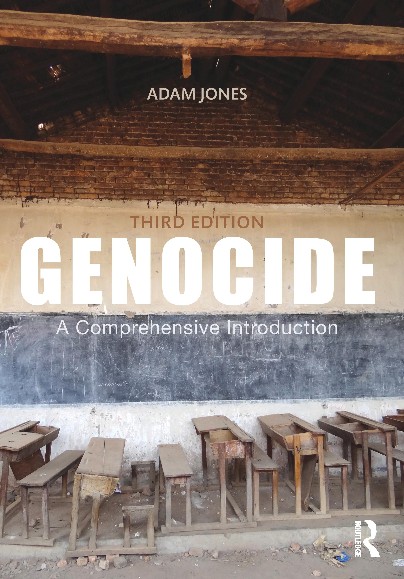
NOW AVAILABLE: Men of the Global South: A Reader, edited by Adam Jones (Zed Books, 2006; 425 pp., US $29.99 pbk). "This impressive collection is a much-needed contribution to the visibility and understanding of diversity in the lives of men from the South" (Dr. Dubravka Zarkov, Institute of Social Studies, The Hague).
Sunday, April 01, 2007
NOW AVAILABLE: Men of the Global South: A Reader, edited by Adam Jones (Zed Books, 2006; 425 pp., US $29.99 pbk). "This impressive collection is a much-needed contribution to the visibility and understanding of diversity in the lives of men from the South" (Dr. Dubravka Zarkov, Institute of Social Studies, The Hague).


Genocide Studies Media File
March 20 - April 1, 2007
A compendium of news stories, features, and human rights reports pertaining to genocide and crimes against humanity. Compiled by Adam Jones. Please send links and feedback to adamj_jones@hotmail.com.
Consider inviting colleagues and friends to subscribe to Genocide_Studies and the G_S Media File. All it takes is an email to genocide_studies-subscribe@topica.com.
CANADA/RWANDAN GENOCIDE
"Canada's First Crimes against Humanity Trial Opens"
By Frederic Bastien
Agence France-Presse dispatch on Yahoo! News, 26 March 2007
"Canada's first trial for crimes against humanity opened Monday, with a Rwandan in the dock accused of taking part in his country's 1994 genocide of ethnic Tutsis. Desire Munyaneza, 40, is accused of involvement in the rape and killing of civilians in Butare, southern Rwanda, from April to July, 1994. 'Either he participated in, helped or encouraged murders, sexual violence and pillaging with the intention and presence of mind to destroy the Tutsi population in an armed conflict,' prosecutor Pascale Ledoux said. Munyaneza pleaded not guilty to the crimes. The trial is due to last three months. About 800,000 people, most of them Tutsis, were killed within six weeks in Rwanda by members of the Hutu ethnic group. The genocide followed years of tension between the two groups and was sparked by the death of president Juvenal Habyarimana, a Hutu, in a plane crash. Rwandan witnesses are to testify at Munyaneza's trial in the Quebec high court. Also due to testify is Romeo Dallaire, the retired Canadian general who at the time headed a United Nations peacekeeping force in Rwanda, as well as Canadian police experts who have investigated the case. [...]"
CANADA/INDIGENOUS PEOPLES
"Canadian Politics: No Apology For Residential Schools"
By Richard Marcus
Blogcritics Magazine, 28 March 2007
"[...] In Ireland and elsewhere the Empire enacted official policies forbidding the native languages in the hopes of cutting people off from their heritage. But the most insidious practice was carried out in North America by post-colonial governments, with the assistance of the Catholic and Anglican Churches in Canada. Residential Schools were established to forcibly turn Indian children against their parents and their heritage. Each child who entered the system was forbidden to speak the language of their nation and was told that all they had been taught up until that point was evil and a lie. They were given haircuts and forced to take new names. Anybody caught speaking their language or using their old name was severely punished. ... It was bad enough that they were ripped away from their families and emotionally, mentally, and physically abused by the staff of these institutions during the day. What went on at night in the dormitories is the stuff of nightmares. Many of the students, male and female, were sexually abused on a continual basis for their entire stay in these prisons. The end result of these schools was the creation of a generation of people who were almost completely cut off from their own culture and not capable of existing in the one they were supposedly 'trained' to take part in: A lost generation of scared, hurt, and, lonely people, damaged far beyond anything most of us can understand. By the year 2005 the federal government of Canada under the Liberal party had agreed to certain measures to redress the issue. Various financial packages were offered, and it was promised as part of the deal that the government would offer an official apology for the policy. But now the current administration, the Conservative Party of Canada has reneged on that promise. In fact from comments made by the Indian Affairs Minister, Jim Prentice, lead one to believe that the government is trying to whitewash what exactly the schools did. The most he will say is that the residential schools involved a difficult time in our history, but -- and this is the real killer -- 'the underlying objective had been to provide aboriginal children with an education.' Which means that Jim Prentice is either a professional liar or an ignorant fool who doesn't even read history books. But then again the Conservative Party already knows that Native Canadians aren't going to vote for them, and neither are people who are sympathetic to their plight. They're playing to their constituents, the people who believe that Native people are welfare drunks who lost the war and are lucky we give them anything. [...]"
COLOMBIA/MULTINATIONAL CORPORATIONS
"'Para-politics' Goes Bananas"
By Michael Evans
The Nation, 29 March 2007
"[...] The indictment handed down by US Attorneys in the Chiquita case describes in the most lucid terms the deliberate, methodical nature of the company's relationship with the [AUC] paramilitaries. Chiquita's payments to paras began in 1997, the year the AUC was formed, and continued until February 2004. Importantly, the company gave the group at least $825,000 after it was designated a Foreign Terrorist Organization (FTO) in 2001. US law bars support to any organization on the State Department's FTO list. Chiquita had been making similar payments to the leftist FARC and ELN guerrillas since returning to Urabá in 1989. Seven years earlier, the company had sold off its holdings in the war-torn region, but was lured back by the promise of expanding international fruit markets. ... The first payment came just in time to help underwrite a major southward expansion of paramilitary influence in the country. Over the next seven years, Chiquita would make more than 100 separate payments to the AUC, and the AUC would carry out some of its most shocking massacres. The paramilitary offensive began with the July 1997 killings of at least thirty civilians in Mapiripán, a traditionally guerrilla-controlled hamlet in a remote coca-growing region in southeastern Colombia. ... The AUC quickly gained a reputation for the shocking brutality of its crimes, and Castaño openly boasted about many of them. The slaughter left a trail of mangled corpses across the country, from the banana farms of Urabá to the coca fields of Putumayo. An overwhelming majority of the victims were civilians. ... Mario Iguarán, Colombia's attorney general, says he will seek the extradition of eight Chiquita officials connected to the case. His office is also seeking information about charges that in 2001 a ship unloaded some 3,400 AK-47 rifles and 4 million rounds of ammunition in a Banadex-controlled dock in Colombia destined for the AUC. These charges were first detailed in a 2003 report from the Organization of the American States. 'This was a criminal relationship,' said Iguarán, in a recent report published in theWashington Post. 'Money and arms and, in exchange, the bloody pacification of Urabá.' [...]"
"U.S. Mining Co. Denies Link to Killings"
By Toby Muse
Associated Press dispatch on Yahoo! News, 22 March 2007
"An Alabama mining company on Thursday denied having any relationship with right-wing death squads in Colombia and said it has no intention of settling a related U.S. lawsuit. A federal judge in Alabama last month allowed a civil suit to go forward against Drummond Co. Inc. for allegedly paying a hit squad to kill three union leaders in 2001 at one of its Colombia mines. In a related move, Colombia's chief prosecutor announced a formal criminal investigation into Drummond Tuesday for alleged ties to paramilitaries. 'Drummond publicly states that it has not nor will it make any payments, agreements or transactions with illegal groups and emphatically denies that the company or any of its executives has had any involvement with the murder of three labor union leaders,' the company said a statement issued at a news conference. 'It will not settle with the plaintiffs.' Drummond's defense comes as another U.S. multinational, fruit giant Chiquita Brands, has acknowledged funneling $1.7 million to far-right paramilitary militias in Colombia. Chiquita has agreed to pay a fine of $25 million for funding a paramilitary group listed as a 'foreign terrorist organization' by the U.S. State Department. Colombia is embroiled in its worst political scandal in decades as revelations continue to emerge tying the country's political class -- many of them backers of President Alvaro Uribe -- and the far-right paramilitaries. The political scandal is now inching toward Drummond, which mines coal along the Caribbean coast, a longtime paramilitary stronghold. [...]"
GERMANY/JEWISH HOLOCAUST
"Six Decades after Holocaust, Jewish Life Thriving Again in Germany"
By Kirsten Grieshaber
Associated Press dispatch in USA Today, 1 April 2007
"[...] Since the German government relaxed immigration laws for Jews following reunification in 1990, tens of thousands of Jewish migrants have come here, mostly from the former Soviet Union. According to the Central Council of Jews in Germany, an estimated 250,000 Jews now live in the country, with some 110,000 of them registered religious community members. Before 1990, there were only 23,000 Jewish community members in Germany, according to the Central Council. 'In 2005, more Jewish immigrants came to Germany than to Israel,' said Stephan Kramer, the general secretary of the Central Council. 'Without immigration, most of the Jewish communities would not exist anymore,' he said, adding that about 200,000 Jews left the former Soviet Union for Germany since the fall of the Iron Curtain in 1989. Cosmopolitan, affordable Berlin in particular has become a magnet, home to several thousand young Israelis expats and hundreds of American Jews, prompting talk of a 'Jewish renaissance' in a place where famous Jews like Albert Einstein or the artist Max Liebermann once lived. Berlin has the biggest Jewish community with 12,000 registered members and eight synagogues, followed by Munich with 9,200 members and a recently opened synagogue, community center and Jewish museum. In Dresden, the ordination of the first three rabbis since World War II was celebrated in September as a milestone in the rebirth of Jewish life in Germany -- 62 years after the end of the Nazi genocide that killed some 6 million Jews, including 200,000 from Germany. But the numbers are still a far cry from Germany's flourishing Jewish community of 560,000 -- and its cultural and intellectual prominence -- before the Third Reich. While there were 600 Jewish schools in Germany before the Holocaust, there are only seven now. And in 1933 Berlin's Jewish community had 120,000 members -- 10 times bigger than today. Still, says Rabbi Chaim Rozwaski, 'it's a miracle that the Jewish people are coming back to resettle in Germany.' [...]"
"German Neo-Nazi Fear over Police Cadets"
By Roger Boyes
The Times, 23 March 2007
"Fears that the German police force contains neo-Nazi sympathisers have been sparked after disdainful cadets delivered an extraordinary rebuff to a Holocaust survivor. Students at the Berlin police academy refused to listen to the harrowing testimony of Isaak Behar, 83, who had been invited to lecture them on his experiences as a Jew in the Third Reich. Mr. Behar lost his parents and his two sisters in the Auschwitz concentration camp. The cadets shouted that they did not want to hear about the Holocaust any more, and said that the Jewish community was emotionally blackmailing Germany, according to German press reports. Dieter Glietsch, Berlin’s police commissioner, has opened an investigation. German police officers are given compulsory Holocaust-awareness training. Visits to sites where Nazis murdered or deported Jews are part of the curriculum. Mr. Behar and other Jewish survivors frequently lecture at police and army colleges. 'There have always been antiSemitic incidents in the army as well as the police,' said Mr Behar. 'But senior officers take action when they hear of them.' This episode, though, which occurred on Feb. 27, is seen as part of a broader and more menacing trend. Last month it was revealed that at least three police bodyguards assigned to protect Michael Friedman, a leading Jewish activist, were neo-Nazi sympathisers. [...]"
IRAQ
"Lancet Was Right -- Shock"
By Owen Bennett Jones
New Statesman, 2 April 2007
"When, last October, the Lancet published a study which concluded that the Iraq war had caused 655,000 more deaths than would have been expected if the conflict had not happened, the Prime Minister's official spokesman dismissed its findings as nowhere near accurate. He said the survey had used an extrapolation technique, using a small sample from an area of Iraq that was not representative of the country. Now, documents released under the Freedom of Information Act reveal that British government experts backed the methodology used by the scientists responsible for the study. If the Lancet estimate is correct, it means 2.5 per cent of the Iraqi population -- an average of more than 500 people a day -- have been killed since the invasion. Of these, 601,000 died in violent acts -- the majority involving gunfire. Asked by officials to comment on the survey, the chief scientific adviser to the Ministry of Defence, Sir Roy Anderson, concluded: 'The study design is robust and employs methods that are regarded as close to "best practice".' He recommended 'caution in publicly criticising the study.' ... A statistician at the Department for International Development was also asked for an opinion of the Lancet study. The techniques used were 'tried and tested,' he said. If anything, the method 'should lead to an underestimation of the deaths in the war and early post-invasion period.' [...]"
ISRAEL/PALESTINE
"U.N. Envoy Likens Israeli Actions to Apartheid"
Reuters dispatch on MSNBC.com, 22 March 2007
"A United Nations human rights envoy on Thursday likened Israeli treatment of Palestinians in occupied territory to apartheid, and said its settlement policy amounted to colonialism. South African lawyer John Dugard warned Western states they would never rally support among developing nations for effective action against perceived abuses in Sudan's Darfur, Zimbabwe and Myanmar unless they tackled the plight of Palestinians. 'This places in danger the whole international human rights enterprise,' he told the U.N. Human Rights Council, a Geneva-based watchdog agency. Dugard, special rapporteur on human rights in the Palestinian territories, said restrictions on movement and separate residential areas gave a sense of 'deja vu' to anyone with experience of apartheid. 'Of course there are similarities between the OPT (Occupied Palestinian Territory) and apartheid South Africa,' he told the council. ... Dugard said Gaza was an imprisoned society, with the situation in the West Bank little better. 'Settlers, largely unrestrained by the Israel Defense Forces (IDF), subject many Palestinians to a reign of terror -- particularly in Hebron,' he said. He said some 500,000 Israeli settlers were now living in the West Bank and East Jerusalem, territories seized by Israel during the 1967 Middle East War. 'Apartheid and colonialism are contrary to international law,' he said."
[n.b. Actually, apartheid is not just "contrary to international law," it is formally designated as a crime against humanity.]
JAPAN/WORLD WAR TWO
"Japanese Prime Minister Apologizes to World War II-Era Sex Slaves"
By Hiroko Tabuchi
The Independent, 27 March 2007
"Japan's nationalist prime minister apologized yesterday to women who suffered in the country's wartime brothels, but stopped short of bowing to international pressure by clearly acknowledging Tokyo's role in forcing thousands into sexual slavery. 'I express my sympathy toward the comfort women and apologize for the situation they found themselves in,' Shinzo Abe told a parliamentary committee on Monday, using a euphemism used by Japanese politicians for sex slaves. 'I apologize here and now as prime minister.' Abe's apology was his clearest yet since the conservative leader triggered international furore earlier this month by saying there was no evidence that women were coerced into sexual service in the World War II era. Still, his remarks fell short of demands made by victims that Abe clearly acknowledge that the wartime military forced the women into prostitution. Historians say that as many as 200,000 Asian women, mostly from Korea and China, worked in military-run brothels. Victims say they were forced into the brothels by the Japanese military and were held against their will. But right-wing politicians, which make up a bulk of Abe's support base, have in recent weeks made renewed efforts to push for an official revision of a landmark apology offered by a senior government official in 1993. Conservative ruling party lawmakers argue that the women were professional prostitutes and were paid for their services, and maintain that the military authorities were not directly responsible for the establishment or running of the brothels. Abe's earlier denial of coercion drew intense criticism from China and Korea, which accuse Japan of failing to fully atone for wartime invasions and atrocities. [...]"
RUSSIA/STALINISM
"TV Series on Stalin Divides Russian Audience"
By David Holley
The Los Angeles Times, 30 March 2007
"Josef Stalin is speaking to his son Yakov, who has just telephoned to say that he will soon head off to battle the Nazi invaders. 'I sometimes was not fair to you. Forgive me. I devoted little time to you,' the Soviet dictator apologizes. 'Son, go and fight. This is your duty.' ... The poignant scene -- for viewers who can stomach it -- is part of a controversial 40-episode TV drama, 'Stalin Live,' now airing on a nationwide network here. The show's structural device is an elderly Stalin, in the last weeks of his life, recalling episodes in his younger days, most presenting him in a favorable light. For Stalin admirers, of whom there are many in Russia, the series is an entertaining and educational look at the man who turned the Soviet Union into a superpower. To critics, it is a dangerous distortion of history that threatens to misinform a younger generation about a leader responsible for the deaths of millions of people, and reinforce a trend toward greater authoritarianism in politics. ... Estimates of the number of Stalin's victims vary widely, but most historians say that 10 million to 20 million people died in purges, famines, deportations and labor camps as a result of his policies from the time he rose to power in the mid-1920s until his death in 1953. In addition, the Soviet Union suffered at least 20 million troop and civilian deaths in World War II. Among them was his son Yakov, who died in a German prisoner-of-war camp. Critics say that 'Stalin Live' ignores the dictator's worst crimes and treats him far too sympathetically. ... Surveys conducted two years ago on the 60th anniversary of victory over Nazi Germany showed a nation roughly divided between the pro- and anti-Stalin camps, with those sympathetic to the dictator holding a modest edge. In a poll by the All-Russian Public Opinion Research Center, 20% of respondents described his role as 'very positive,' and 30% called it 'somewhat positive.' Only 12% described it as 'very negative.' [...]"
RWANDAN GENOCIDE
"'Beyond the Gates': Even the Credits Are Wrenching"
By Moira Macdonald
Seattle Times, 30 March 2007
"Michael Caton-Jones' devastating story of the 1994 Rwandan genocide, 'Beyond the Gates,' ends on a note that transforms everything you've seen before it. After the drama ends, the credits roll, but it's not just a list of names on the screen. We see snapshots of the film's Rwandan crew members, and brief histories of what they lost in the genocide: husbands, sisters, families. One was raped and contracted HIV; others escaped from a sea of corpses. There are no words to describe the horror, or the kind of bravery that brought these people to work on this film. Based on real events, 'Beyond the Gates' takes place within a very brief period of time, at a school that became a shelter for thousands of Rwandans fleeing the murderous soldiers in the streets. (The film's specific characters are fictional, though some are inspired by real people. Its locations are historically accurate, with most of the filming taking place at the actual Kigali school.) Father Christopher (John Hurt) and young teacher Joe Connor (Hugh Dancy) are devoted to their students, promising their safety as the frightened crowds gather. At first, the grounds are protected by U.N. soldiers -- somewhat. 'This is a military base, not a refugee camp,' huffs one of them to Father Christopher. ('Actually, it's a school,' the priest replies.) Eventually, the soldiers announce that they are withdrawing. The chaos beyond the school's gates will soon enter the enclosure; a massacre is inevitable. As non-Rwandans, Christopher and Joe can, if they wish, leave with the soldiers. Do they stay and face certain death, or flee and live with their consciences? 'Beyond the Gates,' unlike the equally fine 'Hotel Rwanda,' makes its central characters outsiders; the story unfolds mostly from the point of view of the two British teachers. You feel the lack of a Rwandan perspective (until the final credits), but the film is nonetheless extremely affecting. [...]"
SERBIA/KOSOVO
"Gruesome Details of Kosovo War Crimes Emerge"
By Dusan Stojanovic
Associated Press dispatch in The Globe and Mail, 22 March 2007
"Decomposing corpses were dumped into a trash-filled ditch. Blindfolded and hands bound, three Albanian-Americans were led to its edge and shot in the head, their bodies joining the others. The details, emerging for the first time at the trial of two former Serbian commandos, shed light on how the regime of late Serbian President Slobodan Milosevic tried to conceal atrocities against ethnic Albanians in the 1998-99 Kosovo war. Thousands were killed in the Serbian crackdown against Kosovo separatists in 1998-99. When NATO launched air strikes to stop the carnage, hundreds of bodies of Kosovars were dug up and moved more than 200 miles to three locations in central Serbia, reburied in mass graves to cover up the killings. The commandos have been charged as accomplices in the murder of brothers Illy, Mehmet and Agron Bytyqi -- three U.S. citizens who had left New York to fight in Kosovo and were captured by the Serbs. The bodies of the Bytyqi brothers were discovered in 2001. Their identities were later confirmed by an FBI forensics team. 'One day, a truck carrying some 30 corpses appeared in our camp,' Radomir Djeric, a former commander of a special police training facility in Petrovo Selo, some 60 miles east of Belgrade, said at the trial Wednesday. His testimony for the prosecution was closed to the public but minutes were made available to The Associated Press. Djeric said he thought a large ditch had been dug to be used as a garbage disposal for the police training camp. [...]"
SUDAN/DARFUR
"Splintering of Rebel Groups Adds to Chaos in Darfur"
By Stephanie McCrummen
The Washington Post, 1 April 2007 [Registration Required]
"[...] The situation is complicated, but there is a growing sense that the biggest obstacles to peace in Darfur are not only the Sudanese government and its militias, but the Darfur rebels themselves. After four years of conflict, the western region of Sudan has become fragmented among at least a dozen rebel groups, a development that leaders such as Nur believe is the product of a clever divide-and-conquer strategy by the government but that others say is the result of clashing egos within the movement. An array of foreign diplomats have shifted their efforts from pressuring the government to encouraging rebel unity. The United Nations, for example, recently airlifted 300 rebel commanders to a meeting place in Darfur where they were to decide on a military structure. The conference was delayed twice because the government bombed the area, and it finally fell apart amid internecine quarreling. Officials monitoring the region and aid groups say that as the rebel groups splinter, they are increasingly moonlighting as roving bandits, attacking humanitarian organizations, African Union soldiers and whoever else might have the coveted trucks and satellite phones that are the means to power in this rugged region. 'The danger is that if they don't get it together, we're going to end up with a bunch of warlords,' said one U.S. official in the region, who, like many people interviewed for this article, spoke on condition of anonymity because of the sensitivity of the situation. 'The factionalization is indicative of the priority they put on their own personal positions, rather than on Darfur.' [...]"
"The Politics of Naming"
Letter by Gérard Prunier
London Review of Books, 5 April 2007
"Mahmood Mamdani begins his piece on 'The Politics of Naming' (LRB, 8 March) with a parallel between 'state-connected counter-insurgencies in Iraq and Darfur.' But the counter-insurgency in Iraq is organised by a foreign power and is the result of foreign occupation while the counter-insurgency in Darfur is organised by the national government and has no foreign cause. Whatever one thinks of US policy in Iraq, it has no genocidal component. In Darfur the 'counter-insurgency' is ethnic cleansing at the least and borders on genocide. Professor Mamdani quotes President Obasanjo of Nigeria to defend the idea that the violence in Darfur is not of a genocidal nature since we do not have proof of a 'plan.' But we do not have proof of a plan in either the Armenian or the Rwandan genocides. Professor Mamdani is right about the international community’s lack of interest in the war in the Congo, the most murderous conflict since the Second World War, but he insists on the Hema-Lendu conflict in the Ituri region as if it were the only violent conflict in the country and talks of 'the two sides,' apparently projecting a kind of Tutsi-Hutu framework on the Ituri, whose victims represent, to the best of my knowledge, about 2 per cent of the total number of fatalities in the Congo in the period. He describes the 'Hema and Lendu militias' as 'trained by the US allies in the region, Uganda and Rwanda,' but these militias were never properly trained by anybody, which is one reason they were so wild and murderous. Finally, the Hema and Lendu have nothing to do with the Tutsi and the Hutu. The Lendu are a Sudanic tribe loosely related to the Alur while the Bantu Hema are a sub-group of the Ugandan Banyoro. To see these tribes as 'US proxies' is untenable. It was the Ugandans (not the Rwandans and even less the Americans) who used them, though they were not responsible either for their antagonisms or for their political strategies. Mamdani trivialises Darfur by saying that violence in Central Africa is recurring and banal, that Darfur is nothing special, and that in any case the factor responsible above all others for these various evils is US imperialism. [...]"
[n.b. Having referenced Mamdani's piece in the last "Media File," I feel obliged to link here to Prunier's eloquent response.]
"The 'Genocide Olympics'"
By Mia and Roman Farrow
The Huffington Post, 28 March 2007
"'One World, One Dream' is China's slogan for its 2008 Olympics. But there is one nightmare that China shouldn't be allowed to sweep under the rug. That nightmare is Darfur, where more than 400,000 people have been killed and more than two-and-a-half million driven from flaming villages by the Chinese-backed government of Sudan. That so many corporate sponsors want the world to look away from that atrocity during the games is bad enough. But equally disappointing is the decision of artists like director Steven Spielberg -- who quietly visited China this month as he prepares to help stage the Olympic ceremonies -- to sanitize Beijing's image. Is Mr. Spielberg, who in 1994 founded the Shoah Foundation to record the testimony of survivors of the holocaust, aware that China is bankrolling Darfur's genocide? China is pouring billions of dollars into Sudan. Beijing purchases an overwhelming majority of Sudan's annual oil exports and state-owned China National Petroleum Corp. -- an official partner of the upcoming Olympic Games -- owns the largest shares in each of Sudan's two major oil consortia. The Sudanese government uses as much as 80% of proceeds from those sales to fund its brutal Janjaweed proxy militia and purchase their instruments of destruction: bombers, assault helicopters, armored vehicles and small arms, most of them of Chinese manufacture. Airstrips constructed and operated by the Chinese have been used to launch bombing campaigns on villages. And China has used its veto power on the U.N. Security Council to repeatedly obstruct efforts by the U.S. and the U.K. to introduce peacekeepers to curtail the slaughter. As one of the few players whose support is indispensable to Sudan, China has the power to, at the very least, insist that Khartoum accept a robust international peacekeeping force to protect defenseless civilians in Darfur. Beijing is uniquely positioned to put a stop to the slaughter, yet they have so far been unabashed in their refusal to do so. [...]"
"Blair Threatens Force over Darfur"
By Julian Borger
The Guardian, 27 March 2007
"Tony Blair is pushing the United Nations to declare a no-fly zone over Darfur, enforced if necessary by the bombing of Sudanese military airfields used for raids on the province, the Guardian has learned. The controversial initiative comes as a classified new report by a UN panel of experts alleges Sudan has violated UN resolutions by moving arms into Darfur, conducting overflights and disguising its military planes as UN humanitarian aircraft. Mr. Blair has been pushing for much tougher international action against Sudan since President Omar Hassan al-Bashir reneged earlier this month on last November's agreement to allow UN peacekeepers into Darfur to protect civilians. Over 200,000 have been killed in the course of a counter-insurgency by government forces and allied Janjaweed militia, and more than 10 times that number forced to flee their homes. Humanitarian supplies to the millions of refugees in the area are tenuous and threatened by continuing violence on the Sudan-Chad border. Talks are under way in the UN security council over a package of sanctions being pushed by Britain and the US, which includes a comprehensive arms embargo and the freezing assets of Sudanese leaders implicated in the Darfur ethnic cleansing. Speaking in Berlin on Sunday, Mr. Blair described the situation in Darfur as 'intolerable' and said: 'We need to consider a no-fly zone to prevent the use of Sudanese air power against refugees and displaced people.' According to Downing Street, he is pushing for a no-fly zone to be passed at the same time as the new sanctions package, in the form of a 'Chapter 7' security council resolution, allowing the use of force. [...]"
"UN Warns of Darfur Aid Collapse"
By Karen Allen
BBC Online, 25 March 2007
"The UN's new humanitarian chief, John Holmes, has spoken of the fragile morale among relief workers in Sudan's troubled region of Darfur. Mr. Holmes warned it could take just one major security incident to prompt a "humanitarian collapse", endangering tens of thousands of refugees. The four-year conflict between rebel groups and pro-government Arab militia has seen more than 2.5m displaced. Mr. Holmes is on a tour of Sudan, Chad and the Central African Republic. Crowds of children chanted their welcome to the UN's new humanitarian chief as he arrived in the rebel stronghold of Jebel Marra, west Darfur. It was a very different scene to Saturday when Mr Holmes was barred from entering a camp for displaced people in north Darfur by the Sudanese military, though they later apologised. But the message from some of the tens of thousands of people caught up in this four-year conflict is that they feel cut off. One woman told me they feel insecure because, she says, the government has blocked the roads. She explains people here fear further attacks. [...]"
TURKEY/UNITED STATES/ARMENIAN GENOCIDE
"Turks Warn U.S. against Resolution on Armenian Genocide"
By Sebnem Arsu and Brian Knowlton
International Herald Tribuen, 30 March 2007
"A planned vote in the U.S. Congress that would classify the widespread killings of Armenians by the Ottoman Turkish government early in the 20th century as genocide is threatening to make bilateral relations unusually tense. The speaker of the House of Representatives, Nancy Pelosi, backs the resolution and at first wanted a vote in April. But under Turkish pressure, Bush administration figures have lobbied for the Democrats in charge of Congress to drop the measure. Secretary of State Condoleezza Rice and Defense Secretary Robert Gates sent strong letters of protest to her and to Representative Tom Lantos, chairman of the House Foreign Affairs Committee, which has not set a date for the vote. 'That has had an impact,' said Lynne Weil, a Lantos spokeswoman, referring to the letters. Copies were also sent to Representative John Boehner, Republican of Ohio, the House minority leader. Turkey vehemently denies that the killings of 1.5 million Armenians during a period of several years, beginning in 1915, amounted to genocide. It contends that the deaths occurred in the chaos of war as the Ottoman Empire was falling apart, and that many Turks were also killed when Armenians sided with Russian forces in the hope of claiming territory in eastern Turkey. But many Armenians have sought acknowledgment from nations around the world that the deaths amounted to systematic genocide at Ottoman hands. So far, parliaments of more than 15 countries have agreed. France and Switzerland went further and called for criminal charges against those who deny it. A vote in Congress would be purely symbolic, but Turks have warned that it would be felt as a bitter slap, and that it could bring enormous public pressure on the government in Ankara to chill its cooperation with Washington. The U.S. has strong military ties to Turkey, a NATO member. [...]"
UNITED STATES/INDIGENOUS PEOPLES
"Waste Firm Fined 46 Mln Dlrs for Dump on US Indian Land"
Agence France-Presse dispatch on RawStory.com, 22 March 2007
"A waste disposal firm that operated an illegal dump on an Indian reservation in southern California has been ordered to pay more than 46 million dollars in clean-up costs, officials said Thursday. A statement from the Justice Department and Environmental Protection Agency (EPA) said Lawson Enterprises must pay nearly 43 million dollars to clean the site along with three million dollars in civil penalties. The order was made by United States District Court judge Stephen Larson following a four-year legal battle surrounding the dump on the Torres Martinez Reservation in the Coachella Valley, 200 kilometers (125 miles) east of Los Angeles. 'This legal victory makes it loud and clear -- open dumping on tribal lands is a crime,' said EPA official Wayne Nastri. Lawson Enterprises operated the solid-waste disposal dump from 1992 to 2006, burning waste until 2003. Smoke from the dump affected surrounding schools, where students were restricted from open-air activities and reported health problems including headaches and stomachaches. Local fire services also had to tackle numerous fires that broke out at the dump, officials said. Earlier this month a court in San Francisco ruled that a ski resort's plan to spray artificial snow made with treated sewage on mountains and parkland revered by Native American tribes was unlawful."
UNITED STATES/IRAQ
"Spain Judge Says Bush and Iraq War Allies Should Face War Crimes Charges"
By Katerina Ossenova
Jurist, 20 March 2007
"Baltasar Garzon, an investigating judge for Spain's National Court, said Tuesday that President George W. Bush and his allies eventually should face war crimes charges for their actions in Iraq. In an opinion piece for El Pais, Garzon called the war in Iraq 'one of the most sordid and unjustifiable episodes in recent human history.' Garzon also criticized those who joined the US president in the war against Iraq as having equally responsible for joining the war effort despite their doubts. In 1999, Garzon tried to extradite former Chilean dictator General Augusto Pinochet from Britain and try him for crimes against humanity. On Sunday, ICC Chief Prosecutor Luis Moreno-Ocampo said President Bush and UK Prime Minister Tony Blair may one day face war crimes charges before the International Criminal Court (ICC) at The Hague. Moreno-Ocampo said that the ICC could investigate allegations of war crimes stemming from the conduct of coalition forces in Iraq, so long as Iraq agrees to ratify the Rome Statute and accede to ICC jurisdiction."
[n.b. This is the complete text of the dispatch. Link to the text of Garzon's op-ed, in Spanish.]
UNITED STATES/URUGUAY
"Kissinger's Extradition to Uruguay Sought over Operation Condor"
Agence France-Presse dispatch on Yahoo! News, 25 March 2007
"An attorney for a victim of Uruguay's 1973-1985 dictatorship has asked his government to request the extradition of former US secretary of state Henry Kissinger over his alleged role in the notorious Operation Condor. Condor was a secret plan hatched by South American dictators in the 1970s to eliminate leftist political opponents in the region. Details of the plan have emerged over the past years in documents and court testimony. The Latin American dictatorships of the time 'were mere executors' of a 'plan of extermination' hatched in the United States by a group led by Kissinger, said attorney Gustavo Salle, who represents the family of Bernardo Arnone. Uruguayan prosecutor Mirtha Guianze has received the request and is studying the case, according to news reports. A leftist activist, Arnone was arrested in October 1976 and flown to Argentina with a group of political prisoners that vanished and were presumably executed. Kissinger played a dominant role in US foreign policy between 1969 and 1977, and was a strong supporter of right-wing regimes across Latin America. The extradition request comes as the topic of rights violations during Uruguay's dictatorship is making headlines again, with Salle citing evidence from declassified US State Department documents. Witnesses are set to testify in April in a case that began in September against eight retired regime officials over rights violations."
[n.b. This is the full text of the dispatch.]
Consider inviting colleagues and friends to subscribe to Genocide_Studies and the G_S Media File. All it takes is an email to genocide_studies-subscribe@topica.com.
CANADA/RWANDAN GENOCIDE
"Canada's First Crimes against Humanity Trial Opens"
By Frederic Bastien
Agence France-Presse dispatch on Yahoo! News, 26 March 2007
"Canada's first trial for crimes against humanity opened Monday, with a Rwandan in the dock accused of taking part in his country's 1994 genocide of ethnic Tutsis. Desire Munyaneza, 40, is accused of involvement in the rape and killing of civilians in Butare, southern Rwanda, from April to July, 1994. 'Either he participated in, helped or encouraged murders, sexual violence and pillaging with the intention and presence of mind to destroy the Tutsi population in an armed conflict,' prosecutor Pascale Ledoux said. Munyaneza pleaded not guilty to the crimes. The trial is due to last three months. About 800,000 people, most of them Tutsis, were killed within six weeks in Rwanda by members of the Hutu ethnic group. The genocide followed years of tension between the two groups and was sparked by the death of president Juvenal Habyarimana, a Hutu, in a plane crash. Rwandan witnesses are to testify at Munyaneza's trial in the Quebec high court. Also due to testify is Romeo Dallaire, the retired Canadian general who at the time headed a United Nations peacekeeping force in Rwanda, as well as Canadian police experts who have investigated the case. [...]"
CANADA/INDIGENOUS PEOPLES
"Canadian Politics: No Apology For Residential Schools"
By Richard Marcus
Blogcritics Magazine, 28 March 2007
"[...] In Ireland and elsewhere the Empire enacted official policies forbidding the native languages in the hopes of cutting people off from their heritage. But the most insidious practice was carried out in North America by post-colonial governments, with the assistance of the Catholic and Anglican Churches in Canada. Residential Schools were established to forcibly turn Indian children against their parents and their heritage. Each child who entered the system was forbidden to speak the language of their nation and was told that all they had been taught up until that point was evil and a lie. They were given haircuts and forced to take new names. Anybody caught speaking their language or using their old name was severely punished. ... It was bad enough that they were ripped away from their families and emotionally, mentally, and physically abused by the staff of these institutions during the day. What went on at night in the dormitories is the stuff of nightmares. Many of the students, male and female, were sexually abused on a continual basis for their entire stay in these prisons. The end result of these schools was the creation of a generation of people who were almost completely cut off from their own culture and not capable of existing in the one they were supposedly 'trained' to take part in: A lost generation of scared, hurt, and, lonely people, damaged far beyond anything most of us can understand. By the year 2005 the federal government of Canada under the Liberal party had agreed to certain measures to redress the issue. Various financial packages were offered, and it was promised as part of the deal that the government would offer an official apology for the policy. But now the current administration, the Conservative Party of Canada has reneged on that promise. In fact from comments made by the Indian Affairs Minister, Jim Prentice, lead one to believe that the government is trying to whitewash what exactly the schools did. The most he will say is that the residential schools involved a difficult time in our history, but -- and this is the real killer -- 'the underlying objective had been to provide aboriginal children with an education.' Which means that Jim Prentice is either a professional liar or an ignorant fool who doesn't even read history books. But then again the Conservative Party already knows that Native Canadians aren't going to vote for them, and neither are people who are sympathetic to their plight. They're playing to their constituents, the people who believe that Native people are welfare drunks who lost the war and are lucky we give them anything. [...]"
COLOMBIA/MULTINATIONAL CORPORATIONS
"'Para-politics' Goes Bananas"
By Michael Evans
The Nation, 29 March 2007
"[...] The indictment handed down by US Attorneys in the Chiquita case describes in the most lucid terms the deliberate, methodical nature of the company's relationship with the [AUC] paramilitaries. Chiquita's payments to paras began in 1997, the year the AUC was formed, and continued until February 2004. Importantly, the company gave the group at least $825,000 after it was designated a Foreign Terrorist Organization (FTO) in 2001. US law bars support to any organization on the State Department's FTO list. Chiquita had been making similar payments to the leftist FARC and ELN guerrillas since returning to Urabá in 1989. Seven years earlier, the company had sold off its holdings in the war-torn region, but was lured back by the promise of expanding international fruit markets. ... The first payment came just in time to help underwrite a major southward expansion of paramilitary influence in the country. Over the next seven years, Chiquita would make more than 100 separate payments to the AUC, and the AUC would carry out some of its most shocking massacres. The paramilitary offensive began with the July 1997 killings of at least thirty civilians in Mapiripán, a traditionally guerrilla-controlled hamlet in a remote coca-growing region in southeastern Colombia. ... The AUC quickly gained a reputation for the shocking brutality of its crimes, and Castaño openly boasted about many of them. The slaughter left a trail of mangled corpses across the country, from the banana farms of Urabá to the coca fields of Putumayo. An overwhelming majority of the victims were civilians. ... Mario Iguarán, Colombia's attorney general, says he will seek the extradition of eight Chiquita officials connected to the case. His office is also seeking information about charges that in 2001 a ship unloaded some 3,400 AK-47 rifles and 4 million rounds of ammunition in a Banadex-controlled dock in Colombia destined for the AUC. These charges were first detailed in a 2003 report from the Organization of the American States. 'This was a criminal relationship,' said Iguarán, in a recent report published in theWashington Post. 'Money and arms and, in exchange, the bloody pacification of Urabá.' [...]"
"U.S. Mining Co. Denies Link to Killings"
By Toby Muse
Associated Press dispatch on Yahoo! News, 22 March 2007
"An Alabama mining company on Thursday denied having any relationship with right-wing death squads in Colombia and said it has no intention of settling a related U.S. lawsuit. A federal judge in Alabama last month allowed a civil suit to go forward against Drummond Co. Inc. for allegedly paying a hit squad to kill three union leaders in 2001 at one of its Colombia mines. In a related move, Colombia's chief prosecutor announced a formal criminal investigation into Drummond Tuesday for alleged ties to paramilitaries. 'Drummond publicly states that it has not nor will it make any payments, agreements or transactions with illegal groups and emphatically denies that the company or any of its executives has had any involvement with the murder of three labor union leaders,' the company said a statement issued at a news conference. 'It will not settle with the plaintiffs.' Drummond's defense comes as another U.S. multinational, fruit giant Chiquita Brands, has acknowledged funneling $1.7 million to far-right paramilitary militias in Colombia. Chiquita has agreed to pay a fine of $25 million for funding a paramilitary group listed as a 'foreign terrorist organization' by the U.S. State Department. Colombia is embroiled in its worst political scandal in decades as revelations continue to emerge tying the country's political class -- many of them backers of President Alvaro Uribe -- and the far-right paramilitaries. The political scandal is now inching toward Drummond, which mines coal along the Caribbean coast, a longtime paramilitary stronghold. [...]"
GERMANY/JEWISH HOLOCAUST
"Six Decades after Holocaust, Jewish Life Thriving Again in Germany"
By Kirsten Grieshaber
Associated Press dispatch in USA Today, 1 April 2007
"[...] Since the German government relaxed immigration laws for Jews following reunification in 1990, tens of thousands of Jewish migrants have come here, mostly from the former Soviet Union. According to the Central Council of Jews in Germany, an estimated 250,000 Jews now live in the country, with some 110,000 of them registered religious community members. Before 1990, there were only 23,000 Jewish community members in Germany, according to the Central Council. 'In 2005, more Jewish immigrants came to Germany than to Israel,' said Stephan Kramer, the general secretary of the Central Council. 'Without immigration, most of the Jewish communities would not exist anymore,' he said, adding that about 200,000 Jews left the former Soviet Union for Germany since the fall of the Iron Curtain in 1989. Cosmopolitan, affordable Berlin in particular has become a magnet, home to several thousand young Israelis expats and hundreds of American Jews, prompting talk of a 'Jewish renaissance' in a place where famous Jews like Albert Einstein or the artist Max Liebermann once lived. Berlin has the biggest Jewish community with 12,000 registered members and eight synagogues, followed by Munich with 9,200 members and a recently opened synagogue, community center and Jewish museum. In Dresden, the ordination of the first three rabbis since World War II was celebrated in September as a milestone in the rebirth of Jewish life in Germany -- 62 years after the end of the Nazi genocide that killed some 6 million Jews, including 200,000 from Germany. But the numbers are still a far cry from Germany's flourishing Jewish community of 560,000 -- and its cultural and intellectual prominence -- before the Third Reich. While there were 600 Jewish schools in Germany before the Holocaust, there are only seven now. And in 1933 Berlin's Jewish community had 120,000 members -- 10 times bigger than today. Still, says Rabbi Chaim Rozwaski, 'it's a miracle that the Jewish people are coming back to resettle in Germany.' [...]"
"German Neo-Nazi Fear over Police Cadets"
By Roger Boyes
The Times, 23 March 2007
"Fears that the German police force contains neo-Nazi sympathisers have been sparked after disdainful cadets delivered an extraordinary rebuff to a Holocaust survivor. Students at the Berlin police academy refused to listen to the harrowing testimony of Isaak Behar, 83, who had been invited to lecture them on his experiences as a Jew in the Third Reich. Mr. Behar lost his parents and his two sisters in the Auschwitz concentration camp. The cadets shouted that they did not want to hear about the Holocaust any more, and said that the Jewish community was emotionally blackmailing Germany, according to German press reports. Dieter Glietsch, Berlin’s police commissioner, has opened an investigation. German police officers are given compulsory Holocaust-awareness training. Visits to sites where Nazis murdered or deported Jews are part of the curriculum. Mr. Behar and other Jewish survivors frequently lecture at police and army colleges. 'There have always been antiSemitic incidents in the army as well as the police,' said Mr Behar. 'But senior officers take action when they hear of them.' This episode, though, which occurred on Feb. 27, is seen as part of a broader and more menacing trend. Last month it was revealed that at least three police bodyguards assigned to protect Michael Friedman, a leading Jewish activist, were neo-Nazi sympathisers. [...]"
IRAQ
"Lancet Was Right -- Shock"
By Owen Bennett Jones
New Statesman, 2 April 2007
"When, last October, the Lancet published a study which concluded that the Iraq war had caused 655,000 more deaths than would have been expected if the conflict had not happened, the Prime Minister's official spokesman dismissed its findings as nowhere near accurate. He said the survey had used an extrapolation technique, using a small sample from an area of Iraq that was not representative of the country. Now, documents released under the Freedom of Information Act reveal that British government experts backed the methodology used by the scientists responsible for the study. If the Lancet estimate is correct, it means 2.5 per cent of the Iraqi population -- an average of more than 500 people a day -- have been killed since the invasion. Of these, 601,000 died in violent acts -- the majority involving gunfire. Asked by officials to comment on the survey, the chief scientific adviser to the Ministry of Defence, Sir Roy Anderson, concluded: 'The study design is robust and employs methods that are regarded as close to "best practice".' He recommended 'caution in publicly criticising the study.' ... A statistician at the Department for International Development was also asked for an opinion of the Lancet study. The techniques used were 'tried and tested,' he said. If anything, the method 'should lead to an underestimation of the deaths in the war and early post-invasion period.' [...]"
ISRAEL/PALESTINE
"U.N. Envoy Likens Israeli Actions to Apartheid"
Reuters dispatch on MSNBC.com, 22 March 2007
"A United Nations human rights envoy on Thursday likened Israeli treatment of Palestinians in occupied territory to apartheid, and said its settlement policy amounted to colonialism. South African lawyer John Dugard warned Western states they would never rally support among developing nations for effective action against perceived abuses in Sudan's Darfur, Zimbabwe and Myanmar unless they tackled the plight of Palestinians. 'This places in danger the whole international human rights enterprise,' he told the U.N. Human Rights Council, a Geneva-based watchdog agency. Dugard, special rapporteur on human rights in the Palestinian territories, said restrictions on movement and separate residential areas gave a sense of 'deja vu' to anyone with experience of apartheid. 'Of course there are similarities between the OPT (Occupied Palestinian Territory) and apartheid South Africa,' he told the council. ... Dugard said Gaza was an imprisoned society, with the situation in the West Bank little better. 'Settlers, largely unrestrained by the Israel Defense Forces (IDF), subject many Palestinians to a reign of terror -- particularly in Hebron,' he said. He said some 500,000 Israeli settlers were now living in the West Bank and East Jerusalem, territories seized by Israel during the 1967 Middle East War. 'Apartheid and colonialism are contrary to international law,' he said."
[n.b. Actually, apartheid is not just "contrary to international law," it is formally designated as a crime against humanity.]
JAPAN/WORLD WAR TWO
"Japanese Prime Minister Apologizes to World War II-Era Sex Slaves"
By Hiroko Tabuchi
The Independent, 27 March 2007
"Japan's nationalist prime minister apologized yesterday to women who suffered in the country's wartime brothels, but stopped short of bowing to international pressure by clearly acknowledging Tokyo's role in forcing thousands into sexual slavery. 'I express my sympathy toward the comfort women and apologize for the situation they found themselves in,' Shinzo Abe told a parliamentary committee on Monday, using a euphemism used by Japanese politicians for sex slaves. 'I apologize here and now as prime minister.' Abe's apology was his clearest yet since the conservative leader triggered international furore earlier this month by saying there was no evidence that women were coerced into sexual service in the World War II era. Still, his remarks fell short of demands made by victims that Abe clearly acknowledge that the wartime military forced the women into prostitution. Historians say that as many as 200,000 Asian women, mostly from Korea and China, worked in military-run brothels. Victims say they were forced into the brothels by the Japanese military and were held against their will. But right-wing politicians, which make up a bulk of Abe's support base, have in recent weeks made renewed efforts to push for an official revision of a landmark apology offered by a senior government official in 1993. Conservative ruling party lawmakers argue that the women were professional prostitutes and were paid for their services, and maintain that the military authorities were not directly responsible for the establishment or running of the brothels. Abe's earlier denial of coercion drew intense criticism from China and Korea, which accuse Japan of failing to fully atone for wartime invasions and atrocities. [...]"
RUSSIA/STALINISM
"TV Series on Stalin Divides Russian Audience"
By David Holley
The Los Angeles Times, 30 March 2007
"Josef Stalin is speaking to his son Yakov, who has just telephoned to say that he will soon head off to battle the Nazi invaders. 'I sometimes was not fair to you. Forgive me. I devoted little time to you,' the Soviet dictator apologizes. 'Son, go and fight. This is your duty.' ... The poignant scene -- for viewers who can stomach it -- is part of a controversial 40-episode TV drama, 'Stalin Live,' now airing on a nationwide network here. The show's structural device is an elderly Stalin, in the last weeks of his life, recalling episodes in his younger days, most presenting him in a favorable light. For Stalin admirers, of whom there are many in Russia, the series is an entertaining and educational look at the man who turned the Soviet Union into a superpower. To critics, it is a dangerous distortion of history that threatens to misinform a younger generation about a leader responsible for the deaths of millions of people, and reinforce a trend toward greater authoritarianism in politics. ... Estimates of the number of Stalin's victims vary widely, but most historians say that 10 million to 20 million people died in purges, famines, deportations and labor camps as a result of his policies from the time he rose to power in the mid-1920s until his death in 1953. In addition, the Soviet Union suffered at least 20 million troop and civilian deaths in World War II. Among them was his son Yakov, who died in a German prisoner-of-war camp. Critics say that 'Stalin Live' ignores the dictator's worst crimes and treats him far too sympathetically. ... Surveys conducted two years ago on the 60th anniversary of victory over Nazi Germany showed a nation roughly divided between the pro- and anti-Stalin camps, with those sympathetic to the dictator holding a modest edge. In a poll by the All-Russian Public Opinion Research Center, 20% of respondents described his role as 'very positive,' and 30% called it 'somewhat positive.' Only 12% described it as 'very negative.' [...]"
RWANDAN GENOCIDE
"'Beyond the Gates': Even the Credits Are Wrenching"
By Moira Macdonald
Seattle Times, 30 March 2007
"Michael Caton-Jones' devastating story of the 1994 Rwandan genocide, 'Beyond the Gates,' ends on a note that transforms everything you've seen before it. After the drama ends, the credits roll, but it's not just a list of names on the screen. We see snapshots of the film's Rwandan crew members, and brief histories of what they lost in the genocide: husbands, sisters, families. One was raped and contracted HIV; others escaped from a sea of corpses. There are no words to describe the horror, or the kind of bravery that brought these people to work on this film. Based on real events, 'Beyond the Gates' takes place within a very brief period of time, at a school that became a shelter for thousands of Rwandans fleeing the murderous soldiers in the streets. (The film's specific characters are fictional, though some are inspired by real people. Its locations are historically accurate, with most of the filming taking place at the actual Kigali school.) Father Christopher (John Hurt) and young teacher Joe Connor (Hugh Dancy) are devoted to their students, promising their safety as the frightened crowds gather. At first, the grounds are protected by U.N. soldiers -- somewhat. 'This is a military base, not a refugee camp,' huffs one of them to Father Christopher. ('Actually, it's a school,' the priest replies.) Eventually, the soldiers announce that they are withdrawing. The chaos beyond the school's gates will soon enter the enclosure; a massacre is inevitable. As non-Rwandans, Christopher and Joe can, if they wish, leave with the soldiers. Do they stay and face certain death, or flee and live with their consciences? 'Beyond the Gates,' unlike the equally fine 'Hotel Rwanda,' makes its central characters outsiders; the story unfolds mostly from the point of view of the two British teachers. You feel the lack of a Rwandan perspective (until the final credits), but the film is nonetheless extremely affecting. [...]"
SERBIA/KOSOVO
"Gruesome Details of Kosovo War Crimes Emerge"
By Dusan Stojanovic
Associated Press dispatch in The Globe and Mail, 22 March 2007
"Decomposing corpses were dumped into a trash-filled ditch. Blindfolded and hands bound, three Albanian-Americans were led to its edge and shot in the head, their bodies joining the others. The details, emerging for the first time at the trial of two former Serbian commandos, shed light on how the regime of late Serbian President Slobodan Milosevic tried to conceal atrocities against ethnic Albanians in the 1998-99 Kosovo war. Thousands were killed in the Serbian crackdown against Kosovo separatists in 1998-99. When NATO launched air strikes to stop the carnage, hundreds of bodies of Kosovars were dug up and moved more than 200 miles to three locations in central Serbia, reburied in mass graves to cover up the killings. The commandos have been charged as accomplices in the murder of brothers Illy, Mehmet and Agron Bytyqi -- three U.S. citizens who had left New York to fight in Kosovo and were captured by the Serbs. The bodies of the Bytyqi brothers were discovered in 2001. Their identities were later confirmed by an FBI forensics team. 'One day, a truck carrying some 30 corpses appeared in our camp,' Radomir Djeric, a former commander of a special police training facility in Petrovo Selo, some 60 miles east of Belgrade, said at the trial Wednesday. His testimony for the prosecution was closed to the public but minutes were made available to The Associated Press. Djeric said he thought a large ditch had been dug to be used as a garbage disposal for the police training camp. [...]"
SUDAN/DARFUR
"Splintering of Rebel Groups Adds to Chaos in Darfur"
By Stephanie McCrummen
The Washington Post, 1 April 2007 [Registration Required]
"[...] The situation is complicated, but there is a growing sense that the biggest obstacles to peace in Darfur are not only the Sudanese government and its militias, but the Darfur rebels themselves. After four years of conflict, the western region of Sudan has become fragmented among at least a dozen rebel groups, a development that leaders such as Nur believe is the product of a clever divide-and-conquer strategy by the government but that others say is the result of clashing egos within the movement. An array of foreign diplomats have shifted their efforts from pressuring the government to encouraging rebel unity. The United Nations, for example, recently airlifted 300 rebel commanders to a meeting place in Darfur where they were to decide on a military structure. The conference was delayed twice because the government bombed the area, and it finally fell apart amid internecine quarreling. Officials monitoring the region and aid groups say that as the rebel groups splinter, they are increasingly moonlighting as roving bandits, attacking humanitarian organizations, African Union soldiers and whoever else might have the coveted trucks and satellite phones that are the means to power in this rugged region. 'The danger is that if they don't get it together, we're going to end up with a bunch of warlords,' said one U.S. official in the region, who, like many people interviewed for this article, spoke on condition of anonymity because of the sensitivity of the situation. 'The factionalization is indicative of the priority they put on their own personal positions, rather than on Darfur.' [...]"
"The Politics of Naming"
Letter by Gérard Prunier
London Review of Books, 5 April 2007
"Mahmood Mamdani begins his piece on 'The Politics of Naming' (LRB, 8 March) with a parallel between 'state-connected counter-insurgencies in Iraq and Darfur.' But the counter-insurgency in Iraq is organised by a foreign power and is the result of foreign occupation while the counter-insurgency in Darfur is organised by the national government and has no foreign cause. Whatever one thinks of US policy in Iraq, it has no genocidal component. In Darfur the 'counter-insurgency' is ethnic cleansing at the least and borders on genocide. Professor Mamdani quotes President Obasanjo of Nigeria to defend the idea that the violence in Darfur is not of a genocidal nature since we do not have proof of a 'plan.' But we do not have proof of a plan in either the Armenian or the Rwandan genocides. Professor Mamdani is right about the international community’s lack of interest in the war in the Congo, the most murderous conflict since the Second World War, but he insists on the Hema-Lendu conflict in the Ituri region as if it were the only violent conflict in the country and talks of 'the two sides,' apparently projecting a kind of Tutsi-Hutu framework on the Ituri, whose victims represent, to the best of my knowledge, about 2 per cent of the total number of fatalities in the Congo in the period. He describes the 'Hema and Lendu militias' as 'trained by the US allies in the region, Uganda and Rwanda,' but these militias were never properly trained by anybody, which is one reason they were so wild and murderous. Finally, the Hema and Lendu have nothing to do with the Tutsi and the Hutu. The Lendu are a Sudanic tribe loosely related to the Alur while the Bantu Hema are a sub-group of the Ugandan Banyoro. To see these tribes as 'US proxies' is untenable. It was the Ugandans (not the Rwandans and even less the Americans) who used them, though they were not responsible either for their antagonisms or for their political strategies. Mamdani trivialises Darfur by saying that violence in Central Africa is recurring and banal, that Darfur is nothing special, and that in any case the factor responsible above all others for these various evils is US imperialism. [...]"
[n.b. Having referenced Mamdani's piece in the last "Media File," I feel obliged to link here to Prunier's eloquent response.]
"The 'Genocide Olympics'"
By Mia and Roman Farrow
The Huffington Post, 28 March 2007
"'One World, One Dream' is China's slogan for its 2008 Olympics. But there is one nightmare that China shouldn't be allowed to sweep under the rug. That nightmare is Darfur, where more than 400,000 people have been killed and more than two-and-a-half million driven from flaming villages by the Chinese-backed government of Sudan. That so many corporate sponsors want the world to look away from that atrocity during the games is bad enough. But equally disappointing is the decision of artists like director Steven Spielberg -- who quietly visited China this month as he prepares to help stage the Olympic ceremonies -- to sanitize Beijing's image. Is Mr. Spielberg, who in 1994 founded the Shoah Foundation to record the testimony of survivors of the holocaust, aware that China is bankrolling Darfur's genocide? China is pouring billions of dollars into Sudan. Beijing purchases an overwhelming majority of Sudan's annual oil exports and state-owned China National Petroleum Corp. -- an official partner of the upcoming Olympic Games -- owns the largest shares in each of Sudan's two major oil consortia. The Sudanese government uses as much as 80% of proceeds from those sales to fund its brutal Janjaweed proxy militia and purchase their instruments of destruction: bombers, assault helicopters, armored vehicles and small arms, most of them of Chinese manufacture. Airstrips constructed and operated by the Chinese have been used to launch bombing campaigns on villages. And China has used its veto power on the U.N. Security Council to repeatedly obstruct efforts by the U.S. and the U.K. to introduce peacekeepers to curtail the slaughter. As one of the few players whose support is indispensable to Sudan, China has the power to, at the very least, insist that Khartoum accept a robust international peacekeeping force to protect defenseless civilians in Darfur. Beijing is uniquely positioned to put a stop to the slaughter, yet they have so far been unabashed in their refusal to do so. [...]"
"Blair Threatens Force over Darfur"
By Julian Borger
The Guardian, 27 March 2007
"Tony Blair is pushing the United Nations to declare a no-fly zone over Darfur, enforced if necessary by the bombing of Sudanese military airfields used for raids on the province, the Guardian has learned. The controversial initiative comes as a classified new report by a UN panel of experts alleges Sudan has violated UN resolutions by moving arms into Darfur, conducting overflights and disguising its military planes as UN humanitarian aircraft. Mr. Blair has been pushing for much tougher international action against Sudan since President Omar Hassan al-Bashir reneged earlier this month on last November's agreement to allow UN peacekeepers into Darfur to protect civilians. Over 200,000 have been killed in the course of a counter-insurgency by government forces and allied Janjaweed militia, and more than 10 times that number forced to flee their homes. Humanitarian supplies to the millions of refugees in the area are tenuous and threatened by continuing violence on the Sudan-Chad border. Talks are under way in the UN security council over a package of sanctions being pushed by Britain and the US, which includes a comprehensive arms embargo and the freezing assets of Sudanese leaders implicated in the Darfur ethnic cleansing. Speaking in Berlin on Sunday, Mr. Blair described the situation in Darfur as 'intolerable' and said: 'We need to consider a no-fly zone to prevent the use of Sudanese air power against refugees and displaced people.' According to Downing Street, he is pushing for a no-fly zone to be passed at the same time as the new sanctions package, in the form of a 'Chapter 7' security council resolution, allowing the use of force. [...]"
"UN Warns of Darfur Aid Collapse"
By Karen Allen
BBC Online, 25 March 2007
"The UN's new humanitarian chief, John Holmes, has spoken of the fragile morale among relief workers in Sudan's troubled region of Darfur. Mr. Holmes warned it could take just one major security incident to prompt a "humanitarian collapse", endangering tens of thousands of refugees. The four-year conflict between rebel groups and pro-government Arab militia has seen more than 2.5m displaced. Mr. Holmes is on a tour of Sudan, Chad and the Central African Republic. Crowds of children chanted their welcome to the UN's new humanitarian chief as he arrived in the rebel stronghold of Jebel Marra, west Darfur. It was a very different scene to Saturday when Mr Holmes was barred from entering a camp for displaced people in north Darfur by the Sudanese military, though they later apologised. But the message from some of the tens of thousands of people caught up in this four-year conflict is that they feel cut off. One woman told me they feel insecure because, she says, the government has blocked the roads. She explains people here fear further attacks. [...]"
TURKEY/UNITED STATES/ARMENIAN GENOCIDE
"Turks Warn U.S. against Resolution on Armenian Genocide"
By Sebnem Arsu and Brian Knowlton
International Herald Tribuen, 30 March 2007
"A planned vote in the U.S. Congress that would classify the widespread killings of Armenians by the Ottoman Turkish government early in the 20th century as genocide is threatening to make bilateral relations unusually tense. The speaker of the House of Representatives, Nancy Pelosi, backs the resolution and at first wanted a vote in April. But under Turkish pressure, Bush administration figures have lobbied for the Democrats in charge of Congress to drop the measure. Secretary of State Condoleezza Rice and Defense Secretary Robert Gates sent strong letters of protest to her and to Representative Tom Lantos, chairman of the House Foreign Affairs Committee, which has not set a date for the vote. 'That has had an impact,' said Lynne Weil, a Lantos spokeswoman, referring to the letters. Copies were also sent to Representative John Boehner, Republican of Ohio, the House minority leader. Turkey vehemently denies that the killings of 1.5 million Armenians during a period of several years, beginning in 1915, amounted to genocide. It contends that the deaths occurred in the chaos of war as the Ottoman Empire was falling apart, and that many Turks were also killed when Armenians sided with Russian forces in the hope of claiming territory in eastern Turkey. But many Armenians have sought acknowledgment from nations around the world that the deaths amounted to systematic genocide at Ottoman hands. So far, parliaments of more than 15 countries have agreed. France and Switzerland went further and called for criminal charges against those who deny it. A vote in Congress would be purely symbolic, but Turks have warned that it would be felt as a bitter slap, and that it could bring enormous public pressure on the government in Ankara to chill its cooperation with Washington. The U.S. has strong military ties to Turkey, a NATO member. [...]"
UNITED STATES/INDIGENOUS PEOPLES
"Waste Firm Fined 46 Mln Dlrs for Dump on US Indian Land"
Agence France-Presse dispatch on RawStory.com, 22 March 2007
"A waste disposal firm that operated an illegal dump on an Indian reservation in southern California has been ordered to pay more than 46 million dollars in clean-up costs, officials said Thursday. A statement from the Justice Department and Environmental Protection Agency (EPA) said Lawson Enterprises must pay nearly 43 million dollars to clean the site along with three million dollars in civil penalties. The order was made by United States District Court judge Stephen Larson following a four-year legal battle surrounding the dump on the Torres Martinez Reservation in the Coachella Valley, 200 kilometers (125 miles) east of Los Angeles. 'This legal victory makes it loud and clear -- open dumping on tribal lands is a crime,' said EPA official Wayne Nastri. Lawson Enterprises operated the solid-waste disposal dump from 1992 to 2006, burning waste until 2003. Smoke from the dump affected surrounding schools, where students were restricted from open-air activities and reported health problems including headaches and stomachaches. Local fire services also had to tackle numerous fires that broke out at the dump, officials said. Earlier this month a court in San Francisco ruled that a ski resort's plan to spray artificial snow made with treated sewage on mountains and parkland revered by Native American tribes was unlawful."
UNITED STATES/IRAQ
"Spain Judge Says Bush and Iraq War Allies Should Face War Crimes Charges"
By Katerina Ossenova
Jurist, 20 March 2007
"Baltasar Garzon, an investigating judge for Spain's National Court, said Tuesday that President George W. Bush and his allies eventually should face war crimes charges for their actions in Iraq. In an opinion piece for El Pais, Garzon called the war in Iraq 'one of the most sordid and unjustifiable episodes in recent human history.' Garzon also criticized those who joined the US president in the war against Iraq as having equally responsible for joining the war effort despite their doubts. In 1999, Garzon tried to extradite former Chilean dictator General Augusto Pinochet from Britain and try him for crimes against humanity. On Sunday, ICC Chief Prosecutor Luis Moreno-Ocampo said President Bush and UK Prime Minister Tony Blair may one day face war crimes charges before the International Criminal Court (ICC) at The Hague. Moreno-Ocampo said that the ICC could investigate allegations of war crimes stemming from the conduct of coalition forces in Iraq, so long as Iraq agrees to ratify the Rome Statute and accede to ICC jurisdiction."
[n.b. This is the complete text of the dispatch. Link to the text of Garzon's op-ed, in Spanish.]
UNITED STATES/URUGUAY
"Kissinger's Extradition to Uruguay Sought over Operation Condor"
Agence France-Presse dispatch on Yahoo! News, 25 March 2007
"An attorney for a victim of Uruguay's 1973-1985 dictatorship has asked his government to request the extradition of former US secretary of state Henry Kissinger over his alleged role in the notorious Operation Condor. Condor was a secret plan hatched by South American dictators in the 1970s to eliminate leftist political opponents in the region. Details of the plan have emerged over the past years in documents and court testimony. The Latin American dictatorships of the time 'were mere executors' of a 'plan of extermination' hatched in the United States by a group led by Kissinger, said attorney Gustavo Salle, who represents the family of Bernardo Arnone. Uruguayan prosecutor Mirtha Guianze has received the request and is studying the case, according to news reports. A leftist activist, Arnone was arrested in October 1976 and flown to Argentina with a group of political prisoners that vanished and were presumably executed. Kissinger played a dominant role in US foreign policy between 1969 and 1977, and was a strong supporter of right-wing regimes across Latin America. The extradition request comes as the topic of rights violations during Uruguay's dictatorship is making headlines again, with Salle citing evidence from declassified US State Department documents. Witnesses are set to testify in April in a case that began in September against eight retired regime officials over rights violations."
[n.b. This is the full text of the dispatch.]
Monday, March 19, 2007
 NOW AVAILABLE: Genocide: A Comprehensive Introduction, by Adam Jones (Routledge, 2006; 430 pp., US $33.95 pbk). See www.genocidetext.net. "The best introductory text available to students of genocide studies ... likely to become the gold standard by which all subsequent introductions to this enormously important subject will be measured" (Kenneth J. Campbell).
Genocide Studies Media File
March 13-19, 2007
A compendium of news stories, features, and human rights reports pertaining to genocide and crimes against humanity. Compiled by Adam Jones. Please send links and feedback to adamj_jones@hotmail.com.
Consider inviting colleagues and friends to subscribe to Genocide_Studies and the G_S Media File. All it takes is an email to genocide_studies-subscribe@topica.com.
ARGENTINA/IRAN
"Arrests To Be Sought in '94 Argentina Bombing"
Associated Press dispatch in The Los Angeles Times, 16 March 2007 [Registration Required]
"Interpol said Thursday that it would seek the arrest of five Iranians and a Lebanese wanted in Argentina's worst terrorist attack: the 1994 bombing of a Jewish community center in Buenos Aires. Eighty-five people were killed and 200 were wounded when a van pulled up outside the seven-story building and exploded. Argentine prosecutors allege that the attack was orchestrated by Iranian officials and its execution entrusted to the Lebanon-based militant group Hezbollah. Interpol said Thursday that it would help Argentina seek the six arrests but turned down the country's request for assistance in pursuing three former Iranian officials, including onetime President Hashemi Rafsanjani. Iran said it would appeal Interpol's decision to seek the six arrests, a challenge that would in effect put the process on hold. The six people targeted by Interpol, based in the French city of Lyon, are former Iranian intelligence chief Ali Fallahian; Mohsen Rabbani, former cultural attache at the Iranian Embassy in Buenos Aires; former diplomat Ahmad Reza Asghari; Mohsen Rezaei, former leader of the elite Revolutionary Guard; Ahmad Vahidi, a general in the Revolutionary Guard; and Hezbollah militant Imad Fayez Moughnieh."
[n.b. This is the complete text of the dispatch.]
BALKANS
"To Avoid 'Us vs. Them' in Balkans, Rewrite History"
By Nicole Itano
The Christian Science Monitor, 14 March 2007
"[...] In this still-fragile region, history is often served up as a nationalistic tale that highlights the wrongs perpetrated by others. Now a group of historians from across the region is trying to change the way the past is taught in southeast Europe -- from Croatia to Turkey -- in an effort to encourage reconciliation rather than division. 'History plays an important role in shaping national identity,' said Christina Koulouri, the editor of a series of new history textbooks and a professor of history at the University of the Peloponnese in Greece. 'We want to change history teaching because we are concerned about the joint future of the Balkans and we think mutual understanding can be promoted through better history teaching.' More than 60 scholars and teachers from around the Balkans have joined to create a new series of history books that tackle some of the most controversial periods in the region. The books, which are being translated into 10 regional languages, present history from various perspectives and excerpt historical documents to challenge interpretations of key events like the Ottoman conquest of Constantinople. Most students, Ms. Koulouri says, know little about their neighbors, despite the region's intertwined past and the relative youth of most of the countries that exist today. Schools typically use government-issued texts in which wars -- and there have been many in the region over the centuries -- are portrayed in 'us versus them' terms with ancient wrongs visited again and again. The Joint History Project, run by the Greek-based Center for Democracy and Reconciliation in Southeast Europe (CDRSEE), has translated the books into Greek, Serbian, and Albanian, and has begun training teachers how to use them. [...]"
CAMBODIA/GENOCIDE TRIBUNALS
"'I Always Knew I'd Find My Sister Again'"
By Jon Swain
The Sunday Times, 18 March 2007
"[...] Out of this poignant but uplifting story came Loung's determination to tell the world about the Cambodian genocide. In 2000 she published an extraordinary book, First They Killed My Father. Initially rejected by 20 publishers, it went on to become a bestseller. At the same time Loung became an activist, immersing herself in the campaign against landmines. Today she is a spokes-woman for the Cambodia Fund, a programme run by Veterans for America, helping disabled Cambodians and amputees. She leads delegations to Cambodia several times a year. 'I wanted to be a human being and if I didn't speak out and live the life I wanted to live I might as well be still in the Khmer Rouge,' she said. 'I felt I had been given a second opportunity of life and thought it would be a real shame, a real squander not to live it, not to grab it at the fullest, so that meant me being involved in the community and the world.' Her new book, After They Killed Our Father (Mainstream), deals with her tragic separation and eventual happy reunion with [her sister] Chou and has just been published in Britain. She had to piece together Chou’s story from their numerous conversations and interviews with family members and neighbours. While Loung was growing up in America, facing her own demons, Chou was living in a squalid village without electricity or running water and wishing she could have had an education. She had to endure many hardships, from a Khmer Rouge attack to the death of a young cousin who fell into a pot of boiling water. She, too, is a strong woman. [...]"
"Khmer Rouge Trial Rules Agreed At Last"
By Ek Madra
Reuters dispatch, 16 March 2007
"The trials of surviving Khmer Rouge leaders moved a big step closer on Friday as international and Cambodian judges said they had finally agreed on the rules of the tribunal. 'The review committee discussed in exhaustive detail many points and resolved all remaining disagreements, although some fine tuning remains to be done,' they said in a statement at the end of 10 days of talks. Disagreements which had held up the start of the tribunal, set up last year by Cambodia and the United Nations, ranged from admissibility of evidence and witness protection to the height of the judges' chairs. The statement gave few details of what the agreement entailed, but it appeared to have ended what diplomats said was the threat of the U.N. side to walk away from trials expected to take three years and cost $53 million. But it said one remaining point at issue was the fee demanded by the Bar Association of the Kingdom of Cambodia (BAKC) for international lawyers to join it so they can appear. 'The latest decision of the BAKC imposes a fee that is unacceptable to the international judges, who consider that it severely limits the rights of accused and victims to select counsel of their choice,' the statement said. It did not say what fee the Bar Association was demanding, but said the international judges believed it should not be an obstacle and the two sides had promised to thrash out their differences by the end of April. It remained unclear when the trials would begin of 10 surviving leaders of the Khmer Rouge, who emptied the cities and embarked on four years of radical agrarian revolution in which an estimated 1.7 people were executed or died of hunger or disease. But tribunal spokeswoman Helen Jarvis said the agreement meant they could start soon. [...]"
COLOMBIA/MULTINATIONAL CORPORATIONS
"Colombia May Extradite Chiquita Officials"
By Simon Romero
The New York Times, 19 March 2007 [Registration Required]
"Colombian officials said over the weekend that they would consider seeking the extradition of senior executives of Chiquita Brands International after the company pleaded guilty in United States federal court to making payments to paramilitary death squads. Chiquita, one of the world's largest banana producers, agreed to pay a fine of $25 million last week to the United States Justice Department to settle the case. Chiquita told the Justice Department that from 1997 to 2004, a subsidiary in Colombia had paid $1.7 million to right-wing paramilitary groups, which are classified by the United States government as terrorist organizations. ... President Álvaro Uribe of Colombia told reporters on Saturday that extradition 'should be from here to there and from there to here.' Colombia, the Bush administration's closest ally in South America, has extradited hundreds of drug-trafficking suspects to the United States since Mr. Uribe took office in 2002. Chiquita, whose history in Colombia goes back more than a century, said it voluntarily informed the Justice Department in Washington of its payments to the paramilitary groups in 2003, after the organizations' classification as terrorist organizations. The company's former chief executive from 2002 to 2004, Cyrus Freidheim Jr., on Friday told the board of directors of the Sun-Times Media Group, of which he is currently chief executive, that he is among present and former officials at Chiquita that may be subjects of the investigation in the United States. ... United Fruit Company, one of the companies that merged to create Chiquita, was long considered a bastion of American influence in Colombia's banana-growing regions. Thousands of striking United Fruit workers were massacred in Colombia in 1928, an incident that made its way into 'One Hundred Years of Solitude,' the epic novel by Gabriel García Márquez. [...]"
"Chiquita Banana Company is Fined $25m for Paying Off Colombian Paramilitary Groups"
By Andrew Gumbel
The Independent, 13 March 2007
"The Chiquita banana company, one of the world's biggest and most powerful food companies, has admitted paying 'protection' money to Colombian paramilitary groups identified by the US government as terrorist organisations -- and has agreed to pay a $25m (£13m) fine to wrap up a federal investigation. The settlement was quickly denounced as too lenient by human rights groups, which have long said that Chiquita's bananas are 'stained with blood,' accusing the company of paying paramilitary groups not only to protect workers, but also to target union leaders and agitators perceived as going against the company's commercial interests. They also pointed to President George Bush's policy that anyone financing a terrorist organisation should be prosecuted as vigorously as the terrorists. Rather than handing down indictments through a federal grand jury, the Justice Department chose to file a 'document of criminal information' against Chiquita Brands International -- a less aggressive form of prosecution that usually leads to a settlement rather than a criminal trial. Under the deal worked out on Wednesday, Chiquita will plead guilty to one charge of doing business with a terrorist group, and face no immediate sanction other than the fine. Chiquita itself insists that the only money it ever paid was to protect the well-being of its workers. Local human rights groups in Colombia have accused the company in the past of using the ports it controls to smuggle weapons into the country for the United Self-Defence Forces of Colombia, often described as a death squad. [...]"
[n.b. "To protect the well-being of its workers ..."!]
GREAT BRITAIN/ATLANTIC SLAVERY
"In Liverpool, Memory of Slavery Revived"
By Robert Barr
Associated Press dispatch in Yahoo! News, 16 March 2007
"Beatles lovers who seek out Penny Lane imagine it as that magical place 'in my ears and in my eyes, there beneath the blue suburban skies.' But it has a sinister undertone that still reverberates. The street in Liverpool, home town of the Fab Four, is named after James Penny, a slave trader and investor in 11 voyages that took 500 to 600 captives at a time to the New World. Penny was among the many who enriched themselves and their city on human trafficking until the slave trade was abolished 200 years ago. Their ships carried millions of human beings from West Africa to the plantations of the Americas in a triangular trade that also brought profitable cargoes of sugar, tobacco and rum to England. ... Liverpool's problem is its 'hidden history -- nobody wants to talk about it,' said Eric Lynch, a black Liverpudlian who leads walking tours in the west coast city. However, the past has not gone unacknowledged. The city council formally apologized in 1999, expressing 'shame and remorse for the city's role in this trade in human misery.' It has commissioned statues titled "Reconciliation," two abstract bronze figures embracing, which will be dedicated this year in Richmond, Va., and Benin, a West African port of call for Liverpool's slave ships. On Aug. 23, the anniversary of the slave uprising in French-ruled Haiti in 1791, Liverpool will open the International Slavery Museum. Part of its mission is recovering Liverpool's history, which remains a fraught issue. [...]"
GUATEMALA
"Menchu: Presidential Bid Helping Indians"
By Julie Watson
The Boston Globe, 15 March 2007
"Nobel Peace laureate Rigoberta Menchu said Thursday her bid for Guatemala's presidency is opening doors for Mayan Indians and shows how far the country has advanced in building democracy and battling racism. A small, non-Indian elite has long ruled the impoverished Central American nation where 42 percent of the population of 12 million is Mayan Indian. That elite 'had 200 years to show what they can do,' Menchu said in an interview with The Associated Press. 'We want them to give us the opportunity.' Menchu, Guatemala's first Mayan presidential candidate, is one of 12 in a crowded field for the Sept. 9 vote. She acknowledged the race could get ugly, but said she will not respond to any racist or macho attacks. 'I don't have to justify myself,' she said. Menchu won the 1992 Nobel Peace prize for her work as an Indian activist. Polls have shown that while she is well-liked, she trails the top three candidates and has only an outside chance of winning. Even if she loses, she said, the fact that she ran at all will be a success. 'This is the time to measure whether Guatemala still lives with the fears that have produced racism and exclusion,' she said. Talk of an Indian resurgence in Latin America surfaced in 2005, when Evo Morales became the first Indian to win Bolivia's presidency. Menchu is running on promises to clean up entrenched corruption in Guatemala, as well as plans to review the new Central American Free Trade Agreement with the United States. She also wants to reform the country's military and police forces to make them more accountable and end widespread abuse. Menchu, who received death threats during Guatemala's 1960-1996 civil war -- which killed more than 200,000 people, mostly Indians -- said she no longer fears for her life, although two armed guards watch her house 24 hours a day. [...]"
IRAQ/UNITED STATES
"Poll Shows Iraqis Feel Quality of Life Has Plunged"
By Cameron W. Barr and Jon Cohen
The Washington Post, 19 March 2007 [Registration Required]
"More than six in 10 Iraqis now say that their lives are going badly -- double the percentage who said so in late 2005 -- and about half say that increasing U.S. forces in the country will make the security situation worse, according to a poll of more than 2,200 Iraqis conducted by ABC News and other media organizations. The survey, released Monday, shows that Iraqi assessments of the quality of their lives and the future of the country have plunged in comparison with similar polling done in November 2005 and February 2004. The proportion of Iraqis who say their lives are better now than they were before the U.S.-led invasion in 2003 has slipped below half for the first time. Forty-two percent say 'things overall' in their lives have improved, down from 51 percent who said so in 2005 and 56 percent in 2004. Thirty-six percent now say things in their lives are worse today; 22 percent say their lives are about the same. ... Nearly half of the Iraqis in the ABC News poll -- 49 percent -- said that bringing more U.S. forces into Baghdad and volatile Anbar province will worsen security. President Bush has authorized the deployment of nearly 30,000 additional troops to those areas to support a month-old security plan developed by the Iraqi and U.S. governments. Sixty-nine percent of Iraqis in the poll said the presence of U.S. forces in the country makes the overall security situation worse, but just 35 percent said U.S. and other coalition forces should 'leave now.' Thirty-eight percent said the forces should stay until security is restored; 14 percent said the forces should remain until the Iraqi government is stronger; 11 percent said they should stay until Iraqi forces can operate on their own. Fifty-one percent said they thought it was 'acceptable' for 'other people' to attack coalition forces, a term that generally refers to U.S. troops. In the 2004 survey, 17 percent said such attacks were acceptable. [...]"
"For Many Iraqis, Hunt for Missing is Never-Ending"
By Damien Cave
The New York Times, 19 March 2007 [Registration Required]
"He comes to her in dreams, dressed in the blue police uniform he wore the day he disappeared. 'I'm alive,; he tells Intisar Rashid, his wife and the mother of their five children. 'I'm alive.' And so she restlessly keeps searching. Ever since the Thursday two months ago when her husband failed to come home, Ms. Rashid has tried to find the man she loves. In the Green Zone last week, where she waited to scour a database of Iraqis detained by American troops, she said she had already visited the Baghdad morgue a dozen times, every hospital in the city and a handful of Iraqi government ministries. 'I feel like I'm going to collapse,' she said, carrying her husband’s police identification card in one hand and a crumpled tissue in the other. 'It's taken over my days, my nights.' The past year of dizzying violence here has produced thousands of Iraqis like Ms. Rashid -- sad-eyed seekers caught in an endless loop of inquiry and disappointment. Burdened by grief without end or answers, they face a set of horrors as varied and fractured as Iraq itself. Has my son or husband or father been killed by a death squad, his body hidden? Or has he been arrested? Is he in a legitimate prison with his name unregistered, or trapped in a secret basement jail with masked torturers? Most importantly: How can he be found? Under Saddam Hussein, the disappeared were not discussed. Asking for information about people believed to be detained or killed by the regime only brought more danger to the family. But since the war, and particularly following the sharp rise in sectarian fighting over the past year, searching has become an obsession. Nearly 3,000 Iraqis visited the American-run National Iraqi Assistance Center in the Green Zone last month to look for missing relatives, roughly triple the monthly traffic of last spring, and an increase of 50 percent since December, according to military figures. [...]"
[n.b. Gendercide, though one has to read between the lines to realize it ...]
"Salvador Option Surfaces Again"
By Elizabeth DiNovella
The Progressive, 16 March 2007
"During Bush's 'social justice' tour of Latin America, he didn’t stop in El Salvador, a nation sorely needing some social justice. His military planners, though, had the small Central American country on their minds. The same day Bush talked about the U.S. being 'generous and compassionate' on his Latin American tour, Pentagon officials and military consultants discussed a fallback strategy for Iraq based on counterinsurgency tactics used in El Salvador. The U.S. government spent millions of dollars to support the Salvadoran military throughout the 1980s as part of its Cold War strategy of propping up anti-Communist forces. Reagan also sent fifty-five Green Berets to train Salvadoran troops, led for several years by James Steele. ... This discourse on death squads is nothing new for the Bush Administration. Cheney has been jawing about El Salvador in the 1980s as a model for Iraq for more than two years. But this time the Salvador Option resurfaces just a few days after the death of Rufina Amaya. Amaya saw Salvadoran troops slaughter her family and others in her village of El Mozote in 1981. The U.S.-trained Atlacatl Battalion tortured and executed at least eight hundred people in El Mozote and five surrounding hamlets. The Salvadoran and American governments denied that civilians were killed. But Rufina Amaya told another story. So did the mass graves unearthed after the war ended. Journalist Alma Guillermoprieto, writing for The Washington Post, interviewed Amaya a month after the butchery took place, and, along with Ray Bonner of The New York Times, broke the story. ... Amaya escaped the Atlacatl Battalion. But the Atlacatl Battalion escaped prosecution, thanks to a general amnesty passed in 1993. And James Steele is back prosecuting another counterinsurgency conflict, this time in Iraq. But the similarities between U.S. military involvement in Iraq and El Salvador don’t end there. In order to circumvent Congressionally mandated limits on the number of U.S. military personnel on the ground, the Pentagon outsourced the work to private contractors. Some of the same private military contractors, such as DynCorp, now hold contracts for security work in Iraq. The use of paramilitaries and mercenaries led to the deaths of thousands of people in El Salvador. This is not a decent option for the people of Iraq."
[n.b. The U.S. government has been doing more than "jawing about El Salvador ... as a model for Iraq." There is strong evidence that the Salvador model was in fact used to arm and train Iraqi death squads run from the Iraqi Interior Ministry. Thus, an unknown but probably significant number of the terrorist forces currently committing largescale extrajudicial killings and mass torture in Iraq are the creation of the U.S. government and CIA. For more information, see Christopher Dickey's article in Newsweek, "Death-Squad Democracy," 11 January 2005; and Max Fuller, "For Iraq, 'The Salvador Option' Becomes Reality," GlobalResearch.ca, 2 June 2005.]
"Conscience and the War"
By Stephen F. Cohen
The Nation, 8 March 2007
"Unless the United States withdraws its military forces from Iraq in the near future, a war that began as an unnecessary invasion based on deception and predictably grew into a disastrous occupation will go down in history as a terrible crime, if it hasn't already. For Americans of conscience, Iraq has therefore become the paramount moral issue of our time. ... It is the war's human costs that must be emphasized above all else. The Bush Administration and its bipartisan enablers have already squandered more than 3,100 American lives and maimed tens of thousands more for an unworthy and unwinnable military adventure whose declared purpose has changed repeatedly--from capturing Iraq's (nonexistent) weapons of mass destruction, to fighting Al Qaeda, to deposing a tyrant, to spreading democracy and now to countering Iran. As a result, the families of those American victims have been left without even the solace of knowing their sacrifices were not in vain. Still worse, all innocent life being equal, is the ongoing humanitarian catastrophe the US war and occupation have wrought in Iraq itself. Since 2003 that society has been decimated. Anywhere between 58,000 and 655,000 are estimated to have been killed, and a great many other bodies have been shattered, not to mention the thousands inhumanely imprisoned and mistreated; approximately 4 million have been driven in fear from their hometowns and villages, a figure increasing by 50,000 every month, about half of those out of the country; and much of its once modern social and economic infrastructures have been pounded into rubble. Among the major casualties is Iraq's middle class, a prerequisite of stability, whose professions, prospects and notable religious tolerance have been all but destroyed, along with many mixed Shiite-Sunni marriages and extended families. 'This,' lamented a young Iraqi, 'is civilization gone backwards.' The US war is not solely responsible for these tragedies, but it made them possible. [...]"
IVORY COAST
"Ivorian Women 'Forgotten Victims'"
BBC Online, 15 March 2007
"Sexual violence against women in Ivory Coast's conflict has been ignored, says Amnesty International in a new report. Hundreds and maybe thousands of women have been raped, assaulted or forced into sexual slavery, it says. Fighters from all sides have used sexual violence as part of a deliberate strategy to instil terror in and to humiliate the population, Amnesty says. A peace deal signed this month aims to unite the country split in two since rebels seized the north in 2002. The UK-based human rights group says the scale and brutality of the sexual and physical violence being perpetrated against women in the conflict in Ivory Coast is vastly underestimated. 'Hundreds, if not thousands of women and girls have been, and indeed are, still victims of widespread and, at times, systematic rape and sexual assault committed by a range of fighting forces,' Amnesty's Veronique Aubert said. The report -- Cote d'Ivoire: Targeting women, the forgotten victims of conflict -- includes testimony from women who have been raped, often in front of family and friends. [...]"
[n.b. Link to the full text of the Amnesty report.]
JAPAN/SECOND WORLD WAR
"Japan Stands by Declaration on 'Comfort Women'"
By Norimitsu Onishi
The New York Times, 16 March 2007 [Registration Required]
"The government of Prime Minister Shinzo Abe repeated today that there was no evidence that the Japanese military had forcibly recruited women into sex slavery during World War II. In a written statement endorsed by the Cabinet, the government referred to a study from the early 1990's and said that 'among the materials it discovered, it did not come across any that directly show that the military or authorities so-called forcibly led away' the women, known euphemistically as comfort women. The statement was in response to an opposition lawmaker, Kiyomi Tsujimoto, who had asked Mr. Abe to explain earlier remarks in which he denied that the military had coerced the women into working as prostitutes for Japanese soldiers throughout Asia. The remarks caused a furor throughout Asia, as well as in the United States, where the House of Representatives is now considering a non-binding resolution that would call on Japan to acknowledge and apologize unequivocally for its wartime sex slavery. The government stated that it would adhere to a 1993 declaration that acknowledged and apologized for Japan's brutal mistreatment of the comfort women. But Mr. Abe -- who has been under pressure from the right wing of his Liberal Democratic Party to reject the 1993 declaration’s admission of state responsibility -- said last week that the women had been coerced by private brokers. [...]"
NAZISM/JEWISH HOLOCAUST
"Letter Proves Speer Knew of Holocaust Plan"
By Kate Connolly
The Guardian, 13 March 2007
"A newly discovered letter by Adolf Hitler's architect and armaments minister Albert Speer offers proof that he knew about the plans to exterminate the Jews, despite his repeated claims to the contrary. Writing in 1971 to Hélène Jeanty, the widow of a Belgian resistance leader, Speer admitted that he had been at a conference where Heinrich Himmler, the head of the SS and Gestapo, had unveiled plans to exterminate the Jews in what is known as the Posen speech. Speer's insistence that he had left before the end of the meeting, and had therefore known nothing about the Holocaust, probably spared him from execution after the Nuremberg trials at the end of the second world war. It helped earn him the name of 'the good Nazi' and the image of a genius architect who had misguidedly slipped into Nazi circles to further his career. Instead of facing death as many top Nazis did, Speer served 20 years in prison, mainly for using slave labour. In the letter to Jeanty, written on December 23 1971, Speer wrote: 'There is no doubt -- I was present as Himmler announced on October 6 1943 that all Jews would be killed.' He continued: 'Who would believe me that I suppressed this, that it would have been easier to have written all of this in my memoirs?' Speer, who died in London in 1981, denied knowing about the Holocaust in his best-selling 1969 book, Inside the Third Reich, as well as in lengthy interviews with the British author Gitta Sereny, who wrote a biography on him. The letter is part of a collection of 100 between Speer and Mrs. Jeanty, an author, written between 1971 and 1981, recently found in Britain. They are due to be auctioned at Bonhams, London, on March 27."
[n.b. This is the complete text of the dispatch.]
SERBIA/KOSOVO
"Balkans on the Brink"
By Simon Tisdall
The Guardian, 15 March 2007
"[...] After years of getting nowhere on the central issue of Kosovo's final status, the international community is now desperately short of time. Martti Ahtisaari, the UN special envoy, will present his plan to the security council on March 26. The former Finnish president insists a status decision cannot be delayed any longer. If it cannot be settled sooner, a showdown is expected at the June G8 summit in Germany's Baltic resort of Heiligendamm, where western leaders will confront the Russian president, Vladimir Putin. Hardline nationalists among Kosovo's ethnic Albanian Muslim majority are already pushing for immediate, full independence. The UN mission was targeted recently and tensions are rising. Nato sent 600 German troops yesterday to reinforce the 16,000 peacekeepers already deployed. Anticipating trouble, the US commander of Nato, General Bantz Craddock, said during a visit on Monday that his forces were 'fully prepared' to respond to any violence. That potentially includes renewed attacks on Kosovo's ethnic Serb Christian minority. Tempers are also fraying in fractious Belgrade where rival politicians, struggling to form a government after an inconclusive January election, agree on two things only: that Kosovo is sovereign Serbian territory that will not be surrendered, and that the UN is acting illegally. [...]"
SERBIA/SREBRENICA MASSACRE/INTERNATIONAL TRIBUNALS
"Slobodan Milosevic's Last Waltz"
By Ruth Wedgwood
The New York Times, 12 March 2007
"[...] In 1993, Bosnia sued Serbia in the International Court of Justice, sometimes known as the World Court, for planning, abetting and committing genocide in the Bosnian conflict. Bosnia argued that the Serbian militias' sniping and bombardment of civilian enclaves, torture and assassination of detainees, and ultimately, slaughter of more than 7,000 Muslim men and boys at Srebrenica, amounted to genocide. Last month, the court dismissed Bosnia's case on almost all counts. The judges sitting in Andrew Carnegie’s peace palace in The Hague held that the Serbian campaign of violence and ethnic cleansing against Bosnian Muslims could not constitute genocide. The only actionable instance of genocide, said the court, was the wholesale execution of prisoners at Srebrenica in 1995, and even there, Serbia was not adequately implicated in the crime's commission. This is a remarkable result. It's true that Srebrenica woke the West from its stupor and brought NATO military action. But the ethnic conflagration had already raged for three years, with countless acts of nationalist violence aimed at expelling Muslims from the north, south and east of Bosnia. Yet the International Court of Justice shrinks from recognition, failing to explain why the deliberate slaughter of civilians in the riverside town of Brcko in 1992, or the torture and execution of Muslim civilians in Foca, were legally different in kind from the Srebrenica murders. [...]"
[n.b. Thanks to Ursula Daba for bringing this source to my attention.]
SRI LANKA
"More Than 100,000 Cross Jungle to Flee Sri Lanka War"
By Justin Huggler
The Independent, 14 March 2007
"Tens of thousands of refugees are streaming out of eastern Sri Lanka as fighting between government forces and the Tamil Tigers worsens. So many people have fled that there is no room left in refugee camps, and many are being forced to sleep rough with only the trees for shelter. ... At least 40,000 civilians are believed to have fled from Tiger-held territory in the past week as government forces have kept up a fearsome bombardment, bringing the total number of displaced people to 127,000, according to the UN High Commissioner for Refugees. 'Almost every night we can hear the sound of heavy shelling, and each day more families arrive carrying what they have salvaged from their homes,' said Mr. Wickramage. Yesterday the government carried out air strikes on a rebel-held area for a second day. At least 80,000 people are believed to have fled to government-controlled areas in January. Aid agencies, including the UN, the World Bank, Oxfam and Save the Children are warning of a potential humanitarian disaster. 'So far we haven't seen major outbreaks of disease, but as more families flee here and the summer heat builds up, we're worried that things could get out of control,' said Mr Wickramage."
SUDAN/DARFUR
"Sudanese in Israel Hope They Have Found a Home"
By Dina Kraft
The New York Times, 18 March 2007 [Registration Required]
"[...] After rounds of Supreme Court appeals, parliamentary hearings and a public push by human rights groups, some of the detained Sudanese are beginning to be released to collective farms known as kibbutzim and moshavim, while their official refugee status can be determined and a country of asylum found. About 190 remain in custody. Roughly 200 of the Sudanese in Israel are Muslim, including about 100 who fled the bloodshed in Darfur. Others include Christians who say they are fleeing persecution from southern Sudan and those simply looking for work. In Egypt, their prior haven, they struggled with poverty and dismissiveness -- and sometimes outright hostility -- from the authorities. Some of them had been part of a Sudanese encampment in a Cairo park in December 2005, meant to try to pressure officials in the nearby United Nations office to relocate them. When they refused to follow the orders of Egyptian authorities to disperse, they were blasted with water cannons and dragged away. Twenty-seven people were reportedly killed in the melee. ... The presence of refugees from the Darfur conflict, which the United States calls genocide, presents Israel with a particularly difficult problem. Israel, founded in the shadow of the Holocaust, has felt a responsibility to harbor refugees -- plucking Vietnamese boat people out of international waters, for example. But now, government officials fear that if word spreads that Israel is a good place to settle, their country could be overwhelmed by large waves of refugees from Sudan and elsewhere in Africa. ... 'Israel is endeavoring to be as humane as possible,' said Mark Regev, a Foreign Ministry spokesman. 'Israel has a special understanding of the genocide in Darfur. We have a very real compassion for the refugees, and no one is being turned back.' But, he added, 'Israel does not have the capability to deal with all of Africa's refugees, so we have to be mindful.' [...]"
"Bush and Blair Threaten New Sudan Sanctions"
By Julian Borger
The Guardian, 15 March 2007
"Sudan was confronted yesterday with the prospect of stiffer sanctions over its failure to allow UN peacekeepers in Darfur, after Tony Blair threatened tougher action and a top US official warned of measures targeting the country's economic interests. Britain will press for a broader UN arms embargo applying to the whole of Sudan, rather than just Darfur province, and targeted sanctions against a longer list of people and organisations linked to the ethnic cleansing there, the prime minister said. Sudan was confronted yesterday with the prospect of stiffer sanctions over its failure to allow UN peacekeepers in Darfur, after Tony Blair threatened tougher action and a top US official warned of measures targeting the country's economic interests. Britain will press for a broader UN arms embargo applying to the whole of Sudan, rather than just Darfur province, and targeted sanctions against a longer list of people and organisations linked to the ethnic cleansing there, the prime minister said. 'We must show we are prepared to take tough action if the situation doesn't change,' Mr. Blair said yesterday. 'We cannot let this slip down the agenda.' In Washington George Bush was preparing to impose sanctions on Sudanese companies which would, among other things, block international transactions involving US dollars, according to the presidential envoy to Sudan, Andrew Natsios. 'I don't want to presuppose the decision that the president is going to make,' Mr. Natsios told humanitarian groups. 'It is pretty clear the president is angrier than anyone else. He gets very upset when he talks to me about the situation. He gets very frustrated by it.' Britain, meanwhile, will begin lobbying for a new sanctions package in the UN security council and in the EU, which the prime minister believes should be taking a leading role on the issue. [...]"
"The Legacy of Iraq is That the World Stands By While Darfur Burns"
By Jonathan Freedland
The Guardian, 14 March 2007
"[...] Fourteen different UN humanitarian bodies, including the World Food Programme and the World Health Organisation, issued an unprecedented cry of despair. They explained that their workers had 'effectively been holding the line for the survival and protection of millions, [but] that line cannot be held much longer.' Under attack themselves, these UN workers could no longer reach the people they sought to protect and feed. 'In the last six months alone,' they wrote, 'more than 250,000 people have been displaced by fighting, many of them fleeing for the second or third time. Villages have been burnt, looted and arbitrarily bombed and crops and livestock destroyed. Sexual violence against women is occurring at alarming rates. This situation is unacceptable.' I'm sure that when they drafted that message, they believed the world would stir and come to their rescue. Surely it could not ignore such a stark, desperate plea from those whose only motive is to save lives? Well, now they know. The message came and went, reported here and there, posted on the odd website and comprehensively ignored. The humanitarians of Darfur have learned the lesson of the old Bosnia press corps: that the world might know, and know in great detail -- but still the world does nothing, or waits until it's too late. [...]"
"Rebels Pose a New Threat to Darfur's Displaced"
By Edmund Sanders
The Los Angeles Times, 13 March 2007 [Registration Required]
"This sunbaked displacement camp, considered the largest in Darfur, has become a virtual no-go zone. Aid workers abandoned Gereida in December after gunmen stormed their compounds, raping an international staffer and stealing a dozen trucks. Last week, African Union troops suspended daily patrols after the shooting deaths of two Nigerian soldiers outside their base. Now anxiety and desperation are growing among the 120,000 people crammed inside this camp in the southern part of Sudan's western region of Darfur. The misery is depressingly common in this region torn by war, but the prime culprits are new: Darfur's rebels. Until now, the bulk of the suffering in Darfur involved attacks by Arab nomad militias, known as janjaweed, allegedly backed by the Sudanese government. But the attacks against aid groups and the African Union soldiers came not from the janjaweed or government troops, officials say, but from factions of the Sudanese Liberation Army, or SLA, the rebel group formed in 2003 to defend Darfur's tribes against assault. Once viewed by many here as freedom fighters, the rebels over the last year have fractured into more than a dozen feuding factions. Their attacks underscore a new and rising threat to Darfur's long-suffering people. Many here ran out of food in January when rebel attacks forced the United Nations World Food Program to halt visits. The International Committee of the Red Cross took over emergency work last month, resuming food deliveries and stabilizing the water supply. But camp residents fear other humanitarian workers may never return, leaving them to fend for themselves in a hostile desert. [...]"
UNITED STATES/INDIGENOUS PEOPLES
"Racism and the Cherokee Nation"
By William Loren Katz
Counterpunch.org, 17-18 March 2007
"As President Bill Clinton and others arrived in Selma, Alabama for the 42nd anniversary of the 'bloody Sunday' march that prodded Congress to pass the 1965 Voting Rights Act, the Cherokee Nation chose a lower road. It voted overwhelmingly for an amendment to their constitution that revokes citizenship rights for 2,800 members because their ancestors included people of African descent. Marilyn Vann, president of the Descendants of Freedmen of the Five Civilized Tribes, has long fought racism from both governmental officials and indigenous figures. In this instance, she claims, Cherokee leaders misled voters by insisting 'freedmen don't have Indian blood,' 'the freedmen were forced on the tribe,' 'the freedmen do not have a treaty right to citizenship,' 'the people have never voted on citizenship provisions in the history of the tribe,' and 'the amendment will create an all Indian tribe.' Cherokee voters were also influenced by the racist charge 'that the freedmen if not ejected, would use up all of the tribal service monies.' The design of the amendment, Vann points out, is patently discriminatory. It removes membership from descendants of enrolled African Cherokees whose documentation of Indian ancestry was affirmed by the Dawes Commission more than a century ago as well as those without documentation of Indian ancestry. On the other hand it accepts Cherokee members with white blood or even people whose ancestors are listed as 'adopted whites.' ... How ironic and sad that people of African Cherokee lineage still have to fight for natural rights being denied them by the New World's first victims of virulent bigotry, imported by the European invaders."
"Court Backs Indian Tribe on Sacred Mountain"
By Adam Tanner
Reuters dispatch on Yahoo! News, 12 March 2007
"An Arizona ski resort's plan to use treated sewage to make snow on a mountain sacred to several Native American tribes violates religious freedom laws, a U.S federal appeals court ruled on Monday. 'We hold that the Forest Service's approval of the proposed expansion of the Snowbowl, including the use of treated sewage effluent to make artificial snow, violates RFRA,' a three-judge panel of the 9th U.S. Circuit Court of Appeals wrote. The Religious Freedom Restoration Act, or RFRA, holds that the federal government may not 'substantially burden a person's exercise of religion.' The dispute is one of the most prominent in recent years pitting the religious beliefs of American Indians against local economic interests. According to the Navajo Nation, the San Francisco Peaks are sacred to more than 13 Native American nations. 'They walked all over our dignity,' Navajo Nation President Joe Shirley Jr. said in 2005. 'You're committing genocide; you're demeaning us.' The Arizona Snowbowl ski resort, 150 miles north of Phoenix, wanted to use artificial snow to enable skiing throughout the winter and says the move in the San Francisco Peaks is crucial to its economic survival. Organized skiing started at Snowbowl in 1938, but has depended on highly variable natural snowfall rather than using artificial snow as at many U.S. resorts. In many years, enthusiasts can ski for more than 100 days a year, although in the especially poor 2001-2 season there were only four days when skiing was possible. Last year, a U.S. District Court judge backed the plans to allow a $25 million upgrade on the 777-acre (314.5-hectare) facility on federal forest land to include the use of treated sewage water. The Navajo Nation, which has an estimated 300,000 tribal members in Arizona, New Mexico and Utah, joined several other tribes and environmental groups to fight the decision. [...]"
ISSUE: THE "WAR ON TERROR"
"The Liberal War on Democracy"
By John Pilger
New Statesman, 19 March 2007
"In Andrew Cockburn's new book, Rumsfeld, the gap between rampant power and its faraway victims is closed. Donald Rumsfeld, US secretary of defence until last year and a designer of the Iraq bloodbath, is revealed as personally directing from his office in the Pentagon the torture of fellow human beings, exploiting 'individual phobias, such as fear of dogs, to induce stress' and use of 'a wet towel and dripping water to induce the misperception of suffocation.' Cockburn's documented evidence shows that other Bush mafiosi, such as Paul Wolfowitz, now president of the World Bank, 'had already agreed that Rumsfeld should approve all but the most severe options, such as the wet towel, without restriction.' In Washington, I asked Ray McGovern, formerly a senior CIA officer, what he made of Norman Mailer's remark that America had entered a pre-fascist state. 'I hope he's right,' he replied, 'because there are others saying we are already in a fascist mode. When you see who is controlling the means of production here, when you see who is controlling the newspapers and periodicals, and the TV stations, from which most Americans take their news, and when you see how the so-called war on terror is being conducted, you begin to understand where we are headed. It's quite something that the nuclear threat today should be seen first and foremost as coming from the United States of America and Great Britain.' [...]"
Consider inviting colleagues and friends to subscribe to Genocide_Studies and the G_S Media File. All it takes is an email to genocide_studies-subscribe@topica.com.
ARGENTINA/IRAN
"Arrests To Be Sought in '94 Argentina Bombing"
Associated Press dispatch in The Los Angeles Times, 16 March 2007 [Registration Required]
"Interpol said Thursday that it would seek the arrest of five Iranians and a Lebanese wanted in Argentina's worst terrorist attack: the 1994 bombing of a Jewish community center in Buenos Aires. Eighty-five people were killed and 200 were wounded when a van pulled up outside the seven-story building and exploded. Argentine prosecutors allege that the attack was orchestrated by Iranian officials and its execution entrusted to the Lebanon-based militant group Hezbollah. Interpol said Thursday that it would help Argentina seek the six arrests but turned down the country's request for assistance in pursuing three former Iranian officials, including onetime President Hashemi Rafsanjani. Iran said it would appeal Interpol's decision to seek the six arrests, a challenge that would in effect put the process on hold. The six people targeted by Interpol, based in the French city of Lyon, are former Iranian intelligence chief Ali Fallahian; Mohsen Rabbani, former cultural attache at the Iranian Embassy in Buenos Aires; former diplomat Ahmad Reza Asghari; Mohsen Rezaei, former leader of the elite Revolutionary Guard; Ahmad Vahidi, a general in the Revolutionary Guard; and Hezbollah militant Imad Fayez Moughnieh."
[n.b. This is the complete text of the dispatch.]
BALKANS
"To Avoid 'Us vs. Them' in Balkans, Rewrite History"
By Nicole Itano
The Christian Science Monitor, 14 March 2007
"[...] In this still-fragile region, history is often served up as a nationalistic tale that highlights the wrongs perpetrated by others. Now a group of historians from across the region is trying to change the way the past is taught in southeast Europe -- from Croatia to Turkey -- in an effort to encourage reconciliation rather than division. 'History plays an important role in shaping national identity,' said Christina Koulouri, the editor of a series of new history textbooks and a professor of history at the University of the Peloponnese in Greece. 'We want to change history teaching because we are concerned about the joint future of the Balkans and we think mutual understanding can be promoted through better history teaching.' More than 60 scholars and teachers from around the Balkans have joined to create a new series of history books that tackle some of the most controversial periods in the region. The books, which are being translated into 10 regional languages, present history from various perspectives and excerpt historical documents to challenge interpretations of key events like the Ottoman conquest of Constantinople. Most students, Ms. Koulouri says, know little about their neighbors, despite the region's intertwined past and the relative youth of most of the countries that exist today. Schools typically use government-issued texts in which wars -- and there have been many in the region over the centuries -- are portrayed in 'us versus them' terms with ancient wrongs visited again and again. The Joint History Project, run by the Greek-based Center for Democracy and Reconciliation in Southeast Europe (CDRSEE), has translated the books into Greek, Serbian, and Albanian, and has begun training teachers how to use them. [...]"
CAMBODIA/GENOCIDE TRIBUNALS
"'I Always Knew I'd Find My Sister Again'"
By Jon Swain
The Sunday Times, 18 March 2007
"[...] Out of this poignant but uplifting story came Loung's determination to tell the world about the Cambodian genocide. In 2000 she published an extraordinary book, First They Killed My Father. Initially rejected by 20 publishers, it went on to become a bestseller. At the same time Loung became an activist, immersing herself in the campaign against landmines. Today she is a spokes-woman for the Cambodia Fund, a programme run by Veterans for America, helping disabled Cambodians and amputees. She leads delegations to Cambodia several times a year. 'I wanted to be a human being and if I didn't speak out and live the life I wanted to live I might as well be still in the Khmer Rouge,' she said. 'I felt I had been given a second opportunity of life and thought it would be a real shame, a real squander not to live it, not to grab it at the fullest, so that meant me being involved in the community and the world.' Her new book, After They Killed Our Father (Mainstream), deals with her tragic separation and eventual happy reunion with [her sister] Chou and has just been published in Britain. She had to piece together Chou’s story from their numerous conversations and interviews with family members and neighbours. While Loung was growing up in America, facing her own demons, Chou was living in a squalid village without electricity or running water and wishing she could have had an education. She had to endure many hardships, from a Khmer Rouge attack to the death of a young cousin who fell into a pot of boiling water. She, too, is a strong woman. [...]"
"Khmer Rouge Trial Rules Agreed At Last"
By Ek Madra
Reuters dispatch, 16 March 2007
"The trials of surviving Khmer Rouge leaders moved a big step closer on Friday as international and Cambodian judges said they had finally agreed on the rules of the tribunal. 'The review committee discussed in exhaustive detail many points and resolved all remaining disagreements, although some fine tuning remains to be done,' they said in a statement at the end of 10 days of talks. Disagreements which had held up the start of the tribunal, set up last year by Cambodia and the United Nations, ranged from admissibility of evidence and witness protection to the height of the judges' chairs. The statement gave few details of what the agreement entailed, but it appeared to have ended what diplomats said was the threat of the U.N. side to walk away from trials expected to take three years and cost $53 million. But it said one remaining point at issue was the fee demanded by the Bar Association of the Kingdom of Cambodia (BAKC) for international lawyers to join it so they can appear. 'The latest decision of the BAKC imposes a fee that is unacceptable to the international judges, who consider that it severely limits the rights of accused and victims to select counsel of their choice,' the statement said. It did not say what fee the Bar Association was demanding, but said the international judges believed it should not be an obstacle and the two sides had promised to thrash out their differences by the end of April. It remained unclear when the trials would begin of 10 surviving leaders of the Khmer Rouge, who emptied the cities and embarked on four years of radical agrarian revolution in which an estimated 1.7 people were executed or died of hunger or disease. But tribunal spokeswoman Helen Jarvis said the agreement meant they could start soon. [...]"
COLOMBIA/MULTINATIONAL CORPORATIONS
"Colombia May Extradite Chiquita Officials"
By Simon Romero
The New York Times, 19 March 2007 [Registration Required]
"Colombian officials said over the weekend that they would consider seeking the extradition of senior executives of Chiquita Brands International after the company pleaded guilty in United States federal court to making payments to paramilitary death squads. Chiquita, one of the world's largest banana producers, agreed to pay a fine of $25 million last week to the United States Justice Department to settle the case. Chiquita told the Justice Department that from 1997 to 2004, a subsidiary in Colombia had paid $1.7 million to right-wing paramilitary groups, which are classified by the United States government as terrorist organizations. ... President Álvaro Uribe of Colombia told reporters on Saturday that extradition 'should be from here to there and from there to here.' Colombia, the Bush administration's closest ally in South America, has extradited hundreds of drug-trafficking suspects to the United States since Mr. Uribe took office in 2002. Chiquita, whose history in Colombia goes back more than a century, said it voluntarily informed the Justice Department in Washington of its payments to the paramilitary groups in 2003, after the organizations' classification as terrorist organizations. The company's former chief executive from 2002 to 2004, Cyrus Freidheim Jr., on Friday told the board of directors of the Sun-Times Media Group, of which he is currently chief executive, that he is among present and former officials at Chiquita that may be subjects of the investigation in the United States. ... United Fruit Company, one of the companies that merged to create Chiquita, was long considered a bastion of American influence in Colombia's banana-growing regions. Thousands of striking United Fruit workers were massacred in Colombia in 1928, an incident that made its way into 'One Hundred Years of Solitude,' the epic novel by Gabriel García Márquez. [...]"
"Chiquita Banana Company is Fined $25m for Paying Off Colombian Paramilitary Groups"
By Andrew Gumbel
The Independent, 13 March 2007
"The Chiquita banana company, one of the world's biggest and most powerful food companies, has admitted paying 'protection' money to Colombian paramilitary groups identified by the US government as terrorist organisations -- and has agreed to pay a $25m (£13m) fine to wrap up a federal investigation. The settlement was quickly denounced as too lenient by human rights groups, which have long said that Chiquita's bananas are 'stained with blood,' accusing the company of paying paramilitary groups not only to protect workers, but also to target union leaders and agitators perceived as going against the company's commercial interests. They also pointed to President George Bush's policy that anyone financing a terrorist organisation should be prosecuted as vigorously as the terrorists. Rather than handing down indictments through a federal grand jury, the Justice Department chose to file a 'document of criminal information' against Chiquita Brands International -- a less aggressive form of prosecution that usually leads to a settlement rather than a criminal trial. Under the deal worked out on Wednesday, Chiquita will plead guilty to one charge of doing business with a terrorist group, and face no immediate sanction other than the fine. Chiquita itself insists that the only money it ever paid was to protect the well-being of its workers. Local human rights groups in Colombia have accused the company in the past of using the ports it controls to smuggle weapons into the country for the United Self-Defence Forces of Colombia, often described as a death squad. [...]"
[n.b. "To protect the well-being of its workers ..."!]
GREAT BRITAIN/ATLANTIC SLAVERY
"In Liverpool, Memory of Slavery Revived"
By Robert Barr
Associated Press dispatch in Yahoo! News, 16 March 2007
"Beatles lovers who seek out Penny Lane imagine it as that magical place 'in my ears and in my eyes, there beneath the blue suburban skies.' But it has a sinister undertone that still reverberates. The street in Liverpool, home town of the Fab Four, is named after James Penny, a slave trader and investor in 11 voyages that took 500 to 600 captives at a time to the New World. Penny was among the many who enriched themselves and their city on human trafficking until the slave trade was abolished 200 years ago. Their ships carried millions of human beings from West Africa to the plantations of the Americas in a triangular trade that also brought profitable cargoes of sugar, tobacco and rum to England. ... Liverpool's problem is its 'hidden history -- nobody wants to talk about it,' said Eric Lynch, a black Liverpudlian who leads walking tours in the west coast city. However, the past has not gone unacknowledged. The city council formally apologized in 1999, expressing 'shame and remorse for the city's role in this trade in human misery.' It has commissioned statues titled "Reconciliation," two abstract bronze figures embracing, which will be dedicated this year in Richmond, Va., and Benin, a West African port of call for Liverpool's slave ships. On Aug. 23, the anniversary of the slave uprising in French-ruled Haiti in 1791, Liverpool will open the International Slavery Museum. Part of its mission is recovering Liverpool's history, which remains a fraught issue. [...]"
GUATEMALA
"Menchu: Presidential Bid Helping Indians"
By Julie Watson
The Boston Globe, 15 March 2007
"Nobel Peace laureate Rigoberta Menchu said Thursday her bid for Guatemala's presidency is opening doors for Mayan Indians and shows how far the country has advanced in building democracy and battling racism. A small, non-Indian elite has long ruled the impoverished Central American nation where 42 percent of the population of 12 million is Mayan Indian. That elite 'had 200 years to show what they can do,' Menchu said in an interview with The Associated Press. 'We want them to give us the opportunity.' Menchu, Guatemala's first Mayan presidential candidate, is one of 12 in a crowded field for the Sept. 9 vote. She acknowledged the race could get ugly, but said she will not respond to any racist or macho attacks. 'I don't have to justify myself,' she said. Menchu won the 1992 Nobel Peace prize for her work as an Indian activist. Polls have shown that while she is well-liked, she trails the top three candidates and has only an outside chance of winning. Even if she loses, she said, the fact that she ran at all will be a success. 'This is the time to measure whether Guatemala still lives with the fears that have produced racism and exclusion,' she said. Talk of an Indian resurgence in Latin America surfaced in 2005, when Evo Morales became the first Indian to win Bolivia's presidency. Menchu is running on promises to clean up entrenched corruption in Guatemala, as well as plans to review the new Central American Free Trade Agreement with the United States. She also wants to reform the country's military and police forces to make them more accountable and end widespread abuse. Menchu, who received death threats during Guatemala's 1960-1996 civil war -- which killed more than 200,000 people, mostly Indians -- said she no longer fears for her life, although two armed guards watch her house 24 hours a day. [...]"
IRAQ/UNITED STATES
"Poll Shows Iraqis Feel Quality of Life Has Plunged"
By Cameron W. Barr and Jon Cohen
The Washington Post, 19 March 2007 [Registration Required]
"More than six in 10 Iraqis now say that their lives are going badly -- double the percentage who said so in late 2005 -- and about half say that increasing U.S. forces in the country will make the security situation worse, according to a poll of more than 2,200 Iraqis conducted by ABC News and other media organizations. The survey, released Monday, shows that Iraqi assessments of the quality of their lives and the future of the country have plunged in comparison with similar polling done in November 2005 and February 2004. The proportion of Iraqis who say their lives are better now than they were before the U.S.-led invasion in 2003 has slipped below half for the first time. Forty-two percent say 'things overall' in their lives have improved, down from 51 percent who said so in 2005 and 56 percent in 2004. Thirty-six percent now say things in their lives are worse today; 22 percent say their lives are about the same. ... Nearly half of the Iraqis in the ABC News poll -- 49 percent -- said that bringing more U.S. forces into Baghdad and volatile Anbar province will worsen security. President Bush has authorized the deployment of nearly 30,000 additional troops to those areas to support a month-old security plan developed by the Iraqi and U.S. governments. Sixty-nine percent of Iraqis in the poll said the presence of U.S. forces in the country makes the overall security situation worse, but just 35 percent said U.S. and other coalition forces should 'leave now.' Thirty-eight percent said the forces should stay until security is restored; 14 percent said the forces should remain until the Iraqi government is stronger; 11 percent said they should stay until Iraqi forces can operate on their own. Fifty-one percent said they thought it was 'acceptable' for 'other people' to attack coalition forces, a term that generally refers to U.S. troops. In the 2004 survey, 17 percent said such attacks were acceptable. [...]"
"For Many Iraqis, Hunt for Missing is Never-Ending"
By Damien Cave
The New York Times, 19 March 2007 [Registration Required]
"He comes to her in dreams, dressed in the blue police uniform he wore the day he disappeared. 'I'm alive,; he tells Intisar Rashid, his wife and the mother of their five children. 'I'm alive.' And so she restlessly keeps searching. Ever since the Thursday two months ago when her husband failed to come home, Ms. Rashid has tried to find the man she loves. In the Green Zone last week, where she waited to scour a database of Iraqis detained by American troops, she said she had already visited the Baghdad morgue a dozen times, every hospital in the city and a handful of Iraqi government ministries. 'I feel like I'm going to collapse,' she said, carrying her husband’s police identification card in one hand and a crumpled tissue in the other. 'It's taken over my days, my nights.' The past year of dizzying violence here has produced thousands of Iraqis like Ms. Rashid -- sad-eyed seekers caught in an endless loop of inquiry and disappointment. Burdened by grief without end or answers, they face a set of horrors as varied and fractured as Iraq itself. Has my son or husband or father been killed by a death squad, his body hidden? Or has he been arrested? Is he in a legitimate prison with his name unregistered, or trapped in a secret basement jail with masked torturers? Most importantly: How can he be found? Under Saddam Hussein, the disappeared were not discussed. Asking for information about people believed to be detained or killed by the regime only brought more danger to the family. But since the war, and particularly following the sharp rise in sectarian fighting over the past year, searching has become an obsession. Nearly 3,000 Iraqis visited the American-run National Iraqi Assistance Center in the Green Zone last month to look for missing relatives, roughly triple the monthly traffic of last spring, and an increase of 50 percent since December, according to military figures. [...]"
[n.b. Gendercide, though one has to read between the lines to realize it ...]
"Salvador Option Surfaces Again"
By Elizabeth DiNovella
The Progressive, 16 March 2007
"During Bush's 'social justice' tour of Latin America, he didn’t stop in El Salvador, a nation sorely needing some social justice. His military planners, though, had the small Central American country on their minds. The same day Bush talked about the U.S. being 'generous and compassionate' on his Latin American tour, Pentagon officials and military consultants discussed a fallback strategy for Iraq based on counterinsurgency tactics used in El Salvador. The U.S. government spent millions of dollars to support the Salvadoran military throughout the 1980s as part of its Cold War strategy of propping up anti-Communist forces. Reagan also sent fifty-five Green Berets to train Salvadoran troops, led for several years by James Steele. ... This discourse on death squads is nothing new for the Bush Administration. Cheney has been jawing about El Salvador in the 1980s as a model for Iraq for more than two years. But this time the Salvador Option resurfaces just a few days after the death of Rufina Amaya. Amaya saw Salvadoran troops slaughter her family and others in her village of El Mozote in 1981. The U.S.-trained Atlacatl Battalion tortured and executed at least eight hundred people in El Mozote and five surrounding hamlets. The Salvadoran and American governments denied that civilians were killed. But Rufina Amaya told another story. So did the mass graves unearthed after the war ended. Journalist Alma Guillermoprieto, writing for The Washington Post, interviewed Amaya a month after the butchery took place, and, along with Ray Bonner of The New York Times, broke the story. ... Amaya escaped the Atlacatl Battalion. But the Atlacatl Battalion escaped prosecution, thanks to a general amnesty passed in 1993. And James Steele is back prosecuting another counterinsurgency conflict, this time in Iraq. But the similarities between U.S. military involvement in Iraq and El Salvador don’t end there. In order to circumvent Congressionally mandated limits on the number of U.S. military personnel on the ground, the Pentagon outsourced the work to private contractors. Some of the same private military contractors, such as DynCorp, now hold contracts for security work in Iraq. The use of paramilitaries and mercenaries led to the deaths of thousands of people in El Salvador. This is not a decent option for the people of Iraq."
[n.b. The U.S. government has been doing more than "jawing about El Salvador ... as a model for Iraq." There is strong evidence that the Salvador model was in fact used to arm and train Iraqi death squads run from the Iraqi Interior Ministry. Thus, an unknown but probably significant number of the terrorist forces currently committing largescale extrajudicial killings and mass torture in Iraq are the creation of the U.S. government and CIA. For more information, see Christopher Dickey's article in Newsweek, "Death-Squad Democracy," 11 January 2005; and Max Fuller, "For Iraq, 'The Salvador Option' Becomes Reality," GlobalResearch.ca, 2 June 2005.]
"Conscience and the War"
By Stephen F. Cohen
The Nation, 8 March 2007
"Unless the United States withdraws its military forces from Iraq in the near future, a war that began as an unnecessary invasion based on deception and predictably grew into a disastrous occupation will go down in history as a terrible crime, if it hasn't already. For Americans of conscience, Iraq has therefore become the paramount moral issue of our time. ... It is the war's human costs that must be emphasized above all else. The Bush Administration and its bipartisan enablers have already squandered more than 3,100 American lives and maimed tens of thousands more for an unworthy and unwinnable military adventure whose declared purpose has changed repeatedly--from capturing Iraq's (nonexistent) weapons of mass destruction, to fighting Al Qaeda, to deposing a tyrant, to spreading democracy and now to countering Iran. As a result, the families of those American victims have been left without even the solace of knowing their sacrifices were not in vain. Still worse, all innocent life being equal, is the ongoing humanitarian catastrophe the US war and occupation have wrought in Iraq itself. Since 2003 that society has been decimated. Anywhere between 58,000 and 655,000 are estimated to have been killed, and a great many other bodies have been shattered, not to mention the thousands inhumanely imprisoned and mistreated; approximately 4 million have been driven in fear from their hometowns and villages, a figure increasing by 50,000 every month, about half of those out of the country; and much of its once modern social and economic infrastructures have been pounded into rubble. Among the major casualties is Iraq's middle class, a prerequisite of stability, whose professions, prospects and notable religious tolerance have been all but destroyed, along with many mixed Shiite-Sunni marriages and extended families. 'This,' lamented a young Iraqi, 'is civilization gone backwards.' The US war is not solely responsible for these tragedies, but it made them possible. [...]"
IVORY COAST
"Ivorian Women 'Forgotten Victims'"
BBC Online, 15 March 2007
"Sexual violence against women in Ivory Coast's conflict has been ignored, says Amnesty International in a new report. Hundreds and maybe thousands of women have been raped, assaulted or forced into sexual slavery, it says. Fighters from all sides have used sexual violence as part of a deliberate strategy to instil terror in and to humiliate the population, Amnesty says. A peace deal signed this month aims to unite the country split in two since rebels seized the north in 2002. The UK-based human rights group says the scale and brutality of the sexual and physical violence being perpetrated against women in the conflict in Ivory Coast is vastly underestimated. 'Hundreds, if not thousands of women and girls have been, and indeed are, still victims of widespread and, at times, systematic rape and sexual assault committed by a range of fighting forces,' Amnesty's Veronique Aubert said. The report -- Cote d'Ivoire: Targeting women, the forgotten victims of conflict -- includes testimony from women who have been raped, often in front of family and friends. [...]"
[n.b. Link to the full text of the Amnesty report.]
JAPAN/SECOND WORLD WAR
"Japan Stands by Declaration on 'Comfort Women'"
By Norimitsu Onishi
The New York Times, 16 March 2007 [Registration Required]
"The government of Prime Minister Shinzo Abe repeated today that there was no evidence that the Japanese military had forcibly recruited women into sex slavery during World War II. In a written statement endorsed by the Cabinet, the government referred to a study from the early 1990's and said that 'among the materials it discovered, it did not come across any that directly show that the military or authorities so-called forcibly led away' the women, known euphemistically as comfort women. The statement was in response to an opposition lawmaker, Kiyomi Tsujimoto, who had asked Mr. Abe to explain earlier remarks in which he denied that the military had coerced the women into working as prostitutes for Japanese soldiers throughout Asia. The remarks caused a furor throughout Asia, as well as in the United States, where the House of Representatives is now considering a non-binding resolution that would call on Japan to acknowledge and apologize unequivocally for its wartime sex slavery. The government stated that it would adhere to a 1993 declaration that acknowledged and apologized for Japan's brutal mistreatment of the comfort women. But Mr. Abe -- who has been under pressure from the right wing of his Liberal Democratic Party to reject the 1993 declaration’s admission of state responsibility -- said last week that the women had been coerced by private brokers. [...]"
NAZISM/JEWISH HOLOCAUST
"Letter Proves Speer Knew of Holocaust Plan"
By Kate Connolly
The Guardian, 13 March 2007
"A newly discovered letter by Adolf Hitler's architect and armaments minister Albert Speer offers proof that he knew about the plans to exterminate the Jews, despite his repeated claims to the contrary. Writing in 1971 to Hélène Jeanty, the widow of a Belgian resistance leader, Speer admitted that he had been at a conference where Heinrich Himmler, the head of the SS and Gestapo, had unveiled plans to exterminate the Jews in what is known as the Posen speech. Speer's insistence that he had left before the end of the meeting, and had therefore known nothing about the Holocaust, probably spared him from execution after the Nuremberg trials at the end of the second world war. It helped earn him the name of 'the good Nazi' and the image of a genius architect who had misguidedly slipped into Nazi circles to further his career. Instead of facing death as many top Nazis did, Speer served 20 years in prison, mainly for using slave labour. In the letter to Jeanty, written on December 23 1971, Speer wrote: 'There is no doubt -- I was present as Himmler announced on October 6 1943 that all Jews would be killed.' He continued: 'Who would believe me that I suppressed this, that it would have been easier to have written all of this in my memoirs?' Speer, who died in London in 1981, denied knowing about the Holocaust in his best-selling 1969 book, Inside the Third Reich, as well as in lengthy interviews with the British author Gitta Sereny, who wrote a biography on him. The letter is part of a collection of 100 between Speer and Mrs. Jeanty, an author, written between 1971 and 1981, recently found in Britain. They are due to be auctioned at Bonhams, London, on March 27."
[n.b. This is the complete text of the dispatch.]
SERBIA/KOSOVO
"Balkans on the Brink"
By Simon Tisdall
The Guardian, 15 March 2007
"[...] After years of getting nowhere on the central issue of Kosovo's final status, the international community is now desperately short of time. Martti Ahtisaari, the UN special envoy, will present his plan to the security council on March 26. The former Finnish president insists a status decision cannot be delayed any longer. If it cannot be settled sooner, a showdown is expected at the June G8 summit in Germany's Baltic resort of Heiligendamm, where western leaders will confront the Russian president, Vladimir Putin. Hardline nationalists among Kosovo's ethnic Albanian Muslim majority are already pushing for immediate, full independence. The UN mission was targeted recently and tensions are rising. Nato sent 600 German troops yesterday to reinforce the 16,000 peacekeepers already deployed. Anticipating trouble, the US commander of Nato, General Bantz Craddock, said during a visit on Monday that his forces were 'fully prepared' to respond to any violence. That potentially includes renewed attacks on Kosovo's ethnic Serb Christian minority. Tempers are also fraying in fractious Belgrade where rival politicians, struggling to form a government after an inconclusive January election, agree on two things only: that Kosovo is sovereign Serbian territory that will not be surrendered, and that the UN is acting illegally. [...]"
SERBIA/SREBRENICA MASSACRE/INTERNATIONAL TRIBUNALS
"Slobodan Milosevic's Last Waltz"
By Ruth Wedgwood
The New York Times, 12 March 2007
"[...] In 1993, Bosnia sued Serbia in the International Court of Justice, sometimes known as the World Court, for planning, abetting and committing genocide in the Bosnian conflict. Bosnia argued that the Serbian militias' sniping and bombardment of civilian enclaves, torture and assassination of detainees, and ultimately, slaughter of more than 7,000 Muslim men and boys at Srebrenica, amounted to genocide. Last month, the court dismissed Bosnia's case on almost all counts. The judges sitting in Andrew Carnegie’s peace palace in The Hague held that the Serbian campaign of violence and ethnic cleansing against Bosnian Muslims could not constitute genocide. The only actionable instance of genocide, said the court, was the wholesale execution of prisoners at Srebrenica in 1995, and even there, Serbia was not adequately implicated in the crime's commission. This is a remarkable result. It's true that Srebrenica woke the West from its stupor and brought NATO military action. But the ethnic conflagration had already raged for three years, with countless acts of nationalist violence aimed at expelling Muslims from the north, south and east of Bosnia. Yet the International Court of Justice shrinks from recognition, failing to explain why the deliberate slaughter of civilians in the riverside town of Brcko in 1992, or the torture and execution of Muslim civilians in Foca, were legally different in kind from the Srebrenica murders. [...]"
[n.b. Thanks to Ursula Daba for bringing this source to my attention.]
SRI LANKA
"More Than 100,000 Cross Jungle to Flee Sri Lanka War"
By Justin Huggler
The Independent, 14 March 2007
"Tens of thousands of refugees are streaming out of eastern Sri Lanka as fighting between government forces and the Tamil Tigers worsens. So many people have fled that there is no room left in refugee camps, and many are being forced to sleep rough with only the trees for shelter. ... At least 40,000 civilians are believed to have fled from Tiger-held territory in the past week as government forces have kept up a fearsome bombardment, bringing the total number of displaced people to 127,000, according to the UN High Commissioner for Refugees. 'Almost every night we can hear the sound of heavy shelling, and each day more families arrive carrying what they have salvaged from their homes,' said Mr. Wickramage. Yesterday the government carried out air strikes on a rebel-held area for a second day. At least 80,000 people are believed to have fled to government-controlled areas in January. Aid agencies, including the UN, the World Bank, Oxfam and Save the Children are warning of a potential humanitarian disaster. 'So far we haven't seen major outbreaks of disease, but as more families flee here and the summer heat builds up, we're worried that things could get out of control,' said Mr Wickramage."
SUDAN/DARFUR
"Sudanese in Israel Hope They Have Found a Home"
By Dina Kraft
The New York Times, 18 March 2007 [Registration Required]
"[...] After rounds of Supreme Court appeals, parliamentary hearings and a public push by human rights groups, some of the detained Sudanese are beginning to be released to collective farms known as kibbutzim and moshavim, while their official refugee status can be determined and a country of asylum found. About 190 remain in custody. Roughly 200 of the Sudanese in Israel are Muslim, including about 100 who fled the bloodshed in Darfur. Others include Christians who say they are fleeing persecution from southern Sudan and those simply looking for work. In Egypt, their prior haven, they struggled with poverty and dismissiveness -- and sometimes outright hostility -- from the authorities. Some of them had been part of a Sudanese encampment in a Cairo park in December 2005, meant to try to pressure officials in the nearby United Nations office to relocate them. When they refused to follow the orders of Egyptian authorities to disperse, they were blasted with water cannons and dragged away. Twenty-seven people were reportedly killed in the melee. ... The presence of refugees from the Darfur conflict, which the United States calls genocide, presents Israel with a particularly difficult problem. Israel, founded in the shadow of the Holocaust, has felt a responsibility to harbor refugees -- plucking Vietnamese boat people out of international waters, for example. But now, government officials fear that if word spreads that Israel is a good place to settle, their country could be overwhelmed by large waves of refugees from Sudan and elsewhere in Africa. ... 'Israel is endeavoring to be as humane as possible,' said Mark Regev, a Foreign Ministry spokesman. 'Israel has a special understanding of the genocide in Darfur. We have a very real compassion for the refugees, and no one is being turned back.' But, he added, 'Israel does not have the capability to deal with all of Africa's refugees, so we have to be mindful.' [...]"
"Bush and Blair Threaten New Sudan Sanctions"
By Julian Borger
The Guardian, 15 March 2007
"Sudan was confronted yesterday with the prospect of stiffer sanctions over its failure to allow UN peacekeepers in Darfur, after Tony Blair threatened tougher action and a top US official warned of measures targeting the country's economic interests. Britain will press for a broader UN arms embargo applying to the whole of Sudan, rather than just Darfur province, and targeted sanctions against a longer list of people and organisations linked to the ethnic cleansing there, the prime minister said. Sudan was confronted yesterday with the prospect of stiffer sanctions over its failure to allow UN peacekeepers in Darfur, after Tony Blair threatened tougher action and a top US official warned of measures targeting the country's economic interests. Britain will press for a broader UN arms embargo applying to the whole of Sudan, rather than just Darfur province, and targeted sanctions against a longer list of people and organisations linked to the ethnic cleansing there, the prime minister said. 'We must show we are prepared to take tough action if the situation doesn't change,' Mr. Blair said yesterday. 'We cannot let this slip down the agenda.' In Washington George Bush was preparing to impose sanctions on Sudanese companies which would, among other things, block international transactions involving US dollars, according to the presidential envoy to Sudan, Andrew Natsios. 'I don't want to presuppose the decision that the president is going to make,' Mr. Natsios told humanitarian groups. 'It is pretty clear the president is angrier than anyone else. He gets very upset when he talks to me about the situation. He gets very frustrated by it.' Britain, meanwhile, will begin lobbying for a new sanctions package in the UN security council and in the EU, which the prime minister believes should be taking a leading role on the issue. [...]"
"The Legacy of Iraq is That the World Stands By While Darfur Burns"
By Jonathan Freedland
The Guardian, 14 March 2007
"[...] Fourteen different UN humanitarian bodies, including the World Food Programme and the World Health Organisation, issued an unprecedented cry of despair. They explained that their workers had 'effectively been holding the line for the survival and protection of millions, [but] that line cannot be held much longer.' Under attack themselves, these UN workers could no longer reach the people they sought to protect and feed. 'In the last six months alone,' they wrote, 'more than 250,000 people have been displaced by fighting, many of them fleeing for the second or third time. Villages have been burnt, looted and arbitrarily bombed and crops and livestock destroyed. Sexual violence against women is occurring at alarming rates. This situation is unacceptable.' I'm sure that when they drafted that message, they believed the world would stir and come to their rescue. Surely it could not ignore such a stark, desperate plea from those whose only motive is to save lives? Well, now they know. The message came and went, reported here and there, posted on the odd website and comprehensively ignored. The humanitarians of Darfur have learned the lesson of the old Bosnia press corps: that the world might know, and know in great detail -- but still the world does nothing, or waits until it's too late. [...]"
"Rebels Pose a New Threat to Darfur's Displaced"
By Edmund Sanders
The Los Angeles Times, 13 March 2007 [Registration Required]
"This sunbaked displacement camp, considered the largest in Darfur, has become a virtual no-go zone. Aid workers abandoned Gereida in December after gunmen stormed their compounds, raping an international staffer and stealing a dozen trucks. Last week, African Union troops suspended daily patrols after the shooting deaths of two Nigerian soldiers outside their base. Now anxiety and desperation are growing among the 120,000 people crammed inside this camp in the southern part of Sudan's western region of Darfur. The misery is depressingly common in this region torn by war, but the prime culprits are new: Darfur's rebels. Until now, the bulk of the suffering in Darfur involved attacks by Arab nomad militias, known as janjaweed, allegedly backed by the Sudanese government. But the attacks against aid groups and the African Union soldiers came not from the janjaweed or government troops, officials say, but from factions of the Sudanese Liberation Army, or SLA, the rebel group formed in 2003 to defend Darfur's tribes against assault. Once viewed by many here as freedom fighters, the rebels over the last year have fractured into more than a dozen feuding factions. Their attacks underscore a new and rising threat to Darfur's long-suffering people. Many here ran out of food in January when rebel attacks forced the United Nations World Food Program to halt visits. The International Committee of the Red Cross took over emergency work last month, resuming food deliveries and stabilizing the water supply. But camp residents fear other humanitarian workers may never return, leaving them to fend for themselves in a hostile desert. [...]"
UNITED STATES/INDIGENOUS PEOPLES
"Racism and the Cherokee Nation"
By William Loren Katz
Counterpunch.org, 17-18 March 2007
"As President Bill Clinton and others arrived in Selma, Alabama for the 42nd anniversary of the 'bloody Sunday' march that prodded Congress to pass the 1965 Voting Rights Act, the Cherokee Nation chose a lower road. It voted overwhelmingly for an amendment to their constitution that revokes citizenship rights for 2,800 members because their ancestors included people of African descent. Marilyn Vann, president of the Descendants of Freedmen of the Five Civilized Tribes, has long fought racism from both governmental officials and indigenous figures. In this instance, she claims, Cherokee leaders misled voters by insisting 'freedmen don't have Indian blood,' 'the freedmen were forced on the tribe,' 'the freedmen do not have a treaty right to citizenship,' 'the people have never voted on citizenship provisions in the history of the tribe,' and 'the amendment will create an all Indian tribe.' Cherokee voters were also influenced by the racist charge 'that the freedmen if not ejected, would use up all of the tribal service monies.' The design of the amendment, Vann points out, is patently discriminatory. It removes membership from descendants of enrolled African Cherokees whose documentation of Indian ancestry was affirmed by the Dawes Commission more than a century ago as well as those without documentation of Indian ancestry. On the other hand it accepts Cherokee members with white blood or even people whose ancestors are listed as 'adopted whites.' ... How ironic and sad that people of African Cherokee lineage still have to fight for natural rights being denied them by the New World's first victims of virulent bigotry, imported by the European invaders."
"Court Backs Indian Tribe on Sacred Mountain"
By Adam Tanner
Reuters dispatch on Yahoo! News, 12 March 2007
"An Arizona ski resort's plan to use treated sewage to make snow on a mountain sacred to several Native American tribes violates religious freedom laws, a U.S federal appeals court ruled on Monday. 'We hold that the Forest Service's approval of the proposed expansion of the Snowbowl, including the use of treated sewage effluent to make artificial snow, violates RFRA,' a three-judge panel of the 9th U.S. Circuit Court of Appeals wrote. The Religious Freedom Restoration Act, or RFRA, holds that the federal government may not 'substantially burden a person's exercise of religion.' The dispute is one of the most prominent in recent years pitting the religious beliefs of American Indians against local economic interests. According to the Navajo Nation, the San Francisco Peaks are sacred to more than 13 Native American nations. 'They walked all over our dignity,' Navajo Nation President Joe Shirley Jr. said in 2005. 'You're committing genocide; you're demeaning us.' The Arizona Snowbowl ski resort, 150 miles north of Phoenix, wanted to use artificial snow to enable skiing throughout the winter and says the move in the San Francisco Peaks is crucial to its economic survival. Organized skiing started at Snowbowl in 1938, but has depended on highly variable natural snowfall rather than using artificial snow as at many U.S. resorts. In many years, enthusiasts can ski for more than 100 days a year, although in the especially poor 2001-2 season there were only four days when skiing was possible. Last year, a U.S. District Court judge backed the plans to allow a $25 million upgrade on the 777-acre (314.5-hectare) facility on federal forest land to include the use of treated sewage water. The Navajo Nation, which has an estimated 300,000 tribal members in Arizona, New Mexico and Utah, joined several other tribes and environmental groups to fight the decision. [...]"
ISSUE: THE "WAR ON TERROR"
"The Liberal War on Democracy"
By John Pilger
New Statesman, 19 March 2007
"In Andrew Cockburn's new book, Rumsfeld, the gap between rampant power and its faraway victims is closed. Donald Rumsfeld, US secretary of defence until last year and a designer of the Iraq bloodbath, is revealed as personally directing from his office in the Pentagon the torture of fellow human beings, exploiting 'individual phobias, such as fear of dogs, to induce stress' and use of 'a wet towel and dripping water to induce the misperception of suffocation.' Cockburn's documented evidence shows that other Bush mafiosi, such as Paul Wolfowitz, now president of the World Bank, 'had already agreed that Rumsfeld should approve all but the most severe options, such as the wet towel, without restriction.' In Washington, I asked Ray McGovern, formerly a senior CIA officer, what he made of Norman Mailer's remark that America had entered a pre-fascist state. 'I hope he's right,' he replied, 'because there are others saying we are already in a fascist mode. When you see who is controlling the means of production here, when you see who is controlling the newspapers and periodicals, and the TV stations, from which most Americans take their news, and when you see how the so-called war on terror is being conducted, you begin to understand where we are headed. It's quite something that the nuclear threat today should be seen first and foremost as coming from the United States of America and Great Britain.' [...]"
Monday, March 12, 2007
NOW AVAILABLE: Men of the Global South: A Reader, edited by Adam Jones (Zed Books, 2006; 425 pp., US $29.99 pbk). "This impressive collection is a much-needed contribution to the visibility and understanding of diversity in the lives of men from the South" (Dr. Dubravka Zarkov, Institute of Social Studies, The Hague).
Genocide Studies Media File
March 6-12, 2007
A compendium of news stories, features, and human rights reports pertaining to genocide and crimes against humanity. Compiled by Adam Jones. Please send links and feedback to adamj_jones@hotmail.com.
Consider inviting colleagues and friends to subscribe to Genocide_Studies and the G_S Media File. All it takes is an email to genocide_studies-subscribe@topica.com.
AFGHANISTAN
"Amnesty Bill Clears Hurdle in Kabul"
Reuters dispatch in The New York Times, 11 March 2007 [Registration Required]
"The lower house of the Afghan Parliament passed a revised bill on Saturday that called for amnesty for groups involved in war crimes, lawmakers said. It also recognized the right of victims to seek justice. It was not immediately clear when the bill would go to the upper house and be signed into law by President Hamid Karzai. Parliament, which includes several warlords, last month passed the original version of the bill, which granted immunity to all Afghans involved in the country's long conflict, despite calls by human rights groups for war crimes trials. Earlier Saturday, President Karzai praised Parliament's 'important initiative' to promote national reconciliation and stability, but he proposed adding the article that also 'safeguards the victim's rights and punishment of an individual who committed crimes against an individual.' Last month, tens of thousands of supporters of former mujahedeen leaders rallied in Kabul to press President Karzai to sign the bill into law. [...]"
CAMBODIA/GENOCIDE TRIBUNALS
"Crisis Talks to Save Khmer Rouge Trial"
By Ian MacKinnon
The Guardian, 7 March 2007
"Critical talks to avert the collapse of a genocide trial for the extermination of 1.7 million Cambodians by Pol Pot's Khmer Rouge regime began in Phnom Penh today. A high-level committee of Cambodian and international judges is to meet over the next 10 days, in a final effort to thrash out the ground rules for the special war crimes tribunal to try the Khmer Rouge's senior leaders. But the UN-appointed international judges have warned that if agreement cannot be reached on a framework to enable a fair trial that meets the highest standards, they will pull out. Critical talks to avert the collapse of a genocide trial for the extermination of 1.7 million Cambodians by Pol Pot's Khmer Rouge regime began in Phnom Penh today. A high-level committee of Cambodian and international judges is to meet over the next 10 days, in a final effort to thrash out the ground rules for the special war crimes tribunal to try the Khmer Rouge's senior leaders. But the UN-appointed international judges have warned that if agreement cannot be reached on a framework to enable a fair trial that meets the highest standards, they will pull out. Two attempts to resolve the differences, in November and January, failed. But officials of the court, where Cambodian judges are in a majority and thus have a veto, are optimistic some contentious issues have been resolved in informal discussions. The collapse of the trial to hold the Khmer Rouge's senior leaders accountable for the torture, starvation and execution of so many in the 'killing fields' would dash the hopes of Cambodians who have waited almost 30 years for answers. After almost a decade of wrangling between the UN and the Cambodian government, the special court's three-year mandate began last July, fostering hopes that hearings could begin within months. Yet, even if the rules are agreed and indictments are served, as few as 10 of the most senior Khmer Rouge leaders and those 'most responsible' for the genocide are likely to appear in the dock. [...]"
COLOMBIA
"A Dark Underbelly of Mass Graves and Electoral Fraud"
By Isabel Hilton
The Guardian, 8 March 2007
"Bush will be the first US president to visit Bogota since John Kennedy, and only in Colombia will he find an unconditional friend in President Alvaro Uribe, whom he has praised as an ally and granted billions of dollars in military aid. But on the eve of the visit, Bush's best friend is becoming his biggest embarrassment. Uribe leads a country mired in corruption, violence and drugs -- the source of 90% of the cocaine in the US -- and where critics of the government receive death threats and drug barons and death squad leaders win amnesty. Uribe didn't invent Colombia's problems -- it has endured 40 years of civil war and narcotics flourished long before he became president in 2002. But Uribe, who changed the constitution to permit his own re-election last year, has devised a 'peace' plan that has opened the door to a future incorporation of amnestied narco-paramilitary groups into Colombian politics, who have close ties with Uribe's own political machine. As Massachusetts congressman Jim McGovern put it: 'President Uribe's main step towards "peace" has been a likely deal with the paramilitaries that will allow them to pay brief sentences in luxurious jails despite having massacred thousands of innocent people, while avoiding extradition despite having sent tons of drugs to my country.' ... Some 31,000 paramilitary fighters have accepted Uribe's demobilisation programme, gaining virtual immunity for past crimes. The president claims increased security and a dramatic drop in human rights abuse, but human rights organisations disagree and the recent discovery of mass graves attests to a four-year rise in disappearances. [...]"
EL SALVADOR
"Rufina Amaya, 64, Dies"
By Douglas Martin
The New York Times, 9 March 2007 [Registration Required]
"Rufina Amaya, who in 1981 saw Salvadoran troops slaughter her family and many others in her village, then, as the only witness, dedicated her life to telling about it, died Tuesday in San Miguel, El Salvador. She was 64. The cause was a stroke, said her daughter Marta. Mrs. Amaya escaped government soldiers on the morning of Dec. 11, 1981, as they killed all the men, women and children in her village, El Mozote. There and in the surrounding area, the Catholic Office of Human Rights in El Salvador said, 809 victims have now been identified, many found in mass graves. After Rufina Amaya returned to El Salvador from a Honduran refugee camp in 1990, moving to a nearby village, she worked as a lay pastor for the local Roman Catholic church and led what she called 'reflection groups.' She received a ceaseless stream of visitors from around the world. Again and again, she told of seeing her husband being beheaded and hearing her daughter's mortal scream, after she miraculously found a hiding place. 'God saved me because he needed someone to tell the story of what happened,' she said in 1996 in an interview with The New York Times. Her most significant influence came less than a month after the massacre. Both the Salvadoran and American governments were denying the atrocity, despite protests from church groups and others. After The Times and The Washington Post reported the killings on Jan. 27, 1982, both extensively quoting Mrs. Amaya as well as citing their own observations of human remains, the debate grew sharper. The United States and Salvadoran governments insisted that any dead were probably armed rebels. In 1992 the exhumation of bodies, first those of many children, began. The atrocity could no longer be denied. [...]"
IRAQ
"Hussein Official Denies Genocide"
Associated Press dispatch in The Los Angeles Times, 6 March 2007 [Registration Required]
"A top member of Saddam Hussein's former regime said Monday that there 'was no genocide' against Iraqi Kurds and blamed Iran for an infamous 1988 poison gas attack on a Kurdish town. Tarik Aziz, whose posts included foreign minister and deputy prime minister, told a special tribunal that Iraq did not possess the nerve agents used to kill an estimated 5,000 people in Halabja, an attack that became a worldwide symbol of the Anfal campaign against the ethnic Kurds in northern Iraq. Aziz, appearing as a defense witness, said such chemicals were held by Iran, which battled Hussein's regime during a 1980-88 war. 'You can check with experts,' he told judges overseeing the trial of six former officials charged with various crimes against humanity for the 1980s crackdown on the Kurds, which killed an estimated 100,000. 'There was no genocide against the Kurds ... Those defendants were honest officers who defended their country and fought Iran,' Aziz said. Prosecutors have read from documents showing that dozens of villages were destroyed, thousands of people displaced and children separated from their families. They also have played an audiotape with the alleged voice of Hussein warning, 'These weapons are only used at my orders,' and assuring colleagues that the weapons 'kill by the thousands.' Aziz also called Hussein a 'hero and patriot for Iraq sovereignty.' The former dictator was hanged Dec. 30 for the killing of 148 Shiite Muslims after a 1982 assassination attempt."
ISRAEL/EGYPT
"Egypt Anger over 1967 'Massacre'"
BBC Online, 5 March 2007
"An Israeli Cabinet member has postponed a trip to Egypt, amid media reports his army unit may have killed 250 Egyptian POWs during the 1967 Middle East war. Binyamin Ben-Eliezer denies the allegations, saying the dead were Palestinian fighters killed in combat. Mr. Ben-Eliezer, Israel's infrastructure minister, had been due in Cairo this week to discuss natural gas imports. 'Following false publications in the Egyptian press, both sides decided to postpone,' his spokesman said. A senior Israeli official quoted anonymously by AFP said the affair was becoming a major diplomatic incident. 'The relations between the two countries are compromised,' the official was quoted saying. ... The claims were aired last week in an Israeli documentary, described by its director as a 'self-examination' of Israel's use of force during the war. 'In Egypt, the opposition is taking the story and distorting it into an issue to disrupt the peace,' film-maker Ron Edelist said on Israel Army Radio. The Egyptian media reports said the documentary showed that Mr. Ben-Eliezer's unit killed 250 Egyptian prisoners of war in the Sinai peninsula rather than taking them to POW camps. ... Israel captured the arid Sinai peninsula from Egypt in the Six Day war of 1967. The two sides signed a peace treaty in 1979 which saw the territory returned. Claims that Israeli troops massacred about 1,000 Egyptian POWs in several incidents in Sinai were first raised in 1995 by Israeli military researcher Aryeh Yitzhaki. At the time Mr. Ben-Eliezer said he was not aware of any POW killings by his troops. The story soured relations between Israel and Egypt for months."
ISRAEL/PALESTINE
"German Bishops Rile Holocaust Memorial"
Associated Press dispatch on Yahoo! News, 10 March 2007
"The director of Israel's Holocaust memorial has said he was 'appalled and surprised' by comments three Roman Catholic bishops from Germany made that compared conditions in the West Bank to the Holocaust. 'The remarks illustrate a woeful ignorance of history and a distorted sense of perspective. Israel's actions do not bear any resemblance to the Nazis,' Avner Shalev, director of the Yad Vashem memorial, wrote in a letter Tuesday to Cardinal Karl Lehmann, head of the German Bishops Conference. He said was especially disappointed because Lehmann, who led a delegation to Israel and the West Bank last week, had shown a 'deep understanding of the Holocaust and its significance for Jews, Germans and the entire world.' The Sueddeutsche Zeitung, one of Germany's largest newspapers, reported that during the visit, Bishop Gregor Maria Hanke of Eichstaett commented on conditions endured by Palestinians. 'Photos of the inhuman Warsaw ghetto at Yad Vashem in the morning, in the evening we go to the ghetto in Ramallah -- that blows your lid off," Hanke said. Bishop Walter Mixa of Augsburg also spoke of 'ghetto-like conditions' in the West Bank. [...]"
"Bishops Equate Israel's Actions to Holocaust"
By Eldad Beck
YnetNews.com, 6 March 2007
"'This morning we saw pictures of the Warsaw ghetto at Yad Vashem and this evening we are going to the Ramallah ghetto.' Several hours earlier on Sunday you probably would not have heard German Bishop Gregor Maria Franz Hanke choose such a divisive analogy. But then on Sunday morning he was still in Israel and the rhetoric was considerably different than the one elected by the German Bishops' Conference once they crossed over in to the Palestinian Authority on Sunday evening. The visit of 27 members of the German Bishops' Conference to Israel included a historic first-time visit to the Yad Vashem Holocaust memorial museum in Jerusalem as well as guided tours of sites holy to Christianity and meetings with Christian congregations in Israel and in the Palestinian Authority. During their time in Israel the bishops uniformly made moderate and balanced statements, but once in the PA they provided German reporters accompanying them with a plethora of harsh proclamations against Israel. Their criticism received widespread coverage in the German media on Monday. While crossing one of the checkpoints into East Jerusalem the Archbishop of Cologne, Cardinal Joachim Meisner, told reporters: 'This is something that is done to animals, not people.' Meisner, a resident of eastern Germany, said that the fence reminded him of the Berlin Wall and that in his lifetime he did not believe he would see such a thing again. As the Berlin Wall was brought down so will this wall be brought down, he said, adding that the fence served no purpose. The delegation's visit to Ramallah took place several hours after their visit to Yad Vashem and several of the bishops chose to equate the situation in the Palestinian Authority with the Holocaust. 'Cages in the image of ghettos,' said the Bishop of Augsburg of the territories. ... 'Israel has, of course, the right to exist, but this right cannot be realized in such a brutal manner,' said Bishop Hanke, who later stated that he intends to amend this year's Easter message to German churches so as to include the delegation's political impressions from their visit to the territories and a demand to change the situation."
JAPAN/CHINA/SECOND WORLD WAR
"Denial Reopens Wounds of Japan's Ex-Sex Slaves"
By Norimitsu Onishi
The New York Times, 8 March 2007 [Registration Required]
"Wu Hsiu-mei said she was 23 and working as a maid in a hotel in 1940 when her Taiwanese boss handed her over to Japanese officers. She and some 15 other women were sent to Guangdong Province in southern China to become sex slaves. Among the victims of Japanese sexual slavery addressing a conference in Sydney were, top, from left, Wu Hsiu-mei of Taiwan; Jan Ruff O’Herne, an Australian formerly from Java; and bottom, Gil Won-ok, a South Korean. Inside a hotel there was a so-called comfort station, managed by a Taiwanese but serving only the Japanese military, Ms. Wu said. Forced to have sex with more than 20 Japanese a day for almost a year, she said, she had multiple abortions and became sterile. The long festering issue of Japan's war-era sex slaves gained new prominence last week when Prime Minister Shinzo Abe denied the military’s role in coercing the women into servitude. The denial by Mr. Abe, Japan’s first prime minister born after the war, drew official protests from China, Taiwan, South Korea and the Philippines, some of the countries from which the sex slaves were taken. The furor highlighted yet again Japan's unresolved history in a region where it has been ceding influence to China. The controversy has also drawn in the United States, which has strongly resisted entering the history disputes that have roiled East Asia in recent years. [...]"
"China Raps Japan over Sex Slaves"
BBC Online, 6 March 2007
"Chinese Foreign Minister Li Zhaoxing says Japan should face up to history and take responsibility for its army's use of sex slaves during World War II. He was speaking after Japan's Prime Minister Shinzo Abe caused controversy last week by questioning whether women were 'coerced' into sexual slavery. Mr. Abe has said Japan will not go beyond a 1993 apology on the issue. Many historians say Japan compelled up to 200,000 women, mostly Chinese and Korean, to become sex slaves. But some Japanese scholars deny that force was used to round up the women, blaming private contractors for any abuses. Mr. Li told a press conference in Beijing that the treatment of so-called comfort women 'is one of the serious crimes committed by the Japanese militarists in World War II. This is a historical fact,' he stressed. 'I believe the Japanese government should face up to this part of history, take responsibility, seriously view and properly handle this issue,' he added. South Korean Foreign Minister Song Min-soon has already described Mr Abe's remarks as 'not helpful.' The US House of Representatives is currently considering a non-binding resolution calling on Tokyo to 'formally acknowledge, apologise and accept historical responsibility' for the treatment of the women. The draft text was debated last week, and three former comfort women gave evidence, describing the rape and torture they endured at the hands of the Japanese soldiers. [...]"
JEWISH HOLOCAUST
"Exhibit Considers Nazis' Deadly Medicine"
By Dan Nephin
Associated Press dispatch on CBSNews.com, 11 March 2007
"Adolf Hitler used the theory of eugenics in his quest to create a master race, legitimizing the murder of thousands deemed unfit for the German race and culminating in the genocide of 6 million Jews. But the idea behind eugenics -- improving a population's health through genetics -- was hardly unique to Germany, as shown by a traveling exhibit developed by the United States Holocaust Memorial Museum in Washington, D.C., and on display at The Andy Warhol Museum. 'Deadly Medicine: Creating the Master Race' uses 200 photographs, videotaped survivor stories and several dozen artifacts to trace eugenics' development as a perversion of Charles Darwin's theory of evolution to its Nazi justification for genocide. The exhibit also looks at eugenics in other countries, including Norway, Spain, Brazil, Japan and the United States, where nearly 300 'eugenic sterilizations' were done at Mendocino State Hospital between 1909 and 1935. Perhaps most chilling is how seemingly easy its noble-sounding goal was twisted. After all, who could argue against improving health? [...]"
"Jews 'Partly Responsible' For Their Troubles: Churchill"
Agence France-Presse on Yahoo! News, 10 March 2007
"The Second World War prime minister Winston Churchill argued that Jews were 'partly responsible for the antagonism from which they suffer' in an article publicised for the first time Sunday. Churchill made the claim in an article entitled 'How The Jews Can Combat Persecution' written in 1937, three years before he started leading the country. He outlined a new wave of anti-Semitism sweeping across Europe and the United States, which was followed by the deaths of millions of Jews in the Holocaust under the German Nazi regime. 'It would be easy to ascribe it to the wickedness of the persecutors, but that does not fit all the facts,' the article read. 'It exists even in lands, like Great Britain and the United States, where Jew and Gentile are equal in the eyes of the law and where large numbers of Jews have found not only asylum, but opportunity. These facts must be faced in any analysis of anti-Semitism. They should be pondered especially by the Jews themselves. For it may be that, unwittingly, they are inviting persecution -- that they have been partly responsible for the antagonism from which they suffer.' The article adds: 'The central fact which dominates the relations of Jew and non-Jew is that the Jew is "different." He looks different. He thinks differently. He has a different tradition and background. He refuses to be absorbed.' Elsewhere, Churchill praised Jews as 'sober, industrious, law-abiding' and urged Britons to stand up for the race against persecution. 'There is no virtue in a tame acquiescence in evil. To protest against cruelty and wrong, and to strive to end them, is the mark of a man,' he wrote. [...]"
"Dying To Know"
By Anne Applebaum
Slate.com, 6 March 2007
"Anyone who has ever had the good luck to work in old archives knows how surprising they can be. A thick and unappetizing file might, with patience, yield up a wealth of interesting detail; a pile of yellowed papers can contain the solution to an old riddle. Recently, an amateur archivist stumbled across the letters of Otto Frank, Anne Frank's father, in a collection of documents that had been gathering dust in the YIVO Institute for Jewish Research for 30 years -- proving that there was still more to learn, even about the most famous of all Holocaust victims, even in the middle of New York City. Incredible though it sounds, there could be many more such surprises to come -- given that the largest, most definitive, and so far most inaccessible of Holocaust archives has yet to be opened to scholars or anyone else. Officially known as the International Tracing Service, this archive contains files on more than 17 million people who passed through the concentration camps and forced labor camps of the Third Reich, as well as the displaced persons camps that sprang up across Europe after the war. In 1955, the Allied powers deposited these records in Bad Arolsen, Germany. Legally, they were placed under the aegis of an 11-nation treaty. In practice, they were put under the day-to-day management of the International Committee of the Red Cross. And there they remained, almost entirely under lock and key. Outside scholars were not permitted inside Bad Arolsen. Victims who requested documents were put on a waiting list decades long. ... Last summer, things changed. The commission finally decided to alter the treaty and to make digital copies of the documents available to member countries. Under a certain amount of international pressure, the ICRC fired the weirdly secretive archive director. Under quite a lot of international pressure, the German government had a change of heart. Some of the digitization is already under way. And yet, although commission members are meeting in Holland this week, supposedly to make final arrangements, it's still far from clear that they will finish the process soon. Sixty-two years after the end of World War II, how can this be? In whose interest can it possibly be to keep Holocaust archives closed? [...]"
NORWAY/SECOND WORLD WAR
"Norway's Aryan Children Go to Court over Years of Prejudice"
Associated Press dispatch in The Guardian, 8 March 2007
"They claim they were locked up in mental homes and denied education, the victims of a monstrous Nazi scheme and decades of public prejudice. Now a group of Norwegian 'war children,' born as part of a German plan to create a genetically pure race, are taking their case to the European court of human rights, demanding compensation and recognition of their suffering from the government in Oslo. Up to 12,000 children with a Norwegian mother and a German father were born in Norway during the second world war under the Lebensborn -- Fountain of Life -- scheme, first introduced by SS chief Heinrich Himmler in 1935 to propagate Aryan children. Outside Germany, Norway was the jewel of the programme. A group of 154 Norwegians, along with four Swedes and a German, have turned to the European court of human rights, arguing that the Norwegian government's inaction to protect them violated their civil liberties. 'We want it to be recognised that the government of Norway violated the rights of these people, and we are asking for financial damages,' said Randi Hagen Spydevold, a lawyer for the group. Norwegian courts have ruled that the government cannot be held responsible for failing to sufficiently protect the Lebensborn children before 1953, when Norway signed the European convention on human rights. But the group argues that ill-treatment continued long afterwards. Discrimination included public denouncement by doctors and clergy who claimed they were mentally and genetically defective and potential Nazi sympathisers. Many also had problems finding work. [...]"
RWANDA
"Big Gamble in Rwanda"
By Stephen Kinzer
New York Review of Books, 29 March 2007
"[...] After the slaughter of 1994, which ended when the Tutsi-dominated Rwandan Patriotic Front overthrew the Hutu government and seized power, Rwanda seemed likely to become either a Tutsi dictatorship or a failed state torn apart by ethnic warlords. Instead, it is stable and full of ambition. The central figure in its rebirth, President Paul Kagame, has emerged as one of the most intriguing leaders in Africa. He preaches a doctrine of security, guided reconciliation, anti-corruption, and above all a drive toward self-reliance that he hopes will free his country from its heavy dependence on foreign aid. This program has produced economic growth rates of 5 percent a year, and has won Kagame a fervent base of support among some development experts in the United States. ... Yet at the same time, the Rwandan government has been criticized by human rights groups and other observers for restricting free speech and political action. Before the 2003 presidential election, the man who would have been Kagame's principal opponent was jailed on corruption charges. Political parties may not appeal to group identity, and public statements promoting 'divisionism' are forbidden. The authorities have used these limitations to imprison critics. This contrast is striking in today's Rwanda. Many outsiders believe that no other poor country is embarked on such a promising campaign to improve itself, and are thrilled with what President Kagame is doing. Others, however, are deeply skeptical. On a continent where development efforts have failed so spectacularly for so long, and where vast multitudes live in seemingly hopeless poverty, Rwanda's contradictions embody a great conundrum. [...]"
"Movie Review: Beyond The Gates"
By Caballero Oscuro
Blogcritics Magazine, 9 March 2007
"In 1994, approximately 800,000 Rwandans were killed during a brutal genocide. Beyond The Gates presents a dramatic recreation of the events that transpired during the initial days of the genocide, centering on the efforts of two British citizens to protect the endangered natives. The events portrayed in the film are presented much as they transpired, although the two main characters are fictional creations based on people encountered by the writers. Lending a further sense of reality to the production, it was filmed in Rwanda in the same compound where the events originally took place. ... In the hands of veteran director Michael Caton-Jones, the story is presented in a straightforward, polished fashion that belies the difficulty of its production. Filming in Rwanda presented numerous logistical challenges, as the country has no film infrastructure and the production's modest budget didn't allow much leeway to create one. Filming the story in the exact location where it took place also affected many of the local crewmembers hired on to assist the production as they had personal knowledge of the site's terrible history. In fact, the most moving aspect of the entire film occurs during its final credits through the descriptions of the family members lost by its crewmembers and the steps they took to survive. It's not played for shock value, but it's an extremely effective method of driving home the extent of damage caused by this largely forgotten genocide."
[n.b. This is the movie titled "Shooting Dogs" for its UK release.]
SERBIA/INTERNATIONAL TRIBUNALS
"Mixed Ruling on Genocide Still Puts Pressure on Serbia"
By Marlise Simons
The New York Times, 6 March 2007 [Registration Required]
"The recent ruling by the United Nations' highest court that found fault with Serbia under the Genocide Convention complicates Serbia’s diplomatic rehabilitation, several legal experts said. A United Nations court says that Serbia violates the genocide law by harboring those accused of it, notably Ratko Mladic, left, and Radovan Karadzic, both seen in 1995. They said the decision by the International Court of Justice would bind diplomats of the European Union and NATO, whose ties with Serbia have been growing. That is so, the experts said, even though the court did not find that Serbia was directly responsible for the genocide of close to 8,000 Bosnian Muslims in 1995, but found that it 'could and should' have prevented the killings as the Genocide Convention requires. 'Holding Serbia in violation of the Genocide Convention creates new pressures,' said Antonio Cassese, a former president of the war crimes tribunal in The Hague and now a law professor in Italy. 'There is great moral weight attached to this. It can pose all sorts of obstacles for Belgrade, unless it acts quickly and makes arrests' of the key war crimes suspects who have long been at large, though they are charged with genocide. The judges ordered Serbia to hand over not only 'individuals accused of genocide,' but also those accused of other crimes whose trials are pending at the United Nations tribunal for the former Yugoslavia, in The Hague. The tribunal's chief prosecutor, Carla Del Ponte, immediately sent a letter to the 27-nation European Union about the decision. In their ruling on Feb. 26, the 15 judges of what is often called the World Court said that by failing to hand over individuals accused of genocide, notably the Bosnian Serb leaders Ratko Mladic and Radovan Karadzic, Serbia was violating the 1948 Genocide Convention, which requires the arrest and punishment of perpetrators. Legal experts said the ruling had important effects reaching beyond Serbia, because any country sheltering Mr. Mladic or Mr. Karadzic would now be considered in violation of the convention. [...]"
SERBIA/KOSOVO
"UN Set to Endorse Separate Kosovo"
By Matt Robinson
The Sydney Morning Herald, 12 March 2007
"The United Nations Security Council will decide whether to grant Kosovo independence from Serbia after the UN envoy Martti Ahtisaari declared an end to more than a year of fruitless talks. Mr. Ahtisaari said the leaders of Serbia and Kosovo's ethnic Albanian majorities were still deadlocked over the fate of the UN-run territory after a meeting in Vienna, the last in a mediation process that began in February 2006. If the Security Council adopts his blueprint, Kosovo will declare itself Europe's newest state and the last to be carved from the former Yugoslavia. 'I would have very much preferred that this process would lead to a negotiated solution,' the former Finnish president told a news conference on Saturday, 'but it has left me in no doubt that the parties' stands ... do not contain any common ground to reach such an agreement. It is my intention to finalise the proposal for submission to the UN Security Council in the course of this month.' The West wants a solution imposed by June, seeing no prospect of forcing 2 million Albanians back into the arms of Serbia and fearing unrest if they are frustrated much longer. Kosovo has been run by the UN since 1999, when NATO bombed Serbia to drive out of the province Serb forces accused of atrocities in a two-year counter-insurgency war. [...]"
SUDAN/DARFUR
"Sudan Government 'Orchestrated Darfur Crimes'"
By James Sturcke
The Guardian, 12 March 2007
"The Sudanese government has orchestrated and taken part in 'large-scale international crimes' in Darfur, a high-level UN human rights team said today. Headed by the Nobel peace laureate Jody Williams, the UN assessors found the Sudanese government was responsible for waging a ruthless campaign resulting in war crimes and human rights abuses. 'The principal pattern is one of a violent counter-insurgency campaign waged by the government of the Sudan in concert with Janjaweed/militia, and targeting mostly civilians. Rebel forces are also guilty of serious abuses of human rights and violations of humanitarian law,' Ms. Williams's team found. During a two-week visit to the region, and despite Sudanese attempts to hamper their work by blocking visas, the five members of the UN party met hundreds of people affected by violence which has resulted in at least 200,000 deaths and the displacement of millions since rebels from African tribes took up arms against the government in 2003. Most of the victims died after fleeing their homes under attack from government troops and the Arab Janjaweed militia they supported. Sudan denies that widespread abuses have occurred in Darfur and does not recognise the International Criminal Court (ICC), which is also investigating war crimes in the region. [...]"
[n.b. Link to the advance text of the report.]
"Sudan Dashes Hope for Quick UN Deployment"
By Evelyn Leopold
Reuters dispatch in The Mail & Guardian (South Africa), 10 March 2007
"Sudanese President Omar Hassan al-Bashir has refused to accept an interim United Nations plan to bolster African troops in Darfur, calling for more negotiations despite an earlier agreement in principle. Responding to a letter from UN Secretary General Ban Ki-moon, obtained by Reuters on Friday, Bashir said it was still unclear whether the African Union, which has 7 000 under-financed troops in Darfur, would retain total control. The letter, anticipated over the past six weeks, dashed hopes UN peacekeepers could be deployed soon, even in auxiliary functions in Darfur, where at least 200,000 people have died, four million need emergency aid and 2,5-million are in makeshift arid camps. Ban's letter spelled out plans for an interim UN force with about 3,000 personnel, mainly engineers, logistics and medical units as well as helicopter pilots. That group would plan for a far larger African Union-UN operation of more than 22 000 troops and police. In reply, Bashir wrote a three-page letter in English with a 14-page annex in Arabic, yet to be translated. He based most of his objections on provisions in the Darfur Peace Agreement, or DPA, signed last May between one rebel faction and the Khartoum government that he said contravened Ban's plans. Since the DPA agreement, the process has moved on, with a UN-Sudanese negotiated deal in Addis Ababa on November 16 that was endorsed by Sudan at an AU meeting in Abuja, Nigeria, two weeks later. [...]"
"The Politics of Naming: Genocide, Civil War, Insurgency"
By Mahmood Mamdani
London Review of Books, 8 March 2007
"The similarities between Iraq and Darfur are remarkable. The estimate of the number of civilians killed over the past three years is roughly similar. The killers are mostly paramilitaries, closely linked to the official military, which is said to be their main source of arms. The victims too are by and large identified as members of groups, rather than targeted as individuals. But the violence in the two places is named differently. In Iraq, it is said to be a cycle of insurgency and counter-insurgency; in Darfur, it is called genocide. Why the difference? Who does the naming? Who is being named? What difference does it make? ... What would happen if we thought of Darfur as we do of Iraq, as a place with a history and politics -- a messy politics of insurgency and counter-insurgency? Why should an intervention in Darfur not turn out to be a trigger that escalates rather than reduces the level of violence as intervention in Iraq has done? Why might it not create the actual possibility of genocide, not just rhetorically but in reality? Morally, there is no doubt about the horrific nature of the violence against civilians in Darfur. The ambiguity lies in the politics of the violence, whose sources include both a state-connected counter-insurgency and an organised insurgency, very much like the violence in Iraq. [...]"
SWITZERLAND/ARMENIAN GENOCIDE
"Swiss 'Genocide' Trial for Turk"
BBC Online, 6 March 2007
"A Turkish nationalist leader has gone on trial in Switzerland for denying that the mass killings of Armenians in Turkey in 1915 amounted to 'genocide.' Dogu Perincek, 65, is accused under Swiss law of racial discrimination. The Swiss parliament, along with more than a dozen countries, recognises the killings as 'genocide.' Turkey firmly rejects the 'genocide' allegation. The prosecutor in the city of Lausanne called for a six-month jail sentence for genocide denial. Dogu Perincek, head of the Turkish Workers' Party, made the statements in a public speech in Lausanne in 2005. 'I have not denied genocide because there was no genocide,' he said in court on Tuesday. Armenians say 1.5 million of their people were killed in a genocide by Ottoman Turks during World War I, either through systematic massacres or through starvation. More than a dozen countries, various international bodies and many Western historians agree that it was 'genocide.' Turkey says there was no genocide. It acknowledges that many Armenians died, but says the figure was below one million. [...]"
UNITED STATES
"FBI Hunts Last of the Lynchers"
By Paul Harris
The Observer, 11 March 2007
"When the mutilated bodies of Henry Dee and Charles Moore were dragged up from the waters of the Mississippi in 1964, they were tied to the engine block of a Jeep. The Ku Klux Klansmen who killed the black teenagers had intended their bodies never to be found. In the Fifties and Sixties, black men, women and children were often killed with impunity by southern whites who believed they would get away with murder. But they were wrong in the case of Dee and Moore, who were both 19. Next month, James Seale, 71, will go on trial in Mississippi for their murders. He is unlikely to be the last elderly white man to face such a trial for crimes some might deem old history and others would call horrifically delayed justice. In a dramatic new official move to come to terms with the past, the FBI is re-examining almost 100 unsolved murder cases from the civil rights era. It will look at brutal slayings and lynchings that happened across the American South before 1968, when the region was in turmoil as blacks campaigned for the right to vote. Up to a dozen of the 100 suspected racial killings have been given top priority and a special team, in partnership with civil rights groups, has been set up to look at hunting and prosecuting suspects. The aim is to ignite a fire under these long dormant 'cold cases'. 'There are murder cases from the civil rights era that cry out for justice, cases that cry out for further investigation,' said Richard Cohen, president of the Southern Poverty Law Centre, which fights civil rights cases and has handed many of its files to the FBI. [...]"
"China Says U.S. Actions in Iraq Violate Human Rights"
By Scott McDonald
Associated Press dispatch in The Globe and Mail, 8 March 2007
"China on Thursday accused the United States of trampling on Iraq's sovereignty, saying Washington was using its campaign against terrorism as an excuse to torture people around the world and violate the rights of its own citizens. The charges came in a report titled the 'Human Rights Record of the United States in 2006,' China's response to U.S. criticism of Beijing's human rights record in a report Tuesday by the State Department. 'As in previous years, the State Department pointed the finger at human rights conditions in more than 190 countries and regions, including China, but avoided touching on the human rights situation in the United States,' the Chinese report said. ... It said the United States has used its military power to trespass on the sovereignty of other countries and violate human rights. The Chinese report cites U.S. news stories estimating that more than 655,000 Iraqis have died in Iraq since war started in March, 2003, and repeats charges of atrocities carried out by U.S. forces there. It said the United States has 'a flagrant record' of violating the Geneva Convention by systematically abusing prisoners in Iraq and in Afghanistan, citing the mistreatment of prisoners in Baghdad's Abu Ghraib prison. The report said the international image of the United States had been hurt by these rights violations it said were carried out under the banner of 'safeguarding human rights.' China also said the United States had a poor domestic human rights record, with its citizens suffering 'increasing civil rights infringements' under security measures imposed after the Sept. 11 attacks. Citing U.S. reports, it said nearly three-quarters of the terrorism suspects seized by the United States in the five years since the attacks have not come to trial due to lack of evidence. [...]"
[n.b. China's claims are massively hypocritical, of course -- and indubitably accurate.]
ZIMBABWE
"The New African Genocide"
By James Kirchick
CBSNews.com, 8 March 2007 (from The New Republic)
"[...] The conditions Mugabe rendered in Zimbabwe do not merely stem from idealistic economic and social policies gone awry. He has undertaken a campaign of violence and starvation against political opponents, the fallout of which is killing tens of thousands, if not more, every year. In 2005, there were roughly 4,000 more deaths each week than births, a rate that the famine has surely increased. This is worse than brutality. The United Nations says that 'deliberately inflicting on the group conditions of life calculated to bring about its physical destruction in whole or in part' constitutes genocide, and that is exactly what Robert Mugabe has wrought. The genocide in Zimbabwe is not as stark as others. There are no cattle cars and gas chambers. There are no machete-wielding gangs roaming the countryside. There are no helicopter gunships or Janjaweed. The killing in Zimbabwe is slow, oftentimes indirect, and not particularly bloody. But Mugabe's campaign of mass murder against those who oppose him has been no less deliberate than any of the other genocides in human history. [...]"
Consider inviting colleagues and friends to subscribe to Genocide_Studies and the G_S Media File. All it takes is an email to genocide_studies-subscribe@topica.com.
AFGHANISTAN
"Amnesty Bill Clears Hurdle in Kabul"
Reuters dispatch in The New York Times, 11 March 2007 [Registration Required]
"The lower house of the Afghan Parliament passed a revised bill on Saturday that called for amnesty for groups involved in war crimes, lawmakers said. It also recognized the right of victims to seek justice. It was not immediately clear when the bill would go to the upper house and be signed into law by President Hamid Karzai. Parliament, which includes several warlords, last month passed the original version of the bill, which granted immunity to all Afghans involved in the country's long conflict, despite calls by human rights groups for war crimes trials. Earlier Saturday, President Karzai praised Parliament's 'important initiative' to promote national reconciliation and stability, but he proposed adding the article that also 'safeguards the victim's rights and punishment of an individual who committed crimes against an individual.' Last month, tens of thousands of supporters of former mujahedeen leaders rallied in Kabul to press President Karzai to sign the bill into law. [...]"
CAMBODIA/GENOCIDE TRIBUNALS
"Crisis Talks to Save Khmer Rouge Trial"
By Ian MacKinnon
The Guardian, 7 March 2007
"Critical talks to avert the collapse of a genocide trial for the extermination of 1.7 million Cambodians by Pol Pot's Khmer Rouge regime began in Phnom Penh today. A high-level committee of Cambodian and international judges is to meet over the next 10 days, in a final effort to thrash out the ground rules for the special war crimes tribunal to try the Khmer Rouge's senior leaders. But the UN-appointed international judges have warned that if agreement cannot be reached on a framework to enable a fair trial that meets the highest standards, they will pull out. Critical talks to avert the collapse of a genocide trial for the extermination of 1.7 million Cambodians by Pol Pot's Khmer Rouge regime began in Phnom Penh today. A high-level committee of Cambodian and international judges is to meet over the next 10 days, in a final effort to thrash out the ground rules for the special war crimes tribunal to try the Khmer Rouge's senior leaders. But the UN-appointed international judges have warned that if agreement cannot be reached on a framework to enable a fair trial that meets the highest standards, they will pull out. Two attempts to resolve the differences, in November and January, failed. But officials of the court, where Cambodian judges are in a majority and thus have a veto, are optimistic some contentious issues have been resolved in informal discussions. The collapse of the trial to hold the Khmer Rouge's senior leaders accountable for the torture, starvation and execution of so many in the 'killing fields' would dash the hopes of Cambodians who have waited almost 30 years for answers. After almost a decade of wrangling between the UN and the Cambodian government, the special court's three-year mandate began last July, fostering hopes that hearings could begin within months. Yet, even if the rules are agreed and indictments are served, as few as 10 of the most senior Khmer Rouge leaders and those 'most responsible' for the genocide are likely to appear in the dock. [...]"
COLOMBIA
"A Dark Underbelly of Mass Graves and Electoral Fraud"
By Isabel Hilton
The Guardian, 8 March 2007
"Bush will be the first US president to visit Bogota since John Kennedy, and only in Colombia will he find an unconditional friend in President Alvaro Uribe, whom he has praised as an ally and granted billions of dollars in military aid. But on the eve of the visit, Bush's best friend is becoming his biggest embarrassment. Uribe leads a country mired in corruption, violence and drugs -- the source of 90% of the cocaine in the US -- and where critics of the government receive death threats and drug barons and death squad leaders win amnesty. Uribe didn't invent Colombia's problems -- it has endured 40 years of civil war and narcotics flourished long before he became president in 2002. But Uribe, who changed the constitution to permit his own re-election last year, has devised a 'peace' plan that has opened the door to a future incorporation of amnestied narco-paramilitary groups into Colombian politics, who have close ties with Uribe's own political machine. As Massachusetts congressman Jim McGovern put it: 'President Uribe's main step towards "peace" has been a likely deal with the paramilitaries that will allow them to pay brief sentences in luxurious jails despite having massacred thousands of innocent people, while avoiding extradition despite having sent tons of drugs to my country.' ... Some 31,000 paramilitary fighters have accepted Uribe's demobilisation programme, gaining virtual immunity for past crimes. The president claims increased security and a dramatic drop in human rights abuse, but human rights organisations disagree and the recent discovery of mass graves attests to a four-year rise in disappearances. [...]"
EL SALVADOR
"Rufina Amaya, 64, Dies"
By Douglas Martin
The New York Times, 9 March 2007 [Registration Required]
"Rufina Amaya, who in 1981 saw Salvadoran troops slaughter her family and many others in her village, then, as the only witness, dedicated her life to telling about it, died Tuesday in San Miguel, El Salvador. She was 64. The cause was a stroke, said her daughter Marta. Mrs. Amaya escaped government soldiers on the morning of Dec. 11, 1981, as they killed all the men, women and children in her village, El Mozote. There and in the surrounding area, the Catholic Office of Human Rights in El Salvador said, 809 victims have now been identified, many found in mass graves. After Rufina Amaya returned to El Salvador from a Honduran refugee camp in 1990, moving to a nearby village, she worked as a lay pastor for the local Roman Catholic church and led what she called 'reflection groups.' She received a ceaseless stream of visitors from around the world. Again and again, she told of seeing her husband being beheaded and hearing her daughter's mortal scream, after she miraculously found a hiding place. 'God saved me because he needed someone to tell the story of what happened,' she said in 1996 in an interview with The New York Times. Her most significant influence came less than a month after the massacre. Both the Salvadoran and American governments were denying the atrocity, despite protests from church groups and others. After The Times and The Washington Post reported the killings on Jan. 27, 1982, both extensively quoting Mrs. Amaya as well as citing their own observations of human remains, the debate grew sharper. The United States and Salvadoran governments insisted that any dead were probably armed rebels. In 1992 the exhumation of bodies, first those of many children, began. The atrocity could no longer be denied. [...]"
IRAQ
"Hussein Official Denies Genocide"
Associated Press dispatch in The Los Angeles Times, 6 March 2007 [Registration Required]
"A top member of Saddam Hussein's former regime said Monday that there 'was no genocide' against Iraqi Kurds and blamed Iran for an infamous 1988 poison gas attack on a Kurdish town. Tarik Aziz, whose posts included foreign minister and deputy prime minister, told a special tribunal that Iraq did not possess the nerve agents used to kill an estimated 5,000 people in Halabja, an attack that became a worldwide symbol of the Anfal campaign against the ethnic Kurds in northern Iraq. Aziz, appearing as a defense witness, said such chemicals were held by Iran, which battled Hussein's regime during a 1980-88 war. 'You can check with experts,' he told judges overseeing the trial of six former officials charged with various crimes against humanity for the 1980s crackdown on the Kurds, which killed an estimated 100,000. 'There was no genocide against the Kurds ... Those defendants were honest officers who defended their country and fought Iran,' Aziz said. Prosecutors have read from documents showing that dozens of villages were destroyed, thousands of people displaced and children separated from their families. They also have played an audiotape with the alleged voice of Hussein warning, 'These weapons are only used at my orders,' and assuring colleagues that the weapons 'kill by the thousands.' Aziz also called Hussein a 'hero and patriot for Iraq sovereignty.' The former dictator was hanged Dec. 30 for the killing of 148 Shiite Muslims after a 1982 assassination attempt."
ISRAEL/EGYPT
"Egypt Anger over 1967 'Massacre'"
BBC Online, 5 March 2007
"An Israeli Cabinet member has postponed a trip to Egypt, amid media reports his army unit may have killed 250 Egyptian POWs during the 1967 Middle East war. Binyamin Ben-Eliezer denies the allegations, saying the dead were Palestinian fighters killed in combat. Mr. Ben-Eliezer, Israel's infrastructure minister, had been due in Cairo this week to discuss natural gas imports. 'Following false publications in the Egyptian press, both sides decided to postpone,' his spokesman said. A senior Israeli official quoted anonymously by AFP said the affair was becoming a major diplomatic incident. 'The relations between the two countries are compromised,' the official was quoted saying. ... The claims were aired last week in an Israeli documentary, described by its director as a 'self-examination' of Israel's use of force during the war. 'In Egypt, the opposition is taking the story and distorting it into an issue to disrupt the peace,' film-maker Ron Edelist said on Israel Army Radio. The Egyptian media reports said the documentary showed that Mr. Ben-Eliezer's unit killed 250 Egyptian prisoners of war in the Sinai peninsula rather than taking them to POW camps. ... Israel captured the arid Sinai peninsula from Egypt in the Six Day war of 1967. The two sides signed a peace treaty in 1979 which saw the territory returned. Claims that Israeli troops massacred about 1,000 Egyptian POWs in several incidents in Sinai were first raised in 1995 by Israeli military researcher Aryeh Yitzhaki. At the time Mr. Ben-Eliezer said he was not aware of any POW killings by his troops. The story soured relations between Israel and Egypt for months."
ISRAEL/PALESTINE
"German Bishops Rile Holocaust Memorial"
Associated Press dispatch on Yahoo! News, 10 March 2007
"The director of Israel's Holocaust memorial has said he was 'appalled and surprised' by comments three Roman Catholic bishops from Germany made that compared conditions in the West Bank to the Holocaust. 'The remarks illustrate a woeful ignorance of history and a distorted sense of perspective. Israel's actions do not bear any resemblance to the Nazis,' Avner Shalev, director of the Yad Vashem memorial, wrote in a letter Tuesday to Cardinal Karl Lehmann, head of the German Bishops Conference. He said was especially disappointed because Lehmann, who led a delegation to Israel and the West Bank last week, had shown a 'deep understanding of the Holocaust and its significance for Jews, Germans and the entire world.' The Sueddeutsche Zeitung, one of Germany's largest newspapers, reported that during the visit, Bishop Gregor Maria Hanke of Eichstaett commented on conditions endured by Palestinians. 'Photos of the inhuman Warsaw ghetto at Yad Vashem in the morning, in the evening we go to the ghetto in Ramallah -- that blows your lid off," Hanke said. Bishop Walter Mixa of Augsburg also spoke of 'ghetto-like conditions' in the West Bank. [...]"
"Bishops Equate Israel's Actions to Holocaust"
By Eldad Beck
YnetNews.com, 6 March 2007
"'This morning we saw pictures of the Warsaw ghetto at Yad Vashem and this evening we are going to the Ramallah ghetto.' Several hours earlier on Sunday you probably would not have heard German Bishop Gregor Maria Franz Hanke choose such a divisive analogy. But then on Sunday morning he was still in Israel and the rhetoric was considerably different than the one elected by the German Bishops' Conference once they crossed over in to the Palestinian Authority on Sunday evening. The visit of 27 members of the German Bishops' Conference to Israel included a historic first-time visit to the Yad Vashem Holocaust memorial museum in Jerusalem as well as guided tours of sites holy to Christianity and meetings with Christian congregations in Israel and in the Palestinian Authority. During their time in Israel the bishops uniformly made moderate and balanced statements, but once in the PA they provided German reporters accompanying them with a plethora of harsh proclamations against Israel. Their criticism received widespread coverage in the German media on Monday. While crossing one of the checkpoints into East Jerusalem the Archbishop of Cologne, Cardinal Joachim Meisner, told reporters: 'This is something that is done to animals, not people.' Meisner, a resident of eastern Germany, said that the fence reminded him of the Berlin Wall and that in his lifetime he did not believe he would see such a thing again. As the Berlin Wall was brought down so will this wall be brought down, he said, adding that the fence served no purpose. The delegation's visit to Ramallah took place several hours after their visit to Yad Vashem and several of the bishops chose to equate the situation in the Palestinian Authority with the Holocaust. 'Cages in the image of ghettos,' said the Bishop of Augsburg of the territories. ... 'Israel has, of course, the right to exist, but this right cannot be realized in such a brutal manner,' said Bishop Hanke, who later stated that he intends to amend this year's Easter message to German churches so as to include the delegation's political impressions from their visit to the territories and a demand to change the situation."
JAPAN/CHINA/SECOND WORLD WAR
"Denial Reopens Wounds of Japan's Ex-Sex Slaves"
By Norimitsu Onishi
The New York Times, 8 March 2007 [Registration Required]
"Wu Hsiu-mei said she was 23 and working as a maid in a hotel in 1940 when her Taiwanese boss handed her over to Japanese officers. She and some 15 other women were sent to Guangdong Province in southern China to become sex slaves. Among the victims of Japanese sexual slavery addressing a conference in Sydney were, top, from left, Wu Hsiu-mei of Taiwan; Jan Ruff O’Herne, an Australian formerly from Java; and bottom, Gil Won-ok, a South Korean. Inside a hotel there was a so-called comfort station, managed by a Taiwanese but serving only the Japanese military, Ms. Wu said. Forced to have sex with more than 20 Japanese a day for almost a year, she said, she had multiple abortions and became sterile. The long festering issue of Japan's war-era sex slaves gained new prominence last week when Prime Minister Shinzo Abe denied the military’s role in coercing the women into servitude. The denial by Mr. Abe, Japan’s first prime minister born after the war, drew official protests from China, Taiwan, South Korea and the Philippines, some of the countries from which the sex slaves were taken. The furor highlighted yet again Japan's unresolved history in a region where it has been ceding influence to China. The controversy has also drawn in the United States, which has strongly resisted entering the history disputes that have roiled East Asia in recent years. [...]"
"China Raps Japan over Sex Slaves"
BBC Online, 6 March 2007
"Chinese Foreign Minister Li Zhaoxing says Japan should face up to history and take responsibility for its army's use of sex slaves during World War II. He was speaking after Japan's Prime Minister Shinzo Abe caused controversy last week by questioning whether women were 'coerced' into sexual slavery. Mr. Abe has said Japan will not go beyond a 1993 apology on the issue. Many historians say Japan compelled up to 200,000 women, mostly Chinese and Korean, to become sex slaves. But some Japanese scholars deny that force was used to round up the women, blaming private contractors for any abuses. Mr. Li told a press conference in Beijing that the treatment of so-called comfort women 'is one of the serious crimes committed by the Japanese militarists in World War II. This is a historical fact,' he stressed. 'I believe the Japanese government should face up to this part of history, take responsibility, seriously view and properly handle this issue,' he added. South Korean Foreign Minister Song Min-soon has already described Mr Abe's remarks as 'not helpful.' The US House of Representatives is currently considering a non-binding resolution calling on Tokyo to 'formally acknowledge, apologise and accept historical responsibility' for the treatment of the women. The draft text was debated last week, and three former comfort women gave evidence, describing the rape and torture they endured at the hands of the Japanese soldiers. [...]"
JEWISH HOLOCAUST
"Exhibit Considers Nazis' Deadly Medicine"
By Dan Nephin
Associated Press dispatch on CBSNews.com, 11 March 2007
"Adolf Hitler used the theory of eugenics in his quest to create a master race, legitimizing the murder of thousands deemed unfit for the German race and culminating in the genocide of 6 million Jews. But the idea behind eugenics -- improving a population's health through genetics -- was hardly unique to Germany, as shown by a traveling exhibit developed by the United States Holocaust Memorial Museum in Washington, D.C., and on display at The Andy Warhol Museum. 'Deadly Medicine: Creating the Master Race' uses 200 photographs, videotaped survivor stories and several dozen artifacts to trace eugenics' development as a perversion of Charles Darwin's theory of evolution to its Nazi justification for genocide. The exhibit also looks at eugenics in other countries, including Norway, Spain, Brazil, Japan and the United States, where nearly 300 'eugenic sterilizations' were done at Mendocino State Hospital between 1909 and 1935. Perhaps most chilling is how seemingly easy its noble-sounding goal was twisted. After all, who could argue against improving health? [...]"
"Jews 'Partly Responsible' For Their Troubles: Churchill"
Agence France-Presse on Yahoo! News, 10 March 2007
"The Second World War prime minister Winston Churchill argued that Jews were 'partly responsible for the antagonism from which they suffer' in an article publicised for the first time Sunday. Churchill made the claim in an article entitled 'How The Jews Can Combat Persecution' written in 1937, three years before he started leading the country. He outlined a new wave of anti-Semitism sweeping across Europe and the United States, which was followed by the deaths of millions of Jews in the Holocaust under the German Nazi regime. 'It would be easy to ascribe it to the wickedness of the persecutors, but that does not fit all the facts,' the article read. 'It exists even in lands, like Great Britain and the United States, where Jew and Gentile are equal in the eyes of the law and where large numbers of Jews have found not only asylum, but opportunity. These facts must be faced in any analysis of anti-Semitism. They should be pondered especially by the Jews themselves. For it may be that, unwittingly, they are inviting persecution -- that they have been partly responsible for the antagonism from which they suffer.' The article adds: 'The central fact which dominates the relations of Jew and non-Jew is that the Jew is "different." He looks different. He thinks differently. He has a different tradition and background. He refuses to be absorbed.' Elsewhere, Churchill praised Jews as 'sober, industrious, law-abiding' and urged Britons to stand up for the race against persecution. 'There is no virtue in a tame acquiescence in evil. To protest against cruelty and wrong, and to strive to end them, is the mark of a man,' he wrote. [...]"
"Dying To Know"
By Anne Applebaum
Slate.com, 6 March 2007
"Anyone who has ever had the good luck to work in old archives knows how surprising they can be. A thick and unappetizing file might, with patience, yield up a wealth of interesting detail; a pile of yellowed papers can contain the solution to an old riddle. Recently, an amateur archivist stumbled across the letters of Otto Frank, Anne Frank's father, in a collection of documents that had been gathering dust in the YIVO Institute for Jewish Research for 30 years -- proving that there was still more to learn, even about the most famous of all Holocaust victims, even in the middle of New York City. Incredible though it sounds, there could be many more such surprises to come -- given that the largest, most definitive, and so far most inaccessible of Holocaust archives has yet to be opened to scholars or anyone else. Officially known as the International Tracing Service, this archive contains files on more than 17 million people who passed through the concentration camps and forced labor camps of the Third Reich, as well as the displaced persons camps that sprang up across Europe after the war. In 1955, the Allied powers deposited these records in Bad Arolsen, Germany. Legally, they were placed under the aegis of an 11-nation treaty. In practice, they were put under the day-to-day management of the International Committee of the Red Cross. And there they remained, almost entirely under lock and key. Outside scholars were not permitted inside Bad Arolsen. Victims who requested documents were put on a waiting list decades long. ... Last summer, things changed. The commission finally decided to alter the treaty and to make digital copies of the documents available to member countries. Under a certain amount of international pressure, the ICRC fired the weirdly secretive archive director. Under quite a lot of international pressure, the German government had a change of heart. Some of the digitization is already under way. And yet, although commission members are meeting in Holland this week, supposedly to make final arrangements, it's still far from clear that they will finish the process soon. Sixty-two years after the end of World War II, how can this be? In whose interest can it possibly be to keep Holocaust archives closed? [...]"
NORWAY/SECOND WORLD WAR
"Norway's Aryan Children Go to Court over Years of Prejudice"
Associated Press dispatch in The Guardian, 8 March 2007
"They claim they were locked up in mental homes and denied education, the victims of a monstrous Nazi scheme and decades of public prejudice. Now a group of Norwegian 'war children,' born as part of a German plan to create a genetically pure race, are taking their case to the European court of human rights, demanding compensation and recognition of their suffering from the government in Oslo. Up to 12,000 children with a Norwegian mother and a German father were born in Norway during the second world war under the Lebensborn -- Fountain of Life -- scheme, first introduced by SS chief Heinrich Himmler in 1935 to propagate Aryan children. Outside Germany, Norway was the jewel of the programme. A group of 154 Norwegians, along with four Swedes and a German, have turned to the European court of human rights, arguing that the Norwegian government's inaction to protect them violated their civil liberties. 'We want it to be recognised that the government of Norway violated the rights of these people, and we are asking for financial damages,' said Randi Hagen Spydevold, a lawyer for the group. Norwegian courts have ruled that the government cannot be held responsible for failing to sufficiently protect the Lebensborn children before 1953, when Norway signed the European convention on human rights. But the group argues that ill-treatment continued long afterwards. Discrimination included public denouncement by doctors and clergy who claimed they were mentally and genetically defective and potential Nazi sympathisers. Many also had problems finding work. [...]"
RWANDA
"Big Gamble in Rwanda"
By Stephen Kinzer
New York Review of Books, 29 March 2007
"[...] After the slaughter of 1994, which ended when the Tutsi-dominated Rwandan Patriotic Front overthrew the Hutu government and seized power, Rwanda seemed likely to become either a Tutsi dictatorship or a failed state torn apart by ethnic warlords. Instead, it is stable and full of ambition. The central figure in its rebirth, President Paul Kagame, has emerged as one of the most intriguing leaders in Africa. He preaches a doctrine of security, guided reconciliation, anti-corruption, and above all a drive toward self-reliance that he hopes will free his country from its heavy dependence on foreign aid. This program has produced economic growth rates of 5 percent a year, and has won Kagame a fervent base of support among some development experts in the United States. ... Yet at the same time, the Rwandan government has been criticized by human rights groups and other observers for restricting free speech and political action. Before the 2003 presidential election, the man who would have been Kagame's principal opponent was jailed on corruption charges. Political parties may not appeal to group identity, and public statements promoting 'divisionism' are forbidden. The authorities have used these limitations to imprison critics. This contrast is striking in today's Rwanda. Many outsiders believe that no other poor country is embarked on such a promising campaign to improve itself, and are thrilled with what President Kagame is doing. Others, however, are deeply skeptical. On a continent where development efforts have failed so spectacularly for so long, and where vast multitudes live in seemingly hopeless poverty, Rwanda's contradictions embody a great conundrum. [...]"
"Movie Review: Beyond The Gates"
By Caballero Oscuro
Blogcritics Magazine, 9 March 2007
"In 1994, approximately 800,000 Rwandans were killed during a brutal genocide. Beyond The Gates presents a dramatic recreation of the events that transpired during the initial days of the genocide, centering on the efforts of two British citizens to protect the endangered natives. The events portrayed in the film are presented much as they transpired, although the two main characters are fictional creations based on people encountered by the writers. Lending a further sense of reality to the production, it was filmed in Rwanda in the same compound where the events originally took place. ... In the hands of veteran director Michael Caton-Jones, the story is presented in a straightforward, polished fashion that belies the difficulty of its production. Filming in Rwanda presented numerous logistical challenges, as the country has no film infrastructure and the production's modest budget didn't allow much leeway to create one. Filming the story in the exact location where it took place also affected many of the local crewmembers hired on to assist the production as they had personal knowledge of the site's terrible history. In fact, the most moving aspect of the entire film occurs during its final credits through the descriptions of the family members lost by its crewmembers and the steps they took to survive. It's not played for shock value, but it's an extremely effective method of driving home the extent of damage caused by this largely forgotten genocide."
[n.b. This is the movie titled "Shooting Dogs" for its UK release.]
SERBIA/INTERNATIONAL TRIBUNALS
"Mixed Ruling on Genocide Still Puts Pressure on Serbia"
By Marlise Simons
The New York Times, 6 March 2007 [Registration Required]
"The recent ruling by the United Nations' highest court that found fault with Serbia under the Genocide Convention complicates Serbia’s diplomatic rehabilitation, several legal experts said. A United Nations court says that Serbia violates the genocide law by harboring those accused of it, notably Ratko Mladic, left, and Radovan Karadzic, both seen in 1995. They said the decision by the International Court of Justice would bind diplomats of the European Union and NATO, whose ties with Serbia have been growing. That is so, the experts said, even though the court did not find that Serbia was directly responsible for the genocide of close to 8,000 Bosnian Muslims in 1995, but found that it 'could and should' have prevented the killings as the Genocide Convention requires. 'Holding Serbia in violation of the Genocide Convention creates new pressures,' said Antonio Cassese, a former president of the war crimes tribunal in The Hague and now a law professor in Italy. 'There is great moral weight attached to this. It can pose all sorts of obstacles for Belgrade, unless it acts quickly and makes arrests' of the key war crimes suspects who have long been at large, though they are charged with genocide. The judges ordered Serbia to hand over not only 'individuals accused of genocide,' but also those accused of other crimes whose trials are pending at the United Nations tribunal for the former Yugoslavia, in The Hague. The tribunal's chief prosecutor, Carla Del Ponte, immediately sent a letter to the 27-nation European Union about the decision. In their ruling on Feb. 26, the 15 judges of what is often called the World Court said that by failing to hand over individuals accused of genocide, notably the Bosnian Serb leaders Ratko Mladic and Radovan Karadzic, Serbia was violating the 1948 Genocide Convention, which requires the arrest and punishment of perpetrators. Legal experts said the ruling had important effects reaching beyond Serbia, because any country sheltering Mr. Mladic or Mr. Karadzic would now be considered in violation of the convention. [...]"
SERBIA/KOSOVO
"UN Set to Endorse Separate Kosovo"
By Matt Robinson
The Sydney Morning Herald, 12 March 2007
"The United Nations Security Council will decide whether to grant Kosovo independence from Serbia after the UN envoy Martti Ahtisaari declared an end to more than a year of fruitless talks. Mr. Ahtisaari said the leaders of Serbia and Kosovo's ethnic Albanian majorities were still deadlocked over the fate of the UN-run territory after a meeting in Vienna, the last in a mediation process that began in February 2006. If the Security Council adopts his blueprint, Kosovo will declare itself Europe's newest state and the last to be carved from the former Yugoslavia. 'I would have very much preferred that this process would lead to a negotiated solution,' the former Finnish president told a news conference on Saturday, 'but it has left me in no doubt that the parties' stands ... do not contain any common ground to reach such an agreement. It is my intention to finalise the proposal for submission to the UN Security Council in the course of this month.' The West wants a solution imposed by June, seeing no prospect of forcing 2 million Albanians back into the arms of Serbia and fearing unrest if they are frustrated much longer. Kosovo has been run by the UN since 1999, when NATO bombed Serbia to drive out of the province Serb forces accused of atrocities in a two-year counter-insurgency war. [...]"
SUDAN/DARFUR
"Sudan Government 'Orchestrated Darfur Crimes'"
By James Sturcke
The Guardian, 12 March 2007
"The Sudanese government has orchestrated and taken part in 'large-scale international crimes' in Darfur, a high-level UN human rights team said today. Headed by the Nobel peace laureate Jody Williams, the UN assessors found the Sudanese government was responsible for waging a ruthless campaign resulting in war crimes and human rights abuses. 'The principal pattern is one of a violent counter-insurgency campaign waged by the government of the Sudan in concert with Janjaweed/militia, and targeting mostly civilians. Rebel forces are also guilty of serious abuses of human rights and violations of humanitarian law,' Ms. Williams's team found. During a two-week visit to the region, and despite Sudanese attempts to hamper their work by blocking visas, the five members of the UN party met hundreds of people affected by violence which has resulted in at least 200,000 deaths and the displacement of millions since rebels from African tribes took up arms against the government in 2003. Most of the victims died after fleeing their homes under attack from government troops and the Arab Janjaweed militia they supported. Sudan denies that widespread abuses have occurred in Darfur and does not recognise the International Criminal Court (ICC), which is also investigating war crimes in the region. [...]"
[n.b. Link to the advance text of the report.]
"Sudan Dashes Hope for Quick UN Deployment"
By Evelyn Leopold
Reuters dispatch in The Mail & Guardian (South Africa), 10 March 2007
"Sudanese President Omar Hassan al-Bashir has refused to accept an interim United Nations plan to bolster African troops in Darfur, calling for more negotiations despite an earlier agreement in principle. Responding to a letter from UN Secretary General Ban Ki-moon, obtained by Reuters on Friday, Bashir said it was still unclear whether the African Union, which has 7 000 under-financed troops in Darfur, would retain total control. The letter, anticipated over the past six weeks, dashed hopes UN peacekeepers could be deployed soon, even in auxiliary functions in Darfur, where at least 200,000 people have died, four million need emergency aid and 2,5-million are in makeshift arid camps. Ban's letter spelled out plans for an interim UN force with about 3,000 personnel, mainly engineers, logistics and medical units as well as helicopter pilots. That group would plan for a far larger African Union-UN operation of more than 22 000 troops and police. In reply, Bashir wrote a three-page letter in English with a 14-page annex in Arabic, yet to be translated. He based most of his objections on provisions in the Darfur Peace Agreement, or DPA, signed last May between one rebel faction and the Khartoum government that he said contravened Ban's plans. Since the DPA agreement, the process has moved on, with a UN-Sudanese negotiated deal in Addis Ababa on November 16 that was endorsed by Sudan at an AU meeting in Abuja, Nigeria, two weeks later. [...]"
"The Politics of Naming: Genocide, Civil War, Insurgency"
By Mahmood Mamdani
London Review of Books, 8 March 2007
"The similarities between Iraq and Darfur are remarkable. The estimate of the number of civilians killed over the past three years is roughly similar. The killers are mostly paramilitaries, closely linked to the official military, which is said to be their main source of arms. The victims too are by and large identified as members of groups, rather than targeted as individuals. But the violence in the two places is named differently. In Iraq, it is said to be a cycle of insurgency and counter-insurgency; in Darfur, it is called genocide. Why the difference? Who does the naming? Who is being named? What difference does it make? ... What would happen if we thought of Darfur as we do of Iraq, as a place with a history and politics -- a messy politics of insurgency and counter-insurgency? Why should an intervention in Darfur not turn out to be a trigger that escalates rather than reduces the level of violence as intervention in Iraq has done? Why might it not create the actual possibility of genocide, not just rhetorically but in reality? Morally, there is no doubt about the horrific nature of the violence against civilians in Darfur. The ambiguity lies in the politics of the violence, whose sources include both a state-connected counter-insurgency and an organised insurgency, very much like the violence in Iraq. [...]"
SWITZERLAND/ARMENIAN GENOCIDE
"Swiss 'Genocide' Trial for Turk"
BBC Online, 6 March 2007
"A Turkish nationalist leader has gone on trial in Switzerland for denying that the mass killings of Armenians in Turkey in 1915 amounted to 'genocide.' Dogu Perincek, 65, is accused under Swiss law of racial discrimination. The Swiss parliament, along with more than a dozen countries, recognises the killings as 'genocide.' Turkey firmly rejects the 'genocide' allegation. The prosecutor in the city of Lausanne called for a six-month jail sentence for genocide denial. Dogu Perincek, head of the Turkish Workers' Party, made the statements in a public speech in Lausanne in 2005. 'I have not denied genocide because there was no genocide,' he said in court on Tuesday. Armenians say 1.5 million of their people were killed in a genocide by Ottoman Turks during World War I, either through systematic massacres or through starvation. More than a dozen countries, various international bodies and many Western historians agree that it was 'genocide.' Turkey says there was no genocide. It acknowledges that many Armenians died, but says the figure was below one million. [...]"
UNITED STATES
"FBI Hunts Last of the Lynchers"
By Paul Harris
The Observer, 11 March 2007
"When the mutilated bodies of Henry Dee and Charles Moore were dragged up from the waters of the Mississippi in 1964, they were tied to the engine block of a Jeep. The Ku Klux Klansmen who killed the black teenagers had intended their bodies never to be found. In the Fifties and Sixties, black men, women and children were often killed with impunity by southern whites who believed they would get away with murder. But they were wrong in the case of Dee and Moore, who were both 19. Next month, James Seale, 71, will go on trial in Mississippi for their murders. He is unlikely to be the last elderly white man to face such a trial for crimes some might deem old history and others would call horrifically delayed justice. In a dramatic new official move to come to terms with the past, the FBI is re-examining almost 100 unsolved murder cases from the civil rights era. It will look at brutal slayings and lynchings that happened across the American South before 1968, when the region was in turmoil as blacks campaigned for the right to vote. Up to a dozen of the 100 suspected racial killings have been given top priority and a special team, in partnership with civil rights groups, has been set up to look at hunting and prosecuting suspects. The aim is to ignite a fire under these long dormant 'cold cases'. 'There are murder cases from the civil rights era that cry out for justice, cases that cry out for further investigation,' said Richard Cohen, president of the Southern Poverty Law Centre, which fights civil rights cases and has handed many of its files to the FBI. [...]"
"China Says U.S. Actions in Iraq Violate Human Rights"
By Scott McDonald
Associated Press dispatch in The Globe and Mail, 8 March 2007
"China on Thursday accused the United States of trampling on Iraq's sovereignty, saying Washington was using its campaign against terrorism as an excuse to torture people around the world and violate the rights of its own citizens. The charges came in a report titled the 'Human Rights Record of the United States in 2006,' China's response to U.S. criticism of Beijing's human rights record in a report Tuesday by the State Department. 'As in previous years, the State Department pointed the finger at human rights conditions in more than 190 countries and regions, including China, but avoided touching on the human rights situation in the United States,' the Chinese report said. ... It said the United States has used its military power to trespass on the sovereignty of other countries and violate human rights. The Chinese report cites U.S. news stories estimating that more than 655,000 Iraqis have died in Iraq since war started in March, 2003, and repeats charges of atrocities carried out by U.S. forces there. It said the United States has 'a flagrant record' of violating the Geneva Convention by systematically abusing prisoners in Iraq and in Afghanistan, citing the mistreatment of prisoners in Baghdad's Abu Ghraib prison. The report said the international image of the United States had been hurt by these rights violations it said were carried out under the banner of 'safeguarding human rights.' China also said the United States had a poor domestic human rights record, with its citizens suffering 'increasing civil rights infringements' under security measures imposed after the Sept. 11 attacks. Citing U.S. reports, it said nearly three-quarters of the terrorism suspects seized by the United States in the five years since the attacks have not come to trial due to lack of evidence. [...]"
[n.b. China's claims are massively hypocritical, of course -- and indubitably accurate.]
ZIMBABWE
"The New African Genocide"
By James Kirchick
CBSNews.com, 8 March 2007 (from The New Republic)
"[...] The conditions Mugabe rendered in Zimbabwe do not merely stem from idealistic economic and social policies gone awry. He has undertaken a campaign of violence and starvation against political opponents, the fallout of which is killing tens of thousands, if not more, every year. In 2005, there were roughly 4,000 more deaths each week than births, a rate that the famine has surely increased. This is worse than brutality. The United Nations says that 'deliberately inflicting on the group conditions of life calculated to bring about its physical destruction in whole or in part' constitutes genocide, and that is exactly what Robert Mugabe has wrought. The genocide in Zimbabwe is not as stark as others. There are no cattle cars and gas chambers. There are no machete-wielding gangs roaming the countryside. There are no helicopter gunships or Janjaweed. The killing in Zimbabwe is slow, oftentimes indirect, and not particularly bloody. But Mugabe's campaign of mass murder against those who oppose him has been no less deliberate than any of the other genocides in human history. [...]"
Subscribe to:
Posts (Atom)

 Posts
Posts