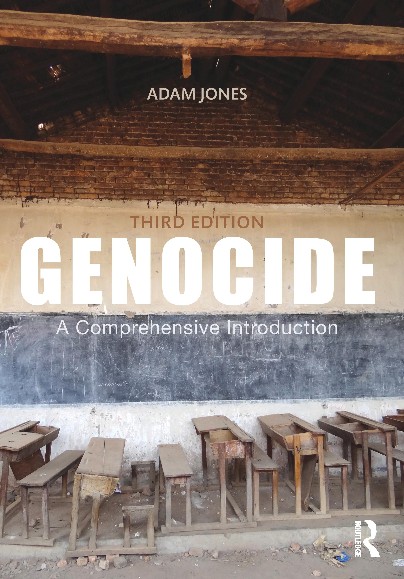
NOW AVAILABLE: Genocide: A Comprehensive Introduction, by Adam Jones (Routledge, 2006; 430 pp., US $33.95 pbk). See www.genocidetext.net. "The best introductory text available to students of genocide studies ... likely to become the gold standard by which all subsequent introductions to this enormously important subject will be measured" (Kenneth J. Campbell).
Wednesday, August 15, 2007
NOW AVAILABLE: Genocide: A Comprehensive Introduction, by Adam Jones (Routledge, 2006; 430 pp., US $33.95 pbk). See www.genocidetext.net. "The best introductory text available to students of genocide studies ... likely to become the gold standard by which all subsequent introductions to this enormously important subject will be measured" (Kenneth J. Campbell).


Genocide Studies Media File
July 26 - August 13, 2007
A compendium of news stories, features, and human rights reports pertaining to genocide and crimes against humanity. Compiled by Adam Jones. Please send links and feedback to adamj_jones@hotmail.com.
Consider inviting colleagues and friends to subscribe to Genocide_Studies and the G_S Media File. All it takes is an email to genocide_studies-subscribe@topica.com.
NOTE:
Greetings to all: I hope you have had, or are having, a good holiday. The following is the first "Media File" for the new semester. I have had most productive travels over the last couple of months: see my Romania photo galleries, and six galleries from Bosnia and Herzegovina (the city of Mostar, and the commemoration ceremony for the 1995 Srebrenica massacre). I'm settling into my new home in Kelowna, BC, site of the first satellite campus of the University of British Columbia. After two years as a postdoctoral fellow in the Genocide Studies Program at Yale, I'm now a tenured Associate Professor in the Political Science department at UBC Okanagan. - AJ
ARGENTINA
"Argentina's 'Dirty War' Crimes Trial"
By Marie Trigona
Counterpunch.com, 26 July 2007
"Former Chaplain Christian Von Wernich wore a priest's collar and bulletproof vest as he sat behind reinforced glass in a federal court. The court clerk read charges accusing him of collaborating with state security agents and covering up crimes in seven deaths, 31 cases of torture, and 42 cases of illegal imprisonment. He answered basic court questions but refused to testify in the case, stating, 'Following the advice of Dr. Jerollini who is my lawyer. I am not going to make a declaration. And I am not going to accept questions.' An estimated 30,000 people were killed during the military junta's reign of terror. As his trial began, hundreds of human rights activists stood outside the courtroom in the city of La Plata to decry Von Wernich as a murderer. President Nestor Kirchner traveled to La Plata and said during a speech that Von Wernich 'brought dishonor to the Church, to poor people, and to human rights.' At least 120 witnesses are slated to testify against Von Wernich and the court has taken precautions to protect their safety, putting up police fences around the courthouse and installing metal detectors. In the front row of the courtroom's audience, representatives from the human rights organization Mothers of Plaza de Mayo sat with their white headscarves listening to the court's accusations. According to Nora Cortinas, president of the Mothers of Plaza de Mayo's founding chapter, the Catholic Church supported the crimes committed during the dictatorship. [...]"
CAMBODIA/GENOCIDE TRIBUNALS
"Awaiting Justice in Cambodia"
By Paul Watson
The Los Angeles Times, 12 August 2007 [Registration Required]
"[...] More than three decades after the communist Khmer Rouge seized power in 1975, declared it Year Zero and launched into one of the 20th century's worst genocides, a special court is inching toward its first prosecutions. Pol Pot, Brother No. 1, died nine years ago, before he could be brought to trial. It may not be long before Brother No. 2 slips away himself. At 82, Nuon Chea's heart is growing weaker. Poor circulation has left his lower legs swollen, and his blood pressure is running high. 'I have a disease,' the man suspected of ordering the execution of thousands of Cambodians said wryly. 'It's called old age. Some days are good, some days are bad. But generally, my health goes up and down like any old person.' The clock is also ticking for the Khmer Rouge's surviving victims, such as artist Vann Nath, one of only seven prisoners known to have made it out alive from the notorious Tuol Sleng death camp. He was saved from execution there so he could paint portraits to feed Pol Pot's ego. Now the 61-year-old artist who survived on a watery prison gruel is wasting away from kidney disease. Vann Nath waits for justice in a cramped home above his family's restaurant, a popular breakfast spot for military officers on their way to work in the capital, Phnom Penh. Twice a week, he is attached to a dialysis machine. He relies on charity from Australia to pay medical bills of about $1,000 a month. His greatest hope is that he and his country's tormentors can stay alive long enough to face each other in court. 'I don't want a few people at the top to die yet,' he said, his voice weary. 'I don't want revenge. What I need from them is that they take responsibility for their mistakes.' [...]"
"Khmer Rouge Figure Is First Charged in Atrocities"
By Seth Mydans
The New York Times, 1 August 2007 [Registration Required]
"A tribunal in Cambodia charged the commandant of the main Khmer Rouge torture house with crimes against humanity on Tuesday, bringing the first charge in a long-delayed trial in the deaths of 1.7 million people in the late 1970s. The commandant, Kaing Guek Eav, 64, known as Duch, was the leader of the Tuol Sleng prison in Phnom Penh where at least 14,000 men, women and children were tortured and sent to killing fields. Only a handful survived. Two weeks ago, prosecutors announced that they had submitted to the tribunal a list of five potential defendants for consideration by co-investigating judges, who are authorized to decide on filing formal charges. The other four names have not been disclosed. In the charges on Tuesday, the judges said Duch had been placed in 'provisional detention,' but did not explain. A small holding center was recently built on the grounds of the tribunal in Phnom Penh, the capital of Cambodia. Duch has been the only major Khmer Rouge figure in custody, in a military jail in Phnom Penh on separate charges, since 1999 when a British photographer discovered him in rural Cambodia. He was working for a government agency and had become a born-again Christian. Because of his conversion, 'He spoke candidly about his role as Pol Pot's chief executioner,' said the photographer, Nic Dunlop, referring to the Khmer Rouge leader. 'If he remains true to his words and talks as openly as he did then, he can potentially throw huge light on areas of darkness that have eluded scholars for decades,' said Mr. Dunlop, who wrote about Duch in 'The Lost Executioner.' Duch could offer damaging testimony against other potential defendants, who have denied or minimized their roles in the Khmer Rouge rule. [...]"
CHINA/TIBET
"China Reportedly Jails Scores of Tibet Buddhists"
Associated Press dispatch on MSNBC.com, 3 August 2007
"Scores of people were arrested in a traditionally Tibetan area of western China following public calls for the return of Tibet's exiled spiritual leader, the Dalai Lama, reports said Friday. Also Friday, China moved to tighten its control over Tibetan Buddhism by asserting the communist government's sole right to recognize Buddhist reincarnations of the lamas that form the backbone of the religion's clergy. All future incarnations of living Buddhas related to Tibetan Buddhism 'must get government approval,' the official Xinhua News Agency said, citing the State Administration for Religious Affairs. Reincarnate lamas, known as tulkus, often lead religious communities and oversee the training of monks, giving them enormous influence over religious life in Tibet. Police and army reinforcements were sent to the town of Lithang in western Sichuan province following the incident Wednesday at an annual horse festival that attracts thousands, according to the overseas monitoring group International Campaign for Tibet and the U.S. government-supported Radio Free Asia. The reports said a local man, Runggye Adak, was detained after he climbed onto a stage erected for Chinese officials, grabbed a microphone and asked the crowd if they wanted the Dalai Lama to return. Hundreds responded with a roaring yes, the reports said. A crowd later gathered a detention center to appeal for Runggye Adak's release, but officers fired warning shots to disperse the group, it said. RFA said about 200 Tibetans were detained following the protest, but gave no indication of whether they were still in custody. A woman who answered the telephone at Lithang’s police station confirmed the protest had occurred, but hung up when asked for details. [...]"
GUATEMALA
"Civil War by Other Means"
By Jacob Wheeler
In These Times, 6 August 2007
"Guatemalans will go to the voting booths on Sept. 9 for their third national election since the country's bloody civil war ended in 1996. But 11 years later, the miseries of the 36-year conflicto armado, and its most notorious characters, are still visible across the landscape. On one side is the Mayan indigenous-rights activist Rigoberta Menchú Tum, who etched her name in Guatemalan history after winning the 1992 Nobel Peace Prize for her work exposing the atrocities of the civil war. She is known internationally for her memoir, 'I, Rigoberta Menchú,' which brought to light the murder of her family, and the suffering of her people, at the hands of the U.S.-trained and -funded military counterinsurgency. Menchú is running for president, and though she is a long shot to reach the likely run-off on Nov. 4, the fact that she has entered the political mainstream after hiding out in Mexico and France during the '80s speaks volumes to how far the country has come since the military put a price on her head. On the other side is El General, Efraín Ríos Montt, the former dictator and evangelical preacher who, as general, and briefly, president, presided over the bloody massacres that raged between the coup d'etats of March 1982 and August 1983. Montt is running for Congress this fall, and is almost guaranteed a seat since he heads the list of candidates for the right-wing Guatemalan Republican Front, one of the country's two largest parties. If Montt wins, the 81-year-old will secure immunity -- at least for the four-year length of his term -- from a lawsuit charging him with genocide brought by Menchú and other activists. Those charges were initiated in the Spanish National Court in 1999, and in July 2006, Spain issued international arrest warrants for Montt and seven other former military and civilian officials for their role in setting fire to the Spanish embassy in 1980, which killed the peasant activists hiding inside, as well as crimes committed during the 'scorched earth' campaign of the early '80s that wiped out about 440 indigenous villages. ... The ultimate irony would be if Menchú somehow won the election, and her nemesis Montt seized the top spot in Congress. According to tradition, the man accused of genocide would swear in the victim, and place the banda presidencial, a cloth with the blue and white colors of the Guatemalan flag, on her shoulders."
IRAQ
"Iraqi Sunni Claims 'Genocide Campaign'"
By Steven R. Hurst
Associated Press dispatch on Yahoo! News, 12 August 2007
"Iraq's most senior Sunni politician issued a desperate appeal Sunday for Arab nations to help stop what he called an 'unprecedented genocide campaign' by Shiite militias armed, trained and controlled by Iran. The U.S. military reported five American soldiers were killed, apparently lured into an al-Qaida trap. Adnan al-Dulaimi said 'Persians' and 'Safawis,' Sunni terms for Iranian Shiites, were on the brink of total control in Baghdad and soon would threaten Sunni Arab regimes which predominate in the Mideast. 'It is a war that has started in Baghdad and they will not stop there but will expand it to all Arab lands,' al-Dulaimi wrote in an impassioned broadside e-mailed to The Associated Press. Sunni Arab regimes throughout the Middle East fear the growing influence of Iran's Shiite theocracy with radical groups like Hezbollah and Hamas as well as the Syrian regime. Raising the specter of Iranian power reaching the Arab doorstep, unlikely in the near-term, betrayed al-Dulaimi's desperation. But his fears of a Shiite takeover of Baghdad were not as farfetched. Mahdi Army militiamen have cleansed entire neighborhoods of Sunni residents and seized Sunni mosques. Day by day, hundreds have been killed and thousands have fled their homes, seeking safety in the shrinking number of majority Sunni districts. The fighters, nominally loyal to radical Shiite cleric Muqtada al-Sadr, are believed to operate as death squads blamed for much of the country's sectarian slaughter. ... 'Arabs, your brothers in the land of the two rivers and in Baghdad in particular are exposed to an unprecedented genocide campaign by the militias and death squads that are directed, armed and supported by Iran,' al-Dulaimi said. [...]"
JAPAN/UNITED STATES/SECOND WORLD WAR
"Call by U.S. House for Sex Slavery Apology Angers Japan's Leader"
By Norimitsu Onishi
The New York Times, 1 August 2007 [Registration Required]
"Prime Minister Shinzo Abe expressed some irritation on Tuesday at the resolution approved by the House of Representatives in Washington that calls on Japan to acknowledge its wartime sex slavery. His reaction indicated strongly that the Japanese government would not offer surviving victims an official apology. 'The resolution's approval was regrettable,' said Mr. Abe, who caused a furor in Asia and the United States in March by denying that the Japanese military had directly coerced women into sex slavery in World War II. News of the approval, which had been expected, came as Mr. Abe faced more calls to resign as prime minister after the crushing defeat of his governing Liberal Democratic Party in the election on Sunday for the upper house of Parliament. On Wednesday morning, Norihiko Akagi, the scandal-ridden agriculture minister, resigned, admitting that he had contributed to Mr. Abe's loss on Sunday. Asked whether he would comply with the House resolution's demand for an official apology, Mr. Abe said: 'The 20th century was an era in which human rights were violated. I would like to make the 21st century into an era with no human rights violations.' On Monday, the House unanimously passed the nonbinding resolution strongly urging the Japanese government to 'formally acknowledge' and 'apologize' for its military’s 'coercion of women into sexual slavery.' Japan had lobbied hard against the resolution in Washington, warning that it could harm relations. Mr. Abe has expressed sympathy for the former sex slaves. But he has consistently refused to acknowledge the military's role in directly coercing women into sex slavery despite historical evidence and the testimony of many of the women. [...]"
JEWISH HOLOCAUST
"X-Ray of the Holocaust: Claude Lanzmann Talks to Marc Semo"
Libération (on Truthout.org), 8 August 2007
"For a long time, Raul Hilberg's great book, 'The Destruction of the European Jews,' was known only to a few specialists. The time was probably not yet ripe. The historiography of the Holocaust, which we now call the Shoah, is complicated, and a certain number of elements were required in order for the Nazi extermination of European Jews to appear in all its scope and specificity. When I began my work on what was to become the film 'Shoah' in 1973, I had never heard of Raul Hilberg. A small group of Israeli academics working at the Holocaust museum Yad Vashem, where I began my research, were the first to talk to me about his work. Only one of them had read the entire book and the two others had incomplete knowledge of it. So I went and got a copy of the book, which then existed in an American edition only. The text was in very tight print, published in two columns, and there was an almost physical difficulty to read it. I began to plunge into it as though seized by a holy terror. At that time, there were only a very few works on the subject apart from the one written slightly earlier by Gerhard Reitlinger, and, in France, Léon Poliakov's 'The Breviary of Hatred,' neither of which boast the scale of research conducted by Raul Hilberg. Most amazing, perhaps, was the way he proceeded by [detailing] vertical geological sections of that process of annihilation that stretched from 1933 to 1945. They don't observe the chronology, but show how the destruction of people is always accompanied by that of their assets: the confiscation or 'Aryanization' of the latter, right up to the ripping out of gold teeth after the gassings. He showed the branding, segregation, ghettoization, etc. He laid bare the implacable mechanism of what he held to be a bureaucratic process of destruction. From the moment the German bureaucracy made it its object, it could only go all the way, as though carried by its own logic. [...]"
"Cracks Appear in Berlin's Holocaust Memorial"
By Kate Connolly
The Guardian, 9 August 2007
"Berlin's Holocaust memorial is said to be in urgent need of repair after cracks were found in some 400 of its concrete slabs. The £20m monument to the 6 million Jews who were murdered by the Nazis was unveiled just over two years ago. It covers the area of about three football pitches in central Berlin and has attracted 7 million visitors, making it one of the capital's most popular tourist sites. The hairline cracks, up to 4.7 metres (15.4ft) long, began appearing after just seven months. They have been letting in rain and causing a hard lime deposit to appear to ooze out of more than a fifth of the grey blocks that make up the memorial and resemble undulating gravestones. Experts say they now have to be injected with a plastic resin. Suggestions that the material used was mediocre have been dismissed by the memorial's New York architect, Peter Eisenman. He described the concrete as 'the best in Berlin.' A spokesman for his office said it was surprising that the cracks had spread so quickly. Several explanations for the cracks have been put forward, including frost damage and building works nearby. A road by the memorial had to be moved to accommodate the new US embassy, which is being built between the site and the Brandenburg Gate. The construction of a new train tunnel has also caused much disruption. [...]"
"Israel Pulls Scorned Holocaust Survivor Stipend"
Associated Press dispatch on MSNBC.com, 3 August 2007
"The Israeli government will revise a widely criticized plan to grant needy Holocaust survivors a monthly stipend of $20, officials said Friday, after survivors said the plan was laughable. Israeli Prime Minister Ehud Olmert announced the plan this week in response to concern about poverty among the some 240,000 Israelis who survived the Nazi genocide, saying he was 'correcting a 60-year-old blight.' But the meager sum -- 83 shekels a month, or $20 -- drew scorn from survivors, and after a meeting Thursday night between Olmert's staff and survivor representatives, the sides released a joint statement saying the government would look into new solutions. The government and the survivors 'decided to set a short timetable during which the pressing matters on the agenda will be worked out,' leading up to a meeting between Olmert and the survivors next week, the statement said. Noah Flug, chair of a consortium of survivors' groups, said the $20 allowance was now 'off the agenda.' Speaking on Army Radio, Flug said he was confident that Olmert's representatives 'want to solve the problem.' [...]"
NANJING MASSACRE
"Nanjing Massacre Anniversary Marked in New Film"
Reuters dispatch, 31 July 2007
"Film producers from China, the United States and Britain have begun shooting a movie about the Rape of Nanjing, adding to a series of films marking the 70th anniversary of the massacre, Xinhua news agency said on Tuesday. 'Purple Mountain' would depict the atrocities by the invading Japanese army in December 1937, in which China says hundreds of thousands of Nanjing residents were slaughtered, through the eyes of a middle-class Chinese mother and her daughter, Xinhua said. Shooting began on Tuesday in the city, then the Chinese capital and known as Nanking, in the eastern province of Jiangsu, but the producers had yet to reveal who would star in the film, Xinhua said. The crew hoped the $53 million movie would have an impact on audiences similar to that of Steven Spielberg's Holocaust film, "Schindler's List", Xinhua quoted American producer Gerald Green as saying. ... The U.S.-made documentary film 'Nanking,' about a dozen Westerners setting up a safe zone for refugees in the war-torn city, premiered in China earlier in July to coincide with the 70th anniversary of the start of all-out Sino-Japanese War. [...]"
RUSSIA/STALINISM
"Memorial Raised to Victims of Stalin"
Agence France-Presse dispatch in The Times, 9 August 2007
"A three-storey cross has been erected on a site where thousands of victims of Stalin’s purges were executed 70 years ago. About 500 people gathered in the southern suburb of Butovo for a religious service after the 12.5m (41ft) wooden cross was raised by hand and then fixed in place with rocks. More than 20,000 were killed at the site during Stalin's campaign against 'enemies of the people,' with the first executions taking place on August 8, 1937. The cross was carved from cedar and pine from Solovetsky Monastery in Siberia, one of Stalin's most notorious prison camps."
[n.b. This is the complete text of the dispatch.]
SUDAN/DARFUR/CHAD
"In Darfur, Another Obstacle to Peace"
By Edmund Sanders
The Los Angeles Times, 12 August 2007 [Registration Required]
"Three years after it was burned to the ground, the village of Tulus in Darfur is springing back to life. Corn and sesame sprout from fertile fields. Children play around newly built huts. Smoke from cooking fires once again rises from the land. Problem is, those rebuilding Tulus are not the original inhabitants, who were chased away by pro-government Sudanese militias in 2004 and are afraid to return. Instead, their place has been taken by Chadian Arabs, who recently crossed the border to flee violence in their own country. 'It's comfortable here,' said Sheik Algooni Mohammed Zeean, 42, leader of 150 Chadian Arabs who in March settled on a grassy plain not far from the ruins of Tulus' abandoned homes and school. Gesturing toward the fields bearing their first harvest in Sudan, he smiled. 'I feel like this is my home now.' Over the last six months, nearly 30,000 Chadian Arabs have crossed into Sudan, many of them settling on land owned by Darfur's pastoral tribes that have been driven into displacement camps, aid groups say. This migration has quickly become the latest obstacle to peace in western Sudan, drawing the attention of international observers and protests from those displaced from Darfur, who accuse the Sudanese government of orchestrating an 'Arabization' scheme by repopulating their burned-out villages with foreigners. 'This is a government plot to give our land to Chadian Arabs,' said Mohammed Abakar Mohammed Adam, 27, a farmer from the village of Bechabecha, which he said was abandoned after armed nomadic tribes known asjanjaweed, widely believed to be backed by the government, attacked in 2003. But in recent months, Chadian newcomers have begun building homes atop the remains. [...]"
"Key Darfur Rebel Chief Boycotts Peace Talks"
By Xan Rice
The Observer, 5 August 2007
"Peace talks aimed at uniting the myriad rebel groups fighting the Sudanese government in Darfur -- where 200,000 have died - seemed to be becoming irrelevant when a key rebel leader said he would not be attending. In a luxury lodge in northern Tanzania, representatives of most of Darfur's rebel groups sat down yesterday to try to forge a common position before possible negotiations with Khartoum. Coming just days after the UN agreed to send a 26,000 force to the war-torn province, the talks had seemed to represent a second coup for international mediators trying to end the four-year conflict. But those hopes were dashed when Abdel Wahed Mohamed el-Nur, the head of the main faction of the rebel Sudan Liberation Movement, stayed in Paris, from where he questioned both Khartoum's willingness to end the conflict and the legitimacy of some of the rebel leaders attending the talks. 'Peace negotiations need a conducive environment, but the government of Sudan is still killing people, thousands are being displaced,' he said. While mediators from the African Union (AU) and UN tried to play down el-Nur's absence, it has dampened hopes that negotiations between the rebels and President Omar el-Bashir's government could begin soon. El-Nur, who enjoys widespread support among the Fur ethnic group, refused to sign an internationally brokered peace deal with the Sudanese government in May 2006 in Abuja, Nigeria, rendering the so-called Darfur Peace Agreement largely meaningless. The decision by the UN Security Council to allow a hybrid AU-UN force of 26,000 peacekeepers to replace the 7,000-strong AU mission will improve security, even if it takes several months to deploy. But it is widely acknowledged that, without a political settlement that addresses the rebels' demands of more autonomy and power-sharing at a national level, the crisis is Darfur will not end. [...]"
"UN Darfur Force 'Will Be Too Weak'"
By Denise Driscoll
The Sunday Telegraph, 5 August 2007
"United Nations officials in Sudan fear that the hasty plan to send a 26,000-strong peacekeeping force to Darfur, approved by the Security Council last week, will backfire because its mandate is too weak. Senior aid workers and UN staff on the ground are strongly critical of the deal, hurriedly struck in New York with the backing of Britain, France and the US, immediately after Gordon Brown's first visit as Prime Minister to the organisation's headquarters. The force is unlikely to be deployed until next year, but the critics claim the decision is already undermining political progress within Sudan. One UN official near Al Fasher, the capital city of north Darfur, said: 'It has come as a real blow to the international community here and has seriously damaged what little political progress was being made. Brown, Bush and Sarkozy have been pushing the issue of Darfur without any real success, but now they have a resolution to hold up as a trophy.' The Security Council vote on Tuesday followed months of debate over how to intervene to end Sudan's four-year war, which has claimed more than 200,000 lives and left more than two million homeless. A smaller force of military monitors, provided by the African Union, has failed to halt the slaughter of black African villagers by pro-government Arab Janjaweed militias. To overcome Chinese objections at the Security Council, it was agreed that the new force would not have the power to disarm the warring factions or seize illegal weapons. There was no threat of sanctions against Sudan's government, which agreed to abide by the watered-down resolution. [...]"
"UN Approves 26,000 Peacekeepers for Darfur"
By James Bone
The Times, 1 August 2007
"The United Nations launched the largest peacekeeping mission in the world last night in an attempt to halt more than four years of massacres that have cost almost a quarter of a million lives in the Darfur region of Sudan. After months of tortuous negotiation, the UN Security Council adopted unanimously a landmark resolution, co-sponsored by Britain, to create a 26,000-strong 'hybrid' UN-African Union peacekeeping force. The force, to be composed primarily of African troops, will be empowered to 'take the necessary action' to prevent attacks and protect civilians in the vast desert region that has been racked by violence since 2003. Gordon Brown hailed the move during a stop at UN headquarters on his way home from his summit with President Bush. He threatened to seek further sanctions if Sudan failed to co-operate. 'This is the world coming together to say that we have a plan now, that we expect the authorities in Sudan to act. We will not tolerate further inaction, and the violence has got to stop now,' Mr. Brown said. The resolution authorises a force of 19,555 troops plus 6,432 civilian police to take over from the overstretched 7,000-strong African Union peacekeeping operation in Darfur by the end of the year. The hybrid force will try to quell the violence, which began with camelriding Arab Janjawid militia slaughtering black villagers but has now fragmented to involve a patchwork of rebel groups and feuding tribes and has spilt over the borders into Chad and the Central African Republic. ... The new force will overtake the 17,000-strong operation in the Democratic Republic of Congo to become the largest UN peacekeeping mission, costing an estimated $2.6 billion (£1.3 billion) a year. It will run in parallel with the existing UN peacekeeping mission in southern Sudan, which comprises about 16,000 personnel and costs $1 billion a year. [...]"
"Defunding the Genocide"
By Johann Hari
CommonDreams.org (from The Independent), 30 July 2007
"[...] Only China can halt the genocide now. Yet, ordinarily, the Chinese dictators are impervious to international human rights condemnation. Look, for example, at how they continue to brutalise Tibet, the Uighurs, the Falun Gong and trade unionists in their own country. But the Beijing Olympics next year provide us with a crucial pressure point, where we can inflict real pain on the CCP. They are desperate for their post-Tiananmen coming-out party to go without a hitch. But unless China stops the flow of petrodollars to the Sudanese genocidaires, Save Dafur campaigners are determined to brand the games the Genocide Olympics. Already, Steven Spielberg is having to make uncomfortable noises about shooting the CCP's Olympic propaganda films, and pressure is building on the corporate Olympics sponsors, including Johnson and Johnson, Coca-Cola, and McDonald's. The US boycotted the Moscow Olympic Games after the Soviet invasion of Afghanistan; isn't a genocide even worse? Shouldn't we all be refusing to turn up unless China changes its support for race-slaughter? [...]"
"The Reluctant Hero of Ddarfur, The Movie"
By John Anderson
The New York Times, 29 July 2007 [Registration Required]
"'The Holocaust,' Stanley Kubrick once said, 'is about six million people who get killed. "Schindler's List" was about 600 people who don't.' Despite the acclaim afforded 'Schindler's List,' Steven Spielberg’s 1993 Oscar winner, its venerable dramatic strategy -- addressing a tragedy of the many via the actions of a few -- didn't quite get to the heart of darkness. At least not for Kubrick. 'The Devil Came on Horseback,' which opened Wednesday in New York, has similar issues: genocide, for one. The documentary, directed by Annie Sundberg and Ricki Stern, concerns the ongoing crisis in the Darfur region of Sudan, where atrocities continue to be committed on many sides, including the rape and murder of black Africans by the Arab Janjaweed ('devils on horseback'). And it focuses on a lone hero, Brian Steidle, an ex-marine captain who served as an observer for the African Union-United Nations peacekeeping force, took photographs of the atrocities being perpetrated and eventually published them in The New York Times. That Mr. Steidle, a white, middle-class American from a military family, is the focus of a movie about a black-African catastrophe, is something that might rankle some audiences. If there were a show of hands, Mr. Steidle’s would be the first one up. 'The hardest part for me during the filming,' said Mr. Steidle, 30, 'was when we were shooting in Rwanda, during a commemoration of the genocide there. There were huge ceremonies, people crying, people lighting candles. And here's this one camera, in the dark, with a bright, white spotlight, and it's pointed at me, one of only about 10 white people who were there. I'm very sensitive to it,' he said. 'But they convinced me that the best way to tell the story is through me.' [...]"
"Climate Change Escalates Darfur Crisis"
By Scott Baldauf
The Christian Science Monitor, 27 July 2007
"[...] Competition for water -- in refugee camps, between farmers and herders, and between countries -- has long sparked conflict in the arid region and forms one of the main causes of the war in Sudan's Darfur region. But the trouble is only beginning, as it becomes clear that dramatic climate change will have its sharpest effects in Africa, leading to rising hardship, massive population displacement, and, in some cases, all-out war. Yet a growing number of aid workers here say that the same issue that pits communities against each other can also bring them together. Solving common problems -- improving access to water for farmers and herders alike -- could be the first step toward reconciliation, and lasting peace. 'In a way, water can be a divider or it can bring people together,' says Caroline Saint-Mleux, head of Care International's office in Iriba, Chad, which manages two refugee camps in the Iriba area. 'Is [water] the only cause of the problem?' she asks. 'Obviously, everyone knows it's a very complex conflict. But at the same time, you can use [water] to bring the communities back together. ... You have to have [the warring parties] talk about a common need, and after that you might have them talk about something else that would start giving other solutions to the conflict.' [...]"
"No Hopes for Us"
By Mia Farrow
HuffingtonPost.com (from The Wall Street Journal), 27 July 2007
"If we hear of Eastern Chad at all, it is as a spillover of the genocidal slaughter in Darfur. But this swath of land along Darfur's border has become a full-scale catastrophe in its own right, and it is without the immense and effective humanitarian infrastructure which is sustaining millions of lives in Darfur. When I first came here in November 2006, I met Abdullah Idris Zaid, who was lying in the tiny Goz Beida hospital. It was a terrible month in eastern Chad. The Janjaweed, Darfur's government-backed Arab militias, joined with Chadian Arab tribes on a rampage of destruction; 60 villages were burned and scores of people were killed, raped, and mutilated. Mr. Zaid's eyes were gouged out by Janjaweed knives. ... Eastern Chad has been plunged into chaos and lawlessness. In border towns, pick-up trucks outfitted with machine guns and loaded with armed, uniformed men careen through the dusty streets. No one knows who they are: the army, Chadian rebels, bandits? It makes little difference to the victims of the escalating violence. For about $5 dollars (U.S.), anyone can get a uniform in the marketplace. As I passed through the town of Abeche, a U.N. refugee agency guard was murdered and two staffers severely wounded. About 100 humanitarian vehicles have been highjacked in the last year; aid workers have been robbed, beaten, abducted and killed. Eight months ago, 40,000 Chadians had been displaced by Janjaweed attacks. Today the number is 175,000 and rising. People have fled from their burning villages and the fields that sustained them to squalid camps across Eastern Chad. 'Mortality rates of children under five are double what is accepted as the threshold for an emergency,' says Johanne Sekkenes, a Doctors Without Borders program director. 'The situation here is massively deteriorating. The needs are huge. Assistance has been too little, and it comes too late.' [...]"
"The Genocide Olympics: Why Mia Farrow Attacked Steven Spielberg"
By Kim Masters
Slate.com, 26 July 2007
"When Mia Farrow wrote in the pages of the Wall Street Journal that Steven Spielberg risks becoming 'the Leni Riefenstahl of the Beijing games,' you might think that she was doing the Lord's work. Or you might think that she struck too low a blow to the man who founded the Shoah Foundation. But whatever your reaction, you have to admit: She's got some cojones. We caught up with her this week -- she's shooting a film in soggy Normandy -- and she told us the back story. ... Spielberg hasn't commented on what he plans to do about the games, but he's expected to communicate something soon. Clearly, he was stung by Farrow's article. Perhaps it's only coincidence that he wrote to the Chinese president soon after it was published, and asked for action. But he considers it unfair that he's facing pressure to boycott the Olympics when none of the activist groups is asking the same of the athletes. Farrow knows that many in the industry consider it madness to reproach Spielberg publicly or privately. 'I know how it is out there,' she says of Hollywood. 'I think the flags are flying at half-mast over at my management. But I'm not risking my life. Maybe I'm risking my career. It's a pittance. We're talking about millions of lives at stake." ... Spielberg's spokesman, Andy Spahn, has now gone on the record saying that Spielberg is considering 'all options,' including quitting, depending on what the Chinese do in the days ahead: 'We're pretty far down the road in discussions and then we'll decide if the path is productive or not and then consider other options.'"
ISSUE: FEMALE FOETICIDE
"Foetuses Aborted and Dumped Secretly as India Shuns Baby Girls"
By Randeep Ramesh
The Guardian, 28 July 2007
"A hundred yards from a school playing field on the edge of Nayagarh, a small town in eastern India, is an innocuous damp circular patch covered with what appears to be sticks and stones. A closer look reveals that the debris is shards of tiny skulls and bones, all that remains of more than 40 female foetuses -- aborted because of their sex and then dumped in a disused well. The secret tragedy of being conceived female in India burst into the open this week with the grim discovery of the well, dug on land earmarked for a private hospital -- the Krishna clinic owned by an obstetrician, Nabakirshora Sahu, and his wife, Savitha. The latter is in custody but the medic is on the run. Last Thursday Santish Mishra, a health official, was poking at the top of the hole, from which had been exhumed 132 bags of putrefying human remains. Above the grisly sight hangs an acrid smell, the telltale chemical stench of hospital waste used to hide the truth. 'Femur, skull, forearm -- probably. We are pretty sure these are all female, aborted at about five months which is the legal limit,' said Dr. Mishra. 'You can say it was a hidden mass grave.' In India ultrasound technology, coupled with a traditional preference for boys, has led to mass female foeticide. Although gender-based abortion is illegal, parents are choosing to abort female foetuses in such large numbers that experts estimate India has lost 10 million girls in the past 20 years. In the 12 years since selective abortion was outlawed only one doctor has been convicted of the crime. [...]"
ISSUE: LANGUAGE OF GENOCIDE
"Getting Comfy With Genocide"
By Ron Rosenbaum
Slate.com, 1 August 2007
"It's good that we're beginning to get all relaxed and comfy about genocide, isn't it? Samantha Power's important book on the subject was called A Problem From Hell. But in recent discourse, genocide seems to have become A Problem From Heck. One aspect of the shift is a new 'realism' about genocide that reflects the way the world has come to tolerate it: We now tacitly concede that in practice, we can't or won't do much more than deplore it and learn to live with it. Another -- more troubling -- trend is toward what we might call 'defining genocide down': redefining genocide to refer to lesser episodes of killing and thus lessening the power of the word to shock. One has to admire the honesty of Barack Obama, who argued in the recent Democratic YouTube debate that even if rapid withdrawal of troops from Iraq might lead to genocide, he'd favor going ahead and getting the troops out. He wasn't saying he was happy about the possibility—he was just expressing the view that the word genocide shouldn't freeze all discourse: He wouldn't let it be a deal-breaker. Some were shocked by this remark. Others agreed that fear of a future genocide should not inhibit efforts to stop the current killing. ... It's an argument in which the definition of genocide can get lost in the welter of terms that range from 'ethnic strife' to 'ethnic cleansing' to 'mass murder.' But by blurring the definition of genocide, by conflating it with various forms of what might be called 'genocide-lite,' we risk diminishing the moral weight and admonitory power of the term. [...]"
ISSUE: NUCLEARISM
"The Terror America Wrought"
By Robert Scheer
Truthdig.com, 7 August 2007
"During a week of mayhem in Iraq, in which terrorists have rightly been condemned for targeting schoolchildren, it is sobering to recall that this week is also the 62nd anniversary of a U.S. attack that deliberately took the lives of thousands of children on their way to school in the Japanese cities of Hiroshima and Nagasaki. As noted in the Strategic Bombing Survey conducted at President Harry Truman's request, when the bomb hit Hiroshima on April 6, 1945, 'nearly all the school children ... were at work in the open,' to be exploded, irradiated or incinerated in the perfect firestorm that the planners back at the University of California-run Los Alamos lab had envisioned for the bomb's maximum psychological impact. The terror plot worked all too well, as Hiroshima's Mayor Tadatoshi Akiba recalled this week: 'That fateful summer, 8:15 a.m. The roar of a B-29 breaks the morning calm. A parachute opens in the blue sky. Then suddenly, a flash, an enormous blast -- silence -- hell on Earth. The eyes of young girls watching the parachute were melted. Their faces became giant charred blisters. The skin of people seeking help dangled from their fingernails. ... Others died when their eyeballs and internal organs burst from their bodies -- Hiroshima was a hell where those who somehow survived envied the dead.' Like most of the others killed by the two American bombs, neither the children nor the adults had any role in Japan's decision to go to war, but they were picked as the target instead of an isolated but fortified military base whose antiaircraft fire posed a higher risk. The target preferred by U.S. atomic scientists -- a patch in the ocean or unpopulated terrain -- was rejected, because the effect of hundreds of thousands of civilians dying would be all the more dramatic. The victims in Hiroshima and Nagasaki were available soft targets, much like the children playing in Iraq, suddenly caught in the crossfire of battles waged beyond their control. [...]"
Consider inviting colleagues and friends to subscribe to Genocide_Studies and the G_S Media File. All it takes is an email to genocide_studies-subscribe@topica.com.
NOTE:
Greetings to all: I hope you have had, or are having, a good holiday. The following is the first "Media File" for the new semester. I have had most productive travels over the last couple of months: see my Romania photo galleries, and six galleries from Bosnia and Herzegovina (the city of Mostar, and the commemoration ceremony for the 1995 Srebrenica massacre). I'm settling into my new home in Kelowna, BC, site of the first satellite campus of the University of British Columbia. After two years as a postdoctoral fellow in the Genocide Studies Program at Yale, I'm now a tenured Associate Professor in the Political Science department at UBC Okanagan. - AJ
ARGENTINA
"Argentina's 'Dirty War' Crimes Trial"
By Marie Trigona
Counterpunch.com, 26 July 2007
"Former Chaplain Christian Von Wernich wore a priest's collar and bulletproof vest as he sat behind reinforced glass in a federal court. The court clerk read charges accusing him of collaborating with state security agents and covering up crimes in seven deaths, 31 cases of torture, and 42 cases of illegal imprisonment. He answered basic court questions but refused to testify in the case, stating, 'Following the advice of Dr. Jerollini who is my lawyer. I am not going to make a declaration. And I am not going to accept questions.' An estimated 30,000 people were killed during the military junta's reign of terror. As his trial began, hundreds of human rights activists stood outside the courtroom in the city of La Plata to decry Von Wernich as a murderer. President Nestor Kirchner traveled to La Plata and said during a speech that Von Wernich 'brought dishonor to the Church, to poor people, and to human rights.' At least 120 witnesses are slated to testify against Von Wernich and the court has taken precautions to protect their safety, putting up police fences around the courthouse and installing metal detectors. In the front row of the courtroom's audience, representatives from the human rights organization Mothers of Plaza de Mayo sat with their white headscarves listening to the court's accusations. According to Nora Cortinas, president of the Mothers of Plaza de Mayo's founding chapter, the Catholic Church supported the crimes committed during the dictatorship. [...]"
CAMBODIA/GENOCIDE TRIBUNALS
"Awaiting Justice in Cambodia"
By Paul Watson
The Los Angeles Times, 12 August 2007 [Registration Required]
"[...] More than three decades after the communist Khmer Rouge seized power in 1975, declared it Year Zero and launched into one of the 20th century's worst genocides, a special court is inching toward its first prosecutions. Pol Pot, Brother No. 1, died nine years ago, before he could be brought to trial. It may not be long before Brother No. 2 slips away himself. At 82, Nuon Chea's heart is growing weaker. Poor circulation has left his lower legs swollen, and his blood pressure is running high. 'I have a disease,' the man suspected of ordering the execution of thousands of Cambodians said wryly. 'It's called old age. Some days are good, some days are bad. But generally, my health goes up and down like any old person.' The clock is also ticking for the Khmer Rouge's surviving victims, such as artist Vann Nath, one of only seven prisoners known to have made it out alive from the notorious Tuol Sleng death camp. He was saved from execution there so he could paint portraits to feed Pol Pot's ego. Now the 61-year-old artist who survived on a watery prison gruel is wasting away from kidney disease. Vann Nath waits for justice in a cramped home above his family's restaurant, a popular breakfast spot for military officers on their way to work in the capital, Phnom Penh. Twice a week, he is attached to a dialysis machine. He relies on charity from Australia to pay medical bills of about $1,000 a month. His greatest hope is that he and his country's tormentors can stay alive long enough to face each other in court. 'I don't want a few people at the top to die yet,' he said, his voice weary. 'I don't want revenge. What I need from them is that they take responsibility for their mistakes.' [...]"
"Khmer Rouge Figure Is First Charged in Atrocities"
By Seth Mydans
The New York Times, 1 August 2007 [Registration Required]
"A tribunal in Cambodia charged the commandant of the main Khmer Rouge torture house with crimes against humanity on Tuesday, bringing the first charge in a long-delayed trial in the deaths of 1.7 million people in the late 1970s. The commandant, Kaing Guek Eav, 64, known as Duch, was the leader of the Tuol Sleng prison in Phnom Penh where at least 14,000 men, women and children were tortured and sent to killing fields. Only a handful survived. Two weeks ago, prosecutors announced that they had submitted to the tribunal a list of five potential defendants for consideration by co-investigating judges, who are authorized to decide on filing formal charges. The other four names have not been disclosed. In the charges on Tuesday, the judges said Duch had been placed in 'provisional detention,' but did not explain. A small holding center was recently built on the grounds of the tribunal in Phnom Penh, the capital of Cambodia. Duch has been the only major Khmer Rouge figure in custody, in a military jail in Phnom Penh on separate charges, since 1999 when a British photographer discovered him in rural Cambodia. He was working for a government agency and had become a born-again Christian. Because of his conversion, 'He spoke candidly about his role as Pol Pot's chief executioner,' said the photographer, Nic Dunlop, referring to the Khmer Rouge leader. 'If he remains true to his words and talks as openly as he did then, he can potentially throw huge light on areas of darkness that have eluded scholars for decades,' said Mr. Dunlop, who wrote about Duch in 'The Lost Executioner.' Duch could offer damaging testimony against other potential defendants, who have denied or minimized their roles in the Khmer Rouge rule. [...]"
CHINA/TIBET
"China Reportedly Jails Scores of Tibet Buddhists"
Associated Press dispatch on MSNBC.com, 3 August 2007
"Scores of people were arrested in a traditionally Tibetan area of western China following public calls for the return of Tibet's exiled spiritual leader, the Dalai Lama, reports said Friday. Also Friday, China moved to tighten its control over Tibetan Buddhism by asserting the communist government's sole right to recognize Buddhist reincarnations of the lamas that form the backbone of the religion's clergy. All future incarnations of living Buddhas related to Tibetan Buddhism 'must get government approval,' the official Xinhua News Agency said, citing the State Administration for Religious Affairs. Reincarnate lamas, known as tulkus, often lead religious communities and oversee the training of monks, giving them enormous influence over religious life in Tibet. Police and army reinforcements were sent to the town of Lithang in western Sichuan province following the incident Wednesday at an annual horse festival that attracts thousands, according to the overseas monitoring group International Campaign for Tibet and the U.S. government-supported Radio Free Asia. The reports said a local man, Runggye Adak, was detained after he climbed onto a stage erected for Chinese officials, grabbed a microphone and asked the crowd if they wanted the Dalai Lama to return. Hundreds responded with a roaring yes, the reports said. A crowd later gathered a detention center to appeal for Runggye Adak's release, but officers fired warning shots to disperse the group, it said. RFA said about 200 Tibetans were detained following the protest, but gave no indication of whether they were still in custody. A woman who answered the telephone at Lithang’s police station confirmed the protest had occurred, but hung up when asked for details. [...]"
GUATEMALA
"Civil War by Other Means"
By Jacob Wheeler
In These Times, 6 August 2007
"Guatemalans will go to the voting booths on Sept. 9 for their third national election since the country's bloody civil war ended in 1996. But 11 years later, the miseries of the 36-year conflicto armado, and its most notorious characters, are still visible across the landscape. On one side is the Mayan indigenous-rights activist Rigoberta Menchú Tum, who etched her name in Guatemalan history after winning the 1992 Nobel Peace Prize for her work exposing the atrocities of the civil war. She is known internationally for her memoir, 'I, Rigoberta Menchú,' which brought to light the murder of her family, and the suffering of her people, at the hands of the U.S.-trained and -funded military counterinsurgency. Menchú is running for president, and though she is a long shot to reach the likely run-off on Nov. 4, the fact that she has entered the political mainstream after hiding out in Mexico and France during the '80s speaks volumes to how far the country has come since the military put a price on her head. On the other side is El General, Efraín Ríos Montt, the former dictator and evangelical preacher who, as general, and briefly, president, presided over the bloody massacres that raged between the coup d'etats of March 1982 and August 1983. Montt is running for Congress this fall, and is almost guaranteed a seat since he heads the list of candidates for the right-wing Guatemalan Republican Front, one of the country's two largest parties. If Montt wins, the 81-year-old will secure immunity -- at least for the four-year length of his term -- from a lawsuit charging him with genocide brought by Menchú and other activists. Those charges were initiated in the Spanish National Court in 1999, and in July 2006, Spain issued international arrest warrants for Montt and seven other former military and civilian officials for their role in setting fire to the Spanish embassy in 1980, which killed the peasant activists hiding inside, as well as crimes committed during the 'scorched earth' campaign of the early '80s that wiped out about 440 indigenous villages. ... The ultimate irony would be if Menchú somehow won the election, and her nemesis Montt seized the top spot in Congress. According to tradition, the man accused of genocide would swear in the victim, and place the banda presidencial, a cloth with the blue and white colors of the Guatemalan flag, on her shoulders."
IRAQ
"Iraqi Sunni Claims 'Genocide Campaign'"
By Steven R. Hurst
Associated Press dispatch on Yahoo! News, 12 August 2007
"Iraq's most senior Sunni politician issued a desperate appeal Sunday for Arab nations to help stop what he called an 'unprecedented genocide campaign' by Shiite militias armed, trained and controlled by Iran. The U.S. military reported five American soldiers were killed, apparently lured into an al-Qaida trap. Adnan al-Dulaimi said 'Persians' and 'Safawis,' Sunni terms for Iranian Shiites, were on the brink of total control in Baghdad and soon would threaten Sunni Arab regimes which predominate in the Mideast. 'It is a war that has started in Baghdad and they will not stop there but will expand it to all Arab lands,' al-Dulaimi wrote in an impassioned broadside e-mailed to The Associated Press. Sunni Arab regimes throughout the Middle East fear the growing influence of Iran's Shiite theocracy with radical groups like Hezbollah and Hamas as well as the Syrian regime. Raising the specter of Iranian power reaching the Arab doorstep, unlikely in the near-term, betrayed al-Dulaimi's desperation. But his fears of a Shiite takeover of Baghdad were not as farfetched. Mahdi Army militiamen have cleansed entire neighborhoods of Sunni residents and seized Sunni mosques. Day by day, hundreds have been killed and thousands have fled their homes, seeking safety in the shrinking number of majority Sunni districts. The fighters, nominally loyal to radical Shiite cleric Muqtada al-Sadr, are believed to operate as death squads blamed for much of the country's sectarian slaughter. ... 'Arabs, your brothers in the land of the two rivers and in Baghdad in particular are exposed to an unprecedented genocide campaign by the militias and death squads that are directed, armed and supported by Iran,' al-Dulaimi said. [...]"
JAPAN/UNITED STATES/SECOND WORLD WAR
"Call by U.S. House for Sex Slavery Apology Angers Japan's Leader"
By Norimitsu Onishi
The New York Times, 1 August 2007 [Registration Required]
"Prime Minister Shinzo Abe expressed some irritation on Tuesday at the resolution approved by the House of Representatives in Washington that calls on Japan to acknowledge its wartime sex slavery. His reaction indicated strongly that the Japanese government would not offer surviving victims an official apology. 'The resolution's approval was regrettable,' said Mr. Abe, who caused a furor in Asia and the United States in March by denying that the Japanese military had directly coerced women into sex slavery in World War II. News of the approval, which had been expected, came as Mr. Abe faced more calls to resign as prime minister after the crushing defeat of his governing Liberal Democratic Party in the election on Sunday for the upper house of Parliament. On Wednesday morning, Norihiko Akagi, the scandal-ridden agriculture minister, resigned, admitting that he had contributed to Mr. Abe's loss on Sunday. Asked whether he would comply with the House resolution's demand for an official apology, Mr. Abe said: 'The 20th century was an era in which human rights were violated. I would like to make the 21st century into an era with no human rights violations.' On Monday, the House unanimously passed the nonbinding resolution strongly urging the Japanese government to 'formally acknowledge' and 'apologize' for its military’s 'coercion of women into sexual slavery.' Japan had lobbied hard against the resolution in Washington, warning that it could harm relations. Mr. Abe has expressed sympathy for the former sex slaves. But he has consistently refused to acknowledge the military's role in directly coercing women into sex slavery despite historical evidence and the testimony of many of the women. [...]"
JEWISH HOLOCAUST
"X-Ray of the Holocaust: Claude Lanzmann Talks to Marc Semo"
Libération (on Truthout.org), 8 August 2007
"For a long time, Raul Hilberg's great book, 'The Destruction of the European Jews,' was known only to a few specialists. The time was probably not yet ripe. The historiography of the Holocaust, which we now call the Shoah, is complicated, and a certain number of elements were required in order for the Nazi extermination of European Jews to appear in all its scope and specificity. When I began my work on what was to become the film 'Shoah' in 1973, I had never heard of Raul Hilberg. A small group of Israeli academics working at the Holocaust museum Yad Vashem, where I began my research, were the first to talk to me about his work. Only one of them had read the entire book and the two others had incomplete knowledge of it. So I went and got a copy of the book, which then existed in an American edition only. The text was in very tight print, published in two columns, and there was an almost physical difficulty to read it. I began to plunge into it as though seized by a holy terror. At that time, there were only a very few works on the subject apart from the one written slightly earlier by Gerhard Reitlinger, and, in France, Léon Poliakov's 'The Breviary of Hatred,' neither of which boast the scale of research conducted by Raul Hilberg. Most amazing, perhaps, was the way he proceeded by [detailing] vertical geological sections of that process of annihilation that stretched from 1933 to 1945. They don't observe the chronology, but show how the destruction of people is always accompanied by that of their assets: the confiscation or 'Aryanization' of the latter, right up to the ripping out of gold teeth after the gassings. He showed the branding, segregation, ghettoization, etc. He laid bare the implacable mechanism of what he held to be a bureaucratic process of destruction. From the moment the German bureaucracy made it its object, it could only go all the way, as though carried by its own logic. [...]"
"Cracks Appear in Berlin's Holocaust Memorial"
By Kate Connolly
The Guardian, 9 August 2007
"Berlin's Holocaust memorial is said to be in urgent need of repair after cracks were found in some 400 of its concrete slabs. The £20m monument to the 6 million Jews who were murdered by the Nazis was unveiled just over two years ago. It covers the area of about three football pitches in central Berlin and has attracted 7 million visitors, making it one of the capital's most popular tourist sites. The hairline cracks, up to 4.7 metres (15.4ft) long, began appearing after just seven months. They have been letting in rain and causing a hard lime deposit to appear to ooze out of more than a fifth of the grey blocks that make up the memorial and resemble undulating gravestones. Experts say they now have to be injected with a plastic resin. Suggestions that the material used was mediocre have been dismissed by the memorial's New York architect, Peter Eisenman. He described the concrete as 'the best in Berlin.' A spokesman for his office said it was surprising that the cracks had spread so quickly. Several explanations for the cracks have been put forward, including frost damage and building works nearby. A road by the memorial had to be moved to accommodate the new US embassy, which is being built between the site and the Brandenburg Gate. The construction of a new train tunnel has also caused much disruption. [...]"
"Israel Pulls Scorned Holocaust Survivor Stipend"
Associated Press dispatch on MSNBC.com, 3 August 2007
"The Israeli government will revise a widely criticized plan to grant needy Holocaust survivors a monthly stipend of $20, officials said Friday, after survivors said the plan was laughable. Israeli Prime Minister Ehud Olmert announced the plan this week in response to concern about poverty among the some 240,000 Israelis who survived the Nazi genocide, saying he was 'correcting a 60-year-old blight.' But the meager sum -- 83 shekels a month, or $20 -- drew scorn from survivors, and after a meeting Thursday night between Olmert's staff and survivor representatives, the sides released a joint statement saying the government would look into new solutions. The government and the survivors 'decided to set a short timetable during which the pressing matters on the agenda will be worked out,' leading up to a meeting between Olmert and the survivors next week, the statement said. Noah Flug, chair of a consortium of survivors' groups, said the $20 allowance was now 'off the agenda.' Speaking on Army Radio, Flug said he was confident that Olmert's representatives 'want to solve the problem.' [...]"
NANJING MASSACRE
"Nanjing Massacre Anniversary Marked in New Film"
Reuters dispatch, 31 July 2007
"Film producers from China, the United States and Britain have begun shooting a movie about the Rape of Nanjing, adding to a series of films marking the 70th anniversary of the massacre, Xinhua news agency said on Tuesday. 'Purple Mountain' would depict the atrocities by the invading Japanese army in December 1937, in which China says hundreds of thousands of Nanjing residents were slaughtered, through the eyes of a middle-class Chinese mother and her daughter, Xinhua said. Shooting began on Tuesday in the city, then the Chinese capital and known as Nanking, in the eastern province of Jiangsu, but the producers had yet to reveal who would star in the film, Xinhua said. The crew hoped the $53 million movie would have an impact on audiences similar to that of Steven Spielberg's Holocaust film, "Schindler's List", Xinhua quoted American producer Gerald Green as saying. ... The U.S.-made documentary film 'Nanking,' about a dozen Westerners setting up a safe zone for refugees in the war-torn city, premiered in China earlier in July to coincide with the 70th anniversary of the start of all-out Sino-Japanese War. [...]"
RUSSIA/STALINISM
"Memorial Raised to Victims of Stalin"
Agence France-Presse dispatch in The Times, 9 August 2007
"A three-storey cross has been erected on a site where thousands of victims of Stalin’s purges were executed 70 years ago. About 500 people gathered in the southern suburb of Butovo for a religious service after the 12.5m (41ft) wooden cross was raised by hand and then fixed in place with rocks. More than 20,000 were killed at the site during Stalin's campaign against 'enemies of the people,' with the first executions taking place on August 8, 1937. The cross was carved from cedar and pine from Solovetsky Monastery in Siberia, one of Stalin's most notorious prison camps."
[n.b. This is the complete text of the dispatch.]
SUDAN/DARFUR/CHAD
"In Darfur, Another Obstacle to Peace"
By Edmund Sanders
The Los Angeles Times, 12 August 2007 [Registration Required]
"Three years after it was burned to the ground, the village of Tulus in Darfur is springing back to life. Corn and sesame sprout from fertile fields. Children play around newly built huts. Smoke from cooking fires once again rises from the land. Problem is, those rebuilding Tulus are not the original inhabitants, who were chased away by pro-government Sudanese militias in 2004 and are afraid to return. Instead, their place has been taken by Chadian Arabs, who recently crossed the border to flee violence in their own country. 'It's comfortable here,' said Sheik Algooni Mohammed Zeean, 42, leader of 150 Chadian Arabs who in March settled on a grassy plain not far from the ruins of Tulus' abandoned homes and school. Gesturing toward the fields bearing their first harvest in Sudan, he smiled. 'I feel like this is my home now.' Over the last six months, nearly 30,000 Chadian Arabs have crossed into Sudan, many of them settling on land owned by Darfur's pastoral tribes that have been driven into displacement camps, aid groups say. This migration has quickly become the latest obstacle to peace in western Sudan, drawing the attention of international observers and protests from those displaced from Darfur, who accuse the Sudanese government of orchestrating an 'Arabization' scheme by repopulating their burned-out villages with foreigners. 'This is a government plot to give our land to Chadian Arabs,' said Mohammed Abakar Mohammed Adam, 27, a farmer from the village of Bechabecha, which he said was abandoned after armed nomadic tribes known asjanjaweed, widely believed to be backed by the government, attacked in 2003. But in recent months, Chadian newcomers have begun building homes atop the remains. [...]"
"Key Darfur Rebel Chief Boycotts Peace Talks"
By Xan Rice
The Observer, 5 August 2007
"Peace talks aimed at uniting the myriad rebel groups fighting the Sudanese government in Darfur -- where 200,000 have died - seemed to be becoming irrelevant when a key rebel leader said he would not be attending. In a luxury lodge in northern Tanzania, representatives of most of Darfur's rebel groups sat down yesterday to try to forge a common position before possible negotiations with Khartoum. Coming just days after the UN agreed to send a 26,000 force to the war-torn province, the talks had seemed to represent a second coup for international mediators trying to end the four-year conflict. But those hopes were dashed when Abdel Wahed Mohamed el-Nur, the head of the main faction of the rebel Sudan Liberation Movement, stayed in Paris, from where he questioned both Khartoum's willingness to end the conflict and the legitimacy of some of the rebel leaders attending the talks. 'Peace negotiations need a conducive environment, but the government of Sudan is still killing people, thousands are being displaced,' he said. While mediators from the African Union (AU) and UN tried to play down el-Nur's absence, it has dampened hopes that negotiations between the rebels and President Omar el-Bashir's government could begin soon. El-Nur, who enjoys widespread support among the Fur ethnic group, refused to sign an internationally brokered peace deal with the Sudanese government in May 2006 in Abuja, Nigeria, rendering the so-called Darfur Peace Agreement largely meaningless. The decision by the UN Security Council to allow a hybrid AU-UN force of 26,000 peacekeepers to replace the 7,000-strong AU mission will improve security, even if it takes several months to deploy. But it is widely acknowledged that, without a political settlement that addresses the rebels' demands of more autonomy and power-sharing at a national level, the crisis is Darfur will not end. [...]"
"UN Darfur Force 'Will Be Too Weak'"
By Denise Driscoll
The Sunday Telegraph, 5 August 2007
"United Nations officials in Sudan fear that the hasty plan to send a 26,000-strong peacekeeping force to Darfur, approved by the Security Council last week, will backfire because its mandate is too weak. Senior aid workers and UN staff on the ground are strongly critical of the deal, hurriedly struck in New York with the backing of Britain, France and the US, immediately after Gordon Brown's first visit as Prime Minister to the organisation's headquarters. The force is unlikely to be deployed until next year, but the critics claim the decision is already undermining political progress within Sudan. One UN official near Al Fasher, the capital city of north Darfur, said: 'It has come as a real blow to the international community here and has seriously damaged what little political progress was being made. Brown, Bush and Sarkozy have been pushing the issue of Darfur without any real success, but now they have a resolution to hold up as a trophy.' The Security Council vote on Tuesday followed months of debate over how to intervene to end Sudan's four-year war, which has claimed more than 200,000 lives and left more than two million homeless. A smaller force of military monitors, provided by the African Union, has failed to halt the slaughter of black African villagers by pro-government Arab Janjaweed militias. To overcome Chinese objections at the Security Council, it was agreed that the new force would not have the power to disarm the warring factions or seize illegal weapons. There was no threat of sanctions against Sudan's government, which agreed to abide by the watered-down resolution. [...]"
"UN Approves 26,000 Peacekeepers for Darfur"
By James Bone
The Times, 1 August 2007
"The United Nations launched the largest peacekeeping mission in the world last night in an attempt to halt more than four years of massacres that have cost almost a quarter of a million lives in the Darfur region of Sudan. After months of tortuous negotiation, the UN Security Council adopted unanimously a landmark resolution, co-sponsored by Britain, to create a 26,000-strong 'hybrid' UN-African Union peacekeeping force. The force, to be composed primarily of African troops, will be empowered to 'take the necessary action' to prevent attacks and protect civilians in the vast desert region that has been racked by violence since 2003. Gordon Brown hailed the move during a stop at UN headquarters on his way home from his summit with President Bush. He threatened to seek further sanctions if Sudan failed to co-operate. 'This is the world coming together to say that we have a plan now, that we expect the authorities in Sudan to act. We will not tolerate further inaction, and the violence has got to stop now,' Mr. Brown said. The resolution authorises a force of 19,555 troops plus 6,432 civilian police to take over from the overstretched 7,000-strong African Union peacekeeping operation in Darfur by the end of the year. The hybrid force will try to quell the violence, which began with camelriding Arab Janjawid militia slaughtering black villagers but has now fragmented to involve a patchwork of rebel groups and feuding tribes and has spilt over the borders into Chad and the Central African Republic. ... The new force will overtake the 17,000-strong operation in the Democratic Republic of Congo to become the largest UN peacekeeping mission, costing an estimated $2.6 billion (£1.3 billion) a year. It will run in parallel with the existing UN peacekeeping mission in southern Sudan, which comprises about 16,000 personnel and costs $1 billion a year. [...]"
"Defunding the Genocide"
By Johann Hari
CommonDreams.org (from The Independent), 30 July 2007
"[...] Only China can halt the genocide now. Yet, ordinarily, the Chinese dictators are impervious to international human rights condemnation. Look, for example, at how they continue to brutalise Tibet, the Uighurs, the Falun Gong and trade unionists in their own country. But the Beijing Olympics next year provide us with a crucial pressure point, where we can inflict real pain on the CCP. They are desperate for their post-Tiananmen coming-out party to go without a hitch. But unless China stops the flow of petrodollars to the Sudanese genocidaires, Save Dafur campaigners are determined to brand the games the Genocide Olympics. Already, Steven Spielberg is having to make uncomfortable noises about shooting the CCP's Olympic propaganda films, and pressure is building on the corporate Olympics sponsors, including Johnson and Johnson, Coca-Cola, and McDonald's. The US boycotted the Moscow Olympic Games after the Soviet invasion of Afghanistan; isn't a genocide even worse? Shouldn't we all be refusing to turn up unless China changes its support for race-slaughter? [...]"
"The Reluctant Hero of Ddarfur, The Movie"
By John Anderson
The New York Times, 29 July 2007 [Registration Required]
"'The Holocaust,' Stanley Kubrick once said, 'is about six million people who get killed. "Schindler's List" was about 600 people who don't.' Despite the acclaim afforded 'Schindler's List,' Steven Spielberg’s 1993 Oscar winner, its venerable dramatic strategy -- addressing a tragedy of the many via the actions of a few -- didn't quite get to the heart of darkness. At least not for Kubrick. 'The Devil Came on Horseback,' which opened Wednesday in New York, has similar issues: genocide, for one. The documentary, directed by Annie Sundberg and Ricki Stern, concerns the ongoing crisis in the Darfur region of Sudan, where atrocities continue to be committed on many sides, including the rape and murder of black Africans by the Arab Janjaweed ('devils on horseback'). And it focuses on a lone hero, Brian Steidle, an ex-marine captain who served as an observer for the African Union-United Nations peacekeeping force, took photographs of the atrocities being perpetrated and eventually published them in The New York Times. That Mr. Steidle, a white, middle-class American from a military family, is the focus of a movie about a black-African catastrophe, is something that might rankle some audiences. If there were a show of hands, Mr. Steidle’s would be the first one up. 'The hardest part for me during the filming,' said Mr. Steidle, 30, 'was when we were shooting in Rwanda, during a commemoration of the genocide there. There were huge ceremonies, people crying, people lighting candles. And here's this one camera, in the dark, with a bright, white spotlight, and it's pointed at me, one of only about 10 white people who were there. I'm very sensitive to it,' he said. 'But they convinced me that the best way to tell the story is through me.' [...]"
"Climate Change Escalates Darfur Crisis"
By Scott Baldauf
The Christian Science Monitor, 27 July 2007
"[...] Competition for water -- in refugee camps, between farmers and herders, and between countries -- has long sparked conflict in the arid region and forms one of the main causes of the war in Sudan's Darfur region. But the trouble is only beginning, as it becomes clear that dramatic climate change will have its sharpest effects in Africa, leading to rising hardship, massive population displacement, and, in some cases, all-out war. Yet a growing number of aid workers here say that the same issue that pits communities against each other can also bring them together. Solving common problems -- improving access to water for farmers and herders alike -- could be the first step toward reconciliation, and lasting peace. 'In a way, water can be a divider or it can bring people together,' says Caroline Saint-Mleux, head of Care International's office in Iriba, Chad, which manages two refugee camps in the Iriba area. 'Is [water] the only cause of the problem?' she asks. 'Obviously, everyone knows it's a very complex conflict. But at the same time, you can use [water] to bring the communities back together. ... You have to have [the warring parties] talk about a common need, and after that you might have them talk about something else that would start giving other solutions to the conflict.' [...]"
"No Hopes for Us"
By Mia Farrow
HuffingtonPost.com (from The Wall Street Journal), 27 July 2007
"If we hear of Eastern Chad at all, it is as a spillover of the genocidal slaughter in Darfur. But this swath of land along Darfur's border has become a full-scale catastrophe in its own right, and it is without the immense and effective humanitarian infrastructure which is sustaining millions of lives in Darfur. When I first came here in November 2006, I met Abdullah Idris Zaid, who was lying in the tiny Goz Beida hospital. It was a terrible month in eastern Chad. The Janjaweed, Darfur's government-backed Arab militias, joined with Chadian Arab tribes on a rampage of destruction; 60 villages were burned and scores of people were killed, raped, and mutilated. Mr. Zaid's eyes were gouged out by Janjaweed knives. ... Eastern Chad has been plunged into chaos and lawlessness. In border towns, pick-up trucks outfitted with machine guns and loaded with armed, uniformed men careen through the dusty streets. No one knows who they are: the army, Chadian rebels, bandits? It makes little difference to the victims of the escalating violence. For about $5 dollars (U.S.), anyone can get a uniform in the marketplace. As I passed through the town of Abeche, a U.N. refugee agency guard was murdered and two staffers severely wounded. About 100 humanitarian vehicles have been highjacked in the last year; aid workers have been robbed, beaten, abducted and killed. Eight months ago, 40,000 Chadians had been displaced by Janjaweed attacks. Today the number is 175,000 and rising. People have fled from their burning villages and the fields that sustained them to squalid camps across Eastern Chad. 'Mortality rates of children under five are double what is accepted as the threshold for an emergency,' says Johanne Sekkenes, a Doctors Without Borders program director. 'The situation here is massively deteriorating. The needs are huge. Assistance has been too little, and it comes too late.' [...]"
"The Genocide Olympics: Why Mia Farrow Attacked Steven Spielberg"
By Kim Masters
Slate.com, 26 July 2007
"When Mia Farrow wrote in the pages of the Wall Street Journal that Steven Spielberg risks becoming 'the Leni Riefenstahl of the Beijing games,' you might think that she was doing the Lord's work. Or you might think that she struck too low a blow to the man who founded the Shoah Foundation. But whatever your reaction, you have to admit: She's got some cojones. We caught up with her this week -- she's shooting a film in soggy Normandy -- and she told us the back story. ... Spielberg hasn't commented on what he plans to do about the games, but he's expected to communicate something soon. Clearly, he was stung by Farrow's article. Perhaps it's only coincidence that he wrote to the Chinese president soon after it was published, and asked for action. But he considers it unfair that he's facing pressure to boycott the Olympics when none of the activist groups is asking the same of the athletes. Farrow knows that many in the industry consider it madness to reproach Spielberg publicly or privately. 'I know how it is out there,' she says of Hollywood. 'I think the flags are flying at half-mast over at my management. But I'm not risking my life. Maybe I'm risking my career. It's a pittance. We're talking about millions of lives at stake." ... Spielberg's spokesman, Andy Spahn, has now gone on the record saying that Spielberg is considering 'all options,' including quitting, depending on what the Chinese do in the days ahead: 'We're pretty far down the road in discussions and then we'll decide if the path is productive or not and then consider other options.'"
ISSUE: FEMALE FOETICIDE
"Foetuses Aborted and Dumped Secretly as India Shuns Baby Girls"
By Randeep Ramesh
The Guardian, 28 July 2007
"A hundred yards from a school playing field on the edge of Nayagarh, a small town in eastern India, is an innocuous damp circular patch covered with what appears to be sticks and stones. A closer look reveals that the debris is shards of tiny skulls and bones, all that remains of more than 40 female foetuses -- aborted because of their sex and then dumped in a disused well. The secret tragedy of being conceived female in India burst into the open this week with the grim discovery of the well, dug on land earmarked for a private hospital -- the Krishna clinic owned by an obstetrician, Nabakirshora Sahu, and his wife, Savitha. The latter is in custody but the medic is on the run. Last Thursday Santish Mishra, a health official, was poking at the top of the hole, from which had been exhumed 132 bags of putrefying human remains. Above the grisly sight hangs an acrid smell, the telltale chemical stench of hospital waste used to hide the truth. 'Femur, skull, forearm -- probably. We are pretty sure these are all female, aborted at about five months which is the legal limit,' said Dr. Mishra. 'You can say it was a hidden mass grave.' In India ultrasound technology, coupled with a traditional preference for boys, has led to mass female foeticide. Although gender-based abortion is illegal, parents are choosing to abort female foetuses in such large numbers that experts estimate India has lost 10 million girls in the past 20 years. In the 12 years since selective abortion was outlawed only one doctor has been convicted of the crime. [...]"
ISSUE: LANGUAGE OF GENOCIDE
"Getting Comfy With Genocide"
By Ron Rosenbaum
Slate.com, 1 August 2007
"It's good that we're beginning to get all relaxed and comfy about genocide, isn't it? Samantha Power's important book on the subject was called A Problem From Hell. But in recent discourse, genocide seems to have become A Problem From Heck. One aspect of the shift is a new 'realism' about genocide that reflects the way the world has come to tolerate it: We now tacitly concede that in practice, we can't or won't do much more than deplore it and learn to live with it. Another -- more troubling -- trend is toward what we might call 'defining genocide down': redefining genocide to refer to lesser episodes of killing and thus lessening the power of the word to shock. One has to admire the honesty of Barack Obama, who argued in the recent Democratic YouTube debate that even if rapid withdrawal of troops from Iraq might lead to genocide, he'd favor going ahead and getting the troops out. He wasn't saying he was happy about the possibility—he was just expressing the view that the word genocide shouldn't freeze all discourse: He wouldn't let it be a deal-breaker. Some were shocked by this remark. Others agreed that fear of a future genocide should not inhibit efforts to stop the current killing. ... It's an argument in which the definition of genocide can get lost in the welter of terms that range from 'ethnic strife' to 'ethnic cleansing' to 'mass murder.' But by blurring the definition of genocide, by conflating it with various forms of what might be called 'genocide-lite,' we risk diminishing the moral weight and admonitory power of the term. [...]"
ISSUE: NUCLEARISM
"The Terror America Wrought"
By Robert Scheer
Truthdig.com, 7 August 2007
"During a week of mayhem in Iraq, in which terrorists have rightly been condemned for targeting schoolchildren, it is sobering to recall that this week is also the 62nd anniversary of a U.S. attack that deliberately took the lives of thousands of children on their way to school in the Japanese cities of Hiroshima and Nagasaki. As noted in the Strategic Bombing Survey conducted at President Harry Truman's request, when the bomb hit Hiroshima on April 6, 1945, 'nearly all the school children ... were at work in the open,' to be exploded, irradiated or incinerated in the perfect firestorm that the planners back at the University of California-run Los Alamos lab had envisioned for the bomb's maximum psychological impact. The terror plot worked all too well, as Hiroshima's Mayor Tadatoshi Akiba recalled this week: 'That fateful summer, 8:15 a.m. The roar of a B-29 breaks the morning calm. A parachute opens in the blue sky. Then suddenly, a flash, an enormous blast -- silence -- hell on Earth. The eyes of young girls watching the parachute were melted. Their faces became giant charred blisters. The skin of people seeking help dangled from their fingernails. ... Others died when their eyeballs and internal organs burst from their bodies -- Hiroshima was a hell where those who somehow survived envied the dead.' Like most of the others killed by the two American bombs, neither the children nor the adults had any role in Japan's decision to go to war, but they were picked as the target instead of an isolated but fortified military base whose antiaircraft fire posed a higher risk. The target preferred by U.S. atomic scientists -- a patch in the ocean or unpopulated terrain -- was rejected, because the effect of hundreds of thousands of civilians dying would be all the more dramatic. The victims in Hiroshima and Nagasaki were available soft targets, much like the children playing in Iraq, suddenly caught in the crossfire of battles waged beyond their control. [...]"
Thursday, May 24, 2007
On the road until July
To Jonestream visitors: I will be leaving New Haven at the end of May, and travelling in the Balkans until mid-July. Thereafter, I will be taking up my new position as Associate Professor of Political Science at the University of British Columbia Okanagan. I should be able to resume posting the "Media File" by the end of July. See you then!
Genocide Studies Media File
May 14-24, 2007
A compendium of news stories, features, and human rights reports pertaining to genocide and crimes against humanity. Compiled by Adam Jones. Please send links and feedback to adamj_jones@hotmail.com.
Consider inviting colleagues and friends to subscribe to Genocide_Studies and the G_S Media File. All it takes is an email to genocide_studies-subscribe@topica.com.
AFGHANISTAN
"Forgotten Women Turn Kabul into Widows' Capital"
By Sharmeen Obaid-Chinoy
The Independent, 17 May 2007
"There are two million war widows in Afghanistan, and their plight is easy to forget in Hamid Karzai's capital, where Western-style shopping malls, bars and French restaurants are opening up for wealthy foreign aid workers and Afghan expatriates. Every morning Gul, who was widowed when an American bomb hit her house in 2001, leaves her two daughters to go begging on the streets of Kabul. 'If I'm lucky, I'll make about 50 afghanis (80p), enough to buy two pieces of bread,' she says. Kabul, it is said, is the widows' capital of the world. As many as 50,000 women like Gul live in the city, and many make their home in the abandoned buildings that dot the suburbs, often living in horrific conditions. In a nation with a fractured infrastructure and, at £125 a year, one of the lowest per-capita incomes in the world, many widows are left without relatives able to take them in or offer even modest financial support. Gul's blue burqa at least affords her some dignity. 'The men hurl abuse at me, they make indecent gestures and I'm always being harassed, but at least they cannot see me,' she says. There is no social security system in Afghanistan. Widows are not provided pensions or housing so there is no safety net for them to fall back on. In other Muslim countries, getting remarried can resolve the economic problems of widows. But in Afghanistan's that is not so. Most Afghan men do not want to bring up children from a previous marriage. 'They are fiercely protective of their wives and the mere thought of them being married before is an insult to their honour,' says Maria Akrami, a social worker who runs a small NGO in Kabul. [...]"
AUSTRALIA/ABORIGINAL GENOCIDE
"Abbbott Heckled at Stolen Generation Forum"
By Sarah Wiley
News.com.au, 24 May 2007
"Federal Health Minister Tony Abbott has been heckled by an audience at a forum for the 10th anniversary of the report on the Stolen Generation. The 1997 report into the separation of Aboriginal and Torres Strait Islander children from their families accused governments of genocide and called for an apology and compensation. Members of the audience disrupted the Health Minister's speech at Parliament House in Canberra, calling for the government to say sorry. Mr. Abbott continued with his speech amid heckling and groans from the audience. Earlier, Lowitja O'Donoghue, co-patron of the Stolen Generation Alliance, criticised Prime Minister John Howard's attitude to the Stolen Generation. 'The Prime Minister either doesn't get it, or he doesn't care, and I am not sure which is worse,' Professor O'Donoghue told the forum. Indigenous people were dying of despair, while those in power looked the other way. 'It is for this reason that I have no expectation of an apology from our current Prime Minister,' she said. 'Every state government has taken this important step, and said sorry. But at a federal level, rebuilding relationships is not the name of the game.' Mr. Abbott said later that while he could understand why Prof O'Donoghue wanted a government apology, the debate had moved on. 'The important thing for reconciliation is what happens in the hearts of individual people,' he said. ... 'I'd rather focus on the good things that are happening and the good that has been done than go over old ground.' The Government has announced 22 more staff will be employed for services to help members of the Stolen Generation find their families."
CENTRAL AFRICAN REPUBLIC/INTERNATIONAL TRIBUNALS
"ICC Begins CAR Mass Rape Inquiry"
By Katy Glassborow
Institute for War and Peace Reporting, 22 May 2007
"Prosecutors from the International Criminal Court, ICC, have launched an investigation into mass rape and killings in the Central African Republic, CAR, which took place during fighting between government and rebel forces in 2002 and 2003, following a failed coup. Launching the inquiry on May 22, the chief prosecutor, Luis Moreno-Ocampo, said the conflict appears to have featured a pattern of mass rapes and sexual violence committed against civilians by armed fighters. The CAR government referred the situation to ICC prosecutors in December 2004, providing investigators and lawyers with information relating to the crimes, together with evidence collected for prosecutions in national courts. In 2005, prosecutors sent a team to Bangui, the CAR capital, and found that the Cour de Cassation -- the country's highest judicial body -- was unable to carry out necessary proceedings to investigate and prosecute crimes. The ICC can only intervene if national justice systems are 'unwilling or unable' to deal with cases domestically, and prosecutors concluded that the CAR authorities were unable even to 'collect evidence and obtain the accused.' ... Following criticism that crimes of sexual violence have not featured heavily in arrest warrants for suspects from Uganda, the DR Congo and Darfur -- the other areas the ICC is involved in -- prosecutors stressed that sexual crimes far outnumber killings in CAR. ... Reports used by ICC prosecution investigators indicate that rape has been committed against innocent elderly women, young girls and men, often featuring 'aggravating aspects of cruelty,' such as multiple perpetrators and the forced participation of family members. 'These victims are calling for justice,' said Moreno-Ocampo. [...]"
COLOMBIA
"Paramilitary Ties to Elite In Colombia Are Detailed"
By Juan Forero
The Washington Post, 22 May 2007 [Registration Required]
"Top paramilitary commanders have in recent days confirmed what human rights groups and others have long alleged: Some of Colombia's most influential political, military and business figures helped build a powerful anti-guerrilla movement that operated with impunity, killed civilians and shipped cocaine to U.S. cities. The commanders have named army generals, entrepreneurs, foreign companies and politicians who not only bankrolled paramilitary operations but also worked hand in hand with fighters to carry them out. In accounts that are at odds with those of the government, the commanders have said their organization, rather than simply sprouting up to fill a void in lawless regions of the country, had been systematically built with the help of bigger forces. 'Paramilitarism was state policy,' Salvatore Mancuso, a top paramilitary commander, said last week at a hearing in this city's Palace of Justice. 'I am proof positive of state paramilitarism in Colombia.' In a scandal that began to gain momentum last fall, investigators have revealed dozens of cases of government collaboration with paramilitary groups. But Mancuso's testimony, buttressed with remarks made in a jailhouse interview by another top paramilitary commander, represents the first time that major players in the scandal have described in detail how the establishment joined forces with them. Dozens of other top commanders are scheduled to testify before special judicial hearings in the coming days and weeks. Their testimony could help uncover the roots of the violence and drug trafficking that have plagued this country and commanded significant aid from Washington. [...]"
"Death-Squad Scandal Circles Closer to Colombia's President"
By Simon Romero
The New York Times, 16 May 2007
"President Álvaro Uribe, the Bush administration's closest ally in Latin America, faces an intensifying scandal after a jailed former commander of paramilitary death squads testified Tuesday that Mr. Uribe's defense minister had tried to plot with the outlawed private militias to upset the rule of a former president. The revelations threaten the government of President Álvaro Uribe, who is trying to improve trade ties with the United States. Speaking at a closed court hearing in Medellín, Salvatore Mancuso, the former paramilitary warlord, said Defense Minister Juan Manuel Santos had met with paramilitary leaders in the mid-1990s to discuss efforts to destabilize the president at the time, Ernesto Samper, according to judicial officials. Mr. Mancuso also said that Vice President Francisco Santos had met with paramilitary leaders in 1997 to discuss taking their operations to the capital, Bogotá. A spokesman for the Defense Ministry said the minister would not comment. The spokesman said a meeting did take place in which Mr. Santos, the defense minister, discussed an effort to reach a peace plan between two guerrilla groups and the paramilitaries. The vice president, who was traveling outside the country, was not immediately available for comment. Mr. Uribe went on national television on Tuesday night, but did not address the allegations. These revelations followed the disclosure this week of an illegal domestic spying program by the national police force and additional arrests of high-ranking political allies of Mr. Uribe on charges of ties to the paramilitaries. [...]"
"Colombian Lawmakers Arrested"
By Juan Forero
The Washington Post, 15 May 2007 [Registration Required]
"The Colombian Supreme Court on Monday ordered the arrest of five more congressmen for alleged links with illegal paramilitary groups, bringing to 14 the number of lawmakers charged in the widening 'para-politics' scandal that has shaken this Andean country and its conservative government. Four of the five have been taken into custody. The attorney general's office also ordered the arrest of six former members of Congress, including Eleonora Pineda, who is well-known for her open friendship with paramilitary commanders. Authorities have accused the lawmakers -- as well as several local officials -- of meeting with paramilitary commanders in 2001 in Santa Fe de Ralito, a town the government had set aside as a haven for negotiations with paramilitary groups, and of signing a document in which they pledged to 'refound the fatherland' and 'build a new Colombia.' ... The arrests are sure to further tarnish Uribe's government. Although the president remains popular, he has seen one ally in Congress after another arrested or linked to paramilitary groups. ... The para-political scandal, meanwhile, has expanded to a point that an opposition congressman alleged in a hearing last month that paramilitary members met at Uribe's ranch in the late 1980s. The Supreme Court is also collecting evidence to establish whether the president's cousin, Sen. Mario Uribe, had met with paramilitary commanders to plot land-grabs; the senator denied any such links in a recent interview. [...]"
CROATIA/INTERNATIONAL TRIBUNALS
"Is Croatia's Judiciary Ready for Its Big Challenge?"
By Lisa Clifford
Institute for War and Peace Reporting, 18 May 2007
"All eyes will be on Zagreb County Court next month when the first case transferred to the Croatian judiciary by the Hague tribunal comes to trial. Croatian generals Rahim Ademi and Mirko Norac are charged with war crimes allegedly committed against Serbs in 1993. Their trial is expected to generate great interest at home but also in Brussels where EU accession officials will be looking on with keen interest when the case begins on June 18. The judiciary has been Croatia's biggest obstacle to its hopes to join the union in 2009, and observers say a well-run trial could demonstrate that legal reforms have firmly taken hold. Ademi and Norac are indicted for persecutions on political, racial and religious grounds; murder; plunder of public or private property; and wanton destruction of cities, towns or villages. The charges against them relate to an attack on Serb civilians in the so-called Medak Pocket, south of the city of Gospic in Croatia. Ademi was acting commander of the Gospic military district and Norac was commander of the 9th Guards Motorised Brigade of the Croatian army during the military operation in the area. At the time, it was part of the Republika Srpska Krajina, a self-proclaimed Serbian entity in Croatia. The indictment says the Medak Pocket was wiped out during the September 9-17 attack by Croat forces and the population of 400 Serbs forced to flee. Many Serbs were killed or wounded and their property stolen. According to the indictment, Ademi and Norac, 'planned, instigated, ordered, committed or otherwise aided and abetted in the planning, preparation or execution of persecutions of Serb civilians of the Medak Pocket on racial, political or religious grounds.' That includes the unlawful killing of Serb civilians and captured and wounded soldiers; cruel and inhumane treatment of local people, including stabbing, cutting of fingers, severe beatings with rifle butts, burning with cigarettes and mutilation. [...]"
EAST GERMANY
"The Dreams of Others"
By Slavoj Zizek
In These Times, 18 May 2007
"[...] Like so many other films depicting the harshness of Communist regimes, The Lives of Others misses their true horror. How so? First, what sets the film's plot in motion is the corrupt minister of culture, who wants to get rid of the top German Democratic Republic (GDR) playwright, Georg Dreyman, so he can pursue unimpeded an affair with Dreyman's partner, the actress Christa-Maria. In this way, the horror that was inscribed into the very structure of the East German system is relegated to a mere personal whim. What's lost is that the system would be no less terrifying without the minister's personal corruption, even if it were run by only dedicated and 'honest' bureaucrats. Equally troublesome is the film's portrayal of Dreyman. He is idealized in the opposite direction -- a great writer, both honest and sincerely dedicated to the Communist system, who is personally close to the top regime figures. ... To ask some obvious questions: If he was such an honest and powerful writer, how come he did not get into trouble with the regime much earlier? Why wasn't he considered at least a little bit problematic by the regime, with his excesses tolerated because of his international fame, as was the case with famous GDR authors like Bertolt Brecht, Heiner Muller and Christa Wolf? ... We are still waiting for a film that would provide a complete description of the GDR terror, a film that would do for the Stasi what Varlam Shalamov, in his unsurpassed Kolyma Tales, did for the Gulag."
HAITI/UNITED STATES
"Haitian Ex-Paramilitary Leader to Stand Trial"
Reuters dispatch, 22 May 2007
"A Haitian former paramilitary leader accused of rape and murder in Haiti will stand trial in New York for mortgage fraud, a state judge ruled on Tuesday after a human rights group argued he could escape justice if he were to return to Haiti. Emmanuel 'Toto' Constant, 50, was to have served a reduced prison term in return for pleading guilty in February to fraud and grand larceny. But State Supreme Court Judge Abraham Gerges rejected that plea agreement based on detailed information he recently received regarding Constant's leadership role in the Front for the Advancement and Progress of Haiti, known as FRAPH. 'These allegations, if true, are heinous, and the court cannot in good conscience consent to the previously negotiated sentence,' the judge said in a written ruling. ;The court also cannot consent to time served, as that would be a travesty.' The judge set a trial date of September 24. If convicted, Constant faces a maximum of 15 years in prison. The Center for Constitutional Rights told the judge by letter that Constant should not be deported but instead serve a full sentence for economic crimes in New York because it was likely Constant 'could evade justice in his home country; for human rights violations. The legal rights group said the ex-death squad leader of FRAPH, which formed to undermine former Haitian President Jean-Bertrand Aristide, fled to New York in 1994 soon after Aristide returned to power and issued his arrest warrant. The group said Constant was a former paid CIA informant and had directly conspired in the assassination of Aristide's Minister of Justice, Guy Malary, but had been allowed to stay in the United States."
[n.b. This is the complete text of the dispatch.]
NAZISM/JEWISH HOLOCAUST
"Documents From Vast Nazi Archive To Be Made Available to Scholars"
By Mark Landler
The New York Times, 16 May 2007 [Registration Required]
"Electronic copies of documents from a closely guarded Nazi archive will start flowing to several countries for the first time since World War II, following an agreement announced Tuesday by the 11 countries that govern the archive in central Germany. The decision could speed access by historians to a vast repository of material -- most mundane, some revelatory -- about 17.5 million people who passed through concentration camps or were otherwise victimized during and immediately after the Nazi period. The archive has long restricted access to the documents to Holocaust victims' family members, frustrating scholars who complained they were being deprived of access to a vital historical record. 'It is a very important decision for us because it means we can begin sending out copies of our documents as soon as we have the technical capability,' said Iris Möker, a spokeswoman for the International Tracing Service, which runs the archive in Bad Arolsen. The decision, reached at a meeting of diplomats in Amsterdam, carried an important caveat: the institutions that receive the documents, among them the United States Holocaust Memorial Museum in Washington, cannot offer unfettered access until all 11 countries ratify amendments to a treaty, adopted last year, that will open the archives. France, Italy, Luxembourg and Greece have not yet ratified the treaty. Luxembourg has indicated that ratification is imminent, while the other three nations have not raised any fresh hurdles, according to people who attended the two-day meeting. 'My optimism is that the governments have authorized the digital transfer of the documents,' said Paul Shapiro, the director of advanced Holocaust studies at the museum in Washington, who lobbied the diplomats. 'That would not have happened if they didn't intend to ratify.' Mr. Shapiro added, however, that he could not rule out further delays in what he called a 'long and quite excruciating process.' [...]"
RWANDAN GENOCIDE
"Rwanda: France Financed Genocide, German Tells Mucyo"
By F. Kimenyi and R. Mukombozi
The New Times (Kigali) (on AllAfrica.com), 23 May 2007
"A financial expert has told the Mucyo commission that the French government used French pensioners' money to secretly finance the 1994 Rwanda Genocide. Martin Marschner, a private insurance broker told the seven-man panel of commissioners that the Paris establishment diverted social security funds into procurement of arms that were sent to Rwanda. 'I became aware of what was taking place on January 12, 1994, when I found out that at least one billion French francs (about Frw 108.75 billion) of my clients' money had disappeared mysteriously,' he alleged. The German-born was testifying to the commission on Monday at Telecom House in Kacyiru on Monday. The panel is charged with gathering and documenting evidence depicting the role of France in the Genocide which claimed the lives of an estimated one million Tutsis and moderate Hutus. After thorough investigations into the matter, alleged Marschner, it emerged that the funds had been spent on the purchase of fire arms that were being exported to Kigali. He also disclosed that the huge sum, which was deposited in Caisse Centrale De Reassurances, a body managing French insurance institutions, was channeled through its financing department known as Rochefort Finances. As an independent insurance broker using the same institution, Marschner said he later realised that the money amounting to Frw 1bn, including deposits of his own clients had disappeared without a clear accountability between January and August of 1994. ... In his 750-page report which he presented to the commission, Marschner highlighted that the separate accounts used by the French government to finance the flow of arms into Rwanda during the Genocide clearly indicates a syndicated move involving illegal weapons payment and delivery. 'They (French) were also aware that the deal was illegal; that is why they had to use secret accounts managed exclusively in Paris,' he said, adding that the syndicate involved high-ranking French officials in the ministry of finance. [...]"
SERBIA/KOSOVO
"War Fears in Kosovo as Moscow Veto Looms"
The Observer, 20 May 2007
"[...] A crisis eight years in the making is unfolding with a giddy inevitability. For while the fighting in Kosovo stopped in 1999, the conflict itself, as diplomats here acknowledge, has never really ended. All that has been held in check has been forced to the surface again. For Kosovo's Albanians, fired up by the repeated promises of their political leaders, there is the prospect that independence may be only weeks away. It is a prospect that has forced Serbs to confront the fact that it may now likely require some act of partition on their part, a gesture that risks retaliation and expulsion of the most vulnerable Serb pockets. Suddenly all is to play for. 'During these past years we have made Kosovo. It is done,' insists Kosovo's Prime Minister, Agim Ceku, former chief of staff of the ethnic Albanian Kosovo Liberation Army. 'We have built functioning institutions. We have built our vision for the future. The worst case scenario now is a lack of clarity, an ambiguity.' 'If you ask me what I think the risks of partition are at the moment,' says Naim Rashiti of the International Crisis Group, which issued a report last week warning of the risk of violence if the Ahtisaari plan was abandoned, 'I would say 50-50. And I am worried that, if there is partition, it has the potential to be very dirty, precisely because no one has any plan B.' [...]"
"Radical Serbia Speaker Steps Down"
BBC Online, 13 May 2007
"The nationalist speaker of Serbia's parliament has stepped down after just five days in the job. Tomislav Nikolic's removal was a condition of a deal reached on Friday between the country's two main parties, who hope to form a coalition. Serbia's parliament can now vote on the new coalition cabinet, which should receive formal approval on Tuesday. The coalition partners must form government by 15 May, nearly four months after parliamentary elections. Western governments had expressed serious concern at Mr. Nikolic's election to Serbia's third most powerful position and feared the country may be abandoning its road to reform. In an emotional resignation speech in parliament, Mr Nikolic warned the new government that if it 'peacefully accepts' independence for Kosovo, his nationalist Radical Party would not 'sit calmly and wait.' 'I resign from the post ... but be sure that I will watch closely what your new government will do,' he said. Mr. Nikolic has previously called for military intervention in Kosovo if it splits from Serbia. [...]"
SOMALIA
"UN Official Wants Inquiry into Somali 'War Crimes'"
By Steve Bloomfield
The Independent, 15 May 2007
"A senior United Nations official has called for an investigation into allegations of war crimes in Somalia's capital, Mogadishu, following weeks of fighting that has left more than 1,600 people dead and caused hundreds of thousands to flee. Sir John Holmes, the UN's emergency relief co-ordinator, who visited Mogadishu on Saturday, said there was 'clearly a need' for an investigation by the UN Office of the High Commissioner for Human Rights, Louise Arbour. Ethiopian tanks and helicopters bombarded Mogadishu residential districts during weeks of fighting in March and April as Somalia's Ethiopian-backed interim government attempted to pacify an insurgency. Civilians were caught in the crossfire of what the Red Cross described as the worst fighting in the capital for 15 years. Human rights groups and regional analysts have accused the government and the Ethiopian forces of committing war crimes. Sir John said Somalia's interim President, Abdullahi Yusuf Ahmed, and interim Prime Minister, Ali Mohamed Gedi, had agreed there should be an investigation. 'They accepted it very clearly,' he said. Jose Diaz, a spokesman for Ms. Arbour, confirmed that the UN was ready to send a team of human rights investigators to Mogadishu. 'It is good to hear that this is the government's position. It needs urgent attention,' he said. Up to 400,000 people have fled the capital since the insurgency began at the end of January. A further 300,000 are believed to be displaced within the city. The fighting has made it difficult for aid agencies to reach those in need and the majority of those who fled Mogadishu are still without any humanitarian assistance. Some Somali businessmen have sought to take advantage of the situation. In some areas, the price of water has risen by 2,000 per cent, while in others a 'shade tax' has been introduced, charging women and children to sit under a tree. [...]"
SUDAN/DARFUR
"Crisis Appeal for Darfur Region"
BBC Online, 24 May 2007
"UK charities have launched an emergency appeal to save lives in Sudan's Darfur region and neighbouring countries. The Disasters Emergency Committee (DEC) says 4.5m people are affected by the conflict in the region while looming rain threatens to bring further misery. Hundreds of thousands have been living in camps for up to four years. DEC head Brendan Gormley said: 'We are seeing one of the greatest concentrations of human suffering right now in Darfur and Chad.' Some 200,000 people have died in Darfur since a rebellion began in 2003. Pro-government Arab militias have been accused of widespread atrocities, such as mass killings, rape and looting black African villages. The DEC, which represents 13 aid agencies, says the start of the rainy season brings the risk of conditions such as diarrhoea and malaria which threaten children, pregnant women and the elderly in particular. It says malnutrition levels are already rising in some areas and "vital help" is needed to respond to a rapidly-growing crisis. The DEC said aid agencies also needed to bolster life-saving food and medicines before the rains hit anytime in the next four weeks. [...]"
"China Tries to Head Off a 'Genocide Olympics': Frederick Kempe"
By Frederick Kempe
Bloomberg.com, 23 May 2007
"When I Googled the words 'China, Olympics, and Genocide,' I came up with some 774,000 hits -- and that was just in English. This focus on China, host of the 2008 Summer Olympics, has prompted the country to begin pressing Sudan to end a war that has led to 400,000 deaths in the Darfur region since 2003. China is Sudan's biggest trade partner. ... It looks like China is beginning to realize that with great power comes great responsibility. Less generously put, growing external pressure on issues ranging from Sudan to economic policies are forcing China to understand what the U.S. has known for a long time: Global leadership brings increased international scrutiny. ... China's policy is shifting under the pressure of global-rights campaigners who are threatening to redub the 2008 Games in Beijing, which have been advancing under the slogan 'One World, One Dream,' as the 'Genocide Olympics.' One of the most important of the activists, Eric Reeves of Smith College, concluded long ago that only China -- as a United Nations Security Council member and Sudan's biggest economic and diplomatic partner -- could stop the killing. He and others reckoned that classic diplomacy offered little leverage compared with the threat of lumping Beijing's Olympics together with the Nazi-stained Games of 1936. Sounds like a stretch? Not to actress Mia Farrow and her son Ronan, who wrote a critical op-ed piece in the Wall Street Journal in late March. That turned up the heat on China as well as their Hollywood neighbor Steven Spielberg, who has visited China in preparation for helping to stage the Olympic ceremonies. 'Is Mr. Spielberg, who in 1994 founded the Shoah Foundation to record the testimony of survivors of the Holocaust, aware that China is bankrolling Darfur's genocide,' the Farrows wrote. It's hard to know what role this campaign had in China's changed approach to Sudan, but change it has. 'We have an increasingly cooperative relationship with China on Darfur,' said Jan Eliasson, the UN special envoy to Darfur, at the Atlantic Council in Washington last week. 'There is a certain unease among the Chinese that they in the past were seen as stopping action in Darfur. And I don't think they want to be placed in that position again.' [...]"
"Chinese Official Decries Attempts to Link Darfur, Olympics"
By Edward Cody
The Washington Post, 19 May 2007 [Registration Required]
"China's new foreign minister on Friday denounced U.S. and European efforts to link the Beijing Olympics with Chinese policy in Darfur, saying they run counter to the Olympic spirit. The comments, from Foreign Minister Yang Jiechi, underscored China's determination to prevent anything from spoiling the 2008 Olympics in Beijing, which are viewed by the public and government as an international endorsement of China's rising status and its effort to cultivate friendly relations with countries around the world. 'There is a handful of people who are trying to politicize the Olympic Games,' Yang told reporters after meeting with the visiting British foreign secretary, Margaret Beckett. 'This is against the spirit of the Games. It also runs counter to the aspirations of all the people in the world, and so their aims will never be achieved.' A group of 108 members of the U.S. House of Representatives sent a letter to the Chinese government last week warning that the Beijing Olympics could be endangered if China did not change its policies in Sudan. The Bush administration, while praising China for recent steps, has long complained that Beijing is not doing enough to pressure the Sudanese government to accept a full U.N. peacekeeping force in the embattled Darfur region. In addition, some U.S. entertainment figures have raised the threat of an Olympic boycott unless China moves more forcefully to use its influence in Khartoum, with which it has deep economic and military ties. [...]"
"China Up Against the Wall"
By Nat Hentoff
The Village Voice, 15 May 2007
"[...] As the organizing effort compelling China to get its partner Sudan to end the genocide takes shape, I will be alerting those of you who want to get involved. Already, there is a grassroots, staffed operation that can provide a range of information: Olympic Dream for Darfur (dream.darfur@gmail.com). Its companion website is dreamfordarfur.org. The leader of Olympic Dream for Darfur is Jill Savitt, formerly with Human Rights First. Senior adviser to the project is Smith College's Reeves, who has done more than anyone I know to keep a meticulously accurate record—and analysis—of Sudan's multiple crimes against humanity. His website is worth looking at regularly, including its 'Genocide Olympics' pages: sudanreeves.org. Olympic Dream for Darfur is not a boycott operation. Its focus is on organizing activities to put persistent pressure on China to force Sudan to end the mass murders and mass rapes. Among such actions, with more to come, are international teach-ins, rallies, vigils, and counter Olympic relays in a series of countries to vividly call attention to China's complicity in genocide. That's for openers. Also coming, Savitt tells me, 'will be other creative actions that people can dream up.' I've told her that I expect that many of those contacting Olympic Dream for Darfur will also—on their own—get involved in boycotts of the Summer Olympics and of its corporate sponsors. Unlike Eric Reeves and his colleagues, I am not opposed to boycotts of the Olympics or the corporate sponsors of the games. But all I can do is write. Jill Savitt, Eric Reeves, and all the others involved in Olympic Dream for Darfur are not just writing and talking—they are doing something, and I hope you will keep in contact with them. And if you intend to visit the Summer Olympics, don't just sit there. [...]"
UZBEKISTAN
"Why There's Little Coverage of the Andijan Massacre in Uzbekistan"
By Michael J. Jordan
The Christian Science Monitor, 15 May 2007
"Two years ago this week, Uzbekistan's security forces opened fire on antigovernment demonstrators in the city of Andijan, killing 187 people. That's the official number. The actual figure was likely hundreds more, say most observers. With the anniversary of the 'Andijan massacre,' one would expect Western journalists to flood into this ex-Soviet republic. They would be expected to write stories about how a predominantly Muslim nation in Central Asia that Washington had enlisted in its 'War on Terror' had since clamped down on dissent. They would likely note that Freedom House, the pro-democracy watchdog based in Washington, now ranks Uzbekistan as among "the worst of the worst" abusers of human rights and civil liberties in the world. Instead, Uzbek President Islam Karimov has effectively gagged the media. Besides persecuting independent local journalists and blocking critical news websites, Tashkent has barred entry to most foreign correspondents. 'It's easily explained: [Mr.] Karimov doesn't want any foreign witness to what's going on,' says Elsa Vidal, head of the Europe desk for the Paris-based Reporters Without Borders. Yet, Uzbeks are puzzled -- and upset -- by this lack of foreign coverage. Revealing the depth of their isolation, one Uzbek journalist asked me at a recent videoconference to mark World Press Freedom Day, 'Why are no foreign journalists in Uzbekistan? Not interested?' [...]"
ZIMBABWE
"Why Africa Won't Rein in Mugabe"
By Scott Baldauf
The Christian Science Monitor, 16 May 2007
"When African leaders nominated Zimbabwe -- a country with 2,200 percent inflation, looming famine, and authoritarian tendencies -- to chair the UN Commission for Sustainable Development this past week, they may have been sending the world a message. By giving Robert Mugabe's Zimbabwe the yearlong chairmanship, Africa has signaled defiance of the West, which has attemptedto isolate Zimbabwe for alleged human rights abuses and economic mismanagement. Many African nations have grown increasingly frustrated by the development policies of Western donors that they see as intrusive and harsh. When Australia cancels a cricket tour to Zimbabwe, as it did this week, or when the European Union refuses to hold an EU-Africa summit, as it has for the past six years, because of Mr. Mugabe, many Africans see the pressure as neocolonial habits that must be broken. For many across the continent, Mugabe's muscular land confiscation from white farmers and talk of social justice still have appeal. ... While most African leaders recognize that following Zimbabwe's anti-Western stance would be an act of economic suicide, Mr. Kagwanja says that Africa is throwing its support behind Zimbabwe to show its disinclination to be pushed around by the powerful West. ... For the West, Zimbabwe is a pariah nation. British newspapers regularly refer to Mugabe as 'Mad Bob,' and Australia said Monday it would spend $15 million backing Mugabe's critics, just a day after banning the cricket tour. But for many in Africa, Mugabe is something of a hero. He's seen as a man who took land away from whites whose ancestors swindled or stole the land from blacks nearly a century ago. [...]"
ISSUE: CLUSTER BOMBS
"Cluster Bombs Cause Decades of Harm, Says Study"
By Richard Norton-Taylor
The Guardian, 17 May 2007
"Millions of people will be endangered by up to 132m cluster bomblets that have not yet exploded, causing lasting economic and social harm to communities in more than 20 countries for decades to come, a leading charity warned yesterday. Handicap International studied data from nine countries most heavily affected by the weapon and found that about 440m cluster bomblets had been dropped there since 1965. Based on failure rates of 5-30%, the group estimated that 22m-132m of the devices remain unexploded. The vast majority of cluster bomb casualties occur while victims are carrying on their daily lives, says the report, Circle of Impact: The Fatal Footprint of Cluster Munitions on People and Communities. The huge numbers turn 'homes and crucial social areas of the people living in affected countries into de facto minefields,' says the Brussels-based charity. 'As men and boys are the traditional earners and the majority of casualties, the economic loss for both the short term and the distant future cannot be underestimated.' In Afghanistan, boys between five and 14 who are tending animals are most likely to be casualties. In Laos, more than 1,000 people were killed by submunitions while weeding or sowing crops. In many cases people knowingly enter contaminated areas out of economic necessity, the report says. In southern Lebanon cluster munitions contaminate approximately 90% of the land used for farming. The contamination of essential land is reflected in the rise of cluster bomb casualties from two per year prior to 2006 to two per day in the months following last summer's conflict with Israel. In Iraq, the repeated use of cluster bombs has left a devastating legacy that continues to severely restrict the lives of its people, the charity reports. More than 4,000 civilians have been killed or injured by failed cluster munitions since the end of the 1991 Gulf war. Some 60% of the casualties have been children. [...]"
[n.b. For the full text of the Handicap International report, see http://www.handicap-international.org.uk/pdfs/Circle_of_Impact_Handicap_International_May_2007.pdf. I was personally not aware of the enormous disparity in the gender of victims, with men and boys standardly comprising 80 percent or more of the victims.]
ISSUE: CORPORATE MALFEASANCE
"Nestlé 'Bypasses' Baby Milk Code"
By Joanna Moorehead
The Guardian, 15 May 2007
"Thirty years after a boycott of Nestlé products was launched to highlight its unethical marketing of baby formula in developing countries, baby formula manufacturers are still failing in their responsibilities towards the world's poorest mothers and babies, Save the Children claims today. It says around 1.4 million children die each year of illnesses such as diarrhoea that could have been prevented if they were being breastfed. But -- despite the dangers of mixing infant formula with dirty water and using unsterile bottles -- food companies continue to use aggressive marketing techniques to keep their share of a multi-million pound market. Since 1981, baby milk manufacturers have been bound by a World Health Organisation-ratified code which bans direct marketing to mothers and free samples, which can undermine successful breastfeeding. But, the report says, 'manufacturers are still flouting the code by heavily promoting manufactured baby milk and food.' A Guardian investigation in Bangladesh found widespread use of 'prescription pads,' where Nestlé reps give health workers tear-off pads, with pictures of their products, for them to pass on to mothers. Nestlé spokesman Robin Tickle said he did not believe the pads equated to promotion of the company's formula milks. The device was 'a safety measure,' to help mothers to be sure the milk they were buying was the right kind for their baby."
[n.b. This is the complete text of the dispatch.]
ISSUE: GENOCIDE AND RELIGION
[n.b. The following items are presented in chronological order.]
"Pope Assails Marxism and Capitalism"
By Victor L. Simpson
Associated Press dispatch on Yahoo! News, 13 May 2007
"[...] Touching on a sensitive historical episode, [Pope] Benedict said Latin American Indians had been 'silently longing' to become Christians when Spanish and Portuguese conquerors took over their native lands centuries ago. 'In effect, the proclamation of Jesus and of his Gospel did not at any point involve an alienation of the pre-Columbus cultures, nor was it the imposition of a foreign culture,' he said. Many Indians, however, say the conquest of Latin America by Catholic Spaniards and Portuguese lead [sic] to misery, enslavement and death. [...]"
"Brazil's Indians Offended by Pope Comments"
By Raymond Colitt
Reuters dispatch on Yahoo! News, 14 May 2007
"Outraged Indian leaders in Brazil said on Monday they were offended by Pope Benedict's 'arrogant and disrespectful' comments that the Roman Catholic Church had purified them and a revival of their religions would be a backward step. In a speech to Latin American and Caribbean bishops at the end of a visit to Brazil, the Pope said the Church had not imposed itself on the indigenous peoples of the Americas. They had welcomed the arrival of European priests at the time of the conquest as they were 'silently longing' for Christianity, he said. Millions of tribal Indians are believed to have died as a result of European colonization backed by the Church since Columbus landed in the Americas in 1492, through slaughter, disease or enslavement. Many Indians today struggle for survival, stripped of their traditional ways of life and excluded from society. 'It's arrogant and disrespectful to consider our cultural heritage secondary to theirs,' said Jecinaldo Satere Mawe, chief coordinator of the Amazon Indian group Coiab. Several Indian groups sent a letter to the Pope last week asking for his support in defending their ancestral lands and culture. They said the Indians had suffered a 'process of genocide' since the first European colonizers had arrived. Priests blessed conquistadors as they waged war on the indigenous peoples, although some later defended them and many today are the most vociferous allies of Indians. 'The state used the Church to do the dirty work in colonizing the Indians but they already asked forgiveness for that ... so is the Pope taking back the Church's word?' said Dionito Jose de Souza a leader of the Makuxi tribe in northern Roraima state. [...]"
"When Does Genocide Purify? Ask Pope Benedict"
By Adam Jones
Counterpunch.org, 18 May 2007
"Pope Benedict XVI's recent trip to Brazil seems to have done little to shore up the Catholic Church's declining power in its Latin American heartland. It went a long way, however, towards confirming Benedict's reputation as a reactionary bigot. ... On the last day of his visit, in the city of Aparecida, the Pope 'touch[ed] on a sensitive historical episode,' in the blandly understated language of an Associated Press dispatch (May 13). In other words, he ripped the bandages off a still-suppurating wound. According to the official text of Benedict's comments on the Vatican website, the Pope declared that 'the nations of Latin America and the Caribbean' were 'silently longing' to receive Christ as their savior. He was 'the unknown God whom their ancestors were seeking, without realizing it ...' Colonization by Spain and Portugal was not a conquest, but rather an 'adoption' of the Indians through baptism, making their cultures "fruitful" and "purifying" them. Accordingly, 'the proclamation of Jesus and of his Gospel did not at any point involve an alienation of the pre-Columbian cultures, nor was it the imposition of a foreign culture.' So there we have it. The invasion and conquest of the Americas, which caused the deaths of upwards of 90 percent of the indigenous population, was something the Indians had been pining for all along. They weren't just 'asking for it,' as sexist cranks depict women as complicit in their own rapes. They were actually 'longing' for it, since salvation and 'purification' came with it. ... Benedict's astounding comments attracted barely a flicker of media attention in the West -- almost all of it on the wire services, and some of it problematic in itself. A May 13 Reuters dispatch noted blithely that, contrary to Benedict's claims, 'many Indian groups believe the conquest brought them enslavement and genocide.' This is rather like writing that 'many Jewish groups believe that the Nazi Holocaust brought Jews enslavement and genocide.' The reality exists independently of the belief. As blogger Stentor Danielson points out: 'In the real world, it's a basic historical fact that the Indians were enslaved. It's a basic historical fact that entire tribes were wiped out. The reason [that] "many Indian groups believe" these historical facts is because people like Reuters' craven reporters won't admit when there's a fact behind the claims.' [...]"
"Pope Recognizes Colonial Injustices"
By Tracy Wilkinson
The Los Angeles Times, 24 May 2007
"Confronted with continued anger in Latin America, Pope Benedict XVI on Wednesday acknowledged that the Christian colonization of Indian populations was not as rosy as he portrayed in a major speech earlier this month in Brazil. The pope did not apologize, as some indigenous and Latin American leaders have demanded. However, he said it was impossible to ignore the dark 'shadows' and 'unjustified crimes' that accompanied the evangelization of the New World by Roman Catholic priests in the 15th and 16th centuries. 'It is not possible to forget the sufferings and injustices inflicted by the colonizers on the indigenous population, whose fundamental human rights were often trampled upon,' the pope said. 'Certainly, the memory of a glorious past cannot ignore the shadows that accompanied the work of evangelizing the Latin American continent.' Still, he said, recognizing the sins should not detract from the good achieved by the missionaries: 'Mentioning this must not prevent us from acknowledging with gratitude the marvelous work accomplished by the divine grace among these people in the course of these centuries,' he said. Benedict was addressing pilgrims gathered in St. Peter's Square for his weekly public audience. Benedict made his first papal voyage to the Americas this month, visiting Brazil. In his final and most important speech of the five-day visit, he gave what many saw as a revisionist account of history. Indigenous populations, he said at the time, welcomed their European colonizers because they were 'secretly longing' for Christ 'without realizing it.' Conversion to Christianity 'did not at any point involve an alienation of the pre-Columbus cultures, nor was it the imposition of a foreign culture,' he said. The pope made no mention of forced conversions, epidemic illnesses, massacres, enslavement and other abuses that most historians agree accompanied colonization. Indigenous rights groups, plus the presidents of Venezuela and Bolivia, were incensed. [...]"
ISSUE: GENOCIDE INTERVENTION
"Where Anti-Arab Prejudice and Oil Make the Difference"
By Roger Howard
The Guardian, 16 May 2007
"In a remote corner of Africa, millions of civilians have been slaughtered in a conflict fuelled by an almost genocidal ferocity that has no end in sight. Victims have been targeted because of their ethnicity and entire ethnic groups destroyed -- but the outside world has turned its back, doing little to save people from the wrath of the various government and rebel militias. You could be forgiven for thinking that this is a depiction of the Sudanese province of Darfur, racked by four years of bitter fighting. But it describes the Democratic Republic of Congo, which has received a fraction of the media attention devoted to Darfur. The UN estimates that 3 million to 4 million Congolese have been killed, compared with the estimated 200,000 civilian deaths in Darfur. A peace deal agreed in December 2002 has never been adhered to, and atrocities have been particularly well documented in the province of Kivu -- carried out by paramilitary organisations with strong governmental links. In the last month alone, thousands of civilians have been killed in heavy fighting between rebel and government forces vying for control of an area north of Goma, and the UN reckons that another 50,000 have been made refugees. How curious, then, that so much more attention has been focused on Darfur than Congo. There are no pressure groups of any note that draw attention to the Congolese situation. In the media there is barely a word. The politicians are silent. Yet if ever there were a case for the outside world to intervene on humanitarian grounds alone -- 'liberal interventionism' -- then surely this is it. The key difference between the two situations lies in the racial and ethnic composition of the perceived victims and perpetrators. In Congo, black Africans are killing other black Africans in a way that is difficult for outsiders to identify with. The turmoil there can in that sense be regarded as a narrowly African affair. In Darfur the fighting is portrayed as a war between black Africans, rightly or wrongly regarded as the victims, and 'Arabs,' widely regarded as the perpetrators of the killings. In practice these neat racial categories are highly indistinct, but it is through such a prism that the conflict is generally viewed. It is not hard to imagine why some in the west have found this perception so alluring, for there are numerous people who want to portray 'the Arabs' in these terms. [...]"
[n.b. I'm not persuaded by this analysis. Those who are most dedicated to the Darfur cause -- student activists on university campuses around Norht America -- are the most cosmopolitan, least reflexively anti-Arab people on the continent. There is a reasonable point to be made about the lack of attention to Congo; but I do not think racism and political favoritism go very far to explain it.]
ISSUE: THE GLOBAL ENVIRONMENT
"Climate Change to Force Mass Migration"
By John Vidal
The Guardian, 14 May 2007
"A billion people -- one in seven people on Earth today -- could be forced to leave their homes over the next 50 years as the effects of climate change worsen an already serious migration crisis, a new report from Christian Aid predicts. The report, which is based on latest UN population and climate change figures, says conflict, large-scale development projects and widespread environmental deterioration will combine to make life unsupportable for hundreds of millions of people, mostly in the Sahara belt, south Asia and the Middle East. According to the development charity, the world faces its largest movement of people forced from their homes. 'Forced migration is now the most urgent threat facing poor nations,' said John Davison, the report's lead author. 'Climate change is the great, frightening unknown in this equation.' About 155 million people are known to be displaced now by conflict, natural disaster and development projects. This figure could be augmented by as many as 850 million, as more people are expected to be affected by water shortages, sea level crises, deteriorating pasture land, conflicts and famine, the report says. The authors admit that the figures are uncertain 'because there are no recent, authoritative global figures on the number of people who could be displaced by climate change.' 'But the lack of knowledge must not lead to a neglect of what can be done now to prevent displacement and to help people who are affected,' says the report, which says the best way to reduce people's vulnerability would be to reduce global poverty. [...]"
ISSUE: VIOLENCE AGAINST FEMALES
"Discrimination against Girls 'Still Deeply Entrenched'"
By Terri Judd and Harriet Griffey
The Independent, 15 May 2007
"Almost 100 million girls 'disappear' each year, killed in the womb or as babies, a study has revealed. The report, 'Because I am a Girl,' exposes the gender discrimination which remains deeply entrenched and widely tolerated across the world, including the fact that female foeticide is on the increase in countries where a male child remains more valued. The report highlights the fact that two million girls a year still suffer genital mutilation, half a million die during pregnancy -- the leading killer among 15 to 19-year-olds -- every 12 months and an estimated 7.3 million are living with HIV/Aids compared with 4.5 million young men. Almost a million girls fall victim to child traffickers each year compared with a quarter that number of boys. Of the 1.5 billion people living on less than 50p a day, 70 per cent are female, with 96 million young women aged 15 to 24 unable to read or write -- almost double the number for males. ... Statistics show that 62 million girls are not even receiving primary school education while an estimated 450 million have stunted growth because of childhood malnutrition. 'Why, in an era that saw the term "girl power" coined, are millions of girls being condemned to a life of inequality and poverty?' the report asks. Graça Machel, the children's rights campaigner from Mozambique, said: 'The study shows that our failure to make an equal, more just world has resulted in the most intolerable of situations. To discriminate on the basis of sex and gender is morally indefensible; it is economically, politically and socially unsupportable.'"
[n.b. At the same time as this report was released, international media were obsessing over the search for one English girl missing on holiday in Portugal. Will the media ever devote one day of such coverage to 100 million missing girls? Link to the the full text of the Plan International report.]
ISSUE: THE "WAR ON TERROR"
"US Treats World as 'Giant Battlefield,' Says Amnesty"
By Philippe Naughton
The Times, 23 May 2007
"Amnesty International launched a scathing attack on the United States today, accusing it of trampling on human rights, and using the world as 'a giant battlefield' in its War on Terror. The criticism came in Amnesty's 2007 worldwide report, in which the human rights watchdog complained of a return to the geopolitical polarisation of the Cold War era and said that the global agenda was being largely driven by fear. 'Human rights -- those global values, universal principles and common standards that are meant to unite us -- are being bartered away in the name of security,' wrote Irene Khan, Amnesty's secretary-general, in a foreword to the report. 'Like the Cold War times, the agenda is being driven by fear -- instigated, encouraged and sustained by unpincipled leaders.' Amnesty said that President Bush had invoked the fear of terrorism to bolster his executive power after the attacks of September 11, 2001, 'without Congressional oversight or judicial scrutiny.' But he was not alone -- John Howard, the Australian Prime Minister, was accused of portraying asylum-seekers as a threat to national security to help secure his re-election. The Sudanese President, Omar al-Bashir, 'whipped up fear among his supporters and in the Arab world that the deployment of UN peacekeepers in Darfur would be a pretext for an Iraq-style, US-led invasion.' 'Meanwhile,' it added, 'his armed forces and militia allies continued to kill rape and plunder with impunity.' ... But it was Amnesty's criticisms of the United States - far stronger than those levelled against any other major Western democracy -- which will grab most attention. 'Unfettered discretionary executive power is being purused [sic] relentlessly by the US administration, which treats the world as one big battlefield for its "war on terror": kidnapping, arresting, detaining or torturing suspects either directly or with the help of countries as far apart as Pakistan and Gambia, Afghanistan and Jordan,' Ms. Khan said. ... Amnesty said that international investigations had shown that hundreds of people had been unlawfully transferred by the US and its allies to countries such as Syria, Jordan and Egypt -- out of the reach of legal protection. [...]"
"The Price of a Life"
By Tom Engelhardt
The Nation, 14 May 2007
"[...] Recently, through a Freedom of Information Act request, the ACLU pried loose some of the requests for compensation payments submitted by Iraqis and Afghans (and the military's decisions on them, including denials of payment). They make grim reading. Greg Mitchell of Editor & Publisher offered this description: 'What price (when we do pay) do we place on the life of a 9-year-old boy, shot by one of our soldiers who mistook his book bag for a bomb satchel? Would you believe $500? And when we shoot an Iraqi journalist on a bridge we shell out $2,500 to his widow -- but why not the measly $5,000 she had requested?' Back in 2005, Iraqi payments already seemed to average about $2,500 for a wrongful death. ... We don't know who exactly decided on the value in US dollars of the life of a 16-year-old Afghan girl, slaughtered while carrying a bundle of grass to her family farmhouse, or on the basis of what formula for pricing life the decision was made. We know a good deal more about how the US government evaluated the worth of the lives of slaughtered American innocents. For that, however, you have to think back to the aftermath of the attacks of September 11, 2001. The family or spouse of a loved one murdered on that day was also given a monetary value by the US government -- on average $1.8 million, thanks to the September 11 Victim Compensation Fund, created by an act of Congress, signed into law by President Bush thirteen days after the attacks, and put into operation thanks to thirty-three months of careful, pro bono evaluation of the worth of an innocent American life by Special Master of the fund Kenneth Feinberg. ... So there we have it. ... The value of an innocent civilian slaughtered by Al Qaeda terrorists on September 11, 2001 to his or her family: $1.8 million. The value of an innocent civilian slaughtered at Haditha, Iraq, by US Marines: $2,500. The value of an innocent civilian slaughtered by US Marines near Jalalabad, Afghanistan: $2,000. Never say that the US government is incapable of putting a price on the deaths of innocents."
Consider inviting colleagues and friends to subscribe to Genocide_Studies and the G_S Media File. All it takes is an email to genocide_studies-subscribe@topica.com.
AFGHANISTAN
"Forgotten Women Turn Kabul into Widows' Capital"
By Sharmeen Obaid-Chinoy
The Independent, 17 May 2007
"There are two million war widows in Afghanistan, and their plight is easy to forget in Hamid Karzai's capital, where Western-style shopping malls, bars and French restaurants are opening up for wealthy foreign aid workers and Afghan expatriates. Every morning Gul, who was widowed when an American bomb hit her house in 2001, leaves her two daughters to go begging on the streets of Kabul. 'If I'm lucky, I'll make about 50 afghanis (80p), enough to buy two pieces of bread,' she says. Kabul, it is said, is the widows' capital of the world. As many as 50,000 women like Gul live in the city, and many make their home in the abandoned buildings that dot the suburbs, often living in horrific conditions. In a nation with a fractured infrastructure and, at £125 a year, one of the lowest per-capita incomes in the world, many widows are left without relatives able to take them in or offer even modest financial support. Gul's blue burqa at least affords her some dignity. 'The men hurl abuse at me, they make indecent gestures and I'm always being harassed, but at least they cannot see me,' she says. There is no social security system in Afghanistan. Widows are not provided pensions or housing so there is no safety net for them to fall back on. In other Muslim countries, getting remarried can resolve the economic problems of widows. But in Afghanistan's that is not so. Most Afghan men do not want to bring up children from a previous marriage. 'They are fiercely protective of their wives and the mere thought of them being married before is an insult to their honour,' says Maria Akrami, a social worker who runs a small NGO in Kabul. [...]"
AUSTRALIA/ABORIGINAL GENOCIDE
"Abbbott Heckled at Stolen Generation Forum"
By Sarah Wiley
News.com.au, 24 May 2007
"Federal Health Minister Tony Abbott has been heckled by an audience at a forum for the 10th anniversary of the report on the Stolen Generation. The 1997 report into the separation of Aboriginal and Torres Strait Islander children from their families accused governments of genocide and called for an apology and compensation. Members of the audience disrupted the Health Minister's speech at Parliament House in Canberra, calling for the government to say sorry. Mr. Abbott continued with his speech amid heckling and groans from the audience. Earlier, Lowitja O'Donoghue, co-patron of the Stolen Generation Alliance, criticised Prime Minister John Howard's attitude to the Stolen Generation. 'The Prime Minister either doesn't get it, or he doesn't care, and I am not sure which is worse,' Professor O'Donoghue told the forum. Indigenous people were dying of despair, while those in power looked the other way. 'It is for this reason that I have no expectation of an apology from our current Prime Minister,' she said. 'Every state government has taken this important step, and said sorry. But at a federal level, rebuilding relationships is not the name of the game.' Mr. Abbott said later that while he could understand why Prof O'Donoghue wanted a government apology, the debate had moved on. 'The important thing for reconciliation is what happens in the hearts of individual people,' he said. ... 'I'd rather focus on the good things that are happening and the good that has been done than go over old ground.' The Government has announced 22 more staff will be employed for services to help members of the Stolen Generation find their families."
CENTRAL AFRICAN REPUBLIC/INTERNATIONAL TRIBUNALS
"ICC Begins CAR Mass Rape Inquiry"
By Katy Glassborow
Institute for War and Peace Reporting, 22 May 2007
"Prosecutors from the International Criminal Court, ICC, have launched an investigation into mass rape and killings in the Central African Republic, CAR, which took place during fighting between government and rebel forces in 2002 and 2003, following a failed coup. Launching the inquiry on May 22, the chief prosecutor, Luis Moreno-Ocampo, said the conflict appears to have featured a pattern of mass rapes and sexual violence committed against civilians by armed fighters. The CAR government referred the situation to ICC prosecutors in December 2004, providing investigators and lawyers with information relating to the crimes, together with evidence collected for prosecutions in national courts. In 2005, prosecutors sent a team to Bangui, the CAR capital, and found that the Cour de Cassation -- the country's highest judicial body -- was unable to carry out necessary proceedings to investigate and prosecute crimes. The ICC can only intervene if national justice systems are 'unwilling or unable' to deal with cases domestically, and prosecutors concluded that the CAR authorities were unable even to 'collect evidence and obtain the accused.' ... Following criticism that crimes of sexual violence have not featured heavily in arrest warrants for suspects from Uganda, the DR Congo and Darfur -- the other areas the ICC is involved in -- prosecutors stressed that sexual crimes far outnumber killings in CAR. ... Reports used by ICC prosecution investigators indicate that rape has been committed against innocent elderly women, young girls and men, often featuring 'aggravating aspects of cruelty,' such as multiple perpetrators and the forced participation of family members. 'These victims are calling for justice,' said Moreno-Ocampo. [...]"
COLOMBIA
"Paramilitary Ties to Elite In Colombia Are Detailed"
By Juan Forero
The Washington Post, 22 May 2007 [Registration Required]
"Top paramilitary commanders have in recent days confirmed what human rights groups and others have long alleged: Some of Colombia's most influential political, military and business figures helped build a powerful anti-guerrilla movement that operated with impunity, killed civilians and shipped cocaine to U.S. cities. The commanders have named army generals, entrepreneurs, foreign companies and politicians who not only bankrolled paramilitary operations but also worked hand in hand with fighters to carry them out. In accounts that are at odds with those of the government, the commanders have said their organization, rather than simply sprouting up to fill a void in lawless regions of the country, had been systematically built with the help of bigger forces. 'Paramilitarism was state policy,' Salvatore Mancuso, a top paramilitary commander, said last week at a hearing in this city's Palace of Justice. 'I am proof positive of state paramilitarism in Colombia.' In a scandal that began to gain momentum last fall, investigators have revealed dozens of cases of government collaboration with paramilitary groups. But Mancuso's testimony, buttressed with remarks made in a jailhouse interview by another top paramilitary commander, represents the first time that major players in the scandal have described in detail how the establishment joined forces with them. Dozens of other top commanders are scheduled to testify before special judicial hearings in the coming days and weeks. Their testimony could help uncover the roots of the violence and drug trafficking that have plagued this country and commanded significant aid from Washington. [...]"
"Death-Squad Scandal Circles Closer to Colombia's President"
By Simon Romero
The New York Times, 16 May 2007
"President Álvaro Uribe, the Bush administration's closest ally in Latin America, faces an intensifying scandal after a jailed former commander of paramilitary death squads testified Tuesday that Mr. Uribe's defense minister had tried to plot with the outlawed private militias to upset the rule of a former president. The revelations threaten the government of President Álvaro Uribe, who is trying to improve trade ties with the United States. Speaking at a closed court hearing in Medellín, Salvatore Mancuso, the former paramilitary warlord, said Defense Minister Juan Manuel Santos had met with paramilitary leaders in the mid-1990s to discuss efforts to destabilize the president at the time, Ernesto Samper, according to judicial officials. Mr. Mancuso also said that Vice President Francisco Santos had met with paramilitary leaders in 1997 to discuss taking their operations to the capital, Bogotá. A spokesman for the Defense Ministry said the minister would not comment. The spokesman said a meeting did take place in which Mr. Santos, the defense minister, discussed an effort to reach a peace plan between two guerrilla groups and the paramilitaries. The vice president, who was traveling outside the country, was not immediately available for comment. Mr. Uribe went on national television on Tuesday night, but did not address the allegations. These revelations followed the disclosure this week of an illegal domestic spying program by the national police force and additional arrests of high-ranking political allies of Mr. Uribe on charges of ties to the paramilitaries. [...]"
"Colombian Lawmakers Arrested"
By Juan Forero
The Washington Post, 15 May 2007 [Registration Required]
"The Colombian Supreme Court on Monday ordered the arrest of five more congressmen for alleged links with illegal paramilitary groups, bringing to 14 the number of lawmakers charged in the widening 'para-politics' scandal that has shaken this Andean country and its conservative government. Four of the five have been taken into custody. The attorney general's office also ordered the arrest of six former members of Congress, including Eleonora Pineda, who is well-known for her open friendship with paramilitary commanders. Authorities have accused the lawmakers -- as well as several local officials -- of meeting with paramilitary commanders in 2001 in Santa Fe de Ralito, a town the government had set aside as a haven for negotiations with paramilitary groups, and of signing a document in which they pledged to 'refound the fatherland' and 'build a new Colombia.' ... The arrests are sure to further tarnish Uribe's government. Although the president remains popular, he has seen one ally in Congress after another arrested or linked to paramilitary groups. ... The para-political scandal, meanwhile, has expanded to a point that an opposition congressman alleged in a hearing last month that paramilitary members met at Uribe's ranch in the late 1980s. The Supreme Court is also collecting evidence to establish whether the president's cousin, Sen. Mario Uribe, had met with paramilitary commanders to plot land-grabs; the senator denied any such links in a recent interview. [...]"
CROATIA/INTERNATIONAL TRIBUNALS
"Is Croatia's Judiciary Ready for Its Big Challenge?"
By Lisa Clifford
Institute for War and Peace Reporting, 18 May 2007
"All eyes will be on Zagreb County Court next month when the first case transferred to the Croatian judiciary by the Hague tribunal comes to trial. Croatian generals Rahim Ademi and Mirko Norac are charged with war crimes allegedly committed against Serbs in 1993. Their trial is expected to generate great interest at home but also in Brussels where EU accession officials will be looking on with keen interest when the case begins on June 18. The judiciary has been Croatia's biggest obstacle to its hopes to join the union in 2009, and observers say a well-run trial could demonstrate that legal reforms have firmly taken hold. Ademi and Norac are indicted for persecutions on political, racial and religious grounds; murder; plunder of public or private property; and wanton destruction of cities, towns or villages. The charges against them relate to an attack on Serb civilians in the so-called Medak Pocket, south of the city of Gospic in Croatia. Ademi was acting commander of the Gospic military district and Norac was commander of the 9th Guards Motorised Brigade of the Croatian army during the military operation in the area. At the time, it was part of the Republika Srpska Krajina, a self-proclaimed Serbian entity in Croatia. The indictment says the Medak Pocket was wiped out during the September 9-17 attack by Croat forces and the population of 400 Serbs forced to flee. Many Serbs were killed or wounded and their property stolen. According to the indictment, Ademi and Norac, 'planned, instigated, ordered, committed or otherwise aided and abetted in the planning, preparation or execution of persecutions of Serb civilians of the Medak Pocket on racial, political or religious grounds.' That includes the unlawful killing of Serb civilians and captured and wounded soldiers; cruel and inhumane treatment of local people, including stabbing, cutting of fingers, severe beatings with rifle butts, burning with cigarettes and mutilation. [...]"
EAST GERMANY
"The Dreams of Others"
By Slavoj Zizek
In These Times, 18 May 2007
"[...] Like so many other films depicting the harshness of Communist regimes, The Lives of Others misses their true horror. How so? First, what sets the film's plot in motion is the corrupt minister of culture, who wants to get rid of the top German Democratic Republic (GDR) playwright, Georg Dreyman, so he can pursue unimpeded an affair with Dreyman's partner, the actress Christa-Maria. In this way, the horror that was inscribed into the very structure of the East German system is relegated to a mere personal whim. What's lost is that the system would be no less terrifying without the minister's personal corruption, even if it were run by only dedicated and 'honest' bureaucrats. Equally troublesome is the film's portrayal of Dreyman. He is idealized in the opposite direction -- a great writer, both honest and sincerely dedicated to the Communist system, who is personally close to the top regime figures. ... To ask some obvious questions: If he was such an honest and powerful writer, how come he did not get into trouble with the regime much earlier? Why wasn't he considered at least a little bit problematic by the regime, with his excesses tolerated because of his international fame, as was the case with famous GDR authors like Bertolt Brecht, Heiner Muller and Christa Wolf? ... We are still waiting for a film that would provide a complete description of the GDR terror, a film that would do for the Stasi what Varlam Shalamov, in his unsurpassed Kolyma Tales, did for the Gulag."
HAITI/UNITED STATES
"Haitian Ex-Paramilitary Leader to Stand Trial"
Reuters dispatch, 22 May 2007
"A Haitian former paramilitary leader accused of rape and murder in Haiti will stand trial in New York for mortgage fraud, a state judge ruled on Tuesday after a human rights group argued he could escape justice if he were to return to Haiti. Emmanuel 'Toto' Constant, 50, was to have served a reduced prison term in return for pleading guilty in February to fraud and grand larceny. But State Supreme Court Judge Abraham Gerges rejected that plea agreement based on detailed information he recently received regarding Constant's leadership role in the Front for the Advancement and Progress of Haiti, known as FRAPH. 'These allegations, if true, are heinous, and the court cannot in good conscience consent to the previously negotiated sentence,' the judge said in a written ruling. ;The court also cannot consent to time served, as that would be a travesty.' The judge set a trial date of September 24. If convicted, Constant faces a maximum of 15 years in prison. The Center for Constitutional Rights told the judge by letter that Constant should not be deported but instead serve a full sentence for economic crimes in New York because it was likely Constant 'could evade justice in his home country; for human rights violations. The legal rights group said the ex-death squad leader of FRAPH, which formed to undermine former Haitian President Jean-Bertrand Aristide, fled to New York in 1994 soon after Aristide returned to power and issued his arrest warrant. The group said Constant was a former paid CIA informant and had directly conspired in the assassination of Aristide's Minister of Justice, Guy Malary, but had been allowed to stay in the United States."
[n.b. This is the complete text of the dispatch.]
NAZISM/JEWISH HOLOCAUST
"Documents From Vast Nazi Archive To Be Made Available to Scholars"
By Mark Landler
The New York Times, 16 May 2007 [Registration Required]
"Electronic copies of documents from a closely guarded Nazi archive will start flowing to several countries for the first time since World War II, following an agreement announced Tuesday by the 11 countries that govern the archive in central Germany. The decision could speed access by historians to a vast repository of material -- most mundane, some revelatory -- about 17.5 million people who passed through concentration camps or were otherwise victimized during and immediately after the Nazi period. The archive has long restricted access to the documents to Holocaust victims' family members, frustrating scholars who complained they were being deprived of access to a vital historical record. 'It is a very important decision for us because it means we can begin sending out copies of our documents as soon as we have the technical capability,' said Iris Möker, a spokeswoman for the International Tracing Service, which runs the archive in Bad Arolsen. The decision, reached at a meeting of diplomats in Amsterdam, carried an important caveat: the institutions that receive the documents, among them the United States Holocaust Memorial Museum in Washington, cannot offer unfettered access until all 11 countries ratify amendments to a treaty, adopted last year, that will open the archives. France, Italy, Luxembourg and Greece have not yet ratified the treaty. Luxembourg has indicated that ratification is imminent, while the other three nations have not raised any fresh hurdles, according to people who attended the two-day meeting. 'My optimism is that the governments have authorized the digital transfer of the documents,' said Paul Shapiro, the director of advanced Holocaust studies at the museum in Washington, who lobbied the diplomats. 'That would not have happened if they didn't intend to ratify.' Mr. Shapiro added, however, that he could not rule out further delays in what he called a 'long and quite excruciating process.' [...]"
RWANDAN GENOCIDE
"Rwanda: France Financed Genocide, German Tells Mucyo"
By F. Kimenyi and R. Mukombozi
The New Times (Kigali) (on AllAfrica.com), 23 May 2007
"A financial expert has told the Mucyo commission that the French government used French pensioners' money to secretly finance the 1994 Rwanda Genocide. Martin Marschner, a private insurance broker told the seven-man panel of commissioners that the Paris establishment diverted social security funds into procurement of arms that were sent to Rwanda. 'I became aware of what was taking place on January 12, 1994, when I found out that at least one billion French francs (about Frw 108.75 billion) of my clients' money had disappeared mysteriously,' he alleged. The German-born was testifying to the commission on Monday at Telecom House in Kacyiru on Monday. The panel is charged with gathering and documenting evidence depicting the role of France in the Genocide which claimed the lives of an estimated one million Tutsis and moderate Hutus. After thorough investigations into the matter, alleged Marschner, it emerged that the funds had been spent on the purchase of fire arms that were being exported to Kigali. He also disclosed that the huge sum, which was deposited in Caisse Centrale De Reassurances, a body managing French insurance institutions, was channeled through its financing department known as Rochefort Finances. As an independent insurance broker using the same institution, Marschner said he later realised that the money amounting to Frw 1bn, including deposits of his own clients had disappeared without a clear accountability between January and August of 1994. ... In his 750-page report which he presented to the commission, Marschner highlighted that the separate accounts used by the French government to finance the flow of arms into Rwanda during the Genocide clearly indicates a syndicated move involving illegal weapons payment and delivery. 'They (French) were also aware that the deal was illegal; that is why they had to use secret accounts managed exclusively in Paris,' he said, adding that the syndicate involved high-ranking French officials in the ministry of finance. [...]"
SERBIA/KOSOVO
"War Fears in Kosovo as Moscow Veto Looms"
The Observer, 20 May 2007
"[...] A crisis eight years in the making is unfolding with a giddy inevitability. For while the fighting in Kosovo stopped in 1999, the conflict itself, as diplomats here acknowledge, has never really ended. All that has been held in check has been forced to the surface again. For Kosovo's Albanians, fired up by the repeated promises of their political leaders, there is the prospect that independence may be only weeks away. It is a prospect that has forced Serbs to confront the fact that it may now likely require some act of partition on their part, a gesture that risks retaliation and expulsion of the most vulnerable Serb pockets. Suddenly all is to play for. 'During these past years we have made Kosovo. It is done,' insists Kosovo's Prime Minister, Agim Ceku, former chief of staff of the ethnic Albanian Kosovo Liberation Army. 'We have built functioning institutions. We have built our vision for the future. The worst case scenario now is a lack of clarity, an ambiguity.' 'If you ask me what I think the risks of partition are at the moment,' says Naim Rashiti of the International Crisis Group, which issued a report last week warning of the risk of violence if the Ahtisaari plan was abandoned, 'I would say 50-50. And I am worried that, if there is partition, it has the potential to be very dirty, precisely because no one has any plan B.' [...]"
"Radical Serbia Speaker Steps Down"
BBC Online, 13 May 2007
"The nationalist speaker of Serbia's parliament has stepped down after just five days in the job. Tomislav Nikolic's removal was a condition of a deal reached on Friday between the country's two main parties, who hope to form a coalition. Serbia's parliament can now vote on the new coalition cabinet, which should receive formal approval on Tuesday. The coalition partners must form government by 15 May, nearly four months after parliamentary elections. Western governments had expressed serious concern at Mr. Nikolic's election to Serbia's third most powerful position and feared the country may be abandoning its road to reform. In an emotional resignation speech in parliament, Mr Nikolic warned the new government that if it 'peacefully accepts' independence for Kosovo, his nationalist Radical Party would not 'sit calmly and wait.' 'I resign from the post ... but be sure that I will watch closely what your new government will do,' he said. Mr. Nikolic has previously called for military intervention in Kosovo if it splits from Serbia. [...]"
SOMALIA
"UN Official Wants Inquiry into Somali 'War Crimes'"
By Steve Bloomfield
The Independent, 15 May 2007
"A senior United Nations official has called for an investigation into allegations of war crimes in Somalia's capital, Mogadishu, following weeks of fighting that has left more than 1,600 people dead and caused hundreds of thousands to flee. Sir John Holmes, the UN's emergency relief co-ordinator, who visited Mogadishu on Saturday, said there was 'clearly a need' for an investigation by the UN Office of the High Commissioner for Human Rights, Louise Arbour. Ethiopian tanks and helicopters bombarded Mogadishu residential districts during weeks of fighting in March and April as Somalia's Ethiopian-backed interim government attempted to pacify an insurgency. Civilians were caught in the crossfire of what the Red Cross described as the worst fighting in the capital for 15 years. Human rights groups and regional analysts have accused the government and the Ethiopian forces of committing war crimes. Sir John said Somalia's interim President, Abdullahi Yusuf Ahmed, and interim Prime Minister, Ali Mohamed Gedi, had agreed there should be an investigation. 'They accepted it very clearly,' he said. Jose Diaz, a spokesman for Ms. Arbour, confirmed that the UN was ready to send a team of human rights investigators to Mogadishu. 'It is good to hear that this is the government's position. It needs urgent attention,' he said. Up to 400,000 people have fled the capital since the insurgency began at the end of January. A further 300,000 are believed to be displaced within the city. The fighting has made it difficult for aid agencies to reach those in need and the majority of those who fled Mogadishu are still without any humanitarian assistance. Some Somali businessmen have sought to take advantage of the situation. In some areas, the price of water has risen by 2,000 per cent, while in others a 'shade tax' has been introduced, charging women and children to sit under a tree. [...]"
SUDAN/DARFUR
"Crisis Appeal for Darfur Region"
BBC Online, 24 May 2007
"UK charities have launched an emergency appeal to save lives in Sudan's Darfur region and neighbouring countries. The Disasters Emergency Committee (DEC) says 4.5m people are affected by the conflict in the region while looming rain threatens to bring further misery. Hundreds of thousands have been living in camps for up to four years. DEC head Brendan Gormley said: 'We are seeing one of the greatest concentrations of human suffering right now in Darfur and Chad.' Some 200,000 people have died in Darfur since a rebellion began in 2003. Pro-government Arab militias have been accused of widespread atrocities, such as mass killings, rape and looting black African villages. The DEC, which represents 13 aid agencies, says the start of the rainy season brings the risk of conditions such as diarrhoea and malaria which threaten children, pregnant women and the elderly in particular. It says malnutrition levels are already rising in some areas and "vital help" is needed to respond to a rapidly-growing crisis. The DEC said aid agencies also needed to bolster life-saving food and medicines before the rains hit anytime in the next four weeks. [...]"
"China Tries to Head Off a 'Genocide Olympics': Frederick Kempe"
By Frederick Kempe
Bloomberg.com, 23 May 2007
"When I Googled the words 'China, Olympics, and Genocide,' I came up with some 774,000 hits -- and that was just in English. This focus on China, host of the 2008 Summer Olympics, has prompted the country to begin pressing Sudan to end a war that has led to 400,000 deaths in the Darfur region since 2003. China is Sudan's biggest trade partner. ... It looks like China is beginning to realize that with great power comes great responsibility. Less generously put, growing external pressure on issues ranging from Sudan to economic policies are forcing China to understand what the U.S. has known for a long time: Global leadership brings increased international scrutiny. ... China's policy is shifting under the pressure of global-rights campaigners who are threatening to redub the 2008 Games in Beijing, which have been advancing under the slogan 'One World, One Dream,' as the 'Genocide Olympics.' One of the most important of the activists, Eric Reeves of Smith College, concluded long ago that only China -- as a United Nations Security Council member and Sudan's biggest economic and diplomatic partner -- could stop the killing. He and others reckoned that classic diplomacy offered little leverage compared with the threat of lumping Beijing's Olympics together with the Nazi-stained Games of 1936. Sounds like a stretch? Not to actress Mia Farrow and her son Ronan, who wrote a critical op-ed piece in the Wall Street Journal in late March. That turned up the heat on China as well as their Hollywood neighbor Steven Spielberg, who has visited China in preparation for helping to stage the Olympic ceremonies. 'Is Mr. Spielberg, who in 1994 founded the Shoah Foundation to record the testimony of survivors of the Holocaust, aware that China is bankrolling Darfur's genocide,' the Farrows wrote. It's hard to know what role this campaign had in China's changed approach to Sudan, but change it has. 'We have an increasingly cooperative relationship with China on Darfur,' said Jan Eliasson, the UN special envoy to Darfur, at the Atlantic Council in Washington last week. 'There is a certain unease among the Chinese that they in the past were seen as stopping action in Darfur. And I don't think they want to be placed in that position again.' [...]"
"Chinese Official Decries Attempts to Link Darfur, Olympics"
By Edward Cody
The Washington Post, 19 May 2007 [Registration Required]
"China's new foreign minister on Friday denounced U.S. and European efforts to link the Beijing Olympics with Chinese policy in Darfur, saying they run counter to the Olympic spirit. The comments, from Foreign Minister Yang Jiechi, underscored China's determination to prevent anything from spoiling the 2008 Olympics in Beijing, which are viewed by the public and government as an international endorsement of China's rising status and its effort to cultivate friendly relations with countries around the world. 'There is a handful of people who are trying to politicize the Olympic Games,' Yang told reporters after meeting with the visiting British foreign secretary, Margaret Beckett. 'This is against the spirit of the Games. It also runs counter to the aspirations of all the people in the world, and so their aims will never be achieved.' A group of 108 members of the U.S. House of Representatives sent a letter to the Chinese government last week warning that the Beijing Olympics could be endangered if China did not change its policies in Sudan. The Bush administration, while praising China for recent steps, has long complained that Beijing is not doing enough to pressure the Sudanese government to accept a full U.N. peacekeeping force in the embattled Darfur region. In addition, some U.S. entertainment figures have raised the threat of an Olympic boycott unless China moves more forcefully to use its influence in Khartoum, with which it has deep economic and military ties. [...]"
"China Up Against the Wall"
By Nat Hentoff
The Village Voice, 15 May 2007
"[...] As the organizing effort compelling China to get its partner Sudan to end the genocide takes shape, I will be alerting those of you who want to get involved. Already, there is a grassroots, staffed operation that can provide a range of information: Olympic Dream for Darfur (dream.darfur@gmail.com). Its companion website is dreamfordarfur.org. The leader of Olympic Dream for Darfur is Jill Savitt, formerly with Human Rights First. Senior adviser to the project is Smith College's Reeves, who has done more than anyone I know to keep a meticulously accurate record—and analysis—of Sudan's multiple crimes against humanity. His website is worth looking at regularly, including its 'Genocide Olympics' pages: sudanreeves.org. Olympic Dream for Darfur is not a boycott operation. Its focus is on organizing activities to put persistent pressure on China to force Sudan to end the mass murders and mass rapes. Among such actions, with more to come, are international teach-ins, rallies, vigils, and counter Olympic relays in a series of countries to vividly call attention to China's complicity in genocide. That's for openers. Also coming, Savitt tells me, 'will be other creative actions that people can dream up.' I've told her that I expect that many of those contacting Olympic Dream for Darfur will also—on their own—get involved in boycotts of the Summer Olympics and of its corporate sponsors. Unlike Eric Reeves and his colleagues, I am not opposed to boycotts of the Olympics or the corporate sponsors of the games. But all I can do is write. Jill Savitt, Eric Reeves, and all the others involved in Olympic Dream for Darfur are not just writing and talking—they are doing something, and I hope you will keep in contact with them. And if you intend to visit the Summer Olympics, don't just sit there. [...]"
UZBEKISTAN
"Why There's Little Coverage of the Andijan Massacre in Uzbekistan"
By Michael J. Jordan
The Christian Science Monitor, 15 May 2007
"Two years ago this week, Uzbekistan's security forces opened fire on antigovernment demonstrators in the city of Andijan, killing 187 people. That's the official number. The actual figure was likely hundreds more, say most observers. With the anniversary of the 'Andijan massacre,' one would expect Western journalists to flood into this ex-Soviet republic. They would be expected to write stories about how a predominantly Muslim nation in Central Asia that Washington had enlisted in its 'War on Terror' had since clamped down on dissent. They would likely note that Freedom House, the pro-democracy watchdog based in Washington, now ranks Uzbekistan as among "the worst of the worst" abusers of human rights and civil liberties in the world. Instead, Uzbek President Islam Karimov has effectively gagged the media. Besides persecuting independent local journalists and blocking critical news websites, Tashkent has barred entry to most foreign correspondents. 'It's easily explained: [Mr.] Karimov doesn't want any foreign witness to what's going on,' says Elsa Vidal, head of the Europe desk for the Paris-based Reporters Without Borders. Yet, Uzbeks are puzzled -- and upset -- by this lack of foreign coverage. Revealing the depth of their isolation, one Uzbek journalist asked me at a recent videoconference to mark World Press Freedom Day, 'Why are no foreign journalists in Uzbekistan? Not interested?' [...]"
ZIMBABWE
"Why Africa Won't Rein in Mugabe"
By Scott Baldauf
The Christian Science Monitor, 16 May 2007
"When African leaders nominated Zimbabwe -- a country with 2,200 percent inflation, looming famine, and authoritarian tendencies -- to chair the UN Commission for Sustainable Development this past week, they may have been sending the world a message. By giving Robert Mugabe's Zimbabwe the yearlong chairmanship, Africa has signaled defiance of the West, which has attemptedto isolate Zimbabwe for alleged human rights abuses and economic mismanagement. Many African nations have grown increasingly frustrated by the development policies of Western donors that they see as intrusive and harsh. When Australia cancels a cricket tour to Zimbabwe, as it did this week, or when the European Union refuses to hold an EU-Africa summit, as it has for the past six years, because of Mr. Mugabe, many Africans see the pressure as neocolonial habits that must be broken. For many across the continent, Mugabe's muscular land confiscation from white farmers and talk of social justice still have appeal. ... While most African leaders recognize that following Zimbabwe's anti-Western stance would be an act of economic suicide, Mr. Kagwanja says that Africa is throwing its support behind Zimbabwe to show its disinclination to be pushed around by the powerful West. ... For the West, Zimbabwe is a pariah nation. British newspapers regularly refer to Mugabe as 'Mad Bob,' and Australia said Monday it would spend $15 million backing Mugabe's critics, just a day after banning the cricket tour. But for many in Africa, Mugabe is something of a hero. He's seen as a man who took land away from whites whose ancestors swindled or stole the land from blacks nearly a century ago. [...]"
ISSUE: CLUSTER BOMBS
"Cluster Bombs Cause Decades of Harm, Says Study"
By Richard Norton-Taylor
The Guardian, 17 May 2007
"Millions of people will be endangered by up to 132m cluster bomblets that have not yet exploded, causing lasting economic and social harm to communities in more than 20 countries for decades to come, a leading charity warned yesterday. Handicap International studied data from nine countries most heavily affected by the weapon and found that about 440m cluster bomblets had been dropped there since 1965. Based on failure rates of 5-30%, the group estimated that 22m-132m of the devices remain unexploded. The vast majority of cluster bomb casualties occur while victims are carrying on their daily lives, says the report, Circle of Impact: The Fatal Footprint of Cluster Munitions on People and Communities. The huge numbers turn 'homes and crucial social areas of the people living in affected countries into de facto minefields,' says the Brussels-based charity. 'As men and boys are the traditional earners and the majority of casualties, the economic loss for both the short term and the distant future cannot be underestimated.' In Afghanistan, boys between five and 14 who are tending animals are most likely to be casualties. In Laos, more than 1,000 people were killed by submunitions while weeding or sowing crops. In many cases people knowingly enter contaminated areas out of economic necessity, the report says. In southern Lebanon cluster munitions contaminate approximately 90% of the land used for farming. The contamination of essential land is reflected in the rise of cluster bomb casualties from two per year prior to 2006 to two per day in the months following last summer's conflict with Israel. In Iraq, the repeated use of cluster bombs has left a devastating legacy that continues to severely restrict the lives of its people, the charity reports. More than 4,000 civilians have been killed or injured by failed cluster munitions since the end of the 1991 Gulf war. Some 60% of the casualties have been children. [...]"
[n.b. For the full text of the Handicap International report, see http://www.handicap-international.org.uk/pdfs/Circle_of_Impact_Handicap_International_May_2007.pdf. I was personally not aware of the enormous disparity in the gender of victims, with men and boys standardly comprising 80 percent or more of the victims.]
ISSUE: CORPORATE MALFEASANCE
"Nestlé 'Bypasses' Baby Milk Code"
By Joanna Moorehead
The Guardian, 15 May 2007
"Thirty years after a boycott of Nestlé products was launched to highlight its unethical marketing of baby formula in developing countries, baby formula manufacturers are still failing in their responsibilities towards the world's poorest mothers and babies, Save the Children claims today. It says around 1.4 million children die each year of illnesses such as diarrhoea that could have been prevented if they were being breastfed. But -- despite the dangers of mixing infant formula with dirty water and using unsterile bottles -- food companies continue to use aggressive marketing techniques to keep their share of a multi-million pound market. Since 1981, baby milk manufacturers have been bound by a World Health Organisation-ratified code which bans direct marketing to mothers and free samples, which can undermine successful breastfeeding. But, the report says, 'manufacturers are still flouting the code by heavily promoting manufactured baby milk and food.' A Guardian investigation in Bangladesh found widespread use of 'prescription pads,' where Nestlé reps give health workers tear-off pads, with pictures of their products, for them to pass on to mothers. Nestlé spokesman Robin Tickle said he did not believe the pads equated to promotion of the company's formula milks. The device was 'a safety measure,' to help mothers to be sure the milk they were buying was the right kind for their baby."
[n.b. This is the complete text of the dispatch.]
ISSUE: GENOCIDE AND RELIGION
[n.b. The following items are presented in chronological order.]
"Pope Assails Marxism and Capitalism"
By Victor L. Simpson
Associated Press dispatch on Yahoo! News, 13 May 2007
"[...] Touching on a sensitive historical episode, [Pope] Benedict said Latin American Indians had been 'silently longing' to become Christians when Spanish and Portuguese conquerors took over their native lands centuries ago. 'In effect, the proclamation of Jesus and of his Gospel did not at any point involve an alienation of the pre-Columbus cultures, nor was it the imposition of a foreign culture,' he said. Many Indians, however, say the conquest of Latin America by Catholic Spaniards and Portuguese lead [sic] to misery, enslavement and death. [...]"
"Brazil's Indians Offended by Pope Comments"
By Raymond Colitt
Reuters dispatch on Yahoo! News, 14 May 2007
"Outraged Indian leaders in Brazil said on Monday they were offended by Pope Benedict's 'arrogant and disrespectful' comments that the Roman Catholic Church had purified them and a revival of their religions would be a backward step. In a speech to Latin American and Caribbean bishops at the end of a visit to Brazil, the Pope said the Church had not imposed itself on the indigenous peoples of the Americas. They had welcomed the arrival of European priests at the time of the conquest as they were 'silently longing' for Christianity, he said. Millions of tribal Indians are believed to have died as a result of European colonization backed by the Church since Columbus landed in the Americas in 1492, through slaughter, disease or enslavement. Many Indians today struggle for survival, stripped of their traditional ways of life and excluded from society. 'It's arrogant and disrespectful to consider our cultural heritage secondary to theirs,' said Jecinaldo Satere Mawe, chief coordinator of the Amazon Indian group Coiab. Several Indian groups sent a letter to the Pope last week asking for his support in defending their ancestral lands and culture. They said the Indians had suffered a 'process of genocide' since the first European colonizers had arrived. Priests blessed conquistadors as they waged war on the indigenous peoples, although some later defended them and many today are the most vociferous allies of Indians. 'The state used the Church to do the dirty work in colonizing the Indians but they already asked forgiveness for that ... so is the Pope taking back the Church's word?' said Dionito Jose de Souza a leader of the Makuxi tribe in northern Roraima state. [...]"
"When Does Genocide Purify? Ask Pope Benedict"
By Adam Jones
Counterpunch.org, 18 May 2007
"Pope Benedict XVI's recent trip to Brazil seems to have done little to shore up the Catholic Church's declining power in its Latin American heartland. It went a long way, however, towards confirming Benedict's reputation as a reactionary bigot. ... On the last day of his visit, in the city of Aparecida, the Pope 'touch[ed] on a sensitive historical episode,' in the blandly understated language of an Associated Press dispatch (May 13). In other words, he ripped the bandages off a still-suppurating wound. According to the official text of Benedict's comments on the Vatican website, the Pope declared that 'the nations of Latin America and the Caribbean' were 'silently longing' to receive Christ as their savior. He was 'the unknown God whom their ancestors were seeking, without realizing it ...' Colonization by Spain and Portugal was not a conquest, but rather an 'adoption' of the Indians through baptism, making their cultures "fruitful" and "purifying" them. Accordingly, 'the proclamation of Jesus and of his Gospel did not at any point involve an alienation of the pre-Columbian cultures, nor was it the imposition of a foreign culture.' So there we have it. The invasion and conquest of the Americas, which caused the deaths of upwards of 90 percent of the indigenous population, was something the Indians had been pining for all along. They weren't just 'asking for it,' as sexist cranks depict women as complicit in their own rapes. They were actually 'longing' for it, since salvation and 'purification' came with it. ... Benedict's astounding comments attracted barely a flicker of media attention in the West -- almost all of it on the wire services, and some of it problematic in itself. A May 13 Reuters dispatch noted blithely that, contrary to Benedict's claims, 'many Indian groups believe the conquest brought them enslavement and genocide.' This is rather like writing that 'many Jewish groups believe that the Nazi Holocaust brought Jews enslavement and genocide.' The reality exists independently of the belief. As blogger Stentor Danielson points out: 'In the real world, it's a basic historical fact that the Indians were enslaved. It's a basic historical fact that entire tribes were wiped out. The reason [that] "many Indian groups believe" these historical facts is because people like Reuters' craven reporters won't admit when there's a fact behind the claims.' [...]"
"Pope Recognizes Colonial Injustices"
By Tracy Wilkinson
The Los Angeles Times, 24 May 2007
"Confronted with continued anger in Latin America, Pope Benedict XVI on Wednesday acknowledged that the Christian colonization of Indian populations was not as rosy as he portrayed in a major speech earlier this month in Brazil. The pope did not apologize, as some indigenous and Latin American leaders have demanded. However, he said it was impossible to ignore the dark 'shadows' and 'unjustified crimes' that accompanied the evangelization of the New World by Roman Catholic priests in the 15th and 16th centuries. 'It is not possible to forget the sufferings and injustices inflicted by the colonizers on the indigenous population, whose fundamental human rights were often trampled upon,' the pope said. 'Certainly, the memory of a glorious past cannot ignore the shadows that accompanied the work of evangelizing the Latin American continent.' Still, he said, recognizing the sins should not detract from the good achieved by the missionaries: 'Mentioning this must not prevent us from acknowledging with gratitude the marvelous work accomplished by the divine grace among these people in the course of these centuries,' he said. Benedict was addressing pilgrims gathered in St. Peter's Square for his weekly public audience. Benedict made his first papal voyage to the Americas this month, visiting Brazil. In his final and most important speech of the five-day visit, he gave what many saw as a revisionist account of history. Indigenous populations, he said at the time, welcomed their European colonizers because they were 'secretly longing' for Christ 'without realizing it.' Conversion to Christianity 'did not at any point involve an alienation of the pre-Columbus cultures, nor was it the imposition of a foreign culture,' he said. The pope made no mention of forced conversions, epidemic illnesses, massacres, enslavement and other abuses that most historians agree accompanied colonization. Indigenous rights groups, plus the presidents of Venezuela and Bolivia, were incensed. [...]"
ISSUE: GENOCIDE INTERVENTION
"Where Anti-Arab Prejudice and Oil Make the Difference"
By Roger Howard
The Guardian, 16 May 2007
"In a remote corner of Africa, millions of civilians have been slaughtered in a conflict fuelled by an almost genocidal ferocity that has no end in sight. Victims have been targeted because of their ethnicity and entire ethnic groups destroyed -- but the outside world has turned its back, doing little to save people from the wrath of the various government and rebel militias. You could be forgiven for thinking that this is a depiction of the Sudanese province of Darfur, racked by four years of bitter fighting. But it describes the Democratic Republic of Congo, which has received a fraction of the media attention devoted to Darfur. The UN estimates that 3 million to 4 million Congolese have been killed, compared with the estimated 200,000 civilian deaths in Darfur. A peace deal agreed in December 2002 has never been adhered to, and atrocities have been particularly well documented in the province of Kivu -- carried out by paramilitary organisations with strong governmental links. In the last month alone, thousands of civilians have been killed in heavy fighting between rebel and government forces vying for control of an area north of Goma, and the UN reckons that another 50,000 have been made refugees. How curious, then, that so much more attention has been focused on Darfur than Congo. There are no pressure groups of any note that draw attention to the Congolese situation. In the media there is barely a word. The politicians are silent. Yet if ever there were a case for the outside world to intervene on humanitarian grounds alone -- 'liberal interventionism' -- then surely this is it. The key difference between the two situations lies in the racial and ethnic composition of the perceived victims and perpetrators. In Congo, black Africans are killing other black Africans in a way that is difficult for outsiders to identify with. The turmoil there can in that sense be regarded as a narrowly African affair. In Darfur the fighting is portrayed as a war between black Africans, rightly or wrongly regarded as the victims, and 'Arabs,' widely regarded as the perpetrators of the killings. In practice these neat racial categories are highly indistinct, but it is through such a prism that the conflict is generally viewed. It is not hard to imagine why some in the west have found this perception so alluring, for there are numerous people who want to portray 'the Arabs' in these terms. [...]"
[n.b. I'm not persuaded by this analysis. Those who are most dedicated to the Darfur cause -- student activists on university campuses around Norht America -- are the most cosmopolitan, least reflexively anti-Arab people on the continent. There is a reasonable point to be made about the lack of attention to Congo; but I do not think racism and political favoritism go very far to explain it.]
ISSUE: THE GLOBAL ENVIRONMENT
"Climate Change to Force Mass Migration"
By John Vidal
The Guardian, 14 May 2007
"A billion people -- one in seven people on Earth today -- could be forced to leave their homes over the next 50 years as the effects of climate change worsen an already serious migration crisis, a new report from Christian Aid predicts. The report, which is based on latest UN population and climate change figures, says conflict, large-scale development projects and widespread environmental deterioration will combine to make life unsupportable for hundreds of millions of people, mostly in the Sahara belt, south Asia and the Middle East. According to the development charity, the world faces its largest movement of people forced from their homes. 'Forced migration is now the most urgent threat facing poor nations,' said John Davison, the report's lead author. 'Climate change is the great, frightening unknown in this equation.' About 155 million people are known to be displaced now by conflict, natural disaster and development projects. This figure could be augmented by as many as 850 million, as more people are expected to be affected by water shortages, sea level crises, deteriorating pasture land, conflicts and famine, the report says. The authors admit that the figures are uncertain 'because there are no recent, authoritative global figures on the number of people who could be displaced by climate change.' 'But the lack of knowledge must not lead to a neglect of what can be done now to prevent displacement and to help people who are affected,' says the report, which says the best way to reduce people's vulnerability would be to reduce global poverty. [...]"
ISSUE: VIOLENCE AGAINST FEMALES
"Discrimination against Girls 'Still Deeply Entrenched'"
By Terri Judd and Harriet Griffey
The Independent, 15 May 2007
"Almost 100 million girls 'disappear' each year, killed in the womb or as babies, a study has revealed. The report, 'Because I am a Girl,' exposes the gender discrimination which remains deeply entrenched and widely tolerated across the world, including the fact that female foeticide is on the increase in countries where a male child remains more valued. The report highlights the fact that two million girls a year still suffer genital mutilation, half a million die during pregnancy -- the leading killer among 15 to 19-year-olds -- every 12 months and an estimated 7.3 million are living with HIV/Aids compared with 4.5 million young men. Almost a million girls fall victim to child traffickers each year compared with a quarter that number of boys. Of the 1.5 billion people living on less than 50p a day, 70 per cent are female, with 96 million young women aged 15 to 24 unable to read or write -- almost double the number for males. ... Statistics show that 62 million girls are not even receiving primary school education while an estimated 450 million have stunted growth because of childhood malnutrition. 'Why, in an era that saw the term "girl power" coined, are millions of girls being condemned to a life of inequality and poverty?' the report asks. Graça Machel, the children's rights campaigner from Mozambique, said: 'The study shows that our failure to make an equal, more just world has resulted in the most intolerable of situations. To discriminate on the basis of sex and gender is morally indefensible; it is economically, politically and socially unsupportable.'"
[n.b. At the same time as this report was released, international media were obsessing over the search for one English girl missing on holiday in Portugal. Will the media ever devote one day of such coverage to 100 million missing girls? Link to the the full text of the Plan International report.]
ISSUE: THE "WAR ON TERROR"
"US Treats World as 'Giant Battlefield,' Says Amnesty"
By Philippe Naughton
The Times, 23 May 2007
"Amnesty International launched a scathing attack on the United States today, accusing it of trampling on human rights, and using the world as 'a giant battlefield' in its War on Terror. The criticism came in Amnesty's 2007 worldwide report, in which the human rights watchdog complained of a return to the geopolitical polarisation of the Cold War era and said that the global agenda was being largely driven by fear. 'Human rights -- those global values, universal principles and common standards that are meant to unite us -- are being bartered away in the name of security,' wrote Irene Khan, Amnesty's secretary-general, in a foreword to the report. 'Like the Cold War times, the agenda is being driven by fear -- instigated, encouraged and sustained by unpincipled leaders.' Amnesty said that President Bush had invoked the fear of terrorism to bolster his executive power after the attacks of September 11, 2001, 'without Congressional oversight or judicial scrutiny.' But he was not alone -- John Howard, the Australian Prime Minister, was accused of portraying asylum-seekers as a threat to national security to help secure his re-election. The Sudanese President, Omar al-Bashir, 'whipped up fear among his supporters and in the Arab world that the deployment of UN peacekeepers in Darfur would be a pretext for an Iraq-style, US-led invasion.' 'Meanwhile,' it added, 'his armed forces and militia allies continued to kill rape and plunder with impunity.' ... But it was Amnesty's criticisms of the United States - far stronger than those levelled against any other major Western democracy -- which will grab most attention. 'Unfettered discretionary executive power is being purused [sic] relentlessly by the US administration, which treats the world as one big battlefield for its "war on terror": kidnapping, arresting, detaining or torturing suspects either directly or with the help of countries as far apart as Pakistan and Gambia, Afghanistan and Jordan,' Ms. Khan said. ... Amnesty said that international investigations had shown that hundreds of people had been unlawfully transferred by the US and its allies to countries such as Syria, Jordan and Egypt -- out of the reach of legal protection. [...]"
"The Price of a Life"
By Tom Engelhardt
The Nation, 14 May 2007
"[...] Recently, through a Freedom of Information Act request, the ACLU pried loose some of the requests for compensation payments submitted by Iraqis and Afghans (and the military's decisions on them, including denials of payment). They make grim reading. Greg Mitchell of Editor & Publisher offered this description: 'What price (when we do pay) do we place on the life of a 9-year-old boy, shot by one of our soldiers who mistook his book bag for a bomb satchel? Would you believe $500? And when we shoot an Iraqi journalist on a bridge we shell out $2,500 to his widow -- but why not the measly $5,000 she had requested?' Back in 2005, Iraqi payments already seemed to average about $2,500 for a wrongful death. ... We don't know who exactly decided on the value in US dollars of the life of a 16-year-old Afghan girl, slaughtered while carrying a bundle of grass to her family farmhouse, or on the basis of what formula for pricing life the decision was made. We know a good deal more about how the US government evaluated the worth of the lives of slaughtered American innocents. For that, however, you have to think back to the aftermath of the attacks of September 11, 2001. The family or spouse of a loved one murdered on that day was also given a monetary value by the US government -- on average $1.8 million, thanks to the September 11 Victim Compensation Fund, created by an act of Congress, signed into law by President Bush thirteen days after the attacks, and put into operation thanks to thirty-three months of careful, pro bono evaluation of the worth of an innocent American life by Special Master of the fund Kenneth Feinberg. ... So there we have it. ... The value of an innocent civilian slaughtered by Al Qaeda terrorists on September 11, 2001 to his or her family: $1.8 million. The value of an innocent civilian slaughtered at Haditha, Iraq, by US Marines: $2,500. The value of an innocent civilian slaughtered by US Marines near Jalalabad, Afghanistan: $2,000. Never say that the US government is incapable of putting a price on the deaths of innocents."
Subscribe to:
Posts (Atom)


 Posts
Posts