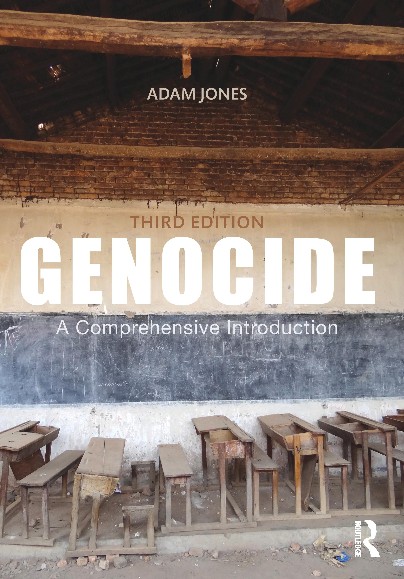
NOW AVAILABLE: Men of the Global South: A Reader, edited by Adam Jones (Zed Books, 2006; 425 pp., US $29.99 pbk). "This impressive collection is a much-needed contribution to the visibility and understanding of diversity in the lives of men from the South" (Dr. Dubravka Zarkov, Institute of Social Studies, The Hague).
Monday, March 17, 2008
NOW AVAILABLE: Men of the Global South: A Reader, edited by Adam Jones (Zed Books, 2006; 425 pp., US $29.99 pbk). "This impressive collection is a much-needed contribution to the visibility and understanding of diversity in the lives of men from the South" (Dr. Dubravka Zarkov, Institute of Social Studies, The Hague).


Genocide Studies Media File
February 28 - March 17, 2008
A compendium of news stories, features, and human rights reports pertaining to genocide and crimes against humanity. Compiled by Adam Jones. Please send links and feedback to adamj_jones@hotmail.com.
Consider inviting colleagues and friends to subscribe to Genocide_Studies and the G_S Media File. All it takes is an email to genocide_studies-subscribe@topica.com.
ARGENTINA
"Argentine 'Dirty War' Witness is Found Dead"
Associated Press dispatch in the Los Angeles Times, 27 February 2008 [Registration Required]
"A retired Argentine army officer, called to testify about the fate of twins born to a political prisoner, has been found dead of a gunshot to the head, police said Tuesday. The body of retired Lt. Col. Paul Alberto Navone was found Monday with a handgun near his side in a park near his home outside the central city of Cordoba, authorities said. Police said evidence pointed to suicide, but some human rights activists expressed concern that he might have been slain, based on the deaths or abductions of other witnesses in cases stemming from the 1976-83 military dictatorship. Federal Judge Myriam Galizzi had summoned Navone for questioning next week about what happened to twins born in 1978 to a dissident held at a military hospital in the northeastern city of Parana. The mother, Raquel Negro, remains missing and was presumably executed -- one of at least 13,000 suspected leftists who died or vanished while in military custody during Argentina's 'dirty war.' Human rights activists say more than 200 babies were born to political prisoners of the dictatorship. Most are believed to have been taken from their mothers and offered for adoption, and 88 of them so far have been identified. The government news agency Telam said the judge is investigating claims by a former intelligence agent that one of the twins died soon after birth and that the other was abandoned at an orphanage."
[n.b. This is the complete text of the dispatch.]
CHINA/SUDAN
"Olympics Near, China Bends on Darfur"
By Barbara Demick
The Los Angeles Times, 8 March 2008 [Registration Required]
"When filmmaker Steven Spielberg announced last month that he was withdrawing as an artistic advisor to the 2008 Olympics over violence in Darfur, the reaction in Beijing was righteous indignation. Organizers accused him of violating the Olympic spirit by injecting politics into the Games, while the state-run media unleashed a torrent of insults, calling him naive, vain and childish. Now China is taking a new tack. After its initial outburst, the Foreign Ministry has launched something of a charm offensive to convince the international community that it does indeed care about human rights. In recent weeks, Beijing has been pushing the Sudanese government to accept a peacekeeping force in its troubled Darfur region. A senior Chinese diplomat who had just returned from a trip to Sudan was trotted out Friday for a rare briefing with foreign correspondents on China's role in Sudan. 'We are using our relationship with the Sudanese government to exert leverage,' said Liu Guijin at the briefing. 'China has done many positive things which have been recognized by the international community.' ... Asked whether 'genocide' was occurring in Darfur, Liu responded, 'I don't like to debate with people what words should be used to describe what has happened, which has caused the displacement of millions of people and cost tens of thousands of lives.' He also said that rebel groups should be held as responsible as the Sudanese government for the violence and that the international community should pressure them as well to accept a cease-fire. In his travels, Liu has met with human rights groups, and he spent an hour with Spielberg in September. [...]"
CHINA/TIBET
"80 People Dead in 'Cultural Genocide'"
By Tristan Stewart-Robertson
The Scotsman, 17 March 2008
"Tibet is facing 'cultural genocide' by Chinese authorities as protests continue against almost 60 years of occupation, according to the Dalai Lama.
The exiled spiritual leader of Tibet also accused China of a 'rule of terror' and said at least 80 Tibetans had died in violence on Friday and another 72 were injured. China had previously claimed just 10 had died, in fires started by the rioters. Clashes yesterday spread into neighbouring Chinese provinces with large Tibetan populations as the deadline by which protesters were instructed to turn themselves in came closer. It expires at midnight tonight. The Dalai Lama, speaking from the base of the Tibetan government-in-exile in Dharamsala, India, called for an international investigation. He said: 'Whether intentionally or unintentionally, some cultural genocide is taking place. Whether the (Chinese] government there admits or not, there is a problem ... [an] ancient nation with ancient cultural heritage is actually dying. 'Some respected international organisation can find out what the situation is in Tibet and what is the cause. Please investigate.' China blocked internet users from accessing video sharing website YouTube after footage of showing foreign news reports about the Lhasa demonstrations, montages of photos, and scenes from Tibet-related protests abroad was uploaded. The government of the country is trying to present a polished image in advance of the Olympic Games in Beijing in August. Foreign leaders yesterday condemned the Chinese crackdown on protesters. [...]"
"India Blocks Tibetan Exiles' China Protest"
Associated Press dispatch on MSNBC.com, 10 March 2008
"Police blocked hundreds of Tibetan exiles Monday from leaving an area near this northern Indian city at the start of a planned six-month march to Tibet to protest China hosting the Summer Olympics. The march got under way on the anniversary of a failed Tibetan uprising against Chinese rule that forced the Dalai Lama, the Tibetan Buddhist spiritual leader, into exile in 1959. Dharmsala is the seat of the Tibetan government in exile. A recommendation by the Indian government led to the order banning the marchers from leaving the area outside Dharmsala where they stopped for the night, local police chief Atul Fulzele said. Tenzin Tsundue, one of the march leaders, said the Tibetan exiles have not decided whether to defy the ban. In Tibet, Radio Free Asia reported that as many as 300 monks marched five miles from a monastery outside the capital Lhasa to the city's center on the 49th anniversary of the uprising. The monks were demanding the release of monks detained last October when the Dalai Lama was given a Congressional Gold Medal in Washington, an honor that infuriated the Chinese government. [...]"
"Bjork's Tibet Outburst Provokes Censors"
By Jane Macartney
The Times, 8 March 2008
"Shanghai expected a surprise from the Icelandic singer Björk on her debut in China and she did not disappoint. But her first concert is set to be her last. The Chinese Ministry of Culture has said that it will impose stricter rules on foreign artists wanting to come to China after Björk ended her performance this week with a cry for Tibetan independence. She concluded a passionate performance of her song Declare Independence with a shout of 'Tibet, Tibet' -- an outburst intended to draw public attention to Chinese rule over the Buddhist Himalayan region. The Dalai Lama, revered by Tibetans as a God-king, fled during an uprising in 1959 in which tens of thousands of Tibetans were killed. The Culture Ministry said that the action by Björk had hurt the feelings of the Chinese people and would be handled according to the law. 'We will further tighten controls on foreign artists performing in China to prevent similar cases from happening in the future. We shall never tolerate any attempt to separate Tibet from China and will no longer welcome any artists who deliberately do this,' it said in a statement on its website. The singer has performed the song to support other movements in the past and dedicated it to Kosovo at a concert in Japan last month. Her performance last Sunday, which was not reported for several days in the state-controlled media, has set off a flurry of angry comments in Chinese cyberspace. “I don't understand. Why do Western stars give a s*** about Tibet? Isn't Tibet ours?' one comment said. [...]"
"Group Says Railway Threatens Tibet"
By Anita Chang
Associated Press dispatch on Yahoo! News, 27 February 2008
"China's railway to Tibet is allowing the government to exploit the region's natural resources while threatening its Buddhist culture and traditional way of life, an activist group said Thursday. The Washington-based International Campaign for Tibet did not prominently mention the upcoming Beijing Olympics, but the report was released amid increasing criticism of China over a variety of issues, including its policies on ethnic minorities. The report said the nearly two-year-old railway has accelerated the migration of Han Chinese, the country's majority ethnic group, to Tibet. Though the train was touted as part of a plan to bring economic growth to the far western region, the traditionally nomadic Tibetans have been relegated to unskilled work while Han business owners reap the benefits of development, it said. The railway allows efficient transport of raw materials -- iron, copper, zinc and others -- out of Tibet to manufacturing centers where they are used to make the world's televisions, DVD players and other electronics, ICT said. 'The large-scale extraction of these resources is a key element of the authorities' motivation for building the railroad, together with strengthening the state's authority and control over Tibetan areas,' said the report, titled 'Tracking the Steel Dragon.' ... The ICT report also noted that Chinese military presence has increased in Tibet since the railway opened. Its now-accessible mineral resources have increased its strategic importance, and forces apparently were dispatched 'to prepare for any contingencies that might threaten the interest of the state.' [...]"
CROATIA/INTERNATIONAL TRIBUNALS
"Croat General Ante Gotovina Stands Trial for War Crimes"
By Adam LeBor
The Times, 11 March 2008
"A Croatian general who spent four years on the run goes on trial today, charged with jointly planning one of the largest episodes of 'ethnic cleansing' of the Yugoslav wars and failing to prevent war crimes. Ante Gotovina was commander of Operation Storm in August 1995, when between 150,000 and 200,000 Serbs fled or were forced to flee as the newly armed Croatian Army, trained by American advisers, smashed through Serb lines. Croat troops found towns and villages abandoned in panic, with meals still warm on the table. General Gotovina fled Croatia after being indicted in 2001 and spent four years on the run, protected and funded by an international network of supporters. He was eventually arrested in a luxury hotel on Tenerife in December 2005, thus easing Croatia's path to EU membership. He is charged at the UN war crimes tribunal together with two other generals, Ivan Cermak and Mladen Markac. All three plead not guilty. Prosecutors also allege that while General Gotovina’s troops murdered at least 37 Serbs, looted, burnt villages and expelled civilians from their homes, he knew that war crimes were being committed but failed to stop the atrocities or punish the perpetrators. The trial is vital for the Balkans to come to terms with its recent bloody history, UN officials say. For many in Croatia, General Gotovina and his comrades are national heroes. The three generals are accused of taking part in a joint criminal enterprise together with Franjo Tudjman, former President of Croatia, Gojko Susak, former Minister of Defence, and two former army chiefs of staff. All four are now dead, but would otherwise have probably joined the three generals in the dock. [...]"
EUROPEAN WITCH-HUNTS
"Britain's Last 'Witch' May Be Pardoned"
By Bonnie Malkin
The Telegraph, 28 February 2008
"Campaigners will submit a petition to the Scottish Parliament today calling for the last woman convicted under the Witchcraft Act to be pardoned. Helen Duncan spent nine months in Holloway prison after being convicted at a trial in 1944. Her conviction followed a seance at which the spirit of a dead sailor was said to have disclosed the loss of the battleship HMS Barham with most of her crew. The sinking had been kept secret by the authorities to maintain wartime morale, and was not disclosed for several months. A petition to the Westminster Government last year failed to secure a pardon, and the new petition urges the Scottish Government to urge the Home Secretary to reconsider the case. The 1735 Witchcraft Act was repealed by the Fraudulent Mediums Act of 1951. Scottish Parliament researchers said it was a common misconception that Mrs. Duncan was convicted of being a witch. 'In fact, the 1735 Witchcraft Act was originally formulated to eradicate the belief in witches and its introduction meant that from 1735 onwards an individual could no longer be tried as a witch,' said their research paper. 'It was, however, possible to be prosecuted for pretending "to exercise or use any kind of witchcraft, sorcery, enchantment or conjuration, or undertake to tell fortunes." Supposed contact with spirits fell into this category.' A second petition asks MSPs to urge the Scottish Parliament to grant a posthumous pardon to all people convicted in Scotland under all witchcraft legislation. The petitioners claim around 4,000 people were convicted, 85 per cent of them women. The Witchcraft Act was in force between 1563 and 1736, and the top county for witchhunting was the area that is now East Lothian. Torture was used to extract confessions as late as 1704, said the petition, and those convicted were almost always strangled before their body was burnt. The petition states: 'Many of today's professions have their roots in tradition and what could be seen as mystical wisdom. Professions such as mediumship, herbalists, midwifery, reiki and many alternative therapies, to name just a few.'"
[n.b. 1941!! This is the complete text of the dispatch.]
INDIA/FEMALE FOETICIDE
"India Will Pay Families to Have Girls to End Foeticide"
By Randeep Ramesh
The Guardian, 4 March 2008
"The Indian government yesterday announced a scheme to pay poor families to give birth to and bring up girl children, in a bid to stop the trend of parents aborting female foetuses at the rate of half a million a year. Families in seven states are set to benefit from a series of cash payments amounting to 15,500 rupees (£193) to poor families to keep their girl children. Ministers say more than 100,000 girls will be saved in the first year. In India ultrasound technology, coupled with a traditional preference for boys who are seen as future breadwinners, has led to mass female foeticide. According to a study in the British medical journal the Lancet, 10 million female foetuses may have been aborted in India over the past 20 years after illegal sex determination tests. The government has been alarmed by the country's dropping sex ratio and hopes the promise of money will change people's behaviour. As an extra incentive any girl who reaches 18 will get a further 100,000 rupees (£1,200) provided she has completed her school education and is not married. ... Prosperous Chandigarh in Punjab and the nation's capital Delhi have only 900 females for every 1,000 male babies. 'It is the urban middle classes who can also afford the ultrasound tests to determine the sex of the foetus,' said Sabu George, a campaigner against female foeticide. 'That is really the problem. The poor are copying the behaviour of the richer people in India. What we have not seen stop is that technology is more and more available and that every small town now has a doctor who illegally will test your baby's sex and abort it for a fee.' George said there was a 'conspiracy of silence' by the medical profession over female foeticide. In the 12 years since selective abortion was outlawed only one doctor has been convicted of the crime. The government is considering giving life sentences to doctors convicted of the offence. The social implications of India's 'missing girls' has worried many researchers. Some point to surveys which show brides are being trafficked across India. Other social scientists have predicted a crime explosion as unmarried young men turn to violence unable ever to find a mate."
IRAQ
"Catholic Archbishop Paulos Faraj Rahho Found Murdered in Iraq"
By David Byers and Joanna Sugden
The Times, 13 March 2008
"The body of Iraq's kidnapped Chaldean Catholic Archbishop has been found near the northern city of Mosul, prompting warnings of a mass exodus of Christians from Iraq. Archbishop Paulos Faraj Rahho was abducted on February 29 shortly after leaving Mass in Mosul, in what the Pope described as an 'abominable' act. The three people who were with him were killed by the kidnappers. 'Monsignor Rahho is dead. We have found him lifeless near Mosul,' the auxiliary bishop of Iraq, Monsignor Shlemon Warduni, told the Italian SIR news agency today. A host of leading charities and Christians in Iraq warned that the community now faced a mass exodus amid rising threats, discrimination and violence. Reacting to the killing, Pope Benedict XVI said it caused him 'deep sadness.' He added: 'The most absurd and unjustified violence continues to afflict the Iraqi people and in particular the small Christian community.' Canon Andrew White, the only Anglican vicar working in Baghdad said warned of the 'very real danger faced by Christians in Iraq,' adding: 'This awful event happened in the very heartland of Iraqi Christianity in Nineveh. We are in tears -- we are devasted. We are not giving up our faith in Jesus and I am not leaving this beloved land of Iraq.' Daniel Hoffman, director of Middle East Concern, a charity campaigning for the rights of Christians in Iraq, today said that -- fearing for their safety -- the killing could lead to Christians leaving Iraq in even greater numbers. 'This will lead to an exodus of the Christian community in Iraq,' he said. 'This is going to be a very heavy blow for the Church. The community is devastated.' His concerns were echoed by John Pontifex, a spokesman for Aid to the Church in Need, which campaigned for the archbishop's release. He said ...: "Among the parishioners, fears about safety have escalated to such a degree that this piece of news is like the last straw and will only serve to increase the exodus of Christians which may well result in the extinction of Christianity in Iraq. 'The situation has become materially worse over the last four years for Christians and the West has ignored the issue.' The Chaldean church, to which he belonged, is an Eastern-rite denomination that recognises the authority of the Pope and is aligned with Rome. There are just over 600,000 Christians in Iraq, less than two per cent of the population, but Chaldeans are believed to be the largest grouping. [...]"
"Iraq Premier Criticizes Delay in Executions"
By Alexandra Zavis
The Los Angeles Times, 1 March 2008 [Registration Required]
"Prime Minister Nouri Maliki's office lashed out Friday at the Iraqi presidential council for refusing to approve the executions of two of the three men sentenced to hang for the genocidal campaign against Iraq's ethnic Kurdish minority during Saddam Hussein's rule. The public dispute highlighted the persistent rancor between Iraq's major ethnic and religious factions, which continues to paralyze the highest levels of government nearly five years after Hussein's fall. Maliki, a Shiite Muslim, has pressed for speedy executions for the three, who were convicted in June of genocide and other crimes for their roles in a late-1980s military crackdown known as the Anfal, or 'spoils of war,' campaign, which killed as many as 180,000 Kurds. Earlier Friday, senior government aides said the three-member presidency council, which consists of President Jalal Talabani and two vice presidents, had signed off on the execution of Hussein's cousin Ali Hassan Majid, who became known as 'Chemical Ali' for ordering the use of poison gas against villages said to be harboring Kurdish guerrillas. The council's decision was the last legal obstacle to carrying out the sentence, which must be done within 30 days. But an aide said Vice President Tariq Hashimi, who, like the defendants, is a Sunni Arab, would not endorse the executions of the two military leaders who helped carry out the deadly attacks: Sultan Hashim Ahmad Jabburi Tai, a former defense minister, and Hussein Rashid Mohammed, the former deputy head of army operations. Execution orders require the signatures of all three members of the presidency council under Iraqi law. Talabani, a Kurd who opposes the death penalty on principle, has given Vice President Adel Abdul Mehdi, a Shiite, authority to sign on his behalf. Many Sunnis regard Tai and Mohammed as military professionals who were only following orders, and Hashimi has argued that their lives should be spared. [...]"
IRAQ/ANFAL CAMPAIGN
"In Northern Iraq, Kurds Mourn Victims of Gas Attacks 20 Years Ago"
By Erica Goode
The New York Times, 17 March 2008 [Registration Required]
"Thousands of Kurds gathered on Sunday in the town of Halabja, in the northern uplands of Iraq, to mark a grim anniversary: the day 20 years ago when clouds of poison gas swept through the town, killing as many as 5,000 people. A Kurdish woman on Sunday at a shrine for victims of Saddam Hussein's 1988 attack on the northern Iraqi town of Halabja. The chemical bombings, part of Saddam Hussein’s campaign against the Kurds, began on March 16, 1988, and continued through the night. On Sunday, ceremonies commemorated the dead and paid homage to the more than 200 survivors who suffer lingering effects from the poisons used in the bombings. The Iraqi government of Prime Minister Nuri Kamal al-Maliki called for a moment of silence and a reading of a verse from the Koran. One survivor, Ismail Abdullah, 50, who helped bury the dead after the attacks, died on Saturday. Luqman Muhammad, a spokesman for relatives of the Halabja victims, said Mr. Abdullah had died from health problems caused by the chemical bombings. ... Iraq's leaders have been wrangling over the fates of Mr. Majid and two other former military commanders, all of whom have been sentenced to death. On Sunday, Rear Adm. Greg Smith, a spokesman for the American military in Iraq, said Mr. Majid remained in American custody because the Iraqi government had not formally requested that he be turned over to them. [...]"
ISRAEL/PALESTINE
"U.N. Chief Condemns Israel after Bloody Day in Gaza"
By Nidal al-Mughrabi
Reuters dispatch, 2 March 2008
"U.N. Secretary-General Ban Ki-moon condemned Israel for using 'excessive' force in the Gaza Strip and demanded a halt to its offensive after troops killed 61 people on the bloodiest day for Palestinians since the 1980s. Addressing an emergency session of the Security Council in New York after four days of fighting in which 96 Palestinians have been killed, many of them civilians, Ban also called on Gaza's Islamist militants to stop firing rockets. The 1.5 million Palestinians crammed into the blockaded, 45 km (30-mile) sliver of coast, enjoyed a relative respite early on Sunday from Israeli air strikes and raids. Two Israeli soldiers died in a ground assault on Saturday. An Israeli civilian was killed by a rocket in a border town on Wednesday. 'While recognizing Israel's right to defend itself, I condemn the disproportionate and excessive use of force that has killed and injured so many civilians, including children ... I call on Israel to cease such attacks,' said Ban. 'I condemn Palestinian rocket attacks and call for the immediate cessation of such acts of terrorism,' he said. But with public anger boiling in Israel, there was no sign the government was ready to call off an offensive that took troops deeper into Gaza on Saturday and in larger numbers than at any time since Israel ended a 38-year occupation in 2005. [...]"
"Israeli's Use of 'Holocaust' Has Fallout"
By Ashraf Khalil
The Los Angeles Times, 2 March 2008 [Registration Required]
"The Hebrew word shoah, or holocaust, is not used casually in Israeli society. Occasionally, it is employed to denote a massive disaster. This weekend, though, Arab politicians and international pro-Palestinian activists, seizing on a comment by an Israeli minister, are calling the bloody Israeli incursion in the Gaza Strip a holocaust. In what may prove to be a significant miscalculation, Israeli Deputy Defense Minister Matan Vilnai on Friday used the term in warning of more military action in Gaza. By allowing constant rocket barrages from Gaza on nearby Israeli cities, the Palestinians, Vilnai said, were 'bringing upon themselves a greater shoah because we will use all our strength in every way we deem appropriate, whether in airstrikes or on the ground.' As the three-day death toll in Gaza climbed toward triple digits, senior Hamas leader Khaled Mashaal accused Israel of 'implementing a real holocaust against the Palestinian people for the past 60 years. What is happening today in Gaza is a new holocaust.' The nongovernmental Palestinian Information Center issued a statement calling Vilnai's words 'the first indirect admission by an Israeli official that what Israel is conducting against the Palestinians in the West Bank and the Gaza Strip is a holocaust, albeit a slow-motion one.' Given the Arab reaction and the rising Palestinian death toll, Vilnai's use of the word is proving controversial within Israel as well. As one Israeli commentator put it on a weblog: 'This is a disastrous case of the foot-in-mouth disease, all too common among the contemporary breed of Israeli politicians. Terrible timing, too.' Vilnai's aides released a statement saying the former career army officer had only meant to imply a disaster. Others defended him as a victim of sloppy out-of-context translation. [...]"
[n.b. A very odd choice of words indeed; meanwhile, many more dead kids.]
JEWISH HOLOCAUST
"Jewish Leader Calls German Railway Boss a 'Nazi'"
Agence France-Presse dispatch in TheLocal.de, 11 March 2008
"Germany's national railway operator Deutsche Bahn threatened on Tuesday to sue a Jewish community leader for calling its chief executive Hartmut Mehdorn a 'Nazi' who would have enthusiastically taken part in the Holocaust. 'The remarks are unforgivable and we will ask our lawyers to look into the matter,' Deutsche Bahn said in a statement. Michael Szentei-Heise, the leader of the Jewish community in the western city of Düsseldorf, was quoted by the Rheinischer Post newspaper as saying Mehdorn was a 'a Nazi at heart.' 'If Mehdorn had held the same position in the Third Reich he would have arranged the deportation of Jews with great conviction,' he added. The remarks came amid a debate over Deutsche Bahn's decision to charge transport fees to the organizers of a travelling exhibition in memory of Jewish children deported in the Holocaust during World War II. The exhibition traces the plight of, among others, 11,400 Jewish children who were deported from France to the Auschwitz death camp, often crammed together in cattle trucks, between 1942 and 1944. The Nazi regime paid Deutsche Bahn's wartime predecessor, the Reichsbahn, 25 Reichsmarks, the equivalent of €25 ($38), for each child it transported to the camp. Deutsche Bahn initially refused to host the exhibition in stations, saying that the subject deserved more than the divided attention of hurried commuters, but relented after its stance drew strong criticism. The exhibition opened in Berlin in January and is being shown at eight other stations in Germany."
[n.b. This is the full text of the dispatch.]
JEWISH HOLOCAUST
"Belgium to Pay Holocaust Survivors"
By Raf Casert
Associated Press dispatch on Yahoo! News, 11 March 2008
"David Susskind survived the Holocaust by fleeing to Switzerland, eventually joining the French Resistance. When he returned to Belgium after the war, he had nothing. His mother, a widow, died in the Nazi death camp at Auschwitz. Strangers were living in his family home in Antwerp. The local grocer greeted him with shock, saying, 'You're still alive?' 'We lost everything. There was nothing,' said Susskind, now 82. On Tuesday, Belgium's banks and government sought to make material amends, announcing $170 million in restitution for the Jewish community and families of Holocaust survivors whose property and goods were looted by Nazi occupiers. Overall, $54 million will be paid to individual claimants, with the rest going to a Jewish trust that will help the poor and keep the memory of the horrors of World War II alive. ... Some 50,000 Jews lived in Belgium in the 1930s and about half died in the Holocaust. Last year, Prime Minister Guy Verhofstadt apologized for the involvement of Belgian authorities in the deportation of Jews to Nazi concentration camps. After the Nazi invasion in May 1940, the Belgian government fled to Britain, but instructed civil servants who stayed to work with the Nazis to keep services running and prevent the economic breakdown that occurred during the German occupation in World War I. That often led to Belgian officials collaborating with the persecution of Jews, though the resistance movement was also strong and underground networks to save Jews were more successful than in many occupied nations. [...]"
"Spanish Musical Treats Anne Frank Seriously"
By Tracy Wilkinson
The Los Angeles Times, 3 March 2008 [Registration Required]
"Presenting, 'Anne Frank, the Musical.' Now, before you start humming 'Springtime for Hitler,' the producers of a new Anne Frank musical here want you to know that they are serious. They are offering a rendition of the popular, tragic story of a Jewish girl and her diary during the Holocaust that they say is respectful, inspirational and educational. And -- surprise! -- controversial. Even before the premiere last week, uneasy voices were raised about whether committing such a heart-wrenching tale to music was a good idea. Octogenarian Buddy Elias, one of Anne Frank's last surviving relatives and head of a Swiss-based foundation that controls rights to the diary, protested the project. The suffering of the Holocaust was not an appropriate subject for entertainment he said in several statements to the media. But the writers, actors and director behind the Spanish-language, $4.5-million production of 'The Diary of Anne Frank: A Song to Life' ('El Diario de Ana Frank: Un Canto a la Vida') have worked hard to dispel any notion of trivialization or irreverence. 'This is one more way to talk about the Holocaust, to remind people of something they must know about and remember,' executive director Rafael Alvero said in an interview. The message is especially urgent in these 'scrambled times' of xenophobia and intolerance, he said. Alvero, a veteran of Spanish theater and cinema production, including a dramatization of the works of slain poet Federico Garcia Lorca, said he got the idea for 'A Song to Life' when he visited the Anne Frank House in Amsterdam, the museum that enshrines the canal-front building where the Frank family hid from the Nazis for two years. [...]"
"Author Admits Making Up Memoir of Surviving Holocaust"
David Mehegan
Boston Globe, 29 February 2008
"Eleven years after the publication of her best-selling Holocaust memoir -- a heartwarming tale of a small Jewish girl trekking across Europe and living with wolves -- the Massachusetts author yesterday admitted the whole story was a hoax. In a statement issued by her Belgian lawyer, Misha Defonseca of Dudley, whose book, 'Misha: A Memoire of the Holocaust Years,' has been translated into 18 languages and is the basis for a new French movie, 'Survivre avec les Loups' ('Surviving With the Wolves'), confessed that she is not Jewish and that she spent the war safely in Brussels. ... Yesterday's confession follows a week of intense publicity in French and Belgian media, prompted by disclosure of documents unearthed by Waltham-based genealogical researcher Sharon Sergeant showing that Monique De Wael (Defonseca's real maiden name) was baptized in a Brussels Catholic church in September 1937 and that she was enrolled in a Brussels primary school in 1943-44. The researcher also discovered that Defonseca's parents, Robert and Josephine De Wael, were members of the Belgian resistance and were arrested and executed by the Nazis. In her statement, approximately translated from the French, Defonseca said: 'Yes, my name is Monique De Wael, but I have wanted to forget it since I was 4 years old. My parents were arrested and I was taken in by my grandfather, Ernest De Wael, and my uncle, Maurice De Wael. I was called "daughter of a traitor" because my father was suspected of having spoken under torture in the prison of Saint-Gilles. Ever since I can remember, I felt Jewish. ... There are times when I find it difficult to differentiate between reality and my inner world. The story in the book is mine. It is not the actual reality -- it was my reality, my way of surviving. At first, I did not want to publish it, but then I was convinced by Jane Daniel. I ask forgiveness from all those who feel betrayed.' [...]"
MEXICO
"2 Sentenced in '97 Chiapas Massacre"
Associated Press dispatch in the Los Angeles Times, 28 February 2008 [Registration Required]
"A Mexican judge has sentenced two brothers to 26 years in prison for their participation in the 1997 massacre of 45 men, women and children in southern Chiapas state. Brothers Antonio and Mariano Pucuj were also ordered to pay more than $70,000 in compensation to the victims' families, the human rights group Fray Bartolome de las Casas said Wednesday. Karla Banos, a spokeswoman for state prosecutors, said the Pucuj brothers are appealing the judge's decision. Pro-government villagers armed with guns and machetes killed the 45 on Dec. 22, 1997 in an incident known as the Acteal massacre for the town where it occurred. At the time, Chiapas was deeply divided between supporters of the Zapatista rebels -- fighting for greater autonomy and indigenous rights -- and backers of the Institutional Revolutionary Party, or PRI, which ruled Mexico for seven decades. Officials said the killings were motivated by a land dispute between two Tzotzil Indian communities. But victims' families say the massacre resulted from a bid to crush the Zapatistas, with state officials providing weapons and paramilitary training for the attack. Justice in the case has been slow. It wasn't until last October -- a decade later -- that courts sentenced 34 men to 26 years each for the killings. Several others were convicted in 2002."
[n.b. This is the complete text of the dispatch.]
RWANDA/INTERNATIONAL TRIBUNALS
"War Crimes Court Upholds Ruling on Rwandan"
Agence France-Presse dispatch in The New York Times, 13 March 2008 [Registration Required]
"A United Nations war crimes court on Wednesday upheld the war crimes and genocide conviction of a Roman Catholic priest and increased his sentence to life in prison for his part in the killings of 800,000 fellow Rwandans. In April 1994, when pro-government Hutu militiamen were rounding up ethnic Tutsi and moderate Hutu for slaughter across Rwanda, 1,500 parishioners of the priest, the Rev. Athanase Seromba, took shelter in his church in the town of Nyange. Rather than seeking to protect his flock, Father Seromba, an ethnic Hutu, had the church leveled by bulldozers and ordered gunmen to shoot any Tutsis who tried to flee the carnage, according to testimony introduced in court. There were no survivors. 'Seromba knew that approximately 1,500 refugees were in the church,' Judge Mohamed Shahabuddeen said, handing down his ruling on the appeal. 'He committed genocide as well as extermination as a crime against humanity by virtue of his role in the destruction of the church. The acts of Seromba are sufficient to constitute direct participation in the crimes.' Father Seromba was the first priest charged with genocide by the International Criminal Court for Rwanda, which was set up to prosecute the planners of the 1994 massacre. He was convicted in 2006 and sentenced to 15 years in jail. [...]"
"Rwanda Economy Thriving as Country Moves Past Genocide"
By Shashank Bengali
McClatchey Newspapers on Yahoo! News, 1 March 2008
"When President Bush came here last month on his five-nation Africa tour, he paid a solemn visit to the site where 250,000 victims of the 1994 genocide are buried, laying a wreath and strolling quietly along a row of concrete slabs marking mass graves. But government officials here say Bush's more important act that day was something else: He signed a deal to promote bilateral U.S.-Rwandan investment. Rwanda hasn't forgotten the genocide, but it's moving forward, and 14 years later this tiny central African nation boasts one of the most stable and rapidly expanding economies in the region. Poverty and illiteracy are declining, immunization rates are up, HIV and malaria have been dramatically curtailed, and new industries from coffee to information technology are experiencing sudden booms. The country's rebirth under President Paul Kagame -- a bookish former rebel leader -- was noted last year by the Ibrahim Index, a scale that rates African countries on political and economic freedoms. It called Rwanda the most improved country over the past five years. ... Under Kagame, the government has pumped money into the country's roads and electricity networks and slashed red tape on businesses in a bid to lure foreign investors. Since 1994, the country's economy has grown at a robust 6 percent clip annually. Lured perhaps in part by its tragedy-to-triumph story, American corporate giants have been drawn to this tiny, hilly nation, where 8 million people are crammed into a space smaller than Maryland . Starbucks and Costco have signed exclusive deals with Rwandan coffee growers to sell their smooth, aromatic beans in U.S. stores. Government officials say Microsoft has floated a plan to equip the country's Senate chamber so that lawmakers can draft and edit legislation electronically. 'There is a wave of enthusiasm right now for Rwanda,' said Josh Ruxin, a Columbia University public health professor who lives in Rwanda. [...]"
SERBIA/KOSOVO
"Kosovo Fallout Continues in Serbia"
By Dejan Anastasijevic
Time.com, 10 March 2008
"[...] The breakdown of the government reflects rift within the electorate over whether to move Serbia into Europe. [Prime Minister Vojislav] Kostunica has been the swing vote between the hard-core nationalists of the Radical Party, whose chairman, Vojislav Seselj, is on trial for war crimes in the Hague, and the pro-Western Tadic. Kostunica refused to support Tadic in the presidential election, and may be ready to forge an alliance with the Radicals. The Radicals hold almost a third of the seats in parliament, and were only kept out of power by Kostunica agreeing to share power with Tadic. Now that the deal is off, Serbia's voters are being asked to make a choice that could shape their country's future for many years to come. While Tadic advocates continuing the E.U. accession process despite the loss of Kosovo, Kostunica and the Radicals instead advocate aligning with countries that oppose Kosovo's secession, such as Russia and China. Recent opinion polls give Tadic's Democrats and the Radicals each around 30% of support among the voters. Kostunica's own party has been steadily losing support in the past months, and can now count on just about 7%. Several other small parties will also be running, making the outcome even more uncertain. 'This may look like a final battle, but I'm afraid that the result would again turn out to be inconclusive,' Dragoljub Zarkovic, the editor in chief of the Vreme political weekly tells TIME. 'Neither the pro-Western nor the nationalist bloc can achieve a clear victory, so the next government will likely be another fragile coalition, and it may take several election cycles before we see some stability,' he says. Already, Serbia is coping with a sharp falloff in foreign investment and rising inflation that analysts attribute to political instability. 'Everybody is talking about Kosovo, while they should really be talking about jobs and prices,' says Danica Popovic of Belgrade's Economic Institute. 'If things don't cool down, no serious foreign company will want to invest here.' But within the next few months, at least, the political climate in Serbia is likely to get even hotter."
"Serbia's Government Collapses"
By Dusan Stojanovic
AP dispatch on Yahoo! News, 8 March 2008
"Serbia's government collapsed Saturday over an impasse between the nationalist prime minister and the pro-Western president on how Kosovo's independence affects the Balkan country's pursuit of EU membership. 'The government, which does not have united policies, cannot function,' Prime Minister Vojislav Kostunica said as he announced the fall of his Cabinet. 'That's the end of the government.' Kostunica said he will convene a session of the caretaker government Monday, which will propose to President Boris Tadic to dissolve the Parliament and call new elections for May 11. Tadic said in a statement that he will call early elections because they are a 'democratic way to overcome the political crisis.' But he disputed Kostunica's claim that their clash was over Kosovo, the Serbian medieval heartland which proclaimed independence last month with the backing of the United States and several EU countries. 'Kosovo is of course an integral part of our country,' Tadic said. 'I believe the issue is that the Serbian government does not have a united position over European and economic perspectives of Serbia and its citizens,' he added. Kostunica said the government 'will function in a reduced capacity until the elections are held.' He insists that EU governments recognizing Kosovo must rescind their decisions before Serbia resumes initial membership talks with the 27-nation bloc. Within his government, Kostunica accuses pro-Western ministers of failing to support his efforts to preserve Kosovo as part of Serbia. [...]"
SRI LANKA
"Ethnic Divide Worsens as Sri Lanka Conflict Escalates"
By Somini Sengupta
The New York Times, 8 March 2008 [Registration Required]
"There are no eyes on this war. A truce between the Sri Lankan government and the separatist Liberation Tigers of Tamil Eelam is over, and gone are the Nordic monitors who kept watch over it. The government has refused entry to United Nations human rights monitors. Independent journalists are not allowed anywhere near the front lines. Only occasionally does a glimpse of the war's damage surface, as when the Red Cross confirmed that in the first six weeks of this year alone, 180 civilians had been killed, a toll it called 'appalling.' While it is impossible to gauge what is happening on the battlefield, that is where, it seems, the government has placed its bets to settle the long-running ethnic war, once and for all. As it does, the public mood in this country is more divided than in many years, like an old scratch that has festered into a gaping wound. The new government offensive against the ethnic Tamil insurgents, who have fought for a quarter-century to carve a separate homeland from this island, has received ample public support, at least among the ethnic Sinhalese who are the majority. ... Such enthusiasm is hard to find among minority Tamils. Anxiety prevails, sometimes panic. They say they stay off the streets in the evenings for fear of arrest or abduction. They quietly produce identity cards at security checkpoints and say little when theirs are more closely scrutinized. Tamil neighborhoods are raided at night. Few people are willing to speak their minds, for fear that any criticism of the war effort will be construed as support for the rebels, or worse, that they will be detained under stringent emergency laws. S. Hariharasharma, 20, desperately searching for a sponsor to help him emigrate to Britain, recounted one incident, and it echoed the recollections of many young Tamils here. He was on the bus home from the British Council library one afternoon when police officers got on and demanded to see passengers’ identity cards. He began to tremble, he said, because he knew his identity would be suspect: a young man, a newcomer from Tamil-majority Jaffna in the north, unable to speak the Sinhala language. 'Somehow I managed to hide my fear,' he said. 'It is a must to be normal.' [...]"
[n.b. The gender dimension captured in the second half of this excerpt is especially poignantly evoked.]
SUDAN/DARFUR
"China Defends Darfur Role"
By Jim Yardley
The New York Times, 8 March 2008 [Registration Required]
"China has expressed 'grave concerns' to the Sudanese government about the recent violence in western Darfur and is actively working to resolve delays in establishing an international peacekeeping force, China's special envoy to Darfur said Friday. The envoy, Liu Guijin, who recently returned from his fourth visit to Sudan, offered a detailed defense of China's role in Darfur at a news conference at the Foreign Ministry here and repeated Beijing's stance that activists are wrong to link the strife in Darfur to the Beijing Olympics in August. He also expressed surprise at the film director Steven Spielberg’s public withdrawal as artistic director of the Beijing Olympics last month. Mr. Spielberg said at the time that he was stepping down because China, Sudan’s largest trading partner, had not used enough of its leverage over the Sudanese government to resolve the conflict. But Mr. Liu said China's relationship with Mr. Spielberg had effectively ended months earlier. In recent weeks, violence in the western Darfur region of Sudan has escalated as the Sudanese Army and its janjaweed militia allies have attacked rebel groups and civilians, creating a new wave of refugees. Mr. Liu said China was pressing Sudan to do more to end the violence, but added that rebel groups also shared responsibility. ... Mr. Liu's recent trip included stops in Chad, where many Darfur refugees have fled, France and Britain, and was a blend of diplomacy and public relations as China tries to end the controversy as the Olympics draw near. China's role as an arms supplier and oil patron of Sudan has brought international criticism from advocacy groups, which blame Beijing for protecting Khartoum's interests. [...]"
"Scorched-Earth Strategy Returns to Darfur"
By Lydia Polgreen
The New York Times, 2 March 2008 [Registration Required]
"The janjaweed are back. They came to this dusty town in the Darfur region of Sudan on horses and camels on market day. Almost everybody was in the bustling square. At the first clatter of automatic gunfire, everyone ran. The militiamen laid waste to the town -- burning huts, pillaging shops, carrying off any loot they could find and shooting anyone who stood in their way, residents said. Asha Abdullah Abakar, wizened and twice widowed, described how she hid in a hut, praying it would not be set on fire. 'I have never been so afraid,' she said. The attacks by the janjaweed, the fearsome Arab militias that came three weeks ago, accompanied by government bombers and followed by the Sudanese Army, were a return to the tactics that terrorized Darfur in the early, bloodiest stages of the conflict. Such brutal, three-pronged attacks of this scale -- involving close coordination of air power, army troops and Arab militias in areas where rebel troops have been -- have rarely been seen in the past few years, when the violence became more episodic and fractured. But they resemble the kinds of campaigns that first captured the world's attention and prompted the Bush administration to call the violence in Darfur genocide. Aid workers, diplomats and analysts say the return of such attacks is an ominous sign that the fighting in Darfur, which has grown more complex and confusing as it has stretched on for five years, is entering a new and deadly phase -- one in which the government is planning a scorched-earth campaign against the rebel groups fighting here as efforts to find a negotiated peace founder. The government has carried out a series of coordinated attacks in recent weeks, using air power, ground forces and, according to witnesses and peacekeepers stationed in the area, the janjaweed, as their allied militias are known here. [...]"
UGANDA
"Museveni Refuses to Hand over Rebel Leaders to War Crimes Court"
By Chris McGreal
The Guardian, 13 March 2008
"The Ugandan president, Yoweri Museveni, is headed for a confrontation with the international criminal court after saying he will not hand over to The Hague the leaders of his country's rebel Lord's Resistance Army indicted for war crimes. Museveni said Joseph Kony, the LRA leader, and his commanders will instead be brought before 'traditional' Ugandan courts -- which emphasise apologies and compensation rather than punishment -- as part of a deal to end a 21-year civil war marked by the abduction of children as combatants, mass rape of women and the mutilation and murder of civilians. Museveni said local trials were the wish of the victims and leaders in the areas hit by the conflict. 'What we have agreed with our people is that they should face traditional justice, which is more compensatory than a retributive system,' he said on a visit to London. 'That is what we have agreed at the request of the local community. They have been mainly tormenting people in one area and it is that community which asked us to use traditional justice.' But critics have accused Museveni of misusing the ICC indictments as a bargaining tool to press Kony into a peace settlement. The court issued arrest warrants in 2005 for Kony and four of his commanders, two of whom are now believed to be dead, after Museveni appealed for the ICC to investigate the rebels' crimes. Under international law, Uganda is obliged to send the accused men for trial at The Hague. But the matter has opened a rift between African governments, which believe such trials should be subordinated to local peace deals and reconciliation, and countries such as Britain, which back the ICC as establishing international justice. [...]"
UNITED STATES/INCARCERATION
"Prison Nation"
The New York Times (Editorial) on Truthout.org, 10 March 2008
"After three decades of explosive growth, the nation's prison population has reached some grim milestones: More than 1 in 100 American adults are behind bars. One in nine black men, ages 20 to 34, are serving time, as are 1 in 36 adult Hispanic men. Nationwide, the prison population hovers at almost 1.6 million, which surpasses all other countries for which there are reliable figures. The 50 states last year spent about $44 billion in tax dollars on corrections, up from nearly $11 billion in 1987. Vermont, Connecticut, Delaware, Michigan and Oregon devote as much money or more to corrections as they do to higher education. These statistics, contained in a new report from the Pew Center on the States, point to a terrible waste of money and lives. They underscore the urgent challenge facing the federal government and cash-strapped states to reduce their overreliance on incarceration without sacrificing public safety. The key, as some states are learning, is getting smarter about distinguishing between violent criminals and dangerous repeat offenders, who need a prison cell, and low-risk offenders, who can be handled with effective community supervision, electronic monitoring and mandatory drug treatment programs, combined in some cases with shorter sentences. Persuading public officials to adopt a more rational, cost-effective approach to prison policy is a daunting prospect, however, not least because building and running jailhouses has become a major industry. Criminal behavior partly explains the size of the prison population, but incarceration rates have continued to rise while crime rates have fallen. Any effort to reduce the prison population must consider the blunderbuss impact of get-tough sentencing laws adopted across the United States beginning in the 1970's. Many Americans have come to believe, wrongly, that keeping an outsized chunk of the population locked up is essential for sustaining a historic crime drop since the 1990's. [...]"
UNITED STATES/GENOCIDE PREVENTION
"Samantha Power: From Obama Asset To Campaign Casuality"
By Sam Stein
The Washington Post, 7 March 2008
"In early 2005, Samantha Power was working on a follow up to her Pulitzer Prize winning book 'A Problem from Hell: America and the Age of Genocide,' when she got a call from the office of Sen. Barack Obama. She had never heard of the freshman Democrat who had taken office just months earlier. So Power researched him, downloading the famous address Obama gave to the Democratic convention the summer prior. The two met shortly after -- it was only supposed to last an hour but they ended up talking for four. 'Why don't I quit my job at Harvard and come and intern in your office and answer the phones or do whatever you want?' It was literally that spontaneous,' she recalled saying. To which, the senator responded: 'Great.' And so it was that Obama scored what was hailed as a staffing coup only months into his time in Washington. Power, who was working at the time for Harvard's John F. Kennedy School of Government, was widely considered to be one of the most forward-thinking, gifted foreign policy minds of her generation. In 2004, she was named by Time Magazine as one of the 100 top thinkers of the year. That Obama could bring her on board -- he was, Power said, the first government official to have ever called her -- was emblematic of the different style of politics that the Illinois senator was promising to represent. Far from a down-the-line liberal on international affairs, Power was known for her innovative (if not self-reflectively painful) analysis. On the Rwanda genocide, she concluded that U.S. officials had worked to ignore the problem, not failed to address it. On the Israeli-Palestinian crisis, she once advocated (though later recanted) spending billions of dollars and sending a military force to help create a Palestinian state next to Israel. The relationship ended on Friday after Power resigned from Obama's presidential campaign. Her comments, made to the Scottsman, that Sen. Hillary Clinton was a 'monster' devoted to political opportunism, were responsible for her departure. 'With deep regret, I am resigning from my role as an advisor the Obama campaign effective today,' Power wrote. ... While there is an acknowledgment that Power likely had to resign because of what she said, there is also a deep regret that the Democratic Party, for the time being, is losing one of its brightest thinkers. [...]"
VIETNAM/UNITED STATES
"Soldiers Gather for 40th My Lai Anniversary"
Associated Press dispatch in The Sydney Morning Herald, 16 March 2008
"To the villagers who survived the My Lai massacre and many of the Americans who fought in the Vietnam War, all the anniversaries of the atrocity are important. But commemorations tomorrow, 40 years after the event, seem especially urgent to many of the Americans who have travelled to Vietnam to attend. Some see parallels between what happened here on March 16, 1968, and events in Iraq, the site of another controversial war that has drawn US troops to a faraway corner of the globe. 'We're supposed to learn from the mistakes of history, but we keep making the same mistakes,' said Lawrence Colburn, whose helicopter landed in My Lai in the midst of the massacre. 'That's what makes My Lai more important today than ever before.' US troops landed in My Lai on a 'search and destroy' mission, looking for Vietcong guerrillas. Although there were no reports of enemy fire, the troops began mowing down villagers and setting fire to homes, killing as many as 504 villagers, including unarmed women, children and the elderly. The incident shocked Americans and undermined support for the war. A memorial will be held tomorrow next to a museum about the massacre. This morning, Buddhist monks led a group prayer at the massacre site, burning incense and praying for the souls of those who died. ... Colburn and Hugh Thompson, who was piloting their helicopter that day, landed between the soldiers and terrified villagers and are credited with stopping the slaughter by talking to their fellow troops. Mike Boehm, another veteran in My Lai for the commemoration, said the slaughter reminded him of the 2005 scandal that emerged from the Abu Ghraib prison in Iraq, where American guards abused and sexually humiliated Muslim prisoners and photographed their actions. 'If you follow the war in Iraq,' Boehm said, 'you can see nothing has changed. At both My Lai and Abu Ghraib, there was a dehumanisation of our enemy and a dehumanisation of our own soldiers.' [...]"
ISSUE: MILITARISM
"Iraq War 'Caused Slowdown in the US'"
By Peter Wilson
The Australian, 28 February 2008
"The Iraq war has cost the US 50-60 times more than the Bush administration predicted and was a central cause of the sub-prime banking crisis threatening the world economy, according to Nobel Prize-winning economist Joseph Stiglitz. The former World Bank vice-president yesterday said the war had, so far, cost the US something like $US 3 trillion compared with the $US50-$US60-billion predicted in 2003. ... Professor Stiglitz told the Chatham House think tank in London that the Bush White House was currently estimating the cost of the war at about $US 500 billion, but that figure massively understated things such as the medical and welfare costs of US military servicemen. The war was now the second-most expensive in US history after World War II and the second-longest after Vietnam, he said. The spending on Iraq was a hidden cause of the current credit crunch because the US central bank responded to the massive financial drain of the war by flooding the American economy with cheap credit. ... That led to a housing bubble and a consumption boom, and the fallout was plunging the US economy into recession and saddling the next US president with the biggest budget deficit in history, he said. Professor Stiglitz, an academic at the Columbia Business School and a former economic adviser to president Bill Clinton, said a further $US 500 billion was going to be spent on the fighting in the next two years and that could have been used more effectively to improve the security and quality of life of Americans and the rest of the world. The money being spent on the war each week would be enough to wipe out illiteracy around the world, he said. Just a few days' funding would be enough to provide health insurance for US children who were not covered, he said. [...]"
[n.b. I find those last two sentences both unsurprising and absolutely chilling.]
ISSUE: PSYCHOLOGY OF GENOCIDE
"Is There a Dark Side in All of Us?"
By Elizabeth Heathcote
The Independent (on AlterNet.org), 14 March 2008
"On 28 April 2004, Philip Zimbardo was in Washington for a conference. The TV was on in his hotel room and photographs of the abuses carried out in Abu Ghraib prison in Iraq by U.S. servicemen and women flashed across the screen. The images are ingrained in our psyche now, but then they were new. Naked men stacked in a pyramid with soldiers grinning alongside. A female soldier leading a prisoner around on a dog leash. Prisoners forced to simulate sexual acts on each other. A prisoner in a hood balancing precariously on a box in the belief he would be electrocuted if he moved. Like millions of others, Zimbardo was deeply shocked by what he saw, but for the professor emeritus of psychology at Stanford University, California, there was a disturbing element of familiarity. 'I had taken similar images myself 30 years earlier,' he says. 'And by similar, I mean prisoners with bags over their heads, prisoners stripped naked, prisoners made to do sexually degrading activities. It was very disturbing. [The scenes at Abu Ghraib] recreated emotionally the horrible things I not only saw but that I allowed to continue to happen.' The images he is referring to came from one of the most infamous episodes in American academic history, the Stanford Prison Experiment -- a study Zimbardo led in 1971 into the psychological and behavioral effects of imprisonment that swiftly descended into scenes of cruelty and degradation. Zimbardo hoped he would never see Americans behave so abominably again. The shock of the Abu Ghraib scandal three years ago dashed that hope -- and prompted the then-71-year-old to come to the defense of one of those accused of the terrible crimes committed in the Iraqi prison. What took place on a peaceful Californian university campus nearly four decades ago still has the power to disturb. [...]"
Consider inviting colleagues and friends to subscribe to Genocide_Studies and the G_S Media File. All it takes is an email to genocide_studies-subscribe@topica.com.
ARGENTINA
"Argentine 'Dirty War' Witness is Found Dead"
Associated Press dispatch in the Los Angeles Times, 27 February 2008 [Registration Required]
"A retired Argentine army officer, called to testify about the fate of twins born to a political prisoner, has been found dead of a gunshot to the head, police said Tuesday. The body of retired Lt. Col. Paul Alberto Navone was found Monday with a handgun near his side in a park near his home outside the central city of Cordoba, authorities said. Police said evidence pointed to suicide, but some human rights activists expressed concern that he might have been slain, based on the deaths or abductions of other witnesses in cases stemming from the 1976-83 military dictatorship. Federal Judge Myriam Galizzi had summoned Navone for questioning next week about what happened to twins born in 1978 to a dissident held at a military hospital in the northeastern city of Parana. The mother, Raquel Negro, remains missing and was presumably executed -- one of at least 13,000 suspected leftists who died or vanished while in military custody during Argentina's 'dirty war.' Human rights activists say more than 200 babies were born to political prisoners of the dictatorship. Most are believed to have been taken from their mothers and offered for adoption, and 88 of them so far have been identified. The government news agency Telam said the judge is investigating claims by a former intelligence agent that one of the twins died soon after birth and that the other was abandoned at an orphanage."
[n.b. This is the complete text of the dispatch.]
CHINA/SUDAN
"Olympics Near, China Bends on Darfur"
By Barbara Demick
The Los Angeles Times, 8 March 2008 [Registration Required]
"When filmmaker Steven Spielberg announced last month that he was withdrawing as an artistic advisor to the 2008 Olympics over violence in Darfur, the reaction in Beijing was righteous indignation. Organizers accused him of violating the Olympic spirit by injecting politics into the Games, while the state-run media unleashed a torrent of insults, calling him naive, vain and childish. Now China is taking a new tack. After its initial outburst, the Foreign Ministry has launched something of a charm offensive to convince the international community that it does indeed care about human rights. In recent weeks, Beijing has been pushing the Sudanese government to accept a peacekeeping force in its troubled Darfur region. A senior Chinese diplomat who had just returned from a trip to Sudan was trotted out Friday for a rare briefing with foreign correspondents on China's role in Sudan. 'We are using our relationship with the Sudanese government to exert leverage,' said Liu Guijin at the briefing. 'China has done many positive things which have been recognized by the international community.' ... Asked whether 'genocide' was occurring in Darfur, Liu responded, 'I don't like to debate with people what words should be used to describe what has happened, which has caused the displacement of millions of people and cost tens of thousands of lives.' He also said that rebel groups should be held as responsible as the Sudanese government for the violence and that the international community should pressure them as well to accept a cease-fire. In his travels, Liu has met with human rights groups, and he spent an hour with Spielberg in September. [...]"
CHINA/TIBET
"80 People Dead in 'Cultural Genocide'"
By Tristan Stewart-Robertson
The Scotsman, 17 March 2008
"Tibet is facing 'cultural genocide' by Chinese authorities as protests continue against almost 60 years of occupation, according to the Dalai Lama.
The exiled spiritual leader of Tibet also accused China of a 'rule of terror' and said at least 80 Tibetans had died in violence on Friday and another 72 were injured. China had previously claimed just 10 had died, in fires started by the rioters. Clashes yesterday spread into neighbouring Chinese provinces with large Tibetan populations as the deadline by which protesters were instructed to turn themselves in came closer. It expires at midnight tonight. The Dalai Lama, speaking from the base of the Tibetan government-in-exile in Dharamsala, India, called for an international investigation. He said: 'Whether intentionally or unintentionally, some cultural genocide is taking place. Whether the (Chinese] government there admits or not, there is a problem ... [an] ancient nation with ancient cultural heritage is actually dying. 'Some respected international organisation can find out what the situation is in Tibet and what is the cause. Please investigate.' China blocked internet users from accessing video sharing website YouTube after footage of showing foreign news reports about the Lhasa demonstrations, montages of photos, and scenes from Tibet-related protests abroad was uploaded. The government of the country is trying to present a polished image in advance of the Olympic Games in Beijing in August. Foreign leaders yesterday condemned the Chinese crackdown on protesters. [...]"
"India Blocks Tibetan Exiles' China Protest"
Associated Press dispatch on MSNBC.com, 10 March 2008
"Police blocked hundreds of Tibetan exiles Monday from leaving an area near this northern Indian city at the start of a planned six-month march to Tibet to protest China hosting the Summer Olympics. The march got under way on the anniversary of a failed Tibetan uprising against Chinese rule that forced the Dalai Lama, the Tibetan Buddhist spiritual leader, into exile in 1959. Dharmsala is the seat of the Tibetan government in exile. A recommendation by the Indian government led to the order banning the marchers from leaving the area outside Dharmsala where they stopped for the night, local police chief Atul Fulzele said. Tenzin Tsundue, one of the march leaders, said the Tibetan exiles have not decided whether to defy the ban. In Tibet, Radio Free Asia reported that as many as 300 monks marched five miles from a monastery outside the capital Lhasa to the city's center on the 49th anniversary of the uprising. The monks were demanding the release of monks detained last October when the Dalai Lama was given a Congressional Gold Medal in Washington, an honor that infuriated the Chinese government. [...]"
"Bjork's Tibet Outburst Provokes Censors"
By Jane Macartney
The Times, 8 March 2008
"Shanghai expected a surprise from the Icelandic singer Björk on her debut in China and she did not disappoint. But her first concert is set to be her last. The Chinese Ministry of Culture has said that it will impose stricter rules on foreign artists wanting to come to China after Björk ended her performance this week with a cry for Tibetan independence. She concluded a passionate performance of her song Declare Independence with a shout of 'Tibet, Tibet' -- an outburst intended to draw public attention to Chinese rule over the Buddhist Himalayan region. The Dalai Lama, revered by Tibetans as a God-king, fled during an uprising in 1959 in which tens of thousands of Tibetans were killed. The Culture Ministry said that the action by Björk had hurt the feelings of the Chinese people and would be handled according to the law. 'We will further tighten controls on foreign artists performing in China to prevent similar cases from happening in the future. We shall never tolerate any attempt to separate Tibet from China and will no longer welcome any artists who deliberately do this,' it said in a statement on its website. The singer has performed the song to support other movements in the past and dedicated it to Kosovo at a concert in Japan last month. Her performance last Sunday, which was not reported for several days in the state-controlled media, has set off a flurry of angry comments in Chinese cyberspace. “I don't understand. Why do Western stars give a s*** about Tibet? Isn't Tibet ours?' one comment said. [...]"
"Group Says Railway Threatens Tibet"
By Anita Chang
Associated Press dispatch on Yahoo! News, 27 February 2008
"China's railway to Tibet is allowing the government to exploit the region's natural resources while threatening its Buddhist culture and traditional way of life, an activist group said Thursday. The Washington-based International Campaign for Tibet did not prominently mention the upcoming Beijing Olympics, but the report was released amid increasing criticism of China over a variety of issues, including its policies on ethnic minorities. The report said the nearly two-year-old railway has accelerated the migration of Han Chinese, the country's majority ethnic group, to Tibet. Though the train was touted as part of a plan to bring economic growth to the far western region, the traditionally nomadic Tibetans have been relegated to unskilled work while Han business owners reap the benefits of development, it said. The railway allows efficient transport of raw materials -- iron, copper, zinc and others -- out of Tibet to manufacturing centers where they are used to make the world's televisions, DVD players and other electronics, ICT said. 'The large-scale extraction of these resources is a key element of the authorities' motivation for building the railroad, together with strengthening the state's authority and control over Tibetan areas,' said the report, titled 'Tracking the Steel Dragon.' ... The ICT report also noted that Chinese military presence has increased in Tibet since the railway opened. Its now-accessible mineral resources have increased its strategic importance, and forces apparently were dispatched 'to prepare for any contingencies that might threaten the interest of the state.' [...]"
CROATIA/INTERNATIONAL TRIBUNALS
"Croat General Ante Gotovina Stands Trial for War Crimes"
By Adam LeBor
The Times, 11 March 2008
"A Croatian general who spent four years on the run goes on trial today, charged with jointly planning one of the largest episodes of 'ethnic cleansing' of the Yugoslav wars and failing to prevent war crimes. Ante Gotovina was commander of Operation Storm in August 1995, when between 150,000 and 200,000 Serbs fled or were forced to flee as the newly armed Croatian Army, trained by American advisers, smashed through Serb lines. Croat troops found towns and villages abandoned in panic, with meals still warm on the table. General Gotovina fled Croatia after being indicted in 2001 and spent four years on the run, protected and funded by an international network of supporters. He was eventually arrested in a luxury hotel on Tenerife in December 2005, thus easing Croatia's path to EU membership. He is charged at the UN war crimes tribunal together with two other generals, Ivan Cermak and Mladen Markac. All three plead not guilty. Prosecutors also allege that while General Gotovina’s troops murdered at least 37 Serbs, looted, burnt villages and expelled civilians from their homes, he knew that war crimes were being committed but failed to stop the atrocities or punish the perpetrators. The trial is vital for the Balkans to come to terms with its recent bloody history, UN officials say. For many in Croatia, General Gotovina and his comrades are national heroes. The three generals are accused of taking part in a joint criminal enterprise together with Franjo Tudjman, former President of Croatia, Gojko Susak, former Minister of Defence, and two former army chiefs of staff. All four are now dead, but would otherwise have probably joined the three generals in the dock. [...]"
EUROPEAN WITCH-HUNTS
"Britain's Last 'Witch' May Be Pardoned"
By Bonnie Malkin
The Telegraph, 28 February 2008
"Campaigners will submit a petition to the Scottish Parliament today calling for the last woman convicted under the Witchcraft Act to be pardoned. Helen Duncan spent nine months in Holloway prison after being convicted at a trial in 1944. Her conviction followed a seance at which the spirit of a dead sailor was said to have disclosed the loss of the battleship HMS Barham with most of her crew. The sinking had been kept secret by the authorities to maintain wartime morale, and was not disclosed for several months. A petition to the Westminster Government last year failed to secure a pardon, and the new petition urges the Scottish Government to urge the Home Secretary to reconsider the case. The 1735 Witchcraft Act was repealed by the Fraudulent Mediums Act of 1951. Scottish Parliament researchers said it was a common misconception that Mrs. Duncan was convicted of being a witch. 'In fact, the 1735 Witchcraft Act was originally formulated to eradicate the belief in witches and its introduction meant that from 1735 onwards an individual could no longer be tried as a witch,' said their research paper. 'It was, however, possible to be prosecuted for pretending "to exercise or use any kind of witchcraft, sorcery, enchantment or conjuration, or undertake to tell fortunes." Supposed contact with spirits fell into this category.' A second petition asks MSPs to urge the Scottish Parliament to grant a posthumous pardon to all people convicted in Scotland under all witchcraft legislation. The petitioners claim around 4,000 people were convicted, 85 per cent of them women. The Witchcraft Act was in force between 1563 and 1736, and the top county for witchhunting was the area that is now East Lothian. Torture was used to extract confessions as late as 1704, said the petition, and those convicted were almost always strangled before their body was burnt. The petition states: 'Many of today's professions have their roots in tradition and what could be seen as mystical wisdom. Professions such as mediumship, herbalists, midwifery, reiki and many alternative therapies, to name just a few.'"
[n.b. 1941!! This is the complete text of the dispatch.]
INDIA/FEMALE FOETICIDE
"India Will Pay Families to Have Girls to End Foeticide"
By Randeep Ramesh
The Guardian, 4 March 2008
"The Indian government yesterday announced a scheme to pay poor families to give birth to and bring up girl children, in a bid to stop the trend of parents aborting female foetuses at the rate of half a million a year. Families in seven states are set to benefit from a series of cash payments amounting to 15,500 rupees (£193) to poor families to keep their girl children. Ministers say more than 100,000 girls will be saved in the first year. In India ultrasound technology, coupled with a traditional preference for boys who are seen as future breadwinners, has led to mass female foeticide. According to a study in the British medical journal the Lancet, 10 million female foetuses may have been aborted in India over the past 20 years after illegal sex determination tests. The government has been alarmed by the country's dropping sex ratio and hopes the promise of money will change people's behaviour. As an extra incentive any girl who reaches 18 will get a further 100,000 rupees (£1,200) provided she has completed her school education and is not married. ... Prosperous Chandigarh in Punjab and the nation's capital Delhi have only 900 females for every 1,000 male babies. 'It is the urban middle classes who can also afford the ultrasound tests to determine the sex of the foetus,' said Sabu George, a campaigner against female foeticide. 'That is really the problem. The poor are copying the behaviour of the richer people in India. What we have not seen stop is that technology is more and more available and that every small town now has a doctor who illegally will test your baby's sex and abort it for a fee.' George said there was a 'conspiracy of silence' by the medical profession over female foeticide. In the 12 years since selective abortion was outlawed only one doctor has been convicted of the crime. The government is considering giving life sentences to doctors convicted of the offence. The social implications of India's 'missing girls' has worried many researchers. Some point to surveys which show brides are being trafficked across India. Other social scientists have predicted a crime explosion as unmarried young men turn to violence unable ever to find a mate."
IRAQ
"Catholic Archbishop Paulos Faraj Rahho Found Murdered in Iraq"
By David Byers and Joanna Sugden
The Times, 13 March 2008
"The body of Iraq's kidnapped Chaldean Catholic Archbishop has been found near the northern city of Mosul, prompting warnings of a mass exodus of Christians from Iraq. Archbishop Paulos Faraj Rahho was abducted on February 29 shortly after leaving Mass in Mosul, in what the Pope described as an 'abominable' act. The three people who were with him were killed by the kidnappers. 'Monsignor Rahho is dead. We have found him lifeless near Mosul,' the auxiliary bishop of Iraq, Monsignor Shlemon Warduni, told the Italian SIR news agency today. A host of leading charities and Christians in Iraq warned that the community now faced a mass exodus amid rising threats, discrimination and violence. Reacting to the killing, Pope Benedict XVI said it caused him 'deep sadness.' He added: 'The most absurd and unjustified violence continues to afflict the Iraqi people and in particular the small Christian community.' Canon Andrew White, the only Anglican vicar working in Baghdad said warned of the 'very real danger faced by Christians in Iraq,' adding: 'This awful event happened in the very heartland of Iraqi Christianity in Nineveh. We are in tears -- we are devasted. We are not giving up our faith in Jesus and I am not leaving this beloved land of Iraq.' Daniel Hoffman, director of Middle East Concern, a charity campaigning for the rights of Christians in Iraq, today said that -- fearing for their safety -- the killing could lead to Christians leaving Iraq in even greater numbers. 'This will lead to an exodus of the Christian community in Iraq,' he said. 'This is going to be a very heavy blow for the Church. The community is devastated.' His concerns were echoed by John Pontifex, a spokesman for Aid to the Church in Need, which campaigned for the archbishop's release. He said ...: "Among the parishioners, fears about safety have escalated to such a degree that this piece of news is like the last straw and will only serve to increase the exodus of Christians which may well result in the extinction of Christianity in Iraq. 'The situation has become materially worse over the last four years for Christians and the West has ignored the issue.' The Chaldean church, to which he belonged, is an Eastern-rite denomination that recognises the authority of the Pope and is aligned with Rome. There are just over 600,000 Christians in Iraq, less than two per cent of the population, but Chaldeans are believed to be the largest grouping. [...]"
"Iraq Premier Criticizes Delay in Executions"
By Alexandra Zavis
The Los Angeles Times, 1 March 2008 [Registration Required]
"Prime Minister Nouri Maliki's office lashed out Friday at the Iraqi presidential council for refusing to approve the executions of two of the three men sentenced to hang for the genocidal campaign against Iraq's ethnic Kurdish minority during Saddam Hussein's rule. The public dispute highlighted the persistent rancor between Iraq's major ethnic and religious factions, which continues to paralyze the highest levels of government nearly five years after Hussein's fall. Maliki, a Shiite Muslim, has pressed for speedy executions for the three, who were convicted in June of genocide and other crimes for their roles in a late-1980s military crackdown known as the Anfal, or 'spoils of war,' campaign, which killed as many as 180,000 Kurds. Earlier Friday, senior government aides said the three-member presidency council, which consists of President Jalal Talabani and two vice presidents, had signed off on the execution of Hussein's cousin Ali Hassan Majid, who became known as 'Chemical Ali' for ordering the use of poison gas against villages said to be harboring Kurdish guerrillas. The council's decision was the last legal obstacle to carrying out the sentence, which must be done within 30 days. But an aide said Vice President Tariq Hashimi, who, like the defendants, is a Sunni Arab, would not endorse the executions of the two military leaders who helped carry out the deadly attacks: Sultan Hashim Ahmad Jabburi Tai, a former defense minister, and Hussein Rashid Mohammed, the former deputy head of army operations. Execution orders require the signatures of all three members of the presidency council under Iraqi law. Talabani, a Kurd who opposes the death penalty on principle, has given Vice President Adel Abdul Mehdi, a Shiite, authority to sign on his behalf. Many Sunnis regard Tai and Mohammed as military professionals who were only following orders, and Hashimi has argued that their lives should be spared. [...]"
IRAQ/ANFAL CAMPAIGN
"In Northern Iraq, Kurds Mourn Victims of Gas Attacks 20 Years Ago"
By Erica Goode
The New York Times, 17 March 2008 [Registration Required]
"Thousands of Kurds gathered on Sunday in the town of Halabja, in the northern uplands of Iraq, to mark a grim anniversary: the day 20 years ago when clouds of poison gas swept through the town, killing as many as 5,000 people. A Kurdish woman on Sunday at a shrine for victims of Saddam Hussein's 1988 attack on the northern Iraqi town of Halabja. The chemical bombings, part of Saddam Hussein’s campaign against the Kurds, began on March 16, 1988, and continued through the night. On Sunday, ceremonies commemorated the dead and paid homage to the more than 200 survivors who suffer lingering effects from the poisons used in the bombings. The Iraqi government of Prime Minister Nuri Kamal al-Maliki called for a moment of silence and a reading of a verse from the Koran. One survivor, Ismail Abdullah, 50, who helped bury the dead after the attacks, died on Saturday. Luqman Muhammad, a spokesman for relatives of the Halabja victims, said Mr. Abdullah had died from health problems caused by the chemical bombings. ... Iraq's leaders have been wrangling over the fates of Mr. Majid and two other former military commanders, all of whom have been sentenced to death. On Sunday, Rear Adm. Greg Smith, a spokesman for the American military in Iraq, said Mr. Majid remained in American custody because the Iraqi government had not formally requested that he be turned over to them. [...]"
ISRAEL/PALESTINE
"U.N. Chief Condemns Israel after Bloody Day in Gaza"
By Nidal al-Mughrabi
Reuters dispatch, 2 March 2008
"U.N. Secretary-General Ban Ki-moon condemned Israel for using 'excessive' force in the Gaza Strip and demanded a halt to its offensive after troops killed 61 people on the bloodiest day for Palestinians since the 1980s. Addressing an emergency session of the Security Council in New York after four days of fighting in which 96 Palestinians have been killed, many of them civilians, Ban also called on Gaza's Islamist militants to stop firing rockets. The 1.5 million Palestinians crammed into the blockaded, 45 km (30-mile) sliver of coast, enjoyed a relative respite early on Sunday from Israeli air strikes and raids. Two Israeli soldiers died in a ground assault on Saturday. An Israeli civilian was killed by a rocket in a border town on Wednesday. 'While recognizing Israel's right to defend itself, I condemn the disproportionate and excessive use of force that has killed and injured so many civilians, including children ... I call on Israel to cease such attacks,' said Ban. 'I condemn Palestinian rocket attacks and call for the immediate cessation of such acts of terrorism,' he said. But with public anger boiling in Israel, there was no sign the government was ready to call off an offensive that took troops deeper into Gaza on Saturday and in larger numbers than at any time since Israel ended a 38-year occupation in 2005. [...]"
"Israeli's Use of 'Holocaust' Has Fallout"
By Ashraf Khalil
The Los Angeles Times, 2 March 2008 [Registration Required]
"The Hebrew word shoah, or holocaust, is not used casually in Israeli society. Occasionally, it is employed to denote a massive disaster. This weekend, though, Arab politicians and international pro-Palestinian activists, seizing on a comment by an Israeli minister, are calling the bloody Israeli incursion in the Gaza Strip a holocaust. In what may prove to be a significant miscalculation, Israeli Deputy Defense Minister Matan Vilnai on Friday used the term in warning of more military action in Gaza. By allowing constant rocket barrages from Gaza on nearby Israeli cities, the Palestinians, Vilnai said, were 'bringing upon themselves a greater shoah because we will use all our strength in every way we deem appropriate, whether in airstrikes or on the ground.' As the three-day death toll in Gaza climbed toward triple digits, senior Hamas leader Khaled Mashaal accused Israel of 'implementing a real holocaust against the Palestinian people for the past 60 years. What is happening today in Gaza is a new holocaust.' The nongovernmental Palestinian Information Center issued a statement calling Vilnai's words 'the first indirect admission by an Israeli official that what Israel is conducting against the Palestinians in the West Bank and the Gaza Strip is a holocaust, albeit a slow-motion one.' Given the Arab reaction and the rising Palestinian death toll, Vilnai's use of the word is proving controversial within Israel as well. As one Israeli commentator put it on a weblog: 'This is a disastrous case of the foot-in-mouth disease, all too common among the contemporary breed of Israeli politicians. Terrible timing, too.' Vilnai's aides released a statement saying the former career army officer had only meant to imply a disaster. Others defended him as a victim of sloppy out-of-context translation. [...]"
[n.b. A very odd choice of words indeed; meanwhile, many more dead kids.]
JEWISH HOLOCAUST
"Jewish Leader Calls German Railway Boss a 'Nazi'"
Agence France-Presse dispatch in TheLocal.de, 11 March 2008
"Germany's national railway operator Deutsche Bahn threatened on Tuesday to sue a Jewish community leader for calling its chief executive Hartmut Mehdorn a 'Nazi' who would have enthusiastically taken part in the Holocaust. 'The remarks are unforgivable and we will ask our lawyers to look into the matter,' Deutsche Bahn said in a statement. Michael Szentei-Heise, the leader of the Jewish community in the western city of Düsseldorf, was quoted by the Rheinischer Post newspaper as saying Mehdorn was a 'a Nazi at heart.' 'If Mehdorn had held the same position in the Third Reich he would have arranged the deportation of Jews with great conviction,' he added. The remarks came amid a debate over Deutsche Bahn's decision to charge transport fees to the organizers of a travelling exhibition in memory of Jewish children deported in the Holocaust during World War II. The exhibition traces the plight of, among others, 11,400 Jewish children who were deported from France to the Auschwitz death camp, often crammed together in cattle trucks, between 1942 and 1944. The Nazi regime paid Deutsche Bahn's wartime predecessor, the Reichsbahn, 25 Reichsmarks, the equivalent of €25 ($38), for each child it transported to the camp. Deutsche Bahn initially refused to host the exhibition in stations, saying that the subject deserved more than the divided attention of hurried commuters, but relented after its stance drew strong criticism. The exhibition opened in Berlin in January and is being shown at eight other stations in Germany."
[n.b. This is the full text of the dispatch.]
JEWISH HOLOCAUST
"Belgium to Pay Holocaust Survivors"
By Raf Casert
Associated Press dispatch on Yahoo! News, 11 March 2008
"David Susskind survived the Holocaust by fleeing to Switzerland, eventually joining the French Resistance. When he returned to Belgium after the war, he had nothing. His mother, a widow, died in the Nazi death camp at Auschwitz. Strangers were living in his family home in Antwerp. The local grocer greeted him with shock, saying, 'You're still alive?' 'We lost everything. There was nothing,' said Susskind, now 82. On Tuesday, Belgium's banks and government sought to make material amends, announcing $170 million in restitution for the Jewish community and families of Holocaust survivors whose property and goods were looted by Nazi occupiers. Overall, $54 million will be paid to individual claimants, with the rest going to a Jewish trust that will help the poor and keep the memory of the horrors of World War II alive. ... Some 50,000 Jews lived in Belgium in the 1930s and about half died in the Holocaust. Last year, Prime Minister Guy Verhofstadt apologized for the involvement of Belgian authorities in the deportation of Jews to Nazi concentration camps. After the Nazi invasion in May 1940, the Belgian government fled to Britain, but instructed civil servants who stayed to work with the Nazis to keep services running and prevent the economic breakdown that occurred during the German occupation in World War I. That often led to Belgian officials collaborating with the persecution of Jews, though the resistance movement was also strong and underground networks to save Jews were more successful than in many occupied nations. [...]"
"Spanish Musical Treats Anne Frank Seriously"
By Tracy Wilkinson
The Los Angeles Times, 3 March 2008 [Registration Required]
"Presenting, 'Anne Frank, the Musical.' Now, before you start humming 'Springtime for Hitler,' the producers of a new Anne Frank musical here want you to know that they are serious. They are offering a rendition of the popular, tragic story of a Jewish girl and her diary during the Holocaust that they say is respectful, inspirational and educational. And -- surprise! -- controversial. Even before the premiere last week, uneasy voices were raised about whether committing such a heart-wrenching tale to music was a good idea. Octogenarian Buddy Elias, one of Anne Frank's last surviving relatives and head of a Swiss-based foundation that controls rights to the diary, protested the project. The suffering of the Holocaust was not an appropriate subject for entertainment he said in several statements to the media. But the writers, actors and director behind the Spanish-language, $4.5-million production of 'The Diary of Anne Frank: A Song to Life' ('El Diario de Ana Frank: Un Canto a la Vida') have worked hard to dispel any notion of trivialization or irreverence. 'This is one more way to talk about the Holocaust, to remind people of something they must know about and remember,' executive director Rafael Alvero said in an interview. The message is especially urgent in these 'scrambled times' of xenophobia and intolerance, he said. Alvero, a veteran of Spanish theater and cinema production, including a dramatization of the works of slain poet Federico Garcia Lorca, said he got the idea for 'A Song to Life' when he visited the Anne Frank House in Amsterdam, the museum that enshrines the canal-front building where the Frank family hid from the Nazis for two years. [...]"
"Author Admits Making Up Memoir of Surviving Holocaust"
David Mehegan
Boston Globe, 29 February 2008
"Eleven years after the publication of her best-selling Holocaust memoir -- a heartwarming tale of a small Jewish girl trekking across Europe and living with wolves -- the Massachusetts author yesterday admitted the whole story was a hoax. In a statement issued by her Belgian lawyer, Misha Defonseca of Dudley, whose book, 'Misha: A Memoire of the Holocaust Years,' has been translated into 18 languages and is the basis for a new French movie, 'Survivre avec les Loups' ('Surviving With the Wolves'), confessed that she is not Jewish and that she spent the war safely in Brussels. ... Yesterday's confession follows a week of intense publicity in French and Belgian media, prompted by disclosure of documents unearthed by Waltham-based genealogical researcher Sharon Sergeant showing that Monique De Wael (Defonseca's real maiden name) was baptized in a Brussels Catholic church in September 1937 and that she was enrolled in a Brussels primary school in 1943-44. The researcher also discovered that Defonseca's parents, Robert and Josephine De Wael, were members of the Belgian resistance and were arrested and executed by the Nazis. In her statement, approximately translated from the French, Defonseca said: 'Yes, my name is Monique De Wael, but I have wanted to forget it since I was 4 years old. My parents were arrested and I was taken in by my grandfather, Ernest De Wael, and my uncle, Maurice De Wael. I was called "daughter of a traitor" because my father was suspected of having spoken under torture in the prison of Saint-Gilles. Ever since I can remember, I felt Jewish. ... There are times when I find it difficult to differentiate between reality and my inner world. The story in the book is mine. It is not the actual reality -- it was my reality, my way of surviving. At first, I did not want to publish it, but then I was convinced by Jane Daniel. I ask forgiveness from all those who feel betrayed.' [...]"
MEXICO
"2 Sentenced in '97 Chiapas Massacre"
Associated Press dispatch in the Los Angeles Times, 28 February 2008 [Registration Required]
"A Mexican judge has sentenced two brothers to 26 years in prison for their participation in the 1997 massacre of 45 men, women and children in southern Chiapas state. Brothers Antonio and Mariano Pucuj were also ordered to pay more than $70,000 in compensation to the victims' families, the human rights group Fray Bartolome de las Casas said Wednesday. Karla Banos, a spokeswoman for state prosecutors, said the Pucuj brothers are appealing the judge's decision. Pro-government villagers armed with guns and machetes killed the 45 on Dec. 22, 1997 in an incident known as the Acteal massacre for the town where it occurred. At the time, Chiapas was deeply divided between supporters of the Zapatista rebels -- fighting for greater autonomy and indigenous rights -- and backers of the Institutional Revolutionary Party, or PRI, which ruled Mexico for seven decades. Officials said the killings were motivated by a land dispute between two Tzotzil Indian communities. But victims' families say the massacre resulted from a bid to crush the Zapatistas, with state officials providing weapons and paramilitary training for the attack. Justice in the case has been slow. It wasn't until last October -- a decade later -- that courts sentenced 34 men to 26 years each for the killings. Several others were convicted in 2002."
[n.b. This is the complete text of the dispatch.]
RWANDA/INTERNATIONAL TRIBUNALS
"War Crimes Court Upholds Ruling on Rwandan"
Agence France-Presse dispatch in The New York Times, 13 March 2008 [Registration Required]
"A United Nations war crimes court on Wednesday upheld the war crimes and genocide conviction of a Roman Catholic priest and increased his sentence to life in prison for his part in the killings of 800,000 fellow Rwandans. In April 1994, when pro-government Hutu militiamen were rounding up ethnic Tutsi and moderate Hutu for slaughter across Rwanda, 1,500 parishioners of the priest, the Rev. Athanase Seromba, took shelter in his church in the town of Nyange. Rather than seeking to protect his flock, Father Seromba, an ethnic Hutu, had the church leveled by bulldozers and ordered gunmen to shoot any Tutsis who tried to flee the carnage, according to testimony introduced in court. There were no survivors. 'Seromba knew that approximately 1,500 refugees were in the church,' Judge Mohamed Shahabuddeen said, handing down his ruling on the appeal. 'He committed genocide as well as extermination as a crime against humanity by virtue of his role in the destruction of the church. The acts of Seromba are sufficient to constitute direct participation in the crimes.' Father Seromba was the first priest charged with genocide by the International Criminal Court for Rwanda, which was set up to prosecute the planners of the 1994 massacre. He was convicted in 2006 and sentenced to 15 years in jail. [...]"
"Rwanda Economy Thriving as Country Moves Past Genocide"
By Shashank Bengali
McClatchey Newspapers on Yahoo! News, 1 March 2008
"When President Bush came here last month on his five-nation Africa tour, he paid a solemn visit to the site where 250,000 victims of the 1994 genocide are buried, laying a wreath and strolling quietly along a row of concrete slabs marking mass graves. But government officials here say Bush's more important act that day was something else: He signed a deal to promote bilateral U.S.-Rwandan investment. Rwanda hasn't forgotten the genocide, but it's moving forward, and 14 years later this tiny central African nation boasts one of the most stable and rapidly expanding economies in the region. Poverty and illiteracy are declining, immunization rates are up, HIV and malaria have been dramatically curtailed, and new industries from coffee to information technology are experiencing sudden booms. The country's rebirth under President Paul Kagame -- a bookish former rebel leader -- was noted last year by the Ibrahim Index, a scale that rates African countries on political and economic freedoms. It called Rwanda the most improved country over the past five years. ... Under Kagame, the government has pumped money into the country's roads and electricity networks and slashed red tape on businesses in a bid to lure foreign investors. Since 1994, the country's economy has grown at a robust 6 percent clip annually. Lured perhaps in part by its tragedy-to-triumph story, American corporate giants have been drawn to this tiny, hilly nation, where 8 million people are crammed into a space smaller than Maryland . Starbucks and Costco have signed exclusive deals with Rwandan coffee growers to sell their smooth, aromatic beans in U.S. stores. Government officials say Microsoft has floated a plan to equip the country's Senate chamber so that lawmakers can draft and edit legislation electronically. 'There is a wave of enthusiasm right now for Rwanda,' said Josh Ruxin, a Columbia University public health professor who lives in Rwanda. [...]"
SERBIA/KOSOVO
"Kosovo Fallout Continues in Serbia"
By Dejan Anastasijevic
Time.com, 10 March 2008
"[...] The breakdown of the government reflects rift within the electorate over whether to move Serbia into Europe. [Prime Minister Vojislav] Kostunica has been the swing vote between the hard-core nationalists of the Radical Party, whose chairman, Vojislav Seselj, is on trial for war crimes in the Hague, and the pro-Western Tadic. Kostunica refused to support Tadic in the presidential election, and may be ready to forge an alliance with the Radicals. The Radicals hold almost a third of the seats in parliament, and were only kept out of power by Kostunica agreeing to share power with Tadic. Now that the deal is off, Serbia's voters are being asked to make a choice that could shape their country's future for many years to come. While Tadic advocates continuing the E.U. accession process despite the loss of Kosovo, Kostunica and the Radicals instead advocate aligning with countries that oppose Kosovo's secession, such as Russia and China. Recent opinion polls give Tadic's Democrats and the Radicals each around 30% of support among the voters. Kostunica's own party has been steadily losing support in the past months, and can now count on just about 7%. Several other small parties will also be running, making the outcome even more uncertain. 'This may look like a final battle, but I'm afraid that the result would again turn out to be inconclusive,' Dragoljub Zarkovic, the editor in chief of the Vreme political weekly tells TIME. 'Neither the pro-Western nor the nationalist bloc can achieve a clear victory, so the next government will likely be another fragile coalition, and it may take several election cycles before we see some stability,' he says. Already, Serbia is coping with a sharp falloff in foreign investment and rising inflation that analysts attribute to political instability. 'Everybody is talking about Kosovo, while they should really be talking about jobs and prices,' says Danica Popovic of Belgrade's Economic Institute. 'If things don't cool down, no serious foreign company will want to invest here.' But within the next few months, at least, the political climate in Serbia is likely to get even hotter."
"Serbia's Government Collapses"
By Dusan Stojanovic
AP dispatch on Yahoo! News, 8 March 2008
"Serbia's government collapsed Saturday over an impasse between the nationalist prime minister and the pro-Western president on how Kosovo's independence affects the Balkan country's pursuit of EU membership. 'The government, which does not have united policies, cannot function,' Prime Minister Vojislav Kostunica said as he announced the fall of his Cabinet. 'That's the end of the government.' Kostunica said he will convene a session of the caretaker government Monday, which will propose to President Boris Tadic to dissolve the Parliament and call new elections for May 11. Tadic said in a statement that he will call early elections because they are a 'democratic way to overcome the political crisis.' But he disputed Kostunica's claim that their clash was over Kosovo, the Serbian medieval heartland which proclaimed independence last month with the backing of the United States and several EU countries. 'Kosovo is of course an integral part of our country,' Tadic said. 'I believe the issue is that the Serbian government does not have a united position over European and economic perspectives of Serbia and its citizens,' he added. Kostunica said the government 'will function in a reduced capacity until the elections are held.' He insists that EU governments recognizing Kosovo must rescind their decisions before Serbia resumes initial membership talks with the 27-nation bloc. Within his government, Kostunica accuses pro-Western ministers of failing to support his efforts to preserve Kosovo as part of Serbia. [...]"
SRI LANKA
"Ethnic Divide Worsens as Sri Lanka Conflict Escalates"
By Somini Sengupta
The New York Times, 8 March 2008 [Registration Required]
"There are no eyes on this war. A truce between the Sri Lankan government and the separatist Liberation Tigers of Tamil Eelam is over, and gone are the Nordic monitors who kept watch over it. The government has refused entry to United Nations human rights monitors. Independent journalists are not allowed anywhere near the front lines. Only occasionally does a glimpse of the war's damage surface, as when the Red Cross confirmed that in the first six weeks of this year alone, 180 civilians had been killed, a toll it called 'appalling.' While it is impossible to gauge what is happening on the battlefield, that is where, it seems, the government has placed its bets to settle the long-running ethnic war, once and for all. As it does, the public mood in this country is more divided than in many years, like an old scratch that has festered into a gaping wound. The new government offensive against the ethnic Tamil insurgents, who have fought for a quarter-century to carve a separate homeland from this island, has received ample public support, at least among the ethnic Sinhalese who are the majority. ... Such enthusiasm is hard to find among minority Tamils. Anxiety prevails, sometimes panic. They say they stay off the streets in the evenings for fear of arrest or abduction. They quietly produce identity cards at security checkpoints and say little when theirs are more closely scrutinized. Tamil neighborhoods are raided at night. Few people are willing to speak their minds, for fear that any criticism of the war effort will be construed as support for the rebels, or worse, that they will be detained under stringent emergency laws. S. Hariharasharma, 20, desperately searching for a sponsor to help him emigrate to Britain, recounted one incident, and it echoed the recollections of many young Tamils here. He was on the bus home from the British Council library one afternoon when police officers got on and demanded to see passengers’ identity cards. He began to tremble, he said, because he knew his identity would be suspect: a young man, a newcomer from Tamil-majority Jaffna in the north, unable to speak the Sinhala language. 'Somehow I managed to hide my fear,' he said. 'It is a must to be normal.' [...]"
[n.b. The gender dimension captured in the second half of this excerpt is especially poignantly evoked.]
SUDAN/DARFUR
"China Defends Darfur Role"
By Jim Yardley
The New York Times, 8 March 2008 [Registration Required]
"China has expressed 'grave concerns' to the Sudanese government about the recent violence in western Darfur and is actively working to resolve delays in establishing an international peacekeeping force, China's special envoy to Darfur said Friday. The envoy, Liu Guijin, who recently returned from his fourth visit to Sudan, offered a detailed defense of China's role in Darfur at a news conference at the Foreign Ministry here and repeated Beijing's stance that activists are wrong to link the strife in Darfur to the Beijing Olympics in August. He also expressed surprise at the film director Steven Spielberg’s public withdrawal as artistic director of the Beijing Olympics last month. Mr. Spielberg said at the time that he was stepping down because China, Sudan’s largest trading partner, had not used enough of its leverage over the Sudanese government to resolve the conflict. But Mr. Liu said China's relationship with Mr. Spielberg had effectively ended months earlier. In recent weeks, violence in the western Darfur region of Sudan has escalated as the Sudanese Army and its janjaweed militia allies have attacked rebel groups and civilians, creating a new wave of refugees. Mr. Liu said China was pressing Sudan to do more to end the violence, but added that rebel groups also shared responsibility. ... Mr. Liu's recent trip included stops in Chad, where many Darfur refugees have fled, France and Britain, and was a blend of diplomacy and public relations as China tries to end the controversy as the Olympics draw near. China's role as an arms supplier and oil patron of Sudan has brought international criticism from advocacy groups, which blame Beijing for protecting Khartoum's interests. [...]"
"Scorched-Earth Strategy Returns to Darfur"
By Lydia Polgreen
The New York Times, 2 March 2008 [Registration Required]
"The janjaweed are back. They came to this dusty town in the Darfur region of Sudan on horses and camels on market day. Almost everybody was in the bustling square. At the first clatter of automatic gunfire, everyone ran. The militiamen laid waste to the town -- burning huts, pillaging shops, carrying off any loot they could find and shooting anyone who stood in their way, residents said. Asha Abdullah Abakar, wizened and twice widowed, described how she hid in a hut, praying it would not be set on fire. 'I have never been so afraid,' she said. The attacks by the janjaweed, the fearsome Arab militias that came three weeks ago, accompanied by government bombers and followed by the Sudanese Army, were a return to the tactics that terrorized Darfur in the early, bloodiest stages of the conflict. Such brutal, three-pronged attacks of this scale -- involving close coordination of air power, army troops and Arab militias in areas where rebel troops have been -- have rarely been seen in the past few years, when the violence became more episodic and fractured. But they resemble the kinds of campaigns that first captured the world's attention and prompted the Bush administration to call the violence in Darfur genocide. Aid workers, diplomats and analysts say the return of such attacks is an ominous sign that the fighting in Darfur, which has grown more complex and confusing as it has stretched on for five years, is entering a new and deadly phase -- one in which the government is planning a scorched-earth campaign against the rebel groups fighting here as efforts to find a negotiated peace founder. The government has carried out a series of coordinated attacks in recent weeks, using air power, ground forces and, according to witnesses and peacekeepers stationed in the area, the janjaweed, as their allied militias are known here. [...]"
UGANDA
"Museveni Refuses to Hand over Rebel Leaders to War Crimes Court"
By Chris McGreal
The Guardian, 13 March 2008
"The Ugandan president, Yoweri Museveni, is headed for a confrontation with the international criminal court after saying he will not hand over to The Hague the leaders of his country's rebel Lord's Resistance Army indicted for war crimes. Museveni said Joseph Kony, the LRA leader, and his commanders will instead be brought before 'traditional' Ugandan courts -- which emphasise apologies and compensation rather than punishment -- as part of a deal to end a 21-year civil war marked by the abduction of children as combatants, mass rape of women and the mutilation and murder of civilians. Museveni said local trials were the wish of the victims and leaders in the areas hit by the conflict. 'What we have agreed with our people is that they should face traditional justice, which is more compensatory than a retributive system,' he said on a visit to London. 'That is what we have agreed at the request of the local community. They have been mainly tormenting people in one area and it is that community which asked us to use traditional justice.' But critics have accused Museveni of misusing the ICC indictments as a bargaining tool to press Kony into a peace settlement. The court issued arrest warrants in 2005 for Kony and four of his commanders, two of whom are now believed to be dead, after Museveni appealed for the ICC to investigate the rebels' crimes. Under international law, Uganda is obliged to send the accused men for trial at The Hague. But the matter has opened a rift between African governments, which believe such trials should be subordinated to local peace deals and reconciliation, and countries such as Britain, which back the ICC as establishing international justice. [...]"
UNITED STATES/INCARCERATION
"Prison Nation"
The New York Times (Editorial) on Truthout.org, 10 March 2008
"After three decades of explosive growth, the nation's prison population has reached some grim milestones: More than 1 in 100 American adults are behind bars. One in nine black men, ages 20 to 34, are serving time, as are 1 in 36 adult Hispanic men. Nationwide, the prison population hovers at almost 1.6 million, which surpasses all other countries for which there are reliable figures. The 50 states last year spent about $44 billion in tax dollars on corrections, up from nearly $11 billion in 1987. Vermont, Connecticut, Delaware, Michigan and Oregon devote as much money or more to corrections as they do to higher education. These statistics, contained in a new report from the Pew Center on the States, point to a terrible waste of money and lives. They underscore the urgent challenge facing the federal government and cash-strapped states to reduce their overreliance on incarceration without sacrificing public safety. The key, as some states are learning, is getting smarter about distinguishing between violent criminals and dangerous repeat offenders, who need a prison cell, and low-risk offenders, who can be handled with effective community supervision, electronic monitoring and mandatory drug treatment programs, combined in some cases with shorter sentences. Persuading public officials to adopt a more rational, cost-effective approach to prison policy is a daunting prospect, however, not least because building and running jailhouses has become a major industry. Criminal behavior partly explains the size of the prison population, but incarceration rates have continued to rise while crime rates have fallen. Any effort to reduce the prison population must consider the blunderbuss impact of get-tough sentencing laws adopted across the United States beginning in the 1970's. Many Americans have come to believe, wrongly, that keeping an outsized chunk of the population locked up is essential for sustaining a historic crime drop since the 1990's. [...]"
UNITED STATES/GENOCIDE PREVENTION
"Samantha Power: From Obama Asset To Campaign Casuality"
By Sam Stein
The Washington Post, 7 March 2008
"In early 2005, Samantha Power was working on a follow up to her Pulitzer Prize winning book 'A Problem from Hell: America and the Age of Genocide,' when she got a call from the office of Sen. Barack Obama. She had never heard of the freshman Democrat who had taken office just months earlier. So Power researched him, downloading the famous address Obama gave to the Democratic convention the summer prior. The two met shortly after -- it was only supposed to last an hour but they ended up talking for four. 'Why don't I quit my job at Harvard and come and intern in your office and answer the phones or do whatever you want?' It was literally that spontaneous,' she recalled saying. To which, the senator responded: 'Great.' And so it was that Obama scored what was hailed as a staffing coup only months into his time in Washington. Power, who was working at the time for Harvard's John F. Kennedy School of Government, was widely considered to be one of the most forward-thinking, gifted foreign policy minds of her generation. In 2004, she was named by Time Magazine as one of the 100 top thinkers of the year. That Obama could bring her on board -- he was, Power said, the first government official to have ever called her -- was emblematic of the different style of politics that the Illinois senator was promising to represent. Far from a down-the-line liberal on international affairs, Power was known for her innovative (if not self-reflectively painful) analysis. On the Rwanda genocide, she concluded that U.S. officials had worked to ignore the problem, not failed to address it. On the Israeli-Palestinian crisis, she once advocated (though later recanted) spending billions of dollars and sending a military force to help create a Palestinian state next to Israel. The relationship ended on Friday after Power resigned from Obama's presidential campaign. Her comments, made to the Scottsman, that Sen. Hillary Clinton was a 'monster' devoted to political opportunism, were responsible for her departure. 'With deep regret, I am resigning from my role as an advisor the Obama campaign effective today,' Power wrote. ... While there is an acknowledgment that Power likely had to resign because of what she said, there is also a deep regret that the Democratic Party, for the time being, is losing one of its brightest thinkers. [...]"
VIETNAM/UNITED STATES
"Soldiers Gather for 40th My Lai Anniversary"
Associated Press dispatch in The Sydney Morning Herald, 16 March 2008
"To the villagers who survived the My Lai massacre and many of the Americans who fought in the Vietnam War, all the anniversaries of the atrocity are important. But commemorations tomorrow, 40 years after the event, seem especially urgent to many of the Americans who have travelled to Vietnam to attend. Some see parallels between what happened here on March 16, 1968, and events in Iraq, the site of another controversial war that has drawn US troops to a faraway corner of the globe. 'We're supposed to learn from the mistakes of history, but we keep making the same mistakes,' said Lawrence Colburn, whose helicopter landed in My Lai in the midst of the massacre. 'That's what makes My Lai more important today than ever before.' US troops landed in My Lai on a 'search and destroy' mission, looking for Vietcong guerrillas. Although there were no reports of enemy fire, the troops began mowing down villagers and setting fire to homes, killing as many as 504 villagers, including unarmed women, children and the elderly. The incident shocked Americans and undermined support for the war. A memorial will be held tomorrow next to a museum about the massacre. This morning, Buddhist monks led a group prayer at the massacre site, burning incense and praying for the souls of those who died. ... Colburn and Hugh Thompson, who was piloting their helicopter that day, landed between the soldiers and terrified villagers and are credited with stopping the slaughter by talking to their fellow troops. Mike Boehm, another veteran in My Lai for the commemoration, said the slaughter reminded him of the 2005 scandal that emerged from the Abu Ghraib prison in Iraq, where American guards abused and sexually humiliated Muslim prisoners and photographed their actions. 'If you follow the war in Iraq,' Boehm said, 'you can see nothing has changed. At both My Lai and Abu Ghraib, there was a dehumanisation of our enemy and a dehumanisation of our own soldiers.' [...]"
ISSUE: MILITARISM
"Iraq War 'Caused Slowdown in the US'"
By Peter Wilson
The Australian, 28 February 2008
"The Iraq war has cost the US 50-60 times more than the Bush administration predicted and was a central cause of the sub-prime banking crisis threatening the world economy, according to Nobel Prize-winning economist Joseph Stiglitz. The former World Bank vice-president yesterday said the war had, so far, cost the US something like $US 3 trillion compared with the $US50-$US60-billion predicted in 2003. ... Professor Stiglitz told the Chatham House think tank in London that the Bush White House was currently estimating the cost of the war at about $US 500 billion, but that figure massively understated things such as the medical and welfare costs of US military servicemen. The war was now the second-most expensive in US history after World War II and the second-longest after Vietnam, he said. The spending on Iraq was a hidden cause of the current credit crunch because the US central bank responded to the massive financial drain of the war by flooding the American economy with cheap credit. ... That led to a housing bubble and a consumption boom, and the fallout was plunging the US economy into recession and saddling the next US president with the biggest budget deficit in history, he said. Professor Stiglitz, an academic at the Columbia Business School and a former economic adviser to president Bill Clinton, said a further $US 500 billion was going to be spent on the fighting in the next two years and that could have been used more effectively to improve the security and quality of life of Americans and the rest of the world. The money being spent on the war each week would be enough to wipe out illiteracy around the world, he said. Just a few days' funding would be enough to provide health insurance for US children who were not covered, he said. [...]"
[n.b. I find those last two sentences both unsurprising and absolutely chilling.]
ISSUE: PSYCHOLOGY OF GENOCIDE
"Is There a Dark Side in All of Us?"
By Elizabeth Heathcote
The Independent (on AlterNet.org), 14 March 2008
"On 28 April 2004, Philip Zimbardo was in Washington for a conference. The TV was on in his hotel room and photographs of the abuses carried out in Abu Ghraib prison in Iraq by U.S. servicemen and women flashed across the screen. The images are ingrained in our psyche now, but then they were new. Naked men stacked in a pyramid with soldiers grinning alongside. A female soldier leading a prisoner around on a dog leash. Prisoners forced to simulate sexual acts on each other. A prisoner in a hood balancing precariously on a box in the belief he would be electrocuted if he moved. Like millions of others, Zimbardo was deeply shocked by what he saw, but for the professor emeritus of psychology at Stanford University, California, there was a disturbing element of familiarity. 'I had taken similar images myself 30 years earlier,' he says. 'And by similar, I mean prisoners with bags over their heads, prisoners stripped naked, prisoners made to do sexually degrading activities. It was very disturbing. [The scenes at Abu Ghraib] recreated emotionally the horrible things I not only saw but that I allowed to continue to happen.' The images he is referring to came from one of the most infamous episodes in American academic history, the Stanford Prison Experiment -- a study Zimbardo led in 1971 into the psychological and behavioral effects of imprisonment that swiftly descended into scenes of cruelty and degradation. Zimbardo hoped he would never see Americans behave so abominably again. The shock of the Abu Ghraib scandal three years ago dashed that hope -- and prompted the then-71-year-old to come to the defense of one of those accused of the terrible crimes committed in the Iraqi prison. What took place on a peaceful Californian university campus nearly four decades ago still has the power to disturb. [...]"
Wednesday, February 27, 2008
 NOW AVAILABLE: Genocide: A Comprehensive Introduction, by Adam Jones (Routledge, 2006; 430 pp., US $33.95 pbk). See www.genocidetext.net. "The best introductory text available to students of genocide studies ... likely to become the gold standard by which all subsequent introductions to this enormously important subject will be measured" (Kenneth J. Campbell).
Genocide Studies Media File
February 4-27, 2008
A compendium of news stories, features, and human rights reports pertaining to genocide and crimes against humanity. Compiled by Adam Jones. Please send links and feedback to adamj_jones@hotmail.com.
Consider inviting colleagues and friends to subscribe to Genocide_Studies and the G_S Media File. All it takes is an email to genocide_studies-subscribe@topica.com.
AUSTRALIA
"Australia Prime Minister Submits Historic Apology to Aborigines"
By Tim Johnston
The New York Times, 13 February 2008 [Registration Required]
"Prime Minister Kevin Rudd of Australia on Tuesday asked Parliament to approve a historic apology to the country's indigenous minorities for their past mistreatment at the hands of the authorities. The apology itself will be made by Mr. Rudd on Wednesday, but he presented the text he intends to use to Parliament, which is dominated by his party and is expected to approve it. 'We apologize for the laws and policies of successive Parliaments and governments that have inflicted profound grief, suffering and loss on these our fellow Australians,' the text read. The apology is aimed particularly at the 'stolen generations,' the thousands of Aboriginal and mixed-race children who were taken from their parents, in some states as part of a policy to 'breed out the color,' in the words of Cecil Cook, who went by the title of chief protector of Aborigines in the Northern Territory in the 1930's. The text of the apology fulfills one of the basic demands of the people who have been calling for such a move for years: it contains the word 'sorry.' 'We apologize especially for the removal of Aboriginal and Torres Strait Islander children from their families, their communities and their country. For the pain, suffering and hurt of these Stolen Generations, their descendants and for their families left behind, we say sorry. To the mothers and the fathers, the brothers and the sisters, for the breaking up of families and communities, we say sorry. And for the indignity and degradation thus inflicted on a proud people and a proud culture, we say sorry,' the text reads. Kirstie Parker, the managing editor of the Aboriginal newspaper the Koori Mail, said she felt that the apology had hit the right note. 'I think it is a very broad but in some places quite specific statement, and I found it very moving,' she said. But she said that for many indigenous Australians the apology would fall short because the government had ruled out offering compensation to those affected by the policy. [...]"
"Australia's Finest Hour"
By Hall Greenland
Counterpunch.org, 13 February 2008
"Australia's new Prime Minister, Kevin Rudd went up onto the mountain and delivered. The first order of business, on the first day in parliament, of the new Labor government. Nothing would, nothing could, and nothing did take precedence over the apology. Kevin Rudd's 'Sorry' to the stolen generations of indigenous Australians was social democracy's finest hour. It was long overdue. It was delivered after a decade of denial and delay by the previous John Howard government. Bringing Them Home, the report on the enforced removal of up to 50,000 mixed-blood children between 1900 and 1970, had recommended a simple but historic Sorry back in 1997. We had to wait until now for moral leadership at the national level. It's not to denigrate the man to say that never again will Kevin Rudd reach such noble heights. Rather it is to signal the sheer decency of his achievement. And he did it without flamboyance, but with a quiet, genuine eloquence. There was not a trace of grandstanding in his delivery. There were tears in Kevin Rudd's eyes as the parliament, the crowded gallery and huge crowd outside rose to give him a standing ovation. And there was not a dry eye among the thousands that assembled at the open-air broadcast in Eveleigh Street in the Sydney suburb of Redfern -- Australia's little Harlem. All over Sydney the Aboriginal flag flew from town halls, schools and even Sydney University two blocks from Eveleigh Street. ... For many kids this day will be like the day of the moon landing, or the day Martin Luther King was assassinated, or Che murdered, or JFK shot, was for previous generations; they will remember where they were if only because lots of schools watched the apology. It means these rising generations will inherit an Australia which has, if not a clean sheet, at least an honest one. [...]"
CAMBODIA/GENOCIDE TRIBUNALS
"Khmer Rouge Defendant Weeps at Site of Mass Graves"
Associated Press dispatch in the International Herald Tribune, 26 February 2008
"The former head of a notorious Khmer Rouge torture center was moved to tears Tuesday when he was taken by Cambodia's genocide tribunal to one of the country's notorious 'killing fields' to which he is accused of sending thousands of people to their deaths, an official said. Kaing Guek Eav, also known as Duch, has been charged with crimes against humanity for his role three decades ago as commandant of the Khmer Rouge's notorious S-21 prison in Phnom Penh. He was taken into custody by the UN-assisted tribunal last year pending trial. An estimated 1.7 million people died during the 1975-79 Communist Khmer Rouge regime, which cut off contact with the outside world and forced the entire population into agricultural collectives, leading to starvation and disease. The regime tortured and executed untold thousands of people. Duch, 65, is one of five former high-ranking Khmer Rouge officials being held for trial by the joint UN-Cambodian tribunal established in 2006 to finally bring aging top Khmer Rouge leaders to justice. The so-called re-enactment Tuesday, closed to the public and the news media, was part of an investigative process that involves taking the accused to the crime scene to be questioned about what happened in the past. Duch wept during the three-and-a-half-hour visit as 'the accused explained what happened' when he commanded S-21, according to Reach Sambath, a tribunal spokesman. 'We noticed that he was feeling pity, tears were rolling down his face two or three times,' Reach Sambath said. Duch was especially moved when he stood before a tree with a sign describing how executioners disposed of child victims by bashing their heads against its trunk, the spokesman said. There are several similar displays among the shallow graves, which contain skeletal remains and ragged clothes. Some 16,000 men, women and children who had been at S-21 were killed and buried at Choeung Ek, which is now a memorial site and a tourist attraction. [...]"
"Discussing Genocide"
By Cindy Cantrell
The Boston Globe, 24 February 2008
"While a person's name and birth date are major components of one's identity, Sayon Soeun of Lowell says he can't be sure either of his is accurate. Both were assigned to him by a refugee camp relief worker in Thailand. Born in the Takeo province of Cambodia around 1967, Soeun was taken away from his parents and siblings by the Khmer Rouge in the 1970s to be trained as a child soldier. 'I was trained to fight,' said Soeun, who carried a gun and witnessed executions, forced labor, and widespread illness and starvation. 'They taught me not to trust anybody. They taught me to hate. It has been a very long road to becoming the person I am today.' Soeun credits his inner strength and the support of 'many wonderful people' with helping him on his journey. In 1979, he fled to Thailand, where a church matched him with his adopted parents, two brothers, and a sister, whom he joined in Connecticut. In 1990, he moved to Lowell, where he is now executive director of Light of Cambodian Children Inc. Although Soeun has not returned to his native country, he hopes next year to travel to Cambodia in search of his birth siblings -- four brothers and two sisters, according to his memory. 'It's very sad to remember what happened in Cambodia, but sharing my story helps me heal,' said Soeun, who will discuss his experiences this week as part of a genocide series at Northern Essex Community College. 'Even people who are not rich in this country have the luxury of freedom. It should not be taken for granted.' [...]"
CANADA/INDIGENOUS PEOPLE
"Righting a Great Wrong"
By Cathryn Atkinson
New Statesman, 15 February 2008
"[...] Billy, like 80,000 other aboriginal people across Canada, is due to receive compensation from the federal government for being forced into a Catholic residential school as a teenager in the early 1970s. Stuck 135km away from Waiwakum, she was expected to drop everything that made her who she is. Now considered by many as a nationally implemented racist policy of cultural and actual genocide, residential schools took children away from their families, their languages and histories, and often left them to the mercy of sadistic guardians, subjected to widespread sexual, emotional and physical abuse. Native activists believe up to 50,000 children died at the schools, which were first operated in Upper Canada (now Ontario) in the 1840s, while Canada was still a British colony. In 1928, a government official predicted that the country would end its 'Indian problem' within two generations. Church-run by various denominations, including Anglicans and Presbyterians, the government-funded residential schools for native children were supposed to prepare them for life in white society. But the system backfired, of course, the aims of forced assimilation leaving deep and abiding scars. By 1898, there were 54 schools nationwide, which increased to 74 schools in 1920. In the same year, the Department of Indian Affairs decided to make such schooling mandatory for children aged seven to 15. The 1950s were the peak of the residential school era, with 76 schools in operation. However, the numbers started to go down as rumours about the treatment of the children spread. ... Aboriginal people have demanded, and received, official apologies from the Anglican, United and Roman Catholic churches for their treatment. As more former pupils come forth with stories about abuse, some religious authorities who administered the schools are being criminally charged. In November 2005, a truth and reconciliation commission was established with an aim similar to that of the South African commission established a decade earlier: to allow native people to tell their stories of almost 500 years of oppression. As part of this, a final compensation package worth $2bn came into effect last autumn for those who attended the residential schools, settling dozens of class-action lawsuits. [...]"
CANADA/ISRAEL/LEBANON
"Canadian Inquiry Blames Israelis for Deaths in 2006"
By Ian Austin
The New York Times, 2 February 2008 [Registration Required]
"A Canadian military inquiry's report released Friday blames Israeli forces for the 'tragic and preventable' deaths of a Canadian soldier and three other United Nations observers in Lebanon in July 2006. The board of inquiry was convened because of the death of Maj. Paeta Hess-Von Kruedener, a Canadian assigned as a United Nations observer in southern Lebanon when Israel invaded the region during fighting between Israeli forces and Hezbollah. A censored version of its report was made public on Friday. While Israel does not deny that it killed the observers, it says the episode was unintentional. The four observers were killed by a 1,100-pound G.P.S.-guided bomb dropped by the Israeli military that destroyed most of their observation post. The Canadian inquiry found that the fatal bombing was the third in a series of attacks on the post over several hours on July 25, 2006. The first two attacks, which included artillery and aerial bombing, damaged the post and led United Nations commanders to schedule its evacuation for the following morning. The attacks prompted increasingly strong messages from United Nations commanders to Israeli military liaisons asking them to stop attacking the post. About 40 minutes before the final bomb fell, the report said, a United Nations commander told the Israeli military, 'You are killing my people.' The report said that because the Israeli military offered limited cooperation with the inquiry, it could not determine exactly why the bomb was dropped. But it said Israel apparently ignored warnings to stop the attack. The report said that while the Israeli Army 'has acknowledged the receipt of the protests from the U.N. it has failed to explain why the attack was not halted.'"
[n.b. This is the complete text of the dispatch.]
CHINA/SUDAN
"China, in New Role, Presses Sudan on Darfur"
By Lydia Polgreen
The New York Times, 23 February 2008 [Registration Required]
"Amid the international outrage over the bloodshed in Darfur, frustration has increasingly turned toward China, Sudan’s biggest trading partner and international protector, culminating in Steven Spielberg’s decision last week to withdraw as artistic adviser to the Beijing Olympics. And it may be working. China has begun shifting its position on Darfur, stepping outside its diplomatic comfort zone to quietly push Sudan to accept the world’s largest peacekeeping force, diplomats and analysts say. It has also acted publicly, sending engineers to help peacekeepers in Darfur and appointing a special envoy to the region who has toured refugee camps and pressed the Sudanese government to change its policies. Few analysts expect China to walk away from its business ties to Sudan, but its willingness to take up the issue is a rare venture into something China swears it never does -- meddle in the internal affairs of its trading partners. 'China in my view has been very cooperative,; said Andrew S. Natsios, the former special envoy of President Bush to Sudan. 'The level of coordination and cooperation has been improving each month.' ... The conflict has also inspired one of the largest protest movements in the United States since the battle to end apartheid in South Africa. China, with its vast commercial interests and sensitivity to criticism around the Olympics, presents a unique leverage point for this movement. Like Mr. Spielberg, Mia Farrow, an actress and Darfur activist, has said China can do more, specifically by pushing for the full deployment of 27,000 peacekeeping troops in Darfur, supplying some of the helicopters needed for the mission and demanding an end to aerial bombardment of civilian areas. [...]"
CONGO
"Congo Turns Over War-Crimes Suspect"
By Mike Corder
Associated Press dispatch in The Globe and Mail, 7 February 2008
"Congo has arrested and turned over for trial an army colonel and former rebel leader accused of leading a 2003 attack on a village in the country's lawless east that left 200 civilians dead, the International Criminal Court announced Thursday. Mathieu Ngudjolo, 37, was handed to court officials in Kinshasa on Wednesday and was expected to arrive at the court's detention unit in The Hague later Thursday, a court statement said. He is the third Congolese suspect to be taken into custody by the world's first permanent war crimes court. Mr. Ngudjolo allegedly led forces of the National Integrationist Front -- including child soldiers -- who attacked the village of Bogoro in the eastern Ituri region in 2003, the court said. Judge Sylvia Steiner at the Hague-based court who ordered the arrest said evidence gave 'reasonable grounds to believe' that his forces murdered about 200 civilians, mutilated others and captured women and girls to use as sex slaves. The arrest 'shows that justice will reach those who seem untouchable because of their official position,' said Param-Preet Singh, counsel in Human Rights Watch's International Justice Program. 'The arrest brings hope to the many victims of war crimes in Ituri that other political and military officials will be held to account.' Mr. Ngudjolo is accused of three crimes against humanity: murder, sexual slavery and inhumane acts. He also is accused of six war crimes counts, including using child soldiers in the attack. [...]"
EAST TIMOR
"Timor's Mass Graves to be Excavated"
By Susan Wellings
The Sydney Morning Herald, 18 February 2008
"One of East Timor's most bloody massacres is finally to be investigated by a team of Australian forensic scientists who plan to excavate a mass grave and identify up to 400 missing people. TV footage of the slaughter of peaceful protesters by Indonesian troops at the Santa Cruz cemetery in 1991 was smuggled into Australia and flashed around a shocked world, providing the catalyst for the push towards independence for the embattled population. Now comes the last act in the drama: the hastily buried remains of the dead will be exhumed and attempts made to identify them, in the hope of bringing closure to the hundreds of families still searching for their missing sons, husbands and fathers. ... Starting days after the bungled attacks on the country's President and Prime Minister which threatens to tip the country back into chaos, the project -- funded by the Australian Government aid agency AusAID and with the co-operation of the Timorese Government -- is likely to be a delicate one. But Dr Blau, 37, of the Centre for Human Identification at the Victorian Institute of Forensic Medicine, with a forensic dentist, a translator and two other forensic anthropologists from Argentina, says she hopes it will be a unifying project for the nation. ... Estimates of the number of dead from that day on November 12, 1991, vary from 200 to 400. Soldiers opened fire on unarmed demonstrators in what was the first public showing in Dili of support for the resistance movement against Indonesian occupation, with banners depicting Xanana Gusmao, who later became the first president and is now the Prime Minister. The bodies, said to have been loaded on to military trucks, and injured survivors taken from hospital, have never been found. 'The atrocity has huge significance for the Timorese in terms of the move towards independence,' Dr. Blau said. 'Now, with eyewitnesses guiding us to the alleged mass grave, our primary aim is humanitarian, but we will be collecting evidence and what the Government does with that will be up to them.'"
FRANCE/JEWISH HOLOCAUST
"Sarkozy Ignites Row over Religion, Holocaust Study"
By Tom Heneghan
Reuters dispatch, 14 February 2007
"President Nicolas Sarkozy has triggered a row over religion by saying faith has a place in the public sphere and schoolchildren should study the 11,000 French Jewish child victims of the Holocaust. Sarkozy has angered secularists with repeated praise for faith and references to France's Christian roots, and he told a French Jewish organization that the violence and wars of the 20th century were due to an ;absence of God.' Ten-year-old pupils 'should know the name and life story of a child who died in the Holocaust,' he told the Representative Council of Jewish Institutions in France (CRIF) on Wednesday. He attracted criticism on Thursday from two camps -- secularists keen to keep religion out of public discourse and those worried that pupils could be traumatized by studying the Holocaust through child victims with whom they could identify. 'The president should not turn into a kind of preacher, as he is doing now,' said left-wing Senator Jean-Luc Melenchon. Centrist deputy Francois Bayrou predicted 'a clash between France's values and those of Nicolas Sarkozy.' 'I don't think we can impose remembrance,' former Prime Minister Dominique de Villepin said. Having pupils 'adopt' a Holocaust victim was 'something very heavy to carry around.' Sarkozy's recent speeches to Catholics and Muslims prompted charges he was violating France's separation of church and state. He was the first French president to address the CRIF annual dinner, a role the prime minister normally takes. [...]"
GUATEMALA
"Guatemala to Open Army Files to Probe War Crimes"
Reuters dispatch, 25 February 2008
"Guatemala's new President Alvaro Colom said on Monday he will open army files for the first time to make public details of massacres and torture by soldiers during the country's 36-year civil war. 'We are going to make all of the army's archives public so we can know the truth, to start building on a foundation of truth and justice,' said Colom, who beat a right-wing former general to take office in January. Almost a quarter of a million people were killed or disappeared during the 1960-1996 conflict between leftist guerrillas and the government. Over 80 percent of the murders were committed by the army, according to a United Nations-backed truth commission. The commission, which compiled thousands of interviews with victims after the 1996 peace accords, named no officials, in part because the army files were not open to the public. Colom's uncle, Manuel Colom Argueta, a leftist politician with presidential ambitions, was killed by the army in 1979 in a well-coordinated ambush. Rights groups say the new army files will help solve war crimes when matched with information in the police archive discovered in June 2005, as police collaborated with the army. Colom said all the information from the military will be turned over to the human rights ombudsman, also in charge of cleaning and categorizing the thousands of police documents left molding in an old warehouse behind a dump for rusted cars. The massive paper trail gives hope to family members who are looking for answers about their long-disappeared relatives. [...]"
IRAQ/GREAT BRITAIN
"British Troops Executed 20 Captives in Southern Iraq, Say Lawyers"
By Fred Attewill
The Guardian, 22 February 2008
"British troops may have executed up to 20 captives in southern Iraq in 2004, human rights lawyers claimed today. A dossier of evidence from men taken captive after a gun battle near the Iraqi town of Majat-al-Kabir in May 2004 also suggested soldiers tortured and mutilated captives. Lawyers for five Iraqis today issued detailed witness statements, photographs of corpses and death certificates of the men who died. The allegations first emerged within weeks of the incident and have since been investigated by the Royal Military Police. The claims, which the Ministry of Defence denies, are among the most serious yet levelled against British soldiers who served in Iraq. Solicitor Phil Shiner said: 'There is the clearest evidence available of systematic abuse and systematic failings at the very highest levels of politicians, the civil service and the military.' He added: 'Until we as a nation face up to this evidence we cannot hope for the fundamental reforms required to ensure these things can never happen again. We do not want to be talked about in the same vein as the Japanese in the second world war or the Americans at My Lai, but unless we stand up and say as a nation that this cannot happen in our name, that is where we seem to be headed.' ... Detailed witness statements from the five men -- Hussein Jabbari Ali, Hussain Fadhil Abass, Atiyah Sayid Abdelreza, Madhi Jassim Abdullah and Ahmad Jabber Ahmood -- described what they heard while in detention, when they were handcuffed and forced to wear blacked-out goggles. The statements described hearing other men screaming and choking as well as the sound of gunfire. Abdelreza's statement read: 'I believed people were being killed. I have never heard anything like that sound ever before in my life. It shocked me and filled me with such terror.' The lawyers, who are bringing a damages claim in the UK courts, say the five witnesses are labourers who have lived all their lives in Majar and had 'absolutely nothing' to do with the Shia Mahdi army, who engaged British troops in the gun battle. Day said: 'The nature of a number of the injuries of the Iraqis would seem to us to be highly unusual in a battlefield. For example, quite how so many of the Iraqis sustained single gunshots to the head and from seemingly at close quarter, how did two of them end with their eyes gouged out, gow did one have his penis cut off (and) some have torture wounds?' [...]"
JEWISH HOLOCAUST
"Timothy Snyder on the Forgotten Holocaust"
By Timothy Snyder
Truthdig.com, 15 February 2008
"Though she survived the Holocaust, Ida Belozovskaya was not invoking the crematoriums of Auschwitz. In the Kiev of September 1941 that she was describing in one of the interviews published in 'The Unknown Black Book,' the Germans were killing the Jews, but without the help of gas chambers. These had not yet been invented, but the Holocaust was under way. What she was trying to describe was the fear and shame of hiding in a city where 30,000 Jews could be shot in a single day, where her father had just been seized on the street. Her references jar the ones we have come to know, but her experience is just as representative, and important, as that of Jews who lived through Auschwitz. Half of the Jews who died in the Holocaust were killed by bullets rather than by gas, in death pits rather than in death camps. Some 2.2 million Soviet Jews were killed by shooting; 350,000 more were asphyxiated in mobile gas vans. Compare this to the 1.1 million deaths at Auschwitz, or the approximately 800,000 deaths at Treblinka. Even had the death camps never existed, this eastern Holocaust would have to be regarded as the most horrible of atrocities. Yet we have all but forgotten it. The east is where the killing began. The mass murder of Europe’s Jews began not in Germany or in German-occupied Poland, but on the eastern front, after the German invasion of the Soviet Union in June 1941. As the German army swept forward in 1941 and 1942, four Einsatzgruppen ('Task Forces') followed them to the east, assigned to liquidate political enemies and Jews. At the end of August, the Germans killed some 23,000 Jews in the Ukrainian city of Kamenets-Podolsk. After that the total elimination of Jewish populations in Ukraine and Belarus became the norm. [...]"
[n.b. Thanks to Jo Jones for bringing this source to my attention.]
KENYA/VIOLENCE AGAINST WOMEN
"Rape is Weapon in Kenyan Violence"
By Katy Pownall
Associated Press dispatch on Yahoo! News, 13 February 2008
"Looting, arson and murder have become hallmarks of Kenya's conflict over a disputed presidential election. Another, less talked about tactic in the violence that has degenerated into ethnic clashes: rape. Dr. Joseph Osoo, who runs a tin-roofed, two-room clinic in Nairobi's Mathare slum, said he was overwhelmed by the number of women and girls who came for treatment and by the brutality of their ordeals. 'During the days immediately after the election I was treating up to 45 rape victims a day,' he said. Usually, he treats one rape victim a week. One 10-year-old girl suffered a ruptured cervix as the result of her attack, another woman was cleaved across the top of her thighs with a machete and left to bleed to death, he said. 'What is unusual is that most cases are gang rapes, which I have never seen before,' he said. Lucy Kiama, who heads the Gender Violence Recovery Center at Nairobi Women's Hospital, said she also has seen 'a huge increase in incidences of sexual violence in the postelection period.' The hospital treated 135 sexually assaulted women and children -- one just 2 years old -- in the three weeks after the Dec. 27 election that the opposition accuses the president of stealing. Kiama said the numbers may be even higher. The general violence and lack of transport during skirmishes mean many victims never make it to the hospital to report rape, she said. [...]"
RWANDA/BELGIUM
"Rwanda: Genocide Survivor Wants to Sue Belgium"
Hirondelle News Agency dispatch on AllAfrica.com, 25 February 2008
"A Rwandan genocide survivor has filed a suit in a civil court to prosecute the Belgian state and is also seeking for compensation estimated at 100,000 Euros for death of her relatives during the 1994 genocide, according to 'Le Soir' Belgium daily newspaper. The financial compensation is sought on grounds that the Belgium peace keeping force failed to protect her sister, brother-in-law and their children on April 11, 1994 at the height of the slaughter. The summon underlines responsibility of Belgium soldiers in the massacre of approximately 2,000 Rwandans who had placed themselves under the protection of the peacekeepers at the Official Technical School (ETO) Don Bosco, situated in Kicukiro. The ETO was at the time one of the main barracks, nicknamed 'Beverly Hills,' of the Belgian battalion of the United Nations Assistance Mission for Rwanda (UNAMIR) headquartered in Kigali. The plaintiff and her family had found refuge there on 8 April, just two days after the bloodbath began on April 6 following assassination of Rwandan President Juvenal Habyarimana. 'It was decided by Colonel Marchal, then head of the Belgian battalion KIBAT of the UNAMIR to withdraw during the afternoon of 11 April 1994 peacekeepers from ETO,' claimed the summon. It added: 'By abandoning Rwandan refugees who were there and the fact that the site was encircled by armed militiamen (Interahamwe) of which everyone, including the Belgian soldiers knew that they [Interahamwe] were going to proceed to commit the massacres.' Belgium decided to withdraw its contingent of UNAMIR peacekeepers following the assassination of ten of its soldiers on 7 April 1994. However, the plaintiff has wished to remain anonymous at this stage. [...]"
RWANDA/DARFUR/UNITED STATES
"Bush Calls for Darfur Crisis to End"
Associated Press dispatch in USA Today, 19 February 2008
"Speaking on soil once stained with the blood of Rwanda's genocide, President Bush called Tuesday on all nations to step up efforts to end 'once and for all' the ethnic slaughter still continuing in Sudan's western Darfur region. The president said the U.S. is using sanctions, pressure and money to help resolve the Darfur crisis that Bush calls a genocide. But the president, frustrated at the lack of willingness of some other countries to do the same, sought to give his campaign for their increased involvement added weight by making pointed remarks on it from the Rwandan capital. 'The Rwanda people know the horrors of genocide,' Bush said after meeting with Rwandan President Paul Kagame. 'My message to other nations is: "Join with the president and help us get this problem solved once and for all." And we will help.' Rwanda was the first to deploy peacekeepers to the violent Darfur region in a joint African Union-U.N. mission. The United States has trained nearly 7,000 Rwandan troops and spent more than $17 million to equip and airlift them into the region. The U.S. has committed $100 million to train and provide equipment for peacekeepers from several African nations deploying to Darfur. 'I'm not comfortable with how quickly the response has been,' the president said. Bush spoke after a somber visit to the haunting Kigali Memorial Centre. Exhibits there tell the story of Rwanda's 1994 genocide as well as other ethnic slaughter around the world. Mass graves on a trellis-covered hilltop outside hold some remains of about 250,000 people. Over 800,000 Tutsis and moderate Hutus were shot, clubbed and hacked to death in just 100 days by extremist Hutu militias incited by the then-government. It ended when Kagame's rebel forces ousted the Hutu government. 'It's a moving place. It can't help but shake your emotions to their very foundation,' Bush said after walking through its rooms and gardens. 'There is evil in the world and evil must be confronted.' [...]"
[n.b. Thanks to Paula Drumond for bringing this source to my attention.]
SERBIA/KOSOVO/BOSNIA & HERZEGOVINA
"Kosovo Warns Serbia as Riots Continue"
By Matt Robinson
Reuters dispatch, 26 February 2008
"Kosovo told Serbia on Tuesday it would not yield one inch of its territory, and a violent protest by ethnic Serbs in Bosnia against Kosovo's secession highlighted continued volatility in the Balkan region. Kosovo's ethnic Albanian Prime Minister Hashim Thaci was responding to a Serbian government pledge to rule Serb-dominated parts of Kosovo following its secession from Serbia 10 days ago. Hundreds of protesters tried to attack the United States consulate in the Bosnian Serb Republic capital, Banja Luka, after a largely peaceful march by some 10,000 people. They stoned the building before being pushed back by riot police. The windows of Croat-owned shops in the centre of town were smashed and two policemen were injured in the melee, the latest in a series of violent Serb protests in Belgrade, Novi Sad, Vienna, and northern Kosovo, a Serb stronghold in the new state. 'We understand and respect peaceful reactions, guaranteed by the law, but we will not allow the territorial integrity of Kosovo to be compromised,' Thaci, a former guerrilla commander, said. 'I am constantly in contact with NATO to prevent anyone from touching even one inch of Kosovo's territory,' he told reporters in Racak, scene of a Serb massacre a decade ago. Kosovo's Albanian majority declared independence from Serbia with Western backing on February 17. Serbs in the north reject the secession, fuelling fears that the country is destined for partition, and may trigger a Serb secession from Bosnia. 'As long as we live here we will not recognise an act of violence and secession of Kosovo from Serbia,' Bosnian Serb Prime Minister Milorad Dodik told the Banja Luka rally. [...]"
"Russia Could Use Force in Kosovo"
BBC Online, 22 February 2008
"Russia's ambassador to Nato, Dmitry Rogozin, has warned that Russia could use military force if the Kosovo independence dispute escalates. 'If the EU develops a unified position or if Nato exceeds its mandate set by the UN, then these organisations will be in conflict with the UN,' he said. In that case Russia would 'proceed on the basis that in order to be respected we need to use brute force,' he said. Many EU members have recognised Kosovo, but several oppose recognition. Russia, a permanent member of the UN Security Council, backs Serbia, which has condemned the independence declaration issued by the Kosovo parliament on 17 February. On Tuesday members of the Serb minority in Kosovo attacked two border posts staffed by UN personnel and Kosovo police. The violence led the Nato troops in Kosovo -- known as K-For -- to reinforce the border with Serbia. Kosovo's majority ethnic Albanians are following a plan drawn up by UN special envoy Martti Ahtisaari for 'supervised independence,' which was rejected by Serbia. The EU will soon deploy 2,000 officials to strengthen law and order in Kosovo, which has a population of about two million. Russia argues that the mission has no legal basis. There has been a furious reaction in some Russian media to Kosovo's declaration of independence. A commentary in the Vesti Plus analytical programme, on state-run television, called the assassinated former Serbian Prime Minister, Zoran Djindjic, a Western puppet who had 'received a well-deserved bullet.' It said Djindjic had sold national heroes to the International War Crimes Tribunal in The Hague. The programme concluded that Serbia -- and not only Serbia -- must now decide whether to acquiesce in what has happened, or resist."
[n.b. This is the complete text of the dispatch.]
"Bosnia Serbs Play Up Secession Threats over Kosovo"
By Olja Stanic
Reuters dispatch, 14 February 2008
"Bosnian Serb nationalists stepped up threats on Thursday to secede from Bosnia if Kosovo declares independence from Serbia on Sunday. 'In case Kosovo proclaims independence, we shall request independence for the Serb Republic as well,' Branislav Dukic, the chairman of SPONA, an association gathering several Bosnian Serb war veterans groups, told a news conference. Under the Dayton accords that ended the 1992-95 war, Bosnia comprises two loosely connected autonomous regions, the Serb Republic and the Muslim-Croat federation, with little love lost between them. While Muslims and Croats want a stronger state, the Serbs want to preserve full autonomy of the region they won in the war with help from their political and economic backers in Serbia. Dukic said his association would ask the regional parliament to declare the Serb Republic's independence without referendum 'if the European Union recognizes independent Kosovo unilaterally and against international law.' 'If Kosovo's illegal parliament may declare independence, there is no reason why the Republika Srpska legal parliament would not have that right,' Dukic told Reuters. [...]"
SPAIN/RWANDA
"Spanish Judge Indicts Rwanda Officers"
By Tracy Wilkinson
The Los Angeles Times, 7 February 2008 [Registration required]
"A Spanish judge Wednesday indicted 40 Rwandan army officers on charges of mass murder and crimes against humanity in the aftermath of the 1994 Rwanda genocide, asserting a concept of justice championed by his nation known as 'universal jurisdiction.' Judge Fernando Andreu of Spain's National Court said he also had sufficient evidence to implicate current Rwandan President Paul Kagame in a long string of reprisal massacres after he and his forces seized power, ending the genocide. But Andreu said he could not indict Kagame because as president he has immunity. Rwandan officials reacted angrily. An army spokesman, Maj. Jill Rutaremara, said the legal case was 'nothing but an attempt to tarnish Rwanda's image,' according to reports by Agence France-Presse from Kigali, the capital. The indicted men include a Rwandan military attache stationed in Washington and a Rwandan ambassador in Asia, as well as the army chief of staff, according to people familiar with the judicial order. The doctrine of universal jurisdiction holds that some crimes such as torture and genocide are so heinous that people accused of committing them can be tried anywhere, even in countries where the crimes did not take place. Spain has the broadest universal jurisdiction law in the world, human rights experts say. With it, the country's judiciary has attempted to prosecute late Chilean dictator Gen. Augusto Pinochet, Argentine and Guatemalan military officers accused of mass political killings of civilians, and even Osama bin Laden. And though Madrid wins praise in international-law circles for the effort, the cases have rarely resulted in convictions and have generated some controversy at home among Spanish officials who believe their courts are not equipped to take on such mammoth cases. [...]"
SUDAN/DARFUR
"Dark Anniversary for Darfur"
By Jennie Matthew
Agence France-Presse dispatch on Yahoo! News, 26 February 2008
"The deadly conflict in Darfur entered its sixth year on Tuesday with no solution in sight as Khartoum continued to resist the full deployment of a peacekeeping force amid a fresh wave of bombings. The anniversary coincides with visits to the country by Washington's special envoy for Sudan, Richard Williamson, and China's pointman for Darfur, Liu Giujin, for top-level talks aimed at nailing down an elusive peace. US President George W. Bush has said that genocide is taking place in Darfur, while Beijing has been accused of supplying many of the arms being used to crush the insurgency and of turning a diplomatic blind eye to the violence. The United Nations said earlier this week that new bombings were endangering thousands of lives in Darfur, seeking reassurances that more civilians would be allowed to flee to join the estimated 2.2 million already displaced by the conflict. The UN refugee agency has said that two days of heavy bombardments and attacks by the Sudanese army and Janjaweed militia earlier this month in western Darfur prompted about 12,000 more refugees to flee into eastern Chad. Ravaging one of the most remote and deprived places on earth, the conflict pits ethnic minorities fighting for resources and power against state-backed Arab militias. International organisations estimate that 200,000 people have died since 2003 with more than a third of the six-million population displaced, although the Khartoum government puts the death toll at 9,000. Around 4.2 million people in the area live on aid handouts. [...]"
"A Genocide Foretold"
By Nicholas D. Kristof
The New York Times, 28 February 2008 [Registration Required]
"The Sudanese government started the first genocide of the 21st century in Darfur, and now it seems to be preparing to start the second here among the thatch-roof huts of southern Sudan. South Sudan is rich in oil, but its people are among the poorest in the world, far poorer than those in Darfur. Only 1 percent of girls here finish elementary school, meaning that a young woman is more likely to die in pregnancy or childbirth than to become literate. Leprosy and Ebola linger here. South Sudan is the size of Texas, yet it has only 10 miles of paved road and almost no electricity; just about the only running water here is the Nile River. The poverty is mostly the result of the civil war between North and South Sudan that raged across the southern part of the country for two decades and cost 2 million lives. For many impoverished villagers, their only exposure to modern technology has been to endure bombings by the Sudanese Air Force. The war finally ended, thanks in part to strong American pressure, in 2005 with a landmark peace agreement -- but that peace is now fraying. Sudanese President Omar al-Bashir is backing away from the peace agreement, and prodding Arab militias to revive the war with the South Sudan military forces. Small-scale armed clashes have broken out since late last year, and it looks increasingly likely that Darfur will become simply the prologue to a far bloodier conflict that engulfs all Sudan. Even my presence here is a sign of the rising tensions and mistrust. [...]"
UNITED STATES/CHINA/DARFUR
"China Feels Heat as Activists Take Their Cue from Spielberg"
By Tania Branigan in Beijing, Paul Kelso and Will Woodward
The Guardian, 14 February 2008
"The Chinese authorities yesterday received an uncomfortable preview of the scrutiny and criticism likely to accompany the Beijing Olympics this summer as human rights groups hailed Steven Spielberg's withdrawal from his role as an artistic adviser to the games. Campaign groups vowed to turn their attention to the major Olympic sponsors and other high-profile supporters of the games as they celebrated the international reaction to Spielberg's decision. The director stepped down from his role as artistic adviser to Beijing late on Tuesday, citing his opposition to China's support for the Sudanese regime responsible for the humanitarian crisis in Darfur. He accused China of not doing enough to press Sudan to end the 'continuing human suffering in the troubled region. China imports two-thirds of Sudan's oil and in return is said to be the African country's biggest arms supplier. Spielberg's move, taken after months of sustained pressure form his Hollywood peers, led by actor Mia Farrow, apparently took Beijing by surprise. The state-controlled media pointedly ignored the story and the Beijing organising committee for the Olympic games is understood to be preparing a statement which is likely to be issued this morning. However, Spielberg's action is bound to anger and alarm the authorities as it comes amid growing complaints about Beijing's record on human rights and Tibet, and is likely to encourage attempts to use the Olympics as leverage on those issues. There is particular concern that the government is cracking down on critics to ensure that they do not embarrass it during the games. Human rights groups vowed to do just that by targeting other high-profile institutions and individuals [...]"
"China Lashes Out against Darfur Critics in Olympics Row"
By Jane Macartney
The Times, 14 February 2008
"China has voiced regret at Steven Spielberg's withdrawal as an artistic adviser for the Summer Olympics because of Chinese involvement in Sudan, and in its first response to his decision has lashed out at those it accused of having ulterior motives. The snub from the Oscar-winning director this week coincided with a public protest by a group of Nobel prizewinners and Olympic athletes critical of Beijing's record in Darfur, who addressed a letter to Hu Jintao, President of China. Liu Jianchao, the Chinese Foreign Ministry spokesman, said: 'We hope not to see such a major event anticipated by the whole world disturbed by political issues. This not in line with the Olympic spirit.' Chinese officials have consistently voiced their opposition to any attempts to politicise the Olympics, which open on August 8. Mr Liu said that China had been working with the United Nations to resolve the crisis in Darfur and had been playing a positive and constructive role to try to bring peace. 'It is understandable if some people do not understand the Chinese government policy on Darfur, but I am afraid that some people may have ulterior motives, and this we cannot accept,' he said. China commonly makes reference to 'ulterior motives' as a term to describe people it considers to be operating behind a cover and with the purpose of doing it harm. [...]"
"Spielberg Drops Out as Adviser to Beijing Olympics in Dispute Over Darfur Conflict"
By Helene Cooper
The New York Times, 13 February 2008 [Registration Required]
"Steven Spielberg said Tuesday that he was withdrawing as an artistic adviser to the 2008 Summer Olympics in Beijing, after almost a year of trying unsuccessfully to prod President Hu Jintao of China to do more to try to end Sudan’s attacks in the Darfur region. Mr. Spielberg's decision, and the public way he announced it, is a blow to China, which has said that its relationship with Sudan should not be linked to the Olympics, which have become a source of national pride. In a statement sent to the Chinese ambassador and the Beijing Olympic committee on Tuesday, Mr. Spielberg said that his 'conscience will not allow me to continue with business as usual.' 'Sudan's government bears the bulk of the responsibility for these ongoing crimes but the international community, and particularly China, should be doing more to end the continuing human suffering there,' the statement said. 'China's economic, military and diplomatic ties to the government of Sudan continue to provide it with the opportunity and obligation to press for change.' Responding to Mr. Spielberg’s action, a spokesman at the Chinese Embassy in Washington said, 'As the Darfur issue is neither an internal issue of China nor is it caused by China, it is completely unreasonable, irresponsible and unfair to link the two as one.' Mr. Spielberg had written to Mr. Hu about Darfur twice in the past 10 months, his spokesman said, taking China to task for its 'silence' while Sudan blocked the deployment of international peacekeepers and expelled aid workers from the region. [...]"
ISSUE: GENOCIDE PREVENTION/INTERNATIONAL TRIBUNALS
"A Human Rights Statistician Finds Truth in Numbers"
By Jina Moore
The Christian Science Monitor, 7 February 2008
"[...] [Patrick] Ball is a statistician -- not exactly a profession usually associated with human rights defense. But the Human Rights Data Program that he heads at Benetech, a technology company with a social justice focus, is bringing the power of quantitative analysis to a field otherwise full of anecdote. In juridical terms, Ball's work on Kosovo went nowhere: Milosevic died in 2006, the trial was suspended and the evidence sealed. But nearly 20 years working on some of the world's worst human rights crimes prompts him to take the long view. Even without a ruling, his science complements the efforts of dozens of other professionals -- lawyers, forensic scientists, historians, political scientists -- to tell a truth bigger than the story abruptly silenced in the courtroom. 'The thing about human rights violations is that they occur massively. They don't occur one at a time,' he says. What turns out to be really important, he says, is whether it's thousands or tens of thousands. 'Because ... we have very different political understandings of [numbers].' Since 1988, Ball has been 'hacking code' -- writing software -- to unlock secrets from numbers. He taught himself computer programming so he could get a job that would cover expenses not included in his undergraduate scholarship to Columbia University. ... The level of expertise and discipline his work requires puts Ball on par with Olympic runners or violin virtuosos. Lara J. Nettelfield, a Balkans scholar at Simon Fraser University in Vancouver, British Columbia, says he's 'one of the very small group of people in the world who could properly analyze and consult on [mass atrocities].' [...]"
ISSUE: GLOBAL POVERTY
"Rich African States 'Squander Their Wealth' As Children Die"
By Katherine Butler
The Independent, 18 February 2008
"Some of Africa's biggest 'success stories' are accused today of squandering money they could be using to help prevent millions of children dying. A report says that many of the developing countries hailed by the West as economic miracles are using little of their new wealth to tackle easily preventable diseases that kill millions of the most vulnerable, in particular newborn babies, young children and women in childbirth. The findings from Save the Children are, the aid agency says, an indictment of governments in sub-Saharan Africa. Nearly half of the worst performing countries are in Africa, despite some boasting economic growth rates three times the global average. The agency has plotted rates of child mortality against UN data on per-capita income to publish an index showing which countries are making the best use of their new prosperity. Oil-rich Angola emerges worst. Although it now has a per-capita income high enough to put it in the 'middle income' category of states, more than one in four children dies before their fifth birthday. Sierra Leone is the second-worst performing, with 118 more children per 1,000 dying than should do for the amount of cash coming into the country. South Africa and Nigeria are also criticised. However, Bangladesh, despite its poverty, is one of the few countries to improve significantly child health. Its wealth per head grew at a rate of 23 per cent between 2000 and 2006, and the increased prosperity has at least partly been converted into a better deal for the poor. During the same period, its child mortality rate has fallen by 25 per cent. India's per-capita income grew 82 per cent in the same period, but it managed to cut child mortality rates by only 19 per cent. Some 10 million children die each year of illnesses related to poverty and limited access to medical treatment, and 41 countries account for 9 million of those child deaths. The 10 countries with the worst record for converting new wealth into child survival are Angola, Sierra Leone, Niger, Chad, Mali, Burkina Faso, Guinea, Nigeria, South Africa and Cameroon. The developing-country governments praised for having lower child-mortality rates than their income suggests include Nepal, Yemen, Malawi, Indonesia, Tanzania, Bangladesh, Egypt, Madagascar, The Philippines and China. Save the Children says governments must prioritise free health care, clean water and sanitation and to support women's education. [...]"
ISSUE: THE "WAR ON TERROR"
"'Taxi to the Dark Side': How Did America Become a Country That Tortures?"
By Cynthia Fuchs
PopMatters (on Truthout.org), 20 February 2008
"In December 2002, a 22-year-old Afghan taxi driver named Dilawar was picked up and delivered to the Bagram Air Force Base prison. Five days later, he was dead. Sgt. Thomas Curtis, one of the Military Police at Bagram, remembers, 'There was definitely a sense of concern because he was the second one. You wonder, was it something we did?' As detailed in Alex Gibney's devastating documentary, Taxi to the Dark Side, Dilawar's demise was officially termed a homicide, like the first detainee to die at Bagram, Habibullah. Captured by a warlord and handed over to the U.S. just days before Dilawar, Habibullah as deemed 'an important prisoner,' hooded, shackled, and isolated, periodically beaten for 'noncompliance.' Autopsies showed that Dilawar and Habibullah suffered similar abuses, including deep bruises all over their bodies; according to the Army coroner, Dilawar suffered 'massive tissue damage to his legs ... his legs had been pulpified.' And yet, despite initial concerns among the guards and interrogators at Bagram over an investigation, instead, the officer in charge of interrogation at the prison, Captain Carolyn Wood, was awarded a Bronze Star for Valor and, following the Iraq invasion in 2003, she and her unit were sent to Abu Ghraib. Methodically, relentlessly, Gibney's Oscar-nominated film assembles stories, evidence, and testimony from witnesses and experts (its deliberate structure recalls that of Charles Ferguson's No End in Sight, both films suggesting that, if the Bush Administration had not already put in place legal protections, more than one member might be subject to criminal charges). [...]"
Consider inviting colleagues and friends to subscribe to Genocide_Studies and the G_S Media File. All it takes is an email to genocide_studies-subscribe@topica.com.
AUSTRALIA
"Australia Prime Minister Submits Historic Apology to Aborigines"
By Tim Johnston
The New York Times, 13 February 2008 [Registration Required]
"Prime Minister Kevin Rudd of Australia on Tuesday asked Parliament to approve a historic apology to the country's indigenous minorities for their past mistreatment at the hands of the authorities. The apology itself will be made by Mr. Rudd on Wednesday, but he presented the text he intends to use to Parliament, which is dominated by his party and is expected to approve it. 'We apologize for the laws and policies of successive Parliaments and governments that have inflicted profound grief, suffering and loss on these our fellow Australians,' the text read. The apology is aimed particularly at the 'stolen generations,' the thousands of Aboriginal and mixed-race children who were taken from their parents, in some states as part of a policy to 'breed out the color,' in the words of Cecil Cook, who went by the title of chief protector of Aborigines in the Northern Territory in the 1930's. The text of the apology fulfills one of the basic demands of the people who have been calling for such a move for years: it contains the word 'sorry.' 'We apologize especially for the removal of Aboriginal and Torres Strait Islander children from their families, their communities and their country. For the pain, suffering and hurt of these Stolen Generations, their descendants and for their families left behind, we say sorry. To the mothers and the fathers, the brothers and the sisters, for the breaking up of families and communities, we say sorry. And for the indignity and degradation thus inflicted on a proud people and a proud culture, we say sorry,' the text reads. Kirstie Parker, the managing editor of the Aboriginal newspaper the Koori Mail, said she felt that the apology had hit the right note. 'I think it is a very broad but in some places quite specific statement, and I found it very moving,' she said. But she said that for many indigenous Australians the apology would fall short because the government had ruled out offering compensation to those affected by the policy. [...]"
"Australia's Finest Hour"
By Hall Greenland
Counterpunch.org, 13 February 2008
"Australia's new Prime Minister, Kevin Rudd went up onto the mountain and delivered. The first order of business, on the first day in parliament, of the new Labor government. Nothing would, nothing could, and nothing did take precedence over the apology. Kevin Rudd's 'Sorry' to the stolen generations of indigenous Australians was social democracy's finest hour. It was long overdue. It was delivered after a decade of denial and delay by the previous John Howard government. Bringing Them Home, the report on the enforced removal of up to 50,000 mixed-blood children between 1900 and 1970, had recommended a simple but historic Sorry back in 1997. We had to wait until now for moral leadership at the national level. It's not to denigrate the man to say that never again will Kevin Rudd reach such noble heights. Rather it is to signal the sheer decency of his achievement. And he did it without flamboyance, but with a quiet, genuine eloquence. There was not a trace of grandstanding in his delivery. There were tears in Kevin Rudd's eyes as the parliament, the crowded gallery and huge crowd outside rose to give him a standing ovation. And there was not a dry eye among the thousands that assembled at the open-air broadcast in Eveleigh Street in the Sydney suburb of Redfern -- Australia's little Harlem. All over Sydney the Aboriginal flag flew from town halls, schools and even Sydney University two blocks from Eveleigh Street. ... For many kids this day will be like the day of the moon landing, or the day Martin Luther King was assassinated, or Che murdered, or JFK shot, was for previous generations; they will remember where they were if only because lots of schools watched the apology. It means these rising generations will inherit an Australia which has, if not a clean sheet, at least an honest one. [...]"
CAMBODIA/GENOCIDE TRIBUNALS
"Khmer Rouge Defendant Weeps at Site of Mass Graves"
Associated Press dispatch in the International Herald Tribune, 26 February 2008
"The former head of a notorious Khmer Rouge torture center was moved to tears Tuesday when he was taken by Cambodia's genocide tribunal to one of the country's notorious 'killing fields' to which he is accused of sending thousands of people to their deaths, an official said. Kaing Guek Eav, also known as Duch, has been charged with crimes against humanity for his role three decades ago as commandant of the Khmer Rouge's notorious S-21 prison in Phnom Penh. He was taken into custody by the UN-assisted tribunal last year pending trial. An estimated 1.7 million people died during the 1975-79 Communist Khmer Rouge regime, which cut off contact with the outside world and forced the entire population into agricultural collectives, leading to starvation and disease. The regime tortured and executed untold thousands of people. Duch, 65, is one of five former high-ranking Khmer Rouge officials being held for trial by the joint UN-Cambodian tribunal established in 2006 to finally bring aging top Khmer Rouge leaders to justice. The so-called re-enactment Tuesday, closed to the public and the news media, was part of an investigative process that involves taking the accused to the crime scene to be questioned about what happened in the past. Duch wept during the three-and-a-half-hour visit as 'the accused explained what happened' when he commanded S-21, according to Reach Sambath, a tribunal spokesman. 'We noticed that he was feeling pity, tears were rolling down his face two or three times,' Reach Sambath said. Duch was especially moved when he stood before a tree with a sign describing how executioners disposed of child victims by bashing their heads against its trunk, the spokesman said. There are several similar displays among the shallow graves, which contain skeletal remains and ragged clothes. Some 16,000 men, women and children who had been at S-21 were killed and buried at Choeung Ek, which is now a memorial site and a tourist attraction. [...]"
"Discussing Genocide"
By Cindy Cantrell
The Boston Globe, 24 February 2008
"While a person's name and birth date are major components of one's identity, Sayon Soeun of Lowell says he can't be sure either of his is accurate. Both were assigned to him by a refugee camp relief worker in Thailand. Born in the Takeo province of Cambodia around 1967, Soeun was taken away from his parents and siblings by the Khmer Rouge in the 1970s to be trained as a child soldier. 'I was trained to fight,' said Soeun, who carried a gun and witnessed executions, forced labor, and widespread illness and starvation. 'They taught me not to trust anybody. They taught me to hate. It has been a very long road to becoming the person I am today.' Soeun credits his inner strength and the support of 'many wonderful people' with helping him on his journey. In 1979, he fled to Thailand, where a church matched him with his adopted parents, two brothers, and a sister, whom he joined in Connecticut. In 1990, he moved to Lowell, where he is now executive director of Light of Cambodian Children Inc. Although Soeun has not returned to his native country, he hopes next year to travel to Cambodia in search of his birth siblings -- four brothers and two sisters, according to his memory. 'It's very sad to remember what happened in Cambodia, but sharing my story helps me heal,' said Soeun, who will discuss his experiences this week as part of a genocide series at Northern Essex Community College. 'Even people who are not rich in this country have the luxury of freedom. It should not be taken for granted.' [...]"
CANADA/INDIGENOUS PEOPLE
"Righting a Great Wrong"
By Cathryn Atkinson
New Statesman, 15 February 2008
"[...] Billy, like 80,000 other aboriginal people across Canada, is due to receive compensation from the federal government for being forced into a Catholic residential school as a teenager in the early 1970s. Stuck 135km away from Waiwakum, she was expected to drop everything that made her who she is. Now considered by many as a nationally implemented racist policy of cultural and actual genocide, residential schools took children away from their families, their languages and histories, and often left them to the mercy of sadistic guardians, subjected to widespread sexual, emotional and physical abuse. Native activists believe up to 50,000 children died at the schools, which were first operated in Upper Canada (now Ontario) in the 1840s, while Canada was still a British colony. In 1928, a government official predicted that the country would end its 'Indian problem' within two generations. Church-run by various denominations, including Anglicans and Presbyterians, the government-funded residential schools for native children were supposed to prepare them for life in white society. But the system backfired, of course, the aims of forced assimilation leaving deep and abiding scars. By 1898, there were 54 schools nationwide, which increased to 74 schools in 1920. In the same year, the Department of Indian Affairs decided to make such schooling mandatory for children aged seven to 15. The 1950s were the peak of the residential school era, with 76 schools in operation. However, the numbers started to go down as rumours about the treatment of the children spread. ... Aboriginal people have demanded, and received, official apologies from the Anglican, United and Roman Catholic churches for their treatment. As more former pupils come forth with stories about abuse, some religious authorities who administered the schools are being criminally charged. In November 2005, a truth and reconciliation commission was established with an aim similar to that of the South African commission established a decade earlier: to allow native people to tell their stories of almost 500 years of oppression. As part of this, a final compensation package worth $2bn came into effect last autumn for those who attended the residential schools, settling dozens of class-action lawsuits. [...]"
CANADA/ISRAEL/LEBANON
"Canadian Inquiry Blames Israelis for Deaths in 2006"
By Ian Austin
The New York Times, 2 February 2008 [Registration Required]
"A Canadian military inquiry's report released Friday blames Israeli forces for the 'tragic and preventable' deaths of a Canadian soldier and three other United Nations observers in Lebanon in July 2006. The board of inquiry was convened because of the death of Maj. Paeta Hess-Von Kruedener, a Canadian assigned as a United Nations observer in southern Lebanon when Israel invaded the region during fighting between Israeli forces and Hezbollah. A censored version of its report was made public on Friday. While Israel does not deny that it killed the observers, it says the episode was unintentional. The four observers were killed by a 1,100-pound G.P.S.-guided bomb dropped by the Israeli military that destroyed most of their observation post. The Canadian inquiry found that the fatal bombing was the third in a series of attacks on the post over several hours on July 25, 2006. The first two attacks, which included artillery and aerial bombing, damaged the post and led United Nations commanders to schedule its evacuation for the following morning. The attacks prompted increasingly strong messages from United Nations commanders to Israeli military liaisons asking them to stop attacking the post. About 40 minutes before the final bomb fell, the report said, a United Nations commander told the Israeli military, 'You are killing my people.' The report said that because the Israeli military offered limited cooperation with the inquiry, it could not determine exactly why the bomb was dropped. But it said Israel apparently ignored warnings to stop the attack. The report said that while the Israeli Army 'has acknowledged the receipt of the protests from the U.N. it has failed to explain why the attack was not halted.'"
[n.b. This is the complete text of the dispatch.]
CHINA/SUDAN
"China, in New Role, Presses Sudan on Darfur"
By Lydia Polgreen
The New York Times, 23 February 2008 [Registration Required]
"Amid the international outrage over the bloodshed in Darfur, frustration has increasingly turned toward China, Sudan’s biggest trading partner and international protector, culminating in Steven Spielberg’s decision last week to withdraw as artistic adviser to the Beijing Olympics. And it may be working. China has begun shifting its position on Darfur, stepping outside its diplomatic comfort zone to quietly push Sudan to accept the world’s largest peacekeeping force, diplomats and analysts say. It has also acted publicly, sending engineers to help peacekeepers in Darfur and appointing a special envoy to the region who has toured refugee camps and pressed the Sudanese government to change its policies. Few analysts expect China to walk away from its business ties to Sudan, but its willingness to take up the issue is a rare venture into something China swears it never does -- meddle in the internal affairs of its trading partners. 'China in my view has been very cooperative,; said Andrew S. Natsios, the former special envoy of President Bush to Sudan. 'The level of coordination and cooperation has been improving each month.' ... The conflict has also inspired one of the largest protest movements in the United States since the battle to end apartheid in South Africa. China, with its vast commercial interests and sensitivity to criticism around the Olympics, presents a unique leverage point for this movement. Like Mr. Spielberg, Mia Farrow, an actress and Darfur activist, has said China can do more, specifically by pushing for the full deployment of 27,000 peacekeeping troops in Darfur, supplying some of the helicopters needed for the mission and demanding an end to aerial bombardment of civilian areas. [...]"
CONGO
"Congo Turns Over War-Crimes Suspect"
By Mike Corder
Associated Press dispatch in The Globe and Mail, 7 February 2008
"Congo has arrested and turned over for trial an army colonel and former rebel leader accused of leading a 2003 attack on a village in the country's lawless east that left 200 civilians dead, the International Criminal Court announced Thursday. Mathieu Ngudjolo, 37, was handed to court officials in Kinshasa on Wednesday and was expected to arrive at the court's detention unit in The Hague later Thursday, a court statement said. He is the third Congolese suspect to be taken into custody by the world's first permanent war crimes court. Mr. Ngudjolo allegedly led forces of the National Integrationist Front -- including child soldiers -- who attacked the village of Bogoro in the eastern Ituri region in 2003, the court said. Judge Sylvia Steiner at the Hague-based court who ordered the arrest said evidence gave 'reasonable grounds to believe' that his forces murdered about 200 civilians, mutilated others and captured women and girls to use as sex slaves. The arrest 'shows that justice will reach those who seem untouchable because of their official position,' said Param-Preet Singh, counsel in Human Rights Watch's International Justice Program. 'The arrest brings hope to the many victims of war crimes in Ituri that other political and military officials will be held to account.' Mr. Ngudjolo is accused of three crimes against humanity: murder, sexual slavery and inhumane acts. He also is accused of six war crimes counts, including using child soldiers in the attack. [...]"
EAST TIMOR
"Timor's Mass Graves to be Excavated"
By Susan Wellings
The Sydney Morning Herald, 18 February 2008
"One of East Timor's most bloody massacres is finally to be investigated by a team of Australian forensic scientists who plan to excavate a mass grave and identify up to 400 missing people. TV footage of the slaughter of peaceful protesters by Indonesian troops at the Santa Cruz cemetery in 1991 was smuggled into Australia and flashed around a shocked world, providing the catalyst for the push towards independence for the embattled population. Now comes the last act in the drama: the hastily buried remains of the dead will be exhumed and attempts made to identify them, in the hope of bringing closure to the hundreds of families still searching for their missing sons, husbands and fathers. ... Starting days after the bungled attacks on the country's President and Prime Minister which threatens to tip the country back into chaos, the project -- funded by the Australian Government aid agency AusAID and with the co-operation of the Timorese Government -- is likely to be a delicate one. But Dr Blau, 37, of the Centre for Human Identification at the Victorian Institute of Forensic Medicine, with a forensic dentist, a translator and two other forensic anthropologists from Argentina, says she hopes it will be a unifying project for the nation. ... Estimates of the number of dead from that day on November 12, 1991, vary from 200 to 400. Soldiers opened fire on unarmed demonstrators in what was the first public showing in Dili of support for the resistance movement against Indonesian occupation, with banners depicting Xanana Gusmao, who later became the first president and is now the Prime Minister. The bodies, said to have been loaded on to military trucks, and injured survivors taken from hospital, have never been found. 'The atrocity has huge significance for the Timorese in terms of the move towards independence,' Dr. Blau said. 'Now, with eyewitnesses guiding us to the alleged mass grave, our primary aim is humanitarian, but we will be collecting evidence and what the Government does with that will be up to them.'"
FRANCE/JEWISH HOLOCAUST
"Sarkozy Ignites Row over Religion, Holocaust Study"
By Tom Heneghan
Reuters dispatch, 14 February 2007
"President Nicolas Sarkozy has triggered a row over religion by saying faith has a place in the public sphere and schoolchildren should study the 11,000 French Jewish child victims of the Holocaust. Sarkozy has angered secularists with repeated praise for faith and references to France's Christian roots, and he told a French Jewish organization that the violence and wars of the 20th century were due to an ;absence of God.' Ten-year-old pupils 'should know the name and life story of a child who died in the Holocaust,' he told the Representative Council of Jewish Institutions in France (CRIF) on Wednesday. He attracted criticism on Thursday from two camps -- secularists keen to keep religion out of public discourse and those worried that pupils could be traumatized by studying the Holocaust through child victims with whom they could identify. 'The president should not turn into a kind of preacher, as he is doing now,' said left-wing Senator Jean-Luc Melenchon. Centrist deputy Francois Bayrou predicted 'a clash between France's values and those of Nicolas Sarkozy.' 'I don't think we can impose remembrance,' former Prime Minister Dominique de Villepin said. Having pupils 'adopt' a Holocaust victim was 'something very heavy to carry around.' Sarkozy's recent speeches to Catholics and Muslims prompted charges he was violating France's separation of church and state. He was the first French president to address the CRIF annual dinner, a role the prime minister normally takes. [...]"
GUATEMALA
"Guatemala to Open Army Files to Probe War Crimes"
Reuters dispatch, 25 February 2008
"Guatemala's new President Alvaro Colom said on Monday he will open army files for the first time to make public details of massacres and torture by soldiers during the country's 36-year civil war. 'We are going to make all of the army's archives public so we can know the truth, to start building on a foundation of truth and justice,' said Colom, who beat a right-wing former general to take office in January. Almost a quarter of a million people were killed or disappeared during the 1960-1996 conflict between leftist guerrillas and the government. Over 80 percent of the murders were committed by the army, according to a United Nations-backed truth commission. The commission, which compiled thousands of interviews with victims after the 1996 peace accords, named no officials, in part because the army files were not open to the public. Colom's uncle, Manuel Colom Argueta, a leftist politician with presidential ambitions, was killed by the army in 1979 in a well-coordinated ambush. Rights groups say the new army files will help solve war crimes when matched with information in the police archive discovered in June 2005, as police collaborated with the army. Colom said all the information from the military will be turned over to the human rights ombudsman, also in charge of cleaning and categorizing the thousands of police documents left molding in an old warehouse behind a dump for rusted cars. The massive paper trail gives hope to family members who are looking for answers about their long-disappeared relatives. [...]"
IRAQ/GREAT BRITAIN
"British Troops Executed 20 Captives in Southern Iraq, Say Lawyers"
By Fred Attewill
The Guardian, 22 February 2008
"British troops may have executed up to 20 captives in southern Iraq in 2004, human rights lawyers claimed today. A dossier of evidence from men taken captive after a gun battle near the Iraqi town of Majat-al-Kabir in May 2004 also suggested soldiers tortured and mutilated captives. Lawyers for five Iraqis today issued detailed witness statements, photographs of corpses and death certificates of the men who died. The allegations first emerged within weeks of the incident and have since been investigated by the Royal Military Police. The claims, which the Ministry of Defence denies, are among the most serious yet levelled against British soldiers who served in Iraq. Solicitor Phil Shiner said: 'There is the clearest evidence available of systematic abuse and systematic failings at the very highest levels of politicians, the civil service and the military.' He added: 'Until we as a nation face up to this evidence we cannot hope for the fundamental reforms required to ensure these things can never happen again. We do not want to be talked about in the same vein as the Japanese in the second world war or the Americans at My Lai, but unless we stand up and say as a nation that this cannot happen in our name, that is where we seem to be headed.' ... Detailed witness statements from the five men -- Hussein Jabbari Ali, Hussain Fadhil Abass, Atiyah Sayid Abdelreza, Madhi Jassim Abdullah and Ahmad Jabber Ahmood -- described what they heard while in detention, when they were handcuffed and forced to wear blacked-out goggles. The statements described hearing other men screaming and choking as well as the sound of gunfire. Abdelreza's statement read: 'I believed people were being killed. I have never heard anything like that sound ever before in my life. It shocked me and filled me with such terror.' The lawyers, who are bringing a damages claim in the UK courts, say the five witnesses are labourers who have lived all their lives in Majar and had 'absolutely nothing' to do with the Shia Mahdi army, who engaged British troops in the gun battle. Day said: 'The nature of a number of the injuries of the Iraqis would seem to us to be highly unusual in a battlefield. For example, quite how so many of the Iraqis sustained single gunshots to the head and from seemingly at close quarter, how did two of them end with their eyes gouged out, gow did one have his penis cut off (and) some have torture wounds?' [...]"
JEWISH HOLOCAUST
"Timothy Snyder on the Forgotten Holocaust"
By Timothy Snyder
Truthdig.com, 15 February 2008
"Though she survived the Holocaust, Ida Belozovskaya was not invoking the crematoriums of Auschwitz. In the Kiev of September 1941 that she was describing in one of the interviews published in 'The Unknown Black Book,' the Germans were killing the Jews, but without the help of gas chambers. These had not yet been invented, but the Holocaust was under way. What she was trying to describe was the fear and shame of hiding in a city where 30,000 Jews could be shot in a single day, where her father had just been seized on the street. Her references jar the ones we have come to know, but her experience is just as representative, and important, as that of Jews who lived through Auschwitz. Half of the Jews who died in the Holocaust were killed by bullets rather than by gas, in death pits rather than in death camps. Some 2.2 million Soviet Jews were killed by shooting; 350,000 more were asphyxiated in mobile gas vans. Compare this to the 1.1 million deaths at Auschwitz, or the approximately 800,000 deaths at Treblinka. Even had the death camps never existed, this eastern Holocaust would have to be regarded as the most horrible of atrocities. Yet we have all but forgotten it. The east is where the killing began. The mass murder of Europe’s Jews began not in Germany or in German-occupied Poland, but on the eastern front, after the German invasion of the Soviet Union in June 1941. As the German army swept forward in 1941 and 1942, four Einsatzgruppen ('Task Forces') followed them to the east, assigned to liquidate political enemies and Jews. At the end of August, the Germans killed some 23,000 Jews in the Ukrainian city of Kamenets-Podolsk. After that the total elimination of Jewish populations in Ukraine and Belarus became the norm. [...]"
[n.b. Thanks to Jo Jones for bringing this source to my attention.]
KENYA/VIOLENCE AGAINST WOMEN
"Rape is Weapon in Kenyan Violence"
By Katy Pownall
Associated Press dispatch on Yahoo! News, 13 February 2008
"Looting, arson and murder have become hallmarks of Kenya's conflict over a disputed presidential election. Another, less talked about tactic in the violence that has degenerated into ethnic clashes: rape. Dr. Joseph Osoo, who runs a tin-roofed, two-room clinic in Nairobi's Mathare slum, said he was overwhelmed by the number of women and girls who came for treatment and by the brutality of their ordeals. 'During the days immediately after the election I was treating up to 45 rape victims a day,' he said. Usually, he treats one rape victim a week. One 10-year-old girl suffered a ruptured cervix as the result of her attack, another woman was cleaved across the top of her thighs with a machete and left to bleed to death, he said. 'What is unusual is that most cases are gang rapes, which I have never seen before,' he said. Lucy Kiama, who heads the Gender Violence Recovery Center at Nairobi Women's Hospital, said she also has seen 'a huge increase in incidences of sexual violence in the postelection period.' The hospital treated 135 sexually assaulted women and children -- one just 2 years old -- in the three weeks after the Dec. 27 election that the opposition accuses the president of stealing. Kiama said the numbers may be even higher. The general violence and lack of transport during skirmishes mean many victims never make it to the hospital to report rape, she said. [...]"
RWANDA/BELGIUM
"Rwanda: Genocide Survivor Wants to Sue Belgium"
Hirondelle News Agency dispatch on AllAfrica.com, 25 February 2008
"A Rwandan genocide survivor has filed a suit in a civil court to prosecute the Belgian state and is also seeking for compensation estimated at 100,000 Euros for death of her relatives during the 1994 genocide, according to 'Le Soir' Belgium daily newspaper. The financial compensation is sought on grounds that the Belgium peace keeping force failed to protect her sister, brother-in-law and their children on April 11, 1994 at the height of the slaughter. The summon underlines responsibility of Belgium soldiers in the massacre of approximately 2,000 Rwandans who had placed themselves under the protection of the peacekeepers at the Official Technical School (ETO) Don Bosco, situated in Kicukiro. The ETO was at the time one of the main barracks, nicknamed 'Beverly Hills,' of the Belgian battalion of the United Nations Assistance Mission for Rwanda (UNAMIR) headquartered in Kigali. The plaintiff and her family had found refuge there on 8 April, just two days after the bloodbath began on April 6 following assassination of Rwandan President Juvenal Habyarimana. 'It was decided by Colonel Marchal, then head of the Belgian battalion KIBAT of the UNAMIR to withdraw during the afternoon of 11 April 1994 peacekeepers from ETO,' claimed the summon. It added: 'By abandoning Rwandan refugees who were there and the fact that the site was encircled by armed militiamen (Interahamwe) of which everyone, including the Belgian soldiers knew that they [Interahamwe] were going to proceed to commit the massacres.' Belgium decided to withdraw its contingent of UNAMIR peacekeepers following the assassination of ten of its soldiers on 7 April 1994. However, the plaintiff has wished to remain anonymous at this stage. [...]"
RWANDA/DARFUR/UNITED STATES
"Bush Calls for Darfur Crisis to End"
Associated Press dispatch in USA Today, 19 February 2008
"Speaking on soil once stained with the blood of Rwanda's genocide, President Bush called Tuesday on all nations to step up efforts to end 'once and for all' the ethnic slaughter still continuing in Sudan's western Darfur region. The president said the U.S. is using sanctions, pressure and money to help resolve the Darfur crisis that Bush calls a genocide. But the president, frustrated at the lack of willingness of some other countries to do the same, sought to give his campaign for their increased involvement added weight by making pointed remarks on it from the Rwandan capital. 'The Rwanda people know the horrors of genocide,' Bush said after meeting with Rwandan President Paul Kagame. 'My message to other nations is: "Join with the president and help us get this problem solved once and for all." And we will help.' Rwanda was the first to deploy peacekeepers to the violent Darfur region in a joint African Union-U.N. mission. The United States has trained nearly 7,000 Rwandan troops and spent more than $17 million to equip and airlift them into the region. The U.S. has committed $100 million to train and provide equipment for peacekeepers from several African nations deploying to Darfur. 'I'm not comfortable with how quickly the response has been,' the president said. Bush spoke after a somber visit to the haunting Kigali Memorial Centre. Exhibits there tell the story of Rwanda's 1994 genocide as well as other ethnic slaughter around the world. Mass graves on a trellis-covered hilltop outside hold some remains of about 250,000 people. Over 800,000 Tutsis and moderate Hutus were shot, clubbed and hacked to death in just 100 days by extremist Hutu militias incited by the then-government. It ended when Kagame's rebel forces ousted the Hutu government. 'It's a moving place. It can't help but shake your emotions to their very foundation,' Bush said after walking through its rooms and gardens. 'There is evil in the world and evil must be confronted.' [...]"
[n.b. Thanks to Paula Drumond for bringing this source to my attention.]
SERBIA/KOSOVO/BOSNIA & HERZEGOVINA
"Kosovo Warns Serbia as Riots Continue"
By Matt Robinson
Reuters dispatch, 26 February 2008
"Kosovo told Serbia on Tuesday it would not yield one inch of its territory, and a violent protest by ethnic Serbs in Bosnia against Kosovo's secession highlighted continued volatility in the Balkan region. Kosovo's ethnic Albanian Prime Minister Hashim Thaci was responding to a Serbian government pledge to rule Serb-dominated parts of Kosovo following its secession from Serbia 10 days ago. Hundreds of protesters tried to attack the United States consulate in the Bosnian Serb Republic capital, Banja Luka, after a largely peaceful march by some 10,000 people. They stoned the building before being pushed back by riot police. The windows of Croat-owned shops in the centre of town were smashed and two policemen were injured in the melee, the latest in a series of violent Serb protests in Belgrade, Novi Sad, Vienna, and northern Kosovo, a Serb stronghold in the new state. 'We understand and respect peaceful reactions, guaranteed by the law, but we will not allow the territorial integrity of Kosovo to be compromised,' Thaci, a former guerrilla commander, said. 'I am constantly in contact with NATO to prevent anyone from touching even one inch of Kosovo's territory,' he told reporters in Racak, scene of a Serb massacre a decade ago. Kosovo's Albanian majority declared independence from Serbia with Western backing on February 17. Serbs in the north reject the secession, fuelling fears that the country is destined for partition, and may trigger a Serb secession from Bosnia. 'As long as we live here we will not recognise an act of violence and secession of Kosovo from Serbia,' Bosnian Serb Prime Minister Milorad Dodik told the Banja Luka rally. [...]"
"Russia Could Use Force in Kosovo"
BBC Online, 22 February 2008
"Russia's ambassador to Nato, Dmitry Rogozin, has warned that Russia could use military force if the Kosovo independence dispute escalates. 'If the EU develops a unified position or if Nato exceeds its mandate set by the UN, then these organisations will be in conflict with the UN,' he said. In that case Russia would 'proceed on the basis that in order to be respected we need to use brute force,' he said. Many EU members have recognised Kosovo, but several oppose recognition. Russia, a permanent member of the UN Security Council, backs Serbia, which has condemned the independence declaration issued by the Kosovo parliament on 17 February. On Tuesday members of the Serb minority in Kosovo attacked two border posts staffed by UN personnel and Kosovo police. The violence led the Nato troops in Kosovo -- known as K-For -- to reinforce the border with Serbia. Kosovo's majority ethnic Albanians are following a plan drawn up by UN special envoy Martti Ahtisaari for 'supervised independence,' which was rejected by Serbia. The EU will soon deploy 2,000 officials to strengthen law and order in Kosovo, which has a population of about two million. Russia argues that the mission has no legal basis. There has been a furious reaction in some Russian media to Kosovo's declaration of independence. A commentary in the Vesti Plus analytical programme, on state-run television, called the assassinated former Serbian Prime Minister, Zoran Djindjic, a Western puppet who had 'received a well-deserved bullet.' It said Djindjic had sold national heroes to the International War Crimes Tribunal in The Hague. The programme concluded that Serbia -- and not only Serbia -- must now decide whether to acquiesce in what has happened, or resist."
[n.b. This is the complete text of the dispatch.]
"Bosnia Serbs Play Up Secession Threats over Kosovo"
By Olja Stanic
Reuters dispatch, 14 February 2008
"Bosnian Serb nationalists stepped up threats on Thursday to secede from Bosnia if Kosovo declares independence from Serbia on Sunday. 'In case Kosovo proclaims independence, we shall request independence for the Serb Republic as well,' Branislav Dukic, the chairman of SPONA, an association gathering several Bosnian Serb war veterans groups, told a news conference. Under the Dayton accords that ended the 1992-95 war, Bosnia comprises two loosely connected autonomous regions, the Serb Republic and the Muslim-Croat federation, with little love lost between them. While Muslims and Croats want a stronger state, the Serbs want to preserve full autonomy of the region they won in the war with help from their political and economic backers in Serbia. Dukic said his association would ask the regional parliament to declare the Serb Republic's independence without referendum 'if the European Union recognizes independent Kosovo unilaterally and against international law.' 'If Kosovo's illegal parliament may declare independence, there is no reason why the Republika Srpska legal parliament would not have that right,' Dukic told Reuters. [...]"
SPAIN/RWANDA
"Spanish Judge Indicts Rwanda Officers"
By Tracy Wilkinson
The Los Angeles Times, 7 February 2008 [Registration required]
"A Spanish judge Wednesday indicted 40 Rwandan army officers on charges of mass murder and crimes against humanity in the aftermath of the 1994 Rwanda genocide, asserting a concept of justice championed by his nation known as 'universal jurisdiction.' Judge Fernando Andreu of Spain's National Court said he also had sufficient evidence to implicate current Rwandan President Paul Kagame in a long string of reprisal massacres after he and his forces seized power, ending the genocide. But Andreu said he could not indict Kagame because as president he has immunity. Rwandan officials reacted angrily. An army spokesman, Maj. Jill Rutaremara, said the legal case was 'nothing but an attempt to tarnish Rwanda's image,' according to reports by Agence France-Presse from Kigali, the capital. The indicted men include a Rwandan military attache stationed in Washington and a Rwandan ambassador in Asia, as well as the army chief of staff, according to people familiar with the judicial order. The doctrine of universal jurisdiction holds that some crimes such as torture and genocide are so heinous that people accused of committing them can be tried anywhere, even in countries where the crimes did not take place. Spain has the broadest universal jurisdiction law in the world, human rights experts say. With it, the country's judiciary has attempted to prosecute late Chilean dictator Gen. Augusto Pinochet, Argentine and Guatemalan military officers accused of mass political killings of civilians, and even Osama bin Laden. And though Madrid wins praise in international-law circles for the effort, the cases have rarely resulted in convictions and have generated some controversy at home among Spanish officials who believe their courts are not equipped to take on such mammoth cases. [...]"
SUDAN/DARFUR
"Dark Anniversary for Darfur"
By Jennie Matthew
Agence France-Presse dispatch on Yahoo! News, 26 February 2008
"The deadly conflict in Darfur entered its sixth year on Tuesday with no solution in sight as Khartoum continued to resist the full deployment of a peacekeeping force amid a fresh wave of bombings. The anniversary coincides with visits to the country by Washington's special envoy for Sudan, Richard Williamson, and China's pointman for Darfur, Liu Giujin, for top-level talks aimed at nailing down an elusive peace. US President George W. Bush has said that genocide is taking place in Darfur, while Beijing has been accused of supplying many of the arms being used to crush the insurgency and of turning a diplomatic blind eye to the violence. The United Nations said earlier this week that new bombings were endangering thousands of lives in Darfur, seeking reassurances that more civilians would be allowed to flee to join the estimated 2.2 million already displaced by the conflict. The UN refugee agency has said that two days of heavy bombardments and attacks by the Sudanese army and Janjaweed militia earlier this month in western Darfur prompted about 12,000 more refugees to flee into eastern Chad. Ravaging one of the most remote and deprived places on earth, the conflict pits ethnic minorities fighting for resources and power against state-backed Arab militias. International organisations estimate that 200,000 people have died since 2003 with more than a third of the six-million population displaced, although the Khartoum government puts the death toll at 9,000. Around 4.2 million people in the area live on aid handouts. [...]"
"A Genocide Foretold"
By Nicholas D. Kristof
The New York Times, 28 February 2008 [Registration Required]
"The Sudanese government started the first genocide of the 21st century in Darfur, and now it seems to be preparing to start the second here among the thatch-roof huts of southern Sudan. South Sudan is rich in oil, but its people are among the poorest in the world, far poorer than those in Darfur. Only 1 percent of girls here finish elementary school, meaning that a young woman is more likely to die in pregnancy or childbirth than to become literate. Leprosy and Ebola linger here. South Sudan is the size of Texas, yet it has only 10 miles of paved road and almost no electricity; just about the only running water here is the Nile River. The poverty is mostly the result of the civil war between North and South Sudan that raged across the southern part of the country for two decades and cost 2 million lives. For many impoverished villagers, their only exposure to modern technology has been to endure bombings by the Sudanese Air Force. The war finally ended, thanks in part to strong American pressure, in 2005 with a landmark peace agreement -- but that peace is now fraying. Sudanese President Omar al-Bashir is backing away from the peace agreement, and prodding Arab militias to revive the war with the South Sudan military forces. Small-scale armed clashes have broken out since late last year, and it looks increasingly likely that Darfur will become simply the prologue to a far bloodier conflict that engulfs all Sudan. Even my presence here is a sign of the rising tensions and mistrust. [...]"
UNITED STATES/CHINA/DARFUR
"China Feels Heat as Activists Take Their Cue from Spielberg"
By Tania Branigan in Beijing, Paul Kelso and Will Woodward
The Guardian, 14 February 2008
"The Chinese authorities yesterday received an uncomfortable preview of the scrutiny and criticism likely to accompany the Beijing Olympics this summer as human rights groups hailed Steven Spielberg's withdrawal from his role as an artistic adviser to the games. Campaign groups vowed to turn their attention to the major Olympic sponsors and other high-profile supporters of the games as they celebrated the international reaction to Spielberg's decision. The director stepped down from his role as artistic adviser to Beijing late on Tuesday, citing his opposition to China's support for the Sudanese regime responsible for the humanitarian crisis in Darfur. He accused China of not doing enough to press Sudan to end the 'continuing human suffering in the troubled region. China imports two-thirds of Sudan's oil and in return is said to be the African country's biggest arms supplier. Spielberg's move, taken after months of sustained pressure form his Hollywood peers, led by actor Mia Farrow, apparently took Beijing by surprise. The state-controlled media pointedly ignored the story and the Beijing organising committee for the Olympic games is understood to be preparing a statement which is likely to be issued this morning. However, Spielberg's action is bound to anger and alarm the authorities as it comes amid growing complaints about Beijing's record on human rights and Tibet, and is likely to encourage attempts to use the Olympics as leverage on those issues. There is particular concern that the government is cracking down on critics to ensure that they do not embarrass it during the games. Human rights groups vowed to do just that by targeting other high-profile institutions and individuals [...]"
"China Lashes Out against Darfur Critics in Olympics Row"
By Jane Macartney
The Times, 14 February 2008
"China has voiced regret at Steven Spielberg's withdrawal as an artistic adviser for the Summer Olympics because of Chinese involvement in Sudan, and in its first response to his decision has lashed out at those it accused of having ulterior motives. The snub from the Oscar-winning director this week coincided with a public protest by a group of Nobel prizewinners and Olympic athletes critical of Beijing's record in Darfur, who addressed a letter to Hu Jintao, President of China. Liu Jianchao, the Chinese Foreign Ministry spokesman, said: 'We hope not to see such a major event anticipated by the whole world disturbed by political issues. This not in line with the Olympic spirit.' Chinese officials have consistently voiced their opposition to any attempts to politicise the Olympics, which open on August 8. Mr Liu said that China had been working with the United Nations to resolve the crisis in Darfur and had been playing a positive and constructive role to try to bring peace. 'It is understandable if some people do not understand the Chinese government policy on Darfur, but I am afraid that some people may have ulterior motives, and this we cannot accept,' he said. China commonly makes reference to 'ulterior motives' as a term to describe people it considers to be operating behind a cover and with the purpose of doing it harm. [...]"
"Spielberg Drops Out as Adviser to Beijing Olympics in Dispute Over Darfur Conflict"
By Helene Cooper
The New York Times, 13 February 2008 [Registration Required]
"Steven Spielberg said Tuesday that he was withdrawing as an artistic adviser to the 2008 Summer Olympics in Beijing, after almost a year of trying unsuccessfully to prod President Hu Jintao of China to do more to try to end Sudan’s attacks in the Darfur region. Mr. Spielberg's decision, and the public way he announced it, is a blow to China, which has said that its relationship with Sudan should not be linked to the Olympics, which have become a source of national pride. In a statement sent to the Chinese ambassador and the Beijing Olympic committee on Tuesday, Mr. Spielberg said that his 'conscience will not allow me to continue with business as usual.' 'Sudan's government bears the bulk of the responsibility for these ongoing crimes but the international community, and particularly China, should be doing more to end the continuing human suffering there,' the statement said. 'China's economic, military and diplomatic ties to the government of Sudan continue to provide it with the opportunity and obligation to press for change.' Responding to Mr. Spielberg’s action, a spokesman at the Chinese Embassy in Washington said, 'As the Darfur issue is neither an internal issue of China nor is it caused by China, it is completely unreasonable, irresponsible and unfair to link the two as one.' Mr. Spielberg had written to Mr. Hu about Darfur twice in the past 10 months, his spokesman said, taking China to task for its 'silence' while Sudan blocked the deployment of international peacekeepers and expelled aid workers from the region. [...]"
ISSUE: GENOCIDE PREVENTION/INTERNATIONAL TRIBUNALS
"A Human Rights Statistician Finds Truth in Numbers"
By Jina Moore
The Christian Science Monitor, 7 February 2008
"[...] [Patrick] Ball is a statistician -- not exactly a profession usually associated with human rights defense. But the Human Rights Data Program that he heads at Benetech, a technology company with a social justice focus, is bringing the power of quantitative analysis to a field otherwise full of anecdote. In juridical terms, Ball's work on Kosovo went nowhere: Milosevic died in 2006, the trial was suspended and the evidence sealed. But nearly 20 years working on some of the world's worst human rights crimes prompts him to take the long view. Even without a ruling, his science complements the efforts of dozens of other professionals -- lawyers, forensic scientists, historians, political scientists -- to tell a truth bigger than the story abruptly silenced in the courtroom. 'The thing about human rights violations is that they occur massively. They don't occur one at a time,' he says. What turns out to be really important, he says, is whether it's thousands or tens of thousands. 'Because ... we have very different political understandings of [numbers].' Since 1988, Ball has been 'hacking code' -- writing software -- to unlock secrets from numbers. He taught himself computer programming so he could get a job that would cover expenses not included in his undergraduate scholarship to Columbia University. ... The level of expertise and discipline his work requires puts Ball on par with Olympic runners or violin virtuosos. Lara J. Nettelfield, a Balkans scholar at Simon Fraser University in Vancouver, British Columbia, says he's 'one of the very small group of people in the world who could properly analyze and consult on [mass atrocities].' [...]"
ISSUE: GLOBAL POVERTY
"Rich African States 'Squander Their Wealth' As Children Die"
By Katherine Butler
The Independent, 18 February 2008
"Some of Africa's biggest 'success stories' are accused today of squandering money they could be using to help prevent millions of children dying. A report says that many of the developing countries hailed by the West as economic miracles are using little of their new wealth to tackle easily preventable diseases that kill millions of the most vulnerable, in particular newborn babies, young children and women in childbirth. The findings from Save the Children are, the aid agency says, an indictment of governments in sub-Saharan Africa. Nearly half of the worst performing countries are in Africa, despite some boasting economic growth rates three times the global average. The agency has plotted rates of child mortality against UN data on per-capita income to publish an index showing which countries are making the best use of their new prosperity. Oil-rich Angola emerges worst. Although it now has a per-capita income high enough to put it in the 'middle income' category of states, more than one in four children dies before their fifth birthday. Sierra Leone is the second-worst performing, with 118 more children per 1,000 dying than should do for the amount of cash coming into the country. South Africa and Nigeria are also criticised. However, Bangladesh, despite its poverty, is one of the few countries to improve significantly child health. Its wealth per head grew at a rate of 23 per cent between 2000 and 2006, and the increased prosperity has at least partly been converted into a better deal for the poor. During the same period, its child mortality rate has fallen by 25 per cent. India's per-capita income grew 82 per cent in the same period, but it managed to cut child mortality rates by only 19 per cent. Some 10 million children die each year of illnesses related to poverty and limited access to medical treatment, and 41 countries account for 9 million of those child deaths. The 10 countries with the worst record for converting new wealth into child survival are Angola, Sierra Leone, Niger, Chad, Mali, Burkina Faso, Guinea, Nigeria, South Africa and Cameroon. The developing-country governments praised for having lower child-mortality rates than their income suggests include Nepal, Yemen, Malawi, Indonesia, Tanzania, Bangladesh, Egypt, Madagascar, The Philippines and China. Save the Children says governments must prioritise free health care, clean water and sanitation and to support women's education. [...]"
ISSUE: THE "WAR ON TERROR"
"'Taxi to the Dark Side': How Did America Become a Country That Tortures?"
By Cynthia Fuchs
PopMatters (on Truthout.org), 20 February 2008
"In December 2002, a 22-year-old Afghan taxi driver named Dilawar was picked up and delivered to the Bagram Air Force Base prison. Five days later, he was dead. Sgt. Thomas Curtis, one of the Military Police at Bagram, remembers, 'There was definitely a sense of concern because he was the second one. You wonder, was it something we did?' As detailed in Alex Gibney's devastating documentary, Taxi to the Dark Side, Dilawar's demise was officially termed a homicide, like the first detainee to die at Bagram, Habibullah. Captured by a warlord and handed over to the U.S. just days before Dilawar, Habibullah as deemed 'an important prisoner,' hooded, shackled, and isolated, periodically beaten for 'noncompliance.' Autopsies showed that Dilawar and Habibullah suffered similar abuses, including deep bruises all over their bodies; according to the Army coroner, Dilawar suffered 'massive tissue damage to his legs ... his legs had been pulpified.' And yet, despite initial concerns among the guards and interrogators at Bagram over an investigation, instead, the officer in charge of interrogation at the prison, Captain Carolyn Wood, was awarded a Bronze Star for Valor and, following the Iraq invasion in 2003, she and her unit were sent to Abu Ghraib. Methodically, relentlessly, Gibney's Oscar-nominated film assembles stories, evidence, and testimony from witnesses and experts (its deliberate structure recalls that of Charles Ferguson's No End in Sight, both films suggesting that, if the Bush Administration had not already put in place legal protections, more than one member might be subject to criminal charges). [...]"
Subscribe to:
Posts (Atom)

 Posts
Posts