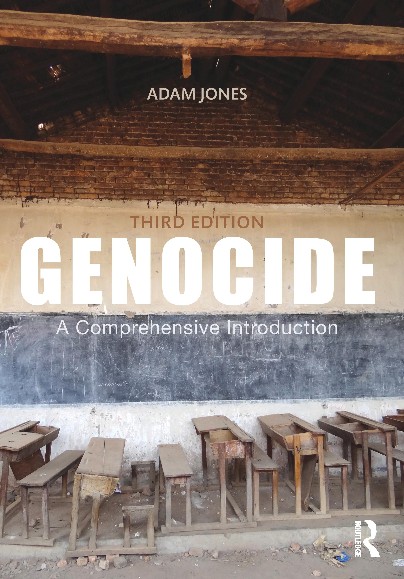
NOW AVAILABLE: Crimes Against Humanity: A Beginner's Guide, by Adam Jones (OneWorld, 2008; 168 pp., US $14.95 pbk). See www.crimesagainsthumanity.ca. "A remarkable book that is immediately accessible for the novice in the field, or students, and yet also engages with its topic in intellectually interesting ways for the more seasoned reader." (James Gow, Professor of International Peace and Security, King's College London.)
Sunday, November 16, 2008
NOW AVAILABLE: Crimes Against Humanity: A Beginner's Guide, by Adam Jones (OneWorld, 2008; 168 pp., US $14.95 pbk). See www.crimesagainsthumanity.ca. "A remarkable book that is immediately accessible for the novice in the field, or students, and yet also engages with its topic in intellectually interesting ways for the more seasoned reader." (James Gow, Professor of International Peace and Security, King's College London.)


Genocide Studies Media File
November 1-17, 2008
A compendium of news stories, features, and human rights reports pertaining to genocide and crimes against humanity. Compiled by Adam Jones. Please send links and feedback to adamj_jones@hotmail.com.
Consider inviting colleagues and friends to subscribe to Genocide_Studies and the G_S Media File. All it takes is an email to genocide_studies-subscribe@topica.com.
AUSTRIA/JEWISH HOLOCAUST
"Shards of Kristallnacht Still Cut Deep"
By Adam LeBor
The Times, 8 November 2008
"Seventy years on, the memories have not faded. Kitty Suschny was a terrified schoolgirl of 13 when the Nazis unleashed a night of violence against Vienna's Jews on November 9, 1938. 'I saw the brown shirts marching from our window but my mother pulled me inside. I heard them shouting "Jews go to hell." There was screaming, shouting, the synagogues were set on fire. Many people committed suicide,' recalled Mrs. Suschny, who was evacuated to Britain but returned to Vienna where she lives with her husband, Otto. Thousands of Jews were arrested and sent to concentration camps on Kristallnacht, the night of broken glass, a harbinger of the destruction to come. The dazzling era of Jewish Vienna, that brought the world the psychiatrist Sigmund Freud, the writer Arthur Schnitzler and the composer Gusztav Mahler, soon evaporated in the crematoria of the Nazi concentration camps. Of the city's 185,000 Jews, one third perished in the Holocaust and the remainder emigrated. Pogroms erupted across the Third Reich that night but the onslaught against Vienna's Jews was especially ferocious. Annexed by Nazi Germany in March 1938, Hitler's homeland was his most devoted disciple. Vienna was a 'laboratory for anti-Jewish violence,' writes the historian Mark Mazower, in Hitler's Empire. This weekend Austria and its neighbours commemorate the 70th anniversary of Kristallnacht. But behind the diplomatic dinners and sombre speeches lies a darker reality: of a nation much of whose post-war prosperity was built on looted Jewish assets, numerous members of whose elite were personally enriched by the Holocaust, and which has only just started to face the darkest chapter in its history. [...]"
BOLIVIA/UNITED STATES
"Bolivia Asks US to Extradite Former President for Genocide Trial"
NewKerala.com, 12 November 2008
"Bolivia has asked the US to extradite a former president and two ministers in his 2002-2003 administration to face genocide charges, EFE reported Wednesday. 'We have officially delivered the letters requesting the extradition of former president Gonzalo Sanchez de Lozada, his defence minister Carlos Sanchez Berzain and energy minister Jorge Berindoague,' Charges d'Affaires at the Bolivian Embassy here, Erika Dueñas, said Tuesday. Bolivia's Congress in October 2004 authorized a trial of Lozada and his two ministers and in September 2007 the Supreme Court ordered the foreign ministry to request the former president's extradition from the United States. Lozada, who had previously been president from 1993-1997, resigned amid unrest Oct 17, 2003, and fled to the United States. The former president and the two former ministers face genocide charges for the death of 63 people during an uprising by coca growers, unionists and peasant farmers that erupted over his plans to export natural gas to the United States and Mexico via Chilean ports. He also faces charges on eight other counts. [...]"
BOSNIA AND HERZEGOVINA
"Film on Horrors of Bosnian War Wins Rome Festival"
Reuters dispatch, 31 October 2008
"'Resolution 819,' a film about the Srebrenica massacre in the last months of Bosnia's 1992-1995 war, won the top prize at the Rome film festival Friday. A French production directed by Italy's Giacomo Battiato, the film tells the true story of a policeman sent by the U.N.'s highest court to investigate the disappearance of 8,000 Muslim men and boys from the Bosnian town after it fell to Bosnian Serb forces. The film spares the audience little of the harrowing evidence the policeman gathers over the years on the slaughter in what was supposed to be a U.N. safe area. That evidence served as the basis for the indictment for genocide of Bosnian Serb President Radovan Karadzic, who was arrested in July. His wartime commander Ratko Mladic, also indicted by the U.N. war crimes tribunal in The Hague, is still at large. The title refers to a 1993 U.N. Security Council resolution calling for an end to armed Serb attacks on Srebrenica. 'Resolution 819' won the prize for best film awarded by members of the public. ... 'I think the public shared my point of view, and that is the anger, the pain toward the worst war since World War Two, a war that happened before our eyes,' Battiato said at the awards ceremony. [...]"
CHINA/TIBET
"Tibetans Meet to Rethink Autonomy"
AlJazeera.net, 17 November 2008
"Hundreds of exiled Tibetans have begun a landmark meeting in northern India to discuss their homeland's future with China. The Dalai Lama, the Tibetan Buddhist spiritual leader, called the meeting following frustrations over repeated failed talks with the Chinese government, saying that new ideas were necessary. The gathering in Dharamsala, the seat of Tibet's government in exile, is to re-evaluate the so-called 'middle path' policy with China which espouses 'meaningful autonomy' for the Himalayan region. Talks last week -- the third round since violent anti-China protests rocked the Tibetan capital Lhasa in March -- failed because of 'a great divergence' between the two sides over China's policy on Tibet, according to Chinese officials. A Chinese government spokesman earlier dismissed the gathering to discuss the core of the decades-old dispute, saying that such 'separatist attempts will get nowhere.' On Sunday, the Dalai Lama's envoys to the Beijing talks said China had rejected a detailed plan on how Tibetans could meet their needs of autonomy within the framework of the Chinese constitution. Before Monday's meeting, the Dalai Lama urged the 500 participants to consider all aspects of policy regarding China, ensuring that the thorny issue of whether to push for full independence is tackled. [...]"
COLOMBIA
"U.N. Says Colombian Military Executing Civilians"
CNN.com, 1 November 2008
"Colombia's U.S.-backed security forces are engaging in 'systematic and widespread' extrajudicial executions of innocent civilians as part of their counterinsurgency campaign, a top United Nations diplomat said Saturday U.N. High Commissioner for Human Rights Navi Pillay, in Bogota, says Colombia must rein in its security forces. U.N. High Commissioner for Human Rights Navi Pillay, in Bogota, says Colombia must rein in its security forces. Speaking in Bogota after a weeklong fact-finding tour, Navi Pillay, the U.N. High Commissioner for Human Rights, said the scale of the killings could constitute a 'crime against humanity' under international humanitarian law, adding that international courts could intervene if the Colombian government was 'unwilling or unable' to handle the investigations itself. 'An offense becomes a crime against humanity if it is widespread and systematic against the civilian population,' Pillay said at a news conference. 'We are observing and keeping a record of the number of extrajudicial killings [in Colombia], and it does appear to be systematic and widespread in my view. The goal is to have the national authorities these crimes and prosecute the perpetrators. It's only when a country is unable and unwilling that the International Criminal Court, for instance, would have the power to intervene,' she added. Her comments come three days after Colombian President Alvaro Uribe fired 25 army officers and non-commissioned officers, including three generals and 11 colonels, for alleged involvement or negligence in a case involving the forced disappearance and summary executions of at least 11 young men from a poor Bogota suburb this year. It was the biggest purge in Colombian military ranks for alleged human rights abuses. [...]"
CONGO
"UN Adviser Urges Combatants in Congo to Refrain from Actions That Might Encourage Genocide"
By Edith M. Lederer
Associated Press dispatch in The Los Angeles Times, 7 November 2008
"A key U.N. adviser warned combatants in eastern Congo Friday against any actions that might encourage genocide, saying anyone promoting ethnic killings will be held accountable. Francis Deng, the special adviser on genocide to Secretary-General Ban Ki-moon, said he has been 'especially alarmed by the escalation of violence in the past few weeks.' The conflict in eastern Congo is fueled by ethnic hatred left over from genocide in 1994 the claimed half-million Tutsis in neighboring Rwanda. Rebel leader Laurent Nkunda, who went on the offensive Aug. 28, claims he is fighting to protect minority Tutsis from Rwandan Hutu rebels who participated in the genocide and fled to Congo afterward. In a statement released at U.N. headquarters, Deng emphasized 'that the belligerents in eastern Congo must refrain from actions that might encourage genocide and that they, and any actors who provide material support, will be held accountable if they fail to do so.' He said that under international law 'the intention to destroy an ethnic population group, in whole or in part, is a grave crime' and that the international community is obligated to punish violators. ... Deng, a human rights expert and former Sudanese diplomat, is responsible for determining from existing sources of information whether there is a risk of genocide in any part of the world and to alert the international community to such risks."
"Murder, Muddle and Panic"
The Economist, 6 November 2008
"'The situation is catastrophic,' says a Red Cross man. 'There's no other word.' Tens of thousands of terrified civilians are jamming the roads of Congo's North Kivu province in a frantic southbound exodus in the hope of self-preservation ... General Laurent Nkunda's mainly Tutsi rebels are poised to grab the eastern city of Goma after capturing most of the smaller towns in the area. Reports of massacres on the night of November 5th in Kiwanja, a small town north of Goma, have increased the panic. An officer in General Nkunda's force said that his men had 'neutralised' men in civilian clothes there who, he said, covertly belonged to the so-called Mai-Mai militias; they, along with the Congolese army and others, have been fighting the Tutsi rebels. A local clergyman said at least 180 civilians had been killed during the night. The UN's mission to Congo, known by the acronym MONUC, which has 17,000 peacekeepers across the country, including 6,000-odd in North Kivu, has been unable to cope. Diplomacy, hitherto fruitless, is intensifying. European diplomats, led by the foreign ministers of Britain and France, David Miliband and Bernard Kouchner, have visited regional capitals, calling for talks and troop reinforcements. The UN secretary-general, Ban Ki-moon, was set to host a summit on November 7th in Nairobi, Kenya's capital, bringing together the presidents of Congo and Rwanda, Joseph Kabila and Paul Kagame respectively, who have been sponsoring some of the rival rebel armies. ... The French government suggested that a robust European force of 400 to 1,500 soldiers be dispatched urgently to protect the humanitarian missions that are struggling to give relief to hundreds of thousands of hapless and hungry civilians. So far the European Union has been loth to give the go-ahead. [...]"
"Ashley Judd's Heart Of Darkness"
By Christopher Dickey
Newsweek, 30 October 2008
"[...] 'This epidemic of rape; it's like a contagion,' said Judd. 'When one man does it, it activates other men, and then the more brutal it becomes—looking for pregnant women to rape, and children. It's so unbelievably heinous that it's hard for us to wrap our minds around. Sit with a woman, who, through word of mouth, heard there was a clinic which could help a woman who had been raped ... She had to figure out -- in the midst of being stigmatized, in the midst of her physical agony, in the midst of incontinence and starvation -- how to get herself walking, crawling to this clinic, only to find that it's overcrowded, because there are so many women, hundreds, if not thousands, just like her. And just imagine, this is a clinic that does nothing but genital reconstruction.' 'What exactly are we talking about here?' 'Well, the vagina will tear when being forced to accommodate either a rapist's anatomy or objects that are introduced: wood, rock, sticks, guns, bayonets. There will be perforation of the vaginal walls, perforation and ripping of the cervix, potentially, based on the extent of the penetration into the uterus. The wall between the rectum and vagina is ripped apart. The urethra, which goes to the bladder, is damaged. There is incontinence. The urine is constantly seeping out, because the muscles and mechanisms that hold the bladder intact are ruined; there is faecal incontinency, which of course can introduce faecal matter into the gut, which results in horrific infections. Does that paint the picture?' It did. So I asked Judd if she thought people ought to have a stronger sense of just how horrible these scenes are -- or would people simply turn their backs ... again?" [...]"
[As this excerpt indicates, this is no mere celebrity portrait, but one of the more powerful and evocative recent features on Congo that I have seen.]
EL SALVADOR
"In El Salvador, A New Push for Justice in Priests' Slayings"
By Tracy Wilkinson and Alex Renderos
The Los Angeles Times, 13 November 2008
"The murder 19 years ago of six Jesuit priests by a U.S.-trained army unit was the turning point in El Salvador's long civil war, an atrocity so grave that it helped force an end to the fighting. But the soldiers and officers convicted or implicated in the slayings are free under a controversial amnesty law that is receiving new attention thanks to election politics here and a potentially landmark court case in Spain. Relatives of the priests, who were killed along with their housekeeper and her young daughter, have joined with two human rights organizations and today plan to file suit in Madrid against the generals, colonels and soldiers blamed for the killings. The plaintiffs are invoking the doctrine of universal jurisdiction, which Spanish courts have championed, that allows a case of egregious human rights violation to be heard in a country even if the acts did not take place there and the defendants do not reside there. Human rights activists in the Americas and Europe said they hoped the Jesuit complaint could be used to fight impunity and bring justice to the victims' families by joining a procession of Spanish court cases that have forced Latin America to confront its violent past. These include suits against Guatemalan military officers accused in the massacre of indigenous citizens and figures in Argentina's 'dirty war' against leftist dissidents. 'This has an invaluable historic importance for El Salvador,' said David Morales, program coordinator at a legal think tank in San Salvador that specializes in justice issues. 'All Salvadoran society has been the victim here. ... Just knowing the truth has a restorative effect.' [...]"
GERMANY/ITALY/SECOND WORLD WAR
"Berlin Takes Rome to Court"
Der Spiegel Online, 3 November 2008
"After a high court in Italy ruled that Germany is liable for damages stemming from a 1944 massacre in the village of Civitella perpetrated by Nazi soldiers, Berlin has asked the International Criminal Court to look into the case. Berlin worries the verdict could set off an avalanche of World War II-related court cases against the German government. On Oct. 22, Italy's highest appellate court, the Cassation, ruled that Germany must pay €1 million in compensation to the descendents of those killed by Nazi soldiers in the Italian town of Civitella in 1944. Now, Germany has taken the case to the International Criminal Court in The Hague in the hopes that it will rule that the payments don't have to be made. A spokesman for the foreign ministry in Berlin on Saturday confirmed a report in this week's SPIEGEL, saying that the ICC 'has been asked to clarify this question.' The October verdict in Rome also sentenced a German officer named Max Josef Milde in abstentia to life in prison. The court found that the officer was involved in the June 29, 1944 massacre which saw over 200 villagers, including the village priest, executed in revenge for the killing of three German soldiers by partisans 10 days earlier. Germany and Italy signed an agreement in 1961, which resulted in a blanket payment of 40 million deutsche marks. Of particular concern to Berlin, however, is the finding that Germany can also be held liable for the massacre. Such a precedent could trigger an expensive wave of individual lawsuits against Germany. [...]"
GERMANY/JEWISH HOLOCAUST
"Alleged Nazi Mass Murderer Could Face Trial in Germany"
Spiegel Online, 10 November 2008
"A suspected Nazi mass murderer, accused of complicity in the deaths of tens of thousands of Jews, could soon find himself hauled before the courts in Germany. Ivan John Demjanjuk's alleged role as a World War II death camp guard has for years made him one of the most hotly pursued targets of German investigators. And now Nazi hunter Kurt Schrimm, who heads up the world's largest investigation center for such atrocities in Ludwigsburg, Germany believes he has finally pinned him down. Following painstaking research across three continents, Schrimm and his colleagues believe they have enough material to request the extradition of 88-year-old Demjanjuk, who now lives in the state of Ohio in the United States. Public investigator Schrimm on Monday handed documentation for preliminary proceedings against the 88-year-old, remembered by those he allegedly tortured as 'Ivan the Terrible,' over to the Public Prosecutor's Office in Munich. ... The charges against the elderly man are enough to send a shiver down the spine of even the most conflict-hardened. It is alleged he trained as a guard in the SS camp Trawniki close to the Polish city of Lublin. From the end of March to the middle of September 1943, prosecutors claim he served in the death camp Sobibor in south-east Poland. Between May 1942 and October 1943, some 250,000 people were executed there. It is alleged Demjanjuk personally has the blood of tens of thousands of these victims on his hands. [...]"
[n.b. See also Spiegel's useful "Nazi Most Wanted List."]
"Blueprints for Auschwitz Camp Found in Germany"
By Erik Kirschbaum
Reuters dispatch, 9 November 2008
"The original construction plans believed used for a major expansion of the Nazi death camp at Auschwitz in 1941 have been found in a Berlin flat, Germany's Bild newspaper reported on Saturday. The daily printed three architect's drawings on yellowing paper from the batch of 28 pages of blueprints it obtained. One has an 11.66 meter by 11.20 meter room marked 'Gaskammer' (gas chamber) that was part of a 'delousing facility.' No one from the federal government's archives was immediately available for comment on the authenticity or importance of the documents. The plans, published ahead of the 70th anniversary of the 'Kristallnacht' or the Nazi pogrom that was a harbinger of the Holocaust, also include a crematorium and a 'L. Keller' -- an abbreviation for 'Leichenkeller' or corpse cellar. A drawing of the building for Auschwitz's main gate was also found in the documents that Bild said were believed to have been discovered when a Berlin flat was cleaned out. The mass-circulation newspaper quoted Hans-Dieter Kreikamp, head of the federal archives office in Berlin, as saying the blueprints offered 'authentic evidence of the systematically planned genocide of European Jews.' There were mass killings of about one million Jews before the Nazi's "Final Solution" was formulated in late 1941. The decision to kill Europe's 11 million Jews was made at the Wannsee Conference in January 1942. ... 'These documents reveal that everyone who had even anything remotely to do with the planning and construction of the concentration camp must have know that people were to be gassed to death in assembly-line fashion,' Bild wrote. [...]"
"Germany Confronts Its Dark Past"
By Andrew Purvis
Time.com, 8 November 2008
"Seventy years ago on Nov. 9, the Jews of Germany -- and perhaps most of Europe -- had their fate revealed to them on one frightening night. Kristallnacht, or 'Night of Broken Glass,' saw the ruling Nazi party unleash bands of thugs on Jewish communities throughout Germany and Austria, ostensibly to avenge an attack on a German diplomat in Paris by a young German Jew whose family had been forced to flee Hitler's regime. By dawn on Nov. 10, 92 Jews lay dead, among the 400 beaten, shot or driven to suicide by the abuse. Some 267 synagogues had been torched and hundreds of Jewish businesses destroyed, and 30,000 Jews had been rounded up and dispatched to concentration camps. It was, most historians believe, the pogrom that portended the systematic murder of 6 million European Jews by Hitler's regime. Germany will commemorate the 70th anniversary of Kristallnacht on Sunday through a series of events aimed at ensuring that a new generation of Germans, too young to have known anyone connected with those events, learn about the horrors that flowed from the racism of Germany's past, in the hope of guarding against any future recurrence. Chancellor Angela Merkel plans to mark the anniversary by speaking alongside the head of Germany's Jewish community, Charlotte Knobloch, at the Ryke Street synagogue in the old eastern part of Berlin. Although the synagogue was torched on Kristallnacht (or Reichspogromnacht, as some German Jews now prefer to call it), its structure remained intact, and it was reopened last year for the first time since World War II. The ceremony will include the screening of a documentary on the infamous night and another on the Jewish community in Germany today. Elsewhere in Berlin, a Mozart requiem and concert for violin by Felix Mendelssohn will be performed by the philharmonic chamber orchestra. [...]"
"Berlin Center Marks Those Who Saved Jews"
Associated Press dispatch in The Los Angeles Times, 2 November 2008
"The 'Silent Heroes' now have a voice. A new memorial center in Berlin pays tribute to the thousands of German gentiles who risked everything to save Jews from persecution by the Nazis and documents the stories of those who sometimes spent years in hiding. The 'Silent Heroes' memorial center opened to the public last week amid a new focus in recent years on the legacy of the 'good German' -- individuals who resisted Hitler, were labeled as traitors by the Nazis and were often shunned after the war. 'Their accomplishments were totally forgotten, and this is an initiative to bring them back into our memory,' said Johannes Tuchel, director of the German Resistance Memorial Center Foundation, which is behind the new memorial. About 5,000 Jews were able to survive the war in hiding in Germany. It is not clear how many people were involved in helping them, Tuchel said. Research suggests that for each person in hiding, about 10 people aided him or her. Peter Michalski, whose family went into hiding in 1944, said it was a long overdue tribute to the Germans who helped people like him escape death. 'Where would you be now if these people hadn't existed?' he asked contemplatively while looking at an exhibit focusing on his family's plight. 'The answer is simple: We wouldn't be.' The three-room exhibition has many multimedia displays in English and German -- audio accounts, touch-screen computers focusing on 18 aspects of survival, and computers with more details on those in hiding and their rescuers. There are also personal photos, diaries and letters. The best-known subject is Oskar Schindler, whose story was told by Steven Spielberg's Oscar-winning film 'Schindler's List,' which showed his efforts to shield 1,000 Jews from Nazi camps by hiring them to work in his factories. Some of the lesser-known stories are just as moving. [...]"
INDIA/FOOD SECURITY
"The GM Genocide: Thousands of Indian Farmers are Committing Suicide after Using Genetically Modified Crops"
By Andrew Malone
The Daily Mail, 3 November 2008
"[...] Official figures from the Indian Ministry of Agriculture do indeed confirm that in a huge humanitarian crisis, more than 1,000 farmers kill themselves here each month. Simple, rural people, they are dying slow, agonising deaths. Most swallow insecticide -- a pricey substance they were promised they would not need when they were coerced into growing expensive GM crops. It seems that many are massively in debt to local money-lenders, having over-borrowed to purchase GM seed.Take the case of Suresh Bhalasa, another farmer who was cremated this week, leaving a wife and two children. As night fell after the ceremony, and neighbours squatted outside while sacred cows were brought in from the fields, his family had no doubt that their troubles stemmed from the moment they were encouraged to buy BT Cotton, a geneticallymodified plant created by Monsanto. 'We are ruined now,' said the dead man's 38-year-old wife. 'We bought 100 grams of BT Cotton. Our crop failed twice. My husband had become depressed. He went out to his field, lay down in the cotton and swallowed insecticide.' Villagers bundled him into a rickshaw and headed to hospital along rutted farm roads. 'He cried out that he had taken the insecticide and he was sorry,' she said, as her family and neighbours crowded into her home to pay their respects. 'He was dead by the time they got to hospital.' Asked if the dead man was a 'drunkard' or suffered from other 'social problems', as alleged by pro-GM officials, the quiet, dignified gathering erupted in anger. 'No! No!' one of the dead man's brothers exclaimed. 'Suresh was a good man. He sent his children to school and paid his taxes. 'He was strangled by these magic seeds. They sell us the seeds, saying they will not need expensive pesticides but they do. We have to buy the same seeds from the same company every year. It is killing us. Please tell the world what is happening here.' [...]"
ISRAEL/JEWISH HOLOCAUST
"Holocaust is Over, Leading Israeli Tells Likud"
By Donald Macintyre
The Independent, 1 November 2008
"Benjamin Netanyahu, a front-runner for the Israeli premiership, has been severely criticised by a former Speaker of the Knesset and head of the Jewish Agency for comparing the threat posed by Iran to that of pre-war Nazi Germany. Mr. Netanyahu, whose Likud Party is running neck and neck in the polls with Kadima, led by Tzipi Livni, has gone further than his rivals in implying he might authorise a unilateral attack on Iranian nuclear installations. Avraham Burg, whose new book The Holocaust Is Over: We Must Rise From Its Ashes is out in Britain this weekend, says in an interview with The Independent Magazine that the Iranian President, Mahmoud Ahmadinejad, is 'no doubt a problem.' Mr. Burg adds: 'He is an issue in the Western world and for Israel's sense of confidence in particular.' But he continues: 'What is [Mr. Netanyahu's] soundbite? "It is [19]38 all over again." Do me a favour. Did we have such a powerful state in '38? Did we have this onmipotent army in '38? Did we have the most important superpowers siding with us in '38? Did we have the Catholic church taking a different attitude in '38? It's not '38, however you look at it. And even Ahmadinejad, when you compare him with Hitler, you diminish Hitler.' Mr. Burg's book, in part a plea to fellow Israelis more than 60 years after the Holocaust to stop seeing themselves as 'a nation of victims,' caused furious debate when the Hebrew version became a bestseller in Israel last year. The new translation is likely to provoke similar argument, particularly in the US. Mr. Burg, a strong Barack Obama supporter, says 'a dialoguing President is better than a shooter' and that George Bush has been a 'disaster for the world and for Israel.' He argues against Israel defining itself as a 'Jewish state' instead of as a 'state for the Jewish people which belongs to all its citizens' -- including Arabs. Mr. Burg, who does not rule out a return to Israeli politics, also warns that the days for a two-state solution are 'numbered' because Israeli and Palestinian societies have been 'abducted' by fundamentalists. [...]"
JAPAN/SECOND WORLD WAR
"WWII Apologists Persist Despite Japanese Policy"
By Blaine Harden
The Washington Post, 3 November 2008
"Once again, a Japanese official with nationalist sympathies -- in this case, the head of the air force -- has glossed over the Asian suffering caused by Japan during World War II. Once again, China and South Korea -- principal victims of Japan's wartime depredations -- have expressed shock and anger. And once again, the government in Tokyo has restated its official policy, which is that Japan deeply regrets and apologizes for its wartime aggression. The abiding reluctance of prominent nationalists in Japan to come to grips with the past resurfaced Friday, when a hotel company announced the winner of its $30,000 'true modern history' essay contest. The winning essay was written by Gen. Toshio Tamogami, who until Friday night was chief of staff of the air force. He was fired a few hours after the essay appeared on the hotel company's Web site. Japan attacked Pearl Harbor because of a 'trap' set by U.S. President Franklin D. Roosevelt, Tamogami claimed in his essay, which also argued 'that many Asian countries take a positive view' of Japan's role in the war. He wrote, too, that the war was good for international race relations: 'If Japan had not fought the Great East Asia War at that time, it might have taken another 100 or 200 years before we could have experienced the world of racial equality that we have today.' The essay concluded that 'it is certainly a false accusation to say that our country was an aggressor nation.' Explaining why Tamogami was fired, Defense Minister Yasukazu Hamada told reporters that a senior military leader 'should not make public an opinion opposed to the government's position.' [...]"
JEWISH HOLOCAUST/RACISM
"Kristallnacht 70 Years On"
By Karen Pollock
New Statesman, 8 November 2008
"[...] If we are to learn anything from Kristallnacht it is a reminder to us all of where unchecked racism and intolerance can lead and underscores our responsibility as human beings to ensure that such evil is always confronted whenever and wherever it occurs. The Holocaust did not begin with the gas chambers at Auschwitz, it did not even begin with Kristallnacht -- it began with words and was reacted to with silence. The extermination of European Jewry took place at the end of a long road, a long history marked by centuries of age-old antisemitism and prejudice dating back to the middle ages and most significantly it was a long road marked by indifference. Nor was the Holocaust a mere symptom of the time; the era. As we have seen repeatedly in the years that have followed the Holocaust genocide and atrocities have plagued every corner of the globe and continue to do so. We cannot and must not consign the terror and cruelty of that night to our history books or fool ourselves into believing that it was a history belonging to a different era. To remove ourselves in this way is to remove our own responsibility in fighting racism and intolerance today. This year, many of us have no doubt felt helpless as far-right parties continue to gain a foothold in local councils, and even in the London Assembly -- the body representing one of the most diverse cities in the world. And make no mistake about it -- these are politicians who exploit community divisions, and whose ideology is based on the same racism and prejudice exhibited during the Holocaust. But we do have the ability to halt racism in its tracks. [...]"
KENYA
"Kenyan Police Units 'Murder Hundreds'"
By Jon Swain
The Times, 16 November 2008
"A damning report containing evidence of a high-level policy to murder suspected criminals and troublemakers in Kenya threatens to undermine the reputation of the government of President Mwai Kibaki. The report, by the Kenya National Commission on Human Rights, reveals that in the past 18 months about 500 young men have been killed or have disappeared in a police campaign carried out with the apparent connivance of political leaders. The dead and missing were suspected of being members of the Mungiki, a feared criminal gang that had itself committed gruesome murders. The Mungiki was outlawed in 2002 following a spate of slum violence. It is a quasi-religious group from the dominant Kikuyu tribe and had become one of Kenya's largest crime and extortion rings. In a speech on June 1 last year, Kibaki warned gang members they should expect no mercy. Two days later more than 300 Mungiki members were arrested and 20 killed. John Michuki, the internal security minister, said: 'We will pulverise and finish them off. Even those arrested over the recent killings, I cannot tell you where they are today. What you will certainly hear is that so and so's burial is tomorrow.' Since then the commission has compiled the names of at least 300 men who have been killed or have disappeared. It also said there were about 200 victims whose identities could not be established since they were booked into the mortuaries as unknown. Initially the police shot most suspects but then, the commission said, they turned to strangulation, drowning, mutilation and bludgeoning in an attempt to make the public believe rival gangs were responsible for the killings. Several witnesses told the commission that police death squads carried machetes, iron bars, ropes and other crude weapons in their cars. Its evidence is being studied by the United Nations committee against torture. [...]"
PALESTINE/ISRAEL
"Chronic Malnutrition in Gaza Blamed on Israel"
By Donald Macintyre
The Independent, 15 November 2008
"The Israeli blockade of Gaza has led to a steady rise in chronic malnutrition among the 1.5 million people living in the strip, according to a leaked report from the Red Cross. It chronicles the 'devastating' effect of the siege that Israel imposed after Hamas seized control in June 2007 and notes that the dramatic fall in living standards has triggered a shift in diet that will damage the long-term health of those living in Gaza and has led to alarming deficiencies in iron, vitamin A and vitamin D. The 46-page report from the International Committee of the Red Cross -- seen by The Independent -- is the most authoritative yet on the impact that Israel's closure of crossings to commercial goods has had on Gazan families and their diets. The report says the heavy restrictions on all major sectors of Gaza's economy, compounded by a cost of living increase of at least 40 per cent, is causing 'progressive deterioration in food security for up to 70 per cent of Gaza's population.' That in turn is forcing people to cut household expenditures down to 'survival levels.' 'Chronic malnutrition is on a steadily rising trend and micronutrient deficiencies are of great concern,' it said. Since last year, the report found, there had been a switch to 'low cost/high energy' cereals, sugar and oil, away from higher-cost animal products and fresh fruit and vegetables. Such a shift 'increases exposure to micronutrient deficiencies which in turn will affect their health and wellbeing in the long term.' Israel has often said that it will not allow a humanitarian crisis to develop in Gaza and the report says that the groups surveyed had 'accessed their annual nutritional energy needs.' But it warned governments, including Israel's, that 'food insecurity and undernutrition, including micronutrient deficiencies' were occurring in the absence of 'overt food shortages.' [...]"
RWANDA
"Rwanda President: Aide Arrested in Germany Was on Government Business"
Associated Press dispatch in The Los Angeles Times, 11 November 2008
"Rwandan President Paul Kagame said today his country's sovereignty was violated when an aide visiting Germany was arrested in connection with an attack that set off Rwanda's 1994 genocide. Rose Kabuye, Kagame's chief of protocol, was arrested Sunday at Frankfurt International Airport on a warrant from France, where she is wanted in connection with the fatal April 1994 attack on the plane of President Juvenal Habyarimana. Hutu extremists accuse Tutsi fighters -- then led by Kagame -- of shooting down the plane and killing Habyarimana, a Hutu. Other speculation, though, has focused on hard-line Hutus hoping to create a pretext for mass violence against Tutsis. Kagame visited Kabuye today at the Preungsheim women's prison where she is being held. He told reporters afterward that her case was politically motivated and added it could affect Rwanda's cooperation with the European Union in regard to the fighting in Congo. ... French authorities, who are investigating because Habyarimana's two pilots were French, suspect Kabuye housed the commando unit blamed for shooting down the plane. Forster said Kabuye denies involvement. Ties between Rwanda and France have been strained since a French judge's decision to issue warrants for nine associates of Kagame, including Kabuye, over the crash, All nine are in Kagame's government. The Tutsi-led government and genocide survivor organizations by contrast have often accused France of training and arming the Hutu militias and former government troops who led the genocide. [...]"
[n.b. Does the shootdown of Habyarimana's plane now count as the most significant unsolved act of homicide anywhere in the world?]
"Warrants over Rwanda Genocide Imminent: Sources"
Agence France-Presse dispatch on RawStory.com, 11 November 2008
"Rwanda is poised to issue indictments and arrest warrants against 23 French military and political officials over their suspected role in the country's 1994 genocide, judicial sources said on Tuesday. Indictments against France's late president Francois Mitterrand and former prime minister Dominique de Villepin among others would mark a new step in the judicial escalation between the two countries. The threat of warrants against top French officials -- several of whom are still active -- came as hundreds demonstrated in Kigali against the arrest by Germany, acting on a French warrant, of a top aide to the Rwandan president. ... Rwandan prosecutors had spent the past three months examining a 500-page report drafted by a special commission tasked with probing France's role in the genocide and released on August 5 by the justice ministry. It names former French prime minister Edouard Balladur, former foreign minister Alain Juppe and then-president Francois Mitterrand, who died in 1996, among 13 French politicians accused of playing a role in the massacres. Dominique de Villepin, who was then Juppe's top aide and later became prime minister, was also among those listed in the Rwandan report. It also names 20 military officials, involved notably in Operation Turquoise, a 1994 French military mission to Rwanda which Kigali charges was used to assist Hutu genocide perpetrators. The justice official speaking to AFP on Tuesday did not specify who were the 23 officials facing indictment. [...]"
SPAIN
"Spanish Court Suspends Opening of Franco-Era Mass Graves"
The Telegraph, 7 November 2008
"A court in Spain has halted the opening of mass graves of victims of the nation's 1936-39 civil war and the ensuing dictatorship as ordered by top judge Baltasar Garzon while it analyses the legal basis for his decision. A panel of judges belonging to the National Audience, Spain's top criminal court, ruled to suspend the order by 10 votes to five in response to a demand by the public prosecutor. ... National Audience judge Baltasar Garzon, on October 16, ordered the opening of 19 mass graves, including one near Granada where Spain's most widely acclaimed 20th century poet, Federico Garcia Lorca, is thought to be buried. He ordered four more mass graves to be opened on Thursday as part of an investigation into the disappearances of some 114,000 people during the war and the early years of General Francisco Franco's right-wing dictatorship. Judge Garzon decided to open Spain's first criminal investigation into Franco-era executions and repression in response to a petition filed by 13 associations of victims' families. He based his decision on the grounds that he was probing a case of crimes against humanity that he says has no statute of limitations, an argument he has used in the past to try to prosecute atrocities that took place under military rule in Argentina and Chile that affected Spaniards. But the public prosecutor's office appealed his decision, arguing that it violated an amnesty agreed by political parties in the spirit of national reconciliation in 1977, two years after Franco's death, for crimes committed under the general's rule. The opposition conservative Popular Party has argued that the judge's move would open up old wounds in Spanish society, but last week Judge Garzon's move got the backing of the UN Commission on Human Rights which called on Spain to abolish its 1977 amnesty law. [...]"
SUDAN/DARFUR/UNITED STATES
"Obama is Asked to Focus on Darfur"
By Elise Labott
CNN.com, 13 November 2008
"Human rights groups are asking President-elect Barack Obama to pay early attention to the crisis in Sudan's troubled Darfur region, where government forces have waged a bloody war against militias that some international critics have characterized as genocide. Sudan President Omar al-Bashir has agreed to a cease-fire with rebels, which could give the U.S. an opening. 'We've seen the military surge in Iraq. We've seen the development surge that NATO's announced for Afghanistan,' said Darfur activist John Prendergast. 'What's really needed in Sudan and the broader Horn and East Africa region is a peace surge.' Prendergast's ENOUGH organization to combat genocide is a project of the Center for American Progress, a Democratic think tank run by Obama's transition co-chairman, John Podesta. Prendergast and other Darfur activists penned a recent letter to Obama, asking him to designate a team to focus solely on the Darfur issue within the first 100 days of his administration. ... During the presidential campaign, Obama called the crisis in Darfur 'a collective stain on our national and human conscience' and said he would make ending it a priority on 'Day One.' Obama has promised to appoint a special envoy to deal with the Darfur issue and implementing the Comprehensive Peace Agreement, which ended the decades-long civil war between the North and South. That agreement could be a model for a peace process in Darfur, Prendergast said. Although the United States does not have to lead the peace process, it could be an active partner in the global effort to develop a strategy for getting the various parties in Sudan together, he said. [...]"
"Sudan President Offers Ceasefire in Darfur, Other Steps Aiming to Show Ready for Peace"
By Mohamed Osman
Associated Press dispatch in The Los Angeles Times, 12 November 2008
"President Omar al-Bashir offered a ceasefire in Darfur on Wednesday and promised to disarm militias, a top rebel demand, in a new push by his government to show it is serious about ending the nearly 6-year-old conflict. Darfur rebels dismissed the moves, saying they don't trust al-Bashir and want to see disarmament of the feared janjaweed militias before agreeing to a ceasefire. Al-Bashir's announcement is part of a high-profile campaign by Khartoum to display its readiness amid attempts to cobble together new Darfur peace negotiations mediated by the Arab nation Qatar and a U.N. envoy. It comes as the Sudanese president is trying to fend off possible genocide charges by the International Criminal Court over atrocities in Darfur. Up to 300,000 people have been killed and 2.5 million driven from their homes in the vast region of western Sudan since fighting erupted in early 2003. The war pits troops from the Arab-led Sudanese government against ethnic African rebels, and Khartoum is accused of backing Arab militias known as janjaweed said to have carried out widespread atrocities against ethnic African civilians. The government has repeatedly called ceasefires in Darfur in the past, but they have quickly broken down. ... The call appeared to stop short of ordering a unilateral ceasefire by government troops in Darfur. [...]"
TANZANIA
"Tanzania's Macabre Trade: Albinos Killed for Body Parts"
The Telegraph, 7 November 2008
"Tanzanian albinos are living in terror following 30 murders in the east African nation by people apparently seeking their body parts for witchcraft, a campaigner said. The government says most of the killings happened in the last 10 months. The latest three occurred just after a rally held in Dar es Salaam last month to denounce the practice. 'Our biggest fear right now is the fear of living. If you leave work at night as an albino, you are unsure of reaching home safely. When you sleep, you are unsure of waking up in one piece,' Zihada Msembo, secretary general of the Tanzania Albino Society said. 'We marched, the president (Jakaya Kikwete) received us and we said "now we can have some peace" and slept soundly that night. Next morning, we hear yet another albino was killed that very night.' The government says most of the murders occurred in western Tanzania. Police have arrested 53 suspects. The killers sell body parts such as arms, legs, hair, skin and genitals, according to police and albino groups. Those involved in witchcraft, especially in mining and fishing industries, believe these will enrich them, President Kikwete said last month, calling it a 'stupid belief.' Local media have reported several incidents of victims left to bleed to death. [...]"
UKRAINE/RUSSIA
"Kiev Famine Tribute Irks Medvedev"
The Moscow Times, 17 November 2008
"President Dmitry Medvedev accused Ukrainian President Viktor Yushchenko on Friday of distorting history for political gain by commemorating a famine engineered by Soviet dictator Josef Stalin. 'We clearly see that this theme, along with persistent attempts to secure an invitation to NATO's "prep classes," has in recent years all but become the main element of Ukrainian foreign policy,' Medvedev told Yushchenko in a letter. 'Such steps can hardly be explained by a bid to restore historical justice or to honor the victims' memory. They are more likely aimed at dividing our peoples as much as possible,' he said. The dispute over this week's anniversary of the 1932-33 famine is part of a long series of disputes between the neighbors over Kiev's shift toward the West, which includes seeking membership of NATO and the European Union. Historians say 7.5 million people died in the famine, intended to break the spirit of Ukraine's independent farmers. Medvedev said the famine was 'the consequence of drought and forced collectivization. ... To suggest that the main aim was to destroy Ukrainians is to fly in the face of the facts and paint a general tragedy in nationalist tones.' Ukrainian authorities, led by Yushchenko, have sought to have the famine internationally declared a genocide. Several days of commemorations this week include a conference to be attended by regional leaders, the unveiling of a monument and a solemn procession to honor victims."
[n.b. This is the complete text of the dispatch.]
"Ukrainians Remember Famine-Genocide of 1933"
By Lori Sherman
Niagara This Week, 14 November 2008
"Mary Burtatynsky was once a happy child, playing in the fields and helping her mother, while growing up with her brother and sister in a small village in the Ukraine. But that childhood was short-lived and soon the happy memories were overshadowed by horrible atrocities most cannot fathom. At the tender age of eight, Burtatynsky endured Holodomor - the widely unknown genocide inflicted by means of a Soviet government-engineered famine that wiped out millions of people across the Ukraine in the early 30s. Burtatynsky joined 19 other survivors at a 75th anniversary commemoration ceremony this weekend at the Ukrainian Black Sea Hall on Welland Avenue. 'We suffered. We suffered so much,' said Burtatynsky, clutching a tissue and wiping away tears from her aging face. 'My father hid a bag of wheat in our home. I remember watching the soldiers go through. They took everything, but they didn't find the bag of wheat.' That bag fed her family of five for over a month, each eating a cup a day mixed with leaves from trees and flowers from the gardens. 'My family survived, but so many did not. My neighbours died. The houses were empty. My street was empty.' Burtatynsky recalls seeing people dying in the streets of her village, some even resorting to cannibalism to feed their starving bodies. ... Until recently, Holodomor, which roughly translates to suffering through starvation, was not recognized by the world as a form of genocide. It wasn't until this year that the European parliament recognized Holodomor as a crime against humanity. Canada has also now followed the lead of other nations in recognizing the event as a deliberate attempt by Josef Stalin to torture and ultimately kill Ukrainians and as such, Canada has now proclaimed the fourth Saturday of November as a memorial day for the victims of Holodomor. [...]"
UNITED KINGDOM
"Our Haven for War Criminals"
By Ken Macdonald
The Guardian, 8 November 2008
"... There are serious gaps in our law. Suspects can be tried for genocide, war crimes and crimes against humanity committed abroad only if they are UK residents or nationals, and if they committed their crimes after the International Criminal Court Act was passed in 2001. Quite illogically, this differs from hostage-taking and torture, which are fully prosecutable here, wherever the offences took place, and have no nationality or residency requirements. So foreign torturers and hostage-takers who commit their crimes overseas can be prosecuted, but Rwandan génocidaires living in the UK are protected. British residents committing war crimes abroad in 2002 may face justice here, but those whose crimes occurred in 1992 are immune. These distinctions lack all humanity and their consequences are ugly. At present, four suspected category-one genocidaires are appealing against an order for their extradition to Rwanda. If they succeed we shall be unable to prosecute them for genocide in our courts. These men, each accused of mass murder, will simply be released to live contentedly among us. The Aegis Trust, an organisation that campaigns on genocide issues, proposes two changes to the law. First, we should move from a strict 'residency' requirement for prosecution, and embrace something closer to a basic 'presence' requirement. This would deal with situations where suspects are found temporarily visiting our country, for example to enjoy medical treatment. It would also bring the UK into line with other common law countries. Second, our courts should be given jurisdiction over crimes against humanity, genocide and all war crimes from the point at which these offences were recognised under international customary law. This would greatly extend our reach into the past. It would largely scrub away the stain of impunity. [...]"
UNITED STATES
"Obama Election Spurs Race Crimes around Country"
By Jesse Washington
Associated Press dispatch on Yahoo! News, 16 November 2008
"Cross burnings. Schoolchildren chanting 'Assassinate Obama.' Black figures hung from nooses. Racial epithets scrawled on homes and cars. Incidents around the country referring to President-elect Barack Obama are dampening the postelection glow of racial progress and harmony, highlighting the stubborn racism that remains in America. From California to Maine, police have documented a range of alleged crimes, from vandalism and vague threats to at least one physical attack. Insults and taunts have been delivered by adults, college students and second-graders. There have been 'hundreds' of incidents since the election, many more than usual, said Mark Potok, director of the Intelligence Project at the Southern Poverty Law Center, which monitors hate crimes. One was in Snellville, Ga., where Denene Millner said a boy on the school bus told her 9-year-old daughter the day after the election: 'I hope Obama gets assassinated.' That night, someone trashed her sister-in-law's front lawn, mangled the Obama lawn signs, and left two pizza boxes filled with human feces outside the front door, Millner said. She described her emotions as a combination of anger and fear. 'I can't say that every white person in Snellville is evil and anti-Obama and willing to desecrate my property because one or two idiots did it,' said Millner, who is black. 'But it definitely makes you look a little different at the people who you live with, and makes you wonder what they're capable of and what they're really thinking.' Potok, who is white, said he believes there is 'a large subset of white people in this country who feel that they are losing everything they know, that the country their forefathers built has somehow been stolen from them.' [...]"
UNITED STATES/THE "WAR ON TERROR"
"Bush Torture Memo Slapped Down by Court"
By Johnny Dwyer
Time.com, 3 November 2008
"As the curtain falls on the Bush Administration, one set piece of the Administration's policy on torture has finally been ushered offstage. The Bybee Memo, a 2002 opinion authored by the Justice Department's Office of Legal Counsel, was brushed aside last week by a federal judge overseeing the nation's first-ever criminal trial of an American accused of torture abroad. The public defenders representing torture suspect Chucky Taylor, a U.S. citizen and the son of former Liberian military strongman Charles Taylor, submitted it for consideration as part of potential jury instructions. But Federal Judge Cecilia Altonaga rejected the terms laid out in the memo, saying, 'I will not give an instruction that relies upon that memorandum as its authority.' It was a humiliating epilogue to the Bush Administration's attempt to integrate what many critics describe as undeniable torture into U.S. military and intelligence policy. The Bybee memo, (named for Jay Bybee, then head of the Office of Legal Counsel) was largely authored by John Yoo, then Deputy Assistant Attorney General of the Office of General Counsel. ... Rejected now by both court and bureaucracy, the Bybee Memo may have no effective existence. But its notoriety is certain to outlive this Administration. Indeed, critics believe it will be part of the Bush legacy. Says Martin Lederman, visiting professor with the Georgetown University Law Center and former adviser to the Office of Legal Counsel: 'the memo will be seen as one of the most extreme deviations from the rule of law and from the President's obligation to take care that the law is faithfully executed.'"
VATICAN/JEWISH HOLOCAUST
"Catholic-Jewish Controversy Slows Path to Sainthood for Pope Pius XII"
By Justin Ewers
US News & World Report, 14 November 2008
"A half-century after the death of Pope Pius XII, the pontiff who led the Vatican during World War II, the passionate debate over his wartime actions and his qualifications for sainthood shows no signs of fading. Critics have long insisted that Pius was no saint, accusing him of turning a blind eye to the fate of the Jews when he failed to publicly condemn the Holocaust. Pius's defenders disagree, and the former pope's legacy has become the center of a ferocious battle among the Vatican, church historians, and the Jewish community -- a struggle, many experts believe, that has delayed Pius's sainthood for years. Last month, when the Vatican commemorated the 50th anniversary of Pius's death, high-ranking members of the Roman Catholic Church seemed determined to renew the push for Pius's beatification -- a declaration that he is blessed and worthy of veneration, and the last step before sainthood. Pope Benedict XVI himself, in one of the most forceful defenses by a pope of Pius to date, declared that his predecessor, who led the church from 1939 to 1958, had done all he could -- and more than most -- to stop the Holocaust. ... Seeming to excuse Pius's silence during the Holocaust, when the Vatican, like the rest of Europe, was threatened by the Nazis, Benedict insisted the pope's wartime interventions were 'made secretly and silently precisely because, given the concrete situation of that difficult historical moment, only in this way was it possible to avoid the worst and save the greatest number of Jews.' This increasingly muscular defense of Pius, which experts viewed as an attempt to pave the way to sainthood, outraged many in the Jewish community. [...]"
"Holocaust Group to Lobby Pope over Pius Sainthood"
By Philip Pullella
Reuters dispatch, 7 November 2008
"Holocaust survivors and their descendants will lobby Pope Benedict to stop the process of making his wartime predecessor Pius XII a saint, saying beatifying him would be a tragedy for Catholic-Jewish relations. The plan, involving appealing to the pope by lobbying his ambassadors around the world, was approved Thursday night in New York and will be announced formally Monday, a leader of an organization spearheading it told Reuters Friday. 'Beatifying Pius XII would be a tragedy for Catholic-Jewish relations, which have become so warm in recent years,' said Elan Steinberg, vice president of the American Gathering of Jewish Holocaust Survivors and their Descendants (AGJHSD). Some Jews have accused Pius, who reigned from 1939 to 1958, of turning a blind eye to the Holocaust. The Vatican says he worked silently behind the scenes and helped save many Jews from certain death during World War Two. Steinberg, who is also executive director emeritus of the World Jewish Congress, said survivors' groups around the world would seek meetings with Vatican nuncios (ambassadors) to express their concern. This is believed to be the first time Holocaust survivors have organized a global campaign to lobby the Vatican. The American group has about 60,000 members. Thursday, Pope Benedict's deputy, Cardinal Tarcisio Bertone, said Jewish accusations were 'outrageous' and that no one could tell the Vatican whether Pius should be made a saint. [...]"
ISSUE: INTERNATIONAL TRIBUNALS
"UN Court on Rwandan Genocide Expects Its Term to Be Extended"
By Sarah McGregor
Bloomberg.com, 12 November 2008
"The United Nations-backed war crimes court on the Rwandan genocide expects that its term will be extended until the end of next year to allow more time to handle a backlog of cases, spokesman Roland Amoussouga said. The Tanzania-based International Criminal Tribunal for Rwanda has handed down 32 convictions and five acquittals, while one case is on appeal, Amoussouga said yesterday in an interview in Arusha, Tanzania. Another 37 detainees are on or awaiting trial, the ICTR said on its Web site. Thirteen people suspected of genocide-related crimes are still at large, Amoussouga said. 'The tribunal made a presentation to the Security Council in June and requested it be granted an extension in order to complete the cases,' Amoussouga said. 'We are waiting a final decision, but already there are indications that we should be granted such an extension at least until the end of December 2009.' As many as 800,000 people, or more than a 10th of Rwanda's population, died in the three-month long slaughter of minority Tutsis and moderate Hutus by ethnic Hutu militias, following the assassination of President Juvenal Habyarimana on April 6, 1994. Habyarimana died when a plane he was traveling in was shot down as it prepared for landing in Kigali, Rwanda's capital. The term of ICTR judges already has been extended to next year, Amoussouga said. The tribunal was established in 1994 with a mandate to conclude first instance cases by the end of this year and appeal trials by 2010. Verdicts on three cases, including that of Colonel Theoneste Bagosora who is an alleged mastermind of the killings, will be delivered next month, Amoussouga said. 'We have reached our cruising altitude and now many decisions are coming,' he said. Operating the Arusha-based tribunal and its offices at the Hague and in Rwanda have cost an average of $90 million a year, Amoussouga said."
[n.b. This is the complete text of the dispatch.]
Consider inviting colleagues and friends to subscribe to Genocide_Studies and the G_S Media File. All it takes is an email to genocide_studies-subscribe@topica.com.
AUSTRIA/JEWISH HOLOCAUST
"Shards of Kristallnacht Still Cut Deep"
By Adam LeBor
The Times, 8 November 2008
"Seventy years on, the memories have not faded. Kitty Suschny was a terrified schoolgirl of 13 when the Nazis unleashed a night of violence against Vienna's Jews on November 9, 1938. 'I saw the brown shirts marching from our window but my mother pulled me inside. I heard them shouting "Jews go to hell." There was screaming, shouting, the synagogues were set on fire. Many people committed suicide,' recalled Mrs. Suschny, who was evacuated to Britain but returned to Vienna where she lives with her husband, Otto. Thousands of Jews were arrested and sent to concentration camps on Kristallnacht, the night of broken glass, a harbinger of the destruction to come. The dazzling era of Jewish Vienna, that brought the world the psychiatrist Sigmund Freud, the writer Arthur Schnitzler and the composer Gusztav Mahler, soon evaporated in the crematoria of the Nazi concentration camps. Of the city's 185,000 Jews, one third perished in the Holocaust and the remainder emigrated. Pogroms erupted across the Third Reich that night but the onslaught against Vienna's Jews was especially ferocious. Annexed by Nazi Germany in March 1938, Hitler's homeland was his most devoted disciple. Vienna was a 'laboratory for anti-Jewish violence,' writes the historian Mark Mazower, in Hitler's Empire. This weekend Austria and its neighbours commemorate the 70th anniversary of Kristallnacht. But behind the diplomatic dinners and sombre speeches lies a darker reality: of a nation much of whose post-war prosperity was built on looted Jewish assets, numerous members of whose elite were personally enriched by the Holocaust, and which has only just started to face the darkest chapter in its history. [...]"
BOLIVIA/UNITED STATES
"Bolivia Asks US to Extradite Former President for Genocide Trial"
NewKerala.com, 12 November 2008
"Bolivia has asked the US to extradite a former president and two ministers in his 2002-2003 administration to face genocide charges, EFE reported Wednesday. 'We have officially delivered the letters requesting the extradition of former president Gonzalo Sanchez de Lozada, his defence minister Carlos Sanchez Berzain and energy minister Jorge Berindoague,' Charges d'Affaires at the Bolivian Embassy here, Erika Dueñas, said Tuesday. Bolivia's Congress in October 2004 authorized a trial of Lozada and his two ministers and in September 2007 the Supreme Court ordered the foreign ministry to request the former president's extradition from the United States. Lozada, who had previously been president from 1993-1997, resigned amid unrest Oct 17, 2003, and fled to the United States. The former president and the two former ministers face genocide charges for the death of 63 people during an uprising by coca growers, unionists and peasant farmers that erupted over his plans to export natural gas to the United States and Mexico via Chilean ports. He also faces charges on eight other counts. [...]"
BOSNIA AND HERZEGOVINA
"Film on Horrors of Bosnian War Wins Rome Festival"
Reuters dispatch, 31 October 2008
"'Resolution 819,' a film about the Srebrenica massacre in the last months of Bosnia's 1992-1995 war, won the top prize at the Rome film festival Friday. A French production directed by Italy's Giacomo Battiato, the film tells the true story of a policeman sent by the U.N.'s highest court to investigate the disappearance of 8,000 Muslim men and boys from the Bosnian town after it fell to Bosnian Serb forces. The film spares the audience little of the harrowing evidence the policeman gathers over the years on the slaughter in what was supposed to be a U.N. safe area. That evidence served as the basis for the indictment for genocide of Bosnian Serb President Radovan Karadzic, who was arrested in July. His wartime commander Ratko Mladic, also indicted by the U.N. war crimes tribunal in The Hague, is still at large. The title refers to a 1993 U.N. Security Council resolution calling for an end to armed Serb attacks on Srebrenica. 'Resolution 819' won the prize for best film awarded by members of the public. ... 'I think the public shared my point of view, and that is the anger, the pain toward the worst war since World War Two, a war that happened before our eyes,' Battiato said at the awards ceremony. [...]"
CHINA/TIBET
"Tibetans Meet to Rethink Autonomy"
AlJazeera.net, 17 November 2008
"Hundreds of exiled Tibetans have begun a landmark meeting in northern India to discuss their homeland's future with China. The Dalai Lama, the Tibetan Buddhist spiritual leader, called the meeting following frustrations over repeated failed talks with the Chinese government, saying that new ideas were necessary. The gathering in Dharamsala, the seat of Tibet's government in exile, is to re-evaluate the so-called 'middle path' policy with China which espouses 'meaningful autonomy' for the Himalayan region. Talks last week -- the third round since violent anti-China protests rocked the Tibetan capital Lhasa in March -- failed because of 'a great divergence' between the two sides over China's policy on Tibet, according to Chinese officials. A Chinese government spokesman earlier dismissed the gathering to discuss the core of the decades-old dispute, saying that such 'separatist attempts will get nowhere.' On Sunday, the Dalai Lama's envoys to the Beijing talks said China had rejected a detailed plan on how Tibetans could meet their needs of autonomy within the framework of the Chinese constitution. Before Monday's meeting, the Dalai Lama urged the 500 participants to consider all aspects of policy regarding China, ensuring that the thorny issue of whether to push for full independence is tackled. [...]"
COLOMBIA
"U.N. Says Colombian Military Executing Civilians"
CNN.com, 1 November 2008
"Colombia's U.S.-backed security forces are engaging in 'systematic and widespread' extrajudicial executions of innocent civilians as part of their counterinsurgency campaign, a top United Nations diplomat said Saturday U.N. High Commissioner for Human Rights Navi Pillay, in Bogota, says Colombia must rein in its security forces. U.N. High Commissioner for Human Rights Navi Pillay, in Bogota, says Colombia must rein in its security forces. Speaking in Bogota after a weeklong fact-finding tour, Navi Pillay, the U.N. High Commissioner for Human Rights, said the scale of the killings could constitute a 'crime against humanity' under international humanitarian law, adding that international courts could intervene if the Colombian government was 'unwilling or unable' to handle the investigations itself. 'An offense becomes a crime against humanity if it is widespread and systematic against the civilian population,' Pillay said at a news conference. 'We are observing and keeping a record of the number of extrajudicial killings [in Colombia], and it does appear to be systematic and widespread in my view. The goal is to have the national authorities these crimes and prosecute the perpetrators. It's only when a country is unable and unwilling that the International Criminal Court, for instance, would have the power to intervene,' she added. Her comments come three days after Colombian President Alvaro Uribe fired 25 army officers and non-commissioned officers, including three generals and 11 colonels, for alleged involvement or negligence in a case involving the forced disappearance and summary executions of at least 11 young men from a poor Bogota suburb this year. It was the biggest purge in Colombian military ranks for alleged human rights abuses. [...]"
CONGO
"UN Adviser Urges Combatants in Congo to Refrain from Actions That Might Encourage Genocide"
By Edith M. Lederer
Associated Press dispatch in The Los Angeles Times, 7 November 2008
"A key U.N. adviser warned combatants in eastern Congo Friday against any actions that might encourage genocide, saying anyone promoting ethnic killings will be held accountable. Francis Deng, the special adviser on genocide to Secretary-General Ban Ki-moon, said he has been 'especially alarmed by the escalation of violence in the past few weeks.' The conflict in eastern Congo is fueled by ethnic hatred left over from genocide in 1994 the claimed half-million Tutsis in neighboring Rwanda. Rebel leader Laurent Nkunda, who went on the offensive Aug. 28, claims he is fighting to protect minority Tutsis from Rwandan Hutu rebels who participated in the genocide and fled to Congo afterward. In a statement released at U.N. headquarters, Deng emphasized 'that the belligerents in eastern Congo must refrain from actions that might encourage genocide and that they, and any actors who provide material support, will be held accountable if they fail to do so.' He said that under international law 'the intention to destroy an ethnic population group, in whole or in part, is a grave crime' and that the international community is obligated to punish violators. ... Deng, a human rights expert and former Sudanese diplomat, is responsible for determining from existing sources of information whether there is a risk of genocide in any part of the world and to alert the international community to such risks."
"Murder, Muddle and Panic"
The Economist, 6 November 2008
"'The situation is catastrophic,' says a Red Cross man. 'There's no other word.' Tens of thousands of terrified civilians are jamming the roads of Congo's North Kivu province in a frantic southbound exodus in the hope of self-preservation ... General Laurent Nkunda's mainly Tutsi rebels are poised to grab the eastern city of Goma after capturing most of the smaller towns in the area. Reports of massacres on the night of November 5th in Kiwanja, a small town north of Goma, have increased the panic. An officer in General Nkunda's force said that his men had 'neutralised' men in civilian clothes there who, he said, covertly belonged to the so-called Mai-Mai militias; they, along with the Congolese army and others, have been fighting the Tutsi rebels. A local clergyman said at least 180 civilians had been killed during the night. The UN's mission to Congo, known by the acronym MONUC, which has 17,000 peacekeepers across the country, including 6,000-odd in North Kivu, has been unable to cope. Diplomacy, hitherto fruitless, is intensifying. European diplomats, led by the foreign ministers of Britain and France, David Miliband and Bernard Kouchner, have visited regional capitals, calling for talks and troop reinforcements. The UN secretary-general, Ban Ki-moon, was set to host a summit on November 7th in Nairobi, Kenya's capital, bringing together the presidents of Congo and Rwanda, Joseph Kabila and Paul Kagame respectively, who have been sponsoring some of the rival rebel armies. ... The French government suggested that a robust European force of 400 to 1,500 soldiers be dispatched urgently to protect the humanitarian missions that are struggling to give relief to hundreds of thousands of hapless and hungry civilians. So far the European Union has been loth to give the go-ahead. [...]"
"Ashley Judd's Heart Of Darkness"
By Christopher Dickey
Newsweek, 30 October 2008
"[...] 'This epidemic of rape; it's like a contagion,' said Judd. 'When one man does it, it activates other men, and then the more brutal it becomes—looking for pregnant women to rape, and children. It's so unbelievably heinous that it's hard for us to wrap our minds around. Sit with a woman, who, through word of mouth, heard there was a clinic which could help a woman who had been raped ... She had to figure out -- in the midst of being stigmatized, in the midst of her physical agony, in the midst of incontinence and starvation -- how to get herself walking, crawling to this clinic, only to find that it's overcrowded, because there are so many women, hundreds, if not thousands, just like her. And just imagine, this is a clinic that does nothing but genital reconstruction.' 'What exactly are we talking about here?' 'Well, the vagina will tear when being forced to accommodate either a rapist's anatomy or objects that are introduced: wood, rock, sticks, guns, bayonets. There will be perforation of the vaginal walls, perforation and ripping of the cervix, potentially, based on the extent of the penetration into the uterus. The wall between the rectum and vagina is ripped apart. The urethra, which goes to the bladder, is damaged. There is incontinence. The urine is constantly seeping out, because the muscles and mechanisms that hold the bladder intact are ruined; there is faecal incontinency, which of course can introduce faecal matter into the gut, which results in horrific infections. Does that paint the picture?' It did. So I asked Judd if she thought people ought to have a stronger sense of just how horrible these scenes are -- or would people simply turn their backs ... again?" [...]"
[As this excerpt indicates, this is no mere celebrity portrait, but one of the more powerful and evocative recent features on Congo that I have seen.]
EL SALVADOR
"In El Salvador, A New Push for Justice in Priests' Slayings"
By Tracy Wilkinson and Alex Renderos
The Los Angeles Times, 13 November 2008
"The murder 19 years ago of six Jesuit priests by a U.S.-trained army unit was the turning point in El Salvador's long civil war, an atrocity so grave that it helped force an end to the fighting. But the soldiers and officers convicted or implicated in the slayings are free under a controversial amnesty law that is receiving new attention thanks to election politics here and a potentially landmark court case in Spain. Relatives of the priests, who were killed along with their housekeeper and her young daughter, have joined with two human rights organizations and today plan to file suit in Madrid against the generals, colonels and soldiers blamed for the killings. The plaintiffs are invoking the doctrine of universal jurisdiction, which Spanish courts have championed, that allows a case of egregious human rights violation to be heard in a country even if the acts did not take place there and the defendants do not reside there. Human rights activists in the Americas and Europe said they hoped the Jesuit complaint could be used to fight impunity and bring justice to the victims' families by joining a procession of Spanish court cases that have forced Latin America to confront its violent past. These include suits against Guatemalan military officers accused in the massacre of indigenous citizens and figures in Argentina's 'dirty war' against leftist dissidents. 'This has an invaluable historic importance for El Salvador,' said David Morales, program coordinator at a legal think tank in San Salvador that specializes in justice issues. 'All Salvadoran society has been the victim here. ... Just knowing the truth has a restorative effect.' [...]"
GERMANY/ITALY/SECOND WORLD WAR
"Berlin Takes Rome to Court"
Der Spiegel Online, 3 November 2008
"After a high court in Italy ruled that Germany is liable for damages stemming from a 1944 massacre in the village of Civitella perpetrated by Nazi soldiers, Berlin has asked the International Criminal Court to look into the case. Berlin worries the verdict could set off an avalanche of World War II-related court cases against the German government. On Oct. 22, Italy's highest appellate court, the Cassation, ruled that Germany must pay €1 million in compensation to the descendents of those killed by Nazi soldiers in the Italian town of Civitella in 1944. Now, Germany has taken the case to the International Criminal Court in The Hague in the hopes that it will rule that the payments don't have to be made. A spokesman for the foreign ministry in Berlin on Saturday confirmed a report in this week's SPIEGEL, saying that the ICC 'has been asked to clarify this question.' The October verdict in Rome also sentenced a German officer named Max Josef Milde in abstentia to life in prison. The court found that the officer was involved in the June 29, 1944 massacre which saw over 200 villagers, including the village priest, executed in revenge for the killing of three German soldiers by partisans 10 days earlier. Germany and Italy signed an agreement in 1961, which resulted in a blanket payment of 40 million deutsche marks. Of particular concern to Berlin, however, is the finding that Germany can also be held liable for the massacre. Such a precedent could trigger an expensive wave of individual lawsuits against Germany. [...]"
GERMANY/JEWISH HOLOCAUST
"Alleged Nazi Mass Murderer Could Face Trial in Germany"
Spiegel Online, 10 November 2008
"A suspected Nazi mass murderer, accused of complicity in the deaths of tens of thousands of Jews, could soon find himself hauled before the courts in Germany. Ivan John Demjanjuk's alleged role as a World War II death camp guard has for years made him one of the most hotly pursued targets of German investigators. And now Nazi hunter Kurt Schrimm, who heads up the world's largest investigation center for such atrocities in Ludwigsburg, Germany believes he has finally pinned him down. Following painstaking research across three continents, Schrimm and his colleagues believe they have enough material to request the extradition of 88-year-old Demjanjuk, who now lives in the state of Ohio in the United States. Public investigator Schrimm on Monday handed documentation for preliminary proceedings against the 88-year-old, remembered by those he allegedly tortured as 'Ivan the Terrible,' over to the Public Prosecutor's Office in Munich. ... The charges against the elderly man are enough to send a shiver down the spine of even the most conflict-hardened. It is alleged he trained as a guard in the SS camp Trawniki close to the Polish city of Lublin. From the end of March to the middle of September 1943, prosecutors claim he served in the death camp Sobibor in south-east Poland. Between May 1942 and October 1943, some 250,000 people were executed there. It is alleged Demjanjuk personally has the blood of tens of thousands of these victims on his hands. [...]"
[n.b. See also Spiegel's useful "Nazi Most Wanted List."]
"Blueprints for Auschwitz Camp Found in Germany"
By Erik Kirschbaum
Reuters dispatch, 9 November 2008
"The original construction plans believed used for a major expansion of the Nazi death camp at Auschwitz in 1941 have been found in a Berlin flat, Germany's Bild newspaper reported on Saturday. The daily printed three architect's drawings on yellowing paper from the batch of 28 pages of blueprints it obtained. One has an 11.66 meter by 11.20 meter room marked 'Gaskammer' (gas chamber) that was part of a 'delousing facility.' No one from the federal government's archives was immediately available for comment on the authenticity or importance of the documents. The plans, published ahead of the 70th anniversary of the 'Kristallnacht' or the Nazi pogrom that was a harbinger of the Holocaust, also include a crematorium and a 'L. Keller' -- an abbreviation for 'Leichenkeller' or corpse cellar. A drawing of the building for Auschwitz's main gate was also found in the documents that Bild said were believed to have been discovered when a Berlin flat was cleaned out. The mass-circulation newspaper quoted Hans-Dieter Kreikamp, head of the federal archives office in Berlin, as saying the blueprints offered 'authentic evidence of the systematically planned genocide of European Jews.' There were mass killings of about one million Jews before the Nazi's "Final Solution" was formulated in late 1941. The decision to kill Europe's 11 million Jews was made at the Wannsee Conference in January 1942. ... 'These documents reveal that everyone who had even anything remotely to do with the planning and construction of the concentration camp must have know that people were to be gassed to death in assembly-line fashion,' Bild wrote. [...]"
"Germany Confronts Its Dark Past"
By Andrew Purvis
Time.com, 8 November 2008
"Seventy years ago on Nov. 9, the Jews of Germany -- and perhaps most of Europe -- had their fate revealed to them on one frightening night. Kristallnacht, or 'Night of Broken Glass,' saw the ruling Nazi party unleash bands of thugs on Jewish communities throughout Germany and Austria, ostensibly to avenge an attack on a German diplomat in Paris by a young German Jew whose family had been forced to flee Hitler's regime. By dawn on Nov. 10, 92 Jews lay dead, among the 400 beaten, shot or driven to suicide by the abuse. Some 267 synagogues had been torched and hundreds of Jewish businesses destroyed, and 30,000 Jews had been rounded up and dispatched to concentration camps. It was, most historians believe, the pogrom that portended the systematic murder of 6 million European Jews by Hitler's regime. Germany will commemorate the 70th anniversary of Kristallnacht on Sunday through a series of events aimed at ensuring that a new generation of Germans, too young to have known anyone connected with those events, learn about the horrors that flowed from the racism of Germany's past, in the hope of guarding against any future recurrence. Chancellor Angela Merkel plans to mark the anniversary by speaking alongside the head of Germany's Jewish community, Charlotte Knobloch, at the Ryke Street synagogue in the old eastern part of Berlin. Although the synagogue was torched on Kristallnacht (or Reichspogromnacht, as some German Jews now prefer to call it), its structure remained intact, and it was reopened last year for the first time since World War II. The ceremony will include the screening of a documentary on the infamous night and another on the Jewish community in Germany today. Elsewhere in Berlin, a Mozart requiem and concert for violin by Felix Mendelssohn will be performed by the philharmonic chamber orchestra. [...]"
"Berlin Center Marks Those Who Saved Jews"
Associated Press dispatch in The Los Angeles Times, 2 November 2008
"The 'Silent Heroes' now have a voice. A new memorial center in Berlin pays tribute to the thousands of German gentiles who risked everything to save Jews from persecution by the Nazis and documents the stories of those who sometimes spent years in hiding. The 'Silent Heroes' memorial center opened to the public last week amid a new focus in recent years on the legacy of the 'good German' -- individuals who resisted Hitler, were labeled as traitors by the Nazis and were often shunned after the war. 'Their accomplishments were totally forgotten, and this is an initiative to bring them back into our memory,' said Johannes Tuchel, director of the German Resistance Memorial Center Foundation, which is behind the new memorial. About 5,000 Jews were able to survive the war in hiding in Germany. It is not clear how many people were involved in helping them, Tuchel said. Research suggests that for each person in hiding, about 10 people aided him or her. Peter Michalski, whose family went into hiding in 1944, said it was a long overdue tribute to the Germans who helped people like him escape death. 'Where would you be now if these people hadn't existed?' he asked contemplatively while looking at an exhibit focusing on his family's plight. 'The answer is simple: We wouldn't be.' The three-room exhibition has many multimedia displays in English and German -- audio accounts, touch-screen computers focusing on 18 aspects of survival, and computers with more details on those in hiding and their rescuers. There are also personal photos, diaries and letters. The best-known subject is Oskar Schindler, whose story was told by Steven Spielberg's Oscar-winning film 'Schindler's List,' which showed his efforts to shield 1,000 Jews from Nazi camps by hiring them to work in his factories. Some of the lesser-known stories are just as moving. [...]"
INDIA/FOOD SECURITY
"The GM Genocide: Thousands of Indian Farmers are Committing Suicide after Using Genetically Modified Crops"
By Andrew Malone
The Daily Mail, 3 November 2008
"[...] Official figures from the Indian Ministry of Agriculture do indeed confirm that in a huge humanitarian crisis, more than 1,000 farmers kill themselves here each month. Simple, rural people, they are dying slow, agonising deaths. Most swallow insecticide -- a pricey substance they were promised they would not need when they were coerced into growing expensive GM crops. It seems that many are massively in debt to local money-lenders, having over-borrowed to purchase GM seed.Take the case of Suresh Bhalasa, another farmer who was cremated this week, leaving a wife and two children. As night fell after the ceremony, and neighbours squatted outside while sacred cows were brought in from the fields, his family had no doubt that their troubles stemmed from the moment they were encouraged to buy BT Cotton, a geneticallymodified plant created by Monsanto. 'We are ruined now,' said the dead man's 38-year-old wife. 'We bought 100 grams of BT Cotton. Our crop failed twice. My husband had become depressed. He went out to his field, lay down in the cotton and swallowed insecticide.' Villagers bundled him into a rickshaw and headed to hospital along rutted farm roads. 'He cried out that he had taken the insecticide and he was sorry,' she said, as her family and neighbours crowded into her home to pay their respects. 'He was dead by the time they got to hospital.' Asked if the dead man was a 'drunkard' or suffered from other 'social problems', as alleged by pro-GM officials, the quiet, dignified gathering erupted in anger. 'No! No!' one of the dead man's brothers exclaimed. 'Suresh was a good man. He sent his children to school and paid his taxes. 'He was strangled by these magic seeds. They sell us the seeds, saying they will not need expensive pesticides but they do. We have to buy the same seeds from the same company every year. It is killing us. Please tell the world what is happening here.' [...]"
ISRAEL/JEWISH HOLOCAUST
"Holocaust is Over, Leading Israeli Tells Likud"
By Donald Macintyre
The Independent, 1 November 2008
"Benjamin Netanyahu, a front-runner for the Israeli premiership, has been severely criticised by a former Speaker of the Knesset and head of the Jewish Agency for comparing the threat posed by Iran to that of pre-war Nazi Germany. Mr. Netanyahu, whose Likud Party is running neck and neck in the polls with Kadima, led by Tzipi Livni, has gone further than his rivals in implying he might authorise a unilateral attack on Iranian nuclear installations. Avraham Burg, whose new book The Holocaust Is Over: We Must Rise From Its Ashes is out in Britain this weekend, says in an interview with The Independent Magazine that the Iranian President, Mahmoud Ahmadinejad, is 'no doubt a problem.' Mr. Burg adds: 'He is an issue in the Western world and for Israel's sense of confidence in particular.' But he continues: 'What is [Mr. Netanyahu's] soundbite? "It is [19]38 all over again." Do me a favour. Did we have such a powerful state in '38? Did we have this onmipotent army in '38? Did we have the most important superpowers siding with us in '38? Did we have the Catholic church taking a different attitude in '38? It's not '38, however you look at it. And even Ahmadinejad, when you compare him with Hitler, you diminish Hitler.' Mr. Burg's book, in part a plea to fellow Israelis more than 60 years after the Holocaust to stop seeing themselves as 'a nation of victims,' caused furious debate when the Hebrew version became a bestseller in Israel last year. The new translation is likely to provoke similar argument, particularly in the US. Mr. Burg, a strong Barack Obama supporter, says 'a dialoguing President is better than a shooter' and that George Bush has been a 'disaster for the world and for Israel.' He argues against Israel defining itself as a 'Jewish state' instead of as a 'state for the Jewish people which belongs to all its citizens' -- including Arabs. Mr. Burg, who does not rule out a return to Israeli politics, also warns that the days for a two-state solution are 'numbered' because Israeli and Palestinian societies have been 'abducted' by fundamentalists. [...]"
JAPAN/SECOND WORLD WAR
"WWII Apologists Persist Despite Japanese Policy"
By Blaine Harden
The Washington Post, 3 November 2008
"Once again, a Japanese official with nationalist sympathies -- in this case, the head of the air force -- has glossed over the Asian suffering caused by Japan during World War II. Once again, China and South Korea -- principal victims of Japan's wartime depredations -- have expressed shock and anger. And once again, the government in Tokyo has restated its official policy, which is that Japan deeply regrets and apologizes for its wartime aggression. The abiding reluctance of prominent nationalists in Japan to come to grips with the past resurfaced Friday, when a hotel company announced the winner of its $30,000 'true modern history' essay contest. The winning essay was written by Gen. Toshio Tamogami, who until Friday night was chief of staff of the air force. He was fired a few hours after the essay appeared on the hotel company's Web site. Japan attacked Pearl Harbor because of a 'trap' set by U.S. President Franklin D. Roosevelt, Tamogami claimed in his essay, which also argued 'that many Asian countries take a positive view' of Japan's role in the war. He wrote, too, that the war was good for international race relations: 'If Japan had not fought the Great East Asia War at that time, it might have taken another 100 or 200 years before we could have experienced the world of racial equality that we have today.' The essay concluded that 'it is certainly a false accusation to say that our country was an aggressor nation.' Explaining why Tamogami was fired, Defense Minister Yasukazu Hamada told reporters that a senior military leader 'should not make public an opinion opposed to the government's position.' [...]"
JEWISH HOLOCAUST/RACISM
"Kristallnacht 70 Years On"
By Karen Pollock
New Statesman, 8 November 2008
"[...] If we are to learn anything from Kristallnacht it is a reminder to us all of where unchecked racism and intolerance can lead and underscores our responsibility as human beings to ensure that such evil is always confronted whenever and wherever it occurs. The Holocaust did not begin with the gas chambers at Auschwitz, it did not even begin with Kristallnacht -- it began with words and was reacted to with silence. The extermination of European Jewry took place at the end of a long road, a long history marked by centuries of age-old antisemitism and prejudice dating back to the middle ages and most significantly it was a long road marked by indifference. Nor was the Holocaust a mere symptom of the time; the era. As we have seen repeatedly in the years that have followed the Holocaust genocide and atrocities have plagued every corner of the globe and continue to do so. We cannot and must not consign the terror and cruelty of that night to our history books or fool ourselves into believing that it was a history belonging to a different era. To remove ourselves in this way is to remove our own responsibility in fighting racism and intolerance today. This year, many of us have no doubt felt helpless as far-right parties continue to gain a foothold in local councils, and even in the London Assembly -- the body representing one of the most diverse cities in the world. And make no mistake about it -- these are politicians who exploit community divisions, and whose ideology is based on the same racism and prejudice exhibited during the Holocaust. But we do have the ability to halt racism in its tracks. [...]"
KENYA
"Kenyan Police Units 'Murder Hundreds'"
By Jon Swain
The Times, 16 November 2008
"A damning report containing evidence of a high-level policy to murder suspected criminals and troublemakers in Kenya threatens to undermine the reputation of the government of President Mwai Kibaki. The report, by the Kenya National Commission on Human Rights, reveals that in the past 18 months about 500 young men have been killed or have disappeared in a police campaign carried out with the apparent connivance of political leaders. The dead and missing were suspected of being members of the Mungiki, a feared criminal gang that had itself committed gruesome murders. The Mungiki was outlawed in 2002 following a spate of slum violence. It is a quasi-religious group from the dominant Kikuyu tribe and had become one of Kenya's largest crime and extortion rings. In a speech on June 1 last year, Kibaki warned gang members they should expect no mercy. Two days later more than 300 Mungiki members were arrested and 20 killed. John Michuki, the internal security minister, said: 'We will pulverise and finish them off. Even those arrested over the recent killings, I cannot tell you where they are today. What you will certainly hear is that so and so's burial is tomorrow.' Since then the commission has compiled the names of at least 300 men who have been killed or have disappeared. It also said there were about 200 victims whose identities could not be established since they were booked into the mortuaries as unknown. Initially the police shot most suspects but then, the commission said, they turned to strangulation, drowning, mutilation and bludgeoning in an attempt to make the public believe rival gangs were responsible for the killings. Several witnesses told the commission that police death squads carried machetes, iron bars, ropes and other crude weapons in their cars. Its evidence is being studied by the United Nations committee against torture. [...]"
PALESTINE/ISRAEL
"Chronic Malnutrition in Gaza Blamed on Israel"
By Donald Macintyre
The Independent, 15 November 2008
"The Israeli blockade of Gaza has led to a steady rise in chronic malnutrition among the 1.5 million people living in the strip, according to a leaked report from the Red Cross. It chronicles the 'devastating' effect of the siege that Israel imposed after Hamas seized control in June 2007 and notes that the dramatic fall in living standards has triggered a shift in diet that will damage the long-term health of those living in Gaza and has led to alarming deficiencies in iron, vitamin A and vitamin D. The 46-page report from the International Committee of the Red Cross -- seen by The Independent -- is the most authoritative yet on the impact that Israel's closure of crossings to commercial goods has had on Gazan families and their diets. The report says the heavy restrictions on all major sectors of Gaza's economy, compounded by a cost of living increase of at least 40 per cent, is causing 'progressive deterioration in food security for up to 70 per cent of Gaza's population.' That in turn is forcing people to cut household expenditures down to 'survival levels.' 'Chronic malnutrition is on a steadily rising trend and micronutrient deficiencies are of great concern,' it said. Since last year, the report found, there had been a switch to 'low cost/high energy' cereals, sugar and oil, away from higher-cost animal products and fresh fruit and vegetables. Such a shift 'increases exposure to micronutrient deficiencies which in turn will affect their health and wellbeing in the long term.' Israel has often said that it will not allow a humanitarian crisis to develop in Gaza and the report says that the groups surveyed had 'accessed their annual nutritional energy needs.' But it warned governments, including Israel's, that 'food insecurity and undernutrition, including micronutrient deficiencies' were occurring in the absence of 'overt food shortages.' [...]"
RWANDA
"Rwanda President: Aide Arrested in Germany Was on Government Business"
Associated Press dispatch in The Los Angeles Times, 11 November 2008
"Rwandan President Paul Kagame said today his country's sovereignty was violated when an aide visiting Germany was arrested in connection with an attack that set off Rwanda's 1994 genocide. Rose Kabuye, Kagame's chief of protocol, was arrested Sunday at Frankfurt International Airport on a warrant from France, where she is wanted in connection with the fatal April 1994 attack on the plane of President Juvenal Habyarimana. Hutu extremists accuse Tutsi fighters -- then led by Kagame -- of shooting down the plane and killing Habyarimana, a Hutu. Other speculation, though, has focused on hard-line Hutus hoping to create a pretext for mass violence against Tutsis. Kagame visited Kabuye today at the Preungsheim women's prison where she is being held. He told reporters afterward that her case was politically motivated and added it could affect Rwanda's cooperation with the European Union in regard to the fighting in Congo. ... French authorities, who are investigating because Habyarimana's two pilots were French, suspect Kabuye housed the commando unit blamed for shooting down the plane. Forster said Kabuye denies involvement. Ties between Rwanda and France have been strained since a French judge's decision to issue warrants for nine associates of Kagame, including Kabuye, over the crash, All nine are in Kagame's government. The Tutsi-led government and genocide survivor organizations by contrast have often accused France of training and arming the Hutu militias and former government troops who led the genocide. [...]"
[n.b. Does the shootdown of Habyarimana's plane now count as the most significant unsolved act of homicide anywhere in the world?]
"Warrants over Rwanda Genocide Imminent: Sources"
Agence France-Presse dispatch on RawStory.com, 11 November 2008
"Rwanda is poised to issue indictments and arrest warrants against 23 French military and political officials over their suspected role in the country's 1994 genocide, judicial sources said on Tuesday. Indictments against France's late president Francois Mitterrand and former prime minister Dominique de Villepin among others would mark a new step in the judicial escalation between the two countries. The threat of warrants against top French officials -- several of whom are still active -- came as hundreds demonstrated in Kigali against the arrest by Germany, acting on a French warrant, of a top aide to the Rwandan president. ... Rwandan prosecutors had spent the past three months examining a 500-page report drafted by a special commission tasked with probing France's role in the genocide and released on August 5 by the justice ministry. It names former French prime minister Edouard Balladur, former foreign minister Alain Juppe and then-president Francois Mitterrand, who died in 1996, among 13 French politicians accused of playing a role in the massacres. Dominique de Villepin, who was then Juppe's top aide and later became prime minister, was also among those listed in the Rwandan report. It also names 20 military officials, involved notably in Operation Turquoise, a 1994 French military mission to Rwanda which Kigali charges was used to assist Hutu genocide perpetrators. The justice official speaking to AFP on Tuesday did not specify who were the 23 officials facing indictment. [...]"
SPAIN
"Spanish Court Suspends Opening of Franco-Era Mass Graves"
The Telegraph, 7 November 2008
"A court in Spain has halted the opening of mass graves of victims of the nation's 1936-39 civil war and the ensuing dictatorship as ordered by top judge Baltasar Garzon while it analyses the legal basis for his decision. A panel of judges belonging to the National Audience, Spain's top criminal court, ruled to suspend the order by 10 votes to five in response to a demand by the public prosecutor. ... National Audience judge Baltasar Garzon, on October 16, ordered the opening of 19 mass graves, including one near Granada where Spain's most widely acclaimed 20th century poet, Federico Garcia Lorca, is thought to be buried. He ordered four more mass graves to be opened on Thursday as part of an investigation into the disappearances of some 114,000 people during the war and the early years of General Francisco Franco's right-wing dictatorship. Judge Garzon decided to open Spain's first criminal investigation into Franco-era executions and repression in response to a petition filed by 13 associations of victims' families. He based his decision on the grounds that he was probing a case of crimes against humanity that he says has no statute of limitations, an argument he has used in the past to try to prosecute atrocities that took place under military rule in Argentina and Chile that affected Spaniards. But the public prosecutor's office appealed his decision, arguing that it violated an amnesty agreed by political parties in the spirit of national reconciliation in 1977, two years after Franco's death, for crimes committed under the general's rule. The opposition conservative Popular Party has argued that the judge's move would open up old wounds in Spanish society, but last week Judge Garzon's move got the backing of the UN Commission on Human Rights which called on Spain to abolish its 1977 amnesty law. [...]"
SUDAN/DARFUR/UNITED STATES
"Obama is Asked to Focus on Darfur"
By Elise Labott
CNN.com, 13 November 2008
"Human rights groups are asking President-elect Barack Obama to pay early attention to the crisis in Sudan's troubled Darfur region, where government forces have waged a bloody war against militias that some international critics have characterized as genocide. Sudan President Omar al-Bashir has agreed to a cease-fire with rebels, which could give the U.S. an opening. 'We've seen the military surge in Iraq. We've seen the development surge that NATO's announced for Afghanistan,' said Darfur activist John Prendergast. 'What's really needed in Sudan and the broader Horn and East Africa region is a peace surge.' Prendergast's ENOUGH organization to combat genocide is a project of the Center for American Progress, a Democratic think tank run by Obama's transition co-chairman, John Podesta. Prendergast and other Darfur activists penned a recent letter to Obama, asking him to designate a team to focus solely on the Darfur issue within the first 100 days of his administration. ... During the presidential campaign, Obama called the crisis in Darfur 'a collective stain on our national and human conscience' and said he would make ending it a priority on 'Day One.' Obama has promised to appoint a special envoy to deal with the Darfur issue and implementing the Comprehensive Peace Agreement, which ended the decades-long civil war between the North and South. That agreement could be a model for a peace process in Darfur, Prendergast said. Although the United States does not have to lead the peace process, it could be an active partner in the global effort to develop a strategy for getting the various parties in Sudan together, he said. [...]"
"Sudan President Offers Ceasefire in Darfur, Other Steps Aiming to Show Ready for Peace"
By Mohamed Osman
Associated Press dispatch in The Los Angeles Times, 12 November 2008
"President Omar al-Bashir offered a ceasefire in Darfur on Wednesday and promised to disarm militias, a top rebel demand, in a new push by his government to show it is serious about ending the nearly 6-year-old conflict. Darfur rebels dismissed the moves, saying they don't trust al-Bashir and want to see disarmament of the feared janjaweed militias before agreeing to a ceasefire. Al-Bashir's announcement is part of a high-profile campaign by Khartoum to display its readiness amid attempts to cobble together new Darfur peace negotiations mediated by the Arab nation Qatar and a U.N. envoy. It comes as the Sudanese president is trying to fend off possible genocide charges by the International Criminal Court over atrocities in Darfur. Up to 300,000 people have been killed and 2.5 million driven from their homes in the vast region of western Sudan since fighting erupted in early 2003. The war pits troops from the Arab-led Sudanese government against ethnic African rebels, and Khartoum is accused of backing Arab militias known as janjaweed said to have carried out widespread atrocities against ethnic African civilians. The government has repeatedly called ceasefires in Darfur in the past, but they have quickly broken down. ... The call appeared to stop short of ordering a unilateral ceasefire by government troops in Darfur. [...]"
TANZANIA
"Tanzania's Macabre Trade: Albinos Killed for Body Parts"
The Telegraph, 7 November 2008
"Tanzanian albinos are living in terror following 30 murders in the east African nation by people apparently seeking their body parts for witchcraft, a campaigner said. The government says most of the killings happened in the last 10 months. The latest three occurred just after a rally held in Dar es Salaam last month to denounce the practice. 'Our biggest fear right now is the fear of living. If you leave work at night as an albino, you are unsure of reaching home safely. When you sleep, you are unsure of waking up in one piece,' Zihada Msembo, secretary general of the Tanzania Albino Society said. 'We marched, the president (Jakaya Kikwete) received us and we said "now we can have some peace" and slept soundly that night. Next morning, we hear yet another albino was killed that very night.' The government says most of the murders occurred in western Tanzania. Police have arrested 53 suspects. The killers sell body parts such as arms, legs, hair, skin and genitals, according to police and albino groups. Those involved in witchcraft, especially in mining and fishing industries, believe these will enrich them, President Kikwete said last month, calling it a 'stupid belief.' Local media have reported several incidents of victims left to bleed to death. [...]"
UKRAINE/RUSSIA
"Kiev Famine Tribute Irks Medvedev"
The Moscow Times, 17 November 2008
"President Dmitry Medvedev accused Ukrainian President Viktor Yushchenko on Friday of distorting history for political gain by commemorating a famine engineered by Soviet dictator Josef Stalin. 'We clearly see that this theme, along with persistent attempts to secure an invitation to NATO's "prep classes," has in recent years all but become the main element of Ukrainian foreign policy,' Medvedev told Yushchenko in a letter. 'Such steps can hardly be explained by a bid to restore historical justice or to honor the victims' memory. They are more likely aimed at dividing our peoples as much as possible,' he said. The dispute over this week's anniversary of the 1932-33 famine is part of a long series of disputes between the neighbors over Kiev's shift toward the West, which includes seeking membership of NATO and the European Union. Historians say 7.5 million people died in the famine, intended to break the spirit of Ukraine's independent farmers. Medvedev said the famine was 'the consequence of drought and forced collectivization. ... To suggest that the main aim was to destroy Ukrainians is to fly in the face of the facts and paint a general tragedy in nationalist tones.' Ukrainian authorities, led by Yushchenko, have sought to have the famine internationally declared a genocide. Several days of commemorations this week include a conference to be attended by regional leaders, the unveiling of a monument and a solemn procession to honor victims."
[n.b. This is the complete text of the dispatch.]
"Ukrainians Remember Famine-Genocide of 1933"
By Lori Sherman
Niagara This Week, 14 November 2008
"Mary Burtatynsky was once a happy child, playing in the fields and helping her mother, while growing up with her brother and sister in a small village in the Ukraine. But that childhood was short-lived and soon the happy memories were overshadowed by horrible atrocities most cannot fathom. At the tender age of eight, Burtatynsky endured Holodomor - the widely unknown genocide inflicted by means of a Soviet government-engineered famine that wiped out millions of people across the Ukraine in the early 30s. Burtatynsky joined 19 other survivors at a 75th anniversary commemoration ceremony this weekend at the Ukrainian Black Sea Hall on Welland Avenue. 'We suffered. We suffered so much,' said Burtatynsky, clutching a tissue and wiping away tears from her aging face. 'My father hid a bag of wheat in our home. I remember watching the soldiers go through. They took everything, but they didn't find the bag of wheat.' That bag fed her family of five for over a month, each eating a cup a day mixed with leaves from trees and flowers from the gardens. 'My family survived, but so many did not. My neighbours died. The houses were empty. My street was empty.' Burtatynsky recalls seeing people dying in the streets of her village, some even resorting to cannibalism to feed their starving bodies. ... Until recently, Holodomor, which roughly translates to suffering through starvation, was not recognized by the world as a form of genocide. It wasn't until this year that the European parliament recognized Holodomor as a crime against humanity. Canada has also now followed the lead of other nations in recognizing the event as a deliberate attempt by Josef Stalin to torture and ultimately kill Ukrainians and as such, Canada has now proclaimed the fourth Saturday of November as a memorial day for the victims of Holodomor. [...]"
UNITED KINGDOM
"Our Haven for War Criminals"
By Ken Macdonald
The Guardian, 8 November 2008
"... There are serious gaps in our law. Suspects can be tried for genocide, war crimes and crimes against humanity committed abroad only if they are UK residents or nationals, and if they committed their crimes after the International Criminal Court Act was passed in 2001. Quite illogically, this differs from hostage-taking and torture, which are fully prosecutable here, wherever the offences took place, and have no nationality or residency requirements. So foreign torturers and hostage-takers who commit their crimes overseas can be prosecuted, but Rwandan génocidaires living in the UK are protected. British residents committing war crimes abroad in 2002 may face justice here, but those whose crimes occurred in 1992 are immune. These distinctions lack all humanity and their consequences are ugly. At present, four suspected category-one genocidaires are appealing against an order for their extradition to Rwanda. If they succeed we shall be unable to prosecute them for genocide in our courts. These men, each accused of mass murder, will simply be released to live contentedly among us. The Aegis Trust, an organisation that campaigns on genocide issues, proposes two changes to the law. First, we should move from a strict 'residency' requirement for prosecution, and embrace something closer to a basic 'presence' requirement. This would deal with situations where suspects are found temporarily visiting our country, for example to enjoy medical treatment. It would also bring the UK into line with other common law countries. Second, our courts should be given jurisdiction over crimes against humanity, genocide and all war crimes from the point at which these offences were recognised under international customary law. This would greatly extend our reach into the past. It would largely scrub away the stain of impunity. [...]"
UNITED STATES
"Obama Election Spurs Race Crimes around Country"
By Jesse Washington
Associated Press dispatch on Yahoo! News, 16 November 2008
"Cross burnings. Schoolchildren chanting 'Assassinate Obama.' Black figures hung from nooses. Racial epithets scrawled on homes and cars. Incidents around the country referring to President-elect Barack Obama are dampening the postelection glow of racial progress and harmony, highlighting the stubborn racism that remains in America. From California to Maine, police have documented a range of alleged crimes, from vandalism and vague threats to at least one physical attack. Insults and taunts have been delivered by adults, college students and second-graders. There have been 'hundreds' of incidents since the election, many more than usual, said Mark Potok, director of the Intelligence Project at the Southern Poverty Law Center, which monitors hate crimes. One was in Snellville, Ga., where Denene Millner said a boy on the school bus told her 9-year-old daughter the day after the election: 'I hope Obama gets assassinated.' That night, someone trashed her sister-in-law's front lawn, mangled the Obama lawn signs, and left two pizza boxes filled with human feces outside the front door, Millner said. She described her emotions as a combination of anger and fear. 'I can't say that every white person in Snellville is evil and anti-Obama and willing to desecrate my property because one or two idiots did it,' said Millner, who is black. 'But it definitely makes you look a little different at the people who you live with, and makes you wonder what they're capable of and what they're really thinking.' Potok, who is white, said he believes there is 'a large subset of white people in this country who feel that they are losing everything they know, that the country their forefathers built has somehow been stolen from them.' [...]"
UNITED STATES/THE "WAR ON TERROR"
"Bush Torture Memo Slapped Down by Court"
By Johnny Dwyer
Time.com, 3 November 2008
"As the curtain falls on the Bush Administration, one set piece of the Administration's policy on torture has finally been ushered offstage. The Bybee Memo, a 2002 opinion authored by the Justice Department's Office of Legal Counsel, was brushed aside last week by a federal judge overseeing the nation's first-ever criminal trial of an American accused of torture abroad. The public defenders representing torture suspect Chucky Taylor, a U.S. citizen and the son of former Liberian military strongman Charles Taylor, submitted it for consideration as part of potential jury instructions. But Federal Judge Cecilia Altonaga rejected the terms laid out in the memo, saying, 'I will not give an instruction that relies upon that memorandum as its authority.' It was a humiliating epilogue to the Bush Administration's attempt to integrate what many critics describe as undeniable torture into U.S. military and intelligence policy. The Bybee memo, (named for Jay Bybee, then head of the Office of Legal Counsel) was largely authored by John Yoo, then Deputy Assistant Attorney General of the Office of General Counsel. ... Rejected now by both court and bureaucracy, the Bybee Memo may have no effective existence. But its notoriety is certain to outlive this Administration. Indeed, critics believe it will be part of the Bush legacy. Says Martin Lederman, visiting professor with the Georgetown University Law Center and former adviser to the Office of Legal Counsel: 'the memo will be seen as one of the most extreme deviations from the rule of law and from the President's obligation to take care that the law is faithfully executed.'"
VATICAN/JEWISH HOLOCAUST
"Catholic-Jewish Controversy Slows Path to Sainthood for Pope Pius XII"
By Justin Ewers
US News & World Report, 14 November 2008
"A half-century after the death of Pope Pius XII, the pontiff who led the Vatican during World War II, the passionate debate over his wartime actions and his qualifications for sainthood shows no signs of fading. Critics have long insisted that Pius was no saint, accusing him of turning a blind eye to the fate of the Jews when he failed to publicly condemn the Holocaust. Pius's defenders disagree, and the former pope's legacy has become the center of a ferocious battle among the Vatican, church historians, and the Jewish community -- a struggle, many experts believe, that has delayed Pius's sainthood for years. Last month, when the Vatican commemorated the 50th anniversary of Pius's death, high-ranking members of the Roman Catholic Church seemed determined to renew the push for Pius's beatification -- a declaration that he is blessed and worthy of veneration, and the last step before sainthood. Pope Benedict XVI himself, in one of the most forceful defenses by a pope of Pius to date, declared that his predecessor, who led the church from 1939 to 1958, had done all he could -- and more than most -- to stop the Holocaust. ... Seeming to excuse Pius's silence during the Holocaust, when the Vatican, like the rest of Europe, was threatened by the Nazis, Benedict insisted the pope's wartime interventions were 'made secretly and silently precisely because, given the concrete situation of that difficult historical moment, only in this way was it possible to avoid the worst and save the greatest number of Jews.' This increasingly muscular defense of Pius, which experts viewed as an attempt to pave the way to sainthood, outraged many in the Jewish community. [...]"
"Holocaust Group to Lobby Pope over Pius Sainthood"
By Philip Pullella
Reuters dispatch, 7 November 2008
"Holocaust survivors and their descendants will lobby Pope Benedict to stop the process of making his wartime predecessor Pius XII a saint, saying beatifying him would be a tragedy for Catholic-Jewish relations. The plan, involving appealing to the pope by lobbying his ambassadors around the world, was approved Thursday night in New York and will be announced formally Monday, a leader of an organization spearheading it told Reuters Friday. 'Beatifying Pius XII would be a tragedy for Catholic-Jewish relations, which have become so warm in recent years,' said Elan Steinberg, vice president of the American Gathering of Jewish Holocaust Survivors and their Descendants (AGJHSD). Some Jews have accused Pius, who reigned from 1939 to 1958, of turning a blind eye to the Holocaust. The Vatican says he worked silently behind the scenes and helped save many Jews from certain death during World War Two. Steinberg, who is also executive director emeritus of the World Jewish Congress, said survivors' groups around the world would seek meetings with Vatican nuncios (ambassadors) to express their concern. This is believed to be the first time Holocaust survivors have organized a global campaign to lobby the Vatican. The American group has about 60,000 members. Thursday, Pope Benedict's deputy, Cardinal Tarcisio Bertone, said Jewish accusations were 'outrageous' and that no one could tell the Vatican whether Pius should be made a saint. [...]"
ISSUE: INTERNATIONAL TRIBUNALS
"UN Court on Rwandan Genocide Expects Its Term to Be Extended"
By Sarah McGregor
Bloomberg.com, 12 November 2008
"The United Nations-backed war crimes court on the Rwandan genocide expects that its term will be extended until the end of next year to allow more time to handle a backlog of cases, spokesman Roland Amoussouga said. The Tanzania-based International Criminal Tribunal for Rwanda has handed down 32 convictions and five acquittals, while one case is on appeal, Amoussouga said yesterday in an interview in Arusha, Tanzania. Another 37 detainees are on or awaiting trial, the ICTR said on its Web site. Thirteen people suspected of genocide-related crimes are still at large, Amoussouga said. 'The tribunal made a presentation to the Security Council in June and requested it be granted an extension in order to complete the cases,' Amoussouga said. 'We are waiting a final decision, but already there are indications that we should be granted such an extension at least until the end of December 2009.' As many as 800,000 people, or more than a 10th of Rwanda's population, died in the three-month long slaughter of minority Tutsis and moderate Hutus by ethnic Hutu militias, following the assassination of President Juvenal Habyarimana on April 6, 1994. Habyarimana died when a plane he was traveling in was shot down as it prepared for landing in Kigali, Rwanda's capital. The term of ICTR judges already has been extended to next year, Amoussouga said. The tribunal was established in 1994 with a mandate to conclude first instance cases by the end of this year and appeal trials by 2010. Verdicts on three cases, including that of Colonel Theoneste Bagosora who is an alleged mastermind of the killings, will be delivered next month, Amoussouga said. 'We have reached our cruising altitude and now many decisions are coming,' he said. Operating the Arusha-based tribunal and its offices at the Hague and in Rwanda have cost an average of $90 million a year, Amoussouga said."
[n.b. This is the complete text of the dispatch.]
Friday, October 31, 2008
 NOW AVAILABLE: Men of the Global South: A Reader, edited by Adam Jones (Zed Books, 2006; 425 pp., US $29.99 pbk). "This impressive collection is a much-needed contribution to the visibility and understanding of diversity in the lives of men from the South" (Dr. Dubravka Zarkov, Institute of Social Studies, The Hague).
Genocide Studies Media File
October 16-31, 2008
A compendium of news stories, features, and human rights reports pertaining to genocide and crimes against humanity. Compiled by Adam Jones. Please send links and feedback to adamj_jones@hotmail.com.
Consider inviting colleagues and friends to subscribe to Genocide_Studies and the G_S Media File. All it takes is an email to genocide_studies-subscribe@topica.com.
ARGENTINA
"Where is Julio Lopez?"
By Chris Bradley
New Statesman, 31 October 2008
"Julio Lopez may have counted himself lucky to be released from a secret Argentine detention centre in 1979 suffering only bruises, given an estimated 30,000 of his compatriots would never be seen again. As he later gave evidence in the trial of one of his oppressors, he couldn't possibly have imagined he might yet suffer a similar fate. He was wrong. If Lopez's sudden disappearance during that trial suggested Argentina still had some way to go to finally exorcise the ghosts of its violent past, over two years of botched attempts to find him have confirmed it. Major marches and protests last month brought renewed attention to the cause. However they have failed to spur on the investigation, which if anything is going backwards. Lopez's testimony helped ensure the conviction of Miguel Etchecolatz, a retired police chief responsible for illegal detention centres in Buenos Aires province during the dictatorship. In one of the first trials for human rights abuses since amnesty laws were repealed in 2005, Etchecolatz had been charged with involvement in six murders plus two cases of kidnap and torture. One of those two still alive to tell the tale was Julio Lopez. In court he described the violence meted out daily both to him and other prisoners, but he would never see justice done. The retired bricklayer vanished on 18th September 2006, the day before Etchecolatz was sentenced to life imprisonment. It gives him the dubious distinction of being the first Argentine 'disappeared' since the return of democracy. [...]"
BOSNIA AND HERZEGOVINA/ICTY
"Radovan Karadzic Appears at Hague Hearing"
CNN dispatch, 28 October 2008
"Former Bosnian Serb leader Radovan Karadzic appeared Tuesday at The Hague for a pre-trial hearing to discuss an amended indictment on war crimes and genocide charges. Radovan Karadzic has said he will represent himself at the Hague tribunal. Radovan Karadzic has said he will represent himself at the Hague tribunal. Karadzic faces 11 counts, including genocide, crimes against humanity, and war crimes, stemming from the 1992-95 war in Bosnia-Herzigovina, when he was president of a breakaway Serb republic. In late August, Karadzic refused to enter a plea on the charges. The judge at the International Criminal Tribunal for the former Yugoslavia entered pleas of not guilty on his behalf. Karadzic, who appeared in court Tuesday wearing a dark suit and dark patterned tie, has said he will represent himself. A starting date for the trial has not been set. The current indictment against Karadzic dates from 2000. Prosecutors proposed an amended indictment last month that they said would narrow and clarify the charges against him and present a more precise case. The amended indictment still includes 11 counts against the former Bosnian Serb leader. But two of the counts -- grave breaches of the Geneva Conventions and complicity in genocide -- have been removed and replaced with two counts of genocide. The amended document seeks to tie Karadzic more closely with crimes he allegedly committed with others. It also reduces the number of municipalities involved in the indictment from 41 to 27 to allow the prosecution to present a more 'efficient and expeditious' case, according to a court statement. [...]"
CAMBODIA/GENOCIDE TRIBUNALS
"Ex-Khmer Rouge Leader Loses Appeal for Release"
Associated Press dispatch on CNN.com, 17 October 2008
"Cambodia's genocide tribunal on Friday rejected an appeal by the Khmer Rouge's former foreign minister for release from pretrial detention on charges of crimes against humanity and war atrocities. Former Cambodian King Norodom Sihanouk pardoned Ieng Sary in 1996. Judge Prak Kim San rejected Ieng Sary's appeal out of concern he could flee if released. Peter Foster, a spokesman for the U.N.-assisted tribunal, said the judge's ruling was also based on concerns that Ieng Sary could intimidate potential witnesses. The tribunal is seeking to establish accountability for an estimated 1.7 million deaths and other atrocities under the 1975-79 Khmer Rouge regime. Ieng Sary, 82, is one of five former senior members of the ultra-communist regime detained by the tribunal. His wife, Ieng Thirith, the former social affairs minister, is also detained on charges of crimes against humanity. ... Ieng Sary was condemned to death by a tribunal under a communist government installed by Vietnamese troops after they toppled the Khmer Rouge regime in 1979. That tribunal was a show trial with no real effort to allow a defense. Former Cambodian King Norodom Sihanouk pardoned Ieng Sary in 1996 as a reward for his leading thousands of his fellow guerrillas to join the government, a move that foreshadowed the Khmer Rouge's final collapse in 1999 and brought an end to the country's civil war. The pardon issue once threatened to derail negotiations between the Cambodia and the United Nations on establishing the tribunal. [...]"
CANADA/INDIGENOUS PEOPLES
"Schools Commission to Examine 'Disappearances of Children'"
By Bill Curry and Joe Friesen
The Globe and Mail, 27 October 2008
"The commission examining Indian residential schools is launching a massive new research project to find out who is buried on school grounds and what happened to the young aboriginal boys and girls who left for boarding schools and never returned home. Kimberly Phillips, a spokesperson for Canada's Truth and Reconciliation Commission, said the expanded research has been approved by Claudette Dumont-Smith, one of the commissioners. The 'Missing Children Research Project,' as it has been named, will include 'an examination of the number and cause of deaths, illnesses and disappearances of children at the residential schools as well as the location of burial sites,' Ms. Phillips said. Ms. Phillips said researchers will go through all relevant church and federal government records to find information that will help families looking for lost children. They will also prepare a questionnaire, and encourage former students and people who worked at the schools to come forward with their stories. The commission's plans also suggest possible options for honouring the spirit of those who died. ... Tuberculosis was the most common reason cited for deaths at schools across the country, however, survivors have said that rumours have circulated over the years that some of the forgotten children died of neglect, abuse or even murder. The project is viewed internally as highly daunting, given the sheer volume of material available and number of former students willing to talk. It will build on preliminary research that The Globe reported on Monday. That research confirmed that several residential schools had graveyards on site, that children at some schools were tasked with digging graves, and that some of those cemeteries were unmarked or had only anonymous white crosses. [...]"
CANADA/UKRAINE
"Alta. Approves Memorial Day for Ukrainian Genocide"
Canwest News Service dispatch on Canada.com, 31 October 2008
"Premier Ed Stelmach's voice cracked as he spoke about an Act introduced and passed unanimously Thursday that makes every fourth Saturday in November an official memorial day in Alberta for the Ukrainian famine and genocide, or Holodomor. 'I do this with a great range of personal emotion,' said Stelmach, whose grandparents immigrated to Alberta from Ukraine a century ago. In a speech heavily peppered with Ukrainian phrases and words, Stelmach called the famine forced upon Ukrainians in the early 20th century 'one of the most heinous atrocities of modern history.' He outlined how millions of people from his ancestral home were starved to death by Soviet policies that stripped grains from Europe's traditional 'bread basket.' 'My grandfather and grandmother were amongst those early pioneers who came to Alberta in the late 1890s,' Stelmach said. 'Marie and I still maintain the original farm that they settled on, till the same soil that they did and ...' The premier took a long pause before continuing, 'And we also give thanks for the abundant crops that soil yielded.' Sadly, he said, the dark black soil of the Ukraine his own ancestors treasured could not offer the same happy yields through the early 1930s. The Act was introduced by Aboriginal Affairs Minister Gene Zwozdesky -- who is also of Ukrainian descent."
COLOMBIA
"Upping the Body Count"
The Economist, 30 October 2008
"It is the kind of outrage that Colombians hoped belonged to the past rather than the present. Over the course of this year, a score of unemployed young men disappeared from their homes in Soacha, a poor suburb of Bogotá, only to turn up dead, apparently killed in combat by the army, several hundred miles farther north. There was speculation that they had been offered jobs by paramilitary groups. But as investigations have proceeded, the truth turns out to be even worse. The young men appear to have been kidnapped, turned over to army units and then murdered in order to inflate the body count of dead guerrillas. ... Worryingly, the case of the Soacha youths may not be an isolated one. There have been reports of similar disappearances of young men in two other parts of the country. In a report released this week, Amnesty International, a human-rights group, says that the security forces were responsible for 330 'extrajudicial executions' last year, up from an average of 220 a year in 2004-06. Amnesty says paramilitaries killed around 300 civilians last year and guerrillas about 260. The government's own watchdog is investigating 930 suspected killings by the army. [...]"
"Colombia Killings Cast Doubt on War Against Insurgents"
By Simon Romero
The New York Times, 29 October 2008 [Registration Required]
"Julian Oviedo, a 19-year-old construction worker in this gritty patchwork of slums, told his mother on March 2 that he was going to talk to a man about a job offer. A day later, Mr. Oviedo was shot dead by army troops some 350 miles to the north. He was classified as a subversive and registered as a combat kill. Colombia's government, the Bush administration's top ally in Latin America, has been buffeted by the disappearance of Mr. Oviedo and dozens of other young, impoverished men and women whose cases have come to light in recent weeks. Some were vagrants, others street vendors and manual laborers. But their fates were often the same: being catalogued as insurgents or criminal gang members and killed by the armed forces. Prosecutors and human rights researchers are investigating hundreds of such deaths and disappearances, contending that Colombia's security forces are increasingly murdering civilians and making it look as if they were killed in combat, often by planting weapons by the bodies or dressing the corpses in guerrilla fatigues. With soldiers under intense pressure in recent years to register combat kills to earn promotions and benefits like time off and extra pay, reports of civilian killings are climbing, prosecutors and researchers say, pointing to a grisly facet of Colombia's long internal war against leftist insurgencies. The deaths have called into question the depth of Colombia's recent strides against the rebel Revolutionary Armed Forces of Colombia, or FARC, and have begun to haunt the nation's military hierarchy. On Wednesday, President Álvaro Uribe's government announced that it had fired more than two dozen officers and soldiers -- including three generals -- in connection with the deaths of Mr. Oviedo and 10 other young men from Soacha, whose bodies were recently discovered in unmarked graves in a distant combat zone. The purge came after an initial shake-up last Friday, when the army command relieved three colonels from their duties. [...]"
[n.b. Though women are surely targeted on occasion as well, all the victims cited in the article are male, suggesting that the broadly gendercidal trend in Colombian state terror continues. See the Gendercide Watch case study of Colombia for more.]
"HRW: Colombia's President an Obstacle in Probing Far-Right Militias"
By Frank Bajak
Associated Press dispatch in The Los Angeles Times, 16 October 2008
"President Alvaro Uribe's government has consistently tried to obstruct legal efforts to rid Colombia of far-right militias and punish politicians and military officers who collaborated with them, according to a report issued by a leading human rights group Thursday. 'The Uribe administration claims it is committed to uncovering the truth and demobilizing the paramilitaries,' Human Rights Watch said in the 140-page document. 'But it has repeatedly taken steps that could undermine the progress' the Supreme Court and chief prosecutor's office have made to eradicate the drug-trafficking mafias, which have killed thousands and stolen millions of acres of farmland, operating as shadow states in many regions. Those steps have included attempts to browbeat and smear with 'unfounded accusations' judges on the Supreme Court, which has ordered more than 30 members of Congress jailed for alleged collusion with the illegal militias, the report said. The vast majority of those lawmakers are Uribe allies. ... President Uribe made peace with the militias' leaders after assuming office in 2002, only to end up extraditing 14 top paramilitary warlords to the United States in May to stand trial on drug-trafficking charges. Critics say the extraditions will allow countless crimes to go unpunished at home. [...]"
[n.b. Link to the text of the Human Rights Watch report.]
CONGO
"Drunk and in Retreat, Troops Unleash Wave of Death on Their Own People"
By Patrick Barth
The Times, 31 October 2008
"It was the small hours of yesterday morning when they swept through Goma's neighbourhoods: Congolese government soldiers meant to protect the city's population, but who came instead as looters and killers. Bright red lines of tracer fire criss-crossing the night sky brought the first signs of a bloody night. ... Angry, drunk and in retreat, rogue gangs of soldiers who had given up the fight against the rebels stole what they could from homes and shops as panic gripped this tumbledown volcanic town on the banks of Lake Kivu. In one incident a Goma restaurant owner was shot dead, his bullet-riddled body left lying on the city centre's dusty, lava-blackened streets. At least eight other civilians were killed. Earlier on Wednesday evening, at the border crossing point with Rwanda, the road was clogged with vehicles and the immigration post swamped with many of Goma's civilians and foreign aid workers, desperate to leave as rumours again circulated that Nkunda's fighters were bearing down on the city. 'I've been here for hours, trying to get our exit documents. Look at them, look in their eyes -- people are gripped with fear,' said one Tutsi man fleeing with his family to the nearby Rwandan border town of Gisenyi, fearing that Hutus in Goma would carry out reprisals after the rebels' advance. Hotels on the Rwandan side of the frontier were full. The vehicles of international NGOs packed with expatriate field staff leaving Goma could be seen on the road to the Rwandan capital Kigali. ... Many of the soldiers were drawn and reticent, while some appeared traumatised by their experiences on the front lines after battling a well-armed, motivated and disciplined rebel force. [...]"
"Don't Let It Happen All Over Again"
The Economist (editorial), 30 October 2008
"[...] A rebel force is poised to capture Goma, one of Congo's main towns. Some 250,000 civilians have fled their homes since August. Perhaps most shocking of all, the UN's 17,000-strong peacekeeping force, its largest mission anywhere, is failing ignominiously in its prime task: to protect the lives of civilians. The first requirement is for the UN, on the ground and in the Security Council, to get a grip of itself. Its force commander, an experienced Spaniard, has resigned in despair seven weeks after taking over. The Indian units that make up the core of the UN force in the area under attack have given up on the Congolese army, which has disintegrated in the face of rebels from the Tutsi group. Moreover, command and control among the peacekeepers, not to mention their discipline, have been poor. The blue helmets have incurred the enmity of the locals, the rebels and the useless, predatory Congolese army. Plainly, the peacekeepers need reinforcing fast, with the right sort of troops. Instead of wringing its hands, the UN Security Council must resolve to send a robust force of extra troops forthwith. ... Diplomacy must be applied too. There are no angels in this war. But the immediate cause of the latest upheaval is the assault by the Tutsi rebels of General Laurent Nkunda on Goma and their attempt to control the province of North Kivu; the general, who says he just wants to protect his fellow Tutsis, is egged on by the Tutsi-led government of next-door Rwanda, which is a favourite of many Western governments, especially America's. Rwanda's President Paul Kagame is best placed to rein in General Nkunda's men, and must be pressed to do so, with the threat of aid withheld if he does not. [...]"
"What the World Owes Congo"
By Kambale Musavuli
Root.com, 20 October 2008
"Last summer, the national news media announced the deaths of four gorillas killed in a national park in eastern Congo. A United Nations delegation was quickly dispatched to investigate. As a Congolese living in the United States and hungry for news back home, I was thankful for the coverage. But since my grandparents still live in East Congo, I would have also liked to have heard about some other recent breaking news items: women being raped, children being enslaved, men being killed, and many more horrors. I would like to hear about the nearly 6 million lives lost, half of them children under age 5 -- that every month, 45,000 people continue to die in the Democratic Republic of the Congo (DRC); that the scale of devastation in Darfur happens in the Congo every 5½ months. I was granted asylum in 1998. Every day since then, I have appreciated the privilege of living in a peaceful community and pursuing a college degree at North Carolina A&T State University. But I will never forget that my people are not free—or the responsibility that comes with the privilege of living in the most powerful country in the world. Oct. 19-25 is "Break the Silence" Congo Week, a global initiative led by students to raise awareness and provide support to the people of Congo. [...]"
"Rape Victims' Words Help Jolt Congo Into Change"
By Jeffrey Gettleman
The New York Times, 17 October 2008 [Registration Required]
"[...] Congo, it seems, is finally facing its horrific rape problem, which United Nations officials have called the worst sexual violence in the world. Tens of thousands of women, possibly hundreds of thousands, have been raped in the past few years in this hilly, incongruously beautiful land. Many of these rapes have been marked by a level of brutality that is shocking even by the twisted standards of a place riven by civil war and haunted by warlords and drug-crazed child soldiers. After years of denial and shame, the silence is being broken. Because of stepped-up efforts in the past nine months by international organizations and the Congolese government, rapists are no longer able to count on a culture of impunity. Of course, countless men still get away with assaulting women. But more and more are getting caught, prosecuted and put behind bars. European aid agencies are spending tens of millions of dollars building new courthouses and prisons across eastern Congo, in part to punish rapists. Mobile courts are holding rape trials in villages deep in the forest that have not seen a black-robed magistrate since the Belgians ruled the country decades ago. The American Bar Association opened a legal clinic in January specifically to help rape victims bring their cases to court. So far the work has resulted in eight convictions. Here in Bukavu, one of the biggest cities in the country, a special unit of Congolese police officers has filed 103 rape cases since the beginning of this year, more than any year in recent memory. [...]"
CUBA/UNITED STATES
"Cuban Diplomat: US Embargo is Akin to Genocide"
By Barry Schweid
Associated Press dispatch on AGweekly.com, 31 October 2008
"Looking ahead to a new American administration, Cuba's top diplomat in Washington opened a campaign Wednesday to generate world pressure to kill a half-century old U.S. trade embargo that he likened to genocide. 'It's equivalent to genocide; its intention is strangulation,' Jorge Bolanos said in an Associated Press interview a week before Cuba plans to ask the U.N. General Assembly to condemn the U.S. boycott of his country. ... 'The last eight years have seen the most ruthless and inhumane application of the blockade,' Bolanos said. It 'typifies the act of genocide' and from the start was designed to undermine the Cuban revolution of 1959 led by Fidel Castro, the diplomat said. ... Again and again, in a 50-minute interview conducted mostly in English, Bolanos returned to the U.S. embargo and its impact. He said a few sick Cuban children have been unable to receive proper medical treatment because the United States would not approve the export of catheters. Some material for the blind also is under boycott, and Cuba was unable to purchase washing machines from Mexico because they had parts manufactured in the United States, he said. [...]"
GERMANY/SECOND WORLD WAR/VIOLENCE AGAINST WOMEN
"A Woman in Berlin Opens Old Wounds over Red Army Rapes in Germany"
By Roger Boyes
The Times, 21 October 2008
"The gruff phrase 'Komm Frau!' -- Come, woman! -- still sends shivers down the spines of elderly Germans. It was the command given by Russian soldiers as they prowled Berlin and other bombed-out postwar German cities, searching for women to rape. The hidden horror of those months is about to be revealed in a new German film, A Woman in Berlin, that is likely to shock the nation, stir resentment against the Russians and provoke a debate about morality in war. The film is based on a diary written by the German journalist Marta Hillers. She began to scribble it in a dusty cellar on Friday April 20, 1945 -- Hitler's birthday, the last before his suicide ten days later. Within days of the occupation she had been raped several times by Red Army soldiers, one of many hundreds of thousands of German women abused in this way. It was the crime that no one talked about. In communist East Germany, where the Soviet Union was hailed as friend and protector, the dark days of postwar rape and abuse were forgotten; in West Germany they were locked away among family secrets. 'The German soldiers came back from the war and did not want to know about the humiliation of their wives, daughters, even mothers,' says Nina Hoss, who plays the lead role in the film that opens in Berlin this week. 'There was a double silence: the men about what they did on the front; the women about their suffering.' Hillers, who died in 2001 aged 90, wrote the book anonymously, afraid of the reaction to her confessions. It was published in Britain and the US in the 1950s but was shunned by Germans when it appeared there. Since then the question of the rapes has been tackled by historians but Germans have tried to avoid the subject: it upsets too many memories about their grandmothers. A reissue in 2003 in Germany was more widely read but often seen as a novel rather than an historical document. [...]"
INDIA
"India's Persecuted Christians"
By Barbara Crossette
The Nation, 29 October 2008
"[...] In India, where a national election, next year, will pit a Hindu nationalist-led party against a more secular incumbent government, led by the Congress Party, there have been a spate of assaults on Christians. Disturbing photographs and amateur videos show ransacked Christian churches in Orissa state in eastern India, where terrified Christian families have fled to shelters to avoid the cruel choice between conversion to Hinduism or death. Bibles and prayer books have been found burned among the ruins of Christian homes. This is not the image of secular, democratic, modernizing India that its boosters want to see. But unfortunately, these are not isolated, momentary scenes. In late September, the United States Commission on International Religious Freedom wrote to President Bush, asking him to raise the issue of religious persecution with India's prime minister, Manmohan Singh. In the letter, Felice Gaer, director of the American Jewish Committee's Jacob Blaustein Institute for Human Rights and the US commission chair, called attention to more than a year of anti-Christian violence occurring in several states, and said that the national government's response had been 'inadequate.' Gaer wrote: 'If India is to exercise global leadership as the largest and perhaps most pluralistic democracy in the world, Prime Minister Singh should demonstrate his government's commitment to uphold the basic human rights obligations to which he has agreed, including the protection of religious minorities.' [...]"
"Convert or We Will Kill You, Hindu Lynch Mobs Tell Fleeing Christians"
By Gethin Chamberlain
The Observer, 19 October 2008
"[...] Relations between the Hindu and Christian communities were already at a low ebb when the killing of VHP leader Swami Laxmanananda Saraswati on 23 August provided the trigger for the current wave of violence. The VHP blamed Christians and the mobs descended on the homes of neighbours and friends. Those who were too slow to get away were killed. Amid the savagery, two incidents stood out: a young Hindu woman working in a Christian orphanage was burnt alive and a nun was gang-raped. Yet the VHP is unrepentant and appears to be involved, at least at grassroots level, with the campaign of forced conversions. One priest who converted 18 Christians in the village of Sankarakhole last week told The Observer that he had been approached by local VHP representatives to carry out the ceremony. ... Before the violence started, Christians outnumbered Hindus in Minia: now 115 have converted, roughly half of their original number. The rest have fled. Burn your Bibles, the men told Ashish Digal. He told them he had, but hid them instead. Every couple of days people come to his house to search, hoping to catch him out. Those people are not strangers; they are his neighbours. [...]"
INDONESIA/NETHERLANDS
"Politicians Meet Victims of Massacre in Indonesia"
NRC Handelsblad, 20 October 2008
"Several members of a Dutch parliamentary delegation to the the Netherlands' former colony of Indonesia talked to the survivors of a massacre by Dutch soldiers in the Java village Rawagede in 1947 on Friday, just hours before leaving the country. Earlier it seemed unlikely the meeting would take place. The parliamentarians were divided about whether to meet the survivors who are demanding a formal apology and compensation from the Dutch state. While the majority of the delegation felt a meeting would be 'inappropriate' in light of the legal action, some members of the group decided to go ahead. One of those was Harry van Bommel, a member of parliament for the Socialist Party, who said he was determined to visit the village which has been renamed Balongsari. Just hours before their return to the Netherlands, Van Bommel and Joël Voordewind, member of parliament for the orthodox Christian party, met Saih, the only man who survived the massacre, and the widows of two men who were killed. Labour parliamentarian Harm Evert Waalkens also joined the talks at the delegation's Jakarta hotel, despite saying earlier that he was against the meeting. Dutch soldiers looking for resistance fighters allegedly killed over 400 people in the village on December 9, 1947. A foundation which represents civilian victims of Dutch colonial rule in Indonesia is now claiming compensation from the Netherlands on behalf of one male survivor and nine widows who still live in the village. After the meeting, the members of parliament said they had agreed to try to get a number of Dutch war veterans to visit the village. 'It would be nice if these people come and talk to us. Maybe next time they will bring some money,' said Saih."
[n.b. This is the complete text of the dispatch. See also "Indonesians Demand Justice After More Than 60 Years," NRC Handelsblad, 17 October 2008.]
IRAQ
"Christians On the Run in Iraq"
By Peter Wensierski and Bernhard Zand
Der Spiegel Online, 30 October 2008
"[...] Since the US invasion of Iraq in March 2003, Christians in Mosul have had to fear for their lives. Churches have been set on fire, and priests, doctors, engineers and businesspeople have been murdered. In March, aides found the body of Archbishop Paulos Faraj Rahho on the outskirts of the city. A new series of killings that began in late September has already claimed 18 lives. To stop the Christians who are fleeing Mosul, their persecutors set up fake checkpoints along the roads leading out of the city. They are often robbed, beaten and even killed. In the Sadik neighborhood, masked men recently stopped a man with his child. When they saw a Christian name on his identification card, they shot the man on the spot. When the boy said the man they had just killed was his father, they shot him as well. Church members who have not yet fled are finding flyers in their apartments with a 'Warning to all Christians.' 'If you do not leave,' the flyers read, 'you will be slaughtered in three days.' These are not empty threats. At the beginning of October, 15 masked youths broke into the house of a Christian family living on the east bank of the Tigris in Mosul. First they collected the family's mobile phone, and then one of the masked intruders held a gun to the head of the eight-year-old son. The attackers shouted that everyone in the family should abandon the house and leave their belongings behind. Then they carried in large amounts of explosives. Although the neighbors had alerted the police, they did not arrive in time to save the building, which exploded in front of their eyes and those of the victimized family. [...]"
"'We Are Killed Because We Are Christians'"
By Deborah Haynes
The Times, 27 October 2008
"One grey-haired woman understands more than most the fear that has gripped Iraq's beleaguered Christian community over the past month. Her brother, Bashar al-Hazim, was among the first to be murdered in a wave of targeted killings that has forced more than 2,000 Christian families to flee the northern city of Mosul. Masked gunmen walked up to Mr. Hashim as he stood with his two children outside their house in the east-side of Mosul in late September. They demanded to see his identity card, confirmed he was Christian and executed the 41-year-old on the spot. 'I could have died when I found out. He was a dear brother and was killed in a very despicable way,' said the woman, 60, who was too afraid to give her name. She, like thousands of other Christians who have left the city since the start of October, claims to have no idea who carried out the attack. Fear of potential repercussions appears to prevent many in the region from speaking their mind. 'We're peaceful people. When my brother was executed he had no enemies. Why was he killed? He was not a member of a party. There was no reason except for being Christian,' the woman, dressed in a black gown, said. Worried that they would be next, she and her family evacuated to Bartella, a Christian town 20 miles north of Mosul in the Nineveh Plains, which border the largely-autonomous region of Iraqi Kurdistan. They took shelter in a stone building attached to a churchyard, where some 19 other families were also gathered. Of the estimated 13,000 Christians to flee Mosul this month, some have since returned but the majority remain refugees in monasteries and convents to the north and east of the city as well as in spare rooms in the towns and villages that dot the Nineveh Plains. [...]"
"Pope Condemns Christian Killings in Iraq, India"
Associated Press dispatch on CNN.com, 26 October 2008
"Pope Benedict XVI decried the killing of Christians in Iraq and India and appealed Sunday for political and religious leaders to defend them. In India, anti-Christian riots and rampages by Hindu extremists have claimed at least 38 lives since late August, destroying dozen of churches and leaving as many as 30,000 people homeless. Attacks against Christians and other minorities in Iraq had tapered off amid a drastic decline in overall violence nationwide before some 13,000 Christians were chased away by threats and extremist attacks in the northern Iraqi city of Mosul in recent weeks, according to the U.N. Sunni extremists are believed to be behind the campaign. The pope reiterated a call for 'religious leaders and to all men and women of good will about the tragedy that is developing in some Asian countries, where Christians are victims of intolerance and cruel violence, killed, threatened and forced to abandon their homes and wander about in search of refuge.' 'I am thinking above all of Iraq and India,' Benedict told pilgrims in St. Peter's Square. 'I am sure that the ancient and noble peoples of those nations have learned, through centuries of respectful coexistence, to appreciate the contribution that the small, but hardworking and qualified, Christian minorities contribute to the growth of their common countries,' Benedict said. He insisted that the Christians 'are not seeking privileges, but desire only to be able to continue to live in their country together with their fellow citizens, as they have always done.' Benedict called on leaders to 'spare no effort' so that 'honest and loyal citizens can count on adequate protection' from national authorities."
[n.b. This is the complete text of the dispatch.]
"UN Aids Iraqi Christians Chased from Mosul"
By Bradley S. Klapper
Associated Press dispatch on Yahoo! News, 24 October 2008
"The U.N. refugee agency said Friday that it was rushing aid to thousands of Christians who fled a northern Iraqi city, while a prominent Shiite cleric appealed for unity as lawmakers consider a U.S.-Iraq security deal. Some 13,000 Christians have been chased away by threats and extremist attacks in Mosul this month, said Ron Redmond, spokesman for the U.N. High Commissioner for Refugees. That number is over half the community in a city where Christians have lived since the early days of the religion. 'Many left with little money and need help,' Redmond told reporters in Geneva, where the agency is headquartered. He recounted the story of a Christian nurse who told his agency the threats started months ago with phone calls, letters and messages left on doors. Another woman said she fled when she heard of a Christian that was murdered. 'We were the hard core that never wanted to leave Iraq, even with the tense environment,' the woman, who fled to Syria, was quoted by the agency as saying. The agency has delivered relief supplies to over 1,700 Christian families now displaced in the north of the country, Redmond said. Most are living in churches, monasteries and the homes of relatives in nearby Christian villages and towns. No group has claimed responsibility but Sunni extremists are believed to be behind the campaign, which is taking place despite U.S.-Iraqi operations aimed at routing insurgents from remaining strongholds north of the capital. Attacks against Christians and other minorities had tapered off amid a drastic decline in overall violence nationwide, before picking up again this month. [...]"
JAPAN/SECOND WORLD WAR
"WWII Forced Labor Issue Dogs Aso, Japanese Firms"
By William Underwood
The Japan Times, 28 October 2008
"After evading the issue for more than two years, Taro Aso conceded to foreign reporters on the eve of becoming prime minister that Allied POWs worked at his family's coal mine in Kyushu during World War II. But Aso's terse admission fell far short of the apology overseas veterans' groups have demanded, while refocusing attention on Japan's unhealed legacy of wartime forced labor by Asians and Westerners. Calls for forced labor reparations are growing louder due to Prime Minister Aso's personal ties to the brutal practice, as well as his combative reputation as a historical revisionist. The New York Times recently referred to 'nostalgic fantasies about Japan's ugly past for which Mr. Aso has become well known.' Reuters ran an article headlined 'Japan's PM haunted by family's wartime past.' Three hundred Allied prisoners of war (197 Australians, 101 British and two Dutch) were forced to dig coal without pay for Aso Mining Co. in 1945. Some 10,000 Korean labor conscripts worked under severe conditions in the company's mines between 1939 and 1945; many died and most were never properly paid. Taro Aso was president of Aso Cement Co., the successor firm to Aso Mining, during the 1970s and oversaw publication of a 1,000-page corporate history that omitted all mention of Allied POWs. Aso's father headed Aso Mining during the war. The family's business empire is known as Aso Group today and is run by Aso's younger brother, with the prime minister's wife serving on the board of directors. The company has never commented on the POW issue, nor provided information about Aso Mining's Korean workforce despite requests from the South Korean government. [...]"
KOSOVO/SERBIA
"Kosovo State Inevitable, Says Nobel Laureate"
By Julian Borger
The Guardian, 18 October 2008
"Martti Ahtisaari, the former Finnish president awarded the Nobel peace prize for his mediation in Kosovo and a string of other conflicts around the world, said yesterday that Serbia would have no option but to accept the new Balkan state. In his first interview with a British newspaper since being named Nobel laureate last week, Ahtisaari shrugged off the apparent setback to his work in Kosovo inflicted when Serbia succeeded in having its declaration of independence referred to the international court of justice. The 71-year old also argued that it did not matter that the former Serbian province had been recognised so far by only 51 of the world's 192 countries. That was less important than the economic clout of the nations that did recognise Kosovo, including the US and most of western Europe. 'It really doesn't matter if Paraguay hasn't recognised,' Ahtisaari said. 'Well over 65% of the wealth of the world has recognised. That matters.' Ahtisaari was commissioned by the UN in 2005 to find a compromise solution for Kosovo's status as a way of ending the deadlock that followed the 1999 war and Nato intervention. His plan for supervised independence coupled with extensive minority rights for Kosovo's Serb minority was rejected by Serbia and Russia last year. However, Kosovo -- with western backing -- declared independence in February. Belgrade has vowed never to accept Kosovo's sovereignty, but Ahtisaari said Serbia would have to relent if it wanted eventual European membership. 'You can't be poking the EU in the eye [while] saying you want to join EU,' he said. [...]"
NIGER/SLAVERY
"Former Slave Wins Historic Case against Niger Government"
By Mike Pflanz
The Telegraph, 27 October 2008
"Hadijatou Mani, 24, was born to a mother who was herself a slave and thus immediately became the property of her mother's master, a practice still widespread in the West African nation, according to Anti-Slavery International. Her 'owner' then sold her on to another slave master for £250 when she was 12 years old, when she started her life as an unpaid worker in the man's house and fields. She was also regularly beaten and sexually abused and bore the man, El Hadj Soulemayne Naroua, three children, one of whom died. She was freed in 2005, and went on to marry another man, but was at one point jailed for bigamy by Niger's court system. Her former master argued at the time that, despite being freed, she was still automatically his wife and he started court proceedings against her for bigamy. She lost her appeal and served two months of a six month prison sentence. With the support of Anti-Slavery International and other campaign groups, she then sued her country's government at a West African regional court of justice, arguing that Niger had failed to protect her from being sold into slavery despite laws against the practice. 'I am very happy with the decision,' Miss Mani told reporters after the judgement in the Nigerien capital, Niamey. Anti-Slavery International estimates that there are still at least 43,000 slaves owned by masters in the vast, arid country on the southern edge of the Sahara. Most are born into established 'slave classes' of people whose families have been slaves for generations. They are forced to carry out household chores and work tending crops without being paid and are treated as inferior members of the household. Women are often raped by their masters and their children automatically become his property. Most West African countries have in the past decade passed legislation to outlaw this traditional practice, but until Monday none had been prosecuted for failing to uphold those laws. [...]"
RWANDAN GENOCIDE
"Women Run the Show In a Recovering Rwanda"
By Stephanie McCrummen
The Washington Post, 27 October 2008
"On a continent that has been dominated by the rule of men, this tiny East African nation is trying something new. Here, women are not only driving the economy -- working on construction sites, in factories and as truck and taxi drivers -- they are also filling the ranks of government. Women hold a third of all cabinet positions, including foreign minister, education minister, Supreme Court chief and police commissioner general. And Rwanda's parliament last month became the first in the world where women claim the majority -- 56 percent, including the speaker's chair. One result is that Rwanda has banished archaic patriarchal laws that are still enforced in many African societies, such as those that prevent women from inheriting land. The legislature has passed bills aimed at ending domestic violence and child abuse, while a committee is now combing through the legal code to purge it of discriminatory laws. ... The unusually high percentage of women in Rwandan government is in part a reflection of popular will in a country of 10 million that is 55 percent female. But it also reflects the heavy hand of one man, President Paul Kagame, whose photo hangs on the walls of houses, restaurants and shops. It also hovered over the swiveling leather chair of parliament speaker Rose Mukantabana as she opened a session late last week. Since the 1994 genocide, in which more than 800,000 ethnic Tutsis and moderate Hutus were killed in 100 days of highly organized violence that included the systematic rape of Tutsi women, Kagame, a Tutsi, has enforced a kind of zealous social With a population that was about 70 percent female after the genocide, Kagame's new government adopted ambitious policies to help women economically and politically, including a new constitution in 2003 requiring that at least 30 percent of all parliamentary and cabinet seats go to women. The remaining 26 percent of the women in parliament were indirectly elected. [...]"
"Sarandon's Hero: Genocide Survivor Turned Refugees' Rescuer"
CNN.com, 17 October 2008
"Academy Award winner Susan Sarandon has a long-documented career in public advocacy, but as she describes it, those efforts have been 'self-serving.' Susan Sarandon is on the advisory board of Rose Mapendo's organization, Mapendo International. 'It's [an] overwhelming time when you hear so many things going wrong and there's so little trust in the world,' says Sarandon. 'It's very self-serving to get involved because you meet people who give you hope for the future; you hear stories that make you feel there's going to be a happy ending somewhere.' For Sarandon, Rose Mapendo represents one such happy ending. Mapendo, a Tutsi, survived 16 months of harrowing atrocity in a Congolese death camp with her children before their life-saving rescue and resettlement. Her journey ultimately led to her collaborative establishment of Mapendo International, a nonprofit organization dedicated to identifying, saving and resettling endangered refugees. 'She's the story of the power of forgiveness,' says Sarandon. As victims of the genocidal campaign against Tutsis in Rwanda and the Congo, Mapendo, her husband and seven of their children landed in a refugee death camp in 1998. Captives at the prison were starved, tortured and systematically killed because of their ethnicity. There, she survived the torture and murder of her husband, fought off soldiers attempting to rape her daughter, and endured the near starvation of her family every day for months -- all while pregnant and preparing herself for childbirth. ... In an act of forgiveness and an appeal to her enemies' humanity, she named her babies after the commanders charged to kill her family. The gesture became the first in what Mapendo describes as a miraculous chain of events that ultimately resulted in her family's rescue and resettlement in Phoenix. [...]"
SLOVENIA/SECOND WORLD WAR
"The Massacre That Haunts Slovenia"
By Andy McSmith
The Independent, 21 October 2008
"[...] Slovenia is now a prosperous tourist destination, vastly different from the war-ravaged province it was in 1945. Living standards are higher than in any other former communist state. Britain's ambassador, Tim Simmons, has said that the two-day state visit by the Queen and Prince Philip will be a celebration of 17 successful years. During the years when it was part of communist Yugoslavia, nothing was said about the bloodbath in the weeks after Germany surrendered, as the communist partisans commanded by Josif Tito secured control. After independence, a special commission was formed to examine 383 mass graves. As Tito's reputation for ruthlessness spread through Yugoslavia, the mountain road from Slovenia to Austria was choked with hundreds of thousands of refugees, including German soldiers trying to get home, and large numbers of Slovenes, Croats and Serbs who had backed pro-German regimes and feared communist reprisals. The area of south Austria where they all sought refuge was controlled by 25,000 British soldiers from V Corps of the 8th Army. ... Winston Churchill had struck a private deal with Stalin, under which the Soviet dictator undertook not to aid communist guerrillas in Greece, and Britain recognised Tito's partisans as allies in the war against fascism. The 8th Army also deported thousands of Serb and Croat collaborators, who ended up in the same mass graves as the Slovenes. About 40,000 Russians and Ukrainians who had fought for the Germans were handed over to Stalin's police. Their fate has been raised on the right of British politics, but never officially by the Conservative Party, partly because so many prominent Conservatives were involved. [...]"
SOMALIA/UNITED STATES
"The Endorsement From Hell"
By Nicholas D. Kristof
The New York Times, 25 October 2008
"[...] Today, Somalia is the world's greatest humanitarian disaster, worse even than Darfur or Congo. The crisis has complex roots, and Somali warlords bear primary blame. But Bush administration paranoia about Islamic radicals contributed to the disaster. Somalia has been in chaos for many years, but in 2006 an umbrella movement called the Islamic Courts Union seemed close to uniting the country. The movement included both moderates and extremists, but it constituted the best hope for putting Somalia together again. Somalis were ecstatic at the prospect of having a functional government again. Bush administration officials, however, were aghast at the rise of an Islamist movement that they feared would be uncooperative in the war on terror. So they gave Ethiopia, a longtime rival in the region, the green light to invade, and Somalia's best hope for peace collapsed. 'A movement that looked as if it might end this long national nightmare was derailed, in part because of American and Ethiopian actions,' said Ken Menkhaus, a Somalia expert at Davidson College. As a result, Islamic militancy and anti-Americanism have surged, partly because Somalis blame Washington for the brutality of the Ethiopian occupiers. .... Patrick Duplat, an expert on Somalia at Refugees International, the Washington-based advocacy group, says that during his last visit to Somalia, earlier this year, a local mosque was calling for jihad against America -- something he had never heard when he lived peacefully in Somalia during the rise of the Islamic Courts Union. 'The situation has dramatically taken a turn for the worse,' he said. 'The U.S. chose a very confrontational route early on. Who knows what would have happened if the U.S. had reached out to moderates? But that might have averted the disaster we're in today.' The greatest catastrophe is the one endured by ordinary Somalis who now must watch their children starve. [...]"
[n.b. I spoke in very strong terms against this policy at the time, and I think Kristof's column is an eloquent exposition of the argument. Note also the final sentence of the excerpt. Was this a perfectly foreseeable consequence? What are the consequences for a genocide-studies framework?]
SPAIN
"At Last, Spain Faces Up to Franco's Guilt"
By Lisa Abend
Time.com, 17 October 2008
"Germany had the Nuremberg trials. Italy took justice into its own hands by executing Mussolini and hanging him upside down in Milan's Piazzale Loreto. France prosecuted its Vichy collaborators in a series of contentious trials that stretched into the 1990s. On Oct. 16, it was finally Spain's turn. Spanish dictator Francisco Franco died 33 years ago, but it was only this week that Judge Baltasar Garzón of the National Court declared him and his cronies guilty of crimes against humanity and authorized a long-awaited investigation into their misdeeds. 'It's an extremely important moment,' says Emilio Silva, president of the Association for the Recovery of Historic Memory, which filed the judicial complaints on behalf of victims of the regime. 'In 30 years of democracy, this is the first time the State has condemned the dictatorship.' Following Franco's death in 1975, Spaniards tacitly agreed to a 'Pact of Silence' that covered over the wounds of the 1936-39 civil war and the following dictatorship, and even granted amnesty to those who carried out the Francoist repression. With his ruling, which authorizes the National Court to investigate the disappearance and assassination of some 114,000 victims of the regime between the years 1936 and 1952, Garzón has brought that silence officially to an end. The ruling is based on his own finding that Franco and 34 of his generals and ministers were guilty of crimes against humanity both for initiating the 1936 military uprising against Spain's legally elected democratic government, and for subsequently attempting to systematically eliminate the regime's supposed political enemies. Garzón has also ordered the exhumation of 19 mass graves from the era, including, most notably, one that is supposedly the final resting place of poet Federico García Lorca. [...]"
"Judge Orders Investigation of Executions in Franco Era"
By Dale Fuchs
The New York Times, 16 October 2008 [Registration Required]
"The crusading investigative judge Baltasar Garzón opened Spain's first criminal investigation into Franco-era executions and repression with an order Thursday to open 19 mass graves, including one believed to contain the remains of the poet Federico García Lorca. ... Judge Garzón, who has focused on terrorism cases in recent years, is often praised for his failed attempt to prosecute Gen. Augusto Pinochet, the Chilean dictator, in 1998 for crimes against humanity. But his order on Thursday raised an immediate controversy within Spain itself. Silence and a so-called pact of forgetting about past atrocities were the pillars of the peaceful transition to democracy after the nearly 40-year dictatorship of Franco, who died in 1975. In a 68-page court document, Judge Garzón accepted a petition to investigate the forced disappearances of thousands of people who, like García Lorca, were on or linked to the losing Republican side of the Spanish Civil War. The petition was filed by 13 associations of victims' families. ... Earlier this month Judge Garzón requested information from churches and city halls around the country, as well as the Catholic hierarchy, to compile a definitive list of victims' names, which now totals 114,266, according to the court document. The judge has now also requested proof from the Interior Ministry that 35 generals and ministers in the early years of Franco's dictatorship are dead. The Franco regime, Judge Garzón wrote, 'used all its resources to locate, identify and grant reparations to the victims from the winning side but did not give the same respect to the losers, who were persecuted, jailed, disappeared and tortured.' The disappearances, he concluded, constitute 'crimes against humanity.' [...]"
[n.b. Baltasar Garzón is my hero.]
SUDAN/DARFUR
"Piercing the Silence"
By Arlene Getz
Newsweek, 29 October 2008
"Too often, atrocities blur into abstractions. The burned-out villages; the camps for the desperate displaced; the brutalized women -- for all that we've seen, read and heard about Darfur, for all the celebrities who've adopted it as their own cause célèbre, it's still hard for us to get a real sense of the hideousness that has taken place there. Halima Bashir might be the person who finally pulls us through that barrier. Bashir was 24 when the Sudanese soldiers came for her. By then, of course, she was already sadly familiar with her country's political tensions. As a village child sent to school in the city, she had been taunted by members of Sudan's Arab elite for being African. As a medical student, her studies were repeatedly disrupted when the authorities closed down her campus and tried to force students to fight in what she called the 'plastic jihad' against non-Muslim Sudanese in the south. But it was when she first saw the bleeding bodies of the 8-year-old girls from the school in the remote Darfuri village of Mazkhabad that she realized 'someone had let the devil in' to her country. Bashir was the lone doctor at the village clinic as teachers and parents carried the girls in. The Arab militia known as the Janjaweed had held some 40 of the children hostage for two hours, forcing them to watch as their friends were raped, beating them in the head with sticks or rifle butts if they tried to resist and yelling at them that Sudan was for Arabs, not black dogs and slaves. Bashir wept as she sutured, trying to comfort the girls and console herself that at least they were too young to become pregnant. 'I eased little Aisha's legs open, to reveal a red, bloodied rawness,' Bashir writes in her newly-released memoir 'Tears of the Desert.' 'When that first Arab had forced himself into her, he had ripped her apart ... It was exactly as I had expected, exactly what I had been fearing. I would have to clean the wound and sew her up again, and I knew that I had no anesthetic with which to do so.' It was a week later that the three men in dirty soldiers' uniforms dragged her off. [...]"
"Indicted over Darfur, Sudan's President Feints and Punches Back"
By Nick Wadhams
Time.com, 21 October 2008
"Ever since the International Criminal Court began pursuing allegations of war crimes in Darfur in 2005, its investigators have pursued a government-backed militia leader known as 'the colonel of colonels.' Ali Muhammad Ali Abd Al Rahman -- a.k.a. Ali Kushayb -- was high in the pantheon of the Janjaweed militia when a warrant was finally issued for his arrest in February 2007. Investigators said he led raids that left hundreds dead and countless homes destroyed. According to one witness, Ali Kushayb once inspected a line of naked women just before they were raped by his men. There were critical grumblings that the Sudanese government was coddling him: Ali Kushayb had been detained before but had been released for lack of evidence. So it was more than a surprise when Khartoum announced last week that it had, in fact, been holding Ali Kushayb for several months and that he would be put on trial. 'The timing of this particular claim about an arrest is certainly interesting,' says Christopher Hall, head of Amnesty International's International Justice Project. Sudan claims that the investigation into Kushayb gained speed after a special prosecutor was appointed in August. But Hall and many others suspect that Ali Kushayb's trial -- if it ever happens -- is just the Sudanese government's latest gambit in what has become a full-blown campaign to derail the International Criminal Court's investigation into its own complicity in charges of genocide in Darfur. [...]"
"Darfur: UN Says 40,000 Displaced in Last 2 Months"
By Sarah El Deeb
Associated Press dispatch on Yahoo! News, 18 October 2008
"Some 40,000 civilians have been displaced in Darfur in the last two months by fighting between Sudanese government forces and rebels in the northern and central parts of the wartorn region, said the U.N. on Saturday. The estimate is based on witness accounts, a brief assessment mission and reports by the Sudanese government and aid agencies working in the area, said Gregory Alex, the head of the U.N. Office for the Coordination of Humanitarian Affairs in North Darfur. 'No emergency assistance has gotten to these people,' said Alex. 'For the last five or six weeks, they have been living off assistance they are getting from other people ... or what they can scrounge for.' Most of the newly displaced are living in the desert rather than in refugee camps, said Alex. Many of them had been displaced by fighting before but had returned ahead of the recent attacks, he added. More than 2.5 million people have been displaced in Darfur and up to 300,000 killed since ethnic African groups rebelled against the Arab-dominated national government early in 2003. A recent round of fighting began in August when government troops attacked rebel-held areas along the border with Libya in northern Darfur -- sometimes accompanied by aircraft and Arab militias. In September, the fighting moved south toward more populated areas. But the U.N. and aid workers said they have had little access to the areas because of the continued tension. Some villages in the Jebel Marrah area in central Darfur were totally emptied by the September fighting, said an international aid worker, speaking on condition of anonymity for fear of government harassment. [...]"
UNITED STATES/ARMENIAN GENOCIDE
"Genocide Dispute Bursts into SoCal US House Race"
Fresno Bee, 30 October 2008
"A Southern California contender for a U.S. House seat has received thousands of dollars of campaign contributions raised by a Turkish-American businessman opposed to the incumbent candidate's support of a failed resolution calling the 1915 killing of Armenians by Ottoman Turks genocide. Charles Hahn, who is seeking to unseat Democratic Rep. Adam Schiff, received $5,700 from fundraising and contributions by Ergun Kirlikovali, the Pasadena Star-News reported on its Web site Wednesday. Hahn has also received $2,300 from the national Turkish Coalition USA Political Action Committee, which also opposed Schiff's legislation. Kirlikovali, who runs a Web site denying that a genocide took place, said the main reason he and others at his fundraiser for Hahn supported the Republican challenger was because they disliked Schiff's resolution. 'I find Schiff's stand racist and dishonest,' Kirlikovali said. 'I'd like to support someone who can defeat him.' Schiff, whose district includes tens of thousands of Armenians, said he found Kirlikovali's involvement troubling. 'This is a pretty narrow special interest group that is devoted to eradicating the memory of genocide,' he said. The resolution failed last year after inflaming U.S. tensions with Turkey, which denies the deaths of as many as 1.5 million Armenians constituted genocide. It says the toll has been inflated, and those killed were victims of civil war and unrest as the Ottoman Empire fell into disarray. Hahn said he does not deny that an Armenian genocide took place, but said he would not have supported Schiff's legislation. He said he would like to introduce legislation that Armenian- and Turkish-American groups could agree on. He would not say what specifically his bill would say or accomplish."
[n.b. This is the complete text of the dispatch.]
VATICAN/JEWISH HOLOCAUST
"Pope Considers Freeze on Sainthood of Pius XII"
Associated Press dispatch in The International Herald Tribune, 30 October 2008
"A Jewish leader said that Pope Benedict XVI was considering a request to freeze the sainthood process for the Nazi-era Pope Pius XII, who critics say did not speak out enough during World War II to save Jews amid Hitler's extermination campaign. Rabbi Ravid Rosen said that the pope was asked to do so during a meeting Thursday with a Jewish group and the pontiff replied that he would give 'serious consideration' to the request to wait. Rosen spoke after the Vatican rejected Jewish groups' requests to immediately open its secret archives on Pius XII's papacy during the Holocaust years. A Vatican spokesman, Reverend Federico Lombardi, said the requests to see the wartime archives were 'understandable,' but added Thursday that it would take another six or seven years to catalogue those 16 million documents. Currently, the archives can be consulted only up through the papacy of Pius XII's predecessor, Pius XI, which ended in early 1939, a few months before World War II began in Europe. Pius XII was Pius XI's secretary of state, as Cardinal Eugenio Pacelli. Some scholars who have examined archive documents dealing with the future Pius XII's diplomacy say Pacelli was an indecisive diplomat as Nazism and Fascism took hold in parts of Western Europe. [...]"
"The Unholy Legacy of Pius XII"
By Peter Popham
The Independent, 20 October 2008
"The 'Pius Wars' that have long raged over the Vatican's desire to declare Pope Pius XII a saint flared up again over the weekend when the Jesuit priest in charge of the canonisation process declared that Pope Benedict XVI could not visit Israel until a disputed panel in Jerusalem's Holocaust museum, which refers disparagingly to Pius, is removed. Pius XII, the austere, bespectacled Vatican diplomat who reigned from 1939 to 1958, has long been regarded by conservative Catholics as one of the greatest of modern popes. His claim to sainthood was opened by Pope Paul VI, 'with the same sort of urgency and certainty,' the Vatican journalist Robert Mickens said yesterday, 'as when John Paul II opened the case for Mother Teresa.' But the Pius XII depicted in the Yad Vashem Holocaust Museum is a very different figure. Included among the 'Unjust,' those responsible directly or indirectly for the Holocaust, he is castigated on a large panel in the museum for his failure 'to leave his palace, with crucifix high, to witness one day of pogrom.' 'When reports of the massacre of the Jews reached the Vatican,' it goes on, 'he did not react with written or verbal protests. In 1942, he did not associate himself with the condemnation of the killing of the Jews issued by the Allies. When they were deported from Rome to Auschwitz, Pius XII did not intervene.' 'As long as that panel remains in the museum,' Father Peter Gumpel said, 'Benedict XVI cannot go to Israel because it would be a scandal for Catholics. The Catholic Church is doing everything possible to have good relations with Israel, but friendly relations can only be built if there is reciprocity.' [...]"
ISSUE: JUSTICE/GENOCIDE TRIBUNALS
"War is No Longer Chic"
By Hugh O'Shaughnessy
New Statesman, 27 October 2008
"There are acts that people commit which are so frightful and disgusting that over the centuries they have become known to some of us as 'the sins crying to heaven for vengeance.' That striking and terrible term has always fascinated me and made me think hard whenever I have come up against it. The principal one of these sins is murder committed by a person in full knowledge of what he or she is doing. Another, national and multi-national employers should remember, is that of defrauding a labourer of his wages. For decades, observing what went on around me -- the Second World War and all the subsequent hostilities, the Central American atrocities, the Great Indonesian Massacre and their attendant monsters, Hitler, Stalin, Soeharto, Beria and the Somozas -- it seemed that heaven was not taking much interest about the cries addressed to it. Now I sense that things are looking up and heaven has started to take much more notice than I had expected. Take Spain, take Chile, take the increasing rejection of the concept of war -- that anteroom for murder -- and the careless misuse of that word by politicians on both sides of the North Atlantic. ... In Madrid, Baltasar Garzón (the judge who had Pinochet banged up briefly in Britain for the atrocities he committed during his dictatorship) has reminded Spaniards of ancient crimes. He has moved to try those implicated in the overthrow of the elected government of Spain in the 1930s and the killing of the 130,000 victims by Francisco Franco. Even the generalissimo's sins are no longer to be passed over. In Chile another dictator's sins are being revisited. [...]"
"10 Years of the Pinochet Principle"
By Philippe Sands
The Guardian, 16 October 2008
"On October 16 1998, a magistrate signed a warrant for the arrest of Senator Augusto Pinochet and changed the course of history. The former Chilean head of state was arrested a few hours later, at the request of a Spanish prosecutor who charged him with a raft of international crimes, some dating back to the early 1970s. Over the next 18 months, one dramatic development followed another. The House of Lords rendered three landmark judgments in the space of five months; home secretary Jack Straw defied expectations by giving a green light to the continuation of proceedings that could lead to Pinochet's removal to Madrid; Pinochet made a dramatic appearance in the dock at Belmarsh magistrate's court; and eventually Straw decided that Pinochet was too unhealthy to stand trial and he was returned to Chile in April 2000. For the rest of his life he was dogged by legal proceedings. One central question lay at the heart of the whole affair: was a former head of state entitled to claim immunity before the English courts, where it was alleged that he had participated in crimes, in violation of international conventions, such as torture? This question had never before been decided. ... The legacy of the arrest warrant signed in Hampstead 10 years today, is the Pinochet principle, that no one is above the law. It may one day come to haunt the very people who sought to set it aside. If, that is, they ever dare to set foot outside the United States. [...]"
"Pinochet's European Vacation"
By Reed Brody
New Statesman, 16 October 2008
"In the ten years since, the world has become a smaller place for brutal despots. Indeed, today a former dictator accused of thousands of killings and 'disappearances,' as Pinochet was, wouldn't even think of a European vacation. The arrest and the subsequent decisions by the British House of Lords to reject Pinochet's claim of immunity were a wake-up call to tyrants everywhere, but more important, they gave hope to victims elsewhere that they too could bring their tormentors to justice. In country after country, particularly in Latin America, victims were inspired to challenge the transitional arrangements of the 1980s and 1990s that had allowed the perpetrators of atrocities to go unpunished and, often, to remain in power. Thanks to these efforts, former leaders in Argentina, Peru and Uruguay face human rights trials. Pinochet's arrest also strengthened a nascent international movement -- spurred by the killings in Bosnia and Rwanda, and facilitated by the end of the Cold War -- to make certain the worst abuses are punished. After the creation of UN tribunals for the former Yugoslavia and Rwanda, the world established the International Criminal Court (ICC) to prosecute genocide, crimes against humanity and serious war crimes when national courts are unable or unwilling to do so. The ICC is now investigating crimes in Darfur, the Central African Republic, Uganda and Congo, and in July its prosecutor requested the indictment of President Omar al-Bashir of Sudan on charges of genocide in Darfur. That bold request touched off a firestorm that underlines the two great challenges facing international justice today. The first is the so-called 'peace v justice' dichotomy. Because the ICC does not recognize immunity for heads of state, it can intervene while perpetrators are still in power in an effort to prevent further crimes. But some have argued that an indictment of Bashir will make him less inclined to respond to diplomatic efforts to negotiate peace. A similar argument was made when the ICC indicted Ugandan rebel leaders. ... Another challenge is the sentiment, propagated by many African leaders, that African rulers accused of crimes are ensnared in the web of international justice while the leaders of more powerful states go free. Unfortunately, it can't be denied that a double standard does exist. What is the likelihood that US leaders will be brought to book for the crimes they authorized at Guantanamo and the archipelago of secret prisons around the world? Or that Russian officials will be called to account for war crimes in Chechnya? [...]"
ISSUE: MATERNAL MORTALITY
"Action Call over Maternal Deaths"
BBC Online, 24 October 2008
"Urgent action is needed to reduce the number of women dying during pregnancy and childbirth, the World Health Organization has said. Its director of maternal health, Dr Franciso Songanem, said funding needed to be better co-ordinated. And he admitted the 2015 target to reduce maternal deaths by 75% from 1990 levels was likely to be missed. Analysis in 2007 show rates have changed little -- latest figures show 500,000 women are dying each year. The research by Harvard University, shows that between 1990 and 2005 mortality rates fell at less than 1% per year. The study said unsafe abortions, haemorrhaging and problems delivering were the major causes. Dr. Songane, director of the WHO's Partnership for Maternal, Newborn and Child Health, said maternal deaths were still far too common and the 2015 target was 'unlikely to be met.' 'Some 99% of maternal deaths occur in the poorest communities of the world. Most deaths could be prevented and solutions exist, but are not available to those who need them most. Urgent global action is needed to increase investment and political commitment to scale up these life-saving services for mothers and their children.' He said the solution lay in more investment and directing funds to local projects that could make a difference. He cited a project in Matlab in the south of Bangladesh run by the International Centre for Diarrhoeal Disease Research, which is featured in the BBC World series Survival. Nine in 10 women in Bangladesh give birth at home without any medical intervention, with more than one in 50 dying. The scheme trains local women to offer advice about diet, run ante-natal classes and help deliver babies. Dr. Muhammad Yunnus, who is helping to run the project, said: 'We have to give all women a better chance of surviving childbirth.'"
[n.b. This is the complete text of the dispatch.]
Consider inviting colleagues and friends to subscribe to Genocide_Studies and the G_S Media File. All it takes is an email to genocide_studies-subscribe@topica.com.
ARGENTINA
"Where is Julio Lopez?"
By Chris Bradley
New Statesman, 31 October 2008
"Julio Lopez may have counted himself lucky to be released from a secret Argentine detention centre in 1979 suffering only bruises, given an estimated 30,000 of his compatriots would never be seen again. As he later gave evidence in the trial of one of his oppressors, he couldn't possibly have imagined he might yet suffer a similar fate. He was wrong. If Lopez's sudden disappearance during that trial suggested Argentina still had some way to go to finally exorcise the ghosts of its violent past, over two years of botched attempts to find him have confirmed it. Major marches and protests last month brought renewed attention to the cause. However they have failed to spur on the investigation, which if anything is going backwards. Lopez's testimony helped ensure the conviction of Miguel Etchecolatz, a retired police chief responsible for illegal detention centres in Buenos Aires province during the dictatorship. In one of the first trials for human rights abuses since amnesty laws were repealed in 2005, Etchecolatz had been charged with involvement in six murders plus two cases of kidnap and torture. One of those two still alive to tell the tale was Julio Lopez. In court he described the violence meted out daily both to him and other prisoners, but he would never see justice done. The retired bricklayer vanished on 18th September 2006, the day before Etchecolatz was sentenced to life imprisonment. It gives him the dubious distinction of being the first Argentine 'disappeared' since the return of democracy. [...]"
BOSNIA AND HERZEGOVINA/ICTY
"Radovan Karadzic Appears at Hague Hearing"
CNN dispatch, 28 October 2008
"Former Bosnian Serb leader Radovan Karadzic appeared Tuesday at The Hague for a pre-trial hearing to discuss an amended indictment on war crimes and genocide charges. Radovan Karadzic has said he will represent himself at the Hague tribunal. Radovan Karadzic has said he will represent himself at the Hague tribunal. Karadzic faces 11 counts, including genocide, crimes against humanity, and war crimes, stemming from the 1992-95 war in Bosnia-Herzigovina, when he was president of a breakaway Serb republic. In late August, Karadzic refused to enter a plea on the charges. The judge at the International Criminal Tribunal for the former Yugoslavia entered pleas of not guilty on his behalf. Karadzic, who appeared in court Tuesday wearing a dark suit and dark patterned tie, has said he will represent himself. A starting date for the trial has not been set. The current indictment against Karadzic dates from 2000. Prosecutors proposed an amended indictment last month that they said would narrow and clarify the charges against him and present a more precise case. The amended indictment still includes 11 counts against the former Bosnian Serb leader. But two of the counts -- grave breaches of the Geneva Conventions and complicity in genocide -- have been removed and replaced with two counts of genocide. The amended document seeks to tie Karadzic more closely with crimes he allegedly committed with others. It also reduces the number of municipalities involved in the indictment from 41 to 27 to allow the prosecution to present a more 'efficient and expeditious' case, according to a court statement. [...]"
CAMBODIA/GENOCIDE TRIBUNALS
"Ex-Khmer Rouge Leader Loses Appeal for Release"
Associated Press dispatch on CNN.com, 17 October 2008
"Cambodia's genocide tribunal on Friday rejected an appeal by the Khmer Rouge's former foreign minister for release from pretrial detention on charges of crimes against humanity and war atrocities. Former Cambodian King Norodom Sihanouk pardoned Ieng Sary in 1996. Judge Prak Kim San rejected Ieng Sary's appeal out of concern he could flee if released. Peter Foster, a spokesman for the U.N.-assisted tribunal, said the judge's ruling was also based on concerns that Ieng Sary could intimidate potential witnesses. The tribunal is seeking to establish accountability for an estimated 1.7 million deaths and other atrocities under the 1975-79 Khmer Rouge regime. Ieng Sary, 82, is one of five former senior members of the ultra-communist regime detained by the tribunal. His wife, Ieng Thirith, the former social affairs minister, is also detained on charges of crimes against humanity. ... Ieng Sary was condemned to death by a tribunal under a communist government installed by Vietnamese troops after they toppled the Khmer Rouge regime in 1979. That tribunal was a show trial with no real effort to allow a defense. Former Cambodian King Norodom Sihanouk pardoned Ieng Sary in 1996 as a reward for his leading thousands of his fellow guerrillas to join the government, a move that foreshadowed the Khmer Rouge's final collapse in 1999 and brought an end to the country's civil war. The pardon issue once threatened to derail negotiations between the Cambodia and the United Nations on establishing the tribunal. [...]"
CANADA/INDIGENOUS PEOPLES
"Schools Commission to Examine 'Disappearances of Children'"
By Bill Curry and Joe Friesen
The Globe and Mail, 27 October 2008
"The commission examining Indian residential schools is launching a massive new research project to find out who is buried on school grounds and what happened to the young aboriginal boys and girls who left for boarding schools and never returned home. Kimberly Phillips, a spokesperson for Canada's Truth and Reconciliation Commission, said the expanded research has been approved by Claudette Dumont-Smith, one of the commissioners. The 'Missing Children Research Project,' as it has been named, will include 'an examination of the number and cause of deaths, illnesses and disappearances of children at the residential schools as well as the location of burial sites,' Ms. Phillips said. Ms. Phillips said researchers will go through all relevant church and federal government records to find information that will help families looking for lost children. They will also prepare a questionnaire, and encourage former students and people who worked at the schools to come forward with their stories. The commission's plans also suggest possible options for honouring the spirit of those who died. ... Tuberculosis was the most common reason cited for deaths at schools across the country, however, survivors have said that rumours have circulated over the years that some of the forgotten children died of neglect, abuse or even murder. The project is viewed internally as highly daunting, given the sheer volume of material available and number of former students willing to talk. It will build on preliminary research that The Globe reported on Monday. That research confirmed that several residential schools had graveyards on site, that children at some schools were tasked with digging graves, and that some of those cemeteries were unmarked or had only anonymous white crosses. [...]"
CANADA/UKRAINE
"Alta. Approves Memorial Day for Ukrainian Genocide"
Canwest News Service dispatch on Canada.com, 31 October 2008
"Premier Ed Stelmach's voice cracked as he spoke about an Act introduced and passed unanimously Thursday that makes every fourth Saturday in November an official memorial day in Alberta for the Ukrainian famine and genocide, or Holodomor. 'I do this with a great range of personal emotion,' said Stelmach, whose grandparents immigrated to Alberta from Ukraine a century ago. In a speech heavily peppered with Ukrainian phrases and words, Stelmach called the famine forced upon Ukrainians in the early 20th century 'one of the most heinous atrocities of modern history.' He outlined how millions of people from his ancestral home were starved to death by Soviet policies that stripped grains from Europe's traditional 'bread basket.' 'My grandfather and grandmother were amongst those early pioneers who came to Alberta in the late 1890s,' Stelmach said. 'Marie and I still maintain the original farm that they settled on, till the same soil that they did and ...' The premier took a long pause before continuing, 'And we also give thanks for the abundant crops that soil yielded.' Sadly, he said, the dark black soil of the Ukraine his own ancestors treasured could not offer the same happy yields through the early 1930s. The Act was introduced by Aboriginal Affairs Minister Gene Zwozdesky -- who is also of Ukrainian descent."
COLOMBIA
"Upping the Body Count"
The Economist, 30 October 2008
"It is the kind of outrage that Colombians hoped belonged to the past rather than the present. Over the course of this year, a score of unemployed young men disappeared from their homes in Soacha, a poor suburb of Bogotá, only to turn up dead, apparently killed in combat by the army, several hundred miles farther north. There was speculation that they had been offered jobs by paramilitary groups. But as investigations have proceeded, the truth turns out to be even worse. The young men appear to have been kidnapped, turned over to army units and then murdered in order to inflate the body count of dead guerrillas. ... Worryingly, the case of the Soacha youths may not be an isolated one. There have been reports of similar disappearances of young men in two other parts of the country. In a report released this week, Amnesty International, a human-rights group, says that the security forces were responsible for 330 'extrajudicial executions' last year, up from an average of 220 a year in 2004-06. Amnesty says paramilitaries killed around 300 civilians last year and guerrillas about 260. The government's own watchdog is investigating 930 suspected killings by the army. [...]"
"Colombia Killings Cast Doubt on War Against Insurgents"
By Simon Romero
The New York Times, 29 October 2008 [Registration Required]
"Julian Oviedo, a 19-year-old construction worker in this gritty patchwork of slums, told his mother on March 2 that he was going to talk to a man about a job offer. A day later, Mr. Oviedo was shot dead by army troops some 350 miles to the north. He was classified as a subversive and registered as a combat kill. Colombia's government, the Bush administration's top ally in Latin America, has been buffeted by the disappearance of Mr. Oviedo and dozens of other young, impoverished men and women whose cases have come to light in recent weeks. Some were vagrants, others street vendors and manual laborers. But their fates were often the same: being catalogued as insurgents or criminal gang members and killed by the armed forces. Prosecutors and human rights researchers are investigating hundreds of such deaths and disappearances, contending that Colombia's security forces are increasingly murdering civilians and making it look as if they were killed in combat, often by planting weapons by the bodies or dressing the corpses in guerrilla fatigues. With soldiers under intense pressure in recent years to register combat kills to earn promotions and benefits like time off and extra pay, reports of civilian killings are climbing, prosecutors and researchers say, pointing to a grisly facet of Colombia's long internal war against leftist insurgencies. The deaths have called into question the depth of Colombia's recent strides against the rebel Revolutionary Armed Forces of Colombia, or FARC, and have begun to haunt the nation's military hierarchy. On Wednesday, President Álvaro Uribe's government announced that it had fired more than two dozen officers and soldiers -- including three generals -- in connection with the deaths of Mr. Oviedo and 10 other young men from Soacha, whose bodies were recently discovered in unmarked graves in a distant combat zone. The purge came after an initial shake-up last Friday, when the army command relieved three colonels from their duties. [...]"
[n.b. Though women are surely targeted on occasion as well, all the victims cited in the article are male, suggesting that the broadly gendercidal trend in Colombian state terror continues. See the Gendercide Watch case study of Colombia for more.]
"HRW: Colombia's President an Obstacle in Probing Far-Right Militias"
By Frank Bajak
Associated Press dispatch in The Los Angeles Times, 16 October 2008
"President Alvaro Uribe's government has consistently tried to obstruct legal efforts to rid Colombia of far-right militias and punish politicians and military officers who collaborated with them, according to a report issued by a leading human rights group Thursday. 'The Uribe administration claims it is committed to uncovering the truth and demobilizing the paramilitaries,' Human Rights Watch said in the 140-page document. 'But it has repeatedly taken steps that could undermine the progress' the Supreme Court and chief prosecutor's office have made to eradicate the drug-trafficking mafias, which have killed thousands and stolen millions of acres of farmland, operating as shadow states in many regions. Those steps have included attempts to browbeat and smear with 'unfounded accusations' judges on the Supreme Court, which has ordered more than 30 members of Congress jailed for alleged collusion with the illegal militias, the report said. The vast majority of those lawmakers are Uribe allies. ... President Uribe made peace with the militias' leaders after assuming office in 2002, only to end up extraditing 14 top paramilitary warlords to the United States in May to stand trial on drug-trafficking charges. Critics say the extraditions will allow countless crimes to go unpunished at home. [...]"
[n.b. Link to the text of the Human Rights Watch report.]
CONGO
"Drunk and in Retreat, Troops Unleash Wave of Death on Their Own People"
By Patrick Barth
The Times, 31 October 2008
"It was the small hours of yesterday morning when they swept through Goma's neighbourhoods: Congolese government soldiers meant to protect the city's population, but who came instead as looters and killers. Bright red lines of tracer fire criss-crossing the night sky brought the first signs of a bloody night. ... Angry, drunk and in retreat, rogue gangs of soldiers who had given up the fight against the rebels stole what they could from homes and shops as panic gripped this tumbledown volcanic town on the banks of Lake Kivu. In one incident a Goma restaurant owner was shot dead, his bullet-riddled body left lying on the city centre's dusty, lava-blackened streets. At least eight other civilians were killed. Earlier on Wednesday evening, at the border crossing point with Rwanda, the road was clogged with vehicles and the immigration post swamped with many of Goma's civilians and foreign aid workers, desperate to leave as rumours again circulated that Nkunda's fighters were bearing down on the city. 'I've been here for hours, trying to get our exit documents. Look at them, look in their eyes -- people are gripped with fear,' said one Tutsi man fleeing with his family to the nearby Rwandan border town of Gisenyi, fearing that Hutus in Goma would carry out reprisals after the rebels' advance. Hotels on the Rwandan side of the frontier were full. The vehicles of international NGOs packed with expatriate field staff leaving Goma could be seen on the road to the Rwandan capital Kigali. ... Many of the soldiers were drawn and reticent, while some appeared traumatised by their experiences on the front lines after battling a well-armed, motivated and disciplined rebel force. [...]"
"Don't Let It Happen All Over Again"
The Economist (editorial), 30 October 2008
"[...] A rebel force is poised to capture Goma, one of Congo's main towns. Some 250,000 civilians have fled their homes since August. Perhaps most shocking of all, the UN's 17,000-strong peacekeeping force, its largest mission anywhere, is failing ignominiously in its prime task: to protect the lives of civilians. The first requirement is for the UN, on the ground and in the Security Council, to get a grip of itself. Its force commander, an experienced Spaniard, has resigned in despair seven weeks after taking over. The Indian units that make up the core of the UN force in the area under attack have given up on the Congolese army, which has disintegrated in the face of rebels from the Tutsi group. Moreover, command and control among the peacekeepers, not to mention their discipline, have been poor. The blue helmets have incurred the enmity of the locals, the rebels and the useless, predatory Congolese army. Plainly, the peacekeepers need reinforcing fast, with the right sort of troops. Instead of wringing its hands, the UN Security Council must resolve to send a robust force of extra troops forthwith. ... Diplomacy must be applied too. There are no angels in this war. But the immediate cause of the latest upheaval is the assault by the Tutsi rebels of General Laurent Nkunda on Goma and their attempt to control the province of North Kivu; the general, who says he just wants to protect his fellow Tutsis, is egged on by the Tutsi-led government of next-door Rwanda, which is a favourite of many Western governments, especially America's. Rwanda's President Paul Kagame is best placed to rein in General Nkunda's men, and must be pressed to do so, with the threat of aid withheld if he does not. [...]"
"What the World Owes Congo"
By Kambale Musavuli
Root.com, 20 October 2008
"Last summer, the national news media announced the deaths of four gorillas killed in a national park in eastern Congo. A United Nations delegation was quickly dispatched to investigate. As a Congolese living in the United States and hungry for news back home, I was thankful for the coverage. But since my grandparents still live in East Congo, I would have also liked to have heard about some other recent breaking news items: women being raped, children being enslaved, men being killed, and many more horrors. I would like to hear about the nearly 6 million lives lost, half of them children under age 5 -- that every month, 45,000 people continue to die in the Democratic Republic of the Congo (DRC); that the scale of devastation in Darfur happens in the Congo every 5½ months. I was granted asylum in 1998. Every day since then, I have appreciated the privilege of living in a peaceful community and pursuing a college degree at North Carolina A&T State University. But I will never forget that my people are not free—or the responsibility that comes with the privilege of living in the most powerful country in the world. Oct. 19-25 is "Break the Silence" Congo Week, a global initiative led by students to raise awareness and provide support to the people of Congo. [...]"
"Rape Victims' Words Help Jolt Congo Into Change"
By Jeffrey Gettleman
The New York Times, 17 October 2008 [Registration Required]
"[...] Congo, it seems, is finally facing its horrific rape problem, which United Nations officials have called the worst sexual violence in the world. Tens of thousands of women, possibly hundreds of thousands, have been raped in the past few years in this hilly, incongruously beautiful land. Many of these rapes have been marked by a level of brutality that is shocking even by the twisted standards of a place riven by civil war and haunted by warlords and drug-crazed child soldiers. After years of denial and shame, the silence is being broken. Because of stepped-up efforts in the past nine months by international organizations and the Congolese government, rapists are no longer able to count on a culture of impunity. Of course, countless men still get away with assaulting women. But more and more are getting caught, prosecuted and put behind bars. European aid agencies are spending tens of millions of dollars building new courthouses and prisons across eastern Congo, in part to punish rapists. Mobile courts are holding rape trials in villages deep in the forest that have not seen a black-robed magistrate since the Belgians ruled the country decades ago. The American Bar Association opened a legal clinic in January specifically to help rape victims bring their cases to court. So far the work has resulted in eight convictions. Here in Bukavu, one of the biggest cities in the country, a special unit of Congolese police officers has filed 103 rape cases since the beginning of this year, more than any year in recent memory. [...]"
CUBA/UNITED STATES
"Cuban Diplomat: US Embargo is Akin to Genocide"
By Barry Schweid
Associated Press dispatch on AGweekly.com, 31 October 2008
"Looking ahead to a new American administration, Cuba's top diplomat in Washington opened a campaign Wednesday to generate world pressure to kill a half-century old U.S. trade embargo that he likened to genocide. 'It's equivalent to genocide; its intention is strangulation,' Jorge Bolanos said in an Associated Press interview a week before Cuba plans to ask the U.N. General Assembly to condemn the U.S. boycott of his country. ... 'The last eight years have seen the most ruthless and inhumane application of the blockade,' Bolanos said. It 'typifies the act of genocide' and from the start was designed to undermine the Cuban revolution of 1959 led by Fidel Castro, the diplomat said. ... Again and again, in a 50-minute interview conducted mostly in English, Bolanos returned to the U.S. embargo and its impact. He said a few sick Cuban children have been unable to receive proper medical treatment because the United States would not approve the export of catheters. Some material for the blind also is under boycott, and Cuba was unable to purchase washing machines from Mexico because they had parts manufactured in the United States, he said. [...]"
GERMANY/SECOND WORLD WAR/VIOLENCE AGAINST WOMEN
"A Woman in Berlin Opens Old Wounds over Red Army Rapes in Germany"
By Roger Boyes
The Times, 21 October 2008
"The gruff phrase 'Komm Frau!' -- Come, woman! -- still sends shivers down the spines of elderly Germans. It was the command given by Russian soldiers as they prowled Berlin and other bombed-out postwar German cities, searching for women to rape. The hidden horror of those months is about to be revealed in a new German film, A Woman in Berlin, that is likely to shock the nation, stir resentment against the Russians and provoke a debate about morality in war. The film is based on a diary written by the German journalist Marta Hillers. She began to scribble it in a dusty cellar on Friday April 20, 1945 -- Hitler's birthday, the last before his suicide ten days later. Within days of the occupation she had been raped several times by Red Army soldiers, one of many hundreds of thousands of German women abused in this way. It was the crime that no one talked about. In communist East Germany, where the Soviet Union was hailed as friend and protector, the dark days of postwar rape and abuse were forgotten; in West Germany they were locked away among family secrets. 'The German soldiers came back from the war and did not want to know about the humiliation of their wives, daughters, even mothers,' says Nina Hoss, who plays the lead role in the film that opens in Berlin this week. 'There was a double silence: the men about what they did on the front; the women about their suffering.' Hillers, who died in 2001 aged 90, wrote the book anonymously, afraid of the reaction to her confessions. It was published in Britain and the US in the 1950s but was shunned by Germans when it appeared there. Since then the question of the rapes has been tackled by historians but Germans have tried to avoid the subject: it upsets too many memories about their grandmothers. A reissue in 2003 in Germany was more widely read but often seen as a novel rather than an historical document. [...]"
INDIA
"India's Persecuted Christians"
By Barbara Crossette
The Nation, 29 October 2008
"[...] In India, where a national election, next year, will pit a Hindu nationalist-led party against a more secular incumbent government, led by the Congress Party, there have been a spate of assaults on Christians. Disturbing photographs and amateur videos show ransacked Christian churches in Orissa state in eastern India, where terrified Christian families have fled to shelters to avoid the cruel choice between conversion to Hinduism or death. Bibles and prayer books have been found burned among the ruins of Christian homes. This is not the image of secular, democratic, modernizing India that its boosters want to see. But unfortunately, these are not isolated, momentary scenes. In late September, the United States Commission on International Religious Freedom wrote to President Bush, asking him to raise the issue of religious persecution with India's prime minister, Manmohan Singh. In the letter, Felice Gaer, director of the American Jewish Committee's Jacob Blaustein Institute for Human Rights and the US commission chair, called attention to more than a year of anti-Christian violence occurring in several states, and said that the national government's response had been 'inadequate.' Gaer wrote: 'If India is to exercise global leadership as the largest and perhaps most pluralistic democracy in the world, Prime Minister Singh should demonstrate his government's commitment to uphold the basic human rights obligations to which he has agreed, including the protection of religious minorities.' [...]"
"Convert or We Will Kill You, Hindu Lynch Mobs Tell Fleeing Christians"
By Gethin Chamberlain
The Observer, 19 October 2008
"[...] Relations between the Hindu and Christian communities were already at a low ebb when the killing of VHP leader Swami Laxmanananda Saraswati on 23 August provided the trigger for the current wave of violence. The VHP blamed Christians and the mobs descended on the homes of neighbours and friends. Those who were too slow to get away were killed. Amid the savagery, two incidents stood out: a young Hindu woman working in a Christian orphanage was burnt alive and a nun was gang-raped. Yet the VHP is unrepentant and appears to be involved, at least at grassroots level, with the campaign of forced conversions. One priest who converted 18 Christians in the village of Sankarakhole last week told The Observer that he had been approached by local VHP representatives to carry out the ceremony. ... Before the violence started, Christians outnumbered Hindus in Minia: now 115 have converted, roughly half of their original number. The rest have fled. Burn your Bibles, the men told Ashish Digal. He told them he had, but hid them instead. Every couple of days people come to his house to search, hoping to catch him out. Those people are not strangers; they are his neighbours. [...]"
INDONESIA/NETHERLANDS
"Politicians Meet Victims of Massacre in Indonesia"
NRC Handelsblad, 20 October 2008
"Several members of a Dutch parliamentary delegation to the the Netherlands' former colony of Indonesia talked to the survivors of a massacre by Dutch soldiers in the Java village Rawagede in 1947 on Friday, just hours before leaving the country. Earlier it seemed unlikely the meeting would take place. The parliamentarians were divided about whether to meet the survivors who are demanding a formal apology and compensation from the Dutch state. While the majority of the delegation felt a meeting would be 'inappropriate' in light of the legal action, some members of the group decided to go ahead. One of those was Harry van Bommel, a member of parliament for the Socialist Party, who said he was determined to visit the village which has been renamed Balongsari. Just hours before their return to the Netherlands, Van Bommel and Joël Voordewind, member of parliament for the orthodox Christian party, met Saih, the only man who survived the massacre, and the widows of two men who were killed. Labour parliamentarian Harm Evert Waalkens also joined the talks at the delegation's Jakarta hotel, despite saying earlier that he was against the meeting. Dutch soldiers looking for resistance fighters allegedly killed over 400 people in the village on December 9, 1947. A foundation which represents civilian victims of Dutch colonial rule in Indonesia is now claiming compensation from the Netherlands on behalf of one male survivor and nine widows who still live in the village. After the meeting, the members of parliament said they had agreed to try to get a number of Dutch war veterans to visit the village. 'It would be nice if these people come and talk to us. Maybe next time they will bring some money,' said Saih."
[n.b. This is the complete text of the dispatch. See also "Indonesians Demand Justice After More Than 60 Years," NRC Handelsblad, 17 October 2008.]
IRAQ
"Christians On the Run in Iraq"
By Peter Wensierski and Bernhard Zand
Der Spiegel Online, 30 October 2008
"[...] Since the US invasion of Iraq in March 2003, Christians in Mosul have had to fear for their lives. Churches have been set on fire, and priests, doctors, engineers and businesspeople have been murdered. In March, aides found the body of Archbishop Paulos Faraj Rahho on the outskirts of the city. A new series of killings that began in late September has already claimed 18 lives. To stop the Christians who are fleeing Mosul, their persecutors set up fake checkpoints along the roads leading out of the city. They are often robbed, beaten and even killed. In the Sadik neighborhood, masked men recently stopped a man with his child. When they saw a Christian name on his identification card, they shot the man on the spot. When the boy said the man they had just killed was his father, they shot him as well. Church members who have not yet fled are finding flyers in their apartments with a 'Warning to all Christians.' 'If you do not leave,' the flyers read, 'you will be slaughtered in three days.' These are not empty threats. At the beginning of October, 15 masked youths broke into the house of a Christian family living on the east bank of the Tigris in Mosul. First they collected the family's mobile phone, and then one of the masked intruders held a gun to the head of the eight-year-old son. The attackers shouted that everyone in the family should abandon the house and leave their belongings behind. Then they carried in large amounts of explosives. Although the neighbors had alerted the police, they did not arrive in time to save the building, which exploded in front of their eyes and those of the victimized family. [...]"
"'We Are Killed Because We Are Christians'"
By Deborah Haynes
The Times, 27 October 2008
"One grey-haired woman understands more than most the fear that has gripped Iraq's beleaguered Christian community over the past month. Her brother, Bashar al-Hazim, was among the first to be murdered in a wave of targeted killings that has forced more than 2,000 Christian families to flee the northern city of Mosul. Masked gunmen walked up to Mr. Hashim as he stood with his two children outside their house in the east-side of Mosul in late September. They demanded to see his identity card, confirmed he was Christian and executed the 41-year-old on the spot. 'I could have died when I found out. He was a dear brother and was killed in a very despicable way,' said the woman, 60, who was too afraid to give her name. She, like thousands of other Christians who have left the city since the start of October, claims to have no idea who carried out the attack. Fear of potential repercussions appears to prevent many in the region from speaking their mind. 'We're peaceful people. When my brother was executed he had no enemies. Why was he killed? He was not a member of a party. There was no reason except for being Christian,' the woman, dressed in a black gown, said. Worried that they would be next, she and her family evacuated to Bartella, a Christian town 20 miles north of Mosul in the Nineveh Plains, which border the largely-autonomous region of Iraqi Kurdistan. They took shelter in a stone building attached to a churchyard, where some 19 other families were also gathered. Of the estimated 13,000 Christians to flee Mosul this month, some have since returned but the majority remain refugees in monasteries and convents to the north and east of the city as well as in spare rooms in the towns and villages that dot the Nineveh Plains. [...]"
"Pope Condemns Christian Killings in Iraq, India"
Associated Press dispatch on CNN.com, 26 October 2008
"Pope Benedict XVI decried the killing of Christians in Iraq and India and appealed Sunday for political and religious leaders to defend them. In India, anti-Christian riots and rampages by Hindu extremists have claimed at least 38 lives since late August, destroying dozen of churches and leaving as many as 30,000 people homeless. Attacks against Christians and other minorities in Iraq had tapered off amid a drastic decline in overall violence nationwide before some 13,000 Christians were chased away by threats and extremist attacks in the northern Iraqi city of Mosul in recent weeks, according to the U.N. Sunni extremists are believed to be behind the campaign. The pope reiterated a call for 'religious leaders and to all men and women of good will about the tragedy that is developing in some Asian countries, where Christians are victims of intolerance and cruel violence, killed, threatened and forced to abandon their homes and wander about in search of refuge.' 'I am thinking above all of Iraq and India,' Benedict told pilgrims in St. Peter's Square. 'I am sure that the ancient and noble peoples of those nations have learned, through centuries of respectful coexistence, to appreciate the contribution that the small, but hardworking and qualified, Christian minorities contribute to the growth of their common countries,' Benedict said. He insisted that the Christians 'are not seeking privileges, but desire only to be able to continue to live in their country together with their fellow citizens, as they have always done.' Benedict called on leaders to 'spare no effort' so that 'honest and loyal citizens can count on adequate protection' from national authorities."
[n.b. This is the complete text of the dispatch.]
"UN Aids Iraqi Christians Chased from Mosul"
By Bradley S. Klapper
Associated Press dispatch on Yahoo! News, 24 October 2008
"The U.N. refugee agency said Friday that it was rushing aid to thousands of Christians who fled a northern Iraqi city, while a prominent Shiite cleric appealed for unity as lawmakers consider a U.S.-Iraq security deal. Some 13,000 Christians have been chased away by threats and extremist attacks in Mosul this month, said Ron Redmond, spokesman for the U.N. High Commissioner for Refugees. That number is over half the community in a city where Christians have lived since the early days of the religion. 'Many left with little money and need help,' Redmond told reporters in Geneva, where the agency is headquartered. He recounted the story of a Christian nurse who told his agency the threats started months ago with phone calls, letters and messages left on doors. Another woman said she fled when she heard of a Christian that was murdered. 'We were the hard core that never wanted to leave Iraq, even with the tense environment,' the woman, who fled to Syria, was quoted by the agency as saying. The agency has delivered relief supplies to over 1,700 Christian families now displaced in the north of the country, Redmond said. Most are living in churches, monasteries and the homes of relatives in nearby Christian villages and towns. No group has claimed responsibility but Sunni extremists are believed to be behind the campaign, which is taking place despite U.S.-Iraqi operations aimed at routing insurgents from remaining strongholds north of the capital. Attacks against Christians and other minorities had tapered off amid a drastic decline in overall violence nationwide, before picking up again this month. [...]"
JAPAN/SECOND WORLD WAR
"WWII Forced Labor Issue Dogs Aso, Japanese Firms"
By William Underwood
The Japan Times, 28 October 2008
"After evading the issue for more than two years, Taro Aso conceded to foreign reporters on the eve of becoming prime minister that Allied POWs worked at his family's coal mine in Kyushu during World War II. But Aso's terse admission fell far short of the apology overseas veterans' groups have demanded, while refocusing attention on Japan's unhealed legacy of wartime forced labor by Asians and Westerners. Calls for forced labor reparations are growing louder due to Prime Minister Aso's personal ties to the brutal practice, as well as his combative reputation as a historical revisionist. The New York Times recently referred to 'nostalgic fantasies about Japan's ugly past for which Mr. Aso has become well known.' Reuters ran an article headlined 'Japan's PM haunted by family's wartime past.' Three hundred Allied prisoners of war (197 Australians, 101 British and two Dutch) were forced to dig coal without pay for Aso Mining Co. in 1945. Some 10,000 Korean labor conscripts worked under severe conditions in the company's mines between 1939 and 1945; many died and most were never properly paid. Taro Aso was president of Aso Cement Co., the successor firm to Aso Mining, during the 1970s and oversaw publication of a 1,000-page corporate history that omitted all mention of Allied POWs. Aso's father headed Aso Mining during the war. The family's business empire is known as Aso Group today and is run by Aso's younger brother, with the prime minister's wife serving on the board of directors. The company has never commented on the POW issue, nor provided information about Aso Mining's Korean workforce despite requests from the South Korean government. [...]"
KOSOVO/SERBIA
"Kosovo State Inevitable, Says Nobel Laureate"
By Julian Borger
The Guardian, 18 October 2008
"Martti Ahtisaari, the former Finnish president awarded the Nobel peace prize for his mediation in Kosovo and a string of other conflicts around the world, said yesterday that Serbia would have no option but to accept the new Balkan state. In his first interview with a British newspaper since being named Nobel laureate last week, Ahtisaari shrugged off the apparent setback to his work in Kosovo inflicted when Serbia succeeded in having its declaration of independence referred to the international court of justice. The 71-year old also argued that it did not matter that the former Serbian province had been recognised so far by only 51 of the world's 192 countries. That was less important than the economic clout of the nations that did recognise Kosovo, including the US and most of western Europe. 'It really doesn't matter if Paraguay hasn't recognised,' Ahtisaari said. 'Well over 65% of the wealth of the world has recognised. That matters.' Ahtisaari was commissioned by the UN in 2005 to find a compromise solution for Kosovo's status as a way of ending the deadlock that followed the 1999 war and Nato intervention. His plan for supervised independence coupled with extensive minority rights for Kosovo's Serb minority was rejected by Serbia and Russia last year. However, Kosovo -- with western backing -- declared independence in February. Belgrade has vowed never to accept Kosovo's sovereignty, but Ahtisaari said Serbia would have to relent if it wanted eventual European membership. 'You can't be poking the EU in the eye [while] saying you want to join EU,' he said. [...]"
NIGER/SLAVERY
"Former Slave Wins Historic Case against Niger Government"
By Mike Pflanz
The Telegraph, 27 October 2008
"Hadijatou Mani, 24, was born to a mother who was herself a slave and thus immediately became the property of her mother's master, a practice still widespread in the West African nation, according to Anti-Slavery International. Her 'owner' then sold her on to another slave master for £250 when she was 12 years old, when she started her life as an unpaid worker in the man's house and fields. She was also regularly beaten and sexually abused and bore the man, El Hadj Soulemayne Naroua, three children, one of whom died. She was freed in 2005, and went on to marry another man, but was at one point jailed for bigamy by Niger's court system. Her former master argued at the time that, despite being freed, she was still automatically his wife and he started court proceedings against her for bigamy. She lost her appeal and served two months of a six month prison sentence. With the support of Anti-Slavery International and other campaign groups, she then sued her country's government at a West African regional court of justice, arguing that Niger had failed to protect her from being sold into slavery despite laws against the practice. 'I am very happy with the decision,' Miss Mani told reporters after the judgement in the Nigerien capital, Niamey. Anti-Slavery International estimates that there are still at least 43,000 slaves owned by masters in the vast, arid country on the southern edge of the Sahara. Most are born into established 'slave classes' of people whose families have been slaves for generations. They are forced to carry out household chores and work tending crops without being paid and are treated as inferior members of the household. Women are often raped by their masters and their children automatically become his property. Most West African countries have in the past decade passed legislation to outlaw this traditional practice, but until Monday none had been prosecuted for failing to uphold those laws. [...]"
RWANDAN GENOCIDE
"Women Run the Show In a Recovering Rwanda"
By Stephanie McCrummen
The Washington Post, 27 October 2008
"On a continent that has been dominated by the rule of men, this tiny East African nation is trying something new. Here, women are not only driving the economy -- working on construction sites, in factories and as truck and taxi drivers -- they are also filling the ranks of government. Women hold a third of all cabinet positions, including foreign minister, education minister, Supreme Court chief and police commissioner general. And Rwanda's parliament last month became the first in the world where women claim the majority -- 56 percent, including the speaker's chair. One result is that Rwanda has banished archaic patriarchal laws that are still enforced in many African societies, such as those that prevent women from inheriting land. The legislature has passed bills aimed at ending domestic violence and child abuse, while a committee is now combing through the legal code to purge it of discriminatory laws. ... The unusually high percentage of women in Rwandan government is in part a reflection of popular will in a country of 10 million that is 55 percent female. But it also reflects the heavy hand of one man, President Paul Kagame, whose photo hangs on the walls of houses, restaurants and shops. It also hovered over the swiveling leather chair of parliament speaker Rose Mukantabana as she opened a session late last week. Since the 1994 genocide, in which more than 800,000 ethnic Tutsis and moderate Hutus were killed in 100 days of highly organized violence that included the systematic rape of Tutsi women, Kagame, a Tutsi, has enforced a kind of zealous social With a population that was about 70 percent female after the genocide, Kagame's new government adopted ambitious policies to help women economically and politically, including a new constitution in 2003 requiring that at least 30 percent of all parliamentary and cabinet seats go to women. The remaining 26 percent of the women in parliament were indirectly elected. [...]"
"Sarandon's Hero: Genocide Survivor Turned Refugees' Rescuer"
CNN.com, 17 October 2008
"Academy Award winner Susan Sarandon has a long-documented career in public advocacy, but as she describes it, those efforts have been 'self-serving.' Susan Sarandon is on the advisory board of Rose Mapendo's organization, Mapendo International. 'It's [an] overwhelming time when you hear so many things going wrong and there's so little trust in the world,' says Sarandon. 'It's very self-serving to get involved because you meet people who give you hope for the future; you hear stories that make you feel there's going to be a happy ending somewhere.' For Sarandon, Rose Mapendo represents one such happy ending. Mapendo, a Tutsi, survived 16 months of harrowing atrocity in a Congolese death camp with her children before their life-saving rescue and resettlement. Her journey ultimately led to her collaborative establishment of Mapendo International, a nonprofit organization dedicated to identifying, saving and resettling endangered refugees. 'She's the story of the power of forgiveness,' says Sarandon. As victims of the genocidal campaign against Tutsis in Rwanda and the Congo, Mapendo, her husband and seven of their children landed in a refugee death camp in 1998. Captives at the prison were starved, tortured and systematically killed because of their ethnicity. There, she survived the torture and murder of her husband, fought off soldiers attempting to rape her daughter, and endured the near starvation of her family every day for months -- all while pregnant and preparing herself for childbirth. ... In an act of forgiveness and an appeal to her enemies' humanity, she named her babies after the commanders charged to kill her family. The gesture became the first in what Mapendo describes as a miraculous chain of events that ultimately resulted in her family's rescue and resettlement in Phoenix. [...]"
SLOVENIA/SECOND WORLD WAR
"The Massacre That Haunts Slovenia"
By Andy McSmith
The Independent, 21 October 2008
"[...] Slovenia is now a prosperous tourist destination, vastly different from the war-ravaged province it was in 1945. Living standards are higher than in any other former communist state. Britain's ambassador, Tim Simmons, has said that the two-day state visit by the Queen and Prince Philip will be a celebration of 17 successful years. During the years when it was part of communist Yugoslavia, nothing was said about the bloodbath in the weeks after Germany surrendered, as the communist partisans commanded by Josif Tito secured control. After independence, a special commission was formed to examine 383 mass graves. As Tito's reputation for ruthlessness spread through Yugoslavia, the mountain road from Slovenia to Austria was choked with hundreds of thousands of refugees, including German soldiers trying to get home, and large numbers of Slovenes, Croats and Serbs who had backed pro-German regimes and feared communist reprisals. The area of south Austria where they all sought refuge was controlled by 25,000 British soldiers from V Corps of the 8th Army. ... Winston Churchill had struck a private deal with Stalin, under which the Soviet dictator undertook not to aid communist guerrillas in Greece, and Britain recognised Tito's partisans as allies in the war against fascism. The 8th Army also deported thousands of Serb and Croat collaborators, who ended up in the same mass graves as the Slovenes. About 40,000 Russians and Ukrainians who had fought for the Germans were handed over to Stalin's police. Their fate has been raised on the right of British politics, but never officially by the Conservative Party, partly because so many prominent Conservatives were involved. [...]"
SOMALIA/UNITED STATES
"The Endorsement From Hell"
By Nicholas D. Kristof
The New York Times, 25 October 2008
"[...] Today, Somalia is the world's greatest humanitarian disaster, worse even than Darfur or Congo. The crisis has complex roots, and Somali warlords bear primary blame. But Bush administration paranoia about Islamic radicals contributed to the disaster. Somalia has been in chaos for many years, but in 2006 an umbrella movement called the Islamic Courts Union seemed close to uniting the country. The movement included both moderates and extremists, but it constituted the best hope for putting Somalia together again. Somalis were ecstatic at the prospect of having a functional government again. Bush administration officials, however, were aghast at the rise of an Islamist movement that they feared would be uncooperative in the war on terror. So they gave Ethiopia, a longtime rival in the region, the green light to invade, and Somalia's best hope for peace collapsed. 'A movement that looked as if it might end this long national nightmare was derailed, in part because of American and Ethiopian actions,' said Ken Menkhaus, a Somalia expert at Davidson College. As a result, Islamic militancy and anti-Americanism have surged, partly because Somalis blame Washington for the brutality of the Ethiopian occupiers. .... Patrick Duplat, an expert on Somalia at Refugees International, the Washington-based advocacy group, says that during his last visit to Somalia, earlier this year, a local mosque was calling for jihad against America -- something he had never heard when he lived peacefully in Somalia during the rise of the Islamic Courts Union. 'The situation has dramatically taken a turn for the worse,' he said. 'The U.S. chose a very confrontational route early on. Who knows what would have happened if the U.S. had reached out to moderates? But that might have averted the disaster we're in today.' The greatest catastrophe is the one endured by ordinary Somalis who now must watch their children starve. [...]"
[n.b. I spoke in very strong terms against this policy at the time, and I think Kristof's column is an eloquent exposition of the argument. Note also the final sentence of the excerpt. Was this a perfectly foreseeable consequence? What are the consequences for a genocide-studies framework?]
SPAIN
"At Last, Spain Faces Up to Franco's Guilt"
By Lisa Abend
Time.com, 17 October 2008
"Germany had the Nuremberg trials. Italy took justice into its own hands by executing Mussolini and hanging him upside down in Milan's Piazzale Loreto. France prosecuted its Vichy collaborators in a series of contentious trials that stretched into the 1990s. On Oct. 16, it was finally Spain's turn. Spanish dictator Francisco Franco died 33 years ago, but it was only this week that Judge Baltasar Garzón of the National Court declared him and his cronies guilty of crimes against humanity and authorized a long-awaited investigation into their misdeeds. 'It's an extremely important moment,' says Emilio Silva, president of the Association for the Recovery of Historic Memory, which filed the judicial complaints on behalf of victims of the regime. 'In 30 years of democracy, this is the first time the State has condemned the dictatorship.' Following Franco's death in 1975, Spaniards tacitly agreed to a 'Pact of Silence' that covered over the wounds of the 1936-39 civil war and the following dictatorship, and even granted amnesty to those who carried out the Francoist repression. With his ruling, which authorizes the National Court to investigate the disappearance and assassination of some 114,000 victims of the regime between the years 1936 and 1952, Garzón has brought that silence officially to an end. The ruling is based on his own finding that Franco and 34 of his generals and ministers were guilty of crimes against humanity both for initiating the 1936 military uprising against Spain's legally elected democratic government, and for subsequently attempting to systematically eliminate the regime's supposed political enemies. Garzón has also ordered the exhumation of 19 mass graves from the era, including, most notably, one that is supposedly the final resting place of poet Federico García Lorca. [...]"
"Judge Orders Investigation of Executions in Franco Era"
By Dale Fuchs
The New York Times, 16 October 2008 [Registration Required]
"The crusading investigative judge Baltasar Garzón opened Spain's first criminal investigation into Franco-era executions and repression with an order Thursday to open 19 mass graves, including one believed to contain the remains of the poet Federico García Lorca. ... Judge Garzón, who has focused on terrorism cases in recent years, is often praised for his failed attempt to prosecute Gen. Augusto Pinochet, the Chilean dictator, in 1998 for crimes against humanity. But his order on Thursday raised an immediate controversy within Spain itself. Silence and a so-called pact of forgetting about past atrocities were the pillars of the peaceful transition to democracy after the nearly 40-year dictatorship of Franco, who died in 1975. In a 68-page court document, Judge Garzón accepted a petition to investigate the forced disappearances of thousands of people who, like García Lorca, were on or linked to the losing Republican side of the Spanish Civil War. The petition was filed by 13 associations of victims' families. ... Earlier this month Judge Garzón requested information from churches and city halls around the country, as well as the Catholic hierarchy, to compile a definitive list of victims' names, which now totals 114,266, according to the court document. The judge has now also requested proof from the Interior Ministry that 35 generals and ministers in the early years of Franco's dictatorship are dead. The Franco regime, Judge Garzón wrote, 'used all its resources to locate, identify and grant reparations to the victims from the winning side but did not give the same respect to the losers, who were persecuted, jailed, disappeared and tortured.' The disappearances, he concluded, constitute 'crimes against humanity.' [...]"
[n.b. Baltasar Garzón is my hero.]
SUDAN/DARFUR
"Piercing the Silence"
By Arlene Getz
Newsweek, 29 October 2008
"Too often, atrocities blur into abstractions. The burned-out villages; the camps for the desperate displaced; the brutalized women -- for all that we've seen, read and heard about Darfur, for all the celebrities who've adopted it as their own cause célèbre, it's still hard for us to get a real sense of the hideousness that has taken place there. Halima Bashir might be the person who finally pulls us through that barrier. Bashir was 24 when the Sudanese soldiers came for her. By then, of course, she was already sadly familiar with her country's political tensions. As a village child sent to school in the city, she had been taunted by members of Sudan's Arab elite for being African. As a medical student, her studies were repeatedly disrupted when the authorities closed down her campus and tried to force students to fight in what she called the 'plastic jihad' against non-Muslim Sudanese in the south. But it was when she first saw the bleeding bodies of the 8-year-old girls from the school in the remote Darfuri village of Mazkhabad that she realized 'someone had let the devil in' to her country. Bashir was the lone doctor at the village clinic as teachers and parents carried the girls in. The Arab militia known as the Janjaweed had held some 40 of the children hostage for two hours, forcing them to watch as their friends were raped, beating them in the head with sticks or rifle butts if they tried to resist and yelling at them that Sudan was for Arabs, not black dogs and slaves. Bashir wept as she sutured, trying to comfort the girls and console herself that at least they were too young to become pregnant. 'I eased little Aisha's legs open, to reveal a red, bloodied rawness,' Bashir writes in her newly-released memoir 'Tears of the Desert.' 'When that first Arab had forced himself into her, he had ripped her apart ... It was exactly as I had expected, exactly what I had been fearing. I would have to clean the wound and sew her up again, and I knew that I had no anesthetic with which to do so.' It was a week later that the three men in dirty soldiers' uniforms dragged her off. [...]"
"Indicted over Darfur, Sudan's President Feints and Punches Back"
By Nick Wadhams
Time.com, 21 October 2008
"Ever since the International Criminal Court began pursuing allegations of war crimes in Darfur in 2005, its investigators have pursued a government-backed militia leader known as 'the colonel of colonels.' Ali Muhammad Ali Abd Al Rahman -- a.k.a. Ali Kushayb -- was high in the pantheon of the Janjaweed militia when a warrant was finally issued for his arrest in February 2007. Investigators said he led raids that left hundreds dead and countless homes destroyed. According to one witness, Ali Kushayb once inspected a line of naked women just before they were raped by his men. There were critical grumblings that the Sudanese government was coddling him: Ali Kushayb had been detained before but had been released for lack of evidence. So it was more than a surprise when Khartoum announced last week that it had, in fact, been holding Ali Kushayb for several months and that he would be put on trial. 'The timing of this particular claim about an arrest is certainly interesting,' says Christopher Hall, head of Amnesty International's International Justice Project. Sudan claims that the investigation into Kushayb gained speed after a special prosecutor was appointed in August. But Hall and many others suspect that Ali Kushayb's trial -- if it ever happens -- is just the Sudanese government's latest gambit in what has become a full-blown campaign to derail the International Criminal Court's investigation into its own complicity in charges of genocide in Darfur. [...]"
"Darfur: UN Says 40,000 Displaced in Last 2 Months"
By Sarah El Deeb
Associated Press dispatch on Yahoo! News, 18 October 2008
"Some 40,000 civilians have been displaced in Darfur in the last two months by fighting between Sudanese government forces and rebels in the northern and central parts of the wartorn region, said the U.N. on Saturday. The estimate is based on witness accounts, a brief assessment mission and reports by the Sudanese government and aid agencies working in the area, said Gregory Alex, the head of the U.N. Office for the Coordination of Humanitarian Affairs in North Darfur. 'No emergency assistance has gotten to these people,' said Alex. 'For the last five or six weeks, they have been living off assistance they are getting from other people ... or what they can scrounge for.' Most of the newly displaced are living in the desert rather than in refugee camps, said Alex. Many of them had been displaced by fighting before but had returned ahead of the recent attacks, he added. More than 2.5 million people have been displaced in Darfur and up to 300,000 killed since ethnic African groups rebelled against the Arab-dominated national government early in 2003. A recent round of fighting began in August when government troops attacked rebel-held areas along the border with Libya in northern Darfur -- sometimes accompanied by aircraft and Arab militias. In September, the fighting moved south toward more populated areas. But the U.N. and aid workers said they have had little access to the areas because of the continued tension. Some villages in the Jebel Marrah area in central Darfur were totally emptied by the September fighting, said an international aid worker, speaking on condition of anonymity for fear of government harassment. [...]"
UNITED STATES/ARMENIAN GENOCIDE
"Genocide Dispute Bursts into SoCal US House Race"
Fresno Bee, 30 October 2008
"A Southern California contender for a U.S. House seat has received thousands of dollars of campaign contributions raised by a Turkish-American businessman opposed to the incumbent candidate's support of a failed resolution calling the 1915 killing of Armenians by Ottoman Turks genocide. Charles Hahn, who is seeking to unseat Democratic Rep. Adam Schiff, received $5,700 from fundraising and contributions by Ergun Kirlikovali, the Pasadena Star-News reported on its Web site Wednesday. Hahn has also received $2,300 from the national Turkish Coalition USA Political Action Committee, which also opposed Schiff's legislation. Kirlikovali, who runs a Web site denying that a genocide took place, said the main reason he and others at his fundraiser for Hahn supported the Republican challenger was because they disliked Schiff's resolution. 'I find Schiff's stand racist and dishonest,' Kirlikovali said. 'I'd like to support someone who can defeat him.' Schiff, whose district includes tens of thousands of Armenians, said he found Kirlikovali's involvement troubling. 'This is a pretty narrow special interest group that is devoted to eradicating the memory of genocide,' he said. The resolution failed last year after inflaming U.S. tensions with Turkey, which denies the deaths of as many as 1.5 million Armenians constituted genocide. It says the toll has been inflated, and those killed were victims of civil war and unrest as the Ottoman Empire fell into disarray. Hahn said he does not deny that an Armenian genocide took place, but said he would not have supported Schiff's legislation. He said he would like to introduce legislation that Armenian- and Turkish-American groups could agree on. He would not say what specifically his bill would say or accomplish."
[n.b. This is the complete text of the dispatch.]
VATICAN/JEWISH HOLOCAUST
"Pope Considers Freeze on Sainthood of Pius XII"
Associated Press dispatch in The International Herald Tribune, 30 October 2008
"A Jewish leader said that Pope Benedict XVI was considering a request to freeze the sainthood process for the Nazi-era Pope Pius XII, who critics say did not speak out enough during World War II to save Jews amid Hitler's extermination campaign. Rabbi Ravid Rosen said that the pope was asked to do so during a meeting Thursday with a Jewish group and the pontiff replied that he would give 'serious consideration' to the request to wait. Rosen spoke after the Vatican rejected Jewish groups' requests to immediately open its secret archives on Pius XII's papacy during the Holocaust years. A Vatican spokesman, Reverend Federico Lombardi, said the requests to see the wartime archives were 'understandable,' but added Thursday that it would take another six or seven years to catalogue those 16 million documents. Currently, the archives can be consulted only up through the papacy of Pius XII's predecessor, Pius XI, which ended in early 1939, a few months before World War II began in Europe. Pius XII was Pius XI's secretary of state, as Cardinal Eugenio Pacelli. Some scholars who have examined archive documents dealing with the future Pius XII's diplomacy say Pacelli was an indecisive diplomat as Nazism and Fascism took hold in parts of Western Europe. [...]"
"The Unholy Legacy of Pius XII"
By Peter Popham
The Independent, 20 October 2008
"The 'Pius Wars' that have long raged over the Vatican's desire to declare Pope Pius XII a saint flared up again over the weekend when the Jesuit priest in charge of the canonisation process declared that Pope Benedict XVI could not visit Israel until a disputed panel in Jerusalem's Holocaust museum, which refers disparagingly to Pius, is removed. Pius XII, the austere, bespectacled Vatican diplomat who reigned from 1939 to 1958, has long been regarded by conservative Catholics as one of the greatest of modern popes. His claim to sainthood was opened by Pope Paul VI, 'with the same sort of urgency and certainty,' the Vatican journalist Robert Mickens said yesterday, 'as when John Paul II opened the case for Mother Teresa.' But the Pius XII depicted in the Yad Vashem Holocaust Museum is a very different figure. Included among the 'Unjust,' those responsible directly or indirectly for the Holocaust, he is castigated on a large panel in the museum for his failure 'to leave his palace, with crucifix high, to witness one day of pogrom.' 'When reports of the massacre of the Jews reached the Vatican,' it goes on, 'he did not react with written or verbal protests. In 1942, he did not associate himself with the condemnation of the killing of the Jews issued by the Allies. When they were deported from Rome to Auschwitz, Pius XII did not intervene.' 'As long as that panel remains in the museum,' Father Peter Gumpel said, 'Benedict XVI cannot go to Israel because it would be a scandal for Catholics. The Catholic Church is doing everything possible to have good relations with Israel, but friendly relations can only be built if there is reciprocity.' [...]"
ISSUE: JUSTICE/GENOCIDE TRIBUNALS
"War is No Longer Chic"
By Hugh O'Shaughnessy
New Statesman, 27 October 2008
"There are acts that people commit which are so frightful and disgusting that over the centuries they have become known to some of us as 'the sins crying to heaven for vengeance.' That striking and terrible term has always fascinated me and made me think hard whenever I have come up against it. The principal one of these sins is murder committed by a person in full knowledge of what he or she is doing. Another, national and multi-national employers should remember, is that of defrauding a labourer of his wages. For decades, observing what went on around me -- the Second World War and all the subsequent hostilities, the Central American atrocities, the Great Indonesian Massacre and their attendant monsters, Hitler, Stalin, Soeharto, Beria and the Somozas -- it seemed that heaven was not taking much interest about the cries addressed to it. Now I sense that things are looking up and heaven has started to take much more notice than I had expected. Take Spain, take Chile, take the increasing rejection of the concept of war -- that anteroom for murder -- and the careless misuse of that word by politicians on both sides of the North Atlantic. ... In Madrid, Baltasar Garzón (the judge who had Pinochet banged up briefly in Britain for the atrocities he committed during his dictatorship) has reminded Spaniards of ancient crimes. He has moved to try those implicated in the overthrow of the elected government of Spain in the 1930s and the killing of the 130,000 victims by Francisco Franco. Even the generalissimo's sins are no longer to be passed over. In Chile another dictator's sins are being revisited. [...]"
"10 Years of the Pinochet Principle"
By Philippe Sands
The Guardian, 16 October 2008
"On October 16 1998, a magistrate signed a warrant for the arrest of Senator Augusto Pinochet and changed the course of history. The former Chilean head of state was arrested a few hours later, at the request of a Spanish prosecutor who charged him with a raft of international crimes, some dating back to the early 1970s. Over the next 18 months, one dramatic development followed another. The House of Lords rendered three landmark judgments in the space of five months; home secretary Jack Straw defied expectations by giving a green light to the continuation of proceedings that could lead to Pinochet's removal to Madrid; Pinochet made a dramatic appearance in the dock at Belmarsh magistrate's court; and eventually Straw decided that Pinochet was too unhealthy to stand trial and he was returned to Chile in April 2000. For the rest of his life he was dogged by legal proceedings. One central question lay at the heart of the whole affair: was a former head of state entitled to claim immunity before the English courts, where it was alleged that he had participated in crimes, in violation of international conventions, such as torture? This question had never before been decided. ... The legacy of the arrest warrant signed in Hampstead 10 years today, is the Pinochet principle, that no one is above the law. It may one day come to haunt the very people who sought to set it aside. If, that is, they ever dare to set foot outside the United States. [...]"
"Pinochet's European Vacation"
By Reed Brody
New Statesman, 16 October 2008
"In the ten years since, the world has become a smaller place for brutal despots. Indeed, today a former dictator accused of thousands of killings and 'disappearances,' as Pinochet was, wouldn't even think of a European vacation. The arrest and the subsequent decisions by the British House of Lords to reject Pinochet's claim of immunity were a wake-up call to tyrants everywhere, but more important, they gave hope to victims elsewhere that they too could bring their tormentors to justice. In country after country, particularly in Latin America, victims were inspired to challenge the transitional arrangements of the 1980s and 1990s that had allowed the perpetrators of atrocities to go unpunished and, often, to remain in power. Thanks to these efforts, former leaders in Argentina, Peru and Uruguay face human rights trials. Pinochet's arrest also strengthened a nascent international movement -- spurred by the killings in Bosnia and Rwanda, and facilitated by the end of the Cold War -- to make certain the worst abuses are punished. After the creation of UN tribunals for the former Yugoslavia and Rwanda, the world established the International Criminal Court (ICC) to prosecute genocide, crimes against humanity and serious war crimes when national courts are unable or unwilling to do so. The ICC is now investigating crimes in Darfur, the Central African Republic, Uganda and Congo, and in July its prosecutor requested the indictment of President Omar al-Bashir of Sudan on charges of genocide in Darfur. That bold request touched off a firestorm that underlines the two great challenges facing international justice today. The first is the so-called 'peace v justice' dichotomy. Because the ICC does not recognize immunity for heads of state, it can intervene while perpetrators are still in power in an effort to prevent further crimes. But some have argued that an indictment of Bashir will make him less inclined to respond to diplomatic efforts to negotiate peace. A similar argument was made when the ICC indicted Ugandan rebel leaders. ... Another challenge is the sentiment, propagated by many African leaders, that African rulers accused of crimes are ensnared in the web of international justice while the leaders of more powerful states go free. Unfortunately, it can't be denied that a double standard does exist. What is the likelihood that US leaders will be brought to book for the crimes they authorized at Guantanamo and the archipelago of secret prisons around the world? Or that Russian officials will be called to account for war crimes in Chechnya? [...]"
ISSUE: MATERNAL MORTALITY
"Action Call over Maternal Deaths"
BBC Online, 24 October 2008
"Urgent action is needed to reduce the number of women dying during pregnancy and childbirth, the World Health Organization has said. Its director of maternal health, Dr Franciso Songanem, said funding needed to be better co-ordinated. And he admitted the 2015 target to reduce maternal deaths by 75% from 1990 levels was likely to be missed. Analysis in 2007 show rates have changed little -- latest figures show 500,000 women are dying each year. The research by Harvard University, shows that between 1990 and 2005 mortality rates fell at less than 1% per year. The study said unsafe abortions, haemorrhaging and problems delivering were the major causes. Dr. Songane, director of the WHO's Partnership for Maternal, Newborn and Child Health, said maternal deaths were still far too common and the 2015 target was 'unlikely to be met.' 'Some 99% of maternal deaths occur in the poorest communities of the world. Most deaths could be prevented and solutions exist, but are not available to those who need them most. Urgent global action is needed to increase investment and political commitment to scale up these life-saving services for mothers and their children.' He said the solution lay in more investment and directing funds to local projects that could make a difference. He cited a project in Matlab in the south of Bangladesh run by the International Centre for Diarrhoeal Disease Research, which is featured in the BBC World series Survival. Nine in 10 women in Bangladesh give birth at home without any medical intervention, with more than one in 50 dying. The scheme trains local women to offer advice about diet, run ante-natal classes and help deliver babies. Dr. Muhammad Yunnus, who is helping to run the project, said: 'We have to give all women a better chance of surviving childbirth.'"
[n.b. This is the complete text of the dispatch.]
Subscribe to:
Posts (Atom)

 Posts
Posts