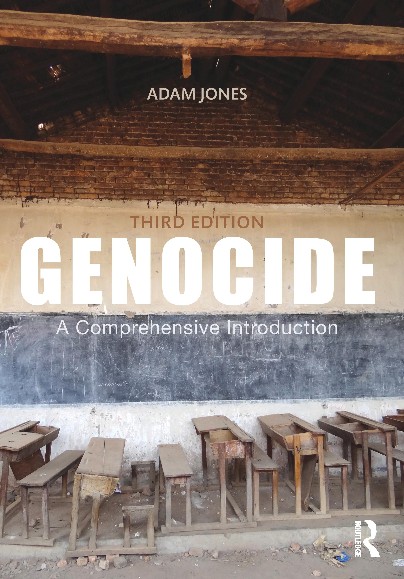
NOW AVAILABLE: Crimes Against Humanity: A Beginner's Guide, by Adam Jones (OneWorld, 2008; 168 pp., US $14.95 pbk). See www.crimesagainsthumanity.ca. "A remarkable book that is immediately accessible for the novice in the field, or students, and yet also engages with its topic in intellectually interesting ways for the more seasoned reader." (James Gow, Professor of International Peace and Security, King's College London.)
Friday, April 03, 2009
NOW AVAILABLE: Crimes Against Humanity: A Beginner's Guide, by Adam Jones (OneWorld, 2008; 168 pp., US $14.95 pbk). See www.crimesagainsthumanity.ca. "A remarkable book that is immediately accessible for the novice in the field, or students, and yet also engages with its topic in intellectually interesting ways for the more seasoned reader." (James Gow, Professor of International Peace and Security, King's College London.)


Genocide Studies Media File
March 16 - April 3, 2009
A compendium of news stories, features, and human rights reports pertaining to genocide and crimes against humanity. Compiled by Adam Jones. Please send links and feedback to adamj_jones@hotmail.com.
Consider inviting colleagues and friends to subscribe to Genocide_Studies and the G_S Media File. All it takes is an email to genocide_studies-subscribe@topica.com.
AFGHANISTAN/VIOLENCE AGAINST WOMEN
"Afghan Leader Accused of Bid to 'Legalise Rape'"
By Jerome Starkey
The Independent, 31 March 2009
"Afghanistan's President, Hamid Karzai, has signed a law which 'legalises' rape, women's groups and the United Nations warn. Critics claim the president helped rush the bill through parliament in a bid to appease Islamic fundamentalists ahead of elections in August. In a massive blow for women's rights, the new Shia Family Law negates the need for sexual consent between married couples, tacitly approves child marriage and restricts a woman's right to leave the home, according to UN papers seen by The Independent. 'It is one of the worst bills passed by the parliament this century,' fumed Shinkai Karokhail, a woman MP who campaigned against the legislation. 'It is totally against women's rights. This law makes women more vulnerable.' The law regulates personal matters like marriage, divorce, inheritance and sexual relations among Afghanistan's minority Shia community. 'It's about votes,' Ms. Karokhail added. 'Karzai is in a hurry to appease the Shia because the elections are on the way.' The provisions are reminiscent of the hardline Taliban regime, which banned women from leaving their homes without a male relative. But in a sign of Afghanistan's faltering steps towards gender equality, politicians who opposed it have been threatened. 'There are moderate views among the Shia, but unfortunately our MPs, the people who draft the laws, rely on extremists,' Ms. Karokhail said. The bill lay dormant for more than a year, but in February it was rushed through parliament as President Karzai sought allies in a constitutional row over the upcoming election. Senator Humeira Namati claimed it wasn't even read out in the Upper House, let alone debated, before it was passed to the Supreme Court. 'They accused me of being an unbeliever,' she said. Details of the law emerged after Mr Karzai was endorsed by Afghanistan's Supreme Court to stay in power until elections scheduled in August. Some MPs claimed President Karzai was under pressure from Iran, which maintains a close relationship with Afghanistan's Shias. The most controversial parts of the law deal explicitly with sexual relations. Article 132 requires women to obey their husband's sexual demands and stipulates that a man can expect to have sex with his wife at least 'once every four nights' when travelling, unless they are ill. The law also gives men preferential inheritance rights, easier access to divorce, and priority in court. [...]"
BRAZIL/JEWISH HOLOCAUST
"Brazilian Archbishop in Hot Seat after Claiming More Catholics Than Jews Died in Holocaust"
By Bradley Brooks
Associated Press dispatch in The Los Angeles Times, 2 April 2009
"A Roman Catholic archbishop whose statements about the Holocaust have come under fire met with Jewish leaders this week to clarify his claim that Jewish domination of the media has obscured the toll of non-Jews killed by the Nazis. Jewish groups including the Anti-Defamation League condemned the comments by Archbishop Dadeus Grings, who was quoted by Brazil's Press magazine last week as saying: 'More Catholics than Jews died in the Holocaust, but this isn't known because the Jews control the world's media.' Grings, who leads one of Brazil's largest dioceses and is the chancellor of the Catholic University of Rio Grande do Sul, has been criticized before for his views on the matter. In 2003 he argued that only 1 million Jews died in the Holocaust, although he backed away from that in an interview with The Associated Press this week, saying it 'is evident that 6 million Jews were killed.' However, he repeated the suggestion that Jewish media power was distorting the picture. The ADL issued a statement Wednesday saying: 'The incident involving Archbishop Grings, who has a history of Holocaust denial, marks the third time in as many months where a Catholic clergyman has publicly denied or diminished the Holocaust.' Last month, a British bishop was removed from leading a seminary in Argentina after claiming that only 200,000 to 300,000 Jews were killed in the Holocaust. That bishop, Richard Williamson, has not recanted. In January, Italian priest The Rev. Floriano Abrahamowicz was quoted in an Italian newspaper as saying 'I know the gas chambers existed at least for disinfecting but not whether they caused deaths or not.' Henry Chmelnitsky, vice president of the Jewish Federation of Rio Grande do Sul, said that in claiming more Catholics than Jews were killed, Grings was including Catholics who died on the battlefields of World War II, whereas 'The Jews, the Gypsies, the communists, and the handicapped were persecuted for being who they were.' [...]"
CAMBODIA/GENOCIDE TRIBUNALS
"Khmer Rouge Jail Boss Begs for Forgiveness"
By Andrew Buncombe
The Independent, 1 April 2009
"The man who was in charge of a notorious prison operated by the Khmer Rouge in which thousands were tortured and dispatched for execution has offered his 'heartfelt sorrow' for his actions 30 years ago. Appearing in front a genocide tribunal in Cambodia, Kaing Guek Eav, also known as Comrade Duch, said he did not expect the families of those who died to forgive him now but he hoped that at some point they would. 'My current plea is that I would like you to please leave an open window for me to seek forgiveness,' he said. He would give his full co-operation to the UN-sponsored tribunal, he said, adding: 'This is only the remedy that can help me to relieve all the sorrow and crimes I have committed.' Up to 1.8 million people died or were murdered by the Maoist Khmer Rouge regime, which ruled from 1975 to 1979. Duch, 66, was the head of the Tuol Sleng prison in the capital, Phnom Penh. Also known as S-21, the converted school was used to interrogate and torture so-called 'internal enemies,' namely regime members suspected or accused of dissent. Of the 14,000 prisoners sent to the jail, only a dozen survived. Just a handful are still alive today. Duch is one of five senior Khmer Rouge leaders being tried for genocide. While his statements amounted to a confession of guilt, defendants are not required to enter pleas. A panel of judges will deliver a verdict. After the prosecution's opening arguments, which described Duch as a key cog in the Khmer Rouge killing machine, the defendant asked permission to make a personal statement. He began by reading from a document but then put down his papers, removed his spectacles and stared at the 500 or so people gathered in the court room. He claimed that he had tried to avoid being made commander of S-21, but once assigned he feared for his own life and his family's safety if he did not carry out the job. He then apologised to his victims' families but said he was not asking to be pardoned for such 'serious crimes that cannot be tolerated.' The tribunal has made clear that it will not be a defence for those in the dock to claim that they were simply following orders. [...]"
"Court Hears Khmer Rouge Testimony"
The Irish Times, 30 March 2009
"An alleged Khmer Rouge torturer faced trial for crimes against humanity today, the first involving a senior Pol Pot cadre 30 years after the end of a regime blamed for 1.7 million deaths. After years of delays and procedural wrangling, prosecutors for the joint UN-Cambodian tribunal will lay out their case against Duch, the former chief of the S-21 prison, where 14,000 'enemies' of the 1975-79 revolution were tortured and killed. 'I never thought that this day would come,' said 64-year-old Svay Simon, one of hundreds of Khmer Rouge victims gathered at the specially built court on the outskirts of Phnom Penh. Duch's trial, which formally began with procedural hearings last month, marks a turning-point for the strife-torn country, where nearly every family lost someone during the Khmer Rouge era, one of the darkest chapters of the 20th century. 'The Cambodian people will finally see one of the most notorious Khmer Rouge leaders face trial. But many more need to face the court to really deliver justice to the millions of victims of these horrific crimes,' said Brittis Edman, a Cambodia researcher for rights group Amnesty International. Duch, whose real name is Kaing Guek Eav, faces charges of crimes against humanity, war crimes, torture and homicide. The silver-haired former school teacher is the first of five ageing senior cadres charged for their role in Pol Pot's 'Year Zero' revolution to achieve an agrarian utopia. He is expected to be a key witness in the future trials of 'Brother Number Two' Nuon Chea, the regime's ex-president Khieu Samphan and Ieng Sary, its foreign minister, and his wife. The four others have denied knowledge of any atrocities by the Khmer Rouge during its rule, which began by driving everyone out of the cities with whatever they could carry. There is no death penalty in Cambodia and the five could get life sentences if convicted by the panel of five Cambodian and international judges. Advocates hope the tribunal -- formally known as the Extraordinary Chambers in the Courts of Cambodia (ECCC) - will serve as a model of professionalism for the country's erratic and politicized judiciary. Critics say the tribunal's integrity is threatened by allegations of corruption and political interference, particularly on the issue of pursuing other Khmer Rouge suspects. Pol Pot's death in 1998 was followed by a formal Khmer Rouge surrender which helped to usher in a decade of peace and stability, threatened now by the global economic downturn."
[n.b. This is the complete text of the dispatch.]
"Cambodia Genocide Court Must Up Caseload: Amnesty"
Agence France-Presse dispatch on Yahoo! News, 28 March 2008
"Amnesty International on Saturday welcomed the opening of Cambodia's first genocide trial, but said the court must increase its caseload and address allegations of corruption. Amnesty said the court should 'urgently expand its prosecution strategy' following the start of the long-awaited trial of Khmer Rouge prison chief Kaing Guek Eav, better known by the alias Duch. His trial began last month. One of five former Khmer Rouge leaders scheduled to be tried by the court, Duch is due to finally take the stand on Monday. 'Many more need to face the court to really deliver justice to the millions of victims of these horrific crimes,' said researcher Brittis Edman, adding that many suspects were now elderly and could die before facing justice. The Cambodian government has been accused of trying to scupper further trials amid fears that it could target former Khmer Rouge members currently in top posts in Prime Minister Hun Sen's administration. The Cambodian side of the international court has also been hit by claims of political interference and a scandal in which local staff were allegedly forced to pay kickbacks for their jobs. The London-based group said the claims must be quickly addressed. 'Any corruption allegations must be investigated promptly and thoroughly,' Edman said. Up to two million people died of starvation and overwork, or were executed, as the 1975-1979 regime emptied Cambodia's cities in its drive to create a communist utopia."
CANADA/JEWISH HOLOCAUST
"Teaching the Holocaust, One Clip at a Time"
By Katherine Dedyna
National Post, 18 March 2009
"When Victoria resident Peter Schroeder notices a paper clip on the sidewalk, he feels obliged to pick it up. It's not a meaningless bit of metal but a profound symbol of a human life snuffed out by the Nazis. So he places the paper clip in a box and takes it to tiny Whitwell, Tenn. -- home of the Children's Holocaust Memorial. Filled with millions of paper clips mailed from all over the world, it's the only children's memorial to the genocide. And Peter and his wife, Dagmar, helped make it happen. They also co-authored the bestselling children's book Six Million Paper Clips -- in reference to the number of Jews systematically killed in the Second World War. At one point, the Schroeders drove thousands of kilometres across Germany to find and purchase the only remaining railcar used to transport Nazi victims to death camps. That car now holds 11 million paper clips sent to the children of Whitwell to represent both Jewish and non-Jewish people murdered at Hitler's behest. The Schroeders have given countless speeches on the subject, including two at the Simon Wiesenthal Center for human rights in Los Angeles. And they'll lead young Victorians in a question and answer period on March 29 after a screening of the award-winning documentary Paper Clips -- based on their book -- at the Victoria Conference Centre. Their message: To speak out against bullying and intolerance whenever youth see the signs, and to celebrate how young people in an isolated town created an international beacon of tolerance. 'Everybody should do their little part,' says Dagmar, a psychologist. Don't worry about feeling silly. 'Words are very, very important. They can hurt more than slapping someone in the face.' 'This is not Holocaust education,' stresses Susan Kendal, president of the Victoria branch of Hadassah WIZO, the event's sponsor. 'You come out feeling really good.' [...]"
[n.b. Thanks to Jo Jones for bringing this story to my attention.]
COLOMBIA
"Colombia Orders Return of Stolen Farmland"
By Juan Forero
The Washington Post, 23 March 2009
"As with so many crimes of war, what happened here in the dense, humid jungles of northwestern Colombia more than a decade ago might easily have been forgotten. Illegal militias forced hundreds of poor black farmers off their land, which politically connected businessmen then seized and turned into lucrative palm oil plantations. The displaced farmers, well aware that the hundreds of thousands of people uprooted by Colombia's long civil conflict rarely returned home, thought they would never see their land again. But in this case, the government recently ordered nine palm oil companies to return thousands of acres to the farmers, and the attorney general's office is investigating the firms' operators on accusations of homicide, land theft and forced displacement. The government, however, is motivated as much by self-interest as altruism, say human rights groups, which also charge that state negligence coupled with aid for the palm oil companies helped facilitate the land seizures. President Álvaro Uribe's administration urgently wants a free-trade agreement with the United States, and Democrats on Capitol Hill have made clear that the pact is contingent on human rights advances in Colombia, particularly for blacks and other marginalized groups. ... The plight of Afro-Colombians has been of particular concern to the 42-member Congressional Black Caucus, several of whose members, including Payne, have met with Uribe to raise their concerns. Some have also traveled to Choco, under heavy military guard, visiting areas mired in poverty and violence. Few in this country have suffered as much as Afro-Colombians, who make up more than 20 percent of Colombia's 45 million people, the largest black community in Spanish-speaking America. Black Colombians, the descendants of African slaves, have endured mass killings, forced displacements and fighting on ancestral lands -- the hard reality of a simmering but brutal conflict involving deaths squads, Marxist rebels and drug traffickers. The Afro-Colombian population here in Choco, where the majority of people are black, suffers from an infant mortality rate twice the national average and a poverty rate topping 75 percent. [...]"
EAST TIMOR
"Blood on Their Hands"
By Lindsay Murdoch
The Sydney Morning Herald, 4 April 2009
"A decade after a massacre intended to blunt East Timor's demands for independence, Lindsay Murdoch finds that the appetite for justice continues unabated. We confronted the mass murderer as his men hosed blood from his balcony; Leoneto Martins angrily denied the massacre in the East Timorese town where he was Indonesia's appointed mayor. Before suggesting it was unsafe for myself and three other journalists to remain in Liquica, a seaside town of 55,000 people 30 kilometres west of the capital Dili, Martins dismissed our questions by claiming clashes between rival groups had resulted in five deaths. We suspected he was lying. Shops and markets were closed and the usually busy streets were largely deserted, except for menacing groups of men wearing bandanas and ribbons in the red and white of Indonesia's flag. Wide-eyed terror in the faces of women searching for family members confirmed the presence of something terrible. But on that stifling April 6 early morning 10 years ago the extent and brutality of what the world would come to know as the Liquica Massacre -- the slaughter of between 30 and 100, probably 86, innocent East Timorese in the quaint Sao Joao de Brito church -- was not immediately evident. Liquica was the first of many attacks across East Timor that left about 1500 people dead and thousands more raped, maimed or wounded. While Catholics across Australia will be asked this weekend to observe a minute's silence, Eurico Guterres, an organiser of the Liquica massacre, will spend the anniversary campaigning in Indonesian West Timor for election to the national parliament. And former general Wiranto, the Indonesian in charge of the military-inspired reign of terror across East Timor that year, will be campaigning to become the nation's next president. In East Timor events have not so neatly moved on. 'When I speak with the victims, the one thing they ask me is "when will there be justice?",' says Christina Carrascalao, a local who has begun her own crusade to improve the lives of survivors, many of them poor and illiterate farmers. 'I tell them I can't answer that.' [...]"
ERITREA
"Former Torture Victim Urges EU to Withhold €122m Eritrean Aid"
By Luc Verling
The Irish Times, 3 April 2009
"A former Eritrean torture victim Helen Berhane last night added her voice to mounting international pressure on the EU to withhold a proposed €122 million development aid package to Eritrea, one of the world's 10 poorest countries. Providing a rare insider's account of conditions within Eritrea, where the government exercises total control of the media, Ms Berhane questioned the wisdom of the EU's diplomatic approach to Eritrea, granting aid with few or no conditions attached, and without accountability or monitoring structures in place. The Eritrean diaspora's newspapers, other governments and international non-government organisations are likewise expressing concern about the EU aid, and protesting at Eritrean president Isaias Afwerki’s behaviour towards both the international community and his own people. Last week Mr. Afwerki defied international opinion by welcoming the Sudanese president Omar Al Bashir to his Horn of Africa state, just three weeks after an international arrest warrant was issued on Mr. Al Bashir by the International Criminal Court in The Hague for crimes against humanity. Mr Al Bashir's one-day visit to Eritrea came on the day that the EU's European Development Fund (EDF) committee were to discuss the Eritrean aid package. That discussion was postponed, the EDF said in a statement, for 'technical reasons.' Given Mr. Afwerki's defiance of the international community, Eritrea's poor human rights record, and the policy of self-sufficiency pursued by the Eritrean government -- which has seen a marked deterioration in living conditions in the country and resulted in thousands of Eritreans pouring across its borders in search of food and shelter -- the aid has come under wide criticism with claims that the aid is not getting to the people, and is sending the wrong signals to the Afwerki administration. Eritrea has been ranked by Reporters Without Borders, the international human rights media watchdog, as the worst nation in the world, ahead of North Korea, for press freedom. While stopping short of branding Eritrea a rogue nation, the US has shown signs of deep concern about the country’s role in proxy wars in neighbouring countries. The US ambassador to the UN just this week lodged a formal complaint protesting at the proposal to offer aid. [...]"
IRAQ
"It's Fear That Keeps Baghdad's Peace"
By Hamza Hendawi
Associated Press dispatch on Yahoo! News, 25 March 2009
"The streets are calmer now. The fighting between Shiites and Sunnis has largely ceased. But this is not a sign of normalcy in the Iraqi capital. It's fear that keeps the peace. Only an estimated 16 percent of the mainly Sunni families forced by Shiite militiamen and death squads to flee their homes have dared to return. It takes two sides to have a fight, and there's really only one side left in Baghdad after violence and fear turned parts of neighborhoods into ghost towns. Families that have gone back are sometimes met with spray-painted threats and other forms of intimidation. 'Back after a break, the Mahdi Army,' is a Shiite militia's slogan -- playing off the same words that Iraqi television uses as a lead-in to commercials. The findings -- based on statistics obtained by The Associated Press from U.S. and Iraqi officials as well as AP interviews in key Baghdad neighborhoods in recent weeks -- are acknowledged by U.S. military commanders on the ground. And they point to a troubling prospect. Baghdad has been much calmer since the massacres reached their peak in late 2006 and the first half of 2007. And a U.S. military spokesman said Wednesday that attacks nationwide had fallen to their lowest level since the first months of the war. In the capital, however, the calm has been achieved in part because the city is now ethnically divided. Shiites predominate. Sunnis have largely fled. The situation is somewhat similar to Bosnia after the war of the 1990s -- years of calm but no lasting political reconciliation after its populations divided into different regions and governments. 'Baghdad has been turned from a mixed city, about half of its population Shiite and the other half Sunni in 2003, into a Shiite city where the Sunni population may be as little as 10 to 15 percent,' said Juan Cole, a prominent U.S. expert on Iraq. No accurate census has been taken since the bloodletting. But Cole's estimates, backed up by AP observations and U.S. statistics, hold troubling implications for the future should Sunnis come back in greater numbers. A Sunni government employee, Mohammed Abdul-Razzaq, fled his home in the Jihad neighborhood of west Baghdad for majority Sunni Amiriyah after Shiite militiamen threatened to kill him. Iraqi police last year forced out the squatters who had moved into his house, but he has no plans to return. 'Security is still fragile,' Abdul-Razzaq said. 'I was forced to flee once, and it can happen again. Next time they may kill me.' Most startlingly, the ethnic divides remain even though the Iraqi and U.S. militaries have driven Shiite militiamen and death squads off the streets. That suggests Sunnis still do not trust Iraq's government to protect them in the long run. Their mistrust could hold the seeds of future bouts of violence, especially as the U.S. military begins to draw down this year. [...]"
ISRAEL/PALESTINE
"South African to Head U.N. Rights Inquiry In Gaza"
Reuters dispatch in The New York Times, 3 April 2009
"South African judge Richard Goldstone will lead a United Nations investigation into alleged war crimes committed by Israeli forces and Palestinian militants in Gaza, the U.N. Human Rights Council said Friday. The four-member team, which also involves experts from Pakistan, Britain, and Ireland, hopes to start its fact-finding work in the region within weeks, according to a U.N. statement. Goldstone, a former war crimes prosecutor, said he would review conduct by both sides in Israel's 22-day offensive in the Hamas-ruled Gaza Strip. ... The team's mandate stems from a resolution adopted by the Human Rights Council at a special session on January 12. The 47 member-state forum, dominated by Muslim countries and their allies, condemned Israel for 'grave violations' of human rights during its offensive and called for an international mission to probe wrongdoings. U.N. High Commissioner for Human Rights Navi Pillay and independent U.N. rights envoy Richard Falk have also called for an investigation into whether Israeli forces committed war crimes in the coastal strip where 1.5 million people live. Pillay, a former judge at the International Criminal Court, has raised specific concerns about the Israeli shelling of a home that killed 30 Palestinian civilians, and a lack of care for young, starving children whose mothers died in the attack. Falk, in a report to the Council last month, said launching attacks without the ability to distinguish between military targets and surrounding civilians 'would seem to constitute a war crime of the greatest magnitude under international law.' As Gaza's borders were sealed, civilians could not escape harm, which may constitute a crime against humanity, according to the American law professor. He suggested the U.N. Security Council might set up an ad hoc criminal tribunal on the matter. Israel's military has been rocked by soldier accounts about the killing of civilians in Gaza, and allegations that deep contempt for Palestinians pervaded its ranks. Military investigators said Monday that Israeli soldiers were passing on unsubstantiated rumours when they said Israeli troops shot unarmed Palestinian women and children. [...]"
"U.N. Reports Say Israel Targeted Civilians in Gaza"
By Robert Evans
Reuters dispatch, 23 March 2009
"United Nations investigators said on Monday Israel violated a range of human rights during its invasion of Gaza, including targeting civilians and using a child as a human shield. The accusations came in reports to the U.N. Human Rights Council which also called for an urgent end to Israeli restrictions on humanitarian supplies to Gaza and a full international investigation into the conflict. 'Civilian targets, particularly homes and their occupants, appear to have taken the brunt of the attacks, but schools and medical facilities have also been hit,' said one report by Radhika Coomaraswamy, the U.N. Secretary-General's Special Representative for Children and Armed Conflict. The Sri Lankan human rights lawyer visited the region in early February. She cited a long series of incidents to back her charges. In one, she said, Israeli soldiers shot a father after ordering him out of his house and then opened fire into the room where the rest of the family was sheltering, wounding the mother and three brothers and killing a fourth. In another, on January 15, at Tal al Hawa south-west of Gaza City, Israeli soldiers forced an 11-year-old boy to walk in front of them for several hours as they moved through the town, even after they had been shot at. An Israeli commander in the 22-day Gaza invasion said on Monday Israel's efforts to protect troops from Palestinian fire may have contributed to unwarranted killing of civilians. 'If you want to know whether I think that in doing so we killed innocents, the answer is, unequivocally, yes,' Tzvika Fogel, a reserve brigadier-general, told Reuters. Fogel added that such incidents were exceptional. Coomaraswamy's comments formed part of a much longer report from nine U.N. investigators including specialists on the right to health, to food, to adequate housing and education and on summary executions and violence against women. All cited violations by Israel -- and in some cases by the Hamas Islamic movement that controls Gaza -- during the invasion from December 27 until January 17 which Israeli leaders say was launched to stop rocket attacks by Hamas from the territory. Palestinian officials say 1,434 people in Gaza -- 960 of them civilians -- were killed in the fighting, a figure Israel contests. The report from the nine gave the total as 1,440, saying of these 431 were children and 114 women. The overall report was criticized in the 47-nation Council by Israel's ambassador Aharon Leshno Yar, who said it 'wilfully ignores and downplays the terrorist and other threats we face,' and the use by Hamas of human shields. [...]"
"A Religious War in Israel's Army"
By Ethan Bronner
The New York Times, 21 March 2009
"The publication late last week of eyewitness accounts by Israeli soldiers alleging acute mistreatment of Palestinian civilians in the recent Gaza fighting highlights a debate here about the rules of war. But it also exposes something else: the clash between secular liberals and religious nationalists for control over the army and society. A soldier, identified by the pseudonym Ram, is quoted as saying that in Gaza, 'the rabbinate brought in a lot of booklets and articles and their message was very clear: We are the Jewish people, we came to this land by a miracle, God brought us back to this land and now we need to fight to expel the non-Jews who are interfering with our conquest of this holy land. This was the main message, and the whole sense many soldiers had in this operation was of a religious war.' Dany Zamir, the director of the one-year premilitary course who solicited the testimonies and then leaked them, leading to a promise by the military to investigate, is quoted in the transcripts as expressing anguish over the growing religious nationalist elements of the military. 'If clerics are anointing us with oil and sticking holy books in our hands, and if the soldiers in these units aren't representative of the whole spectrum of the Jewish people, but rather of certain segments of the population, what can we expect?' he said. 'To whom do we complain?' ... In many cases, the religious nationalists have ascended to command positions from precisely the kind of premilitary college course that Mr. Zamir runs -- but theirs are run by the religious movements rather than his secular one, meaning that the competition between him and them is both ideological and careerist. 'The officer corps of the elite Golani Brigade is now heavily populated by religious right-wing graduates of the preparatory academies,' noted Moshe Halbertal, a Jewish philosophy professor who co-wrote the military code of ethics and who is himself religiously observant but politically liberal. 'The religious right is trying to have an impact on Israeli society through the army.' For Mr. Halbertal, like for the vast majority of Israelis, the army is an especially sensitive institution because it has always functioned as a social cauldron, throwing together people from all walks of life and scores of ethnic and national backgrounds, and helping form them into a cohesive society with social networks that carry on throughout their lives. Those who oppose the religious right have been especially concerned about the influence of the military's chief rabbi, Brig. Gen. Avichai Rontzki, who is himself a West Bank settler and who was very active during the war, spending most of it in the company of the troops in the field. He took a quotation from a classical Hebrew text and turned it into a slogan during the war: 'He who is merciful to the cruel will end up being cruel to the merciful.' A controversy then arose when a booklet handed out to soldiers was found to contain a rabbinical edict against showing the enemy mercy. The Defense Ministry reprimanded the rabbi. [...]"
"Israel's Dirty Secrets in Gaza"
By Donald Macintyre
The Independent, 20 March 2009
"Israel was last night confronting a major challenge over the conduct of its 22-day military offensive in Gaza after testimonies by its own soldiers revealed that troops were allowed and, in some cases, even ordered to shoot unarmed Palestinian civilians. The testimonies -- the first of their kind to emerge from inside the military -- are at marked variance with official claims that the military made strenuous efforts to avoid civilian casualties and tend to corroborate Palestinian accusations that troops used indiscriminate and disproportionate firepower in civilian areas during the operation. In one of the testimonies shedding harsh new light on what the soldiers say were the permissive rules of engagement for Operation Cast Lead, one soldier describes how an officer ordered the shooting of an elderly woman 100 metres from a house commandeered by troops. ... A squad leader said: 'At the beginning the directive was to enter a house with an armoured vehicle, to break the door down, to start shooting inside and -- I call it murder -- to shoot at everyone we identify. In the beginning I asked myself how could this make sense? Higher-ups said it is permissible because everyone left in the city [Gaza City] is culpable because they didn't run away.' The accounts, which also describe apparently indiscriminate destruction of property, were given at a post-operation discussion by graduates of the Yitzhak Rabin pre-military course at the Oranim Academic College in northern Israel. The transcript of the session in front of the head of the course -- details from which were published by the newspaper Haaretz -- prompted the Israel Defence Forces (IDF) military advocate general Avichai Mendelblit yesterday to announce a military police investigation into the claims. Haaretz said the airing of the 'dirty secrets' would make it more difficult for Israelis to dismiss the claims as Palestinian propaganda. The course principal, Danny Zamir, told the newspaper that after being 'shocked' by the testimonies on 13 February he told the IDF chief of staff Gabi Ashkenazi he 'feared a serious moral failure' in the IDF. [...]"
"Dupes? No, We Were Telling the Truth"
By Johann Hari
The Independent, 20 March 2009
"For months, the opponents of Operation Cast Lead -- the assault on Gaza that killed 1,434 Palestinians -- have been told we are 'dupes for Islamic fundamentalists,' or even anti-Semitic. The defenders of Israel's war claimed you could only believe the reports that Israeli troops were deliberately firing on civilians, scrawling 'death to Arabs' on the walls, and trashing olive groves, or using the chemical weapon white phosphorus that burns to the bone, if you were infected with the old European virus of Jew-hatred. Now the very people who fought that war have confirmed we were simply describing reality. One Israeli Defence Force squad leader says of the orders he was given to target civilians: 'I call it murder.' As he put it: 'In the end the directive was to go into a house, switch on loudspeakers and tell them "you have five minutes to run away and whoever doesn't will be killed".' In a crowded civilian city, there are all sorts of people who cannot run away: the elderly, the disabled, the pregnant, the terrified. This soldier was told to kill them. He is not alone. Anybody who has reported from the Occupied Territories has witnessed a culture of racist contempt for ordinary Palestinian civilians. They are treated as suspects simply for walking around their own home towns, or trying to sell their own produce. This is not a few bad apples: it is endemic to the nature of occupation, blockade and repeated assault. Yet there is a swelling movement of young Israelis who are speaking out -- and refusing to kill on occupied land. It's a strikingly brave move in a country that is drifting to the right. Ehud Olmert, Israel's out-going Prime Minister, has publicly bragged that Israel's response to attack 'will naturally be disproportionate,' just as he boasted about the 2007 war in Lebanon: 'Half of Lebanon was destroyed -- is that a loss?' None of this had to happen. On the eve of the attack, Ephraim Halevy, the former head of Mossad, said that the way to stop rocket attacks on Israel was to draw Hamas, the elected Palestinian government, into negotiation and compromise -- but 'Israel, for reasons of its own, did not want to turn the ceasefire into the start of a diplomatic process with Hamas.' Instead, Israel launched an attack on civilians of which her own soldiers are ashamed. It can only increase hatred -- and make the fair division of the land between Palestinians and Israelis recede even further on to the horizon."
[n.b. This is the complete text of the dispatch.]
"After Gaza, Israel Grapples With Crisis of Isolation"
By Ethan Bronner
The New York Times, 18 March 2009
"Israel, whose founding idea was branded as racism by the United Nations General Assembly in 1975 and which faced an Arab boycott for decades, is no stranger to isolation. But in the weeks since its Gaza war, and as it prepares to inaugurate a hawkish right-wing government, it is facing its worst diplomatic crisis in two decades. Examples abound. Its sports teams have met hostility and violent protests in Sweden, Spain and Turkey. Mauritania has closed Israel's embassy. Relations with Turkey, an important Muslim ally, have suffered severely. A group of top international judges and human rights investigators recently called for an inquiry into Israel's actions in Gaza. 'Israel Apartheid Week' drew participants in 54 cities around the world this month, twice the number of last year, according to its organizers. And even in the American Jewish community, albeit in its liberal wing, there is a chill. The issue has not gone unnoticed here, but it has generated two distinct and somewhat contradictory reactions. On one hand, there is real concern. Global opinion surveys are being closely examined and the Foreign Ministry has been granted an extra $2 million to improve Israel's image through cultural and information diplomacy. 'We will send well-known novelists and writers overseas, theater companies, exhibits,' said Arye Mekel, the ministry's deputy director general for cultural affairs. 'This way you show Israel's prettier face, so we are not thought of purely in the context of war.' But there is also a growing sense that outsiders do not understand Israel's predicament, so criticism is dismissed. ... Moreover, Mr. Netanyahu is expected to appoint Avigdor Lieberman, leader of the ultranationalist Yisrael Beiteinu party, as his foreign minister. This alone has Israelis and their allies in Europe and the United States worried because of Mr. Lieberman's views of Israeli Arabs that some have called racist. Mr. Lieberman had campaigned on the need for a loyalty oath in Israel so that those who did not support a Jewish democratic state would lose their citizenship. One-fifth of Israeli citizens are Arabs, and many do not support defining the state as Jewish. ... The gap between Israelis and many liberal American Jews could be seen Tuesday in a blog by Bradley Burston, who writes on the Web site of the left-leaning newspaper Haaretz. He said that while visiting Los Angeles he faced many questions that amounted to 'What is wrong with these people, your friends, the Israelis?' He quoted an article by Anne Roiphe, an American Jewish liberal, which said that witnessing the popularity of Mr. Lieberman in Israel made her feel 'as if my spouse had cheated on me with Mussolini.' [...]"
KOSOVO/CANADA
"Kosovo War Massacre: Sole Survivor Found by Telegraph Ten Years On"
By Neil Tweedie
The Telegraph, 2 April 2009
"Vancouver is almost 6,000 miles from Kosovo but Dren Caka visits his homeland most nights. He goes back in his dreams, to his home in Milosa Gilica Street in the town of Gjakova where he lived with his extended family, and to the neighbouring pool hall owned by Luli Vejsa, a family friend. Finally, in his darkest moments, he makes the journey to Luli’s house, back to the night of April 1 1999, when the Serbs came. A decade on from the Kosovo War, that last great exercise in 20th-century European blood-letting, Dren Caka, 20, is a casualty still. 'I have nightmares a lot,' he says, looking out over Vancouver's glistening waterfront. 'I can't sleep at night and feel constantly tired; I usually have bags under my eyes.' He speaks with a Canadian accent now, and looks and behaves like a typical young Canadian, but his history separates him from friends who have known nothing but peace and affluence by the Pacific Ocean. 'If you were to look at me walking along you would think "he's just a normal a [sic] kid,' but I'm not just a normal kid. When I tell them, when I tell my friends, they are speechless.' Dren Caka is the sole survivor -- the miraculous survivor -- of one of the most notorious episodes of the war: the massacre of 19 women and children, including his mother and three sisters, by Serb police. Kosovo has already faded from the popular memory, overtaken by the seismic events of September 11 2001 and their aftermath. Slobodan Milosevic is dead and many of the henchmen responsible for the ethnic cleansing of the former Serbian province have stood trial before the International Criminal Tribunal for the former Yugoslavia in The Hague, but the war continues to cast a shadow over people like Dren. He was 10 years old in March 1999 when the Serbs began their campaign of deportation and murder against the predominantly ethnic Albanian population of Kosovo. On the night of April 1, a week after Nato began bombing Serb forces, the paramilitary police arrived in Milosa Galica Street. Gjakova -- Djakovica to the Serbs -- was a particular target, standing as it does in the shadow of the Accursed Mountains, which separate Kosovo from Albania. Members of the Kosovo Liberation Army (KLA), fighting for independence from Serbia, were using mountain tracks to import weapons from Albania and the Serbs wanted to choke off the insurgents' supply routes. That meant clearing Gjakova of its majority Albanian population and fortifying the area. To escape Nato bombs and Serb reprisals, women and children living in Milosa Galica Street slept in the basement of Luli Vejsa's pool hall. The men, including Dren's father, Ali, hid elsewhere -- it was thought only males of military age were at risk. [...]"
PALESTINE/JEWISH HOLOCAUST
"Palestinian Discord over Holocaust Concert"
By Martin Fletcher
MSNBC.com, 30 March 2009
"Wafaa Younis is a woman whose heart is in the right place; she is an Israeli Arab who has made a real effort to help Palestinian children in the Jenin refugee camp in the northern West Bank. She started with the boys; she wanted them to put down their stones and learn the violin, in the hope that they would not grow up and pick up a gun. I first met her three years ago when she finally persuaded the Israelis to allow the Palestinian children to leave the West Bank and go to her home in the Israeli town of Ara for violin lessons. She even took them on trips to the coast; even though they grew up 30 miles from the Mediterranean, they had never seen the sea. Her first attempts to teach a few boys the violin grew into a small orchestra of boys and girls. She even rented an apartment in Jenin so that she could teach them there, because it was easier for her to cross into the West Bank than it was for them to leave. Then Younis had an idea; as part of Israel's annual Good Deeds Week, she would arrange a little concert in Holon, near Tel Aviv. Her young musicians from the 'Strings of Freedom' orchestra would entertain Holocaust survivors. They would play their favorite classics, and also some songs of peace; a way to bridge the divide between Palestinians and Israelis. At the concert last Wednesday, the group of 13 young musicians from Jenin played for about 30 Holocaust survivors and they even dedicated one song to Gilad Shalit, the Israeli soldier who has been held prisoner by Hamas in Gaza for three years. Younis is not the first person to make such an effort – there are literally hundreds of peace groups that have the same aim -- bringing together Arabs and Jews with similar interests and hopes. But playing for the Holocaust survivors turned out to be bridge too far. Adnan Hindi, a Palestinian political leader in Jenin, was outraged by the concert. He called the Holocaust a political issue and said that the Palestinian children had been tricked. He complained that Younis had not told the children they would be playing before such a politically sensitive audience. She answered that she tried to explain to them, but that they made too much noise on the bus and didn't hear her. Other Palestinians said that was a bit late to tell them. Younis said she didn't realize anybody could possibly object to playing a concert for those 'poor old people' -- and anyway, most of the Palestinian children had never heard of the Holocaust. The Holocaust is a particularly sensitive subject for Palestinians. There is widespread ignorance of the details of the atrocities committed by the Nazis against Jews during World War II and there is a sense among many Palestinians that why should they care about Jewish suffering more than 60 years ago when Israelis don’t seem to care about the suffering they are causing Palestinians today. [...]"
PERU
"In Peru, Former Leader's Lengthy Human Rights Trial Nears End"
By Joshua Partlow
The Washington Post, 24 March 2009
"It started with a former president red-faced and bellowing his innocence, and it is ending amid worry over whether his health may be enough to derail the whole show. After more than 15 months and more than 70 witnesses, the often tedious, sometimes riveting and always live-televised judicial proceeding that is known here as the 'mega-trial' has entered its final stages. Attorneys for former president Alberto Fujimori, accused of human rights violations involving state-sponsored killings and kidnappings, plan to present concluding arguments this week. Then comes Fujimori's closing statement. If Fujimori is convicted, his sentencing -- he could face up to 30 years in prison -- is expected by mid-April. The trial, taking place in a special forces police base on the outskirts of this seaside capital, has been delayed in recent days because of concerns over Fujimori's health. His attorney said he suffers from hypertension while others describe it variously as a throat infection, diarrhea or simply a stalling tactic. If the proceedings are delayed for more than 12 days, a mistrial can result, prosecutor José Antonio Peláez said, and the proceedings could start over again. But for the most part, lawyers involved in the case and observers say the process is notable for its fairness, thoroughness and transparency, especially for such a politically volatile case. 'This is a major step forward,' said Jo-Marie Burt, a Latin American studies professor at George Mason University who has been an observer of Fujimori's trial. 'Peru is a country in which impunity has been the norm. Powerful people have routinely gotten away with all sorts of things, ranging from massive corruption to grave violations of human rights.' Across Latin America, the political abuses of earlier generations -- the Argentine military's 'dirty war' against its people or Chilean dictator Augusto Pinochet's state-sponsored killings -- still regularly reverberate in trials, public debates about memorials, books and documentaries. The prosecution describes this case as the first time that a former head of state has been extradited back to his own country for trial on charges of human rights violations. For Peru, the case not only represents a rare high-level reckoning with the past, but also is wrapped up in current politics. [...]"
SUDAN/DARFUR
"In Darfur, Fault Lines Intersect and Inflame"
By Edmund Sanders
The Los Angeles Times, 21 March 2009
"One side of Muhajeria is a ghost town. The only sign of life is the occasional animal left behind when thousands of people fled last month. Most huts have been plundered; hundreds have been reduced to ashes. Straw fences lie tumbled in ruins as wind blows through emptied streets. Not far away are the 'winners' in the recent fighting here. At first glance, their side of town seems equally dismal. Families live under scraps of plastic sheeting with limited food and water. All around are half-destroyed homes. Yet they consider themselves the happiest people in Darfur. They were chased away three years ago and now are back. 'I may have nothing, but it still feels great,' beamed Adam Mousa, 40, a father of seven who arrived two days earlier. The 20-day battle for Muhajeria, one of the biggest clashes in Darfur in recent years, is a window into the complexities of the Darfur conflict and the difficulty of resolving it. Its facets include rebel factionalism, government manipulation, tribal tensions, an environment of impunity -- and at times, disregard for the suffering of thousands of people. At a U.N. peacekeeping base less than a mile from where homes were being systematically burned, commanders said they knew nothing about it -- though everyone in Muhajeria had seen the plumes of smoke. 'It's a very complicated, multilayered story,' said Toby Lanzer, the U.N. humanitarian chief for Darfur, of Muhajeria's recent turmoil. The Darfur conflict started in 2003 with a rebellion against Sudan's Arab-led government in Khartoum. President Omar Hassan Ahmed Bashir is accused by the International Criminal Court of unleashing a brutal campaign against the rebels that killed 35,000 people and led to the deaths of another 100,000 through disease and starvation. When Muhajeria erupted in January, news reports focused mostly on government airstrikes and attacks by pro-government militias known as janjaweed that have been responsible for much of the violence in Darfur, a western region of Sudan. But according to witnesses and victims, janjaweed played a relatively minor role here. Instead, the battle started as a struggle between two Darfur rebel groups. The government escalated the violence with a weeklong bombing campaign that caused more terror than damage. And finally, the most destructive phase appears rooted in long-standing tensions between two Darfur tribes vying for land and resources. Both tribes, the Zagawa and Birgit, had been victims of the janjaweed. Now they're employing the same scorched-earth tactics against each other. By the time the violence ended last month, about 30 civilians and dozens of combatants had been killed, and an additional 30,000 people were left homeless. 'That's the way it goes here,' said Neimat Shafi, 40, a Muhajeria resident from neither tribe, as she rode a donkey through an abandoned neighborhood in search of straw and sticks. 'One side burns down the homes of the other, so the other does the same thing in revenge. And it goes on and on.' [...]"
UNITED KINGDOM/INTERNATIONAL TRIBUNALS
"Fake Faith and Epic Crimes"
By John Pilger
New Statesman, 2 April 2009
"These are extraordinary times. With the United States and Britain on the verge of bankruptcy and committing to an endless colonial war, pressure is building for their crimes to be prosecuted at a tribunal similar to that which tried the Nazis at Nuremberg. This defined rapacious invasion as 'the supreme international crime, differing only from other war crimes [sic] in that it contains within itself the accumulated evil of the whole.' International law would be mere farce, said the chief US chief prosecutor at Nuremberg, the Supreme Court justice Robert Jackson, 'if, in future, we do not apply its principles to ourselves.' That is now happening. Spain, Germany, Belgium, France and Britain have long had 'universal jurisdiction' statutes, which allow their national courts to pursue and prosecute prima facie war criminals. What has changed is an unspoken rule never to use international law against 'ourselves,' or 'our' allies or clients. In 1998, Spain, supported by France, Switzerland and Belgium, indicted the Chilean dictator Augusto Pinochet, client and executioner of the west, and sought his extradition from Britain, where he happened to be at the time. Had he been sent for trial, he almost certainly would have implicated at least one British prime minister and two US presidents in crimes against humanity. The then home secretary, Jack Straw, let him escape back to Chile. The Pinochet case was the ignition. On 19 January, the George Washington University law professor Jonathan Turley compared the status of George W. Bush with that of Pinochet. 'Outside [the United States] there is no longer the ambiguity about what to do about a war crime,' he said. 'So if you try to travel, most people abroad are going to view you not as "former president George Bush" [but] as a current war criminal.' For this reason, Bush’s first defence secretary, Donald Rumsfeld, who demanded an invasion of Iraq in 2001 and personally approved torture techniques for use in Iraq and Guantanamo Bay, no longer travels. Rumsfeld has twice been indicted for war crimes in Germany. On 26 January, the UN special rapporteur on torture, Manfred Nowak, said: 'We have clear evidence that Mr. Rumsfeld knew what he was doing but nevertheless he ordered torture.' ... The International Criminal Court, to which Britain is a signatory, has received a record number of petitions relating to Blair's wars. Spain's celebrated judge Baltasar Garzón, who indicted Pinochet and the leaders of the Argentinian military junta, has called for George W. Bush, Blair and the former Spanish prime minister José María Aznar to be prosecuted for the invasion of Iraq -- 'one of the most sordid and unjustifiable episodes in recent human history -- a devastating attack on the rule of law' that had left the UN 'in tatters.' He said: 'There is enough of an argument in 650,000 deaths for this investigation to start without delay.' [...]"
UNITED STATES/ARMENIAN GENOCIDE
"Obama Encouraged to Lobby against Genocide Bill"
By Bridget Johnson
The Hill, 1 April 2009
"A new report warns President Obama that recognizing the World War I-era killings of Armenians as genocide -- or not lobbying Congress to ditch a bill recognizing as much -- would be a bad foreign-policy move. The Center for Strategic and International Studies (CSIS) report released this week studies the future of U.S. relations with Turkey, in advance of Obama's visit to the predominantly Muslim nation next Monday and Tuesday. 'A near-term uncertainty in the [American-Turkish] relationship is the "Armenian genocide resolution,"' the report states. 'If President Obama takes no action to prevent congressional enactment of the resolution ... endorses the measure, or uses the word genocide himself, the Turkish response will be harsh and trigger a bitter breach in relations.' The resolution, introduced March 17 by Rep. Adam Schiff (D-Calif.) with 77 co-sponsors, now has 88 co-sponsors and has been referred to the House Committee on Foreign Affairs. Rep. Gresham Barrett (R-S.C.), a co-sponsor on the day of the bill's introduction, withdrew his sponsorship on March 23. The contentious resolution calls the deaths of as many as 1.5 million Armenians at the hands of the Ottoman Empire starting in 1915 'genocide.' Turkey blames the deaths on civil upheaval toward the end of and directly after World War I, saying that 300,000 Armenians were killed, and at least as many Turks. In a January 2008 campaign statement, Obama vowed to back such a resolution if elected. 'The facts are undeniable,' Obama said. 'An official policy that calls on diplomats to distort the historical facts is an untenable policy. As a senator, I strongly support passage of the Armenian Genocide Resolution ... and as president I will recognize the Armenian Genocide.' The CSIS report, introduced Monday by Zbigniew Brzezinski and Brent Scowcroft, says, 'Rather than seek to legislate history, the United States and the international community should provide maximum encouragement and support to the diplomatic rapprochement being pursued by the governments of Turkey and Armenia, as well as to emerging regional cooperation.' [...]"
UNITED STATES/THE "WAR ON TERROR"
"US Torture: Voices from the Black Sites"
By Mark Danner
New York Review of Books, 9 April 2009
"[...] In the wake of the ICRC report one can make several definitive statements: 1. Beginning in the spring of 2002 the United States government began to torture prisoners. This torture, approved by the President of the United States and monitored in its daily unfolding by senior officials, including the nation's highest law enforcement officer, clearly violated major treaty obligations of the United States, including the Geneva Conventions and the Convention Against Torture, as well as US law. 2. The most senior officers of the US government, President George W. Bush first among them, repeatedly and explicitly lied about this, both in reports to international institutions and directly to the public. The President lied about it in news conferences, interviews, and, most explicitly, in speeches expressly intended to set out the administration's policy on interrogation before the people who had elected him. 3. The US Congress, already in possession of a great deal of information about the torture conducted by the administration—which had been covered widely in the press, and had been briefed, at least in part, from the outset to a select few of its members -- passed the Military Commissions Act of 2006 and in so doing attempted to protect those responsible from criminal penalty under the War Crimes Act. 4. Democrats, who could have filibustered the bill, declined to do so -- a decision that had much to do with the proximity of the midterm elections, in the run-up to which, they feared, the President and his Republican allies might gain advantage by accusing them of 'coddling terrorists.' ... 5. The political damage to the United States' reputation, and to the 'soft power' of its constitutional and democratic ideals, has been, though difficult to quantify, vast and enduring. In a war that is essentially an insurgency fought on a worldwide scale -- which is to say, a political war, in which the attitudes and allegiances of young Muslims are the critical target of opportunity -- the United States' decision to use torture has resulted in an enormous self-administered defeat, undermining liberal sympathizers of the United States and convincing others that the country is exactly as its enemies paint it: a ruthless imperial power determined to suppress and abuse Muslims. By choosing to torture, we freely chose to become the caricature they made of us. [...]"
[n.b. Danner's article and the revelations of the Red Cross findings (see also the Washington Post story below) are a major moment in the unveiling of the US torture state.]
"Spanish Court Weighs Inquiry on Torture for 6 Bush-Era Officials"
By Marlise Simons
The New York Times, 28 March 2009
"A Spanish court has taken the first steps toward opening a criminal investigation into allegations that six former high-level Bush administration officials violated international law by providing the legal framework to justify the torture of prisoners at Guantánamo Bay, Cuba, an official close to the case said. The case, against former Attorney General Alberto R. Gonzales and others, was sent to the prosecutor's office for review by Baltasar Garzón, the crusading investigative judge who ordered the arrest of the former Chilean dictator Augusto Pinochet. The official said that it was 'highly probable' that the case would go forward and that it could lead to arrest warrants. The move represents a step toward ascertaining the legal accountability of top Bush administration officials for allegations of torture and mistreatment of prisoners in the campaign against terrorism. But some American experts said that even if warrants were issued their significance could be more symbolic than practical, and that it was a near certainty that the warrants would not lead to arrests if the officials did not leave the United States. The complaint under review also names John C. Yoo, the former Justice Department lawyer who wrote secret legal opinions saying the president had the authority to circumvent the Geneva Conventions, and Douglas J. Feith, the former under secretary of defense for policy. Most of the officials cited in the complaint declined to comment on the allegations or could not be reached on Saturday. However their defenders have said their legal analyses and policy work on interrogation practices, conducted under great pressure after the 2001 terrorist attacks, are now being unfairly second-guessed after many years without a terrorist attack on the United States. The court case was not entirely unexpected, as several human rights groups have been asking judges in different countries to indict Bush administration officials. One group, the Center for Constitutional Rights, had asked a German prosecutor for such an indictment, but the prosecutor declined. Judge Garzón, however, has built an international reputation by bringing high-profile cases against human rights violators as well as international terrorist networks like Al Qaeda. The arrest warrant for General Pinochet led to his detention in Britain, although he never faced a trial. The judge has also been outspoken about the treatment of detainees at Guantánamo Bay. Spain can claim jurisdiction in the case because five citizens or residents of Spain who were prisoners at Guantánamo Bay have said they were tortured there. The five had been indicted in Spain, but their cases were dismissed after the Spanish Supreme Court ruled that evidence obtained under torture was not admissible. [...]"
[n.b. This is big. Baltasar Garzón is my hero. Are Rumsfeld, Cheney and Bush next?]
"The Red Cross on Torture"
By Emily Bazelon
Slate.com, 16 March 2009
"We knew, thanks Jane Mayer's book The Dark Side, that the International Committee of the Red Cross called the Bush administration's treatment of certain detainees in CIA custody torture. Now we know, from the text of the ICRC's report leaked to writer Mark Danner, about the mountain of specifics behind that label. See here for Danner's shorter New York Times op-ed and here for his longer piece in the New York Review of Books. The ICRC interviewed 14 high-value detainees in late 2006 at Guantanamo. The Red Cross points out that the 'consistency' of their accounts 'adds particular weight' to their credibility. Some details also match the stories of former British detainees who described what happened to them after release. What repeats: a month of standing, arms over the head and shackled, in a frigid room with incessant noise. Little sleep. Face-slapping and head-smashing against walls. Doctors checking for vital signs during water-boarding. The ICRC also picks up on refinements. A towel around the neck of one detainee (Abu Zabaydah) during head-smashing turns into a plastic collar for detainees interrogated later. When Walid ben Attash is forced to stand shackled, the stump of his amputated leg hurts, and he kicks away his prosthesis. Then the pressure on his good leg increases, and he calls his captors to give him back his artificial limb. Afterward, they sometimes take away the prosthesis and then measure the swelling in the leg he has left to stand on. ... Here and now, the Obama administration has forsworn water-boarding and is currently holding the CIA to the standards for interrogation of the U.S. military, which preclude the techniques in the ICRC report. But the government has left open what it will let the CIA do in the future, and at his confirmation hearing, CIA head Leon Panetta signaled that he is open to some harsher techniques, case by case. Is it better for the executive branch to answer these questions itself, or for a court to step in, as Israel's did? Does the leak of the ICRC report further the goal of truth-telling for the sake of telling, as Sen. Leahy has been arguing in favor of the truth commission he has proposed for the Senate judiciary committee? Or does knowing what happened mean wanting to know who exactly authorized it, at the highest levels? And then once we know that, how do we thread the president's needle of 'looking forward, not backward' and prosecuting the crimes we have evidence of? The questions are sharpening, not going away. [...]"
"Red Cross Described 'Torture' at CIA Jails"
By Joby Warrick, Peter Finn and Julie Tate
The Washington Post, 16 March 2009
"The International Committee of the Red Cross concluded in a secret report that the Bush administration's treatment of al-Qaeda captives 'constituted torture,' a finding that strongly implied that CIA interrogation methods violated international law, according to newly published excerpts from the long-concealed 2007 document. The report, an account alleging physical and psychological brutality inside CIA 'black site' prisons, also states that some U.S. practices amounted to 'cruel, inhuman or degrading treatment.' Such maltreatment of detainees is expressly prohibited by the Geneva Conventions. The findings were based on an investigation by ICRC officials, who were granted exclusive access to the CIA's 'high-value' detainees after they were transferred in 2006 to the U.S. detention camp at Guantanamo Bay, Cuba. The 14 detainees, who had been kept in isolation in CIA prisons overseas, gave remarkably uniform accounts of abuse that included beatings, sleep deprivation, extreme temperatures and, in some cases, waterboarding, or simulating drowning. At least five copies of the report were shared with the CIA and top White House officials in 2007 but barred from public release by ICRC guidelines intended to preserve the humanitarian group's strict policy of neutrality in conflicts. A copy of the report was obtained by Mark Danner, a journalism professor and author who published extensive excerpts in the April 9 edition of the New York Review of Books, released yesterday. He did not say how he obtained the report. 'The ill-treatment to which they were subjected while held in the CIA program, either singly or in combination, constituted torture,' Danner quoted the report as saying. Many of the details of alleged mistreatment at CIA prisons had been reported previously, but the ICRC report is the most authoritative account and the first to use the word 'torture' in a legal context. The CIA declined to comment. A U.S. official familiar with the report said, 'It is important to bear in mind that the report lays out claims made by the terrorists themselves.' [...]"
ZIMBABWE
"Zimbabwe Prisoners in 'Hell on Earth' Die from Disease and Hunger"
By Jonathan Clayton
The Times, 1 April 2009
"A horrifying investigative film, shot undercover in Zimbabwe, has exposed how prisons under President Mugabe have become death camps for thousands of inmates who are deprived of food and medical care. The documentary, shown last night on South Africa's state broadcaster SABC, documented the 'living hell' for prisoners across 55 state institutions. The result, Hell Hole, was a grim account of a crisis in which dozens of inmates die each day. Describing the conditions in two of the main prisons in the capital, Harare, in late 2008, a prison officer said: 'We have gone the whole year in which -- for prisoners and prison officers -- the food is hand-to-mouth. They'll be lucky to get one meal. Sometimes they will sleep without. We have moving skeletons, moving graves. They're dying.' The film was made by SABC's Special Assignment programme and shot over three months with cameras smuggled into the prisons. Reaction in South Africa, where the authorities try to deny the extent of the crisis in its neighbour, is certain to be fierce. The film showed how prison staff have converted cells and storage rooms to 'hospital wards' for the dying and makeshift mortuaries, where bodies 'rotted on the floor with maggots moving all around.' They have had to create mass graves within prison grounds to accommodate the dead. In many prisons the dead took over whole cells and competed for space with the living. Prisoners described how the sick and the healthy slept side by side, packed together like sardines, along with those who died in the night. Prisoners in the film are suffering from slow starvation, nutrition-related illnesses and an array of other diseases to which they are exposed as a result of living in unhygienic conditions. ... From 1998 to 2000 the Zimbabwe Prison Service estimated that there were some 300 deaths each year because of disease, with tuberculosis the biggest killer. In May 2004 a senior prison officer reported 15 deaths a week, and a peak of 130 deaths in March of that year, in just one of the prisons in Zimbabwe's second city, Bulawayo. Since then the crisis has deteriorated greatly as all the country's services have entered meltdown after Mr. Mugabe's refusal to leave office in the wake of rigged polls. The Times spent ten days in one of the 'better' prisons in Bulawayo last year, surrounded by young skeletal men who fought over small plates of sadza (local maize), and noted severe overcrowding, overflowing toilets, water and electricity cuts, and a lack of blankets and basic commodities such as soap. Those without people on the outside to bring them food face almost certain starvation unless they find another solution, such as resorting to prostitution. Prison populations also have high rates of HIV/Aids infection, with some reports estimating that more than half of prisoners are HIV-positive. Antiretrovirals are unavailable and the dietary requirements of treatment cannot be met in any case. [...]"
Consider inviting colleagues and friends to subscribe to Genocide_Studies and the G_S Media File. All it takes is an email to genocide_studies-subscribe@topica.com.
AFGHANISTAN/VIOLENCE AGAINST WOMEN
"Afghan Leader Accused of Bid to 'Legalise Rape'"
By Jerome Starkey
The Independent, 31 March 2009
"Afghanistan's President, Hamid Karzai, has signed a law which 'legalises' rape, women's groups and the United Nations warn. Critics claim the president helped rush the bill through parliament in a bid to appease Islamic fundamentalists ahead of elections in August. In a massive blow for women's rights, the new Shia Family Law negates the need for sexual consent between married couples, tacitly approves child marriage and restricts a woman's right to leave the home, according to UN papers seen by The Independent. 'It is one of the worst bills passed by the parliament this century,' fumed Shinkai Karokhail, a woman MP who campaigned against the legislation. 'It is totally against women's rights. This law makes women more vulnerable.' The law regulates personal matters like marriage, divorce, inheritance and sexual relations among Afghanistan's minority Shia community. 'It's about votes,' Ms. Karokhail added. 'Karzai is in a hurry to appease the Shia because the elections are on the way.' The provisions are reminiscent of the hardline Taliban regime, which banned women from leaving their homes without a male relative. But in a sign of Afghanistan's faltering steps towards gender equality, politicians who opposed it have been threatened. 'There are moderate views among the Shia, but unfortunately our MPs, the people who draft the laws, rely on extremists,' Ms. Karokhail said. The bill lay dormant for more than a year, but in February it was rushed through parliament as President Karzai sought allies in a constitutional row over the upcoming election. Senator Humeira Namati claimed it wasn't even read out in the Upper House, let alone debated, before it was passed to the Supreme Court. 'They accused me of being an unbeliever,' she said. Details of the law emerged after Mr Karzai was endorsed by Afghanistan's Supreme Court to stay in power until elections scheduled in August. Some MPs claimed President Karzai was under pressure from Iran, which maintains a close relationship with Afghanistan's Shias. The most controversial parts of the law deal explicitly with sexual relations. Article 132 requires women to obey their husband's sexual demands and stipulates that a man can expect to have sex with his wife at least 'once every four nights' when travelling, unless they are ill. The law also gives men preferential inheritance rights, easier access to divorce, and priority in court. [...]"
BRAZIL/JEWISH HOLOCAUST
"Brazilian Archbishop in Hot Seat after Claiming More Catholics Than Jews Died in Holocaust"
By Bradley Brooks
Associated Press dispatch in The Los Angeles Times, 2 April 2009
"A Roman Catholic archbishop whose statements about the Holocaust have come under fire met with Jewish leaders this week to clarify his claim that Jewish domination of the media has obscured the toll of non-Jews killed by the Nazis. Jewish groups including the Anti-Defamation League condemned the comments by Archbishop Dadeus Grings, who was quoted by Brazil's Press magazine last week as saying: 'More Catholics than Jews died in the Holocaust, but this isn't known because the Jews control the world's media.' Grings, who leads one of Brazil's largest dioceses and is the chancellor of the Catholic University of Rio Grande do Sul, has been criticized before for his views on the matter. In 2003 he argued that only 1 million Jews died in the Holocaust, although he backed away from that in an interview with The Associated Press this week, saying it 'is evident that 6 million Jews were killed.' However, he repeated the suggestion that Jewish media power was distorting the picture. The ADL issued a statement Wednesday saying: 'The incident involving Archbishop Grings, who has a history of Holocaust denial, marks the third time in as many months where a Catholic clergyman has publicly denied or diminished the Holocaust.' Last month, a British bishop was removed from leading a seminary in Argentina after claiming that only 200,000 to 300,000 Jews were killed in the Holocaust. That bishop, Richard Williamson, has not recanted. In January, Italian priest The Rev. Floriano Abrahamowicz was quoted in an Italian newspaper as saying 'I know the gas chambers existed at least for disinfecting but not whether they caused deaths or not.' Henry Chmelnitsky, vice president of the Jewish Federation of Rio Grande do Sul, said that in claiming more Catholics than Jews were killed, Grings was including Catholics who died on the battlefields of World War II, whereas 'The Jews, the Gypsies, the communists, and the handicapped were persecuted for being who they were.' [...]"
CAMBODIA/GENOCIDE TRIBUNALS
"Khmer Rouge Jail Boss Begs for Forgiveness"
By Andrew Buncombe
The Independent, 1 April 2009
"The man who was in charge of a notorious prison operated by the Khmer Rouge in which thousands were tortured and dispatched for execution has offered his 'heartfelt sorrow' for his actions 30 years ago. Appearing in front a genocide tribunal in Cambodia, Kaing Guek Eav, also known as Comrade Duch, said he did not expect the families of those who died to forgive him now but he hoped that at some point they would. 'My current plea is that I would like you to please leave an open window for me to seek forgiveness,' he said. He would give his full co-operation to the UN-sponsored tribunal, he said, adding: 'This is only the remedy that can help me to relieve all the sorrow and crimes I have committed.' Up to 1.8 million people died or were murdered by the Maoist Khmer Rouge regime, which ruled from 1975 to 1979. Duch, 66, was the head of the Tuol Sleng prison in the capital, Phnom Penh. Also known as S-21, the converted school was used to interrogate and torture so-called 'internal enemies,' namely regime members suspected or accused of dissent. Of the 14,000 prisoners sent to the jail, only a dozen survived. Just a handful are still alive today. Duch is one of five senior Khmer Rouge leaders being tried for genocide. While his statements amounted to a confession of guilt, defendants are not required to enter pleas. A panel of judges will deliver a verdict. After the prosecution's opening arguments, which described Duch as a key cog in the Khmer Rouge killing machine, the defendant asked permission to make a personal statement. He began by reading from a document but then put down his papers, removed his spectacles and stared at the 500 or so people gathered in the court room. He claimed that he had tried to avoid being made commander of S-21, but once assigned he feared for his own life and his family's safety if he did not carry out the job. He then apologised to his victims' families but said he was not asking to be pardoned for such 'serious crimes that cannot be tolerated.' The tribunal has made clear that it will not be a defence for those in the dock to claim that they were simply following orders. [...]"
"Court Hears Khmer Rouge Testimony"
The Irish Times, 30 March 2009
"An alleged Khmer Rouge torturer faced trial for crimes against humanity today, the first involving a senior Pol Pot cadre 30 years after the end of a regime blamed for 1.7 million deaths. After years of delays and procedural wrangling, prosecutors for the joint UN-Cambodian tribunal will lay out their case against Duch, the former chief of the S-21 prison, where 14,000 'enemies' of the 1975-79 revolution were tortured and killed. 'I never thought that this day would come,' said 64-year-old Svay Simon, one of hundreds of Khmer Rouge victims gathered at the specially built court on the outskirts of Phnom Penh. Duch's trial, which formally began with procedural hearings last month, marks a turning-point for the strife-torn country, where nearly every family lost someone during the Khmer Rouge era, one of the darkest chapters of the 20th century. 'The Cambodian people will finally see one of the most notorious Khmer Rouge leaders face trial. But many more need to face the court to really deliver justice to the millions of victims of these horrific crimes,' said Brittis Edman, a Cambodia researcher for rights group Amnesty International. Duch, whose real name is Kaing Guek Eav, faces charges of crimes against humanity, war crimes, torture and homicide. The silver-haired former school teacher is the first of five ageing senior cadres charged for their role in Pol Pot's 'Year Zero' revolution to achieve an agrarian utopia. He is expected to be a key witness in the future trials of 'Brother Number Two' Nuon Chea, the regime's ex-president Khieu Samphan and Ieng Sary, its foreign minister, and his wife. The four others have denied knowledge of any atrocities by the Khmer Rouge during its rule, which began by driving everyone out of the cities with whatever they could carry. There is no death penalty in Cambodia and the five could get life sentences if convicted by the panel of five Cambodian and international judges. Advocates hope the tribunal -- formally known as the Extraordinary Chambers in the Courts of Cambodia (ECCC) - will serve as a model of professionalism for the country's erratic and politicized judiciary. Critics say the tribunal's integrity is threatened by allegations of corruption and political interference, particularly on the issue of pursuing other Khmer Rouge suspects. Pol Pot's death in 1998 was followed by a formal Khmer Rouge surrender which helped to usher in a decade of peace and stability, threatened now by the global economic downturn."
[n.b. This is the complete text of the dispatch.]
"Cambodia Genocide Court Must Up Caseload: Amnesty"
Agence France-Presse dispatch on Yahoo! News, 28 March 2008
"Amnesty International on Saturday welcomed the opening of Cambodia's first genocide trial, but said the court must increase its caseload and address allegations of corruption. Amnesty said the court should 'urgently expand its prosecution strategy' following the start of the long-awaited trial of Khmer Rouge prison chief Kaing Guek Eav, better known by the alias Duch. His trial began last month. One of five former Khmer Rouge leaders scheduled to be tried by the court, Duch is due to finally take the stand on Monday. 'Many more need to face the court to really deliver justice to the millions of victims of these horrific crimes,' said researcher Brittis Edman, adding that many suspects were now elderly and could die before facing justice. The Cambodian government has been accused of trying to scupper further trials amid fears that it could target former Khmer Rouge members currently in top posts in Prime Minister Hun Sen's administration. The Cambodian side of the international court has also been hit by claims of political interference and a scandal in which local staff were allegedly forced to pay kickbacks for their jobs. The London-based group said the claims must be quickly addressed. 'Any corruption allegations must be investigated promptly and thoroughly,' Edman said. Up to two million people died of starvation and overwork, or were executed, as the 1975-1979 regime emptied Cambodia's cities in its drive to create a communist utopia."
CANADA/JEWISH HOLOCAUST
"Teaching the Holocaust, One Clip at a Time"
By Katherine Dedyna
National Post, 18 March 2009
"When Victoria resident Peter Schroeder notices a paper clip on the sidewalk, he feels obliged to pick it up. It's not a meaningless bit of metal but a profound symbol of a human life snuffed out by the Nazis. So he places the paper clip in a box and takes it to tiny Whitwell, Tenn. -- home of the Children's Holocaust Memorial. Filled with millions of paper clips mailed from all over the world, it's the only children's memorial to the genocide. And Peter and his wife, Dagmar, helped make it happen. They also co-authored the bestselling children's book Six Million Paper Clips -- in reference to the number of Jews systematically killed in the Second World War. At one point, the Schroeders drove thousands of kilometres across Germany to find and purchase the only remaining railcar used to transport Nazi victims to death camps. That car now holds 11 million paper clips sent to the children of Whitwell to represent both Jewish and non-Jewish people murdered at Hitler's behest. The Schroeders have given countless speeches on the subject, including two at the Simon Wiesenthal Center for human rights in Los Angeles. And they'll lead young Victorians in a question and answer period on March 29 after a screening of the award-winning documentary Paper Clips -- based on their book -- at the Victoria Conference Centre. Their message: To speak out against bullying and intolerance whenever youth see the signs, and to celebrate how young people in an isolated town created an international beacon of tolerance. 'Everybody should do their little part,' says Dagmar, a psychologist. Don't worry about feeling silly. 'Words are very, very important. They can hurt more than slapping someone in the face.' 'This is not Holocaust education,' stresses Susan Kendal, president of the Victoria branch of Hadassah WIZO, the event's sponsor. 'You come out feeling really good.' [...]"
[n.b. Thanks to Jo Jones for bringing this story to my attention.]
COLOMBIA
"Colombia Orders Return of Stolen Farmland"
By Juan Forero
The Washington Post, 23 March 2009
"As with so many crimes of war, what happened here in the dense, humid jungles of northwestern Colombia more than a decade ago might easily have been forgotten. Illegal militias forced hundreds of poor black farmers off their land, which politically connected businessmen then seized and turned into lucrative palm oil plantations. The displaced farmers, well aware that the hundreds of thousands of people uprooted by Colombia's long civil conflict rarely returned home, thought they would never see their land again. But in this case, the government recently ordered nine palm oil companies to return thousands of acres to the farmers, and the attorney general's office is investigating the firms' operators on accusations of homicide, land theft and forced displacement. The government, however, is motivated as much by self-interest as altruism, say human rights groups, which also charge that state negligence coupled with aid for the palm oil companies helped facilitate the land seizures. President Álvaro Uribe's administration urgently wants a free-trade agreement with the United States, and Democrats on Capitol Hill have made clear that the pact is contingent on human rights advances in Colombia, particularly for blacks and other marginalized groups. ... The plight of Afro-Colombians has been of particular concern to the 42-member Congressional Black Caucus, several of whose members, including Payne, have met with Uribe to raise their concerns. Some have also traveled to Choco, under heavy military guard, visiting areas mired in poverty and violence. Few in this country have suffered as much as Afro-Colombians, who make up more than 20 percent of Colombia's 45 million people, the largest black community in Spanish-speaking America. Black Colombians, the descendants of African slaves, have endured mass killings, forced displacements and fighting on ancestral lands -- the hard reality of a simmering but brutal conflict involving deaths squads, Marxist rebels and drug traffickers. The Afro-Colombian population here in Choco, where the majority of people are black, suffers from an infant mortality rate twice the national average and a poverty rate topping 75 percent. [...]"
EAST TIMOR
"Blood on Their Hands"
By Lindsay Murdoch
The Sydney Morning Herald, 4 April 2009
"A decade after a massacre intended to blunt East Timor's demands for independence, Lindsay Murdoch finds that the appetite for justice continues unabated. We confronted the mass murderer as his men hosed blood from his balcony; Leoneto Martins angrily denied the massacre in the East Timorese town where he was Indonesia's appointed mayor. Before suggesting it was unsafe for myself and three other journalists to remain in Liquica, a seaside town of 55,000 people 30 kilometres west of the capital Dili, Martins dismissed our questions by claiming clashes between rival groups had resulted in five deaths. We suspected he was lying. Shops and markets were closed and the usually busy streets were largely deserted, except for menacing groups of men wearing bandanas and ribbons in the red and white of Indonesia's flag. Wide-eyed terror in the faces of women searching for family members confirmed the presence of something terrible. But on that stifling April 6 early morning 10 years ago the extent and brutality of what the world would come to know as the Liquica Massacre -- the slaughter of between 30 and 100, probably 86, innocent East Timorese in the quaint Sao Joao de Brito church -- was not immediately evident. Liquica was the first of many attacks across East Timor that left about 1500 people dead and thousands more raped, maimed or wounded. While Catholics across Australia will be asked this weekend to observe a minute's silence, Eurico Guterres, an organiser of the Liquica massacre, will spend the anniversary campaigning in Indonesian West Timor for election to the national parliament. And former general Wiranto, the Indonesian in charge of the military-inspired reign of terror across East Timor that year, will be campaigning to become the nation's next president. In East Timor events have not so neatly moved on. 'When I speak with the victims, the one thing they ask me is "when will there be justice?",' says Christina Carrascalao, a local who has begun her own crusade to improve the lives of survivors, many of them poor and illiterate farmers. 'I tell them I can't answer that.' [...]"
ERITREA
"Former Torture Victim Urges EU to Withhold €122m Eritrean Aid"
By Luc Verling
The Irish Times, 3 April 2009
"A former Eritrean torture victim Helen Berhane last night added her voice to mounting international pressure on the EU to withhold a proposed €122 million development aid package to Eritrea, one of the world's 10 poorest countries. Providing a rare insider's account of conditions within Eritrea, where the government exercises total control of the media, Ms Berhane questioned the wisdom of the EU's diplomatic approach to Eritrea, granting aid with few or no conditions attached, and without accountability or monitoring structures in place. The Eritrean diaspora's newspapers, other governments and international non-government organisations are likewise expressing concern about the EU aid, and protesting at Eritrean president Isaias Afwerki’s behaviour towards both the international community and his own people. Last week Mr. Afwerki defied international opinion by welcoming the Sudanese president Omar Al Bashir to his Horn of Africa state, just three weeks after an international arrest warrant was issued on Mr. Al Bashir by the International Criminal Court in The Hague for crimes against humanity. Mr Al Bashir's one-day visit to Eritrea came on the day that the EU's European Development Fund (EDF) committee were to discuss the Eritrean aid package. That discussion was postponed, the EDF said in a statement, for 'technical reasons.' Given Mr. Afwerki's defiance of the international community, Eritrea's poor human rights record, and the policy of self-sufficiency pursued by the Eritrean government -- which has seen a marked deterioration in living conditions in the country and resulted in thousands of Eritreans pouring across its borders in search of food and shelter -- the aid has come under wide criticism with claims that the aid is not getting to the people, and is sending the wrong signals to the Afwerki administration. Eritrea has been ranked by Reporters Without Borders, the international human rights media watchdog, as the worst nation in the world, ahead of North Korea, for press freedom. While stopping short of branding Eritrea a rogue nation, the US has shown signs of deep concern about the country’s role in proxy wars in neighbouring countries. The US ambassador to the UN just this week lodged a formal complaint protesting at the proposal to offer aid. [...]"
IRAQ
"It's Fear That Keeps Baghdad's Peace"
By Hamza Hendawi
Associated Press dispatch on Yahoo! News, 25 March 2009
"The streets are calmer now. The fighting between Shiites and Sunnis has largely ceased. But this is not a sign of normalcy in the Iraqi capital. It's fear that keeps the peace. Only an estimated 16 percent of the mainly Sunni families forced by Shiite militiamen and death squads to flee their homes have dared to return. It takes two sides to have a fight, and there's really only one side left in Baghdad after violence and fear turned parts of neighborhoods into ghost towns. Families that have gone back are sometimes met with spray-painted threats and other forms of intimidation. 'Back after a break, the Mahdi Army,' is a Shiite militia's slogan -- playing off the same words that Iraqi television uses as a lead-in to commercials. The findings -- based on statistics obtained by The Associated Press from U.S. and Iraqi officials as well as AP interviews in key Baghdad neighborhoods in recent weeks -- are acknowledged by U.S. military commanders on the ground. And they point to a troubling prospect. Baghdad has been much calmer since the massacres reached their peak in late 2006 and the first half of 2007. And a U.S. military spokesman said Wednesday that attacks nationwide had fallen to their lowest level since the first months of the war. In the capital, however, the calm has been achieved in part because the city is now ethnically divided. Shiites predominate. Sunnis have largely fled. The situation is somewhat similar to Bosnia after the war of the 1990s -- years of calm but no lasting political reconciliation after its populations divided into different regions and governments. 'Baghdad has been turned from a mixed city, about half of its population Shiite and the other half Sunni in 2003, into a Shiite city where the Sunni population may be as little as 10 to 15 percent,' said Juan Cole, a prominent U.S. expert on Iraq. No accurate census has been taken since the bloodletting. But Cole's estimates, backed up by AP observations and U.S. statistics, hold troubling implications for the future should Sunnis come back in greater numbers. A Sunni government employee, Mohammed Abdul-Razzaq, fled his home in the Jihad neighborhood of west Baghdad for majority Sunni Amiriyah after Shiite militiamen threatened to kill him. Iraqi police last year forced out the squatters who had moved into his house, but he has no plans to return. 'Security is still fragile,' Abdul-Razzaq said. 'I was forced to flee once, and it can happen again. Next time they may kill me.' Most startlingly, the ethnic divides remain even though the Iraqi and U.S. militaries have driven Shiite militiamen and death squads off the streets. That suggests Sunnis still do not trust Iraq's government to protect them in the long run. Their mistrust could hold the seeds of future bouts of violence, especially as the U.S. military begins to draw down this year. [...]"
ISRAEL/PALESTINE
"South African to Head U.N. Rights Inquiry In Gaza"
Reuters dispatch in The New York Times, 3 April 2009
"South African judge Richard Goldstone will lead a United Nations investigation into alleged war crimes committed by Israeli forces and Palestinian militants in Gaza, the U.N. Human Rights Council said Friday. The four-member team, which also involves experts from Pakistan, Britain, and Ireland, hopes to start its fact-finding work in the region within weeks, according to a U.N. statement. Goldstone, a former war crimes prosecutor, said he would review conduct by both sides in Israel's 22-day offensive in the Hamas-ruled Gaza Strip. ... The team's mandate stems from a resolution adopted by the Human Rights Council at a special session on January 12. The 47 member-state forum, dominated by Muslim countries and their allies, condemned Israel for 'grave violations' of human rights during its offensive and called for an international mission to probe wrongdoings. U.N. High Commissioner for Human Rights Navi Pillay and independent U.N. rights envoy Richard Falk have also called for an investigation into whether Israeli forces committed war crimes in the coastal strip where 1.5 million people live. Pillay, a former judge at the International Criminal Court, has raised specific concerns about the Israeli shelling of a home that killed 30 Palestinian civilians, and a lack of care for young, starving children whose mothers died in the attack. Falk, in a report to the Council last month, said launching attacks without the ability to distinguish between military targets and surrounding civilians 'would seem to constitute a war crime of the greatest magnitude under international law.' As Gaza's borders were sealed, civilians could not escape harm, which may constitute a crime against humanity, according to the American law professor. He suggested the U.N. Security Council might set up an ad hoc criminal tribunal on the matter. Israel's military has been rocked by soldier accounts about the killing of civilians in Gaza, and allegations that deep contempt for Palestinians pervaded its ranks. Military investigators said Monday that Israeli soldiers were passing on unsubstantiated rumours when they said Israeli troops shot unarmed Palestinian women and children. [...]"
"U.N. Reports Say Israel Targeted Civilians in Gaza"
By Robert Evans
Reuters dispatch, 23 March 2009
"United Nations investigators said on Monday Israel violated a range of human rights during its invasion of Gaza, including targeting civilians and using a child as a human shield. The accusations came in reports to the U.N. Human Rights Council which also called for an urgent end to Israeli restrictions on humanitarian supplies to Gaza and a full international investigation into the conflict. 'Civilian targets, particularly homes and their occupants, appear to have taken the brunt of the attacks, but schools and medical facilities have also been hit,' said one report by Radhika Coomaraswamy, the U.N. Secretary-General's Special Representative for Children and Armed Conflict. The Sri Lankan human rights lawyer visited the region in early February. She cited a long series of incidents to back her charges. In one, she said, Israeli soldiers shot a father after ordering him out of his house and then opened fire into the room where the rest of the family was sheltering, wounding the mother and three brothers and killing a fourth. In another, on January 15, at Tal al Hawa south-west of Gaza City, Israeli soldiers forced an 11-year-old boy to walk in front of them for several hours as they moved through the town, even after they had been shot at. An Israeli commander in the 22-day Gaza invasion said on Monday Israel's efforts to protect troops from Palestinian fire may have contributed to unwarranted killing of civilians. 'If you want to know whether I think that in doing so we killed innocents, the answer is, unequivocally, yes,' Tzvika Fogel, a reserve brigadier-general, told Reuters. Fogel added that such incidents were exceptional. Coomaraswamy's comments formed part of a much longer report from nine U.N. investigators including specialists on the right to health, to food, to adequate housing and education and on summary executions and violence against women. All cited violations by Israel -- and in some cases by the Hamas Islamic movement that controls Gaza -- during the invasion from December 27 until January 17 which Israeli leaders say was launched to stop rocket attacks by Hamas from the territory. Palestinian officials say 1,434 people in Gaza -- 960 of them civilians -- were killed in the fighting, a figure Israel contests. The report from the nine gave the total as 1,440, saying of these 431 were children and 114 women. The overall report was criticized in the 47-nation Council by Israel's ambassador Aharon Leshno Yar, who said it 'wilfully ignores and downplays the terrorist and other threats we face,' and the use by Hamas of human shields. [...]"
"A Religious War in Israel's Army"
By Ethan Bronner
The New York Times, 21 March 2009
"The publication late last week of eyewitness accounts by Israeli soldiers alleging acute mistreatment of Palestinian civilians in the recent Gaza fighting highlights a debate here about the rules of war. But it also exposes something else: the clash between secular liberals and religious nationalists for control over the army and society. A soldier, identified by the pseudonym Ram, is quoted as saying that in Gaza, 'the rabbinate brought in a lot of booklets and articles and their message was very clear: We are the Jewish people, we came to this land by a miracle, God brought us back to this land and now we need to fight to expel the non-Jews who are interfering with our conquest of this holy land. This was the main message, and the whole sense many soldiers had in this operation was of a religious war.' Dany Zamir, the director of the one-year premilitary course who solicited the testimonies and then leaked them, leading to a promise by the military to investigate, is quoted in the transcripts as expressing anguish over the growing religious nationalist elements of the military. 'If clerics are anointing us with oil and sticking holy books in our hands, and if the soldiers in these units aren't representative of the whole spectrum of the Jewish people, but rather of certain segments of the population, what can we expect?' he said. 'To whom do we complain?' ... In many cases, the religious nationalists have ascended to command positions from precisely the kind of premilitary college course that Mr. Zamir runs -- but theirs are run by the religious movements rather than his secular one, meaning that the competition between him and them is both ideological and careerist. 'The officer corps of the elite Golani Brigade is now heavily populated by religious right-wing graduates of the preparatory academies,' noted Moshe Halbertal, a Jewish philosophy professor who co-wrote the military code of ethics and who is himself religiously observant but politically liberal. 'The religious right is trying to have an impact on Israeli society through the army.' For Mr. Halbertal, like for the vast majority of Israelis, the army is an especially sensitive institution because it has always functioned as a social cauldron, throwing together people from all walks of life and scores of ethnic and national backgrounds, and helping form them into a cohesive society with social networks that carry on throughout their lives. Those who oppose the religious right have been especially concerned about the influence of the military's chief rabbi, Brig. Gen. Avichai Rontzki, who is himself a West Bank settler and who was very active during the war, spending most of it in the company of the troops in the field. He took a quotation from a classical Hebrew text and turned it into a slogan during the war: 'He who is merciful to the cruel will end up being cruel to the merciful.' A controversy then arose when a booklet handed out to soldiers was found to contain a rabbinical edict against showing the enemy mercy. The Defense Ministry reprimanded the rabbi. [...]"
"Israel's Dirty Secrets in Gaza"
By Donald Macintyre
The Independent, 20 March 2009
"Israel was last night confronting a major challenge over the conduct of its 22-day military offensive in Gaza after testimonies by its own soldiers revealed that troops were allowed and, in some cases, even ordered to shoot unarmed Palestinian civilians. The testimonies -- the first of their kind to emerge from inside the military -- are at marked variance with official claims that the military made strenuous efforts to avoid civilian casualties and tend to corroborate Palestinian accusations that troops used indiscriminate and disproportionate firepower in civilian areas during the operation. In one of the testimonies shedding harsh new light on what the soldiers say were the permissive rules of engagement for Operation Cast Lead, one soldier describes how an officer ordered the shooting of an elderly woman 100 metres from a house commandeered by troops. ... A squad leader said: 'At the beginning the directive was to enter a house with an armoured vehicle, to break the door down, to start shooting inside and -- I call it murder -- to shoot at everyone we identify. In the beginning I asked myself how could this make sense? Higher-ups said it is permissible because everyone left in the city [Gaza City] is culpable because they didn't run away.' The accounts, which also describe apparently indiscriminate destruction of property, were given at a post-operation discussion by graduates of the Yitzhak Rabin pre-military course at the Oranim Academic College in northern Israel. The transcript of the session in front of the head of the course -- details from which were published by the newspaper Haaretz -- prompted the Israel Defence Forces (IDF) military advocate general Avichai Mendelblit yesterday to announce a military police investigation into the claims. Haaretz said the airing of the 'dirty secrets' would make it more difficult for Israelis to dismiss the claims as Palestinian propaganda. The course principal, Danny Zamir, told the newspaper that after being 'shocked' by the testimonies on 13 February he told the IDF chief of staff Gabi Ashkenazi he 'feared a serious moral failure' in the IDF. [...]"
"Dupes? No, We Were Telling the Truth"
By Johann Hari
The Independent, 20 March 2009
"For months, the opponents of Operation Cast Lead -- the assault on Gaza that killed 1,434 Palestinians -- have been told we are 'dupes for Islamic fundamentalists,' or even anti-Semitic. The defenders of Israel's war claimed you could only believe the reports that Israeli troops were deliberately firing on civilians, scrawling 'death to Arabs' on the walls, and trashing olive groves, or using the chemical weapon white phosphorus that burns to the bone, if you were infected with the old European virus of Jew-hatred. Now the very people who fought that war have confirmed we were simply describing reality. One Israeli Defence Force squad leader says of the orders he was given to target civilians: 'I call it murder.' As he put it: 'In the end the directive was to go into a house, switch on loudspeakers and tell them "you have five minutes to run away and whoever doesn't will be killed".' In a crowded civilian city, there are all sorts of people who cannot run away: the elderly, the disabled, the pregnant, the terrified. This soldier was told to kill them. He is not alone. Anybody who has reported from the Occupied Territories has witnessed a culture of racist contempt for ordinary Palestinian civilians. They are treated as suspects simply for walking around their own home towns, or trying to sell their own produce. This is not a few bad apples: it is endemic to the nature of occupation, blockade and repeated assault. Yet there is a swelling movement of young Israelis who are speaking out -- and refusing to kill on occupied land. It's a strikingly brave move in a country that is drifting to the right. Ehud Olmert, Israel's out-going Prime Minister, has publicly bragged that Israel's response to attack 'will naturally be disproportionate,' just as he boasted about the 2007 war in Lebanon: 'Half of Lebanon was destroyed -- is that a loss?' None of this had to happen. On the eve of the attack, Ephraim Halevy, the former head of Mossad, said that the way to stop rocket attacks on Israel was to draw Hamas, the elected Palestinian government, into negotiation and compromise -- but 'Israel, for reasons of its own, did not want to turn the ceasefire into the start of a diplomatic process with Hamas.' Instead, Israel launched an attack on civilians of which her own soldiers are ashamed. It can only increase hatred -- and make the fair division of the land between Palestinians and Israelis recede even further on to the horizon."
[n.b. This is the complete text of the dispatch.]
"After Gaza, Israel Grapples With Crisis of Isolation"
By Ethan Bronner
The New York Times, 18 March 2009
"Israel, whose founding idea was branded as racism by the United Nations General Assembly in 1975 and which faced an Arab boycott for decades, is no stranger to isolation. But in the weeks since its Gaza war, and as it prepares to inaugurate a hawkish right-wing government, it is facing its worst diplomatic crisis in two decades. Examples abound. Its sports teams have met hostility and violent protests in Sweden, Spain and Turkey. Mauritania has closed Israel's embassy. Relations with Turkey, an important Muslim ally, have suffered severely. A group of top international judges and human rights investigators recently called for an inquiry into Israel's actions in Gaza. 'Israel Apartheid Week' drew participants in 54 cities around the world this month, twice the number of last year, according to its organizers. And even in the American Jewish community, albeit in its liberal wing, there is a chill. The issue has not gone unnoticed here, but it has generated two distinct and somewhat contradictory reactions. On one hand, there is real concern. Global opinion surveys are being closely examined and the Foreign Ministry has been granted an extra $2 million to improve Israel's image through cultural and information diplomacy. 'We will send well-known novelists and writers overseas, theater companies, exhibits,' said Arye Mekel, the ministry's deputy director general for cultural affairs. 'This way you show Israel's prettier face, so we are not thought of purely in the context of war.' But there is also a growing sense that outsiders do not understand Israel's predicament, so criticism is dismissed. ... Moreover, Mr. Netanyahu is expected to appoint Avigdor Lieberman, leader of the ultranationalist Yisrael Beiteinu party, as his foreign minister. This alone has Israelis and their allies in Europe and the United States worried because of Mr. Lieberman's views of Israeli Arabs that some have called racist. Mr. Lieberman had campaigned on the need for a loyalty oath in Israel so that those who did not support a Jewish democratic state would lose their citizenship. One-fifth of Israeli citizens are Arabs, and many do not support defining the state as Jewish. ... The gap between Israelis and many liberal American Jews could be seen Tuesday in a blog by Bradley Burston, who writes on the Web site of the left-leaning newspaper Haaretz. He said that while visiting Los Angeles he faced many questions that amounted to 'What is wrong with these people, your friends, the Israelis?' He quoted an article by Anne Roiphe, an American Jewish liberal, which said that witnessing the popularity of Mr. Lieberman in Israel made her feel 'as if my spouse had cheated on me with Mussolini.' [...]"
KOSOVO/CANADA
"Kosovo War Massacre: Sole Survivor Found by Telegraph Ten Years On"
By Neil Tweedie
The Telegraph, 2 April 2009
"Vancouver is almost 6,000 miles from Kosovo but Dren Caka visits his homeland most nights. He goes back in his dreams, to his home in Milosa Gilica Street in the town of Gjakova where he lived with his extended family, and to the neighbouring pool hall owned by Luli Vejsa, a family friend. Finally, in his darkest moments, he makes the journey to Luli’s house, back to the night of April 1 1999, when the Serbs came. A decade on from the Kosovo War, that last great exercise in 20th-century European blood-letting, Dren Caka, 20, is a casualty still. 'I have nightmares a lot,' he says, looking out over Vancouver's glistening waterfront. 'I can't sleep at night and feel constantly tired; I usually have bags under my eyes.' He speaks with a Canadian accent now, and looks and behaves like a typical young Canadian, but his history separates him from friends who have known nothing but peace and affluence by the Pacific Ocean. 'If you were to look at me walking along you would think "he's just a normal a [sic] kid,' but I'm not just a normal kid. When I tell them, when I tell my friends, they are speechless.' Dren Caka is the sole survivor -- the miraculous survivor -- of one of the most notorious episodes of the war: the massacre of 19 women and children, including his mother and three sisters, by Serb police. Kosovo has already faded from the popular memory, overtaken by the seismic events of September 11 2001 and their aftermath. Slobodan Milosevic is dead and many of the henchmen responsible for the ethnic cleansing of the former Serbian province have stood trial before the International Criminal Tribunal for the former Yugoslavia in The Hague, but the war continues to cast a shadow over people like Dren. He was 10 years old in March 1999 when the Serbs began their campaign of deportation and murder against the predominantly ethnic Albanian population of Kosovo. On the night of April 1, a week after Nato began bombing Serb forces, the paramilitary police arrived in Milosa Galica Street. Gjakova -- Djakovica to the Serbs -- was a particular target, standing as it does in the shadow of the Accursed Mountains, which separate Kosovo from Albania. Members of the Kosovo Liberation Army (KLA), fighting for independence from Serbia, were using mountain tracks to import weapons from Albania and the Serbs wanted to choke off the insurgents' supply routes. That meant clearing Gjakova of its majority Albanian population and fortifying the area. To escape Nato bombs and Serb reprisals, women and children living in Milosa Galica Street slept in the basement of Luli Vejsa's pool hall. The men, including Dren's father, Ali, hid elsewhere -- it was thought only males of military age were at risk. [...]"
PALESTINE/JEWISH HOLOCAUST
"Palestinian Discord over Holocaust Concert"
By Martin Fletcher
MSNBC.com, 30 March 2009
"Wafaa Younis is a woman whose heart is in the right place; she is an Israeli Arab who has made a real effort to help Palestinian children in the Jenin refugee camp in the northern West Bank. She started with the boys; she wanted them to put down their stones and learn the violin, in the hope that they would not grow up and pick up a gun. I first met her three years ago when she finally persuaded the Israelis to allow the Palestinian children to leave the West Bank and go to her home in the Israeli town of Ara for violin lessons. She even took them on trips to the coast; even though they grew up 30 miles from the Mediterranean, they had never seen the sea. Her first attempts to teach a few boys the violin grew into a small orchestra of boys and girls. She even rented an apartment in Jenin so that she could teach them there, because it was easier for her to cross into the West Bank than it was for them to leave. Then Younis had an idea; as part of Israel's annual Good Deeds Week, she would arrange a little concert in Holon, near Tel Aviv. Her young musicians from the 'Strings of Freedom' orchestra would entertain Holocaust survivors. They would play their favorite classics, and also some songs of peace; a way to bridge the divide between Palestinians and Israelis. At the concert last Wednesday, the group of 13 young musicians from Jenin played for about 30 Holocaust survivors and they even dedicated one song to Gilad Shalit, the Israeli soldier who has been held prisoner by Hamas in Gaza for three years. Younis is not the first person to make such an effort – there are literally hundreds of peace groups that have the same aim -- bringing together Arabs and Jews with similar interests and hopes. But playing for the Holocaust survivors turned out to be bridge too far. Adnan Hindi, a Palestinian political leader in Jenin, was outraged by the concert. He called the Holocaust a political issue and said that the Palestinian children had been tricked. He complained that Younis had not told the children they would be playing before such a politically sensitive audience. She answered that she tried to explain to them, but that they made too much noise on the bus and didn't hear her. Other Palestinians said that was a bit late to tell them. Younis said she didn't realize anybody could possibly object to playing a concert for those 'poor old people' -- and anyway, most of the Palestinian children had never heard of the Holocaust. The Holocaust is a particularly sensitive subject for Palestinians. There is widespread ignorance of the details of the atrocities committed by the Nazis against Jews during World War II and there is a sense among many Palestinians that why should they care about Jewish suffering more than 60 years ago when Israelis don’t seem to care about the suffering they are causing Palestinians today. [...]"
PERU
"In Peru, Former Leader's Lengthy Human Rights Trial Nears End"
By Joshua Partlow
The Washington Post, 24 March 2009
"It started with a former president red-faced and bellowing his innocence, and it is ending amid worry over whether his health may be enough to derail the whole show. After more than 15 months and more than 70 witnesses, the often tedious, sometimes riveting and always live-televised judicial proceeding that is known here as the 'mega-trial' has entered its final stages. Attorneys for former president Alberto Fujimori, accused of human rights violations involving state-sponsored killings and kidnappings, plan to present concluding arguments this week. Then comes Fujimori's closing statement. If Fujimori is convicted, his sentencing -- he could face up to 30 years in prison -- is expected by mid-April. The trial, taking place in a special forces police base on the outskirts of this seaside capital, has been delayed in recent days because of concerns over Fujimori's health. His attorney said he suffers from hypertension while others describe it variously as a throat infection, diarrhea or simply a stalling tactic. If the proceedings are delayed for more than 12 days, a mistrial can result, prosecutor José Antonio Peláez said, and the proceedings could start over again. But for the most part, lawyers involved in the case and observers say the process is notable for its fairness, thoroughness and transparency, especially for such a politically volatile case. 'This is a major step forward,' said Jo-Marie Burt, a Latin American studies professor at George Mason University who has been an observer of Fujimori's trial. 'Peru is a country in which impunity has been the norm. Powerful people have routinely gotten away with all sorts of things, ranging from massive corruption to grave violations of human rights.' Across Latin America, the political abuses of earlier generations -- the Argentine military's 'dirty war' against its people or Chilean dictator Augusto Pinochet's state-sponsored killings -- still regularly reverberate in trials, public debates about memorials, books and documentaries. The prosecution describes this case as the first time that a former head of state has been extradited back to his own country for trial on charges of human rights violations. For Peru, the case not only represents a rare high-level reckoning with the past, but also is wrapped up in current politics. [...]"
SUDAN/DARFUR
"In Darfur, Fault Lines Intersect and Inflame"
By Edmund Sanders
The Los Angeles Times, 21 March 2009
"One side of Muhajeria is a ghost town. The only sign of life is the occasional animal left behind when thousands of people fled last month. Most huts have been plundered; hundreds have been reduced to ashes. Straw fences lie tumbled in ruins as wind blows through emptied streets. Not far away are the 'winners' in the recent fighting here. At first glance, their side of town seems equally dismal. Families live under scraps of plastic sheeting with limited food and water. All around are half-destroyed homes. Yet they consider themselves the happiest people in Darfur. They were chased away three years ago and now are back. 'I may have nothing, but it still feels great,' beamed Adam Mousa, 40, a father of seven who arrived two days earlier. The 20-day battle for Muhajeria, one of the biggest clashes in Darfur in recent years, is a window into the complexities of the Darfur conflict and the difficulty of resolving it. Its facets include rebel factionalism, government manipulation, tribal tensions, an environment of impunity -- and at times, disregard for the suffering of thousands of people. At a U.N. peacekeeping base less than a mile from where homes were being systematically burned, commanders said they knew nothing about it -- though everyone in Muhajeria had seen the plumes of smoke. 'It's a very complicated, multilayered story,' said Toby Lanzer, the U.N. humanitarian chief for Darfur, of Muhajeria's recent turmoil. The Darfur conflict started in 2003 with a rebellion against Sudan's Arab-led government in Khartoum. President Omar Hassan Ahmed Bashir is accused by the International Criminal Court of unleashing a brutal campaign against the rebels that killed 35,000 people and led to the deaths of another 100,000 through disease and starvation. When Muhajeria erupted in January, news reports focused mostly on government airstrikes and attacks by pro-government militias known as janjaweed that have been responsible for much of the violence in Darfur, a western region of Sudan. But according to witnesses and victims, janjaweed played a relatively minor role here. Instead, the battle started as a struggle between two Darfur rebel groups. The government escalated the violence with a weeklong bombing campaign that caused more terror than damage. And finally, the most destructive phase appears rooted in long-standing tensions between two Darfur tribes vying for land and resources. Both tribes, the Zagawa and Birgit, had been victims of the janjaweed. Now they're employing the same scorched-earth tactics against each other. By the time the violence ended last month, about 30 civilians and dozens of combatants had been killed, and an additional 30,000 people were left homeless. 'That's the way it goes here,' said Neimat Shafi, 40, a Muhajeria resident from neither tribe, as she rode a donkey through an abandoned neighborhood in search of straw and sticks. 'One side burns down the homes of the other, so the other does the same thing in revenge. And it goes on and on.' [...]"
UNITED KINGDOM/INTERNATIONAL TRIBUNALS
"Fake Faith and Epic Crimes"
By John Pilger
New Statesman, 2 April 2009
"These are extraordinary times. With the United States and Britain on the verge of bankruptcy and committing to an endless colonial war, pressure is building for their crimes to be prosecuted at a tribunal similar to that which tried the Nazis at Nuremberg. This defined rapacious invasion as 'the supreme international crime, differing only from other war crimes [sic] in that it contains within itself the accumulated evil of the whole.' International law would be mere farce, said the chief US chief prosecutor at Nuremberg, the Supreme Court justice Robert Jackson, 'if, in future, we do not apply its principles to ourselves.' That is now happening. Spain, Germany, Belgium, France and Britain have long had 'universal jurisdiction' statutes, which allow their national courts to pursue and prosecute prima facie war criminals. What has changed is an unspoken rule never to use international law against 'ourselves,' or 'our' allies or clients. In 1998, Spain, supported by France, Switzerland and Belgium, indicted the Chilean dictator Augusto Pinochet, client and executioner of the west, and sought his extradition from Britain, where he happened to be at the time. Had he been sent for trial, he almost certainly would have implicated at least one British prime minister and two US presidents in crimes against humanity. The then home secretary, Jack Straw, let him escape back to Chile. The Pinochet case was the ignition. On 19 January, the George Washington University law professor Jonathan Turley compared the status of George W. Bush with that of Pinochet. 'Outside [the United States] there is no longer the ambiguity about what to do about a war crime,' he said. 'So if you try to travel, most people abroad are going to view you not as "former president George Bush" [but] as a current war criminal.' For this reason, Bush’s first defence secretary, Donald Rumsfeld, who demanded an invasion of Iraq in 2001 and personally approved torture techniques for use in Iraq and Guantanamo Bay, no longer travels. Rumsfeld has twice been indicted for war crimes in Germany. On 26 January, the UN special rapporteur on torture, Manfred Nowak, said: 'We have clear evidence that Mr. Rumsfeld knew what he was doing but nevertheless he ordered torture.' ... The International Criminal Court, to which Britain is a signatory, has received a record number of petitions relating to Blair's wars. Spain's celebrated judge Baltasar Garzón, who indicted Pinochet and the leaders of the Argentinian military junta, has called for George W. Bush, Blair and the former Spanish prime minister José María Aznar to be prosecuted for the invasion of Iraq -- 'one of the most sordid and unjustifiable episodes in recent human history -- a devastating attack on the rule of law' that had left the UN 'in tatters.' He said: 'There is enough of an argument in 650,000 deaths for this investigation to start without delay.' [...]"
UNITED STATES/ARMENIAN GENOCIDE
"Obama Encouraged to Lobby against Genocide Bill"
By Bridget Johnson
The Hill, 1 April 2009
"A new report warns President Obama that recognizing the World War I-era killings of Armenians as genocide -- or not lobbying Congress to ditch a bill recognizing as much -- would be a bad foreign-policy move. The Center for Strategic and International Studies (CSIS) report released this week studies the future of U.S. relations with Turkey, in advance of Obama's visit to the predominantly Muslim nation next Monday and Tuesday. 'A near-term uncertainty in the [American-Turkish] relationship is the "Armenian genocide resolution,"' the report states. 'If President Obama takes no action to prevent congressional enactment of the resolution ... endorses the measure, or uses the word genocide himself, the Turkish response will be harsh and trigger a bitter breach in relations.' The resolution, introduced March 17 by Rep. Adam Schiff (D-Calif.) with 77 co-sponsors, now has 88 co-sponsors and has been referred to the House Committee on Foreign Affairs. Rep. Gresham Barrett (R-S.C.), a co-sponsor on the day of the bill's introduction, withdrew his sponsorship on March 23. The contentious resolution calls the deaths of as many as 1.5 million Armenians at the hands of the Ottoman Empire starting in 1915 'genocide.' Turkey blames the deaths on civil upheaval toward the end of and directly after World War I, saying that 300,000 Armenians were killed, and at least as many Turks. In a January 2008 campaign statement, Obama vowed to back such a resolution if elected. 'The facts are undeniable,' Obama said. 'An official policy that calls on diplomats to distort the historical facts is an untenable policy. As a senator, I strongly support passage of the Armenian Genocide Resolution ... and as president I will recognize the Armenian Genocide.' The CSIS report, introduced Monday by Zbigniew Brzezinski and Brent Scowcroft, says, 'Rather than seek to legislate history, the United States and the international community should provide maximum encouragement and support to the diplomatic rapprochement being pursued by the governments of Turkey and Armenia, as well as to emerging regional cooperation.' [...]"
UNITED STATES/THE "WAR ON TERROR"
"US Torture: Voices from the Black Sites"
By Mark Danner
New York Review of Books, 9 April 2009
"[...] In the wake of the ICRC report one can make several definitive statements: 1. Beginning in the spring of 2002 the United States government began to torture prisoners. This torture, approved by the President of the United States and monitored in its daily unfolding by senior officials, including the nation's highest law enforcement officer, clearly violated major treaty obligations of the United States, including the Geneva Conventions and the Convention Against Torture, as well as US law. 2. The most senior officers of the US government, President George W. Bush first among them, repeatedly and explicitly lied about this, both in reports to international institutions and directly to the public. The President lied about it in news conferences, interviews, and, most explicitly, in speeches expressly intended to set out the administration's policy on interrogation before the people who had elected him. 3. The US Congress, already in possession of a great deal of information about the torture conducted by the administration—which had been covered widely in the press, and had been briefed, at least in part, from the outset to a select few of its members -- passed the Military Commissions Act of 2006 and in so doing attempted to protect those responsible from criminal penalty under the War Crimes Act. 4. Democrats, who could have filibustered the bill, declined to do so -- a decision that had much to do with the proximity of the midterm elections, in the run-up to which, they feared, the President and his Republican allies might gain advantage by accusing them of 'coddling terrorists.' ... 5. The political damage to the United States' reputation, and to the 'soft power' of its constitutional and democratic ideals, has been, though difficult to quantify, vast and enduring. In a war that is essentially an insurgency fought on a worldwide scale -- which is to say, a political war, in which the attitudes and allegiances of young Muslims are the critical target of opportunity -- the United States' decision to use torture has resulted in an enormous self-administered defeat, undermining liberal sympathizers of the United States and convincing others that the country is exactly as its enemies paint it: a ruthless imperial power determined to suppress and abuse Muslims. By choosing to torture, we freely chose to become the caricature they made of us. [...]"
[n.b. Danner's article and the revelations of the Red Cross findings (see also the Washington Post story below) are a major moment in the unveiling of the US torture state.]
"Spanish Court Weighs Inquiry on Torture for 6 Bush-Era Officials"
By Marlise Simons
The New York Times, 28 March 2009
"A Spanish court has taken the first steps toward opening a criminal investigation into allegations that six former high-level Bush administration officials violated international law by providing the legal framework to justify the torture of prisoners at Guantánamo Bay, Cuba, an official close to the case said. The case, against former Attorney General Alberto R. Gonzales and others, was sent to the prosecutor's office for review by Baltasar Garzón, the crusading investigative judge who ordered the arrest of the former Chilean dictator Augusto Pinochet. The official said that it was 'highly probable' that the case would go forward and that it could lead to arrest warrants. The move represents a step toward ascertaining the legal accountability of top Bush administration officials for allegations of torture and mistreatment of prisoners in the campaign against terrorism. But some American experts said that even if warrants were issued their significance could be more symbolic than practical, and that it was a near certainty that the warrants would not lead to arrests if the officials did not leave the United States. The complaint under review also names John C. Yoo, the former Justice Department lawyer who wrote secret legal opinions saying the president had the authority to circumvent the Geneva Conventions, and Douglas J. Feith, the former under secretary of defense for policy. Most of the officials cited in the complaint declined to comment on the allegations or could not be reached on Saturday. However their defenders have said their legal analyses and policy work on interrogation practices, conducted under great pressure after the 2001 terrorist attacks, are now being unfairly second-guessed after many years without a terrorist attack on the United States. The court case was not entirely unexpected, as several human rights groups have been asking judges in different countries to indict Bush administration officials. One group, the Center for Constitutional Rights, had asked a German prosecutor for such an indictment, but the prosecutor declined. Judge Garzón, however, has built an international reputation by bringing high-profile cases against human rights violators as well as international terrorist networks like Al Qaeda. The arrest warrant for General Pinochet led to his detention in Britain, although he never faced a trial. The judge has also been outspoken about the treatment of detainees at Guantánamo Bay. Spain can claim jurisdiction in the case because five citizens or residents of Spain who were prisoners at Guantánamo Bay have said they were tortured there. The five had been indicted in Spain, but their cases were dismissed after the Spanish Supreme Court ruled that evidence obtained under torture was not admissible. [...]"
[n.b. This is big. Baltasar Garzón is my hero. Are Rumsfeld, Cheney and Bush next?]
"The Red Cross on Torture"
By Emily Bazelon
Slate.com, 16 March 2009
"We knew, thanks Jane Mayer's book The Dark Side, that the International Committee of the Red Cross called the Bush administration's treatment of certain detainees in CIA custody torture. Now we know, from the text of the ICRC's report leaked to writer Mark Danner, about the mountain of specifics behind that label. See here for Danner's shorter New York Times op-ed and here for his longer piece in the New York Review of Books. The ICRC interviewed 14 high-value detainees in late 2006 at Guantanamo. The Red Cross points out that the 'consistency' of their accounts 'adds particular weight' to their credibility. Some details also match the stories of former British detainees who described what happened to them after release. What repeats: a month of standing, arms over the head and shackled, in a frigid room with incessant noise. Little sleep. Face-slapping and head-smashing against walls. Doctors checking for vital signs during water-boarding. The ICRC also picks up on refinements. A towel around the neck of one detainee (Abu Zabaydah) during head-smashing turns into a plastic collar for detainees interrogated later. When Walid ben Attash is forced to stand shackled, the stump of his amputated leg hurts, and he kicks away his prosthesis. Then the pressure on his good leg increases, and he calls his captors to give him back his artificial limb. Afterward, they sometimes take away the prosthesis and then measure the swelling in the leg he has left to stand on. ... Here and now, the Obama administration has forsworn water-boarding and is currently holding the CIA to the standards for interrogation of the U.S. military, which preclude the techniques in the ICRC report. But the government has left open what it will let the CIA do in the future, and at his confirmation hearing, CIA head Leon Panetta signaled that he is open to some harsher techniques, case by case. Is it better for the executive branch to answer these questions itself, or for a court to step in, as Israel's did? Does the leak of the ICRC report further the goal of truth-telling for the sake of telling, as Sen. Leahy has been arguing in favor of the truth commission he has proposed for the Senate judiciary committee? Or does knowing what happened mean wanting to know who exactly authorized it, at the highest levels? And then once we know that, how do we thread the president's needle of 'looking forward, not backward' and prosecuting the crimes we have evidence of? The questions are sharpening, not going away. [...]"
"Red Cross Described 'Torture' at CIA Jails"
By Joby Warrick, Peter Finn and Julie Tate
The Washington Post, 16 March 2009
"The International Committee of the Red Cross concluded in a secret report that the Bush administration's treatment of al-Qaeda captives 'constituted torture,' a finding that strongly implied that CIA interrogation methods violated international law, according to newly published excerpts from the long-concealed 2007 document. The report, an account alleging physical and psychological brutality inside CIA 'black site' prisons, also states that some U.S. practices amounted to 'cruel, inhuman or degrading treatment.' Such maltreatment of detainees is expressly prohibited by the Geneva Conventions. The findings were based on an investigation by ICRC officials, who were granted exclusive access to the CIA's 'high-value' detainees after they were transferred in 2006 to the U.S. detention camp at Guantanamo Bay, Cuba. The 14 detainees, who had been kept in isolation in CIA prisons overseas, gave remarkably uniform accounts of abuse that included beatings, sleep deprivation, extreme temperatures and, in some cases, waterboarding, or simulating drowning. At least five copies of the report were shared with the CIA and top White House officials in 2007 but barred from public release by ICRC guidelines intended to preserve the humanitarian group's strict policy of neutrality in conflicts. A copy of the report was obtained by Mark Danner, a journalism professor and author who published extensive excerpts in the April 9 edition of the New York Review of Books, released yesterday. He did not say how he obtained the report. 'The ill-treatment to which they were subjected while held in the CIA program, either singly or in combination, constituted torture,' Danner quoted the report as saying. Many of the details of alleged mistreatment at CIA prisons had been reported previously, but the ICRC report is the most authoritative account and the first to use the word 'torture' in a legal context. The CIA declined to comment. A U.S. official familiar with the report said, 'It is important to bear in mind that the report lays out claims made by the terrorists themselves.' [...]"
ZIMBABWE
"Zimbabwe Prisoners in 'Hell on Earth' Die from Disease and Hunger"
By Jonathan Clayton
The Times, 1 April 2009
"A horrifying investigative film, shot undercover in Zimbabwe, has exposed how prisons under President Mugabe have become death camps for thousands of inmates who are deprived of food and medical care. The documentary, shown last night on South Africa's state broadcaster SABC, documented the 'living hell' for prisoners across 55 state institutions. The result, Hell Hole, was a grim account of a crisis in which dozens of inmates die each day. Describing the conditions in two of the main prisons in the capital, Harare, in late 2008, a prison officer said: 'We have gone the whole year in which -- for prisoners and prison officers -- the food is hand-to-mouth. They'll be lucky to get one meal. Sometimes they will sleep without. We have moving skeletons, moving graves. They're dying.' The film was made by SABC's Special Assignment programme and shot over three months with cameras smuggled into the prisons. Reaction in South Africa, where the authorities try to deny the extent of the crisis in its neighbour, is certain to be fierce. The film showed how prison staff have converted cells and storage rooms to 'hospital wards' for the dying and makeshift mortuaries, where bodies 'rotted on the floor with maggots moving all around.' They have had to create mass graves within prison grounds to accommodate the dead. In many prisons the dead took over whole cells and competed for space with the living. Prisoners described how the sick and the healthy slept side by side, packed together like sardines, along with those who died in the night. Prisoners in the film are suffering from slow starvation, nutrition-related illnesses and an array of other diseases to which they are exposed as a result of living in unhygienic conditions. ... From 1998 to 2000 the Zimbabwe Prison Service estimated that there were some 300 deaths each year because of disease, with tuberculosis the biggest killer. In May 2004 a senior prison officer reported 15 deaths a week, and a peak of 130 deaths in March of that year, in just one of the prisons in Zimbabwe's second city, Bulawayo. Since then the crisis has deteriorated greatly as all the country's services have entered meltdown after Mr. Mugabe's refusal to leave office in the wake of rigged polls. The Times spent ten days in one of the 'better' prisons in Bulawayo last year, surrounded by young skeletal men who fought over small plates of sadza (local maize), and noted severe overcrowding, overflowing toilets, water and electricity cuts, and a lack of blankets and basic commodities such as soap. Those without people on the outside to bring them food face almost certain starvation unless they find another solution, such as resorting to prostitution. Prison populations also have high rates of HIV/Aids infection, with some reports estimating that more than half of prisoners are HIV-positive. Antiretrovirals are unavailable and the dietary requirements of treatment cannot be met in any case. [...]"
Sunday, March 15, 2009
 NOW AVAILABLE: Genocide: A Comprehensive Introduction, by Adam Jones (Routledge, 2006; 430 pp., US $33.95 pbk). See www.genocidetext.net. "The best introductory text available to students of genocide studies ... likely to become the gold standard by which all subsequent introductions to this enormously important subject will be measured" (Kenneth J. Campbell).
Genocide Studies Media File
March 8-15, 2009
A compendium of news stories, features, and human rights reports pertaining to genocide and crimes against humanity. Compiled by Adam Jones. Please send links and feedback to adamj_jones@hotmail.com.
Consider inviting colleagues and friends to subscribe to Genocide_Studies and the G_S Media File. All it takes is an email to genocide_studies-subscribe@topica.com.
Past Media Files are archived at http://jonestream.blogspot.com.
CAMBODIA/GENOCIDE TRIBUNALS
"Killing Fields Executioner Faces Justice"
By Miriama Kamo
The Independent, 13 March 2009
"He may be the most prolific torturer and executioner the modern world has known. Kaing Guek Eav, otherwise known as Duch, sits behind a wall of bullet-proof glass, headphones on, listening to the court's proceedings. The 66-year-old has a choice of three languages to choose from: Khmer, English and French. He's a wiry, compact man, expressionless, his silver hair combed tidily to the side. Today he is wearing small, neat glasses and all the markers of advancing years -- his impressively large teeth have degenerated into tombstones, his long face emphasised by the loose skin of his neck pouching into the collar of his light blue shirt. It's been at least 30 years since Duch committed the last of the many acts which see him here today. He has confessed to atrocities, but insists he was acting under orders. Upon this trial, the first of five for former Khmer Rouge leaders, lies the hopes of millions that justice might finally be found. But there remain serious doubts whether this can be achieved. The Extraordinary Chambers of the Courts of Cambodia lies on the outskirts of Phnom Penh, about 25 minutes by taxi. When my partner Mike, a former refugee laywer, and I first came last July, it took 24 hours to find a driver who knew where the courts were. No one seemed to know anything about the war crimes trials of the Khmer Rouge leadership. But by February this year, as the world's media descended upon Phnom Penh, tuktuk, taxi, and bus drivers were confidently touting for business. The long, hot drive is distinguished by kilometres of building sites, elaborate mansions soaring from rickety bamboo scaffolding, sprouting between the shacks, dust and roadside waste. Somewhere among the poverty is money; cynics say war crimes trials are big business, as diplomats flood into town. The court is a military base specially converted to host the trials. The impressively appointed courtroom is ordered and organised. A wall of attack-proof glass separates the court officials from the 500-seat gallery. Security is paramount. Outside, some 50 metres from the courthouse, is a benign cream and yellow villa which houses the cadres who will stand trial. These five defendants are deemed the most responsible for crimes committed under the Khmer Rouge regime, and have been charged with crimes against humanity and war crimes: Nuon Chea 'Brother No. 2,' Ieng Sary, 'Brother No. 3' and the former Minister for Foreign Affairs, his wife Ieng Thirith the former Minister of Social Affairs, Khieu Samphan, the former President of Democratic Kampuchea, and Kaing Guek Eav. [...]"
CHAD/INTERNATIONAL TRIBUNALS
"UN Court To Hear Belgian Case Against Senegal Over Chad's Habre"
Agence France-Presse dispatch on Nasdaq.com, 12 March 2009
"The U.N.'s highest court will hear arguments put forward by Belgium next month to secure the prosecution of Chad's former president Hissene Habre for torture, a court statement said Thursday. Last month, Belgium filed a case against Senegal in the International Court of Justice to compel it to prosecute Habre, who is living on its soil, or to extradite him for trial. It also asked the court, based in The Hague, for an interim ruling on measures to stop Habre from fleeing -- the matter on which public hearings will be held from April 6-8. 'The hearings will be devoted to the request for the indication of provisional measures submitted by Belgium,' the court said. Belgium had argued in documents filed with the court that Senegal's failure to prosecute Habre or to extradite him to Belgium for trial violated the U.N. convention against torture. Habre was toppled from power in 1990 and fled to Senegal after an eight-year reign during which thousands of Chadians were allegedly tortured. An official truth commission report in 1992 accused Habre's regime of committing 40,000 political murders. He was charged in Senegal in February 2000 but the indictment was dismissed by the Dakar Court of Appeal five months later on the grounds that crimes against humanity were not part of Senegalese criminal law. Between November 2000 and December 2001, a Belgian national of Chadian origin and several Chadian nationals filed complaints in Belgian courts, and in September 2005, Belgium issued an international warrant for Habre's arrest. In July 2006, the African Union gave Senegal the green light to prosecute Habre for war crimes and crimes against humanity. The country has since amended its penal code to include the offenses of genocide, war crimes and crimes against humanity but no trial has started as Dakar claims it needs EUR27 million -- a sum international donors say is excessive."
CHINA/TIBET
"Tibet Official Slashes Dalai Lama Clique's 'Tibetan Genocide' Fabrication"
People's Daily Online, 10 March 2009
"A senior official of Tibet said here Tuesday the 'Tibetan genocide' by which the Dalai Lama and his secessionist group claimed more than 1 million Tibetans had been killed in the past 50 years was merely fabrication and vilification. The population of Tibet increased from 1.2 million in 1959 to 2.87 million in 2008, and the 50 years was a period during which the population there grew the most fast in the past several centuries, said Qiangba Puncog, chairman of the Tibet regional government on Tuesday. Of the total population, Tibetans and people from other ethnic minorities account for more than 95 percent, he said."
[n.b. This is the complete text of the dispatch. Provided so readers can gain a sense of China's denialist propaganda on this front.]
"Explosives and Anger on Eve of 50th Anniversary of Dalai Lama's Exile"
By Tania Branigan
The Guardian, 10 March 2009
"China's president, Hu Jintao, called yesterday for a 'great wall' of stability in Tibet on the eve of the 50th anniversary of the failed anti-Chinese uprising which led to the Dalai Lama's flight into exile. Angry crowds had earlier hurled homemade explosives in a Tibetan area of Qinghai province, damaging police cars, state media reported. The unrest broke out after police stopped a truck at a checkpoint during a clampdown across Tibet and areas of western China with large Tibetan communities. It is not known who threw the devices, which are fairly common in China. This month is doubly sensitive, given last year's riots in Lhasa and the subsequent disturbances. Increased numbers of armed police are patrolling Tibetan areas and extra troops are guarding Tibet's borders. 'We should build a solid great wall to oppose the separatists, uphold the unity of the motherland and advance Tibet from basic stability to lasting stability,' Hu said in comments played on state television. He served as the Communist party's secretary in the region during protests in 1989. Anti-Chinese riots broke out in Lhasa last March, apparently after peaceful protests to mark the 1959 rebellion were suppressed. Officials say 22 people, mostly Chinese, were killed, while the Tibetan government in exile claims that scores died in the crackdown which ensued as unrest rippled across Tibetan areas. Human rights and exile groups said yesterday that hundreds of people detained during the disturbances were still unaccounted for. [...]"
"The World Is No Longer Looking -- But Tibet's Plight Isn't Over"
By Isabel Hilton
The Independent, 10 March 2009
"A year after the biggest uprising against Chinese rule in half a century, Tibet is under military lockdown, foreign tourists and reporters are banned and an increasingly intransigent Beijing has ratcheted up its war of words. It seems that few lessons have been learned from the 2008 protests, which came as China was polishing its image for the Olympics and which gave fresh impetus to international supporters of Tibet to disrupt Beijing's grandiose Olympic torch relay. It's 50 years since the people of Lhasa rose against Chinese rule, precipitating the flight into exile of the Dalai Lama, and 20 years since the imposition of martial law following the death of the 10th Panchen Lama, Tibet's second most important religious figure. In this month of anniversaries, Beijing is busy rewriting history to insist, against the evidence of repeated rebellions, that Tibetans are content, or, in the words of a government official last year, 'most Tibetans are humble people who know how to be grateful.' In a White Paper issued for the occasion, China congratulates itself on half a century of material progress in Tibet. In another, published late last year, Beijing described a Tibetan cultural flowering and wide religious freedoms, positioning China as the protector of Tibetan culture. The destruction of 90 per cent of Tibet's monasteries and temples on Beijing's orders in the early Sixties, the looting of Tibet's cultural treasures by China or the continuing intensity in Tibet of 'patriotic education' did not merit even a footnote. In a state with only one political authority, everything is the Party's responsibility unless the blame can be shifted on to somebody else. Against this background, truculent nationalism can thrive. In the case of Tibet, unidentified 'foreigners' and the increasingly demonised Dalai Lama are the problem, rather than decades of bungled Chinese colonialism. [...]"
GERMANY/NAZI HOLOCAUST
"Has Time Run Out for Nazi-hunters?"
By David Cesarani
The Guardian, 14 March 2009
"There is a peculiar air of irrelevance around the news that a prosecutor in Munich has issued an arrest warrant against John Demjanjuk, a Ukrainian, now a US citizen, who is charged with complicity in the deaths of 29,000 Jews at the Sobibor death camp in Poland during 1943. The time that has elapsed since the crimes of the second world war makes the work of 'Nazi hunters' seem slightly absurd and trials almost a mockery of the law. Yet it is important to remember what is at stake here. Ivan Demjanjuk, now 88, was captured by the German army during fighting in the Soviet Union in 1942. Like many other Ukrainians in the Red Army, he took the option to work for the Germans as a way to escape the appalling conditions in the POW camps in Russia in which over 2 million Soviet soldiers perished from wilful neglect. But he was trained at the Trawniki camp set up by the Germans in 1942 specifically to provide guards for ghettos, concentration camps and death camps in Poland. Trawninki men received ideological instruction and if they failed to meet the standards of the SS they were transferred elsewhere. Demjanjuk proved a willing instrument. At least 167,000 Jews were killed at Sobibor, mostly from Poland, the Netherlands, and France. The figure of 29,000 victims attributed to John Demjanjuk is an estimate based on the lists of Jews sent to the camp between March and September 1943, while he served as a guard. John Demjanjuk's son has told the US press that his father never killed anyone, which may well be true. But in serving as a guard he made the work of the gas chambers possible. [...]"
"Former Nazi Camp Guard Charged 29,000 Times"
Associated Press dispatch in The Los Angeles Times, 11 March 2009
"German prosecutors said today they have charged retired Ohio auto worker John Demjanjuk with more than 29,000 counts of accessory to murder for his time as a guard at the Nazis' Sobibor death camp, and will seek his extradition from the U.S. Demjanjuk (dem-YAHN'-yuk) is accused of participating in the murders while he was a guard at the Nazi camp in occupied Poland between March and September 1943. 'In this capacity, he participated in the accessory to murder of at least 29,000 people of the Jewish faith,' Munich prosecutors said in a statement. The 88-year-old Demjanjuk, who lives in a Cleveland suburb, denies involvement. Demjanjuk's son, John Demjanjuk Jr., said in an e-mailed statement to the AP in Cleveland that his father is suffering from a blood disorder and acute kidney failure, and is not fit for international travel. 'Whatever the Germans decide to do, we will continue to fight for justice in this sad case as there has never been any credible evidence of his personal involvement in even one murder, let alone thousands,' Demjanjuk Jr. said. 'He has never hurt anyone -- before, during or after the war. He is a good person as his family, grandchildren, friends and neighbors have always maintained.' Efraim Zuroff, the top Nazi hunter at Israel's Simon Wiesenthal Center, said he was 'very pleased that the German authorities have taken this step.' 'We hope that the process can be expedited to ensure that this Holocaust perpetrator will finally be appropriately punished,' Zuroff told the AP in a telephone interview from Jerusalem. 'We're on our way to a victory for justice today.' A native of Ukraine, Demjanjuk emigrated to the U.S. in 1952 and gained citizenship in 1958. In denying involvement in war crimes, he has said he served in the Soviet army and became a prisoner of war when he was captured by Germany in 1942. Demjanjuk was extradited to Israel in 1986, when the U.S. Justice Department believed he was the sadistic Nazi guard known as Ivan the Terrible from the Treblinka death camp. He spent seven years in custody before the Israeli high court freed him after receiving evidence that another Ukrainian was that Nazi guard. [...]"
ISRAEL/PALESTINE/INTERNATIONAL TRIBUNALS
"Bin Laden: Gaza Offensive is a 'Holocaust'"
Associated Press dispatch in The Los Angeles Times, 14 March 2009
"Al-Qaida leader Osama bin Laden has called Israel's offensive on Gaza a 'holocaust' and blamed Arab leaders for not doing enough to stop the fighting in his latest audio recording aired on Al-Jazeera. Bin Laden accused some Arab countries of 'collaborating' with Israel on the offensive earlier this year that killed about 1,300 Palestinians in Gaza. He did not name any specific Arab countries in the brief audio recording played on Al-Jazeera today. The Arabic satellite network did not say how it obtained the recording, and the authenticity of the tape could not be verified. It was the latest message from the terror leader since an audio message on Gaza in January. In that message, he urged Muslims to launch a jihad against Israel."
[n.b. This is the complete text of the dispatch.]
"It's Genocide. Full Stop"
By Michael Gillespie
Uruknet.de, 11 March 2009
"Stunned and outraged, the world watched as Israeli air and ground forces ushered in the new year by slaughtering defenseless, captive Palestinians in Gaza. From the surprise air attack that caught children on their way home from school, through the repeated targeting of unarmed families, women, children, and United Nations personnel, to the last hours before Israeli Prime Minister Ehud Olmert announced a unilateral ceasefire so the bloody massacre would not distract from news coverage of the inauguration of U.S. President Barack Obama, the wildly disproportionate violence of the Israeli military campaign revealed the hideous reality of the world's most heinous crime, genocide. Hundreds of thousands protested Israel's attack on Gaza in cities and towns around the world. Many spoke the name of the crime, among them the world's highest ranking elected official, the President of the 63rd General Assembly of the United Nations, H. E. Father Miguel d'Escoto Brockmann, M.M. 'The number of victims in Gaza is increasing by the day ... The situation is untenable. It's genocide,' d'Escoto said at the U.N. in New York. ... In the aftermath of the Israeli attack on Gaza, unsurprisingly, Israel, its operatives, supporters, and useful idiots are reacting to widespread public expressions of anger and indignation by denying that genocide occurred. ... The most obvious and glaring flaw in the argument of those who insist on defining genocide by relying on huge numbers of dead and on numbers of dead compared to the total numbers in targeted groups is that they are useful only after the worst has occurred and the numbers of the dead, in their millions, can be estimated -- when it is too late for the law to serve a prevention function. Reliance upon such definitions robs the Convention of its intended prevention function. [...]"
"Memoricide in the West Bank"
By Jonathan Cook
Counterpunch.org, 10 March 2009
"As spring sets in early, Israelis have been pouring into one of the country’s most popular leisure spots. Visitors to Canada Park, a few kilometres north-west of Jerusalem, enjoy its spectacular panaromas, woodland paths, mountain-bike trails, caves and idyllic picnic areas. A series of signs describe the historical significance of the landscape, as well as that of a handful of ancient buildings, in terms of their Biblical, Roman, Hellenic and Ottoman pasts. Few, if any, visitors take notice of the stone blocks that litter sections of the park. But Eitan Bronstein, director of Zochrot (Remembering), is committed to educating Israelis and foreign visitors about the park’s hidden past – its Palestinian history. 'In fact, though you would never realise it, none of this park is even in Israel,' he told a group of 40 Italians on a guided tour this past weekend. 'This is part of the West Bank captured by Israel during the 1967 war. But the presence of Palestinians here -- and their expulsion -- is entirely missing from the signs.' Zochrot also seeks to remind Israelis of the Nakba, the uprooting of hundreds of thousands of Palestinians during Israel's creation in 1948. Its tours are not popular with most Israelis, suggesting, he says, how far they still are from understanding the territorial compromises needed to reach the kind of peace agreement with the Palestinians currently being promoted by the new US administration. An impressive building a short way into the park, signposted as a Roman bathhouse, is all that is recognisably left of a Palestinian village once known as Imwas, itself built on the ruins of the biblical village of Emmaus. There are traces of a cemetery, as well as scattered rubble from the village's houses, a coffee shop, a church, two mosques and a school. The 2,000 Palestinians living there, along with the 3,500 inhabitants of two other villages, Yalu and Beit Nuba, were expelled as the Israeli army captured this area of the West Bank from Jordan. Today, they and their descendants live as refugees, mostly in East Jerusalem and near Ramallah. In place of the three villages, a park was created by an international Zionist organisation, the Jewish National Fund, paid for with $15 million in charitable donations from Canadian Jews. The park entrance is only a minute's drive from the busiest motorway in the country, linking Jerusalem and Tel Aviv. [...]"
ITALY/THE "WAR ON TERROR"
"Italian Prosecutors to Pursue Case over CIA Rendition"
By Sebastian Rotella and Maria de Cristofaro
The Irish Times, 15 March 2009
"Italian prosecutors have insisted that they will continue to pursue a high-stakes case against US and Italian intelligence agents despite a high court ruling that the prosecution broke state secrecy laws while investigating the abduction of an Egyptian extremist in Milan in 2003. The ruling on Wednesday by the 15-judge Constitutional Court, Italy’s highest court, gave a partial victory to the government of prime minister Silvio Berlusconi. The government has tried to block the trial of 26 Americans and seven Italians accused in the abduction of Abu Omar, a Milan imam who allegedly was flown to Egypt at the behest of the CIA and was tortured. In its ruling, the court appeared to exclude the evidence of an Italian military police officer that was 'fundamental' to the prosecution’s case, said Alessia Sorgato, a lawyer defending some of the US agents being tried in absentia. The court also found that prosecutors should not have used classified documents found in the search of a headquarters of an operative of the SISMI, the military intelligence service. But Sorgato said that evidence centred on the accused Italian accomplices, making it possible that the Americans' trial could continue. Prosecutors in Milan declared on Thursday that the ruling did not substantively harm their case, the most dramatic prosecution of a clandestine 'rendition' by the CIA to date. The high court rejected the government’s attempt to quash evidence obtained through wiretaps and interrogations of Italian intelligence officials, prosecutors said. More than half of the trial had been completed last autumn before it was suspended by the government's appeal to the Constitutional Court. Testimony is due to resume on March 18th. [...]"
JEWISH HOLOCAUST/POPULAR CULTURE
"Always Look on the Bright Side of Genocide"
By Michael Atkinson
In These Times, 5 March 2009
"It's been virtually impossible not to notice the surge in Holocaust movies that have come rampaging at us recently, even in addition to the requisite battery of Oscar-aimed documentaries. We've all been head-thumped by the publicity for Defiance, The Reader and Valkyrie, while moviegoers in urban areas also could choose from The Counterfeiters, The Boy in the Striped Pajamas, Good and Adam Resurrected for their glum genocidal-drama fix. Soon to come in 2009: Truth & Treason (starring Haley Joel Osment as anti-Nazi rebel Helmuth Hüberner), the Danish film Flammen & Citronen, the French Les Femmes de l'ombre, and so on. Even the hoax memoir Angel at the Fence, with its publication shamefacedly cancelled, is headed into production as a feature. The why now of it all is, as usual in pop culture arenas, impossible to deduct with certainty. Is it a subliminal answer to the Third Reich tactics of the Bush administration, or nostalgia for a less 'asymmetrical' wartime scenario? Or both? What's more pressing is the upshot: Can the Holocaust be turned into popcorn? ... How is it suddenly that the measure of a Holocaust tale is the degree of sympathy allotted to the Germans? This is almost certainly, six solid decades from the end of the Final Solution, an effort by Hollywood producers to depart from the Manichean cultural stereotypes of Nazi and victim, and appear more enlightened and fair-minded—to see the gray areas on the ethical checkerboard. Time has let it happen, to a degree. Today, all individuals must decide for themselves how much 'gray' they can accept in memorializing the Third Reich. But it seems that accepting little or no gray, for history's sake, is hardly a questionable position. Indulging in Nazi empathy is. [...]"
RUSSIA
"Ethnic Violence in Russia: A Scourge Flares Anew"
By Alex Rodriguez
Chicago Tribune dispatch in The Los Angeles Times, 9 March 2009
"As soon as Dzhomi Kukanshoyev stepped into the Moscow subway car, three young Russian toughs in tracksuits stopped talking and swung their gazes toward him. 'You're not a Russian -- why are you here?' one of the men shouted at Kukanshoyev, one of legions of migrants who have left impoverished Tajikistan to make a living at Moscow construction sites. 'There's no place for you here.' In seconds, the three pounced on Kukanshoyev with a barrage of punches and kicks. The 25-year-old Tajik was lucky, escaping the October attack with a broken nose and finger. His first encounter with angry Russians in 2004 also could have turned out much worse; a group of men threw him off a Moscow bridge into a stream. 'They thought I was dead,' Kukanshoyev said, 'so they left me.' As the Kremlin copes with a financial crisis steadily eroding the Russian economy, a second crisis threatens to make a difficult 2009 even more challenging. Ethnic violence, particularly crimes directed at migrant workers from poverty-stricken former Soviet republics in Central Asia, has reached new heights. In 2008, Russia logged 97 murders and 428 assaults categorized as hate crimes, nearly double the number recorded in 2004. Already in 2009, ethnic violence has claimed 14 lives and left 33 people injured as of mid-February. Xenophobia has been a scourge in Russia for years, but human-rights activists worry that the ongoing economic crisis will fan the flames. As times get tougher, nationalist-minded Russians look for scapegoats -- and the millions of migrant workers pouring into Russia in search of a better life are an obvious target. 'The kinds of attacks that will go up because of the crisis will be committed by average Russians who harbor the same anti-migrant feelings nationalists do,' said Galina Kozhevnikova, an analyst with Sova Center, a Moscow think tank that studies ethnic violence. 'There will be people angry at being laid off, who will attack those that they believe are responsible for their misfortune.' Experts say the Kremlin needs to act fast to crack down on ethnic violence before it seeds widespread unrest. [...]"
RWANDA
"Rwanda: Gacaca Judge Sentenced to 30 Years in Prison"
Hirondelle News Agency dispatch on AllAfrica.com, 9 March 2009
"Aboubakar Karemera, President of Gacaca Court of Kigali, accused of complicity in genocide and crimes against humanity, was last Saturday sentenced to 30 years imprisonment. The defendant was tried by the gacaca court of Kanombe, neighbouring district of Kigali. According to the verdict, the president of the gacaca court of the Munanira cell of the Nyakabanda sector in the Rwandan capital, Karemera was found guilty and sentenced for 'illegal possession of a firearm and having held a road block, in the same cell during the genocide.' He was also found guilty of complicity in the murder of a Tutsi woman near the said road block. On March 1, witnesses had reported that a pregnant Tutsi woman, unknown in the Munanira cell, was savagely killed and cut into pieces, before being exposed at the road block, during the genocide. Karemera was tried alongside four other defendants, including the singer Sudi Mavenge Ngabiganje, who was sentenced to 15 years in prison, and Marie Nyiramitero, who was acquitted. The gacacas (pronounced gatchatchas) courts are charged with trying the majority of the alleged authors of the 1994 genocide, which resulted, according to the UN, in nearly 800 000 people killed, primarily Tutsis and moderate Hutus. They are presided [over], not by professional magistrates, but by 'just people' elected from among the community. However, some of 'these just people' themselves have been accused of having taken part in the genocide and yet others were arrested for corruption."
[n.b. This is the complete text of the dispatch.]
SOUTH AFRICA/VIOLENCE AGAINST LESBIANS
"Raped and Killed for Being a Lesbian: South Africa Ignores 'Corrective' Attacks"
By Annie Kelly
The Guardian, 12 March 2009
"The partially clothed body of Eudy Simelane, former star of South Africa's acclaimed Banyana Banyana national female football squad, was found in a creek in a park in Kwa Thema, on the outskirts of Johannesburg. Simelane had been gang-raped and brutally beaten before being stabbed 25 times in the face, chest and legs. As well as being one of South Africa's best-known female footballers, Simelane was a voracious equality rights campaigner and one of the first women to live openly as a lesbian in Kwa Thema. Her brutal murder took place last April, and since then a tide of violence against lesbian women in South Africa has continued to rise. Human rights campaigners say it is characterised by what they call 'corrective rape' committed by men behind the guise of trying to 'cure' lesbian women of their sexual orientation. Now, a report by the international NGO ActionAid, backed by the South African Human Rights Commission, condemns the culture of impunity around these crimes, which it says are going unrecognised by the state and unpunished by the legal system. The report calls for South Africa's criminal justice system to recognise hate crimes, including corrective rape, as a separate crime category. It argues this will force police to take action over the rising violence and ensure the resources and support is provided to those trying to bring perpetrators to justice. The ferocity and brutality of Simelane's murder sent shockwaves through Kwa Thema, where she was much known and loved for bringing sports fame to the sprawling township. Her mother, Mally Simelane, said she always feared for her daughter's safety but never imagined her life would be taken in such a way. [...]"
SRI LANKA
"Evacuation Would Constitute U.S. 'Complicity in Genocide' -- Prof. Boyle"
TamilNet, 10 March 2009
"For the United States government to 'evacuate' Tamils from Vanni and then turn them over to the genocidal Government of Sri Lanka would constitute 'Complicity in genocide' by the United States to the genocide that GOSL is currently inflicting on the Tamils in violation of Genocide Convention Article III (e) and the United States's own Genocide Convention Implementation Act as amended. Such a turn-over could very well create personal criminal responsibility for United States government officials involved in this process under both international criminal law and United States domestic criminal law,' warns Prof. Boyle, an expert in international law and a professor at University of Illinois College of Law. In a note sent to TamilNet, Prof Boyle adds: 'The United States government is a party to the 1948 Genocide Convention, which has been implemented as internal United States domestic criminal law by means of the Genocide Convention Implementation Act as currently amended. Article III (e) of the Genocide Convention prohibited, criminalized and requires the punishment of "Complicity in genocide."' Note that the 2007 Genocide Accountability Act (GAA) amended the Genocide Convention Implementation Act of 1987 signed by President Ronald Reagan. An article that appeared in Telegraph edition of 8th March said that '[t]he Obama administration will sound out foreign secretary Shiv Shankar Menon on Monday on India's support for a US-led invasion of Sri Lanka to evacuate nearly 200,000 Tamil civilians trapped inside territory controlled by the Liberation Tigers of Tamil Eelam with precariously declining stocks of food or medicine.['] 'We had some people there to look at the situation to identify what the possibilities might be. We would do whatever we can to help these people,' assistant secretary of state for South and Central Asian affairs Richard Boucher told a group of South Asian journalists yesterday,' the Telegraph report added. [...]"
[n.b. What's quoted and what's paraphrased here is a bit hard to tease out -- I'm not sure whether the opening passage is a direct quote from Prof. Boyle -- so handle with care.]
SUDAN/DARFUR
"Doctors Without Borders Exit Darfur"
By Shashank Bengali
McClatchy Newspapers dispatch in The Christian Science Monitor, 14 March 2009
"On her last day in the war-torn Darfur region of western Sudan, Gemma Davies, a British staffer with Doctors Without Borders, helped arrange for a gunshot victim to be transferred from the charity group's remote mountain clinic to a faraway state hospital. She watched as doctors discharged a young mother a day after a difficult delivery. Then she and about a dozen colleagues lifted off in a helicopter, leaving behind a small local staff, a few weeks' worth of supplies, and a promise to make radio contact twice a day. Their departure, three days before the International Criminal Court was due to issue an arrest warrant for Sudanese President Omar al Bashir in connection with atrocities in Darfur, was a security precaution. Ms. Davies figured she'd return to the clinic in a couple of weeks. Now, however, Davies and her team, part of the Dutch arm of Doctors Without Borders, are banned from Darfur after Sudan expelled 13 international humanitarian agencies and three domestic groups last week who were working in the troubled region. Soon after the warrant was announced, Mr. Bashir accused the foreign agencies of collaborating with the court -- which they deny -- and Sudanese authorities began freezing their bank accounts and confiscating computers, telephones and radios. ... The future of the clinic where Davies worked -- and that of scores of programs throughout Darfur that provided clean drinking water, sturdy latrines, prenatal care, vaccinations, schooling, and emergency food for malnourished children -- is in doubt. The clinic and many other sites are cut off from communication and supply lines, reduced to islands in a harsh, sprawling scrubland the size of Texas. Relief groups are scrambling to shutter their offices, pay off local staff members and vacate the country, with no idea how -- or whether -- their programs will continue. The United Nations estimates that the expulsions will affect 1.1 million people. [...]"
"World Court Prosecutor to Appeal Bashir Genocide Ruling"
By Aaron Gray-Block
Yahoo! News, 13 March 2009
"Prosecutors at the International Criminal Court plan to appeal against a decision by judges not to include the charge of genocide when issuing an arrest warrant for Sudan's President Omar Hassan al-Bashir. Judges indicted Bashir last week on seven counts of war crimes and crimes against humanity committed in Darfur, but stopped short of including a count of genocide over a conflict that United Nations officials say has killed as many as 300,000 people since 2003. 'The prosecution intends to request again that a warrant be issued for the arrest of al-Bashir for genocide,' the prosecutor said in documents seen on Friday, and requested the court allow it to appeal. Bashir, 65, the most senior figure pursued by the court since it was set up in 2002, has dismissed the allegations of war crimes made by the ICC, the world's first permanent war crimes court, as part of a Western conspiracy. Sudan shut down 16 humanitarian aid organizations after the ICC issued its arrest warrant, saying they had helped the international court in The Hague. In the prosecution's documents, dated March 10, the prosecutor said the three-judge panel applied an incorrect standard of proof in its decision determining the basis of 'reasonable grounds' of genocide. It added that as this was the first time the court has dealt with charges of genocide and questions regarding the assessment of the nature of evidence, intervention by the appeals chamber will provide critical guidance for the court in future. [...]"
"President Obama's Genocide Test"
By Nat Hentoff
Jewish World Review, 11 March 2009
"Since the early 1990s, I have been reporting about the monstrous abuses and genocide in Sudan -- first in the South against black Christians and animists, and then in Darfur against black African Muslims. In December 2005, I saw a flicker of hope that, despite the uselessness of the United Nations, this modern holocaust might be stopped. That hope sprang from an article I read in the Washington Post by two senators: Democrat Barack Obama and Republican Sam Brownback. In 'Policy Adrift in Darfur,' the senators (Brownback has actually gone to Darfur) wrote: 'If the United States does not change its approach to Darfur, an already grim situation is likely to spiral out of control. ... When the history of this tragedy is written, nobody will remember how many times officials visited the region or how much humanitarian aid was delivered. They will only remember the death toll.' As the death toll continued to mount, there was hope again on March 4 last week when the International Criminal Court at last issued an arrest warrant for Africa's Hitler, Sudanese President Omar Hassan al-Bashir. He is charged with five crimes against humanity: murder, extermination, forcible transfer (of civilian populations), torture and rape. ... In further strutting his contempt of the ICC, al-Bashir commanded 13 foreign humanitarian organizations to get out of the country within 24 hours as his thugs ransacked their offices, taking computers and whatever cash they could find. U.N. Secretary-General Ban Ki-Moon, at last summoning what appeared to be real clear anger at the bloodthirsty head of this sovereign state, emphasized that 4.7 million of al-Bashir's people are in need of aid. These are such basic needs as food, drinking water and medical care. Amid the closing of clinics and deteriorating sanitation, such infectious diseases as cholera will spread. On March 6, the Washington Times and the Associated Press quoted World Health Organization spokeswoman Fadela Chaib on an outbreak of meningitis in Nyala, south of Darfur. It was precisely in that area that the Holland branch of Doctors Without Borders was carrying out meningitis vaccinations. But this indispensable humanitarian organization was one of the 13 expelled by al-Bashir. Said one of its ousted workers (Washington Post, March 5), who had been assigned to one of Darfur's largest refugee camps, 'People have nothing there. The meningitis outbreak alone could lead to thousands of deaths.' [...]"
SUDAN/SOUTH SUDAN
"Hundreds Killed in Raids on Sudan Villages"
The Irish Times, 15 March 2009
"Heavily armed fighters have killed more than 200 people in raids on villages in South Sudan, where bloody tribal disputes over cattle are jeopardising peace efforts in the oil-rich region, officials said today. The commissioner of Pibor County, Akot M. Adikiu, said he had seen more than 200 bodies, but had heard reports that hundreds more may have been killed in a string of attacks over the past two weeks. The surrounding Jonglei State, where Malaysia's Petronas is searching for oil and France's Total owns a huge concession, has long been plagued by tribal violence, often sparked by disputes over livestock. But ethnic fighting has escalated, fuelled by the huge supply of weapons left over from Sudan's two-decade north-south war that ended with a 2005 peace deal. Africa's longest civil war left painful divisions between ethnic communities that have frustrated efforts to bring peace to South Sudan, in the run up to elections and a referendum on southern independence, both promised under the 2005 accord. Scores of people have been killed at a time in one-off cattle attacks in South Sudan. But officials said the number of reported deaths in Pibor and the appearance of a coordinated campaign against a series of villages was unusual. 'We believe about 453 people have been killed, based on the bodies and information from chiefs and members from villages,' Adikiu said. 'Many of the deaths are women and children.' He said at least 17 villages controlled by the Murle tribe were attacked from March 5th to 13th by armed members of the Lou Nuer tribe. He said the attacks were in retaliation for the theft of around 20,000 Lou Nuer cattle in January."
[n.b. This is the complete text of the dispatch.]
TURKEY/KURDISH GENOCIDE
"Turkey Begins Dig for Missing Kurds In Push for New State Accountability"
By Nicholas Birch
The Wall Street Journal, 10 March 2009
"Excavators dug up bone fragments and clothing Monday from a field here that prosecutors say may hold Kurdish victims of state death squads from the 1980s and '90s, a step ahead in efforts to force the country's security establishment to come clean about past abuses. State prosecutors have ordered the excavation of five sites in Silopi and elsewhere in this mountainous region near the border with Iraq, in a search for those who went missing during Turkey's 25-year conflict with the Kurdistan Workers Party, or PKK. Families who have long sought to find missing relatives and see the prosecution of those responsible gained new hope in recent months after the unprecedented arrests of current and former members of Turkey's security services accused of attempting to force military intervention in the government. Several of the leading suspects in the case are believed to be former members of Jitem, an arm of Turkey's military police that local residents in southeastern Turkey blame for many of the killings of Kurds. A trial is now under way in Istanbul of 68 suspects who prosecutors say were part of an ultranationalist network known as Ergenekon that attempted to overthrow the West-leaning government of Prime Minister Recep Tayyip Erdogan. Turkey's ultranationalists oppose efforts by Mr. Erdogan and his government to pursue membership of the European Union. To join the bloc, Turkey is expected to revamp its legal system and make its once-untouchable security forces more accountable, lending impetus to government efforts to resolve claims relating to Kurdish disappearances. Official statistics show 1,412 unsolved murders in 1991 to 1995 as part of the Kurdish conflict. A representative of the Turkish Human Rights Foundation estimates at least 5,000 people were killed, of which 1,000 are missing and presumed dead. The Turkish military denies the existence of Jitem, or any role related to the disappearance and extrajudicial murder of Kurds. [...]"
UNITED KINGDOM/JEWISH HOLOCAUST
"Could Churchill Have Stopped 'Bestial Policy'?"
By Ben Macintyre
The Times, 12 March 2009
"The new evidence suggesting that Britain was aware of Witold Pilecki's plans to liberate Auschwitz will reignite the long-running debate over how much Winston Churchill knew about the death camp and whether he did enough to prevent the genocide taking place there. There is little doubt that Churchill, in contrast to many of his contemporaries, was a staunch defender of the Jews and one of the few statesmen to grasp the enormity of the Holocaust. As early as 1941 the code-breakers at Bletchley Park had furnished Churchill with ample evidence of the systematic mass murder of Jews. By 1942 he was condemning what he called 'a bestial policy of cold-blooded extermination.' More specifically, he knew that a train containing 4,000 Jewish children had left Lyon for 'somewhere in Poland.' 'There is no doubt,' he wrote to Anthony Eden, 'that this is probably the greatest and most horrible crime ever committed in the whole history of the world, and has been done by scientific machinery by nominally civilised men in the name of a great State and one of the leading races in Europe.' Sir Martin Gilbert, Churchill's official biographer, argues that it was not until July 1944 that Churchill learnt of Auschwitz, when he was also informed that Hungarian Jews were being transported there at the rate of 12,000 a day. Responding to a plan to bomb Auschwitz from the air, he told Eden: 'Get anything out of the Air Force you can, and invoke me if necessary.' The camp was within range of US bombers and several nearby military targets were destroyed from the air. Yet the rail lines to Auschwitz were never bombed. Churchill's defenders insist that his orders became bogged down in the Whitehall machinery, which was desperately focused on winning the war by military means. The decision not to bomb was apparently taken for 'operational reasons' that have never been fully explained. Churchill would claim that the full extent of the horror was not appreciated until much later ... Churchill's detractors insist that, for all his vocal support of the Jews, his practical assistance was strictly limited. [...]"
UNITED KINGDOM/THE "WAR ON TERROR"
"UN Report Condemns Britain over Torture Cases"
By Richard Norton-Taylor
The Guardian, 9 March 2009
"Britain is condemned today in a highly critical UN report for breaching basic human rights and 'trying to conceal illegal acts' in the fight against terrorism. The report is sharply critical of British co-operation in the transfer of detainees to places where they are likely to be tortured as part of the US rendition programme. It accuses British intelligence officers of interviewing detainees held incommunicado in Pakistan in 'so-called safe houses where they were being tortured.' It adds that Britain, and a number of other countries, sent interrogators to Guantánamo Bay in a further example of what 'can be reasonably understood as implicitly condoning' torture and ill-treatment. It said the US was able to create its system for moving terror suspects around foreign jails only with the support of its allies. Some individuals faced 'prolonged and secret detention' and practices that breached bans on torture and other forms of ill-treatment, the report says. The document, drawn up for the UN general assembly by Martin Scheinen, the organisation's special rapporteur on the 'promotion and protection of human rights and fundamental freedoms while countering terrorism,' is likely to add pressure on the government, which is facing demands from human rights groups and frontbench opposition MPs for an inquiry into the role of UK security and intelligence officials in the CIA's secret transfer of detainees to 'dark prisons.' The UN report comes days after fresh disclosures about MI5 co-operation in the secret interrogation and torture of Binyam Mohamed, the UK resident recently released from Guantánamo Bay. While the practice of extraordinary rendition was put in place by the US, it was only possible through collaboration from other countries, the report says. It identifies the UK, with Bosnia and Herzegovina, Canada, Croatia, Georgia, Indonesia, Kenya, Macedonia and Pakistan, as countries that provided 'intelligence or have conducted the initial seizure of an individual before he was transferred to (mostly unacknowledged) detention centres in Afghanistan, Egypt, Ethiopia, Jordan, Pakistan, Morocco, Saudi Arabia, Yemen, Syria, Thailand, Uzbekistan ... or to one of the CIA covert detention centres, often referred to as "black sites".' [...]"
UNITED STATES/GENOCIDE PREVENTION
"Morgenthaus vs. Genocide"
By Rafael Medoff
Forward.com, 13 March 2009
"Robert Morgenthau’s announcement that he will retire after more than three decades as Manhattan’s district attorney caps an impressive career in law enforcement. With his latest case, against banks illegally aiding the governments of Iran and Sudan, three generations of Morgenthaus have now confronted perpetrators of genocide -- which is as tragic a commentary on the persistence of human rights abuses in modern times as it is a tribute to a remarkable family that has fought those abuses. It began with Robert Morgenthau's grandfather. A lawyer and realtor in turn-of-the-century Manhattan, Henry Morgenthau Sr. was an unlikely crusader for human rights. His life took a surprising turn when his support for the long-shot presidential candidacy of Woodrow Wilson was rewarded with the post of American ambassador to Turkey. Under the cover of World War I, the Turkish authorities embarked on a campaign of mass murder against their Armenian citizens. Morgenthau's desperate cables to Washington about this 'attempt to exterminate a race' -- relaying details of the wholesale deportations, massacres and rapes -- are among the most important evidence of the atrocities. ... Morgenthau resigned in frustration in early 1916. ... Two decades after Henry Morgenthau Sr. resigned his post as ambassador, a twist of fate put his son in a position to act against genocide. ... Like his father and grandfather, Robert Morgenthau chose a career path that one would not expect to embroil him in international affairs. As Manhattan's district attorney since 1975, Morgenthau prosecuted the usual array of criminals, from muggers to Mafia bosses to white-collar swindlers. Last month, however, Morgenthau announced the results of what is perhaps his most important investigation: His office caught 10 major international banks laundering 'billions of dollars' for Iran and Sudan. Part of the money purchased goods that international sanctions prevent Tehran and Khartoum from acquiring. Some of the money was channeled to terrorist groups, including Hamas and Hezbollah. ... Three generations of Morgenthaus were unexpectedly thrust into the international arena and rose to the challenge. Henry Sr. exposed the perpetrators of the Armenian genocide. Henry Jr. helped interrupt the Nazi genocide. Now the Sudanese regime that is carrying out genocide in Darfur and the Iranian regime that dreams of genocide against Israel are facing their own Morgenthau. The family's legacy has come full circle."
UNITED STATES/ISRAEL LOBBY
"'Israel Lobby' Blamed as Obama's Choice for Intelligence Chief Quits"
By Rupert Cornwell
The Independent, 13 March 2009
"Fears over the Jewish lobby's excess influence on US foreign policy flared anew yesterday after a former diplomat and strong critic of Israel backed out of a key national intelligence post, saying his appointment by President Barack Obama had been torpedoed by a campaign of lies against him. Charles Freeman, a veteran diplomat hugely experienced in Middle Eastern affairs, had been chosen to head the National Intelligence Council, the body that delivers to the White House influential and highly sensitive reports synthesising the views of the country's 16 intelligence agencies. But, on Wednesday, he withdrew his name from consideration, declaring he had fallen victim to what he called the 'Israel lobby.' Its campaign, he charged, had 'plumbed the depths of dishonour and indecency,' including 'wilful distortion of the record, the fabrication of falsehoods, and an utter disregard for the truth.' ... The loss of Mr Freeman, a former ambassador to Saudi Arabia under the first president Bush, suggests that Mr Obama's ability to make significant changes in US policy in the Middle East will be severely limited by domestic political reality. As such, it raises the question of how far Mr Obama will be able -- or willing -- to stand up to Benjamin Netanyahu, the hardline Likud party leader who is all but certain to become Israel's next prime minister. Their relationship will be crucial for the important decisions looming over the Palestinian conflict and Iran's suspected nuclear weapons programme. ... A trenchant critic of the harsh Israeli responses to attacks from Hizbollah in Lebanon and Hamas in Gaza, Mr. Freeman has long maintained that the Jewish state's policies were self-defeating. Yesterday, he repeated that charge in an interview with The New York Times, saying Israel was 'driving itself towards a cliff.' It was 'irresponsible to not question Israeli policy and to decide what is best for the American people,' he said. Those words exactly reflect the thesis of the 2007 book The Israel Lobby and US Foreign Policy that generated huge controversy by asserting that American policy was slavishly aligned to Israel thanks to the efforts of the Jewish state's supporters, to the detriment of underlying US interests. [...]"
[n.b. Meet the new boss, same as the old boss -- the Israel lobby.]
UNITED STATES/TURKEY/ARMENIAN GENOCIDE
"US Lawmakers Press Obama on Armenian 'Genocide'"
Agence France-Presse dispatch on Yahoo! News, 12 March 2009
"US President Barack Obama should label Ottoman World War I-era mass killings of Armenians as 'genocide,' even though such a step would anger US ally Turkey, US lawmakers said in a letter to him. 'We do not minimize Ankara's threats of adverse action when you recognize the genocide, or when Congress takes action to formally recognize the genocide, but we believe that our alliance is strong enough to withstand the truth,' they wrote Obama on Tuesday. Obama, who is expected to visit Turkey next month, repeatedly pledged during his 2008 White House run that he would recognize the 1915-1917 massacres as genocide and has strongly backed US congressional resolutions to that effect. 'No president in the postwar era has come into office with a stronger understanding of the historic facts of the genocide, or with a greater track record of speaking plainly on this terrible chapter,' wrote the lawmakers. US presidents commemorate the killings every year, but Ronald Reagan was the only one to label them genocide. The 94th anniversary of the slaughters is April 24. The letter was signed by Democratic Representatives Frank Pallone and Adam Schiff and Republican Representatives Mark Kirk and George Radanovich. Armenians say up to 1.5 million of their people were systematically killed by Ottoman Turks in an act of genocide between 1915 and 1917 as their empire fell apart -- a claim supported by several other countries. [...]"
[n.b. The quotes around "genocide" in the headline are notable in themselves.]
UNITED STATES/THE "WAR ON TERROR"
"Closing America's Torture Chambers"
By Eric Lewis
In These Times, 12 March 2009
"President Obama was courageous to issue an executive order to close Guantánamo by next January. Having litigated on behalf of Guantánamo detainees for the last five years, I am delighted that this ugly symbol of the cruelty of the Bush years will be shut down. Its closing not only fulfills Obama's promise to obey the rule of law at home, but also demonstrates to the world that the casual torture and humiliation of foreign Muslim men -- in the illusory pursuit of safety -- is over. But while closing Guantánamo is a critical step, it is not an end in itself. To mark a true break from the policies of the Bush years, the Obama administration must resolve some lingering questions. First, what will happen to the detainees who cannot be returned to their home countries? There are about 65 to 85 detainees now held at Guantánamo who have been 'cleared for release.' That is, they have been found not to have committed crimes and not to pose a threat of future danger. Military officials now concede that many of these men were simply in the wrong place at the wrong time. As a first priority, the Obama administration should work with allies to get these men -- some of whom have been incarcerated for nearly seven years -- out of jail and resettled, and accept some of these detainees into the United States. Second, what will happen to the detainees who cannot be charged with crimes but have been viewed as 'too dangerous to release'? No doubt there are dangerous men at Guantánamo. Yet only 21 have been charged with crimes. The Pentagon is holding the rest -- about 70 to 80 detainees -- in preventive detention, which means a special court may have to consider whether they should be held. But a preventive detention court is fundamentally incompatible with our criminal justice system, which adjudicates the culpability of past acts rather than predictions of future dangerousness. These men should be put on trial in our criminal courts. [...]"
"What's Law Got to Do With It?"
By Reza Fiyouzat
Online Journal, 12 March 2009
"In an article titled, Memos Provide Blueprint for Police State, Marjorie Cohn, sets out clearly the role of two key figures in the drafting of a set of memoranda that overturned the most basic protections American citizens had against arbitrary state harassment and violence, effectively turning the U.S. into a police state. Cohn has consistently recorded former administration of George W. Bush’s violations of some of the most fundamental laws protecting civil liberties. She, along with Michael Ratner and Center for Constitutional Rights and others, have been vocal advocates of bringing key Bush administration officials to justice, for their willful violations of the U.S. laws, as well as international laws, for committing war crimes and crimes against humanity, and for their torture policies, as well as illegal spying on American citizens. All of which came about with the helpful signatures on official memoranda shot off from the desks of legal advisors such as John Yoo and Jay Bybee. As she describes, 'In one memo, Yoo said the Justice Department would not enforce U.S. laws against torture, assault, maiming and stalking, in the detention and interrogation of enemy combatants.' In her opening paragraph, Cohn states, 'The memos provide "legal" rationales for the president to suspend freedom of speech and press; order warrantless searches and seizures, including wiretaps of U.S. citizens; lock up U.S. citizens indefinitely in the United States without criminal charges; send suspected terrorists to other countries where they will likely be tortured; and unilaterally abrogate treaties. According to the reasoning in the memos, Congress has no role to check and balance the executive. That is the definition of a police state.' [...]"
"Hersh: 'Executive Assassination Ring' Reported Directly to Cheney"
By Muriel Kane
RawStory.com, 11 March 2009
"Investigative reporter Seymour Hersh dropped a bombshell on Tuesday when he told an audience at the University of Minnesota that the military was running an 'executive assassination ring' throughout the Bush years which reported directly to former Vice President Dick Cheney. The remark came out seemingly inadvertently when Hersh was asked by the moderator of a public discussion of 'America's Constitutional Crisis' whether abuses of executive power, like those which occurred under Richard Nixon, continue to this day. Hersh replied, 'After 9/11, I haven’t written about this yet, but the Central Intelligence Agency was very deeply involved in domestic activities against people they thought to be enemies of the state. Without any legal authority for it. They haven’t been called on it yet.' Hersh then went on to describe a second area of extra-legal operations: the Joint Special Operations Command. 'It is a special wing of our special operations community that is set up independently,' he explained. 'They do not report to anybody, except in the Bush-Cheney days, they reported directly to the Cheney office. ... Congress has no oversight of it. It's an executive assassination ring essentially, and it's been going on and on and on,' Hersh stated. 'Under President Bush’s authority, they’ve been going into countries, not talking to the ambassador or the CIA station chief, and finding people on a list and executing them and leaving. That's been going on, in the name of all of us.' Hersh told MinnPost.com blogger Eric Black in an email exchange after the event that the subject was 'not something I wanted to dwell about in public.' He is looking into it for a book, but he believes it may be a year or two before he has enough evidence 'for even the most skeptical.' [...]"
VATICAN/JEWISH HOLOCAUST
"Pope Acknowledges Problems in Holocaust Denial Controversy"
By Peter Wensierski
Spiegel Online, 12 March 2009
"Pope Benedict XVI has made a rare admission of a 'mishap' in the Vatican's handling of Holocaust denier Bishop Richard Williamson. A cardinal partly to blame for the debacle has been stripped of his power, and the pope says the Vatican ought to make better use of the Internet -- to inform itself about crises more quickly. An unswerving principle of infallibility has traditionally applied at the Vatican, in particular when it comes to questions of doctrine: Popes don't make mistakes. Benedict XVI has shattered this principle with a letter dated March 10, addressed to his 'dear brethren in the Episcopal ministry.' He mentions a 'mishap which I sincerely regret.' And he mentions the consequences -- a reorganization of decision-making bodies that will end the career of a powerful cardinal. The Ecclesia Dei Pontifical Commission, which was responsible for the Richard Williamson case, is being dissolved and will be merged with the Congregation for the Doctrine of the Faith, a control authority headed for years by Cardinal Joseph Ratzinger -- before he became Pope Benedict XVI. Now the pope believes it should take on more authority. As a result, Cardinal Darío Castrillón Hoyos, who triggered the Williamson debacle in mid-January, has been deprived of his power and, at almost 80, will slip into a well-earned retirement. 'Now that was quite a crash,' a prelate who witnessed the events said on Wednesday afternoon. So much self-criticism is rare from a pope. [...]"
ISSUE: WITCH-HUNTS/VIOLENCE AGAINST WOMEN
"Witch Hunt: Africa's Hidden War on Women"
By Johann Hari
The Independent, 12 March 2009
"Across Africa, a war is being waged on women -- but we are refusing to hear the screams. Over the past fortnight, I have travelled into the secretive shadow world that mutilates millions of African women at the beginning of their lives, and at the end. As girls, they face having their genitalia sliced out with razors, to destroy their 'filthy' sexuality and keep them 'pure.' As old women, they face being hacked to death as 'witches,' blamed for every virus and sickness blowing across the savannah. For decades, we have not wanted to know, because it sounded too much like the old colonialist claims of African 'primitivism,' used as an excuse by our ancestors to pillage the continent's resources. Our bad memories stop us hearing their bad experiences. But today, a rebellion of African women has begun, in defence of their own bodies, and their own freedom. They are asking for our support, and receiving it from Comic Relief and the tens of thousands of people raising money for them tomorrow. This is the story of the great African feminist fightback -- and how you can be part of it. ... Witch killings are a daily event in Sukumaland. The victims are almost invariably old women, living alone. These women are frightening anomalies here: they have a flicker of financial independence denied to all other females. It has to be stopped. 'Of course witches must be killed!,' Emanuel Swayer tells me, leaning forward. 'They are witches!' We are sitting in the nearby town of Nasa-Gin now, in the soft breeze by Emanuel's fields. A skinny dog is lolling at Emanuel's feet. He is regarded as a local expert on witches -- and how to dispose of them. [...]"
Consider inviting colleagues and friends to subscribe to Genocide_Studies and the G_S Media File. All it takes is an email to genocide_studies-subscribe@topica.com.
Past Media Files are archived at http://jonestream.blogspot.com.
CAMBODIA/GENOCIDE TRIBUNALS
"Killing Fields Executioner Faces Justice"
By Miriama Kamo
The Independent, 13 March 2009
"He may be the most prolific torturer and executioner the modern world has known. Kaing Guek Eav, otherwise known as Duch, sits behind a wall of bullet-proof glass, headphones on, listening to the court's proceedings. The 66-year-old has a choice of three languages to choose from: Khmer, English and French. He's a wiry, compact man, expressionless, his silver hair combed tidily to the side. Today he is wearing small, neat glasses and all the markers of advancing years -- his impressively large teeth have degenerated into tombstones, his long face emphasised by the loose skin of his neck pouching into the collar of his light blue shirt. It's been at least 30 years since Duch committed the last of the many acts which see him here today. He has confessed to atrocities, but insists he was acting under orders. Upon this trial, the first of five for former Khmer Rouge leaders, lies the hopes of millions that justice might finally be found. But there remain serious doubts whether this can be achieved. The Extraordinary Chambers of the Courts of Cambodia lies on the outskirts of Phnom Penh, about 25 minutes by taxi. When my partner Mike, a former refugee laywer, and I first came last July, it took 24 hours to find a driver who knew where the courts were. No one seemed to know anything about the war crimes trials of the Khmer Rouge leadership. But by February this year, as the world's media descended upon Phnom Penh, tuktuk, taxi, and bus drivers were confidently touting for business. The long, hot drive is distinguished by kilometres of building sites, elaborate mansions soaring from rickety bamboo scaffolding, sprouting between the shacks, dust and roadside waste. Somewhere among the poverty is money; cynics say war crimes trials are big business, as diplomats flood into town. The court is a military base specially converted to host the trials. The impressively appointed courtroom is ordered and organised. A wall of attack-proof glass separates the court officials from the 500-seat gallery. Security is paramount. Outside, some 50 metres from the courthouse, is a benign cream and yellow villa which houses the cadres who will stand trial. These five defendants are deemed the most responsible for crimes committed under the Khmer Rouge regime, and have been charged with crimes against humanity and war crimes: Nuon Chea 'Brother No. 2,' Ieng Sary, 'Brother No. 3' and the former Minister for Foreign Affairs, his wife Ieng Thirith the former Minister of Social Affairs, Khieu Samphan, the former President of Democratic Kampuchea, and Kaing Guek Eav. [...]"
CHAD/INTERNATIONAL TRIBUNALS
"UN Court To Hear Belgian Case Against Senegal Over Chad's Habre"
Agence France-Presse dispatch on Nasdaq.com, 12 March 2009
"The U.N.'s highest court will hear arguments put forward by Belgium next month to secure the prosecution of Chad's former president Hissene Habre for torture, a court statement said Thursday. Last month, Belgium filed a case against Senegal in the International Court of Justice to compel it to prosecute Habre, who is living on its soil, or to extradite him for trial. It also asked the court, based in The Hague, for an interim ruling on measures to stop Habre from fleeing -- the matter on which public hearings will be held from April 6-8. 'The hearings will be devoted to the request for the indication of provisional measures submitted by Belgium,' the court said. Belgium had argued in documents filed with the court that Senegal's failure to prosecute Habre or to extradite him to Belgium for trial violated the U.N. convention against torture. Habre was toppled from power in 1990 and fled to Senegal after an eight-year reign during which thousands of Chadians were allegedly tortured. An official truth commission report in 1992 accused Habre's regime of committing 40,000 political murders. He was charged in Senegal in February 2000 but the indictment was dismissed by the Dakar Court of Appeal five months later on the grounds that crimes against humanity were not part of Senegalese criminal law. Between November 2000 and December 2001, a Belgian national of Chadian origin and several Chadian nationals filed complaints in Belgian courts, and in September 2005, Belgium issued an international warrant for Habre's arrest. In July 2006, the African Union gave Senegal the green light to prosecute Habre for war crimes and crimes against humanity. The country has since amended its penal code to include the offenses of genocide, war crimes and crimes against humanity but no trial has started as Dakar claims it needs EUR27 million -- a sum international donors say is excessive."
CHINA/TIBET
"Tibet Official Slashes Dalai Lama Clique's 'Tibetan Genocide' Fabrication"
People's Daily Online, 10 March 2009
"A senior official of Tibet said here Tuesday the 'Tibetan genocide' by which the Dalai Lama and his secessionist group claimed more than 1 million Tibetans had been killed in the past 50 years was merely fabrication and vilification. The population of Tibet increased from 1.2 million in 1959 to 2.87 million in 2008, and the 50 years was a period during which the population there grew the most fast in the past several centuries, said Qiangba Puncog, chairman of the Tibet regional government on Tuesday. Of the total population, Tibetans and people from other ethnic minorities account for more than 95 percent, he said."
[n.b. This is the complete text of the dispatch. Provided so readers can gain a sense of China's denialist propaganda on this front.]
"Explosives and Anger on Eve of 50th Anniversary of Dalai Lama's Exile"
By Tania Branigan
The Guardian, 10 March 2009
"China's president, Hu Jintao, called yesterday for a 'great wall' of stability in Tibet on the eve of the 50th anniversary of the failed anti-Chinese uprising which led to the Dalai Lama's flight into exile. Angry crowds had earlier hurled homemade explosives in a Tibetan area of Qinghai province, damaging police cars, state media reported. The unrest broke out after police stopped a truck at a checkpoint during a clampdown across Tibet and areas of western China with large Tibetan communities. It is not known who threw the devices, which are fairly common in China. This month is doubly sensitive, given last year's riots in Lhasa and the subsequent disturbances. Increased numbers of armed police are patrolling Tibetan areas and extra troops are guarding Tibet's borders. 'We should build a solid great wall to oppose the separatists, uphold the unity of the motherland and advance Tibet from basic stability to lasting stability,' Hu said in comments played on state television. He served as the Communist party's secretary in the region during protests in 1989. Anti-Chinese riots broke out in Lhasa last March, apparently after peaceful protests to mark the 1959 rebellion were suppressed. Officials say 22 people, mostly Chinese, were killed, while the Tibetan government in exile claims that scores died in the crackdown which ensued as unrest rippled across Tibetan areas. Human rights and exile groups said yesterday that hundreds of people detained during the disturbances were still unaccounted for. [...]"
"The World Is No Longer Looking -- But Tibet's Plight Isn't Over"
By Isabel Hilton
The Independent, 10 March 2009
"A year after the biggest uprising against Chinese rule in half a century, Tibet is under military lockdown, foreign tourists and reporters are banned and an increasingly intransigent Beijing has ratcheted up its war of words. It seems that few lessons have been learned from the 2008 protests, which came as China was polishing its image for the Olympics and which gave fresh impetus to international supporters of Tibet to disrupt Beijing's grandiose Olympic torch relay. It's 50 years since the people of Lhasa rose against Chinese rule, precipitating the flight into exile of the Dalai Lama, and 20 years since the imposition of martial law following the death of the 10th Panchen Lama, Tibet's second most important religious figure. In this month of anniversaries, Beijing is busy rewriting history to insist, against the evidence of repeated rebellions, that Tibetans are content, or, in the words of a government official last year, 'most Tibetans are humble people who know how to be grateful.' In a White Paper issued for the occasion, China congratulates itself on half a century of material progress in Tibet. In another, published late last year, Beijing described a Tibetan cultural flowering and wide religious freedoms, positioning China as the protector of Tibetan culture. The destruction of 90 per cent of Tibet's monasteries and temples on Beijing's orders in the early Sixties, the looting of Tibet's cultural treasures by China or the continuing intensity in Tibet of 'patriotic education' did not merit even a footnote. In a state with only one political authority, everything is the Party's responsibility unless the blame can be shifted on to somebody else. Against this background, truculent nationalism can thrive. In the case of Tibet, unidentified 'foreigners' and the increasingly demonised Dalai Lama are the problem, rather than decades of bungled Chinese colonialism. [...]"
GERMANY/NAZI HOLOCAUST
"Has Time Run Out for Nazi-hunters?"
By David Cesarani
The Guardian, 14 March 2009
"There is a peculiar air of irrelevance around the news that a prosecutor in Munich has issued an arrest warrant against John Demjanjuk, a Ukrainian, now a US citizen, who is charged with complicity in the deaths of 29,000 Jews at the Sobibor death camp in Poland during 1943. The time that has elapsed since the crimes of the second world war makes the work of 'Nazi hunters' seem slightly absurd and trials almost a mockery of the law. Yet it is important to remember what is at stake here. Ivan Demjanjuk, now 88, was captured by the German army during fighting in the Soviet Union in 1942. Like many other Ukrainians in the Red Army, he took the option to work for the Germans as a way to escape the appalling conditions in the POW camps in Russia in which over 2 million Soviet soldiers perished from wilful neglect. But he was trained at the Trawniki camp set up by the Germans in 1942 specifically to provide guards for ghettos, concentration camps and death camps in Poland. Trawninki men received ideological instruction and if they failed to meet the standards of the SS they were transferred elsewhere. Demjanjuk proved a willing instrument. At least 167,000 Jews were killed at Sobibor, mostly from Poland, the Netherlands, and France. The figure of 29,000 victims attributed to John Demjanjuk is an estimate based on the lists of Jews sent to the camp between March and September 1943, while he served as a guard. John Demjanjuk's son has told the US press that his father never killed anyone, which may well be true. But in serving as a guard he made the work of the gas chambers possible. [...]"
"Former Nazi Camp Guard Charged 29,000 Times"
Associated Press dispatch in The Los Angeles Times, 11 March 2009
"German prosecutors said today they have charged retired Ohio auto worker John Demjanjuk with more than 29,000 counts of accessory to murder for his time as a guard at the Nazis' Sobibor death camp, and will seek his extradition from the U.S. Demjanjuk (dem-YAHN'-yuk) is accused of participating in the murders while he was a guard at the Nazi camp in occupied Poland between March and September 1943. 'In this capacity, he participated in the accessory to murder of at least 29,000 people of the Jewish faith,' Munich prosecutors said in a statement. The 88-year-old Demjanjuk, who lives in a Cleveland suburb, denies involvement. Demjanjuk's son, John Demjanjuk Jr., said in an e-mailed statement to the AP in Cleveland that his father is suffering from a blood disorder and acute kidney failure, and is not fit for international travel. 'Whatever the Germans decide to do, we will continue to fight for justice in this sad case as there has never been any credible evidence of his personal involvement in even one murder, let alone thousands,' Demjanjuk Jr. said. 'He has never hurt anyone -- before, during or after the war. He is a good person as his family, grandchildren, friends and neighbors have always maintained.' Efraim Zuroff, the top Nazi hunter at Israel's Simon Wiesenthal Center, said he was 'very pleased that the German authorities have taken this step.' 'We hope that the process can be expedited to ensure that this Holocaust perpetrator will finally be appropriately punished,' Zuroff told the AP in a telephone interview from Jerusalem. 'We're on our way to a victory for justice today.' A native of Ukraine, Demjanjuk emigrated to the U.S. in 1952 and gained citizenship in 1958. In denying involvement in war crimes, he has said he served in the Soviet army and became a prisoner of war when he was captured by Germany in 1942. Demjanjuk was extradited to Israel in 1986, when the U.S. Justice Department believed he was the sadistic Nazi guard known as Ivan the Terrible from the Treblinka death camp. He spent seven years in custody before the Israeli high court freed him after receiving evidence that another Ukrainian was that Nazi guard. [...]"
ISRAEL/PALESTINE/INTERNATIONAL TRIBUNALS
"Bin Laden: Gaza Offensive is a 'Holocaust'"
Associated Press dispatch in The Los Angeles Times, 14 March 2009
"Al-Qaida leader Osama bin Laden has called Israel's offensive on Gaza a 'holocaust' and blamed Arab leaders for not doing enough to stop the fighting in his latest audio recording aired on Al-Jazeera. Bin Laden accused some Arab countries of 'collaborating' with Israel on the offensive earlier this year that killed about 1,300 Palestinians in Gaza. He did not name any specific Arab countries in the brief audio recording played on Al-Jazeera today. The Arabic satellite network did not say how it obtained the recording, and the authenticity of the tape could not be verified. It was the latest message from the terror leader since an audio message on Gaza in January. In that message, he urged Muslims to launch a jihad against Israel."
[n.b. This is the complete text of the dispatch.]
"It's Genocide. Full Stop"
By Michael Gillespie
Uruknet.de, 11 March 2009
"Stunned and outraged, the world watched as Israeli air and ground forces ushered in the new year by slaughtering defenseless, captive Palestinians in Gaza. From the surprise air attack that caught children on their way home from school, through the repeated targeting of unarmed families, women, children, and United Nations personnel, to the last hours before Israeli Prime Minister Ehud Olmert announced a unilateral ceasefire so the bloody massacre would not distract from news coverage of the inauguration of U.S. President Barack Obama, the wildly disproportionate violence of the Israeli military campaign revealed the hideous reality of the world's most heinous crime, genocide. Hundreds of thousands protested Israel's attack on Gaza in cities and towns around the world. Many spoke the name of the crime, among them the world's highest ranking elected official, the President of the 63rd General Assembly of the United Nations, H. E. Father Miguel d'Escoto Brockmann, M.M. 'The number of victims in Gaza is increasing by the day ... The situation is untenable. It's genocide,' d'Escoto said at the U.N. in New York. ... In the aftermath of the Israeli attack on Gaza, unsurprisingly, Israel, its operatives, supporters, and useful idiots are reacting to widespread public expressions of anger and indignation by denying that genocide occurred. ... The most obvious and glaring flaw in the argument of those who insist on defining genocide by relying on huge numbers of dead and on numbers of dead compared to the total numbers in targeted groups is that they are useful only after the worst has occurred and the numbers of the dead, in their millions, can be estimated -- when it is too late for the law to serve a prevention function. Reliance upon such definitions robs the Convention of its intended prevention function. [...]"
"Memoricide in the West Bank"
By Jonathan Cook
Counterpunch.org, 10 March 2009
"As spring sets in early, Israelis have been pouring into one of the country’s most popular leisure spots. Visitors to Canada Park, a few kilometres north-west of Jerusalem, enjoy its spectacular panaromas, woodland paths, mountain-bike trails, caves and idyllic picnic areas. A series of signs describe the historical significance of the landscape, as well as that of a handful of ancient buildings, in terms of their Biblical, Roman, Hellenic and Ottoman pasts. Few, if any, visitors take notice of the stone blocks that litter sections of the park. But Eitan Bronstein, director of Zochrot (Remembering), is committed to educating Israelis and foreign visitors about the park’s hidden past – its Palestinian history. 'In fact, though you would never realise it, none of this park is even in Israel,' he told a group of 40 Italians on a guided tour this past weekend. 'This is part of the West Bank captured by Israel during the 1967 war. But the presence of Palestinians here -- and their expulsion -- is entirely missing from the signs.' Zochrot also seeks to remind Israelis of the Nakba, the uprooting of hundreds of thousands of Palestinians during Israel's creation in 1948. Its tours are not popular with most Israelis, suggesting, he says, how far they still are from understanding the territorial compromises needed to reach the kind of peace agreement with the Palestinians currently being promoted by the new US administration. An impressive building a short way into the park, signposted as a Roman bathhouse, is all that is recognisably left of a Palestinian village once known as Imwas, itself built on the ruins of the biblical village of Emmaus. There are traces of a cemetery, as well as scattered rubble from the village's houses, a coffee shop, a church, two mosques and a school. The 2,000 Palestinians living there, along with the 3,500 inhabitants of two other villages, Yalu and Beit Nuba, were expelled as the Israeli army captured this area of the West Bank from Jordan. Today, they and their descendants live as refugees, mostly in East Jerusalem and near Ramallah. In place of the three villages, a park was created by an international Zionist organisation, the Jewish National Fund, paid for with $15 million in charitable donations from Canadian Jews. The park entrance is only a minute's drive from the busiest motorway in the country, linking Jerusalem and Tel Aviv. [...]"
ITALY/THE "WAR ON TERROR"
"Italian Prosecutors to Pursue Case over CIA Rendition"
By Sebastian Rotella and Maria de Cristofaro
The Irish Times, 15 March 2009
"Italian prosecutors have insisted that they will continue to pursue a high-stakes case against US and Italian intelligence agents despite a high court ruling that the prosecution broke state secrecy laws while investigating the abduction of an Egyptian extremist in Milan in 2003. The ruling on Wednesday by the 15-judge Constitutional Court, Italy’s highest court, gave a partial victory to the government of prime minister Silvio Berlusconi. The government has tried to block the trial of 26 Americans and seven Italians accused in the abduction of Abu Omar, a Milan imam who allegedly was flown to Egypt at the behest of the CIA and was tortured. In its ruling, the court appeared to exclude the evidence of an Italian military police officer that was 'fundamental' to the prosecution’s case, said Alessia Sorgato, a lawyer defending some of the US agents being tried in absentia. The court also found that prosecutors should not have used classified documents found in the search of a headquarters of an operative of the SISMI, the military intelligence service. But Sorgato said that evidence centred on the accused Italian accomplices, making it possible that the Americans' trial could continue. Prosecutors in Milan declared on Thursday that the ruling did not substantively harm their case, the most dramatic prosecution of a clandestine 'rendition' by the CIA to date. The high court rejected the government’s attempt to quash evidence obtained through wiretaps and interrogations of Italian intelligence officials, prosecutors said. More than half of the trial had been completed last autumn before it was suspended by the government's appeal to the Constitutional Court. Testimony is due to resume on March 18th. [...]"
JEWISH HOLOCAUST/POPULAR CULTURE
"Always Look on the Bright Side of Genocide"
By Michael Atkinson
In These Times, 5 March 2009
"It's been virtually impossible not to notice the surge in Holocaust movies that have come rampaging at us recently, even in addition to the requisite battery of Oscar-aimed documentaries. We've all been head-thumped by the publicity for Defiance, The Reader and Valkyrie, while moviegoers in urban areas also could choose from The Counterfeiters, The Boy in the Striped Pajamas, Good and Adam Resurrected for their glum genocidal-drama fix. Soon to come in 2009: Truth & Treason (starring Haley Joel Osment as anti-Nazi rebel Helmuth Hüberner), the Danish film Flammen & Citronen, the French Les Femmes de l'ombre, and so on. Even the hoax memoir Angel at the Fence, with its publication shamefacedly cancelled, is headed into production as a feature. The why now of it all is, as usual in pop culture arenas, impossible to deduct with certainty. Is it a subliminal answer to the Third Reich tactics of the Bush administration, or nostalgia for a less 'asymmetrical' wartime scenario? Or both? What's more pressing is the upshot: Can the Holocaust be turned into popcorn? ... How is it suddenly that the measure of a Holocaust tale is the degree of sympathy allotted to the Germans? This is almost certainly, six solid decades from the end of the Final Solution, an effort by Hollywood producers to depart from the Manichean cultural stereotypes of Nazi and victim, and appear more enlightened and fair-minded—to see the gray areas on the ethical checkerboard. Time has let it happen, to a degree. Today, all individuals must decide for themselves how much 'gray' they can accept in memorializing the Third Reich. But it seems that accepting little or no gray, for history's sake, is hardly a questionable position. Indulging in Nazi empathy is. [...]"
RUSSIA
"Ethnic Violence in Russia: A Scourge Flares Anew"
By Alex Rodriguez
Chicago Tribune dispatch in The Los Angeles Times, 9 March 2009
"As soon as Dzhomi Kukanshoyev stepped into the Moscow subway car, three young Russian toughs in tracksuits stopped talking and swung their gazes toward him. 'You're not a Russian -- why are you here?' one of the men shouted at Kukanshoyev, one of legions of migrants who have left impoverished Tajikistan to make a living at Moscow construction sites. 'There's no place for you here.' In seconds, the three pounced on Kukanshoyev with a barrage of punches and kicks. The 25-year-old Tajik was lucky, escaping the October attack with a broken nose and finger. His first encounter with angry Russians in 2004 also could have turned out much worse; a group of men threw him off a Moscow bridge into a stream. 'They thought I was dead,' Kukanshoyev said, 'so they left me.' As the Kremlin copes with a financial crisis steadily eroding the Russian economy, a second crisis threatens to make a difficult 2009 even more challenging. Ethnic violence, particularly crimes directed at migrant workers from poverty-stricken former Soviet republics in Central Asia, has reached new heights. In 2008, Russia logged 97 murders and 428 assaults categorized as hate crimes, nearly double the number recorded in 2004. Already in 2009, ethnic violence has claimed 14 lives and left 33 people injured as of mid-February. Xenophobia has been a scourge in Russia for years, but human-rights activists worry that the ongoing economic crisis will fan the flames. As times get tougher, nationalist-minded Russians look for scapegoats -- and the millions of migrant workers pouring into Russia in search of a better life are an obvious target. 'The kinds of attacks that will go up because of the crisis will be committed by average Russians who harbor the same anti-migrant feelings nationalists do,' said Galina Kozhevnikova, an analyst with Sova Center, a Moscow think tank that studies ethnic violence. 'There will be people angry at being laid off, who will attack those that they believe are responsible for their misfortune.' Experts say the Kremlin needs to act fast to crack down on ethnic violence before it seeds widespread unrest. [...]"
RWANDA
"Rwanda: Gacaca Judge Sentenced to 30 Years in Prison"
Hirondelle News Agency dispatch on AllAfrica.com, 9 March 2009
"Aboubakar Karemera, President of Gacaca Court of Kigali, accused of complicity in genocide and crimes against humanity, was last Saturday sentenced to 30 years imprisonment. The defendant was tried by the gacaca court of Kanombe, neighbouring district of Kigali. According to the verdict, the president of the gacaca court of the Munanira cell of the Nyakabanda sector in the Rwandan capital, Karemera was found guilty and sentenced for 'illegal possession of a firearm and having held a road block, in the same cell during the genocide.' He was also found guilty of complicity in the murder of a Tutsi woman near the said road block. On March 1, witnesses had reported that a pregnant Tutsi woman, unknown in the Munanira cell, was savagely killed and cut into pieces, before being exposed at the road block, during the genocide. Karemera was tried alongside four other defendants, including the singer Sudi Mavenge Ngabiganje, who was sentenced to 15 years in prison, and Marie Nyiramitero, who was acquitted. The gacacas (pronounced gatchatchas) courts are charged with trying the majority of the alleged authors of the 1994 genocide, which resulted, according to the UN, in nearly 800 000 people killed, primarily Tutsis and moderate Hutus. They are presided [over], not by professional magistrates, but by 'just people' elected from among the community. However, some of 'these just people' themselves have been accused of having taken part in the genocide and yet others were arrested for corruption."
[n.b. This is the complete text of the dispatch.]
SOUTH AFRICA/VIOLENCE AGAINST LESBIANS
"Raped and Killed for Being a Lesbian: South Africa Ignores 'Corrective' Attacks"
By Annie Kelly
The Guardian, 12 March 2009
"The partially clothed body of Eudy Simelane, former star of South Africa's acclaimed Banyana Banyana national female football squad, was found in a creek in a park in Kwa Thema, on the outskirts of Johannesburg. Simelane had been gang-raped and brutally beaten before being stabbed 25 times in the face, chest and legs. As well as being one of South Africa's best-known female footballers, Simelane was a voracious equality rights campaigner and one of the first women to live openly as a lesbian in Kwa Thema. Her brutal murder took place last April, and since then a tide of violence against lesbian women in South Africa has continued to rise. Human rights campaigners say it is characterised by what they call 'corrective rape' committed by men behind the guise of trying to 'cure' lesbian women of their sexual orientation. Now, a report by the international NGO ActionAid, backed by the South African Human Rights Commission, condemns the culture of impunity around these crimes, which it says are going unrecognised by the state and unpunished by the legal system. The report calls for South Africa's criminal justice system to recognise hate crimes, including corrective rape, as a separate crime category. It argues this will force police to take action over the rising violence and ensure the resources and support is provided to those trying to bring perpetrators to justice. The ferocity and brutality of Simelane's murder sent shockwaves through Kwa Thema, where she was much known and loved for bringing sports fame to the sprawling township. Her mother, Mally Simelane, said she always feared for her daughter's safety but never imagined her life would be taken in such a way. [...]"
SRI LANKA
"Evacuation Would Constitute U.S. 'Complicity in Genocide' -- Prof. Boyle"
TamilNet, 10 March 2009
"For the United States government to 'evacuate' Tamils from Vanni and then turn them over to the genocidal Government of Sri Lanka would constitute 'Complicity in genocide' by the United States to the genocide that GOSL is currently inflicting on the Tamils in violation of Genocide Convention Article III (e) and the United States's own Genocide Convention Implementation Act as amended. Such a turn-over could very well create personal criminal responsibility for United States government officials involved in this process under both international criminal law and United States domestic criminal law,' warns Prof. Boyle, an expert in international law and a professor at University of Illinois College of Law. In a note sent to TamilNet, Prof Boyle adds: 'The United States government is a party to the 1948 Genocide Convention, which has been implemented as internal United States domestic criminal law by means of the Genocide Convention Implementation Act as currently amended. Article III (e) of the Genocide Convention prohibited, criminalized and requires the punishment of "Complicity in genocide."' Note that the 2007 Genocide Accountability Act (GAA) amended the Genocide Convention Implementation Act of 1987 signed by President Ronald Reagan. An article that appeared in Telegraph edition of 8th March said that '[t]he Obama administration will sound out foreign secretary Shiv Shankar Menon on Monday on India's support for a US-led invasion of Sri Lanka to evacuate nearly 200,000 Tamil civilians trapped inside territory controlled by the Liberation Tigers of Tamil Eelam with precariously declining stocks of food or medicine.['] 'We had some people there to look at the situation to identify what the possibilities might be. We would do whatever we can to help these people,' assistant secretary of state for South and Central Asian affairs Richard Boucher told a group of South Asian journalists yesterday,' the Telegraph report added. [...]"
[n.b. What's quoted and what's paraphrased here is a bit hard to tease out -- I'm not sure whether the opening passage is a direct quote from Prof. Boyle -- so handle with care.]
SUDAN/DARFUR
"Doctors Without Borders Exit Darfur"
By Shashank Bengali
McClatchy Newspapers dispatch in The Christian Science Monitor, 14 March 2009
"On her last day in the war-torn Darfur region of western Sudan, Gemma Davies, a British staffer with Doctors Without Borders, helped arrange for a gunshot victim to be transferred from the charity group's remote mountain clinic to a faraway state hospital. She watched as doctors discharged a young mother a day after a difficult delivery. Then she and about a dozen colleagues lifted off in a helicopter, leaving behind a small local staff, a few weeks' worth of supplies, and a promise to make radio contact twice a day. Their departure, three days before the International Criminal Court was due to issue an arrest warrant for Sudanese President Omar al Bashir in connection with atrocities in Darfur, was a security precaution. Ms. Davies figured she'd return to the clinic in a couple of weeks. Now, however, Davies and her team, part of the Dutch arm of Doctors Without Borders, are banned from Darfur after Sudan expelled 13 international humanitarian agencies and three domestic groups last week who were working in the troubled region. Soon after the warrant was announced, Mr. Bashir accused the foreign agencies of collaborating with the court -- which they deny -- and Sudanese authorities began freezing their bank accounts and confiscating computers, telephones and radios. ... The future of the clinic where Davies worked -- and that of scores of programs throughout Darfur that provided clean drinking water, sturdy latrines, prenatal care, vaccinations, schooling, and emergency food for malnourished children -- is in doubt. The clinic and many other sites are cut off from communication and supply lines, reduced to islands in a harsh, sprawling scrubland the size of Texas. Relief groups are scrambling to shutter their offices, pay off local staff members and vacate the country, with no idea how -- or whether -- their programs will continue. The United Nations estimates that the expulsions will affect 1.1 million people. [...]"
"World Court Prosecutor to Appeal Bashir Genocide Ruling"
By Aaron Gray-Block
Yahoo! News, 13 March 2009
"Prosecutors at the International Criminal Court plan to appeal against a decision by judges not to include the charge of genocide when issuing an arrest warrant for Sudan's President Omar Hassan al-Bashir. Judges indicted Bashir last week on seven counts of war crimes and crimes against humanity committed in Darfur, but stopped short of including a count of genocide over a conflict that United Nations officials say has killed as many as 300,000 people since 2003. 'The prosecution intends to request again that a warrant be issued for the arrest of al-Bashir for genocide,' the prosecutor said in documents seen on Friday, and requested the court allow it to appeal. Bashir, 65, the most senior figure pursued by the court since it was set up in 2002, has dismissed the allegations of war crimes made by the ICC, the world's first permanent war crimes court, as part of a Western conspiracy. Sudan shut down 16 humanitarian aid organizations after the ICC issued its arrest warrant, saying they had helped the international court in The Hague. In the prosecution's documents, dated March 10, the prosecutor said the three-judge panel applied an incorrect standard of proof in its decision determining the basis of 'reasonable grounds' of genocide. It added that as this was the first time the court has dealt with charges of genocide and questions regarding the assessment of the nature of evidence, intervention by the appeals chamber will provide critical guidance for the court in future. [...]"
"President Obama's Genocide Test"
By Nat Hentoff
Jewish World Review, 11 March 2009
"Since the early 1990s, I have been reporting about the monstrous abuses and genocide in Sudan -- first in the South against black Christians and animists, and then in Darfur against black African Muslims. In December 2005, I saw a flicker of hope that, despite the uselessness of the United Nations, this modern holocaust might be stopped. That hope sprang from an article I read in the Washington Post by two senators: Democrat Barack Obama and Republican Sam Brownback. In 'Policy Adrift in Darfur,' the senators (Brownback has actually gone to Darfur) wrote: 'If the United States does not change its approach to Darfur, an already grim situation is likely to spiral out of control. ... When the history of this tragedy is written, nobody will remember how many times officials visited the region or how much humanitarian aid was delivered. They will only remember the death toll.' As the death toll continued to mount, there was hope again on March 4 last week when the International Criminal Court at last issued an arrest warrant for Africa's Hitler, Sudanese President Omar Hassan al-Bashir. He is charged with five crimes against humanity: murder, extermination, forcible transfer (of civilian populations), torture and rape. ... In further strutting his contempt of the ICC, al-Bashir commanded 13 foreign humanitarian organizations to get out of the country within 24 hours as his thugs ransacked their offices, taking computers and whatever cash they could find. U.N. Secretary-General Ban Ki-Moon, at last summoning what appeared to be real clear anger at the bloodthirsty head of this sovereign state, emphasized that 4.7 million of al-Bashir's people are in need of aid. These are such basic needs as food, drinking water and medical care. Amid the closing of clinics and deteriorating sanitation, such infectious diseases as cholera will spread. On March 6, the Washington Times and the Associated Press quoted World Health Organization spokeswoman Fadela Chaib on an outbreak of meningitis in Nyala, south of Darfur. It was precisely in that area that the Holland branch of Doctors Without Borders was carrying out meningitis vaccinations. But this indispensable humanitarian organization was one of the 13 expelled by al-Bashir. Said one of its ousted workers (Washington Post, March 5), who had been assigned to one of Darfur's largest refugee camps, 'People have nothing there. The meningitis outbreak alone could lead to thousands of deaths.' [...]"
SUDAN/SOUTH SUDAN
"Hundreds Killed in Raids on Sudan Villages"
The Irish Times, 15 March 2009
"Heavily armed fighters have killed more than 200 people in raids on villages in South Sudan, where bloody tribal disputes over cattle are jeopardising peace efforts in the oil-rich region, officials said today. The commissioner of Pibor County, Akot M. Adikiu, said he had seen more than 200 bodies, but had heard reports that hundreds more may have been killed in a string of attacks over the past two weeks. The surrounding Jonglei State, where Malaysia's Petronas is searching for oil and France's Total owns a huge concession, has long been plagued by tribal violence, often sparked by disputes over livestock. But ethnic fighting has escalated, fuelled by the huge supply of weapons left over from Sudan's two-decade north-south war that ended with a 2005 peace deal. Africa's longest civil war left painful divisions between ethnic communities that have frustrated efforts to bring peace to South Sudan, in the run up to elections and a referendum on southern independence, both promised under the 2005 accord. Scores of people have been killed at a time in one-off cattle attacks in South Sudan. But officials said the number of reported deaths in Pibor and the appearance of a coordinated campaign against a series of villages was unusual. 'We believe about 453 people have been killed, based on the bodies and information from chiefs and members from villages,' Adikiu said. 'Many of the deaths are women and children.' He said at least 17 villages controlled by the Murle tribe were attacked from March 5th to 13th by armed members of the Lou Nuer tribe. He said the attacks were in retaliation for the theft of around 20,000 Lou Nuer cattle in January."
[n.b. This is the complete text of the dispatch.]
TURKEY/KURDISH GENOCIDE
"Turkey Begins Dig for Missing Kurds In Push for New State Accountability"
By Nicholas Birch
The Wall Street Journal, 10 March 2009
"Excavators dug up bone fragments and clothing Monday from a field here that prosecutors say may hold Kurdish victims of state death squads from the 1980s and '90s, a step ahead in efforts to force the country's security establishment to come clean about past abuses. State prosecutors have ordered the excavation of five sites in Silopi and elsewhere in this mountainous region near the border with Iraq, in a search for those who went missing during Turkey's 25-year conflict with the Kurdistan Workers Party, or PKK. Families who have long sought to find missing relatives and see the prosecution of those responsible gained new hope in recent months after the unprecedented arrests of current and former members of Turkey's security services accused of attempting to force military intervention in the government. Several of the leading suspects in the case are believed to be former members of Jitem, an arm of Turkey's military police that local residents in southeastern Turkey blame for many of the killings of Kurds. A trial is now under way in Istanbul of 68 suspects who prosecutors say were part of an ultranationalist network known as Ergenekon that attempted to overthrow the West-leaning government of Prime Minister Recep Tayyip Erdogan. Turkey's ultranationalists oppose efforts by Mr. Erdogan and his government to pursue membership of the European Union. To join the bloc, Turkey is expected to revamp its legal system and make its once-untouchable security forces more accountable, lending impetus to government efforts to resolve claims relating to Kurdish disappearances. Official statistics show 1,412 unsolved murders in 1991 to 1995 as part of the Kurdish conflict. A representative of the Turkish Human Rights Foundation estimates at least 5,000 people were killed, of which 1,000 are missing and presumed dead. The Turkish military denies the existence of Jitem, or any role related to the disappearance and extrajudicial murder of Kurds. [...]"
UNITED KINGDOM/JEWISH HOLOCAUST
"Could Churchill Have Stopped 'Bestial Policy'?"
By Ben Macintyre
The Times, 12 March 2009
"The new evidence suggesting that Britain was aware of Witold Pilecki's plans to liberate Auschwitz will reignite the long-running debate over how much Winston Churchill knew about the death camp and whether he did enough to prevent the genocide taking place there. There is little doubt that Churchill, in contrast to many of his contemporaries, was a staunch defender of the Jews and one of the few statesmen to grasp the enormity of the Holocaust. As early as 1941 the code-breakers at Bletchley Park had furnished Churchill with ample evidence of the systematic mass murder of Jews. By 1942 he was condemning what he called 'a bestial policy of cold-blooded extermination.' More specifically, he knew that a train containing 4,000 Jewish children had left Lyon for 'somewhere in Poland.' 'There is no doubt,' he wrote to Anthony Eden, 'that this is probably the greatest and most horrible crime ever committed in the whole history of the world, and has been done by scientific machinery by nominally civilised men in the name of a great State and one of the leading races in Europe.' Sir Martin Gilbert, Churchill's official biographer, argues that it was not until July 1944 that Churchill learnt of Auschwitz, when he was also informed that Hungarian Jews were being transported there at the rate of 12,000 a day. Responding to a plan to bomb Auschwitz from the air, he told Eden: 'Get anything out of the Air Force you can, and invoke me if necessary.' The camp was within range of US bombers and several nearby military targets were destroyed from the air. Yet the rail lines to Auschwitz were never bombed. Churchill's defenders insist that his orders became bogged down in the Whitehall machinery, which was desperately focused on winning the war by military means. The decision not to bomb was apparently taken for 'operational reasons' that have never been fully explained. Churchill would claim that the full extent of the horror was not appreciated until much later ... Churchill's detractors insist that, for all his vocal support of the Jews, his practical assistance was strictly limited. [...]"
UNITED KINGDOM/THE "WAR ON TERROR"
"UN Report Condemns Britain over Torture Cases"
By Richard Norton-Taylor
The Guardian, 9 March 2009
"Britain is condemned today in a highly critical UN report for breaching basic human rights and 'trying to conceal illegal acts' in the fight against terrorism. The report is sharply critical of British co-operation in the transfer of detainees to places where they are likely to be tortured as part of the US rendition programme. It accuses British intelligence officers of interviewing detainees held incommunicado in Pakistan in 'so-called safe houses where they were being tortured.' It adds that Britain, and a number of other countries, sent interrogators to Guantánamo Bay in a further example of what 'can be reasonably understood as implicitly condoning' torture and ill-treatment. It said the US was able to create its system for moving terror suspects around foreign jails only with the support of its allies. Some individuals faced 'prolonged and secret detention' and practices that breached bans on torture and other forms of ill-treatment, the report says. The document, drawn up for the UN general assembly by Martin Scheinen, the organisation's special rapporteur on the 'promotion and protection of human rights and fundamental freedoms while countering terrorism,' is likely to add pressure on the government, which is facing demands from human rights groups and frontbench opposition MPs for an inquiry into the role of UK security and intelligence officials in the CIA's secret transfer of detainees to 'dark prisons.' The UN report comes days after fresh disclosures about MI5 co-operation in the secret interrogation and torture of Binyam Mohamed, the UK resident recently released from Guantánamo Bay. While the practice of extraordinary rendition was put in place by the US, it was only possible through collaboration from other countries, the report says. It identifies the UK, with Bosnia and Herzegovina, Canada, Croatia, Georgia, Indonesia, Kenya, Macedonia and Pakistan, as countries that provided 'intelligence or have conducted the initial seizure of an individual before he was transferred to (mostly unacknowledged) detention centres in Afghanistan, Egypt, Ethiopia, Jordan, Pakistan, Morocco, Saudi Arabia, Yemen, Syria, Thailand, Uzbekistan ... or to one of the CIA covert detention centres, often referred to as "black sites".' [...]"
UNITED STATES/GENOCIDE PREVENTION
"Morgenthaus vs. Genocide"
By Rafael Medoff
Forward.com, 13 March 2009
"Robert Morgenthau’s announcement that he will retire after more than three decades as Manhattan’s district attorney caps an impressive career in law enforcement. With his latest case, against banks illegally aiding the governments of Iran and Sudan, three generations of Morgenthaus have now confronted perpetrators of genocide -- which is as tragic a commentary on the persistence of human rights abuses in modern times as it is a tribute to a remarkable family that has fought those abuses. It began with Robert Morgenthau's grandfather. A lawyer and realtor in turn-of-the-century Manhattan, Henry Morgenthau Sr. was an unlikely crusader for human rights. His life took a surprising turn when his support for the long-shot presidential candidacy of Woodrow Wilson was rewarded with the post of American ambassador to Turkey. Under the cover of World War I, the Turkish authorities embarked on a campaign of mass murder against their Armenian citizens. Morgenthau's desperate cables to Washington about this 'attempt to exterminate a race' -- relaying details of the wholesale deportations, massacres and rapes -- are among the most important evidence of the atrocities. ... Morgenthau resigned in frustration in early 1916. ... Two decades after Henry Morgenthau Sr. resigned his post as ambassador, a twist of fate put his son in a position to act against genocide. ... Like his father and grandfather, Robert Morgenthau chose a career path that one would not expect to embroil him in international affairs. As Manhattan's district attorney since 1975, Morgenthau prosecuted the usual array of criminals, from muggers to Mafia bosses to white-collar swindlers. Last month, however, Morgenthau announced the results of what is perhaps his most important investigation: His office caught 10 major international banks laundering 'billions of dollars' for Iran and Sudan. Part of the money purchased goods that international sanctions prevent Tehran and Khartoum from acquiring. Some of the money was channeled to terrorist groups, including Hamas and Hezbollah. ... Three generations of Morgenthaus were unexpectedly thrust into the international arena and rose to the challenge. Henry Sr. exposed the perpetrators of the Armenian genocide. Henry Jr. helped interrupt the Nazi genocide. Now the Sudanese regime that is carrying out genocide in Darfur and the Iranian regime that dreams of genocide against Israel are facing their own Morgenthau. The family's legacy has come full circle."
UNITED STATES/ISRAEL LOBBY
"'Israel Lobby' Blamed as Obama's Choice for Intelligence Chief Quits"
By Rupert Cornwell
The Independent, 13 March 2009
"Fears over the Jewish lobby's excess influence on US foreign policy flared anew yesterday after a former diplomat and strong critic of Israel backed out of a key national intelligence post, saying his appointment by President Barack Obama had been torpedoed by a campaign of lies against him. Charles Freeman, a veteran diplomat hugely experienced in Middle Eastern affairs, had been chosen to head the National Intelligence Council, the body that delivers to the White House influential and highly sensitive reports synthesising the views of the country's 16 intelligence agencies. But, on Wednesday, he withdrew his name from consideration, declaring he had fallen victim to what he called the 'Israel lobby.' Its campaign, he charged, had 'plumbed the depths of dishonour and indecency,' including 'wilful distortion of the record, the fabrication of falsehoods, and an utter disregard for the truth.' ... The loss of Mr Freeman, a former ambassador to Saudi Arabia under the first president Bush, suggests that Mr Obama's ability to make significant changes in US policy in the Middle East will be severely limited by domestic political reality. As such, it raises the question of how far Mr Obama will be able -- or willing -- to stand up to Benjamin Netanyahu, the hardline Likud party leader who is all but certain to become Israel's next prime minister. Their relationship will be crucial for the important decisions looming over the Palestinian conflict and Iran's suspected nuclear weapons programme. ... A trenchant critic of the harsh Israeli responses to attacks from Hizbollah in Lebanon and Hamas in Gaza, Mr. Freeman has long maintained that the Jewish state's policies were self-defeating. Yesterday, he repeated that charge in an interview with The New York Times, saying Israel was 'driving itself towards a cliff.' It was 'irresponsible to not question Israeli policy and to decide what is best for the American people,' he said. Those words exactly reflect the thesis of the 2007 book The Israel Lobby and US Foreign Policy that generated huge controversy by asserting that American policy was slavishly aligned to Israel thanks to the efforts of the Jewish state's supporters, to the detriment of underlying US interests. [...]"
[n.b. Meet the new boss, same as the old boss -- the Israel lobby.]
UNITED STATES/TURKEY/ARMENIAN GENOCIDE
"US Lawmakers Press Obama on Armenian 'Genocide'"
Agence France-Presse dispatch on Yahoo! News, 12 March 2009
"US President Barack Obama should label Ottoman World War I-era mass killings of Armenians as 'genocide,' even though such a step would anger US ally Turkey, US lawmakers said in a letter to him. 'We do not minimize Ankara's threats of adverse action when you recognize the genocide, or when Congress takes action to formally recognize the genocide, but we believe that our alliance is strong enough to withstand the truth,' they wrote Obama on Tuesday. Obama, who is expected to visit Turkey next month, repeatedly pledged during his 2008 White House run that he would recognize the 1915-1917 massacres as genocide and has strongly backed US congressional resolutions to that effect. 'No president in the postwar era has come into office with a stronger understanding of the historic facts of the genocide, or with a greater track record of speaking plainly on this terrible chapter,' wrote the lawmakers. US presidents commemorate the killings every year, but Ronald Reagan was the only one to label them genocide. The 94th anniversary of the slaughters is April 24. The letter was signed by Democratic Representatives Frank Pallone and Adam Schiff and Republican Representatives Mark Kirk and George Radanovich. Armenians say up to 1.5 million of their people were systematically killed by Ottoman Turks in an act of genocide between 1915 and 1917 as their empire fell apart -- a claim supported by several other countries. [...]"
[n.b. The quotes around "genocide" in the headline are notable in themselves.]
UNITED STATES/THE "WAR ON TERROR"
"Closing America's Torture Chambers"
By Eric Lewis
In These Times, 12 March 2009
"President Obama was courageous to issue an executive order to close Guantánamo by next January. Having litigated on behalf of Guantánamo detainees for the last five years, I am delighted that this ugly symbol of the cruelty of the Bush years will be shut down. Its closing not only fulfills Obama's promise to obey the rule of law at home, but also demonstrates to the world that the casual torture and humiliation of foreign Muslim men -- in the illusory pursuit of safety -- is over. But while closing Guantánamo is a critical step, it is not an end in itself. To mark a true break from the policies of the Bush years, the Obama administration must resolve some lingering questions. First, what will happen to the detainees who cannot be returned to their home countries? There are about 65 to 85 detainees now held at Guantánamo who have been 'cleared for release.' That is, they have been found not to have committed crimes and not to pose a threat of future danger. Military officials now concede that many of these men were simply in the wrong place at the wrong time. As a first priority, the Obama administration should work with allies to get these men -- some of whom have been incarcerated for nearly seven years -- out of jail and resettled, and accept some of these detainees into the United States. Second, what will happen to the detainees who cannot be charged with crimes but have been viewed as 'too dangerous to release'? No doubt there are dangerous men at Guantánamo. Yet only 21 have been charged with crimes. The Pentagon is holding the rest -- about 70 to 80 detainees -- in preventive detention, which means a special court may have to consider whether they should be held. But a preventive detention court is fundamentally incompatible with our criminal justice system, which adjudicates the culpability of past acts rather than predictions of future dangerousness. These men should be put on trial in our criminal courts. [...]"
"What's Law Got to Do With It?"
By Reza Fiyouzat
Online Journal, 12 March 2009
"In an article titled, Memos Provide Blueprint for Police State, Marjorie Cohn, sets out clearly the role of two key figures in the drafting of a set of memoranda that overturned the most basic protections American citizens had against arbitrary state harassment and violence, effectively turning the U.S. into a police state. Cohn has consistently recorded former administration of George W. Bush’s violations of some of the most fundamental laws protecting civil liberties. She, along with Michael Ratner and Center for Constitutional Rights and others, have been vocal advocates of bringing key Bush administration officials to justice, for their willful violations of the U.S. laws, as well as international laws, for committing war crimes and crimes against humanity, and for their torture policies, as well as illegal spying on American citizens. All of which came about with the helpful signatures on official memoranda shot off from the desks of legal advisors such as John Yoo and Jay Bybee. As she describes, 'In one memo, Yoo said the Justice Department would not enforce U.S. laws against torture, assault, maiming and stalking, in the detention and interrogation of enemy combatants.' In her opening paragraph, Cohn states, 'The memos provide "legal" rationales for the president to suspend freedom of speech and press; order warrantless searches and seizures, including wiretaps of U.S. citizens; lock up U.S. citizens indefinitely in the United States without criminal charges; send suspected terrorists to other countries where they will likely be tortured; and unilaterally abrogate treaties. According to the reasoning in the memos, Congress has no role to check and balance the executive. That is the definition of a police state.' [...]"
"Hersh: 'Executive Assassination Ring' Reported Directly to Cheney"
By Muriel Kane
RawStory.com, 11 March 2009
"Investigative reporter Seymour Hersh dropped a bombshell on Tuesday when he told an audience at the University of Minnesota that the military was running an 'executive assassination ring' throughout the Bush years which reported directly to former Vice President Dick Cheney. The remark came out seemingly inadvertently when Hersh was asked by the moderator of a public discussion of 'America's Constitutional Crisis' whether abuses of executive power, like those which occurred under Richard Nixon, continue to this day. Hersh replied, 'After 9/11, I haven’t written about this yet, but the Central Intelligence Agency was very deeply involved in domestic activities against people they thought to be enemies of the state. Without any legal authority for it. They haven’t been called on it yet.' Hersh then went on to describe a second area of extra-legal operations: the Joint Special Operations Command. 'It is a special wing of our special operations community that is set up independently,' he explained. 'They do not report to anybody, except in the Bush-Cheney days, they reported directly to the Cheney office. ... Congress has no oversight of it. It's an executive assassination ring essentially, and it's been going on and on and on,' Hersh stated. 'Under President Bush’s authority, they’ve been going into countries, not talking to the ambassador or the CIA station chief, and finding people on a list and executing them and leaving. That's been going on, in the name of all of us.' Hersh told MinnPost.com blogger Eric Black in an email exchange after the event that the subject was 'not something I wanted to dwell about in public.' He is looking into it for a book, but he believes it may be a year or two before he has enough evidence 'for even the most skeptical.' [...]"
VATICAN/JEWISH HOLOCAUST
"Pope Acknowledges Problems in Holocaust Denial Controversy"
By Peter Wensierski
Spiegel Online, 12 March 2009
"Pope Benedict XVI has made a rare admission of a 'mishap' in the Vatican's handling of Holocaust denier Bishop Richard Williamson. A cardinal partly to blame for the debacle has been stripped of his power, and the pope says the Vatican ought to make better use of the Internet -- to inform itself about crises more quickly. An unswerving principle of infallibility has traditionally applied at the Vatican, in particular when it comes to questions of doctrine: Popes don't make mistakes. Benedict XVI has shattered this principle with a letter dated March 10, addressed to his 'dear brethren in the Episcopal ministry.' He mentions a 'mishap which I sincerely regret.' And he mentions the consequences -- a reorganization of decision-making bodies that will end the career of a powerful cardinal. The Ecclesia Dei Pontifical Commission, which was responsible for the Richard Williamson case, is being dissolved and will be merged with the Congregation for the Doctrine of the Faith, a control authority headed for years by Cardinal Joseph Ratzinger -- before he became Pope Benedict XVI. Now the pope believes it should take on more authority. As a result, Cardinal Darío Castrillón Hoyos, who triggered the Williamson debacle in mid-January, has been deprived of his power and, at almost 80, will slip into a well-earned retirement. 'Now that was quite a crash,' a prelate who witnessed the events said on Wednesday afternoon. So much self-criticism is rare from a pope. [...]"
ISSUE: WITCH-HUNTS/VIOLENCE AGAINST WOMEN
"Witch Hunt: Africa's Hidden War on Women"
By Johann Hari
The Independent, 12 March 2009
"Across Africa, a war is being waged on women -- but we are refusing to hear the screams. Over the past fortnight, I have travelled into the secretive shadow world that mutilates millions of African women at the beginning of their lives, and at the end. As girls, they face having their genitalia sliced out with razors, to destroy their 'filthy' sexuality and keep them 'pure.' As old women, they face being hacked to death as 'witches,' blamed for every virus and sickness blowing across the savannah. For decades, we have not wanted to know, because it sounded too much like the old colonialist claims of African 'primitivism,' used as an excuse by our ancestors to pillage the continent's resources. Our bad memories stop us hearing their bad experiences. But today, a rebellion of African women has begun, in defence of their own bodies, and their own freedom. They are asking for our support, and receiving it from Comic Relief and the tens of thousands of people raising money for them tomorrow. This is the story of the great African feminist fightback -- and how you can be part of it. ... Witch killings are a daily event in Sukumaland. The victims are almost invariably old women, living alone. These women are frightening anomalies here: they have a flicker of financial independence denied to all other females. It has to be stopped. 'Of course witches must be killed!,' Emanuel Swayer tells me, leaning forward. 'They are witches!' We are sitting in the nearby town of Nasa-Gin now, in the soft breeze by Emanuel's fields. A skinny dog is lolling at Emanuel's feet. He is regarded as a local expert on witches -- and how to dispose of them. [...]"
Subscribe to:
Posts (Atom)

 Posts
Posts