Wednesday, June 30, 2010

Congo / Sexual Violence against Women

Congo War Leaves Legacy of Sexual Violence against Women
By Jina Moore
The Christian Science Monitor, June 30, 2010
Photo: A sign in Bukavu, Democratic Republic of Congo, reads "Never Again: Respect the Rights of Women." (Mary Knox Merrill/The Christian Science Monitor)
"In the Democratic Republic of Congo, sexual violence has become so common that the eastern provinces are sometimes called 'the ground zero of rape.' Tens of thousands of women here have been raped by armed combatants seeking to destroy communities by assaulting the women, who are often shunned and sometimes abandoned after sexual assaults. In Congo, it has become common to say rape is a weapon of war. Or at least it was. New data suggest that rape by combatants is on the wane in eastern Congo. But a different trend indicates that crimes of war may have changed habits -- for the worst. As the number of civilian perpetrators climbs, rape in the DRC is more than just a problem of war. An April 2010 study by the Harvard Humanitarian Initiative (HHI) found a 17-fold increase in civilian rapes between 2004 and 2008. The study surveyed more than 4,000 women, in the same years, who sought treatment at Panzi Hospital in Bukavu, the capital of South Kivu.

Belgium / Congo

Belgium Revisits the Scene of Its Colonial Shame
By Vanessa Mock
The Independent, June 30, 2010
Photo: AP
"It must have been with at least some trepidation that Albert II, King of the Belgians, stepped off the plane in the Congolese capital Kinshasa this week to take part in celebrations marking the 50th anniversary of the country's independence from Belgium on June 30 1960. Albert is the great-grandnephew of Leopold II, the Belgian king who wrought colonial terror of the worst kind in the vast central African territory which he called the Congo Free State and ruled brutally as his private property from 1884 until 1908. If that was not bad enough, Albert's late brother, King Baudouin was accused of indirectly inciting the post-independence assassination of Congo's independence hero and first prime minister, Patrice Lumumba, in 1961. Lumumba's sons announced this month that they want to bring murder charges against 12 living Belgians for involvement in their father's assassination. Little wonder then that before the King was allowed to travel to the still troubled Democratic Republic of Congo, the matter triggered a heated debate in the Belgian Parliament. The mood was not helped by the declaration earlier this month by the former Belgian foreign minister, Louis Michel, who called Leopold II 'a true visionary' and 'a hero.'

Monday, June 28, 2010

Rwanda / Genocide Denial

Rwanda Takes a Strict Line on Genocide Denial. The US Should Support That.
By Richard Johnson
The Christian Science Monitor, June 28, 2010
"Arrogance, ignorance, and indifference to African victims of genocide have long been hallmarks of Western treatment of Rwanda. The US government should take care not to perpetuate this unfortunate tradition in the run-up to Rwanda’s presidential election in August and fan ethnic tensions in Rwanda. US Secretary of State Hillary Rodham Clinton admonished the Rwandan government on June 14 for its legal prosecution of 'opposition figures' and 'lawyers,' which she called political actions that should be reversed. Whoever drafted and vetted the secretary’s comments did her, and Rwanda, a disservice. The 'opposition figure' in question is Victoire Ingabire, a Rwandan émigrée who returned to Rwanda from Europe in January to run for president. She had been living outside Rwanda since the 1994 genocide. Upon her return this year, she was soon charged with genocide denial, stirring up ethnic hatred, and collaborating with a rebel force based in eastern Congo -- the Democratic Forces for the Liberation of Rwanda (FDLR), which is led by the remnants of the military officers and politicians who planned and perpetrated the 1994 genocide against the Tutsis in Rwanda.

United States / Torture

Did CIA Doctors Experiment on Terror Suspects?
By Tara A. Lewis
Newsweek, June 24, 2010
"The recent allegation that CIA doctors 'conducted human research and experimentation on prisoners in US custody' adds a new wrinkle to longstanding questions about the role of health professionals during interrogations of terror suspects following 9/11. Physicians for Human Rights (PHR), which issued its report earlier this month, is the first to give evidence of alleged 'illegal experimentation' by CIA medical personnel. 'This current report provides evidence that in addition to medical complicity in torture, health professionals participated in research and experimentation on detainees in U.S. custody,' the report says. After releasing its findings, PHR, along with other activist groups, called for a federal investigation by the Office for Human Research Protections (OHRP) -- part of the Health and Human Services department -- into the CIA's Office of Medical Services. PHR says that the Office of Medical Services personnel -- through 'unethical' human-subject research and experimentation, and complicity in torture -- have violated Article III of the Geneva Conventions, the UN Convention Against Torture, the Nuremberg Code, and the US War Crimes act.

Torture / Universal Jurisdiction

UN Rights Chief Says Torturers Will Face Justice
Agence France-Presse dispatch on CommonDreams.org, June 25, 2010
"UN human rights chief Navi Pillay on Friday warned torturers that they could not escape justice even if they might benefit from short term impunity. 'Torturers, and their superiors, need to hear the following message loud and clear: however powerful you are today, there is a strong chance that sooner or later you will be held to account for your inhumanity,' Pillay said. 'Torture is an extremely serious crime, and in certain circumstances can amount to a war crime, a crime against humanity or genocide,' she added in a statement to mark Saturday's International Day for the Victims of Torture. The High Commissioner for Human Rights urged governments, the United Nations and campaign groups 'to ensure that this message is backed by firm action.'

Cambodian Genocide

A War Revisited / "A Killing Fields Survivor"
By Robert Stokes
Westport News, June 25, 2010
"[...] Mr. Rith was 7 years old when Pol Pot came to power in April 1975, following the overthrow of the U.S.-supported government of Gen. Lon Nol. He was born in the countryside far from the capitol of Phnom Penh. 'We survived,' said Mr. Rith, 'because my family were farmers and the government needed us to produce the rice needed to feed the population. We also lived because we were not from the professional or intellectual classes.' Despite their lives being spared, Rith and his family remained under a death sentence based on how much rice they were required to produce from each harvest. 'We had to deliver three tons of rice from every harvest,' said Rith. 'If not, we would be killed. There wasn't much left for us to eat. We learned to value the nourishment of insects, frogs and rats. In those days, crickets and grasshoppers were considered delicacies. Many people died from starvation and disease caused by malnutrition.' From age 7 to 11, Rith worked in the rice paddies with his parents from dawn to after dark seven days a week.

Rwanda / Uganda / Rwandan Genocide

Uganda Reburies Lake Victoria's Rwanda Genocide Victims
BBC Online, June 25, 2010
Photo: Agence France-Presse
"The last of three ceremonies to rebury victims of Rwanda's 1994 genocide who were washed up on the shores of Lake Victoria in Uganda has taken place. Nearly 11,000 bodies thrown into rivers in Rwanda were recovered from the lake and buried by Ugandan villagers. Their bodies have now all been exhumed from different places and buried at three special memorial sites. Some 800,000 Tutsis and moderate Hutus died in the 100-day slaughter. The BBC's Joshua Mmali at Friday's ceremony in Ggolo said officials from Rwanda and Uganda attended the reburial. Genocide survivors were also present. 'I am a survivor of the 1994 genocide against the Tutsis. I am happy today because at this time I am able to give my relatives burials,' Jenny, whose husband was killed, told the BBC. 'I thank the government of Uganda for this event,' she said.

Psychology of Genocide

The Narcissism of the Small Difference
By Christopher Hitchens
Slate.com, June 28, 2010
"Reviewing the sudden spasm of violence between the Uzbek minority and the Kyrgyz majority in Kyrgyzstan recently, many commentators were at a loss to explain why the two peoples should so abruptly have turned upon one another. Explanations range from official pandering to Kyrgyz nationalism, to sheer police and army brutality, to provocations from Taliban-style militias hoping to create another Afghanistan, but none go very far in analyzing why intercommunal relations became so vicious so fast. As if to make the question still more opaque, several reports stressed the essential similarity -- ethnic, linguistic, cultural -- between the Kyrgyz and Uzbek populations. But that in itself could well be the explanation. In numerous cases of apparently ethno-nationalist conflict, the deepest hatreds are manifested between people who -- to most outward appearances -- exhibit very few significant distinctions. It is one of the great contradictions of civilization and one of the great sources of its discontents, and Sigmund Freud even found a term for it: 'the narcissism of the small difference.' As he wrote, 'It is precisely the minor differences in people who are otherwise alike that form the basis of feelings of hostility between them.'

Saturday, June 26, 2010

United States / Arbitrary Imprisonment

US to Repatriate Guantanamo Detainee to Yemen after Judge Orders Him to be Released
By Peter Finn
The Washington Post, June 26, 2010
"The Obama administration has decided to repatriate to Yemen a detainee held at Guantanamo Bay, Cuba, after he was ordered released by a federal judge who cited overwhelming evidence that the detainee had been held illegally for more than eight years by the United States, administration officials said. In January, President Obama suspended the transfer of any detainees to Yemen because of concerns about the security situation in that country. But the case of Mohammed Odaini, who was 17 when he was picked up in Pakistan in 2002, has forced the administration to partially lift its suspension. Odaini was a student at a religious institution in Faisalabad, Pakistan, when he visited a nearby guesthouse for the first time. The house was raided that night, and Odaini has been in custody since. US District Judge Henry H. Kennedy Jr. 'emphatically' ordered Odaini's release after concluding there was no evidence he had any connection to al-Qaeda.

Rwanda

Rwandan Editor Who Accused Officials in Shooting Is Killed
By Josh Kron
The New York Times, June 25, 2010
"A Rwandan journalist who accused the Rwandan government of trying to assassinate a dissident in South Africa was himself killed Thursday night in Rwanda's capital, Kigali. Jean-Leonard Rugambage, 34, an editor and reporter for a suspended private tabloid, was shot twice and killed late Thursday night near his home, police officials said. Violent crime is exceedingly rare in Kigali, which is known as one of the safest and most orderly capitals in Africa. The shooting is the latest in a string of deadly episodes in the Rwandan capital as the country approaches presidential elections this August. Although investigations were continuing and no arrests had been made, authorities had dismissed the possibility of foul play. 'It is very unfortunate,' said a police spokesperson, Eric Kayiranga. 'He was an ordinary man. At his level, I don’t think he can be a threat.' But Jean-Bosco Gasasira, the senior editor of the local-language tabloid Umuvugizi, where Mr. Rugambage worked, claims that the Rwandan government was behind the killing and that intelligence services had been trailing his colleague for days.

Georgia / Stalinism

Georgia Knocks Stalin Off His Pedestal
By Sarah Marcus and Ellen Barry
The New York Times, June 25, 2010
Photo: Reuters
"In the predawn darkness on Friday, Georgian authorities carried out a clandestine operation in Gori's central square. Wrapping thick cables around Stalin's neck and under one of his armpits, they hoisted him off the pedestal where he has stood for 48 years and set him nose-first on the back of a flatbed truck. Georgian authorities, seeking to purge their country of Soviet monuments, on Friday removed a statue of Stalin from the central square of Gori, Stalin's birthplace. It had stood there for 48 years. By morning, the statue was long gone -- a relief to Georgia's leadership, which has been increasingly intent on moving the 20-foot monument since a 2008 war with Russia. It was a different matter for many citizens in Gori, however, whose claim to fame during the Soviet era was the brick house here where Josef Stalin was born, and where older Georgians still revere him.

Friday, June 25, 2010

South Asia / "Honour" Killings

Honour-Killing: A Sub-continental Phenomenon
By Jason Burke
The Guardian, June 25, 2010
"At least 900 so-called honour killings take place in three Indian states -- Punjab, Haryana and Uttar Pradesh -- every year, according to research to be released published next week. A large number go unreported as families try to pass them off as natural deaths. Honour killing in the south and east of India is rare. The UN Population Fund estimates around 5,000 women die in this way every year worldwide, the vast majority in Pakistan, India and Bangladesh. According to one recent study, -- 172 incidents and 230 honour-killing victims worldwide -- the average age of those killed is 23. In the UK, 10 to 12 women are killed for this reason every year In March this year, a Haryana court sentenced five people to death for murdering a couple on the orders of a 'khap panchayat,' a traditional unofficial local council. Among the guilty were the girl's brother and cousins. Last week, the Indian supreme court demanded an explanation of what steps national and state governments had taken to protect young couples. The government has promised new legislation in the next few weeks."
[n.b. This is the complete text of the dispatch. Interestingly, despite the reference to the "couple" killed in Haryana, there is no mention of the very substantial number of men who also perish in South Asian "honour" killings, which are often linked to perceived "transgressions" by lower-caste males.]

Monday, June 21, 2010

Bangladesh / Bangladeshi Genocide

Int'l Peace Confce Ends with Dhaka Declaration
The New Nation (Dhaka), June 22, 2010
"The one-day International Conference on Peace, Justice and Secular Humanism ended here on Sunday with Dhaka declaration acknowledging 1971 genocide by Pakistani troops as the worst since the Second World War. '... The genocide that was committed in Bangladesh during the War of Liberation, 1971, is the worst genocide to take place after the World War II, committed by the Pakistan Army and its local auxiliary forces killing 3 million people and raping more than 200,000 women within just nine months,' the first para of the nine-point Dhaka declaration read. The declaration, read out by former Nepalese speaker Daman Dhungana, urged the international community to recognize the 'Genocide' committed during the War of Liberation of Bangladesh, 1971 and 'affirm solidarity with the trial process taken by Bangladesh government strongly believing that such trial will discourage the culture of impunity.'

Bangladesh / Bangladeshi Genocide

Growing Global Support for War Crimes Trial (Editorial)
The Daily Star (Dhaka), June 22, 2010
"Delegates from 11 countries and the local organisers of the seminar on trial of 1971 war crimes, held in Dhaka on Sunday, were unequivocal in their observation that the genocide in Bangladesh was among the worst since the Second World War. This eggs us on powerfully to successfully conduct the trial of the collaborators of the Pakistan army who actively participated in the mass killing which saw three million Bengalees being liquidated in nine months. It is certainly good news that participants in the international conference extended wholehearted support to the trial of the war criminals. They had succeeded in rehabilitating themselves in the last four decades, as successive governments made no serious attempt to bring them to justice. There was a shameful hesitation and indecisiveness on this issue, a blot on the nation's collective conscience simply because the very concept of democracy and a just social order is negated by the presence of such killers in society. It is a terrible moral burden on the nation that it had to be relived of.

Israel / Palestine

UN Agency Calls for Full Lifting of Gaza Blockade
By Marwa Awad
Reuters dispatch, June 21, 2010
"Nothing short of the full lifting of Israel's blockade on Gaza would allow the territory to be rebuilt, the UN agency responsible for Palestinian refugees said on Monday, a day after Israel said it would ease its siege. Israel, which sealed off the coastal territory to prevent its Hamas foes from arming, is under international pressure to lift the blockade after its forces killed nine people in an assault on an aid flotilla on May 31. Under the blockade's previous rules, any item that was not explicitly permitted was banned. Israel says it will now allow items to enter Gaza unless they are on a list of banned items, including weapons and materials that can be used to make them. However, critics say the new rules could still make it difficult to import building materials to rehabilitate the territory, damaged by war in 2008-09. 'We need to have the blockade fully lifted,' said spokesman Christopher Gunness of UNRWA, the United Nations relief agency that looks after Palestinian refugees. He spoke to Reuters on the sidelines of a conference in Cairo. 'The Israeli strategy is to make the international community talk about a bag of cement here, a project there. We need full unfettered access through all the crossings.'
What Stands in the Way of Bosnia Reconciliation
By Heather McRobie
The Guardian, June 21, 2010
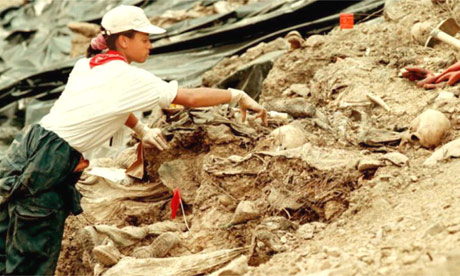
Photo: "An UN investigator removes earth from bodies in a mass grave outside the village of Cerska, near Srebrenica, Bosnia on July 15, 1996." (Odd Andersen/Getty Images)
"[...] An initiative by a German NGO is currently under way to construct a 'pillar of shame' intended to draw attention to the UN's failure to fully own up to its share of responsibility for the Srebrenica genocide 15 years after 8,000 unarmed Bosnian Muslim men and boys were murdered by Bosnian Serb forces in the UN 'safe area.' The pillar will spell out the letters UN using 16,744 shoes, representing the numbers of the victims of Srebrenica, and intends to 'serve as a metaphor for the immense betrayal of the UN in Bosnia and Herzegovina.' The pillar will be presented at The Hague on 1 July, and in Berlin on 11 July, the day Srebrenica fell to the Bosnian Serb army in 1995. The pillar of shame project is supported by the Mothers of Srebrenica, the group representing survivors and relatives of those who were killed in Srebrenica, who filed a law suit against the UN at the Hague, accusing the peacekeepers of failing to take necessary steps to prevent the genocide.

Spain / Nazism / Jewish Holocaust

General Franco Gave List of Spanish Jews to Nazis
By Giles Tremlett
The Guardian, June 20, 2010
Photo: "Hitler and General Franco meet on the French side of the border on 23 October 1940." (LAPI/Roger Viollet/Getty Images)
"It was the list that would have sent thousands more Jews to their deaths in Auschwitz and other extermination camps run by Adolf Hitler's Nazi regime during the second world war, but this time the victims were to be Spaniards. The Spanish dictator, General Francisco Franco, whose apologists usually claim that he protected Jews, ordered his officials to draw up a list of some 6,000 Jews living in Spain and include them in a secret Jewish archive. That list was handed over to the Nazi architect of the so-called 'final solution,' the German SS chief Heinrich Himmler, as the two countries negotiated Spain's possible incorporation into the group of Axis powers that included Italy, according to the El País newspaper today. The newspaper printed the original order, recently unearthed from Spanish archives, that instructed provincial governors to elaborate lists of 'all the national and foreign Jews living in the province ... showing their personal and political leanings, means of living, commercial activities, degree of danger and security category.' Provincial governors were ordered to look out especially for Sephardic Jews, descendants of those expelled from Spain in 1492, because their Ladino language and Hispanic background helped them fit into Spanish society. [...]"

Sunday, June 20, 2010

Bangladesh / Ecocide / Structural Violence

Arsenic Could Kill Millions in Bangladesh -- Study
By Julie Steenhuysen
Reuters dispatch, June 18, 2010
"Tens of millions of people in Bangladesh have been exposed to toxic levels of arsenic from drinking contaminated groundwater, putting them at risk of an early death, U.S. researchers said on Friday. They said more than 20 percent of deaths in a 10-year study of 12,000 Bangladeshis were caused by arsenic exposure from contaminated drinking water. 'Tens of millions of people there are at high risk of dying early. Something needs to be done urgently to reduce the exposure to arsenic for this population and find alternative, safe drinking water sources,' said Dr. Habibul Ahsan of the University of Chicago Medical Center, whose study appears in the Lancet. Arsenic causes cancer and is toxic to the liver, skin, kidney and the cardiovascular system. Ahsan said the West Bengal region of India, Argentina, Chile and parts of Mexico and the US states of Nevada, New Mexico and New Hampshire have areas where people drink groundwater from arsenic-contaminated wells.

Saturday, June 19, 2010

Rwanda / Genocide Denial

American in Rwanda Freed, But Still Faces Genocide Denial Charge
By Scott Baldauf
The Christian Science Monitor, June 17, 2010
"Peter Erlinder, an American lawyer accused of denying the 1994 genocide in Rwanda, has been granted an unconditional release by a Rwandan court in Kigali today. Mr. Erlinder was arrested last month and charged with denying and minimizing the genocide, soon after arriving in Rwanda to defend opposition presidential candidate Victoire Ingabire on similar charges of genocide denial. Erlinder has reportedly promised to return to Rwanda to face the charges against him, although he is currently in a hospital in Kigali for an ailment related to blood pressure. Erlinder's family, reached by phone in the US, says that they are relieved to hear the news and that the US Department of State has confirmed that Erlinder has been granted unconditional release. ... Rwanda's Prosecutor-General Martin Ngoga said in a statement: 'Bail on health grounds cannot be mistaken as vindication for Mr. Erlinder -- it just proves that the justice system he so freely criticizes was willing to show him compassion with respect to his physical and mental wellbeing. This will not deter the prosecution as we finalize the case against Mr. Erlinder.' [...]"

Friday, June 18, 2010

Rwanda / Genocide Denial

The Politics of Denialism: The Strange Case of Rwanda
By Gerald Caplan
Pambazuka.org, June 17, 2010
"[...] All of this is mere preliminary for Herman and Peterson. Their main target, which is none of the cases mentioned so far, can be found squarely in the heart of the book. It's chapter 4, the longest single section, and its purpose is to show that the 1994 genocide of the Rwandan Tutsi never happened. In fact the entire 'genocide' in Rwanda is an elaborate American conspiracy to 'gain a strong military presence in Central Africa, a diminution of its European rivals' influence, proxy armies to serve its interests, and access to the raw material-rich Democratic Republic of the Congo.' The authors' greatest bete noir is Paul Kagame, commander of the Rwandan Patriotic Front (RPF) rebels during the 1990-94 civil war and 1994 genocide, long-time president of post-genocide Rwanda -- and leading Yankee stooge. Yes, in order to blame the American empire for every ill on earth, Herman and Peterson, two dedicated anti-imperialists, have sunk to the level of genocide deniers. And the 'evidence' they adduce to back up their delusional tale rests solidly on a foundation of other deniers, statements by genocidaires, fabrications, distortions, innuendo and gross ignorance. In this Grimm fairy tale, everyone who contradicts their fantasies is an American/RPF pawn -- Paul Kagame, human rights investigator Alison des Forges, the head of the UN military mission in Rwanda during the genocide General Romeo Dallaire, and entire human rights organisations.