Wednesday, April 27, 2011

Turkey / Armenia

"The controversial and uncompleted monument in Kars is being dismantled." (Associated Press)
Hand of Friendship is Withdrawn as Turkey and Armenia Squabble
By Shaun Walker
The Independent, April 27, 2011
"A monument built to celebrate friendship between Turkey and Armenia is being dismantled, in a gesture that shows how much an attempted rapprochement between the two nations has stalled. The statue, in the eastern Turkish city of Kars, depicts two figures emerging from a single mass, signifying common ground between nations with a bitter and difficult history, and was commissioned in 2006 to commemorate cautiously improving ties between them. The countries have been in dispute over the mass killings of up to 1.5 million Armenians during the First World War which Armenia, along with most of the rest of the world, says was genocide but which Turkey refuses to acknowledge as such. Ankara insists that deaths occurred on both sides during a situation of civil war. A crane has been brought to dismantle the 35-metre statue and yesterday the head from one of the figures, which alone weighed 19 tonnes, was removed. The demolition process is expected to take more than a week. 'I am really sorry, sorry on behalf of Turkey,' said Mehmet Aksoy, creator of the monument. 'They can demolish it, we will re-make it.' Tentative efforts at mending ties between Turkey and Armenia started a few years ago, and in 2008 negotiations began to open the long-sealed border between the countries, which would have boosted trade and commerce and proved especially useful to landlocked Armenia. Last year talks were abandoned, and rhetoric between the two has become increasingly tense.

Saturday, April 23, 2011

Syria

Bloodbath New Threat to Assad
The Sydney Morning Herald, April 24, 2011
"US President Barack Obama has condemned Syria's 'outrageous' use of violence, after Syrian security forces met thousands of demonstrators with fusillades of live ammunition, killing at least 81 people in the bloodiest day of the five-week-old Syrian uprising. Protesters gathered on Friday in at least 20 cities and towns, including in the outskirts of the capital, Damascus. Cries for vengeance intersected with calls for the government's fall, marking a potentially dangerous new dynamic in the revolt. 'We want revenge, and we want blood,' said Abu Mohamed, a protester in Azra, a southern town that had the highest death toll on Friday. 'Blood for blood.' The breadth of the protests -- and people's willingness to defy massed security forces -- painted a picture of turmoil in one of the Arab world's most authoritarian countries. In scenes unprecedented only weeks ago, protesters tore down pictures of President Bashar Assad and toppled statues of his father Hafez in two towns on the capital's outskirts. Coming a day after Mr. Assad endorsed the lifting of draconian emergency rule, the killings were another chapter in the government's strategy of alternating promises of concessions with a grim crackdown that has left it staggering but still entrenched. 'There are indications the regime is scared and this is adding to the momentum, but this is still the beginning,' said Wissam Tarif, executive director of Insan, a Syrian human rights group. Abu Nadim, a protester in Douma, on the outskirts of Damascus, said: 'We are not scared any more. We are sad and disappointed at this regime and the president. Protests, demonstrations and death are now part of the daily routine.' In a sharply worded statement, President Obama said the 'outrageous use of violence to quell protests must come to an end now.Instead of listening to their own people, President Assad is blaming outsiders while seeking Iranian assistance in repressing Syria's citizens through the same brutal tactics that have been used by his Iranian allies.' In the capital, hundreds gathered after Friday prayers at the al-Hassan Mosque. But security forces dispersed the protests with tear gas, witnesses said. [...]"

Hungary / Roma-Gypsies

"Some 277 women and children were moved out in a convoy of busses." (AP)
Gipsies Flee as Far-Right Open "Training Camp"
By Matthew Day
The Telegraph, April 22, 2011
"Nearly 300 gipsies have been evacuated out of a remote Hungarian village where a three-day, far-Right 'training camp' has been set up. The gipsies, fled Gyongyospata, 50 miles from Budapest, after members of Vendro, a paramilitary group arrived. The Hungarian Red Cross said it was the first time it had evacuated Hungarian civilians threatened by paramilitary activity since the Second World War. The far-Right Jobbik party won 17 per cent of the vote in a general election in the country last year. Some 277 women and children were moved out in a convoy of busses Janos Farkos, deputy leader of the Hungarian Roma Rights Organisation, said that the village's Roma population had felt 'terrorised' by the presence of the far-right activists. 'The children had to be sent away this weekend because they wouldn't be able to sleep at night,' Mr. Farkos said. Vendro's website said it expected 'all those who loved their country and wanted to learn basic self-defence and military training' to attend. The camp and evacuation will stoke already simmering tensions between Hungary's Roma community and the vocal and popular far-right movements such as Jobbik, an ultra-nationalistic party that campaigns with a hard-line Roma policy and which scooped 17 per-cent of the vote in last year's general election."
[n.b. This is the complete text of the dispatch. Interesting that only women and children were evacuated. Was that a decision of the community, or the Red Cross?]

Saturday, April 16, 2011

Croatia / International Tribunals

"Gen. Ante Gotovina, center, talked to his lawyers on Friday at The Hague, where he was sentenced to 24 years in prison." (Jerry Lampen/Pool photo)
UN Court Convicts Two Croatian Generals of War Crimes and Frees a Third
By Marlise Simons
The New York Times, April 15, 2011
"In a shock to Croatia over its conduct of Balkan warfare in the 1990s, a United Nations court on Friday found a Croatian general, Ante Gotovina, guilty of war crimes and crimes against humanity in a campaign he led to regain Croatian land and drive Serbs out of the Krajina region in 1995. The verdicts of three Croatian generals accused of war crimes were shown on a large screen on a street in Zagreb, drawing an emotional response from the crowd. General Gotovina, who was arrested in the Canary Islands in 2005 after four years on the run, was sentenced to 24 years in prison because troops under his command shelled towns, looted, killed and persecuted civilians. The court sentenced Mladen Markac, another general in the campaign, to 18 years, but acquitted a third, Ivan Cermak, of all charges and ordered his release. The decisions by a three-judge panel of the Yugoslav war crimes tribunal in The Hague were in effect an indirect verdict on the late president of Croatia, Franjo Tudjman, who died in 1999 as prosecutors at The Hague were planning to have him indicted. The court said Mr. Tudjman was the leader of a 'joint criminal enterprise' to drive Serbs from Krajina, a hilly region they had long inhabited in central and southern Croatia, and to repopulate the area with Croats only. In 1991 Serbian rebels, backed by Belgrade, broke away and created a separate statelet there. The verdicts also raised fresh questions about the role Croatia says American advisers played in the campaign, a turning point in the Balkan wars of 1991-95. During and after the operation to drive Serbian military and police forces from Krajina, about 300 civilians were killed, many in their homes, and some 90,000 Serbs fled Croatia. Thousands of their abandoned homes were looted and burned. The campaign was planned by Mr. Tudjman and Croatian commanders, who have said they were helped by active and retired American military personnel.

Wednesday, April 13, 2011

Iraq / United States

Crime against Humanity at Camp Ashraf
By Lord David Waddington
The Independent, April 12, 2011
"Last week Iraqi forces entered a camp in Iraq housing members of the Iranian opposition group, the People's Mojahedin Organisation of Iran (PMOI). Thirty three residents were killed and over 300 wounded. Were the US authorities, as it has been suggested, told of the intended attack by the Iraqi Government? If they were, then surely members of the US government were complicit in a crime against humanity. And of course it shows that the US administration is continuing to appease the regime in Tehran whose influence over the Iraq government grows and grows. The raid which took place at 5am on Friday 8 April, involved 2,500 severely armed Iraqi forces entering the Camp in armoured vehicles and Humvees, with video footage filmed by the residents clearly showing Iraqi forces running over unarmed residents and firing indiscriminately at them. Under any parameter of international law such a massacre of unarmed civilians is a war crime and a crime against humanity. Unfortunately, this is the latest indication that Iraq's Prime Minister Nouri Al-Maliki has no qualms about breaching international law and massacring innocent civilians in order to please his paymasters in Tehran. Al-Maliki continues to lead Iraq into becoming a puppet state which ultimately falls under the leadership of Tehran's Mullahs. In this climate it becomes even more disturbing to know that unarmed civilians to whom the US authorities gave personal guarantees as to their protection and to whom 'protected persons' status under the Fourth Geneva Convention were granted, were left to be butchered in such a way. Based on the current information available it appears that US forces stationed inside the Camp were ordered by their command in Baghdad to withdraw from Camp Ashraf and not to act in any way in preventing the attack. Furthermore given the presence of US Defence Secretary Robert Gates in Iraq at the time of the attack, there exists the possibility that the US authorities provided the Iraqi authorities with an informal go-ahead to carry out the attack. The actions of the US authorities in failing to prevent the attack is a clear breach of their duty under international law to guarantee the safety of 'protected persons' under the Fourth Geneva Convention. This duty falls upon each and every UN member state, but specifically upon the US and its Coalition members who provided the residents with a guarantee to ensure that their rights under international law would be safeguarded. [...]"

Nazi Holocaust

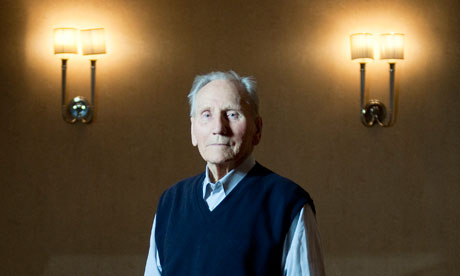
"Kazimierz Piechowski in 2011. 'We just planned that I would play the role of an SS officer so well that the guards would believe me.'" (Christian Sinibaldi/The Guardian)
I Escaped from Auschwitz
By Homa Khaleeli
The Guardian, April 11, 2011
"On 20 June 1942, the SS guard stationed at the exit to Auschwitz was frightened. In front of him was the car of Rudolph Höss, the commandant of the infamous concentration camp. Inside were four armed SS men, one of whom -- an Untersturmführer, or second lieutenant, was shouting and swearing at him. 'Wake up, you buggers!' the officer screamed in German. 'Open up or I'll open you up!' Terrified, the guard scrambled to raise the barrier, allowing the powerful motor to pass through and drive away. Yet had he looked closer, the guard would have noticed something strange: the men were sweating and ashen-faced with fear. For far from being Nazis, the men were Polish prisoners in stolen uniforms and a misappropriated car, who had just made one of the most audacious escapes in the history of Auschwitz. And the architect of the plot, the second lieutenant, was a boy scout, to whom the association's motto 'Be prepared' had become a lifeline. Almost 70 years later, prisoner 918 is holding forth in the home of the scouting association, Baden Powell House in London. At 91, he is impeccably dressed, with a face as wrinkle-free as his well-ironed shirt. As he accepts the ceremonial neckerchief from a shy girl scout from Lancashire, he is as straight-backed as any of the teenagers on parade. In the UK as the guest of a British singer, Katy Carr, who has written a song about his experiences, he is thrilled when the scouts and guides join her to sing for him. Yet in between the traditional trappings of a jamboree, Kazimierz Piechowski, or Kazik as he likes to be called, will tell them a story few in the UK have heard -- how, during Nazi occupation, scouts their age were murdered in the streets, while others like him were sent to concentration camps to witness the horror of Hitler's Final Solution. ... 'We were only the second transportation to the [Auschwitz I] camp,' Piechowski says, 'and we had to help build it.' The old collection of buildings that made up the original concentration camp was not big enough to house all those caught in mass arrests, so inmates were forced to work 12- to 15-hour days to construct a new camp next door that would become notorious as the Nazis' biggest death camp. ... For six weeks, Piechowski was set to work carrying corpses after executions. 'The death wall was between blocks 10 and 11. They would line prisoners up and shoot them in the back of the head.' At the end there would be a pile of naked corpses and Piechowski would take the ankles, while another man held the arms, and throw them on to carts, to transport them to the crematorium. 'Sometimes it was 20 a day, sometimes it was a hundred, sometimes it was more. Men, women and children.' He looks at me fiercely. 'And children,' he repeats. [...]"

Saturday, April 09, 2011

Israel / Nazism / Genocide Tribunals

Adolf Eichmann on trial in Jerusalem, 1961. (Kino International; from the documentary film "The Specialist")
Why the Eichmann Trial Really Mattered [Review of Deborah Lipstadt, "The Eichmann Trial"]
By Franklin Foer
The New York Times, April 8, 2011
"To write about the trial of Adolf Eichmann is to put its most notorious court reporter, Hannah Arendt, in the dock. In the nearly 50 years since its publication, her account of those proceedings, 'Eichmann in Jerusalem,' has come to overshadow its subject. The book, it is true, commands attention. It is a breathtaking admixture of genres (history, philosophy, journalism) and contains strong, often unconventional, moral judgments (especially her contempt for the Jewish leaders who cooperated with their murderers). It aims to render grand historical conclusions but remains unintentionally and inescapably personal. 'The Eichmann Trial,' by Deborah E. Lipstadt, can't entirely avoid Arendt, but it does manage to keep her largely offstage until the very end. Lipstadt has done a great service by untethering the trial from Arendt's polarizing presence, recovering the event as a gripping legal drama, as well as a hinge moment in Israel's history and in the world's delayed awakening to the magnitude of the Holocaust. Aside from Eichmann's trial, in 1961, the Holocaust has been the subject of at least two other memorable legal battles. The first, of course, was the Nuremberg tribunals -- proceedings that occurred amid the ruins of war and concentrated on the crimes of the Nazis, giving little voice to the still dazed survivors of the genocide. The second featured none other than Lipstadt herself. In 2000, she found herself the defendant in a British libel suit unsuccessfully brought by the writer David Irving, who protested her characterization of him as a Holocaust denier. This experience has made her a sensitive guide to the awkward complexities of squeezing the crimes of the Holocaust into the constricting confines of the courthouse.

Sunday, April 03, 2011

Israel / Palestine

Israeli Officials Cheer After Goldstone Rethinks War Crimes Report
AOL News, April 3, 2011
"Israeli officials feel vindicated after Judge Richard Goldstone retracted part of his harsh criticism of Israel's conduct in Gaza two years ago, and have launched a major diplomatic effort to get the United Nations to rescind the Goldstone Report. 'I found it hard to believe that Judge Goldstone, a Jew and even a Zionist, could have really believed that Israel would deliberately target Palestinian civilians,' Strategic Affairs Minister Moshe Ya'alon told a group of journalists, including AOL News, by phone. "He must have been influenced by Arab propaganda." On Friday night, Goldstone posted an op-ed on The Washington Post website, writing, 'We know a lot more today about what happened in the Gaza war of 2008-09 than we did when I chaired the fact-finding mission appointed by the UN Human Rights Council that produced what has come to be known as the Goldstone Report. If I had known then what I know now, the Goldstone Report would have been a different document. ... [Palestinian] civilians were not intentionally targeted as a matter of policy.' That has been Israel's claim all along and today, Israeli politicians celebrated. 'There are very few instances in which those who disseminate libels retract their libel. This happened in the case of the Goldstone Report,' Israeli Prime Minister Benjamin Netanyahu told his cabinet on Sunday. 'This leads us to call for the immediate cancellation of the Goldstone Report.' Goldstone had also harshly criticized the Islamist Hamas movement for its rocket attacks on Israel. Hamas spokesman Sami Abu Zuhri today said, 'Goldstone's retreat is reprehensible' and called on the UN to implement the Goldstone Report -- despite the author's change of heart about Israel.

Saturday, April 02, 2011

Ivory Coast

"Forces loyal to presidential claimant Alassane Ouattara rest about 20 kilometres north of Abidjan on Friday." (Emmanuel Braun/Reuters)
Ivory Coast Massacre Kills 1,000: Agency
CBC News, April 2, 2011
"Aid agencies are reporting mass killings in the Ivory Coast city of Duekoue, captured by fighters supporting UN-recognized president Alassane Ouattara this week. The Red Cross on Saturday said at least 800 civilians were killed in inter-ethnic violence in a single neighbourhood of the city in recent days, while the Roman Catholic charity Caritas said the number exceeded 1,000. Red Cross spokeswoman Dorothea Krimitsas said delegates from the Ivorian Red Cross had visited Duekoue on Thursday and Friday to gather evidence and saw a 'huge number of bodies.' 'We are shocked by the brutality and scale of this act,' said Dominique Liengme, head of the International Committee of the Red Cross delegation in the African country. Caritas spokesman Patrick Nicholson said workers with his agency visited the city on Wednesday. He said they saw victims who died of gunshot and machete wounds. ... It's not clear whether the armed group trying to install Ouattara as president was involved. The mass killing brings the confirmed death toll from violence since the presidential election last November, in which Ouattara was the internationally recognized winner, to 1,300 people.

Democratic Republic of the Congo

"A rape vicitm in Livungi, Congo, 2010." (Michael Kamber/The New York Times)
Explaining Congo's Endless Civil War (Review of Jason K. Stearns, Dancing in the Glory of Monsters)
By Adam Hochschild
The New York Times, April 1, 2011
"[...] The fighting has left tens or even hundreds of thousands of women gang-raped and led to what may be millions of war-related deaths; at its peak, some 3.4 million Congolese (the only one of these tolls we can be remotely sure of) were forced to flee their homes for months or years. But it draws little attention in the United States. As Jason K. Stearns, who has worked for the United Nations in Congo, points out, a study showed that in 2006 even this newspaper gave four times as much coverage to Darfur, although Congolese have died in far greater numbers. One reason we shy away is the conflict's stunning complexity. 'How,' Stearns asks, 'do you cover a war that involves at least 20 different rebel groups and the armies of nine countries, yet does not seem to have a clear cause or objective?' 'Dancing in the Glory of Monsters' is the best account so far: more serious than several recent macho-war-correspondent travelogues, and more lucid and accessible than its nearest competitor, Gérard Prunier's dense and overwhelming 'Africa's World War: Congo, the Rwandan Genocide, and the Making of a Continental Catastrophe.' A fatal combination long primed this vast country for bloodshed.

Argentina / Operation Condor

"Former army intelligence operative Raul Guglielminetti, center, and former agent of Argentina's intelligence agency SIDE, Honorio Ruiz, sit in court before their sentencing in Buenos Aires, Argentina, Thursday March 31, 2011." (AP Photo/Natacha Pisarenko)
Argentina: Ex-Agents Sentenced in Operation Condor 
Associated Press dispatch on Yahoo! News, April 1, 2011
"A court on Thursday sentenced a former army general to life in prison and three ex-state agents to 20 or 25 years for crimes against humanity committed in a notorious torture center during Argentina's military dictatorship. Ex-Gen. Eduardo Cabanillas was convicted of illegal imprisonment, torture and homicide involving 65 people held at Automotores Orletti, an auto body shop that served as an operations center for Operation Condor, a coordinated effort by South America's dictatorships to eliminate dissidents who sought refuge in neighboring countries. The crimes took place in 1976. Prosecutors says about 300 people passed through Automotores Orletti, including Uruguayans, Chileans, Bolivians and Cubans, most of whom were killed or disappeared. The federal Argentine court on Thursday also sentenced former army intelligence agent Raul Guglielminetti to 20 years in prison while former spies Honorio Martinez Ruiz and Eduardo Ruffo each received 25 years. A fifth suspect in the case, retired Col. Ruben Visuara, died in February. 'It is a glorious and historical day that we are living and that the "mothers" didn't think we'd live to see. This is legal justice,' said Tati Almeida of the Mothers of the Plaza de Mayo, an Argentine human rights group.

Saturday, March 19, 2011

Sudan / South Sudan

"South Sudan has seen an increase in violence since its vote to secede from the North in January." (Gallo/Getty)
Deadly Clashes in South Sudan
Al Jazeera English, March 19, 2011
"Heavy fighting between rebels and the south Sudanese army in the oil-producing states of Unity and Upper Nile, has left at least 70 people dead, according to an army spokesman. At least 30 soldiers and 11 rebels died in clashes that broke out on Thursday morning in Mayom county, in Unity state, Philip Aguer, a spokesman for the south's Sudan People's Liberation Army (SPLA), said. 'The fighting was very heavy, but the rebels are now being pursued,' Aguer said, who added that 34 SPLA soldiers were also wounded. ... Aguer said the fighting began after the breakdown of talks aimed at persuading the rebels, who totalled 'several hundred well-armed men,' to join the southern army. In neighbouring Upper Nile state, clashes between the army and a separate rebel group, which Aguer said was responsible for a bloody raid on the state capital Malakal last Saturday, killed 25 rebels and four SPLA soldiers. ... UN officials confirmed that heavy clashes had taken place, but they were unable to verify the casualty figures. South Sudan has seen a surge in bloody clashes between rebel groups and the army since a largely peaceful January referendum on independence, in which southerners voted almost unanimously to form their own nation. Unity and Upper Nile states are close to the south's border with the north -- its former civil war enemy who the southern government has repeatedly accused of supplying arms and providing bases for rebels. The leaders of north and south tentatively agreed on Thursday to resume talks aimed at resolving a host of outstanding issues before the international community recognises an independent south in July.

Thursday, March 10, 2011

Czech Republic / Lidice Massacre / Porrajmos (Roma Genocide)

A Czech Town Memorializes Oft-Forgotten Victims
By Jacy Meyer
The Christian Science Monitor, March 10, 2011
"Deep in the peaceful Bohemian countryside 15 miles northwest of Prague sits the village of Lidice. The town itself has been transformed into a beautiful and haunting memorial with a museum and rose garden to commemorate a brutal Nazi retaliation that razed the original town after high-ranking Nazi official Reinhard Heydrich was assassinated in Prague in 1942. In the museum, a new traveling exhibit tells the story of another group terrorized under the Nazis -- the Roma. About half a million European Roma were killed during World War II. Ninety percent of the Roma living on Czech lands are believed to have been killed. Lety, the Roma internment camp, was originally a prison work camp. It housed more than 1,000 Roma, also known as Gypsies, from 1942 to 1943; about 500 of them went to Auschwitz. Lidice Memorial staff now manage the Lety site as well as Lezaky, a second Roma internment camp, and plans are to develop memorials there as well. 'Like with the Lidice Memorial, we are trying to bring history to young people through various exhibitions,' says Ivona Kasalicka, director of the Lidice Gallery. The traveling exhibition will remain at Lidice until March 29 and then will be displayed at the Museum of Romani Culture in Brno, Czech Republic."
[n.b. This is the complete text of the dispatch.]

Tuesday, March 08, 2011

Libya

"Hundreds of African migrant workers, many from Ghana and Nigeria, live next to the airport in Tripoli, Libya, hoping to fly home." (Moises Saman/The New York Times)
Libya War Traps Poor Immigrants at Tripoli's Edge
By David D. Kirkpatrick and Scott Sayare
The New York Times, March 7, 2011
"As wealthier nations send boats and planes to rescue their citizens from the violence in Libya, a new refugee crisis is taking shape on the outskirts of Tripoli, where thousands of migrant workers from sub-Saharan Africa have been trapped with scant food and water, no international aid and little hope of escape. The migrants -- many of them illegal immigrants from Ghana and Nigeria who have long constituted an impoverished underclass in Libya -- live amid piles of garbage, sleep in makeshift tents of blankets strung from fences and trees, and breathe fumes from a trench of excrement dividing their camp from the parking lot of Tripoli's airport. For dinner on Monday night two men killed a scrawny, half-plucked chicken by dunking it in water boiled on a garbage fire, then hacked it apart with a dull knife and cooked it over an open fire. Some residents of the camp are as young as Essem Ighalo, 9 days old, who arrived on his second day of life and has yet to see a doctor. Many refugees said they had seen deaths from hunger and disease every night. The airport refugees, along with tens of thousands of other African migrants lucky enough to make it across the border to Tunisia, are the most desperate contingent of a vast exodus that has already sent almost 200,000 foreigners fleeing the country since the outbreak of the popular revolt against Col. Muammar el-Qaddafi nearly three weeks ago. Dark-skinned Africans say the Libyan war has caught them in a vise. The heavily armed police and militia forces loyal to Colonel Qaddafi who guard checkpoints along the roads around the capital rob them of their money, possessions and cellphone chips, the migrants say. And the Libyans who oppose Colonel Qaddafi lash out at the African migrants because they look like the dark-skinned mercenaries many here say the Libyan leader has recruited to crush the uprising. 'Qaddafi has brought African soldiers to kill some of them, so if they see black people they beat them,' said Samson Adda, 31, who said residents of Zawiyah, a rebellious city, had beaten him so badly that he could no longer walk.

Monday, March 07, 2011

Libya

Black Men Face Death as Both Anti- and Pro-Gaddafi Bloc Hunt Them Down
The Star/Asia News Network, March 6, 2011
"It is a scary time to be a black man in Libya. The anti-Gaddafi protesters want to lynch you because they think you are a mercenary out to kill them, while the pro-Gaddafi forces want to kidnap you and force you to fight for them. Collins Daakqah from Ghana said he saw five dead Africans in Zawiyah, which is 30km from Tripoli. 'I saw a few Africans trying to leave but some armed men wouldn't let them and shot them. We were so afraid to stay inside if those people came after us, so we had to find a way to run away,' he said when met after crossing the border into Tunisia. Owusu Isaac also from Ghana was also relieved to make it out, but his heart is heavy. His face showed worry and he seemed preoccupied. His brother Stephen has been captured by the police in Tripoli and is being made to fight with the soldiers against the anti-Gaddafi protestors. 'They didn't know my brother still had his mobile phone with him. He managed to call me just to tell me that he was being taken away by the police and that he was given weapons and asked to fight. He was scared. A policeman spotted my brother talking to me on the phone and the line went dead,' he said. 'I want to try and help my brother but I can't. I need to run for my life,' he said. The men say they are not fighters or mercenaries and had merely come over to Libya to make a living. They were working in lowly-paid jobs, mostly plastering newly-built homes and half the time they didn't even get paid. In recent weeks, Libya has exploded into violence as anti-Gaddafi protestors have taken to the streets to try and oust their leader of 41 years, Muammar Gaddafi. But their leader has responded with heavy force to put down the uprising against him and even hired African mercenaries to do the killing and these men have been prowling the streets with weapons, shooting protestors indiscriminately In response, the anti-Gaddafi protestors have gone after the Africans and captured some of the mercenaries and even killed a few.

Sunday, March 06, 2011

Kosovo / Serbia

"Serbian forces were accused of massacring 40 Kosovo Albanians in Racak in 1999." (Reuters)
Kosovo to Hold First Talks with Serbia since Independence
By Vesna Peric Zimonjic
The Independent, March 7, 2011
"Kosovo will tomorrow hold its first face-to-face talks with Serbia since declaring independence three years ago after insurgency and ethnic cleansing left 10,000 people dead and drove hundreds of thousands from their homes. The meeting in Brussels between senior officials will include discussions on the fate of 1,800 people still missing from the 1998-99 conflict and other complex humanitarian issues. Serbia has said that it will never recognise the independence of Kosovo but observers see the meeting as an opportunity for reconciliation despite obvious tensions that remain between Albanians and Serbs. The two sides agreed to the EU-sponsored talks last year to improve the lives of all those in Kosovo -- two million ethnic Albanians and a tiny Serb minority -- where unemployment stands at 50 per cent and many people are living in grinding poverty. 'We joined this process not to play a game of poker where one side will win and the other will lose, but to solve the problems of people,' said Belgrade negotiator Borko Stefanovic. But he added his team would not cross the 'clearly defined' lines regarding Serbia's refusal to accept Kosovo's independence. Serbia goes into the talks hoping to improve its international image, scarred by atrocities committed during the conflict in Kosovo when Serbia was run by Slobodan Milosevic, who died in 2006 while on trial for war crimes at The Hague. Serbia has come under heavy pressure from the EU to enter negotiations with the former province that Serbia claims as the historic birthplace of the Serb people. Serbia still refuses to allow any exports from Kosovo to pass through its territory and its stance has infuriated the EU as Serbia seeks to join the 27-nation bloc.

France / Anti-Semitism

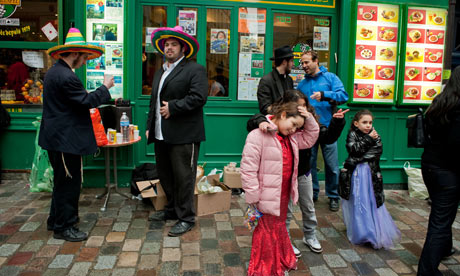
"Orthodox Jews in the Marais district of Paris where John Galliano allegedly made his comments." (Alamy)
Jewish People in the French Capital Live in the Shadow of Hatred
By Kim Willsher
The Observer, March 6, 2011
"Like most Paris schools, the Ecole des Hospitalières-Saint-Gervais bears a sombre plaque. It reads: '165 Jewish children from this school, deported to Germany during the second world war, were exterminated in the Nazi camps. Do not forget.' In this district, known as the Marais, the heart of Paris's oldest Jewish quarter, gay bars rub shoulders with falafel cafés, kosher restaurants, synagogues and prayer rooms. Its labyrinthine streets have been home to Jews on and off since the 13th century. Ten days ago, however, it also played host to John Galliano. The alleged infamous outburst of the Dior designer, who has now been sacked, in which he is said to have abused a Jewish woman and her Asian boyfriend, was offensive on many levels -- not only because of what he allegedly said, but because of where he said it. It was in a bar just a few paces from the Hospitalières-Saint-Gervais that the couturier, who is British but has lived in the French capital for two decades, was arrested. And it was also where, last year, he was filmed telling two women he believed to be Jewish that he loved Hitler. His reported behaviour has shocked France and the fashion world. Yet in what locals call the pletzl -- "little place" in Yiddish -- it provoked little surprise. Local residents and traders say that the insult 'sale juif' (dirty Jew) is a fact of daily life; asking a local if they have suffered abuse provokes a quizzical stare as if you are trying to be funny. 'Bien sûr' ('of course') is the most common reply. 'It's stating the obvious,' says one kippah-wearing youngster in the Rue des Rosiers, the Jewish quarter's main street. 'We hear what Galliano said, or versions of it, every day, sometimes several times every day.' Like many I speak to, he prefers not to be named. Standing in the doorway of a grocery shop, Dan points to his wide-brimmed black hat. 'My 80-year-old neighbour told me that when she was growing up they used to say we Jews wore these hats to hide our horns, and long black coats to hide our tails,' he says, laughing. 'She would tell me not to let my boys wear their [skull] caps in case "they" come back. More than 50 years after the war, she still thought it could happen again.'

Argentina / National Tribunals

"Jorge Videla, left, and Reynaldo Bignone, right, are accused along with six other former military figures." (AFP/Getty)
Argentine Military Dictators on Trial over Baby Kidnappings
By Robin Yapp
The Telegraph, February 28, 2011
"Jorge Videla, who ruled Argentina from 1976 to 1981, and Reynaldo Bignone, the last leader of the military regime from 1982 to 1983, are accused along with six other former military figures. Federico Delgado, federal prosecutor, called the theft of children 'one of the darkest episodes in Argentina's history' as the case began in Buenos Aires. About 500 babies were stolen from their mothers during the dictatorship, according to the campaign group Grandmothers of the Plaza de Mayo. Pregnant female political dissidents were interned at secret maternity wards in centres used to torture opponents of the dictatorship. The babies were handed to military officers or their relatives after birth while the mothers were simply killed, many of them dropped alive from military planes into the sea. Grandmothers of the Plaza de Mayo has managed to identify 102 of the stolen babies so far, some of whom had become politicians or human rights activists. 'We were the regime's war spoils,' said 33-year-old Leonardo Fossati, who was adopted after his parents were abducted while his mother was pregnant, as he gathered with other demonstrators on the steps of the court. The eight on trial, who arrived at court in handcuffs, are accused of being responsible for 34 cases of kidnapping and falsifying children's identities.

Bangladesh / National Tribunals

"Guerrillas beat people suspected of collaborating with pro-Pakistan militias in 1971 during Bangladesh’s war for independence, a conflict that may have killed more than one million people." (Horst Faas and Michel Laurent/Associated Press)
Bangladesh Faces Atrocities of Its Independence Era
By Lydia Polgreen
The New York Times, March 5, 2011
"In the last days of the bloody war that created this nation out of the eastern half of Pakistan in 1971, a gang of men abducted Dr. Alim Chowdhury, an eye surgeon and independence activist, from his home. Three days later, his battered body was found in a mass grave, his eyes gouged from his head. His killers, members of a pro-Pakistan militia, were never punished. Moulana Abdul Mannan, the man who confessed to orchestrating the killing, according to a government investigation, went on to become a cabinet minister and member of the Bangladesh Parliament. He died in 2006. Now, 40 years after Bangladesh's independence struggle -- one of the last century's most wrenching conflicts, whose death toll may have exceeded one million people -- the government here is seeking to prosecute individuals accused of atrocities like the one against Dr. Chowdhury. The effort has touched a raw political nerve here and illustrates a conundrum of international law: Can a country, particularly a young and poor one, fairly try its own citizens for crimes against humanity? Many of those accused of atrocities are not only still alive, but are also among the leading members of two of the main opposition political parties and have enjoyed long stints in power. Six men have been arrested in connection with various crimes of the era, all of them major political figures. The government hopes to try them in a tribunal of its own creation in the coming months.

Saturday, March 05, 2011

Philosophy & Psychology of Genocide

A Philosophy of Genocide's Roots
Review of Less Than Human: Why We Demean, Enslave, and Exterminate Others, by David Livingstone Smith
By David Berreby
The New York Times, March 4, 2011
"Consider, as Americans are so wont to do these days, the zombie. Once, he was a person, just like you or me, but then he changed. Now, despite his outward resemblance to a human being, he is a different thing altogether. He cannot disguise himself. He cannot change back. Another minus: He yearns to sink his zombie-plague-spreading teeth into your brain. But no cloud lacks a silver lining: He is a convenient image for people you despise -- as in the Tucson gunman Jared Loughner's 'zombie grin,' as in the 'zombie children' whom Amy Chua's 'Tiger Mother' philosophy supposedly produces, as in the 'climate zombies,' right-wingers who question the science of global warming. In 'Less Than Human,' the philosopher David Livingstone Smith explains why this sort of talk is not superficial metaphor-slinging. Dehumanization -- representing people to be lesser, non­human creatures, as when police officers label crimes against criminals as 'N.H.I.' ('No Humans Involved'), or when Muammar el-Qaddafi calls his critics 'stray dogs' -- isn't just shabby rhetoric. Dehumanization is a mind-set, as Smith writes, that 'decommissions' our 'moral inhibitions' about mistreating fellow human beings. Encased in law and custom, this psychological process has often licensed slavery, genocide and countless other cruelties. And it is, Smith writes in this stalwart attempt to tame the mystery with philosophy, a moral and cognitive problem as old as history.