Thursday, July 21, 2011

Kenya / United Kingdom / Mau Mau Uprising

"L-R: Ndiku Mutua, Jane Muthoni Mara and Wambugu Wa Nyingi claimed they were tortured."
Mau Mau Kenyans Allowed to Sue UK Government
By Dominic Casciani
BBC Online, July 21, 2011
"Four elderly Kenyans have been told they can sue the Foreign Office for their alleged torture by British colonial authorities 50 years ago. The High Court said the group could seek damages over their treatment during the 1950s and 60s. Mr. Justice McCombe said the claimants had an 'arguable case' and it would be 'dishonourable' to block the action. Ministers say the UK government is not responsible for the actions of the colonial administration. The decision means that the government will have to defend accusations of torture, murder, sexual assault and other alleged abuses at a full damages trial in 2012. The four Kenyans, Ndiku Mutwiwa Mutua, Paulo Muoka Nzili, Wambugu Wa Nyingi and Jane Muthoni Mara, all in their 70s and 80s, say ministers in London approved systematic abuse in special camps. A fifth claimant has died since the action began. The High Court heard that Mr. Mutua and Mr. Nzili had been castrated, Mr. Nyingi was beaten unconscious in an incident in which 11 men were clubbed to death, and Mrs. Mara had been subjected to appalling sexual abuse. Mr. Justice McCombe said in his judgement there was 'ample evidence' to show there may have been 'systematic torture of detainees during the Emergency.'

Cambodian Genocide

Cambodia's Muslims Seek Justice for Genocide
By International Justice Tribune
Radio Netherlands Worldwide, July 18, 2011
"Zakaria Bin Ahmad cannot forget the years of horror under the brutal Khmer Rouge when even praying was to risk death for Cambodia's persecuted minority Muslims. Many others in his community did not survive the late 1970s reign of terror by the hardline communist regime, which executed Islamic scholars, destroyed mosques, forced Muslims to eat pork and forbade headscarves. 'People tried all kinds of ways to pray. Sometimes while they were driving an ox cart ... sometimes in the jungle when we asked to use the toilet, and sometimes while we were washing,' the 61-year-old recalled. But mostly, he remembers people disappearing, never to be seen again. 'Many were killed,' he said quietly in his modest home in the shadow of a modern blue-domed mosque, a source of pride for the town of Chraing Chamres, whose earlier place of worship was destroyed by the Khmer Rouge. Cambodian Muslims, known as Cham, hope finally to see justice as the most senior surviving Khmer Rouge leaders stand trial for genocide at Cambodia's UN-backed court over the treatment of the ethnic and religious minority. 'Now we can tell our story,' said Sales Pin Apoutorliep, the religious leader, or hakem, of the Chraing Chamres mosque.

Wednesday, July 20, 2011

Serbia / Croatia / Genocide Tribunals

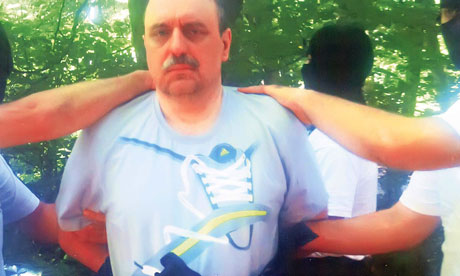
"A handout photograph of Serbian war crimes suspect Goran Hadzic being arrested in Fruska Gora national park, west of Belgrade. He was the last remaining fugitive sought by the UN war crimes tribunal." (Politika newspaper)
Goran Hadzic Capture a Milestone for Yugoslav War Crimes Tribunal
By Ian Traynor
The Guardian, July 20, 2011
"The Yugoslav war crimes tribunal crowned 18 years of operations on Wednesday with the capture of the last of 161 suspects from the wars of the 1990s when Goran Hadzic, a leader of the Serbian insurgency in Croatia, was arrested by the Serbian authorities. The arrest, two months after Belgrade captured genocide suspect General Ratko Mladic and dispatched him for trial in The Hague, marked a turning point for Serbia in seeking to put a blood-soaked, criminalised past behind it and join the European mainstream. The arrest was also a big moment for the UN tribunal in The Hague. Every one of the 161 main war crimes suspects indicted for atrocities in Croatia, Bosnia, Serbia, and Kosovo has now been apprehended and tried or is awaiting trial. 'This is a precedent of enduring significance, not only for this tribunal, but also for international criminal justice more generally,' said Serge Brammertz, the chief prosecutor at the International Criminal Tribunal for the former Yugoslavia in The Hague. 'A milestone in the tribunal's history,' added Judge O-Gon Kwon, the acting head of the temporary court established in 1993 at the height of the wars in Croatia and Bosnia. Hadzic, a former warehouse worker from Slavonia, a region in east Croatia, was a political leader of the Serbian rebellion in 1991, armed and sponsored by Slobodan Milosevic's regime in Belgrade. He led ethnic pogroms and armed insurrection against Zagreb, after Croatia's secession from Yugoslavia in June 1991, resulting in partition of the country and the Serbian seizure of a quarter of the territory during the war.

Monday, July 18, 2011

Uganda / Rape of Males in Wartime

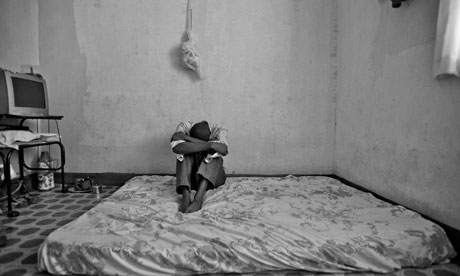
"Dying of shame: a Congolese rape victim, currently resident in Uganda. This man's wife has left him, as she was unable to accept what happened. He attempted suicide at the end of last year." (Will Storr/Observer)
The Rape of Men
By Will Storr
The Observer, July 17, 2011
"Of all the secrets of war, there is one that is so well kept that it exists mostly as a rumour. It is usually denied by the perpetrator and his victim. Governments, aid agencies and human rights defenders at the UN barely acknowledge its possibility. Yet every now and then someone gathers the courage to tell of it. This is just what happened on an ordinary afternoon in the office of a kind and careful counsellor in Kampala, Uganda. For four years Eunice Owiny had been employed by Makerere University's Refugee Law Project (RLP) to help displaced people from all over Africa work through their traumas. This particular case, though, was a puzzle. A female client was having marital difficulties. 'My husband can't have sex,' she complained. 'He feels very bad about this. I'm sure there's something he's keeping from me.' Owiny invited the husband in. For a while they got nowhere. Then Owiny asked the wife to leave. The man then murmured cryptically: 'It happened to me.' Owiny frowned. He reached into his pocket and pulled out an old sanitary pad. 'Mama Eunice,' he said. 'I am in pain. I have to use this.' Laying the pus-covered pad on the desk in front of him, he gave up his secret. During his escape from the civil war in neighbouring Congo, he had been separated from his wife and taken by rebels. His captors raped him, three times a day, every day for three years. And he wasn't the only one. He watched as man after man was taken and raped. The wounds of one were so grievous that he died in the cell in front of him. 'That was hard for me to take,' Owiny tells me today. 'There are certain things you just don't believe can happen to a man, you get me? But I know now that sexual violence against men is a huge problem. Everybody has heard the women's stories. But nobody has heard the men's.'

Argentina

Argentine Torture Trial Ends with Life Sentences for Ex-military Leaders of Notorious Prison
Associated Press dispatch in The Washington Post, July 14, 2011
"Two former military officers were convicted Thursday of murder, kidnapping and torture at one of the most notorious prisons run by Argentina's former dictatorship. Both got life sentences for crimes against humanity. There were very few survivors among the 2,500 political prisoners who passed through 'El Vesubio' prison during the 1976-83 military junta's dirty war on dissidents, which officially claimed 13,000 lives in all. 'El Vesubio' was run by the army in La Matanza, a working-class suburb of the capital, said Rodrigo Borda, a lawyer for the Center for Social and Legal Studies, which has kept close track of Argentina's progress in prosecuting crimes comitted by the junta. 'The detainees were hooded and chained together, and the guards gave them almost nothing to eat,' Borda said in an interview. Witnesses testified that the prison's boss, Col. Pedro Alberto Duran, regularly raped female prisoners and forced them to live with him in rooms in the compound. Duran was charged, but died in June during the trial.

Friday, July 15, 2011

Peru

"Telmo Hurtado is accused of killing 69 peasants in the 1980s."
"Butcher of the Andes" Faces Trial in Peru
The Telegraph, July 15, 2011
"A Peruvian ex-army officer known as the 'Butcher of the Andes' and accused of killing 69 peasants in the 1980s, was extradited to Peru from the United States late on Thursday to face charges, police said. Telmo Hurtado is accused of commanding a military patrol in the southeast of the country that killed the peasants, including 30 children and 27 women, in 1985 during Peru's war against Shining Path Maoist guerrillas. He was to appear before a national criminal court on Friday, which will decide where he will be held while the case is developed against him, said Karim Ninaquispe, a lawyer for families of the victims. Hurtado is alleged to have taken part in the infamous 'Accomarca Massacre' on August 14, 1985, when army units entered the Quebrada de Huancayoc village, herded villagers into houses and set them alight, killing dozens. Hurtado was included in a blanket amnesty granted to military officers in the 1990s but lost his immunity when the Supreme Court nullified the law in 2002, at which point he moved to the US city of Miami, Florida. He was arrested by US authorities in 2007 and the following year was ordered to pay $37 million after a case brought by the Center for Justice and Accountability, a rights group representing two witnesses to the massacre. Around 70,000 people, mostly civilians, were killed during Peru's war on leftist Shining Path and Tupac Amaru rebel groups in the 1980s and 1990s."
[n.b. This is the full text of the dispatch.]

Thursday, July 14, 2011

Sudan / South Kordofan

"Comparison: 17 June - 4 July 2011."
Clooney's Satellites Capture Piles of Bodies, Mass Graves in Sudan
By Mark Benjamin
Time.com, July 14, 2011
"George Clooney's Satellite Sentinel Project set up to monitor the spiraling violence in Sudan has a stunning report out today with convincing evidence showing ;a campaign of systematic mass killing of civilians in Kadugli, South Kordofan' in the south-central area of the country. ... The group combined eyewitness reports and DigitalGlobe satellite imagery to pinpoint what seem almost certainly to be piles of bodies in Kadguli and mass graves south of there. The group cites four eyewitness accounts of Sudan Armed Forces from northern Sudan and related militias searching houses in the town and 'systematically killing' civilians suspected of supporting southern Sudan forces. The report describes the slitting of one civilian's throat and sealing and burning homes with civilians inside. Eyewitnesses also describe the mass graves, shown above, dug by a yellow earth mover on June 8 less than a mile south of the Tilo School in Kadugli. The pits are about 26 meters long and 5 meters wide. Large green trucks were seen driving to the site and unloading around 100 bodies. Witnesses say before being buried in the mass grave, some of the bodies were wrapped in white plastic and piled up in Kadugli. The group captured what seem to be a pile of those bodies, too. [...]"

Wednesday, July 06, 2011

Syria

"Syrian forces enter a village near the town of Jisr al-Shughour, north of Damascus." (Associated Press)
Syrian Forces May Have Committed Crimes against Humanity
The Telegraph, July 6, 2011
"Syrian forces may have committed crimes against humanity when they crushed protests in the town of Tel Kelakh in May, Amnesty International have claimed. Urging the United Nations to refer Syria to the International Criminal Court, the human rights group said nine people died in custody after being captured during the operation in the town, close to the Lebanese border. 'Amnesty International considers that crimes committed in Tel Kalakh amount to crimes against humanity as they appear to be part of a widespread, as well as systematic, attack against the civilian population,' it said. In what it described as a 'devastating security operation,' scores of men were arbitrarily arrested and tortured, including people already wounded, in response to largely peaceful demonstrations against President Bashar al-Assad, it said. The military operation in Tel Kelakh, completed in a few days in mid-May, sent thousands of people fleeing for shelter into Lebanon, Amnesty said in a report compiled from witness testimony gathered in Lebanon and from phone calls into Syria. 'The accounts we have heard from witnesses to events in Tel Kelakh paint a deeply disturbing picture of systematic, targeted abuses to crush dissent,' said Philip Luther, Amnesty International's Middle East and North Africa Deputy Director.

Tuesday, July 05, 2011

Srebrenica Massacre / National Tribunals

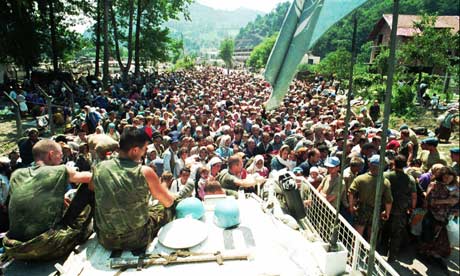
"Dutch UN peacekeepers watch while Muslim refugees from Srebrenica gather in the village of Potocari in 1995." (Associated Press)
Dutch State Responsible for Three Srebrenica Deaths, Says Court
By Ian Traynor
The Guardian, July 5, 2011
"Relatives of the victims of Europe's biggest massacre in decades won a landmark case, immense satisfaction, and the likelihood of substantial damages when a Dutch appeals court ruled for the first time that the Netherlands had to answer for the deaths of Muslim men at Srebrenica 16 years ago. The verdict stunned the Dutch government as well as the plaintiffs, who have campaigned on the issue for more than a decade and had almost given up. If the ruling is upheld by the supreme court, there could be hundreds of claims for damages from relatives from some of the estimated 8,000 Bosnian Muslim males butchered by the Bosnian Serb forces under General Ratko Mladic, on trial at the war crimes tribunal in The Hague on charges of genocide. The verdict also found for the first time that countries contributing to a UN peacekeeping mandate must answer for their actions and cannot enjoy immunity behind a UN cloak. The court rejected the Dutch government's argument that it was not responsible for its troops stationed in Srebrenica as they were under UN authority. 'It has been established that states who take part in UN peacekeeping operations cannot not be responsible for their actions. It's all about effective control,' Liesbeth Zegveld, the lawyer for the two Bosnian plaintiffs, told the Guardian. Hasan Nuhanovic, whose parents and brother were killed at Srebrenica, and the relatives of Rizo Mustafic, who worked as an electrician for the Dutch and was killed, have campaigned for years to get the UN and the Netherlands to bear partial blame for the atrocities on the grounds that at the time Srebrenica, in eastern Bosnia, was a UN-declared 'safe haven' manned by Dutch troops serving with the UN. The court ruled that the Dutch state was responsible for those deaths.

Tuesday, June 28, 2011

Australia / Colonialism / Genocide and Memory

British Settlement of Sydney an "Invasion"
By Jonathan Pearlman
The Telegraph, June 28, 2011
"The British settlement of Sydney in 1788 has been officially declared an 'invasion', following strong pressure from the Aboriginal contingent of the city council. The City of Sydney voted 7-2 to remove the words 'European arrival' from documents and rejected a compromise plan to describe the First Fleet's arrival as 'colonisation.' An Aboriginal advisory group had proposed the use of the word 'invasion' and threatened to quit over the compromise term offered by the Lord Mayor, Clover Moore. 'We were invaded,' said Paul Morris, an Aboriginal leader who pushed for the change. 'It is the truth and shouldn't be watered down. We wouldn't expect Jewish people to accept a watered-down version of the Holocaust, and if you ask American Indians, they wouldn't want the truth of their history watered down, so why should we?' After a bitter feud on the council over the terminology, Miss Moore accepted the Aboriginal panel's insistence on the term despite claims by some councillors it was 'divisive.' The preamble to the council's new 2030 master plan will now include the sentence: 'Despite the destructive impact of this invasion Aboriginal culture endured and is now globally recognised as one of the world's oldest cultures.' The document says the arrival of white settlers to Sydney Harbour had a 'devastating impact' on the local Eora tribe of Aborigines and resulted in the 'occupation and appropriation of traditional lands.' Arthur Phillip, the first governor of New South Wales state, estimated there were at least 1,500 Aborigines in Sydney at the time of white settlement, half of whom perished in a 1789 smallpox epidemic. Others were killed under a programme offering bounties for dead Aborigines, or perished from disease. Australia's original inhabitants, the country's most impoverished minority, are believed to have numbered around one million at the time of white settlement, but are now just 470,000 in a nation of 22 million.

Monday, June 27, 2011

Cambodia / Genocide Tribunals

"Former Cambodian head of state Khieu Samphan, ex-foreign minister Ieng Sary, former social affairs minister Ieng Thirith and 'Brother Number Two' Nuon Chea went on trial for war crimes on Monday." (Reuters)
Alleged Architects of Cambodia's "Killing Fields" Go on Trial
Reuters dispatch on MSNBC.com, June 27, 2011
"Now old and infirm, the four top surviving leaders of Cambodia's brutal Khmer Rouge regime went on trial before a UN-backed court for the first time Monday, facing justice three decades after their plan for a communist utopia left an estimated 1.7 million people dead. Security was tight at the tribunal, with dozens of police on guard and 500 spectators -- the majority victims of the 1975-79 regime -- watching from the gallery. With Khmer Rouge leader Pol Pot long dead, this may be the nation's best chance to hold the accused architects of the 'killing fields' and the enslavement of millions of Cambodians accountable, though all four say they are innocent. Almost a quarter of Cambodia's population were wiped out under the Khmer Rouge through torture, execution, starvation and exhaustion. On trial Monday were 84-year-old Nuon Chea, who was Pol Pot's No. 2 and the group's chief ideologist; 79-year-old former head of state Khieu Samphan; ex-foreign minister Ieng Sary, 85; and his 79-year-old wife, Ieng Thirith, who served as minister for social affairs. The tribunal's chief judge, Nil Nonn, opened the court session. The defendants showed no emotion as opening statements to the UN-backed tribunal were read before a packed auditorium in proceedings screened on national television. The four are charged with committing crimes against humanity and genocide and accused of a litany of crimes under both international and Cambodian laws, including murder, enslavement, religious and political persecution, inhumane treatment and unlawful imprisonment. The four accused sat side by side, without handcuffs. Sem Hoen, who lost four family members at the hands of the Khmer Rouge, queued for several hours for a seat in the courtroom Monday. She said all she wanted was an explanation as to why so many people were killed indiscriminately. 'I want them to confess. People won't stay calm if they don't say what happened,' she said. 'Justice is very important.' Together, the four form what the tribunal calls Case 002. The chief jailer of a notorious Khmer Rouge prison was convicted last year in the breakthrough Case 001. Political and financial pressures on the tribunal are raising doubts over whether there will ever be a Case 003. [...]"

Friday, June 24, 2011

Jewish Holocaust / Gender and Genocide

Silence Lifted: The Untold Stories of Rape during the Holocaust
By Jessica Ravitz
CNN.com, June 24, 2011
"The soldiers came for her at night. They took the girl to a barrack and forced her to watch a woman get raped. The drunken men then set loose a dog to rip off the raped woman's breasts. Blood was everywhere. The woman passed out. The young witness was next. Five soldiers held her down and took turns raping and sodomizing her. They spilled alcohol on her. They laughed. They said they'd kill her. She didn't yet have breasts for the dog to attack. Later, her sister cleaned her up, but they didn't speak about what had happened. No one talked about such things. They didn't have to. Or maybe they couldn't. The Congo? The former Yugoslavia? Libya? These allegations might have emerged from conflicts in any of these places. But this brutal testimony reaches back more than 65 years to the Holocaust -- more than half a century before the United Nations declared rape a war crime. Stories like this have the power to shock even those who think they know Holocaust history. The reason: They haven't been widely discussed. Is that because victims didn't share these accounts? Did interviewers not ask the right questions? Or have influences -- both within academia and the Jewish community -- served to sweep such accounts under the historical rug? A growing movement wants to peel back that rug.

Rwandan Genocide / Genocide Tribunals / Gender and Genocide

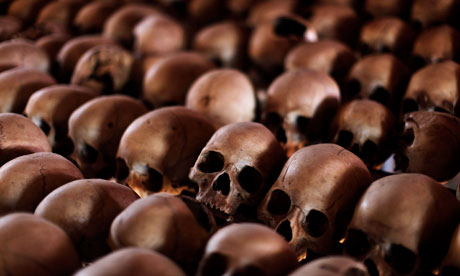
"The skulls of Rwandan victims rest on shelves at a genocide memorial inside the church at Ntarama just outside the capital Kigali." (Finbarr O'Reilly/Reuters)
Rwandan Ex-Minister Becomes First Woman Convicted of Genocide
Associated Press dispatch in The Guardian, June 24, 2011
"A former Rwandan minister became the first woman to be convicted of genocide when she and her son were given life sentences for war crimes in the 1994 genocide. The UN international criminal tribunal for Rwanda found that Pauline Nyiramasuhuko, who was minister for family and women's affairs, and her son, Arsene Ntahobali, a former militia leader, helped to abduct hundreds of ethnic Tutsis who were assaulted, raped and killed in the southern region of Butare. They were both found guilty of genocide, war crimes and crimes against humanity. Hanna Brollowski, an international law researcher at the TMC Asser Institute in The Hague, said Nyiramasuhuko was the first woman to be convicted of genocide. Between April and June 1994 Nyiramasuhuko and Ntahobali, backed by the extremist Hutu militia known as the Interahamwe, abducted hundreds of ethnic Tutsis in Butare. 'Many were physically assaulted, raped and taken away to various places in Butare, where they were killed. During the course of these repeated attacks on vulnerable civilians, both Nyiramasuhuko and Ntahobali ordered killings,' said Judge William Sekule. 'They also ordered rapes. Ntahobali further committed rapes and Nyiramasuhuko aided and abetted rapes.' A former mayor, Elie Ndayambaje, was also jailed for life on Friday and three other defendants were given sentences of between 25 and 35 years.

Sunday, June 19, 2011

Sudan / South Kordofan

In Sudan, Genocide Anew?
By Eric Reeves
The Washington Post, June 18, 2011
We are, once again, on the verge of genocidal counterinsurgency in Sudan. History must not be allowed to repeat itself. By early 2004, it was clear that the ideologically Arabist and Islamist regime in Khartoum was waging a genocidal counterinsurgency war throughout the western region of Darfur. Yet months passed before a broad range of human rights, government and academic voices said as much, even as the consequences of silence and inaction were conspicuous. In February 2004 I argued on this page that a 'credible peace forum must be rapidly created. Immediate plans for humanitarian intervention should begin. The alternative is to allow tens of thousands of civilians to die in the weeks and months ahead in what will be continuing genocidal destruction.' This prediction was borne out in the months that followed, the most destructive phase of the Darfur genocide, in which African tribal groups were mercilessly targeted by soldiers and militias. Sadly, mortality from war-related causes continues to mount. But now we are debating how many hundreds, not tens, of thousands have perished from war-related causes in Darfur. Today, another episode of genocidal counterinsurgency is beginning in another part of Sudan. Absent a vigorous international response, there will almost certainly be a reprise of ethnically targeted human destruction in the middle of the country, specifically within the Nuba Mountains region of South Kordofan, which has a rich mixture of African inhabitants.

Guatemala / Genocide Tribunals

Guatemala Arrests Ex-General in 1980s Killings
Associated Press dispatch, June 17, 2011
"Guatemalan police on Friday arrested a former military chief of staff in the mass killing of government opponents during the country's 36-year civil war, the highest-ranking official yet detained for massacres in the 1980s. Retired Gen. Hector Mario Lopez, 81, was allegedly involved in about 200 massacres committed while he was chief of staff of the Guatemalan military between 1982 and 1983, said prosecutor Mynor Melgar. He faces charges of genocide and forced disappearance, a category of crime in which the victim has never been found. The civil war that started in 1960 cost about 200,000 lives before the government signed peace accords with leftist rebels in 1996. Independent reports blame the armed forces for most of the deaths. Lopez was arrested in Guatemala City. He is accused of directing a 'scorched earth' campaign against mainly Mayan communities during the dictatorship of Gen. Efrain Rios Montt. Rights activist Mario Minera welcomed the arrest of Lopez. 'This opens the possibility that there could be justice for hundreds of families, there could be a historical accounting to explain why the general populace and the Mayan Indians were victims,' Minera said. Rios Montt told a local radio station that he would be willing to face justice as well for the events of the early 1980s. However, Montt enjoys immunity from prosecution because he is currently serving a term as a congressman. 'It was a time of war, of guerrilla wars,' Montt told the Emisoras Unidas station. 'If there is no justice, there can be no talk of peace.' It was not possible to reach Lopez for comment and it was unclear if he had a lawyer."
[n.b. This is the complete text of the dispatch.]

Thursday, June 16, 2011

Sudan / South Kordofan

"Refugees from the Southern Kordofan region of Sudan gathered at a United Nations headquarters last week after ethnic clashes drove them from their homes." (Paul Banks/United Nations Mission in Sudan, via Associated Press)
UN Officials Warn of a Growing "Panic" in Central Sudan as Violence Spreads
By Jeffrey Gettleman
The New York Times, June 15, 2011
"United Nations officials warned on Wednesday of 'a growing sense of panic' in the volatile Kordofan area of central Sudan, with 60,000 people displaced, aid convoys blocked, ethnic clashes erupting and dozens dead -- possibly including several United Nations workers. President Obama urged the Sudanese government to cease 'its military actions immediately.' Aid workers and historians of Sudan said that what was happening in the Kordofan region, as described by United Nations officials, had the echoes of previous conflicts in the country that had spiraled out of control, including the bloodshed in Darfur. 'The ingredients for an explosion are all present,' said Eric Reeves, a professor at Smith College and an outspoken activist who has written frequently on Sudan. 'The violence in South Kordofan threatens peace in Sudan like no other crisis, and there are many.' Kordofan lies at the heart of Sudan, is emblematic of many of the country's problems, and is home to myriad militias, rival ethnic groups and contested oil wells. Vicious fighting broke out there last week, and there is fear that an escalating conflict in Kordofan could complicate southern Sudan's secession into an independent country, scheduled for next month. According to United Nations officials and aid workers, the northern Sudanese Army has embarked on an aggressive campaign against Kordofan's Nuban people, many of whom aligned with the southern Sudanese during Sudan's last civil war. 'They are killing the black people,' said a Sudanese aid worker who just escaped from a bombed village on Wednesday and asked not to be identified for safety reasons.

Wednesday, June 15, 2011

Sri Lanka / United Kingdom

"The British Foreign Office Minister Alistair Burt said he was shocked after seeing footage of attacks on civilians shown in the Channel 4 documentary."
By Andrew Buncombe
The Independent, June 16, 2011
"The British Government has renewed calls for an independent investigation into allegations of war crimes against Sri Lanka after a documentary showed civilians being shelled and troops summarily executing prisoners. Britain said it would lead international action if the Sri Lankan authorities failed to respond. Alistair Burt, the Foreign Office minister, said he was shocked after watching scenes that showed screaming Tamil civilians running for cover during shelling attacks and blindfolded and bound female rebel fighters being executed with a gunshot to the back of the head. 'Since the end of the conflict, the UK has called for an independent, thorough and credible investigation of the allegations that war crimes were committed during the hostilities, and the UK Government expects to see progress by the end of the year,' Mr Burt said in a statement. 'If the Sri Lankan government does not respond we will support the international community in revisiting all options available to press the Sri Lankan government to fulfil its obligations.' Sri Lanka has faced allegations that its troops and fighters from the Liberation Tigers of Tamil Eelaam (LTTE), committed war crimes in the final stages of military operations that crushed the Tamil rebel fighters in the spring of 2009.

Srebrenica Massacre / Rwandan Genocide / Genocide Denial

Left and Libertarian Right Cohabit in the Weird World of the Genocide Belittlers
By George Monbiot
The Guardian, June 13, 2011
"[...] [G]enocide denial is just as embarrassing to the left as it is to the libertarian right. Last week Edward Herman, an American professor of finance best known for co-authoring Manufacturing Consent with Noam Chomsky, published a new book called The Srebrenica Massacre. It claims that the 8,000 deaths at Srebrenica are 'an unsupportable exaggeration. The true figure may be closer to 800.' Like Karadzic, the book claims that the market massacres in Sarajevo were carried out by Bosnian Muslim provocateurs. It maintains that the Serb forces' reburial of Bosnian corpses is 'implausible and lack[s] any evidential support' (an astonishing statement in view of the ICMP's findings). It insists that the witnesses to the killings are 'not credible' and suggests that the Bosnian Muslim soldiers retreated from Srebrenica to ensure that more Bosnians were killed, in order to provoke US intervention. These are not the first such claims that Herman has made. Last year, with David Peterson, he published a book called The Politics of Genocide. Mis-citing a tribunal judgment, he maintains that the Serb forces 'incontestably had not killed any but "Bosnian Muslim men of military age."' Worse still, he places the Rwandan genocide in inverted commas throughout the text and maintains that 'the great majority of deaths were Hutu, with some estimates as high as two million,' and that the story of 800,000 'largely Tutsi deaths' caused by genocide 'appears to have no basis in any facts.' It's as straightforward an instance of revisionism as I've ever seen, comparable in this case only to the claims of the genocidaires themselves.

Tuesday, June 14, 2011

Sudan / South Sudan / South Kordofan

Sudan: Is a New Wave of Mass Crimes Underway?
By Eric Reeves
The New Republic, June 14, 2011
"As the July 9 date for the secession of South Sudan approaches, something very ugly is happening in Sudan. Northern Sudan has initiated a series of violent affronts on contested regions: the border region of Abyei last month, and now, South Kordofan, a northern state whose inhabitants mainly identify with the South. While the assault on Abyei has resulted in an already acknowledged humanitarian crisis, the consequences of the attack on Kordofan are likely to be even more severe. An early UN assessment of the aftermath of the brutal seizure of Abyei found that the actions by Khartoum's military and militia forces -- including killings and ethnically targeted destruction of property -- were 'tantamount to ethnic cleansing.' More than 100,000 Dinka Ngok -- the northernmost of the Dinka tribal groups, the largest in the South -- fled for  their lives to the south of Abyei. A mass of satellite and ground photography depicting ethnic cleansing and the extraordinary statements by former US State Department Ambassadors-at-Large for War Crimes of the 'crimes against humanity' further testified to the gravity of the assault. Conditions are poor for those who fled Abyei, and for many there is no assistance at all. Khartoum has thrown up an economic blockade on goods moving from North to South Sudan, including fuel, leaving many relief organizations without mobility. Many of the displaced are severely suffering. The New York Times reported on one woman, 'slumped in the meager shade of a thorn tree, her belly rumbling from the nearly toxic mix of wild plants,' who had lost two of her children in the 'chaotic exodus out of Abyei.' Now, even greater violence is rapidly unfolding in South Kordofan, which abuts Abyei and lies immediately north of an oil-rich region in the South. For the past week, there have been many reports of ethnically-targeted executions (including women and children), destruction of churches, the killing of church officials, and bombings of civilian targets in the Nuba Mountains.

Monday, June 13, 2011

Cambodia / Genocide Tribunals

A "Toxic Mistrust" at Cambodia's Dysfunctional Genocide Trial
By Andrew Buncombe
The Independent, June 13, 2011
"It's increasingly clear that the genocide tribunal in Cambodia -- a court set up to investigate and prosecute senior members of the Khmer Rouge regime who were responsible for the deaths of unknown numbers of people -- is in nothing less than a state of utter crisis. At the heart of the problem is the issue of how many former members of the murderous regime out to be brought before the court and how many should be allowed to quietly live out their lives. Last month I reported that Andrew Cayley, a British lawyer who serves as one of two prosecutors at the tribunal, had requested the investigating judges extend their inquiries into the actions of several former Khmer Rouge officials. He did so after the judges announced their investigation into the individuals -- a docket that is known as Case 003 -- had been concluded, without the individuals themselves even being questioned. Now there is more turmoil. Dr Stephen Heder, a former journalist and Cambodia expert who now lectures on south-east Asia at London's SOAS and who served as an advisor to the court, has resigned his position. Four other staff, said to be full-time UN employees, are said to have also resigned over what is widely perceived to be a reluctance on behalf the judges to pursue Case 003. The academic has declined to comment on his decision to stand down but in his letter of resignation, which he made available to me, Dr. Heder wrote that he was quitting because the judges had decided to close Case 003 'effectively without investigating it, which I, like others, believe was unreasonable.' But he said more than that, adding that he and others had lost confidence in the leadership of the judges and that they had created a 'toxic atmosphere of mutual distrust' in 'what is now a professionally dysfunctional office.' The $200m tribunal that took more than a decade to establish, has always struggled against a backdrop of interference and opposition from the Cambodian authorities. Five suspects, among them Comrade Duch, or Kaing Guek Eav, the head of the S-21 torture and interrogation centre in Phnom Penh who was convicted last summer, have been formally charged.