Turkey to Return Confiscated Property
By Suzan Fraser
AP dispatch in The Guardian, August 28, 2011
"Turkey's government is returning hundreds of properties confiscated from the country's Christian and Jewish minorities over the past 75 years in a gesture to religious groups who complain of discrimination that is also likely to thwart possible court rulings against the country. A government decree published Saturday returns assets that once belonged to Greek, Armenian or Jewish trusts and makes provisions for the government to pay compensation for any confiscated property that has since been sold on. Prime Minister Recep Tayyip Erdogan was scheduled to announce the decision formally later Sunday when he hosts religious leaders and the heads of about 160 minority trusts, at a fast-breaking dinner for the holy Muslim month of Ramadan, officials said. The properties include former hospital, orphanage or school buildings and cemeteries. Their return is a key European Union demand and a series of court cases has also been filed against primarily Muslim Turkey at the European Court of Human Rights. Last year, the court ordered Turkey to return an orphanage to the Greek Orthodox Patriarchate. Some properties were seized when they fell into disuse over the years. Others were confiscated after 1974 when Turkey ruled that non-Muslim trusts could not own new property in addition to those that were already registered in their names in 1936. The 1974 decision came around the time of a Turkish invasion of Cyprus that followed a coup attempt by supporters of union with Greece and relations with that country were at an all time low. Erdogan's Islamic-rooted government seeking to promote religious freedoms has pledged to address the problems of the religious minorities. In the past few years, it amended laws to allow for the return of some of the properties, but restrictions remained and the issue on how to resolve properties that were sold on to third parties was left unsolved. The decree overcomes those restrictions and helps scupper further court rulings.
Sunday, August 28, 2011


Thursday, August 25, 2011
Sudan / South Kordofan
 |
| "New recruits for the Sudan People's Liberation Army (SPLA) train in a secret camp in the Nuba mountains of South Kordofan in preparation for what they call a long war against Khartoum." (AFP/Getty) |
The Telegraph, August 25, 2011
"A US monitoring group says satellite imagery had revealed the existence of two more mass graves in a contested region of Sudan, bringing the total number of mass graves sited there to eight. The Satellite Sentinel Project, a group backed by actor and Sudan activist George Clooney, said that witnesses told the group that a backhoe was used to dig some of the graves at sites in Kadugli, South Kordofan. Workers with the Sudanese Red Crescent Society were present during some of the burials, the group said. The US group has not made any estimates of the number of bodies it believes have been buried in the graves, saying that onsite research would need to be carried out. South Kordofan lies just across the border from newly independent South Sudan and has been the site of clashes between government troops from Sudan's Arab north and black tribesmen aligned with the south's Sudan People's Liberation Movement. Many inhabitants of South Kordofan fought for the south during the country's two decades-plus civil war against the north and are ethnically linked to the south. A report released this month by the UN human rights office in Geneva said Sudanese security forces allegedly carried out indiscriminate aerial bombardments in South Kordofan that killed civilians in the weeks before South Sudan became independent on July 9. It also alleged that Sudanese forces executed prisoners accused of belonging to the south's Sudan Peoples' Liberation Movement before burying them in mass graves. 'The evidence against the Sudanese government continues to compound and has now become impossible to dismiss. It is time for the international community to take serious action and execute its responsibility to protect innocent lives in Sudan,' said John Prendergast, co-founder of the activist group the Enough Project. [...]"
Monday, August 22, 2011
France / Auschwitz / Nazi Holocaust
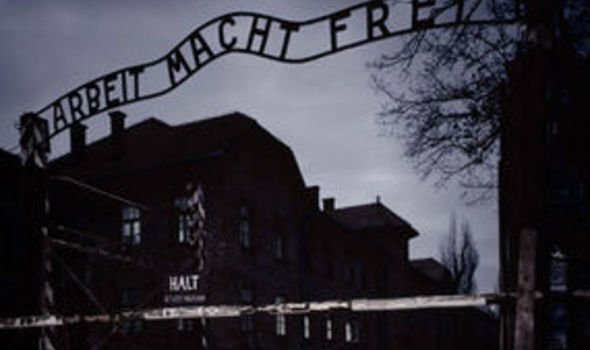 |
| "The hellish entrance at Auschwitz." |
By Caroline Moorehead
Daily Express, August 21, 2011
"On an icy dawn in January 1943, 230 French women were herded on to four cattle trucks in the station of Compiègne. The eldest was a 68-year-old farmer’s wife, the youngest a 15-year-old schoolgirl. In between were teachers and shopkeepers, factory workers and students.Arrested by French police on the orders of the German occupying forces for resistance activities, acting as liaison officers, hiding weapons or writing anti- German slogans on the walls, they had been selected as a warning to troublemakers. Other resisters arrested like them from all over France were being sent to prison or to labour camps in Germany. This group was going to the death camp of Auschwitz. However, these 230 women had deep bonds of friendship and affection born during the many months they had been held together in the old fort of Romainville on the outskirts of Paris. Though separated by age, class, politics and education, they had listened to each other's stories, comforted those who had left children behind, looked after those who were little more than children themselves. They had shared their meagre rations, fought for better conditions, watched each other's backs.
India / Kashmir
Mass Graves Hold Thousands, Kashmir Inquiry Finds
By Lydia Polgreen
The New York Times August 22, 2011
"Thousands of bullet-riddled bodies are buried in dozens of unmarked graves across Kashmir, a state human rights commission inquiry has concluded, many of them likely to be those of civilians who disappeared more than a decade ago in the brutal insurgency in the troubled region. The inquiry, the result of three years of investigative work by senior police officers working for the Jammu and Kashmir State Human Rights Commission, brings the first official acknowledgment that civilians might have been buried in mass graves in Kashmir, a region claimed by both India and Pakistan where insurgents waged a bloody battle for independence in the early 1990s. The report sheds new light on a grim chapter in the history of the troubled province and confirms a 2008 report by a Kashmiri human rights organization that found hundreds of bodies buried in the Kashmir Valley. Tens of thousands of people died in the insurgency, which began in 1989 and was partly fueled by training, weapons and cash from Pakistan. According to the report, the bodies of hundreds of men described as unidentified militants were buried in unmarked graves. But of the more than 2,000 bodies, 574 were identified as local residents. 'There is every probability that these unidentified dead bodies buried in various unmarked graves at 38 places of North Kashmir may contain the dead bodies of enforced disappearances,' the report said.
By Lydia Polgreen
The New York Times August 22, 2011
"Thousands of bullet-riddled bodies are buried in dozens of unmarked graves across Kashmir, a state human rights commission inquiry has concluded, many of them likely to be those of civilians who disappeared more than a decade ago in the brutal insurgency in the troubled region. The inquiry, the result of three years of investigative work by senior police officers working for the Jammu and Kashmir State Human Rights Commission, brings the first official acknowledgment that civilians might have been buried in mass graves in Kashmir, a region claimed by both India and Pakistan where insurgents waged a bloody battle for independence in the early 1990s. The report sheds new light on a grim chapter in the history of the troubled province and confirms a 2008 report by a Kashmiri human rights organization that found hundreds of bodies buried in the Kashmir Valley. Tens of thousands of people died in the insurgency, which began in 1989 and was partly fueled by training, weapons and cash from Pakistan. According to the report, the bodies of hundreds of men described as unidentified militants were buried in unmarked graves. But of the more than 2,000 bodies, 574 were identified as local residents. 'There is every probability that these unidentified dead bodies buried in various unmarked graves at 38 places of North Kashmir may contain the dead bodies of enforced disappearances,' the report said.
Thursday, August 11, 2011
El Salvador / Spain
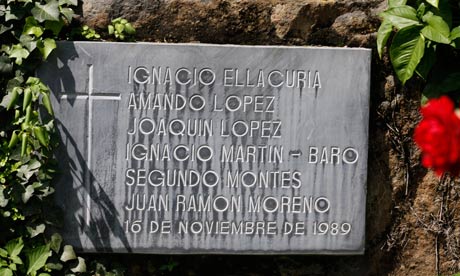 |
| "A stone engraved with the names of the six Jesuit priests killed during El Salvador's 1980-92 civil war." (Luis Galdamez/Reuters) |
By Stephen Burgen
The Guardian, August 9, 2011
"In one of the worst atrocities of El Salvador's dirty wars, members of the military murdered six Jesuit priests, their housekeeper and her 16-year-old daughter 22 years ago. Now an extradition battle looms after the defence ministry handed over nine of the 20 accused to the judicial authorities in a move that has surprised many human rights workers. The soldiers, all retired, include two generals. According to the El Salvador daily El Faro, the suspects presented themselves voluntarily so as to avoid being photographed in handcuffs. Five of the murdered priests were Spanish and in 2008 the Spanish Human Rights Association and the San Francisco-based Centre for Justice and Accountability demanded the extradition of the 20 accused. The extradition order was ratified by Spain's highest court. When the case first went to court in El Salvador in 1991, only two officers were found guilty of murder but were freed almost immediately under an amnesty law passed in 1993. Eloy Velasco, the Spanish judge in charge of the case, regards the 1991 trial as a fraud. 'These are crimes under international law,' said Esther Major, of Amnesty International's Central America team. 'We hope the court will pay regard to its international obligations when it rules on the extradition. We would expect them to allow this extradition and for justice to be sought in the Spanish courts, given that the amnesty law is such a huge obstacle to justice.'
Sunday, August 07, 2011
Bosnia and Herzegovina / Srebrenica Massacre
 |
| "Mevludin Oric, in tears as he recounts the Serb genocide. Captured by the Serbs two days into the Death March, he miraculously survived a brutal mass execution by pretending to be dead." |
By Charlotte Eagar
Daily Mail, August 6, 2011
"The walkers come marching resolutely down the dusty track from the forests, seven and a half thousand of them in bright hiking gear and T-shirts. They are on their way to Srebrenica, an old silver town set in a bowl of rolling, wooded hills. They call themselves the Mars Mira -- the peace march -- but this is no bunch of weekend revolutionaries. There are women, and girls and boys too young to remember the war, but the real heroes of the Mars Mira are the surviving men of Srebrenica, sweaty in the 100-degree heat, clutching the plastic water bottles they wished they had 16 years ago. They set off three days and almost 70 miles ago from the village of Nezuk in northern Bosnia and you can only imagine what memories assail them as they walked through those woods. For the Mars Mira follows (in reverse) the route of Srebrenica's Death March -- the Put Smrti -- along which these men battled for five days, after their town finally fell to the Serbs on July 11, 1995. Srebrenica's name is now synonymous with the worst single act of genocide in Europe since the Nazi Holocaust, when more than 8,000 Bosnian Muslim men were murdered by the Serbs; the actual number is still uncertain, but more than 5,000 bodies have been found so far and thousands more are still missing. But less well known is the extraordinary story of the men who tried to escape the massacre. For although 2,000 wounded and old men did give themselves up and were almost immediately killed, the able-bodied men refused to surrender. [...]"
[n.b. Thanks to Jo Jones for bringing this source to my attention.]
Saturday, August 06, 2011
Bosnia and Herzegovina / Omarska Concentration Camp
| "Kompleks logora Omarska." (BIRN) |
Balkan Investigative Reporting Network, August 6, 2011
"Several hundred former detainees from Prijedor and their families have gathered in Omarska to commemorate August 6th, the day when the disassembly of this camp began 18 years ago. Representatives of victims and families of the killed once more reminded of the initiative to build a Memorial Center in Omarska. According to verdicts of the Hague Tribunal, at the end of May 1992 Serb forces in Prijedor formed the Omarska, Keraterm and Trnopolje camps. Omarska camp was placed near the former coal mine in the Omarska village. During its work, more then 3000 detainees were held there, and a third was killed. All three camps were closed at the end of August 1992 under pressure from the International community, and the disassembly of Omarska started on August 6th. The site of the camp, which consisted of hangars, the management building and the so-called white and red houses, is owned today by Mittal Steel mines. The Prijedor residents started an initiative in 2004 to build a Memorial center in the White house. At the commemoration of the 18th anniversary for killings in Prijedor, Fatima Fazlic president of the 'Association of Prijedor women - Izvor' said they will ask for the entire Mittal Steel facility, and all four buildings where Bosniaks and Croats were held, to be turned into a Memorial center.
Sudan / South Kordofan
 |
| "Representative Chris Smith (pictured in June), who heads the House Foreign Affairs subcommittee on Africa, on Friday urged the immediate deployment of peacekeepers to Sudan's war-torn border region of Southern Kordofan, warning of a risk of 'genocide' by government forces." (AFP/File/Jim Watson) |
Agence France-Presse dispatch on Yahoo! News, August 5, 2011
"A senior US lawmaker urged the immediate deployment of peacekeepers to Sudan's war-torn border region of Southern Kordofan, warning of a risk of 'genocide' by government forces. South Sudan last month broke away from Sudan to become the world's newest independent nation but violence has persisted in Southern Kordofan, an oil-producing region that remains under Khartoum's rule. Representative Chris Smith, who heads the House Foreign Affairs subcommittee on Africa, on Friday said there were credible signs of systematic attacks by Sudan's Arab and Muslim forces against the largely Christian Nubian people. 'There has been far too little interest shown and there are no UN peacekeepers to help provide at least some semblance of protection. So the people are just being mowed down,' Smith said in an interview on C-SPAN's 'Newsmakers' program to air on Sunday. 'We have another potential genocide -- certainly mass killing -- because of who they are, their ethnicity and their faith,' Smith said.
Friday, August 05, 2011
Sudan / United Nations
Sudan Needs to Stop Harassing UN Peacekeepers To Death
By Lauren Jenkins
UNDispatch.com, August 5, 2011
"UN peacekeepers had just arrived in Abyei, Sudan earlier this month to monitor the withdrawal of warring northern and southern Sudanese forces when their convoy hit a landmine. One died instantly, ten more were wounded. The UN called for a Medevac helicopter to get the others emergency medical attention, but the government of Sudan refused to allow the airlift. In fact, they threatened to shoot the helicopter down. Negotiations for the airlift took three hours during which time three injured peacekeepers died. Those peacekeepers were part a 4,200 strong peacekeeping force in Abyei called UNISFA. Their deaths were the latest tragedy in a long series of obstructions, obfuscations and official harassment of UN peacekeeping missions operating in Sudanese territory. Take, for example, the other peacekeeping mission in Sudan, the African Union -United Nations Mission in Darfur (UNAMID). Last Friday, the UN Security Council renewed the mandate of UNAMID). The one-year extension keeps over 19,000 peacekeepers in Darfur protecting civilians and creating space for humanitarian operations and calls on Sudan to remedy myriad issues -- specifically the deteriorating security situation due to aerial bombardments by the government of Sudan. (Just last week, Sudanese air strikes on the village of Abu Hamara killed one civilian and forced others to flee the onslaught according to UN peacekeepers there.) Both votes on the two peacekeeping missions were unanimous, 15-0.
By Lauren Jenkins
UNDispatch.com, August 5, 2011
"UN peacekeepers had just arrived in Abyei, Sudan earlier this month to monitor the withdrawal of warring northern and southern Sudanese forces when their convoy hit a landmine. One died instantly, ten more were wounded. The UN called for a Medevac helicopter to get the others emergency medical attention, but the government of Sudan refused to allow the airlift. In fact, they threatened to shoot the helicopter down. Negotiations for the airlift took three hours during which time three injured peacekeepers died. Those peacekeepers were part a 4,200 strong peacekeeping force in Abyei called UNISFA. Their deaths were the latest tragedy in a long series of obstructions, obfuscations and official harassment of UN peacekeeping missions operating in Sudanese territory. Take, for example, the other peacekeeping mission in Sudan, the African Union -United Nations Mission in Darfur (UNAMID). Last Friday, the UN Security Council renewed the mandate of UNAMID). The one-year extension keeps over 19,000 peacekeepers in Darfur protecting civilians and creating space for humanitarian operations and calls on Sudan to remedy myriad issues -- specifically the deteriorating security situation due to aerial bombardments by the government of Sudan. (Just last week, Sudanese air strikes on the village of Abu Hamara killed one civilian and forced others to flee the onslaught according to UN peacekeepers there.) Both votes on the two peacekeeping missions were unanimous, 15-0.
Croatia / Operation Storm
 |
| "Markac, left, and Gotovina were sentenced in April to prison terms of 18 and 24 years respectively." (EPA/Getty) |
The Telegraph, August 5, 2011
"Jadranka Kosor, the Croatian prime minister, has hailed two ex-generals jailed by a UN war crimes court for their role in the offensive that ended the 1991-1995 Croatian war on the operation's anniversary. 'A special greeting I send to all Croatian veterans, all of Croatia's generals and particularly to generals Ante Gotovina and Mladen Markac,' Kosor said in the southern town of Knin at a ceremony marking the anniversary of Operation Storm, broadcast live by national television. 'Without Storm and the commanders that had led it ... we would have not been here today, we would have nothing to celebrate and to be proud of,' Kosor said. Launched on August 4, 1995, Operation Storm was aimed at recapturing part of Croatian territory held by Belgrade-backed rebel Serbs who opposed Croatia's independence from the former Yugoslavia. Hundreds of Serb civilians were killed and tens of thousands fled Croatia during and after the operation.
Rwanda / Genocide Tribunals
 |
| "Rwandan president Paul Kagame is accused of ensuring that the so-called gacaca courts did not threaten the existing politcal order." (Reuters) |
By Daniel Howden
The Independent, August 5, 2011
"Rwanda's widely praised community genocide courts, due to wind up later this year, have done nothing to 'heal ethnic divisions' and have been used to 'bolster government authority', according to a new report by one of the country's leading donors. The unique 'gacaca' courts, which have heard more than one million cases, have been hailed as the centrepiece of the mountain nation's miracle recovery from the 1994 genocide but their reputation has been disputed in a study by the Japanese aid corporation, JICA. The courts were touted as an 'African solution' that would heal the legacy left by a Hutu-led genocide that killed nearly one in ten Rwandese, many from the Tutsi minority. But the gacaca courts are regarded in Rwanda as handing out 'victor's justice', argues researcher Shinichi Takeuch, who says they 'have done nothing to appease underlying ethnic tensions in the country.' Nearly a decade after 800,000 people were murdered in a 100-day killing spree, impoverished Rwanda found itself with 135,000 detainees and only 12 courts to process their cases. The innovative answer was to revive the concept of the customary 'courtyard' or 'gacaca' hearings and 11,000 of these courts were set up. All but the top tier suspects -- the planners and instigators of the genocide, notorious mass murderers and rapists who were sent to a UN tribunal -- went to gacaca courts where witnesses could confront alleged perpetrators.
Bosnia and Herzegovina / Netherlands / Srebrenica Massacre
UN Commander Expects Charges over Srebrenica
By Peter Cluskey
The Irish Times, August 5, 2011
"The military officer who commanded Dutch UN peacekeepers at the time of the Srebrenica massacre in 1995 has said he believes he may soon face criminal charges -- 16 years after Bosnian Serb forces overran the UN 'safe haven', killing almost 8,000 Muslim men and boys. Retired colonel Thomas Karremans -- who was a lieutenant-colonel in 1995 and was promoted to colonel on his return from Bosnia -- said he expects he may be called to account before judges in Arnhem, where members of the military are tried by a special section of the civilian court. That likelihood has been increased by last month's court of appeal ruling that the Dutch state was responsible for the deaths of three Muslim men who were denied protection when they were turned away from the Dutchbat compound in Srebrenica and later killed by the Serbs. Col. Karremans and two other officers -- his former deputy, Maj Rob Franken, and former personnel officer Berend Oosterveen -- are already facing civil actions begun only last year by relatives of those who died in Srebrenica, the worst atrocity in Europe since the second World War. Col. Karremans (63) was at the head of the 110 lightly armed Dutch soldiers as the Bosnian Serb troops under the command of Gen Ratko Mladic -- now facing 11 charges of genocide, war crimes and crimes against humanity -- advanced on the enclave. The colonel told the war crimes tribunal for the former Yugoslavia in 1996 that he called in Nato air strikes, but when they came they were 'too late and too little.' However, as the Dutch pulled out of Srebrenica he accepted gifts from Gen. Mladic, smiled and shook his hand.
By Peter Cluskey
The Irish Times, August 5, 2011
"The military officer who commanded Dutch UN peacekeepers at the time of the Srebrenica massacre in 1995 has said he believes he may soon face criminal charges -- 16 years after Bosnian Serb forces overran the UN 'safe haven', killing almost 8,000 Muslim men and boys. Retired colonel Thomas Karremans -- who was a lieutenant-colonel in 1995 and was promoted to colonel on his return from Bosnia -- said he expects he may be called to account before judges in Arnhem, where members of the military are tried by a special section of the civilian court. That likelihood has been increased by last month's court of appeal ruling that the Dutch state was responsible for the deaths of three Muslim men who were denied protection when they were turned away from the Dutchbat compound in Srebrenica and later killed by the Serbs. Col. Karremans and two other officers -- his former deputy, Maj Rob Franken, and former personnel officer Berend Oosterveen -- are already facing civil actions begun only last year by relatives of those who died in Srebrenica, the worst atrocity in Europe since the second World War. Col. Karremans (63) was at the head of the 110 lightly armed Dutch soldiers as the Bosnian Serb troops under the command of Gen Ratko Mladic -- now facing 11 charges of genocide, war crimes and crimes against humanity -- advanced on the enclave. The colonel told the war crimes tribunal for the former Yugoslavia in 1996 that he called in Nato air strikes, but when they came they were 'too late and too little.' However, as the Dutch pulled out of Srebrenica he accepted gifts from Gen. Mladic, smiled and shook his hand.
Thursday, August 04, 2011
Sri Lanka / Switzerland
Rights Groups Ask Swiss to Press War Crimes Case against Sri Lankan Diplomat
Associated Press dispatch in The Washington Post, August 4, 2011
"Two advocacy groups asked Swiss authorities Thursday to pursue war crime charges against a former Sri Lankan army commander now serving as a European diplomat, reflecting still-simmering Western concerns about the South Asian island nations' [sic] human rights record. The Swiss-based groups Society for Threatened Peoples and TRIAL said they filed a confidential complaint with Switzerland's attorney general against Jagath Dias, a former major general in Sri Lanka's final offensive that smashed a 26-year rebellion by ethnic minority Tamils in May 2009. The United Nations estimates between 80,000 and 100,000 people were killed during the civil war. Dias, whose Sri Lankan forces captured some of the rebel Tamil Tigers' last strongholds, became Sri Lanka's deputy ambassador to Germany, Switzerland and the Vatican in September 2009. Dias, reached at his embassy in Berlin, said it's easy to make accusations, but he denied being a war criminal. 'Anybody can accuse anyone of anything. I don't see that any of these allegations are well founded,' he told The Associated Press. 'We did our best to complete the military operation with zero casualties. How could we have released or rescued 300,000 people if we really wanted to destroy them?' About 300,000 Tamil civilians were caught in the climactic battle. The government then carved camps out of the jungles of northern Sri Lanka to hold them and screen out former rebels who could stir up trouble. The Swiss groups' complaint -- based largely on the findings of the United Nations and other international organizations -- says Dias' army division was responsible for massive bombing of civilians and hospitals. The groups said in a statement that 'it is high time that Switzerland gives a clear signal against impunity' by pressing criminal charges against him.
Associated Press dispatch in The Washington Post, August 4, 2011
"Two advocacy groups asked Swiss authorities Thursday to pursue war crime charges against a former Sri Lankan army commander now serving as a European diplomat, reflecting still-simmering Western concerns about the South Asian island nations' [sic] human rights record. The Swiss-based groups Society for Threatened Peoples and TRIAL said they filed a confidential complaint with Switzerland's attorney general against Jagath Dias, a former major general in Sri Lanka's final offensive that smashed a 26-year rebellion by ethnic minority Tamils in May 2009. The United Nations estimates between 80,000 and 100,000 people were killed during the civil war. Dias, whose Sri Lankan forces captured some of the rebel Tamil Tigers' last strongholds, became Sri Lanka's deputy ambassador to Germany, Switzerland and the Vatican in September 2009. Dias, reached at his embassy in Berlin, said it's easy to make accusations, but he denied being a war criminal. 'Anybody can accuse anyone of anything. I don't see that any of these allegations are well founded,' he told The Associated Press. 'We did our best to complete the military operation with zero casualties. How could we have released or rescued 300,000 people if we really wanted to destroy them?' About 300,000 Tamil civilians were caught in the climactic battle. The government then carved camps out of the jungles of northern Sri Lanka to hold them and screen out former rebels who could stir up trouble. The Swiss groups' complaint -- based largely on the findings of the United Nations and other international organizations -- says Dias' army division was responsible for massive bombing of civilians and hospitals. The groups said in a statement that 'it is high time that Switzerland gives a clear signal against impunity' by pressing criminal charges against him.
Syria
Death Toll Rises Sharply in Center of Syrian Revolt
By Nada Bakri
The New York Times, August 4, 2011
"The Syrian military forces that rolled into the rebellious city of Hama and occupied its central square have killed more than 100 people over the past 24 hours, according to rights activists in satellite telephone contact with a witness in the city. The ominous new toll raised the rough count of civilian dead there to more than 200 since the military's tanks began shelling Hama over the weekend. The military's assault on the city, a linchpin of the five-month-old uprising against the iron-handed government of President Bashar al-Assad, represents one of the fiercest efforts yet to crush the uprising and a signal of Mr. Assad's defiance in the face of growing international condemnation. Activists say the overall toll since March is more than 1,700. With foreign journalists barred from the country and the government close-mouthed about most aspects of the rebellions, activists have been the main source of information on the crackdowns and casualties. Landlines, cellphones, Internet service, electricity and water remained cut for the second consecutive day in Hama. Satellite connections offered perhaps the only route left to get information out. Activists said they feared the near total media blackout on the city would allow the military to pursue an unrestrained assault. Their fear is only deepened by the painful legacy of Hama, where Mr. Assad's father crushed an uprising in 1982 out of sight of the world, leaving upwards of 10,000 people dead and parts of the city leveled. Other activists spoke of a critical shortage in basic food staples and medical equipment. Hama has been surrounded since Sunday; cars trying to carry food into the city have been attacked, according to reports in recent days. Hundreds of people have been arrested in house-to-house raids. A resident who spoke to Al-Jazeera Satellite Channel said that shelling had been nearly continuous since the day before and that the city was completely disconnected from the outside world and from villages and towns surrounding it. 'The situation is very difficult,' he said, giving his name as Abu Al-Walid. 'The lack of electricity has spoiled food supplies. They are shelling the city around the clock.'
By Nada Bakri
The New York Times, August 4, 2011
"The Syrian military forces that rolled into the rebellious city of Hama and occupied its central square have killed more than 100 people over the past 24 hours, according to rights activists in satellite telephone contact with a witness in the city. The ominous new toll raised the rough count of civilian dead there to more than 200 since the military's tanks began shelling Hama over the weekend. The military's assault on the city, a linchpin of the five-month-old uprising against the iron-handed government of President Bashar al-Assad, represents one of the fiercest efforts yet to crush the uprising and a signal of Mr. Assad's defiance in the face of growing international condemnation. Activists say the overall toll since March is more than 1,700. With foreign journalists barred from the country and the government close-mouthed about most aspects of the rebellions, activists have been the main source of information on the crackdowns and casualties. Landlines, cellphones, Internet service, electricity and water remained cut for the second consecutive day in Hama. Satellite connections offered perhaps the only route left to get information out. Activists said they feared the near total media blackout on the city would allow the military to pursue an unrestrained assault. Their fear is only deepened by the painful legacy of Hama, where Mr. Assad's father crushed an uprising in 1982 out of sight of the world, leaving upwards of 10,000 people dead and parts of the city leveled. Other activists spoke of a critical shortage in basic food staples and medical equipment. Hama has been surrounded since Sunday; cars trying to carry food into the city have been attacked, according to reports in recent days. Hundreds of people have been arrested in house-to-house raids. A resident who spoke to Al-Jazeera Satellite Channel said that shelling had been nearly continuous since the day before and that the city was completely disconnected from the outside world and from villages and towns surrounding it. 'The situation is very difficult,' he said, giving his name as Abu Al-Walid. 'The lack of electricity has spoiled food supplies. They are shelling the city around the clock.'
Wednesday, August 03, 2011
Guatemala / National Tribunals
 |
| "A woman celebrates outside the court at the end of a trial in Guatemala City on Tuesday. The court sentenced three former special forces soldiers to 6,060 years in prison each for the massacre of more than 200 men, women and children." (Rodrigo Abd/AP) |
Associated Press dispatch on MSNBC.com, August 3, 2011
"A Guatemalan court has sentenced four former soldiers to more than 6,000 years in prison each for the 1982 massacre of 201 men, women and children during the Central American country's civil war. Three former special forces soldiers received 6,060 years in prison each on Tuesday. The court also sentenced a former army second lieutenant to 6,066 years in prison for the same massacre in the village of Dos Erres in Guatemala's northern Peten region. The length of the sentences is largely symbolic since under Guatemalan law the maximum time a convict can serve is 50 years. The sentences for Manuel Pop Sun, Reyes Collin Gualip and Daniel Martinez include thirty years for each death, plus thirty years for crimes against humanity. The three men are former members the Guatemalan military's elite Kaibil unit. Former 2nd Lt. Carlos Antonio Carias received an extra six years for stealing the victims' belongings, the court said in a statement. Prosecutors say Carias was in charge of a military base near the community of Dos Erres and provided information to the army that led to the massacre. Outside the court, survivors of the massacre cried when the sentences were announced and held red roses.
Syria / United Nations
UN Condemns Syrian Attacks on Civilians
Associated Press dispatch on MSNBC.com, August 3, 2011
"The UN Security Council has condemned Syrian authorities for attacking civilians and committing widespread human rights violations. After more than three months of deadlock and silence on the escalating violence in Syria, the council adopted a presidential statement Wednesday afternoon condemning President Bashar Assad's crackdown on anti-government protesters. The trigger for the council to start negotiations on a text was the intense military assault launched by they Syrian government over the weekend that sent troops and tanks into the besieged city of Hama. Presidential statements require approval from all 15 council members. Lebanon, a neighbor and close ally of Syria, didn't block adoption of the statement, but it invoked a procedure last used 35 years ago and dissociated itself from the text. The White House also hardened its stance against Assad on Wednesday, saying the United States viewed him as the cause of instability in the country. 'We do not want to see him remain in Syria for stability's sake and, rather, we view him as the cause of instability in Syria,' Carney told a news briefing, toughening the US position on the Syrian leader who has launched military assaults against unarmed protesters.
Associated Press dispatch on MSNBC.com, August 3, 2011
"The UN Security Council has condemned Syrian authorities for attacking civilians and committing widespread human rights violations. After more than three months of deadlock and silence on the escalating violence in Syria, the council adopted a presidential statement Wednesday afternoon condemning President Bashar Assad's crackdown on anti-government protesters. The trigger for the council to start negotiations on a text was the intense military assault launched by they Syrian government over the weekend that sent troops and tanks into the besieged city of Hama. Presidential statements require approval from all 15 council members. Lebanon, a neighbor and close ally of Syria, didn't block adoption of the statement, but it invoked a procedure last used 35 years ago and dissociated itself from the text. The White House also hardened its stance against Assad on Wednesday, saying the United States viewed him as the cause of instability in the country. 'We do not want to see him remain in Syria for stability's sake and, rather, we view him as the cause of instability in Syria,' Carney told a news briefing, toughening the US position on the Syrian leader who has launched military assaults against unarmed protesters.
Thursday, July 21, 2011
Kenya / United Kingdom / Mau Mau Uprising
 |
| "L-R: Ndiku Mutua, Jane Muthoni Mara and Wambugu Wa Nyingi claimed they were tortured." |
By Dominic Casciani
BBC Online, July 21, 2011
"Four elderly Kenyans have been told they can sue the Foreign Office for their alleged torture by British colonial authorities 50 years ago. The High Court said the group could seek damages over their treatment during the 1950s and 60s. Mr. Justice McCombe said the claimants had an 'arguable case' and it would be 'dishonourable' to block the action. Ministers say the UK government is not responsible for the actions of the colonial administration. The decision means that the government will have to defend accusations of torture, murder, sexual assault and other alleged abuses at a full damages trial in 2012. The four Kenyans, Ndiku Mutwiwa Mutua, Paulo Muoka Nzili, Wambugu Wa Nyingi and Jane Muthoni Mara, all in their 70s and 80s, say ministers in London approved systematic abuse in special camps. A fifth claimant has died since the action began. The High Court heard that Mr. Mutua and Mr. Nzili had been castrated, Mr. Nyingi was beaten unconscious in an incident in which 11 men were clubbed to death, and Mrs. Mara had been subjected to appalling sexual abuse. Mr. Justice McCombe said in his judgement there was 'ample evidence' to show there may have been 'systematic torture of detainees during the Emergency.'
Cambodian Genocide
Cambodia's Muslims Seek Justice for Genocide
By International Justice Tribune
Radio Netherlands Worldwide, July 18, 2011
"Zakaria Bin Ahmad cannot forget the years of horror under the brutal Khmer Rouge when even praying was to risk death for Cambodia's persecuted minority Muslims. Many others in his community did not survive the late 1970s reign of terror by the hardline communist regime, which executed Islamic scholars, destroyed mosques, forced Muslims to eat pork and forbade headscarves. 'People tried all kinds of ways to pray. Sometimes while they were driving an ox cart ... sometimes in the jungle when we asked to use the toilet, and sometimes while we were washing,' the 61-year-old recalled. But mostly, he remembers people disappearing, never to be seen again. 'Many were killed,' he said quietly in his modest home in the shadow of a modern blue-domed mosque, a source of pride for the town of Chraing Chamres, whose earlier place of worship was destroyed by the Khmer Rouge. Cambodian Muslims, known as Cham, hope finally to see justice as the most senior surviving Khmer Rouge leaders stand trial for genocide at Cambodia's UN-backed court over the treatment of the ethnic and religious minority. 'Now we can tell our story,' said Sales Pin Apoutorliep, the religious leader, or hakem, of the Chraing Chamres mosque.
By International Justice Tribune
Radio Netherlands Worldwide, July 18, 2011
"Zakaria Bin Ahmad cannot forget the years of horror under the brutal Khmer Rouge when even praying was to risk death for Cambodia's persecuted minority Muslims. Many others in his community did not survive the late 1970s reign of terror by the hardline communist regime, which executed Islamic scholars, destroyed mosques, forced Muslims to eat pork and forbade headscarves. 'People tried all kinds of ways to pray. Sometimes while they were driving an ox cart ... sometimes in the jungle when we asked to use the toilet, and sometimes while we were washing,' the 61-year-old recalled. But mostly, he remembers people disappearing, never to be seen again. 'Many were killed,' he said quietly in his modest home in the shadow of a modern blue-domed mosque, a source of pride for the town of Chraing Chamres, whose earlier place of worship was destroyed by the Khmer Rouge. Cambodian Muslims, known as Cham, hope finally to see justice as the most senior surviving Khmer Rouge leaders stand trial for genocide at Cambodia's UN-backed court over the treatment of the ethnic and religious minority. 'Now we can tell our story,' said Sales Pin Apoutorliep, the religious leader, or hakem, of the Chraing Chamres mosque.
Wednesday, July 20, 2011
Serbia / Croatia / Genocide Tribunals
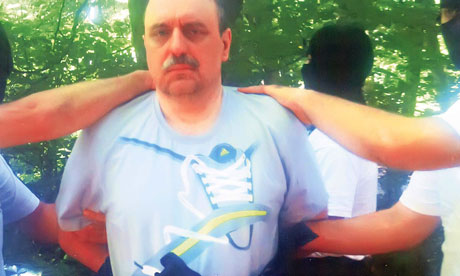 |
| "A handout photograph of Serbian war crimes suspect Goran Hadzic being arrested in Fruska Gora national park, west of Belgrade. He was the last remaining fugitive sought by the UN war crimes tribunal." (Politika newspaper) |
By Ian Traynor
The Guardian, July 20, 2011
"The Yugoslav war crimes tribunal crowned 18 years of operations on Wednesday with the capture of the last of 161 suspects from the wars of the 1990s when Goran Hadzic, a leader of the Serbian insurgency in Croatia, was arrested by the Serbian authorities. The arrest, two months after Belgrade captured genocide suspect General Ratko Mladic and dispatched him for trial in The Hague, marked a turning point for Serbia in seeking to put a blood-soaked, criminalised past behind it and join the European mainstream. The arrest was also a big moment for the UN tribunal in The Hague. Every one of the 161 main war crimes suspects indicted for atrocities in Croatia, Bosnia, Serbia, and Kosovo has now been apprehended and tried or is awaiting trial. 'This is a precedent of enduring significance, not only for this tribunal, but also for international criminal justice more generally,' said Serge Brammertz, the chief prosecutor at the International Criminal Tribunal for the former Yugoslavia in The Hague. 'A milestone in the tribunal's history,' added Judge O-Gon Kwon, the acting head of the temporary court established in 1993 at the height of the wars in Croatia and Bosnia. Hadzic, a former warehouse worker from Slavonia, a region in east Croatia, was a political leader of the Serbian rebellion in 1991, armed and sponsored by Slobodan Milosevic's regime in Belgrade. He led ethnic pogroms and armed insurrection against Zagreb, after Croatia's secession from Yugoslavia in June 1991, resulting in partition of the country and the Serbian seizure of a quarter of the territory during the war.
Monday, July 18, 2011
Uganda / Rape of Males in Wartime
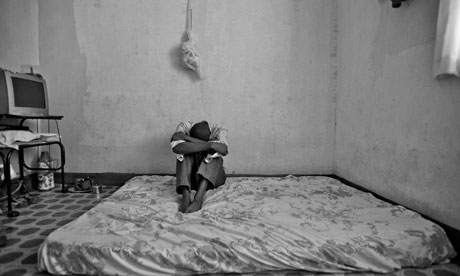 |
| "Dying of shame: a Congolese rape victim, currently resident in Uganda. This man's wife has left him, as she was unable to accept what happened. He attempted suicide at the end of last year." (Will Storr/Observer) |
By Will Storr
The Observer, July 17, 2011
"Of all the secrets of war, there is one that is so well kept that it exists mostly as a rumour. It is usually denied by the perpetrator and his victim. Governments, aid agencies and human rights defenders at the UN barely acknowledge its possibility. Yet every now and then someone gathers the courage to tell of it. This is just what happened on an ordinary afternoon in the office of a kind and careful counsellor in Kampala, Uganda. For four years Eunice Owiny had been employed by Makerere University's Refugee Law Project (RLP) to help displaced people from all over Africa work through their traumas. This particular case, though, was a puzzle. A female client was having marital difficulties. 'My husband can't have sex,' she complained. 'He feels very bad about this. I'm sure there's something he's keeping from me.' Owiny invited the husband in. For a while they got nowhere. Then Owiny asked the wife to leave. The man then murmured cryptically: 'It happened to me.' Owiny frowned. He reached into his pocket and pulled out an old sanitary pad. 'Mama Eunice,' he said. 'I am in pain. I have to use this.' Laying the pus-covered pad on the desk in front of him, he gave up his secret. During his escape from the civil war in neighbouring Congo, he had been separated from his wife and taken by rebels. His captors raped him, three times a day, every day for three years. And he wasn't the only one. He watched as man after man was taken and raped. The wounds of one were so grievous that he died in the cell in front of him. 'That was hard for me to take,' Owiny tells me today. 'There are certain things you just don't believe can happen to a man, you get me? But I know now that sexual violence against men is a huge problem. Everybody has heard the women's stories. But nobody has heard the men's.'
Subscribe to:
Posts (Atom)

 Posts
Posts