Wednesday, November 30, 2011

Ivory Coast / International Tribunals

"Laurent Gbagbo, former President of Ivory Coast, and his wife Simone are watched by republican forces in a hotel in Abidjan, Ivory Coast, on Monday, April 11, 2011." (Aristide Bodegla/AP)
Ivory Coast's Gbagbo in Custody at ICC
By Mike Corder
Associated Press dispatch on Time.com, November 30, 2011
"The International Criminal Court charged former Ivory Coast President Laurent Gbagbo with murder, rape, persecution and inhuman acts Wednesday, crimes allegedly committed as his backers fought brutal battles to keep him in power last year. Gbagbo, 66, is the first former head of state taken into custody by the court since it was established in 2002, although prosecutors also have charged Sudanese President Omar al-Bashir with genocide and Libya's former leader, the late Moammar Gadhafi, with crimes against humanity. 'Mr. Gbagbo is brought to account for his individual responsibility in the attacks against civilians committed by forces acting on his behalf,' Prosecutor Luis Moreno-Ocampo said in a statement. 'He is presumed innocent until proven guilty and will be given full rights and the opportunity to defend himself.' Moreno-Ocampo stressed that both sides of the political divide in Ivory Coast committed crimes in the post-election chaos and that his investigation was continuing. That statement appeared aimed at countering fears that Gbagbo's arrest could further stoke tension in Ivory Coast because it gives the appearance of victor's justice. Grave abuses were also committed by forces loyal to the country's democratically elected leader, Alassane Ouattara, who enlisted the help of a former rebel group to force Gbagbo from office. ...

Chile / United States

Chile Seeks Extradition of ex-US Military Officer in 1973 Death
By Fabiola Gutierrez and Chris Kraul, Los Angeles Times
The Los Angeles Times, November 30, 2011
"A Chilean judge is seeking the extradition of a former U.S. military officer to face murder charges in the 1973 slaying of freelance journalist and filmmaker Charles Horman, a case dramatized in the Oscar-winning film 'Missing,' court sources confirmed Tuesday. Judge Jorge Zepeda wants former U.S. Navy Capt. Ray E. Davis, whose whereabouts were not immediately clear Tuesday, to face trial in Chile for his alleged involvement in the deaths of Horman and US student Frank Teruggi. The two Americans were arrested and executed by Chilean forces shortly after President Salvador Allende was overthrown in a military coup on Sept. 11, 1973. Horman, 31, was working as a screenwriter for state-run Chile Films when military rebel forces led by Gen. Augusto Pinochet attacked the presidential palace La Moneda. Allende committed suicide that day rather than surrender. Horman was arrested Sept. 17 and executed the next day, according to court documents. His body later was found on a Santiago street. Teruggi, 24, was killed Sept. 22 and his body also dumped on a street in the capital. Davis then was head of the U.S. military group attached to the American Embassy in Santiago. A recent truth commission found that 41,000 people were arrested, tortured or killed during Pinochet's 16-year reign of terror. At least 3,200 are thought to have died. Zepeda wrote in court documents that his investigation bore out suspicions from the outset that 'there was participation [in the murders] by citizens of the same nationality.' Zepeda wrote that Davis did nothing to stop the execution of the two Americans 'although he had the opportunity of doing so,' and that he is suspected of giving Pinochet officials a 'list of subversive US citizens in Chile.' A former top official with Chile's DINA intelligence agency, Gen. Pedro Espinoza, was also charged with homicide in the cases.

United States / Genocides of Indigenous Peoples

"Walter Littlemoon speaks to students at Colorado State University." (Mike Kalush, The Rocky Mountain Collegian / The Thick Dark Fog)
New Documentary Tracks Cultural Genocide of American Indians
By Rose Aguilar
Truthout.org, November 24, 2011
"In 1892, US Army officer Richard Pratt delivered a speech in which he described his philosophy behind US government-run boarding schools for American Indians. 'A great general has said that the only good Indian is a dead one,' he said. 'In a sense, I agree with the sentiment, but only in this: that all the Indian there is in the race should be dead. Kill the Indian in him, and save the man.' From 1879 until the 1960s, more than 100,000 American Indian children were forced to attend boarding schools. Children were forcibly removed or kidnapped from their homes and taken to the schools. Families risked imprisonment if they stood in the way or attempted to take their children back. Many of the country's 100 schools were still active up until the 1970s. Generations of children were subjected to dehumanization, cruelty and beatings, all intended to strip them of their Native identity and culture. The ultimate goal was to 'civilize' the children. A new documentary, 'The Thick Dark Fog,' shines a light on the traumatic boarding school experience through the telling of personal stories. The film focuses on Walter Littlemoon, a Lakota who was forced to attend a federal government boarding school on the Pine Ridge Reservation in South Dakota in the 1950s. Littlemoon says his culture, language and spirituality were brutally suppressed. 'The government school had tried to force me to forget the Lakota language and I wouldn't do it,' he says in the film. 'We had a deep sense of preservation for our culture, so we would go and hide in order to speak Lakota. If we got caught, they were allowed to beat us with whatever they could, but we took that chance. The Lakota language is something that comes from deep inside of you. It comes from how you look at things and how you see things.' 'The Thick Dark Fog' profiles Walter's healing process and attempt to reclaim his heritage. 'It wasn't until my sixtieth year that I began to realize that there was more to me. Something was missing. It was like I was a nonbeing,' he says. 'I didn't know the medical words of multigenerational trauma or the complex post-traumatic stress disorder, so I called the problem what I felt it to be: the thick dark fog.' ... In 2008, the Canadian Government set up a Truth and Reconciliation Commission to help indigenous peoples tell their stories and heal.  What should the US government do to help indigenous people heal from the abuses they suffered in government-run boarding schools?"
[n.b. Thanks to Morgan Wood for bringing this source to my attention.]

Wednesday, November 23, 2011

Libya / United Nations / Arbitrary Imprisonment / Torture

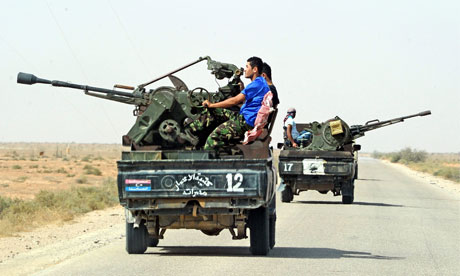
"Libya's former rebels are holding thousands of people in makeshift detention centres, the UN says." (Ciro Fusco/EPA)
Libyan Rebels Detaining Thousands Illegally, Ban Ki-moon Reports
The Guardian, November 24, 2011
"Libya's former rebels have illegally detained thousands of people, including women and children, according to the United Nations secretary general. Many of the 7,000 prisoners have been tortured, with some black Africans mistreated because of their skin colour, women being held under male supervision and children locked up alongside adults, the report by Ban Ki-moon found. The report, due to be published on Monday, presents a grim assessment of Libya following the civil war, with many prisoners held in private jails not under the control of the interim government and denied access to due legal process. The UN chief said: 'While prisoners held by the Gaddafi regime had been released, an estimated 7,000 detainees are currently held in prisons and makeshift detention centres, most of which are under the control of revolutionary brigades.' Prisoners had 'no access to due process in the absence of a functioning police and judiciary', he added. Most courts were 'not fully operational' due to a lack of security and a reduction in the number of judges and administrative staff. Ban said that sub-Saharan Africans accounted for many of the detainees, while members of Libya's Tawerga community had faced reprisals, including revenge killings, for their role in attacks by Gaddafi forces on the city of Misrata. While Gaddafi employed some fighters from neighbouring countries as mercenaries, other Africans worked in civilian jobs in the oil-rich North African country. Human rights groups claim that some rebels made no distinction between the two. The report raised concern about 'disturbing reports' that war crimes had been committed by the rebels and former government forces in Sirte, where deposed dictator Muammar Gaddafi was captured and killed last month. UN officials have called on Libyans to respect human rights and refrain from revenge attacks after months of fierce fighting between rebels and Gaddafi loyalists. [...]"

Monday, November 21, 2011

Cambodia / Genocide Tribunals

Three Top Khmer Rouge Leaders Go on Trial in Cambodia
By Mark Magnier
The Los Angeles Times, November 21, 2011
"Three top Khmer Rouge leaders accused of helping mastermind Cambodia's 'killing fields' in the 1970s went on trial in Phnom Penh on Monday as hundreds of victims and curious onlookers arrived at the court from around the country to witness the proceedings. The United Nations-backed trial is expected to take months. And, based the conduct of past tribunals in Cambodia, there could be a further extended period of time between the end of testimony and the court's reaching a verdict. This reflects in part the highly political nature of these proceedings in a nation where feelings are still raw from the brutal period of history and where many of those who served in the Khmer Rouge remain prominent in society. Adding some immediacy is the advanced age of many of the victims and accused, creating fears that those who committed atrocities will die before they face justice. The three defendants -- Nuon Chea, 85, the Khmer Rouge's chief ideologist and second in command; Khieu Samphan, 80, an ex-head of state; and leng Sary, 86, the former foreign minister -- sat beside their lawyers Monday in a courtroom especially built for the tribunal. Among the charges they face are crimes against humanity, genocide, religious persecution, homicide and torture."
[n.b. This is the complete text of the dispatch.]
[See also: "Khmer Rouge Trio Accused of Cambodia's 'Worst Horrors'", Reuters dispatch, November 21, 2011.]

Sunday, November 20, 2011

Syria

"A protest against President Bashar al-Assad after Friday Prayer in Homs, Syria, last week. The city, a hot spot of resistance against the government, has recently been the scene of sectarian violence." (Reuters)
Sectarian Strife in City Bodes Ill for All of Syria
By Anthony Shadid
The New York Times, November 19, 2011
"A harrowing sectarian war has spread across the Syrian city of Homs this month, with supporters and opponents of the government blamed for beheadings, rival gangs carrying out tit-for-tat kidnappings, minorities fleeing for their native villages, and taxi drivers too fearful of drive-by shootings to ply the streets. As it descends into sectarian hatred, Homs has emerged as a chilling window on what civil war in Syria could look like, just as some of Syria's closest allies say the country appears to be heading in that direction. A spokesman for the Syrian opposition last week called the killings and kidnappings on both sides 'a perilous threat to the revolution.' An American official called the strife in Homs 'reminiscent of the former Yugoslavia,' where the very term 'ethnic cleansing' originated in the 1990s. 'Over the past couple of weeks, we've seen sectarian attacks on the rise, and really ugly sectarian attacks,' the Obama administration official said in Washington. The longer President Bashar al-Assad 'stays in power, what you see in Homs, you'll see across Syria.'

Wednesday, November 09, 2011

India / Gujarat Genocide

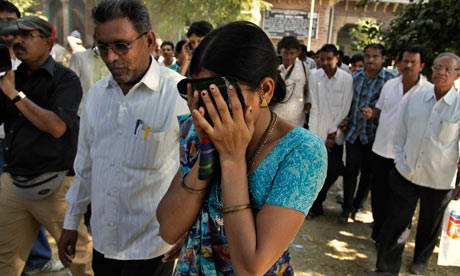
"A relative of one of the Hindus on trial for the killing of dozens of Muslims in a fire breaks down on hearing the verdict in Mehsana, India." (Ajit Solanki/AP)
India Jails 31 Hindus for Life for Killing Muslims
Associated Press dispatch in The Guardian, November 9, 2011
"A court has sentenced 31 Hindus to life imprisonment for killing dozens of Muslims by setting fire to a building during one of India's worst rounds of communal violence nine years ago. Judge ST Srivastava acquitted 41 others of murder for lack of evidence. Those convicted at the Mehsana district court can appeal against the verdict in a higher court. Since partition of the subcontinent into India and Pakistan after independence from Britain in 1947, there have been sporadic bouts of violence. The worst recent violence erupted in 2002 in Gujarat state. More than 1,000 people, most of them Muslims, were killed by Hindu mobs after a train fire killed 60 Hindus returning from a pilgrimage. Muslims were blamed for the fire. During rioting, the suspects set a building on fire in a village in Mehsana district, nearly 25 miles (40km) north of Ahmedabad, the main city of Gujarat. Thirty-three Muslims, including 20 women, who had taken shelter there were burned alive. Two suspects died during the trial that was expedited by orders from India's top court, the supreme court. Muslims account for about 14% of India's population of 1.1 billion but lag far behind the Hindu majority in most social indicators, from literacy to household income."
[n.b. This is the complete text of the dispatch.]

Monday, November 07, 2011

China / Tibet

"Analysts said the Dalai Lama was seeking to avoid a political vacuum after his death, when Tibetans will have to identify his reincarnated successor." (Reuters)
Dalai Lama Blames Suicide Protests on Chinese "Cultural Genocide"
The Telegraph, November 7, 2011
"The Dalai Lama has blamed a recent wave of Tibetan self-immolations on a policy of 'cultural genocide' being carried out by the Chinese government. Eight Buddhist monks and two nuns have set themselves alight in ethnically Tibetan parts of China's Sichuan province since the death of a young monk in March sparked a government crackdown. 'Chinese communist propaganda create a very rosy picture. But actually, including many Chinese from mainland China who visit Tibet, they all have the impression things are terrible,' the Dalai Lama said. 'Some kind of policy, some kind of cultural genocide is taking place,' the 76-year-old Tibetan spiritual leader said, in comments that are likely to rile Beijing. '(In the) last 10, 15 years, there were some kind of hardliner Chinese officials. So that's why you see these sad incidents have happened due to this desperate sort of situation.' Activists say that at least five monks and two nuns have died from their injuries and that Chinese police have at times responded by beating the burning protesters and their colleagues rather than providing assistance.

Saturday, November 05, 2011

Nigeria

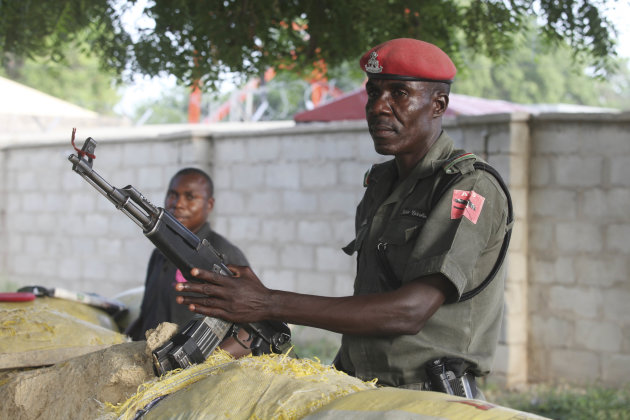
"In this Wednesday, Sept. 28, 2011 photo, police officers armed with AK-47 rifles stand guard at sandbagged bunkers along a major road in Maiduguri, Nigeria. The radical sect Boko Haram, which in August 2011 bombed the United Nations headquarters in Nigeria, is the gravest security threat to Africa's most populous nation and is gaining prominence." (AP Photo/Sunday Alamba)
At Least 67 Dead in North Nigeria Sect Attacks
By Jon Gambrell
Associated Press dispatch on Yahoo! News, November 5, 2011
"Residents fearfully left their homes Saturday to bury their dead in northeast Nigeria following a series of coordinated attacks that killed at least 67 people and left a new police headquarters in ruins, government offices burned and symbols of state power destroyed. A radical Muslim sect known locally as Boko Haram claimed responsibility for the attacks in Borno and Yobe states, with the worst damage done in and around the city of Damaturu. The group also promised to continue its bloody sectarian fight against Nigeria's weak central government, with residents nervously moving through empty streets, waiting for the next attack. 'There's that fear that something might possibly happen again,' Nigerian Red Cross official Ibrahim Bulama said. In Damaturu, the capital of Yobe state, a car bomb exploded Friday afternoon outside a three-story building used as a military office and barracks, killing many uniformed security agents, Bulama said. Gunmen then went through the town, blowing up a bank and attacking at least three police stations and some churches, leaving them in rubble, he said. Gunfire continued through the night and gunmen raided the village of Potiskum near the capital as well, witnesses said, leaving at least two people dead there.

Wednesday, November 02, 2011

Bosnia and Herzegovina / National Tribunals

"A house near the Jewish cemetery in Sarajevo burns after being hit by a mortar shell in September1994." (Peter Andrews/PA)
Bosnia Arrests War Crimes Suspect
Reuters dispatch in The Irish Times, November 2, 2011
"Bosnian police today detained a Bosnian Serb ex-police commander suspected of having ordered the murder of 10 Muslim civilians at the start of the 1992-95 siege of Sarajevo, prosecutors said. Goran Saric (47), was arrested in the northeastern town of Bijeljina, prosecutors' office spokesman Boris Grubesic said. About 11,000 people were killed in the 43-month siege of Sarajevo by separatist Bosnian Serbs, and more than 100,000 in total during the country's war following its secession from Serbian-led federal Yugoslavia. Saric, who was the police commander in the Serb-held part of the capital Sarajevo in June 1992, has been investigated by Bosnian state prosecutors and charged with war crimes. 'Defendant Goran Saric ... is suspected of having ordered the murder of 10 Bosniak (Bosnian Muslim) civilians in June 1992, and the capture and persecution of a large number of people, mostly Bosniak women and children, from the Sarajevo neighbourhoods of Nahorevo, Poljine and others,' the statement said. Bosnia's war crimes court was launched in 2005 to try lower-ranking cases and ease the burden on the International Criminal Tribunal for the Former Yugoslavia (ICTY). The court is now trying two other Bosnian Serbs for atrocities committed against the non-Serb population in parts of Sarajevo seized by Serb forces opposed to Bosnia's independence backed by its Muslims and Croats."
[n.b. This is the complete text of the dispatch.]

Croatia / Ustasha / Jewish Holocaust

Croatia's First Interior Minister Arrested over Accusations of Post-World War II Crimes
Associated Press dispatch in The Washington Post, November 2, 2011
"Croatia's former interior minister was arrested Wednesday over accusations that he ordered mass killings of anti-communists soon after the end of World War II, police said. Josip Boljkovac, 89, and two other former ranking Croatian officials have been under investigation for the alleged murders in 1945 and 1946 of soldiers and sympathizers of Croatia's Ustasha Nazi puppet regime that ruled during the war. Boljkovac, who fought as a member of the Yugoslav communist guerrillas against the occupying German and Italian troops, was a senior officer of the secret service which is accused of going on a revenge shooting spree of the anti-communists after the war ended. Boljkovac is accused of command responsibility in the killing of thousands, including civilians, who were buried in unmarked graves throughout Croatia, his lawyer Anto Nobilo said. A US-based Jewish rights group expressed 'alarm and shock' at the arrest of Boljkovac. Tens of thousands of Jews, Serbs and Gypsies, or Roma people, perished in the Ustasha-run concentration camps in Croatia during the war. 'In view of Croatia's consistent failure to prosecute criminals of the Nazi-allied Ustasha regime in its midst, its action against a fighter who opposed the evil Ustasha forces is hypocritical and unacceptable,' said Elan Steinberg, vice president of the American Gathering of Holocaust Survivors and their Descendants.

Friday, October 28, 2011

Argentina / National Tribunals

"Former Argentine navy officer Alfredo Astiz, also known as the 'Blond Angel of Death' for his role in the1976-83 dictatorship and sought in France for the murder of French nuns Alice Domon and Leonie Duquet, appears during a trial in Buenos Aires on Thursday." (Marcos Brindicci/Reuters)
Argentina's "Blond Angel of Death" Convicted for Role in Dirty War
By Sam Ferguson
The Christian Science Monitor, October 27, 2011
"Nearly 30 years after the collapse of Argentina's last military dictatorship, the man most identified with perpetrating the 1976-1983 'dirty war' was convicted in a Buenos Aires criminal court on Wednesday night. Alfredo Astiz, known as the 'blond angel of death,' served as a lieutenant at the Naval Mechanics School (ESMA), a torture center where thousands of guerrillas and dissidents were secretly imprisoned and executed. He and 17 other defendants were charged with various cases of kidnapping, torture, and murder relating to 86 victims. 'I'm happy. After so many years, there's finally justice,' said Carlos Muñoz, a survivor from the ESMA. The charges against Astiz centered on his role in infiltrating, kidnapping, and executing 12 human rights activists in 1977. Beginning in middle of that year, Astiz began marching with the Mothers of the Plaza de Mayo, a group of women who congregated in Buenos Aires’ central square to protest the disappearance of their children. The Mothers knew him as Gustavo Niño, a young, handsome, well-spoken man who was desperately seeking his missing brother. When Astiz suspected that his cover had been compromised, he helped organize a series of raids around Buenos Aires in December of 1977. Twelve people were kidnapped, including three founding members of the Mothers and two French missionary nuns, Alice Domon and Leonie Duquet. Several were tortured in the Naval Mechanics School, and within days the 12 activists were loaded onto navy airplanes and thrown into the South Atlantic. The ferocity of Astiz's crimes juxtaposed against his good looks and upright demeanor made him an eerie symbol of the repression.

Tuesday, October 25, 2011

Libya

"Volunteers in Surt removed bodies of people apparently killed in reprisal by anti-Qaddafi militias. Many had their hands bound and had been shot in the head." (Mauricio Lima/The New York Times)
In Libya, Massacre Site Is Cleaned Up, Not Investigated
By Kareem Fahim and Adam Nossiter
The New York Times, October 24, 2011
"In the parched garden of the Mahari Hotel, volunteers on Monday scrubbed signs of a recent massacre. They collected dozens of bodies, apparently of people executed on the hotel grounds several days ago, but left other evidence behind, like the plastic ties that were used to bind the hands of victims and shell casings, scattered on the dead grass in patches of blood. The volunteers said the victims included at least two former Qaddafi government officials, local loyalist fighters and maybe civilians. The killers, they believed, were former rebel fighters, belonging to anti-Qaddafi units that had used the hotel as a base in recent weeks. It appeared to be one of the worst massacres of the eight-month conflict, but days after it occurred, no one from Libya's new government had come to investigate. The interim leaders, who declared the country liberated on Sunday, may simply have their hands full with the responsibilities that come with running a state. But throughout the Libyan conflict, they have also shown themselves to be unwilling or incapable of looking into accusations of atrocities by their fighters, despite repeated pledges not to tolerate abuse.

Monday, October 24, 2011

Libya

"The entrance to the Mahari Hotel in Sirte, where at least 53 persons were apparently executed. At the time of their killing the hotel was apparently controlled by anti-Gaddafi fighters from Misrata. The red graffiti on the left states 'Tiger Brigade,' the name of a prominent Misrata fighting group." (Peter Bouckaert/Human Rights Watch)
Libya: Apparent Execution of 53 Gaddafi Supporters
By Peter Bouckaert
Human Rights Watch press release, October 24, 2011
"Fifty-three people, apparent Gaddafi supporters, seem to have been executed at a hotel in Sirte last week, Human Rights Watch said today. The hotel is in an area of the city that was under the control of anti-Gaddafi fighters from Misrata before the killings took place. Human Rights Watch called on Libya’s National Transitional Council (NTC) to conduct an immediate and transparent investigation into the apparent mass execution and to bring those responsible to justice. 'We found 53 decomposing bodies, apparently Gaddafi supporters, at an abandoned hotel in Sirte, and some had their hands bound behind their backs when they were shot,' said Peter Bouckaert, emergencies director at Human Rights Watch, who investigated the killings. 'This requires the immediate attention of the Libyan authorities to investigate what happened and hold accountable those responsible.' Human Rights Watch saw the badly decomposed remains of the 53 people on October 23, 2011, at the Hotel Mahari in District 2 of Sirte. The bodies were clustered together, apparently where they had been killed, on the grass in the sea-view garden of the hotel. Anti-Gaddafi fighters from Misrata had held that area of Sirte since early October, according to witnesses interviewed by Human Rights Watch.

Friday, October 14, 2011

Russia / Circassian Genocide

Genocide Claims Muddle Russian Olympics
By Thomas Grove
Reuters dispatch on MSNBC.com, October 13, 2011
"Muhammed Cherkesov remembers his grandparents whispering about the Russian soldiers who drove his forefathers at gunpoint from their mountain homes down to the Black Sea coast in the mid-19th century. The forced migration of the Muslim Circassians into the lowlands in and around Sochi where they were deported beyond the Russian Empire's borders killed about a third of the population through disease, starvation and exposure to the elements. A century and a half later Russia wants to hold the 2014 Winter Olympics in the very same broad valleys and mountain slopes around Sochi that Circassians say hold the bones of their ancestors. 'We're talking about holding the Olympics over a mass grave of Circassians,' said Cherkesov, a leader for the minority in Karachay-Cherkessia province in the North Caucasus, a patchwork of mostly Muslim regions along Russia's southern flank. Many Circassians believe 1.5 million of their predecessors perished as Russian soldiers embarked on a mass expulsion of their people to ease the czar's conquest of the Caucasus region. European and Russian imperial historians say that number may be closer to 300,000. Circassian extremists say they want to turn back the clock and gain independence from Russia. Most stand behind an increasingly vocal campaign to urge Russia to recognize the killings as genocide and to pave the way for the large Circassian diaspora to return to its historic homeland. Russia has said the deaths were among the tragedies of war that both sides suffered as the czar was closing his grip on the Caucasus Mountains region, but denies that amounted to genocide. 'We are not asking for any material compensation from Russia, we want Russia itself to say that unjust actions were taken against the Circassians and that this was the land of Circassians,' said Cherkesov, speaking to Reuters in his spartan office surrounded by pictures of his forefathers dressed in traditional long red coats and high black boots. Of the nearly 8 million Circassians worldwide, only about 700,000 live in Russia. The rest are the descendants of the men and women who refused to bow to Russian rule and were carried off by the ships of the Ottoman Empire, which resettled them in the far-flung stretches of its territories. [...]"

Wednesday, October 12, 2011

El Salvador / Forced Transfer of Children

"Enma Orellana holds out hope she might one day find her daughter, who was 4 when seized by soldiers during El Salvador's civil war in 1982." (Alex Renderos)
Court Orders El Salvador to Investigate Children's Disappearances
By Ken Ellingwood
The Los Angeles Times, October 10, 2011
"Human rights advocates are hailing an international court decision ordering the government of El Salvador to fully investigate the cases of hundreds of children who disappeared during the nation's civil war three decades ago. The Inter-American Court of Human Rights, based in San Jose, Costa Rica, found rights violations in the cases of six youngsters who vanished after being taken away by soldiers in 1981 and 1982. One of the six children, Gregoria Contreras, 4 years old when she disappeared, was reunited with her family many years later after being tracked down by a Salvadoran group, the Assn. for the Search for Missing Children, also known as Pro-Busqueda. The group's enduring search for children who went missing during the conflict was chronicled earlier this year by The Times here. In its ruling, issued to the parties late last week, the court found what it called a 'systematic pattern of forced disappearances of children' by army personnel battling leftist rebels. Many of the children, seized during raids, were placed into the lucrative international adoption market and raised abroad. Since 1994, Pro Busqueda has received reports of more than 800 children who vanished during the war. The group has located nearly half of them.

Saturday, October 08, 2011

Argentina / Forced Transfer of Children

"Victoria Montenegro was abducted as a newborn by a military colonel. She testified last spring in the trial over baby thefts." (Joao Pina/The New York Times)
Daughter of "Dirty War," Raised by Man Who Killed Her Parents
By Alexei Barrionuevo
The New York Times, October 8, 2011
"Victoria Montenegro recalls a childhood filled with chilling dinnertime discussions. Lt. Col. Hernán Tetzlaff, the head of the family, would recount military operations he had taken part in where 'subversives' had been tortured or killed. The discussions often ended with his 'slamming his gun on the table,' she said.The Mothers of the Plaza de Mayo, who lost children during Argentina's military dictatorship, protesting in Buenos Aires in 1977. It took an incessant search by a human rights group, a DNA match and almost a decade of overcoming denial for Ms. Montenegro, 35, to realize that Colonel Tetzlaff was, in fact, not her father -- nor the hero he portrayed himself to be. Instead, he was the man responsible for murdering her real parents and illegally taking her as his own child, she said. He confessed to her what he had done in 2000, Ms. Montenegro said. But it was not until she testified at a trial here last spring that she finally came to grips with her past, shedding once and for all the name that Colonel Tetzlaff and his wife had given her -- María Sol -- after falsifying her birth records.

Wednesday, October 05, 2011

Germany / Jewish Holocaust / National Tribunals

"Accused former Nazi functionaries of the Treblinka death camp try to hide their faces at the beginning of the Treblinka trial in Dusseldorf, western Germany, on Oct. 12, 1964." (Associated Press file)
Hundreds of Nazi Probes Reopened in Germany
By David Rising
Associated Press dispatch on MSNBC.com, October 5, 2011
"Prosecutors have reopened hundreds of dormant investigations of former Nazi death camp guards and others who might now be charged under a new precedent set by the conviction of retired U.S. autoworker John Demjanjuk, The Associated Press has learned. Given the advanced age of all of the suspects -- the youngest are in their 80s -- the head of the German prosecutors' office dedicated to investigating Nazi war crimes told the AP that authorities are not even waiting until the Demjanjuk appeals process is over. 'We don't want to wait too long, so we've already begun our investigations,' prosecutor Kurt Schrimm said. Meantime, the Simon Wiesenthal Center's top Nazi-hunter, Efraim Zuroff, told the AP he would launch a new campaign in the next two months -- a successor to his Operation Last Chance -- to track down the remaining Nazi war criminals. He said the Demjanjuk conviction has opened the door to prosecutions that he had never thought possible in the past. 'It could be a very interesting final chapter,' he said by telephone from Jerusalem. 'This has tremendous implications even at this late date.'

Friday, September 30, 2011

Germany / Namibia / Herero Genocide

"The Namibian delegation attended a service in Berlin." (Associated Press)
Germany Returns Namibian Skulls Taken in Colonial Era
BBC Online, September 30, 2011
"Namibian tribal leaders have visited Berlin to collect the skulls of 20 compatriots who died under Germany's colonial rule in the early 1900s. German scientists took the heads to perform experiments seeking to prove the racial superiority of white Europeans over black Africans. The skulls were uncovered three years ago in medical archive exhibits. A ceremony was held in the German capital to return the remains as a gesture of reconciliation. But chaotic scenes accompanied the speeches, particularly an address by German Deputy Foreign Minister Cornelia Pieper. A handful of demonstrators shouted 'reparations', 'apology' and 'genocide'. In the 1880s, Germany acquired present-day Namibia, calling it German South-West Africa. In 1904 the Herero, the largest of about 200 ethnic groups, rose up against colonial rule killing more than a 120 civilians. The German response was ruthless. Gen. Lothar von Trotha signed a notorious extermination order against the Herero, defeated them in battle and drove them into the desert, where most died of thirst. Of an estimated 65,000 Herero, only 15,000 survived. It is thought about 10,000 Nama people also died. In 1985, a UN report classified the events as an attempt to exterminate the Herero and Nama peoples of South-West Africa, and therefore the earliest attempted genocide in the 20th Century. In 2004, Germany's ambassador to Namibia expressed regret for what happened. Germany has consistently refused to pay reparations to its former colony, arguing that it has given much development aid to Namibia.

Wednesday, September 28, 2011

Rwanda / France

Rwandan Request to Extradite Widow from France Fails
By Pierre-Antoine Souchard
The Independent, September 29, 2011
"The widow of Rwanda's former President, wanted in connection with the 1994 genocide, has won her court appeal against extradition from France. Agathe Habyarimana has been sought by the Rwandan state prosecutor since 2009 on charges of genocide and crimes against humanity. She denies the accusations. The Paris court's reasons for the decision were not immediately available. Rwanda could make a second request, but an extradition now appears unlikely. Rwanda's genocide was triggered when President Juvenal Habyarimana died after his plane was shot down above Kigali airport on 6 April 1994. Some 500,000 people, mostly ethnic Tutsis but also moderate Hutus, were massacred by radical Hutus in under 100 days. The massacres ended when Tutsi-led rebels under the current President, Paul Kagame, defeated the Hutu extremists in July 1994. French forces flew Mrs. Habyarimana out of Rwanda shortly after the violence began and she has lived in France for years. The head of the Rwandan government's National Commission for the Fight against Genocide last year claimed Mrs Habyarimana was the 'main architect' of the genocide. French police detained the widow last year, but she was released on condition that she check in regularly with police. At the court, Mrs. Habyarimana said she was 'delighted' with the decision."
[n.b. This is the complete text of the dispatch.]