Monday, December 31, 2012

Rwanda / United Nations / United States

Rwanda's Rampaging Rebel Force
By Philippe Bolopion
The New York Times, December 28, 2012
"Few countries dare challenge the Security Council the way Rwanda does; even fewer get away with it. Yet on Tuesday, despite backing an abusive rebel group that has attacked U.N. peacekeepers in the neighboring Democratic Republic of the Congo, Rwanda will take a two-year seat on the council. At the famous horseshoe table, Rwanda will get to make life-and-death decisions on the future of countries in crisis, including the very neighbor it is accused of destabilizing. How could this be? The facts came out in June, when a UN group of experts monitoring sanctions in eastern Congo published a report accusing Rwanda of supporting, as it had done before since the late 1990s, a Congolese rebellion this time named March 23. Even by Congolese standards, M23 has a sinister record: One of its leaders is Bosco Ntaganda, a fugitive from the International Criminal Court accused of war crimes, including murder, rape, sexual slavery and recruitment of child soldiers. As our own research at Human Rights Watch confirmed, Rwandan Army officials were providing M23 with weapons, ammunition and hundreds of young Rwandan recruits, and even sending their troops into Congo to assist them. Despite Rwanda's virulent denials, the diplomatic machinery kicked into gear, with the US government making discreet efforts to encourage its Rwandan ally to use its 'influence' to stop the violence. But throughout the summer Rwandan support continued unabated, enabling M23 to do what its leaders know best: commit widespread crimes, including killing civilians and summarily executing boys who tried to escape recruitment.

United States / Macedonia / Torture / The "War on Terror"

"The European court of human rights has ruled German citizen Khaled el-Masri was tortured by CIA agents, the first time the court has described treatment meted out by the CIA as torture." (Christian Hartmann/AP)
CIA "Tortured and Sodomised" Terror Suspect, Human Rights Court Rules
by Richard Norton-Taylor
The Guardian, December 13, 2012
"CIA agents tortured a German citizen, sodomising, shackling, and beating him, as Macedonian state police looked on, the European court of human rights said in a historic judgment released on Thursday. In a unanimous ruling, it also found Macedonia guilty of torturing, abusing, and secretly imprisoning Khaled el-Masri, a German of Lebanese origin allegedly linked to terrorist organisations. Masri was seized in Macedonia in December 2003 and handed over to a CIA 'rendition team' at Skopje airport and secretly flown to Afghanistan. It is the first time the court has described CIA treatment meted out to terror suspects as torture. 'The grand chamber of the European court of human rights unanimously found that Mr el-Masri was subjected to forced disappearance, unlawful detention, extraordinary rendition outside any judicial process, and inhuman and degrading treatment,' said James Goldston, executive director of the Open Society Justice Initiative. He described the judgment as 'an authoritative condemnation of some of the most objectionable tactics employed in the post-9/11 war on terror'. It should be a wake-up call for the Obama administration and US courts, he told the Guardian. For them to continue to avoid serious scrutiny of CIA activities was "simply unacceptable", he said. Jamil Dakwar, of the American Civil Liberties Union, described the ruling as 'a huge victory for justice and the rule of law'.

Syria / Gendercide

Dozens of Tortured Bodies Found in Damascus
Agence France-Presse dispatch on Yahoo! News, December 31, 2012
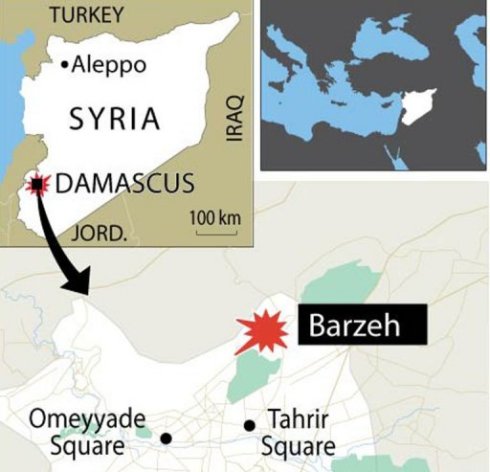
"Dozens of tortured bodies have been found in a flashpoint district of Damascus, a watchdog reported on Monday, in one of the worst atrocities in Syria's 21-month conflict. The report from the Syrian Observatory for Human Rights came as a gruesome video emerged on the Internet of a separate slaying of three children who had their throats slashed, also in the capital. 'Thirty bodies were found in the Barzeh district. They bore signs of torture and have so far not been identified,' said the Britain-based Observatory. The Syrian Revolution General Commission, a grassroots network of anti-regime activists, estimated there were 50 bodies, and added that 'their heads were cut and disfigured to the point that it was no longer possible to identify' them. The video posted online by activists showed the bodies of three young boys with their throats slit open and hands bound behind their backs. Their bodies were discovered on Monday in Jubar. The Observatory also reported the killing of the boys, who opposition activists said had been kidnapped the day before at a checkpoint on their way home from school. These reports could not be verified independently because of media restrictions by the Syrian authorities. Regime warplanes, meanwhile, bombarded rebel positions on the northeastern and southwestern outskirts of Damascus, leaving eight civilians dead including two children, said the Observatory. [...]"
[n.b. When you read "dozens of tortured bodies," translate as follows: "dozens of tortured males." Can you imagine dozens of murdered females being described in this fashion?]

Sunday, December 30, 2012

Nigeria / Gendercide

In Nigeria, Trapped between Islamist Radicals and Security Forces
By Sudarsan Raghavan
The Washington Post, December 30, 2012
"The armed men dragged Musa Muhammad out of his house and ordered him to lie face down on the ground. Then they grabbed his son. After asking his name, the men issued their judgment. 'I heard three gunshots -- pop, pop, pop,' Muhammad recalled, his voice trembling, his fingers in the shape of a pistol. 'My son was dead, killed in front of me.' His assailants were not the radical Islamists who have brutalized this town. They were government security forces sent to protect the residents. In the epicenter of one of Africa's most violent religious extremist movements, civilians are caught in a guerrilla conflict that has shattered families and communal relationships. The Boko Haram, a homegrown group with suspected ties to al-Qaeda, is assassinating people nearly every day, targeting Christians, soldiers, police, even astrologers as it seeks to weaken the Western-allied government and install Islamic sharia law in this nation. But the security forces have also carried out extrajudicial killings, imprisoned hundreds on flimsy grounds, looted and burned shops and houses, according to victims, local officials and human rights activists. ... 'In a guerrilla war, you need the help of the local population. But the security forces are alienating the people,' said Muhammad Abdullahi, the provincial director of religious affairs. 'They are making their jobs more difficult for themselves.'

Saturday, December 29, 2012

India / Rape as Crime against Humanity

"Protesters shield themselves as Indian police beat them with sticks during a violent demonstration near the India Gate against a gang rape and brutal beating of a 23-year-old student on a bus last week, in New Delhi, India." (AP/Kevin Frayer)
India's Culture of Rape is Endemic
By Jason Overdorf
Global Post on Salon.com, December 29, 2012
"As angry protesters marched on India's symbolic seat of power last week, the nation's august members of parliament raged against the government's failure to stop violence against women. They blasted the Delhi police for incompetence and insensitivity. And they cried out for the death penalty for six men accused of brutally gang-raping a 23-year-old woman aboard a private bus on Dec. 16. The woman succumbed to her injuries on Friday in Singapore, where she was being treated at a hospital, according to media reports. In the story of India’s battle against sexual assault, the honorable members ignored one important footnote: Every major political party has fielded and continues to field candidates facing criminal charges for rape, harassment and other crimes against women. 'We found that all these parties had given tickets to people of dubious backgrounds, involved in crimes against women,' said Anil Bairwal, national coordinator of the watchdog group National Election Watch. 'It's the highest order of hypocrisy.' According to mandatory self-declarations filed by candidates with the Election Commission and tabulated by National Election Watch, India’s leading political parties have offered tickets to 27 candidates accused of rape and a whopping 260 candidates facing charges for crimes against women ranging from assault to harassment over the past five years. As a result, two members of the current parliament and six members of the various state legislative assemblies are facing rape charges, while 36 others face charges for lesser crimes against women. Not one of India's major parties is innocent of the charge, and by some measure the two largest, national parties, the Congress and the Bharatiya Janata Party (BJP) are the worst offenders, according to National Election Watch.

Chile / National Tribunals

(Victor Jara Foundation / via Reuters)
Eight Are Charged With Chilean Singer's 1973 Murder After Military Coup
By Pascale Bonnefoy
The New York Times, December 28, 2012
"Eight retired army officers were charged on Friday with the murder of a popular songwriter and theater director, Víctor Jara, who was tortured and killed days after the 1973 military coup in a stadium that had been turned into a detention center. Judge Miguel Vásquez charged two of the former officers, Pedro Barrientos and Hugo Sánchez, with committing the murder and six others as accomplices. Mr. Sánchez, a lieutenant colonel, was second in command at the stadium. Mr. Barrientos, a lieutenant from a Tejas Verdes army unit, currently lives in Deltona, a city southwest of Daytona Beach, Fla., and was interrogated by the FBI earlier this year at the request of a Chilean court. Attempts to reach Mr. Barrientos for comment were unsuccessful; his two listed telephone numbers had been disconnected. Judge Vásquez issued an international arrest warrant against Mr. Barrientos through Interpol Santiago and ordered the arrest of the other seven, who were in Chile. Those charged as accomplices are Roberto Souper, Raúl Jofré, Edwin Dimter, Nelson Hasse, Luis Bethke and Jorge Smith.

Friday, December 28, 2012

France / Algeria / Colonialism

"French President François Hollande delivers a speech at a university in Tlemcen on the last day of his two-day official visit to Algeria, on Dec. 20, 2012." (Bertrand Langlois/AFP/Getty Images)
France's Colonial Hangover: Apologizing Abroad, Ignoring Injustice at Home
By Bruce Crumley
Time, December 28, 2012
"The recent visit of French President François Hollande to Algeria received praise for addressing the painful historical wounds that continue plaguing relations between the two countries. In doing so, Hollande acknowledged the 'brutal and unjust' manner in which France treated its former Algerian colony -- a sober recognition that pointedly stopped short of the full apology officials in Algiers have long demanded. Still, coming a full 50 years after Algeria won its independence with a long and gruesome war, Hollande’s words drew a thundering ovation from the Algerian parliament during his Dec. 20 address. 'Over 132 years, Algeria was subjected to a profoundly unjust and brutal system,' Hollande said during his two-day visit. 'This system has a name: it is colonialism, and I recognize the suffering that colonialism inflicted on the Algerian people.' But despite the praise -- and protest -- Hollande’s comments generated on both sides of the Mediterranean, he failed to touch on two terrible, living consequences of France's legacy in Algeria. First among those is the historical background in which the continuing discrimination and ghettoization of millions of French Arabs are rooted -- much like the increasingly open expression of Islamophobia within French society. Second is his failure to acknowledge the deeply corrupt, brutal and military-supported Algerian power structure that has dominated the country since independence -- one that Paris has preferred to placate and patronize, even as it presses for democracy elsewhere.

Wednesday, December 26, 2012

Bahrain / United States

Bahrain, A Brutal Ally
By Zainab al-Khawaja
The New York Times, December 25, 2012
"Earlier this month, Aqeel Abdul Mohsen, 19, was shot in the face for protesting against Bahrain's government. He was covered in blood, with the lower side of his face blown open, his jaw shattered, and a broken hand hanging awkwardly from his wrist. It's one of those images that you wish you had never seen, and can never forget. After more than 10 hours of surgery, and before Mr. Abdul Mohsen regained consciousness, his hospital room was already under guard by the police. Had he been able to speak, he might even have been interrogated before going into surgery. Others have lain bleeding without medical attention while government security agents asked questions like: 'Were you participating in a protest? Who else was with you?' Bahrain, a small island nation off the coast of Saudi Arabia, has been ruled by the Khalifa family for more than 200 years. It is also home to the headquarters of the United States Navy’s Fifth Fleet, which patrols regional shipping lanes, assists with missions in Iraq and Afghanistan and monitors Iran as tensions in the region mount. The oppressed people of Bahrain joined the Arab Spring soon after the fall of President Hosni Mubarak in Egypt. With newfound hope, Bahrainis took to the streets on Feb. 14, 2011. Rich and poor, Shiite and Sunni, liberal and religious, they felt what it was like to speak freely for the first time in the capital, Manama, at a traffic circle with a pearl monument at its center. The Pearl Roundabout came to symbolize the Bahraini revolution. But this newfound freedom didn’t last long. The government's security forces attacked the peaceful protesters, then tore down the Pearl monument. And in March 2011, troops from neighboring Saudi Arabia and the United Arab Emirates intervened to suppress our pro-democracy protests. Going out on the streets, carrying nothing but a flag and calling for democracy could cost you your life here. Chanting 'down with the dictator' could lead to your being subjected to electric shocks. Giving a speech about human rights and democracy can lead to life imprisonment. Infants have died after suffocating from toxic gases used by riot police. And teenage protesters have been shot and killed.

Monday, December 24, 2012

Burma-Myanmar / Rohingya / United Nations

"A Muslim woman, displaced by recent violence in Kyukphyu township, cries after arriving at the Thaechaung refugee camp outside of Sittwe in this October 28, 2012 file photo." (Reuters/Soe Zeya Tun/Files)
UN General Assembly Voices Concern for Myanmar's Muslims
Reuters dispatch, December 24, 2012
"The UN General Assembly expressed serious concern on Monday over violence between Rohingya Muslims and Buddhists in Myanmar and called upon its government to address reports of human rights abuses by some authorities. The 193-nation General Assembly approved by consensus a non-binding resolution, which Myanmar said last month contained a 'litany of sweeping allegations, accuracies of which have yet to be verified.' Outbreaks of violence between ethnic Rakhine Buddhists and the Rohingyas have killed dozens and displaced thousands since June. Rights groups also have accused Myanmar security forces of killing, raping and arresting Rohingyas after the riots. Myanmar said it exercised 'maximum restraint' to quell the violence. The unanimously adopted UN resolution 'expressing particular concern about the situation of the Rohingya minority in Rakhine state, urges the government to take action to bring about an improvement in their situation and to protect all their human rights, including their right to a nationality.' At least 800,000 Muslim Rohingyas live in Rakhine State along the western coast of Myanmar, also known as Burma. But Buddhist Rakhines and other Burmese view them as illegal immigrants from neighboring Bangladesh who deserve neither rights nor sympathy. The resolution adopted on Monday is identical to one approved last month by the General Assembly's Third Committee, which focuses on human rights. After that vote, Myanmar's mission to the United Nations said that it accepted the resolution but objected to the Rohingyas being referred to as a minority. 'There has been no such ethnic group as Rohingya among the ethnic groups of Myanmar,' a representative of Myanmar said at the time. 'Despite this fact, the right to citizenship for any member or community has been and will never be denied if they are in line with the law of the land.'"
[n.b. This is the complete text of the dispatch.]

Sunday, December 23, 2012

Canada / Indigenous Peoples / Apartheid

"Chief Theresa Spence has been on hunger strike in a teepee across from parliament since 11 December." (Chris Wattie/Reuters)
Rising Anger of Canada's First Nations over Living Conditions
By Isabeau Doucet
The Guardian, December 21, 2012
"When images of Canada's First Nations people living in mouldy shacks and frosty tents, without toilets or running water, emerged last year, Canadians were shocked. It was Canada's 'Katrina moment' says Charlie Angus, New Democratic party member for Timmins-James Bay in north Ontario. Fast forward a year, and progress has been excruciatingly slow. The indigenous community only received 22 trailer homes to deal with the housing crisis. A construction trailer with three bathrooms and a kitchen still caters for around 50 people, according to Angus. As a result, the chief of the Attawapiskat, Theresa Spence, has been on a hunger strike living in a teepee across from parliament since 11 December as winter descends on Canada's capital, Ottawa. She says she is willing to die for her people if the Queen and the prime minister, Stephen Harper, don't meet Canada's indigenous chiefs to discuss the treaty rights they signed with the crown. Many of Canada's aborigines live in what can only be described as developing world conditions. Chronic underfunding of essential social services and complete collapse of infrastructure on reserves results in high mortality, unemployment, substance abuse, suicide and incarceration. Early development is obstructed for children on reserves by a bureaucratic financial hole that gives 30% to 50% less educational funding than to other Canadian youngsters. Unrest is growing among Canada's First Nations as the conservative government makes sweeping changes to environmental protections and the Indian Act which many fear will fast-track the absolute surrender of indigenous territory, terminate treaty rights and endanger land and water in favour of economic gain. The past two weeks has seen the largest series of nationwide protests in two decades, and on Friday a grassroots-led campaign under the Twitter hashtag #IdleNoMore will see thousands in over a dozen cities across Canada, the US and UK take to the streets and call on Harper and Governor General David Johnston to enter negotiations with Spence.

Kenya / United Kingdom / Torture

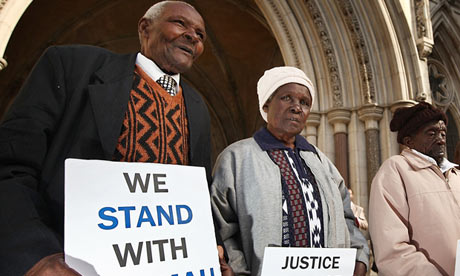
"From left: Wambugu Wa Nyingi, Jane Muthoni Mara and Paulo Muoka Nzili outside the high court in London." (Peter Macdiarmid/Getty)
Fury as Britain Fights Ruling on Kenya Torture Victims
By Mark Townsend
The Observer, December 23, 2012
"The British government has provoked outrage by contesting a high court ruling that gave three elderly Kenyans the right to claim damages for abuses suffered during the Mau Mau insurgency of 1952-1960. Despite Foreign Office lawyers admitting all three were tortured by British colonial authorities, the government has decided to pursue a route that could deny compensation to torture victims. Lawyers have accused the Foreign Office of a 'morally repugnant' move that exposes the government to allegations of hypocrisy over its denouncing of regimes such as Syria and Zimbabwe that use torture. Dan Leader of Leigh Day & Co, which is representing the three Kenyans, said: 'This gives succour to brutal dictators, the fact that one of the principal western democracies is not willing to give redress to acknowledged and admitted victims of British torture.' Archbishop Desmond Tutu has written to David Cameron accusing him of failing to offer elderly torture victims who suffered beatings, castration and sexual assaults 'the dignity they deserve'. Many hoped the high court victory for the torture victims two months ago -- greeted with celebrations in Nairobi -- would lead the Foreign Office to drop any appeal in favour of offering redress. The government argues that too few key witnesses remain alive to show the involvement of the British government in the torture of detainees. However, an archive of once secret documents, incorporating some 8,800 files, offers an intricate record of decision-making in the Kenyan colony during the Mau Mau uprising, as well as in London. The documents suggest there was systematic torture of detainees and include details such as how the Kenyan authorities wrote to the British government during the insurgency asking it to authorise torture methods.

Saturday, December 22, 2012

Indonesia / Genocide and Memory

Indonesia's Killing Fields
AlJazeera.com, December 21, 2012
"It was one of the bloodiest massacres of the 20th century, well hidden from the outside world -- the systematic killing of communists or alleged communists in Indonesia in 1965 and 1966. Researchers estimate that between one and three million people died. Never before have the executioners spoken out in as much detail as in the recently-released documentary The Act of Killing. In this film, killers in North Sumatra give horrifying accounts of their executions, and even re-enact them. The killers have always considered themselves heroes because their acts were supported by the government and large parts of society. Many executions were directly committed by the military. In the years that followed, Indonesians were bombarded with anti-communist propaganda and, until today, most people do not know what really happened. The film, and a recent report by the Indonesian national human rights commission that called the killings crimes against humanity, have launched a new debate on how the country should deal with this very traumatic past. Mass graves have yet to be exhumed and victims are yet to see some kind of justice. In many villages, killers and victims' relatives are still living with the awkward reality that 'our neighbour has killed my father'. Al Jazeera's Step Vaessen talks to former executioners and finds out why so many people - mostly Muslim youths - turned into cold-blooded killers, and why this dark episode in Indonesian history is still very sensitive and alive today. [...]"
See also Kim Segupta, "Indonesia's Killers Escape Justice, But Feature on the Silver Screen", The Independent, December 23, 2012.

Friday, December 21, 2012

Syria / United Nations / Genocide Prevention

"Syrian rebels stand in position near to road blocks and obstacles along a main though fare in Tel Abyad, Syria, Friday, Oct. 5, 2012." (AP Photo)
UN Anti-Genocide Envoy: Syrian Alawites, Other Minorities Face Reprisal Risk
Reuters dispatch in Haaretz, December 21, 2012
"The UN anti-genocide envoy warned on Thursday that minority groups in Syria, including Syrian President Bashar al-Assad's fellow Alawites, are at risk of major reprisal attacks as the 21-month-old conflict escalates and sectarian violence increases. 'I am deeply concerned that entire communities risk paying the price for crimes committed by the Syrian government,' Adama Dieng, UN special adviser on the prevention of genocide, said in a statement. The statement said Alawites and other minorities in Syria were increasingly under threat of large-scale reprisal attacks because they are widely associated with the government and allied militia. Rebels began to push into a strategic town in Syria's central Hama province on Thursday and laid siege to at least one town dominated by Alawites, activists said. Opposition sources said rebels had won some territory in the strategic southern town of Morek and were surrounding the Alawite town of al-Tleisia. The rebel operation risks inflaming already raw sectarian tensions as the revolt against four decades of Assad family rule -- during which the president's Alawite sect has dominated leadership of the Sunni Muslim majority -- rumbles on. 'I urge all parties to the conflict to adhere to international humanitarian and human rights law, which prohibits the targeting of individuals or groups based on religious or ethnic identity as well as attacks against civilians not taking direct part in hostilities,' Dieng said. 'I also call on all actors to condemn hate speech that could constitute incitement to violence against communities based on their religious affiliation,' said Dieng.

Rwanda / Genocide Tribunals

"Former Rwandan Planning Minister Augustin Ngirabatware, right, sits next to his lawyer Cecil John Maruma during his first appearance before the International Criminal Tribunal for Rwanda in Arusha, Tanzania." (Ephrem Ruguririza/AFP/Getty Images)
Former Rwandan Minister Sentenced to 35 Years on Genocide Charges
By Emily Alpert
The Los Angeles Times, December 20, 2012
"A former Rwandan minister was sentenced Thursday to 35 years in jail for crimes tied to the nation's brutal genocide, including handing out machetes to a Hutu militia and spurring them to kill Tutsis. Witnesses described Augustin Ngirabatware as being tantamount to a god in the stretches of Rwanda where he exhorted members of a Hutu militia to wipe out Tutsis, the International Criminal Tribunal for Rwanda said in its judgment. He was Rwanda's planning minister during the 1994 genocide, when hundreds of thousands of Tutsis and sympathetic Hutus were slain. On one April day in 1994, Ngirabatware unloaded machetes and other weapons at roadblocks, explaining 'he did not want to see any Tutsis alive' in the area, the tribunal found. In another, earlier speech, he 'unambiguously called for genocide,' exhorting a crowd of 150 to 200 people to kill Tutsis. As the Tutsis came under attack, two Hutu militiamen abducted and repeatedly raped a Tutsi woman at nearby banana plantations, according to the tribunal judgment. Ngirabatware was found guilty of the rape, a crime against humanity, because he was part of 'a joint criminal enterprise' with the men and it was 'foreseeable' that some would resort to rape, the court said. The former minister denied the accusations and claimed he was out of the country during the attacks, but failed to convince the tribunal that he was gone the entire time.

Kenya

"Kenyan medics treat a woman and child injured in violence between the Pokomo tribe and the semi-nomadic Orma people." (Joseph Okanga/Reuters)
Dozens Killed in Raid on Village in Kenya
Associated Press dispatch in The Guardian, December 21, 2012
"At least 39 people were killed when farmers raided a village of herders in south-eastern Kenya early on Friday in renewed fighting between two communities with a history of violent animosity, a police official said. Thirteen children, six women, 11 men and nine attackers were killed, said the police official Anthony Kamitu. Forty-five houses were set on fire during the attack, the Kenya Red Cross spokeswoman Nelly Muluka said. Kamitu, who is leading police operations to prevent attacks in the region, said the Pokomo tribe of farmers had raided a village of the semi-nomadic Orma herding community at dawn in the Tana river delta. He said the raiders were armed with spears and AK-47 rifles. At least 110 people were killed in clashes between the Pokomo and Orma in August and September. The tit-for-tat cycle of killings may be related to a redrawing of political boundaries and next year's general elections, the UN humanitarian co-ordinator for Kenya, Aeneas C. Chuma, said in late August. However, on the surface the violence seems driven by competition for water, pasture and other resources, he said.

Thursday, December 20, 2012

Algeria / France / Colonialism

"France's President Francois Hollande gives a speech at the Palais des Nations in Algiers on the second day of a two-day official visit, December 20, 2012." (Louafi Larbi/Reuters)
French Colonization of Algeria "Brutal": Hollande
By Julien Ponthus and John Irish
Reuters dispatch, December 20, 2012
"President Francois Hollande acknowledged on Thursday that France's colonization of Algeria had been 'brutal and unfair' but stopped short of making an apology to the oil-rich North African state which Paris sees as a major trading partner. With France's own economy spluttering, Hollande had hoped his visit would not only strengthen trade ties but improve security cooperation, as Paris pushes for intervention against Islamists who have seized control of northern Mali. [...] Hollande's comments on the 1954-1962 Algerian war, which ended in Algerian independence and France's withdrawal, are likely to be carefully analyzed for signs they could help remove lingering resentment about the conflict in both countries, a legacy that has held back a trading partnership which Paris hopes could revive the Mediterranean basin's economic fortunes. 'For 132 years, Algeria was subjected to a brutal and unfair system: colonization. I acknowledge the suffering it caused,' Hollande told the Algerian parliament on the second day of his visit. Seeking to strike a more conciliatory stance than his conservative predecessor Nicolas Sarkozy whom Algerians viewed as overly hostile towards their country because of what they regarded as his tough immigration policies, Hollande tried to take a nuanced approach. 'We respect the act of memory, of all the memories. There is a duty of truth on the violence, the injustices, the massacres and the torture,' he said. But the 58-year-old Hollande had limited room for maneuver.

Wednesday, December 19, 2012

Bosnia and Herzegovina / Serbia / Rape in Genocide


Bosnian War Rape Victims Suffer in Silence, Wait for Justice
By Maja Zuvela
Reuters dispatch in The New York Times, December 19, 2012
"Fika was 15 years old, and her sister 17, when they were captured and repeatedly raped by Bosnian Serb soldiers who swept through eastern Bosnia early in the country's 1992-95 war. 'We were forced to watch each other being raped, and I still feel my pain and the pain of my sister,' she said. 'They wanted us to admit we were spies, so they beat us till they knocked out our teeth.' Twenty years on, Fika is among thousands of Bosnian Muslim women whose search for recognition and support from the Bosnian state is being blocked by Bosnian Serb leaders who fear a wave of compensation claims. Her sister died at the hands of their torturers. Rights groups are losing patience, warning that the psychological toll is only getting worse with time. 'The silence surrounding the wartime rape of women in the Serb Republic ... is deafening,' Amnesty International wrote in October. Fewer than 40 rape cases have been prosecuted in the 17 years since the war ended, and legislation at the state level to extend compensation and rehabilitation rights to rape victims of the war is gathering dust, hostage to ethnic politicking. The lesson of Bosnia has spurred a push by Britain to raise awareness of sexual violence in war when it takes over the chairmanship of the G8 group of industrialized nations next year. Under the Preventing Sexual Violence Initiative, the British government plans to send police officers, lawyers, psychologists and forensic experts to Bosnia and other conflict and post-conflict countries to work with local authorities on the issue. 'Bosnia and Herzegovina is seen as a priority country,' Ann Hannah, a spokeswoman for the initiative, told Reuters. She said a team would arrive in Bosnia early in 2013. 'We have a very strong feeling there is a window of opportunity to make a significant breakthrough on this issue,' Hannah said. 'Without its resolution, any peace process is incomplete.'

Tuesday, December 18, 2012

Iraq / United States

(Christian Werner/Der Spiegel)
Are US Munitions to Blame for Basra Birth Defects?
By Alexander Smoltczyk
Spiegel Online, December 18, 2012
"It sounds at first as if the old man were drunk. Or perhaps as though he had been reading Greek myths. But Askar Bin Said doesn't read anything, especially not books, and there is no alcohol in Basra. In fact, he says, he saw the creatures he describes with his own eyes: 'Some had only one eye in the forehead. Or two heads. One had a tail like a skinned lamb. Another one looked like a perfectly normal child, but with a monkey's face. Or the girl whose legs had grown together, half fish, half human.' The babies Askar Bin Said describes were brought to him. He washed them and wrapped them in shrouds, and then he buried them in the dry soil, littered with bits of plastic and can lids, of his own cemetery, which has been in his family for five generations. It's a cemetery only for children. Though they are small, the graves are crowded so tightly together that they are almost on top of one another. They look as if someone had overturned toy wheelbarrows full of cement and then scratched the names and dates of death into it before it hardened. In many cases, there isn't even room for the birth date. But it doesn't really matter, because in most cases the two dates are the same. There are several thousand graves in the cemetery, and another five to 10 are added every day. The large number of graves is certainly conspicuous, says Bin Said. But, he adds, there 'really isn't an explanation' for why there are so many dead and deformed newborn babies in Basra. Others, though, do have an idea why.

D.R. Congo / International Criminal Court

"Mathieu Ngudjolo Chui in the courtroom during his trial at the International Criminal Court in The Hague on Tuesday." (Reuters)
UN Court Acquits Congo Rebel Leader of War Crimes
Associated Press dispatch in The New York Times, December 18, 2012
"The International Criminal Court acquitted a Congolese militia leader Tuesday of all charges of commanding fighters who destroyed a strategic village in eastern Congo in 2003, raping and hacking to death some 200 people, including children. The acquittal of Mathieu Ngudjolo on charges including rape, murder and pillage was only the second verdict in the court's 10-year history and the first time it had cleared a suspect. It also cast a shadow over ICC prosecutors' efforts to collect and present evidence of atrocities in complex conflicts thousands of miles from the court's headquarters in The Hague. Judges said the testimony of three key prosecution witnesses was unreliable and could not prove definitively that Ngudjolo led the rebel attack on the village of Bogoro, but they emphasized that Ngudjolo's acquittal did not mean that no crimes occurred in the village. 'If an allegation has not been proven beyond a reasonable doubt ... this does not necessarily mean that the alleged fact did not occur,' Presiding Judge Bruno Cotte of France said. Eric Witte, an expert in international law at the Open Society Justice Initiative, said the judgment 'will send a worrying signal about the quality of ICC prosecutions.' He said Prosecutor Fatou Bensouda may now need to rethink the way her office builds its cases. 'A pattern of prosecution failures could undermine support for the court as a whole,' Witte warned.

Sunday, December 16, 2012

Democratic Republic of the Congo

"A member of the Congolese M23 rebel group slept in the back of a truck as the rebels waited to withdraw on Dec. 1 from Goma, in eastern Congo." (Phil Moore/Agence France-Presse/Getty Images)
The World's Worst War
By Jeffrey Gettleman
The New York Times, December 15, 2012
"[...] Congo has become a never-ending nightmare, one of the bloodiest conflicts since World War II, with more than five million dead. It seems incomprehensible that the biggest country in sub-Saharan Africa and on paper one of the richest, teeming with copper, diamonds and gold, vast farmlands of spectacular fertility and enough hydropower to light up the continent, is now one of the poorest, most hopeless nations on earth. Unfortunately, there are no promising solutions within grasp, or even within sight. I didn't always feel this way. During my first trip, in July 2006, Congo was brimming with optimism. It was about to hold its first truly democratic elections, and the streets of the capital, Kinshasa, were festooned with campaign banners and pulsating with liquid Lingala music that seemed to automatically sway people's hips as they waited in line to vote. There was this electricity in the air in a city that usually doesn't have much electricity. In poor, downtrodden countries accustomed to sordid rule, there is something incredibly empowering about the simple act of scratching an X next to the candidate of your choice and having a reasonable hope that your vote will be counted. That's how the Congolese felt. But the euphoria didn't last -- for me or the country. [...]