Thursday, February 28, 2013

Former Yugoslavia / International Tribunals

Court Overturns War Crimes Conviction of Former Chief of Yugoslav Army
By Marlise Simons
The New York Times, February 28, 2013
"A United Nations appeals court on Thursday unexpectedly overturned the war crimes conviction of the former Yugoslav Army chief who had been sentenced to 27 years for aiding and abetting atrocities in Bosnia and Croatia, including attacks on Sarajevo and Srebrenica. The judges, voting 4 to 1, acquitted the former chief, Gen. Momcilo Perisic, of all charges of war crimes and crimes against humanity, including murder, and ordered him released. General Perisic, who surrendered to the court in 2005, was expected to return Friday to Serbia, where officials welcomed the decision. Reports from Bosnia said victims' groups were stunned. The ruling, following other recent acquittals by appeals court judges, was seen as one more decision that is changing the story line of the war. The reversals narrowed the definition of crimes for which military commanders can be held responsible. General Perisic was the most senior officer to be tried, and as the army's chief of staff and as an aide to Slobodan Milosevic, then the Serbian president, he played a crucial role during the 1992-95 war that broke up Yugoslavia. Records showed he regularly attended meetings of the Supreme Defense Council where Mr. Milosevic and other leaders approved sending weapons, fuel, police officers and military personnel to proxy armies fighting for the Serb cause in Bosnia and Croatia.

Monday, February 25, 2013

Zimbabwe / South Africa / Rape as a Crime against Humanity

"US actor Matt Damon meets Sharon Ruzvid, 18, a Zimbabwean refugee who was raped whilst pregnant, during his visit to the South African border town of Musina in Zimbabwe Tuesday, March 3, 2009." (Jerome Delay/The Associated Press)
In Ground-breaking Move, S. Africa Steps in over Alleged Zimbabwe Mass Rapes
By Geoffrey York
The Globe and Mail, February 25, 2013
"In a ground-breaking move, South African prosecutors will investigate President Robert Mugabe's political party for crimes against humanity for an alleged campaign of mass rapes in Zimbabwe’s last election. The decision, following a request by Canadian activist Stephen Lewis and others, marks the first time an African government has used domestic laws to investigate another African country under the emerging doctrine of 'universal jurisdiction.' It's also believed to be the first time that authorities have invoked 'universal jurisdiction' in a rape investigation -- a sign of the growing resistance to the use of rape as an organized political tactic. Mr. Lewis and his organization, AIDS-Free World, plan to announce the South African decision at a press conference in Johannesburg this week. Its legal teams have gathered hundreds of hours of testimony from 84 rape survivors in Zimbabwe who identified more than 200 perpetrators and orchestrators in the alleged rape campaign. In an earlier report, AIDS-Free World concluded that thousands of opposition supporters were raped by members of the ruling ZANU-PF party 'as a tool of terror and intimidation' during the 2008 election campaign.

Sunday, February 24, 2013

Slavery / Reparations

"Slavery on an industrial scale was a major source of the wealth of the British empire."
Britain's Colonial Shame: Slave-owners Given Huge Payouts after Abolition
By Sanchez Manning
The Independent, February 24, 2013
"The true scale of Britain's involvement in the slave trade has been laid bare in documents revealing how the country's wealthiest families received the modern equivalent of billions of pounds in compensation after slavery was abolished. The previously unseen records show exactly who received what in payouts from the Government when slave ownership was abolished by Britain -- much to the potential embarrassment of their descendants. Dr Nick Draper from University College London, who has studied the compensation papers, says as many as one-fifth of wealthy Victorian Britons derived all or part of their fortunes from the slave economy. As a result, there are now wealthy families all around the UK still indirectly enjoying the proceeds of slavery where it has been passed on to them. Dr. Draper said: 'There was a feeding frenzy around the compensation.' A John Austin, for instance, owned 415 slaves, and got compensation of £20,511, a sum worth nearly £17m today. And there were many who received far more. Academics from UCL, led by Dr. Draper, spent three years drawing together 46,000 records of compensation given to British slave-owners into an internet database to be launched for public use on Wednesday. But he emphasised that the claims set to be unveiled were not just from rich families but included many 'very ordinary men and women' and covered the entire spectrum of society.

Friday, February 22, 2013

China / Structural Violence

"China has witnessed growing public anger over pollution caused by industrial development."
China Acknowledges "Cancer Villages"
BBC Online, February 22, 2013
"China's environment ministry appears to have acknowledged the existence of so-called 'cancer villages' after years of public speculation about the impact of pollution in certain areas. For years campaigners have said cancer rates in some villages near factories and polluted waterways have shot up. But the term 'cancer village' has no technical definition and the ministry's report did not elaborate on it. There have been many calls for China to be more transparent on pollution. The latest report from the environment ministry is entitled 'Guard against and control risks presented by chemicals to the environment during the 12th Five-Year period (2011-2015)'. It says that the widespread production and consumption of harmful chemicals forbidden in many developed nations are still found in China. 'The toxic chemicals have caused many environmental emergencies linked to water and air pollution,' it said. The report goes on to acknowledge that such chemicals could pose a long-term risk to human health, making a direct link to the so-called 'cancer villages'. 'There are even some serious cases of health and social problems like the emergence of cancer villages in individual regions,' it said.

Israel / Sabra & Shatila Massacre

Sharon in 1983: Israel Could Be Accused of Genocide
By Roi Mandel
YNetnews.com, February 21, 2013
"'If we adopt this report, our ill-wishers and naysayers will claim that what happened in the (Sabra and Shatila) camp was genocide,' Defense Minister Ariel Sharon warned the cabinet in 1983 during a special meeting dealing with the findings of the Cohen Report on the Sabra and Shatila massacre in the First Lebanon War. Sharon refused to resign, as the external fact-finding mission's report had recommended, and repeatedly stressed that he and then Prime Minister Menachem Begin were in the same boat. Adopting the report, Sharon claimed, would 'leave a mark of Cain on us for generations to come.' Thirty years later, the State Archives on Thursday cleared for publication the protocols of cabinet meetings from the early 1980s, specifically those dealing with the outcome of Cohen Report and the death of Peace Now activist Emil Grunzweig. The main meeting held following the publication of the report by Chief High Court Justice Yitzhak Cohen took place on Febuary 10, 1983 -- the day Grunzwieg was killed.

Rwanda / United States / Gender and Genocide

"Prosecutors said Beatrice Munyenyezi had a 'front row seat' during the mass killings of about 800,000 Tutsis in 1994." (Jim Cole/AP)
Rwandan Woman Stripped of US Citizenship after Lying about Genocide
By Chris McGreal
February 22, 2013
"A Rwandan woman who won political asylum in the US after hiding her family's role in the 1994 genocide has been convicted in a New Hampshire court of lying about her own part in the mass killings. Beatrice Munyenyezi, 43, was immediately stripped of the US citizenship she had gained a decade earlier in the same courthouse where she was found guilty on Thursday of making false statements to officials in order to cover up how she selected Tutsis to be raped and murdered. She faces up to 10 years in prison and then likely deportation to face a trial in Rwanda for genocide. Munyenyezi settled in Manchester, New Hampshire, with three young daughters in 1998 after claiming to have been persecuted in Rwanda. She caught the attention of the US authorities several years later after giving false testimony on behalf of her husband and mother-in-law who were later sentenced to life in prison for genocide and other crimes against humanity by an international tribunal. Prosecutors alleged that Munyenyezi had a 'front row seat' during the mass killings of about 800,000 Tutsis because her mother-in-law, Pauline Nyiramasuhuko, served as the minister of family and women's affairs in the Hutu government which organised the slaughter. When the killings began in April 1994, the government sent Nyiramasuhuko to her home city, Butare, to order the governor to begin murdering Tutsis there. When the governor refused he was killed and Nyiramasuhuko took charge along with her son and Munyenyezi's husband, Arsene Shalom Ntahobali, a leader of the interahamwe militia at the forefront of the murders. The killings in Butare were among the most intense of the genocide.

Thursday, February 21, 2013

Syria / Terrorism as a Crime against Humanity

"Syrians inspecting the scene following a powerful car bomb explosion in the centre of Damascus." (SANA/AFP/Getty Images)
Damascus Bomb One of Deadliest of Syrian Civil War
By Richard Spencer and Magdy Samaan
The Telegraph, February 21, 2013
"More than 50 were killed and 200 wounded in a car bombing in the centre of Syria's embattled capital Damascus in one of the worst attacks in the capital since the start of the civil war. Television footage showed body parts and charred corpses lying in the street in Mazraa after the explosion. It struck near the headquarters of the ruling Baath party and the Russian embassy, but opposition activists said most of the victims were civilians, including children. There was also a school nearby. 'There are children among the casualties and injuries as the bomb hit near Ibn Al-Atheer school, and at a time students were leaving school,' an activist who was nearby, Iman Al-Huda, told The Daily Telegraph. The attack, which bore the hallmarks of the jihadist rebel group Jabhat al-Nusra, further highlighted the divide in the opposition. Jabhat al-Nusra has conducted scores of such attacks in Damascus and other cities, but this one brought immediate condemnation from the opposition Syrian National Coalition, which described it as 'heinous'. 'Any acts targeting civilians with murder or human rights violations are criminal acts that must be condemned, regardless of the perpetrator or the justification,' a statement said. With the regime also launching indiscriminate attacks on civilian areas in Aleppo, Deraa and Deir Al-Zour in recent days, both from the air and by surface-to-surface missiles, John Kerry, the new US secretary of state, will also be under fresh pressure to strengthen American policy. He will begin an introductory two-week tour of the Middle East on Sunday with officials at loggerheads. American media report that President Obama has vetoed requests by the State Department, the Pentagon and the CIA to allow non-jihadist rebel groups to be armed, but analysts and arms experts claim that new weaponry is being supplied in any case. Some point to a recent influx of anti-tank and anti-aircraft missiles from the Balkans, seen regularly on rebel videos, as evidence that somehow the policy on the ground has already changed, and that US allies such as Qatar and Saudi Arabia have been encouraged to infiltrate arms. The centre of Damascus, which remains solidly in regime hands, is currently under fierce attack from rebel positions in the north, east and south, with one advance reaching within a mile of the historic Old City, one of the oldest continuously occupied settlements on earth. There was no immediate claim of responsibility for Thursday's attack, but Jabhat al-Nusra, which America has proscribed as a terrorist group for its alleged ties to al-Qaeda in Iraq, has admitted to at least seven similar bombings this month alone in the city. The Syrian foreign ministry blamed the bombing on 'terrorist' groups linked to al-Qaeda, 'that receive financial and logistic help from abroad'. Figures for the number of dead ranged from 53 to 59. The latter figure would make it the deadliest attack in Damascus since the start of the uprising two years ago. [...]"

Nigeria / National Tribunals

"A woman coated in oil perches near a mangrove after fishing in a creek near the River Nun in Nigeria's oil state of Bayelsa, November 27, 2012." (Reuters)
Nigeria Government Ordered to Pay for Human Rights Violations
By Heather Murdock
VOANews.com, February 20, 2013
"Fourteen years after the Odi community in Nigeria's Niger Delta was flattened in what many call a 'massacre,' a Nigerian court this week ordered the government to pay the community nearly $240 million within the next three weeks. Exactly what happened in Odi, a town in oil-rich Bayelsa State, is still unclear. Human Rights Watch says gang members in Odi killed twelve policemen in early November 1999. A few weeks later, Human Rights Watch says soldiers raided the town of about 15,000 people, destroying almost every single building and possibly killing hundreds of people. Locals say it was thousands who died, and the attacks were racially motivated against ethnic Ijaws, with soldiers writing, 'We will kill all Ijaws' on demolished buildings. The government of the time still defends the raid, saying it was rooting out terrorists and destroying their base. This week, a Nigerian judge ordered the government to pay the town nearly $240 million within 21 days for what it called a 'brazen violation of the fundamental human rights of the victims to movement, life and to own property and live peacefully in their ancestral home.' Perye Brown, a former chairman of Bayelsa State Youth Council, spoke outside the courtroom. 'I find it very exciting. It has been really, really a breakthrough for the people of Odi, especially the young people of Odi, a lot of whom lost their parents, a lot of whom lost their sort of livelihood that would have earned them an education and [allowed them to] pursue their aspiration,' Brown said. 'But today this compensation and this justice delivered will show the truth that the people are law abiding and that they believe in the rule of law.'

Wednesday, February 20, 2013

Mexico / Forced Disappearance

In Mexico, A "Crisis of Enforced Disappearances," Rights Group Says
By Nick Miroff
The Washington Post, February 20, 2013
"Describing what it called 'the most severe crisis of enforced disappearances in Latin America in decades,' the US organization Human Rights Watch issued a new report Wednesday with grim implications for the thousands of Mexican civilians who have gone missing in the country’s shadowy drug fight. While inquiring into the cases of 249 missing persons in Mexico, the group said, its researchers found credible evidence that soldiers or police participated in 149 of the disappearances. The victims included husbands and fathers who went out for groceries and never came back and others dragged from their homes by uniformed men in the middle of the night, the rights group said. Many were last seen being stuffed into military trucks and police vehicles. Claims of extrajudicial killings and other grave rights violations have dogged Mexican security forces for years. But the report released Wednesday is one of the most significant attempts to date to identify patterns of abuse during the anti-drug effort and to examine the degree to which Mexican authorities either fail to investigate disappearances or, in many instances, are responsible for them. US lawmakers have periodically threatened to withhold millions of dollars in security aid to Mexico over concerns that police and military abuses have worsened in recent years, and some funding was temporarily blocked in 2010. Congress has appropriated nearly $2 billion in assistance so far under the terms of the 2007 Merida Initiative, and 15 percent of funds are supposed to be conditioned on rights improvements in Mexico.

India / United Kingdom / Colonialism

"Sunil Kapoor's great-grandfather was among the dead at Amritsar."
David Cameron Defends Lack of Apology for British Massacre at Amritsar
By Nicholas Watt
The Guardian, February 20, 2013
"David Cameron has defended his decision to stop short of delivering a formal British apology for the Amritsar massacre in 1919, in which at least 379 innocent Indians were killed. As relatives of the victims expressed disappointment, the prime minister said it would be wrong to 'reach back into history' and apologise for the wrongs of British colonialism. He was speaking shortly after becoming the first serving British prime minister to visit the scene of the massacre, which emboldened the Indian independence movement. He bowed his head at the memorial, in the Jallianwala Bagh public gardens. In a handwritten note in the book of condolence for victims of the massacre, Cameron quoted Winston Churchill's remarks from 1920. He described the shootings, in his own words, as a 'deeply shameful event'. As he prepared to leave Amritsar, Cameron explained why he had decided against issuing an apology. 'In my view,' he said, 'we are dealing with something here that happened a good 40 years before I was even born, and which Winston Churchill described as "monstrous" at the time and the British government rightly condemned at the time. So I don't think the right thing is to reach back into history and to seek out things you can apologise for. I think the right thing is to acknowledge what happened, to recall what happened, to show respect and understanding for what happened. That is why the words I used are right: to pay respect to those who lost their lives, to remember what happened, to learn the lessons, to reflect on the fact that those who were responsible were rightly criticised at the time, to learn from the bad and to cherish the good.' Among the relatives of the victims who were disappointed that the prime minister had not apologised was Sunil Kapoor, whose great grandfather Waso Mal Kapoor died in the shootings. He said: 'If he said it is shameful, why did he not apologise?'

Monday, February 18, 2013

Canada / Genocides of Indigenous Peoples

At Least 3,000 Deaths Linked to Indian Residential Schools: New Research
By Colin Perkel
Canadian Press dispatch on CTVNews.ca, February 18, 2013
"At least 3,000 children, including four under the age of 10 found huddled together in frozen embrace, are now known to have died during attendance at Canada's Indian residential schools, according to new unpublished research. While deaths have long been documented as part of the disgraced residential school system, the findings are the result of the first systematic search of government, school and other records. 'These are actual confirmed numbers,' Alex Maass, research manager with the Missing Children Project, told The Canadian Press from Vancouver. 'All of them have primary documentation that indicates that there's been a death, when it occurred, what the circumstances were.' The number could rise further as more documents -- especially from government archives -- come to light. The largest single killer, by far, was disease. For decades starting in about 1910, tuberculosis was a consistent killer -- in part because of widespread ignorance over how diseases were spread. 'The schools were a particular breeding ground for (TB),' Maass said. 'Dormitories were incubation wards.' The Spanish flu epidemic in 1918-1919 also took a devastating toll on students -- and in some cases staff. For example, in one grim three-month period, the disease killed 20 children at a residential school in Spanish, Ont., the records show.

Syria / International Criminal Court

"Member of the Commission of Inquiry on Syria Carla del Ponte addresses a news conference at the United Nations European headquarters in Geneva February 18, 2013. Syrians in 'leadership positions' who may be responsible for war crimes have been identified, along with units accused of perpetrating them, United Nations investigators said on Monday." (Reuters/Denis Balibouse)
Time to Refer Syrian War Crimes to ICC, UN Inquiry Says
By Stephanie Nebehay
Reuters dispatch, February 18, 2013
"United Nations investigators said on Monday that Syrian leaders they had identified as suspected war criminals should face the International Criminal Court (ICC). The investigators urged the UN Security Council to 'act urgently to ensure accountability' for violations, including murder and torture, committed by both sides in a conflict that has killed an estimated 70,000 people since a revolt against President Bashar al-Assad began in March, 2011. 'Now really it's time ... We have a permanent court, the International Criminal Court, who would be ready to take this case,' Carla del Ponte, a former ICC chief prosecutor who joined the UN team in September, told a news briefing in Geneva. The inquiry, led by Brazilian Paulo Pinheiro, is tracing the chain of command to establish criminal responsibility and build a case for eventual prosecution. 'Of course we were able to identify high-level perpetrators,' del Ponte said, adding that these were people 'in command responsibility ... deciding, organizing, planning and aiding and abetting the commission of crimes'. She said it was urgent for the Hague-based war crimes tribunal to take up cases of 'very high officials', but did not identify them, in line with the inquiry's practice. 'We have crimes committed against children, rape and sexual violence. We have grave concerns. That is also one reason why an international body of justice must act because it is terrible.' Del Ponte, who brought former Yugoslav President Slobodan Milosevic to the ICC on war crimes charges, said the ICC prosecutor would need to deepen the investigation on Syria before an indictment could be prepared.

Canada / Indigenous Peoples / Violence against Women as a Crime against Humanity

"Highway 16, sometimes referred to as 'the Highway of Tears' in recognition of the women and girls who have gone missing or been murdered in its vicinity, in northern British Columbia. July 2012." (Samer Muscati/Human Rights Watch)
Canada: Abusive Policing, Neglect Along "Highway of Tears"
Human Rights Watch press release, February 13, 2013
"The Royal Canadian Mounted Police in northern British Columbia has failed to protect indigenous women and girls from violence, Human Rights Watch said in a report released today. Women and girls Human Rights Watch interviewed also described abusive treatment by police officers, including excessive use of force, and physical and sexual assault. The 89-page report, 'Those Who Take Us Away: Abusive Policing and Failures in Protection of Indigenous Women and Girls in Northern British Columbia, Canada,' documents both ongoing police failures to protect indigenous women and girls in the north from violence and violent behavior by police officers ... Police failures and abuses add to longstanding tensions between the Royal Canadian Mounted Police (RCMP) and indigenous communities in the region, Human Rights Watch said. The Canadian government should establish a national commission of inquiry into the murders and disappearances of indigenous women and girls, including the impact of police mistreatment on their vulnerability to violence in communities along Highway 16, which has come to be called northern British Columbia's 'Highway of Tears.' 'The threat of domestic and random violence on one side, and mistreatment by RCMP officers on the other, leaves indigenous women in a constant state of insecurity,' said Meghan Rhoad, women's rights researcher at Human Rights Watch. 'Where can they turn for help when the police are known to be unresponsive and, in some cases, abusive.'

Sunday, February 17, 2013

Bangladesh / Genocide Tribunals

Bangladesh Amends War Crimes Law amid Protest
AlJazeera.com, February 18, 2013
"Bangladesh's parliament, meeting the demands of protesters, has amended a law allowing the state to appeal any verdict in war crimes trials it deems inadequate and out of step with public opinion. The amendment will 'empower the tribunals to try and punish any organisations, including Jamaat-e-Islami, for committing crimes during country's liberation war in 1971', Shafique Ahmed, the law minister, said on Sunday amid an opposition boycott. Tens of thousands of demonstrators, jamming central Shahbag Square in the capital, Dhaka, for the 13th day, burst into cheers as the assembly approved the changes. The protesters have been demanding death penalty for war crimes after a tribunal this month sentenced a prominent Jamaat-e-Islami leader to life in prison in connection with Bangladesh's 1971 war of independence from Pakistan. Protests erupted after Abdul Quader Mollah, assistant secretary general of the Jamaat party, the country's largest Islamic party, was sentenced to life for murder, rape and torture. Demonstrators thronged the capital demanding capital punishment to Mollah. However, supporters of Jamaat have held rallies to question the war tribunal's neutrality. They have described the tribunal as politically motivated and demanded that the Jamaat leaders be tried under the auspices of the UN. Lawyers said the amendment sets a timetable for the government to appeal against Mollah's sentence and secure a retrial. The previous law did not allow state prosecutors to call for a retrial except in the case of acquittals. [...]"

Saturday, February 16, 2013

Germany / United Kingdom / Neo-Nazism / Anti-Semitism

"Fans of the German soccer team Kaiserslautern hold up Israeli flags to protest against anti-Semitism prior to the Bundesliga match between FC Kaiserslautern and VfL Wolfsburg in March last year." (Alex Grimm/Bongarts via Getty Images)
Seven Decades after Holocaust, Neo-Nazis Use Soccer to Preach Hitler's Hate
By Donald Snyder
MSNBC.com, February 16, 2013
"Nearly seven decades after the Holocaust, young soccer fans in Germany have become targets of neo-Nazis who preach the hatred of Adolf Hitler's Third Reich. 'Again and again we see neo-Nazi presence in [sports] fan clubs and my office asks that action be taken against them,' said Winfriede Schreiber, head of the Brandenburg branch of the German government's intelligence service 'For example, we see the fan club in [the German city] Cottbus consisting of a lot of neo-Nazis. We asked the football club to do something about this.' At her office in Brandenburg, a state in eastern Germany, Schreiber monitors extremism and reports evidence of hate crimes to prosecutors. 'The neo-Nazis now look like everyone else,' Schreiber said. 'Gone are the jackboots and black leather jackets that used to make it easy to expose them. Now they blend into the local population.' According to Schreiber, the neo-Nazis subscribe to Hitler's views and extol his one-time deputy, Rudolf Hess. 'The danger the neo-Nazis pose is that they are against democracy and they work to alienate young people from democracy,' she said. 'They have made "Juden" [Jews] a curse word even if there are no Jews playing on the soccer field.' Jens Teschke, a spokesman for Germany's interior ministry, which is responsible for domestic security, said neo-Nazi activities are visible throughout Germany, but strongest in the country's east. 'Neo-Nazis take young soccer fans to homes built in the Nazi times as holiday retreats for elite members of Hitler's party,' Teschke said. 'They laud the Nazi era and the legacy of this era.'

Thursday, February 14, 2013

Norway / Rwandan Genocide / Genocide Tribunals

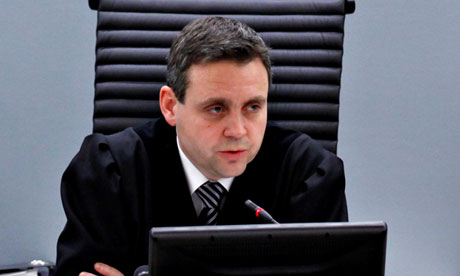
"Norwegian judge Jonas Petter Madsoe sentences Sadi Bugingo for his role in the 1994 genocide." (Anette Karlsen/AP)
Norway Jails Rwandan for 21 Years over Role in 1994 Genocide
Associated Press dispatch in The Guardian, February 14, 2013
"A Norwegian court has convicted a Rwandan man living in Norway for participating in the 1994 genocide in his home country and sentenced him to 21 years in prison. The Oslo district court found Sadi Bugingo, 47, guilty of complicity in the premeditated killings of at least 2,000 people belonging mainly to the Tutsi ethnic group. It singled out three prolonged attacks in his home town of Kibungo, eastern Rwanda, during April 1994. Bugingo has denied all charges and said he would appeal. The court said that the former businessman participated in the massacres and organised them by transporting armed killers and victims to the sites of the killings. 'Several witnesses have described how the accused was present in the massacres,' Judge Jonas Petter Madsoe said. 'In this court's view, there are also several other circumstances in the case which together support the conclusion that the defendant supported and participated in the genocide which took place in Kibungo.' During his defence Bugingo claimed that he was not in the region at the time of the massacres and said he had not known about them. Madsoe noted that he had been a wealthy local businessman and found his claims 'not credible'. Bugingo arrived in Norway in 2001 to join his family who had fled from Rwanda some years earlier. He was granted a residence permit in 2005 and worked as a cleaner in the western city of Bergen until he was arrested in 2011. The 19-week trial was the first genocide case in a Norwegian court. Similar cases against Rwandans have been brought in neighbouring Sweden, Finland and Denmark. More than 500,000 people were killed in the 1994 Rwanda genocide that was carried out by Hutu extremists against the Tutsi minority and Hutu moderates."
[n.b. This is the complete text of the dispatch.]

Wednesday, February 13, 2013

Germany / Area Bombing / Second World War

"Dresden's city centre, of which more than 90 per cent was destroyed." (Wikimedia Commons)
Dresden Deserves to be Remembered
By Tom Chivers
The Telegraph, February 13, 2013
"It's the 68th anniversary of the Dresden bombing. In Britain, we don't think about it as much as, perhaps, we should. The bare facts. More than 1,200 RAF and USAAF bombers attacked the city between the 13th and 15th of February 1945, in four raids. They dropped 3,900 tons of high explosive and incendiary bombs, killing between 22,000 and 25,000 people, almost all civilians. The city's anti-aircraft defences had all been moved to defend the industrial works of the Ruhr valley. The details are chilling. The bombing, first with high explosive to clear buildings out of the way of the wind, and then incendiaries to start fires, was deliberately intended to cause firestorms. A piece written last year on the Command Posts military history blog talks about the 15,000-foot smoke; the RAF bomber crews, 8,000 feet in the air, were sweating, their planes' bellies exposed to incredible heat even at that altitude. The wind whipped up into great fiery tornadoes, hurling people into the air and sucking oxygen from air-raid shelters so that families suffocated underground. The novelist Kurt Vonnegut, who was a prisoner of war in the city at the time and whose novel Slaughterhouse-Five depicted the horror, described the scene in the shelters as 'like a streetcar full of people who’d simultaneously had heart failure. Just people sitting there in their chairs, all dead.'

Sri Lanka / United Nations

"Government soldiers fire their artillery guns at Tamil Tiger insurgents in Kilinochchi, about 330 km (205 miles) north of the capital Colombo, September 22, 2008." (Reuters/Stringer)
Sri Lanka War Investigation Lags, Abuses Persist: UN
By Stephanie Nebehay
Reuters dispatch, February 13, 2013
"Sri Lanka is failing to investigate alleged atrocities committed by government forces in defeating a Tamil insurgency and activists and opposition politicians are still being killed or abducted, the United Nations said on Wednesday. The UN High Commissioner for Human Rights, Navi Pillay, called on authorities to allow international experts in criminal and forensic investigations to help resolve outstanding wartime crimes and end impunity. 'The steps taken by the government to investigate allegations of serious violations of human rights further have also been inconclusive and lack the independence and impartiality required to inspire confidence,' Pillay said in a report on a UN mission that went to Sri Lanka in September. Rights groups say the Sri Lankan military killed thousands of ethnic minority Tamil civilians in the shrinking territory held by rebels of the Liberation Tigers of Tamil Eelam just before their defeat in May 2009. An expert panel set up by UN Secretary-General Ban Ki-moon, whose findings have been rejected by Colombo, has said the army committed large-scale abuses and that as many as 40,000 civilians were killed in the last months of the conflict. Pillay said the government has not set up a mechanism to trace adults who went missing during the latter stages of the war and that investigations of disappearances had not led to arrests or prosecutions.

Saturday, February 09, 2013

Indonesia / Genocide and Memory

"A still from The Act of Killing. The documentary shows how self-professed killers of the 1960s massacre in Indonesia reenact their violent acts, including burning a village." (Carlos Arango de Montis)
Movie, Books Push Indonesia to Confront Its Bloody Past
By Yenni Kwok
Time.com, February 7, 2013
"One of the most-shocking films ever screened in Indonesia isn’t likely to be shown in movie theaters, but rather in bookshops, university campuses and art spaces. The Act of Killing (2012), directed by Joshua Oppenheimer together with Christine Cynn and an anonymous Indonesian filmmaker, tells of brutal state-sponsored mass killings through the eyes of the perpetrators. They are preman -- Indonesian for gangsters -- who took part in the massacre of suspected communists in the town of Medan, in northern Sumatra. It was part of the purge that engulfed the country in 1965 and '66, targeting members of the Indonesian Communist Party (PKI), their friends and families, sympathizers and ethnic Chinese (because of the party’s close ties with Beijing). Many lost their lives at the hands of the army, Muslim militias, youth gangs or rampaging mobs. In Oppenheimer's documentary, which will be screened at Berlinale 2013 starting this weekend, the self-professed and now elderly killers not only recount and boast of their violent acts -- they reenact them for a film within a film, acting as both victims and perpetrators. Their openness is a chilling reminder that in Indonesia, these mass murderers are still influential, untouched by the law, treated like heroes and even hailed as role models for the young. This gives The Act of Killing -- known as Jagal in Indonesian, meaning slaughter -- added poignancy as an indictment of the country's political elite. From a Vice President to a Deputy Minister and a governor, they are shown praising and hobnobbing with  the preman and the killers. The documentary, says Oppenheimer, a Texas-born filmmaker who now lives in Denmark, 'is a game changer because the story is told from the side of the perpetrators. They never lost the war, they built the society.' But The Act of Killing, which was shown at the Toronto Film Festival last year and had its first Indonesian premiere in early November, isn't the only artistic work currently renewing pressure on Indonesians to confront their dark past.

The Vatican / Jewish Holocaust

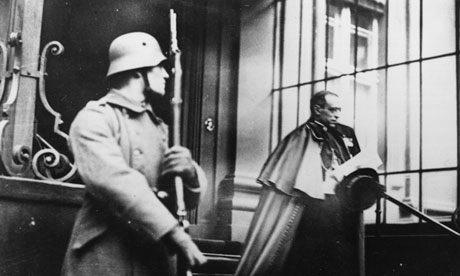
"Pope Pius XII in Berlin." (Hulton Getty)
"Hitler's Pope" Revealed as a Secret Friend to Holocaust Victims
By Dalya Alberge
The Observer, February 9, 2013
"Pius XII has long been vilified as 'Hitler's pope', accused of failing publicly to condemn the genocide of Europe's Jews. Now a British author has unearthed extensive material that Vatican insiders believe will restore his reputation, revealing the part that he played in saving lives and opposing nazism. Gordon Thomas, a Protestant, was given access to previously unpublished Vatican documents and tracked down victims, priests and others who had not told their stories before. The Pope's Jews, which will be published next month, details how Pius gave his blessing to the establishment of safe houses in the Vatican and Europe's convents and monasteries. He oversaw a secret operation with code names and fake documents for priests who risked their lives to shelter Jews, some of whom were even made Vatican subjects. Thomas shows, for example, that priests were instructed to issue baptism certificates to hundreds of Jews hidden in Genoa, Rome and elsewhere in Italy. More than 2,000 Jews in Hungary were given fabricated Vatican documents identifying them as Catholics and a network saved German Jews by bringing them to Rome. The pope appointed a priest with extensive funds with which to provide food, clothing and medicine. More than 4,000 Jews were hidden in convents and monasteries across Italy. During and immediately after the war, the pope was considered a Jewish saviour.