Thursday, April 25, 2013

Jewish Holocaust / Bystanders to Genocide

"Toy Nazi figurines in this exhibition at the United States Holocaust Memorial Museum." (Drew Angerer/The New York Times)
Bystanders, Not So Innocent
By Edward Rothstein
The New York Times, April 25, 2013
"Whatever larger themes are sounded when the United States Holocaust Memorial Museum commemorates its 20th anniversary here this weekend, whatever is said at a Monday ceremony by former President Bill Clinton or by the museum's founding chairman, Elie Wiesel, and whatever assessments are made about its influence, accomplishments or limitations, it will take a visit to its new exhibition, 'Some Were Neighbors,' to grasp one aspect of this imposing institution's power. It reveals the demonic not in grand forces, but in the most minute details. In one video interview, for example, a Lithuanianwitness, Regina Prudnikova, recalls that before the massacres, she cared for a Jewish child in her town, Pilviskiai. But, 'I was very young and had a very red face,' she explains, and was 'on the chubby side.' That wasn’t good. 'I was told that Jews cut you and take your blood.' She stopped baby-sitting. She now mocks such beliefs, but her tone becomes uncertain: 'I know that they say the Jews can't live without Christian blood. During their holidays they had to have at least a drop of that blood to taste.' Then, the recollection returns. The Jews were taken away and shot, their homes plundered. And we see a photograph of a wagon piled with loot being auctioned to passers-by. Or listen to Stanislaw Ochman, who transported the Jews of his village, Zdunska Wola, in Poland, in a wooden wagon to the cemetery where they were murdered. The children, holding their mothers' skirts, were often too short for the raked gunfire, and fell into the pit, still clinging, as soil was piled atop them.

Sunday, April 21, 2013

Japan / Second World War

"Japan's Prime Minister Shinzo Abe speaks during a news conference at the Japan National Press Club in Tokyo April 19, 2013." (Reuters/Yuya Shino)
Japan PM Abe's War Shrine Offering Likely to Infuriate China
Reuters dispatch, April 21, 2013
"Japanese Prime Minister Shinzo Abe made a ritual offering of a pine tree to a shrine seen as a symbol of Japan's former militarism on Sunday, a gesture likely to upset Asian victims of Japan's war-time aggression, including China and South Korea. Abe, an outspoken nationalist, offered the tree to the Yasukuni Shrine, where 14 Japanese leaders convicted as war criminals by an Allied tribunal are honored along with other war dead. Abe did not visit the shrine. Abe, who became prime minister for a second time after his Liberal Democratic Party's (LDP) election win in December, is unlikely to visit the shrine as he seeks to rebuild relationships with China and South Korea. Sino-Japanese relations deteriorated sharply in September after Japan bought islets in the East China Sea claimed by Beijing, sparking anti-Japanese protests across China. Ties have been shadowed for years by what Beijing says has been Tokyo's refusal to admit to wartime atrocities committed by Japanese soldiers in the country between 1931 and 1945. Memories of brutal Japanese occupation also run deep in North and South Korea. Two Japanese ministers and deputy chief cabinet secretary visited the shrine this weekend, as did Abe as main opposition party leader in October. 'It is natural for a lawmaker to offer condolences for the spirits of those who gave their lives for the country,' said Keiji Furuya, minister in charge of the issue of North Korea's abductions of Japanese nationals, who visited on Sunday, as did Deputy Chief Cabinet Secretary Katsunobu Kato. Minister for Internal Affairs and Communications Yoshitaka Shindo visited on Saturday."
[n.b. This is the complete text of the dispatch.]

Friday, April 19, 2013

Serbia / Kosovo / European Union

"From left: Prime Minister Ivica Dacic of Serbia, Catherine Ashton, the European Union's foreign policy chief, and Prime Minister Hashim Thaci of Kosovo." (Pool photo by Yves Logghe)
Serbia and Kosovo Reach Milestone Deal
By Dan Bilefsky
The New York Times, April 19, 2013
"Serbia and Kosovo reached an agreement on Friday aimed at overcoming ethnic enmities in the former Serbian province, a milestone that could enhance stability in the region and help clear the path for their eventual membership in the European Union. Catherine Ashton, the European Union's foreign policy chief, told reporters that the prime ministers of both countries had initialed an agreement during talks in Brussels, marking the end of six months of often heated negotiations. European Union countries meeting Monday in Brussels will decide whether to give Serbia the go-ahead to start negotiations for its entry into the bloc, and analysts said the accord was likely to swing a decision in Serbia's favor. Under the agreement, Serbs in the small majority-Serb area in northern Kosovo will gain more autonomy in return for the Serbian government's recognizing the authority of the Kosovo government. Misha Glenny, a leading Balkan expert, said the potent symbolism of Serbs and ethnic Albanians casting aside their differences could help spur regional reconciliation, in particular in ethnically divided Bosnia, where lingering divisions have impeded progress. 'This remarkable deal demonstrates that the Balkans, once known as the powder keg of Europe, can change and develop in a positive direction,' he said. Kosovo declared independence from Serbia on Feb. 17, 2008, nearly a decade after NATO bombs helped push out forces under the Serbian strongman Slobodan Milosevic.

Guatemala / Genocide Tribunals

In Guatemala, A Twist as Genocide Trial Nears End
By Daniel Hernandez
The Los Angeles Times, April 18, 2013
"On the first day of trial, a witness named Bernardo Bernal recounted how, as a 9-year-old in the spring of 1983, he hid in a stream and watched Guatemalan soldiers kill his parents and two younger brothers. On the second day of testimony in Guatemala City, a man named Pedro Chavez Brito described how soldiers found him and his siblings hiding in a traditional sauna in their village on Nov. 4, 1982. His sister was carrying a newborn. '"You are a guerrilla, you gave food to the guerrillas," they said to my sister,' the witness said, according to an unofficial transcript of the genocide case in Guatemala. Soldiers tied his sister to the stairs of the house and set fire to it, killing her, her children and perhaps six other relatives, Chavez Brito testified. Another witness said soldiers used an old woman's severed head as a soccer ball. The litany of terrors recalled in the genocide trial of former Guatemalan President Gen. Efrain Rios Montt has been relentless. The proceedings have been widely hailed by human rights groups as an important reckoning with the past, a rare prosecution of a former Latin American military dictator for war crimes in his own country. But on Thursday, nearly a month into the trial, the case suffered a potentially devastating setback. In a stunning turn, a judge from a different court granted an appeal from Rios Montt's defense to annul the entire case based on a technicality. That ruling in effect shut down the genocide trial and may force it to start all over. Prosecutors said they would appeal the decision. 'This is an absolute abuse of power, it is illegal, and of course we are going to appeal,' Arturo Aguilar, an aide to the attorney general, said shortly after the ruling. The uncertainty angered survivors, families and human rights advocates who had been attending day after day of wrenching testimony.

Thursday, April 18, 2013

Guatemala / Genocide Tribunals

"Guatemala's ex-dictator Efrain Rios Montt, attends the 19th day of his trial in the Supreme Court of Justice in Guatemala City April 16. Montt is the first Latin American strongman to be tried on genocide charges." (Jorge Dan Lopez/Reuters)
Guatemalan Court Faces Calls to Halt Former Dictator's Genocide Trial
By Romina Ruiz-Goiriena
The Christian Science Monitor, April 18, 2013
"Former Guatemalan dictator Efraín Ríos Montt is the first Latin American strongman to be tried on genocide charges. The landmark case has garnered worldwide attention, presented expert testimony from three continents, and already made history books. International observers, diplomats, and indigenous survivors alike have packed the Supreme Court building every day since the trail began on March 19. A vast majority is astounded the watershed case moved forward in a nation overrun by crime and impunity. But as the verdict nears, sectors of Guatemalan society and leading figures including President Otto Pérez Molina oppose the trial. They deny genocide took place during the country's 36-year-civil war and warn a guilty verdict could throw the country into chaos. Guatemala experts say this is because politicians have made little progress reconciling the country since the signing of the peace accords in 1996. They agree that political maneuverings so close to the trial's end threatens Guatemala's fragile democracy and could derail the Central American nation's best shot at justice. 'This trial has the potential to expose the deep-rooted racism of Guatemalan society,' says Anita Isaacs, professor of political science at Haverford College. 'It is enormously threatening to those who have historically benefited from it.' Mr. Ríos Montt seized power in a March 23, 1982 coup that gave way to the bloodiest period of Guatemala's 1960-1996 civil war. For years Ríos Montt avoided prosecution as a congressman, protected by a law that grants immunity to public officials. A judge charged the 86-year-old retired general in January 2012. The attorney general's office alleges Ríos Montt oversaw the torture, rape, and forced disappearances of 1,771 indigenous Ixils in 15 massacres between 1982 and 1983. The war left 200,000 people dead and more than 45,000 disappeared, mostly indigenous Mayans, according the United Nations.

Friday, April 12, 2013

D.R. Congo / Rape as a Crime against Humanity

"Congo: an army sergeant who says he was ordered to rape by his commanding officer." (Fiona Lloyd-Davies)
Congo: We Did Whatever We Wanted, Says Soldier Who Raped 53 Women
By Pete Jones
The Guardian, April 11, 2013
"In a small house on a hill overlooking Lake Kivu, a young Congolese soldier recounts the crimes he and his comrades committed in Minova a few months ago. 'Twenty-five of us gathered together and said we should rape 10 women each, and we did it,' he said. 'I've raped 53 women. And children of five or six years old. I didn't rape because I am angry, but because it gave us a lot of pleasure,' says 22-year-old Mateso (not his real name). 'When we arrived here we met a lot of women. We could do whatever we wanted.' As William Hague unveiled a sexual violence prevention strategy at a meeting of G8 foreign ministers in London this week, what happened in Minova is a stark reminder of the huge challenges facing those seeking to solve the problem of rape in the Democratic Republic of the Congo . On 22 November last year thousands of exhausted, battered and bruised Congolese army troops descended on the town having just lost a battle with the rebel M23 fighters in Goma, the main city in eastern Congo some 30 miles away. Their retreat was haphazard and chaotic. The soldiers were embarrassed, angry, upset and out of control; their commanders had disappeared and the battalion and regiment structures had disintegrated. When they arrived in Minova they were drunk, hungry and violent. The locals suffered two nightmarish days of looting, rape and murder before the army restored some discipline among its troops. Hundreds of women were raped.

Thursday, April 11, 2013

Myanmar-Burma / Rohingya

"Smoke rises as people look on in Meikhtila on March 21, 2013, when 25 Muslims were killed in a massacre led by Buddhist monks." (Soe Zeya Tun/Reuters)
Myanmar Massacre Fuels Fears of Ethnic Cleansing
by Jason Szep
The Globe and Mail, April 10, 2013
"The Buddhist monk grabbed a young Muslim girl and put a knife to her neck. 'If you follow us, I'll kill her,' the monk taunted police, according to a witness, as a Buddhist mob armed with machetes and swords chased nearly 100 Muslims in this city in central Myanmar. It was Thursday, March 21. Within hours, up to 25 Muslims had been killed. The Buddhist mob dragged their bloodied bodies up a hill in a neighbourhood called Mingalarzay Yone and set the corpses on fire. Some were found butchered in a reedy swamp. A Reuters cameraman saw the charred remains of two children, aged 10 or younger. Ethnic hatred has been unleashed in Myanmar since 49 years of military rule ended in March 2011. And it is spreading, threatening the country's historic democratic transition. Signs have emerged of ethnic cleansing, and of impunity for those inciting it. Over four days, at least 43 people were killed in this dusty city of 100,000, just 128 kilometres north of the capital of Naypyitaw. Nearly 13,000 people, mostly Muslims, were driven from their homes and businesses. The bloodshed here was followed by Buddhist-led mob violence in at least 14 other villages in Myanmar's central heartlands and put the Muslim minority on edge across one of Asia's most ethnically diverse countries. An examination of the riots, based on interviews with more than 30 witnesses, reveals the dawn massacre of 25 Muslims in Meikhtila was led by Buddhist monks -- often held up as icons of democracy in Myanmar. The killings took place in plain view of police, with no intervention by the local or central government. Graffiti scrawled on one wall called for a 'Muslim extermination.' Unrest that ensued in other towns, just a few hours’ drive from the commercial capital of Rangoon, was well-organized, abetted at times by police turning a blind eye. Even after the March 21 killings, the chief minister for the region did little to stop rioting that raged three more days. He effectively ceded control of the city to radical Buddhist monks who blocked fire trucks, intimidated rescue workers and led rampages that gutted whole neighbourhoods.

Myanmar-Burma / Rohingya

"A woman cries for her home, burnt down during the riot in Meiktila in March." (Associated Press)
"They Stood Shouting At Us to Come Out and Be Killed": Anti-Muslim Violence in Central Burma Has Left Thousands of People Homeless
By Peter Popham
The Independent, April 9, 2013
"In a wilderness of scorched rubble and twisted corrugated iron, a woman with wilted jasmine flowers in her hair was trying to locate what was left of her life. Ma Khin Aye lost her home and all her possessions when an anti-Muslim mob -- including Buddhist neighbours with whom she had been friendly for years -- set fire to it, along with all the others in the block in the central Burmese city of Meiktila. Armed with sticks and iron bars they then stood in the street, threatening to murder the terrified residents as they fled. Ma Khin Aye, 48, escaped the flames with her aged mother, who was almost comatose with shock. She braved the mob, got her mother on to the back of a scooter and took her to hospital. A week later, she came back to the ruins, rooting through the rubble to see if anything could be salvaged. While she did so, youths were looting the neighbourhood. They took anything of value that remained . Meiktila had been under army lockdown for a week, but neither the soldiers nor the police were there to stop them. 'I have no enemies. I have been living here for a long time,' Ma Khin Aye, who is unmarried and sells toys in a local market, told The Independent. 'Our communities have always been friendly: nothing like this has ever happened. At Thingyan [Burmese New Year] they would invite us into their homes; we would invite them into ours for Eid.' Who started the attacks? 'Some of them were strangers -- but when they wanted to find the homes of the kalar [Muslims], it was local people who brought them here. They stood there with sticks, shouting, "Come out, kalar, and we will kill you ..."'.

Monday, April 08, 2013

Israel / Iran / Anti-Semitism


Iran's Incitement to Genocide
By Michael Gerson
The Washington Post, April 4, 2013
"Over the years, Americans have come to discount statements on Israel and Zionism by Iran's President Mahmoud Ahmadinejad. Repetition has rendered them unremarkable. Israel must be 'wiped off the map.' Zionism is a 'germ of corruption' that 'will be wiped off the face of the earth.' It is a 'cancer cell' that must be 'removed from the body.' The Zionist regime is 'heading toward annihilation.' 'They should know that they are nearing the last days of their lives.' 'Israel is destined for destruction and will soon disappear.' One is tempted to add: blah, blah, blah. It is easy to dismiss this rhetoric as being designed for domestic consumption. And soon after Iran's June election, Ahmadinejad will be out of a job -- history’s most persuasive argument in favor of term limits. But the problem is this: Ahmadinejad's language is not exceptional within the Iranian regime. Iran's supreme leader, Ayatollah Ali Khamenei, also has referred to Israel as a 'cancerous tumor.' 'The perpetual subject of Iran,' he has explained, 'is the elimination of Israel from the region.' 'There is only one solution to the Middle East problem, namely the annihilation and destruction of the Jewish state.' In recent weeks, Khamenei has promised, if the Iranian nuclear program is attacked, to 'level down Tel Aviv and Haifa.' Senior Iranian military leaders, presidential advisers and religious authorities can be quoted endlessly in a similar vein. Zionists are 'microbes' and 'bacteria' and a 'cancerous growth.' 'Jews are very filthy people,' who are responsible for spreading disease and drug abuse. There is a religious duty to 'fight the Jews and vanquish them so that the conditions for the advent of the Hidden Imam will be met.' Such arguments are deeply embedded in the Iranian regime -- as a statement of mission, an organizing principle. This won't be changed by a single election.

Saturday, April 06, 2013

Ivory Coast

Ivory Coast Begins Exhuming Mass Graves
"Ivorian authorities have begun exhuming dozens of mass graves dating back to the country's 2011 post-election violence. The exercise started on Thursday as a new report accused Alassane Ouattara, Ivory Coast's president, of failing to bring his supporters to justice for crimes they allegedly committed during the conflict. Justice Minister Gnenema Coulibaly presided over the exhumations, observing a moment of silence at the site before digging started at the first grave on the grounds of a mosque in Abidjan's Yopougon district. The grave contained the bodies of four men aged 17 to 35, who were killed at the height of the violence in April 2011 while defending the mosque against supporters of former President Laurent Gbagbo. More than 3,000 people died over a period of five months after Gbagbo refused to concede defeat to Ouattara in the November 2010 election. Addressing religious leaders and relatives of the men who died at the mosque, Coulibaly said 'the prevailing security situation' during the conflict made proper funerals impossible for many families. A government census identified 57 graves for exhumation in the commercial capital Abidjan alone, many of which contain multiple bodies. The graves together are believed to contain more than 400 bodies. The exhumation process will eventually extend throughout the country, Coulibaly said. Yopougon was a flashpoint during the violence, and Coulibly said 36 of the 57 graves identified in Abidjan were located in the district.

United Kingdom / Violence against Alternative Subcultures

"Sophie Lancaster: died after being attacked in a park in 2007."
Goths, Emos and Punks Designated Victims of Hate Crimes
The Irish Times, April 4, 2013
"A [British] police force has begun recording offences against members of alternative subcultures as hate crimes. Greater Manchester Police is believed to be the first force to add abuse towards groups such as goths, emos and punks in the same way they do attacks based on race, religion, disability, sexual orientation or transgender identity. Assistant Chief Constable Garry Shewan said: 'People who wish to express their alternative sub-culture identity freely should not have to tolerate hate crime.' A police spokesman said: “From April 2013 Greater Manchester Police also now records alternative sub-culture related hate crime. 'We have done this following work we have carried out in partnership with the Sophie Lancaster Foundation, as we feel that adding this extra category of hate crime will help us better understand how some people are suffering from crimes because of their appearance, and better respond to the needs of victims of crime. You can let Greater Manchester Police know about an alternative sub-culture hate crime via the national True Vision on-line reporting form -- simply select "other" as a category and write alternative sub-culture in the box provided.' Miss Lancaster (20), was kicked and stamped to death because she was dressed as a goth in a park in Bacup, Lancashire, in August 2007. She slipped into a coma and never regained consciousness. The foundation is campaigning to get hate crimes laws expanded to include 'alternative subcultures or lifestyle and dress' and has gained support from musicians including Gary Numan and Courtney Love. There are no immediate plans to change the national hate crimes register, but last year Equalities Minister Lynne Featherstone acknowledged that the five recognised categories of hate crime was 'an incomplete list'."
[n.b. This is the complete text of the dispatch.]

Monday, April 01, 2013

China / Structural Violence

"Shanghai in January. Researchers said the toll from China’s pollution meant the loss of 25 million healthy years in 2010." (Aly Song/Reuters)
Air Pollution Linked to 1.2 Million Premature Deaths in China
By Edward Wong
The New York Times, April 1, 2013
"Outdoor air pollution contributed to 1.2 million premature deaths in China in 2010, nearly 40 percent of the global total, according to a new summary of data from a scientific study on leading causes of death worldwide. Figured another way, the researchers said, China’s toll from pollution was the loss of 25 million healthy years of life from the population. The data on which the analysis is based was first presented in the ambitious 2010 Global Burden of Disease Study, which was published in December in The Lancet, a British medical journal. The authors decided to break out numbers for specific countries and present the findings at international conferences. The China statistics were offered at a forum in Beijing on Sunday. 'We have been rolling out the India- and China-specific numbers, as they speak more directly to national leaders than regional numbers,' said Robert O'Keefe, the vice president of the Health Effects Institute, a research organization that is helping to present the study. The organization is partly financed by the United States Environmental Protection Agency and the global motor vehicle industry. What the researchers called 'ambient particulate matter pollution' was the fourth-leading risk factor for deaths in China in 2010, behind dietary risks, high blood pressure and smoking. Air pollution ranked seventh on the worldwide list of risk factors, contributing to 3.2 million deaths in 2010. By comparison with China, India, which also has densely populated cities grappling with similar levels of pollution, had 620,000 premature deaths in 2010 because of outdoor air pollution, the study found. That was deemed to be the sixth most common killer in South Asia.

Democratic Republic of the Congo / United Nations

"Congolese refugees at a camp in South Kivu were displaced this month by clashes between rebels and Congolese Army troops." (Jana Asenbrennerova/Reuters)
UN Approves New Force to Pursue Congo's Rebels
 "The United Nations Security Council authorized a new 'intervention brigade' for the Democratic Republic of Congo on Thursday with an unprecedented mandate to take military action against rebel groups to help bring peace to the eastern portion of the country. The resolution, which the Council adopted unanimously, gives the brigade a mandate to carry out offensive operations alone or with Congolese Army troops to neutralize and disarm militant groups. The intervention brigade will be the first such unit created within a traditional United Nations peacekeeping force. But the resolution states clearly that it will be established for one year 'on an exceptional basis and without creating a precedent or any prejudice to the agreed principles of peacekeeping.' The resolution, sponsored by France, the United States and Togo, says the 'intervention brigade' must have 'a clear exit strategy.' It says the Council will determine its continued presence based on its performance and according to whether Congo has made sufficient progress in improving its security sector and creating a Congolese 'rapid reaction force' that can take over responsibility for neutralizing armed groups and reducing the threat they pose to civilians and the government's authority. A United States deputy ambassador to the United Nations, Jeffrey DeLaurentis, said coordination between the military and civilian sides of the United Nations mission remained crucial to ensuring the protection of women and children, and to preventing 'the continuation of the horrible streak of sexual violence' in Congo.

Friday, March 29, 2013

Myanmar-Burma

"Destroyed furniture and belongings are seen in a market in Sitkwin March 29, 2013." (Reuters/Soe Zeya Tun)
Muslims Vanish as Buddhist Attacks Approach Myanmar's Biggest City
By Jason Szep
Reuters dispatch, March 29, 2013
"The Muslims of Sit Kwin were always a small group who numbered no more than 100 of the village's 2,000 people. But as sectarian violence led by Buddhist mobs spreads across central Myanmar, they and many other Muslims are disappearing. Their homes, shops and mosques destroyed, some end up in refugee camps or hide in the homes of friends or relatives. Dozens have been killed. 'We don't know where they are,' says Aung Ko Myint, 24, a taxi driver in Sit Kwin, a farming village where on Friday Buddhists ransacked a store owned by the town's last remaining Muslim. 'He escaped this morning just before the mob got here.' Since 42 people were killed in violence that erupted in Meikhtila town on March 20, unrest led by hardline Buddhists has spread to at least 10 other towns and villages in central Myanmar, with the latest incidents only about a two-hour drive from the commercial capital, Yangon. The crowds are fired up by anti-Muslim rhetoric spread over the Internet and by word of mouth from monks preaching a movement known as '969'. The three numbers refer to various attributes of the Buddha, his teachings and the monkhood. But it has come to represent a radical form of anti-Islamic nationalism which urges Buddhists to boycott Muslim-run shops and services. Myanmar is predominantly Buddhist but about 5 percent of its 60 million people are Muslims. There are large Muslim communities in Yangon, Mandalay and towns across Myanmar's heartland where the religions have co-existed for generations. But as violence spreads from village to village, the unleashing of ethnic hatred, suppressed during 49 years of military rule that ended in March 2011, is challenging the reformist government of one of Asia's most ethnically diverse countries.

India / Gendercide

"Discrimination: Expectant mothers carrying girls are less likely to give birth in hospital, take iron supplements and receive tetanus immunisation,"
Indian Women Are Victims of Discrimination before They Are Even Born as Baby Boys Get Better Medical Treatment before Birth
By Olivia Williams
The Daily Mail, March 28, 2013
"A survey of more than 30,000 Indians by Michigan State University and University of California has revealed that preferential treatment for men starts before they are even born.
Women expecting boys were more likely to get prenatal medical appointments, take iron supplements, and receive vital tetanus shots. They were also more likely to deliver a son in a health-care facility, as opposed to at home. It is even still common practice to have an abortion based on the baby's sex in India, though it is illegal. When baby girls are carried to full term, they still face medical discrimination with serious long-term health consequences. Assistant professor Leah Lakdawala from MSU who carried out the research said: 'This type of discrimination, while not as severe as sex-selective abortion, is very important for children's well-being'. Missing out on the Tetanus vaccinations is a particular worry as it is the main cause of newborn deaths in India. Babies whose mothers had not received a tetanus vaccination were more likely to be born underweight or die shortly after birth. The researchers compared the survey to other patriarchal nations such as China, Bangladesh and Pakistan and saw similar evidence of medical discrimination. This could mean that girls are already at a serious disadvantage when they are born. 'We know that children born at higher birth weights go to school for longer periods and have higher wages as adults, so the future implications here are serious,' Lakdawala said.
The study was published in the Journal of Human Resources."
[n.b. This is the complete text of the dispatch. Thanks to Jo Jones for bringing this source to my attention.]

Tuesday, March 26, 2013

Congo / Rwanda / International Criminal Court

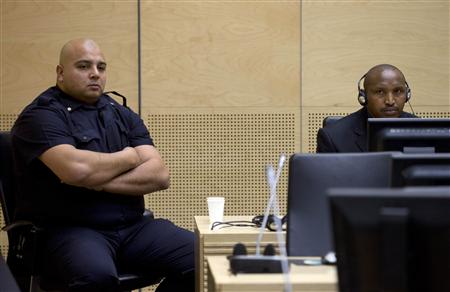
"Congolese warlord Bosco Ntaganda (R) looks on beside a security guard during his first appearance before judges at the International Criminal Court in the Hague March 26, 2013." (Reuters/Peter Dejong/Pool)
Congo Warlord Denies Guilt in First Appearance at Hague Court
By Thomas Escritt
Reuters dispatch on Yahoo! News, March 26, 2013
"Bosco Ntaganda, a Congolese warlord known as 'the Terminator' who evaded arrest on war crimes charges for seven years, denied guilt when he appeared for the first time at the International Criminal Court on Tuesday. Ntaganda unexpectedly gave himself up to diplomats at the U.S. Embassy in Rwanda last week, walking in off the street and demanding to be handed over the ICC. Within days he was put on a plane to The Hague. He is accused of murder, rape and other crimes over a 15-year-period of fighting in Rwandan-backed rebellions in eastern Democratic Republic of Congo. His appearance almost seven years after the court first issued a warrant for his arrest is a much-needed success for the ICC following the collapse of several cases. Dressed in an ill-fitting dark blue suit, blue shirt, and stripy tie -- attire most likely provided by the court -- a stooped and bowed Ntaganda appeared ill at ease in the courtroom on Tuesday, leaning forward and looking down as the hearing began. He confirmed his name, gave his age as 39, and told the court he was not guilty of the charges, but a judge interrupted and said this was not the occasion for discussing his guilt.

Bangladesh

"Proceedings against accused war criminals in Bangladesh have caused civil unrest and violence." (AFP/Getty Images)
Bangladesh Minorities Bear Brunt of Violence
By Saif Khalid
AlJazeera.com, March 24, 2013
"A few weeks ago, after Friday prayers, a mob of more than 3,000 people attacked the house of Sadhanchandra Mandal, a Hindu, in southwestern Bangladesh. 'They attacked our houses shouting slogans such as ... "We are the Taliban, this Bengal will be Afghan", and looted everything," said 60-year-old Mandal, who said the attackers used petrol and weapons in the assault against his home. 'I don't understand how we will survive here -- anytime I will be killed, as they are threatening me.' Mandal said the police and a paramilitary battalion did nothing to stop the crowd from attacking houses in the remote villages of the Satkhira district where he lives. 'My wife and daughter-in-law with her two kids saved their lives by swimming across a pond,' Mandal told Al Jazeera. 'We are still not safe.' The South Asian nation has been caught up in turmoil ever since two war crimes tribunals sentenced several public figures for atrocities committed during the country's liberation war from Pakistan in 1971, and it is members of the minority community like Mandal who have borne the brunt of the violence. Among those sentenced are leaders of the country's largest Islamist Jamaat-e-Islami party, whose supporters are blamed for much of the violence. Supporters of the main opposition Bangladesh Nationalist Party (BNP) have also hit the streets, as some of their own leaders are also facing war crimes charges. With tensions running high, minorities have come to be seen as soft targets to vent frustration.

Friday, March 22, 2013

Myanmar-Burma / Rohingya

"Riot policemen form up near a fire during riots in Meikhtila March 22, 2013." (Soe Zeya Tun/Reuters)
Myanmar Riots Stoke Fears of Widening Sectarian Violence
By Andrew R.C. Marshall
Reuters dispatch, March 22, 2013
"Myanmar declared martial law in four central townships on Friday after unrest between Buddhists and Muslims stoked fears that last year's sectarian bloodshed was spreading into the country's heartland in a test of Asia's newest democracy. Whole neighborhoods were still smoldering on Friday and agitated Buddhist crowds roamed the streets after three days of turbulence, said Reuters reporters in the city 540 km (336 miles) north of the commercial capital Yangon. State television said President Thein Sein had declared a state of emergency and imposed martial law in the four districts, placing the military, rather than local police, in charge of security. Authorities imposed an overnight curfew on Wednesday. Twenty people, including a Buddhist monk, have been killed and dozens wounded since Wednesday, said Win Htein, a lawmaker for the opposition National League for Democracy (NLD) party. Two camps now held more than 2,000 people displaced by the fighting, he added. The unleashing of ethnic hatred, suppressed during 49 years of military rule that ended in March 2011, is challenging the reformist government of one of Asia's most ethnically diverse countries. Jailed dissidents have been released, a free election held and censorship lifted in Myanmar's historic democratic transition. But the government has faced mounting criticism over its failure to stop the bloodshed between Buddhists and Muslims. 'I am really sad over what happened here because this is not just happening to one person. It's affecting all of us,' said Maung Maung, a Buddhist official in Meikhtila. Hundreds of Muslims have fled their homes to shelter at a sports stadium, local officials said.

Thursday, March 21, 2013

Croatia / Serbia

"Police battle rioting fans when violence erupts at a football match between fans of Red Star Belgrade and Dynamo Zagreb Yugoslavia in 1990." (Rex Features)
Croatia vs Serbia The Rematch: Memories of Riots, Battles and War Crimes
By Shaun Walker
The Independent, March 21, 2013
"It was in the Maksimir Stadium that the tremors that presaged the Yugoslav wars first erupted, as a mass riot broke out between fans of Red Star Belgrade and Dinamo Zagreb in May 1990. With fists flying and knives drawn, dozens were injured in a brawl between the two sets of fans, many of whom would soon be facing each other on real battlefields. It is in the same stadium tomorrow night that Serbia and Croatia will face each other for the first time on the football pitch as independent nations in a World Cup qualifier that is overlaid with memories of riots, battles and war crimes. Football-mad at the best of times, there is much more at stake than the chance to edge closer to a place at next year’s World Cup. Serbian fans have been banned from the stadium in an attempt to avert violence, just like their Croatian counterparts will be when the two teams meet in the return leg in Belgrade in September. In Vukovar, a town on the border with Serbia, the tension is palpable. It saw heavy fighting under seven years of Serb occupation before it was handed back to Croatia in 1998. The population is still mixed, with Serbs making up about one third of the inhabitants, but the two ethnic groups live segregated lives. Sparks have flown in recent months as the Serbian population fights to have the town's street signs written bilingually, and Serbs say they will not dare to leave their homes during tonight's game for fear of being attacked by the local Croat population.

Sunday, March 17, 2013

Guatemala / Genocide Tribunals

"The former dictator, Gen. Efraín Ríos Montt, is set to stand trial for the massacres during his rule in 1982-83." (Victor J. Blue/The New York Times)
In Effort to Try Dictator, Guatemala Shows New Judicial Might
By Elisabeth Malkin
The New York Times, March 16, 2013
"Tiburcio Utuy thought he saw fear cross the former dictator's face. A judge had just ruled that the military dictator, Gen. Efraín Ríos Montt, now 86, should stand trial for genocide and crimes against humanity committed under his rule in the 1980s, a decision Mr. Utuy and other Maya survivors of Guatemala's 34-year civil war had gathered in the courtroom to hear in person. 'He won't suffer the same way we suffered -- but he will be scared,' Mr. Utuy said in his mountaintop village a few days after the ruling in late January. 'And maybe he will spend a little bit of time in prison.' Mr. Utuy, 71, is set to be a witness in a trial that few believed would ever take place. But Guatemala's justice system has begun a transformation. In a show of political will, prosecutors are taking long-dormant human rights cases to court, armed with evidence that victims and their advocates have painstakingly compiled over more than a decade -- as much to bear witness as to bring judgment. 'It's sending the most important message of the rule of law -- that nobody is above the law,' said Claudia Paz y Paz, the attorney general, who many here say has been one of the most important forces behind the change. In the 17 months that Mr. Ríos Montt controlled Guatemala, before he was overthrown in a coup in August 1983, his soldiers intensified a scorched-earth campaign across the Maya highlands begun by his predecessor in 1981 to flush out leftist guerrillas. The military marched into villages, torturing, raping and killing those who could not run away. They burned down houses and crops, and butchered livestock. A United Nations truth commission concluded in 1999 that attacks on specific indigenous groups amounted to genocide. 'The aim of the perpetrators was to kill the largest number of group members possible,' the commission's report said. Investigators concluded that the war took more than 200,000 lives over more than three decades before the 1996 peace accords.