Wednesday, February 20, 2013

Mexico / Forced Disappearance

In Mexico, A "Crisis of Enforced Disappearances," Rights Group Says
By Nick Miroff
The Washington Post, February 20, 2013
"Describing what it called 'the most severe crisis of enforced disappearances in Latin America in decades,' the US organization Human Rights Watch issued a new report Wednesday with grim implications for the thousands of Mexican civilians who have gone missing in the country’s shadowy drug fight. While inquiring into the cases of 249 missing persons in Mexico, the group said, its researchers found credible evidence that soldiers or police participated in 149 of the disappearances. The victims included husbands and fathers who went out for groceries and never came back and others dragged from their homes by uniformed men in the middle of the night, the rights group said. Many were last seen being stuffed into military trucks and police vehicles. Claims of extrajudicial killings and other grave rights violations have dogged Mexican security forces for years. But the report released Wednesday is one of the most significant attempts to date to identify patterns of abuse during the anti-drug effort and to examine the degree to which Mexican authorities either fail to investigate disappearances or, in many instances, are responsible for them. US lawmakers have periodically threatened to withhold millions of dollars in security aid to Mexico over concerns that police and military abuses have worsened in recent years, and some funding was temporarily blocked in 2010. Congress has appropriated nearly $2 billion in assistance so far under the terms of the 2007 Merida Initiative, and 15 percent of funds are supposed to be conditioned on rights improvements in Mexico.

India / United Kingdom / Colonialism

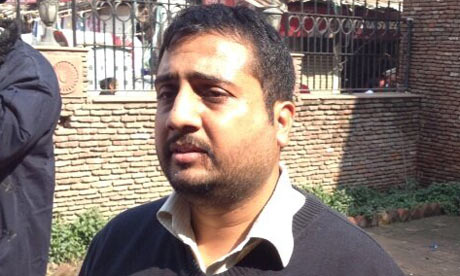
"Sunil Kapoor's great-grandfather was among the dead at Amritsar."
David Cameron Defends Lack of Apology for British Massacre at Amritsar
By Nicholas Watt
The Guardian, February 20, 2013
"David Cameron has defended his decision to stop short of delivering a formal British apology for the Amritsar massacre in 1919, in which at least 379 innocent Indians were killed. As relatives of the victims expressed disappointment, the prime minister said it would be wrong to 'reach back into history' and apologise for the wrongs of British colonialism. He was speaking shortly after becoming the first serving British prime minister to visit the scene of the massacre, which emboldened the Indian independence movement. He bowed his head at the memorial, in the Jallianwala Bagh public gardens. In a handwritten note in the book of condolence for victims of the massacre, Cameron quoted Winston Churchill's remarks from 1920. He described the shootings, in his own words, as a 'deeply shameful event'. As he prepared to leave Amritsar, Cameron explained why he had decided against issuing an apology. 'In my view,' he said, 'we are dealing with something here that happened a good 40 years before I was even born, and which Winston Churchill described as "monstrous" at the time and the British government rightly condemned at the time. So I don't think the right thing is to reach back into history and to seek out things you can apologise for. I think the right thing is to acknowledge what happened, to recall what happened, to show respect and understanding for what happened. That is why the words I used are right: to pay respect to those who lost their lives, to remember what happened, to learn the lessons, to reflect on the fact that those who were responsible were rightly criticised at the time, to learn from the bad and to cherish the good.' Among the relatives of the victims who were disappointed that the prime minister had not apologised was Sunil Kapoor, whose great grandfather Waso Mal Kapoor died in the shootings. He said: 'If he said it is shameful, why did he not apologise?'

Monday, February 18, 2013

Canada / Genocides of Indigenous Peoples

At Least 3,000 Deaths Linked to Indian Residential Schools: New Research
By Colin Perkel
Canadian Press dispatch on CTVNews.ca, February 18, 2013
"At least 3,000 children, including four under the age of 10 found huddled together in frozen embrace, are now known to have died during attendance at Canada's Indian residential schools, according to new unpublished research. While deaths have long been documented as part of the disgraced residential school system, the findings are the result of the first systematic search of government, school and other records. 'These are actual confirmed numbers,' Alex Maass, research manager with the Missing Children Project, told The Canadian Press from Vancouver. 'All of them have primary documentation that indicates that there's been a death, when it occurred, what the circumstances were.' The number could rise further as more documents -- especially from government archives -- come to light. The largest single killer, by far, was disease. For decades starting in about 1910, tuberculosis was a consistent killer -- in part because of widespread ignorance over how diseases were spread. 'The schools were a particular breeding ground for (TB),' Maass said. 'Dormitories were incubation wards.' The Spanish flu epidemic in 1918-1919 also took a devastating toll on students -- and in some cases staff. For example, in one grim three-month period, the disease killed 20 children at a residential school in Spanish, Ont., the records show.

Syria / International Criminal Court

"Member of the Commission of Inquiry on Syria Carla del Ponte addresses a news conference at the United Nations European headquarters in Geneva February 18, 2013. Syrians in 'leadership positions' who may be responsible for war crimes have been identified, along with units accused of perpetrating them, United Nations investigators said on Monday." (Reuters/Denis Balibouse)
Time to Refer Syrian War Crimes to ICC, UN Inquiry Says
By Stephanie Nebehay
Reuters dispatch, February 18, 2013
"United Nations investigators said on Monday that Syrian leaders they had identified as suspected war criminals should face the International Criminal Court (ICC). The investigators urged the UN Security Council to 'act urgently to ensure accountability' for violations, including murder and torture, committed by both sides in a conflict that has killed an estimated 70,000 people since a revolt against President Bashar al-Assad began in March, 2011. 'Now really it's time ... We have a permanent court, the International Criminal Court, who would be ready to take this case,' Carla del Ponte, a former ICC chief prosecutor who joined the UN team in September, told a news briefing in Geneva. The inquiry, led by Brazilian Paulo Pinheiro, is tracing the chain of command to establish criminal responsibility and build a case for eventual prosecution. 'Of course we were able to identify high-level perpetrators,' del Ponte said, adding that these were people 'in command responsibility ... deciding, organizing, planning and aiding and abetting the commission of crimes'. She said it was urgent for the Hague-based war crimes tribunal to take up cases of 'very high officials', but did not identify them, in line with the inquiry's practice. 'We have crimes committed against children, rape and sexual violence. We have grave concerns. That is also one reason why an international body of justice must act because it is terrible.' Del Ponte, who brought former Yugoslav President Slobodan Milosevic to the ICC on war crimes charges, said the ICC prosecutor would need to deepen the investigation on Syria before an indictment could be prepared.

Canada / Indigenous Peoples / Violence against Women as a Crime against Humanity

"Highway 16, sometimes referred to as 'the Highway of Tears' in recognition of the women and girls who have gone missing or been murdered in its vicinity, in northern British Columbia. July 2012." (Samer Muscati/Human Rights Watch)
Canada: Abusive Policing, Neglect Along "Highway of Tears"
Human Rights Watch press release, February 13, 2013
"The Royal Canadian Mounted Police in northern British Columbia has failed to protect indigenous women and girls from violence, Human Rights Watch said in a report released today. Women and girls Human Rights Watch interviewed also described abusive treatment by police officers, including excessive use of force, and physical and sexual assault. The 89-page report, 'Those Who Take Us Away: Abusive Policing and Failures in Protection of Indigenous Women and Girls in Northern British Columbia, Canada,' documents both ongoing police failures to protect indigenous women and girls in the north from violence and violent behavior by police officers ... Police failures and abuses add to longstanding tensions between the Royal Canadian Mounted Police (RCMP) and indigenous communities in the region, Human Rights Watch said. The Canadian government should establish a national commission of inquiry into the murders and disappearances of indigenous women and girls, including the impact of police mistreatment on their vulnerability to violence in communities along Highway 16, which has come to be called northern British Columbia's 'Highway of Tears.' 'The threat of domestic and random violence on one side, and mistreatment by RCMP officers on the other, leaves indigenous women in a constant state of insecurity,' said Meghan Rhoad, women's rights researcher at Human Rights Watch. 'Where can they turn for help when the police are known to be unresponsive and, in some cases, abusive.'

Sunday, February 17, 2013

Bangladesh / Genocide Tribunals

Bangladesh Amends War Crimes Law amid Protest
AlJazeera.com, February 18, 2013
"Bangladesh's parliament, meeting the demands of protesters, has amended a law allowing the state to appeal any verdict in war crimes trials it deems inadequate and out of step with public opinion. The amendment will 'empower the tribunals to try and punish any organisations, including Jamaat-e-Islami, for committing crimes during country's liberation war in 1971', Shafique Ahmed, the law minister, said on Sunday amid an opposition boycott. Tens of thousands of demonstrators, jamming central Shahbag Square in the capital, Dhaka, for the 13th day, burst into cheers as the assembly approved the changes. The protesters have been demanding death penalty for war crimes after a tribunal this month sentenced a prominent Jamaat-e-Islami leader to life in prison in connection with Bangladesh's 1971 war of independence from Pakistan. Protests erupted after Abdul Quader Mollah, assistant secretary general of the Jamaat party, the country's largest Islamic party, was sentenced to life for murder, rape and torture. Demonstrators thronged the capital demanding capital punishment to Mollah. However, supporters of Jamaat have held rallies to question the war tribunal's neutrality. They have described the tribunal as politically motivated and demanded that the Jamaat leaders be tried under the auspices of the UN. Lawyers said the amendment sets a timetable for the government to appeal against Mollah's sentence and secure a retrial. The previous law did not allow state prosecutors to call for a retrial except in the case of acquittals. [...]"

Saturday, February 16, 2013

Germany / United Kingdom / Neo-Nazism / Anti-Semitism

"Fans of the German soccer team Kaiserslautern hold up Israeli flags to protest against anti-Semitism prior to the Bundesliga match between FC Kaiserslautern and VfL Wolfsburg in March last year." (Alex Grimm/Bongarts via Getty Images)
Seven Decades after Holocaust, Neo-Nazis Use Soccer to Preach Hitler's Hate
By Donald Snyder
MSNBC.com, February 16, 2013
"Nearly seven decades after the Holocaust, young soccer fans in Germany have become targets of neo-Nazis who preach the hatred of Adolf Hitler's Third Reich. 'Again and again we see neo-Nazi presence in [sports] fan clubs and my office asks that action be taken against them,' said Winfriede Schreiber, head of the Brandenburg branch of the German government's intelligence service 'For example, we see the fan club in [the German city] Cottbus consisting of a lot of neo-Nazis. We asked the football club to do something about this.' At her office in Brandenburg, a state in eastern Germany, Schreiber monitors extremism and reports evidence of hate crimes to prosecutors. 'The neo-Nazis now look like everyone else,' Schreiber said. 'Gone are the jackboots and black leather jackets that used to make it easy to expose them. Now they blend into the local population.' According to Schreiber, the neo-Nazis subscribe to Hitler's views and extol his one-time deputy, Rudolf Hess. 'The danger the neo-Nazis pose is that they are against democracy and they work to alienate young people from democracy,' she said. 'They have made "Juden" [Jews] a curse word even if there are no Jews playing on the soccer field.' Jens Teschke, a spokesman for Germany's interior ministry, which is responsible for domestic security, said neo-Nazi activities are visible throughout Germany, but strongest in the country's east. 'Neo-Nazis take young soccer fans to homes built in the Nazi times as holiday retreats for elite members of Hitler's party,' Teschke said. 'They laud the Nazi era and the legacy of this era.'

Thursday, February 14, 2013

Norway / Rwandan Genocide / Genocide Tribunals

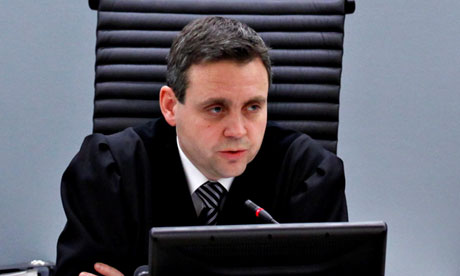
"Norwegian judge Jonas Petter Madsoe sentences Sadi Bugingo for his role in the 1994 genocide." (Anette Karlsen/AP)
Norway Jails Rwandan for 21 Years over Role in 1994 Genocide
Associated Press dispatch in The Guardian, February 14, 2013
"A Norwegian court has convicted a Rwandan man living in Norway for participating in the 1994 genocide in his home country and sentenced him to 21 years in prison. The Oslo district court found Sadi Bugingo, 47, guilty of complicity in the premeditated killings of at least 2,000 people belonging mainly to the Tutsi ethnic group. It singled out three prolonged attacks in his home town of Kibungo, eastern Rwanda, during April 1994. Bugingo has denied all charges and said he would appeal. The court said that the former businessman participated in the massacres and organised them by transporting armed killers and victims to the sites of the killings. 'Several witnesses have described how the accused was present in the massacres,' Judge Jonas Petter Madsoe said. 'In this court's view, there are also several other circumstances in the case which together support the conclusion that the defendant supported and participated in the genocide which took place in Kibungo.' During his defence Bugingo claimed that he was not in the region at the time of the massacres and said he had not known about them. Madsoe noted that he had been a wealthy local businessman and found his claims 'not credible'. Bugingo arrived in Norway in 2001 to join his family who had fled from Rwanda some years earlier. He was granted a residence permit in 2005 and worked as a cleaner in the western city of Bergen until he was arrested in 2011. The 19-week trial was the first genocide case in a Norwegian court. Similar cases against Rwandans have been brought in neighbouring Sweden, Finland and Denmark. More than 500,000 people were killed in the 1994 Rwanda genocide that was carried out by Hutu extremists against the Tutsi minority and Hutu moderates."
[n.b. This is the complete text of the dispatch.]

Wednesday, February 13, 2013

Germany / Area Bombing / Second World War

"Dresden's city centre, of which more than 90 per cent was destroyed." (Wikimedia Commons)
Dresden Deserves to be Remembered
By Tom Chivers
The Telegraph, February 13, 2013
"It's the 68th anniversary of the Dresden bombing. In Britain, we don't think about it as much as, perhaps, we should. The bare facts. More than 1,200 RAF and USAAF bombers attacked the city between the 13th and 15th of February 1945, in four raids. They dropped 3,900 tons of high explosive and incendiary bombs, killing between 22,000 and 25,000 people, almost all civilians. The city's anti-aircraft defences had all been moved to defend the industrial works of the Ruhr valley. The details are chilling. The bombing, first with high explosive to clear buildings out of the way of the wind, and then incendiaries to start fires, was deliberately intended to cause firestorms. A piece written last year on the Command Posts military history blog talks about the 15,000-foot smoke; the RAF bomber crews, 8,000 feet in the air, were sweating, their planes' bellies exposed to incredible heat even at that altitude. The wind whipped up into great fiery tornadoes, hurling people into the air and sucking oxygen from air-raid shelters so that families suffocated underground. The novelist Kurt Vonnegut, who was a prisoner of war in the city at the time and whose novel Slaughterhouse-Five depicted the horror, described the scene in the shelters as 'like a streetcar full of people who’d simultaneously had heart failure. Just people sitting there in their chairs, all dead.'

Sri Lanka / United Nations

"Government soldiers fire their artillery guns at Tamil Tiger insurgents in Kilinochchi, about 330 km (205 miles) north of the capital Colombo, September 22, 2008." (Reuters/Stringer)
Sri Lanka War Investigation Lags, Abuses Persist: UN
By Stephanie Nebehay
Reuters dispatch, February 13, 2013
"Sri Lanka is failing to investigate alleged atrocities committed by government forces in defeating a Tamil insurgency and activists and opposition politicians are still being killed or abducted, the United Nations said on Wednesday. The UN High Commissioner for Human Rights, Navi Pillay, called on authorities to allow international experts in criminal and forensic investigations to help resolve outstanding wartime crimes and end impunity. 'The steps taken by the government to investigate allegations of serious violations of human rights further have also been inconclusive and lack the independence and impartiality required to inspire confidence,' Pillay said in a report on a UN mission that went to Sri Lanka in September. Rights groups say the Sri Lankan military killed thousands of ethnic minority Tamil civilians in the shrinking territory held by rebels of the Liberation Tigers of Tamil Eelam just before their defeat in May 2009. An expert panel set up by UN Secretary-General Ban Ki-moon, whose findings have been rejected by Colombo, has said the army committed large-scale abuses and that as many as 40,000 civilians were killed in the last months of the conflict. Pillay said the government has not set up a mechanism to trace adults who went missing during the latter stages of the war and that investigations of disappearances had not led to arrests or prosecutions.

Saturday, February 09, 2013

Indonesia / Genocide and Memory

"A still from The Act of Killing. The documentary shows how self-professed killers of the 1960s massacre in Indonesia reenact their violent acts, including burning a village." (Carlos Arango de Montis)
Movie, Books Push Indonesia to Confront Its Bloody Past
By Yenni Kwok
Time.com, February 7, 2013
"One of the most-shocking films ever screened in Indonesia isn’t likely to be shown in movie theaters, but rather in bookshops, university campuses and art spaces. The Act of Killing (2012), directed by Joshua Oppenheimer together with Christine Cynn and an anonymous Indonesian filmmaker, tells of brutal state-sponsored mass killings through the eyes of the perpetrators. They are preman -- Indonesian for gangsters -- who took part in the massacre of suspected communists in the town of Medan, in northern Sumatra. It was part of the purge that engulfed the country in 1965 and '66, targeting members of the Indonesian Communist Party (PKI), their friends and families, sympathizers and ethnic Chinese (because of the party’s close ties with Beijing). Many lost their lives at the hands of the army, Muslim militias, youth gangs or rampaging mobs. In Oppenheimer's documentary, which will be screened at Berlinale 2013 starting this weekend, the self-professed and now elderly killers not only recount and boast of their violent acts -- they reenact them for a film within a film, acting as both victims and perpetrators. Their openness is a chilling reminder that in Indonesia, these mass murderers are still influential, untouched by the law, treated like heroes and even hailed as role models for the young. This gives The Act of Killing -- known as Jagal in Indonesian, meaning slaughter -- added poignancy as an indictment of the country's political elite. From a Vice President to a Deputy Minister and a governor, they are shown praising and hobnobbing with  the preman and the killers. The documentary, says Oppenheimer, a Texas-born filmmaker who now lives in Denmark, 'is a game changer because the story is told from the side of the perpetrators. They never lost the war, they built the society.' But The Act of Killing, which was shown at the Toronto Film Festival last year and had its first Indonesian premiere in early November, isn't the only artistic work currently renewing pressure on Indonesians to confront their dark past.

The Vatican / Jewish Holocaust

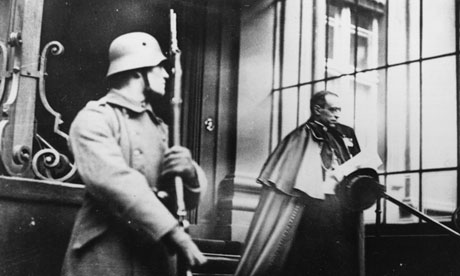
"Pope Pius XII in Berlin." (Hulton Getty)
"Hitler's Pope" Revealed as a Secret Friend to Holocaust Victims
By Dalya Alberge
The Observer, February 9, 2013
"Pius XII has long been vilified as 'Hitler's pope', accused of failing publicly to condemn the genocide of Europe's Jews. Now a British author has unearthed extensive material that Vatican insiders believe will restore his reputation, revealing the part that he played in saving lives and opposing nazism. Gordon Thomas, a Protestant, was given access to previously unpublished Vatican documents and tracked down victims, priests and others who had not told their stories before. The Pope's Jews, which will be published next month, details how Pius gave his blessing to the establishment of safe houses in the Vatican and Europe's convents and monasteries. He oversaw a secret operation with code names and fake documents for priests who risked their lives to shelter Jews, some of whom were even made Vatican subjects. Thomas shows, for example, that priests were instructed to issue baptism certificates to hundreds of Jews hidden in Genoa, Rome and elsewhere in Italy. More than 2,000 Jews in Hungary were given fabricated Vatican documents identifying them as Catholics and a network saved German Jews by bringing them to Rome. The pope appointed a priest with extensive funds with which to provide food, clothing and medicine. More than 4,000 Jews were hidden in convents and monasteries across Italy. During and immediately after the war, the pope was considered a Jewish saviour.

Friday, February 08, 2013

Guatemala / Genocide Tribunals

A Day of Reckoning for Guatemalan Genocide?
By Kate Doyle
Counterpunch.org, February 8-10, 2013
"Judge Miguel Ángel Gálvez ended a four-hour hearing today Monday in the genocide trial of former Guatemalan dictator Efraín Ríos Montt by accepting all of the witnesses, experts and documents submitted as evidence by the prosecution. The defense, by contrast, failed in its bid to incorporate experts and documentary evidence on behalf of their client, although the judge approved several defense witnesses. The ruling signifies that the case will now advance to the Sentencing Tribunal for a decision on when to open the final, oral phase of the groundbreaking trial against the retired general and his intelligence chief, José Mauricio Rodríguez Sánchez. Both men are accused as the masterminds behind a 'scorched earth' military campaign against rebel forces during 1982-83 that massacred hundreds of Mayan civilians living in the northwestern Ixil region of the country. The hearing took place on the 14th floor of the Tribunals Tower in Guatemala City before an audience of human rights defenders, Mayan activists, journalists and other observers. Ríos Montt sat behind his three attorneys, listening to the proceeding and taking notes, while prosecutor Orlando López and four representatives of the victims shared a long table opposite him. Although the afternoon was dominated by the judge as he read aloud the names of the hundreds of witnesses proposed by the Public Ministry -- many of them survivors of the massacres -- his rejection of much of the defense team's evidence sparked a heated response from Ríos Montt's lawyers. ... In effect, the judge was pointing out the failure of the defense team to do the work that the case required.

Wednesday, February 06, 2013

Jewish Holocaust / Genocide and Memory

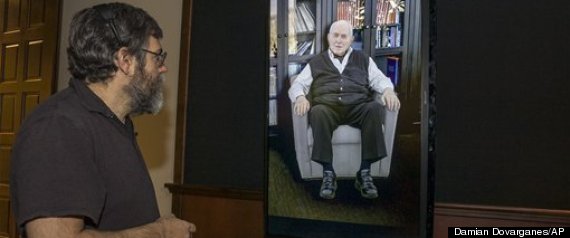
"USC is creating holograms of aging Holocaust survivors telling their stories."
Holocaust Holograms Of Aging Survivors Will Allow Their Stories To Be Retold, Remembered
By John Rogers
The Huffington Post, February 2, 2013
"For years, Holocaust survivor Pinchus Gutter has told the tragic story of watching his parents and 10-year-old twin sister herded into a Nazi death camp's gas chambers so quickly that he had no time to even say goodbye. He was left instead with an enduring image he has carried with him through 70 years: that of his sister vanishing into a sea of people doomed to die. Only this time the elderly, balding man wasn't really there as he recounted the horror of the Holocaust to an audience gathered in an auditorium at the University of Southern California's School of Cinematic Arts. It was the 80-year-old survivor's digital doppelganger, dressed in a white shirt, dark pants and matching vest, that was doing the talking as it gazed intently at its audience, sometimes tapping its feet as it paused to consider a question. Over the years, elderly Holocaust survivors like Gutter have been leaving behind manuscripts and oral histories of their lives, fearful that once they are gone there will be no one to explain the horror they lived through or to challenge the accounts of Holocaust deniers like Iranian President Mahmoud Ahmadinejad. For the past 18 months, a group led by USC's Shoah Foundation has been trying to change that by creating three-dimensional holograms of nearly a dozen people who survived Nazi Germany's systematic extermination of 6 million Jews during World War II.

Rwanda / Genocide Tribunals

"Appeal judge Theodor Meron overturned convictions against Justin Mugenzi and Prosper Mugiraneza." (Agence France-Presse)
Rwanda Genocide Convictions Overturned
AlJazeera.com, February 5, 2013
"A UN appeal court has overturned genocide convictions of two Rwandan ex-ministers who were jailed for 30 years in 2011, and ordered their immediate release. Appeal Judge Theodor Meron overturned the convictions on Monday for complicity to commit genocide and incitement to commit genocide against Justin Mugenzi, who was trade minister during the 1994 genocide, and Prosper Mugiraneza, former minister in charge of civil servants. 'The convictions were reversed because the ICTR Appeals Chamber believes strongly that there were errors in the trial chamber's assessment of the evidence,' Roland Amoussouga, International Criminal Tribunal for Rwanda spokesperson, told Reuters news agency by telephone from its base in the Tanzanian city of Arusha. 'The appeals chamber has acquitted the accused persons and ordered their immediate release.' The lower court had convicted the two on the grounds that they attended a council of ministers meeting that decided the then prefect of Butare, a region in southern Rwanda, was to be dismissed on the grounds that he was preventing the massacres from starting in his region. The prefect, Jean-Baptiste Habyarimana, was killed after his dismissal and the massacres promptly started in Butare.

Tuesday, February 05, 2013

Israel / United States / Terrorism

"July 19, 2012: a damaged bus is transported out of Burgas airport, Bulgaria, a day after a deadly suicide attack on a bus full of Israeli vacationers." (STR/AP)
US, Israel Pressure EU over Hezbollah after Bulgaria Says Group behind Bus Attack
By Sheera Frenkel and Roy Gutman
McClatchy Newspapers, February 5, 2013
"Israel and the United States on Tuesday urged the European Union to declare the Lebanese group Hezbollah a terrorist organization after the Bulgarian government announced that Hezbollah militants were behind the bombing of a tour bus last July that killed five Israeli tourists in that country. Israeli Prime Minister Benjamin Netanyahu called on Europe to draw the 'proper conclusions' from the investigation into the blast, which found that a Hezbollah cell that included a Canadian and an Australian had carried out the attack at the airport in the coastal city of Burgas. 'The attack in Burgas was an attack on European land against a member of the European Union. We hope the Europeans learn the proper conclusions from this about the true character of Hezbollah,' Netanyahu said. The White House echoed the Israeli premier’s statements, with President Barak Obama’s top counter-terrorism adviser, John Brennan, calling on European countries to take 'proactive action' to uncover Hezbollah's infrastructure, financing and operational networks in Europe. European officials were more cautious. Catherine Ashton, the European Union’s high representative for foreign policy, issued a statement that said the 'implications of the investigation need to be assessed seriously as they relate to a terrorist attack on EU soil.' There was no immediate reaction from Hezbollah, and the group's spokesman was unavailable for comment. Hezbollah, Lebanon's most powerful political player, previously had denied involvement in the bombing.

Torture / "The War on Terror" / International Tribunals

"US air force planes land at Diego Garcia in support of the 'war on terror' after 9/11 attacks." (Larry A. Simmons/USAF)
CIA Rendition Report Author Believes UK Could Face Human Rights Court
By Ian Cobain
The Guardian, February 5, 2013
"Up to two dozen European countries including the UK could face proceedings before the European Court of Human Rights from their involvement in the CIA's extraordinary rendition operations after 9/11, according to a human rights organisation that has documented worldwide secret support for the programme. At least 54 different governments -- more than a quarter of the world's total -- were covertly engaged with the global kidnap, detention and torture programme, according to a report published on Tuesday by the Open Society Justice Initiative (OSJI), a New York-based NGO. The greatest number -- 25 -- were in Europe, while 14 were in Asia and 13 in Africa. Among the European participants, Macedonia has been found guilty by the European Court of the illegal imprisonment and torture of a German national. Proceedings are being brought against Poland, Lithuania and Romania after they permitted the CIA to operate secret prisons on their territory. Italy is facing proceedings in the European court over the state's involvement in the abduction of a Muslim cleric, who was kidnapped in Milan and flown to Egypt to be tortured. Last week an Italian appeal court upheld the conviction of the CIA's local station chief and two other Americans involved in the kidnap. Amrit Singh, the author of the OSJI report, said she believes that other European countries that were involved in the CIA's rendition could also find themselves before the European Court. 'The moral cost of these programs was borne not just by the US but by the 54 other countries it recruited to help,' she said. So extensive was the participation of governments in Europe and elsewhere across the world that the OSJI believes the CIA could not have operated its programme without their support.

Monday, February 04, 2013

Bangladesh / Genocide Tribunals

"Riots rocked Dhaka ahead of the verdict as Police clashed with protesters near Old Dhaka." (Agence France-Presse)
Bangladesh Official Gets Life for War Crimes
AlJazeera.com, February 5, 2013
"A Bangladeshi court has sentenced a senior opposition official to life in prison for mass murder and crimes against humanity during the 1971 liberation war against Pakistan. Abdul Kader Mullah, 64, the fourth highest ranked leader of the country's main Jamaat-e-Islami party, is the first politician to be found guilty by the controversial International Crimes Tribunal following charges of rape, genocide and murder. Six leaders of the party are on trial before the much-criticised domestic court based in Dhaka. They too have been accused of committing atrocities during the nine-month war against Pakistan. Mullah has been tried on six counts, including playing a role in the killing of 381 unarmed civilians, the prosecution says. He denies the charges. ... Riots rocked Dhaka before the verdict as Police clashed with protesters early on Tuesday near Old Dhaka after they smashed cars and autorickshaws.

Guatemala / Genocide Tribunals

A Chance at Justice in Guatemala
By Kirsten Weld
The New York Times, February 3, 2013
"Last Monday, a brave Guatemalan judge made history. In greenlighting a public trial for the former dictator Efraín Ríos Montt on charges of genocide, the judge, Miguel Ángel Gálvez, made his country the first in the Americas to prosecute a former head of state, in its own domestic courts, for the ultimate crime. Mr. Ríos Montt, a former cold war general whom Ronald Reagan defended as having gotten a 'bum rap,' will finally face his accusers — three decades after his alleged crimes, and a year after he was indicted. Mr. Ríos Montt seized power by a coup in March 1982, taking charge of a counterinsurgency that was then two decades old. To deny the guerrillas local support, he sent soldiers to wipe out hundreds of Mayan villages. In 1999, after the war’s end, the United Nations-sponsored Historical Clarification Commission tallied thousands of rapes, tortures, disappearances, violations of cultural rights and extrajudicial executions his forces committed while he held power, and concluded that he presided over acts of genocide. The dictator was ousted (in another coup) in August 1983, but this being Guatemala, he was not sent to prison but became a right-wing congressman and a presidential candidate. (He lost.) No other high-ranking Guatemalan Army or police official was brought to justice. Military rule formally ended in 1985, and a peace accord was signed in 1996. But activists seeking to shed light on the past were still threatened and killed. In 2011, Guatemalans elected as president Otto Pérez Molina, a former general who commanded troops in the Ixil region -- the focus of the genocide trial -- during Mr. Ríos Montt's rule. 'There was no genocide,' Mr. Pérez Molina insists.

Mali / Sexual Violence against Women

Azahara Abdou Maiga
Timbuktu: The Women Singled Out for Persecution
By David Blair
The Telegraph, February 3, 2013
"The harsh reality inflicted on the people of Timbuktu by al-Qaeda and its allies is betrayed by the ordeal of Azahara Abdou Maiga. Five of the Islamists placed a gun to the 20-year-old's head, ordered her to keep silent or be killed, and then raped her one by one. 'I did not cry out,' said Miss Maiga. 'I just cried inside of me.' For 10 months, Timbuktu endured occupation by al-Qaeda in the Islamic Maghreb (AQIM) and other extremists. This isolated city of 60,000 people in the Saharan wastes of northern Mali was compelled to discover what life would be like under al-Qaeda's rule. As such, Timbuktu became the unlikely test bed for the world that Osama bin Laden's followers wish to create. That era, which began with AQIM's capture of the city last March, ended a week ago when French paratroopers and helicopter gunships forced them to flee Timbuktu. In the aftermath, the full story of a brutal occupation is now beginning to emerge. Perhaps inevitably, the women of Timbuktu were singled out for special persecution. Miss Maiga committed two offences in Islamist eyes: she sometimes failed to cover her face when venturing out. Most heinously of all, she carried pictures of Western pop stars, notably Celine Dion, on her mobile phone. The latter crime was discovered by four Islamist gunmen who stopped her in the street last November. When they saw the offending images, they beat her with a whip made from camel skin. 'I did not count how many times they hit me,' she said. From then on, they kept track of her movements and watched the home that she shares with her parents and siblings. In late November, she ventured outside to hang some laundry -- and a gunman noticed she was apparently unveiled. She was immediately arrested and taken to a large sand-coloured building in the city centre which AQIM had commandeered as its security headquarters.