Sunday, March 10, 2013

Syria / Gendercide

"Residents attempt to identify bodies found along a river, at a school used as a field hospital in Aleppo's Bustan al-Qasr January 29, 2013. At least 65 people, apparently shot in the head, were found dead with their hands bound in a district of the northern Syrian city of Aleppo." (Zain Karam/Reuters)
Twenty Bodies Turn Up in Aleppo's "River of Martyrs"
Reuters dispatch, March 10, 2013
"Syrian opposition campaigners said at least 20 bodies of young men shot by security forces were found on Sunday in a small waterway running through the contested city of Aleppo. It was the largest number of bodies lifted in a single day from what became known as 'the river of martyrs', after 65 bodies turned up in late January. An average of several bodies a day have been appearing in the river since, several activists in the northern city, which is near Turkey, told Reuters. Most bodies found so far floated down the River Queiq to the opposition-held Bustan al-Qasr neighborhood after being dumped in an upstream district in central Aleppo under the control of President Bashar al-Assad's forces where several security compounds are located, opposition activists in Aleppo said. There was no official comment from the government. State media said the bodies found in January were those of people abducted and killed by the al Qaeda-linked al-Nusra Front. Syrian authorities have banned most independent media, making it difficult to verify reports from inside Syria. Video footage taken on Sunday, which could not be immediately verified, showed 16 bodies of young men dressed in casual clothes lying on the banks of the small stream. Some had their hands bound, and many appeared to have been shot in the head or had deep wounds to the neck.

Kenya / International Criminal Court

"An artist known as solo7 paints a peace message on the tarmac in the Kibera slum in the Kenyan capital of Nairobi March 9, 2013." (Karel Prinsloo/Reuters)
Peace Holds in Heartlands of Kenya's Election Losers
By Hezron Ochiel and Drazen Jorgic
Reuters dispatch, March 10, 2013
"Strongholds of defeated presidential candidate Raila Odinga were peaceful on Sunday, apparently reflecting a desire by Kenyans to avoid a repeat of the bloodshed that followed the last election five years ago. Odinga has refused to concede the election to rival Uhuru Kenyatta, but said he would challenge the result in the courts and urged his supporters to refrain from the violence that convulsed Kenya when he lost the disputed vote of 2007. A smooth handover of power this time around is seen as critical to restoring Kenya's reputation as a stable democracy and safe investment destination -- an image that was shattered by the mayhem that followed the last election. In Kisumu, the biggest city in Odinga's tribal heartland, business owners on Sunday made plans for a full resumption of trading after many had run down their stocks in the run-up to the vote because of fears of unrest and looting. 'Look, I'm preparing a budget to order more stock tomorrow. There is calm and no more fear of losing property,' hardware store owner Linus Omog told Reuters. Nestled on the shores of Lake Victoria in the west of Kenya, Kisumu was a flashpoint in the post-election violence five years ago that left more than 1,200 people dead, hundreds of thousands uprooted from their homes and properties destroyed. From Lake Victoria's lush banks to Kenya's Indian Ocean coastline, Kenyans from across the political divide said lessons had been learned in a country where political support tends to derive from ethnic identity rather than ideology.

Saturday, March 09, 2013

Guatemala / Genocide Tribunals

Guatemalan Appeals Court Delays Start of Genocide Trial for Former Dictator Rios Montt
Associated Press dispatch in The Washington Post, March 9, 2013
"A Guatemalan appeals court has suspended the trial date for retired Gen. Efrain Rios Montt, a former dictator accused of genocide. Court officials said Saturday that the temporary injunction delays the proceedings scheduled to begin March 19. It would be the first genocide case against a former head of state in Latin America. The injunction was requested by military lawyers challenging Judge Miguel Angel Galvez's decision to exclude expert witnesses in Rios Montt's defense. Rios Montt is accused of overseeing the slaughter of at least 1,771 indigenous people between March 23, 1982, and Aug. 8, 1983, while serving as de facto president during the country's civil war. Defense attorney Moses Galindo calls the judge's ruling a 'gross violation of constitutional rights.'"
[n.b. This is the complete text of the dispatch. Uh-oh.]

Kenya / International Criminal Court

"Supporters of presidential candidate Uhuru Kenyatta touch his picture on an election poster as they celebrate after learning of his victory in Kenya's national elections." (Simon Maina/AFP/Getty Images)
A Man Indicted for Crimes Against Humanity Wins Kenya's Presidential Election
By Daniel Politi
Slate.com, March 9, 2013
"Uhuru Kenyatta, the son of Kenya’s first president and a man indicted by the International Criminal Court for crimes against humanity, was officially declared the winner of the presidential election Saturday with the slimmest of margins necessary to avoid a run-off. His victory with 50.07 percent of the vote was certified Saturday, reports the Associated Press, merely 0.07 percentage points over the threshold needed to avoid the runoff. The announcement likely doesn’t mean the end of tension and worries about violence in Kenya since the other top contender, Raila Odinga, had already said he would not concede after a vote that some say was marred by fraud, points out the New York Times. Kenyatta's victory also puts the West in a delicate quandary considering he was indicted by the ICC in the Hague for allegedly funding militias to conduct attacks in the 2007 election. His running mate also faces charges in the Hague, reports CNN. Reuters points out that when the 51-year-old takes office, Kenya will become the second African country after Sudan to have a sitting president who has been indicted by the International Criminal Court. Although the United States and others had warned a Kenyatta victory would complicate relations with Kenya, the country is widely seen as a vital ally in fighting against Islamism in the region."
[n.b. This is the complete text of the dispatch.]

United States / Genocides of Indigenous Peoples / Anti-Semitism

"The 'Wizard of Oz' prequel opening Friday in the US is based on the ideas of L. Frank Baum, whose descendants would eventually apologize for his hateful racial views." (Walt Disney Studios Motion Pictures)
Lions and Tigers and Genocide? Oh Yes
By Matt Lebovic
The Times of Israel, March 8, 2013
"Ten years before a tornado whirled Dorothy to a land of multicultural harmony, 'The Wonderful Wizard of Oz' creator L. Frank Baum penned an editorial for the South Dakota newspaper he owned. 'The Whites, by law of conquest, by justice of civilization, are masters of the American continent,' he wrote, 'and the best safety of the frontier settlements will be secured by the total annihilation of the few remaining Indians.' It was 1890, and Baum was publisher and editor of the Saturday Pioneer in Aberdeen, SD. He ran the paper for only a year, but it happened to be one of the most explosive in America's conquest of the western frontier. The region's expanding population of white settlers had been in conflict with Native Americans since the Dakota War of 1862. Armed skirmishes continued for decades, culminating in what became a day of infamy for US-Native American relations at Wounded Knee Creek on December 29, 1890. During the battle, the US Seventh Cavalry division captured a large group of Sioux Native Americans, most of them unarmed. Although the Sioux surrendered and handed over their weapons, soldiers killed up to 300 unarmed men, women and children. Both before and after the massacre, Baum ran editorials calling for the elimination of South Dakota's Native Americans. Just a week before the massacre, Baum urged readers to put an end to the Native American question with the headline, 'Why Not Annihilation?' He framed the destruction of Native American tribes as a natural step to consolidate the frontier. 'Wipe these untamed and untamable creatures off the face of the Earth,' Baum wrote just days after Wounded Knee. 'In this lies future safety for our settlers and the soldiers who are under incompetent commands.' For his calls to get rid of Native Americans, Baum has been charged with incitement to genocide by some historians.

Bosnia / Rape as a Crime against Humanity

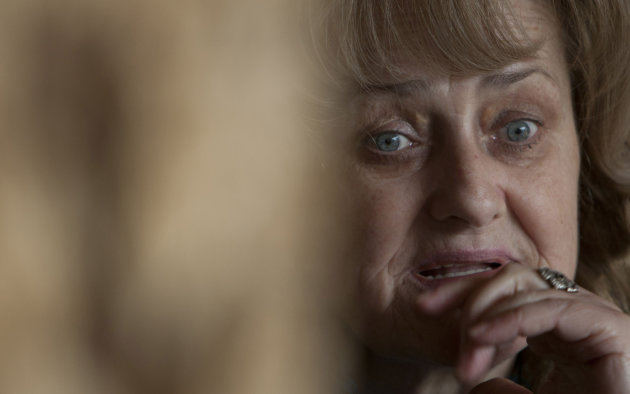
"Muslim Bosniak woman Nusreta Sivac is seen during the interview with The Associated Press in Sanski Most, 260 kms west of Sarajevo on Tuesday, March 5, 2013. Sivac, a former judge, was one of thousands of women who were raped during Bosnia’s 1992-95 war, as part of a systematic Bosnian Serb rape campaign." (Amel Emric/Associated Press)
Bosnian Woman Helped Make Rape a War Crime
By Aida Cerkez
Associated Press dispatch on Yahoo! News, March 8, 2013
"There were days when she prayed for a bullet to end her suffering. When she thought she was dying of a heart attack, she whispered 'Thank you God.' A young judge, Nusreta Sivac was one of 37 women raped by guards at a concentration camp in Bosnia. They never discussed the nightly traumas -- their pained glances were enough to communicate their suffering. She also witnessed murder and torture by Bosnian Serb guards -- and was forced to clean blood from walls and floors of the interrogation room. She told herself to memorize the names and faces of the tormentors so that one day she might bring them to justice. Today, it's partly thanks to Sivac's efforts to gather testimony from women across Bosnia that rape has been categorized as a war crime under international law. Thirty people have been convicted at the international war crimes tribunal in The Hague and another 30 cases are ongoing. She personally helped put the man who raped her repeatedly during her two months in captivity behind bars. 'Most of the strength I took from the idea that one day this evil would be over,' she told The Associated Press this week ahead of International Women's Day on Friday. The UN Special Representative on sexual violence in conflict said Sivac and other victims are helping to make sure wartime rapists pay for their crimes. 'The courage these women have shown coming forward and sharing their stories demonstrates the need to break the silence and stigma surrounding sexual violence in conflict,' said Zainab Hawa Bangura. 'These survivors are helping to end impunity by making sure perpetrators are brought to justice.'

Friday, March 08, 2013

India / Gendercide / Genocide Prevention

A Fight to Save Baby Girls in India
By Kamala Thiagarajan
The New York Times, March 7, 2013
"Back in the 1980s, this rural patch of the southern state of Tamil Nadu had the dubious distinction of the worst reputation for 'gendercide,' or murder of unwanted baby girls, in India. There were no official statistics, of course. Just as no one keeps a tally of how middle-class Indians today use scans to determine a baby's sex and whether to abort a female fetus, the child deaths in the Usilampatti region, home to about 85,000 people, were whispered about, not totaled. Often, births were unregistered, conducted by a village midwife who would then also kill unwanted girls. This was done quite openly -- and prompted Valli Annamalai, head of the Mother and Child Welfare Project, an initiative of the Tamil Nadu state branch of the nongovernmental Indian Council for Child Welfare, to act. She started by trying to grasp the size of the problem. Council statistics suggest that, in 1990, there were as many as 200 unaccounted-for infant deaths, all of girls, in this region. 'Girls were considered a burden and a liability in these parts,' she recalled during a recent visit to a council center in the village of Pannaipatti. Raising economic prospects 'was the only way to stop the mindless violence and discrimination.' One way to improve women's lot, she said, was to care for infants and thus allow mothers to return to their work -- mostly toil in the fields of this spottily fertile region, where women have been second-class for centuries.

Thursday, March 07, 2013

Burma-Myanmar / Rohingya

Ignoring Genocide
By Ramzy Baroud
Counterpunch.org, March 7, 2013
"One fails to understand the unperturbed attitude with which regional and international leaders and organizations are treating the unrelenting onslaught against Rohingya Muslims in Myanmar, formally known as Burma. Numbers speak of atrocities where every violent act is prelude to greater violence and ethnic cleansing. Yet, western governments' normalization with the Myanmar regime continues unabated, regional leaders are as gutless as ever and even human rights organizations seem compelled by habitual urges to issue statements lacking meaningful, decisive and coordinated calls for action. Meanwhile the 'boat people' remain on their own. On February 26, fishermen discovered a rickety wooden boat floating randomly at sea, nearly 25 kilometers (16 miles) off the coast of Indonesia's northern province of Aceh. The Associated Press and other media reported there were 121 people on board including children who were extremely weak, dehydrated and nearly starved. They were Rohingya refugees who preferred to take their chances at sea rather than stay in Myanmar. To understand the decision of a parent to risk his child's life in a tumultuous sea would require understanding the greater risks awaiting them at home. Reporting for Voice of America from Jakarta, Kate Lamb cited a moderate estimate of the outcome of communal violence in the Arakan state, which left hundreds of Rohingya Muslims dead, thousands of homes burnt and nearly 115,000 displaced. The number is likely to be higher at all fronts.

Iraq / El Salvador / United States

"US trained 'death squad' victims in San Salvador, 1981." (Olivier Rebbot/Contact Press/Wikileaks)
From El Salvador to Iraq: Washington's Man behind Brutal Police Squads
By Mona Mahmood, Maggie O'Kane, Chavala Madlena, Teresa Smith, Ben Ferguson, Patrick Farrelly, Guy Grandjean, Josh Strauss, Roisin Glynn, Irene Baqué, Marcus Morgan, Jake Zervudachi and Joshua Boswell
The Guardian, March 6, 2013
"An exclusive golf course backs onto a spacious two-storey house. A coiled green garden hose lies on the lawn. The grey-slatted wooden shutters are closed. And, like the other deserted luxury houses in this gated community near Bryan, Texas, nothing moves. Retired Colonel Jim Steele, whose military decorations include the Silver Star, the Defence Distinguished Service Medal, four Legions of Merit, three Bronze Stars and the Purple Heart, is not at home. Nor is he at his office headquarters in Geneva, where he is listed as the chief executive officer of Buchanan Renewables, an energy company. Similar efforts to track him down at his company's office in Monrovia are futile. Messages are left. He doesn't call back. For over a year the Guardian has been trying to contact Steele, 68, to ask him about his role during the Iraq war as US defence secretary Donald Rumsfeld's personal envoy to Iraq's Special Police Commandos: a fearsome paramilitary force that ran a secret network of detention centres across the country -- where those suspected of rebelling against the US-led invasion were tortured for information. On the 10th anniversary of the Iraq invasion the allegations of American links to the units that eventually accelerated Iraq's descent into civil war cast the US occupation in a new and even more controversial light. The investigation was sparked over a year ago by millions of classified US military documents dumped onto the internet and their mysterious references to US soldiers ordered to ignore torture. Private Bradley Manning, 25, is facing a 20-year sentence, accused of leaking military secrets. Steele's contribution was pivotal. He was the covert US figure behind the intelligence gathering of the new commando units. The aim: to halt a nascent Sunni insurgency in its tracks by extracting information from detainees. It was a role made for Steele. The veteran had made his name in El Salvador almost 20 years earlier as head of a US group of special forces advisers who were training and funding the Salvadoran military to fight the FNLM guerrilla insurgency. These government units developed a fearsome international reputation for their death squad activities.

Death-squad victims in Iraq (unverified).

Tuesday, March 05, 2013

Argentina / Operation Condor / National Tribunals

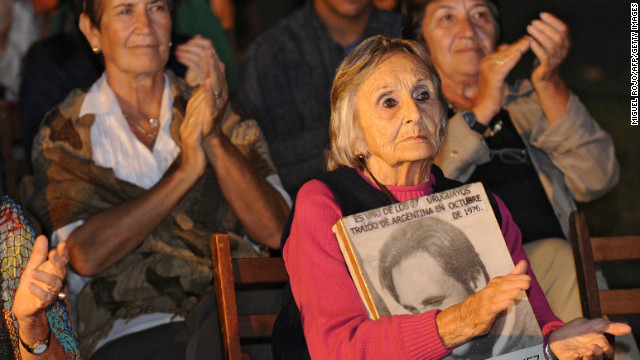
"Relatives of victims during South American military regimes hear trial ruling at Argentine embassy, Montevideo, March 31, 2011." (Miguel Rojo/AFP/Getty Images)
Trial over Terrifying "Operation Condor" Under Way
By Mariano Castillo
CNN.com, March 5, 2013
"A trial over one of Latin America's darkest moments is under way in Argentina, where 25 defendants are accused of crimes against humanity for their alleged role in a 1970s campaign of repression and violence. Operation Condor was an organized campaign by the continent's right-wing governments to suppress and crush political opposition. On Tuesday, 25 former officials tied to the operation appeared in court for the first day of what officials say could be a trial of more than two years. The clandestine nature of Operation Condor means that its full extent may never be known, but researchers estimate that 50,000 were killed, 30,000 were 'disappeared' and presumed killed, and 400,000 were jailed, according to The Center for Justice and Accountability. Chile under dictator Augusto Pinochet was central to the operation, which also included participation from Argentina, Uruguay, Brazil and Paraguay, the center says. Tuesday's trial is the first time for such a large number of defendants in the case to be tried together.

Mexico / Forced Disappearance

"Posters bearing the photos of disappeared people lie piled up on a table at the office of a group hunting for disappeared people in the Mexican state of Coahuila." (Tim Johnson/MCT)
Mexican Families Struggle to Bring Attention to Those Who've Disappeared
By Tim Johnson
McClatchy Newspapers, March 5, 2013
"Rogelio Elizondo's son went to buy a used car in Nuevo Laredo. He never came back. He and a companion simply vanished on May 8, 2011. Because they were carrying the equivalent of $5,000 for the purchase, suspicion turned to foul play. Alarmed, Elizondo fretted over what to do. Friends offered advice. 'People said to us, "Don't report this." They said, "Let us look into this,"' Elizondo recalled. After 10 days, growing more desperate, Elizondo went to the Coahuila state police, only to find utter lack of interest. 'They said it wasn't their jurisdiction. It happened in another state,' Elizondo said. Indeed, Nuevo Laredo is in neighboring Tamaulipas, not Coahuila. 'They said, "We aren't going to investigate. There's nothing we are going to do."' In much of Mexico, Elizondo's tragedy would remain the anguish of a solitary family in a country where the problem of people who've disappeared is worse than anyplace else in the Western Hemisphere. Mexico's government acknowledged in February that it has a list of 26,121 people who'd vanished without a trace during the government of President Felipe Calderon, who left office Dec. 1. But in Coahuila, a slightly more positive story is unfolding. The number of 'disappeared' is still high here -- 1,600 or so, the governor has acknowledged -- but Elizondo wasn't alone. He joined scores of other families looking into the cases of 298 missing persons in the state.

Sunday, March 03, 2013

Russia / Stalinism

"In this Saturday, Feb. 23, 2013 file photo a woman holds a portrait of Soviet dictator Josef Stalin during a communist rally marking the Defenders of the Fatherland Day in Moscow, Russia." (Mikhail Metzel/AP Photo)
Joseph Stalin More Popular In Russia Now Than At End Of Soviet Union, Finds Carnegie Survey
By Vladimir Isachenkov
The Huffington Post, March 1, 2013
"An opinion survey commissioned by the Carnegie Endowment says that Soviet dictator Josef Stalin has remained widely admired in Russia and other ex-Soviet nations, even though millions of people died under his brutally repressive rule. The Carnegie report, released Friday, was based on the first-ever comparative opinion polls in Russia, Armenia, Azerbaijan and Georgia. It found that support for Stalin in Russia has actually increased since the 1991 collapse of the Soviet Union. The report has concluded that public attitudes to the dictator have improved during Russian President Vladimir Putin's 13-year rule as the Kremlin has found Stalin's image useful in its efforts to tighten control. The tyrant led the Soviet Union from 1924 until his death in 1953. Communists and other hardliners credit him with leading the country to victory in World War II, and making it a nuclear superpower, while others condemn the brutal purges that killed millions of people. One of the report's authors, Lev Gudkov, a Russian sociologist whose polling agency conducted the survey, noted that in 1989, the peak of Soviet leader Mikhail Gorbachev's efforts to liberalize the country and expose Stalinist crimes, only 12 percent of Russians polled described Stalin as one of the most prominent historical figures. In the Carnegie poll last year, 42 percent of Russian respondents named Stalin as the most influential historical figure.

Thursday, February 28, 2013

Former Yugoslavia / International Tribunals

Court Overturns War Crimes Conviction of Former Chief of Yugoslav Army
By Marlise Simons
The New York Times, February 28, 2013
"A United Nations appeals court on Thursday unexpectedly overturned the war crimes conviction of the former Yugoslav Army chief who had been sentenced to 27 years for aiding and abetting atrocities in Bosnia and Croatia, including attacks on Sarajevo and Srebrenica. The judges, voting 4 to 1, acquitted the former chief, Gen. Momcilo Perisic, of all charges of war crimes and crimes against humanity, including murder, and ordered him released. General Perisic, who surrendered to the court in 2005, was expected to return Friday to Serbia, where officials welcomed the decision. Reports from Bosnia said victims' groups were stunned. The ruling, following other recent acquittals by appeals court judges, was seen as one more decision that is changing the story line of the war. The reversals narrowed the definition of crimes for which military commanders can be held responsible. General Perisic was the most senior officer to be tried, and as the army's chief of staff and as an aide to Slobodan Milosevic, then the Serbian president, he played a crucial role during the 1992-95 war that broke up Yugoslavia. Records showed he regularly attended meetings of the Supreme Defense Council where Mr. Milosevic and other leaders approved sending weapons, fuel, police officers and military personnel to proxy armies fighting for the Serb cause in Bosnia and Croatia.

Monday, February 25, 2013

Zimbabwe / South Africa / Rape as a Crime against Humanity

"US actor Matt Damon meets Sharon Ruzvid, 18, a Zimbabwean refugee who was raped whilst pregnant, during his visit to the South African border town of Musina in Zimbabwe Tuesday, March 3, 2009." (Jerome Delay/The Associated Press)
In Ground-breaking Move, S. Africa Steps in over Alleged Zimbabwe Mass Rapes
By Geoffrey York
The Globe and Mail, February 25, 2013
"In a ground-breaking move, South African prosecutors will investigate President Robert Mugabe's political party for crimes against humanity for an alleged campaign of mass rapes in Zimbabwe’s last election. The decision, following a request by Canadian activist Stephen Lewis and others, marks the first time an African government has used domestic laws to investigate another African country under the emerging doctrine of 'universal jurisdiction.' It's also believed to be the first time that authorities have invoked 'universal jurisdiction' in a rape investigation -- a sign of the growing resistance to the use of rape as an organized political tactic. Mr. Lewis and his organization, AIDS-Free World, plan to announce the South African decision at a press conference in Johannesburg this week. Its legal teams have gathered hundreds of hours of testimony from 84 rape survivors in Zimbabwe who identified more than 200 perpetrators and orchestrators in the alleged rape campaign. In an earlier report, AIDS-Free World concluded that thousands of opposition supporters were raped by members of the ruling ZANU-PF party 'as a tool of terror and intimidation' during the 2008 election campaign.

Sunday, February 24, 2013

Slavery / Reparations

"Slavery on an industrial scale was a major source of the wealth of the British empire."
Britain's Colonial Shame: Slave-owners Given Huge Payouts after Abolition
By Sanchez Manning
The Independent, February 24, 2013
"The true scale of Britain's involvement in the slave trade has been laid bare in documents revealing how the country's wealthiest families received the modern equivalent of billions of pounds in compensation after slavery was abolished. The previously unseen records show exactly who received what in payouts from the Government when slave ownership was abolished by Britain -- much to the potential embarrassment of their descendants. Dr Nick Draper from University College London, who has studied the compensation papers, says as many as one-fifth of wealthy Victorian Britons derived all or part of their fortunes from the slave economy. As a result, there are now wealthy families all around the UK still indirectly enjoying the proceeds of slavery where it has been passed on to them. Dr. Draper said: 'There was a feeding frenzy around the compensation.' A John Austin, for instance, owned 415 slaves, and got compensation of £20,511, a sum worth nearly £17m today. And there were many who received far more. Academics from UCL, led by Dr. Draper, spent three years drawing together 46,000 records of compensation given to British slave-owners into an internet database to be launched for public use on Wednesday. But he emphasised that the claims set to be unveiled were not just from rich families but included many 'very ordinary men and women' and covered the entire spectrum of society.

Friday, February 22, 2013

China / Structural Violence

"China has witnessed growing public anger over pollution caused by industrial development."
China Acknowledges "Cancer Villages"
BBC Online, February 22, 2013
"China's environment ministry appears to have acknowledged the existence of so-called 'cancer villages' after years of public speculation about the impact of pollution in certain areas. For years campaigners have said cancer rates in some villages near factories and polluted waterways have shot up. But the term 'cancer village' has no technical definition and the ministry's report did not elaborate on it. There have been many calls for China to be more transparent on pollution. The latest report from the environment ministry is entitled 'Guard against and control risks presented by chemicals to the environment during the 12th Five-Year period (2011-2015)'. It says that the widespread production and consumption of harmful chemicals forbidden in many developed nations are still found in China. 'The toxic chemicals have caused many environmental emergencies linked to water and air pollution,' it said. The report goes on to acknowledge that such chemicals could pose a long-term risk to human health, making a direct link to the so-called 'cancer villages'. 'There are even some serious cases of health and social problems like the emergence of cancer villages in individual regions,' it said.

Israel / Sabra & Shatila Massacre

Sharon in 1983: Israel Could Be Accused of Genocide
By Roi Mandel
YNetnews.com, February 21, 2013
"'If we adopt this report, our ill-wishers and naysayers will claim that what happened in the (Sabra and Shatila) camp was genocide,' Defense Minister Ariel Sharon warned the cabinet in 1983 during a special meeting dealing with the findings of the Cohen Report on the Sabra and Shatila massacre in the First Lebanon War. Sharon refused to resign, as the external fact-finding mission's report had recommended, and repeatedly stressed that he and then Prime Minister Menachem Begin were in the same boat. Adopting the report, Sharon claimed, would 'leave a mark of Cain on us for generations to come.' Thirty years later, the State Archives on Thursday cleared for publication the protocols of cabinet meetings from the early 1980s, specifically those dealing with the outcome of Cohen Report and the death of Peace Now activist Emil Grunzweig. The main meeting held following the publication of the report by Chief High Court Justice Yitzhak Cohen took place on Febuary 10, 1983 -- the day Grunzwieg was killed.

Rwanda / United States / Gender and Genocide

"Prosecutors said Beatrice Munyenyezi had a 'front row seat' during the mass killings of about 800,000 Tutsis in 1994." (Jim Cole/AP)
Rwandan Woman Stripped of US Citizenship after Lying about Genocide
By Chris McGreal
February 22, 2013
"A Rwandan woman who won political asylum in the US after hiding her family's role in the 1994 genocide has been convicted in a New Hampshire court of lying about her own part in the mass killings. Beatrice Munyenyezi, 43, was immediately stripped of the US citizenship she had gained a decade earlier in the same courthouse where she was found guilty on Thursday of making false statements to officials in order to cover up how she selected Tutsis to be raped and murdered. She faces up to 10 years in prison and then likely deportation to face a trial in Rwanda for genocide. Munyenyezi settled in Manchester, New Hampshire, with three young daughters in 1998 after claiming to have been persecuted in Rwanda. She caught the attention of the US authorities several years later after giving false testimony on behalf of her husband and mother-in-law who were later sentenced to life in prison for genocide and other crimes against humanity by an international tribunal. Prosecutors alleged that Munyenyezi had a 'front row seat' during the mass killings of about 800,000 Tutsis because her mother-in-law, Pauline Nyiramasuhuko, served as the minister of family and women's affairs in the Hutu government which organised the slaughter. When the killings began in April 1994, the government sent Nyiramasuhuko to her home city, Butare, to order the governor to begin murdering Tutsis there. When the governor refused he was killed and Nyiramasuhuko took charge along with her son and Munyenyezi's husband, Arsene Shalom Ntahobali, a leader of the interahamwe militia at the forefront of the murders. The killings in Butare were among the most intense of the genocide.

Thursday, February 21, 2013

Syria / Terrorism as a Crime against Humanity

"Syrians inspecting the scene following a powerful car bomb explosion in the centre of Damascus." (SANA/AFP/Getty Images)
Damascus Bomb One of Deadliest of Syrian Civil War
By Richard Spencer and Magdy Samaan
The Telegraph, February 21, 2013
"More than 50 were killed and 200 wounded in a car bombing in the centre of Syria's embattled capital Damascus in one of the worst attacks in the capital since the start of the civil war. Television footage showed body parts and charred corpses lying in the street in Mazraa after the explosion. It struck near the headquarters of the ruling Baath party and the Russian embassy, but opposition activists said most of the victims were civilians, including children. There was also a school nearby. 'There are children among the casualties and injuries as the bomb hit near Ibn Al-Atheer school, and at a time students were leaving school,' an activist who was nearby, Iman Al-Huda, told The Daily Telegraph. The attack, which bore the hallmarks of the jihadist rebel group Jabhat al-Nusra, further highlighted the divide in the opposition. Jabhat al-Nusra has conducted scores of such attacks in Damascus and other cities, but this one brought immediate condemnation from the opposition Syrian National Coalition, which described it as 'heinous'. 'Any acts targeting civilians with murder or human rights violations are criminal acts that must be condemned, regardless of the perpetrator or the justification,' a statement said. With the regime also launching indiscriminate attacks on civilian areas in Aleppo, Deraa and Deir Al-Zour in recent days, both from the air and by surface-to-surface missiles, John Kerry, the new US secretary of state, will also be under fresh pressure to strengthen American policy. He will begin an introductory two-week tour of the Middle East on Sunday with officials at loggerheads. American media report that President Obama has vetoed requests by the State Department, the Pentagon and the CIA to allow non-jihadist rebel groups to be armed, but analysts and arms experts claim that new weaponry is being supplied in any case. Some point to a recent influx of anti-tank and anti-aircraft missiles from the Balkans, seen regularly on rebel videos, as evidence that somehow the policy on the ground has already changed, and that US allies such as Qatar and Saudi Arabia have been encouraged to infiltrate arms. The centre of Damascus, which remains solidly in regime hands, is currently under fierce attack from rebel positions in the north, east and south, with one advance reaching within a mile of the historic Old City, one of the oldest continuously occupied settlements on earth. There was no immediate claim of responsibility for Thursday's attack, but Jabhat al-Nusra, which America has proscribed as a terrorist group for its alleged ties to al-Qaeda in Iraq, has admitted to at least seven similar bombings this month alone in the city. The Syrian foreign ministry blamed the bombing on 'terrorist' groups linked to al-Qaeda, 'that receive financial and logistic help from abroad'. Figures for the number of dead ranged from 53 to 59. The latter figure would make it the deadliest attack in Damascus since the start of the uprising two years ago. [...]"

Nigeria / National Tribunals

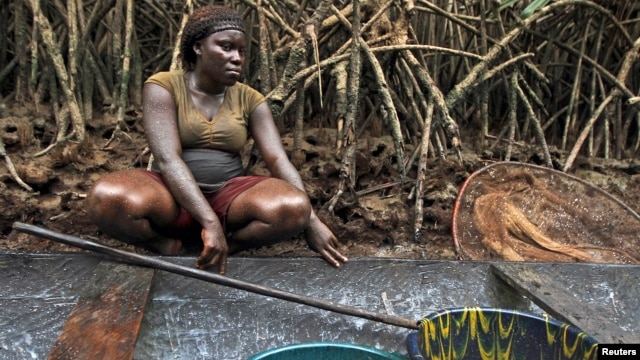
"A woman coated in oil perches near a mangrove after fishing in a creek near the River Nun in Nigeria's oil state of Bayelsa, November 27, 2012." (Reuters)
Nigeria Government Ordered to Pay for Human Rights Violations
By Heather Murdock
VOANews.com, February 20, 2013
"Fourteen years after the Odi community in Nigeria's Niger Delta was flattened in what many call a 'massacre,' a Nigerian court this week ordered the government to pay the community nearly $240 million within the next three weeks. Exactly what happened in Odi, a town in oil-rich Bayelsa State, is still unclear. Human Rights Watch says gang members in Odi killed twelve policemen in early November 1999. A few weeks later, Human Rights Watch says soldiers raided the town of about 15,000 people, destroying almost every single building and possibly killing hundreds of people. Locals say it was thousands who died, and the attacks were racially motivated against ethnic Ijaws, with soldiers writing, 'We will kill all Ijaws' on demolished buildings. The government of the time still defends the raid, saying it was rooting out terrorists and destroying their base. This week, a Nigerian judge ordered the government to pay the town nearly $240 million within 21 days for what it called a 'brazen violation of the fundamental human rights of the victims to movement, life and to own property and live peacefully in their ancestral home.' Perye Brown, a former chairman of Bayelsa State Youth Council, spoke outside the courtroom. 'I find it very exciting. It has been really, really a breakthrough for the people of Odi, especially the young people of Odi, a lot of whom lost their parents, a lot of whom lost their sort of livelihood that would have earned them an education and [allowed them to] pursue their aspiration,' Brown said. 'But today this compensation and this justice delivered will show the truth that the people are law abiding and that they believe in the rule of law.'