Wednesday, May 15, 2013

Syria

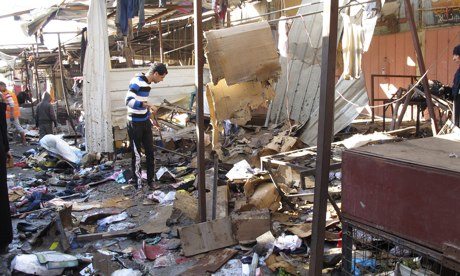
"An image from Bayda, Syria, released by a group, the Syrian Revolution Against Bashar Assad." (Via Associated Press)
An Atrocity in Syria, With No Victim Too Small
By Anne Barnard adn Hania Mourtgada
The New York Times, May 14, 2013
"After dragging 46 bodies from the streets near his hometown on the Syrian coast, Omar lost count. For four days, he said, he could not eat, remembering the burned body of a baby just a few months old; a fetus ripped from a woman's belly; a friend lying dead, his dog still standing guard. Omar survived what residents, antigovernment activists and human rights monitors are calling one of the darkest recent episodes in the Syrian war, a massacre in government-held Tartus Province that has inflamed sectarian divisions, revealed new depths of depravity and made the prospect of stitching the country back together appear increasingly difficult. That mass killing this month was one in a series of recent sectarian-tinged attacks that Syrians on both sides have seized on to demonize each other. Government and rebel fighters have filmed themselves committing atrocities for the world to see. Footage routinely shows pro-government fighters beating, killing and mutilating Sunni rebel detainees, forcing them to refer to President Bashar al-Assad as God. One rebel commander recently filmed himself cutting out an organ of a dead pro-government fighter, biting it and promising the same fate to Alawites, members of Mr. Assad's Shiite Muslim sect. That lurid violence has fueled pessimism about international efforts to end the fighting. As the United States and Russia work to organize peace talks next month between Mr. Assad and his opponents, the ever more extreme carnage makes reconciliation seem more remote. Nadim Houry, the director of Human Rights Watch in Beirut, said he sensed 'a complete disconnect between diplomacy and events on the ground.' 'The conflict is getting more visceral,' he said. Without concrete confidence-building measures, he said, and with more people 'seeing it as an existential struggle, it's hard to imagine what the negotiations would look like.'

Tuesday, May 14, 2013

Japan / Second World War / Rape as a Crime against Humanity

"Osaka Mayor Toru Hashimoto." (Associated Press)
Forced Prostitution of Women for Use by Japanese Soldiers during World War II Was "Necessary" Claims Mayor of Osaka
Associated Press dispatch in The Telegraph, May 14, 2013
"An outspoken nationalist mayor said the Japanese military's forced prostitution of Asian women before and during World War II was necessary to "maintain discipline" in the ranks and provide rest for soldiers who risked their lives in battle. The comments are already raising ire in neighbouring countries that bore the brunt of Japan's wartime aggression and that have long complained that Japan has failed to fully atone for wartime atrocities. Toru Hashimoto, the young, brash mayor of Osaka who is also co-leader of an emerging conservative political party, also told reporters that there wasn't clear evidence that the Japanese military coerced women to become what are euphemistically called 'comfort women.' 'To maintain discipline in the military, it must have been necessary at that time,' said Hashimoto. 'For soldiers who risked their lives in circumstances where bullets are flying around like rain and wind, if you want them to get some rest, a comfort women system was necessary. That's clear to anyone.' Historians say up to 200,000 women, mainly from the Korean Peninsula and China, were forced to provide sex for Japanese soldiers in military brothels.

Monday, May 13, 2013

Nigeria / Gendercide

"The hospital morgue in Maiduguri, Nigeria, where large numbers of bodies have been brought." (Adam Nossiter/The New York Times)
Bodies Pour In as Nigeria Hunts for Islamists
By Adam Nossiter
The New York Times, May 7, 2013
"A fresh load of battered corpses arrived, 29 of them in a routine delivery by the Nigerian military to the hospital morgue here. Unexpectedly, three bodies started moving. 'They were not properly shot,' recalled a security official here. 'I had to call the JTF' -- the military's joint task force -- 'and they gunned them down.' It was a rare oversight. Large numbers of bodies, sometimes more than 60 in a day, are being brought by the Nigerian military to the state hospital, according to government, health and security officials, hospital workers and human rights groups -- the product of the military’s brutal war against radical Islamists rooted in this northern city. The corpses were those of young men arrested in neighborhood sweeps by the military and taken to a barracks nearby. Accused, often on flimsy or no evidence, of being members or supporters of Boko Haram -- the Islamist militant group waging a bloody insurgency against the Nigerian state -- the detainees are beaten, starved, shot and even suffocated to death, say the officials, employees and witnesses. Then, soldiers bring the bodies to the hospital and dump them at the morgue, officials and workers say. The flood is so consistent that the small morgue at the edge of the hospital grounds often has no room, with corpses flung by the military in the sand around it. Residents say they sometimes have to flee the neighborhood because of the fierce smell of rotting flesh. From the outset of the battle between Boko Haram and the military, a dirty war on both sides that has cost nearly 4,000 lives since erupting in this city in 2009, security forces have been accused of extrajudicial killings and broad, often indiscriminate roundups of suspects and sympathizers in residential areas. The military's harsh tactics, which it flatly denies, have reduced militant attacks in this insurgent stronghold, but at huge cost and with likely repercussions, officials and rights advocates contend.

Guatemala / Genocide Tribunals

"The former dictator Efraín Ríos Montt waited for his verdict to be read on Friday. He was sentenced to 80 years in prison." (Moises Castillo/Associated Press)
Former Leader of Guatemala Is Guilty of Genocide Against Mayan Group
By Elisabeth Malkin
The New York Times, May 10, 2013
"A Guatemalan court on Friday found Gen. Efraín Ríos Montt, the former dictator who ruled Guatemala during one of the bloodiest periods of its long civil war, guilty of genocide and crimes against humanity. The verdict marked the first time a former head of state had been found guilty of genocide in his or her own country. Judge Yasmín Barrios sentenced General Ríos Montt, 86, to 80 years in prison. His co-defendant, José Mauricio Rodríguez Sánchez, who served as the director of intelligence under the general, was acquitted of the same two charges. 'We are completely convinced of the intent to destroy the Ixil ethnic group,' Judge Barrios said as she read the hourlong summary of the ruling by the three-judge panel. Over five weeks, the tribunal heard more than 100 witnesses, including psychologists, military experts and Maya Ixil Indian survivors who told how General Ríos Montt's soldiers had killed their families and wiped out their villages. The judge said that as the commander in chief of Guatemala’s armed forces, the general knew about the systematic massacres of Ixil villagers living in hillside hamlets in El Quiché department and did nothing to stop them or the aerial bombardment of the refugees who had fled to nearby mountains. The crowd packed into the courtroom was quiet for much of Judge Barrios's reading. But cries of 'Justicia! Justicia!' erupted when she pronounced the lengthy sentence and ordered General Ríos Montt to begin serving it immediately. As the general tried to walk out a side door, Judge Barrios shouted at him to stay where he was and called for security forces. An hour after the verdict and sentence were read, General Ríos Montt was escorted from the courtroom by a dozen police officers. He said he was ready to go to prison. How long he will stay there is less clear than the verdict.

Thursday, April 25, 2013

Jewish Holocaust / Bystanders to Genocide

"Toy Nazi figurines in this exhibition at the United States Holocaust Memorial Museum." (Drew Angerer/The New York Times)
Bystanders, Not So Innocent
By Edward Rothstein
The New York Times, April 25, 2013
"Whatever larger themes are sounded when the United States Holocaust Memorial Museum commemorates its 20th anniversary here this weekend, whatever is said at a Monday ceremony by former President Bill Clinton or by the museum's founding chairman, Elie Wiesel, and whatever assessments are made about its influence, accomplishments or limitations, it will take a visit to its new exhibition, 'Some Were Neighbors,' to grasp one aspect of this imposing institution's power. It reveals the demonic not in grand forces, but in the most minute details. In one video interview, for example, a Lithuanianwitness, Regina Prudnikova, recalls that before the massacres, she cared for a Jewish child in her town, Pilviskiai. But, 'I was very young and had a very red face,' she explains, and was 'on the chubby side.' That wasn’t good. 'I was told that Jews cut you and take your blood.' She stopped baby-sitting. She now mocks such beliefs, but her tone becomes uncertain: 'I know that they say the Jews can't live without Christian blood. During their holidays they had to have at least a drop of that blood to taste.' Then, the recollection returns. The Jews were taken away and shot, their homes plundered. And we see a photograph of a wagon piled with loot being auctioned to passers-by. Or listen to Stanislaw Ochman, who transported the Jews of his village, Zdunska Wola, in Poland, in a wooden wagon to the cemetery where they were murdered. The children, holding their mothers' skirts, were often too short for the raked gunfire, and fell into the pit, still clinging, as soil was piled atop them.

Sunday, April 21, 2013

Japan / Second World War

"Japan's Prime Minister Shinzo Abe speaks during a news conference at the Japan National Press Club in Tokyo April 19, 2013." (Reuters/Yuya Shino)
Japan PM Abe's War Shrine Offering Likely to Infuriate China
Reuters dispatch, April 21, 2013
"Japanese Prime Minister Shinzo Abe made a ritual offering of a pine tree to a shrine seen as a symbol of Japan's former militarism on Sunday, a gesture likely to upset Asian victims of Japan's war-time aggression, including China and South Korea. Abe, an outspoken nationalist, offered the tree to the Yasukuni Shrine, where 14 Japanese leaders convicted as war criminals by an Allied tribunal are honored along with other war dead. Abe did not visit the shrine. Abe, who became prime minister for a second time after his Liberal Democratic Party's (LDP) election win in December, is unlikely to visit the shrine as he seeks to rebuild relationships with China and South Korea. Sino-Japanese relations deteriorated sharply in September after Japan bought islets in the East China Sea claimed by Beijing, sparking anti-Japanese protests across China. Ties have been shadowed for years by what Beijing says has been Tokyo's refusal to admit to wartime atrocities committed by Japanese soldiers in the country between 1931 and 1945. Memories of brutal Japanese occupation also run deep in North and South Korea. Two Japanese ministers and deputy chief cabinet secretary visited the shrine this weekend, as did Abe as main opposition party leader in October. 'It is natural for a lawmaker to offer condolences for the spirits of those who gave their lives for the country,' said Keiji Furuya, minister in charge of the issue of North Korea's abductions of Japanese nationals, who visited on Sunday, as did Deputy Chief Cabinet Secretary Katsunobu Kato. Minister for Internal Affairs and Communications Yoshitaka Shindo visited on Saturday."
[n.b. This is the complete text of the dispatch.]