Saturday, December 31, 2011

Argentina / Torture

"In this Nov. 4, 2009 file photo, Argentina's last de facto president Gen. Reynaldo Bignone attends his trial at a court house in Buenos Aires, Argentina. The former dictator was sentenced on Thursday Dec. 29, 2011 to 15 years in prison for crimes against humanity committed in a clandestine detention center that operated in a public hospital during the last military dictatorship (1976-1983)." (Rolando Andrade Stracuzzi/AP)
Argentine Dictator Guilty of Torture in Hospital
By Michael Warren
Associated Press dispatch in The Miami Herald, December 30, 2011
"Argentina's last dictator was convicted Thursday of more crimes against humanity, this time getting 15 years in prison for setting up a secret torture center inside a hospital during the 1976 military coup. Reynaldo Bignone personally oversaw the takeover of the Posadas de Haedo hospital in Buenos Aires province 35 years ago, leading soldiers in tanks and helicopters in search of medical personnel who allegedly treated leftist guerrillas. The military dismissed all the doctors and nurses, but kept some for questioning, including the hospital's medical director. Eleven hospital staffers disappeared. Bignone's trial involved 21 cases of kidnappings and tortures, including two victims who were killed and made to disappear by a civilian group of thugs who called themselves the 'SWAT' team and answered to the air force. The SWAT team set up shop inside the medical director's home, interrogating the staff. Some of those crimes are part of a second, upcoming trial involving the same hospital. Bignone was the military junta's social welfare delegate at the time. He later served as the junta's president in 1982 and 1983, ordering the destruction of vast stores of evidence documenting illegal detentions and disappearances, and dictating a military amnesty before democracy returned to Argentina. Bignone, nos 85, already faces life in prison for other kidnappings and tortures in provincial Buenos Aires, including those committed in another torture center inside the Campo de Mayo military base. He's also being tried along with former dictator Jorge Videla on charges of overseeing a systematic plan to steal the babies of pregnant detainees. In his defense, Bignone has said that his actions were justified because Argentina was at war against armed leftist subversives. Also convicted Thursday were SWAT team leader Luis Muina, 57; and a former air force brigadier, Hipolito Rafael Mariani, 85. Prosecutors asked for 25-year sentences for all three, but Bignone received 15 years, Muina 13 and Mariani eight. An official count determined that the regime killed some 13,000 people, but human rights groups estimate about 30,000 fell victim. Since Argentina's democracy was restored in 1983, 268 people have been convicted of crimes against humanity and more than 800 others are being prosecuted, the government said."
[n.b. This is the complete text of the dispatch.]

Friday, December 30, 2011

Syria

Syria: Scores Dead as Arab League Expands Mission
By Richard Spencer
The Telegraph, December 29, 2011
"Syrian security forces shot dead dozens of protesters on Thursday, including at least 11 in the capital Damascus, as the presence of Arab League peace monitors encouraged hundreds of thousands to take to the streets against Bashar al-Assad's rule. As many as 40 demonstrators were said to have been killed in total by government troops after the Arab League's observers fanned out across four restive cities on only the third day of their mission to enforce a peace deal. In Damascus, regime troops opened fire on a crowd of more than 20,000 people as they awaited the arrival of peace monitors outside a mosque in the suburb of Douma. Troops also opened fire in the city's suburbs of Aarbin and Madamiya. 'They used tanks, they used machine guns,' Omar al-Khani, an activist in Damascus, told The Daily Telegraph last night. 'They started shooting everywhere. We are now in a very bad situation. We can't bring the injured outside the city, we can't bring them to hospitals, we can't mova. Anyone who moves, they shoot at them.' Douma, which has seen repeated protests, rang to the sound of machine gun fire. According to the Syrian Observatory for Human Rights, three people died instantly and more later, with many more critically injured. One particularly chilling video posted online on Thursday night showed a protester being bundled into the back of a police van, his face bloodied. It then showed a soldier pointing his gun through a slat in the side, while others raised their guns at the back, before a shot is heard. Mr. Khani said the man's body was found several minutes later.

Monday, December 26, 2011

India / Kashmir / Gendercide

"Where Are Our Missing Sons?" Kashmiri Keep Asking
By Humra Quraishi
WeNews, December 26, 2011
"Parveena Ahangar hasn't known peace for years. 'I can't describe how each day passes. I keep taking medicines every single day to control my tension. At night, I'm awake. I just can't sleep,' Ahangar says. She's felt this way, she says, ever since the day 21 years ago when she lost her son. 'My teenaged son, Javed, was picked by the security agencies in 1990,' she says. 'Security men came to our Batmaloo home to pick him up, saying they were taking him for interrogation. We pleaded with them, saying he couldn't have done anything wrong, that he had just passed his matriculation. But they didn't listen and took him to the interrogation center at Pari Mahal. We never saw him again.' Ahangar's husband fell ill because of the trauma, and gave up working. He remains in poor health today. Ahangar lives in the India-administered state of Jammu and Kashmir in the north of the country, near the borders of Pakistan and China, an area plagued by territorial strife and tensions. She has scoured the Kashmir Valley for news of her son. She has visited jails through the region. She has approached the United Nations. 'I've appealed to every possible government authority, to politicians across party lines.' Many other women in the Kashmir Valley recount similar stories. They say they've sold land, homes, jewelry; exhausted every asset in the search for their children. ...

Israel / Turkey / Armenian Genocide

Israeli Lawmakers Consider Recognizing Massacre of Armenians as Genocide
Associated Press dispatch in The Washington Post, December 26, 2011
"Over their prime minister's objections, Israeli lawmakers on Monday began debating a proposal to recognize the mass killings of Armenians by Ottoman Turks as genocide. Doing so would likely further strain already acrimonious relations with Turkey, which denies the genocide label and says the massacres occurred in civil unrest as the Ottoman Empire disintegrated during World War I, with losses on both sides. The issue is highly sensitive in Turkey, and lawmakers in France set off a diplomatic crisis with Ankara last week when they passed a bill making it a crime to deny that the killings amounted to genocide. Turkish Prime Minister Recep Tayyip Erdogan swiftly halted political and economic contacts with Paris, suspended military cooperation and ordered his country’s ambassador home for consultations. In Israel on Monday, a parliamentary committee considered a proposal to designate a memorial day for the killings and recognize them as genocide. Parliamentary speaker Reuven Rivlin said the debate had nothing to do with Israel's deteriorating ties with Turkey but with Israel's moral obligation, given the history of the Nazi Holocaust, to recognize genocides elsewhere.

Sunday, December 25, 2011

Nigeria / Violence against Christians

"Men look at the wreckage of a car following a bomb blast at St Theresa Catholic Church in Madalla, a town outside the Nigerian capital Abuja on Sunday." (AFP/Getty Images)
Dozens Die as Christmas Day Bombings Sweep Nigeria
MSNBC.com, December 25, 2011
"Islamist sect Boko Haram claimed responsibility for a wave of Christmas Day bombings on Sunday, including an attack on a Catholic church that killed at least 35 people. Boko Haram spokesman Abu Qaqa claimed the bombings in a statement to the journalists' association of Maiduguri, capital of the group's heartland. The Christmas Day attacks show the growing national ambition of Boko Haram, which is responsible for at least 491 killings this year alone, according to an Associated Press count. The assaults come a year after a series of Christmas Eve bombings in Jos claimed by the militants left at least 32 dead and 74 wounded. The first explosion on Sunday struck St. Theresa Catholic Church just after 8 a.m. The attack killed 35 people and wounded another 52, said Slaku Luguard, a coordinator with Nigeria's National Emergency Management Agency. 'We were in the church with my family when we heard the explosion. I just ran out. Now I don't even know where my children or my wife are,' Timothy Onyekwere told Reuters. 'I don't know how many were killed but there were many dead.' 'I want to know if my wife is dead or alive,' a man yelled as he tried to enter the area holding dead and wounded. Nigeria's National Emergency Management Agency already has acknowledged it didn't have enough ambulances immediately on hand to help the wounded. Luguard also said an angry crowd that gathered at the blast site hampered rescue efforts as they refused to allow workers inside. 'We're trying to calm the situation,' Luguard said. 'There are some angry people around trying to cause problems.' President Goodluck Jonathan, a Christian from the south who is struggling to contain the threat of Islamist militancy, called the incident 'unfortunate' but said Boko Haram would 'not be (around) for ever. It will end one day.' [...]"

Saturday, December 24, 2011

Why Do Leading Leftists Deny the Rwandan Genocide of 1994?

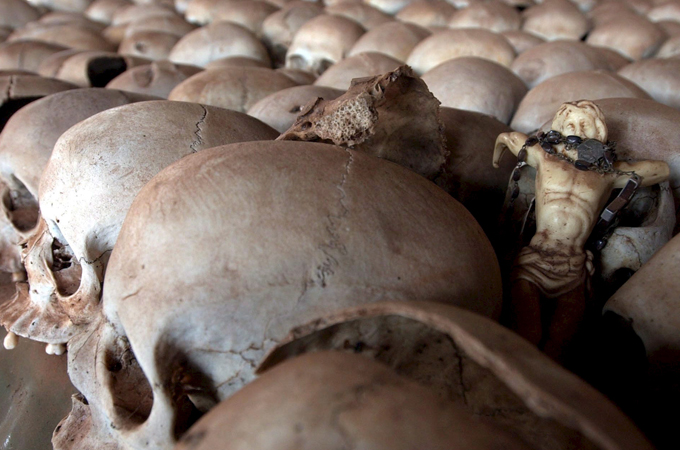
Bodies of Rwandans murdered in the 1994 genocide, washed up on the
Ugandan shores of Lake Victoria.
(Photo by David Blumenkrantz)
by Adam Jones, Ph.D.

John Pilger is one of my heroes. Indeed, reading Heroes, his classic 1986 book on resistance to mass violence and oppression worldwide, was a formative experience. Together with works by Noam Chomsky and Edward S. Herman, Pilger's book persuaded me of the need to defend defenseless victims of power wherever they are found.

So why on earth has Pilger -- together with Chomsky -- warmly endorsed a tract co-authored by none other than Edward Herman, which brazenly denies the genocide of Tutsis in Rwanda in 1994?

Herman and David Peterson’s slender volume The Politics of Genocide was published in mid-2010 by Monthly Review Press -- one of the longest-established and most prestigious leftist publishing houses. In the Rwanda section of their book, and in various online posts, Herman & Peterson allege that the "mainstream" depiction of events in Rwanda in 1994 "turns perpetrator and victim upside-down." Rather than a genocidal "Hutu Power" regime massacring members of the Tutsi minority en masse (along with many oppositionist Hutus), they contend the regime was not "in control of anything" at the time of the mass killing; that the invading, Ugandan-based Rwandan Patriotic Front (RPF), led by Tutsi exiles, was "the only well-organized killing force within Rwanda in 1994"; and that therefore, "the chief responsibility for Rwandan political violence belonged to the RPF, and not to … any Hutu-related group."

Let us be clear. In the Rwandan context, this is the equivalent of asserting that the Nazis never killed Jews in death camps -- indeed, that it was really Jews who killed Germans. It is the most naked denial of the extermination of at least half a million Tutsis by agents of "Hutu Power" that I have ever read in an ostensibly scholarly source. And it relies on "evidence" that, even on cursory examination, proves to be the sheerest gossamer, when it is not simply hearsay and idle speculation -- based on the declamations of "a tiny number of long-time American and Canadian genocide deniers, who gleefully drink each other’s putrid bath water," as Gerald Caplan memorably phrased it in a critique for Pambazuka.org.

Wednesday, December 21, 2011

Russia / Stalinism

(Photo by Donald Weber/VII Network)
Haunted By The Gulags' Ghosts
By Owen Matthews
Newsweek, December 19, 2011
"Spring 1989: a group of young students bends over their spades as they dig in a Siberian forest clearing. In shallow depressions, they quickly uncover human remains, the skulls all neatly pierced by bullet holes, the work of Stalin’s executioners. All around the small group of diggers, dozens more mass graves stretch into the forest, extending, like the old Gulag Archipelago, from one end of the former Soviet Union’s 11 time zones to the other. The scene opens David Satter's It Was a Long Time Ago and It Never Happened Anyway, a sweeping study of how the former Soviet Union's bloody past continues to poison Russia's present and threatens to strangle the country's future. 'I know as one who stood at the edge of that cold pit that a person who sees this, forever becomes different,' recalls one of the student diggers, now a leading liberal politician. Satter's point is that too few Russians have been willing to peer into the burial pit of their country’s own not-so-distant past. 'Russia today is haunted by words that have been left unsaid,' he writes. Unlike Germany after the Second World War, post-Soviet Russia was never wracked [sic] with collective guilt for the crimes of the old regime. There was no South Africa-style Truth and Reconciliation Commission; there was no opening up of secret-police archives, as there was in East Germany or Hungary. The closest Russians came to such a self-examination was during the brief phase when Mikhail Gorbachev’s glasnost filled the airwaves and newspapers with harrowing gulag memoirs. In the wake of a KGB-led attempted coup in August 1991, thousands gathered on Lubyanka Square beneath the statue of Felix Dzerzhinsky, founder of the Soviet secret police, and screamed anti-KGB slogans. Fearing that the KGB building might be stormed, city authorities called in a crane to remove the statue, which dangled from a steel noose as though lynched. But the wave passed. Most ordinary Russians quickly forgot their indignation at the KGB's crimes as a tide of free-market reforms swept away their savings and their jobs, together with any remaining illusions of imperial greatness. For many Russians, reforms meant not freedom but a slow implosion of life’s possibilities. Small wonder that a counterrevolution against glasnost quickly ensued. By the early 2000s, pro-Kremlin political scientist Vyacheslav Nikonov (the grandson of Stalin's foreign minister Vyacheslav Molotov) could accurately say that 'people are not interested in the past. Any attempt to dig into the past evokes only irritation.' [...]"

Rwandan Genocide / Genocide Tribunals

"Hutu extremists targeted Tutsis and moderate Hutus in attacks that left up to 800,000 people dead." (EPA)
Rwandan Politicians Jailed over Genocide
AlJazeera.com, December 21, 2011
"The United Nations war crimes tribunal for Rwanda has found two former ruling party officials guilty of genocide for their leading role in the 1994 massacre of 800,000 Tutsis and moderate Hutus, and sentenced them to life in prison. Mathieu Ngirumpatse and Edouard Karemera, who were president and vice-president of the ruling MRND party at the time of the genocide, had pleaded not guilty to the charges. 'The chamber unanimously condemns Ngirumpatse to life in jail,' said presiding Judge Dennis Byron, before pronouncing the same sentence for Karemera. Last week the tribunal reduced sentences for two former Rwandan military officials who were convicted of genocide. Colonel Theoneste Bagosora, who was a director in the defence ministry, had his life sentence reduced to 35 years while Anatole Nsengiyumva's life sentence was reduced to 15 years -- before he was released for the time served. The tribunal, based in neighbouring Tanzania's town of Arusha, was set up by the UN in 1995 to prosecute people responsible for genocide and other serious violations of international humanitarian law committed in Rwanda. It deals with crimes committed between January 1 1994 and December 31 1994, but the slaughter itself began on Apirl 7 1994. Rwanda set up its own courts -- known as gacaca, Kinyarwanda for grass -- where  many genocide suspects have been tried, but the courts have been criticised by international rights groups for failing to meet international standards. The genocide, which lasted 100 days, began after a plane carrying Juvenal Habyarimana, the Rwandan president at the time, was shot down as it approached Kanombe airport in the capital Kigali. Habyarimana and the president of neighbouring Burundi, Cyprien Ntaryamira, who was travelling on the same aircraft, were both killed along with the French pilots. A French judge blamed the attack on the Rwandan Patriotic Front, which was fighting the government, but the RPF, which now governs Rwanda, denied the charge."
[n.b. This is the complete text of the dispatch.]

Iran / France / Nazism / Jewish Holocaust

"Abdol-Hossein Sardari was a junior Iranian diplomat in 1940."
"Muslim Schindler" Who Risked Life to Save Iranian Jews in Wartime Paris
By Henry Samuel
The Telegraph, December 21, 2011
"A Muslim "Oskar Schindler" saved the lives of thousands of Iranian Jews in wartime Paris, risking all to help compatriots escape the Nazis, a new book claims. Abdol-Hossein Sardari, a junior Iranian diplomat, found himself almost by accident in charge of Iran's mission in Paris in 1940 and went on to help up to 2,000 Iranian Jews flee France, according to In the Lion's Shadow. But he only recently received posthumous recognition for his deeds. Like Oskar Schindler, the German industrialist who saved more than 1,000 Jews during the Holocaust by employing them in his factories, Mr. Sardari cut an unlikely saviour. A bon vivant who fell in love with a Chinese opera singer, the trained lawyer exploited the absurd rationale of Nazi racial purity laws at a time when Adolf Hitler declared the officially neutral Iran an Aryan nation and racially akin to the Germans. Iranian Jews in Paris were still persecuted and forced to wear infamous yellow patches on their clothes and have their documents stamped with their racial identity. But by cultivating his contacts with German and Vichy officials, Mr. Sardari somehow managed to win exemptions from Nazi race laws for at least 2,000 Iranian Jews by arguing that they did not have blood ties to European Jewry. He claimed that despite the fact that some Iranians had followed the teachings of the Prophet Moses for thousands of years, they had always been of Iranian stock and therefore were 'Mousaique' -- Moses followers, which he dubbed 'Djuguten' -- and not part of the Jewish race. The book includes archives of Nazi official correspondence seeking 'expert opinion' on his claims. The racial purity specialists said that deeper research was necessary on the Iranian sect, which the book suggests may have been Mr. Sardari's invention, to ascertain whether its followers were Jewish or not.

France / Turkey / Armenian Genocide

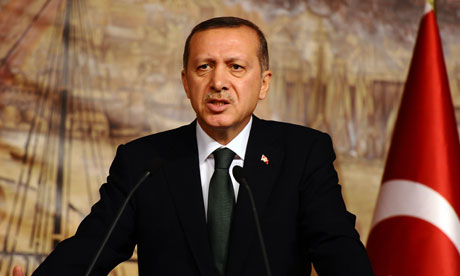
"Recep Tayyip Erdogan, the prime minister of Turkey, has hit out at French plans to prosecute people who deny the mass killings of Armenians was genocide." (Mustafa Ozer/AFP/Getty Images)
Turkey Threatens France over Stance on Killing of Armenians by Ottomans
Associated Press dispatch in The Guardian, December 19, 2011
"Turkey has threatened to denounce France's colonial past at international meetings in retaliation for French plans to prosecute people who deny that the mass killings of Armenians by Ottoman Turks was genocide. Turkey rejects the term genocide to describe the killings of Armenians more than 90 years ago. Historians estimate that up to 1.5 million Armenians were killed and experts say it was the first genocide of the 20th century. France considers the killings a genocide. The lower house of the French parliament is to debate a proposal that would punish anyone denying that the slaughter was genocide with one year in prison and a €45,000 (£37,700) fine. The issue threatens to further harm Turkish-French relations already tense over French president Nicolas Sarkozy's opposition to Turkey's bid to join the EU. Turkey has threatened to withdraw its ambassador to France if the bill is passed, while prime minister Recep Tayyip Erdogan has said the country should investigate alleged French abuses in Algeria and Rwanda instead. France had troops in Rwanda in 1994, and Rwandan president Paul Kagame has accused the country of doing little to stop the country's genocide. Turkey's foreign minister Ahmet Davutoglu said on Sunday that Ankara would bring up the issue of 'French colonialism' and 'start talking about truths everywhere in the world'. His words were carried by the state-run Anadolu agency. Meanwhile, France's foreign ministry said on Monday that foreign minister Alain Juppe would meet a delegation from Turkey's parliament on Tuesday to discuss the draft law. Volkan Bozkir, head of the foreign affairs committee, and opposition figure Osman Koruturk are leading the delegation that is lobbying French legislators against the bill. Turks have called for a boycott of French goods and companies in retaliation for the draft law. Turkish government officials say trade rules and a customs union agreement between Turkey and the EU forbid an official boycott of France -- an important economic partner. Turkey's economy minister said, however, that a joint Turkish-French economic co-operation meeting scheduled for January could be cancelled if the bill is passed. [...]"

Friday, December 09, 2011

Indonesia / The Netherlands / Colonialism

Netherlands Apologises for 1947 Rawagede Massacre in Indonesia
Associated Press dispatch in The Guardian, December 9, 2011
"The Netherlands has apologised after six decades for a notorious massacre of up to 430 men and boys during Indonesia's bitter struggle for independence. Tjeerd de Zwaan, the Dutch ambassador to Indonesia, made the announcement in front hundreds of villagers in Rawagede, the scene of the killings on 9 December 1947 of hundreds of boys and young men by Dutch troops. The military, which was clinging on to a retreating colonial empire, arrived in Rawagede before dawn and opened fire, sending residents scattering from their homes in panic. The soldiers were looking for resistance leader Lukas Kustario, known for ambushing Dutch bases. When villagers said they didn't know where he was, nearly all the men were rounded up and taken to the fields. Squatting in rows, with both hands placed on the backs of their heads, they were shot one by one. The apology was given in a ceremony at the Rawagede Hero cemetery, where many of the victims were buried in a mass grave. 'Today, December 9, we remember the members of your families and those of your fellow villagers who died 64 years ago through the actions of the Dutch military,' said De Zwaan. 'On behalf of the Dutch government I apologise for the tragedy that took place.' The apology followed a landmark ruling earlier this year by a Dutch court in a case filed by nine surviving relatives that said the state was to blame. The relatives' lawyer, Liesbeth Zegveld, said the Netherlands would pay each of the nine relatives €20,000 in compensation. After the apology, the crowd erupted in cheers. Tears rolled down the cheeks of surviving widows, now in their late 80s and early 90s, some of whom had started to doubt they would ever hear the words. 'It makes me feel my struggle for justice was not useless,' said Cawi Binti Baisa, who was 20 when her husband of two years headed to the rice paddy in the morning never to return."
[n.b. This is the complete text of the dispatch]

Wednesday, November 30, 2011

Ivory Coast / International Tribunals

"Laurent Gbagbo, former President of Ivory Coast, and his wife Simone are watched by republican forces in a hotel in Abidjan, Ivory Coast, on Monday, April 11, 2011." (Aristide Bodegla/AP)
Ivory Coast's Gbagbo in Custody at ICC
By Mike Corder
Associated Press dispatch on Time.com, November 30, 2011
"The International Criminal Court charged former Ivory Coast President Laurent Gbagbo with murder, rape, persecution and inhuman acts Wednesday, crimes allegedly committed as his backers fought brutal battles to keep him in power last year. Gbagbo, 66, is the first former head of state taken into custody by the court since it was established in 2002, although prosecutors also have charged Sudanese President Omar al-Bashir with genocide and Libya's former leader, the late Moammar Gadhafi, with crimes against humanity. 'Mr. Gbagbo is brought to account for his individual responsibility in the attacks against civilians committed by forces acting on his behalf,' Prosecutor Luis Moreno-Ocampo said in a statement. 'He is presumed innocent until proven guilty and will be given full rights and the opportunity to defend himself.' Moreno-Ocampo stressed that both sides of the political divide in Ivory Coast committed crimes in the post-election chaos and that his investigation was continuing. That statement appeared aimed at countering fears that Gbagbo's arrest could further stoke tension in Ivory Coast because it gives the appearance of victor's justice. Grave abuses were also committed by forces loyal to the country's democratically elected leader, Alassane Ouattara, who enlisted the help of a former rebel group to force Gbagbo from office. ...

Chile / United States

Chile Seeks Extradition of ex-US Military Officer in 1973 Death
By Fabiola Gutierrez and Chris Kraul, Los Angeles Times
The Los Angeles Times, November 30, 2011
"A Chilean judge is seeking the extradition of a former U.S. military officer to face murder charges in the 1973 slaying of freelance journalist and filmmaker Charles Horman, a case dramatized in the Oscar-winning film 'Missing,' court sources confirmed Tuesday. Judge Jorge Zepeda wants former U.S. Navy Capt. Ray E. Davis, whose whereabouts were not immediately clear Tuesday, to face trial in Chile for his alleged involvement in the deaths of Horman and US student Frank Teruggi. The two Americans were arrested and executed by Chilean forces shortly after President Salvador Allende was overthrown in a military coup on Sept. 11, 1973. Horman, 31, was working as a screenwriter for state-run Chile Films when military rebel forces led by Gen. Augusto Pinochet attacked the presidential palace La Moneda. Allende committed suicide that day rather than surrender. Horman was arrested Sept. 17 and executed the next day, according to court documents. His body later was found on a Santiago street. Teruggi, 24, was killed Sept. 22 and his body also dumped on a street in the capital. Davis then was head of the U.S. military group attached to the American Embassy in Santiago. A recent truth commission found that 41,000 people were arrested, tortured or killed during Pinochet's 16-year reign of terror. At least 3,200 are thought to have died. Zepeda wrote in court documents that his investigation bore out suspicions from the outset that 'there was participation [in the murders] by citizens of the same nationality.' Zepeda wrote that Davis did nothing to stop the execution of the two Americans 'although he had the opportunity of doing so,' and that he is suspected of giving Pinochet officials a 'list of subversive US citizens in Chile.' A former top official with Chile's DINA intelligence agency, Gen. Pedro Espinoza, was also charged with homicide in the cases.

United States / Genocides of Indigenous Peoples

"Walter Littlemoon speaks to students at Colorado State University." (Mike Kalush, The Rocky Mountain Collegian / The Thick Dark Fog)
New Documentary Tracks Cultural Genocide of American Indians
By Rose Aguilar
Truthout.org, November 24, 2011
"In 1892, US Army officer Richard Pratt delivered a speech in which he described his philosophy behind US government-run boarding schools for American Indians. 'A great general has said that the only good Indian is a dead one,' he said. 'In a sense, I agree with the sentiment, but only in this: that all the Indian there is in the race should be dead. Kill the Indian in him, and save the man.' From 1879 until the 1960s, more than 100,000 American Indian children were forced to attend boarding schools. Children were forcibly removed or kidnapped from their homes and taken to the schools. Families risked imprisonment if they stood in the way or attempted to take their children back. Many of the country's 100 schools were still active up until the 1970s. Generations of children were subjected to dehumanization, cruelty and beatings, all intended to strip them of their Native identity and culture. The ultimate goal was to 'civilize' the children. A new documentary, 'The Thick Dark Fog,' shines a light on the traumatic boarding school experience through the telling of personal stories. The film focuses on Walter Littlemoon, a Lakota who was forced to attend a federal government boarding school on the Pine Ridge Reservation in South Dakota in the 1950s. Littlemoon says his culture, language and spirituality were brutally suppressed. 'The government school had tried to force me to forget the Lakota language and I wouldn't do it,' he says in the film. 'We had a deep sense of preservation for our culture, so we would go and hide in order to speak Lakota. If we got caught, they were allowed to beat us with whatever they could, but we took that chance. The Lakota language is something that comes from deep inside of you. It comes from how you look at things and how you see things.' 'The Thick Dark Fog' profiles Walter's healing process and attempt to reclaim his heritage. 'It wasn't until my sixtieth year that I began to realize that there was more to me. Something was missing. It was like I was a nonbeing,' he says. 'I didn't know the medical words of multigenerational trauma or the complex post-traumatic stress disorder, so I called the problem what I felt it to be: the thick dark fog.' ... In 2008, the Canadian Government set up a Truth and Reconciliation Commission to help indigenous peoples tell their stories and heal.  What should the US government do to help indigenous people heal from the abuses they suffered in government-run boarding schools?"
[n.b. Thanks to Morgan Wood for bringing this source to my attention.]

Wednesday, November 23, 2011

Libya / United Nations / Arbitrary Imprisonment / Torture

"Libya's former rebels are holding thousands of people in makeshift detention centres, the UN says." (Ciro Fusco/EPA)
Libyan Rebels Detaining Thousands Illegally, Ban Ki-moon Reports
The Guardian, November 24, 2011
"Libya's former rebels have illegally detained thousands of people, including women and children, according to the United Nations secretary general. Many of the 7,000 prisoners have been tortured, with some black Africans mistreated because of their skin colour, women being held under male supervision and children locked up alongside adults, the report by Ban Ki-moon found. The report, due to be published on Monday, presents a grim assessment of Libya following the civil war, with many prisoners held in private jails not under the control of the interim government and denied access to due legal process. The UN chief said: 'While prisoners held by the Gaddafi regime had been released, an estimated 7,000 detainees are currently held in prisons and makeshift detention centres, most of which are under the control of revolutionary brigades.' Prisoners had 'no access to due process in the absence of a functioning police and judiciary', he added. Most courts were 'not fully operational' due to a lack of security and a reduction in the number of judges and administrative staff. Ban said that sub-Saharan Africans accounted for many of the detainees, while members of Libya's Tawerga community had faced reprisals, including revenge killings, for their role in attacks by Gaddafi forces on the city of Misrata. While Gaddafi employed some fighters from neighbouring countries as mercenaries, other Africans worked in civilian jobs in the oil-rich North African country. Human rights groups claim that some rebels made no distinction between the two. The report raised concern about 'disturbing reports' that war crimes had been committed by the rebels and former government forces in Sirte, where deposed dictator Muammar Gaddafi was captured and killed last month. UN officials have called on Libyans to respect human rights and refrain from revenge attacks after months of fierce fighting between rebels and Gaddafi loyalists. [...]"

Monday, November 21, 2011

Cambodia / Genocide Tribunals

Three Top Khmer Rouge Leaders Go on Trial in Cambodia
By Mark Magnier
The Los Angeles Times, November 21, 2011
"Three top Khmer Rouge leaders accused of helping mastermind Cambodia's 'killing fields' in the 1970s went on trial in Phnom Penh on Monday as hundreds of victims and curious onlookers arrived at the court from around the country to witness the proceedings. The United Nations-backed trial is expected to take months. And, based the conduct of past tribunals in Cambodia, there could be a further extended period of time between the end of testimony and the court's reaching a verdict. This reflects in part the highly political nature of these proceedings in a nation where feelings are still raw from the brutal period of history and where many of those who served in the Khmer Rouge remain prominent in society. Adding some immediacy is the advanced age of many of the victims and accused, creating fears that those who committed atrocities will die before they face justice. The three defendants -- Nuon Chea, 85, the Khmer Rouge's chief ideologist and second in command; Khieu Samphan, 80, an ex-head of state; and leng Sary, 86, the former foreign minister -- sat beside their lawyers Monday in a courtroom especially built for the tribunal. Among the charges they face are crimes against humanity, genocide, religious persecution, homicide and torture."
[n.b. This is the complete text of the dispatch.]
[See also: "Khmer Rouge Trio Accused of Cambodia's 'Worst Horrors'", Reuters dispatch, November 21, 2011.]

Sunday, November 20, 2011

Syria

"A protest against President Bashar al-Assad after Friday Prayer in Homs, Syria, last week. The city, a hot spot of resistance against the government, has recently been the scene of sectarian violence." (Reuters)
Sectarian Strife in City Bodes Ill for All of Syria
By Anthony Shadid
The New York Times, November 19, 2011
"A harrowing sectarian war has spread across the Syrian city of Homs this month, with supporters and opponents of the government blamed for beheadings, rival gangs carrying out tit-for-tat kidnappings, minorities fleeing for their native villages, and taxi drivers too fearful of drive-by shootings to ply the streets. As it descends into sectarian hatred, Homs has emerged as a chilling window on what civil war in Syria could look like, just as some of Syria's closest allies say the country appears to be heading in that direction. A spokesman for the Syrian opposition last week called the killings and kidnappings on both sides 'a perilous threat to the revolution.' An American official called the strife in Homs 'reminiscent of the former Yugoslavia,' where the very term 'ethnic cleansing' originated in the 1990s. 'Over the past couple of weeks, we've seen sectarian attacks on the rise, and really ugly sectarian attacks,' the Obama administration official said in Washington. The longer President Bashar al-Assad 'stays in power, what you see in Homs, you'll see across Syria.'

Wednesday, November 09, 2011

India / Gujarat Genocide

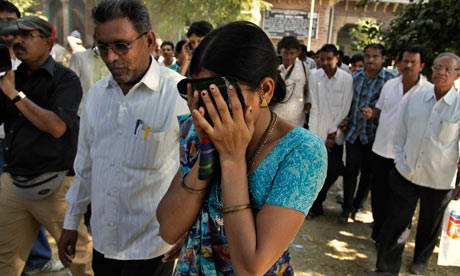
"A relative of one of the Hindus on trial for the killing of dozens of Muslims in a fire breaks down on hearing the verdict in Mehsana, India." (Ajit Solanki/AP)
India Jails 31 Hindus for Life for Killing Muslims
Associated Press dispatch in The Guardian, November 9, 2011
"A court has sentenced 31 Hindus to life imprisonment for killing dozens of Muslims by setting fire to a building during one of India's worst rounds of communal violence nine years ago. Judge ST Srivastava acquitted 41 others of murder for lack of evidence. Those convicted at the Mehsana district court can appeal against the verdict in a higher court. Since partition of the subcontinent into India and Pakistan after independence from Britain in 1947, there have been sporadic bouts of violence. The worst recent violence erupted in 2002 in Gujarat state. More than 1,000 people, most of them Muslims, were killed by Hindu mobs after a train fire killed 60 Hindus returning from a pilgrimage. Muslims were blamed for the fire. During rioting, the suspects set a building on fire in a village in Mehsana district, nearly 25 miles (40km) north of Ahmedabad, the main city of Gujarat. Thirty-three Muslims, including 20 women, who had taken shelter there were burned alive. Two suspects died during the trial that was expedited by orders from India's top court, the supreme court. Muslims account for about 14% of India's population of 1.1 billion but lag far behind the Hindu majority in most social indicators, from literacy to household income."
[n.b. This is the complete text of the dispatch.]

Monday, November 07, 2011

China / Tibet

"Analysts said the Dalai Lama was seeking to avoid a political vacuum after his death, when Tibetans will have to identify his reincarnated successor." (Reuters)
Dalai Lama Blames Suicide Protests on Chinese "Cultural Genocide"
The Telegraph, November 7, 2011
"The Dalai Lama has blamed a recent wave of Tibetan self-immolations on a policy of 'cultural genocide' being carried out by the Chinese government. Eight Buddhist monks and two nuns have set themselves alight in ethnically Tibetan parts of China's Sichuan province since the death of a young monk in March sparked a government crackdown. 'Chinese communist propaganda create a very rosy picture. But actually, including many Chinese from mainland China who visit Tibet, they all have the impression things are terrible,' the Dalai Lama said. 'Some kind of policy, some kind of cultural genocide is taking place,' the 76-year-old Tibetan spiritual leader said, in comments that are likely to rile Beijing. '(In the) last 10, 15 years, there were some kind of hardliner Chinese officials. So that's why you see these sad incidents have happened due to this desperate sort of situation.' Activists say that at least five monks and two nuns have died from their injuries and that Chinese police have at times responded by beating the burning protesters and their colleagues rather than providing assistance.

Saturday, November 05, 2011

Nigeria

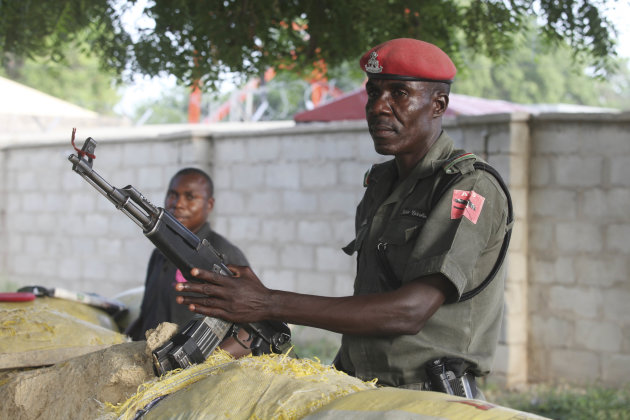
"In this Wednesday, Sept. 28, 2011 photo, police officers armed with AK-47 rifles stand guard at sandbagged bunkers along a major road in Maiduguri, Nigeria. The radical sect Boko Haram, which in August 2011 bombed the United Nations headquarters in Nigeria, is the gravest security threat to Africa's most populous nation and is gaining prominence." (AP Photo/Sunday Alamba)
At Least 67 Dead in North Nigeria Sect Attacks
By Jon Gambrell
Associated Press dispatch on Yahoo! News, November 5, 2011
"Residents fearfully left their homes Saturday to bury their dead in northeast Nigeria following a series of coordinated attacks that killed at least 67 people and left a new police headquarters in ruins, government offices burned and symbols of state power destroyed. A radical Muslim sect known locally as Boko Haram claimed responsibility for the attacks in Borno and Yobe states, with the worst damage done in and around the city of Damaturu. The group also promised to continue its bloody sectarian fight against Nigeria's weak central government, with residents nervously moving through empty streets, waiting for the next attack. 'There's that fear that something might possibly happen again,' Nigerian Red Cross official Ibrahim Bulama said. In Damaturu, the capital of Yobe state, a car bomb exploded Friday afternoon outside a three-story building used as a military office and barracks, killing many uniformed security agents, Bulama said. Gunmen then went through the town, blowing up a bank and attacking at least three police stations and some churches, leaving them in rubble, he said. Gunfire continued through the night and gunmen raided the village of Potiskum near the capital as well, witnesses said, leaving at least two people dead there.