Friday, August 15, 2014

Israel / The Netherlands / Jewish Holocaust

"During the Nazi occupation of Holland Mr. Zanoli's family had helped shelter a young boy until the Allied liberation in 1945."
"Dutchman, 91, Returns Holocaust Honour to Israelis after Six Relatives Killed in Gaza"
By Inna Lazareva
The Telegraph, August 15, 2014
"A 91-year-old Dutch man who was awarded a prestigious honour by the State of Israel for his family's role in saving a Jewish child from the Holocaust has returned his prize after six of his relatives were killed in Gaza. In 2011 the Israeli authorities declared Henk Zanoli 'Righteous Among the Nations' -- a title bestowed upon non-Jews who helped save Jews from the Holocaust. During the Nazi occupation of Holland Mr. Zanoli's family had helped shelter a young boy until the Allied liberation in 1945. But Mr. Zanoli returned his prize to the Israeli embassy in the Netherlands after hearing that six of his relatives had been killed during an attack on their home in Gaza. In a moving letter addressed to the Israeli ambassador and published in Haaretz, an Israeli newspaper, he said: 'For me to hold on to the honour granted by the State of Israel, under these circumstances, will be both an insult to the memory of my courageous mother who risked her life and that of her children fighting against suppression and for the preservation of human life as well as an insult to those in my family, four generations on.' Mr. Zanoli's father was deported from Holland and subsequently died in the Dachau concentration camp due to his outspoken opposition to the German occupation.

Wednesday, December 25, 2013

Iraq / Violence against Christians

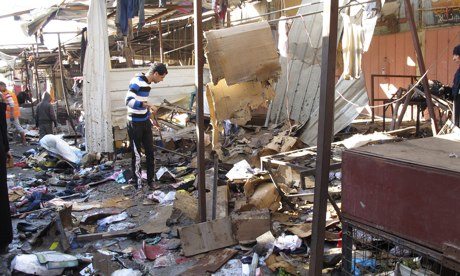
"Debris at the site of the attack at the marketplace in Baghdad." (Reuters)
Bombs Targeting Christians Kill Dozens in Baghdad
The Guardian, December 25, 2013
"Iraq's Christians celebrated Christmas behind blast walls and barbed wire as at least 37 people were killed in bomb attacks in Christian areas, some by a car bomb near a church after a service. Earlier, two bombs ripped through a nearby outdoor market simultaneously in the Christian section of Athorien, killing 11 people and wounding 21, an officer said. The Iraq-based leader of the Chaldean Catholic church, Louis Sako, said the parked car bomb had exploded after a Christmas mass in the capital's southern Dora neighbourhood, killing at least 26 people and wounding 38. He said none of the worshippers had been hurt, and he did not believe the church was the target. There was no immediate claim of responsibility for the attacks, but Iraq's dwindling Christian community, which is estimated to number about 400,000 to 600,000 people, has often been targeted by al-Qaida and other insurgents who see the Christians as heretics. Other targets include civilians in restaurants, cafes or crowded public areas, as well as Shias and members of the security forces, attacked in an attempt to undermine confidence in the Shia-led government and stir up Iraq's already simmering sectarian tensions.

Tuesday, December 24, 2013

South Sudan / Gendercide

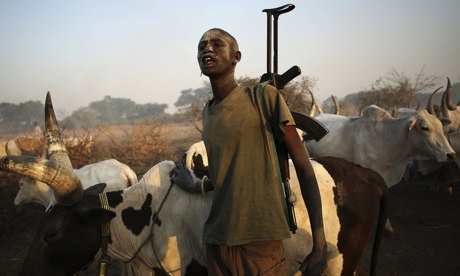
"A young cattle herder from the Dinka tribe carries his AK 47 rifle near Rumbek, capital of the Lakes State in central South Sudan." (Goran Tomasevic/Reuters)
By Daniel Howden
The Guardian, December 23, 2013
"A week ago, Simon K, a 20-year-old student living in the capital of South Sudan, was arrested by men in military uniforms. He was asked a question that has taken on deadly importance in the world's newest country in the past seven days: incholdi -- 'What is your name?' in Dinka, the language of the country's president and its largest ethnic group. Those who, like Simon, were unable to answer, risked being identified as Nuer, the ethnic group of the former vice-president now leading the armed opposition and facing the brunt of what insiders are describing as the world's newest civil war. Simon K was taken to a police station in the Gudele market district of Juba, where he was marched past several dead bodies and locked in a room with other young men, all Nuer. 'We counted ourselves and found we were 252,' he told the Guardian. 'Then they put guns in through the windows and started to shoot us.' The massacre continued for two days with soldiers returning at intervals to shoot again if they saw any sign of life. Simon was one of 12 men to survive the assault by covering themselves in the bodies of the dead and dying. Simon spoke from inside the UN compound that has become an emergency sanctuary to the remaining Nuer in the capital. Sitting on a filthy mattress by the side of a dirt road, with bandages covering bullet wounds in his stomach and legs, he recalled: 'It was horrible, because to survive I had to cover myself with the bodies of dead people, and during the two days, the bodies started to smell really bad.' In the space of seven desperate days, the UN base has been transformed from a logistics hub for an aid operation into a squalid sanctuary for more than 10,000 people. Amid the confusion of bodies and belongings, a handmade sign hangs from the rolls of razor wire. 'The lord is our best defender,' it reads. But there is no sign here of the lord's defence, as the country that gained independence in 2011 with huge international fanfare and support has come apart in the space of a week.

Saturday, December 07, 2013

Central African Republic

Central African Republic: Death Toll from Clashes Increases to 300
The Telegraph, December 6, 2013
"Christian civilians have fled by the thousands to the capital's airport guarded by French forces as the mostly Muslim armed fighters who have ruled the Central African Republic since March hunted door-to-door for their enemies and the death toll from inter-communal violence increased to 300 people. Bodies lay decomposing along the roads in Bangui, where it is too dangerous for many to collect the corpses. Thursday's clashes marked the worst unrest in Bangui in nine months and raised fears that waves of retaliatory attacks could soon follow. 'They are slaughtering us like chickens,' said Appolinaire Donoboy, a Christian whose family remained in hiding. France had pledged to increase its presence in its former colony well before Christian militias attacked the capital at dawn Thursday. The arrival of additional French troops and equipment came as the capital teetered on the brink of total anarchy and represented the greatest hope for many Central Africans. About 1,000 French forces were expected to be on the ground by Friday evening, a French defence official said. As night fell across the near anarchic capital, Christians fearing retaliatory attacks by the mostly Muslim ex-rebels crowded as close to the runway as possible, laying out their woven mats in front of a barbed wire coiled fence. National radio announced that at least 280 people had died, citing figures from local Red Cross officials, but other reports put the death toll at 300.

Wednesday, November 20, 2013

Central African Republic / United Nations

Urgent Call for UN Troops to "Prevent Genocide" in Central African Republic
By Mike Pflanz
The Telegraph, November 20, 2013
"Thousands of United Nations peacekeepers should be dispatched urgently to halt Christian-Muslim fighting in the Central African Republic that risks spiralling into genocide, Ban Ki-moon and aid agencies have said. Months of violence have pushed the country into near-anarchy with thousands of people killed or kidnapped and over half a million forced to flee their homes. On Tuesday, Amnesty International warned there was 'no time to wait' in deploying a UN mission, citing large scale human rights abuses and possible 'crimes against humanity'. The group's call came after the UN secretary-general urged the Security Council to immediately authorise the dispatch of 6,000 blue berets to bolster an existing but ineffective force of 2,500 African peacekeepers, which is all that currently stands between Muslim former rebels and Christian vigilante groups. A further 3,000 UN peacekeepers should be on standby in case the situation deteriorates, Mr. Ban told the Security Council late on Monday. 'This cycle, if not addressed now, threatens to degenerate into a country-wide religious and ethnic divide, with the potential to spiral into an uncontrollable situation, including atrocity crimes, with serious national and regional implications,' Mr. Ban warned. Already, human rights groups say that both sides may have committed war crimes, and a UN expert on genocide said that the situation could worsen. 'We are seeing armed groups killing people under the guise of their religion,' said Adama Dieng, the UN's special adviser on the prevention of genocide. 'My feeling is that this will end with Christian communities, Muslim communities killing each other which means that if we don't act now and decisively I will not exclude the possibility of a genocide occurring.' Despite deposits of gold, diamonds and uranium, the Central African Republic is one of the poorest and most politically unstable nations in the world, and has weathered repeated coups since independence from France in 1960. The current fighting began soon after Michael Djotodia, leader of the Seleka rebels, ousted Francois Bozize, the former president, in the latest coup in March.

China / Tibet

"China's former President Jiang Zemin looks up while President Hu Jintao gives his speech during the opening ceremony of 18th National Congress of the Communist Party of China at the Great Hall of the People in Beijing, November 8, 2012." (Reuters/Jason Lee)
China Dismisses as Absurd Spanish Arrest Warrants over Tibet
Reuters.com, November 20, 2013
"Former Chinese president Jiang Zemin and ex prime minister Li Peng could face arrest when travelling abroad over allegations they committed genocide in Tibet, a Spanish court ruled on Tuesday, in a case Beijing has dismissed as absurd. Two Tibetan support groups and a monk with Spanish nationality brought the case against the former leaders in 2006 using Spanish law, which allows suspects to be tried for human rights abuses committed abroad when a Spanish victim is involved. The two former leaders and three other high-ranking officials who worked in the government in the 1980s and 1990s, are accused of human rights abuses in the Himalayan region. Although it is unlikely the leaders will end up in a Spanish dock, the case is reminiscent of the arrest of former Chilean dictator Augusto Pinochet in London in 1998 after a warrant was issued by former Spanish magistrate Baltasar Garzon. Last month, another ruling by the same Spanish court indicted former Chinese president Hu Jintao for alleged genocide in Tibet. China's government denounced that move as interfering with its internal affairs. China's foreign ministry spokesman, Hong Lei, said at a daily news briefing that Beijing has 'sought clarification from Spain' about the latest ruling. Tuesday's court order will now trigger arrest warrants which in turn could result in the suspects being arrested when they travel to Spain or other countries which recognize orders signed by Spain.

Sunday, October 27, 2013

Guatemala / Genocide Tribunals

New Court Ruling Another Obstacle in Genocide Prosecution of Guatemala's Rios Montt
By Benjamin Reeves
McClatchy News Service, October 25, 2013
"The human rights prosecution of former Guatemalan dictator Jose Efrain Rios Montt, whose brutal rule in the early 1980s saw the deaths of tens of thousands of the country's indigenous people, has hit another obstacle, with one of the country's two high courts saying the retired general may be entitled to amnesty. The court's declaration, which was leaked this week to a Guatemalan news outlet, orders the lower court that is trying Rios Montt to reconsider whether a 1986 amnesty law applies in his case. The court previously had ruled that it did not. The court's declaration and supporting documents have not been provided to either the defense or the prosecution in the case, and the court's precise arguments are yet to be reviewed by the lower court. But should the lower court accept them, it would be a major setback for human rights advocates, who've long viewed Rios Montt's prosecution as a milestone in Guatemala's assigning responsibility for one of the bloodiest period’s in Latin American history. Rios Montt, who enjoyed the support of the Reagan administration at the time, is accused of genocide for a bloody three-year campaign of rural pacification that drove nearly 1 million people from their homes and killed countless others. Massacres, disappearances and torture were common during his rule, which his government justified as being necessary to crush a communist-inspired rebellion among Guatemala’s indigenous people. On May 10, Rios Montt was found guilty of genocide and war crimes, the first time that a former head of state was convicted of crimes against humanity in his own country. He was sentenced to 80 years in prison. However, the Constitutional Court overturned Rios Montt's conviction just 10 days later, citing disputes over jurisdiction.

Saturday, September 21, 2013

Iraq

"In this photo released by the National Council of Resistance of Iran, several of the 52 Iranian exiles killed in a Sept. 1 attack on Camp Ashraf, in eastern Iraq, are seen with gunshot wounds to the head and their hands bound behind their backs." (National Council of Resistance of Iran)
Envoys Urge UN Probe of Massacre at Iranian Exile Camp in Iraq
By Carol J. Williams
The Los Angeles Times, September 19, 2013
"A massacre this month at an Iranian exile camp in Iraq that killed 52 people under international protection was an act of premeditated slaughter and should be thoroughly investigated by the United Nations, two former foreign ministers told the world body Thursday. Former foreign ministers Bernard Kouchner of France and Sid Ahmed Ghozali of Algeria told a UN panel in Geneva that the Sept. 1 raid on the exile refuge known as Camp Ashraf represents 'a crime against humanity.' The former top diplomats also said they had grave fear for the safety of seven survivors of the attack who were taken hostage. A Paris-based Iranian dissident group, the National Council of Resistance of Iran, has accused Iraqi security forces under Prime Minister Nouri Maliki of carrying out the raid on the last remaining exiles at the camp, which Baghdad has been attempting to close since US forces withdrew two years ago. Iraqi officials deny being behind the killings and lay the blame on infighting among the exiles. Camp Ashraf was set up east of Baghdad in Iraq's Diyala Province during the 1980s, when Saddam Hussein's troops were at war with Iran and the Islamic Republic government's enemies were given safe refuge. Some members of the exile group, known as the Mujahedin Khalq, or MEK, fought on the side of Iraq in their effort to see the clerical regime in their homeland defeated. The Mujahedin Khalq has been accused of carrying out bombings and assassinations in Iran in the 1980s. The exile group had been on the US list of foreign terrorist organizations but was removed a year ago, after  intense lobbying effort to convince Congress that the exiles had renounced violence.

Monday, July 01, 2013

Chad / National Tribunals

"Mbacke Fall, head of the Extraordinary African Chambers, a special court set up this year by Senegalese authorities in agreement with the African Union, speaks to journalists at a news conference in Dakar July 1, 2013." (Reuters/Joe Penney)
Ex-Chad Leader Habre Faces War Crimes Charges - Prosecutor
Reuters dispatch, July 1, 2013
"Chad's former president Hissene Habre will be charged with war crimes, crimes against humanity and torture at a special court in Senegal, a legal official said on Monday, a day after the ex-leader's arrest. Habre, 71, was detained in Senegal where he has been living in exile for 22 years since he was overthrown in a coup. Human rights groups hold him responsible for the torture or killing up to 40,000 people during the eight years he led Chad, a poor, oil-rich central African state. Senegal, under pressure from the International Court of Justice and campaign groups, set up the special court this year to look into the allegations. 'After a comprehensive study of the issue, we have retained three charges namely crimes against humanity, war crimes and crimes of torture,' the court's attorney general, Mbacke Fall, told journalists. Fall said the crimes were alleged to have taken place during Habre's rule, especially during a conflict with neighbouring Libya. 'Widespread systematic attacks were ordered against civilian populations. In this context, what followed was torture and detention followed by summary executions suffered by prisoners and political detainees,' Fall said. Habre, who led Chad between 1982 and 1990, will be brought before court's judges on Tuesday for the confirmation of charges, he added."
[n.b. This is the complete text of the dispatch.]

Friday, June 28, 2013

Syria / Gendercide

"Syrian youths walk amongst the rubble in the village of al-Hamidiyeh, north of Qusayr, in Homs province."
A Return to Homs
By Patrick Cockburn
The Independent, June 28, 2013
"Khalid is too frightened of travelling the 100 miles from Homs to Damascus to ask officials if they know what happened to his three sons, who disappeared 16 months ago as government troops over-ran the rebel stronghold of Baba Amr. He has not heard anything from them since and does not know if they are alive or dead, though he has repeatedly asked the authorities in Homs, Syria's third-largest city, about them. Khalid, a thick-set man of 60 with grizzled white hair -- who used to be a construction worker until he injured his back -- says he dare not make the journey to Damascus because 'as soon as the soldiers at the checkpoints on the road see I come from a place like Baba Amr, with a reputation for supporting the rebels, they are likely to arrest me'. He explains that he cannot risk being detained because he has a wife and four daughters who rely on him. He is the last man left in his family since his sons went missing. Syria is full of parents trying to keep their children alive or simply seeking to find out if they are already dead. It is as if both sides in the civil war are in a competition to see who can commit the worst atrocities. A few days before I spoke to Khalid I saw a picture on the internet of a fresh-faced 23-year-old soldier called Youssef Kais Abdin from near the port city of Latakia. He had been kidnapped a week earlier by the al Qa'ida-affiliated Jabhat al-Nusra while serving in the north-east of Syria, close to the Iraqi border. The next his parents heard of Youssef was a call from their son’s mobile at 4am from al-Nusra telling them to look for a picture of their son online. When they did so, they saw his decapitated body in a pool of blood with his severed head placed on top of it. The Syrian conflict is a civil war with all the horrors traditionally inflicted in such struggles wherever they are fought, be it Syria today or Russia, Spain, Greece, Lebanon or Iraq in the past. For the newly appointed American National Security Adviser Susan Rice, David Cameron or William Hague to pretend that this is a simple battle between a dictatorial government and an oppressed people is to misrepresent or misunderstand what is happening on the ground.

Sunday, June 23, 2013

Burma/Myanmar

"Buddhist monasteries associated with the fundamentalist movement, which calls itself 969, have opened community centers and a Sunday school program for children nationwide." (Adam Dean/The New York Times)
Extremism Rises Among Myanmar Buddhists
By Thomas Fuller
The New York Times, June 20, 2013
"After a ritual prayer atoning for past sins, Ashin Wirathu, a Buddhist monk with a rock-star following in Myanmar, sat before an overflowing crowd of thousands of devotees and launched into a rant against what he called 'the enemy' -- the country's Muslim minority. 'You can be full of kindness and love, but you cannot sleep next to a mad dog,' Ashin Wirathu said, referring to Muslims. 'I call them troublemakers, because they are troublemakers,' Ashin Wirathu told a reporter after his two-hour sermon. 'I am proud to be called a radical Buddhist.' The world has grown accustomed to a gentle image of Buddhism defined by the self-effacing words of the Dalai Lama, the global popularity of Buddhist-inspired meditation and postcard-perfect scenes from Southeast Asia and beyond of crimson-robed, barefoot monks receiving alms from villagers at dawn. But over the past year, images of rampaging Burmese Buddhists carrying swords and the vituperative sermons of monks like Ashin Wirathu have underlined the rise of extreme Buddhism in Myanmar -- and revealed a darker side of the country's greater freedoms after decades of military rule. Buddhist lynch mobs have killed more than 200 Muslims and forced more than 150,000 people, mostly Muslims, from their homes. Ashin Wirathu denies any role in the riots. But his critics say that at the very least his anti-Muslim preaching is helping to inspire the violence. What began last year on the fringes of Burmese society has grown into a nationwide movement whose agenda now includes boycotts of Muslim-made goods. Its message is spreading through regular sermons across the country that draw thousands of people and through widely distributed DVDs of those talks. Buddhist monasteries associated with the movement are also opening community centers and a Sunday school program for 60,000 Buddhist children nationwide.

Thursday, June 06, 2013

Kenya / United Kingdom / Colonialism

"Kenyans tortured during the Mau Mau rebellion are to receive compensation payments from the British government." (Dai Kurokawa/EPA)
Britain Has Said Sorry to the Mau Mau. The Rest of the Empire is Still Waiting
By Caroline Elkins
The Guardian, June 6, 2013
"On Thursday nearly 200 elderly Kikuyu people travelled from their rural homesteads and sat before the British high commissioner in Nairobi. Over half a century had passed since many were last in front of a British official. It was a different era then in Kenya. The Mau Mau war was raging, and Britain was implementing coercive policies that left indelible scars on the bodies and minds of countless men and women suspected of subversive activities. In the 1950s they experienced events in colonial detention camps that few imagined possible. Yesterday they gathered to witness another once unimaginable thing: the much-delayed colonial gesture at reconciliation. The high commissioner read extracts from William Hague's earlier statement in parliament. Hague acknowledged for the first time that the elderly Kikuyu and other Kenyans had been subjected to torture and other horrific abuses at the hands of the colonial administration during the Mau Mau emergency. On behalf of the British government he expressed 'sincere regret' that these abuses had taken place, announced payments of £2,600 to each of 5,200 vetted claimants, and urged that the process of healing for both nations begin. The faces of the elderly camp survivors betrayed the day's historical significance. Tears rolled down faces lined from years of internalised pain and bitterness. Many sat motionless as the high commissioner read the statement. Others let out audible gasps, and cries of joy. Some burst into song. By any measure the announcement was stunning. With it, Britain jettisoned its appeal of the Mau Mau reparation case in the high court. Filed in 2009, the case was the first of its kind against the former British empire.

Tuesday, June 04, 2013

Papua New Guinea / Witch Hunts

"Hundreds of bystanders watched as a woman accused of witchcraft was being burned alive in the Western Highlands provincial capital of Mount Hagen in Papua New Guinea, Feb. 6, 2013." (Post Courier/AP)
Despite Legal Moves, PNG's Terrifying Witchcraft Killings Look Set to Continue
By Ian Lloyd
Time.com, June 5, 2013
"One step forward and several giant steps back. That's how the UN's human-rights office described the reintroduction last week of the death penalty in Papua New Guinea (PNG) and the concurrent repealing by parliament of the country's bizarre 1971 Sorcery Act. Straight off a script for Game of Thrones, the act's preamble recognized that various forms of sorcery existed and criminalized the practice of 'evil sorcery' or sanguma. While disputes over sorcery seldom came before the national judicial system, they are common in traditional village courts, where the belief that somebody is practicing sanguma has been used in defense of murder. The law's demise, and the reintroduction of the death penalty as a bid to curb sorcery-related killings, followed international outcry over a series of gruesome deaths earlier this year: the burning at the stake in February of a young mother in front of large crowd in the city of Mount Hagen, the decapitation of a retired school teacher in the autonomous region of Bougainville when I visited PNG in April, and the kidnapping and torturing with hot iron of six women and one man in the Southern Highlands province during the Easter weekend. '[This is] to stop this nonsense about witchcraft,' Prime Minister Peter O'Neill said on announcing his intention to scrap the law in parliament. But according to Richard Eves, an Australian anthropologist who specializes in PNG, political will alone shouldn’t be seen as a magic bullet against sorcery-related violence. Despite 19th century colonial attempts to eradicate it, sorcery is hardwired into the traditional culture of the country and has long been a quotidian fact of life across the socioeconomic and geographic spectrum.

Friday, May 31, 2013

Rwanda / United Kingdom / National Tribunals

"Emmanuel Nteziryayo, pictured in the dossier of his alleged crimes." (Jose Cendon/AFP)
Rwandans Held in Britain on Genocide Extradition Request
Reuters dispatch, May 30, 2013
"Five Rwandans accused of involvement in the genocide that killed 800,000 people in just 100 days were arrested in Britain on Thursday after an extradition request from Rwanda, London police said. Emmanuel Nteziryayo, Charles Munyaneza, Celestin Ugirashebuja, Vincent Bajinya and Celestin Mutabaruka appeared at a London court under extradition warrants alleging genocide and murder, a police spokesman said. Four of the five were freed by the High Court in 2009, overturning a ministerial extradition order because of fears they would not get a fair trial in Rwanda. They had been in custody since 2006. During 100 days of slaughter in 1994, 800,000 minority Tutsis and politically moderate Hutus were killed. Rwandan prosecutor general Martin Ngoga welcomed the arrests, which took place early on Thursday, and said he hoped London would follow the example of other jurisdictions that had extradited suspects. 'They are all suspects of genocide against Tutsis and crimes against humanity committed in Rwanda in 1994 ... Rwanda has made significant progress since 2009 when the British Courts rejected the extradition requests to Rwanda,' he said. The five men are due to appear at Westminster Magistrates court again on June 5."
[n.b. This is the complete text of the dispatch.]

Serbia / Bosnia and Herzegovina / International Tribunals

"Jovica Stanisic, left, and Franko Simatovic, right, await judgment at the tribunal." (Martijn Beekman/AP)
Hague Tribunal Acquits Serbian State Security Chiefs of War Crimes
By Ian Traynor
The Guardian, May 30, 2013
|Two Serbian state security chiefs who facilitated the use of paramilitary murder squads in the wars in Croatia and Bosnia in the 1990s have been acquitted of all charges of war crimes in what is certain to be seen as a debacle for the prosecution at the Yugoslav war crimes tribunal in The Hague. Jovica Stanisic, one of the closest aides and state security chief of Slobodan Milosevic, and the late Serbian leader's sidekick and field officer, Franko Simatovic, walked free on Thursday after 10 years in detention and five years on trial. The judges found that the pair, widely seen as two of Milosevic's key henchmen in the wars of the 1990s, created, organised, directed, and funded special forces teams and paramilitary formations in Serbia whose function was to terrorise non-Serbs out of parts of Croatia and Bosnia. While declaring that the units were responsible for war crimes and mass murder, the judges ruled that the two accused could not be held responsible for any of the crimes. Apart from the continuing trials of the two Bosnian Serb leaders, Radovan Karadzic and Ratko Mladic, who are both facing genocide charges, the case that concluded on Thursday was viewed as the most important in attempting to prove how Belgrade directed the vicious 1991-95 Serbian campaigns in Croatia and Bosnia. The judges found that the men 'directed and organised the formation of the [special forces] unit, organised its involvement in a number of operations in Croatia and Bosnia-Herzegovina, and directed and organised its financing, logistical support, and other substantial assistance or support.' The special forces were found to have perpetrated acts of 'murder, deportation, and forcible transfer' in Bosnia in 1992. While the judges found that Stanisic and Simatovic 'organised the involvement' in the crimes, they said there was no proof the accused 'personally directed the operations' or 'issued orders or instructions.'

Thursday, May 30, 2013

Bosnia and Herzegovina / International Tribunals

"(File) Bruno Stojic, left, and Jadranko Prlic appear at the War Crimes Tribunal in The Hague, Netherlands, in 2004."
6 Former Bosnian Croat Leaders Convicted of War Crimes
By Laura Smith-Spark
CNN.com, May 29, 2013
"Six former top Bosnian Croat leaders were handed long prison sentences Wednesday after they were convicted of crimes against humanity and war crimes, including the rape and murder of Bosnian Muslims. The offenses, which date to between 1992 and 1994, formed part of a wider conflict that followed the break-up of the former Yugoslavia in the early 1990s. The six were accused at the International Criminal Tribunal for the Former Yugoslavia of trying to 'ethnically cleanse' non-Croats from areas of the territory of the Republic of Bosnia and Herzegovina. The Bosnian Croat leadership, along with Croat leaders, wanted to make this territory part of a 'Greater Croatia,' said the ICTY, which is based in the Hague. In order to achieve this, they carried out crimes against Bosnian Muslims and other non-Croats that included murder, rape, sexual assault, destruction of property, imprisonment and deportation, the ICTY statement said. Jadranko Prlic, Bruno Stojic, Milivoj Petkovic and Valentin Coric were convicted on 22 counts of the indictment for war crimes and crimes against humanity. Prlic, the former president of the Croatian Defense Council and later head of the government of a wartime Croat entity, Herceg-Bosna, was sentenced to 25 years in prison -- the toughest penalty. The other three were given prison terms ranging from 16 to 20 years in length. Two of the accused, Slobodan Praljak and Berislav Pusic, were acquitted on some of the charges against them.

Cambodia / Genocide Tribunals

"Nuon Chea expressed 'condolences' to victims of the regime present in the court." (EPA)
Khmer Rouge Leader Accepts Responsibility for Cambodia's Killing Fields
Reuters dispatch in The Telegraph, May 30, 2013
"A leader of the Cambodian Khmer Rouge expressed remorse on Thursday for the deaths of an estimated 1.7 million people during the 'Killing Fields' regime in the 1970s and accepted responsibility for the first time. 'I am responsible for what happened during the time of Democratic Kampuchea,' Nuon Chea told the United Nations-backed tribunal, referring to the name of the country during the period, when he was the party's second-in-command. 'I am very regretful for events that happened intentionally and unintentionally. I am morally responsible,' he said, expressing 'condolences' to victims of the regime present in the court, where he faces charges including war crimes and crimes against humanity. 'Brother Number Two' Nuon Chea and co-defendant Khieu Samphan, a former head of state during the Khmer Rouge period, have until now denied responsibility or even knowledge the killings. Khieu Samphan said he regretted the 'unspeakable suffering' done to the Cambodian people under the Khmer Rouge and offered condolences, his first such apology in court. It was unclear why the two men had chosen to express remorse now, but Lars Olsen, a court spokesman, welcomed the admission. 'Many victims have waited more than 30 years to hear any statement of apology or regret from leadership figures in the Khmer Rouge,' he said. However, Khieu Samphan continued to insist he was simply a figurehead of the regime and knew nothing about its murderous side.

Wednesday, May 29, 2013

Brazil / Genocides of Indigenous Peoples

"Umutima shaman in 1957: the Figueiredo report caused an outcry after it revealed crimes against Brazil's indigenous population." (José Idoyaga/Survival)
Brazil's "Lost Report" into Genocide Surfaces after 40 Years
By Jonathan Watts and Jan Rocha
The Guardian, May 29, 2013
"A 'lost' report into genocide, torture, rape and enslavement of indigenous tribes during Brazil's military dictatorship has been rediscovered, raising fresh questions about whether the government has made amends and punished those responsible. The 7,000-page Figueiredo report has not been seen for more than 40 years, but extracts acquired by the Guardian reveal hundreds of alleged crimes and perpetrators. Submitted in 1967 by the public prosecutor Jader de Figueiredo Correia, the document details horrific abuse by the Indian Protection Service (widely known as the SPI), which was set up to improve the livelihoods of indigenous communities but often ended up as a mechanism to rob them of land or wipe them out with guns or poison. The document caused an international storm when it was released, leading two years later to the foundation of the tribal rights organisation Survival International. Brazil, however, failed to jail a single person despite initial charges against 134 officials alleged to be involved in more than 1,000 crimes. The report was believed to have been destroyed by a fire at the agriculture ministry soon after it came out, prompting suspicions of a cover-up by the dictatorship and its allies among the big landowners. However, most of the document was discovered recently in a musty archive and is being examined by the National Truth Commission, which is investigating human rights violations between 1947 and 1988. Although the document has not been made public since its rediscovery, the Guardian has seen a scanned copy in which Figueiredo describes the enslavement of indigenous people, torture of children and theft of land. 'The Indian Protection Service has degenerated to the point of chasing Indians to extinction,' the prosecutor writes in an introduction addressed to the interior minister. The pages -- all bound, initialled and marked MI-58-455 -- include an alphabetical list of the alleged perpetrators and the indictments against them. Most are accused of falsely appropriating land, misusing funds or illegally selling cattle or timber to enrich themselves at the expense of the communities they were supposed to be protecting. But many are implicated in far more heinous crimes. The number of victims is impossible to calculate. The Truth Commission believes that some tribes, such as those in Maranhão, were completely wiped out. In one case, in Mato Grosso, only two survivors emerged to tell of an attack on a community of 30 Cinta Larga Indians with dynamite dropped from aeroplanes. Figueiredo also details how officials and landowners lethally introduced smallpox into isolated villages and donated sugar mixed with strychnine. Among those to whom responsibility is attributed is Major Luiz Vinhas Neves, who headed the SPI from 1964 until he was sacked as a result of the report in 1968. He is cited in more than 40 counts, including financial irregularities totalling more than 1bn reals (£300,000) in today's money. Following the report, a parliamentary resolution accused him of complicity in the spread of smallpox among two remote communities in Pataxó. [...]"

Wednesday, May 22, 2013

Indigenous Peoples / Slavery

Slave Descendants Seek Equal Rights from Cherokee Nation
By Marcos Barberry
Salon.com, May 22, 2013
"On an oppressively hot evening last May, David Cornsilk addressed a room of so-called 'black Indians' at Gilcrease Hills Baptist Church in northwest Tulsa. He wore a leather-braided bolo tie clasped by an emerald quartz. Though Cornsilk never formally studied law, his voice bellowed with the rhetorical ire of a white-shoed seasoned litigator. 'By a show of hands, how many folks here tonight are Freedmen?' Cornsilk asked into the microphone. Each raised an arm. Visibly dismayed, Cornsilk shook his head. It was a trick question. 'No,' Cornsilk said. 'The Freedmen died a long time ago. You are not Freedmen. You are Cherokee, and it is time that you begin to recognize who you are.' Cornsilk is Cherokee, and a self-taught civil rights advocate and genealogist. He traces his slave-owning ancestors back to their aboriginal lands of Georgia and Tennessee -- to a period before the Trail of Tears. [...] Headquartered in Tahlequah, Oklahoma, the Cherokee Nation and its wholly owned business arm earned over a billion dollars last year through a myriad of businesses such as gaming, U.S. Department of Defense contracts, and federally funded programs. Today, taxpayers help support the Cherokee Nation through federal grants. The brutality committed by whites against American Indians -- especially the Trail of Tears -- has become a part of our national conscience. Yet it is hard to imagine that during this period an even more poorly documented atrocity was being perpetrated: The Cherokee were slave owners long before their forced removal from the southern states. By the time gold was discovered in Georgia at the dawn of the 19th century, Cherokee slave codes were indistinguishable from those enacted by the rest of the South. Soon after, when the US Indian Removal Act forced Cherokee and other Indians to relinquish their native land and move west, countless blacks enslaved by Cherokees crossed into the frontier bound and shackled. These black slaves suffered a far more violent experience than their Indian masters.

Tuesday, May 21, 2013

Guatemala / Genocide Tribunals

Gen. Efraín Ríos Montt. (Johan Ordonez/Agence France-Presse/Getty Images)
Genocide Trial of Guatemalan Ex-Dictator May Have to Restart
By Elisabeth Malkin
The New York Times, May 21, 2013
"A day after Guatemala's highest court threw out the genocide verdict against a former dictator, Gen. Efraín Ríos Montt, lawyers on both sides of the case said Tuesday that his entire trial would probably have to be repeated. In a contentious 3-2 decision, the Constitutional Court on Monday ordered that the clock on the trial be turned back to April 19, part of an awkward remedy to resolve what it decided was a procedural irregularity. By that point in the trial, the prosecution had presented a month of chilling testimony from survivors of Army massacres carried out 30 years ago during one of the bloodiest periods of Guatemala's long civil war. Experts in the trial described how the Army had marched into remote hamlets in the Maya Ixil region in search of leftist guerrillas during General Ríos Montt's 17-month rule in 1982 and 1983. Soldiers killed all those who could not flee, burning down houses, killing livestock and destroying crops. The court's split decision to rewind the trial to April 19 means that everything that came after that point -- including closing statements, the genocide conviction and the general's 80-year prison sentence -- is invalid. Rather than simply restarting the case at that juncture, however, lawyers on both sides said that it would probably have to go before a new panel of judges -- one that had not already convicted the general. And because those new judges would need to rule on the evidence themselves, the trial would probably need to start over from the beginning, possibly dragging out the case against the 86-year-old general for months, if not longer.