Saturday, January 14, 2012

Syria / United States / Responsibility to Protect

"Demonstrators protest against Syria's President Bashar al-Assad in Homs." (Reuters)
"Edging Toward Intervention in Syria"
By Paul Mutter
Salon.com, January 13, 2012
"On Monday, a unity agreement between Syria's two main anti-regime groups collapsed over the issue of foreign military intervention in the country's 11-month-old internal conflict. As anti-government demonstrations and police violence continue, there is still no immediate prospect of a NATO or international military intervention like that undertaken in Libya.  But that doesn't mean it won't happen. Syria is a unique case. Unlike Libya it doesn't have a lot of oil. Unlike Egypt, it is not controlled by a U.S.-funded ally. What it does have is an increasingly violent dictatorship and a growing but divided opposition. The government of Bashar al-Assad shows no signs of weakening resolve, and Arab League monitors in the country have drawn criticism (and live fire) for their work. The Syrian National Council, which is dominated by Syrian émigrés in Turkey and Europe, has reiterated its calls for foreign military intervention despite contradictory remarks from some of its members. The SNC wants to establish a no-fly zone over northern Syria to provide a safe haven for refugees and the loosely organized 'Syria Free Army' in preparation for NATO and Arab League-backed operations against Assad's loyalist forces. The National Coordination Body, composed of left-wing Syrian Arabs and Kurds operating inside Syria, continues to warn against foreign intervention and expansion of armed resistance to Assad. The unity agreement's collapse -- and reports suggesting that a majority of the Syrian opposition and demonstrators now favor foreign military intervention -- may help strengthen the hands of those in the West who have argued for such action from the beginning.  In Washington a 'time-limited, scope-limited military action' as implemented in Libya this past year appeals to both Obama administration policymakers who say they are guided by a 'responsibility to protect' and to neoconservatives who favor 'regime change' in Damascus to isolate Iran and Islamist groups. ... For outside interlocutors assisting the SNC, there is the London-based Henry Jackson Society, which is described by the Guardian as a British group with close ties to American neoconservatives. ... Other prominent voices in the insular but influential world of neoconservative thought include a team of defense specialists at the hawkish Washington Institute for Near East Policy who recently issued a report concluding, 'Intervention in Syria would be a demanding mission carrying significant risks,' while also asserting that 'intervention also presents policy opportunities.'

South Sudan

"A family with a wounded boy waited at a United Nations camp to be evacuated for further treatment." (Sven Torfinn/The New York Times)
Born in Unity, South Sudan Is Torn Again
By Jeffrey Gettleman
The New York Times, January 12, 2012
"The trail of corpses begins about 300 yards from the corrugated metal gate of the United Nations compound and stretches for miles into the bush. There is an old man on his back, a young woman with her legs splayed and skirt bunched up around her hips, and a whole family -- man, woman, two children -- all facedown in the swamp grass, executed together. How many hundreds are scattered across the savannah, nobody really knows. South Sudan, born six months ago in great jubilation, is plunging into a vortex of violence. Bitter ethnic tensions that had largely been shelved for the sake of achieving independence have ruptured into a cycle of massacre and revenge that neither the American-backed government nor the United Nations has been able to stop. The United States and other Western countries have invested billions of dollars in South Sudan, hoping it will overcome its deeply etched history of poverty, violence and ethnic fault lines to emerge as a stable, Western-friendly nation in a volatile region. Instead, heavily armed militias the size of small armies are now marching on villages and towns with impunity, sometimes with blatantly genocidal intent. Eight thousand fighters just besieged this small town in the middle of a vast expanse, razing huts, burning granaries, stealing tens of thousands of cows and methodically killing hundreds, possibly thousands, of men, women and children hiding in the bush. The raiders had even broadcast their massacre plans. 'We have decided to invade Murleland and wipe out the entire Murle tribe on the face of the earth,' the attackers, from a rival ethnic group, the Nuer, warned in a public statement.

Germany / Jews / Nazism

"Rafael Seligmann, publisher and editor of Jewish Voice from Germany, shows a copy of the first issue of his paper." (DAPD)
"We Can Resume Our Common History": New Paper Covers Revival of German Jewish Life
By David Crossland
Spiegel Online, January 4, 2012
"An English-language Jewish newspaper was launched in Berlin this week with the aim of showing foreign audiences that Jewish life in Germany is starting to flourish. Its editor, Rafael Seligmann, 64, a prominent author and journalist, says Jews in Germany are abandoning their self-image as victims of the Holocaust and becoming more confident. He wants his newspaper to promote that by portraying how the community has grown and changed since the fall of the Berlin Wall in 1989. Then, there were fewer than 30,000 Jews in Germany. Most of them were survivors of the Holocaust, and their public role was largely confined to commemorating the genocide, making sure the Germans did likewise, and supporting Israel. The big change came after German unification in 1990, when the government made it easier for Jews from the states of the disintegrating Soviet Union to move to Germany. Almost 200,000 came -- which didn't please Israel -- and Germany became home to the world's fastest-growing Jewish population. Today, more than 100,000 Jews belong to religious communities, and the total population with a Jewish background is estimated at over 200,000, including some 20,000 Israelis who have moved to Germany. That compares to 600,000 before the Holocaust.

Wednesday, January 11, 2012

Rwandan Genocide

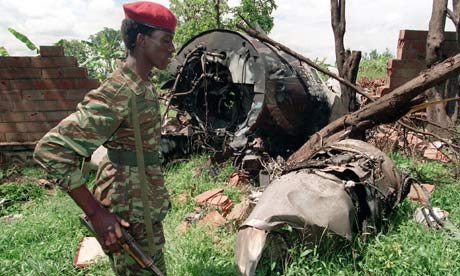
"The wreckage of the plane that was shot down killing Rwanda's president Juvénal Habyarimana in 1994." (AP/Jean Marc Boujou)
Rwanda: At Last We Know the Truth
By Linda Melvern
The Guardian, January 10, 2012
"Few events have been the subject of as many rumours and lies as the assassination on 6 April 1994 of Rwanda's President Juvénal Habyarimana. We may never know the identity of the assassins who fired the two missiles that blew his jet apart as it came in to land at Kigali International Airport; yet this one key event signalled the targeted elimination of Rwanda's political opposition, and triggered the genocide of the Tutsi people. Since that night there has been a ceaseless propaganda war, with each side blaming the other for what happened. One version is that the rebel Tutsi RPF assassinated the Hutu president in a cynical bid to oust his regime; another version blames Hutu extremists who, faced with the possibility of power-sharing with the Tutsi minority, carried out a coup d'etat in order to create a 'pure Hutu' state. This is why the publication of an expert investigation into the aircraft crash in Paris today will have such tremendous repercussions. After 18 years it has essentially settled the central question of who was morally responsible for triggering the genocide. In some 400 detailed pages, including the conclusions of six experts who visited the crash site in 2010, the report has provided scientific proof that, as the plane made a final approach, the assassins were waiting in the confines of Kanombe military camp -- the highly fortified home of Rwanda's French-trained elite unit known as the Presidential Guard, and which is directly under the flight path.

Tuesday, January 10, 2012

Rwanda / France

"Mr. Kagame has accused former French President Francois Mitterrand's administration of training and arming the Hutu militias responsible for the slaughter." (AFP)
Paul Kagame Allies "Did Not Shoot Down Plane" That Sparked Rwanda Genocide
The Telegraph, January 10, 2012
"A French investigation into what sparked the 1994 Rwandan genocide appears to exonerate current President Paul Kagame and his Tutsi allies after Paris had previously accused him of triggering the killing of 800,000 people in 100 days. Diplomatic relations between Rwanda and France were severed in 2006 when a French judge said Mr. Kagame, the rebel leader at the time of the killings, had orchestrated the assassination of Juvenal Habyarimana, the Hutu president, to trigger the bloodshed. After Habyarimana's plane was shot down, Hutu extremists slaughtered Tutsis and moderate Hutus in some of the fastest mass killings ever perpetrated. Kagame's Tutsi-led Rwandan Patriotic Front seized power in the aftermath of the genocide. Mr. Kagame has accused former French President Francois Mitterrand's administration of training and arming the Hutu militias responsible for the slaughter. A team of French investigators, led by two judges, re-examined a dozen eyewitness testimonies to work out where the two missiles that brought down Habyarimana's Dassault Falcon 50 plane were fired from, in an effort to determine final responsibility. Both sides had bases near the airport. The judges on Tuesday presented their report to Kagame's lawyers, who told media that they had concluded the shots could not have come from a military base occupied by Kagame's supporters.

Friday, January 06, 2012

Cambodia / Genocide Memorials

"Nhem En (above)
was recruited at 17
to be photographer
for Pol Pot."
(Lindsay Murdoch)
"Gentle, Intelligent" Man Turned Tyrant: Photographer Plans Pol Pot Memorial
By Lindsay Murdoch
The Sydney Morning Herald, January 7, 2012
"Many of the photographs taken at Cambodia's notorious Tuol Sleng interrogation centre are too gruesome to publish: a man shot in the head crawls through his own blood before his executioner finishes his grisly work. Victims stare without expression from images hanging on the walls of the centre where the women were dubbed 'she-animals' and the men enemies and traitors of Pol Pot's 1970s revolution. One photograph shows a mother cradling her sleeping baby. Another shows a girl's delicate beauty, defying the horror of the moment. But Nhem En, 52, Pol Pot's official photographer, says he cannot describe how he felt taking 10,000 photographs of Tuol Sleng's victims. 'I had no feelings about that ... I had the responsibility to do my work 100 per cent for the organisation,' Nhem En says, referring to Pol Pot's Khmer Rouge that was responsible for one of the worst genocides of the 20th century. 'I must work, think, talk, walk, eat for the organisation and not speak to anyone,' he says in a rare interview with a Western journalist. 'If the organisation lost confidence in me it would regard me as an enemy and I would be destroyed.' Nhem En sips beer in a French restaurant near Cambodia's fabled Angkor Wat temple and talks about building a memorial to Pol Pot in far northern Cambodia with the surprise backing of the government in Phnom Penh. He thinks Australians may want to donate to help build the project. The memorial will include a museum where Nhem En plans to display 2000 photographs he took of Pol Pot, who he says he first knew as a 'calm, gentle and highly intelligent' man with sincere intentions for all Cambodians before he became 'secretive, distrustful and brutal'. 'In the end Pol Pot thought he was god,' he says.

Canada / Rwanda

"Léon Mugesera, left, and lawyer Guy Bertrand ponder questions of a news conference on June 29, 2005 in Quebec City." (Jacques Boissinot/Canadian Press)
Accused Rwandan War Criminal Set for Deportation
By Les Perreaux
The Globe and Mail, January 5, 2012
"A Rwandan philosopher living in Quebec, who is accused of inciting the 1994 genocide with a venomous speech, may be about to test whether Rwandan justice can finally deliver a fair verdict. Léon Mugesera, whose deportation was upheld by the Supreme Court of Canada in 2005, has received notice that his removal will take place on Jan. 12. Mr. Mugesera will ask for a delay and launch a last-ditch appeal in Federal Court on Monday. Mr. Mugesera’s removal has been put off for seven years over concerns he could face torture and death in Rwanda. Like many Western nations, Canada hesitated to return Rwandans accused of crimes against humanity because it was feared the African country was incapable of providing security or a fair trial in cases related to the 1994 massacre of hundreds of thousands of Tutsis and moderate Hutus by Hutu extremists. Federal officials could not answer questions about Mr. Mugesera on Thursday, saying they do not comment on specific cases, but it appears two rulings by international tribunals in late 2011 have paved the way for Mr. Mugesera's deportation. Dealing with separate cases involving Rwandans living in Norway and Sweden, the European Human Rights Court and the International Criminal Tribunal for Rwanda each delivered landmark rulings ordering accused war criminals back to Rwanda. Each tribunal found the country’s courts can now provide sufficient independence and impartiality and its jails are safe enough for prisoners.

South Sudan

Accounts Emerge in South Sudan of 3,000 Deaths in Ethnic Violence
By Jeffrey Gettleman
The New York Times, January 5, 2012
"More than 3,000 villagers were massacred in the recent burst of communal violence in South Sudan, local officials said Thursday, with the fledging South Sudanese government, which just won its independence six months ago, seemingly unable to stem the bloodshed. If the death toll is confirmed -- United Nations officials and South Sudanese Army officers have yet to do that, saying they were still collecting information from the conflict zone -- this would be one of the deadliest clashes in South Sudan in recent memory. In the past two weeks, United Nations aircraft had been tracking an unusually large column of 6,000 to 8,000 heavily armed fighters from the Lou Nuer ethnic group as it advanced toward the town of Pibor, cutting a swath of destruction across the savanna. Pibor is the hometown of the Lou Nuer’s traditional rival, the Murle, and the two groups have been locked in a tit-for-tat cattle rustling feud for years, with the death toll steadily rising each round. According to Joshua Konyi, the commissioner of Pibor County and a Murle, 2,182 women and children and 959 men were killed, 1,293 children were abducted and 375,186 cows were stolen. 'We've been counting the bodies,' Mr. Konyi said by telephone from Pibor on Thursday night. 'It's really a genocide. If you come, you will see.' He said Lou Nuer fighters had mercilessly hunted down civilians who were cowering in the bush.

Sunday, January 01, 2012

Israel / Jewish Holocaust

(Bernat Armangue/Associated Press)
Holocaust Survivors Outraged at Ultra-Orthodox Jewish Use of Nazi Imagery at Jerusalem Protest
Associated Press dispatch in The Washington Post
January 1, 2012
"Israeli Holocaust survivors and political leaders expressed outrage Sunday over a Jerusalem demonstration in which ultra-Orthodox Jews donned Star of David patches and uniforms similar to those the Nazis forced Jews to wear during World War II. Thousands of ultra-Orthodox Jews gathered Saturday night to protest what they say is a nationwide campaign directed against their lifestyle. The practices, which call for strict separation of the sexes, are rejected by mainstream Israelis as religious coercion. Ultra-Orthodox extremists have been under fire for their attempts to ban mixing of the sexes on buses, sidewalks and other public spaces. In one city, extremists have jeered and spit at girls walking to school, saying they are dressed immodestly. These practices, albeit by a fringe sect, have unleashed a backlash against the ultra-Orthodox in general. At Saturday's protest, children with traditional sidelocks wore the striped black-and-white uniforms associated with Nazi concentration camps. One child's hands were raised in surrender -- mimicking an iconic photo of a terrified Jewish boy in the Warsaw Ghetto. Israel's Yad Vashem Holocaust memorial called the use of Nazi imagery 'disgraceful,' and several other survivors' groups and politicians condemned the acts.

Saturday, December 31, 2011

Argentina / Torture

"In this Nov. 4, 2009 file photo, Argentina's last de facto president Gen. Reynaldo Bignone attends his trial at a court house in Buenos Aires, Argentina. The former dictator was sentenced on Thursday Dec. 29, 2011 to 15 years in prison for crimes against humanity committed in a clandestine detention center that operated in a public hospital during the last military dictatorship (1976-1983)." (Rolando Andrade Stracuzzi/AP)
Argentine Dictator Guilty of Torture in Hospital
By Michael Warren
Associated Press dispatch in The Miami Herald, December 30, 2011
"Argentina's last dictator was convicted Thursday of more crimes against humanity, this time getting 15 years in prison for setting up a secret torture center inside a hospital during the 1976 military coup. Reynaldo Bignone personally oversaw the takeover of the Posadas de Haedo hospital in Buenos Aires province 35 years ago, leading soldiers in tanks and helicopters in search of medical personnel who allegedly treated leftist guerrillas. The military dismissed all the doctors and nurses, but kept some for questioning, including the hospital's medical director. Eleven hospital staffers disappeared. Bignone's trial involved 21 cases of kidnappings and tortures, including two victims who were killed and made to disappear by a civilian group of thugs who called themselves the 'SWAT' team and answered to the air force. The SWAT team set up shop inside the medical director's home, interrogating the staff. Some of those crimes are part of a second, upcoming trial involving the same hospital. Bignone was the military junta's social welfare delegate at the time. He later served as the junta's president in 1982 and 1983, ordering the destruction of vast stores of evidence documenting illegal detentions and disappearances, and dictating a military amnesty before democracy returned to Argentina. Bignone, nos 85, already faces life in prison for other kidnappings and tortures in provincial Buenos Aires, including those committed in another torture center inside the Campo de Mayo military base. He's also being tried along with former dictator Jorge Videla on charges of overseeing a systematic plan to steal the babies of pregnant detainees. In his defense, Bignone has said that his actions were justified because Argentina was at war against armed leftist subversives. Also convicted Thursday were SWAT team leader Luis Muina, 57; and a former air force brigadier, Hipolito Rafael Mariani, 85. Prosecutors asked for 25-year sentences for all three, but Bignone received 15 years, Muina 13 and Mariani eight. An official count determined that the regime killed some 13,000 people, but human rights groups estimate about 30,000 fell victim. Since Argentina's democracy was restored in 1983, 268 people have been convicted of crimes against humanity and more than 800 others are being prosecuted, the government said."
[n.b. This is the complete text of the dispatch.]

Friday, December 30, 2011

Syria

Syria: Scores Dead as Arab League Expands Mission
By Richard Spencer
The Telegraph, December 29, 2011
"Syrian security forces shot dead dozens of protesters on Thursday, including at least 11 in the capital Damascus, as the presence of Arab League peace monitors encouraged hundreds of thousands to take to the streets against Bashar al-Assad's rule. As many as 40 demonstrators were said to have been killed in total by government troops after the Arab League's observers fanned out across four restive cities on only the third day of their mission to enforce a peace deal. In Damascus, regime troops opened fire on a crowd of more than 20,000 people as they awaited the arrival of peace monitors outside a mosque in the suburb of Douma. Troops also opened fire in the city's suburbs of Aarbin and Madamiya. 'They used tanks, they used machine guns,' Omar al-Khani, an activist in Damascus, told The Daily Telegraph last night. 'They started shooting everywhere. We are now in a very bad situation. We can't bring the injured outside the city, we can't bring them to hospitals, we can't mova. Anyone who moves, they shoot at them.' Douma, which has seen repeated protests, rang to the sound of machine gun fire. According to the Syrian Observatory for Human Rights, three people died instantly and more later, with many more critically injured. One particularly chilling video posted online on Thursday night showed a protester being bundled into the back of a police van, his face bloodied. It then showed a soldier pointing his gun through a slat in the side, while others raised their guns at the back, before a shot is heard. Mr. Khani said the man's body was found several minutes later.

Monday, December 26, 2011

India / Kashmir / Gendercide

"Where Are Our Missing Sons?" Kashmiri Keep Asking
By Humra Quraishi
WeNews, December 26, 2011
"Parveena Ahangar hasn't known peace for years. 'I can't describe how each day passes. I keep taking medicines every single day to control my tension. At night, I'm awake. I just can't sleep,' Ahangar says. She's felt this way, she says, ever since the day 21 years ago when she lost her son. 'My teenaged son, Javed, was picked by the security agencies in 1990,' she says. 'Security men came to our Batmaloo home to pick him up, saying they were taking him for interrogation. We pleaded with them, saying he couldn't have done anything wrong, that he had just passed his matriculation. But they didn't listen and took him to the interrogation center at Pari Mahal. We never saw him again.' Ahangar's husband fell ill because of the trauma, and gave up working. He remains in poor health today. Ahangar lives in the India-administered state of Jammu and Kashmir in the north of the country, near the borders of Pakistan and China, an area plagued by territorial strife and tensions. She has scoured the Kashmir Valley for news of her son. She has visited jails through the region. She has approached the United Nations. 'I've appealed to every possible government authority, to politicians across party lines.' Many other women in the Kashmir Valley recount similar stories. They say they've sold land, homes, jewelry; exhausted every asset in the search for their children. ...

Israel / Turkey / Armenian Genocide

Israeli Lawmakers Consider Recognizing Massacre of Armenians as Genocide
Associated Press dispatch in The Washington Post, December 26, 2011
"Over their prime minister's objections, Israeli lawmakers on Monday began debating a proposal to recognize the mass killings of Armenians by Ottoman Turks as genocide. Doing so would likely further strain already acrimonious relations with Turkey, which denies the genocide label and says the massacres occurred in civil unrest as the Ottoman Empire disintegrated during World War I, with losses on both sides. The issue is highly sensitive in Turkey, and lawmakers in France set off a diplomatic crisis with Ankara last week when they passed a bill making it a crime to deny that the killings amounted to genocide. Turkish Prime Minister Recep Tayyip Erdogan swiftly halted political and economic contacts with Paris, suspended military cooperation and ordered his country’s ambassador home for consultations. In Israel on Monday, a parliamentary committee considered a proposal to designate a memorial day for the killings and recognize them as genocide. Parliamentary speaker Reuven Rivlin said the debate had nothing to do with Israel's deteriorating ties with Turkey but with Israel's moral obligation, given the history of the Nazi Holocaust, to recognize genocides elsewhere.

Sunday, December 25, 2011

Nigeria / Violence against Christians

"Men look at the wreckage of a car following a bomb blast at St Theresa Catholic Church in Madalla, a town outside the Nigerian capital Abuja on Sunday." (AFP/Getty Images)
Dozens Die as Christmas Day Bombings Sweep Nigeria
MSNBC.com, December 25, 2011
"Islamist sect Boko Haram claimed responsibility for a wave of Christmas Day bombings on Sunday, including an attack on a Catholic church that killed at least 35 people. Boko Haram spokesman Abu Qaqa claimed the bombings in a statement to the journalists' association of Maiduguri, capital of the group's heartland. The Christmas Day attacks show the growing national ambition of Boko Haram, which is responsible for at least 491 killings this year alone, according to an Associated Press count. The assaults come a year after a series of Christmas Eve bombings in Jos claimed by the militants left at least 32 dead and 74 wounded. The first explosion on Sunday struck St. Theresa Catholic Church just after 8 a.m. The attack killed 35 people and wounded another 52, said Slaku Luguard, a coordinator with Nigeria's National Emergency Management Agency. 'We were in the church with my family when we heard the explosion. I just ran out. Now I don't even know where my children or my wife are,' Timothy Onyekwere told Reuters. 'I don't know how many were killed but there were many dead.' 'I want to know if my wife is dead or alive,' a man yelled as he tried to enter the area holding dead and wounded. Nigeria's National Emergency Management Agency already has acknowledged it didn't have enough ambulances immediately on hand to help the wounded. Luguard also said an angry crowd that gathered at the blast site hampered rescue efforts as they refused to allow workers inside. 'We're trying to calm the situation,' Luguard said. 'There are some angry people around trying to cause problems.' President Goodluck Jonathan, a Christian from the south who is struggling to contain the threat of Islamist militancy, called the incident 'unfortunate' but said Boko Haram would 'not be (around) for ever. It will end one day.' [...]"

Saturday, December 24, 2011

Why Do Leading Leftists Deny the Rwandan Genocide of 1994?

Bodies of Rwandans murdered in the 1994 genocide, washed up on the
Ugandan shores of Lake Victoria.
(Photo by David Blumenkrantz)
by Adam Jones, Ph.D.

John Pilger is one of my heroes. Indeed, reading Heroes, his classic 1986 book on resistance to mass violence and oppression worldwide, was a formative experience. Together with works by Noam Chomsky and Edward S. Herman, Pilger's book persuaded me of the need to defend defenseless victims of power wherever they are found.

So why on earth has Pilger -- together with Chomsky -- warmly endorsed a tract co-authored by none other than Edward Herman, which brazenly denies the genocide of Tutsis in Rwanda in 1994?

Herman and David Peterson’s slender volume The Politics of Genocide was published in mid-2010 by Monthly Review Press -- one of the longest-established and most prestigious leftist publishing houses. In the Rwanda section of their book, and in various online posts, Herman & Peterson allege that the "mainstream" depiction of events in Rwanda in 1994 "turns perpetrator and victim upside-down." Rather than a genocidal "Hutu Power" regime massacring members of the Tutsi minority en masse (along with many oppositionist Hutus), they contend the regime was not "in control of anything" at the time of the mass killing; that the invading, Ugandan-based Rwandan Patriotic Front (RPF), led by Tutsi exiles, was "the only well-organized killing force within Rwanda in 1994"; and that therefore, "the chief responsibility for Rwandan political violence belonged to the RPF, and not to … any Hutu-related group."

Let us be clear. In the Rwandan context, this is the equivalent of asserting that the Nazis never killed Jews in death camps -- indeed, that it was really Jews who killed Germans. It is the most naked denial of the extermination of at least half a million Tutsis by agents of "Hutu Power" that I have ever read in an ostensibly scholarly source. And it relies on "evidence" that, even on cursory examination, proves to be the sheerest gossamer, when it is not simply hearsay and idle speculation -- based on the declamations of "a tiny number of long-time American and Canadian genocide deniers, who gleefully drink each other’s putrid bath water," as Gerald Caplan memorably phrased it in a critique for Pambazuka.org.

Wednesday, December 21, 2011

Russia / Stalinism

(Photo by Donald Weber/VII Network)
Haunted By The Gulags' Ghosts
By Owen Matthews
Newsweek, December 19, 2011
"Spring 1989: a group of young students bends over their spades as they dig in a Siberian forest clearing. In shallow depressions, they quickly uncover human remains, the skulls all neatly pierced by bullet holes, the work of Stalin’s executioners. All around the small group of diggers, dozens more mass graves stretch into the forest, extending, like the old Gulag Archipelago, from one end of the former Soviet Union’s 11 time zones to the other. The scene opens David Satter's It Was a Long Time Ago and It Never Happened Anyway, a sweeping study of how the former Soviet Union's bloody past continues to poison Russia's present and threatens to strangle the country's future. 'I know as one who stood at the edge of that cold pit that a person who sees this, forever becomes different,' recalls one of the student diggers, now a leading liberal politician. Satter's point is that too few Russians have been willing to peer into the burial pit of their country’s own not-so-distant past. 'Russia today is haunted by words that have been left unsaid,' he writes. Unlike Germany after the Second World War, post-Soviet Russia was never wracked [sic] with collective guilt for the crimes of the old regime. There was no South Africa-style Truth and Reconciliation Commission; there was no opening up of secret-police archives, as there was in East Germany or Hungary. The closest Russians came to such a self-examination was during the brief phase when Mikhail Gorbachev’s glasnost filled the airwaves and newspapers with harrowing gulag memoirs. In the wake of a KGB-led attempted coup in August 1991, thousands gathered on Lubyanka Square beneath the statue of Felix Dzerzhinsky, founder of the Soviet secret police, and screamed anti-KGB slogans. Fearing that the KGB building might be stormed, city authorities called in a crane to remove the statue, which dangled from a steel noose as though lynched. But the wave passed. Most ordinary Russians quickly forgot their indignation at the KGB's crimes as a tide of free-market reforms swept away their savings and their jobs, together with any remaining illusions of imperial greatness. For many Russians, reforms meant not freedom but a slow implosion of life’s possibilities. Small wonder that a counterrevolution against glasnost quickly ensued. By the early 2000s, pro-Kremlin political scientist Vyacheslav Nikonov (the grandson of Stalin's foreign minister Vyacheslav Molotov) could accurately say that 'people are not interested in the past. Any attempt to dig into the past evokes only irritation.' [...]"

Rwandan Genocide / Genocide Tribunals

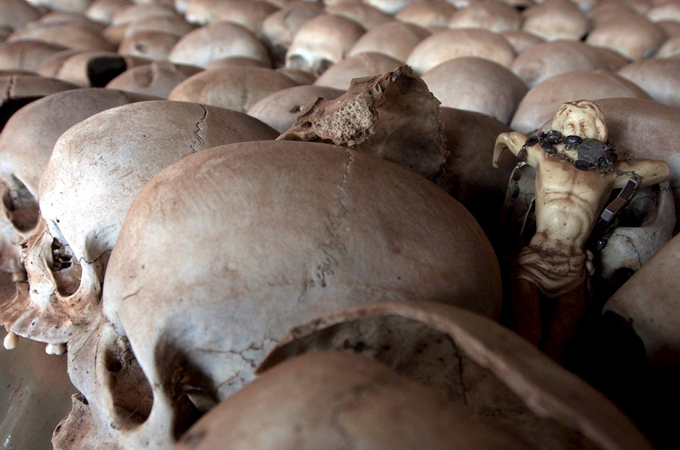
"Hutu extremists targeted Tutsis and moderate Hutus in attacks that left up to 800,000 people dead." (EPA)
Rwandan Politicians Jailed over Genocide
AlJazeera.com, December 21, 2011
"The United Nations war crimes tribunal for Rwanda has found two former ruling party officials guilty of genocide for their leading role in the 1994 massacre of 800,000 Tutsis and moderate Hutus, and sentenced them to life in prison. Mathieu Ngirumpatse and Edouard Karemera, who were president and vice-president of the ruling MRND party at the time of the genocide, had pleaded not guilty to the charges. 'The chamber unanimously condemns Ngirumpatse to life in jail,' said presiding Judge Dennis Byron, before pronouncing the same sentence for Karemera. Last week the tribunal reduced sentences for two former Rwandan military officials who were convicted of genocide. Colonel Theoneste Bagosora, who was a director in the defence ministry, had his life sentence reduced to 35 years while Anatole Nsengiyumva's life sentence was reduced to 15 years -- before he was released for the time served. The tribunal, based in neighbouring Tanzania's town of Arusha, was set up by the UN in 1995 to prosecute people responsible for genocide and other serious violations of international humanitarian law committed in Rwanda. It deals with crimes committed between January 1 1994 and December 31 1994, but the slaughter itself began on Apirl 7 1994. Rwanda set up its own courts -- known as gacaca, Kinyarwanda for grass -- where  many genocide suspects have been tried, but the courts have been criticised by international rights groups for failing to meet international standards. The genocide, which lasted 100 days, began after a plane carrying Juvenal Habyarimana, the Rwandan president at the time, was shot down as it approached Kanombe airport in the capital Kigali. Habyarimana and the president of neighbouring Burundi, Cyprien Ntaryamira, who was travelling on the same aircraft, were both killed along with the French pilots. A French judge blamed the attack on the Rwandan Patriotic Front, which was fighting the government, but the RPF, which now governs Rwanda, denied the charge."
[n.b. This is the complete text of the dispatch.]

Iran / France / Nazism / Jewish Holocaust

"Abdol-Hossein Sardari was a junior Iranian diplomat in 1940."
"Muslim Schindler" Who Risked Life to Save Iranian Jews in Wartime Paris
By Henry Samuel
The Telegraph, December 21, 2011
"A Muslim "Oskar Schindler" saved the lives of thousands of Iranian Jews in wartime Paris, risking all to help compatriots escape the Nazis, a new book claims. Abdol-Hossein Sardari, a junior Iranian diplomat, found himself almost by accident in charge of Iran's mission in Paris in 1940 and went on to help up to 2,000 Iranian Jews flee France, according to In the Lion's Shadow. But he only recently received posthumous recognition for his deeds. Like Oskar Schindler, the German industrialist who saved more than 1,000 Jews during the Holocaust by employing them in his factories, Mr. Sardari cut an unlikely saviour. A bon vivant who fell in love with a Chinese opera singer, the trained lawyer exploited the absurd rationale of Nazi racial purity laws at a time when Adolf Hitler declared the officially neutral Iran an Aryan nation and racially akin to the Germans. Iranian Jews in Paris were still persecuted and forced to wear infamous yellow patches on their clothes and have their documents stamped with their racial identity. But by cultivating his contacts with German and Vichy officials, Mr. Sardari somehow managed to win exemptions from Nazi race laws for at least 2,000 Iranian Jews by arguing that they did not have blood ties to European Jewry. He claimed that despite the fact that some Iranians had followed the teachings of the Prophet Moses for thousands of years, they had always been of Iranian stock and therefore were 'Mousaique' -- Moses followers, which he dubbed 'Djuguten' -- and not part of the Jewish race. The book includes archives of Nazi official correspondence seeking 'expert opinion' on his claims. The racial purity specialists said that deeper research was necessary on the Iranian sect, which the book suggests may have been Mr. Sardari's invention, to ascertain whether its followers were Jewish or not.

France / Turkey / Armenian Genocide

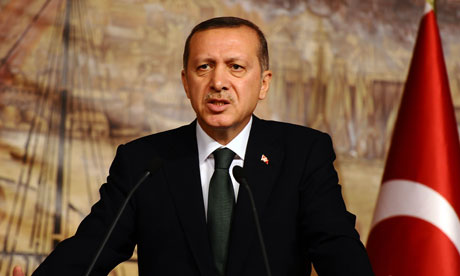
"Recep Tayyip Erdogan, the prime minister of Turkey, has hit out at French plans to prosecute people who deny the mass killings of Armenians was genocide." (Mustafa Ozer/AFP/Getty Images)
Turkey Threatens France over Stance on Killing of Armenians by Ottomans
Associated Press dispatch in The Guardian, December 19, 2011
"Turkey has threatened to denounce France's colonial past at international meetings in retaliation for French plans to prosecute people who deny that the mass killings of Armenians by Ottoman Turks was genocide. Turkey rejects the term genocide to describe the killings of Armenians more than 90 years ago. Historians estimate that up to 1.5 million Armenians were killed and experts say it was the first genocide of the 20th century. France considers the killings a genocide. The lower house of the French parliament is to debate a proposal that would punish anyone denying that the slaughter was genocide with one year in prison and a €45,000 (£37,700) fine. The issue threatens to further harm Turkish-French relations already tense over French president Nicolas Sarkozy's opposition to Turkey's bid to join the EU. Turkey has threatened to withdraw its ambassador to France if the bill is passed, while prime minister Recep Tayyip Erdogan has said the country should investigate alleged French abuses in Algeria and Rwanda instead. France had troops in Rwanda in 1994, and Rwandan president Paul Kagame has accused the country of doing little to stop the country's genocide. Turkey's foreign minister Ahmet Davutoglu said on Sunday that Ankara would bring up the issue of 'French colonialism' and 'start talking about truths everywhere in the world'. His words were carried by the state-run Anadolu agency. Meanwhile, France's foreign ministry said on Monday that foreign minister Alain Juppe would meet a delegation from Turkey's parliament on Tuesday to discuss the draft law. Volkan Bozkir, head of the foreign affairs committee, and opposition figure Osman Koruturk are leading the delegation that is lobbying French legislators against the bill. Turks have called for a boycott of French goods and companies in retaliation for the draft law. Turkish government officials say trade rules and a customs union agreement between Turkey and the EU forbid an official boycott of France -- an important economic partner. Turkey's economy minister said, however, that a joint Turkish-French economic co-operation meeting scheduled for January could be cancelled if the bill is passed. [...]"

Friday, December 09, 2011

Indonesia / The Netherlands / Colonialism

Netherlands Apologises for 1947 Rawagede Massacre in Indonesia
Associated Press dispatch in The Guardian, December 9, 2011
"The Netherlands has apologised after six decades for a notorious massacre of up to 430 men and boys during Indonesia's bitter struggle for independence. Tjeerd de Zwaan, the Dutch ambassador to Indonesia, made the announcement in front hundreds of villagers in Rawagede, the scene of the killings on 9 December 1947 of hundreds of boys and young men by Dutch troops. The military, which was clinging on to a retreating colonial empire, arrived in Rawagede before dawn and opened fire, sending residents scattering from their homes in panic. The soldiers were looking for resistance leader Lukas Kustario, known for ambushing Dutch bases. When villagers said they didn't know where he was, nearly all the men were rounded up and taken to the fields. Squatting in rows, with both hands placed on the backs of their heads, they were shot one by one. The apology was given in a ceremony at the Rawagede Hero cemetery, where many of the victims were buried in a mass grave. 'Today, December 9, we remember the members of your families and those of your fellow villagers who died 64 years ago through the actions of the Dutch military,' said De Zwaan. 'On behalf of the Dutch government I apologise for the tragedy that took place.' The apology followed a landmark ruling earlier this year by a Dutch court in a case filed by nine surviving relatives that said the state was to blame. The relatives' lawyer, Liesbeth Zegveld, said the Netherlands would pay each of the nine relatives €20,000 in compensation. After the apology, the crowd erupted in cheers. Tears rolled down the cheeks of surviving widows, now in their late 80s and early 90s, some of whom had started to doubt they would ever hear the words. 'It makes me feel my struggle for justice was not useless,' said Cawi Binti Baisa, who was 20 when her husband of two years headed to the rice paddy in the morning never to return."
[n.b. This is the complete text of the dispatch]