France Arrests Rwandan Over Congo Atrocities
By Marlise Simons
The New York Times, October 11, 2010
"French police on Monday arrested a Rwandan believed to be a leader of a movement involved in a recent terror campaign in the Kivu region of Congo in which thousands of civilians have been killed and raped. Armed with an arrest warrant from the International Criminal Court in The Hague, police detained the Rwandan, Callixte Mbarushimana, 47, shortly after dawn at his home in Paris, a court official said. He is wanted on charges of war crimes and crimes against humanity, according to a statement from the court. The Rwandan's activities had been tracked for more than 18 months in several countries including France, Germany, the Congo and Rwanda, the court official said. Mr. Mbarushimana, who has the status of political refugee and has lived in France for several years, was to appear later Monday before a local judge, who must decide on his transfer to the international court in The Hague. The process could take several days, because the decision can be appealed. The prosecutor's office in The Hague in a statement said that Mr. Mbarushima was one of the top leaders of the Rwandan rebel group FDLR, that from its base in the Congo was fighting to gain power in Rwanda and was using massive crimes against civilians to demonstrate its power.
Monday, October 11, 2010


Saturday, October 09, 2010
Israel / Turkey / International Criminal Court
By Afua Hirsch
The Guardian, October 8, 2010
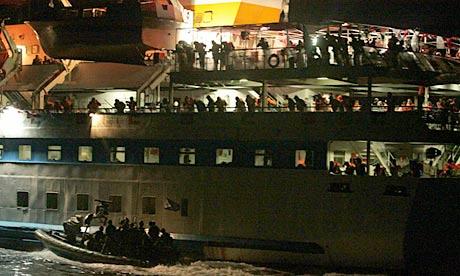
Photo: "Israeli navy commandos intercept the Mavi Marmara on its way to Gaza in May." (Kate Geraghty/Sydney Morning Herald/Getty Images)
"The international criminal court is being urged to prosecute members of the Israeli defence force for the raid on a Gaza-bound aid ship. Turkish victims have formally requested an investigation, the Guardian has learned. Lawyers acting for Turkish citizens injured or killed when Israel intercepted the flotilla in May have written to Luis Moreno Ocampo, the court's prosecutor, claiming there is an 'overwhelming' case for prosecution. The request is a significant step towards a criminal investigation by the court, which experts say has jurisdiction to prosecute those involved in the raid despite Israel not recognising its jurisdiction. 'The attack on the flotilla occurred in international waters, which directly violated many parts of international law as well as international public and criminal law,' said Ramazan Ariturk, a partner at Elmadag Law Office, the Turkish legal body that is representing the Turkish victims and the human rights group IHH. 'The crimes committed by Israeli Defence Forces should be prosecuted and the International Criminal Court is the sole authority which is able to do that.' There is mounting pressure on Israel after a UN report into the incident, in which nine Turkish activists were killed, accused Israel of violating international law. The report, published last month, said Israel 'betrayed an unacceptable level of brutality' during the raid on the flotilla and it 'constituted grave violations of human rights law and international humanitarian law.' Israel condemned the report as 'biased and distorted.' It has created its own state-appointed inquiry, headed by retired supreme court justice Jacob Turkel. [...]"
Sudan / United Nations
UN Delegation Presses Sudan to Allow a Referendum and Avert a New Civil War
By Mark Landler
The New York Times, October 8, 2010
"After languishing as what many experts worried was the world’s most neglected foreign-policy problem, Sudan is now in the spotlight: a high-level delegation from the United Nations Security Council arrived in the capital, Khartoum, on Friday, to press the government not to disrupt a coming referendum that is considered likely to result in partition. The diplomats, including the American ambassador to the United Nations, Susan E. Rice, had earlier toured southern Sudan to monitor preparations for the voting, which many analysts fear could reignite a north-south civil war if it is mishandled. The visit comes two weeks after President Obama publicly warned the Sudanese at the United Nations to allow a credible vote. Voters in the south will be asked whether they want their region to become independent, and it is widely expected that the answer will be yes. There are growing fears that the referendum will not be held on time because of delays in registering voters. Beyond that, some fear that the government of President Omar Hassan al-Bashir, which depends on the oil-rich south for revenues, will try to rig the vote or cancel it. 'There's tension, there's anticipation, there's anxiety and there's fear that this moment will be stolen from them,' Ambassador Rice said Friday from Khartoum. While she said the referendum's official managers assured her that it would proceed on Jan. 9, as scheduled, she added, 'It's going to be very tight.'
By Mark Landler
The New York Times, October 8, 2010
"After languishing as what many experts worried was the world’s most neglected foreign-policy problem, Sudan is now in the spotlight: a high-level delegation from the United Nations Security Council arrived in the capital, Khartoum, on Friday, to press the government not to disrupt a coming referendum that is considered likely to result in partition. The diplomats, including the American ambassador to the United Nations, Susan E. Rice, had earlier toured southern Sudan to monitor preparations for the voting, which many analysts fear could reignite a north-south civil war if it is mishandled. The visit comes two weeks after President Obama publicly warned the Sudanese at the United Nations to allow a credible vote. Voters in the south will be asked whether they want their region to become independent, and it is widely expected that the answer will be yes. There are growing fears that the referendum will not be held on time because of delays in registering voters. Beyond that, some fear that the government of President Omar Hassan al-Bashir, which depends on the oil-rich south for revenues, will try to rig the vote or cancel it. 'There's tension, there's anticipation, there's anxiety and there's fear that this moment will be stolen from them,' Ambassador Rice said Friday from Khartoum. While she said the referendum's official managers assured her that it would proceed on Jan. 9, as scheduled, she added, 'It's going to be very tight.'
Thursday, October 07, 2010
Misrepresenting a famine image
A correspondent has posted to my blog and elsewhere convincing evidence that Bloomsbury, publisher of Frank Dikötter's 2010 book Mao's Great Famine: The History of China's Most Devastating Catastrophe, has misrepresented the cover photo of an orphan begging during a 1946 famine in Nationalist China as an image from the mass famine of the Great Leap Forward period under Mao Zedong's Communist Party (1958-62).
The cover of Dikötter's book:

Here's a scan I made of a close-up of the apparent victim of "Mao's great famine":

And finally, the 1946 photo from LIFE (Mao's Communists did not seize national power until 1949):

(Link to the version of the image as posted on the LIFE site, captioned: "May 1946: Starving child holding out an empty rice bowl during famine.")
I think Wayne is deeply naive about the nature of Mao's rule and the devastation of the Great Leap Forward period. I discuss the famine and its terrible toll in my revised Chapter 5, "Stalin and Mao," for the second edition of my textbook, Genocide: A Comprehensive Introduction. But this is clearly a serious error that the author and publisher need to address promptly.
Beyond the misrepresentation, may I also suggest that the very extensive airbrushing, replacement/grafting of background, colourization and so on of the original image is curiously reminiscent of communist practice under Mao and Stalin?
I have not yet read Dikötter's book, but it is at the top of my list.
The cover of Dikötter's book:

Here's a scan I made of a close-up of the apparent victim of "Mao's great famine":

And finally, the 1946 photo from LIFE (Mao's Communists did not seize national power until 1949):

(Link to the version of the image as posted on the LIFE site, captioned: "May 1946: Starving child holding out an empty rice bowl during famine.")
I think Wayne is deeply naive about the nature of Mao's rule and the devastation of the Great Leap Forward period. I discuss the famine and its terrible toll in my revised Chapter 5, "Stalin and Mao," for the second edition of my textbook, Genocide: A Comprehensive Introduction. But this is clearly a serious error that the author and publisher need to address promptly.
Beyond the misrepresentation, may I also suggest that the very extensive airbrushing, replacement/grafting of background, colourization and so on of the original image is curiously reminiscent of communist practice under Mao and Stalin?
I have not yet read Dikötter's book, but it is at the top of my list.
Wednesday, October 06, 2010
Rwanda / Democratic Republic of the Congo
It's Time to Hold Rwanda Accountable For Its War Crimes
By Mvemba Phezo Dizolele
The New Republic, October 5, 2010
"The Senegalese poet Birago Diop once wrote that the dead are not really dead. They live on in the wind, forests, and rivers, their pleas for justice echoing among the living. So it is today in the Democratic Republic of Congo, where more than five million people have been killed in the world’s deadliest conflict since World War II. But the calls for justice by the dead and the living have been repeatedly muted in several classified or sanitized United Nations reports, all to protect a handful of powerful—and likely guilty—parties in the supposed interest of peace and stability. Today, the international community finds itself at a crossroads concerning Congo. In late August, a draft report by the UN High Commission for Human Rights was leaked to the French newspaper Le Monde. It documented more than 600 incidents of gross human rights violations by Congo’s warring factions and their allies in Rwanda, Uganda, Angola, Zimbabwe, and Burundi. Amid the more serious allegations, the report accuses Rwandan Tutsi soldiers and their allies in Laurent-Désiré Kabila’s rebel alliance of committing war crimes, crimes against humanity, and alleged acts of genocide against tens of thousands of Hutus in Congo. Some of the victims were génocidaires from Rwanda, but others, including women and children, were not.
By Mvemba Phezo Dizolele
The New Republic, October 5, 2010
"The Senegalese poet Birago Diop once wrote that the dead are not really dead. They live on in the wind, forests, and rivers, their pleas for justice echoing among the living. So it is today in the Democratic Republic of Congo, where more than five million people have been killed in the world’s deadliest conflict since World War II. But the calls for justice by the dead and the living have been repeatedly muted in several classified or sanitized United Nations reports, all to protect a handful of powerful—and likely guilty—parties in the supposed interest of peace and stability. Today, the international community finds itself at a crossroads concerning Congo. In late August, a draft report by the UN High Commission for Human Rights was leaked to the French newspaper Le Monde. It documented more than 600 incidents of gross human rights violations by Congo’s warring factions and their allies in Rwanda, Uganda, Angola, Zimbabwe, and Burundi. Amid the more serious allegations, the report accuses Rwandan Tutsi soldiers and their allies in Laurent-Désiré Kabila’s rebel alliance of committing war crimes, crimes against humanity, and alleged acts of genocide against tens of thousands of Hutus in Congo. Some of the victims were génocidaires from Rwanda, but others, including women and children, were not.
Sudan

By Maggie Fick
The Huffington Post, October 6, 2010
Photo: Associated Press
"American actor George Clooney is visiting the little known region of Southern Sudan. The UN Security Council arrived to a raucous welcome on Wednesday, and the United States Holocaust Memorial Museum also made a recent trip here. The high-level visits are putting the spotlight on the Texas-sized area of Sudan that is far less known to Americans than the western region of Darfur, where mass atrocities have been committed over the last decade. Southern Sudan is three months from a Jan. 9 independence vote that could see Africa's largest country break in two. The vote -- and the potential of a new north-south war because of it -- are the reason behind the rash of visits. 'If you knew a tsunami, or Katrina or a Haiti earthquake was coming, what would you do to save people?' Clooney said, according to a blog post by Ann Curry, a reporter for NBC who is accompanying Clooney. Clooney spent the past week traveling to remote, conflict-prone areas of Sudan's south with John Prendergast, the founder of the Enough Project, an anti-genocide advocacy group. One photo posted by Curry showed Clooney pointing over a field that Curry wrote was the site of a mass grave from 2008. That was in Abyei, a town that was largely burned to the ground after southern and northern armies clashed there, prompting an estimated 60,000 people to flee. The UN reported at the time that at least 140 people died. Clooney, who declined a request for comment, also visited the town of Malakal, where elements of Sudan's northern and southern armies have clashed twice since the end of the 21-year north-south civil war in 2005.
Congo / Sexual Violence against Women

The Telegraph, October 6, 2010
Photo: "Zaina Niangoma who was raped along with her 15-year-old daughter (not pictured) by three members of the Hutu rebels of the Democratic Forces for the Liberation of Rwanda." (AFP/Getty Images)
"UN and Congolese forces have arrested a rebel commander allegedly responsible for mass rapes in eastern Congo. The UN has been criticised for failing to stop the attacks after it took days for help to arrive, even though the villages are 12 miles from a camp of UN peacekeepers from India. The UN said a peacekeeping patrol drove through one of the villages while it was being held by the fighters, but said peacekeepers took no action because no one told them what was going on. Rape has been increasingly used by various groups of fighters in eastern Congo to intimidate, punish and control the population, especially in the mining areas. Dr. Chris Baguma, of the Los Angeles-based International Medical Corps, said that he had seen many, many rape victims in the area 'but I have never seen anything so planned, so systematic, so animalistic.'
Monday, October 04, 2010
Congo / Sexual Violence against Women

By Jeffrey Gettleman
The New York Times, October 3, 2010
Photo: "United Nations peacekeepers protecting civilians by escorting them home from a market in the Democratic Republic of Congo." (Michael Kamber/The New York Times)
"Four armed men barged into Anna Mburano's hut, slapped the children and threw them down. They flipped Mrs. Mburano on her back, she said, and raped her, repeatedly. It did not matter that dozens of United Nations peacekeepers were based just up the road. Or that Mrs. Mburano is around 80 years old. 'Grandsons!' she yelled. 'Get off me!' As soon as they finished, they moved house to house, along with hundreds of other marauding rebels, gang-raping at least 200 women. What happened in this remote, thatched-roof village on July 30 and continued for at least three more days has become a searing embarrassment for the United Nations mission in Congo. Despite more than 10 years of experience and billions of dollars, the peacekeeping force still seems to be failing at its most elemental task: protecting civilians. The United Nations' blue-helmets are considered the last line of defense in eastern Congo, given that the nation's own army has a long history of abuses, that the police are often invisible or drunk and that the hills are teeming with rebels. But many critics contend that nowhere else in the world has the United Nations invested so much and accomplished so little.
Sunday, October 03, 2010
Roma/Gypsies / European Union

By Peter Popham
The Independent, October 4, 2010
Photo: "An elderly woman in a camp on the outskirts of Rome." (Agence France-Presse)
"[...] Gypsies have been emigrating to Italy from the Balkans since the 15th century. Today, the Romany population of Italy is thought to be around 180,000, perhaps twice that of Britain. Most of them have been sedentary for centuries. As elsewhere, what has kept them distinct from the majority population is their language, culture and folkways. What has changed over the past 20 years is the arrival in the West of relatively large numbers of Romany immigrants from eastern Europe: from Croatia, Bosnia and Kosovo, fleeing the wars that accompanied the break-up of Yugoslavia in the early Nineties; and from Romania following the death of Ceausescu, the fall of the Communist regime, and the opening of the borders around the same time. The single most critical moment was the entry of Romania into the EU on 1 January 2007, which enabled Romanian citizens to move around the EU at will. Hundreds of thousands of migrants poured into Italy as a result, more than into any other country. The panicky realisation that they could not easily be removed led to a mood of crisis. A small but very visible fraction of them -- no one knows how many -- were Romanies. As in Italy, the Romany populations of Romania and Yugoslavia had been settled for hundreds of years. ... But while Italy's Romanies remained socially marginal and relatively deprived, Tito and Communism had given those in Yugoslavia the opportunity to improve their lives. ... Today, Romanies in Serbia have TV and radio news programmes and newspapers in their own language, and are represented by Romany politicians. In Romania, too, most of the community led settled lives for centuries, though their conditions of life were much worse than in Yugoslavia: Romania's gypsies were slaves until the mid-19th century; most are still very poor, and they still suffer from the prejudices of the majority community. This, as well as the arrival of mass unemployment, explains why many chose to go west. Reaching Italy, they found the affluent land they had heard about -- but became victims of their new country's prejudices. Eighty-four per cent of Italians still believe gypsies to be nomads, and it was as such that they were treated.France / Jewish Holocaust
By Lizzy Davies
The Guardian, October 3, 2010
Photo: Time-Life Pictures/Getty Images
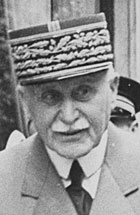
"The direct role played by France's collaborationist leader in the second world war persecution of the Jews was emphasised today after the draft of a decisive memo, annotated by Philippe Pétain, was made public for the first time. A hitherto unseen copy of the original statute on Jews, vehemently antisemitic legislation passed in October 1940 after defeat by the Nazis, reveals that Pétain 'completely redrafted' the memo to make it even harsher and wider-ranging, according to France's foremost Jewish historian. 'The statute on Jews was a statute that was adopted without pressure from the Germans, without the request of the Germans: an indigenous statute,' Serge Klarsfeld, a veteran lawyer, told French radio. 'And now we have decisive evidence that it was the desire of Marshal Pétain himself.' Handed by an anonymous donor to the Holocaust memorial in Paris and authenticated by experts, the papers show for the first time how Pétain, the reactionary head of Vichy, wrote his personal antisemitism into the politics of the new-born French state. Led by the Vichy government, that state would go on to aid the deportation of 77,000 Jews to concentration camps until liberation in 1944.
Thursday, September 30, 2010
United Nations / Rwanda / Democratic Republic of the Congo
UN Tones Down Congo "Genocide" Report
By Frank Jordans
Associated Press dispatch on Time.com, September 30, 2010
"The United Nations has toned down a report detailing hundreds of gruesome attacks against civilians in Congo over a 10-year period but left intact the suggestion that Rwanda's army may have committed genocide there in the 1990s. Rwanda and its northern neighbor Uganda had protested a leaked draft of the report last month, threatening to pull their soldiers from UN peacekeeping missions unless changes were made to the published version. The final report, obtained Thursday by The Associated Press, shows that the UN Office of the High Commissioner for Human Rights rewrote sensitive sections of the 545-page document to couch them in less inflammatory language. For instance, an earlier reference to 'damning elements' that could be used by a court to conclude that genocide took place has been changed to 'inculpatory elements.' Another section elaborates at length -- compared with the earlier draft -- on a number of 'countervailing factors' that could be used to argue that such a crime didn't take place. A draft section that dismissed mitigating arguments was dropped entirely.
By Frank Jordans
Associated Press dispatch on Time.com, September 30, 2010
"The United Nations has toned down a report detailing hundreds of gruesome attacks against civilians in Congo over a 10-year period but left intact the suggestion that Rwanda's army may have committed genocide there in the 1990s. Rwanda and its northern neighbor Uganda had protested a leaked draft of the report last month, threatening to pull their soldiers from UN peacekeeping missions unless changes were made to the published version. The final report, obtained Thursday by The Associated Press, shows that the UN Office of the High Commissioner for Human Rights rewrote sensitive sections of the 545-page document to couch them in less inflammatory language. For instance, an earlier reference to 'damning elements' that could be used by a court to conclude that genocide took place has been changed to 'inculpatory elements.' Another section elaborates at length -- compared with the earlier draft -- on a number of 'countervailing factors' that could be used to argue that such a crime didn't take place. A draft section that dismissed mitigating arguments was dropped entirely.
Sudan / United Kingdom
By Daniel Howden
The Independent, October 1, 2010
Photo: Reuters
"The Government is courting the regime of the indicted war criminal Omar al-Bashir by declaring that relations with Sudan have entered a 'new epoch.' The announcement came as Britain welcomed a trade delegation from the country which has near pariah status, for the first time since warrants for President Bashir's arrest were issued by the International Criminal Court (ICC) in The Hague, over atrocities in Darfur. Khartoum's high-level delegation met British government officials and business leaders on Wednesday to encourage investment in a country still targeted by US sanctions. It was the clearest example yet of how problematic William Hague's new foreign policy, in which commercial interests are to trump ethical concerns, will be for the Coalition to implement. The change has already seen complaints that UK diplomatic missions have been reduced to commercial agencies to drum up business. The 'Opportunities in Sudan' networking event on Wednesday brought a delegation including senior members of Mr Bashir's NCP party together with British counterparts including the UK ambassador to Sudan, Nicholas Kay. It comes after a visit by Henry Bellingham, the new minister for Africa, to Khartoum in July to boost trade and business ties. He told reporters there that Britain would be a 'candid friend' to the regime in Sudan."
[n.b. This is the complete text of the dispatch.]
Rwanda / United Nations
Dispute Over UN Report Evokes Rwandan Déjà Vu
By Howard W. French and Jeffrey Gettleman
The New York Times, September 30, 2010
"When drafts of a United Nations study recently surfaced accusing Rwandan forces of committing atrocities against Hutu refugees in Congo in the 1990s -- crimes that could constitute acts of genocide -- the Rwandan government protested vociferously. It even threatened to withdraw its peacekeepers from Sudan and elsewhere if the report was published. The dispute immediately raised some pointed questions. Would the United Nations stand its ground, or would it suppress or alter a report about the past for the sake of the present? But often lost in the debate was a salient déjà vu: The two sides had been in a similar standoff years before. In the fall of 1994, just after nearly a million people had been killed in the Rwandan genocide, a team of United Nations investigators concluded that the Rwandan rebels who finally stopped the genocide had killed tens of thousands of people themselves. But after strong pressure from both Rwanda and Washington and intense debate within the United Nations, the report was never published.
By Howard W. French and Jeffrey Gettleman
The New York Times, September 30, 2010
"When drafts of a United Nations study recently surfaced accusing Rwandan forces of committing atrocities against Hutu refugees in Congo in the 1990s -- crimes that could constitute acts of genocide -- the Rwandan government protested vociferously. It even threatened to withdraw its peacekeepers from Sudan and elsewhere if the report was published. The dispute immediately raised some pointed questions. Would the United Nations stand its ground, or would it suppress or alter a report about the past for the sake of the present? But often lost in the debate was a salient déjà vu: The two sides had been in a similar standoff years before. In the fall of 1994, just after nearly a million people had been killed in the Rwandan genocide, a team of United Nations investigators concluded that the Rwandan rebels who finally stopped the genocide had killed tens of thousands of people themselves. But after strong pressure from both Rwanda and Washington and intense debate within the United Nations, the report was never published.
Wednesday, September 29, 2010
Nuremberg Tribunal / Genocide Tribunals

By A. O. Scott
The New York Times, September 28, 2010
Photo: "Justice Robert H. Jackson of the Supreme Court, the chief United States prosecutor at the Nuremberg war crimes trials." (cShulberg Productions)
"[...] The United States government never released [Budd Schulberg's] documentary (though it did later adapt some of his materials into a film called 'Nuremberg: Its Lessons for Today'), and the negative and soundtrack were lost or destroyed. Sandra Schulberg, the filmmaker's daughter, and Josh Waletzky have now turned the surviving materials into something haunting and vivid -- a version of the original that is also, implicitly, a record of its partial vanishing. This 'Nuremberg' does not exactly reveal anything new. Later trials of lesser officials inspired Stanley Kramer’s 'Judgment at Nuremberg' (1961), a good, long feature with an all-star cast and a sober respect for history. And the Holocaust has been the subject of countless films of all kinds, especially in recent years, as the first-hand memory of survivors has begun to fade, and the children and grandchildren of both victims and perpetrators take up the burden of interpreting painful history. The shocking revelations that appear in Schulberg's film are now well known. But there is a raw immediacy in 'Nuremberg' that nearly closes the gap between past and present. You don’t necessarily see images of slaughter and cruelty for the first time, but you grasp some of what it must have been like to do so -- to uncover clips showing what most human beings up until then could never have imagined. You also appreciate the systematic, scrupulous nature of the trials themselves, which combined legalistic punctiliousness with deep moral passion.
Soviet Union / Stalinism
What Is Genocide And Why Does Stalin Get A Free Pass?
Science20.com, September 26, 2010
"Hitler gets a bad rap universally for his genocide but a startling subset of progressives in America view Joseph Stalin favorably despite his killing more people. Time magazine put Stalin on its cover 11 times. Then Rwanda, Cambodia and Darfur were essentially ignored while Bosnia was labeled genocide and became a war crime issue despite only a few thousand actual deaths known. Nations have tugs of war over the official definition of the word 'genocide' itself -- which mentions only national, ethnic, racial and religious groups. The definition can determine international relations, foreign aid and national morale. Look at the annual international tussle over whether the 1915 Turkish massacre and deportation of the Armenians counts as 'genocide.' Stanford history Professor Norman Naimark, author of the book Stalin's Genocides, argues that we need a much broader definition of genocide, one that includes nations killing social classes and political groups. His case in point: Stalin.
Science20.com, September 26, 2010
"Hitler gets a bad rap universally for his genocide but a startling subset of progressives in America view Joseph Stalin favorably despite his killing more people. Time magazine put Stalin on its cover 11 times. Then Rwanda, Cambodia and Darfur were essentially ignored while Bosnia was labeled genocide and became a war crime issue despite only a few thousand actual deaths known. Nations have tugs of war over the official definition of the word 'genocide' itself -- which mentions only national, ethnic, racial and religious groups. The definition can determine international relations, foreign aid and national morale. Look at the annual international tussle over whether the 1915 Turkish massacre and deportation of the Armenians counts as 'genocide.' Stanford history Professor Norman Naimark, author of the book Stalin's Genocides, argues that we need a much broader definition of genocide, one that includes nations killing social classes and political groups. His case in point: Stalin.
Friday, September 24, 2010
Rwanda / Democratic Republic of the Congo
UN Report on Rwanda Genocide Threatens Stability in Central Africa
By Harry Verhoeven
The Christian Science Monitor, September 23, 2010
"Until recently, President Paul Kagame and his Rwandan Patriotic Front (RPF) were the international community's aid darling, heralded for their role in stopping the 1994 genocide that claimed the lives of as many as one million Rwandans. They now stand accused of a long list of crimes. A recently-leaked UN report accuses the RPF of atrocities 'that could be classified as genocide' in the Democratic Republic of Congo (DRC) in 1996-1997 -- mass murdering tens of thousands of Hutu refugees. The regime's legitimacy and its leaders' individual criminal responsibility are now being contested. But how wise is it to swap one set of dangerous simplifications for another? Is Rwanda the model of progress and reconciliation, or is Kagame's RPF the genocidal eye of Central African storms? And what does this tell us about international intervention in a region with an immensely troubled past?
By Harry Verhoeven
The Christian Science Monitor, September 23, 2010
"Until recently, President Paul Kagame and his Rwandan Patriotic Front (RPF) were the international community's aid darling, heralded for their role in stopping the 1994 genocide that claimed the lives of as many as one million Rwandans. They now stand accused of a long list of crimes. A recently-leaked UN report accuses the RPF of atrocities 'that could be classified as genocide' in the Democratic Republic of Congo (DRC) in 1996-1997 -- mass murdering tens of thousands of Hutu refugees. The regime's legitimacy and its leaders' individual criminal responsibility are now being contested. But how wise is it to swap one set of dangerous simplifications for another? Is Rwanda the model of progress and reconciliation, or is Kagame's RPF the genocidal eye of Central African storms? And what does this tell us about international intervention in a region with an immensely troubled past?
Tuesday, September 21, 2010
Poland / Jewish Holocaust / Genocide Denial

By Matthew Day
The Telegraph, September 21, 2010
Photo: Reuters
"The controversial British historian David Irving was met with outrage in Poland yesterday as he claimed the country should be “grateful” that he was running a £1,500 a head 'unforgettable' tour of Holocaust sites, including the Treblinka death camp. Mr. Irving said he would 'set the record straight' on the Nazis' extermination of six million Jews, despite the fact that an Austrian court sentenced him in 2006 to three years in jail for his 1989 claims that there were no gas chambers in the Third Reich. He was released and deported to Britain after serving only one year and told the court that his claims had been a mistake.Holocaust survivors and anti-racism groups called on Polish authorities to block his nine-day visit. Mr. Irving told The Daily Telegraph: 'I am baffled by the reaction I've had in Poland because they should be very grateful that I am here. Here I am lecturing to the revisionists and setting the record straight. I am saying to those who believe that not a hair was harmed on the head of the Jewish community that you couldn't be more wrong.' He described people who branded him a Holocaust denier as 'criminal, lying lunatics.'
Jewish Holocaust / Primo Levi
Primo Levi's Auschwitz Survivor "Pikolo" Dies
By Jonathan Brown
The Independent, September 22, 2010
"For decades Jean Samuel chose never to discuss his wartime experiences as an Auschwitz survivor. Living quietly as a local pharmacist, a post he inherited from his father in a small Alsace town, not even his own family could guess that he was Pikolo, the diminutive and quietly spoken beacon of humanity who inspired his friend and fellow concentration camp inmate Primo Levi to immortalise him in his definitive Holocaust memoir If This is a Man. It was not until much later in life that the French Jew chose to break cover and bear witness to the horrors he had seen at Auschwitz in 1944 and on a death march to Buchenwald after a resurgence of anti-Semitism in his native country in the 1980s. Yesterday it was confirmed that Mr. Samuel had died aged 89 in Strasbourg.
By Jonathan Brown
The Independent, September 22, 2010
"For decades Jean Samuel chose never to discuss his wartime experiences as an Auschwitz survivor. Living quietly as a local pharmacist, a post he inherited from his father in a small Alsace town, not even his own family could guess that he was Pikolo, the diminutive and quietly spoken beacon of humanity who inspired his friend and fellow concentration camp inmate Primo Levi to immortalise him in his definitive Holocaust memoir If This is a Man. It was not until much later in life that the French Jew chose to break cover and bear witness to the horrors he had seen at Auschwitz in 1944 and on a death march to Buchenwald after a resurgence of anti-Semitism in his native country in the 1980s. Yesterday it was confirmed that Mr. Samuel had died aged 89 in Strasbourg.
Monday, September 20, 2010
China / Maoism / Great Leap Forward
Mao's Great Famine: The History of China's Most Devastating Catastrophe (1958-62) (book review)
By John Gray
New Statesman, September 20, 2010
"When François Mitterrand visited China in 1961, Mao Zedong mocked reports of famine in the country. There was no famine, he said, only 'a period of scarcity,' an assertion that Mitterand -- who described Mao as 'a great scholar known in the entire world for the diversity of his genius' -- was happy to accept. Returning to France after his three-week tour, Mitterrand had no doubts about his account of events: 'I repeat in order to be clearly understood -- there is no famine in China.' Western politicians of the right shared the French Socialist leader's view. After touring China in late 1960, the Conservative MP for Chester, John Temple, reported that communism was working and that the country was making 'great progress.' At the time these western dignitaries were making their escorted tours through China, it was in the grip of the largest famine in history, a man-made catastrophe in which at least 45 million people were starved, beaten, tortured or worked to death. Though Mao's Great Leap Forward was celebrated in the west as a major advance, the reality was captured by the name villagers gave to the vast irrigation schemes on which they were forced to labour -- they called them 'the killing fields.' At least 2.5 million of the famine's victims died violently. Assaults against women were pervasive, including rape by party cadres and beatings for women who miscarried while being forced to work during the last stage of pregnancy. In some collectives, people were divided into groups and food distributed according to capacity for work -- a type of 'performance feeding' similar to that practised in the Nazi labour camps, with similar results (the old and infirm soon perished). In order to punish their families, those who died of beatings in rural communes might be left unburied; in some cases, their bodies were rendered into compost.
By John Gray
New Statesman, September 20, 2010
"When François Mitterrand visited China in 1961, Mao Zedong mocked reports of famine in the country. There was no famine, he said, only 'a period of scarcity,' an assertion that Mitterand -- who described Mao as 'a great scholar known in the entire world for the diversity of his genius' -- was happy to accept. Returning to France after his three-week tour, Mitterrand had no doubts about his account of events: 'I repeat in order to be clearly understood -- there is no famine in China.' Western politicians of the right shared the French Socialist leader's view. After touring China in late 1960, the Conservative MP for Chester, John Temple, reported that communism was working and that the country was making 'great progress.' At the time these western dignitaries were making their escorted tours through China, it was in the grip of the largest famine in history, a man-made catastrophe in which at least 45 million people were starved, beaten, tortured or worked to death. Though Mao's Great Leap Forward was celebrated in the west as a major advance, the reality was captured by the name villagers gave to the vast irrigation schemes on which they were forced to labour -- they called them 'the killing fields.' At least 2.5 million of the famine's victims died violently. Assaults against women were pervasive, including rape by party cadres and beatings for women who miscarried while being forced to work during the last stage of pregnancy. In some collectives, people were divided into groups and food distributed according to capacity for work -- a type of 'performance feeding' similar to that practised in the Nazi labour camps, with similar results (the old and infirm soon perished). In order to punish their families, those who died of beatings in rural communes might be left unburied; in some cases, their bodies were rendered into compost.
Sunday, September 19, 2010
Afghanistan / United States
US Military in Afghanistan Uncovers Sadistic Death Squad in Ranks
By Ben Farmer
The Telegraph, September 19, 2010
"A group of American soldiers are facing murder charges for a five-month killing spree in which they randomly targeted Afghan civilians for sport, a US military investigation has reported. In at least one attack, a soldier threw a grenade to pretend they were being ambushed as a pretext to then shoot dead an innocent villager. The soldiers also dismembered and photographed bodies and kept bones and skulls as trophies in some of the most grisly accusations against US troops since the invasion in 2001. All were reported to deny wrongdoing and military investigators will hold a pre-trial hearing at their home base in Washington later this year. American commanders fear details of the incidents could cause widespread anger in Afghanistan, where civilian deaths have fostered deep resentment against coalition forces. Five soldiers are accused of forming a 'kill team' and murdering three people in Kandahar province between January and May this year.
By Ben Farmer
The Telegraph, September 19, 2010
"A group of American soldiers are facing murder charges for a five-month killing spree in which they randomly targeted Afghan civilians for sport, a US military investigation has reported. In at least one attack, a soldier threw a grenade to pretend they were being ambushed as a pretext to then shoot dead an innocent villager. The soldiers also dismembered and photographed bodies and kept bones and skulls as trophies in some of the most grisly accusations against US troops since the invasion in 2001. All were reported to deny wrongdoing and military investigators will hold a pre-trial hearing at their home base in Washington later this year. American commanders fear details of the incidents could cause widespread anger in Afghanistan, where civilian deaths have fostered deep resentment against coalition forces. Five soldiers are accused of forming a 'kill team' and murdering three people in Kandahar province between January and May this year.
Subscribe to:
Posts (Atom)

 Posts
Posts


