Wednesday, December 08, 2010

France / Chile

"Relatives of victims of the Chilean dictatorship gather and show pictures of their familly members as the trial opens at the French Criminal Court in Paris." (EPA)
Augusto Pinochet's Officers on Trial over Missing French Citizens
By Henry Samuel
The Telegraph, December 8, 2010
"Fourteen officials from Augusto Pinochet's dictatorship went on trial in absentia in Paris on Wednesday over the disappearance of four French citizens in the mid-1970s. The Frenchmen were among more than 3,000 leftists murdered for political reasons during the 'Dirty War' during the 1973-1990 rule of Gen Pinochet. Many 'vanished,' likely kidnapped and killed, then buried in unmarked graves, leaving relatives unable to properly mourn their dead. None of the accused was in the courtroom. But the families of the four men were present, some clutching black and white photos of the disappeared, as the judge read out charges of kidnapping, arbitrary detention, torture and barbarous acts. Among the 14, most of them military officers, was Manuel Contreras, the former head of the feared Dina secret police in the Pinochet regime. Contreras is believed to have been instrumental in many of the political murders and disappearances in the dictatorship's 'Dirty War' against the Left. He is currently serving life in a Chilean jail for assassinating the defence chief of Salvador Allende, Chile's leftist president who was ousted by Gen Pinochet in a violent US-backed coup in 1973. The disappeared French are George Klein, who was a former adviser to Allende, a priest and two members of the Revolutionary Left Movement, MIR. Gen. Pinochet was also implicated in the disappearance of the four Frenchmen but died in 2006 without ever facing trial or apologising. William Bourdon, a lawyer for the families, said the trial, which is being filmed due to its historic importance, 'will allow a precise, global, almost exhaustive judicial snapshot of the apparatus of repression put in place by General Augusto Pinochet.' [...]"

Sunday, December 05, 2010

Israel

"The Arab lads of Lod don’t want their houses demolished." (AFP)
Israel and Its Arabs: Pulled Apart
The Economist, October 14, 2010 [only just seen]
"[...] Cabinet members have proposed 'strengthening' [Lod's] population by bringing in more Jews and have approved a wider bill requiring new citizens to swear a loyalty oath accepting Israel as Jewish and democratic -- in that order. Other measures are aimed at Israel's Arabs, including a ban on teaching the Palestinian narrative that Israel expelled most of its Arabs in the war of independence. ... Adding to the psychological barriers, the Lod authorities have erected physical ones. This year they have finished building a wall three metres high to separate Lod's Jewish districts from its Arab ones. And where the Arab suburbs are cordoned off to prevent their spread, Israel's prime minister, Binyamin Netanyahu, encourages building for Jews to proceed with abandon. His foreign minister, Avigdor Lieberman, on the coalition's far right, champions building quarters for soldiers' families in the town. The equally chauvinistic interior minister, Eli Yishai, who heads an ultra-Orthodox party, Shas, grants building permits for religious Jews. A series of gated estates are sprouting across the city reserved for religious Zionists. ... By contrast, old Arab houses are under threat of demolition. Now and again, bulldozers demolish a couple, stressing Arab vulnerability. ... Many municipal services, such as street lighting and rubbish collection, stop at the boundaries of Arab suburbs. Sixteen kilometres (ten miles) from Tel Aviv, Israel's richest city, sewage flows through some of Lod's Arab streets. Once mixed districts are separating. ... The local community centre has been shut for the best part of a decade, says its last employee: the Jewish Agency, a welfare organisation, does not want it 'overrun with Arabs.' ... Lod's 120-strong police is Muslim-free."
[n.b. Choose your parallel. Blacks in apartheid-era South Africa? Jews in Nazi Germany?]

Thursday, December 02, 2010

Sweden / Jewish Holocaust

"The queen's attempts earlier this year to play down the Nazi past of her father have led to fierce criticism of her in the media now, both in Germany and Sweden." (AFP/Getty)
Swedish Queen's Family "Made Fortune from Jewish Factory Seized by Nazis" 
By Allan Hall
The Telegraph, December 1, 2010
"Sweden's royal family has been rocked by allegations that the father of Queen Silvia made a fortune from a factory seized from Jewish owners in Nazi Germany. Swedish TV4 broadcast a documentary detailing how Walter Sommerlath, a German Nazi Party member, had bought the factory from Efim Wechsler, a Jew. The transaction was part of the so-called 'Ayranisation' of such enterprises according to the Nuremberg Laws which stripped Jews of their rights and property. The factory allegedly made Ack Ack guns for the Luftwaffe and also parts for tanks. When she married in 1976 the Queen's German father denied he had ever been a member of the Nazi party. That fiction was exposed some years later by a Swedish newspaper which proved he joined the movement in 1934. Earlier this year Queen Silvia spoke for the first time about it in a TV documentary in which she said he was not 'politically active.' 'The truth about Queen Silvia's father, which she doesn't want to tell herself or her family, is that he joined Hitler's Nazi party beginning on December 1st, 1934,' said Swedish investigative journalist Bosse Schon. 'Also, Queen Silvia's father worked during his time in Brazil for the German company Acos-Burderus-do Brasil-Ltda, which used wartime prisoners as slave labour in Nazi Germany.' Mr. Sommelath resettled in Berlin and on 24 May 1939 he took over the company Wechsler & Hennig. Documents found show Sommelath bought it at a knock-down price, as was common at the time. Jews needed the money to try to escape from Germany. The queen's attempts earlier this year to play down the Nazi past of her father have led to fierce criticism of her in the media now, both in Germany and Sweden. She has refused all comment but a statement was issued by the palace ahead of part two of the documentary which runs on Sunday night this coming weekend. [...]"

Sunday, November 28, 2010

Russia / Poland / Katyn Massacre

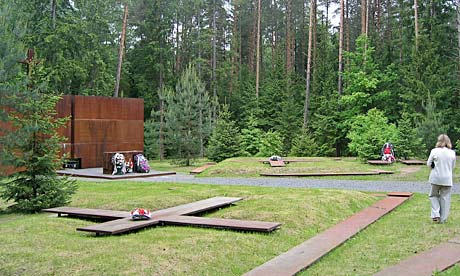
A memorial dedicated to the Polish officers murdered in the Katyn forest in 1940. (Dario Thuburn/AFP/Getty Images)
Russian Parliament Admits Guilt over Polish Massacre
By Tom Parfitt
The Guardian, November 26, 2010
"In a symbolic admission of guilt, Russia's parliament has declared that Joseph Stalin ordered his secret police to execute 22,000 Polish army officers and civilians in 1940, in one of the greatest mass murders of the 20th century. Today's acknowledgment of Stalin's personal culpability over the Katyn massacre comes amid a cautious thaw between Moscow and Warsaw, whose recent relations have been thorny at best. It was also seen as a sign that Russia may finally be ready for muted self-scrutiny over its totalitarian past. Mikhail Gorbachev admitted in 1990 that the NKVD was to blame for the massacre, after a half-century of the Soviets blaming it on Nazi troops. However, there has never been a formal statement which implicates the Soviet leadership in such explicit terms. Officials in Warsaw greeted the declaration positively. 'It is a good step, an important sign,' Poland's speaker of parliament, Grzegorz Schetyna, told reporters. It would ensure a 'better atmosphere' for Russian president Dmitry Medvedev's visit to Warsaw next week, he added. The 21,768 officers, doctors, policemen and other public servants -- captured by the Red Army when it swept into Poland after the outbreak of the second world war in 1939 -- were mainly shot in Katyn forest near Smolensk in western Russia and in several other places. The current improvement in ties accelerated after Poland's then president, Lech Kaczynski, and 95 other people including scores of high-ranking government and military figures, died in April when their plane crashed on landing at Smolensk. The passengers were on their way from Warsaw to attend an event commemorating the 70th anniversary of the massacre. In the wake of the crash, Russia's prime minister, Vladimir Putin, made unequivocal statements about Soviet responsibility for the Katyn massacre and urged reconciliation. Historian Natalya Lebedeva, a Russian member of the two countries' intergovernmental commission on 'especially complex questions,' told the Guardian that Putin's words had helped the healing process. 'Both Russia and Poland realise it is time to stop the confrontations,' she added. [...]"

Tuesday, November 16, 2010

Denying Rwanda: A Response to Herman & Peterson

[Introductory note: In July 2010, Pambazuka.org published a long review by Gerald Caplan of the recent book by Edward S. Herman and David Peterson, The Politics of Genocide, in which Caplan accused the authors of denying the 1994 holocaust in Rwanda. Herman & Peterson responded with a lengthy broadside against Caplan, published on Pambazuka on July 8, to which I issued a stopgap response from my temporary base in Burkina Faso. That intervention elicited another outpouring by Herman & Peterson, specifically attacking me, posted to the Monthly Review blog on August 14. The following comments represent a fuller engagement with Herman & Peterson's assertions, accusations, and denialist fabrications.]


When I first learned of the publication of Edward Herman and David Peterson's barely-a-book, The Politics of Genocide, and when I read Gerald Caplan's lengthy review followed by Herman & Peterson's 8,000-word response, I was travelling with no fixed address in West Africa. While necessarily postponing an engagement with the volume until I returned to Canada, I felt justified in preparing (from Bobo-Dioulasso, Burkina Faso) a thousand words or so of comments explicitly limited to the assertions made in Herman and Peterson's riposte to Caplan. Having now imbibed a further 6,000 words from the authors, specifically denouncing me and my work, and having read The Politics of Genocide, my concerns about their denialist and fundamentally anti-scholarly enterprise have only deepened.

In a paper to be presented to the conference of the International Association of Genocide Scholars next year, I will examine Herman & Peterson's work alongside that of their fellow Rwandan genocide deniers. I limit my comments here to the authors' published statements on Rwanda, both in their online posts and in The Politics of Genocide. (I trust I have the title of their book right, by the way. Herman & Peterson manage to misstate the name of my own work, Genocide: A Comprehensive Introduction, no fewer than eight times in the footnotes of their latest post.)[1]

Sunday, November 14, 2010

Romania / Jewish Holocaust

Photo: Elisabeth Ungureanu
A Mass Grave Raises Ghosts of Romania's Holocaust Past
By Rupert Wolfe Murray
Time.com, November 12, 2010
"One day in 1941, Vasile Enache was tending his cows in the forest of Vulturi, near the city of Iasi, 260 miles (420 km) northeast of Bucharest, when he heard people sobbing. He went to investigate and saw hundreds of civilians being marched through the forest by Romanian army soldiers. Enache didn't know it at the time, but he was witnessing part of Romania's 'Iasi pogrom,' which resulted in the deaths of an estimated 14,000 Jews. For almost 70 years, successive Romanian governments have downplayed the nation's role in the Holocaust. But now a suspected mass grave has been found in the Vulturi forest, and some are hoping that the discovery will help Romania face up to one of the darkest periods in its history. Rumors about a mass grave in the Vulturi forest had been circulating for years; when a similar grave was found near Iasi in 1945, it led to a trial that ended with several top military commanders being sentenced to jail. After persuading Enache to show him the exact location of the Vulturi grave, local historian Adrian Cioflinca organized a team of people from Romania's Elie Wiesel National Institute for Studying the Holocaust to start excavating the site last month. They uncovered the remains of 16 bodies -- including the skeletons of children, a lady's shoe and Romanian-army bullets from 1939 -- but have since called a halt to the dig while they wait for rabbis to bless the site.

United States / Jewish Holocaust

The Plot to Cheat Germany's Holocaust Survivors Fund
By Claire Suddath
Time.com, November 13, 2010
"[...] On Nov. 9 the U.S. Attorney for the Southern District of New York, Preet Bharara, announced charges against 17 people believed to have knowingly defrauded the Conference for Jewish Material Claims Against Germany -- the New York-based organization responsible for processing and approving Germany's restitution payments to Jewish victims of Nazi persecution -- out of more than $42 million. Five former Claims Conference employees -- case agents and at least one supervisor -- along with recruiters and an expert document forger, allegedly submitted or otherwise tampered with more than 5,600 applications over 16 years. The extent of the fraud is so large that at a Nov. 9 press conference even Bharara admitted surprise, saying that he would have expected the nonprofit Holocaust survivors' organization to be 'immune from base greed and criminal fraud.' 'They knew to change all of the things we routinely check,' says Claims Conference executive vice president Greg Schneider. 'The forged documents look exactly like real ones. You cannot tell the difference.'

Spain / Spanish Civil War

Scandal of the Spanish Civil War Mass Graves
By Alasdair Fotheringham
The Independent, November 14, 2010
"When 'A M', a Spanish lawyer in her forties, talks about the Franco death squads who murdered her grandfather and tossed his body in a roadside ditch where it remained hidden for the next 74 years, any hatred or anger at the perpetrators is either long gone or deeply buried. But a huge reservoir of sorrow remains, together with resentment at extreme bureaucratic insensitivity. 'In the records of the government office where he worked, he's still noted as "absent from his work station for unknown reasons",' she says. 'We want those records put straight, with recognition of what really happened.' She has requested anonymity for herself and her grandfather because 'that's what my late father would have wanted.' But, in any case, remaining nameless is all that is on offer to the vast majority of the 120,000-plus victims believed to have been killed and buried by Franco's militias -- and who are still waiting to be dug up. That wait is coming dangerously close to becoming permanent. Today, 71 years after the Spanish civil war ended, 35 years after Franco's death, and four years after a law was passed authorising exhumation of the war's mass graves, barely 10 per cent of the estimated 2,052 sites have been investigated.

Iraq / Violence against Christians

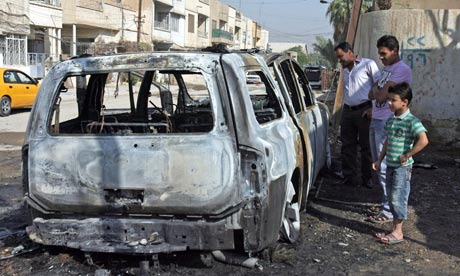
"A burnt out vehicle at the site of one of the bomb attacks targeting Christian homes in Baghdad." (Mohammed Jalil/EPA)
Christians in Iraq Living in Fear of "Pogrom" after Bomb Attacks
By Martin Chulov and Enas Ibrahim
The Guardian, November 12, 2010
"For the second time in four years, Linda Jalal and her family are on the run inside their own country. On Tuesday afternoon, they abruptly packed their meagre belongings and abandoned their house in east Baghdad. The family had been fixing the shattered windows from a bomb placed next to their car when dawned -- the attack was not random; it was one of many that day targeting Christian families. 'I am scared,' she said from a relative's lounge. 'How could this happen to us again?' For Jalal and her mother, Iyada Marouky, the past week has been the worst of their lives. Worse than the grim months of 2003 when they fled their first home in the south Baghdad suburb of Dora after armed men came to their doorstep with a warning. Worse, too, than the initial days of anarchy after the ousting of Saddam Hussein. For all his atrocities, the dictator left the Christians well alone. 'We didn't suffer under him,' said Jalal. 'But now I am terrified to live in this society. We are being slaughtered like sheep. Yet we are civilians and this is our country.' Jalal's house was one of at least a dozen Christian homes attacked on Wednesday morning. Three more were bombed on Tuesday night. The bombings were the first co-ordinated attack on the city's Christians following almost eight years of civil strife.

Wednesday, November 10, 2010

Sri Lanka

Photos Allege Sri Lanka Massacre
Al-Jazeera.net, November 10, 2010
[Includes accompanying video]
"Al Jazeera has obtained photographs that appear to show Sri Lankan army soldiers abusing Tamil civilians in the final days of the Sri Lankan civil war. The pictures show various graphic scenes, with dead bodies blindfolded and hands bound, shot through the head and mounds of bodies on the back of a farmer's trailer. It is claimed that the photos were taken in the closing months of the country’s long-running conflict that ended 18 months ago. One of the photos shows a line of bodies, including what is believed to be the body of the son of Velupillai Prabhakaran, the leader of the rebel group, the Liberation Tigers of Tamil Eelam, or Tamil Tigers, that was defeated in the civil war. Another photo shows the naked body of a young woman and the body of a boy, perhaps in his early teens. It is not possible to verify the authenticity of the images that were obtained by Al Jazeera from Tamil contacts who said the photos were handed over by someone from the Sri Lankan military. It is unclear why it has taken so long from them to surface.

Iraq / Violence against Christians

"At least 14 roadside bombs exploded across the city [of Baghdad] on Wednesday." (Agence France-Presse)
Christians Targeted in Iraq Attacks
Al-Jazeera.net, November 10, 2010
"A series of bomb and mortar attacks targeting Christians have killed three people and injured 24 others in the Iraqi capital, Baghdad, according to police sources. Attackers detonated at least 14 roadside bombs in predominantly Christians areas within a two-hour period on Wednesday morning and a mortar round struck in the southern Doura district. 'These operations, which targeted Christians, came as a continuation of the [October 31] attack that targeted the Salvation church,' an Iraqi interior ministry source said. The official referred to the October 31 attack that killed more than 50 people at a Catholic cathedral in the capital. Al-Qaeda claimed responsibility for that attack and has threatened more violence against the Christian community. Al Jazeera's Rawya Rageh, reporting from Baghdad, said Christians in Iraq have been a typical target of al-Qaeda fighters following the US-led invasion in March 2003. 'We have seen Christians fleeing Iraq between 2004 and 2006. Their numbers now are down to a third,' she said. 'This is a stepped-up attack to revive the chaos that has affected the Christian community in the past.' Younadem Kana, a Christian parliamentarian, condemned the violence and blamed police and military for failing to protect Christians despite boosting security measures at churches around the capital. 'These attacks are not targeting only Christians, but also the government that has promised to protect the Christians,' Kana said. He said Wednesday's bombings exposed "grave flaws in the structure and the work of Iraq's security forces," and that attacks will continue as long as the country remains without a government that represents all Iraqis. Tensions have been running high since the inconclusive parliamentary elections in March left Shia, Sunni and Kurdish political factions rallying support for a new government and raising fears of renewed violence."
[n.b. This is the complete text of the dispatch.]

Iraq / Anfal Campaign

"Ali Ahmad, who survived the gas attack in 1988, greets his mother after more than two decades apart." (Associated Press)
A Happy Ending to the Worst Atrocity of Saddam's Regime
By Catrina Stewart
The Independent, November 10, 2010
"Etched on to the marbled walls of Halabja's memorial centre are the names of the thousands of victims of the 1988 chemical attack on the Kurdish town of Halabja. One name, though, is ringed in green, because the boy who died never actually died at all. At four months old, Zmnaku 'Ali' Ahmad was believed to be one of the youngest victims of the attack, which claimed 5,000 lives and remains the single worst atrocity of Saddam Hussein's rule. But he was whisked away to safety by Iranian soldiers, and grew up in Iran, believing that his real mother was dead. But last year he was reunited with his birth mother, Fatima Saleh, after a request for Iraqi identity papers led him to find his real parents. 'When I first saw Halabja [last year], I started crying,' says Mr. Ahmad, 23, who is now studying English in Sulaymaniya before embarking on a degree course in IT. 'It was a very strange feeling for me.' The tragedy of Halabja was the culmination of the Iraqi regime's brutal campaign against the Kurds in the 1980s, aimed at crushing Kurdish resistance in the northof Iraq. Some 200,000 Iraqi Kurds died during the campaign, often brutally, and hundreds of villages were destroyed. But it was the particularly horrific nature of the attack on Halabja that would come to symbolise the regime's ruthless repression of the Kurds.

Saturday, November 06, 2010

Romania / Jewish Holocaust

Mass Grave with Remains of 100 Jews Found in Romania
Associated Press dispatch in The Irish Times, November 6, 2010
"A Holocaust-era mass grave containing the bodies of an estimated 100 Jews killed by Romanian troops has been discovered in a forest, researchers said yesterday, offering further evidence of the country’s involvement in wartime crimes. The grave, in a forest near the Romanian town of Popricani, contained the bodies of men, women and children who were shot dead in 1941, the Elie Wiesel National Institute for the Study of the Holocaust in Romania said in a statement. The find offered evidence of pogroms against Jews in the region, scholars said, campaigns that were long minimised in a country whose official history taught that Germans were the sole perpetrators of the Holocaust. Sketchy reports about the possibility of a mass grave in the forest began to appear in 2002 and local authorities began an investigation, but it was later suspended after nothing was found. Experts resumed the investigation at the site and began interviewing witnesses again in 2009, according to Romanian historian Adrian Cioflanca. Some 280,000 Jews and 11,000 Roma, or Gypsies, were killed during the pro-fascist regime of dictator Marshal Ion Antonescu, who was prime minister from 1940 to 1944.

Congo / Sexual Violence against Women

Hundreds Were Raped on Congo-Angola Border
By Jeffrey Gettleman
The New York Times, November 5, 2010
"More than 600 women and girls were recently raped along the Congo-Angola border during a mass expulsion of illegal immigrants, according to the United Nations. Many of the victims said they were locked in dungeon-like conditions for several weeks while they were raped repeatedly by security forces. At least one woman died from her internal injuries, United Nations officials said. Maurizio Giuliano, a United Nations spokesman in the Democratic Republic of Congo, said Friday that it was unclear on which side of the Congo-Angola border the women had been attacked, and that the United Nations was calling on both countries to investigate promptly. 'What worries us is that rape seems to be becoming endemic in several parts of Congo,' Mr. Giuliano said, also referring to recent rapes in the eastern Kivu provinces. 'We fear it’s becoming part of the routine.' For the past decade, Congo has been torn apart by dozens of rebel groups that have often swept into villages and brutalized women. United Nations officials call Congo the worst place in the world for sexual violence, and even the longstanding presence of international peacekeepers has not been able to stop it. A few months ago, more than 200 women were raped in a single thatched-roof village in eastern Congo while United Nations peacekeepers were less than 12 miles away. [...]"

Video of the Month


Daniel Goldhagen, author of Hitler's Willing Executioners and the recent Worse Than War: Genocide, Eliminationism, and the Ongoing Assault against Humanity, provides a wide-ranging two-hour overview of genocide in the modern world, in this 2010 PBS documentary. Goldhagen's egotism is a little overweening, but the film is well worth watching. View it in its entirety here.

Friday, November 05, 2010

European Union / Iraq

European Court Demands Halt to Forcible Return of Iraqi Asylum Seekers
By Owen Bowcott
The Guardian, November 5, 2010
"The government's programme of deporting failed asylum seekers to Iraq has been thrown into confusion after the European court of human rights ruled that forcible returns to Baghdad should be suspended immediately because of an upsurge in sectarian violence and suicide bombings. The court decision has already led to the Netherlands halting all removal flights to Iraq. In the UK, the Home Office pledged to 'continue to undertake' deportations but acknowledged that in cases where the Strasbourg court supported petitions from individuals it would not enforce removal. Since the European court of human rights (ECHR) has indicated that requests from Iraqis heading for Baghdad should, for the time being, be granted as a matter of routine, it means that many Iraqi deportees who apply to the court will be allowed to stay in Britain. But the impact of this legal advice could trigger a clash with the Strasbourg court. The Kurdish regional government in the north of Iraq already refuses to accept flights from the UK which carry forcibly deported Kurds, so the latest restriction will effectively prevent the government removing most Iraqis for the time being.

Thursday, November 04, 2010

Indonesia / West Papua

Papuan Tells of Torture by Indonesian Soldiers
By Tom Allard
The Sydney Morning Herald, November 5, 2010
Photo: Karuni Rompies
"A Papuan man depicted in a video being burnt, suffocated and hit by Indonesian troops says he was tortured for two days, according to his testimony recorded and translated by Papuan activists. Tunaliwor Kiwo was shown in agony as the soldiers burnt his penis in the video, which was filmed in May and revealed exclusively in the Herald last month. It prompted a horrified response in Indonesia and around the world, and led to the rapid arrest of five Indonesian soldiers, who face a military tribunal today. But in the new testimony Mr. Kiwo, filmed two weeks ago, said the abuse was far worse than depicted in the first video. He spoke of being repeatedly beaten and suffocated, of his head being crashed into a wall and of being burnt with cigarettes during the first day of torture, which followed his arrest as he travelled by motorcycle with his friend Telangga Gire on the road from Tingginambut to Mulia, the capital of Puncak Jaya regency, a hotbed of separatist activity.

Serbia / Croatia

Serbian President Apologizes for 1991 Massacre of Croats
Associated Press dispatch in The Hamilton Spectator, November 4, 2010
"Serbian President Boris Tadic apologized Thursday at the site where more than 200 Croats were massacred, offering the strongest condemnation to date by a leader from Serbia of wartime atrocities committed by the country. Laying a wreath at Ovcara, a former pig farm where a mass grave remains a painful symbol for Croats of Serb brutality during the 1991 ethnic war, Tadic said he came to 'bow down before the victims.' 'By acknowledging the crime, by apologizing and regretting, we are opening the way for forgiveness and reconciliation,' Tadic said. A few hours later, Croatian counterpart Ivo Josipovic laid a wreath at the graveyard of 18 Serbs killed by Croats in 1991 in a nearby village of Paulin Dvor and Josipovic said that 'those who are left behind those victims deserve our apology.' 'A crime has no justification; revenge cannot be justified by a crime,' Josipovic said. The slaying in Paulin Dvor came a month after the massacre at Ovcara. Though relations between the neighbours have vastly improved, the two presidents’ joint tour of the killing sites and apologies offer a symbolic step of reconciliation after years of mutual accusations over atrocities. Tadic is the first Serb leader to visit Ovcara, the site of one of the worst massacres of the Balkan conflicts that followed the post-communism breakup of Yugoslavia. Accompanied by Josipovic, Tadic said the two of them visited the site near the eastern Croatian town of Vukovar 'to create the possibility that Croats and Serbs can turn a new page of history.'

Israel / United Kingdom / Universal Jursidiction

Israel Ambushes Hague over Arrest Warrants
By Donald Macintyre
The Independent, November 4, 2010
"Israel and Britain moved last night to limit the damage of an Israeli diplomatic ambush that threatened to overshadow the first official visit to the Middle East by William Hague, the Foreign Secretary. British officials were infuriated yesterday when Mr Hague arrived in the region to be confronted with the news that Israel had unilaterally cancelled a series of high-level 'strategic dialogue' meetings between the two countries. The move was a protest against the UK's failure to block arrest warrants being issued against Israeli generals and politicians visiting Britain. The news of the cancellation was broadcast by Israel Radio yesterday, which cited anonymous sources in Israel's foreign ministry. It was quickly confirmed by the ministry. British officials were taken by surprise by the move and were particularly disturbed by the cancellation as Mr Hague was intending to announce later this week that the Government would legislate this year to prevent private individuals from issuing arrest warrants. The warrants -- which have been issued against Israeli politicians and generals accused of war crimes -- have been a source of tension since 2005 when Doron Almog, a retired Israeli major-general, decided not to land at Heathrow after being tipped off that he was facing an arrest warrant from a private prosecution in an English magistrates' court for alleged war crimes. A number of prominent Israeli figures have subsequently cancelled trips to the UK, including the leader of the opposition, Tzipi Livni, who was a member of the Israeli government when it ordered the military onslaught on Hamas-controlled Gaza in 2008-09. This week it was disclosed that Israel's Deputy Prime Minister, Dan Meridor, had cancelled a private trip to London after being advised that he could face private proceedings over the interception of a Gaza-bound Turkish vessel in May. [...]"

Wednesday, November 03, 2010

Iraq / Violence against Christians

Al Qaeda Ally in Iraq Says All Christians "Legitimate Targets"
By Taylor Barnes
The Christian Science Monitor, November 3, 2010
Photo: "Iraqi Christian women react during a funeral for two slain priests and their parishioners in Baghdad on Nov. 2." (Hadi Mizban/AP)
"The Islamic State of Iraq, an insurgent group and Al Qaeda ally, on Tuesday declared all the country's Christians 'legitimate targets.' The group says it believes that Muslim women are being held against their will in Coptic churches in Egypt. The Egyptian state; the Coptic church; and Egypt's leading Islamist movement, the Muslim Brotherhood, have all condemned the threats of violence against Christians. The threat came while Iraq was still reeling from a series of car bombs across the capital Tuesday that killed at least 113 people in Shiite neighborhoods. The attacks bore the hallmarks of Sunni Arab militants like the Islamic State of Iraq. Tuesday's massacre appeared designed to fuel sectarian violence against Shiites. That followed Sunday's targeting of Christians, when the Islamic State of Iraq seized a Catholic church in Baghdad and killed 58 people during a standoff with police. It was said to be the deadliest attack against Christians ever recorded in Iraq. 'All Christian centers, organizations and institutions, leaders and followers, are legitimate targets for the mujahideen [holy warriors],' the Islamic State of Iraq said in a statement posted online late Tuesday. Sunni militant chatrooms have been inflamed in recent weeks with claims that the Egyptian Coptic church is forcibly holding two women, wives of Coptic priests, who converted to Islam. 'Let these idolaters, and at their forefront, the hallucinating tyrant of the Vatican, know that the killing sword will not be lifted from the necks of their followers until they declare their innocence from what the dog of the Egyptian Church is doing,' the message continued. The Coptic church is the Egyptian branch of the Eastern Orthodox right and as many as 10 percent of Egyptians claim the faith. [...]"

Liberia / Sierra Leone / International Criminal Court

Is the Case Against Charles Taylor Falling Apart?
By Thomas Darnstädt and Jan Puhl
Spiegel Online, November 3, 2010
Photo: "Former Liberian President Charles Taylor appears with his defense attorney in the International Criminal Court in The Hague in 2006." (Agence France-Presse)
"[...] Crimes against humanity, mass murder, rape, mutilation, the blame for the massacres that took place during the civil war that raged in neighboring Sierra Leone between 1991 and 2002: the charges against the African politician are as massive as the prosecutors' ambition to force a murderous head of state to atone for his crimes for the first time in history. But the more unbearable the details of this bloody African conflict become in the neon-lit courtroom, the more agonizing is the game of guilt and atonement, and the more untouchable this former president, in his silver-gray tie, gray suit and white pocket handkerchief, becomes. Nothing seems to stick this defendant. Cannibalism? Taylor feigns disgust. What does he have to do with such atrocities, he asks? More than 90 witnesses have already testified. The International Criminal Court in The Hague is currently in the process of hearing the last of the oral evidence, and the man who was almost certain of taking his place in history as the 'Butcher of Monrovia' appears to be emerging as a winner, at least for now.

Monday, November 01, 2010

Uganda / Violence against Homosexuals

Ugandan Tabloid Publishes New "Gay List"
CNN.com, November 1, 2010
"The editor of a tabloid in Uganda who argues that homosexuality is more dangerous than smoking, has published a list of 10 gay and lesbian people in the African nation, urging readers to report them to the police. It's the second time that Rolling Stone -- no relation to the iconic U.S. music magazine -- has published such a list. Last time it listed 100 of what it called the country's top gays and lesbians, with photos and addresses alongside a yellow banner reading 'hang them.' Gay rights groups in Uganda say at least four people have been attacked since then. And a bill that would make homosexuality potentially punishable by death is working its way through Uganda's parliament. The new gay list includes addresses and alleged intimate details about the anatomy of people on it. Editor Giles Muhame, 22, has discouraged readers to physically attack people on the list, but he claims gay people are going to schools and 'recruiting' schoolchildren. He says the bill imposing harsh penalties for homosexuality will become law when Uganda begins drilling oil and becomes less dependent on foreign donors.

Zimbabwe / Matabeleland

It Was Genocide -- Coltart
By Mernat Mafirakurewa
Newsday (Zimbabwe), October 31, 2010
"Education, Arts, Sport and Culture minister David Coltart has equated the post-independence disturbances in Matabeleland that left an estimated 20 000 people dead, to genocide. Coltart said it was a shame that the country had failed dismally to deal with past disturbances by setting up a truth, justice and reconciliation process as had happened elsewhere on the continent. Speaking at the 13th annual Lozikeyi Lecture at the Bulawayo National Art Gallery on Friday, Coltart described Zimbabwe as a nation with a bloody history littered with years of serious human rights violations, violence, abuse of power, racial and ethnic discrimination. Queen Lozikeyi was one of the senior wives of King Lobengula, the second and last monarch of the Ndebele people who ruled until 1894. 'The first 30 years post-independence have been marked by serious and consistent human rights abuses, including a politicide, if not genocide, which occurred in the mid-1980s in the south-west of the country,' said Coltart. 'In other words, Zimbabwe has had a lot of psychological and physical trauma to deal with as a nation and art has a critical role to play as we delve beyond subjective interpretations of history and begin to realise the truth of our past.' He said 2010 had been a traumatic year for the National Art Gallery in Bulawayo because it has been the focus of a clash between certain arms of government and art. The exhibition by Owen Maseko entitled Sibathontisele, focusing on the Gukurahundi mass killings era, was earlier this year banned and the artist still faces serious charges in court. At the same time the sculpture Looking Into The Future, by Stanley Hadebe, of a nude man, was also banned. [...]"
[n.b. Thanks to Geoff Hill for bringing this source to my attention.]

Iraq / Violence against Christians

Iraqi Christians Mourn after Church Siege Kills 58
By Barbara Surk and Hamid Ahmed
Associated Press dispatch on Yahoo! News, November 1, 2010
Photo: "Iraqi security forces survey the scene outside the Sayidat al-Nejat Catholic Cathedral, or Syrian Catholic Church, in central Baghdad." (Sabah Arar/Agence France-Presse)
"Iraq's dwindling Christian community was grieving and afraid on Monday after militants seized a Baghdad church during evening Mass, held the congregation hostage and triggered a raid by Iraqi security forces. The bloodbath left at least 58 people killed and 78 wounded -- nearly everyone inside. The attack, claimed by an al-Qaida-linked organization, was the deadliest ever recorded against Iraq's Christians, whose numbers have plummeted since the 2003 US-led invasion as the community has fled to other countries. Outside Our Lady of Deliverance church, Raed Hadi leaned against the car carrying his cousin's coffin, waiting for the police to let him bury him on church grounds. 'It was a massacre in there and now they are cleaning it up,' he said Monday morning. 'We Christians don't have enough protection. ... What shall I do now? Leave and ask for asylum?' 'Now they make a show,' said Jamal Jaju, who watched as Iraqi forces set up a chain link fence around the church and pushed back observers. 'What can I say? I lost at least 20 friends in there.' Pope Benedict XVI denounced the assault as 'ferocious' and called for renewed international efforts to broker peace in the region. Prime Minister Nouri al-Maliki also condemned the siege, saying it was an attempt to drive more Christians out of the country. Islamic militants have systematically attacked Christians in Iraq since the collapse of Saddam Hussein's regime. Catholics made up 2.89 percent of Iraq's population in 1980; by 2008 they were merely 0.89 percent. [...]"

Bosnia and Herzegovina / Sexual Violence against Women

Rape Victims Tell Jolie to Leave Stories Untold
By Vesna Peric Zimonjic
The Independent, November 1, 2010
"The women's stories are all the same, about men carrying automatic weapons and flashlights, and breaking into their homes in the middle of the night at the beginning of the Balkan war in April 1992. After the men had been taken away or killed, the Muslim girls and women were repeatedly raped for weeks or even months by Serb soldiers, before managing to flee in the summer of 1992. Since then the women have had to live with the trauma of what happened, and have spent nearly two decades looking for justice. The ordeal of the Bosniak women has been thrust into the spotlight again, after it was announced recently that Angelina Jolie is to make a film which will allegedly tell of the love between a Serb rapist and his Muslim victim. The Hollywood star is to begin shooting her first project as a director and scriptwriter, as yet untitled, in Sarajevo next month. But for victims of mass rapes in Bosnia, the idea of their stories being retold is almost torture. Their faces offer horrified expressions, their hands shake and bodies tremble as they speak, in tears, about events that changed their lives forever. For Bakira Hasecic, the 55-year-old head of the Women Victims of War (WVW) association, there is no way anyone can turn the trauma of Bosniak women into film. 'What we have gone through cannot be filmed,' says Ms. Hasecic in Sarajevo. Originally from Visegrad in Bosnia, she is also victim of repeated rape and has dedicated her life to finding the perpetrators and bringing them to justice. 'I'm doing all this to prevent our ordeal from ever happening again ... but revenge leads nowhere,' she told The Independent. [...]"

Friday, October 29, 2010

Rwanda / Genocide Rescuers

Hero of 'Hotel Rwanda' is Declared Enemy of the State
By Daniel Howden
The Independent, October 29, 2010
"The man made famous by the film Hotel Rwanda and credited with saving more than 1,200 Tutsis during the 1994 genocide said yesterday that he fears for his life after the country's President made him 'an enemy of the state.' Paul Rusesabagina, a former hotel manager currently living in Brussels where he says his home has been repeatedly ransacked, will be charged in Rwanda with links to a terrorist group. Rwanda's chief prosecutor said this week that Mr. Rusesabagina has been financing commanders in the FDLR, a rebel army across the border in the Democratic Republic of Congo made up from ethnic Hutus responsible for the 1994 genocide. Mr. Rusesabagina, who was portrayed by Don Cheadle in the acclaimed 2004 film has denied sending any money to the region and accused the government in Kigali of seeking to silence its critics. 'They are coming after me,' he told The Independent. 'While I'm in Brussels I remain in danger, they're following my every step.'

Israel

March of Jewish Extremists Inflames Arab Stronghold
By Donald Macintyre
The Independent, October 28, 2010
Photo: "The right-wing protest in Ummel-Fahm, northern Israel, yesterday." (Reuters)
"Riot police protecting 30 far-right Israeli extremists who marched in the country's largest Arab town yesterday chanting 'death to terrorists' used a barrage of tear gas and stun grenades to disperse protesting residents. Ten arrests were made during clashes between stone-throwing Israeli Arab youths and riot police after the arrival of the marchers, who were led by two of the country's most extreme right-wing activists, Hebron settlers Baruch Marzel and Itamar Ben Gvir. Hundreds of armed police were deployed at the flashpoint on an outer edge and elsewhere in Umm el-Fahm to keep apart local Arab protesters and Jewish ultranationalists taking part in the short symbolic march, which had been permitted by Israel's Supreme Court. The court decision had fuelled tensions between some Israeli Jews and the country's Arab minority, already exacerbated by a series of legislative proposals targeting Arab Israelis and promoted by Avigdor Lieberman, the country's hard-right foreign minister. These include the demand that newly naturalised citizens should pledge loyalty to Israel as a 'Jewish state.'

Wednesday, October 27, 2010

Rwanda / Genocide Rescuers

"Hotel Rwanda" Hero Implicated in Terror Case
By Kezio-Musoke David
Reuters dispatch on MSNBC.com, October 27, 2010
Photo: "Paul Rusesabagina, former Rwandan hotel manager, arrives at 'Save Darfur: Rally To Stop Genocide' in Washington, DC in 2006." (Nancy Ostertag/Getty Images)
"Paul Rusesabagina, the man who saved more than 1,200 people from genocide in events depicted in the Oscar-nominated film 'Hotel Rwanda,' has been implicated in the terrorism case against a Rwandan opposition leader. Martin Ngoga, Rwanda's prosecutor general, told Reuters on Wednesday that Rwandan courts would summon Rusesabagina because investigations indicated he also funded the terrorism activities that opposition leader Victoire Ingabire is being held for. Ingabire, the outspoken head of the unregistered United Democratic Forces (UDF) party, was arrested by Rwandan police on October 14 after they said investigations into a former FDLR rebel commander facing terrorism charges also implicated her. She pleaded not guilty at a hearing Monday and was denied bail Tuesday after a court said the charges against her were of a serious nature. Ingabire says the case against her is politically motivated.

India / Kashmir

I Pity the Nation That Needs to Jail Those Who Ask for Justice
By Arundhati Roy
Times of India, October 26, 2010
" write this from Srinagar, Kashmir. This morning's papers say that I may be arrested on charges of sedition for what I have said at recent public meetings on Kashmir. I said what millions of people here say every day. I said what I, as well as other commentators have written and said for years. Anybody who cares to read the transcripts of my speeches will see that they were fundamentally a call for justice. I spoke about justice for the people of Kashmir who live under one of the most brutal military occupations in the world; for Kashmiri Pandits who live out the tragedy of having been driven out of their homeland; for Dalit soldiers killed in Kashmir whose graves I visited on garbage heaps in their villages in Cuddalore; for the Indian poor who pay the price of this occupation in material ways and who are now learning to live in the terror of what is becoming a police state. esterday I traveled to Shopian, the apple-town in South Kashmir which had remained closed for 47 days last year in protest against the brutal rape and murder of Asiya and Nilofer, the young women whose bodies were found in a shallow stream near their homes and whose murderers have still not been brought to justice. I met Shakeel, who is Nilofer's husband and Asiya's brother. We sat in a circle of people crazed with grief and anger who had lost hope that they would ever get 'insaf' -- justice -- from India, and now believed that Azadi -- freedom -- was their only hope. I met young stone pelters who had been shot through their eyes. I traveled with a young man who told me how three of his friends, teenagers in Anantnag district, had been taken into custody and had their finger-nails pulled out as punishment for throwing stones. In the papers some have accused me of giving 'hate-speeches', of wanting India to break up. On the contrary, what I say comes from love and pride. It comes from not wanting people to be killed, raped, imprisoned or have their finger-nails pulled out in order to force them to say they are Indians. It comes from wanting to live in a society that is striving to be a just one. Pity the nation that has to silence its writers for speaking their minds. Pity the nation that needs to jail those who ask for justice, while communal killers, mass murderers, corporate scamsters, looters, rapists, and those who prey on the poorest of the poor, roam free."
[n.b. This is the complete text of the dispatch.]

Germany / Jewish Holocaust

Were German Diplomats Complicit in the Holocaust?
By Tristana Moore
Time.com, October 26, 2010
Photo: "A document from German diplomat Franz Rademacher says the purpose of his visit to Belgrade in October 1941 was the 'liquidation of Jews.'"
"One of the pillars of Germany's political establishment, the Foreign Ministry, was a 'criminal organization' during the Nazi era, and the country's diplomats played a far more active role in the Holocaust than was previously acknowledged. Those are some of the troubling findings of a new 880-page government-sponsored report, called 'The Ministry and the Past: German Diplomats in the Third Reich and the Federal Republic,' which has shaken the nation. Drawn from thousands of historical documents, the report, due to be officially released on Thursday, makes for uncomfortable reading as it debunks a long cherished belief that Germany's Foreign Ministry was a hive of resistance to the Nazi regime and that German diplomats were not involved in the mass extermination of millions of Jews in Nazi death camps. 'The sheer scale of the participation of Germany's Foreign Ministry in the Holocaust is bewildering. It wasn't just one department; it was the whole institution,' Eckart Conze, a professor of modern history at the Philipps University of Marburg and one of the authors of the report, tells TIME. 'The ministry collaborated with the Nazis' violent policies and took part in all aspects of the discrimination, deportation, persecution and genocide of the Jews.'

Tuesday, October 26, 2010

Spain / Argentina / Universal Jurisdiction

Argentinian Judge Petitions Spain to Try Civil War Crimes of Franco
By Giles Tremlett
The Guardian, October 26, 2010
Photo: "General Francisco Franco, pictured in Vinaroz, Spain, in July 1938, during the Spanish civil war." (AP)
"In a stark reversal of roles, an Argentine judge has taken a step towards opening the first comprehensive investigation into the human rights abuses of General Franco's dictatorship in Spain. Judge María Servini has asked Spain to declare whether its own courts are investigating cases of torture, murder and disappearance of Franco's political opponents. If amnesty laws prevent Spanish courts investigating the cases cited by Servini, which date from 1936 until the dictator's death in 1975, then she might declare her own court competent to investigate and try crimes allegedly committed by Franco's henchmen. In a formal petition to Spain, Servini indicates that the court would investigate allegations of genocide, including tens of thousands of cases of 'torture, assassination, forced disappearances and the stealing of children.' Her request mirrors those made over the past dozen years by Spanish courts which, using international law allowing human rights crimes to be investigated and tried elsewhere if a country cannot do so itself, have brought cases against several military regimes in Latin America. The Spanish magistrate Baltasar Garzón famously used this process to order the arrest of Chile's Augusto Pinochet in London in 1998. In that case the law lords ruled that the former dictator should be extradited to face trial in Spain, although Jack Straw, home secretary at the time, finally sent the general back to Chile on health grounds in 2000. Garzón used the same principle of universal jurisdiction to prosecute the Argentine navy captain Adolfo Scilingo in Madrid in 2005. Scilingo was jailed for throwing drugged political prisoners out of aircraft into the sea. Argentina later repealed its own amnesty laws and the country now tries dirty-war suspects. [...]"

Wednesday, October 20, 2010

Israel / Armenian Genocide

State of Denial
By Peter Balakian
Tablet Magazine, October 19, 2010
"There has been speculation about Turkey’s shifting international ties ever since the election of Prime Minister Recep Tayyip Erdogan, of the Islamist AKP party, in 2003, and the Gaza flotilla incident of May created a new breach in the long-standing alliance between Turkey and Israel. Among the many issues that have emerged in post-flotilla relations between the two countries is the Armenian Genocide of 1915. The flotilla episode is fraught with complexities and ironies on both sides. While the Turkish-led mission focused on a grave human rights crisis -- Israel's oppressive treatment of Gaza's Palestinians -- Turkey's righteous indignation toward Israel both oversimplifies Israel's distress about Hamas and seems glaringly hypocritical in view of its own human-rights problems. Those problems, which include Turkey's repressive and violent treatment of its large Kurdish population, some 15 million or more, and its record of legal detention, imprisonment, and torture of Turkish intellectuals, journalists, and political activists, constitutes one of the world's worst human rights records, as Amnesty International and Human Rights Watch reports repeatedly show, over the past 20 years. Add to that Turkey's occupation of Northern Cyprus in violation of international law and its international campaign to falsify the history of its genocide of the Armenians in 1915, and the ironies multiply.

Monday, October 18, 2010

Germany / Neo-Nazism

Germany's Neighbours from Hell
By Tony Paterson
The Independent, October 19, 2010
Photo: AFP/Getty
"It's hard to escape the menacing ideology that prevails in Jamel -- a tiny hamlet of 10 crumbling red brick Prussian-era farm houses set among the remote fields and beech woods of east German Mecklenburg. 'Braunau am Inn 855 kilometres' proclaims a home-made signpost at the village entrance pointing in the direction of Adolf Hitler's birthplace. At a sandy crossroads between the houses, a huge stone carries the slogan: 'Jamel Village Community: Free, Social and National' -- the choice of adjectives is as close to the term 'National Socialist' as one can legally get in a country where the swastika and Nazi slogans remain outlawed. Jamel, a village of some 40 inhabitants a few kilometres inland from the Baltic port city of Wismar, is almost a pure neo-Nazi stronghold. Seven of its 10 houses are occupied by families whose members either belong to Germany's far-right National Democratic Party (NPD) or support the movement unequivocally. Horst and Birgit Lohmeyer are the exception in Jamel. Six years ago, the couple moved from Hamburg to their secluded house on the edge of the village, hoping for a life of rural bliss. Their expectations were soon shattered. 'A few months after we arrived, the far right started driving out the locals and buying up the houses en masse,' said Mrs. Lohmeyer. 'They want to turn this place into a Nazi-only village.' The Lohmeyers are determined to resist. 'You have to have strong nerves to live here,' said Mr. Lohmeyer. Every summer the couple organises an anti-Nazi rock festival in their large garden as a show of resistance against the rise of the far right in eastern Germany. But this summer the event was marred by a nasty incident caused by a gang of drunken neo-Nazis who attacked one of the festival-goers and broke his nose. 'We are not going to give in to these people -- why should we?' asks Mr. Lohmeyer. Yet it is difficult to see how the far right's dominance of life in Jamel can be curbed. [...]"

Sunday, October 17, 2010

Japan / Jewish Holocaust / Genocide Rescuers

Old Photos Reveal Tale of Japan, World War II Jews
Associated Press dispatch in The Charleston Daily Mail, October 17, 2010
Photo: "A diary owned by Japan Tourist Bureau employee Tatsuo Osako is displayed during an interview in Tokyo. The photographs are part of a recently discovered group of prints which throws more light on a subplot of the Holocaust: the small army of Japanese bureaucrats who helped shepherd thousands of Jews to safety." (Associated Press)
"The young man's monochrome portrait is at least 70 years old, the whites all faded to yellow, but it is still clear he had style. His hair is slicked down, eye arched, suit perfect with matching tie and handkerchief. He also had the good fortune to escape Europe in the early days of World War II. The photo, a gift to the man who helped him escape, is one of seven recently discovered snapshots that cast light on a little known subplot of the war -- even as Germany sought to seal Jewish Europeans in, a small army of tourism officials from its main ally, Japan, helped shepherd thousands away to safety. 'My best regards to my friend Tatsuo Osako,' is scrawled in French on the back of the picture, which is signed 'I. Segaloff' and dated March 4, 1941. His fate is unknown. An effort is under way to find the people in these portraits or their descendants, all of whom are assumed to be Jewish. Personal photos of such refugees, who often fled with few possessions, are rare. The photos were found in an old diary owned by Osako, who was a young employee of the Japan Tourist Bureau at the time, and died in 2003. Akira Kitade, who worked under Osako and is researching a book about him, has contacted Israeli officials for help and visited the United States Holocaust Memorial Museum in Washington, DC. The museum said he gave it about 30 photographs that he is trying to identify, and received a list of over 2,000 Jews who received travel papers that enabled them to reach Japan. Nissim Ben Shitrit, the Israeli ambassador to Japan, says he has passed on the information to Yad Vashem in Jerusalem, which tracks and honors victims of the Holocaust, and is optimistic some of the individuals can be tracked down. 'I thought that we discovered almost everything about the horror of the Holocaust,' Shitrit said. 'And yet there is more to discover.'

Saturday, October 16, 2010

Armenian Genocide / Genocide Denial

Apology for Vilifying One Man, Yet No Apology for Killing 1.5 Million
By Harut Sassounian
Asbarez.com, October 7, 2010
"In 2008, the Southern Poverty Law Center (SPLC), an Alabama-based non-profit civil rights organization, published an article titled, 'State of Denial: Turkey Spends Millions to Cover Up Armenian Genocide.' It was a hard-hitting exposé of the Turkish government's elaborate and sinister efforts to pressure U.S. politicians and entice academics to deny the facts of the Armenian Genocide. According to the SPLC article, 'Turkey exerts political leverage and spends millions of dollars in the United States to obfuscate the Armenian genocide .... Revisionist historians who conjure doubt about the Armenian genocide … are paid by the Turkish government.' Going beyond such general statements, SPLC specifically referred to Guenter Lewy as 'one of the most active members of a network of American scholars, influence peddlers and website operators, financed by hundreds of thousands of dollars each year from the government of Turkey, who promote the denial of the Armenian genocide ....' Lewy, professor emeritus of political science at the University of Massachusetts, had qualified the Armenian Genocide in his lectures and writings as a 'bungling misrule' rather than a deliberately planned and executed mass murder. He had made similar claims in his controversial book published by the University of Utah Press in 2005: 'The Armenian Massacres in Ottoman Turkey: A Disputed Genocide.' Shortly after publication of SPLC's article, an $8 million defamation lawsuit was filed against the civil rights group on behalf of Prof. Lewy by attorneys David Saltzman and Bruce Fein from the Turkish American Legal Defense Fund (TALDF), which is 'generously supported by the Turkish Coalition of America,' according to TALDF's website. Before a jury could judge the merits of the charges in court, however, SPLC agreed to settle the case by issuing 'a retraction and apology' and promising to pay an undisclosed sum to Prof. Lewy. Had SPLC not settled the case, TALDF would have had a difficult task proving in court that Prof. Lewy was actually libeled.

Germany / Nazism / Genocide and Memory

Hitler Exhibit Explores a Wider Circle of Guilt
By Michael Slackman
The New York Times, October 15, 2010
Photo: Michael Sohn/Associated Press
"As artifacts go, they are mere trinkets -- an old purse, playing cards, a lantern. Even the display that caused the crowds to stop and stare is a simple embroidered tapestry, stitched by village women. But the exhibits that opened Friday at the German Historical Museum are intentionally prosaic: they emphasize the everyday way that ordinary Germans once accepted, and often celebrated, Hitler. The household items had Nazi logos and colors. The tapestry, a tribute to the union of church, state and party, was woven by a church congregation at the behest of their priest. 'This is what we call self-mobilization of society,' said Hans-Ulrich Thamer, one of three curators to assemble the exhibit at the German Historical Museum. 'As a person, Hitler was a very ordinary man. He was nothing without the people.' This show, 'Hitler and the Germans: Nation and Crime,' opened Friday. It was billed as the first in Germany since the end of World War II to focus exclusively on Adolf Hitler. Germany outlaws public displays of some Nazi symbols, and the curators took care to avoid showing items that appeared to glorify Hitler. His uniforms, for example, remained in storage. Instead, the show focuses on the society that nurtured and empowered him.

Friday, October 15, 2010

Bosnia and Herzegovina / Sexual Violence against Women

Jolie Questions Decision to Deny Her Film Permit
Associated Press dispatch in The New York Times, October 15, 2010
"Angelina Jolie has questioned Bosnia's decision to withdraw her film permit, saying Friday it was based on false rumors that her movie will be a love story about a Bosniak woman and a Serb man who raped her during the country's war. But the actress, and two members of her film crew in Sarajevo, declined to say what the plot of her directorial debut will be, and that could make it difficult to allay the concerns of the movie's main opponents: Bosnia's wartime rape victims. Jolie said in a written statement Friday that it will be a shame if 'unfair pressure based on wrong information' prevents her crew from shooting her film in Bosnia. It's working title is 'United Love Story.' She offered to meet with wartime rape victims in Bosnia and to clarify misunderstandings that led Sarajevo's culture minister, Gavrilo Grahovac, to deny the permit. 'My hope is that people will hold judgment until they have seen the film,' Jolie said. The movie was supposed to be shot partly in Bosnia in November, but Grahovac revoked the permit this week under pressure from the Association of Women, Victims of War, which represents the several thousand mainly Muslim Bosniak women who were raped during Bosnia's 1992-95 war

Monday, October 11, 2010

Congo / France / International Criminal Court

France Arrests Rwandan Over Congo Atrocities
By Marlise Simons
The New York Times, October 11, 2010
"French police on Monday arrested a Rwandan believed to be a leader of a movement involved in a recent terror campaign in the Kivu region of Congo in which thousands of civilians have been killed and raped. Armed with an arrest warrant from the International Criminal Court in The Hague, police detained the Rwandan, Callixte Mbarushimana, 47, shortly after dawn at his home in Paris, a court official said. He is wanted on charges of war crimes and crimes against humanity, according to a statement from the court. The Rwandan's activities had been tracked for more than 18 months in several countries including France, Germany, the Congo and Rwanda, the court official said. Mr. Mbarushimana, who has the status of political refugee and has lived in France for several years, was to appear later Monday before a local judge, who must decide on his transfer to the international court in The Hague. The process could take several days, because the decision can be appealed. The prosecutor's office in The Hague in a statement said that Mr. Mbarushima was one of the top leaders of the Rwandan rebel group FDLR, that from its base in the Congo was fighting to gain power in Rwanda and was using massive crimes against civilians to demonstrate its power.

Saturday, October 09, 2010

Israel / Turkey / International Criminal Court

Gaza Flotilla Attack: Calls for International Criminal Court to Step In
By Afua Hirsch
The Guardian, October 8, 2010
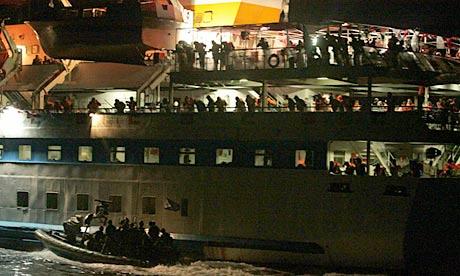
Photo: "Israeli navy commandos intercept the Mavi Marmara on its way to Gaza in May." (Kate Geraghty/Sydney Morning Herald/Getty Images)
"The international criminal court is being urged to prosecute members of the Israeli defence force for the raid on a Gaza-bound aid ship. Turkish victims have formally requested an investigation, the Guardian has learned. Lawyers acting for Turkish citizens injured or killed when Israel intercepted the flotilla in May have written to Luis Moreno Ocampo, the court's prosecutor, claiming there is an 'overwhelming' case for prosecution. The request is a significant step towards a criminal investigation by the court, which experts say has jurisdiction to prosecute those involved in the raid despite Israel not recognising its jurisdiction. 'The attack on the flotilla occurred in international waters, which directly violated many parts of international law as well as international public and criminal law,' said Ramazan Ariturk, a partner at Elmadag Law Office, the Turkish legal body that is representing the Turkish victims and the human rights group IHH. 'The crimes committed by Israeli Defence Forces should be prosecuted and the International Criminal Court is the sole authority which is able to do that.' There is mounting pressure on Israel after a UN report into the incident, in which nine Turkish activists were killed, accused Israel of violating international law. The report, published last month, said Israel 'betrayed an unacceptable level of brutality' during the raid on the flotilla and it 'constituted grave violations of human rights law and international humanitarian law.' Israel condemned the report as 'biased and distorted.' It has created its own state-appointed inquiry, headed by retired supreme court justice Jacob Turkel. [...]"

Sudan / United Nations

UN Delegation Presses Sudan to Allow a Referendum and Avert a New Civil War
By Mark Landler
The New York Times, October 8, 2010
"After languishing as what many experts worried was the world’s most neglected foreign-policy problem, Sudan is now in the spotlight: a high-level delegation from the United Nations Security Council arrived in the capital, Khartoum, on Friday, to press the government not to disrupt a coming referendum that is considered likely to result in partition. The diplomats, including the American ambassador to the United Nations, Susan E. Rice, had earlier toured southern Sudan to monitor preparations for the voting, which many analysts fear could reignite a north-south civil war if it is mishandled. The visit comes two weeks after President Obama publicly warned the Sudanese at the United Nations to allow a credible vote. Voters in the south will be asked whether they want their region to become independent, and it is widely expected that the answer will be yes. There are growing fears that the referendum will not be held on time because of delays in registering voters. Beyond that, some fear that the government of President Omar Hassan al-Bashir, which depends on the oil-rich south for revenues, will try to rig the vote or cancel it. 'There's tension, there's anticipation, there's anxiety and there's fear that this moment will be stolen from them,' Ambassador Rice said Friday from Khartoum. While she said the referendum's official managers assured her that it would proceed on Jan. 9, as scheduled, she added, 'It's going to be very tight.'

Thursday, October 07, 2010

Misrepresenting a famine image

A correspondent has posted to my blog and elsewhere convincing evidence that Bloomsbury, publisher of Frank Dikötter's 2010 book Mao's Great Famine: The History of China's Most Devastating Catastrophe, has misrepresented the cover photo of an orphan begging during a 1946 famine in Nationalist China as an image from the mass famine of the Great Leap Forward period under Mao Zedong's Communist Party (1958-62).

The cover of Dikötter's book:


Here's a scan I made of a close-up of the apparent victim of "Mao's great famine":


And finally, the 1946 photo from LIFE (Mao's Communists did not seize national power until 1949):


(Link to the version of the image as posted on the LIFE site, captioned: "May 1946: Starving child holding out an empty rice bowl during famine.")

I think Wayne is deeply naive about the nature of Mao's rule and the devastation of the Great Leap Forward period. I discuss the famine and its terrible toll in my revised Chapter 5, "Stalin and Mao," for the second edition of my textbook, Genocide: A Comprehensive Introduction. But this is clearly a serious error that the author and publisher need to address promptly.

Beyond the misrepresentation, may I also suggest that the very extensive airbrushing, replacement/grafting of background, colourization and so on of the original image is curiously reminiscent of communist practice under Mao and Stalin?

I have not yet read Dikötter's book, but it is at the top of my list.

Wednesday, October 06, 2010

Rwanda / Democratic Republic of the Congo

It's Time to Hold Rwanda Accountable For Its War Crimes
By Mvemba Phezo Dizolele
The New Republic, October 5, 2010
"The Senegalese poet Birago Diop once wrote that the dead are not really dead. They live on in the wind, forests, and rivers, their pleas for justice echoing among the living. So it is today in the Democratic Republic of Congo, where more than five million people have been killed in the world’s deadliest conflict since World War II. But the calls for justice by the dead and the living have been repeatedly muted in several classified or sanitized United Nations reports, all to protect a handful of powerful—and likely guilty—parties in the supposed interest of peace and stability. Today, the international community finds itself at a crossroads concerning Congo. In late August, a draft report by the UN High Commission for Human Rights was leaked to the French newspaper Le Monde. It documented more than 600 incidents of gross human rights violations by Congo’s warring factions and their allies in Rwanda, Uganda, Angola, Zimbabwe, and Burundi. Amid the more serious allegations, the report accuses Rwandan Tutsi soldiers and their allies in Laurent-Désiré Kabila’s rebel alliance of committing war crimes, crimes against humanity, and alleged acts of genocide against tens of thousands of Hutus in Congo. Some of the victims were génocidaires from Rwanda, but others, including women and children, were not.

Sudan

George Clooney in Southern Sudan over War Worries
By Maggie Fick
The Huffington Post, October 6, 2010
Photo: Associated Press
"American actor George Clooney is visiting the little known region of Southern Sudan. The UN Security Council arrived to a raucous welcome on Wednesday, and the United States Holocaust Memorial Museum also made a recent trip here. The high-level visits are putting the spotlight on the Texas-sized area of Sudan that is far less known to Americans than the western region of Darfur, where mass atrocities have been committed over the last decade. Southern Sudan is three months from a Jan. 9 independence vote that could see Africa's largest country break in two. The vote -- and the potential of a new north-south war because of it -- are the reason behind the rash of visits. 'If you knew a tsunami, or Katrina or a Haiti earthquake was coming, what would you do to save people?' Clooney said, according to a blog post by Ann Curry, a reporter for NBC who is accompanying Clooney. Clooney spent the past week traveling to remote, conflict-prone areas of Sudan's south with John Prendergast, the founder of the Enough Project, an anti-genocide advocacy group. One photo posted by Curry showed Clooney pointing over a field that Curry wrote was the site of a mass grave from 2008. That was in Abyei, a town that was largely burned to the ground after southern and northern armies clashed there, prompting an estimated 60,000 people to flee. The UN reported at the time that at least 140 people died. Clooney, who declined a request for comment, also visited the town of Malakal, where elements of Sudan's northern and southern armies have clashed twice since the end of the 21-year north-south civil war in 2005.

Congo / Sexual Violence against Women

Congolese Rebel Commander Responsible for Mass Rapes Arrested
The Telegraph, October 6, 2010
Photo: "Zaina Niangoma who was raped along with her 15-year-old daughter (not pictured) by three members of the Hutu rebels of the Democratic Forces for the Liberation of Rwanda." (AFP/Getty Images)
"UN and Congolese forces have arrested a rebel commander allegedly responsible for mass rapes in eastern Congo. The UN has been criticised for failing to stop the attacks after it took days for help to arrive, even though the villages are 12 miles from a camp of UN peacekeepers from India. The UN said a peacekeeping patrol drove through one of the villages while it was being held by the fighters, but said peacekeepers took no action because no one told them what was going on. Rape has been increasingly used by various groups of fighters in eastern Congo to intimidate, punish and control the population, especially in the mining areas. Dr. Chris Baguma, of the Los Angeles-based International Medical Corps, said that he had seen many, many rape victims in the area 'but I have never seen anything so planned, so systematic, so animalistic.'

Monday, October 04, 2010

Congo / Sexual Violence against Women

Frenzy of Rape in Congo Reveals UN Weakness
By Jeffrey Gettleman
The New York Times, October 3, 2010
Photo: "United Nations peacekeepers protecting civilians by escorting them home from a market in the Democratic Republic of Congo." (Michael Kamber/The New York Times)
"Four armed men barged into Anna Mburano's hut, slapped the children and threw them down. They flipped Mrs. Mburano on her back, she said, and raped her, repeatedly. It did not matter that dozens of United Nations peacekeepers were based just up the road. Or that Mrs. Mburano is around 80 years old. 'Grandsons!' she yelled. 'Get off me!' As soon as they finished, they moved house to house, along with hundreds of other marauding rebels, gang-raping at least 200 women. What happened in this remote, thatched-roof village on July 30 and continued for at least three more days has become a searing embarrassment for the United Nations mission in Congo. Despite more than 10 years of experience and billions of dollars, the peacekeeping force still seems to be failing at its most elemental task: protecting civilians. The United Nations' blue-helmets are considered the last line of defense in eastern Congo, given that the nation's own army has a long history of abuses, that the police are often invisible or drunk and that the hills are teeming with rebels. But many critics contend that nowhere else in the world has the United Nations invested so much and accomplished so little.

Sunday, October 03, 2010

Roma/Gypsies / European Union

Outsiders: The Trouble with the Roma
By Peter Popham
The Independent, October 4, 2010
Photo: "An elderly woman in a camp on the outskirts of Rome." (Agence France-Presse)
"[...] Gypsies have been emigrating to Italy from the Balkans since the 15th century. Today, the Romany population of Italy is thought to be around 180,000, perhaps twice that of Britain. Most of them have been sedentary for centuries. As elsewhere, what has kept them distinct from the majority population is their language, culture and folkways. What has changed over the past 20 years is the arrival in the West of relatively large numbers of Romany immigrants from eastern Europe: from Croatia, Bosnia and Kosovo, fleeing the wars that accompanied the break-up of Yugoslavia in the early Nineties; and from Romania following the death of Ceausescu, the fall of the Communist regime, and the opening of the borders around the same time. The single most critical moment was the entry of Romania into the EU on 1 January 2007, which enabled Romanian citizens to move around the EU at will. Hundreds of thousands of migrants poured into Italy as a result, more than into any other country. The panicky realisation that they could not easily be removed led to a mood of crisis. A small but very visible fraction of them -- no one knows how many -- were Romanies. As in Italy, the Romany populations of Romania and Yugoslavia had been settled for hundreds of years. ... But while Italy's Romanies remained socially marginal and relatively deprived, Tito and Communism had given those in Yugoslavia the opportunity to improve their lives. ... Today, Romanies in Serbia have TV and radio news programmes and newspapers in their own language, and are represented by Romany politicians. In Romania, too, most of the community led settled lives for centuries, though their conditions of life were much worse than in Yugoslavia: Romania's gypsies were slaves until the mid-19th century; most are still very poor, and they still suffer from the prejudices of the majority community. This, as well as the arrival of mass unemployment, explains why many chose to go west. Reaching Italy, they found the affluent land they had heard about -- but became victims of their new country's prejudices. Eighty-four per cent of Italians still believe gypsies to be nomads, and it was as such that they were treated.

France / Jewish Holocaust

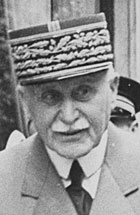
Disclosed: The Zealous Way Marshal Pétain Enforced Nazi Anti-Semitic Laws
By Lizzy Davies
The Guardian, October 3, 2010
Photo:  Time-Life Pictures/Getty Images
"The direct role played by France's collaborationist leader in the second world war persecution of the Jews was emphasised today after the draft of a decisive memo, annotated by Philippe Pétain, was made public for the first time. A hitherto unseen copy of the original statute on Jews, vehemently antisemitic legislation passed in October 1940 after defeat by the Nazis, reveals that Pétain 'completely redrafted' the memo to make it even harsher and wider-ranging, according to France's foremost Jewish historian. 'The statute on Jews was a statute that was adopted without pressure from the Germans, without the request of the Germans: an indigenous statute,' Serge Klarsfeld, a veteran lawyer, told French radio. 'And now we have decisive evidence that it was the desire of Marshal Pétain himself.' Handed by an anonymous donor to the Holocaust memorial in Paris and authenticated by experts, the papers show for the first time how Pétain, the reactionary head of Vichy, wrote his personal antisemitism into the politics of the new-born French state. Led by the Vichy government, that state would go on to aid the deportation of 77,000 Jews to concentration camps until liberation in 1944.