Monday, May 09, 2011

United States / Rwandan Genocide

"Lazare Kobagaya, 84, is on trial in Federal District Court, accused of lying about his activities in Rwanda 17 years ago." (Jeff Tuttle/Associated Press)

In Kansas Courtroom, Echoes of Rwanda Genocide
By James C. McKinley Jr.
The New York Times, May 8, 2011
"The faces in the jury box are a cross-section of southern Kansas. The judge has a white beard, wears a bow tie and speaks in the straightforward language of the Great Plains. One defense lawyer favors cowboy boots and sometimes dons bolo ties. Lazare Kobagaya, 84, is on trial in Federal District Court, accused of lying about his activities in Rwanda 17 years ago. But they are listening to testimony about a place and time in a village half a world away. On the stand, a diminutive Rwandan man with gold-rimmed glasses talks in his native language about how he participated in the murder of his neighbors during the ethnic massacres in Rwanda 17 years ago. The witness, Valens Murindangabo, is asked about a moment on April 17, 1994, when two Tutsi teenagers were captured by Hutu men in some woods. He glances at the defendant, Lazare Kobagaya, an octogenarian with a cane, whose gray head can barely be seen above the back of his chair. 'Kobagaya said, "Wipe them out, kill them,"' Mr. Murindangabo testifies. Then he says one of the men hacked the boys to death with a machete near a watering hole while Mr. Kobagaya watched from a few yards away. The defendant puts his palm to his forehead and shakes his head sadly. He dabs tears from his eyes with a handkerchief. With this testimony, and more to come over the next two months, a federal court jury will hear a detailed account of how the 1994 genocide in Rwanda was carried out in a single village near the mountainous African country’s southern border with Burundi. The jurors have been asked to decide whether Mr. Kobagaya, a former teacher and mill owner born in Burundi, incited local Hutu farmers to turn on their Tutsi neighbors in the turbulent days of April 1994. The Hutu president had died in a plane wreck, and Hutu hard-liners in the government began a genocide against Tutsi civilians, killing as many as 800,000, while a Tutsi rebel army renewed its offensive. The defense has argued that Mr. Kobagaya never participated in the mass killings but has been falsely accused by various villagers who did take part and received reduced sentences in Rwandan prisons for pointing the finger at him and others. 'What they found in the course of their investigation was a group of killers willing to make accusations,' Melanie Morgan, a defense lawyer, said in opening statements. Mr. Kobagaya, who is 84, is not being charged with genocide but with lying to immigration officials about his involvement to obtain American citizenship in 2006. Prosecutors say that he claimed on immigration forms that he lived in Burundi in 1994 and that he denied ever committing a crime. [...]"

Sunday, May 08, 2011

Egypt / Violence against Christians

"Firemen fight a fire at a church surrounded by angry Muslims in the Imbaba neighborhood in Cairo late Saturday, May 7, 2011. Christians and Muslims fought in the streets of western Cairo in violence triggered by word of a mixed romance, Egypt's official news agency reported." (AP Photo)
Mobs Set Egypt Churches on Fire, 12 Killed
By Sarah El Deeb
Associated Press dispatch on Yahoo! News, May 8, 2011
"Muslim mobs set two churches on fire overnight in Cairo during sectarian clashes that left 12 dead and more than 200 injured. The deepening religious violence in military-ruled Egypt added news tensions to an already chaotic and lawless transition to democracy. Military authorities arrested 190 people, immediately sending them to military prosecutions and threatening the maximum penalty against anyone attacking houses of worship. It was the military's toughest response yet to a series of violent clashes between the two religious groups and signifies swift justice. Mobs of ultraconservative Muslims attacked the St. Menas church in the Cairo slum of Imbaba late Saturday following rumors that a Christian woman married to a Muslim man had been abducted. Local residents said a separate mob of youths armed with knives and machetes attacked the Virgin Mary church several blocks away with firebombs. 'People were scared to come near them,' said local resident Adel Mohammed, 29, who lives near the Virgin Mary Church. 'They looked scary. They threw their firebombs at the church and set parts of it ablaze.' During Egypt's 18-day uprising that ousted former President Hosni Mubarak several months ago, there was a rare spirit of brotherhood between Muslims and Christians. Each group protected the other during prayer sessions in Cairo's Tahrir Square, the epicenter of the revolution. But in the months that followed the toppling of Mubarak on Feb. 11, there has been a sharp rise in sectarian tensions, fueled in part by newly active ultraconservative Muslim movement, known as the Salafis. The once quiescent Salafis have become more assertive post-revolution in trying to spread their ultraconservative version of an Islamic way of life. In particular, they have focused their wrath on Egypt's Christians, who make up 10 percent of the country's 80 million people. On Friday, a few hundred Salafis marched through Cairo celebrating al-Qaida leader Osama bin Laden and condemning the US operation that killed him. Egypt's state news agency said of those killed, at least six Muslims and at least three Christians were among those killed. The body of one Christian was found inside the St. Menas church, the agency said. The Health Ministry said 12 had died and more than 230 were injured, at least 11 of them critically.

Thursday, May 05, 2011

North Korea

North Korean Prison Camps Massive and Growing
By Mark McDonald
The New York Times, May 4, 2011
"New satellite images and firsthand accounts from former political prisoners and former jailers in North Korea have confirmed the enormous scale and bleak conditions of the penal system in the secretive North, according to a report released Wednesday by the human rights group Amnesty International. A satellite image shows the Yodok prison camp in North Korea, mentioned in an Amnesty International report released Wednesday. The report estimates that the North's network of political prisons holds 200,000 prisoners. Former inmates at the political labor camp at Yodok, North Korea, said they were frequently tortured and had been forced to watch the executions of fellow prisoners, the report said, noting that the North's network of political prisons is estimated to hold 200,000 inmates. 'North Korea can no longer deny the undeniable,' said Sam Zarifi, the Asia Pacific director of Amnesty International. 'For decades, the authorities have refused to admit to the existence of mass political prison camps. These are places out of sight of the rest of the world.' The report says that almost all of the human rights protections that international law has tried to set up for the past 60 years 'are ignored.' After comparing recent satellite photos of prison camps with images from 10 years ago, Mr. Zarifi said, Amnesty International became concerned that the 'prison camps appear to be growing.' North Korea's work farms and prison factories are the world's most notorious, according to human rights experts. Political prisoners sentenced to hard labor initially included landlords, purged party officials and the religiously active, according to Stephan Haggard and Marcus Noland, the authors of 'Witness to Transformation,' an authoritative study of North Korean refugees. Political prisons, they said, also now hold 'anyone guilty of political or ideological crimes or even suspected of disloyalty,' adding that the system shows 'little pretense of due process.'

Wednesday, April 27, 2011

Turkey / Armenia

"The controversial and uncompleted monument in Kars is being dismantled." (Associated Press)
Hand of Friendship is Withdrawn as Turkey and Armenia Squabble
By Shaun Walker
The Independent, April 27, 2011
"A monument built to celebrate friendship between Turkey and Armenia is being dismantled, in a gesture that shows how much an attempted rapprochement between the two nations has stalled. The statue, in the eastern Turkish city of Kars, depicts two figures emerging from a single mass, signifying common ground between nations with a bitter and difficult history, and was commissioned in 2006 to commemorate cautiously improving ties between them. The countries have been in dispute over the mass killings of up to 1.5 million Armenians during the First World War which Armenia, along with most of the rest of the world, says was genocide but which Turkey refuses to acknowledge as such. Ankara insists that deaths occurred on both sides during a situation of civil war. A crane has been brought to dismantle the 35-metre statue and yesterday the head from one of the figures, which alone weighed 19 tonnes, was removed. The demolition process is expected to take more than a week. 'I am really sorry, sorry on behalf of Turkey,' said Mehmet Aksoy, creator of the monument. 'They can demolish it, we will re-make it.' Tentative efforts at mending ties between Turkey and Armenia started a few years ago, and in 2008 negotiations began to open the long-sealed border between the countries, which would have boosted trade and commerce and proved especially useful to landlocked Armenia. Last year talks were abandoned, and rhetoric between the two has become increasingly tense.

Saturday, April 23, 2011

Syria

Bloodbath New Threat to Assad
The Sydney Morning Herald, April 24, 2011
"US President Barack Obama has condemned Syria's 'outrageous' use of violence, after Syrian security forces met thousands of demonstrators with fusillades of live ammunition, killing at least 81 people in the bloodiest day of the five-week-old Syrian uprising. Protesters gathered on Friday in at least 20 cities and towns, including in the outskirts of the capital, Damascus. Cries for vengeance intersected with calls for the government's fall, marking a potentially dangerous new dynamic in the revolt. 'We want revenge, and we want blood,' said Abu Mohamed, a protester in Azra, a southern town that had the highest death toll on Friday. 'Blood for blood.' The breadth of the protests -- and people's willingness to defy massed security forces -- painted a picture of turmoil in one of the Arab world's most authoritarian countries. In scenes unprecedented only weeks ago, protesters tore down pictures of President Bashar Assad and toppled statues of his father Hafez in two towns on the capital's outskirts. Coming a day after Mr. Assad endorsed the lifting of draconian emergency rule, the killings were another chapter in the government's strategy of alternating promises of concessions with a grim crackdown that has left it staggering but still entrenched. 'There are indications the regime is scared and this is adding to the momentum, but this is still the beginning,' said Wissam Tarif, executive director of Insan, a Syrian human rights group. Abu Nadim, a protester in Douma, on the outskirts of Damascus, said: 'We are not scared any more. We are sad and disappointed at this regime and the president. Protests, demonstrations and death are now part of the daily routine.' In a sharply worded statement, President Obama said the 'outrageous use of violence to quell protests must come to an end now.Instead of listening to their own people, President Assad is blaming outsiders while seeking Iranian assistance in repressing Syria's citizens through the same brutal tactics that have been used by his Iranian allies.' In the capital, hundreds gathered after Friday prayers at the al-Hassan Mosque. But security forces dispersed the protests with tear gas, witnesses said. [...]"

Hungary / Roma-Gypsies

"Some 277 women and children were moved out in a convoy of busses." (AP)
Gipsies Flee as Far-Right Open "Training Camp"
By Matthew Day
The Telegraph, April 22, 2011
"Nearly 300 gipsies have been evacuated out of a remote Hungarian village where a three-day, far-Right 'training camp' has been set up. The gipsies, fled Gyongyospata, 50 miles from Budapest, after members of Vendro, a paramilitary group arrived. The Hungarian Red Cross said it was the first time it had evacuated Hungarian civilians threatened by paramilitary activity since the Second World War. The far-Right Jobbik party won 17 per cent of the vote in a general election in the country last year. Some 277 women and children were moved out in a convoy of busses Janos Farkos, deputy leader of the Hungarian Roma Rights Organisation, said that the village's Roma population had felt 'terrorised' by the presence of the far-right activists. 'The children had to be sent away this weekend because they wouldn't be able to sleep at night,' Mr. Farkos said. Vendro's website said it expected 'all those who loved their country and wanted to learn basic self-defence and military training' to attend. The camp and evacuation will stoke already simmering tensions between Hungary's Roma community and the vocal and popular far-right movements such as Jobbik, an ultra-nationalistic party that campaigns with a hard-line Roma policy and which scooped 17 per-cent of the vote in last year's general election."
[n.b. This is the complete text of the dispatch. Interesting that only women and children were evacuated. Was that a decision of the community, or the Red Cross?]

Saturday, April 16, 2011

Croatia / International Tribunals

"Gen. Ante Gotovina, center, talked to his lawyers on Friday at The Hague, where he was sentenced to 24 years in prison." (Jerry Lampen/Pool photo)
UN Court Convicts Two Croatian Generals of War Crimes and Frees a Third
By Marlise Simons
The New York Times, April 15, 2011
"In a shock to Croatia over its conduct of Balkan warfare in the 1990s, a United Nations court on Friday found a Croatian general, Ante Gotovina, guilty of war crimes and crimes against humanity in a campaign he led to regain Croatian land and drive Serbs out of the Krajina region in 1995. The verdicts of three Croatian generals accused of war crimes were shown on a large screen on a street in Zagreb, drawing an emotional response from the crowd. General Gotovina, who was arrested in the Canary Islands in 2005 after four years on the run, was sentenced to 24 years in prison because troops under his command shelled towns, looted, killed and persecuted civilians. The court sentenced Mladen Markac, another general in the campaign, to 18 years, but acquitted a third, Ivan Cermak, of all charges and ordered his release. The decisions by a three-judge panel of the Yugoslav war crimes tribunal in The Hague were in effect an indirect verdict on the late president of Croatia, Franjo Tudjman, who died in 1999 as prosecutors at The Hague were planning to have him indicted. The court said Mr. Tudjman was the leader of a 'joint criminal enterprise' to drive Serbs from Krajina, a hilly region they had long inhabited in central and southern Croatia, and to repopulate the area with Croats only. In 1991 Serbian rebels, backed by Belgrade, broke away and created a separate statelet there. The verdicts also raised fresh questions about the role Croatia says American advisers played in the campaign, a turning point in the Balkan wars of 1991-95. During and after the operation to drive Serbian military and police forces from Krajina, about 300 civilians were killed, many in their homes, and some 90,000 Serbs fled Croatia. Thousands of their abandoned homes were looted and burned. The campaign was planned by Mr. Tudjman and Croatian commanders, who have said they were helped by active and retired American military personnel.

Wednesday, April 13, 2011

Iraq / United States

Crime against Humanity at Camp Ashraf
By Lord David Waddington
The Independent, April 12, 2011
"Last week Iraqi forces entered a camp in Iraq housing members of the Iranian opposition group, the People's Mojahedin Organisation of Iran (PMOI). Thirty three residents were killed and over 300 wounded. Were the US authorities, as it has been suggested, told of the intended attack by the Iraqi Government? If they were, then surely members of the US government were complicit in a crime against humanity. And of course it shows that the US administration is continuing to appease the regime in Tehran whose influence over the Iraq government grows and grows. The raid which took place at 5am on Friday 8 April, involved 2,500 severely armed Iraqi forces entering the Camp in armoured vehicles and Humvees, with video footage filmed by the residents clearly showing Iraqi forces running over unarmed residents and firing indiscriminately at them. Under any parameter of international law such a massacre of unarmed civilians is a war crime and a crime against humanity. Unfortunately, this is the latest indication that Iraq's Prime Minister Nouri Al-Maliki has no qualms about breaching international law and massacring innocent civilians in order to please his paymasters in Tehran. Al-Maliki continues to lead Iraq into becoming a puppet state which ultimately falls under the leadership of Tehran's Mullahs. In this climate it becomes even more disturbing to know that unarmed civilians to whom the US authorities gave personal guarantees as to their protection and to whom 'protected persons' status under the Fourth Geneva Convention were granted, were left to be butchered in such a way. Based on the current information available it appears that US forces stationed inside the Camp were ordered by their command in Baghdad to withdraw from Camp Ashraf and not to act in any way in preventing the attack. Furthermore given the presence of US Defence Secretary Robert Gates in Iraq at the time of the attack, there exists the possibility that the US authorities provided the Iraqi authorities with an informal go-ahead to carry out the attack. The actions of the US authorities in failing to prevent the attack is a clear breach of their duty under international law to guarantee the safety of 'protected persons' under the Fourth Geneva Convention. This duty falls upon each and every UN member state, but specifically upon the US and its Coalition members who provided the residents with a guarantee to ensure that their rights under international law would be safeguarded. [...]"
Nazi Holocaust

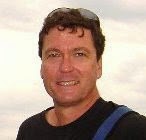
"Kazimierz Piechowski in 2011. 'We just planned that I would play the role of an SS officer so well that the guards would believe me.'" (Christian Sinibaldi/The Guardian)
I Escaped from Auschwitz
By Homa Khaleeli
The Guardian, April 11, 2011
"On 20 June 1942, the SS guard stationed at the exit to Auschwitz was frightened. In front of him was the car of Rudolph Höss, the commandant of the infamous concentration camp. Inside were four armed SS men, one of whom -- an Untersturmführer, or second lieutenant, was shouting and swearing at him. 'Wake up, you buggers!' the officer screamed in German. 'Open up or I'll open you up!' Terrified, the guard scrambled to raise the barrier, allowing the powerful motor to pass through and drive away. Yet had he looked closer, the guard would have noticed something strange: the men were sweating and ashen-faced with fear. For far from being Nazis, the men were Polish prisoners in stolen uniforms and a misappropriated car, who had just made one of the most audacious escapes in the history of Auschwitz. And the architect of the plot, the second lieutenant, was a boy scout, to whom the association's motto 'Be prepared' had become a lifeline. Almost 70 years later, prisoner 918 is holding forth in the home of the scouting association, Baden Powell House in London. At 91, he is impeccably dressed, with a face as wrinkle-free as his well-ironed shirt. As he accepts the ceremonial neckerchief from a shy girl scout from Lancashire, he is as straight-backed as any of the teenagers on parade. In the UK as the guest of a British singer, Katy Carr, who has written a song about his experiences, he is thrilled when the scouts and guides join her to sing for him. Yet in between the traditional trappings of a jamboree, Kazimierz Piechowski, or Kazik as he likes to be called, will tell them a story few in the UK have heard -- how, during Nazi occupation, scouts their age were murdered in the streets, while others like him were sent to concentration camps to witness the horror of Hitler's Final Solution. ... 'We were only the second transportation to the [Auschwitz I] camp,' Piechowski says, 'and we had to help build it.' The old collection of buildings that made up the original concentration camp was not big enough to house all those caught in mass arrests, so inmates were forced to work 12- to 15-hour days to construct a new camp next door that would become notorious as the Nazis' biggest death camp. ... For six weeks, Piechowski was set to work carrying corpses after executions. 'The death wall was between blocks 10 and 11. They would line prisoners up and shoot them in the back of the head.' At the end there would be a pile of naked corpses and Piechowski would take the ankles, while another man held the arms, and throw them on to carts, to transport them to the crematorium. 'Sometimes it was 20 a day, sometimes it was a hundred, sometimes it was more. Men, women and children.' He looks at me fiercely. 'And children,' he repeats. [...]"

Saturday, April 09, 2011

Israel / Nazism / Genocide Tribunals

Adolf Eichmann on trial in Jerusalem, 1961. (Kino International; from the documentary film "The Specialist")
Why the Eichmann Trial Really Mattered [Review of Deborah Lipstadt, "The Eichmann Trial"]
By Franklin Foer
The New York Times, April 8, 2011
"To write about the trial of Adolf Eichmann is to put its most notorious court reporter, Hannah Arendt, in the dock. In the nearly 50 years since its publication, her account of those proceedings, 'Eichmann in Jerusalem,' has come to overshadow its subject. The book, it is true, commands attention. It is a breathtaking admixture of genres (history, philosophy, journalism) and contains strong, often unconventional, moral judgments (especially her contempt for the Jewish leaders who cooperated with their murderers). It aims to render grand historical conclusions but remains unintentionally and inescapably personal. 'The Eichmann Trial,' by Deborah E. Lipstadt, can't entirely avoid Arendt, but it does manage to keep her largely offstage until the very end. Lipstadt has done a great service by untethering the trial from Arendt's polarizing presence, recovering the event as a gripping legal drama, as well as a hinge moment in Israel's history and in the world's delayed awakening to the magnitude of the Holocaust. Aside from Eichmann's trial, in 1961, the Holocaust has been the subject of at least two other memorable legal battles. The first, of course, was the Nuremberg tribunals -- proceedings that occurred amid the ruins of war and concentrated on the crimes of the Nazis, giving little voice to the still dazed survivors of the genocide. The second featured none other than Lipstadt herself. In 2000, she found herself the defendant in a British libel suit unsuccessfully brought by the writer David Irving, who protested her characterization of him as a Holocaust denier. This experience has made her a sensitive guide to the awkward complexities of squeezing the crimes of the Holocaust into the constricting confines of the courthouse.

Sunday, April 03, 2011

Israel / Palestine

Israeli Officials Cheer After Goldstone Rethinks War Crimes Report
AOL News, April 3, 2011
"Israeli officials feel vindicated after Judge Richard Goldstone retracted part of his harsh criticism of Israel's conduct in Gaza two years ago, and have launched a major diplomatic effort to get the United Nations to rescind the Goldstone Report. 'I found it hard to believe that Judge Goldstone, a Jew and even a Zionist, could have really believed that Israel would deliberately target Palestinian civilians,' Strategic Affairs Minister Moshe Ya'alon told a group of journalists, including AOL News, by phone. "He must have been influenced by Arab propaganda." On Friday night, Goldstone posted an op-ed on The Washington Post website, writing, 'We know a lot more today about what happened in the Gaza war of 2008-09 than we did when I chaired the fact-finding mission appointed by the UN Human Rights Council that produced what has come to be known as the Goldstone Report. If I had known then what I know now, the Goldstone Report would have been a different document. ... [Palestinian] civilians were not intentionally targeted as a matter of policy.' That has been Israel's claim all along and today, Israeli politicians celebrated. 'There are very few instances in which those who disseminate libels retract their libel. This happened in the case of the Goldstone Report,' Israeli Prime Minister Benjamin Netanyahu told his cabinet on Sunday. 'This leads us to call for the immediate cancellation of the Goldstone Report.' Goldstone had also harshly criticized the Islamist Hamas movement for its rocket attacks on Israel. Hamas spokesman Sami Abu Zuhri today said, 'Goldstone's retreat is reprehensible' and called on the UN to implement the Goldstone Report -- despite the author's change of heart about Israel.

Saturday, April 02, 2011

Ivory Coast

"Forces loyal to presidential claimant Alassane Ouattara rest about 20 kilometres north of Abidjan on Friday." (Emmanuel Braun/Reuters)
Ivory Coast Massacre Kills 1,000: Agency
CBC News, April 2, 2011
"Aid agencies are reporting mass killings in the Ivory Coast city of Duekoue, captured by fighters supporting UN-recognized president Alassane Ouattara this week. The Red Cross on Saturday said at least 800 civilians were killed in inter-ethnic violence in a single neighbourhood of the city in recent days, while the Roman Catholic charity Caritas said the number exceeded 1,000. Red Cross spokeswoman Dorothea Krimitsas said delegates from the Ivorian Red Cross had visited Duekoue on Thursday and Friday to gather evidence and saw a 'huge number of bodies.' 'We are shocked by the brutality and scale of this act,' said Dominique Liengme, head of the International Committee of the Red Cross delegation in the African country. Caritas spokesman Patrick Nicholson said workers with his agency visited the city on Wednesday. He said they saw victims who died of gunshot and machete wounds. ... It's not clear whether the armed group trying to install Ouattara as president was involved. The mass killing brings the confirmed death toll from violence since the presidential election last November, in which Ouattara was the internationally recognized winner, to 1,300 people.

Democratic Republic of the Congo

"A rape vicitm in Livungi, Congo, 2010." (Michael Kamber/The New York Times)
Explaining Congo's Endless Civil War (Review of Jason K. Stearns, Dancing in the Glory of Monsters)
By Adam Hochschild
The New York Times, April 1, 2011
"[...] The fighting has left tens or even hundreds of thousands of women gang-raped and led to what may be millions of war-related deaths; at its peak, some 3.4 million Congolese (the only one of these tolls we can be remotely sure of) were forced to flee their homes for months or years. But it draws little attention in the United States. As Jason K. Stearns, who has worked for the United Nations in Congo, points out, a study showed that in 2006 even this newspaper gave four times as much coverage to Darfur, although Congolese have died in far greater numbers. One reason we shy away is the conflict's stunning complexity. 'How,' Stearns asks, 'do you cover a war that involves at least 20 different rebel groups and the armies of nine countries, yet does not seem to have a clear cause or objective?' 'Dancing in the Glory of Monsters' is the best account so far: more serious than several recent macho-war-correspondent travelogues, and more lucid and accessible than its nearest competitor, Gérard Prunier's dense and overwhelming 'Africa's World War: Congo, the Rwandan Genocide, and the Making of a Continental Catastrophe.' A fatal combination long primed this vast country for bloodshed.

Argentina / Operation Condor

"Former army intelligence operative Raul Guglielminetti, center, and former agent of Argentina's intelligence agency SIDE, Honorio Ruiz, sit in court before their sentencing in Buenos Aires, Argentina, Thursday March 31, 2011." (AP Photo/Natacha Pisarenko)
Argentina: Ex-Agents Sentenced in Operation Condor 
Associated Press dispatch on Yahoo! News, April 1, 2011
"A court on Thursday sentenced a former army general to life in prison and three ex-state agents to 20 or 25 years for crimes against humanity committed in a notorious torture center during Argentina's military dictatorship. Ex-Gen. Eduardo Cabanillas was convicted of illegal imprisonment, torture and homicide involving 65 people held at Automotores Orletti, an auto body shop that served as an operations center for Operation Condor, a coordinated effort by South America's dictatorships to eliminate dissidents who sought refuge in neighboring countries. The crimes took place in 1976. Prosecutors says about 300 people passed through Automotores Orletti, including Uruguayans, Chileans, Bolivians and Cubans, most of whom were killed or disappeared. The federal Argentine court on Thursday also sentenced former army intelligence agent Raul Guglielminetti to 20 years in prison while former spies Honorio Martinez Ruiz and Eduardo Ruffo each received 25 years. A fifth suspect in the case, retired Col. Ruben Visuara, died in February. 'It is a glorious and historical day that we are living and that the "mothers" didn't think we'd live to see. This is legal justice,' said Tati Almeida of the Mothers of the Plaza de Mayo, an Argentine human rights group.

Saturday, March 19, 2011

Sudan / South Sudan

"South Sudan has seen an increase in violence since its vote to secede from the North in January." (Gallo/Getty)
Deadly Clashes in South Sudan
Al Jazeera English, March 19, 2011
"Heavy fighting between rebels and the south Sudanese army in the oil-producing states of Unity and Upper Nile, has left at least 70 people dead, according to an army spokesman. At least 30 soldiers and 11 rebels died in clashes that broke out on Thursday morning in Mayom county, in Unity state, Philip Aguer, a spokesman for the south's Sudan People's Liberation Army (SPLA), said. 'The fighting was very heavy, but the rebels are now being pursued,' Aguer said, who added that 34 SPLA soldiers were also wounded. ... Aguer said the fighting began after the breakdown of talks aimed at persuading the rebels, who totalled 'several hundred well-armed men,' to join the southern army. In neighbouring Upper Nile state, clashes between the army and a separate rebel group, which Aguer said was responsible for a bloody raid on the state capital Malakal last Saturday, killed 25 rebels and four SPLA soldiers. ... UN officials confirmed that heavy clashes had taken place, but they were unable to verify the casualty figures. South Sudan has seen a surge in bloody clashes between rebel groups and the army since a largely peaceful January referendum on independence, in which southerners voted almost unanimously to form their own nation. Unity and Upper Nile states are close to the south's border with the north -- its former civil war enemy who the southern government has repeatedly accused of supplying arms and providing bases for rebels. The leaders of north and south tentatively agreed on Thursday to resume talks aimed at resolving a host of outstanding issues before the international community recognises an independent south in July.

Thursday, March 10, 2011

Czech Republic / Lidice Massacre / Porrajmos (Roma Genocide)

A Czech Town Memorializes Oft-Forgotten Victims
By Jacy Meyer
The Christian Science Monitor, March 10, 2011
"Deep in the peaceful Bohemian countryside 15 miles northwest of Prague sits the village of Lidice. The town itself has been transformed into a beautiful and haunting memorial with a museum and rose garden to commemorate a brutal Nazi retaliation that razed the original town after high-ranking Nazi official Reinhard Heydrich was assassinated in Prague in 1942. In the museum, a new traveling exhibit tells the story of another group terrorized under the Nazis -- the Roma. About half a million European Roma were killed during World War II. Ninety percent of the Roma living on Czech lands are believed to have been killed. Lety, the Roma internment camp, was originally a prison work camp. It housed more than 1,000 Roma, also known as Gypsies, from 1942 to 1943; about 500 of them went to Auschwitz. Lidice Memorial staff now manage the Lety site as well as Lezaky, a second Roma internment camp, and plans are to develop memorials there as well. 'Like with the Lidice Memorial, we are trying to bring history to young people through various exhibitions,' says Ivona Kasalicka, director of the Lidice Gallery. The traveling exhibition will remain at Lidice until March 29 and then will be displayed at the Museum of Romani Culture in Brno, Czech Republic."
[n.b. This is the complete text of the dispatch.]

Tuesday, March 08, 2011

Libya

"Hundreds of African migrant workers, many from Ghana and Nigeria, live next to the airport in Tripoli, Libya, hoping to fly home." (Moises Saman/The New York Times)
Libya War Traps Poor Immigrants at Tripoli's Edge
By David D. Kirkpatrick and Scott Sayare
The New York Times, March 7, 2011
"As wealthier nations send boats and planes to rescue their citizens from the violence in Libya, a new refugee crisis is taking shape on the outskirts of Tripoli, where thousands of migrant workers from sub-Saharan Africa have been trapped with scant food and water, no international aid and little hope of escape. The migrants -- many of them illegal immigrants from Ghana and Nigeria who have long constituted an impoverished underclass in Libya -- live amid piles of garbage, sleep in makeshift tents of blankets strung from fences and trees, and breathe fumes from a trench of excrement dividing their camp from the parking lot of Tripoli's airport. For dinner on Monday night two men killed a scrawny, half-plucked chicken by dunking it in water boiled on a garbage fire, then hacked it apart with a dull knife and cooked it over an open fire. Some residents of the camp are as young as Essem Ighalo, 9 days old, who arrived on his second day of life and has yet to see a doctor. Many refugees said they had seen deaths from hunger and disease every night. The airport refugees, along with tens of thousands of other African migrants lucky enough to make it across the border to Tunisia, are the most desperate contingent of a vast exodus that has already sent almost 200,000 foreigners fleeing the country since the outbreak of the popular revolt against Col. Muammar el-Qaddafi nearly three weeks ago. Dark-skinned Africans say the Libyan war has caught them in a vise. The heavily armed police and militia forces loyal to Colonel Qaddafi who guard checkpoints along the roads around the capital rob them of their money, possessions and cellphone chips, the migrants say. And the Libyans who oppose Colonel Qaddafi lash out at the African migrants because they look like the dark-skinned mercenaries many here say the Libyan leader has recruited to crush the uprising. 'Qaddafi has brought African soldiers to kill some of them, so if they see black people they beat them,' said Samson Adda, 31, who said residents of Zawiyah, a rebellious city, had beaten him so badly that he could no longer walk.

Monday, March 07, 2011

Libya

Black Men Face Death as Both Anti- and Pro-Gaddafi Bloc Hunt Them Down
The Star/Asia News Network, March 6, 2011
"It is a scary time to be a black man in Libya. The anti-Gaddafi protesters want to lynch you because they think you are a mercenary out to kill them, while the pro-Gaddafi forces want to kidnap you and force you to fight for them. Collins Daakqah from Ghana said he saw five dead Africans in Zawiyah, which is 30km from Tripoli. 'I saw a few Africans trying to leave but some armed men wouldn't let them and shot them. We were so afraid to stay inside if those people came after us, so we had to find a way to run away,' he said when met after crossing the border into Tunisia. Owusu Isaac also from Ghana was also relieved to make it out, but his heart is heavy. His face showed worry and he seemed preoccupied. His brother Stephen has been captured by the police in Tripoli and is being made to fight with the soldiers against the anti-Gaddafi protestors. 'They didn't know my brother still had his mobile phone with him. He managed to call me just to tell me that he was being taken away by the police and that he was given weapons and asked to fight. He was scared. A policeman spotted my brother talking to me on the phone and the line went dead,' he said. 'I want to try and help my brother but I can't. I need to run for my life,' he said. The men say they are not fighters or mercenaries and had merely come over to Libya to make a living. They were working in lowly-paid jobs, mostly plastering newly-built homes and half the time they didn't even get paid. In recent weeks, Libya has exploded into violence as anti-Gaddafi protestors have taken to the streets to try and oust their leader of 41 years, Muammar Gaddafi. But their leader has responded with heavy force to put down the uprising against him and even hired African mercenaries to do the killing and these men have been prowling the streets with weapons, shooting protestors indiscriminately In response, the anti-Gaddafi protestors have gone after the Africans and captured some of the mercenaries and even killed a few.

Sunday, March 06, 2011

Kosovo / Serbia

"Serbian forces were accused of massacring 40 Kosovo Albanians in Racak in 1999." (Reuters)
Kosovo to Hold First Talks with Serbia since Independence
By Vesna Peric Zimonjic
The Independent, March 7, 2011
"Kosovo will tomorrow hold its first face-to-face talks with Serbia since declaring independence three years ago after insurgency and ethnic cleansing left 10,000 people dead and drove hundreds of thousands from their homes. The meeting in Brussels between senior officials will include discussions on the fate of 1,800 people still missing from the 1998-99 conflict and other complex humanitarian issues. Serbia has said that it will never recognise the independence of Kosovo but observers see the meeting as an opportunity for reconciliation despite obvious tensions that remain between Albanians and Serbs. The two sides agreed to the EU-sponsored talks last year to improve the lives of all those in Kosovo -- two million ethnic Albanians and a tiny Serb minority -- where unemployment stands at 50 per cent and many people are living in grinding poverty. 'We joined this process not to play a game of poker where one side will win and the other will lose, but to solve the problems of people,' said Belgrade negotiator Borko Stefanovic. But he added his team would not cross the 'clearly defined' lines regarding Serbia's refusal to accept Kosovo's independence. Serbia goes into the talks hoping to improve its international image, scarred by atrocities committed during the conflict in Kosovo when Serbia was run by Slobodan Milosevic, who died in 2006 while on trial for war crimes at The Hague. Serbia has come under heavy pressure from the EU to enter negotiations with the former province that Serbia claims as the historic birthplace of the Serb people. Serbia still refuses to allow any exports from Kosovo to pass through its territory and its stance has infuriated the EU as Serbia seeks to join the 27-nation bloc.

France / Anti-Semitism

"Orthodox Jews in the Marais district of Paris where John Galliano allegedly made his comments." (Alamy)
Jewish People in the French Capital Live in the Shadow of Hatred
By Kim Willsher
The Observer, March 6, 2011
"Like most Paris schools, the Ecole des Hospitalières-Saint-Gervais bears a sombre plaque. It reads: '165 Jewish children from this school, deported to Germany during the second world war, were exterminated in the Nazi camps. Do not forget.' In this district, known as the Marais, the heart of Paris's oldest Jewish quarter, gay bars rub shoulders with falafel cafés, kosher restaurants, synagogues and prayer rooms. Its labyrinthine streets have been home to Jews on and off since the 13th century. Ten days ago, however, it also played host to John Galliano. The alleged infamous outburst of the Dior designer, who has now been sacked, in which he is said to have abused a Jewish woman and her Asian boyfriend, was offensive on many levels -- not only because of what he allegedly said, but because of where he said it. It was in a bar just a few paces from the Hospitalières-Saint-Gervais that the couturier, who is British but has lived in the French capital for two decades, was arrested. And it was also where, last year, he was filmed telling two women he believed to be Jewish that he loved Hitler. His reported behaviour has shocked France and the fashion world. Yet in what locals call the pletzl -- "little place" in Yiddish -- it provoked little surprise. Local residents and traders say that the insult 'sale juif' (dirty Jew) is a fact of daily life; asking a local if they have suffered abuse provokes a quizzical stare as if you are trying to be funny. 'Bien sûr' ('of course') is the most common reply. 'It's stating the obvious,' says one kippah-wearing youngster in the Rue des Rosiers, the Jewish quarter's main street. 'We hear what Galliano said, or versions of it, every day, sometimes several times every day.' Like many I speak to, he prefers not to be named. Standing in the doorway of a grocery shop, Dan points to his wide-brimmed black hat. 'My 80-year-old neighbour told me that when she was growing up they used to say we Jews wore these hats to hide our horns, and long black coats to hide our tails,' he says, laughing. 'She would tell me not to let my boys wear their [skull] caps in case "they" come back. More than 50 years after the war, she still thought it could happen again.'

Argentina / National Tribunals

"Jorge Videla, left, and Reynaldo Bignone, right, are accused along with six other former military figures." (AFP/Getty)
Argentine Military Dictators on Trial over Baby Kidnappings
By Robin Yapp
The Telegraph, February 28, 2011
"Jorge Videla, who ruled Argentina from 1976 to 1981, and Reynaldo Bignone, the last leader of the military regime from 1982 to 1983, are accused along with six other former military figures. Federico Delgado, federal prosecutor, called the theft of children 'one of the darkest episodes in Argentina's history' as the case began in Buenos Aires. About 500 babies were stolen from their mothers during the dictatorship, according to the campaign group Grandmothers of the Plaza de Mayo. Pregnant female political dissidents were interned at secret maternity wards in centres used to torture opponents of the dictatorship. The babies were handed to military officers or their relatives after birth while the mothers were simply killed, many of them dropped alive from military planes into the sea. Grandmothers of the Plaza de Mayo has managed to identify 102 of the stolen babies so far, some of whom had become politicians or human rights activists. 'We were the regime's war spoils,' said 33-year-old Leonardo Fossati, who was adopted after his parents were abducted while his mother was pregnant, as he gathered with other demonstrators on the steps of the court. The eight on trial, who arrived at court in handcuffs, are accused of being responsible for 34 cases of kidnapping and falsifying children's identities.

Bangladesh / National Tribunals

"Guerrillas beat people suspected of collaborating with pro-Pakistan militias in 1971 during Bangladesh’s war for independence, a conflict that may have killed more than one million people." (Horst Faas and Michel Laurent/Associated Press)
Bangladesh Faces Atrocities of Its Independence Era
By Lydia Polgreen
The New York Times, March 5, 2011
"In the last days of the bloody war that created this nation out of the eastern half of Pakistan in 1971, a gang of men abducted Dr. Alim Chowdhury, an eye surgeon and independence activist, from his home. Three days later, his battered body was found in a mass grave, his eyes gouged from his head. His killers, members of a pro-Pakistan militia, were never punished. Moulana Abdul Mannan, the man who confessed to orchestrating the killing, according to a government investigation, went on to become a cabinet minister and member of the Bangladesh Parliament. He died in 2006. Now, 40 years after Bangladesh's independence struggle -- one of the last century's most wrenching conflicts, whose death toll may have exceeded one million people -- the government here is seeking to prosecute individuals accused of atrocities like the one against Dr. Chowdhury. The effort has touched a raw political nerve here and illustrates a conundrum of international law: Can a country, particularly a young and poor one, fairly try its own citizens for crimes against humanity? Many of those accused of atrocities are not only still alive, but are also among the leading members of two of the main opposition political parties and have enjoyed long stints in power. Six men have been arrested in connection with various crimes of the era, all of them major political figures. The government hopes to try them in a tribunal of its own creation in the coming months.

Saturday, March 05, 2011

Philosophy & Psychology of Genocide

A Philosophy of Genocide's Roots
Review of Less Than Human: Why We Demean, Enslave, and Exterminate Others, by David Livingstone Smith
By David Berreby
The New York Times, March 4, 2011
"Consider, as Americans are so wont to do these days, the zombie. Once, he was a person, just like you or me, but then he changed. Now, despite his outward resemblance to a human being, he is a different thing altogether. He cannot disguise himself. He cannot change back. Another minus: He yearns to sink his zombie-plague-spreading teeth into your brain. But no cloud lacks a silver lining: He is a convenient image for people you despise -- as in the Tucson gunman Jared Loughner's 'zombie grin,' as in the 'zombie children' whom Amy Chua's 'Tiger Mother' philosophy supposedly produces, as in the 'climate zombies,' right-wingers who question the science of global warming. In 'Less Than Human,' the philosopher David Livingstone Smith explains why this sort of talk is not superficial metaphor-slinging. Dehumanization -- representing people to be lesser, non­human creatures, as when police officers label crimes against criminals as 'N.H.I.' ('No Humans Involved'), or when Muammar el-Qaddafi calls his critics 'stray dogs' -- isn't just shabby rhetoric. Dehumanization is a mind-set, as Smith writes, that 'decommissions' our 'moral inhibitions' about mistreating fellow human beings. Encased in law and custom, this psychological process has often licensed slavery, genocide and countless other cruelties. And it is, Smith writes in this stalwart attempt to tame the mystery with philosophy, a moral and cognitive problem as old as history.

Libya

Black Men Mistaken for Mercenaries
By Jason Koutsoukis
The Sydney Morning Herald, March 6, 2011
"Thousands of African workers were attempting to flee eastern Libya last week in fear for their lives after facing accusations of being mercenaries Media reports have quoted countless eyewitness accounts of African men being paid by dictator Muammar Gaddafi to put down the February 17 uprising that has brought his regime to the brink of collapse But the international advocacy group Human Rights Watch has told The Sun-Herald that it is yet to confirm a single case of a mercenary being used in the conflict. Peter Bouckaert, the emergencies director for the group, said that, of the hundreds of suspected mercenaries detained in the east, all had turned out to be innocent workers or Libyans in the regular army. 'I cannot speak for the west of the country, in Tripoli, where reports of mercenaries being used are widespread, but of all the people interviewed by Human Rights Watch so far, we have not identified one mercenary,' he said. Mr. Bouckaert also condemned some media outlets for purporting to identify alleged mercenaries, saying the reports were untrue. He said rumours surrounding the alleged use of mercenaries had incited a level of hysteria that had led to people being lynched. The Sun-Herald has seen images depicting the bodies of alleged mercenaries killed in Bayda, a city in eastern Libya between Benghazi and Tobruk. In video taken on a mobile phone, a black man accused of being a mercenary is shown being harassed and then beaten by a crowd. On February 25 The Sun-Herald was taken to the morgue of Jalla Hospital, Benghazi, and shown the uniformed bodies of black men who had been killed in fighting in Benghazi between February 17 and February 21. Representatives of the United Nations High Commissioner for Refugees said they knew of the difficulties faced by African workers and had helped hundreds leave."

Sudan / Southern Sudan

"The U.N. head of mission in Abyei (C) greets Ngok Dinka leaders returning from a conference with the Missereyi Arab tribe on January 14, 2011." (Trevor Snapp/AFP/Getty Images)
Could Border Clashes Throw Sudan Back into War?
By Alan Boswell
Friday, March 04, 2011
"Over 100 people were killed in days of fighting in Sudan's hotly contested Abyei area, while thousands have fled southward away from the carnage. When south Sudan voted in January to secede, many observers warned that the move could lead to violence that could destabilize the entire region. U.S. Secretary of State Hillary Clinton called it a 'ticking time bomb' and New York Times columnist Nicholas Kristof saw it as a 'genocide foretold.' With Sudan only months away from dividing formally into two new countries, some are now wondering: Is this the moment it all starts falling apart? Dubbed Sudan's Kashmir, Sudan's 22-year conflict killed 2 million people before a peace deal brought fragile calm in 2005. Observers have long warned that if conflict was to break out again, it would most likely start in Abyei, a tiny area of 4,000 square miles where Sudan's northern desert peters into the marshes of the south. Claimed by both the southern Ngok Dinka, who live there year-round, and the northern Misseriya, nomadic cattle-herders who move to the area in dry months, Abyei risks being torn apart as the nation splits along the divide between its Arab north and African south.  As originally envisioned by Sudan's peace deal, the Abyei dispute was to be settled through its own special poll alongside the southern independence vote. But the Abyei vote never happened. As southerners were voting for their freedom in January, Abyei whizzed with bullets -- three days of attacks left at least 41 dead. Then this week the clashes returned with a new ferocity.

Friday, March 04, 2011

Libya

World and Press Watch as Africans Are Lynched in Libya
by Farouk Martins Aresa
By Francis Tawiah
Modern Ghana (undated: March 2, 2011?)
"The whole world is watching, the whole world is watching, the whole world is watching as innocent Africans are being lynched in Libya. The time to act is right now since nobody acted yesterday or day before. It started as a rumor, then it was reported on social network and now we know it is real. The world must act and act quickly. There are men, women and children dying in the hands of Libyan mobs simply because they look Africans and must therefore be mercenaries because they cannot place their hands on Gadhafi. Mercenaries come in different colors and nationalities and these Africans are ordinary workers like the Egyptian and Tunisians. We are demanding a special meeting of United Nation to discuss the elimination of Africans by lynching in Libya. If it was any other group, the world will be crying genocide. Not only are African families in danger, Libyan blacks will be lynched before they open their mouths and speak Arabic. Most people watching the atrocities on face book would have seen Arabian features on some of the people caught and tortured to death. The press published stories of Anti-Gadhafi forces cutting Africans into pieces and posting it on internet but it is yet to catch world outcry or outrage. There is no mention of it at the United Nations by African leaders and countries getting first hand reports are silent. These are not collateral damages of war, these are brutalities of war that must be addressed.

Friday, February 25, 2011

Libya / United Nations / Genocide Intervention

"Distinguished Members of the Council, Madam President,

"My Special Advisers on the Prevention of Genocide and the Responsibility to Protect have reminded the national authorities in Libya, as well as in other countries facing large-scale popular protests, that the heads of State and Government at the 2005 World Summit pledged to protect populations by preventing genocide, war crimes, ethnic cleansing, and crimes against humanity, as well as their incitement.

"The challenge for us now is how to provide real protection and do all we can to halt the ongoing violence."


Ban Ki-moon, UN Secretary-General
Remarks to Security Council Meeting on Peace and Security in Africa
February 25, 2011

Tuesday, February 22, 2011

Libya / International Criminal Court

Photo: Getty Images
This Evil Despot Must Be Brought to Justice
By Geoffrey Robertson
The Independent, February 23, 2011
"Colonel Gaddafi is the worst man left in the world. His bloodstained record of terrorism, torture and mass murder deserves punishment many times over and a people liberated from the moronic tenets of his Green Book might, if they get the chance, string him up in revenge. But the days of hanging dictators from lampposts are over. International justice must take the place of righteous lynch mobs. Alternatively, if Colonel Gaddafi crushes the revolt, it must ensure that he is hunted down should he set foot again outside Libya. The Security Council, disgracefully slow in responding to this crisis, has an urgent duty either to establish an international court to try Gaddafi or (more simply) to require the prosecutor of the International Criminal Court to investigate and indict him for the massacre of protesters. The ICC has been cutting its teeth on a few Congo warlords and gnashing them over Sudan's President Omer Hassan al-Bashir (although its indictment might have prompted yesterday's announcement of his early retirement). Its treaty has now been ratified by 114 nations and the irrational hostility of the Bush era has been replaced by cautious support from President Barack Obama. Libya, of course, is not a member of the ICC (and nor are any other Arab countries except Jordan and Djibouti -- a situation which new powers in Egypt, Tunisia and elsewhere will be advised to change). But Colonel Gaddafi can be brought within the court's jurisdiction by a Security Council direction -- as was Mr. al-Bashir when the council referred the situation in Darfur to the ICC prosecutor.

India / Gujarat Genocide

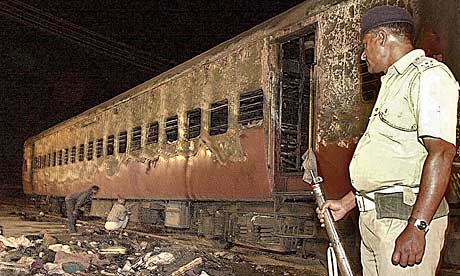
"The Godhra train fire killed 60 Hindu pilgrims and activists in February 2002 and triggered some of the worst communal violence in India in decades." (Sebastian D'Souza/AFP/Getty Images)
Godhra Train Fire Verdict Prompts Tight Security Measures
By Jason Burke
The Guardian, February 22, 2011
"India has imposed tight security measures across much of the western state of Gujarat following the conviction of 31 Muslim men for setting fire to a train in which 60 Hindu pilgrims and activists died nine years ago. The incident, which took place in the town of Godhra in February 2002, triggered some of the worst inter-communal violence in India for decades. More than 1,200 people, mainly from the minority Muslim community, were killed as groups of Hindus rioted in Muslim neighbourhoods and towns across the state. Gujurat security officials fear a repeat of the violence following the verdict. Public gatherings of more than four people in areas seen as prone to violence have been prohibited, local media have been asked not to broadcast images of the clashes that followed the attack on the train, and around 15,000 extra police have been deployed. The families of the more than 60 people acquitted of taking part in the train attack have been given police protection. Those convicted are to be sentenced later in the week. Many have been in jail for years, arrested soon after the violence. Special public prosecutor JM Panchal said he was satisfied with the verdict. The case has become highly politicised, reflecting deep divides in India. The chief minister of Gujarat, Narendra Modi -- a rising star in the rightwing Hindu nationalist Bharatiya Janata party (BJP) -- has been repeatedly accused of failing to stop Hindu revenge attacks. Modi has always denied such claims, but they have tarnished his image and that of the state, one of India's most successful in economic terms. A BJP spokesman said after the verdict that 'law and justice has prevailed', adding: 'There were elements who were trying to belittle [the case]. There have been politicians who tried to abuse it.' An investigation by a judge six years ago had concluded that the train fire had been an accident. However, a separate inquiry found it had been pre-planned and that the train, having been doused in petrol, was deliberately set alight by a mob. Commentators say that inter-communal strife following the verdict is unlikely. Last year, calm followed a controversial court decision over the disputed religious site of Ayodhya in northern India which granted many of the demands of Hindu religious groups, leading many to conclude that the days when sectarian issues could explode into street violence are over."
[n.b. This is the complete text of the dispatch.]

Israel / Palestine / Apartheid

"Avigdor Lieberman, Israel's foreign minister, addresses a news conference at the European council in Brussels." (Francois Lenoir/Reuters)
Israeli Foreign Minister Accused of Apartheid in Attempted Citizen's Arrest
By Leigh Phillips
February 22, 2011
"An Irish journalist has attempted a citizen's arrest of the Israeli foreign minister, Avigdor Lieberman, outside a meeting of the EU-Israel Association council in Brussels. 'Mr. Lieberman, this is a citizen's arrest. You are charged with the crime of apartheid. Please accompany me to the nearest police station,' David Cronin told the Israeli minister as he entered the press room of the European council. Cronin, a freelance journalist who has written for the Economist, the Inter Press Service news agency and the Guardian's Comment is Free, was restrained by security guards and escorted from the building, shouting 'Free Palestine'. It is not the first time Cronin, a member of the Brussels press corps since 1998, has attempted such a manoeuvre. Last March he placed his arm on Tony Blair and announced that the former prime minister was under citizen's arrest for his role in the invasion of Iraq. On that occasion, his press pass was revoked but returned after a warning. The reporter was released without charge after the latest incident. However, Cronin reports that the head of security for the council has informed him that this time the pass will be permanently revoked. 'He told me: "If you come into my house, you have to behave yourself." It's a price I'm willing to pay though. Apartheid -- the domination by one racial group over another -- has been recognised as a crime by the UN since 1973. Israel is an apartheid state, both in the occupied territories and in Israel itself.' ... Yoel Mester, a spokesman for the Israeli mission to the EU, said the ambassador will not be pressing for tighter security for future visits of Israeli dignitaries. 'This was utterly uncivilised, in bad taste. But Israel, like the EU, is very supportive of free speech. It's just a shame that some people take advantage of that freedom sometimes.' [...]"

Libya

Qaddafi's Grip on the Capital Tightens as Revolt Grows
By Kareem Fahim and David D. Kirkpatrick
The New York Times, February 22, 2011
"Vowing to track down and kill protesters "house by house," Col. Muammar el-Qaddafi of Libya tightened his grip on the capital of Tripoli Tuesday, but the eastern half of the country was slipping beyond his control. A bloody crackdown drove protesters from the streets of Tripoli, where residents described a state of terror. The independent group Human Rights Watch said it had confirmed 62 deaths in two hospitals after a rampage Monday night, when witnesses said groups of heavily armed militiamen and African mercenaries cruised the streets in pickup trucks spraying crowds with machine gun fire. The death toll was likely higher; one witness said militia forces appeared to be using vans to cart away bodies. After Colonel Qaddafi's televised speech Tuesday night, thousands of his supporters converged in Tripoli's central Green Square, wearing green bandanas and brandishing oversized machetes. Many loaded into trucks headed for the outlying areas of the city, where they occupied traffic intersections and appeared to be massing for neighborhood-to-neighborhood searches. 'It looks like they have been given a green light to kill these people,' one witness said. [...] Wearing a beige robe and turban and reading at times from his manifesto, the Green Book, Colonel Qaddafi called the protesters 'cockroaches' and blamed the unrest shaking the country on foreigners, a small group of people distributing pills, brainwashing, and young people's naïve desire to imitate the uprisings in Egypt and Tunisia. He urged citizens to take to the streets and beat back the protesters, and he described himself in sweeping, megalomaniacal terms. 'Muammar Qaddafi is history, resistance, liberty, glory, revolution,' he declared. [...]"

Sunday, February 20, 2011

Uganda

Victims of Uganda's Lord's Resistance Army
By Joe Bavier
The Telegraph, February 18, 2011
"Valentine Mbolibirani was harvesting peanuts near her home in eastern Central African Republic when the gunmen arrived. It was 2009 and she was 14 years old. The men, members of the Lord's Resistance Army (LRA), the notorious Ugandan rebel group, had terrorised the nearby villages for more than a year, appearing suddenly out of the dense forest to loot and take captives before vanishing again. Yet Valentine, like most of her neighbours, knew little about them. 'They told us they'd come to surrender,' she said. ‘Villagers arrived to see what was happening. Then a man rode by on a bicycle, and they knocked him to the ground and kicked him. We knew then that we were their prisoners. I was taken with my little sister. There were 14 of us in all.' At one of the rebels' main camps, Valentine was summoned to a grass-roofed hut and told to ready herself. She was about to be raped by Africa's most wanted war criminal, Joseph Kony. Nearly 25 years ago Kony, a former altar boy and self-styled mystic, announced that he had received instructions from the spirit world, ordering him to overthrow Uganda's president, Yoweri Museveni, and impose the Ten Commandments as the law of the land. Today, the 50-year-old warlord's army, responsible for Africa’s longest-running armed conflict, espouses no political programme and exists primarily to shield Kony and his top commanders from war crimes indictments issued by the International Criminal Court in 2005. Theirs is a campaign of incalculable brutality. Over two decades in Uganda, LRA rebels attacked the villages of their own Acholi people, displacing some two million civilians. Untold thousands were killed; exact figures do not exist.

Israel / Palestine / Genocide Studies

"Palestinians evacuate the village of Zenin in 1948. Some scholars say that what is now called 'ethnic cleansing' constitutes a form of genocide." (Getty Images)
Top Genocide Scholars Battle Over How To Characterize Israel's Actions
By Gal Beckerman
Forward.com, February 16, 2011
"Did Jews commit genocide in 1948? The question is provocative, and the answer for most people is an unequivocal no. But a debate over this idea has formed the crux of a heated argument among the most eminent genocide scholars in the world, and led recently to the censure of an Israeli professor by the field’s leading academic association. It's also one more reminder of the growing divide between European scholars and their American and Israeli counterparts when it comes to how they view Israel, both historically and in the present moment. The debate began in the pages of a scholarly publication, the Winter 2010 issue of the Journal of Genocide Research. Two specialists in genocide, Omer Bartov of Brown University and Martin Shaw of Roehampton University, in London, engaged in a back-and-forth exchange about whether the word 'genocide' could be applied to the expulsion and killing of Arabs in Palestine during Israel's War of Independence. During the course of the war, more than 700,000 Palestinians fled or were forced out of their homes and were later prevented from returning, creating what would become one of the world’s most enduring refugee crises. Both Bartov and Shaw agreed that some form of what is now called 'ethnic cleansing' did occur. But where Bartov was not willing to think of this as genocide, Shaw confidently argued that any policies meant to destroy a group, even if not outright murder, should be seen as genocide.

Friday, February 18, 2011

Poland / Jewish Holocaust / Genocide Memorials

"Efforts are underway to update the exhibitions at Auschwitz. Above, Piotr Cywinski, the director of the Auschwitz-Birkenau State Museum." (Piotr Malecki/The New York Times)
Auschwitz Shifts From Memorializing to Teaching
By Michael Kimmelman
The New York Times, February 18, 2011
"For nearly 60 years, Auschwitz has told its own story, shaped in the recent aftermath of the Second World War. It now unfolds, unadorned and mostly unexplained, in displays of hair, shoes and other remains of the dead. Past the notorious, mocking gateway, into the brick ranks of the former barracks of the Polish army camp that the Nazis seized and converted into prisons and death chambers, visitors bear witness via this exhibition. Now those in charge of passing along the legacy of this camp insist that Auschwitz needs an update. Its story needs to be retold, in a different way for a different age. Partly the change has to do with the simple passage of time, refurbishing an aging display. Partly it's about the pressures of tourism, and partly about the changing of generations. What is the most visited site and the biggest cemetery in Poland for Jews and non-Jews alike, needs to explain itself better, officials here contend. A proposed new exhibition at the Auschwitz-Birkenau State Museum here, occupying some of the same barracks or blocks, will retain the piled hair and other remains, which by now have become icons, as inextricable from Auschwitz as the crematoria and railway tracks. But the display will start with an explanatory section on how the camp worked, as a German Nazi bureaucratic institution, a topic now largely absent from the present exhibition, which was devised by survivors during the 1950s. Back then they wished to erase the memory of their tormenters, as the Nazis had tried to erase them, so they said as little as possible in their exhibition about the Germans who had conceived and run the camp. They focused on mass victimhood but didn't highlight individual stories or testimonials of the sort that have become commonplace at memorial museums as devices to translate incomprehensible numbers of dead into real people, giving visitors personal stories and characters they can relate to.

Sunday, February 13, 2011

Greece / Germany / Nazism

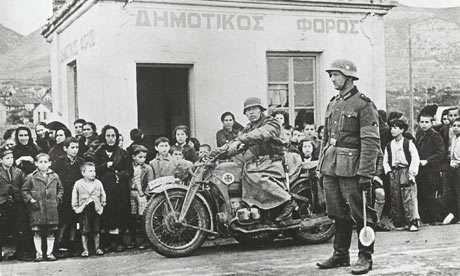
"Greek civilians look on as the Germany army makes its way to Thessaloniki in April 1941." (Getty)
Athens Backs Villagers' Fight for German Compensation over 1944 SS Massacre
By Helena Smith
The Observer, February 13, 2011
"A Nazi massacre remembered by Greeks as one of the worst atrocities of the second world war is threatening to plunge relations between Athens and Berlin to a new low amid rising criticism of Germany's failure to pay compensation. The diplomatic dispute erupted last month after the Greek prime minister, George Papandreou, pledged his government would support the compensation claims of survivors and relatives of the massacre in the village of Distomo in June 1944, which left 218 people dead. No previous administration has dared touch the case for fear of tensions with Germany. 'This is about history. This is not anti-German,' the Socialist leader told the Observer. 'It is about something that happened over 60 years ago, of honouring the memory of Greek citizens who were sacrificed for their country.' At a time when Athens is fighting off bankruptcy with austerity measures – demanded by international creditors after the biggest bailout in history -- Papandreou's move is popular. Under Nazi occupation from April 1941, more than 300,000 Greeks starved to death, 130,000 were executed in reprisals, and most of the Jewish community was sent to the gas chambers. The tragedy at Distomo, near Delphi, is ingrained in the national consciousness. Children are taught that on 10 June 1944 some 218 men, women and children were slaughtered by a Waffen-SS unit in reprisal for an ambush on German troops outside the village. It occurred on the same day as the SS massacre at Oradour-sur-Glane in France. Bodies were found dangling from trees by the road to the village when a Red Cross team visited days later.

Saturday, February 05, 2011

United States / Switzerland / Universal Jurisdiction

Bush Trip to Switzerland Called Off Amid Threats of Protests, Legal Action
By Peter Finn
The Washington Post, February 5, 2011
"A planned trip to Switzerland next week by George W. Bush was canceled after human rights activists called for demonstrations and threatened legal action over allegations that the former president sanctioned the torture of terrorism suspects. The New York-based Center for Constitutional Rights and several European human rights groups said they were planning to file a complaint against Bush and wanted Swiss prosecutors to open a criminal case against him once he arrived in the country. In what would have been his first European trip since leaving the presidency, Bush was scheduled to speak in Geneva on Feb. 12 at a dinner in honor of the United Israel Appeal. A lawyer for the organization said Bush's appearance was canceled because of the risk of violence, and that the threat of legal action was not an issue. 'The calls to demonstrate were sliding into dangerous terrain,' the lawyer, Robert Equey, told the Swiss daily Tribune de Geneve. A spokesman for Bush said the former president regretted that his speech was canceled. 'President Bush was looking forward to speaking about freedom and offering reflections from his time in office,' David Sherzer said in an e-mailed statement.

Friday, February 04, 2011

Rwanda / Media and Genocide

One Man's Rwanda: Philip Gourevitch Softens Some Hard Truths
By Tristan McConnell
"There had been ethnic massacres in Rwanda before, but nothing on the scale of the genocide that began in April 1994. The killing had been over for nearly a year when a young American reporter, Philip Gourevitch, set foot in Rwanda for the first time the following May. The bodies of the dead were reverting to bone but memories were still raw. Gourevitch wrote of accidentally crushing a skull beneath his foot, so thick were the dead at a massacre site, and of the eerie emptiness of a country where so many had died so violently and so recently. In his first dispatch from Rwanda for The New Yorker, seven months after arriving, he wrote, 'It almost seemed as if, with the machete, the nail-studded club, a few well-placed grenades, and a few bursts of automatic rifle fire, the quiet orders of Hutu Power had made the neutron bomb obsolete.' Over three years, Gourevitch spent months at a time in the Great Lakes region of Central Africa, committing himself more wholly to the story of the genocide's aftermath than perhaps any other foreign journalist. The New Yorker ran eight of his lengthy articles during this period as he travelled tirelessly across Rwanda, to remote villages and regional towns as well as the capital. He met ordinary Tutsi survivors, imprisoned Hutu perpetrators, and the leaders of the Rwandan Patriotic Front, or RPF, the rebel army that had ended the genocide and taken control of the country. Gourevitch developed enduring contacts within the upper echelons of the RPF. He often interviewed Major General Paul Kagame, the head of the army, who would, years later, become president. From his first New Yorker article about Rwanda, Gourevitch portrayed Kagame as calm, intelligent, thoughtful, and questioning -- a man who, having stopped a great evil, was working against immense odds and in difficult circumstances to fix his broken country. That portrayal has remained fixed over the years. ...

Thursday, February 03, 2011

Endorsing Denial of the 1994 Genocide against the Tutsi: Open Letters to Professor Noam Chomsky

By Roland Moerland
Lecturer, Faculty of Law, Maastricht University, Netherlands
February 3, 2011

Dear Professor Chomsky,

In 1967 you published a special supplement to The New York Review of Books in which you critically addressed the responsibility of intellectuals. Intellectuals, you wrote, have a deep responsibility “to seek the truth lying hidden behind the veil of distortion and misrepresentation, […], through which the events of current history are presented to us.”

Although your article was written and published more than forty years ago, the argument is highly relevant, because abuses of power still lead to vast human suffering. I believe that much of what you have written after 1967 up to your recent publications reflects these ideas and principles.

I was therefore shocked and disappointed to find out that you, as a highly distinguished intellectual, should write the foreword to the book The Politics of Genocide, which in chapter 4 includes one of the most flagrant cases of denial of the 1994 genocide against the Tutsi that I have ever seen. I find it extremely hard to understand why you would endorse such a gross denial of human suffering. [...]

[Read the full text of the open letters.]

Jewish Holocaust / Genocide Memorials

"This picture taken Jan. 28, 2011, shows people walking through the Nazi death camp Auschwitz-Birkenau in Oswiecim, Poland. The red brick barracks that housed starving inmates are sinking into ruin, and officials launched a global campaign to raise euro120 million ($165 million) to create a 'perpetual fund' whose interest can be drawn on indefinitely to repair barracks, watchtowers, crematoria and other structures at the Auschwitz-Birkenau state museum and memorial in southern Poland." (Czarek Sokolowski/AP)
"Ravages of Time" Leave Auschwitz Decaying
By Vanessa Gera
Associated Press dispatch on MSNBC.com, February 3, 2011
"The red brick barracks that housed starving inmates are sinking into ruin. Time has warped victims' leather shoes into strange shapes. Hair sheared to make cloth is slowly turning to dust. Auschwitz is crumbling -- the world's most powerful and important testament to Nazi Germany's crimes falling victim to age and mass tourism. Now guardians of the memorial site are waging an urgent effort to save what they can before it is too late. Officials last week launched a global campaign to raise euro120 ($165 million) to create a 'perpetual fund' whose interest can be drawn on indefinitely to repair barracks, watchtowers, crematoria and other structures at the Auschwitz-Birkenau state museum and memorial in southern Poland. The Nazis opened Auschwitz soon after invading Poland in 1939, the act that triggered World War II, using it first as a concentration camp for Poles and political prisoners. As they implemented a plan to exterminate Europe's Jews, Gypsies and others, they built the neighboring death camp of Birkenau. The Germans ended up transporting people in cattle cars from across the continent to the death camp in the heart of Europe, and murdered at least 1.1 million in gas chambers or through other acts of barbarity. Museum director Piotr Cywinski made an emotional appeal for help during ceremonies last week marking the 66th anniversary of the camp's liberation by Soviet troops, as he launched the fundraising campaign. Called 'Intervene Now,' the campaign's message has been spread on Facebook, in newspapers and elsewhere. 'There are no more remains of Treblinka, Kulmhof, Sobibor and Belzec,' Cywinski said, referring to extermination camps that the Nazis destroyed in an effort to hide their crimes. 'Let us not allow the biggest of these death camps -- and the only one that is still recognizable -- to fall into decay due to the ravages of time and our indifference.'

Tuesday, February 01, 2011

Spain / Spanish Civil War / Genocide and Memory

Francisco Franco. (Keystone/Getty)
Barcelona Topples the Final Reminder of Franco's Regime
By Alasdair Fotheringham
The Independent, February 1, 2011
"Almost 72 years to the day after Nationalist troops swept into Barcelona during the Spanish Civil War, the city's last monument to General Francisco Franco and his dictatorship has finally been taken down. The removal of the four-metre-high bronze 'Victory' statue -- situated in the central Avenida Diagonal, the boulevard down which Franco's forces advanced on 26 January, 1939 -- was watched by a small crowd of about 200. Thanks to the law of Historic Memory passed in 2007 by Spain's socialist government, monuments of all kinds to the general who ruled Spain for nearly 40 years, from statues to street names, are gradually being removed. In fiercely nationalist Catalonia, where Franco outlawed the region's language and abolished local government, the town halls have been singularly thorough at weeding them out. And in a city like Barcelona, famous for its hard-headed entrepreneurs, only the risk of traffic jams for shoppers rushing to January sales provided a last-minute delay on the statue's removal. 'Franco's triumph represented a great defeat for Catalan culture and values,' said Barcelona's Mayor, Jordi Hereu, as 'Victory,' erected in 1940, came down. 'It was nothing to be proud of at all.' But he added: 'We've been one of the cities that's been fastest to apply the [2007] law.' ...